
Judge, 1926-11-20 · page 24 of 36
Judge — November 20, 1926 — page 24: what you’re looking at
What you’re looking at
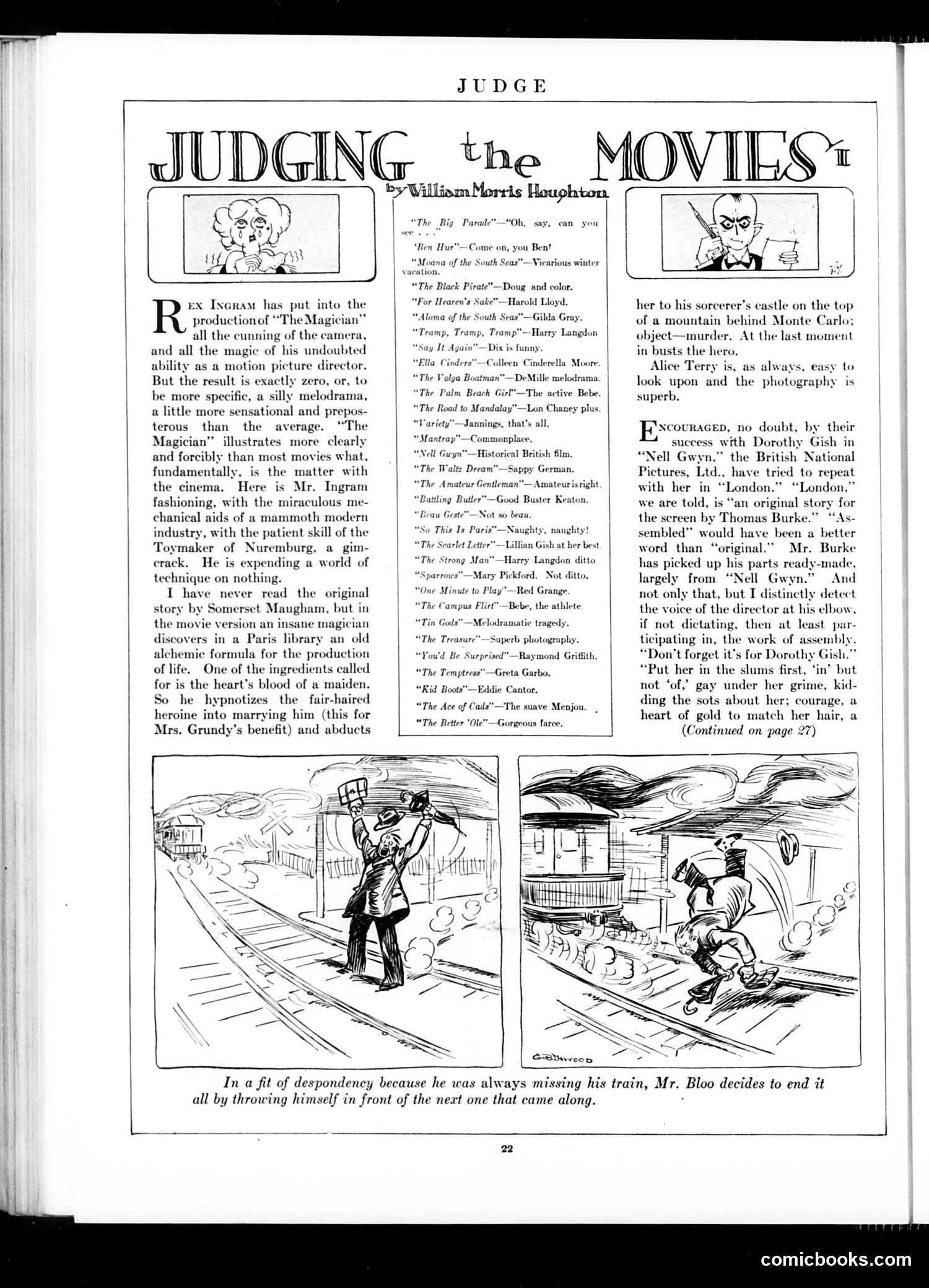
This page from Judge magazine contains two distinct elements: **Top Section**: A film review by William Morris Houghton critiquing Rex Ingram's "The Magician" as a technically accomplished but fundamentally empty melodrama—illustrating cinema's broader problem of expending great technical resources on trivial material. The review then lists contemporary films with brief, punchy jokes about their plots and stars (Buster Keaton, Greta Garbo, etc.). **Bottom Comics**: A two-panel gag strip about "Mr. Bloo," who repeatedly misses trains and, in desperation, decides to end his life by throwing himself in front of one—only to finally succeed at timing it right. This is darkly comedic social satire: the joke mocks modern anxieties about punctuality and transportation while treating suicide as absurdist punchline, reflecting early-20th-century attitudes toward such subject matter as acceptable humor fodder.
📄 Transcribed text from this page (OCR, searchable)
Machine-transcribed from the original scan — historical spelling and the odd misread are preserved.
JUDGE JUDGING, ‘he | MOVIES* EX InGram has put into the productionof “The Magician” all the cunning of the camera, and all the magic of his undoubted ability as a motion picture director. But the result is exactly zero, or, to be more specific, a silly melodrama, a little more sensational and prepos- terous than the average. “The Magician” illustrates more clearly and forcibly than most movies what, fundamentally, is the matter with the cinema. Here is Mr. Ingram fashioning, with the miraculous me- chanical aids of a mammoth modern industry, with the patient skill of the Toymaker of Nuremburg, a gim- crack. He is expending a world of technique on nothing. I have never read the original story by Somerset Maugham, but in the movie version an insane magician discovers in a Paris library an old alchemie formula for the production of life. One of the ingredients called for is the heart’s blood of a maiden. So he hypnotizes the fair-haired heroine into marrying him (this for Mrs. Grundy’s benefit) and abducts by Villiom Morris Hou he Big Parade"—“Oh, say, can you ‘Ben Hur"—Come on, you Bent | “Moana of the South Seas"—Vicarious winter vacation, | “The Black Pirate’—Doug and color. Harold L “Aloma of the South Seas"—G “For Hearen’s Sake”. “Tramp, Tramp, Tramp" Harry Langdon “Say It Again” “Ella Cinders”—Colleen Cinderella Moore. “The Volga Boatman"—DeMille melodrama. “The Palm Beach Girl"—The active Bebe. “The Road to Mandalay”. “Variety"—Jannings, that's all. Dis is funny. Lon Chaney plus. “Mantrap"—C ponplace. “Nell Gwyn"—Historical Brit “The Walt: Dream”—Sappy German, “The Amateur Gentleman"—Amateurisright tiling Butler"—Good Buster Keaton. au Geste”—Ni so beau. “The Scarlet Letter” | “The Strong Man" Ilan Gish at her best -Harry Langdon ditto Mary Pickford. Not ditto. “One Minute to Play"—Red Grange “The Campus Flirt"—Bebe, the athlete “Tin Gods" —Melodramati “The Treasure” “Sparrows”: raged Superb photography. “You'd Be Surprised"—Raymond Griffith. “The Temptress” —Greta Garbo, “Kid Boote"—Eddie Cantor. “The Ace of Cads"—The suave Menjou. , “The Better ‘Ole”—Gorgeous farce, her to his sorcerer’s castle on the top of a mountain behind Monte object—murder. in busts the hero, Alice Terry is, as always, easy to look upon and the photography is superb, Carlo; At the last moment sD, no doubt, by their s with Dorothy Gish in “Nell Gwyn,” the British National Pictures, Ltd., have tried to repeat with her in “London.” “London,” we are told, is “an original story for the screen by Thomas Burke.” “‘As- sembled” would have been a better word than “original.” Mr. Burke has picked up his parts ready-made, largely from “Nell Gwyr And not only that, but I distinctly detect the voice of the director at his elbow, if not dictating, then at least par- ticipating in, the work of assembly. “Don’t forget it’s for Dorothy Gish.” “Put her in the slums first, ‘in’ but not ‘of,’ gay under her grime, kid- ding the sots about her; courage, a heart of gold to match her ha) (Continued on page 27) In a fit of despondency because he was always missing his train, Mr. Bloo decides to end it all by throwing himself in front of the next one that came along. comicbooks.com