
A complete issue · 36 pages · 1926
Judge — October 30, 1926
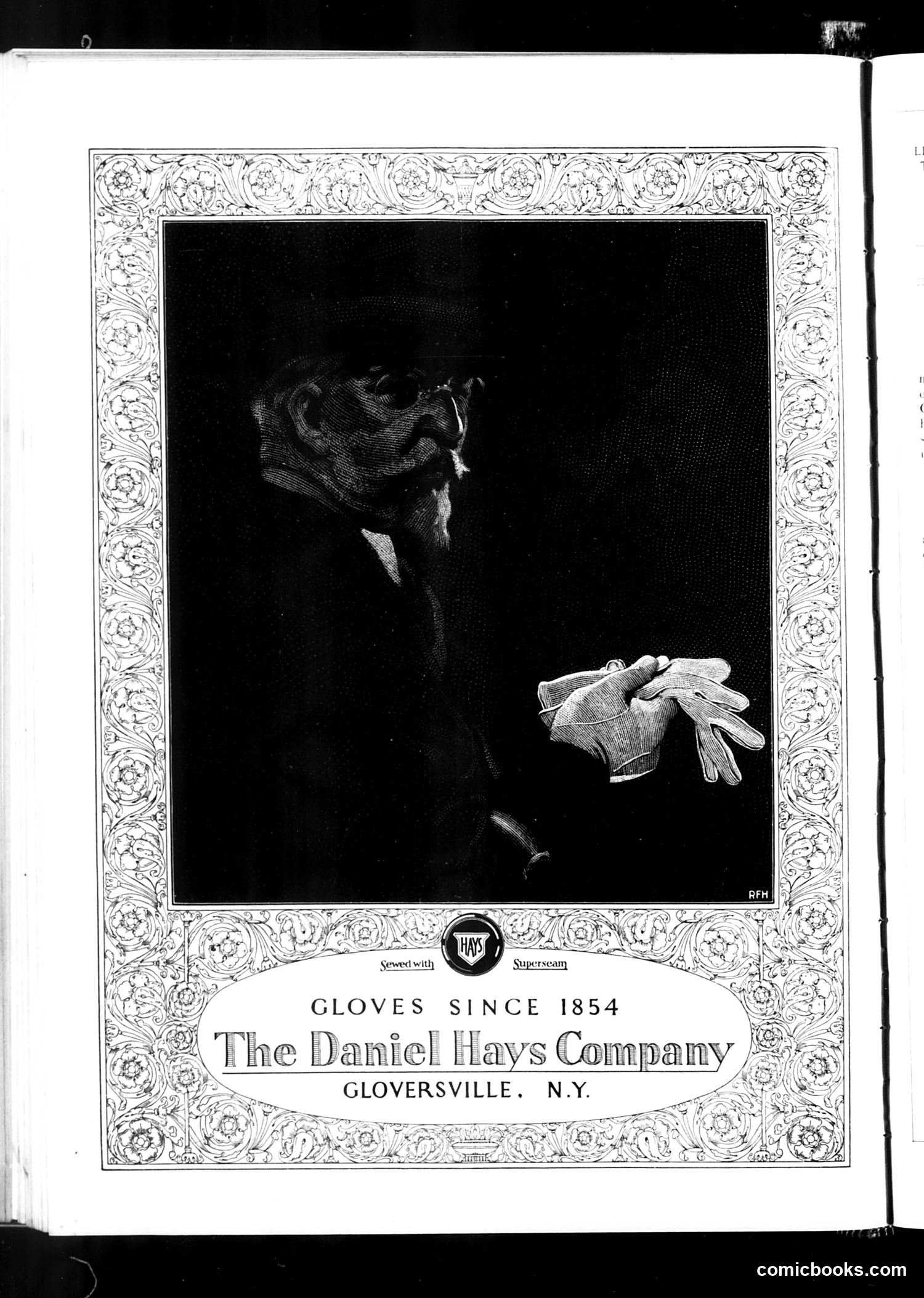
This page is primarily a **product advertisement**, not political satire. It showcases gloves from The Daniel Hays Company of Gloversville, N.Y., established in 1854. The image depicts an elderly gentleman in profile, dressed formally in dark clothing, holding white gloves. The photograph demonstrates the product—fine gloves suitable for formal occasions. The ornate decorative border frames the advertisement in the style typical of Judge magazine's upscale advertising. The text emphasizes the company's long history ("Since 1854") and notes the gloves are "Sewed with Superseam," highlighting a manufacturing feature. This is straightforward commercial promotion rather than political or social commentary—Judge accepted such advertisements to fund its satirical content.
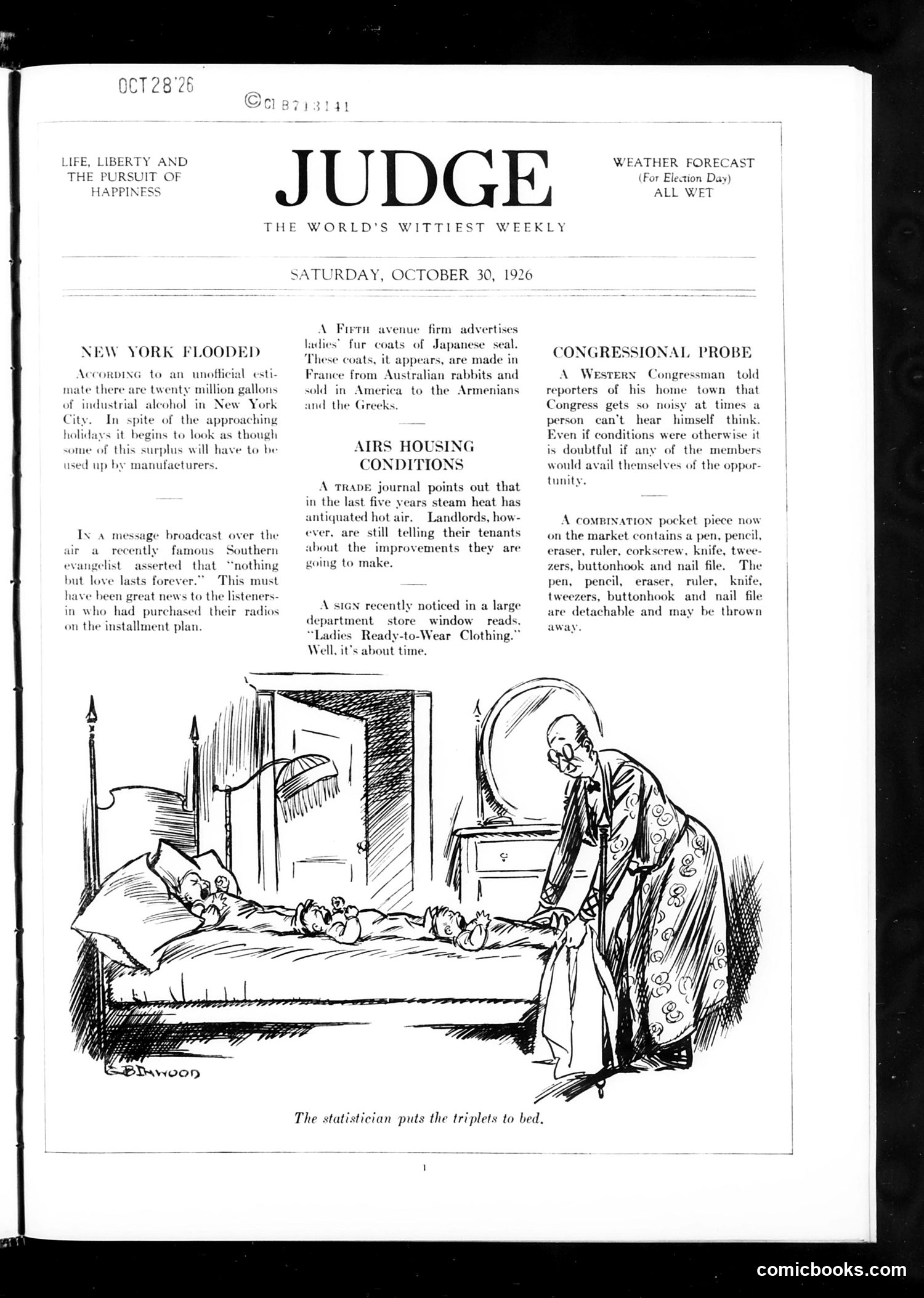
The main cartoon, captioned "The statistician puts the triplets to bed," depicts a woman (appearing to be a statistician or academic) struggling to arrange three babies in a bed while consulting notes or data. The joke satirizes the growing American fascination with statistical analysis and scientific management during the 1920s—suggesting that even basic parenting tasks were being subjected to mathematical quantification and "scientific" methods rather than intuition or common sense. The surrounding articles mock contemporary issues: air-housing conditions (heat/ventilation problems), ready-to-wear clothing marketing, and the flood of industrial alcohol in New York City. Overall, the page ridicules 1920s modernization, statistics-obsession, and commercialism.
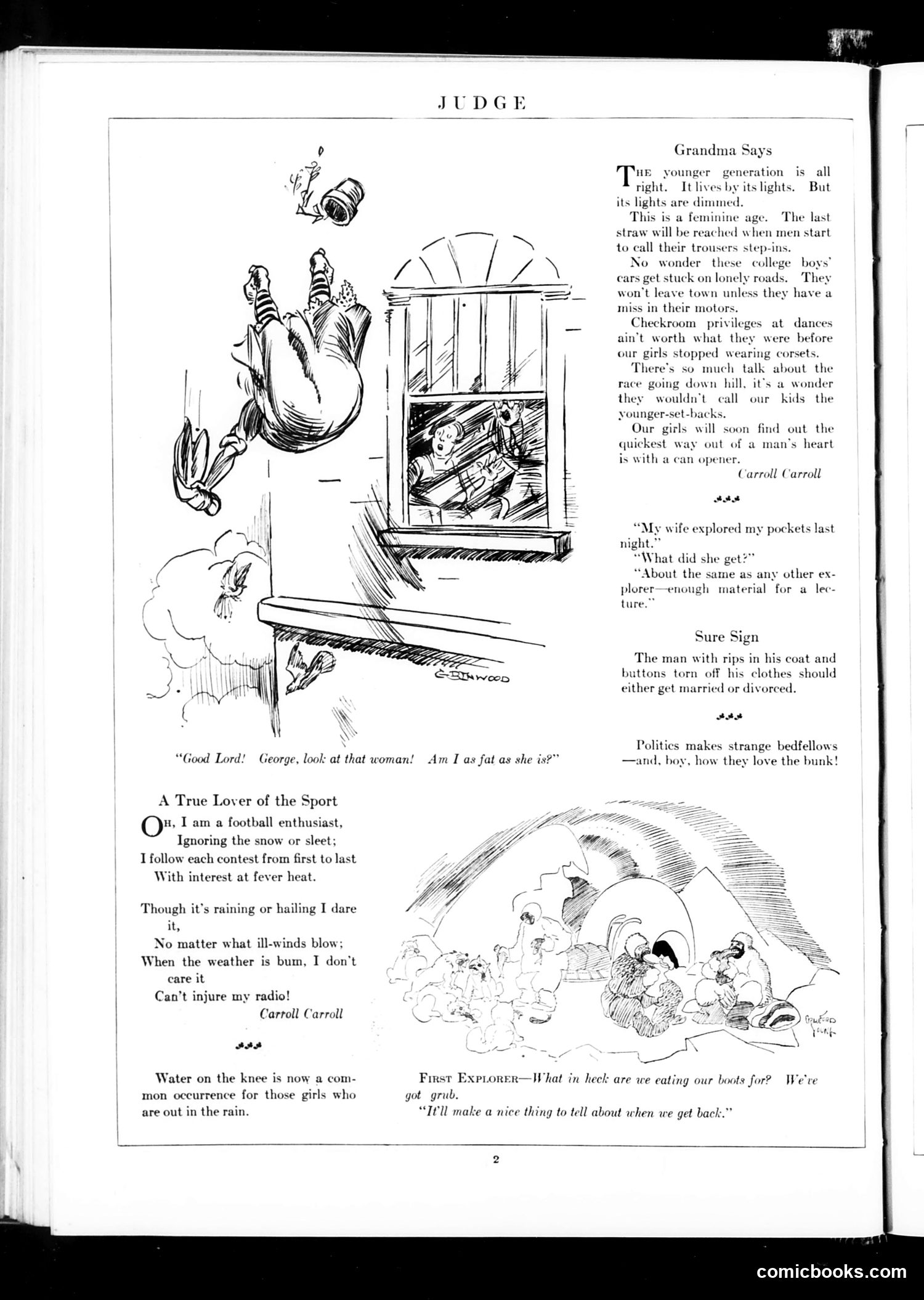
This page contains social humor and commentary typical of early 20th-century American satirical magazines. The main content includes: **"Grandma Says"**: A column mocking modern youth—particularly young women—criticizing their independence, dimmed lights at dances, corset abandonment, and the ease with which they allegedly capture men's hearts. The tone is disapproving of social changes. **"A True Lover of the Sport"**: A poem celebrating football enthusiasm regardless of weather, attributed to Carroll Carroll. **Various One-Liners**: Quick jokes about wives, politics, and contemporary social behaviors. **Cartoons**: Sketches depicting domestic scenes and outdoor activities, with the "First Explorer" cartoon showing children playing, discussing food. The overall page reflects early 1900s anxieties about changing gender roles, youth behavior, and modern social conventions, presented through gentle mockery rather than harsh satire.
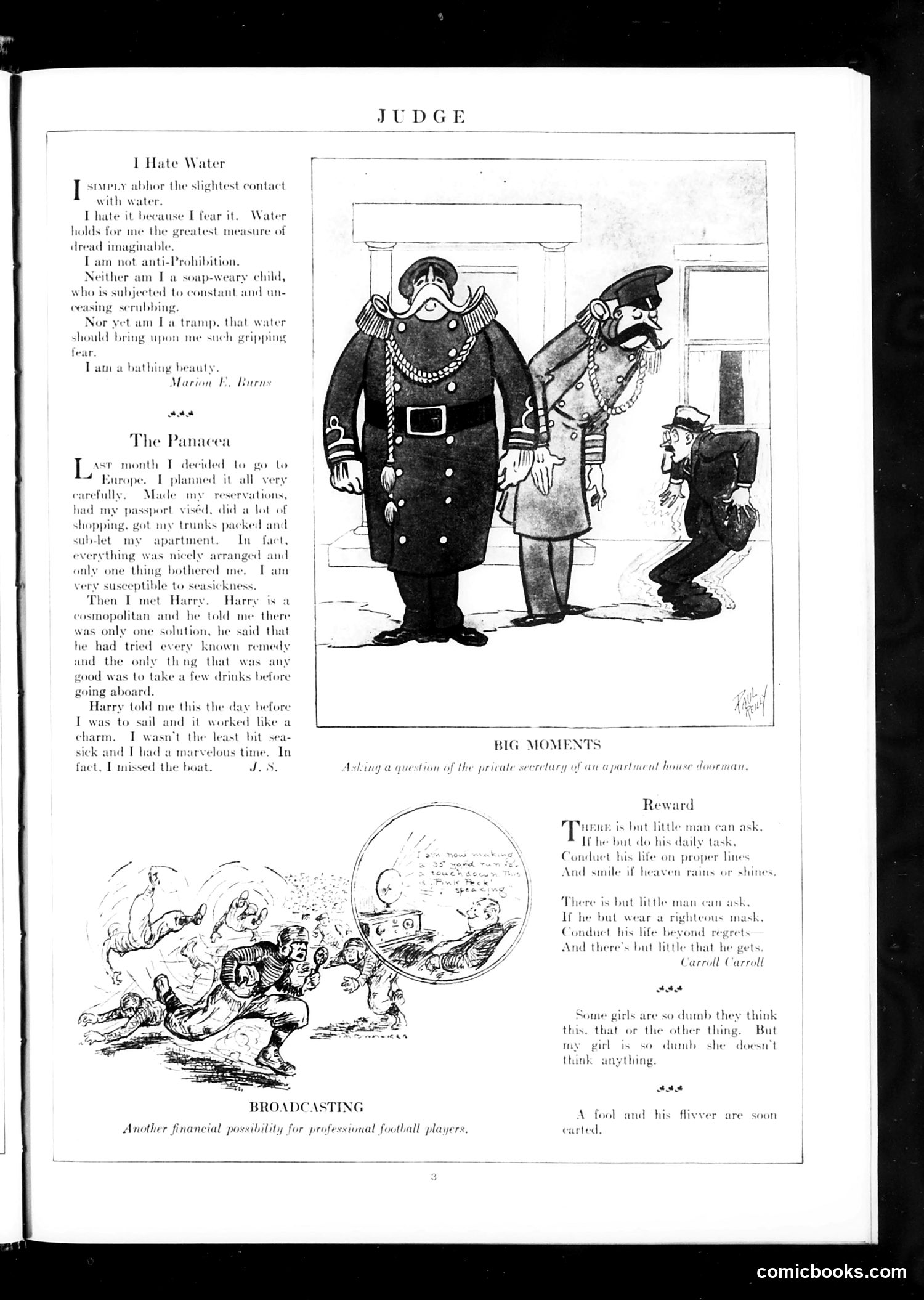
This page contains three distinct humorous pieces: **"I Hate Water"** presents a personal essay by Marion E. Burns about aversion to water—she's "not anti-Prohibition" but dislikes bathing and water-related activities. The humor relies on characterizing her as someone who avoids basic hygiene while claiming not to oppose alcohol prohibition. **"The Panacea"** describes preparations for European travel disrupted by seasickness. The accompanying cartoon shows a large uniformed figure (appears to be a ship's officer or authority figure) with smaller figures around him, captioned "Big Moments: Asking a question of the private secretary of an apartment house doorman"—satirizing bureaucratic absurdity. **"Broadcasting"** cartoon depicts figures with what appears to be early radio equipment, likely satirizing the emerging broadcasting industry as offering financial opportunities for professional football players. The page reflects 1920s American humor about Prohibition, travel anxieties, and new technology.
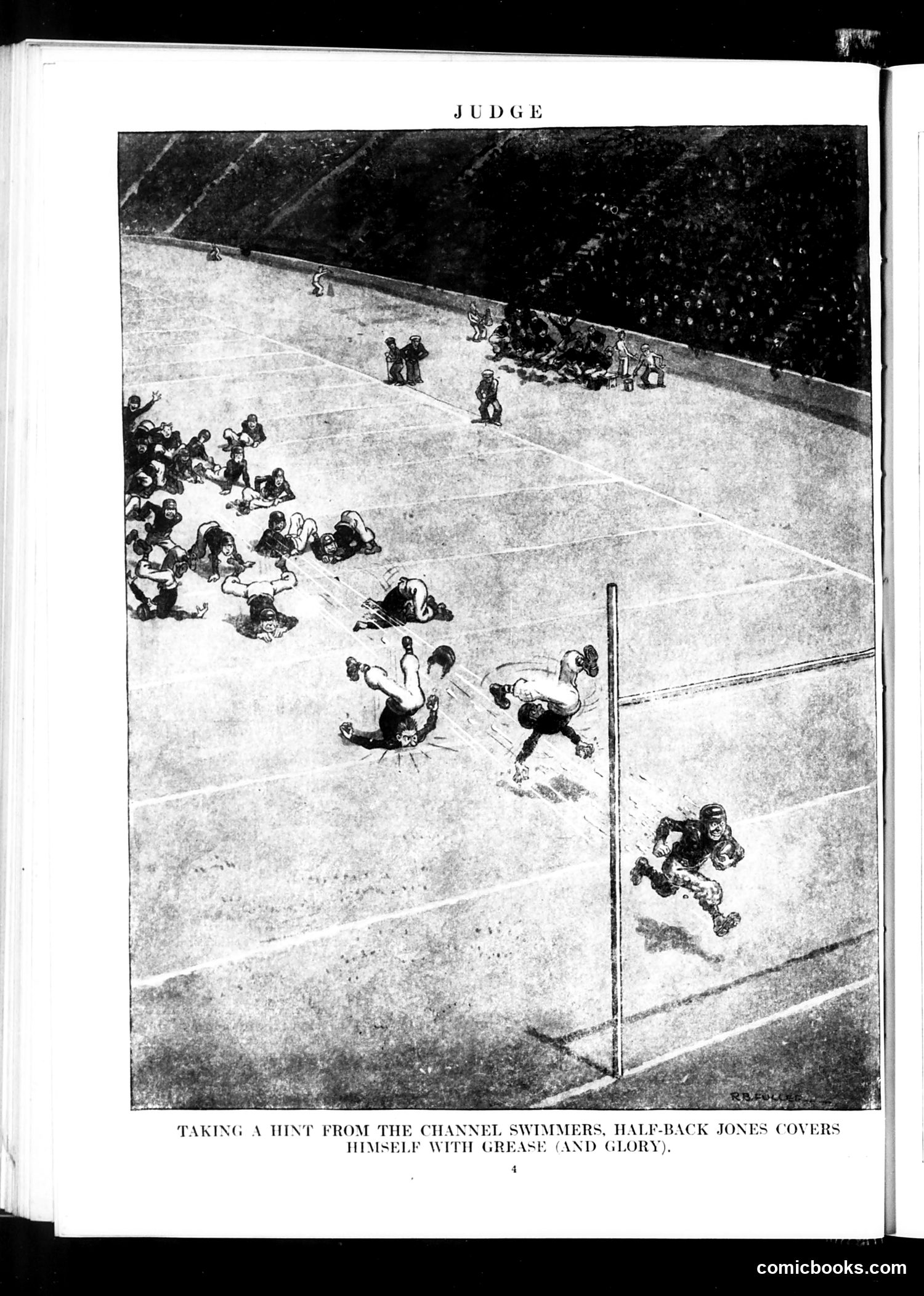
This page depicts a **volleyball game** at what appears to be a competitive or professional sporting event, viewed from above. The caption references "Channel Swimmers" and "Half-back Jones," suggesting this satirizes athletes or sporting celebrities of the era. The humor likely mocks the theatrical or exaggerated nature of athletic performance—note the players' dramatic poses and the spectators' intense reactions. The phrase "covers himself with grease (and glory)" suggests satire about athletes using unconventional methods (actual grease, as channel swimmers did) or playing up their achievements for publicity. Without clearer identification of specific individuals or the exact date, the precise targets remain **unclear**, but the satire appears aimed at **sports culture and athletic self-promotion** in early 20th-century America.
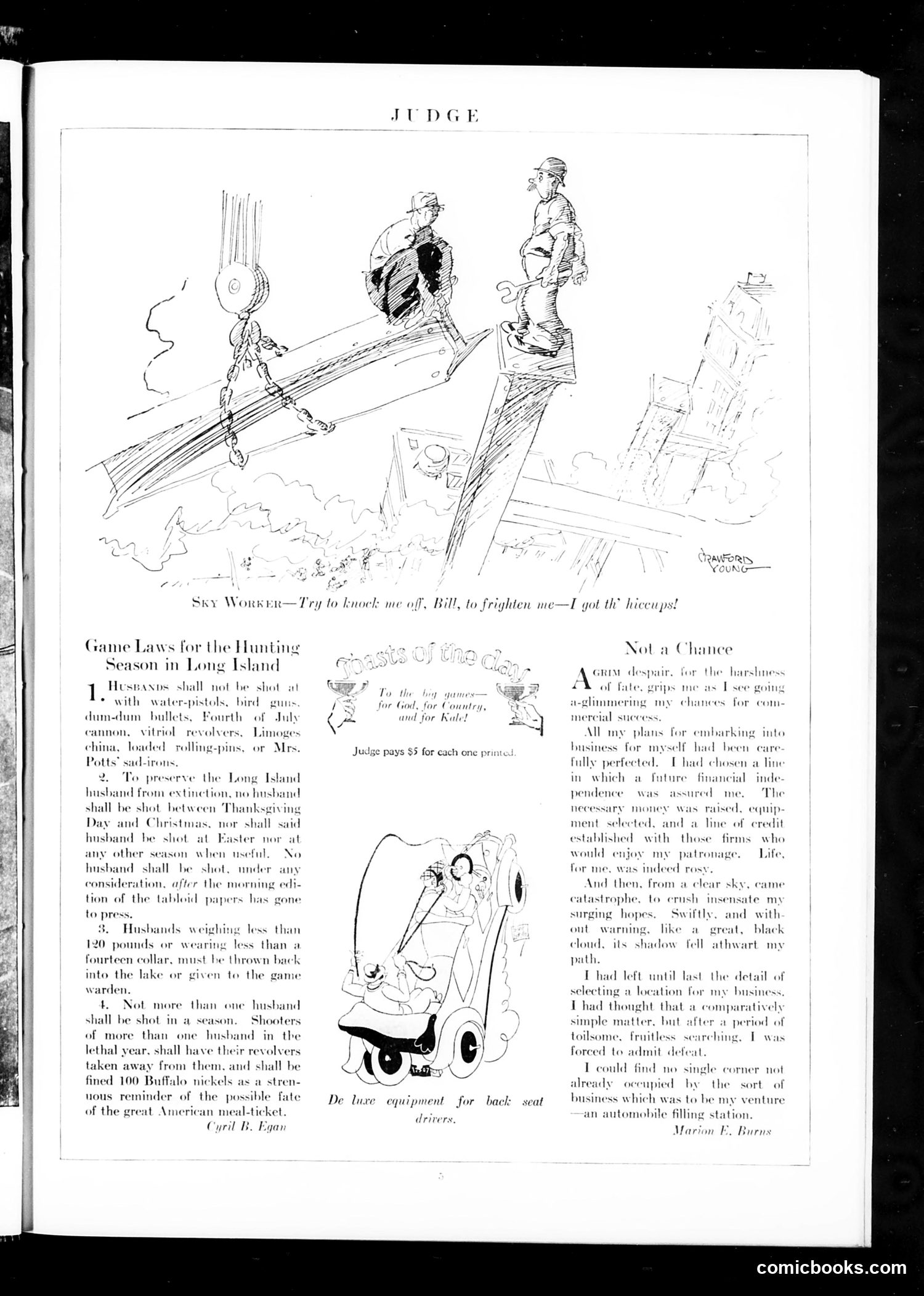
The top cartoon titled "Sky Worker" depicts two men on an I-beam high above a cityscape, with one attempting to knock the other off while a third figure operates a pulley system. The caption reads: "Try to knock me off, Bill, to frighten me—I got th' hiccups!" This appears to be workplace humor about construction or industrial workers, likely playing on the danger and absurdity of their situation—the worker has hiccups while engaged in a precarious balancing act on a skyscraper beam. Below this are three sections: "Game Laws for the Hunting Season in Long Island" (satirizing hunting regulations), "Easter of the Gods" (unclear reference), and "Not a Chance" (a personal narrative about failed business ventures). The bottom illustration shows "De luxe equipment for back seat drivers"—a sarcastic take on passenger-seat critics.
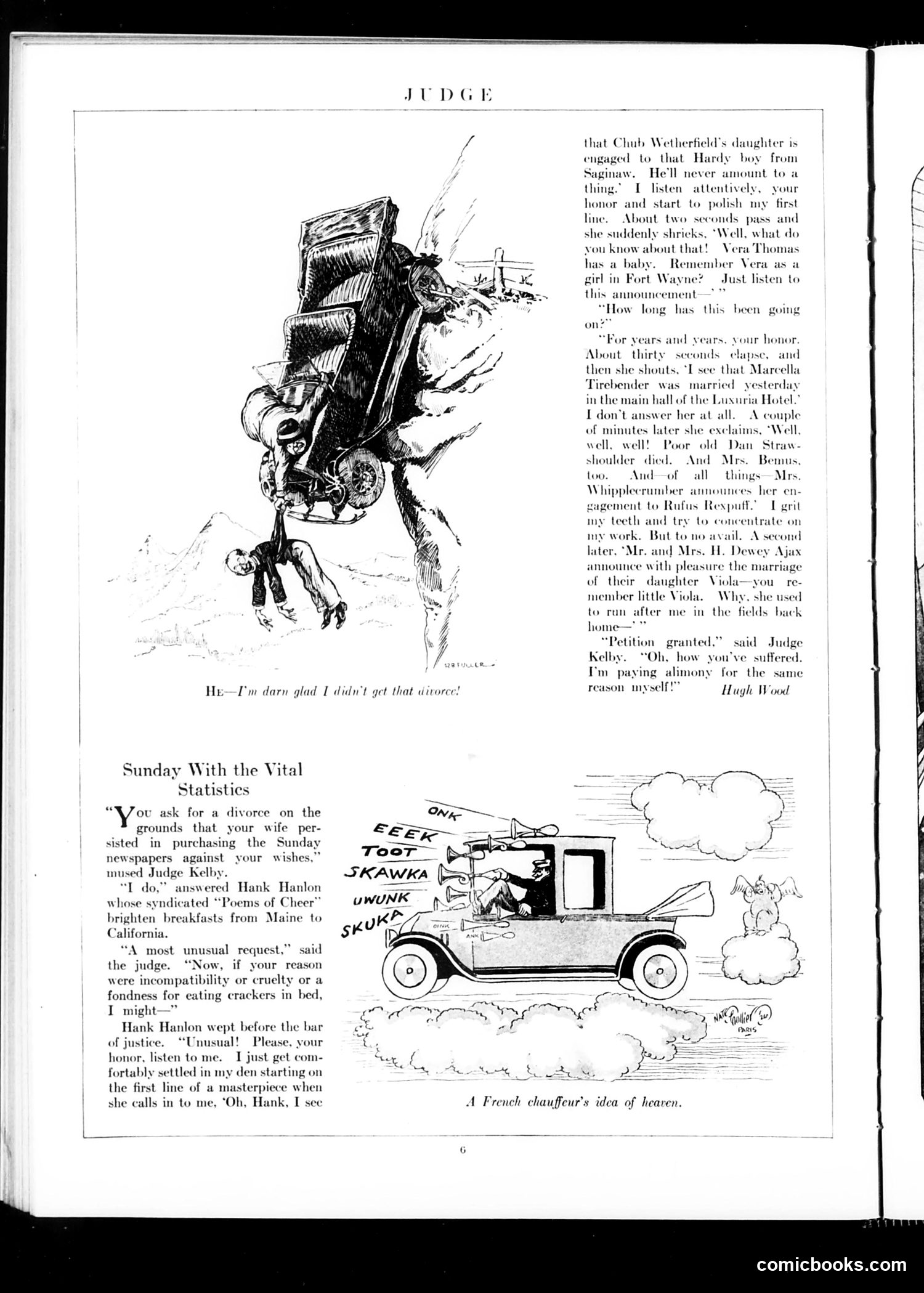
This two-part satire mocks wives' Sunday newspaper habits disrupting husbands' pursuits. **Top section:** A husband seeks divorce because his wife constantly reads Sunday paper gossip aloud—social announcements about engagements, births, and deaths—while he tries to write poetry. Judge Kelby sympathizes, admitting he pays alimony "for the same reason myself," suggesting this is a widespread marital complaint. **Bottom cartoon:** Titled "A French chauffeur's idea of heaven," depicts a car noisily honking and sputtering through clouds, mocking French automotive culture as inherently loud and unreliable—a period stereotype of French engineering and driving habits. The satire targets 1920s domestic frustrations (wives' obsession with Sunday papers' vital statistics and gossip) and xenophobic humor about French automobiles and driving. Both jokes assume male audience frustration with women's interests and foreign incompetence.
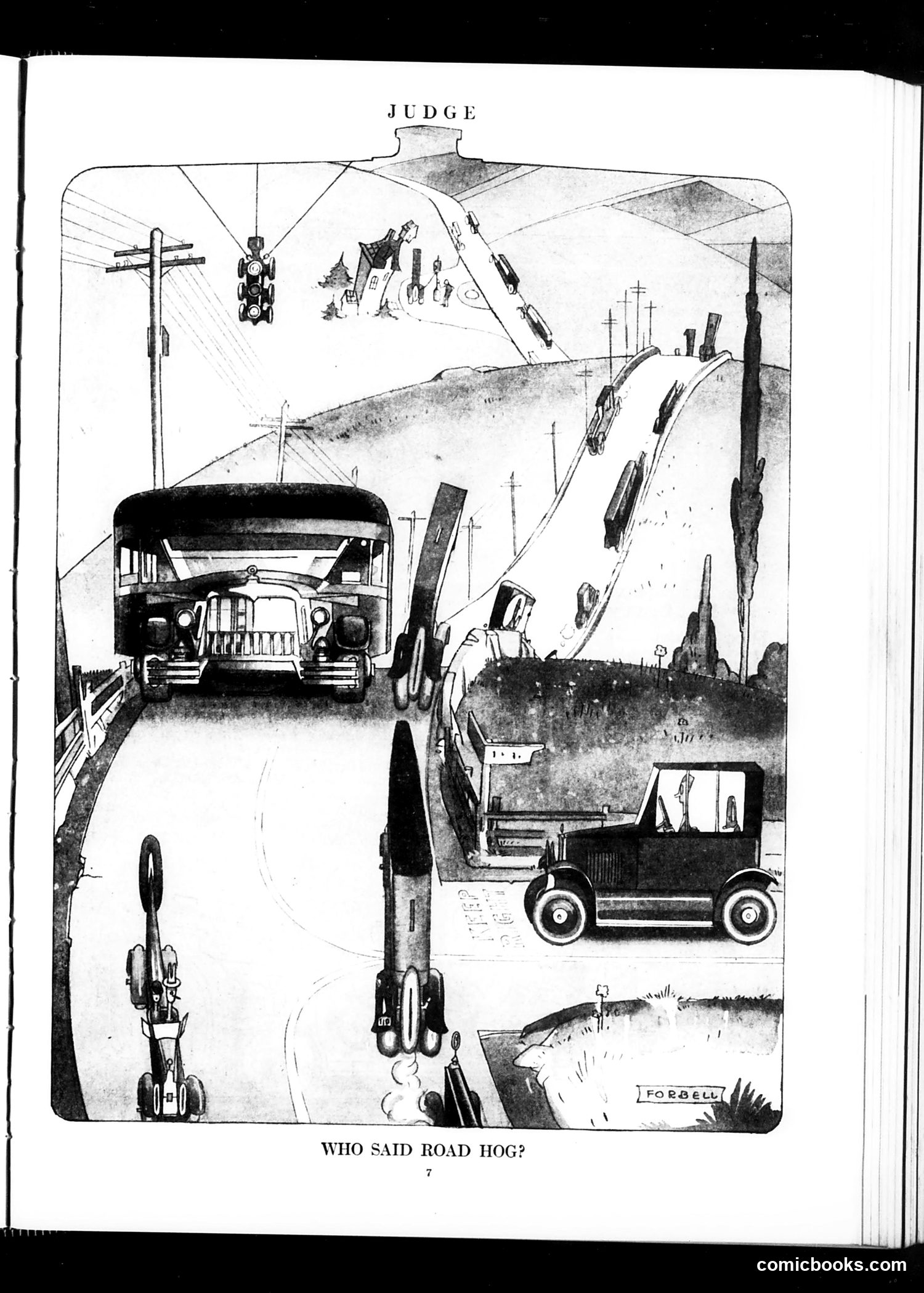
This cartoon satirizes dangerous driving and traffic behavior, likely from the 1920s-30s based on the vehicle styles shown. The title "road hog" refers to drivers who monopolize the road recklessly. The image depicts a chaotic scene where a large truck dominates the roadway, forcing smaller vehicles (a car and motorcycle) off into dangerous terrain. Military aircraft appear overhead, and crosses suggesting graves dot the landscape—visual metaphors for the deadly consequences of reckless driving. The cartoon argues that aggressive drivers ("road hogs") endanger everyone through their selfish road behavior. By depicting destruction and casualties, Judge magazine criticizes poor driving habits as a serious public safety issue, treating traffic hazards with the gravity of warfare.
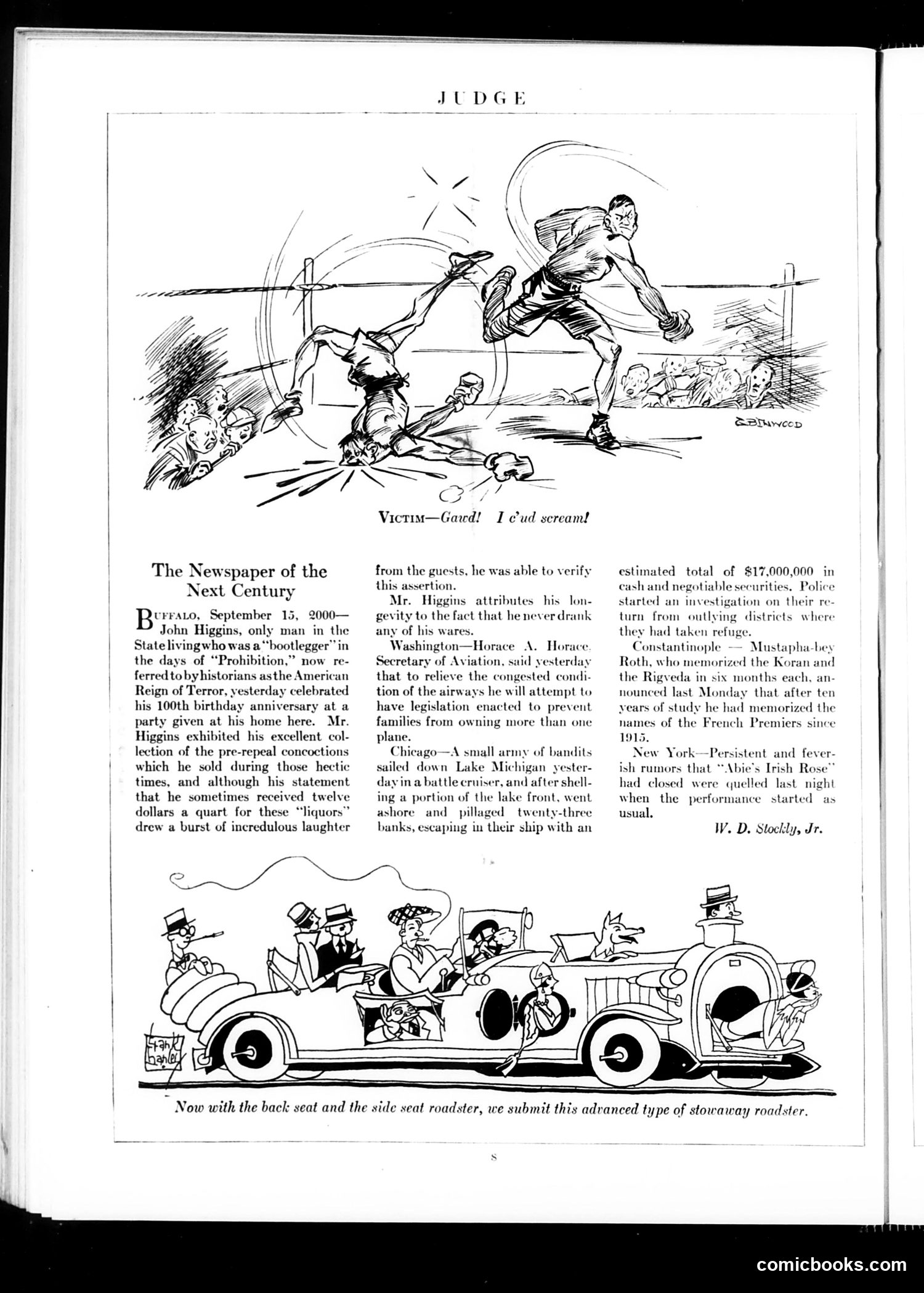
This page satirizes predictions about life in the year 2000 (written from 1920). The top cartoon mocks boxing/prizefighting with exaggerated violence ("Victim—Gared! I cud scream!"). The main text presents absurd "news from 2000," lampooning contemporary concerns: - **Prohibition satire**: A bootlegger celebrates his 100th birthday, having profited enormously from illegal liquor sales—mocking the then-recent Prohibition era's actual bootlegging problem. - **Aviation fears**: A fictional Secretary of Aviation proposes limiting family airplane ownership to manage "congested airways"—satirizing anxieties about emerging aviation technology. - **Organized crime**: Bandits raid Chicago using a "battle cruiser," escaping with millions—exaggerating real 1920s gangster violence. - **"Abie's Irish Rose" reference**: A Broadway play's persistence, treating entertainment as eternal. The bottom cartoon shows an absurdly crowded car designed to accommodate excessive passengers, mocking automotive culture and overcrowding concerns of the 1920s. The satire targets anxiety about Prohibition's failure, new technologies, and urban crime.
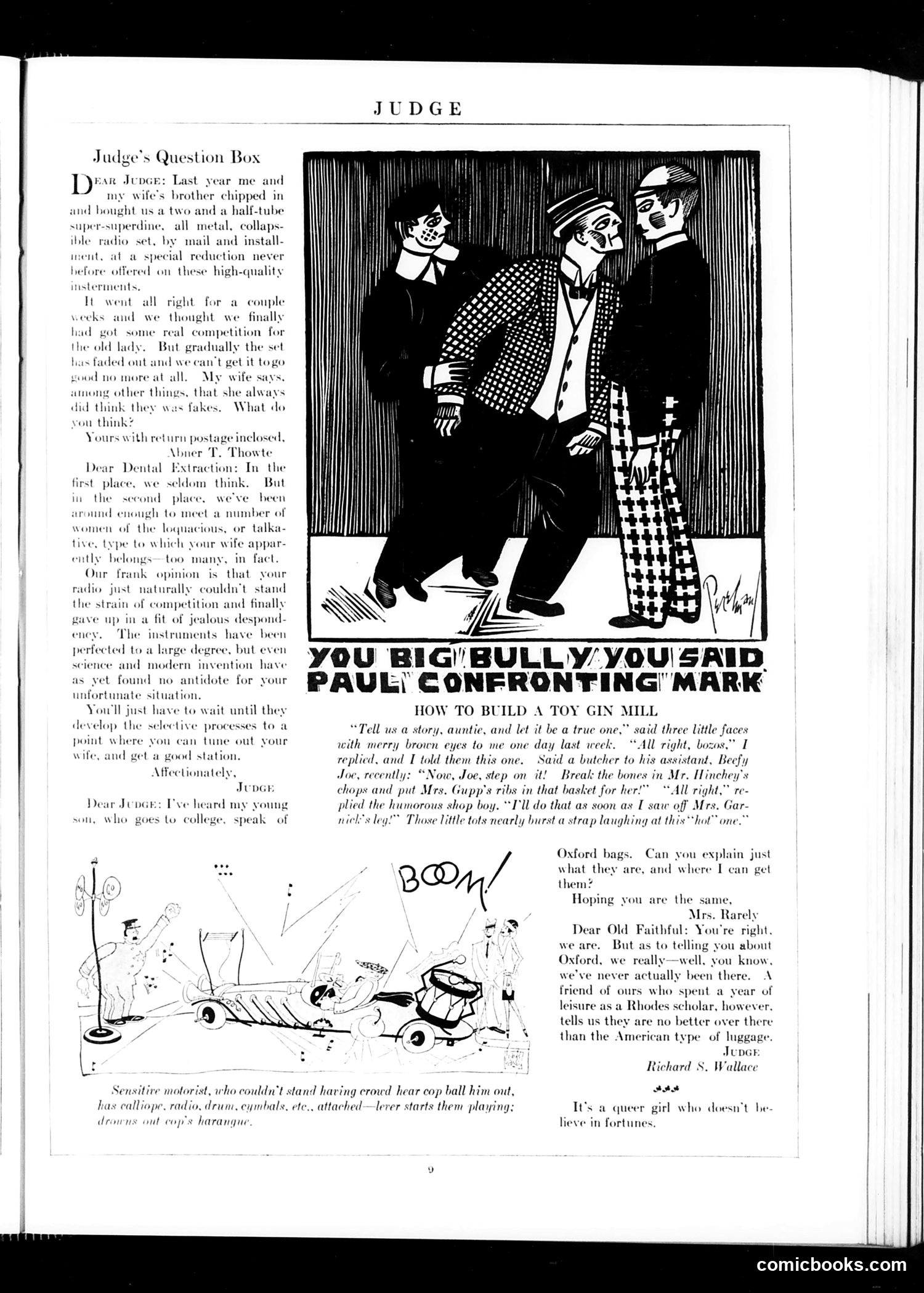
This page from *Judge* magazine presents a humorous advice column ("Judge's Question Box") alongside cartoons and brief jokes. The main content mocks consumer culture and marital dynamics of the era. The opening letter satirizes mail-order radio sets—a popular 1920s consumer product that frequently disappointed buyers. The Judge's response humorously suggests the radio "gave up" from competition with the letter-writer's talkative wife, implying women's chattiness is an unstoppable force even consumer technology cannot overcome. The cartoon captioned "You Big Bully You! Said Paul Confronting Mark" and "How to Build a Toy Gin Mill" references Prohibition-era speakeasies. The darker joke describes a butcher's shop boy humorously misinterpreting violent instructions as innocent toy-building directions, creating dark humor by juxtaposing butchery with children's entertainment. Minor items address "Oxford bags" (a clothing style) and fortune-telling superstitions. The satire targets both consumer gullibility and dated gender stereotypes about women.
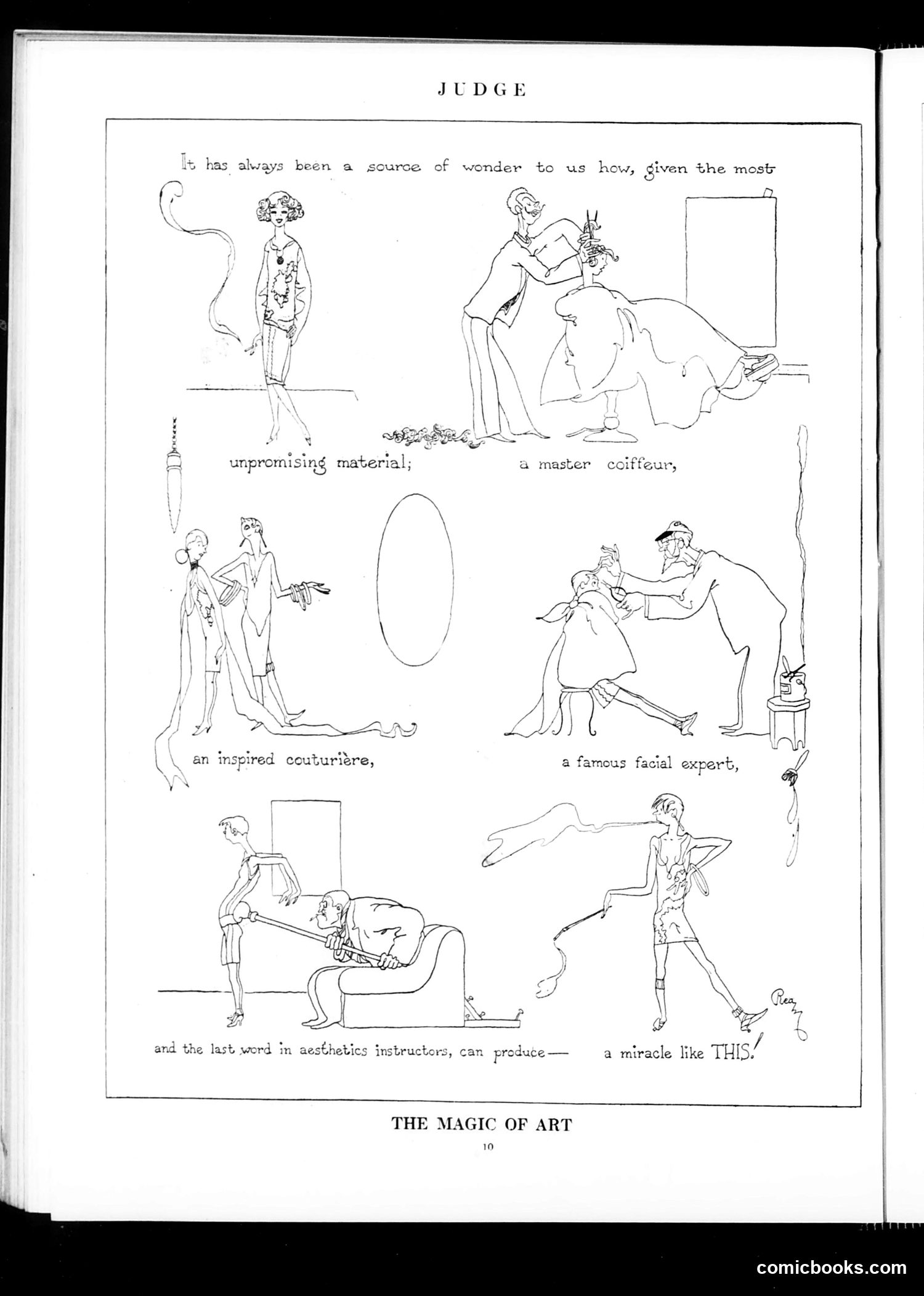
This page satirizes the transformative power of high-end beauty and fashion professionals. The cartoon shows the comic progression: starting with "unpromising material" (an unattractive woman), the illustration depicts how a master hairdresser ("coiffeur"), an inspired couturière (dressmaker), a facial expert, and "aesthetics instructors" collectively work to produce a stunning final result—"a miracle like THIS!" The satire mocks the fashion and beauty industry's ability to completely remake a woman's appearance through styling, clothing, and professional grooming. It's both a commentary on the superficiality of beauty standards and an acknowledgment of how dramatically these services could transform someone's looks. The title "The Magic of Art" suggests this transformation is more artifice than genuine improvement, poking fun at the mystique surrounding beauty professionals and their claimed expertise.
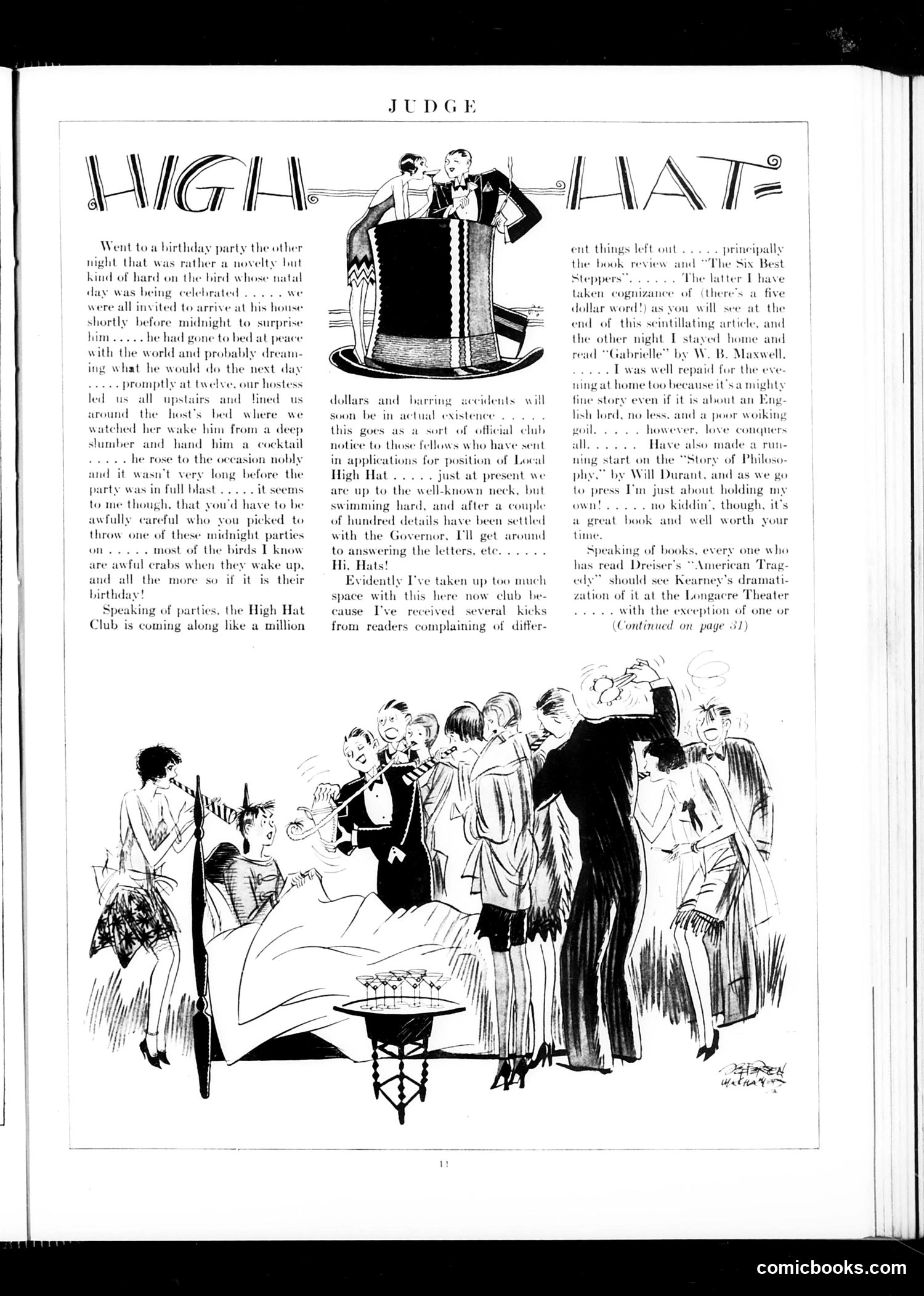
This is a humor column about socializing and entertainment. The main article describes an awkward surprise midnight birthday party—the author critiques waking someone abruptly for celebration, noting that most people are grumpy upon waking, especially on their birthday. The piece also announces the "High Hat Club," apparently a new social organization receiving applications for membership positions. The author humorously notes they're overwhelmed with administrative details ("up to the well-known neck") but swimming through them. The column concludes with book and theater recommendations, including W.B. Maxwell's novel "Gabrielle," Will Durant's "Story of Philosophy," and a dramatization of Theodore Dreiser's "American Tragedy" at the Longacre Theater. The illustration shows a lively party scene with formally dressed guests gathered around what appears to be an elaborate punch bowl or drink service. The tone throughout is light social satire aimed at upper-class leisure activities and entertainment trends of the era.
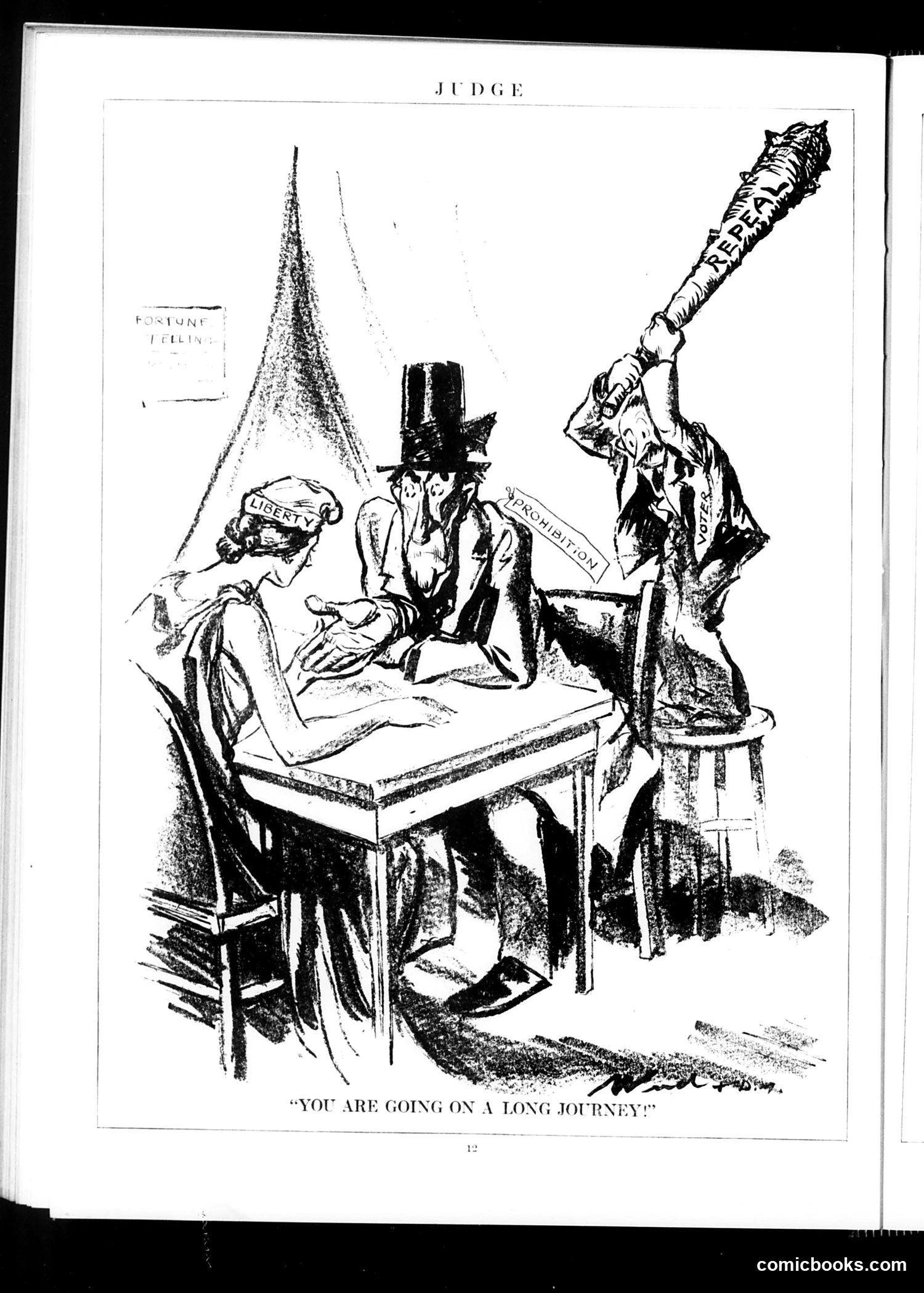
This cartoon depicts a fortune teller (center, in top hat) telling a figure labeled "Liberty" (left, wearing a Liberty cap) that "you are going on a long journey." A menacing figure on the right holds a large club labeled "PROHIBITION." The satire appears to comment on Prohibition's impact on American freedom. Liberty is being given an ominous fortune by what seems to be a charlatan predictor, while Prohibition—personified as a threatening force with a weapon—looms nearby. The cartoon suggests Prohibition represents a threat to American liberty, forcing the nation on an unwanted "long journey" away from its foundational freedoms. The "Fortune Telling" label visible in the corner reinforces the mockery of those predicting Prohibition's effects.
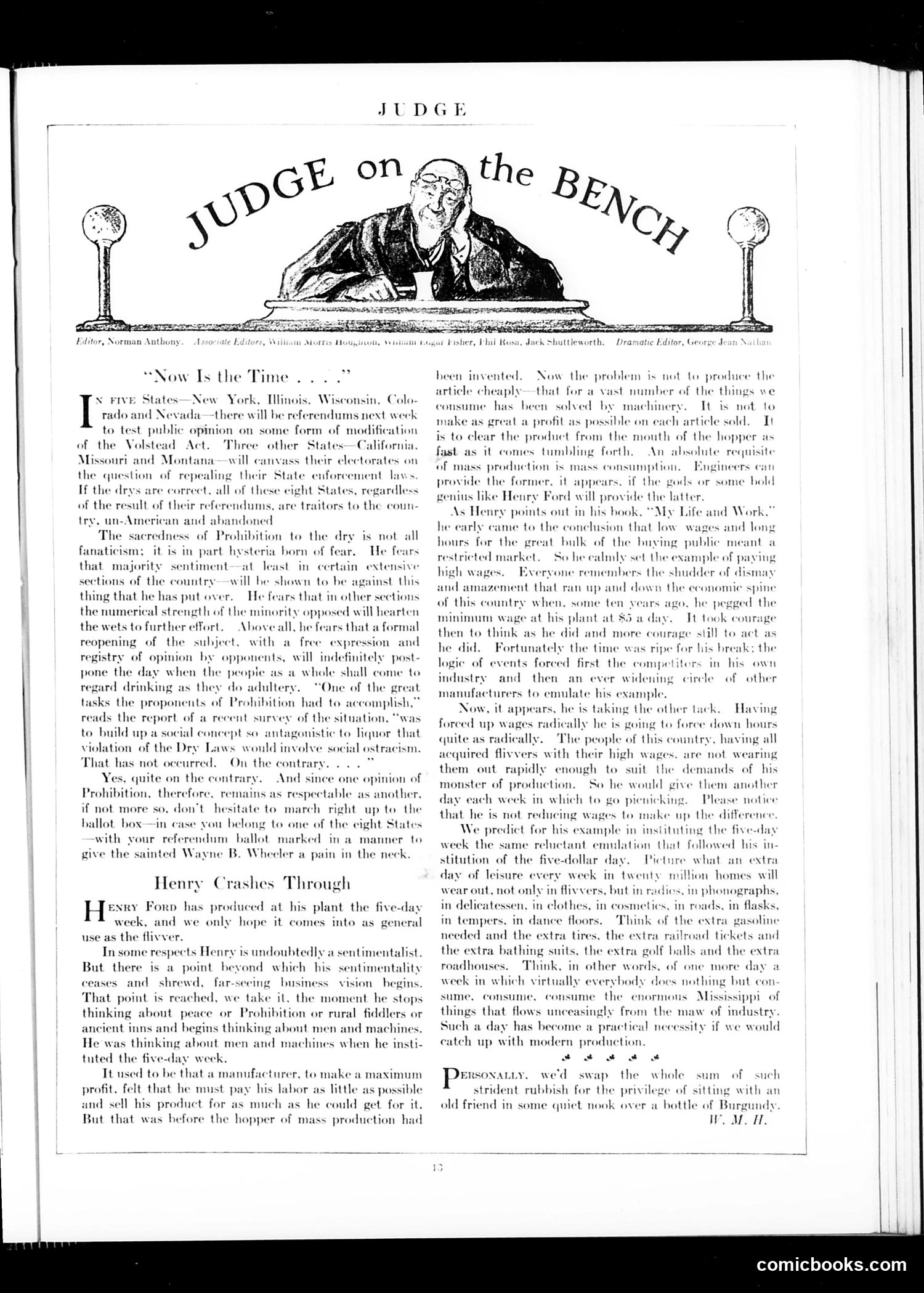
This page contains two editorials from Judge magazine addressing contemporary policy debates. **"Now Is the Time..."** discusses upcoming referendums in eight states on modifying or repealing Prohibition (the Volstead Act). The writer mocks "dry" (anti-alcohol) advocates' fears that public voting will reveal majority opposition to their policies. The satire targets Wayne B. Wheeler, a prominent Prohibition activist, suggesting that allowing democratic expression on the issue would cause him distress. **"Henry Crashes Through"** praises Henry Ford's introduction of the five-day work week. The editorial argues Ford recognized that mass production requires mass consumption, which demands workers with sufficient wages and leisure time to purchase goods. This contrasts Ford's enlightened self-interest against older manufacturing philosophy that minimized labor costs. The piece celebrates Ford's $5 daily wage—controversial when announced—as visionary business strategy rather than mere sentimentality. Both pieces advocate for progressive social change through practical reasoning rather than ideology.
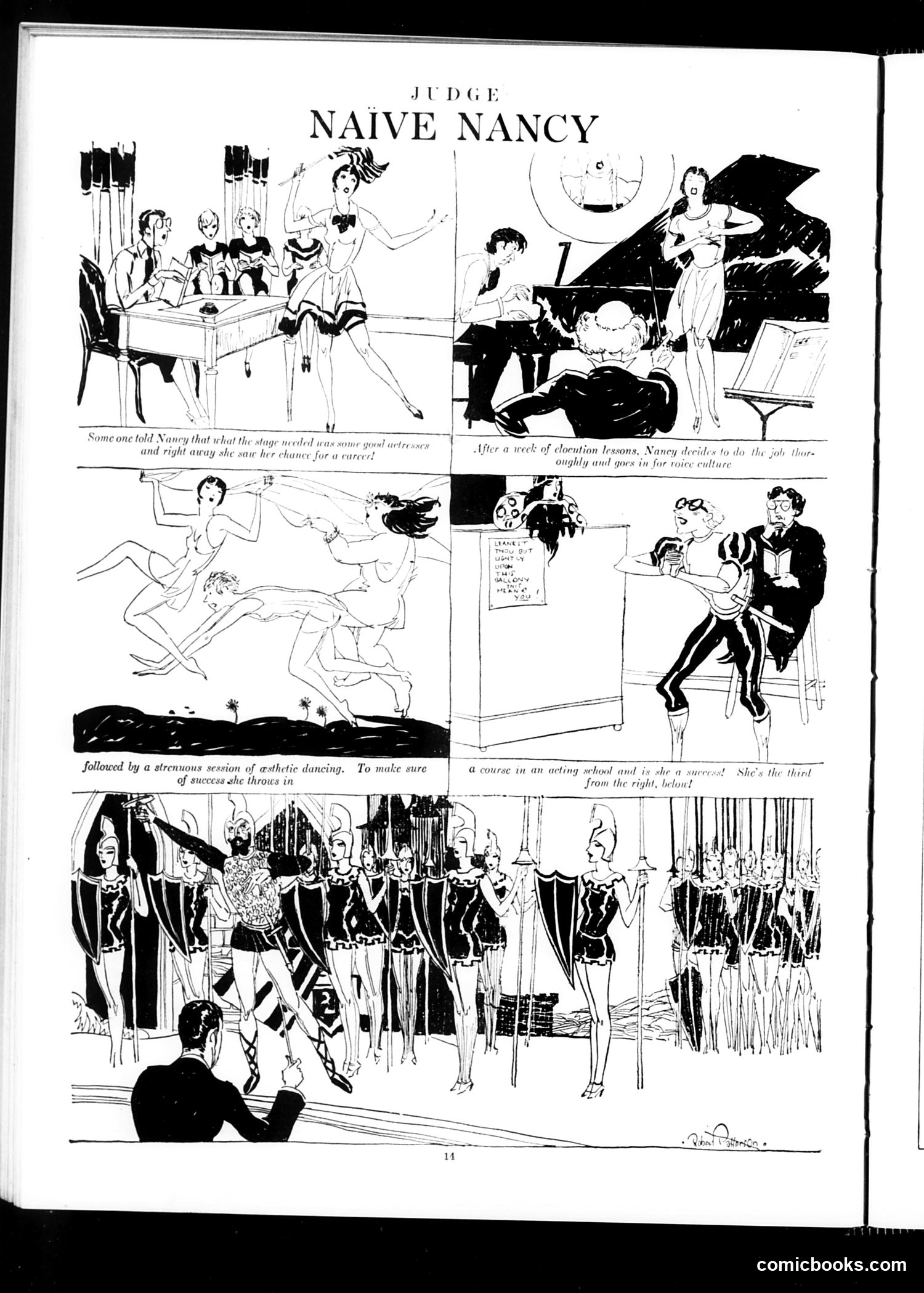
This is a satirical comic strip about a young woman named Nancy pursuing a theatrical career. The narrative follows her naïve journey: someone tells her she needs "stage presence" and she abandons her chance for a career; after receiving "elocution lessons," she attempts performing, depicted through aesthetic dancing scenes; she then enrolls in acting school where she's ranked "third from the right"; finally, she performs in what appears to be a large theatrical production. The satire targets the common experience of aspiring performers—particularly women—being shuffled through costly "lessons" and training with minimal actual advancement, ultimately landing minor roles despite their investment. The comic mocks both the entertainment industry's exploitation of hopeful talent and the naive optimism of stage-struck individuals.
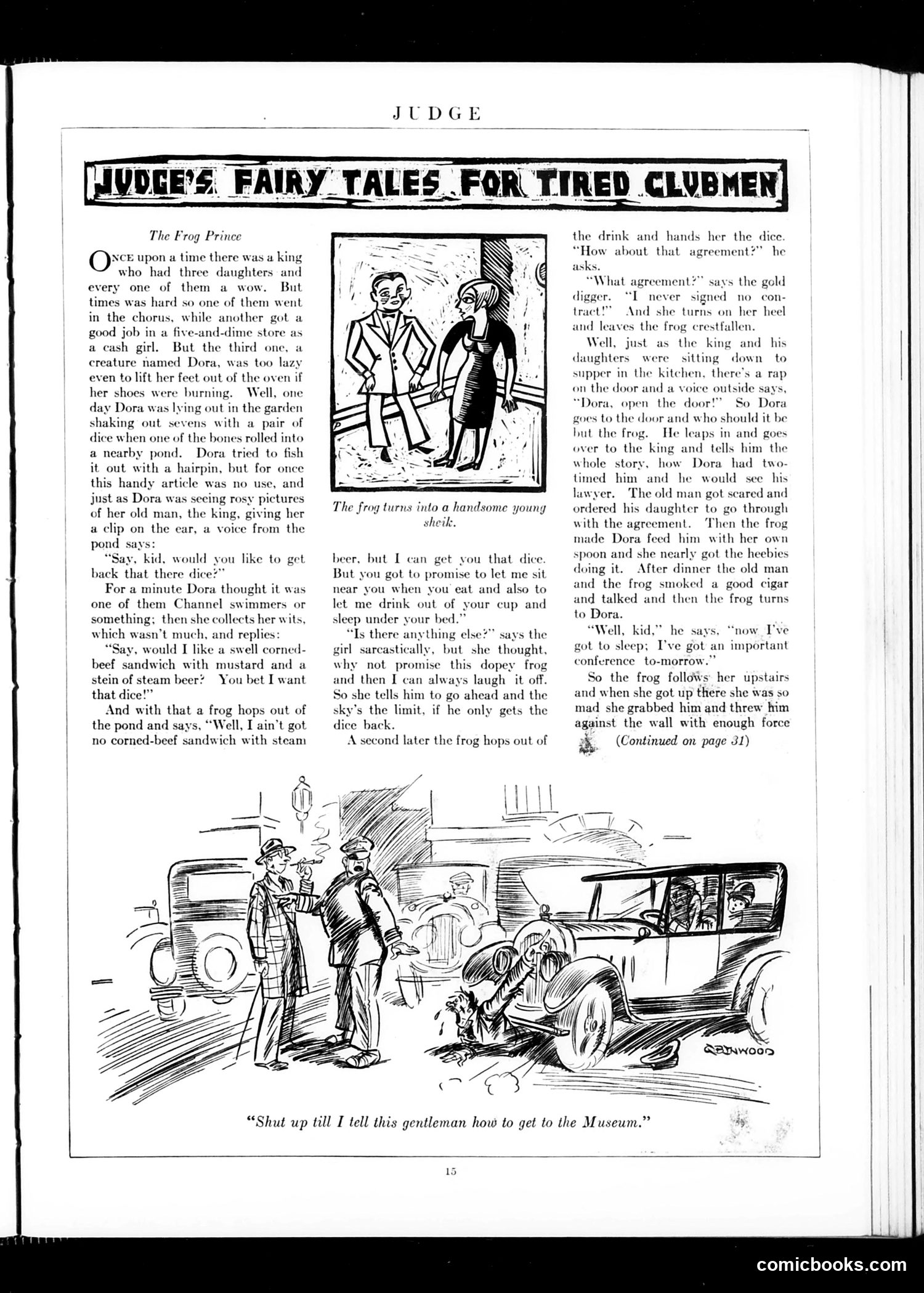
This page presents a modernized, cynical version of the classic fairy tale for a 1920s audience. The story subverts traditional morality by depicting all three royal daughters as undesirable: one works in a chorus line, another in a five-and-dime store, and Dora—the lazy protagonist—gambles with dice. The satire targets the "gold digger" archetype popular in Jazz Age discourse. When Dora breaks her promise to the frog, she embodies the era's anxiety about women who make and discard agreements casually. The frog's threat to hire a lawyer and force compliance through paternal authority mocks both legal disputes and family power dynamics of the period. The bottom cartoon (unrelated) appears to be a separate joke about traffic directions. The piece critiques both irresponsible young women and the legal systems meant to constrain them, reflecting broader 1920s social tensions.
I can see this is a dramatic black and white sketch depicting what appears to be a crowded, chaotic scene—possibly depicting hell, an underworld, or some kind of infernal gathering based on the swirling shadows and numerous figures. However, the OCR text provided only contains "comicbooks.com," which gives no context about the cartoon's subject, title, date, or satirical point. Without accompanying text identifying the specific political or social reference, the figures depicted, or the cartoon's intended message, I cannot reliably explain what modern readers would need to understand. The image alone is insufficient to determine which Judge issue this is from or what contemporary events it satirizes. To properly analyze this, I would need the actual OCR'd text content from the page.
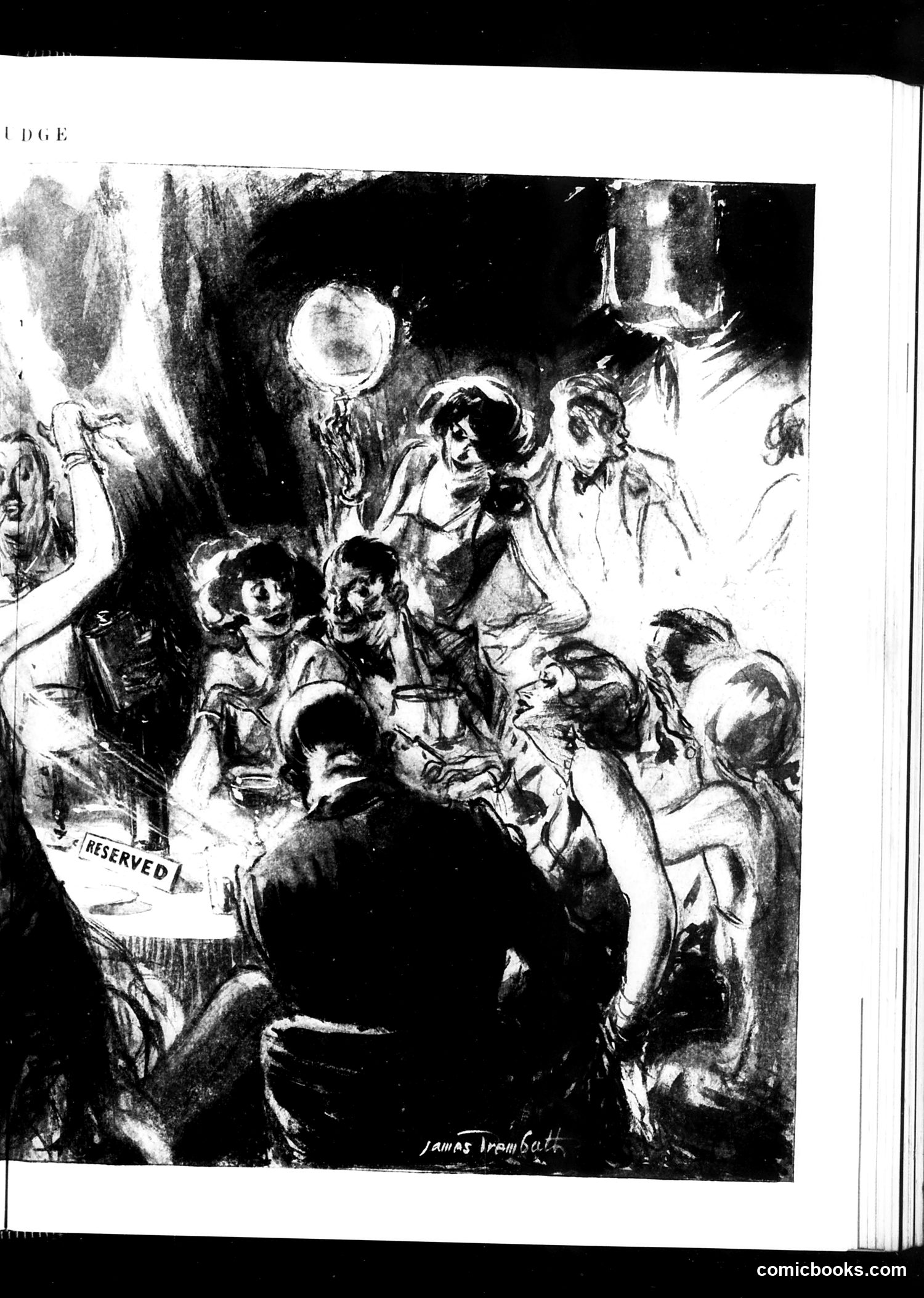
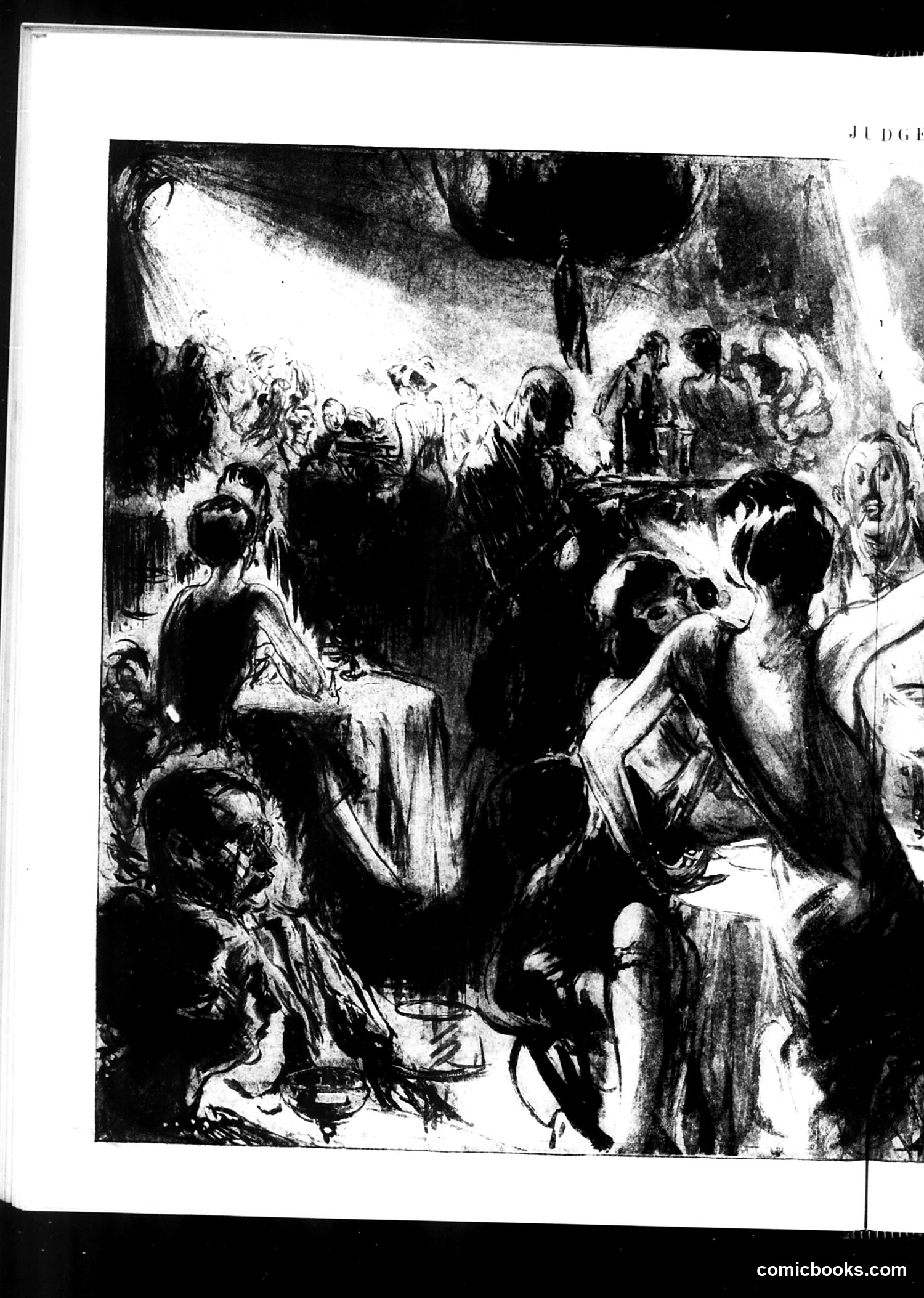
This is a satirical cartoon by James Trumbull, likely from Judge magazine's entertainment/nightlife section (marked "UDGE" at top). The scene depicts a crowded, lively nightclub or cabaret with a mix of patrons—men in suits and women in 1920s-style dress—gathered around what appears to be a reserved table. A single figure in dark clothing sits prominently in the foreground, viewed from behind, while others gesture animatedly around them. The "RESERVED" sign visible on the left suggests the satire concerns exclusive seating arrangements or social exclusion. This likely mocks either pretentious nightclub hierarchies or, possibly, segregation practices of the era. The chaotic energy and crowded composition emphasizes the social tension between those with access and those without. Without additional context, the specific target remains unclear, but the cartoon critiques class or social division in public entertainment venues.
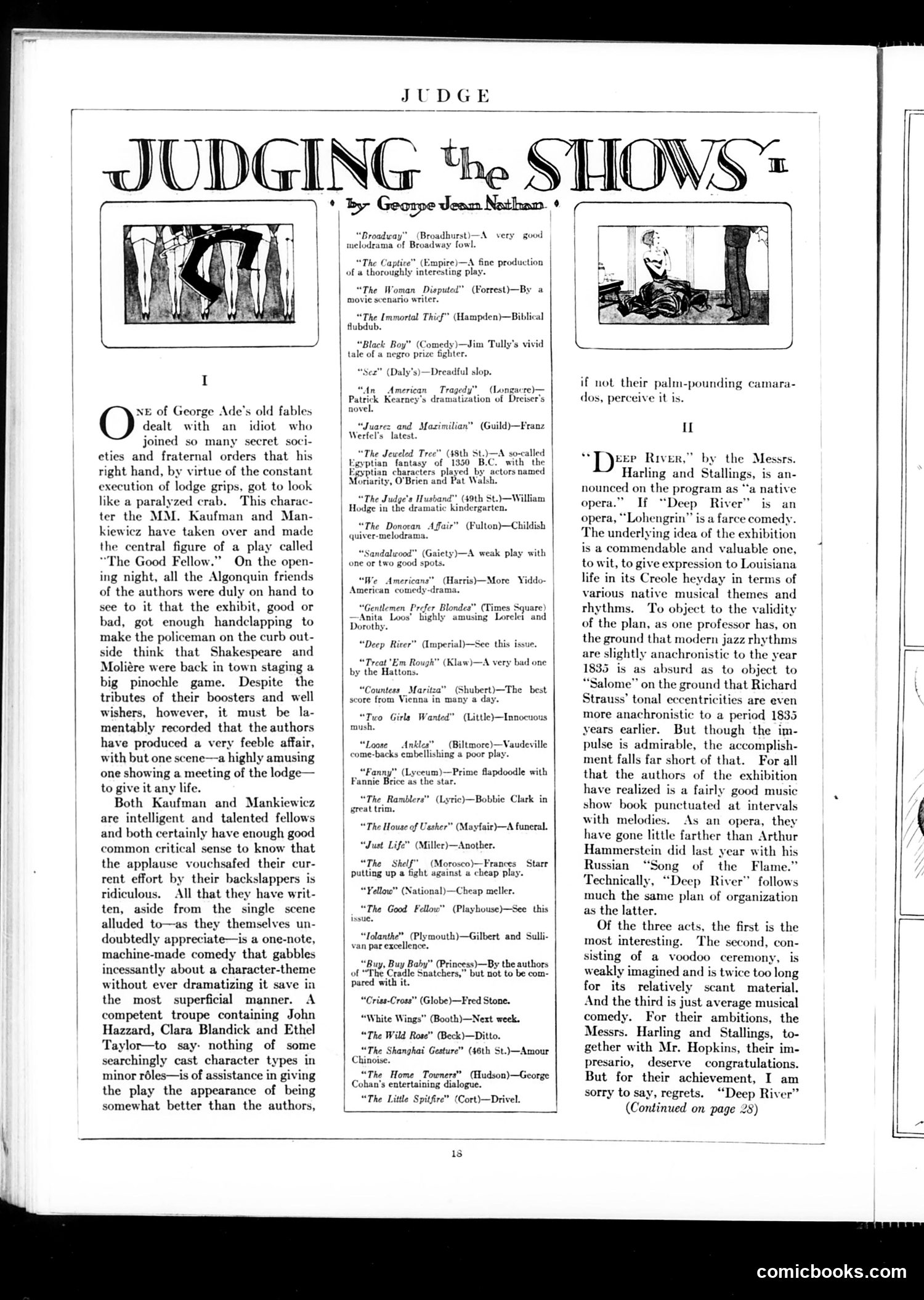
This page is a theater review column by George Jean Nathan examining recent Broadway productions. The two images show scenes from plays under review. The column critiques roughly 30 productions with brief, often caustic assessments—praising some ("The Captive" as "a fine production"), dismissing others as "dreadful slop" or "flapdoodle." Nathan employs typical critical wit, comparing inferior work to vaudeville or calling plots "melodrama." The left column includes commentary on a play by Kaufman and Mankiewicz, praising their intelligence while noting their current work is "very feeble"—a single-scene comedy about lodge meetings that relies too heavily on audience goodwill from the authors' Algonquin Round Table reputation to succeed. The right section reviews "Deep River," a musical attempting to capture Louisiana Creole life. Nathan acknowledges its admirable ambition but finds the execution falls short, comparing anachronistic musical choices unfavorably to opera conventions. This reflects 1920s Broadway's sophistication and Nathan's influential critical voice in Judge magazine.
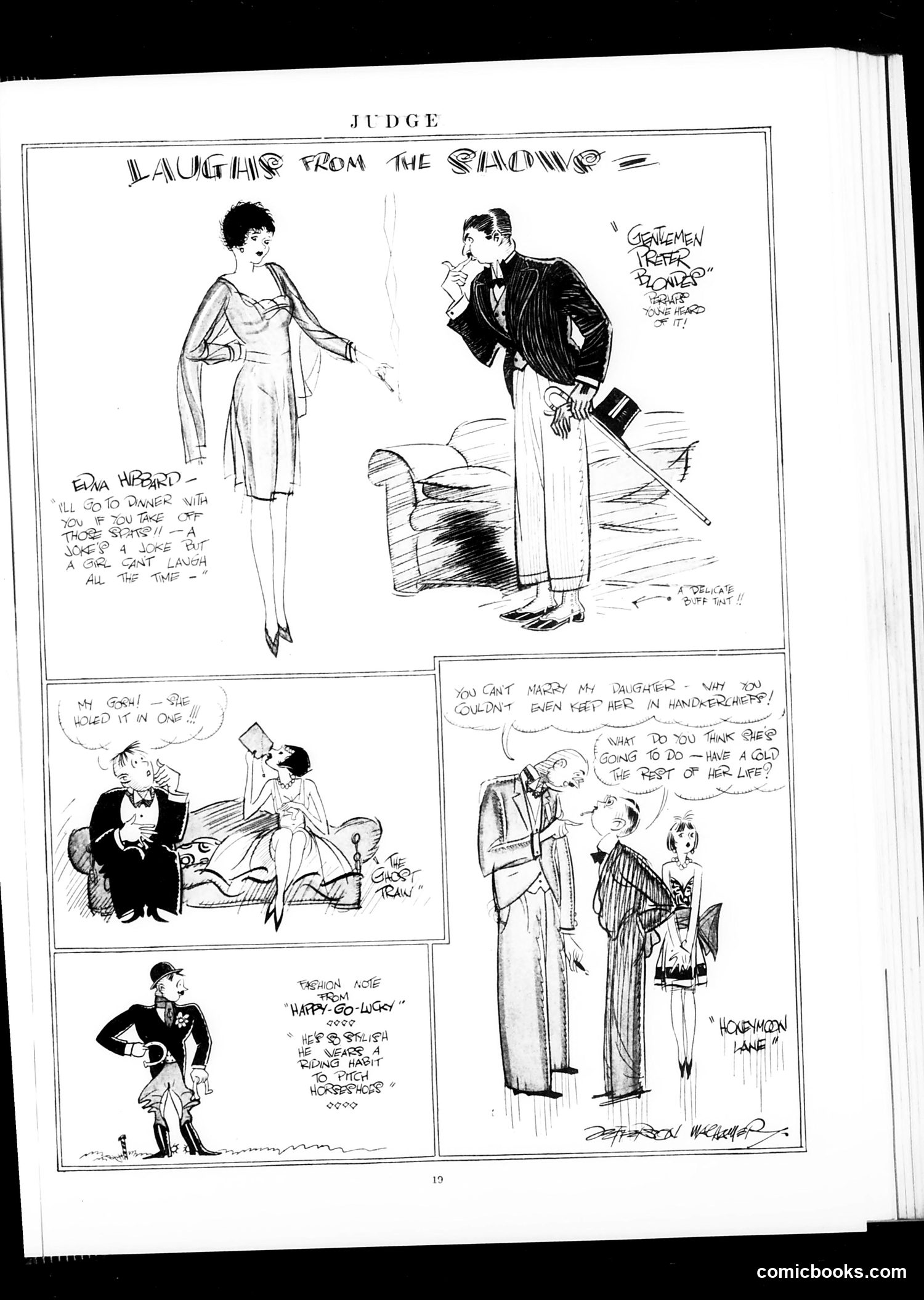
This page satirizes early 20th-century courtship and marriage attitudes. The top panels show a flirtatious couple ("Erna Heppard" and "Gentlemen Prefer Blondes"-style references) exchanging witty banter at what appears to be a seaside venue. The humor centers on traditional gender dynamics: a young woman plays coy while a man pursues her romantically. Lower panels show an older gentleman's exasperation when learning he cannot marry the woman because she's too delicate—she can't even be held in a handkerchief. His response suggests keeping her in isolation ("a cold the rest of her life"), mocking both the era's restrictive treatment of women and the absurd fragility society expected them to perform. The satire targets the contradiction between women's desirability as romantic objects and their simultaneous uselessness in practical life—a critique of both male expectations and enforced feminine helplessness in this period.
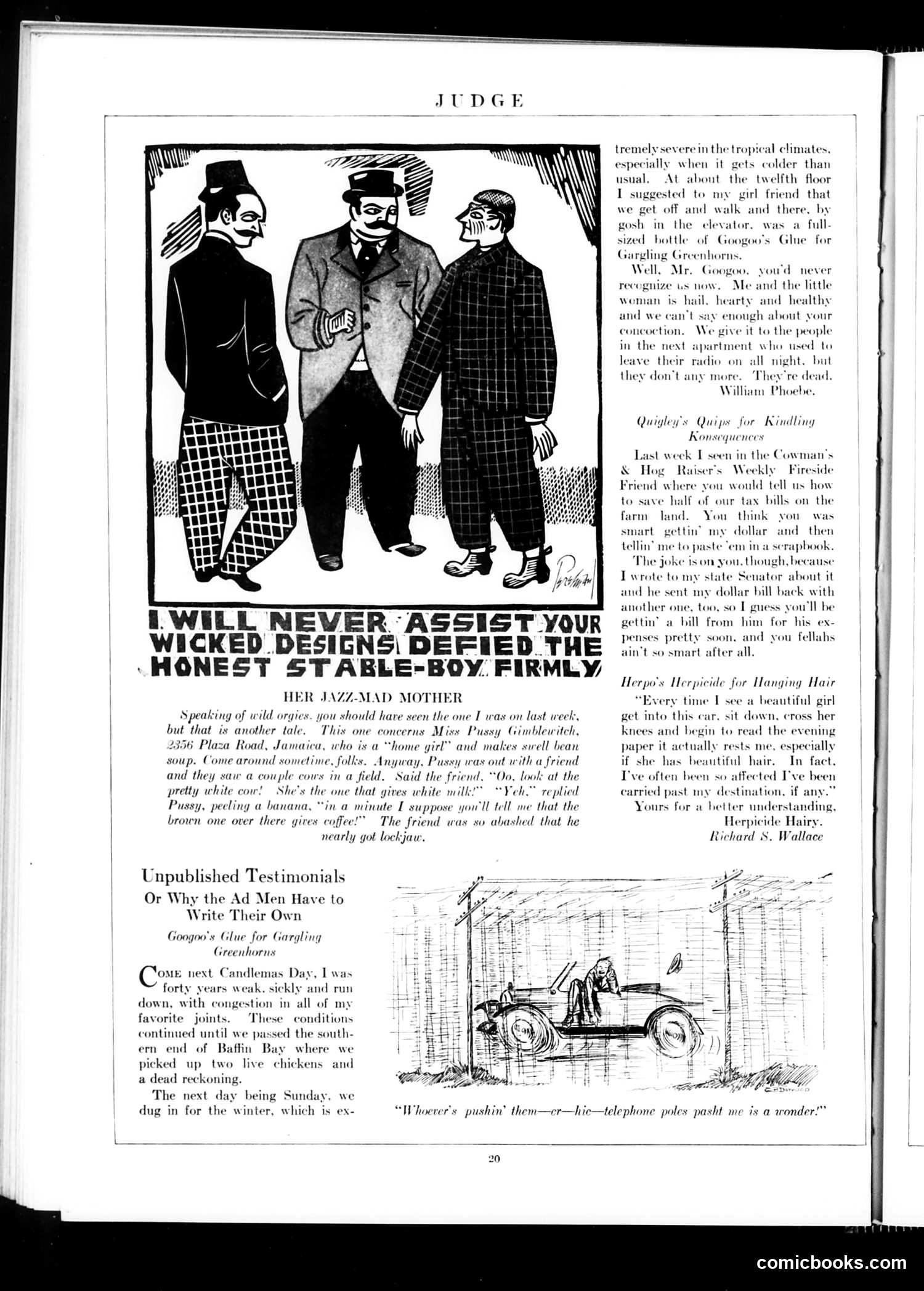
This page contains three satirical humor pieces mocking advertising and American culture circa 1920s: **Main Cartoon**: Shows three men in suits and hats. The caption parodies melodrama, with text about an "honest stable-boy" defying "wicked designs"—likely satirizing overwrought moral tales and sentimental fiction. **"Her Jazz-Mad Mother"**: A crude racial caricature joke about "Miss Pussy Gimblewitch" making inappropriate comments about cows and milk/coffee, playing on offensive stereotypes. The piece mocks both the subject and the sensationalized "jazz age" moral panics of the era. **Mock Testimonials**: Judge satirizes fake product endorsements by presenting absurd, obviously fabricated testimonials for fictional products ("Googoo's Glue," "Quigley's Quips," "Herpo's Herpicide"). The testimonials are intentionally ridiculous—one mentions a product causing neighbor deaths—mocking advertisers' reliance on dubious customer claims and the gullibility of consumers. The humor targets advertising practices, racial attitudes, and popular anxieties of 1920s America.
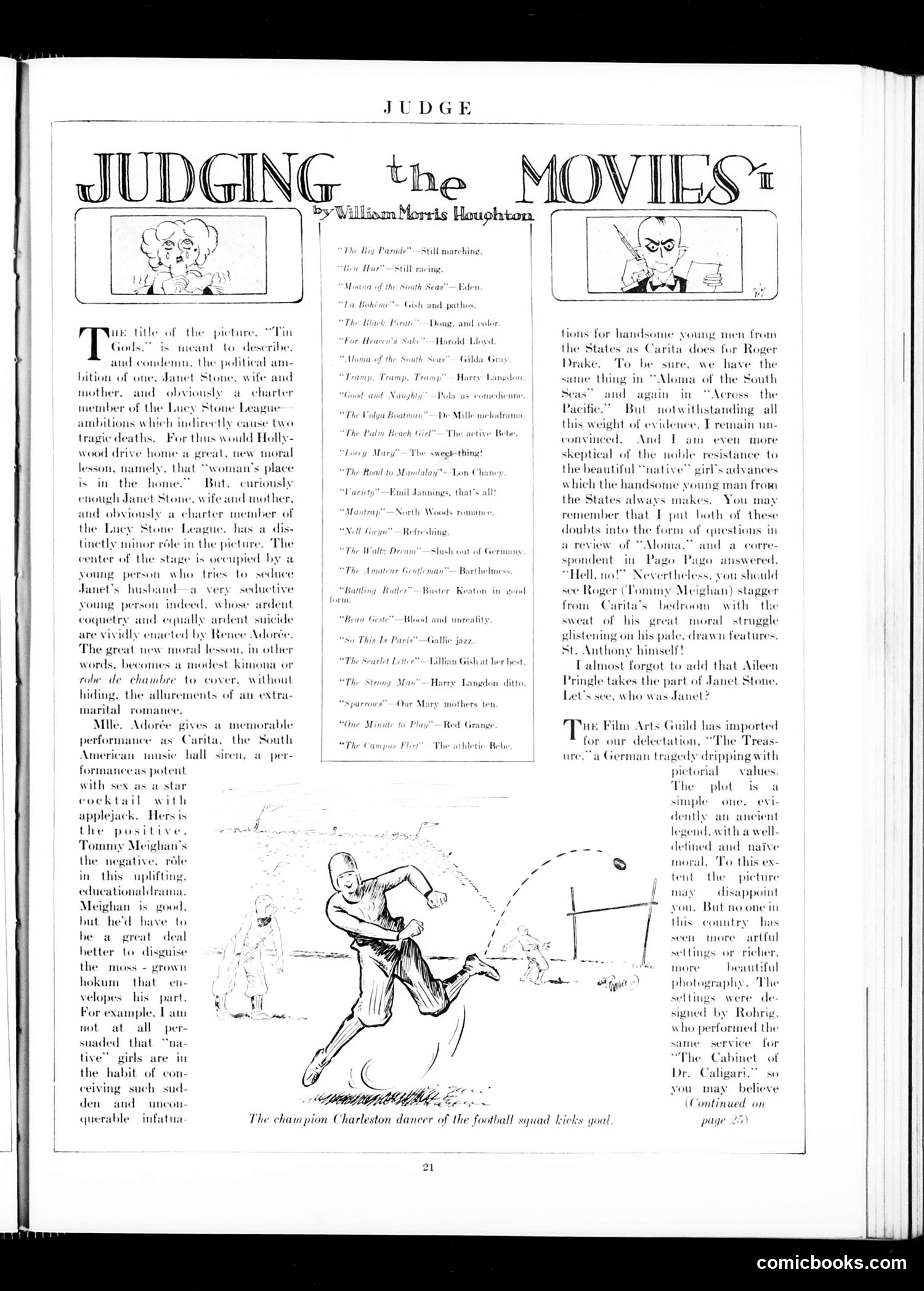
This is a film review column by William Morris Houghton critiquing contemporary movies. The main illustration depicts a Charleston dancer from a football film, visually representing the era's popular entertainment. Houghton satirizes Hollywood's hypocrisy regarding "moral lessons." He notes that "Tin Gods," despite claiming to teach that "woman's place is in the home," actually centers on seduction and extramarital romance—using Renée Adorée's sex appeal rather than serious drama. He praises Adorée's performance but criticizes Tommy Meighan's unconvincing portrayal of a man resisting a native girl's advances, questioning the film's moralizing. The review references contemporary stars (Lillian Gish, Harold Lloyd, Buster Keaton, Harry Langdon) and discusses imported films like "The Treasure," a German tragedy praised for its artistic cinematography and set design by Rohrig. The satire targets Hollywood's tendency to wrap titillation in moralistic messaging—saying one thing while showing another.
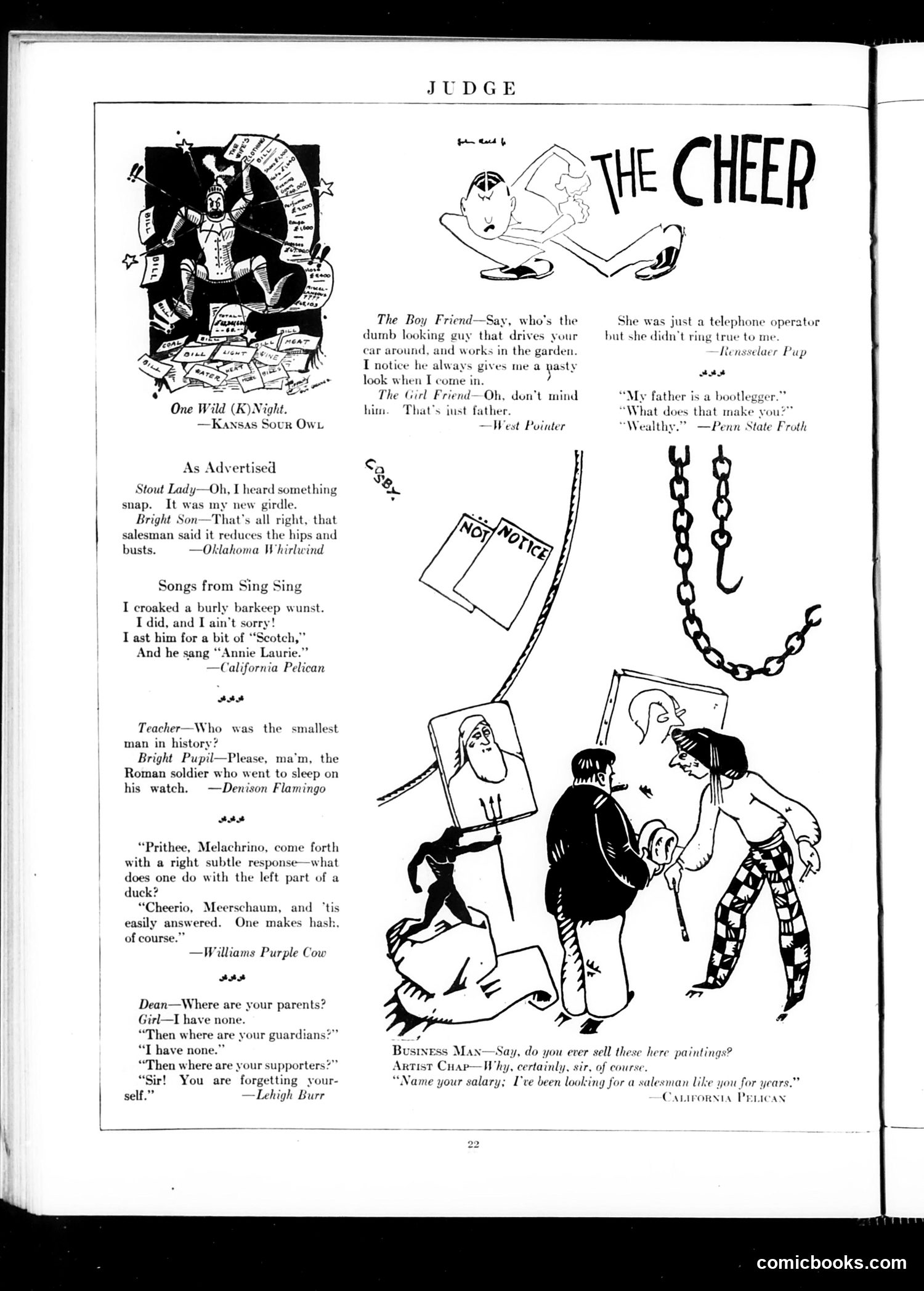
This page collects brief humorous anecdotes and jokes from college humor magazines and newspapers, presented in a satirical format typical of Judge magazine's "filler" content. **Key jokes:** - **"The Boy Friend"**: Plays on class confusion—a girl's wealthy father, dressed poorly and working as a chauffeur/gardener, is mistaken for a servant by her boyfriend. - **Girdle ad joke**: Dark humor about a woman's girdle breaking, with the salesman's claim it "reduces hips and busts" taken literally as physical damage. - **Bootlegger's son**: References Prohibition-era illegal alcohol sales; humor derives from the son claiming wealth through his father's criminal enterprise. - **Telephone operator**: A pun on "didn't ring true"—wordplay on her profession. - **Prison songs**: Dark humor about criminals in sing-sing prison singing innocently. The overall tone reflects 1920s-30s American humor: class commentary, Prohibition references, and coded social satire presented through brief, punchy jokes. Nothing here requires identification of specific public figures.
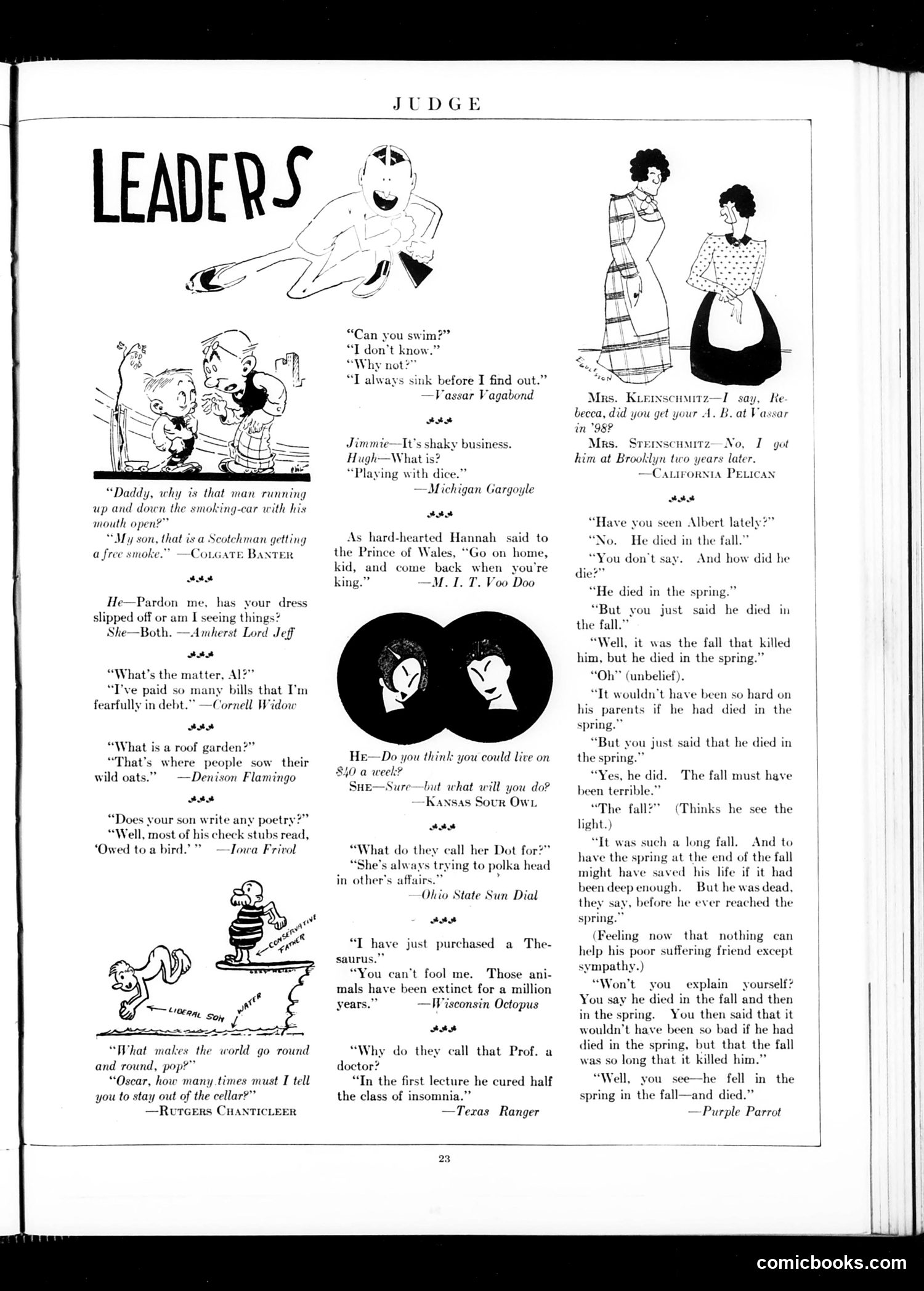
This page collects humor from college newspapers, presented as witty one-liners and short jokes. Most jokes are gentle observational humor typical of early 20th-century college comedy—playing on student life themes like poverty, academic struggles, and romantic confusion. The page's centerpiece is an extended logical paradox about someone dying "in the fall" versus "in the spring," which builds absurdist humor through circular reasoning and the protagonist's mounting frustration trying to parse contradictory statements. Other jokes target stereotypes (Scotsmen seeking free cigarettes), contemporary social concerns (students drowning in debt from bills), and academic pretension (a professor curing insomnia by boring his class). The "Leaders" header suggests these represent the best submissions from university humor publications—a common feature in Judge during this era. The page emphasizes wordplay and situational comedy rather than political or social satire, reflecting college humor's focus on relatable, lighthearted entertainment for a young audience.
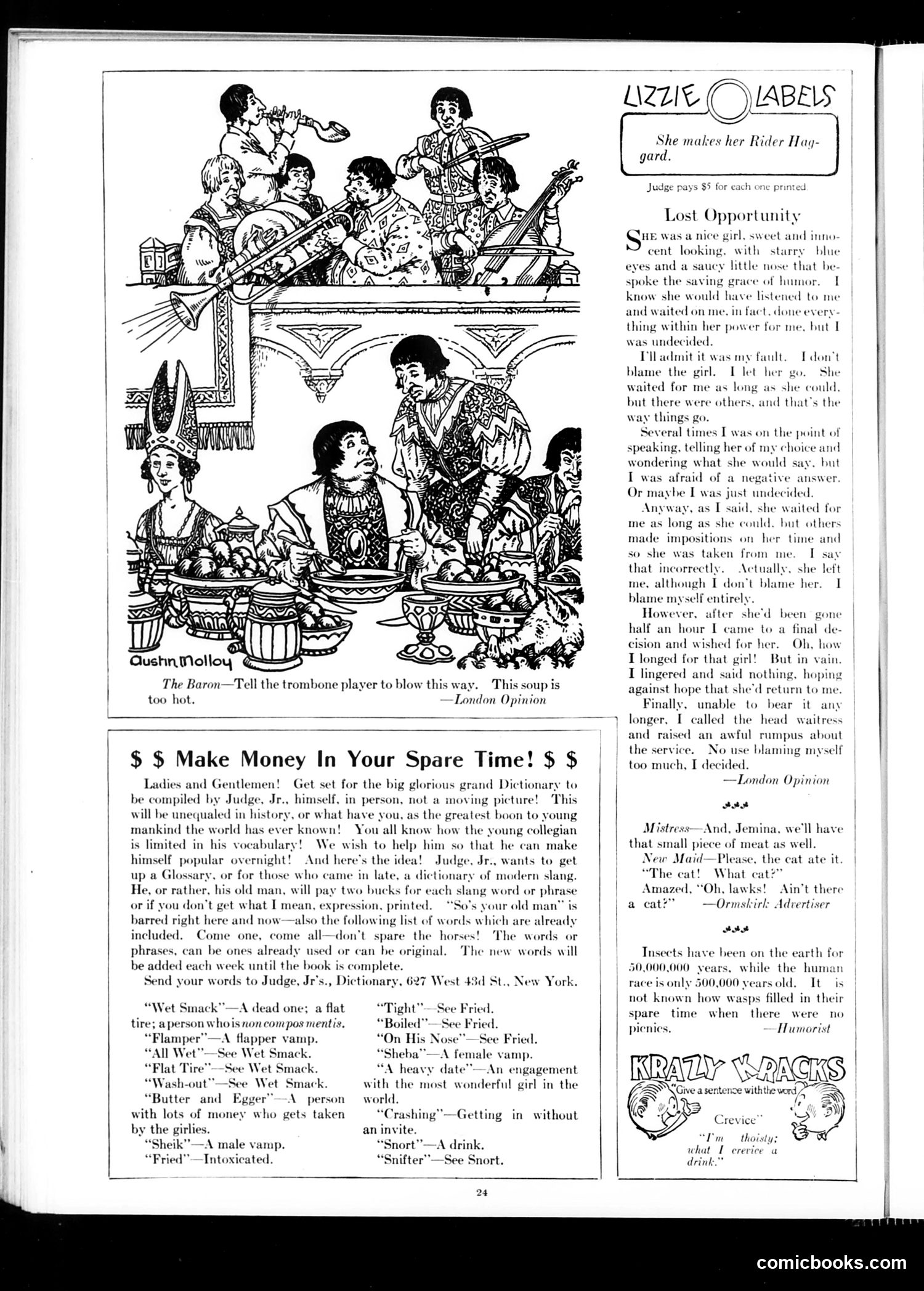
This page contains several satirical pieces typical of Judge magazine's humor: **Main Cartoon ("The Baron"):** A dining scene where an aristocratic host instructs a trombone player to "blow this way" at soup that's "too hot." This is a visual pun—the Baron wants the musician to cool the soup with air from the trombone, treating it as a practical tool rather than an instrument. The humor relies on absurdist logic and class-based pretension. **"Make Money" Advertisement:** Judge Jr. solicits slang terms from readers for a modern dictionary, offering two dollars per phrase. This satirizes the rapid evolution of 1920s youth slang and the generation gap—young collegians' supposedly limited vocabulary needed "fixing." Terms like "Sheik," "Sheba," and "Fried" (drunk) reflect actual flapper-era slang. **"Lost Opportunity":** A melancholic monologue about a man too indecisive to propose to a waitress, who leaves him. His ultimate frustration: he calls for the head waitress to complain about service. Dark comedy about male passivity. The page blends advertising, reader participation, and satirical commentary on contemporary youth culture and social awkwardness.
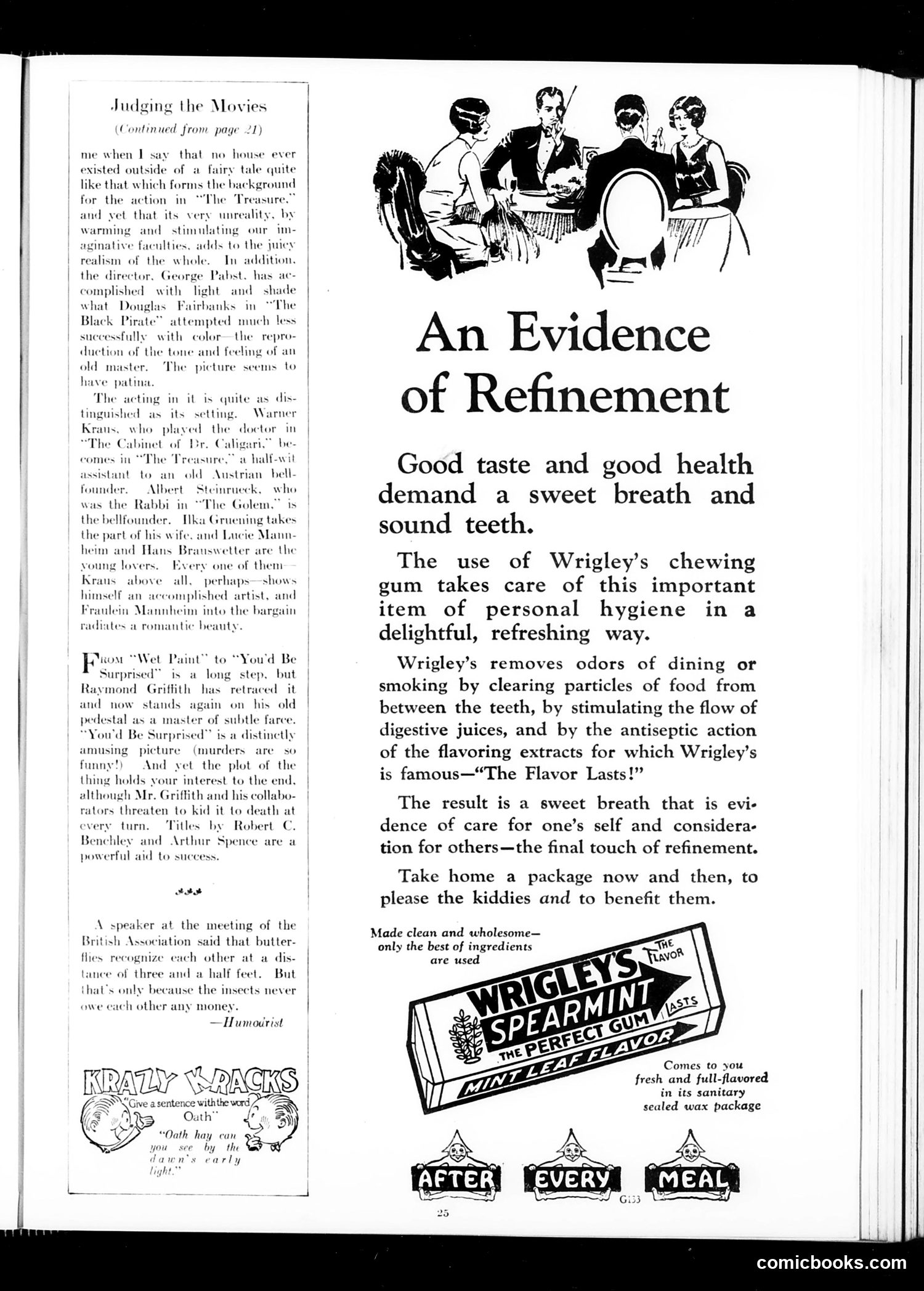
This page contains two distinct elements: a film criticism column and a Wrigley's chewing gum advertisement. **"Judging the Movies" Section:** A continuation of film reviews praising German Expressionist cinema, particularly "The Treasure" directed by Georg Pabst. The critic praises the film's fairy-tale aesthetics, lighting techniques, and the performances of Warner Krauss and other actors. Brief mentions of other films like "You'd Be Surprised" with Raymond Griffith follow. **"An Evidence of Refinement":** A full-page Wrigley's advertisement using early 20th-century marketing rhetoric. It frames chewing gum as a sign of personal hygiene and social courtesy—removing odors from dining/smoking and indicating "care for one's self and consideration for others." The phrase "final touch of refinement" appeals to middle-class aspirations for gentility. The ad targets both adults and children ("please the kiddies"). The page reflects 1920s consumer culture where manufactured products promised to signal good breeding and respectability.
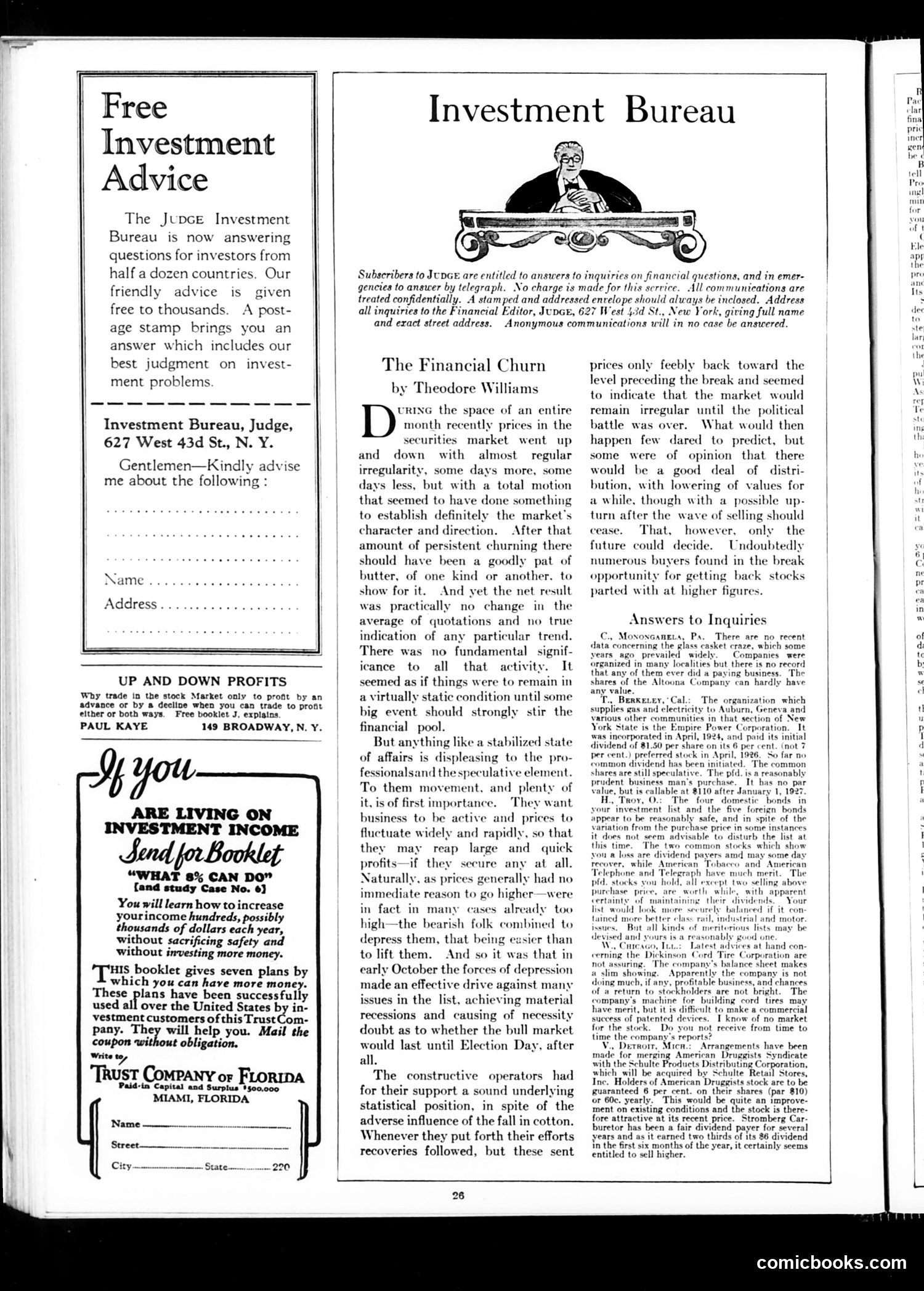
This page is primarily **financial advertising and advice content**, not political satire. Judge magazine's "Investment Bureau" offered free investment guidance to subscribers—a service unusual for the era. The main article, "The Financial Churn" by Theodore Williams, discusses **stock market volatility in early October** (year unclear from image). Williams describes how securities prices fluctuated dramatically without fundamental cause, likening the activity to churning butter that yields no actual product. He notes that speculators (both "bulls" and "bears") deliberately manipulated prices for quick profits, while constructive investors had solid statistical backing. The article references the **upcoming Election Day** as a factor affecting market stability, suggesting political uncertainty influenced investor behavior. The surrounding ads hawk investment schemes promising returns (Trust Company of Florida, various profit-guarantee pamphlets)—typical early-20th-century financial marketing, some likely speculative or dubious by modern standards.
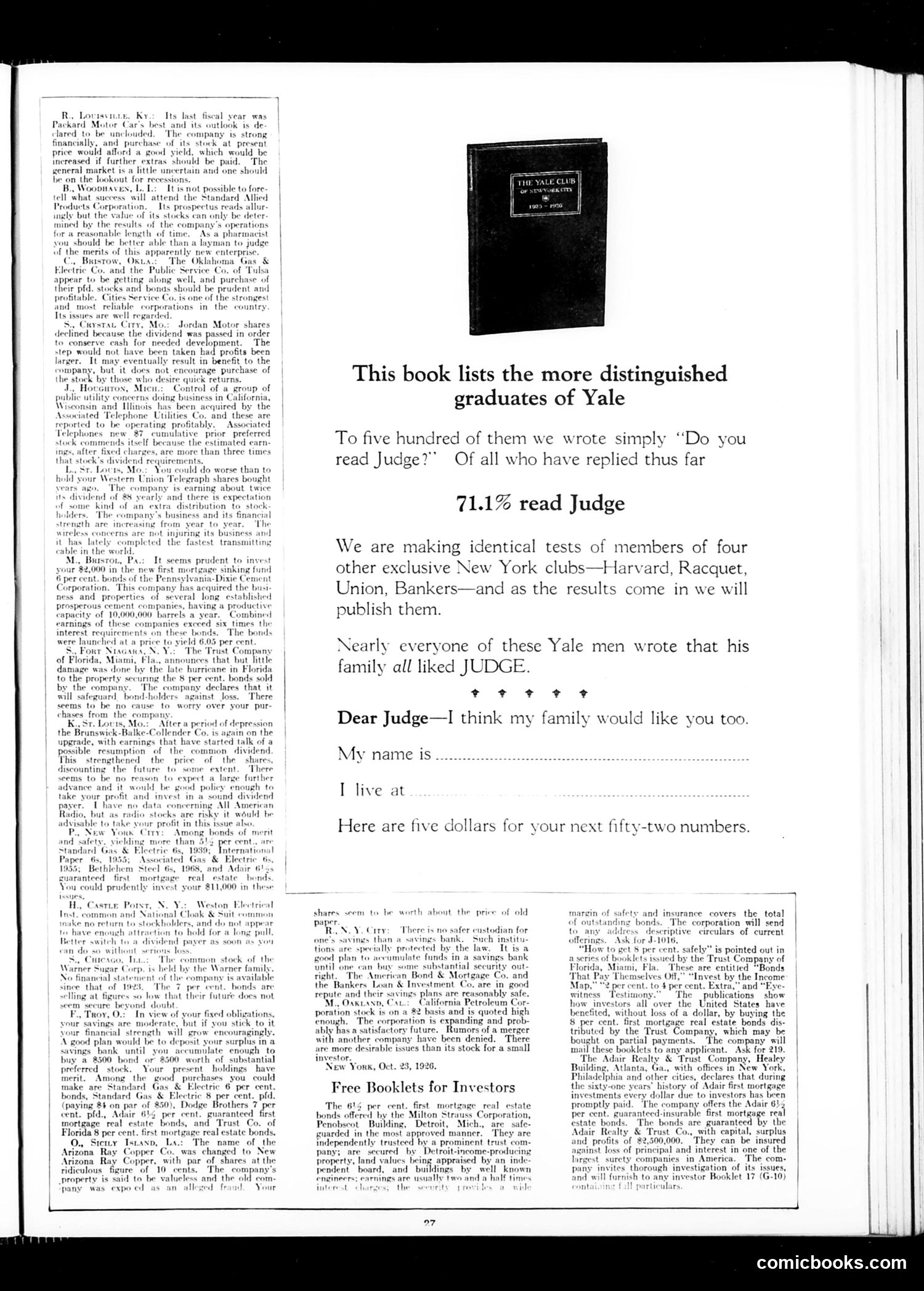
This page is primarily a **financial advice column**, not a satirical cartoon section. The left column contains Q&A responses from what appears to be Judge's investment advisor, addressing readers' specific stock and bond questions from the 1920s-30s era. The right side features an **advertisement for "The Yale Club"** (visible as a book cover image) promoting a survey finding that **71.1% of Yale graduates read Judge magazine**. Below this is a humorous solicitation: the magazine sent 500 Yale alumni a simple question—"Do you read Judge?"—and uses the affirmative responses as proof of the magazine's readership among educated elites. The final section offers a template ("Dear Judge—I think my family would like you too") inviting readers to subscribe, with a $5 enclosed payment for 52 issues. **Context for modern readers**: This represents Judge's business model—leveraging its reputation among wealthy, educated audiences to attract both subscribers and advertisers interested in that demographic.
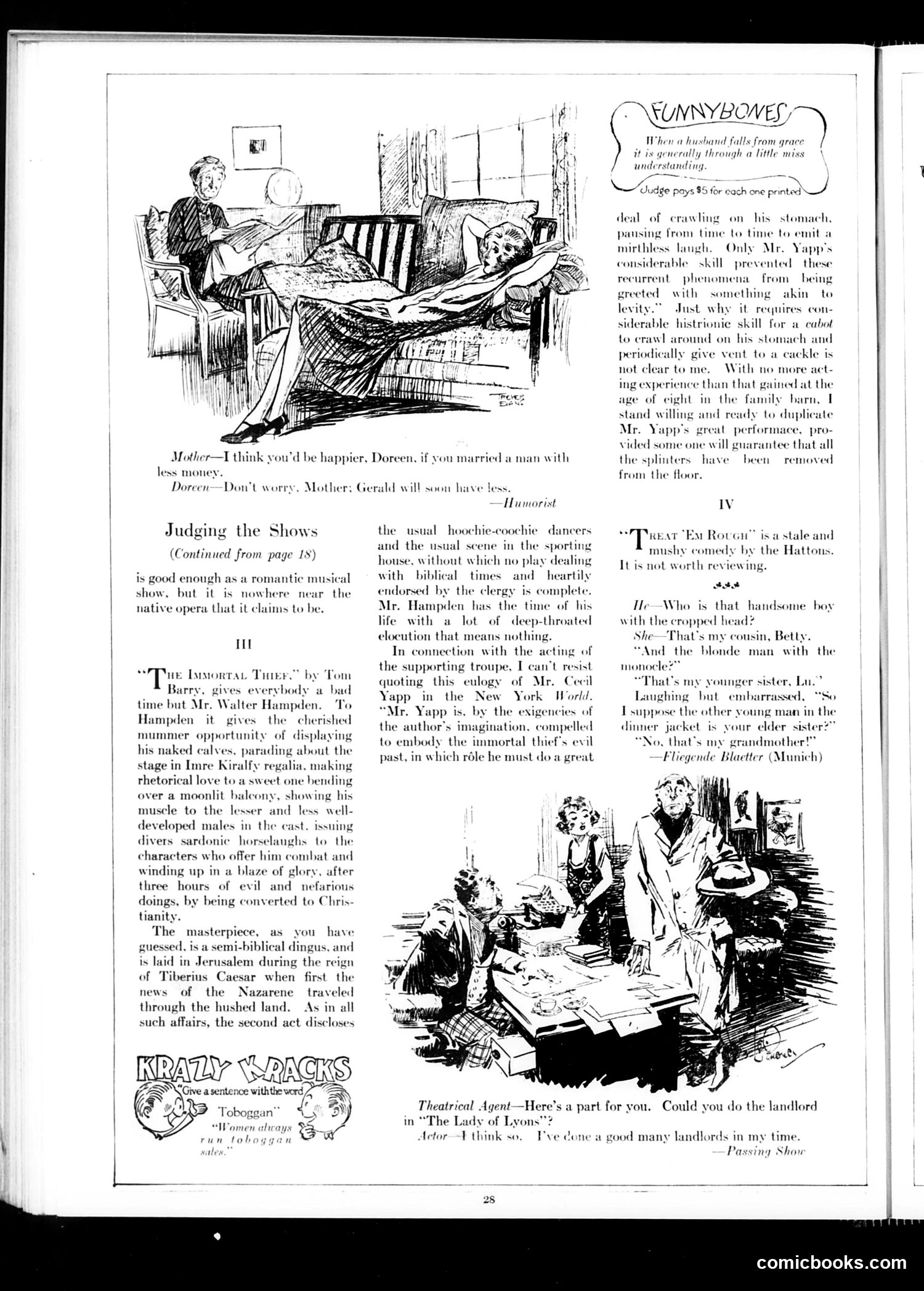
This page contains theatrical reviews and humor pieces typical of early 20th-century satire. **Top Cartoon:** A brief domestic joke where a mother suggests her daughter "Doreen" marry a poor man for happiness, but Doreen's fiancé "Gerald" quips he'll soon be poor anyway—satirizing either his spendthrift habits or the economic precarity of the era. **Theater Reviews:** The bulk critiques recent Broadway productions, particularly mocking Walter Hampden's performance in "The Immortal Thief," which adapts a biblical story with stereotypical theatrical excess (scantily-clad dancers, melodramatic elocution). The reviewer sarcastically notes even inexperienced performers could embody the required roles, undermining the production's artistic pretensions. This reflects Judge's regular skewering of lowbrow theatrical spectacle masquerading as serious drama. **Bottom Cartoon:** A dialogue joke about mistaking family members at dinner—the humor derives from the final reveal that the "handsome young man" is actually the speaker's grandmother, relying on period gender-presentation stereotypes. The page exemplifies Judge's characteristic blend of theatrical criticism and genteel domestic humor.
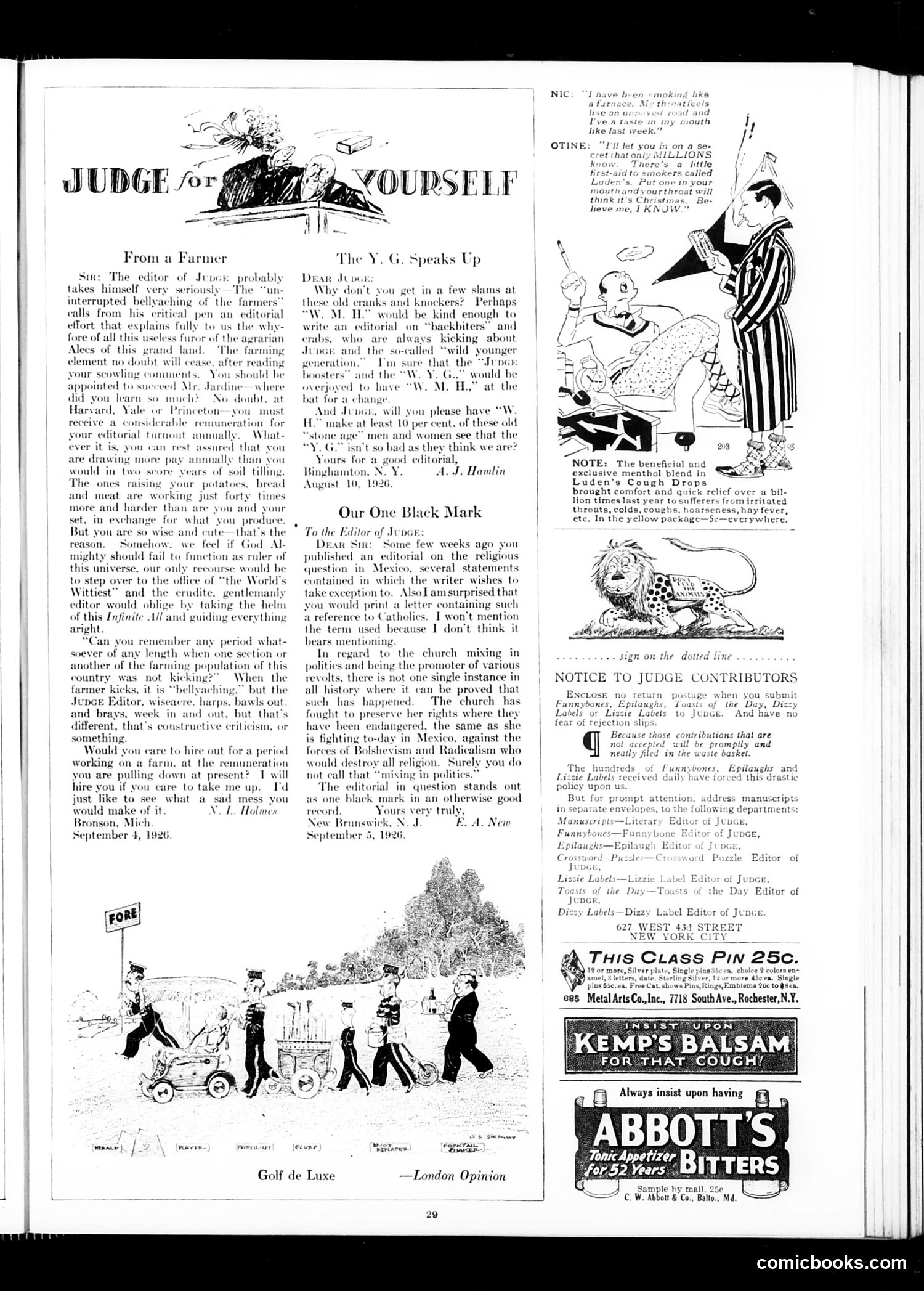
This page from Judge (September 1926) contains reader letters and satirical cartoons addressing social tensions of the era. **The Letters Section** presents three complaints: A farmer sarcastically attacks the magazine's editor for criticizing agricultural complaints while living comfortably in cities. A second writer (signed J.J. Hamlin) requests editorials mocking "old cranks" and defending young people against the "wild younger generation" criticism. A third correspondent defends the Catholic Church against accusations of political meddling in Mexico, objecting to anti-Catholic rhetoric in previous letters. **"Judge for Yourself"** (top) and **"Golf de Luxe"** (bottom) are satirical cartoons. The latter depicts wealthy men playing golf while labeled workers ("Money," "Labor," etc.) toil beneath them—likely critiquing class inequality and leisure disparity. The page reflects 1920s anxieties: generational conflict, rural-urban tensions, and religious/political controversy regarding Mexico's anti-clerical policies. The magazine positions itself as a forum for public debate on these contentious issues.
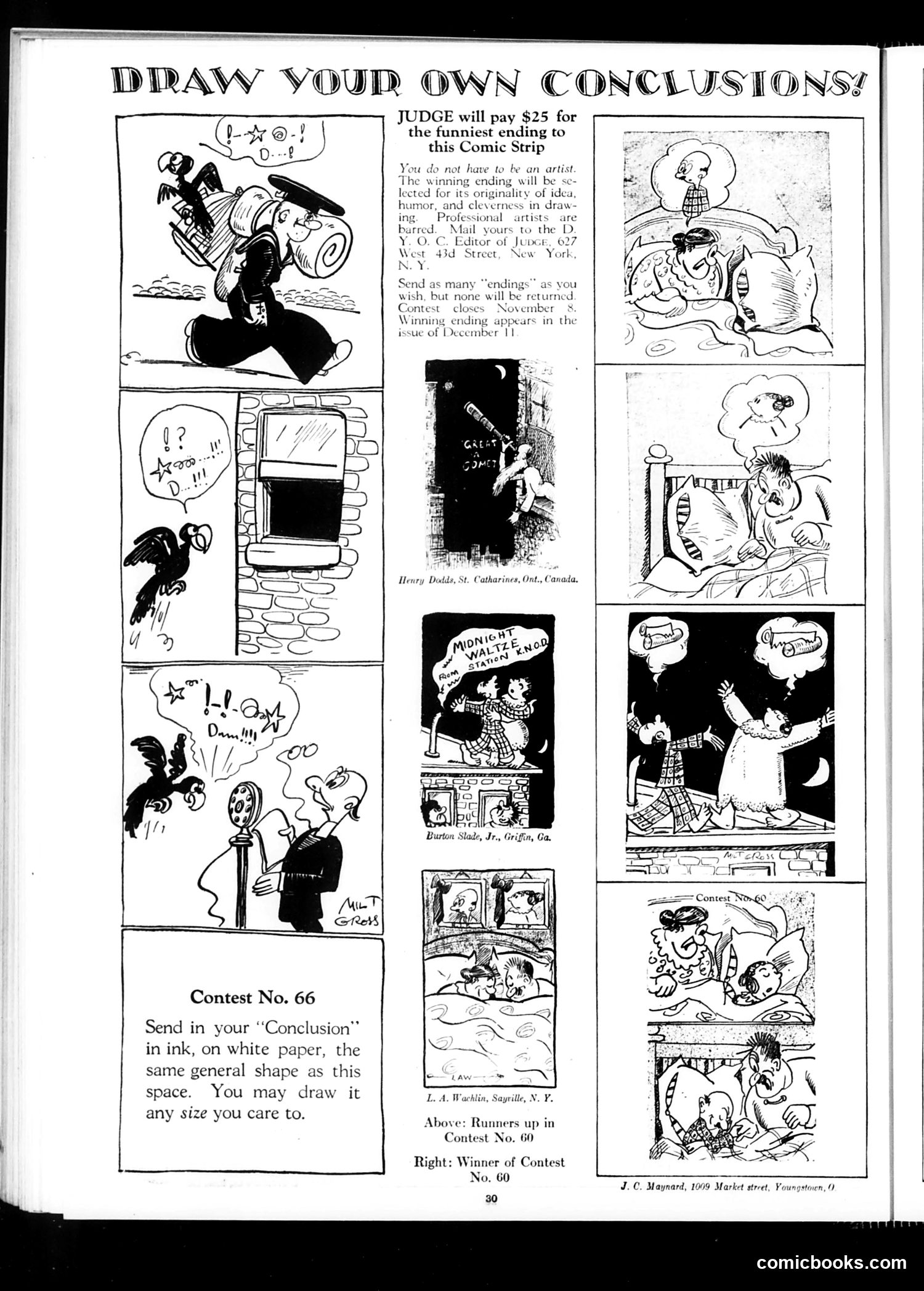
This is a reader-participation contest from *Judge* magazine (Contest No. 66). The publication presents an incomplete four-panel comic strip and invites readers to submit humorous endings, offering $25 to the winner. The strip's narrative is unclear from the panels shown, but depicts a character in various comedic situations—appearing to flee or struggle with something explosive or chaotic, confronting what looks like a brick wall or building, and interacting with other figures. The page also displays winning entries from a previous contest (No. 60), showing readers' creative conclusions to an earlier comic strip. This format was common in early 20th-century humor magazines, democratizing cartooning by crowdsourcing jokes from amateur contributors. The contest emphasized humor and cleverness over artistic skill—professionals were explicitly barred from competing, making it accessible to ordinary readers.
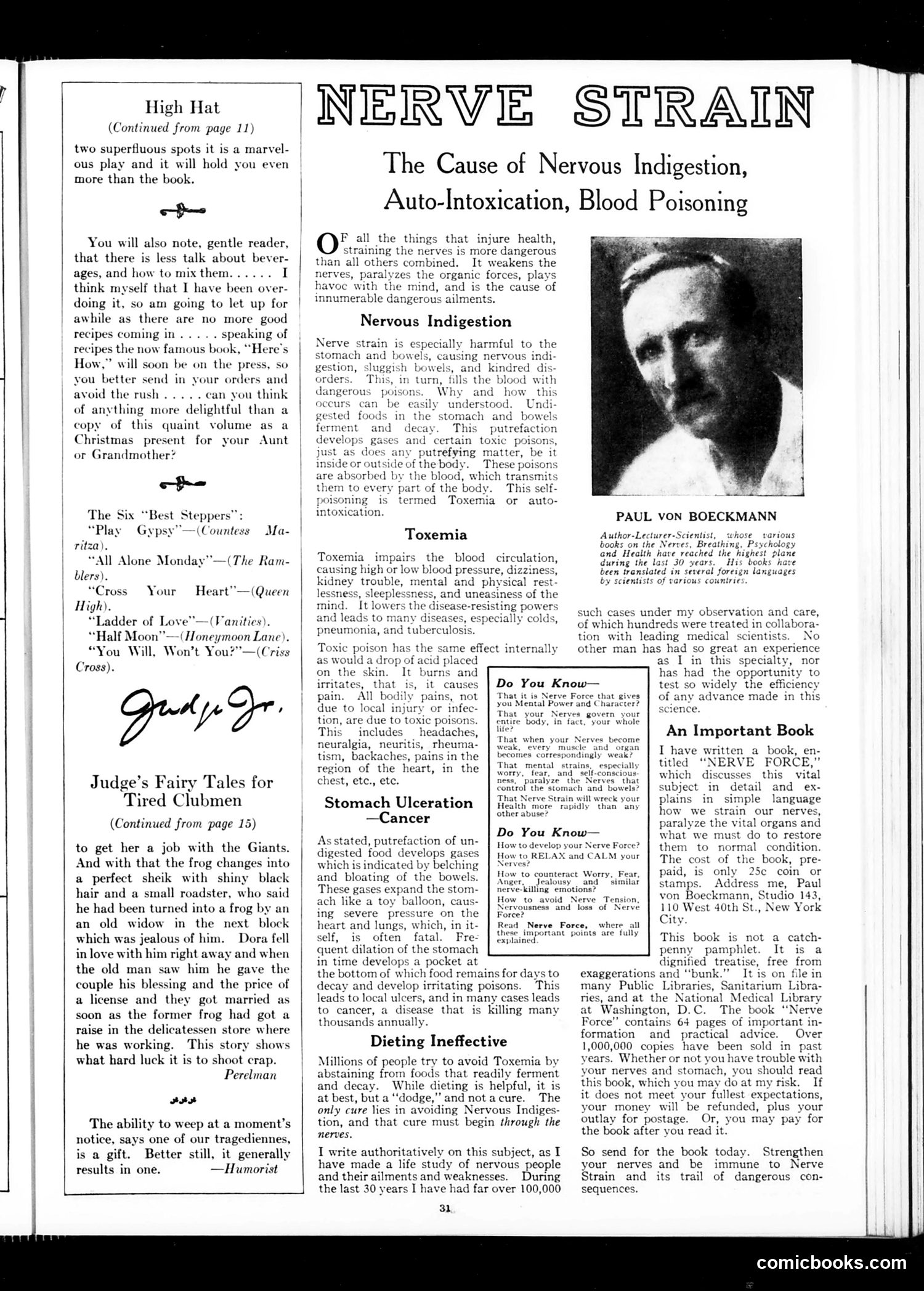
This page combines editorial content with **medical advertising**, primarily promoting Paul von Boeckmann's book "Nerve Force." ## The Humor/Satire: The "High Hat" column contains light social satire about cocktail recipes and Broadway shows—typical Judge fare mocking leisure-class concerns. The "Judge's Fairy Tales for Tired Clubmen" offers absurdist humor (a frog turning into a sheik), poking fun at the escapism wealthy readers sought. ## The Advertisement: The dominant right column is a pseudo-scientific health pitch typical of the era. It warns that "nerve strain" causes nervous indigestion, "auto-intoxication," and blood poisoning through putrefaction. This reflects early 20th-century medical pseudoscience blaming nebulous "nerve weakness" for various ailments—a common quack remedy pitch. The ad promotes Boeckmann's book as a cure-all, available at libraries and for mail order. **Modern context**: This exemplifies how Judge balanced entertainment with dubious medical advertisements, which were largely unregulated before FDA oversight strengthened.
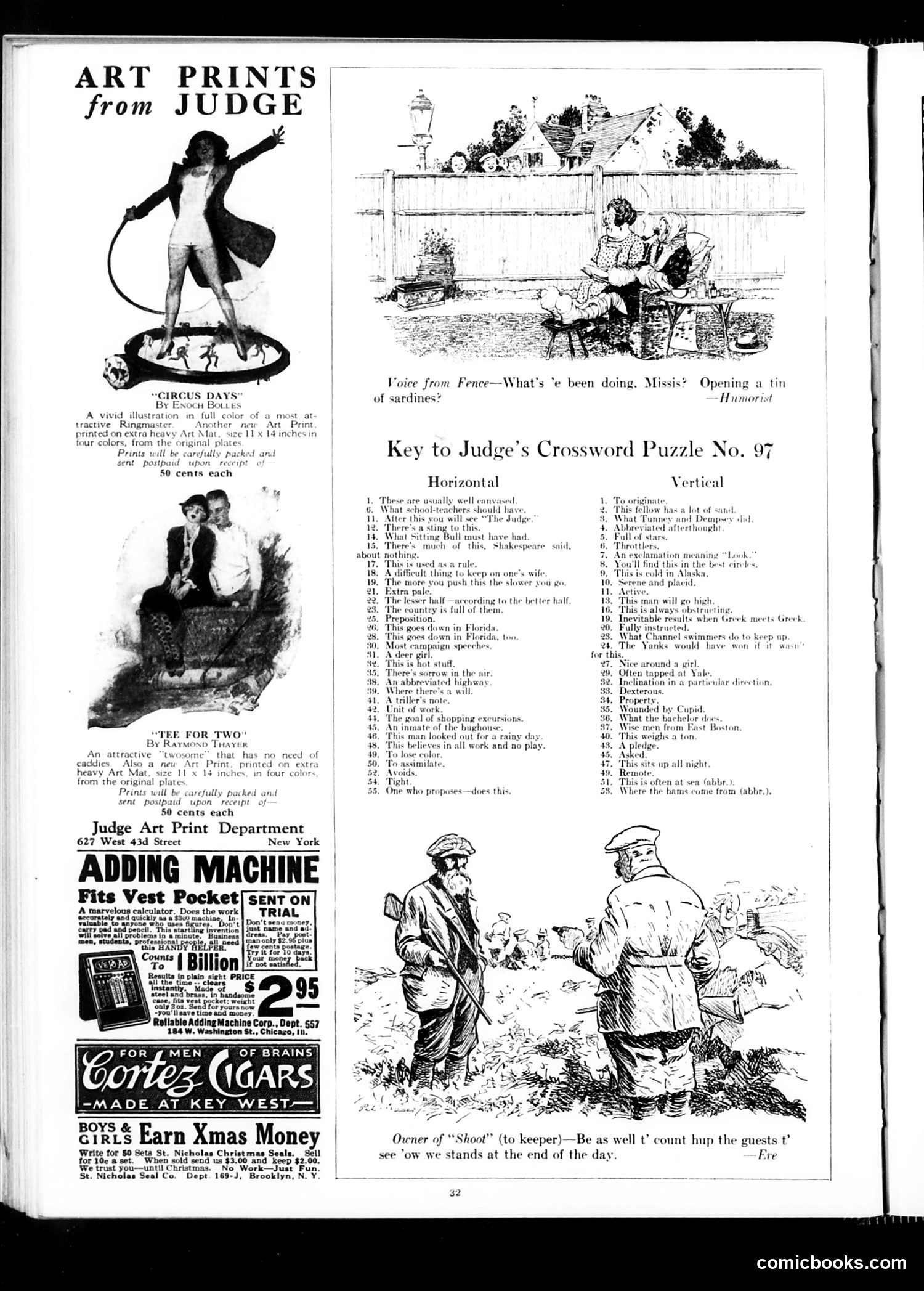
This page is primarily an **advertising and puzzle page** rather than political satire. It features: **Art Print Advertisements**: Three prints offered for sale—"Circus Days" (a ringmaster illustration), "Tee for Two" (a golf scene), and others—typical merchandise Judge sold to readers. **Crossword Puzzle**: Judge's Crossword Puzzle No. 97, with clues and solutions provided. **Magazine Advertisements**: Including an adding machine ("fits vest pocket"), Cortez Cigars ("made at Key West"), and a St. Nicholas Christmas seal fundraising opportunity for children. **Two Cartoons**: Small humorous sketches—one showing someone at a fence asking about sardines, another depicting what appears to be a shooting lodge scene where the owner humorously suggests counting guests to verify everyone survived the day. The page reflects early 20th-century magazine culture: combining humor content with consumer products and crossword puzzles to attract readers. No significant political commentary is present.
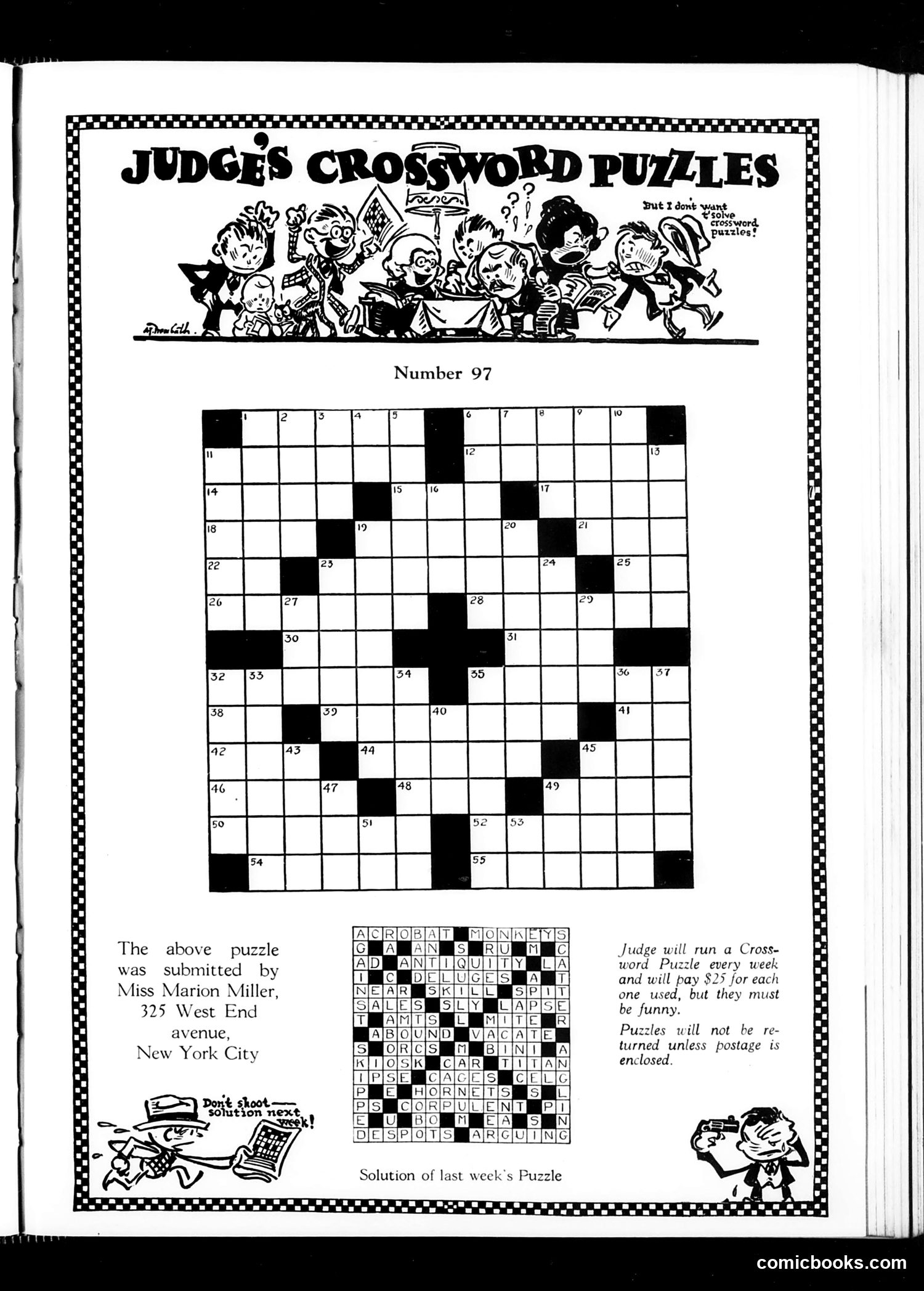
This page features Judge magazine's weekly crossword puzzle contest (Number 97). The puzzle itself is a standard crossword grid with numbered clues. The notable element is the accompanying announcement: Judge will publish crossword puzzles weekly and pay $25 for submissions—but crucially, "they must be funny." This reflects crossword puzzles' popularity in the 1920s-30s as a cultural phenomenon, while Judge's insistence on humor ties the puzzle format to their satirical mission. The solution grid shown demonstrates a completed puzzle, likely from the previous week's contest. The contributor credited is Miss Marion Miller from New York City. The cartoonish illustrations of children scattered throughout reinforce Judge's irreverent, humorous tone. This represents Judge's attempt to engage readers through interactive, prize-incentivized content while maintaining their comedic brand identity.
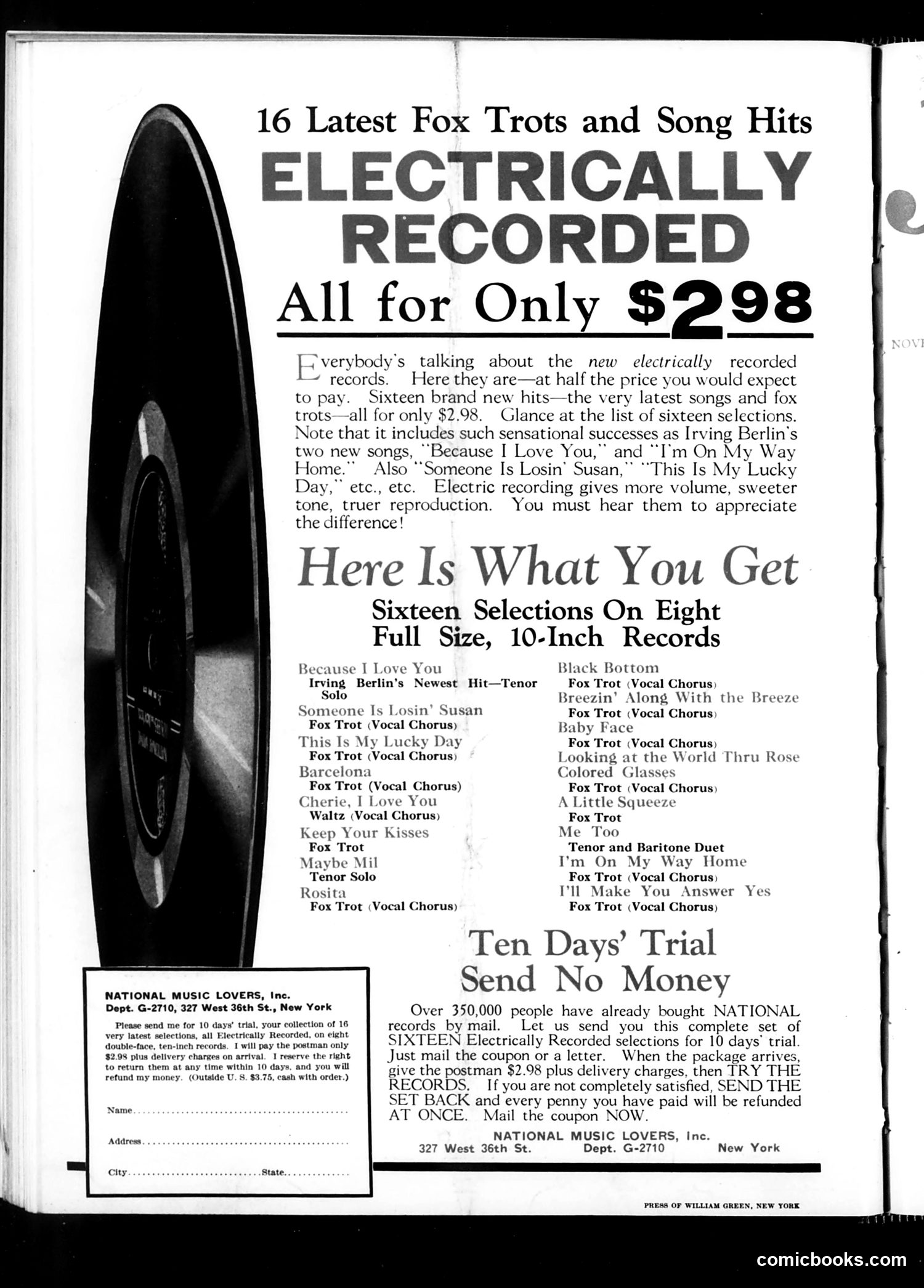
This is **not a cartoon or satire**—it's a straight advertisement. The page is a mail-order ad from National Music Lovers, Inc., promoting a collection of 16 electrically recorded songs and fox trots for $2.98. The key selling point is "electrically recorded," a relatively new technology that offered superior sound quality compared to acoustic recording. The ad emphasizes this innovation provides "more volume, sweeter tone, truer reproduction." The listing includes popular 1920s hits, notably Irving Berlin compositions ("Because I Love You," "I'm On My Way Home"), and dance-oriented songs reflecting Jazz Age culture—fox trots and waltzes were mainstream entertainment. The advertisement employs direct-mail marketing tactics common to the era: a ten-day trial offer with no upfront payment, mail-in coupon, and testimonial ("Over 350,000 people have already bought"). For a modern reader, this reflects how recorded music was sold pre-streaming and how "electrical recording" was once a major technological selling point comparable to modern audio quality claims.