
Judge, 1926-10-30 · page 15 of 36
Judge — October 30, 1926 — page 15: what you’re looking at
What you’re looking at
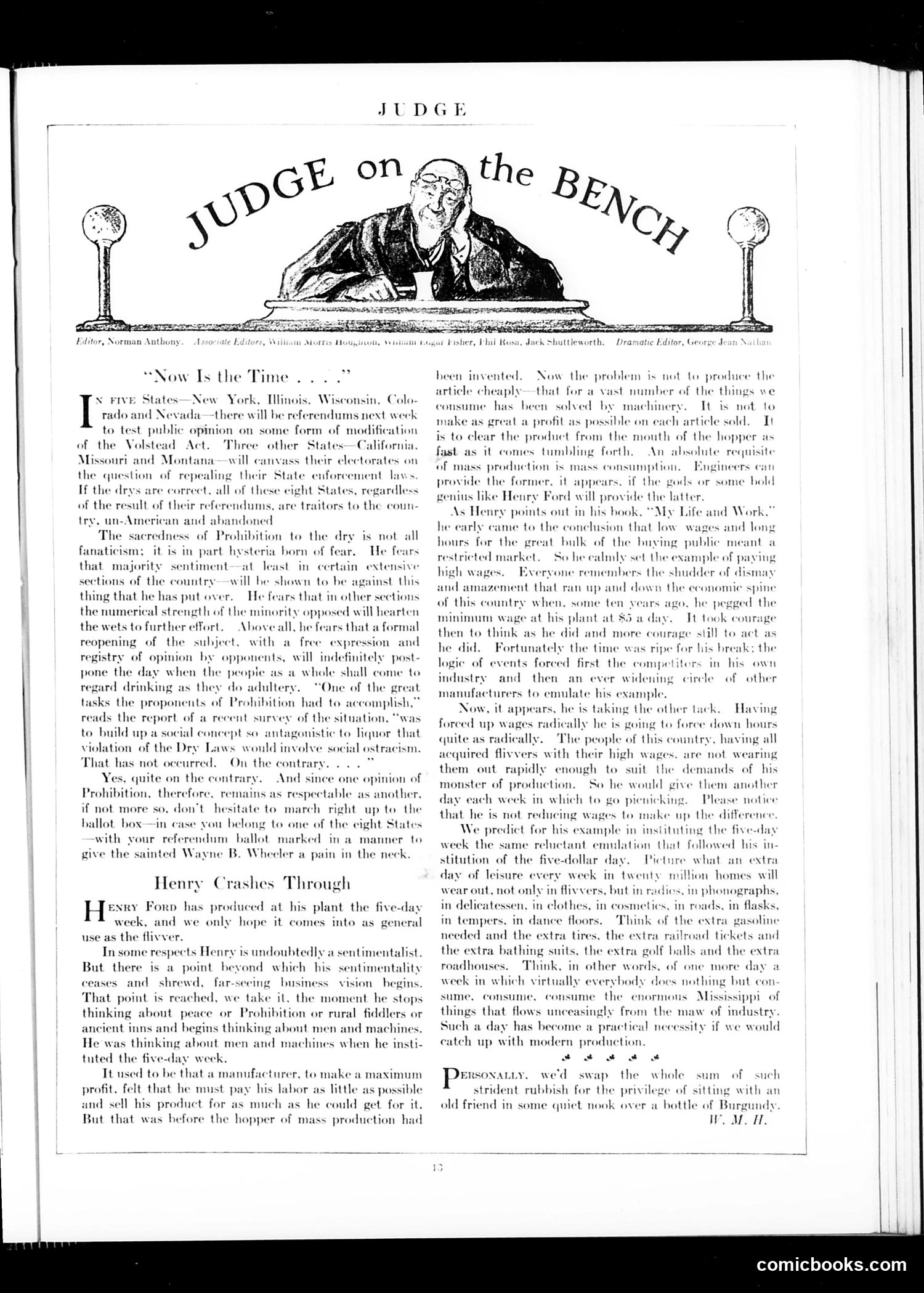
This page contains two editorials from Judge magazine addressing contemporary policy debates. **"Now Is the Time..."** discusses upcoming referendums in eight states on modifying or repealing Prohibition (the Volstead Act). The writer mocks "dry" (anti-alcohol) advocates' fears that public voting will reveal majority opposition to their policies. The satire targets Wayne B. Wheeler, a prominent Prohibition activist, suggesting that allowing democratic expression on the issue would cause him distress. **"Henry Crashes Through"** praises Henry Ford's introduction of the five-day work week. The editorial argues Ford recognized that mass production requires mass consumption, which demands workers with sufficient wages and leisure time to purchase goods. This contrasts Ford's enlightened self-interest against older manufacturing philosophy that minimized labor costs. The piece celebrates Ford's $5 daily wage—controversial when announced—as visionary business strategy rather than mere sentimentality. Both pieces advocate for progressive social change through practical reasoning rather than ideology.
📄 Transcribed text from this page (OCR, searchable)
Machine-transcribed from the original scan — historical spelling and the odd misread are preserved.
Editor, Norman Anthony “Now Is the Time... 2” N FIVE States—New York, Tllinois. Wisconsin. Colo- rado and Nevada—there will be referendums next week to test public opinion on some form of modification of the Volstead Act. Three other States—California. Missouri and Montana—will canvass their electorates on the question of repealing their Sta If the drys are correct, all of these of the result of their referendums, try. un-American and a te enforcement laws it States, regardless traitors to the coun- indoned The sacredness of Prohibition to the dry is not all fanaticism: it is in part hysteria born of fear. He fears that majority sentiment-—at least in’ certain. extensive sections of the country —will be shown to be against this thing that he has put over. He fears that in other sections the numerical strength of the minority opposed will hearten the wets to further effort. Above all, he fears that a formal reopening of the subject, with a free expression and registry of opinion by opponents, will indefinitely post- pone the day when the people as a whole s regard drinking as they Il come to jo adultery. “One of the great tasks the proponents of Prohibition had to accomplish,” reads the report of a recent survey of the situation, * to build up a social concept so ar was zonistic to liquor that violation of the Dry Laws would involve soc ial ostrac’ ism. That has not occurred. On the contrary. Yes, quite on the contrary. And since one opinion of Prohibition, therefore, remains as respectable as another, if not more so, don’t hesitate to march right up to the ballot box—in case you belong to one of the eight States with your refe rendum ballot: marked in a manner to give the sainted Wayne B. Wheeler a pain in the neck. Henry Crashes Through Hs Foro has produced at his plant the five-day week, and we only hope it comes into as general use as the flivver. In some respects Henry is undoubtedly a sentimentalist. But there is a point beyond which his sentimentality ceases and shrewd, far-seeing business vision begins. That point is reached, we take it, the moment he stops thinking about peace or Prohibition or rural fiddlers or ancient inns and begins thinking about men and machines. He was thinking about men and machines when he insti tuted the five-day week. It used to be that a manufacturer, to make a maximum profit. felt that he must pay his labor as little as possible and sell his product for as much as he could get for it. But that was before the hopper of mass production had JUDGE Fisher, hil Kosa, duck Shuttleworth invented. Now the problem is not to produce the article cheaply—that for a vast number of the things we consume. } ren solved by machinery. Tt is not to ta profit as possible on each article sold. It make as gre is to clear the product from the mouth of the hoppe fast as it comes tumbling forth. An absolute requisite of mass production is mass consump titi Engineers can provide the forme it appears. if the gods Ford will provide the latter “My Life and Work, he early came to the conclusion that low wages and long hours for the great bulk of the buying publie meant a restricted market some bold genius like Henr: As Henry points out in his book, So he calmly set the example of paying high wages. Everyone remembers the shudder of dismay and ar ement that ran up and down the economic spine of this country when. some ten years ago. he pegged the minimum wage at his plant at $5.a day. Jt took courage then to think as he did and more cour he did. Fortunately the time was ripe f logic of events fore lll to act as r his break: the d first the competitors in his own industry and then an ever widening cirele of other manufacturers to emulate his example, Now, it appears, he is taking the other tack. Having forced up wages radically he is going to foree down hours quite as radically. The people of this country, having all acquired flivvers with their high wages. are not wearing them out rapidly enough to suit’ the demands of his monster of production. So he would give them another day each week in which to picnicking. Please notice that he is not reducing wages to make up the difference We predict for his example in instituting the five Ly week the same reluctant emulation that followed his in- stitution of the five-dollar day. Picture what an extra day of leisure every week in twenty million homes will wear out, not only in flivvers, but in radic in phonographs, in delicatessen, in clothes, in cosmetics, in roads, in flasks, in tempers. in dance floors. Think of the extra gasoline needed and the extra tires, the extra railroad tickets and the extra bathing suits, the extra golf balls and the extra roadhouses. Think, in other words, of one more day @ week in which virtually everyt s nothing but con sume, consume, consume the enormous Mississippi things that flows unceasingly from the maw of industry Such a day has become a practical necessity if we would catch up with modern production. a er a) ERSONALLY. we'd swap the whole sum of such strident rubbish for the privilege of sitting with an old friend in some quiet nook over a bottle of Burgundy 9 baat é comicbooks.com