
A complete issue · 36 pages · 1926
Judge — October 9, 1926
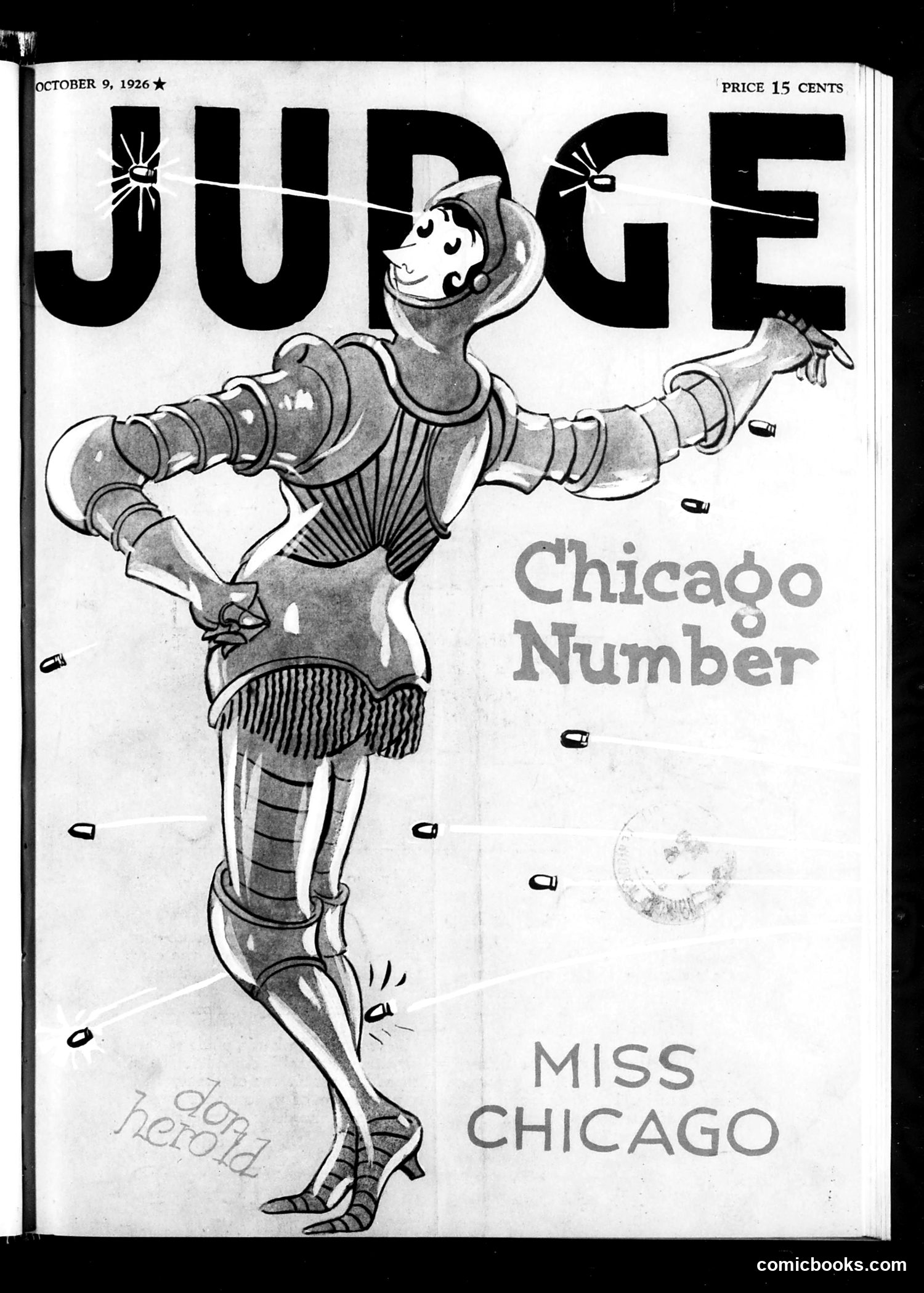
This October 9, 1926 cover features a stylized female figure in a metallic, space-age costume labeled "JUDGE" throwing bolts of electricity or lightning. The subtitle reads "Chicago Number" with "Miss Chicago" below. The image appears to be promoting Judge magazine's special Chicago edition. The futuristic, robotic costume and dynamic pose suggest power and modernity—likely celebrating Chicago's industrial strength and technological advancement during the 1920s, an era of rapid urbanization and industrial growth. The small bolts scattered around suggest energy, dynamism, and forward momentum. This was common 1920s visual language for depicting progress and American industrial prowess. The figure's exaggerated, cheerful expression epitomizes the optimistic spirit of the period before the 1929 stock market crash.
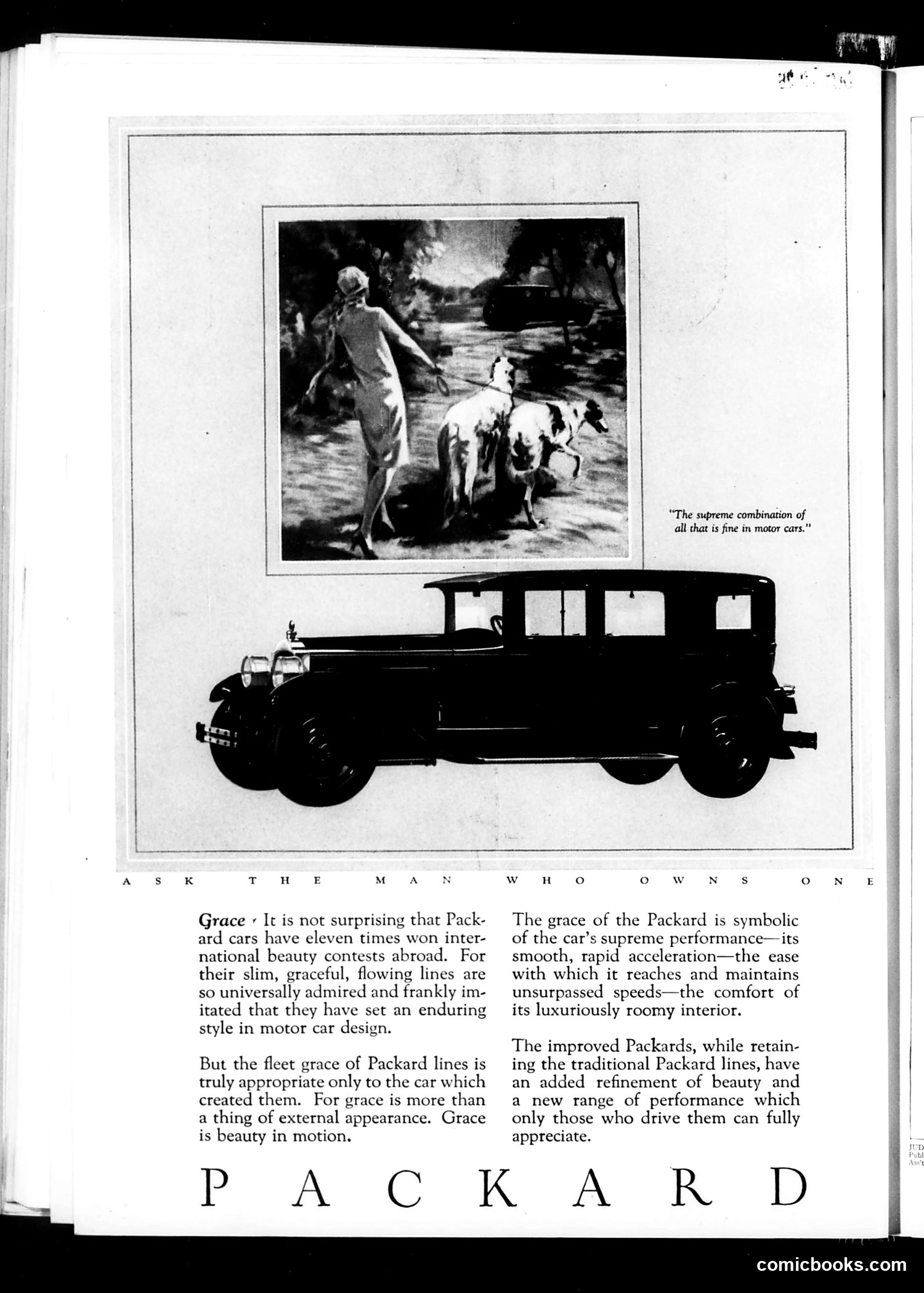
This is a **luxury car advertisement**, not political satire. The page promotes Packard automobiles, emphasizing their aesthetic and mechanical superiority. The headline "Grace" and accompanying photograph (showing a woman with a dog near a Packard) illustrate the brand's claim that elegance extends beyond appearance to performance—"grace is beauty in motion." The advertisement targets wealthy consumers, arguing that Packard's "graceful, flowing lines" have set an enduring design standard. The text boasts of the car's "smooth, rapid acceleration" and "luxuriously roomy interior," positioning Packard as the premium choice for discerning buyers. This represents early 20th-century advertising strategy: linking consumer goods to lifestyle aspirations and social status.
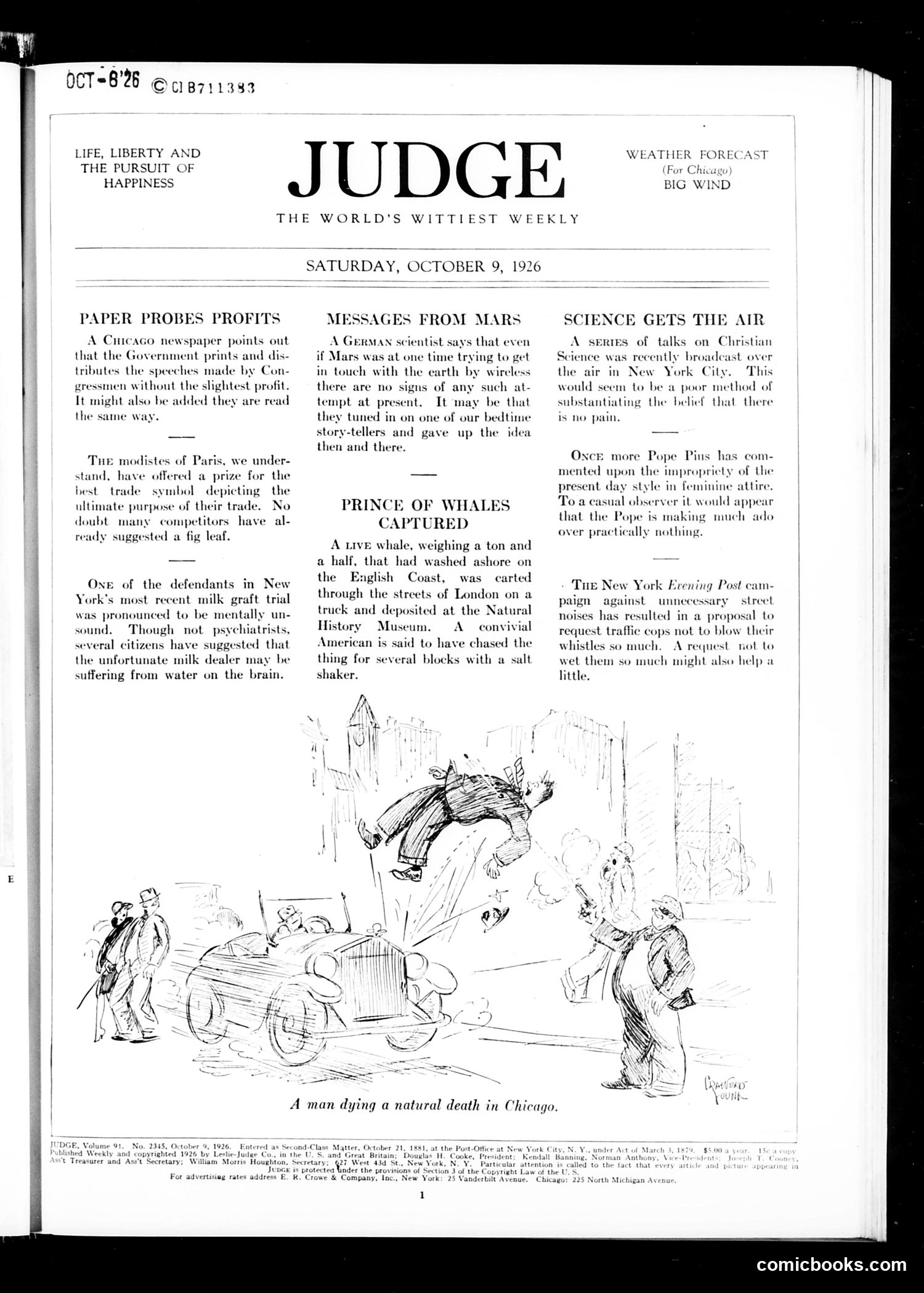
The main cartoon depicts "A man dying a natural death in Chicago." The image shows a figure being thrown from a car amid violence and chaos on a city street, with bystanders reacting in alarm. This is satire about Chicago's notorious gangland violence during Prohibition (1920-1933). The joke's dark premise is that violent death had become so commonplace in Chicago—due to mob wars, bootlegging conflicts, and general lawlessness—that a "natural death" (dying peacefully of old age) would be the unusual occurrence, not violent murder. The cartoon mocks the city's reputation for extreme criminal activity and the apparent indifference of authorities to controlling it. This reflects genuine historical conditions during the Prohibition era when Chicago experienced unprecedented organized crime violence.
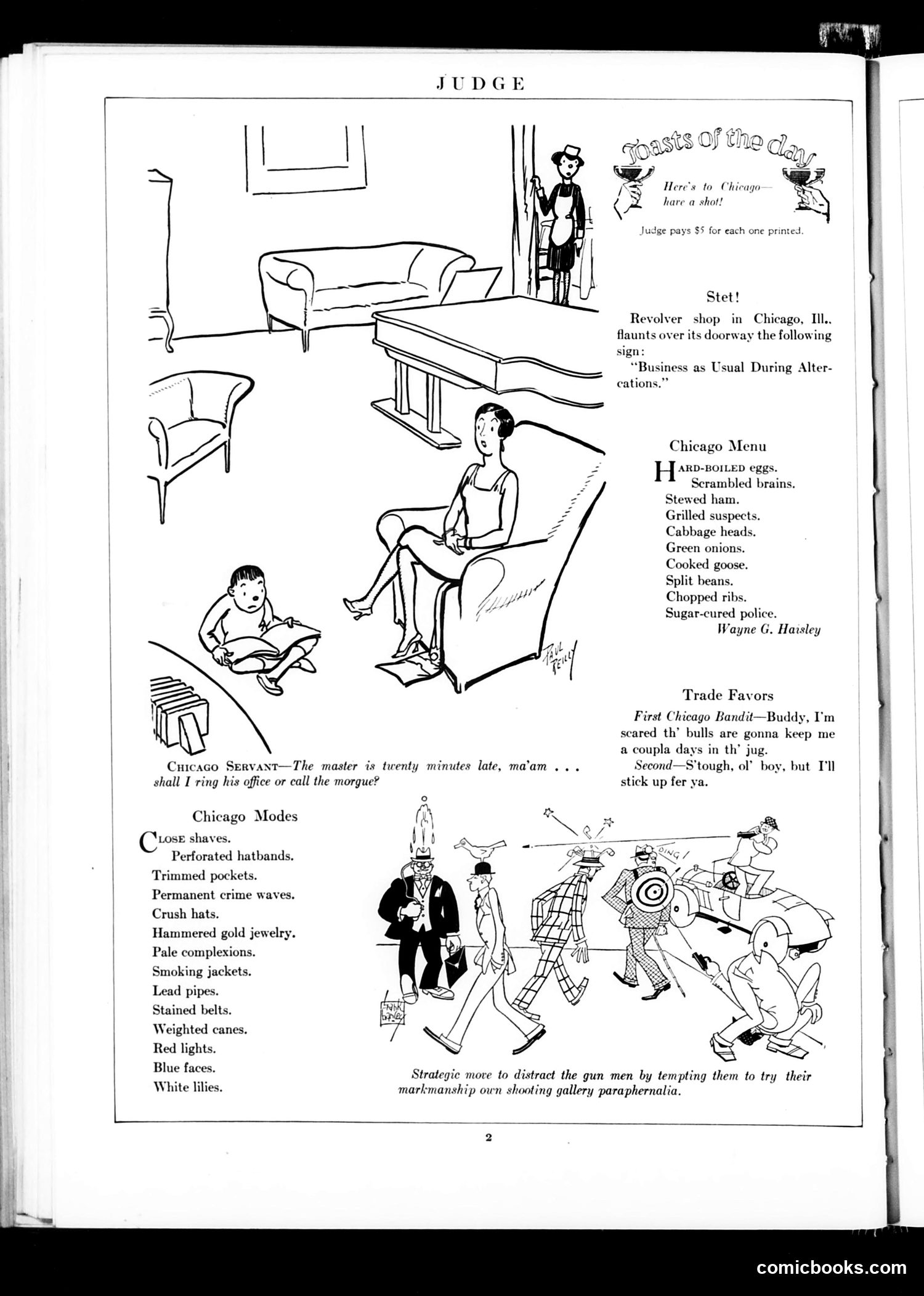
This page satirizes Chicago during Prohibition and the gangster era. The "Chicago Servant" joke references servants calling the morgue when the master is late—implying widespread violence and death. The "Chicago Menu" darkly lists butchered body parts ("Chopped ribs," "Sugar-cured police") alongside food, suggesting organized crime's brutality. "Chicago Modes" mocks the era's fashion as reflecting urban decay: "Red lights," "Blue faces," "Lead pipes," and "Stained belts" allude to vice districts, violence, and weapons. The bottom illustration shows gun violence distracting spectators at what appears to be a shooting gallery. The overall satire portrays Chicago as lawless and violent—a common perception during the height of Prohibition-era gang warfare and corruption.
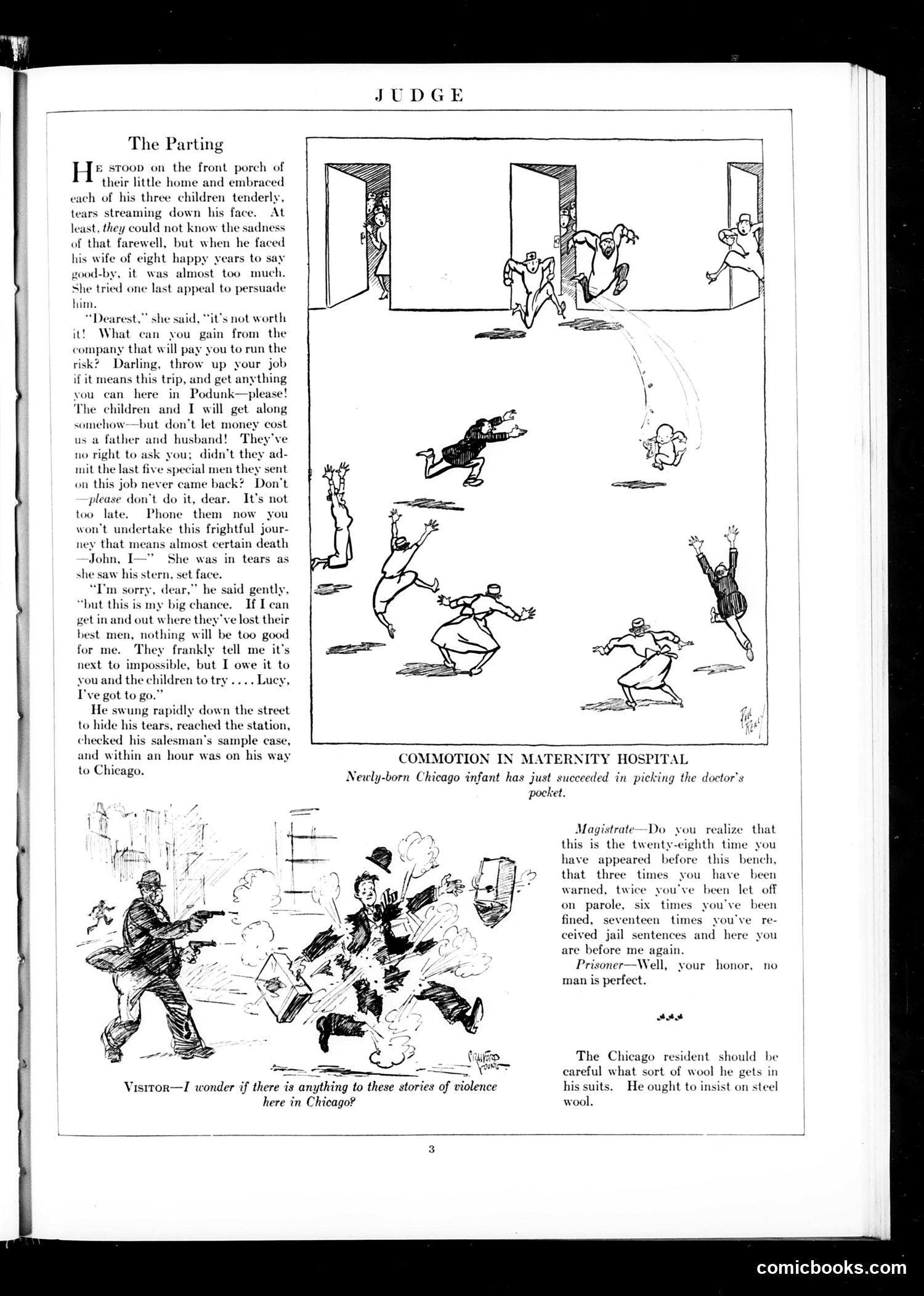
This page contains three distinct satirical pieces: **"The Parting"** depicts a man leaving his family for a job opportunity in Podunk, with his wife tearfully pleading him not to go, fearing financial ruin. The satire critiques masculine pride and poor economic decision-making during what appears to be an employment crisis. **"Commotion in Maternity Hospital"** shows newborns wildly active in a hospital, satirizing either chaotic medical conditions or the unpredictability of childbirth outcomes. **"Visitor" scene** (bottom left) depicts apparent street violence or disorder in Chicago, with accompanying commentary questioning the prevalence of violence in the city—social commentary on urban crime and public safety concerns of the era. The overall page satirizes American domestic anxieties, institutional chaos, and urban disorder.
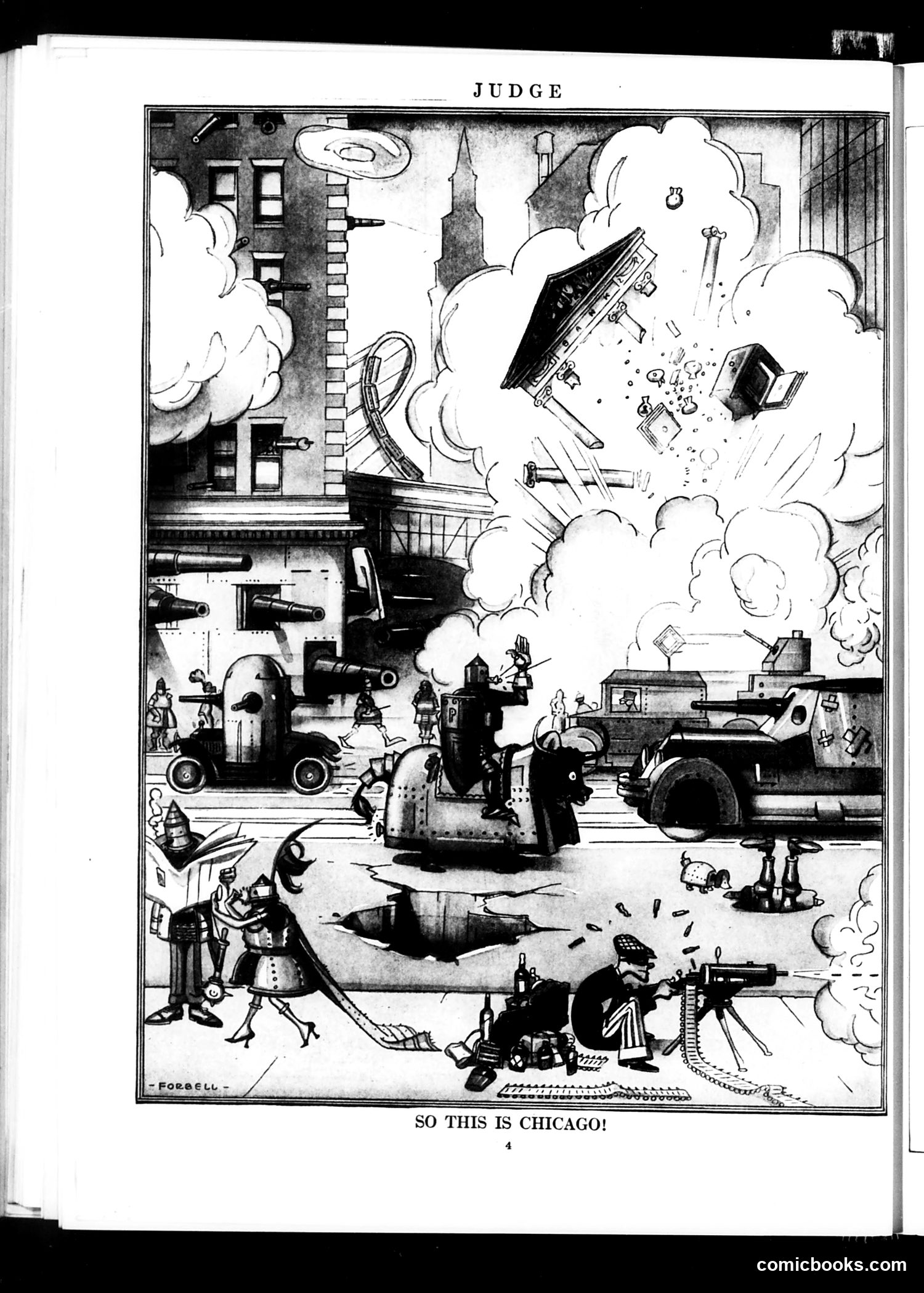
This satirical cartoon depicts Chicago experiencing violent chaos—explosions, gunfire, crashed vehicles, and destruction throughout an urban landscape. The title suggests the image represents a visitor's or newcomer's shocked reaction to the city. The cartoon likely references Chicago's notorious reputation during Prohibition (1920s-1930s) for organized crime, gang violence, and police corruption. The abundance of weapons, explosions, and emergency vehicles suggests the cartoon criticizes the city's inability to maintain public safety and order. The exaggerated, chaotic scene functions as social commentary on Chicago's crime problem. The artist (signed "Forbell") appears to be mocking the city's lawlessness and presenting it as so extreme and widespread that violence and destruction have become the city's defining characteristic—presented ironically as a tourist attraction or defining feature.
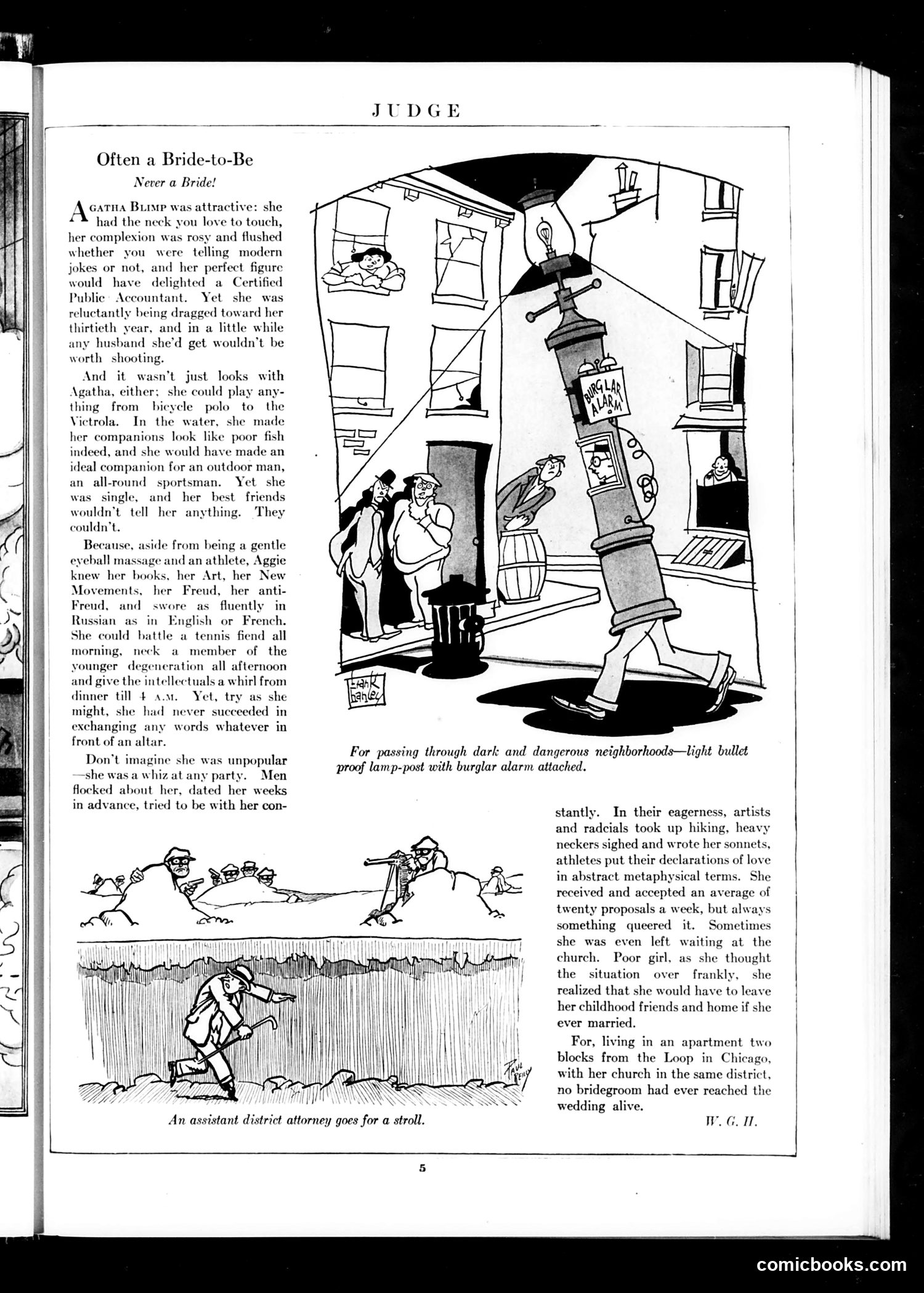
This satirical piece mocks Agatha Blimp, an attractive woman with excellent qualifications (athletic, well-read, intellectually engaged) who is perpetually engaged but never actually marries. The story suggests she receives constant marriage proposals from men, yet something always prevents each engagement from reaching the altar. The accompanying cartoons satirize professional men—an attorney and others—depicted in undignified situations, suggesting the absurdity of romantic pursuits disrupting serious professional life. The central joke targets the era's marriage-obsessed culture: despite being an ideal catch by every measurable standard, Agatha remains single. The satire critiques both her suitors' inability to commit and society's narrow focus on women's marriageability as their primary social value.
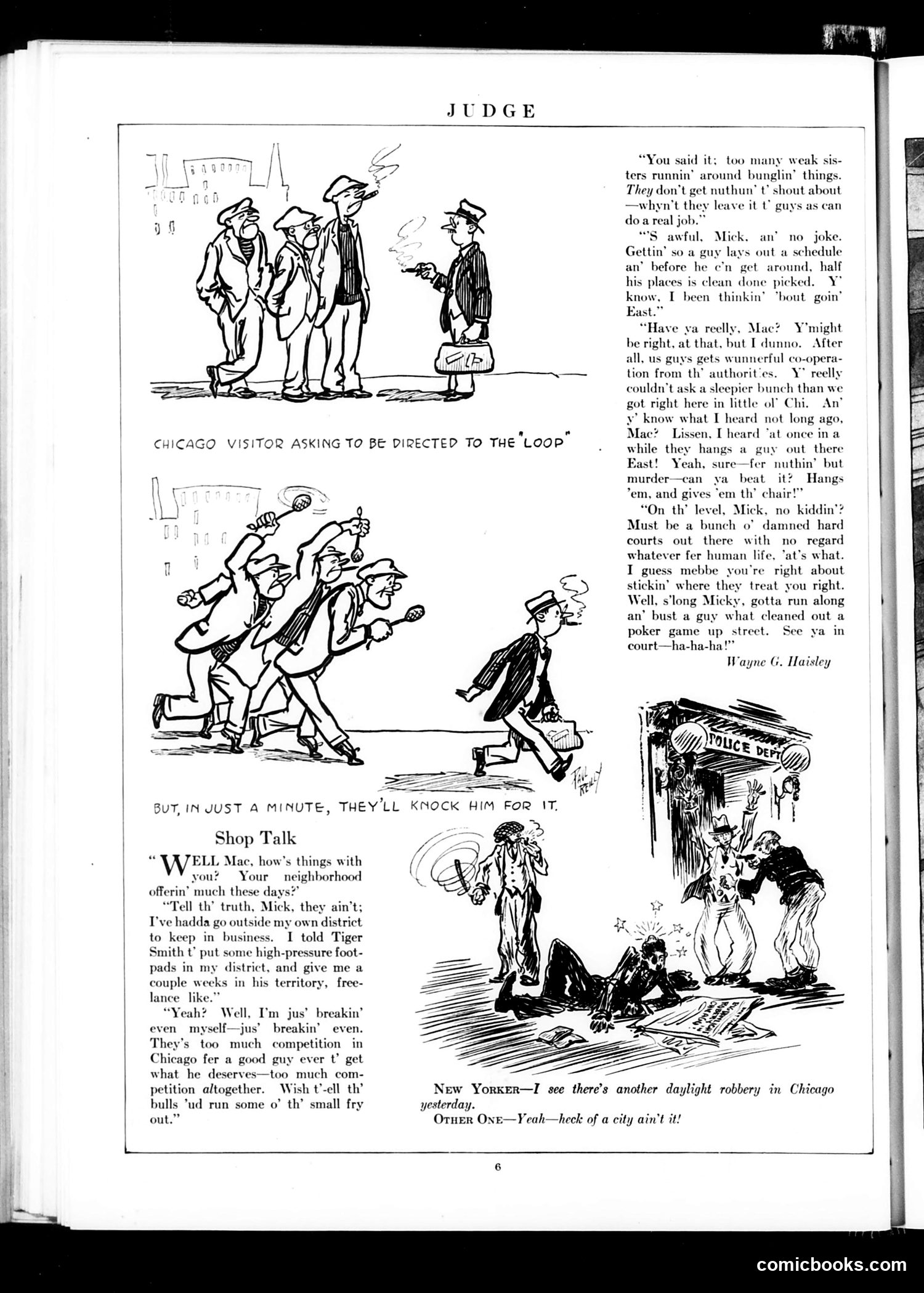
This page satirizes organized crime in Chicago, depicting two criminals ("Mick" and "Mac") casually discussing their "business" — stealing and robbery. The humor relies on treating violent crime as a commercial enterprise with standard workplace complaints: too much competition, encroachment on territory, and unreliable "employees" ("weak sisters") bungling jobs. The cartoons show a Chicago visitor asking directions to "the Loop" (downtown) while being robbed, and criminals being chased by police. The dialogue mocks how criminals operate openly in Chicago with apparent impunity, contrasting this with Eastern cities where murderers face execution ("hangs a guy"). The satire critiques Chicago's corrupt police and judicial system, suggesting authorities tacitly allow organized crime to flourish. The criminals feel safer in Chicago than anywhere else — a damning commentary on civic corruption. The final exchange between a New Yorker and "Other One" reinforces that Chicago's lawlessness is notorious and notorious.
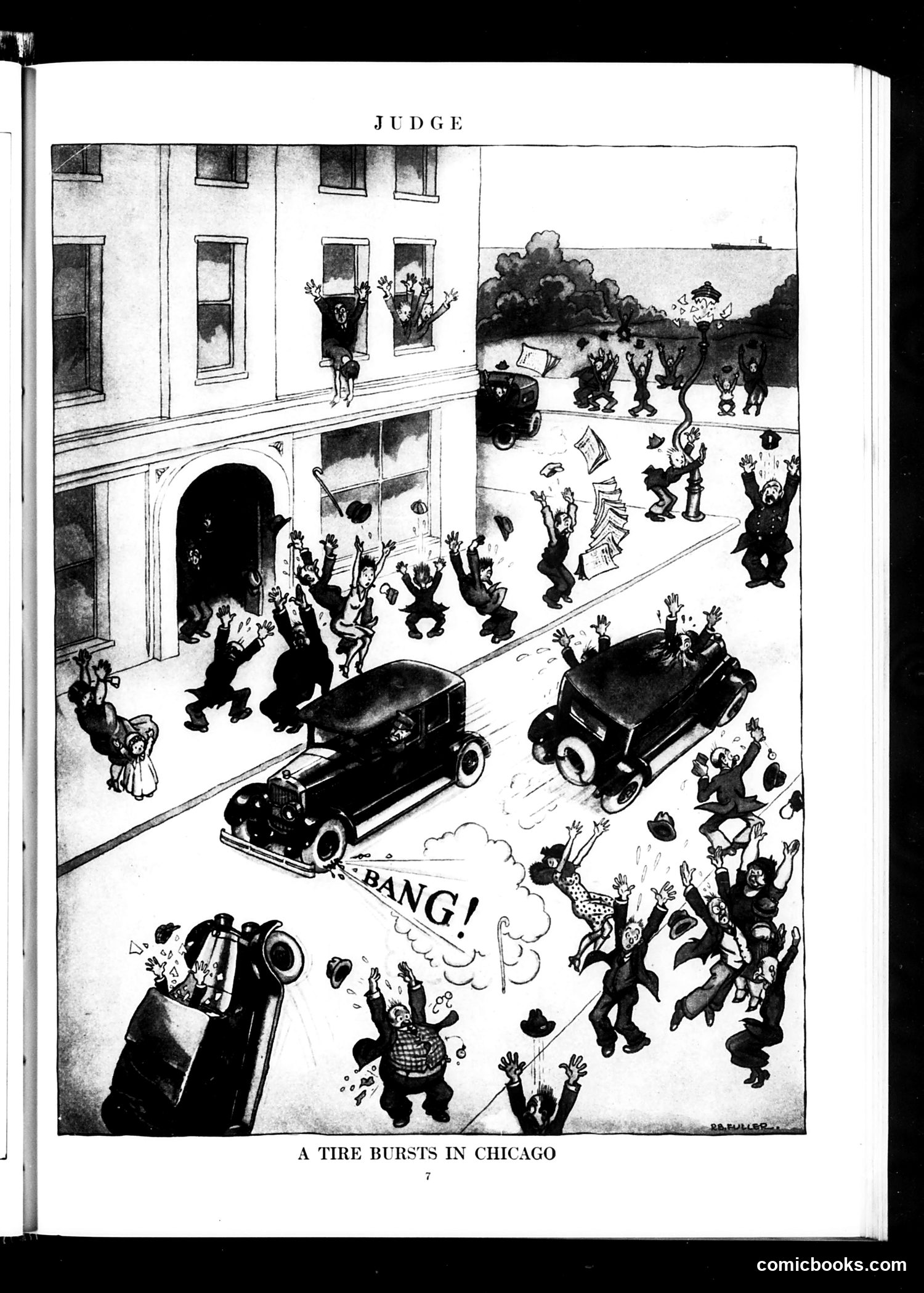
This cartoon satirizes the chaos caused by a simple car tire explosion in an urban setting. The "BANG!" caption marks the moment of the blowout, which triggers absurd, disproportionate panic among pedestrians and bystanders. The joke critiques overreaction to minor incidents—a tire burst prompts a citywide commotion with people fleeing in all directions, cars swerving, and general mayhem. The formal building (possibly a courthouse, given the "JUDGE" header) and respectable setting emphasize the contrast between the trivial cause and the extreme effect. This reflects early 20th-century anxieties about automobiles as unpredictable, dangerous novelties that could disrupt urban order. The cartoon mocks both public fear of cars and the tendency toward mass hysteria over mechanical mishaps in modern cities.
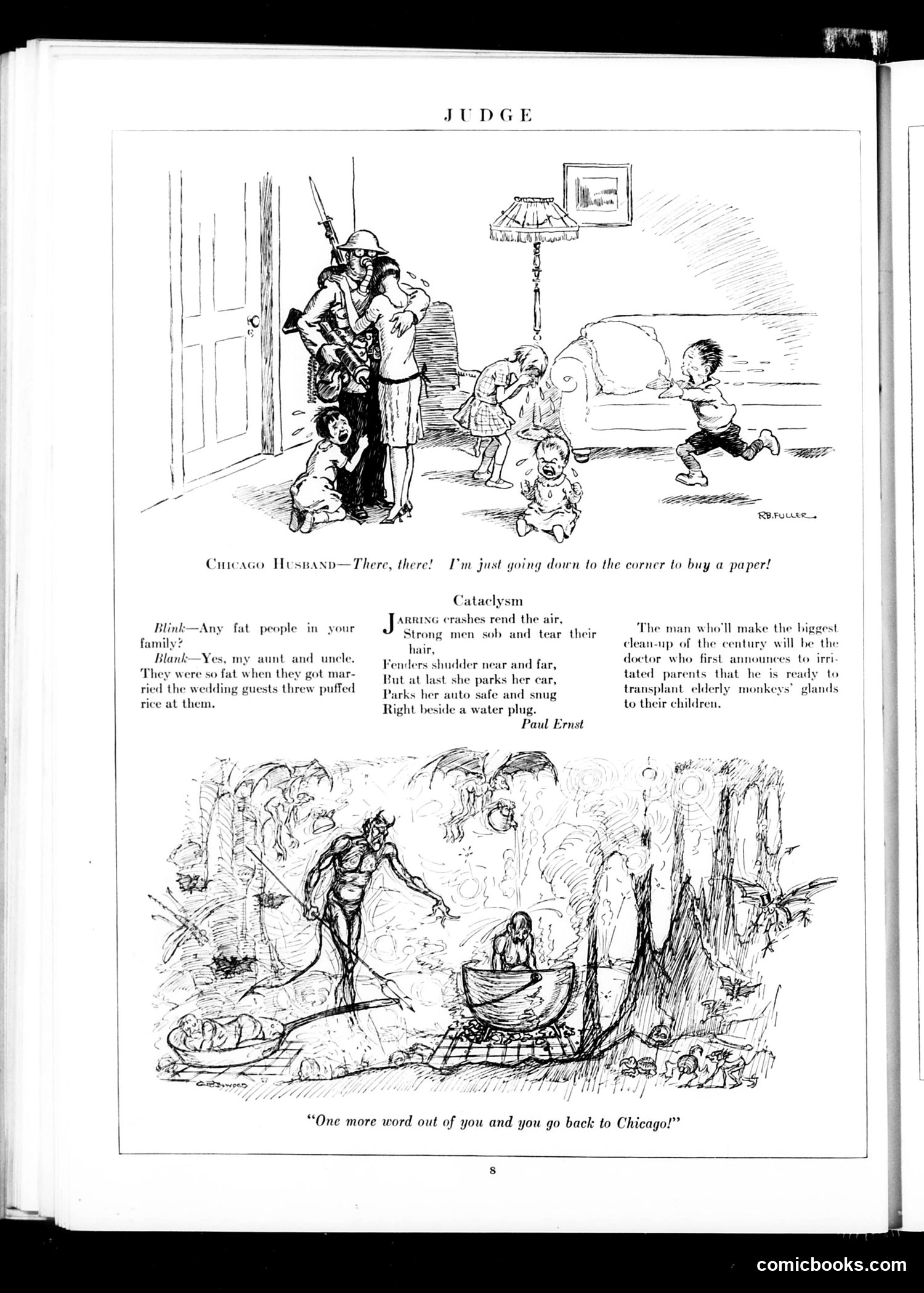
**Top Cartoon:** A Chicago husband reassures his wife he's "just going down to the corner to buy a paper" while surrounded by children—a domestic humor joke about a husband's transparent excuse to escape the chaos of childcare. **Middle Joke:** A brief exchange mocking overweight relatives at a wedding, using the dated phrase "puffed rice" as a pun. **"Cataclysm" Poem:** Satirizes a woman driver whose reckless driving ("crashes," "fenders shudder") is only resolved when she finally parks successfully. This reflects early-20th-century anxiety about women drivers—a common Judge theme. **Bottom Text:** Satirizes both gullible parents and pseudoscientific medical trends of the era. It mocks the notion that transplanting monkey glands could rejuvenate or improve children, referencing the 1920s fad of "monkey gland" transplants promoted by charlatans as age-defying treatments.
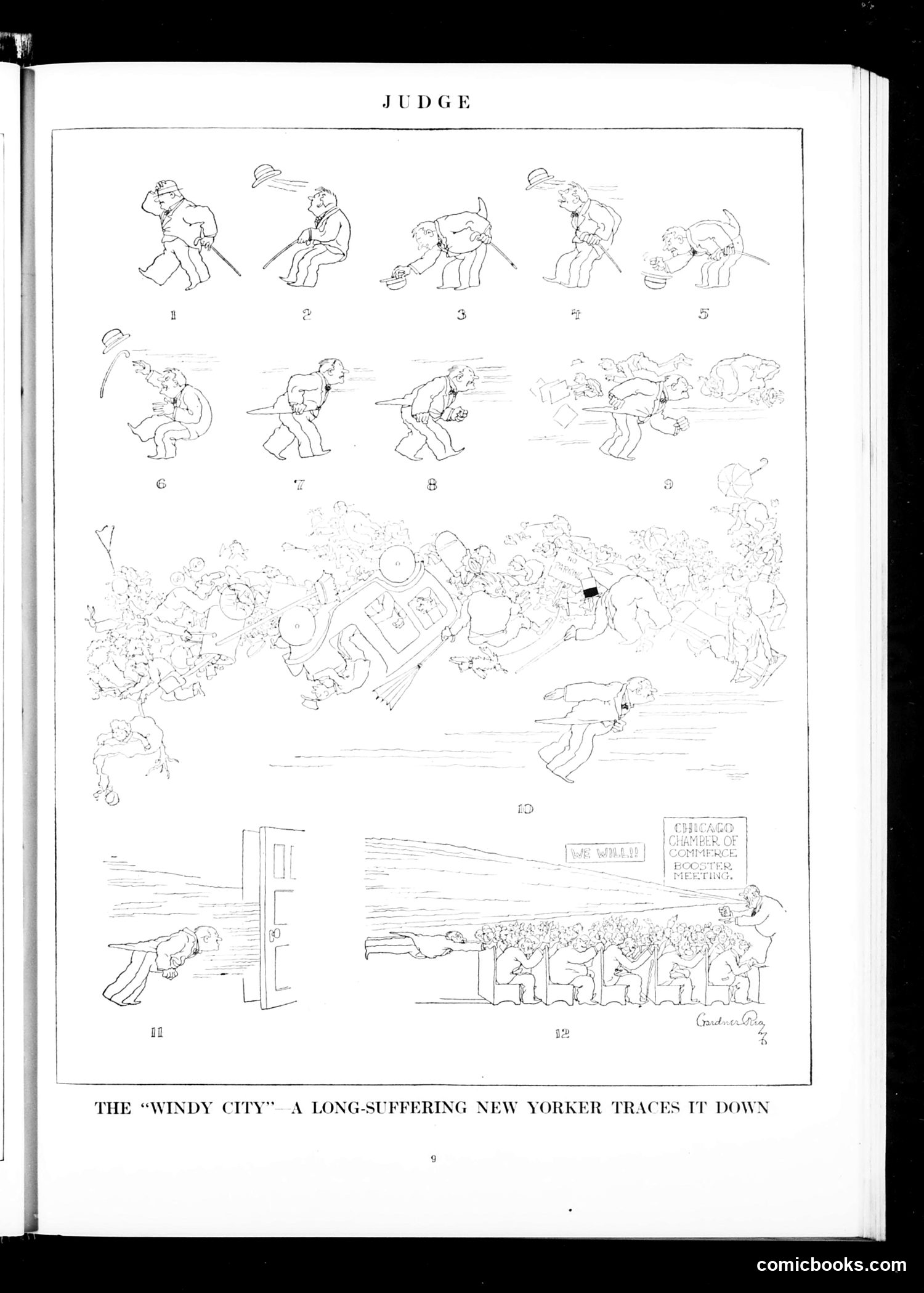
This page satirizes Chicago, nicknamed "The Windy City," through a series of sequential cartoon panels showing a New Yorker experiencing the city's notorious wind. The top panels (1-9) depict increasingly absurd encounters with powerful gusts: a man struggling to walk, being blown around, losing his hat and clothing, and eventually being knocked down entirely. The larger bottom panels show the escalating chaos: pedestrians scattered by wind, a person blown through a doorway, and a final scene at what appears to be the Chicago Chamber of Commerce, where officials are literally blown away by the wind while addressing an audience. The satire mocks both Chicago's extreme weather conditions and the city's boastful Chamber of Commerce, suggesting their civic pride cannot withstand reality. The New Yorker serves as an outsider perspective on Midwestern excess.
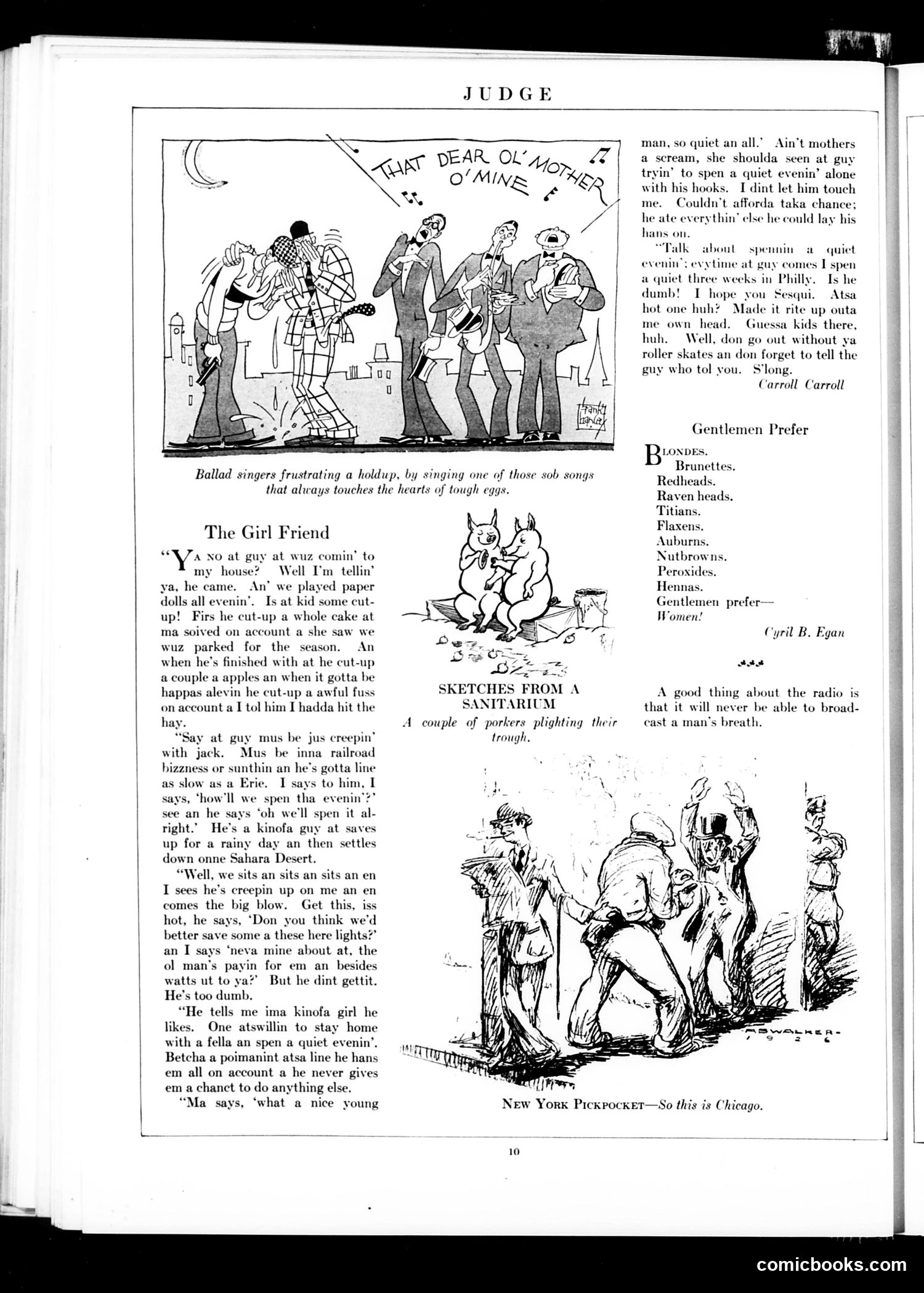
This page contains three distinct pieces of humor: **"The Girl Friend"** (main text): A monologue in exaggerated working-class dialect recounting a date. The satire targets both the verbose, gossipy young woman narrator and her cheap date—a man who tries to economize (turning off lights during an evening) while pretending to be wealthy. The humor lies in her obliviousness to his stinginess and her contradictory boasting. **"Sketches from a Sanitarium"** (bottom left): A simple cartoon showing pigs at a trough, with the caption implying asylum patients eating. This is crude humor comparing institutionalized people to animals. **"Gentlemen Prefer"** (right column): A list by Cyril B. Egan playing on the popular 1920s book *Gentlemen Prefer Blondes*, but extending it to mock men's preferences for various hair colors—ultimately suggesting gentlemen prefer women regardless of appearance, undercutting the original's premise. **"New York Pickpocket"** (bottom): A one-liner joke about a criminal observing Chicago's reputation for crime. The page reflects 1920s-era American humor: working-class dialect comedy, mild misogyny, and social commentary.
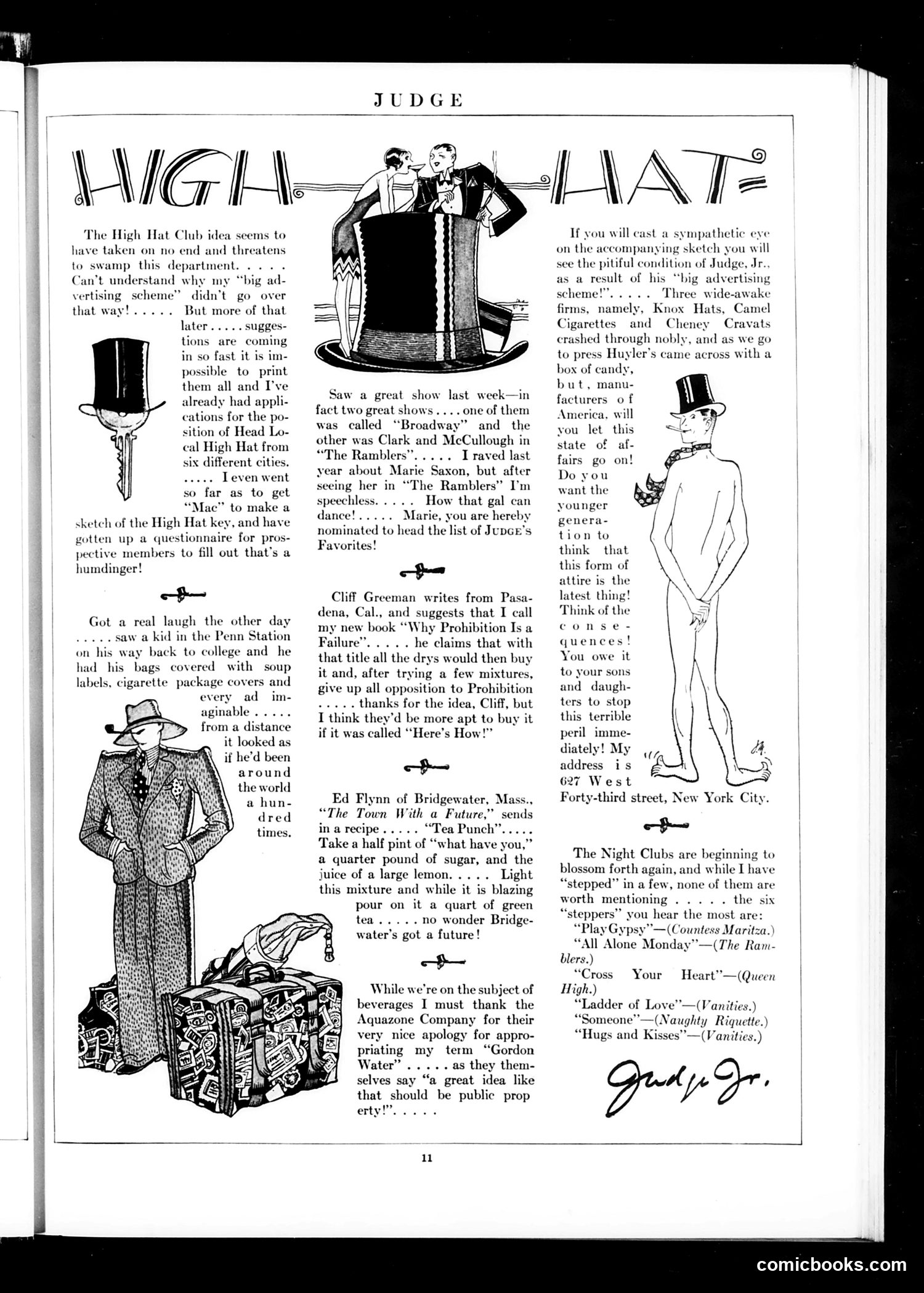
This page from Judge satirizes American consumer culture and advertising excess during the Prohibition era (likely 1920s). The main target is Judge Jr.'s failed "big advertising scheme"—a satire on commercial exploitation where the young mascot became a walking billboard covered in soup labels and cigarette packages, resembling someone "who'd been around the world a hundred times." The humor mocks both corporate opportunism and naive youth vulnerability to marketing. References include real Broadway shows ("The Ramblers"), cigarette brands (Camel, Cheney Cravats), and candy companies (Huyler's). A secondary joke attacks Prohibition's failure, with a recipe for illegal "Tea Punch" disguised as legitimate beverage instruction. The satirical point: American corporations exploit children and young people through aggressive advertising, while Prohibition is openly mocked through thinly-veiled alcohol recipes. The author presents this advertising excess as absurd and morally questionable.
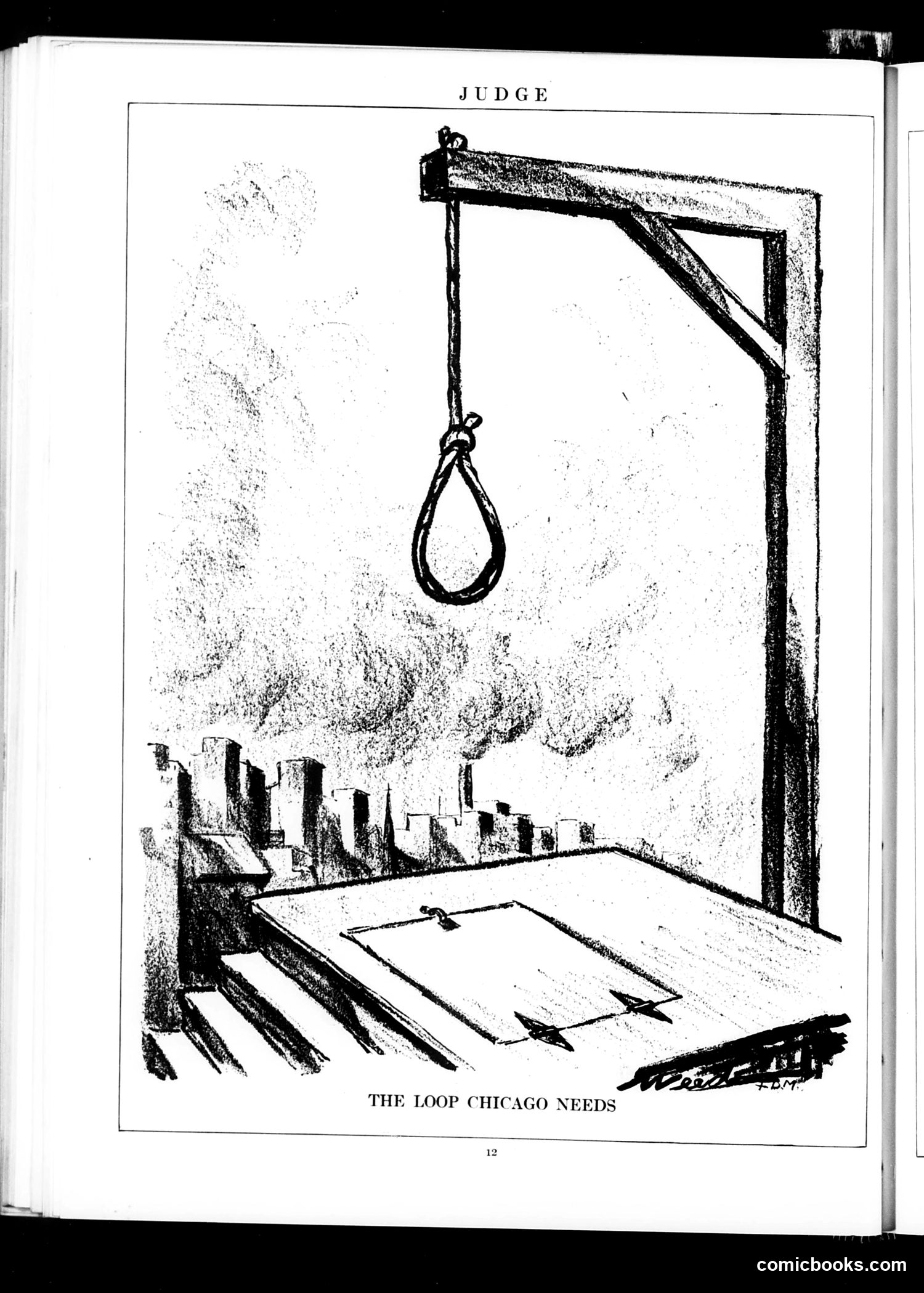
This is a darkly satirical political cartoon titled "The Loop Chicago Needs." The image depicts a gallows with a noose hanging over an empty wooden platform, with Chicago's skyline visible in the background through a barred window. The cartoon appears to be commentary on capital punishment and Chicago's criminal justice system or crime problem. The word "loop" likely references Chicago's downtown "Loop" district while also punning on the noose. The caption suggests the cartoonist is sarcastically proposing execution as a solution to whatever social or criminal problems Chicago faced at the time Judge magazine was published. Without the publication date visible, the specific crisis being referenced remains unclear, though the harsh tone suggests serious urban crime or corruption concerns.
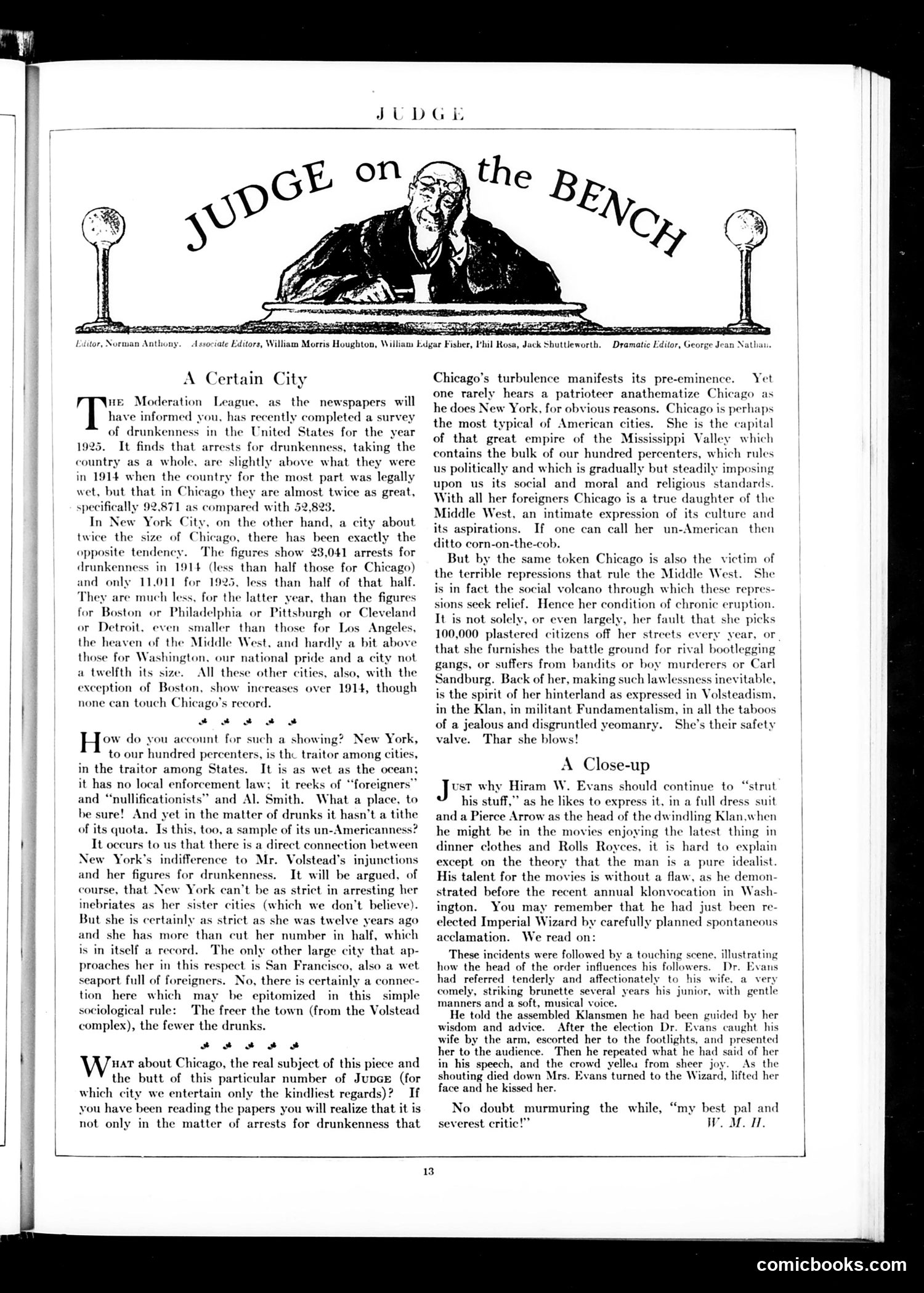
This satirical piece uses 1925 arrest statistics to mock American Prohibition enforcement and regional hypocrisy. The article contrasts Chicago—a supposedly "dry" Midwestern city embodying strict moral standards—with New York, dismissed as lawless and "un-American" for its wet sympathies and immigrant population ("foreigners," "Al. Smith"). The satire's point: Chicago actually has *double* New York's drunkenness arrests, yet faces no patriotic condemnation. Judge argues this proves that strict Prohibition (the "Volstead complex") actually *increases* drunkenness through repression. New York's casual tolerance produces fewer arrests. The deeper jab targets hypocrisy: Middle America preaches morality while generating social chaos; it condemns New York's foreigners while Chicago suffers from the same immigrant presence. The conclusion suggests Chicago is a social "volcano" where Midwestern moral repression inevitably erupts into lawlessness—a critique of Prohibition itself disguised as regional critique.
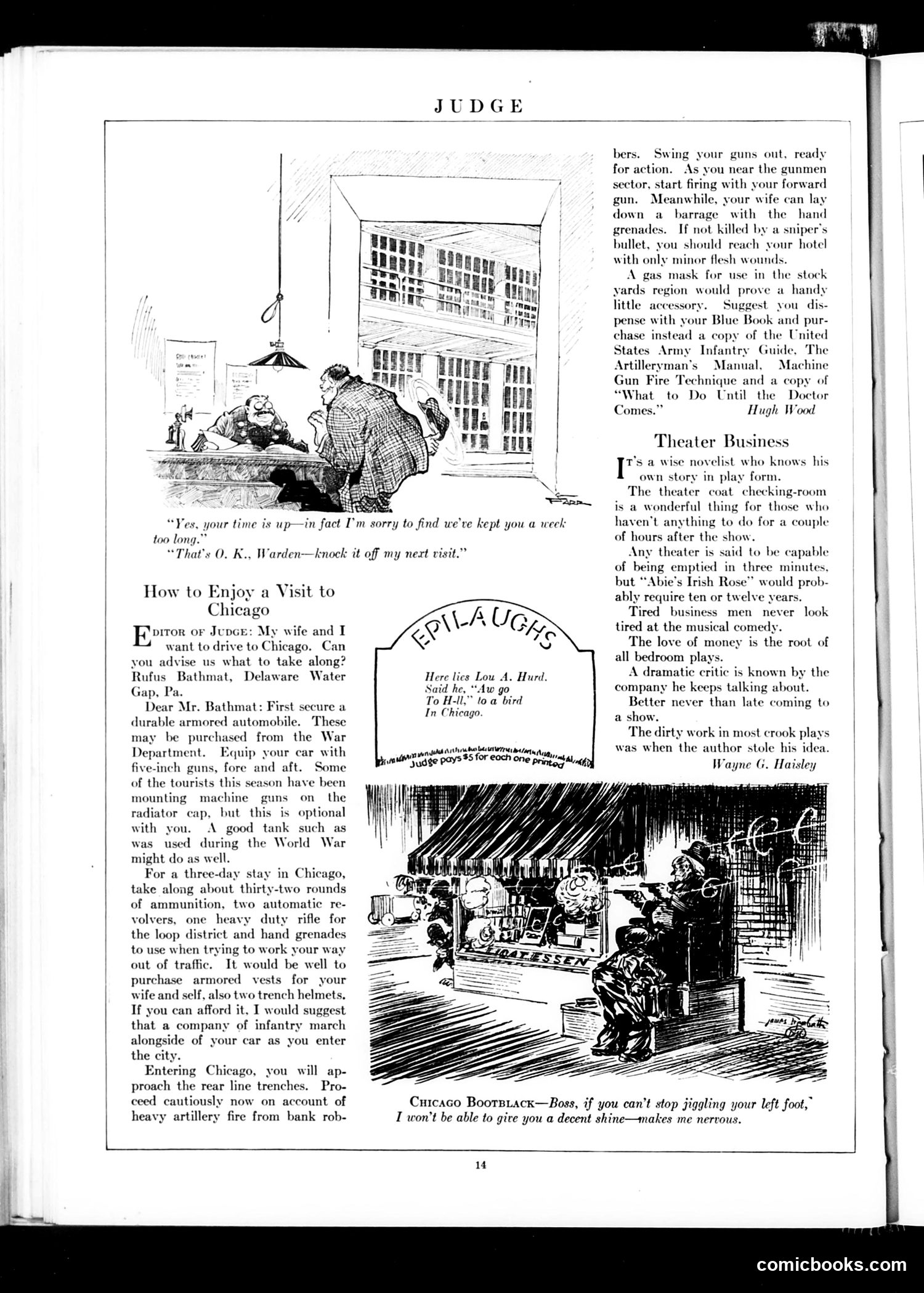
This satirical advice column parodies Chicago's notorious 1920s gangland violence and organized crime. The "Editor or Judge" humorously responds to a tourist inquiry by recommending visitors arrive armed like soldiers—complete with "five-inch guns," machine guns, hand grenades, and armored vests—as if entering a war zone rather than a city. The joke reflects Chicago's real reputation during Prohibition as a dangerous battleground between rival gangs, with frequent shootouts, bank robberies, and gang violence making headlines. References to "gunmen sector," "artillery fire from bank robbers," and treating traffic navigation as combat underscore this deadly reality. The accompanying cartoons and quips mock both the city's lawlessness and period attitudes toward it. This represents Judge's typical satirical approach: exaggerating contemporary social problems for comic effect while implicitly critiquing the conditions that made such satire grimly plausible.
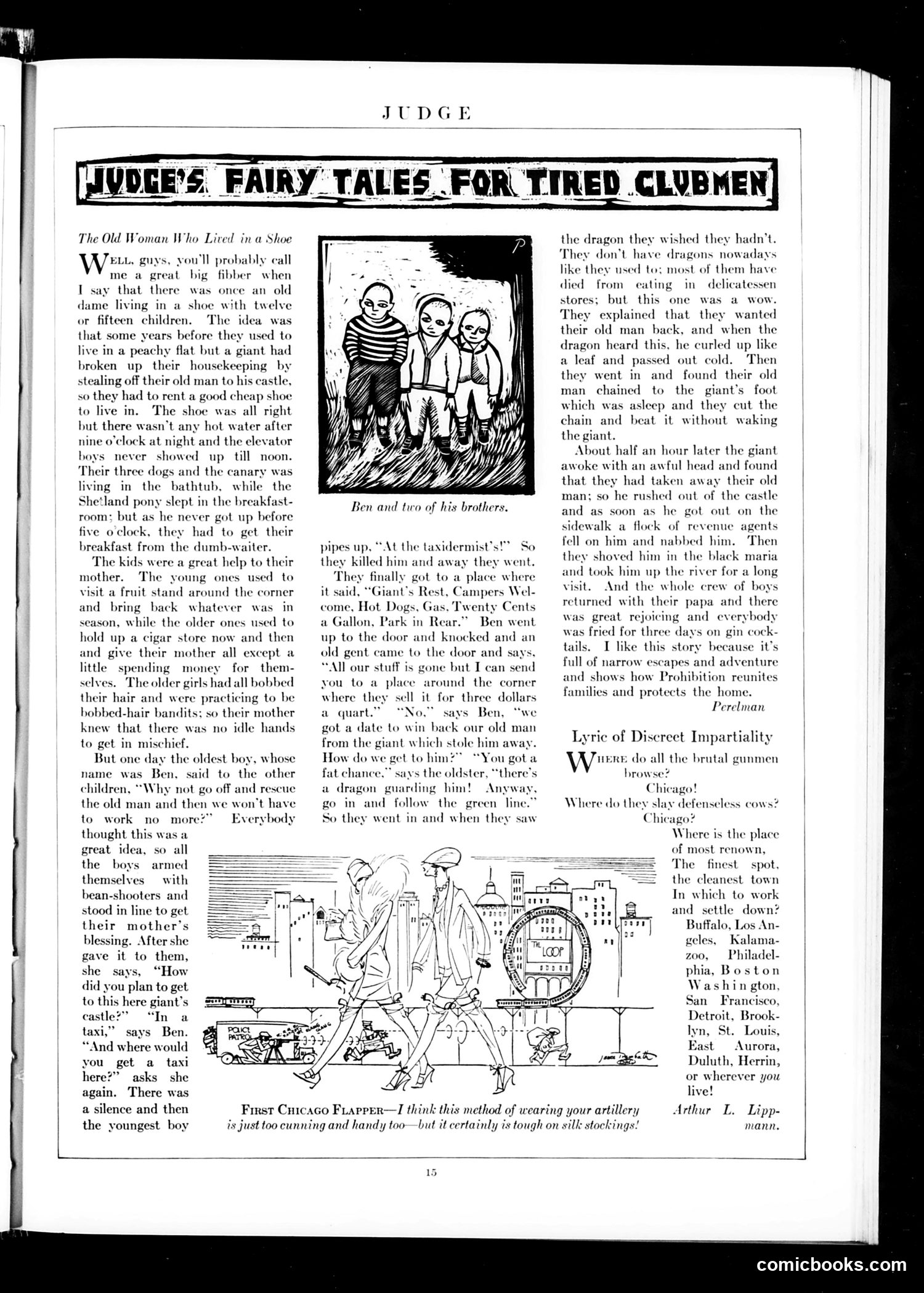
This page contains a satirical fairy tale retelling and Prohibition-era humor targeting a 1920s American audience. **"The Old Woman Who Lived in a Shoe"** modernizes the nursery rhyme as social satire. The family's poverty (living in a shoe, no hot water, dogs in bathtub) reflects Depression-era housing struggles. The children's crimes—stealing from fruit stands and committing armed robberies—are presented matter-of-factly, satirizing urban juvenile delinquency. The story's climax uses Prohibition as a punchline: federal "revenue agents" arrest a giant, and the father's return causes family "rejoicing...on gin cocktails," mocking Prohibition's failure to stop drinking or crime. The accompanying cartoon shows men with "artillery" (bootleg liquor containers), satirizing Chicago's gangster violence during Prohibition. **"Lyric of Discreet Impartiality"** explicitly mocks Chicago as America's crime capital—"where brutal gunmen browse" and violence occurs—suggesting the city's notorious association with organized crime and gang warfare during the Prohibition era. The humor assumes readers' familiarity with Prohibition's unpopularity and its role in enabling organized crime rather than preventing it.
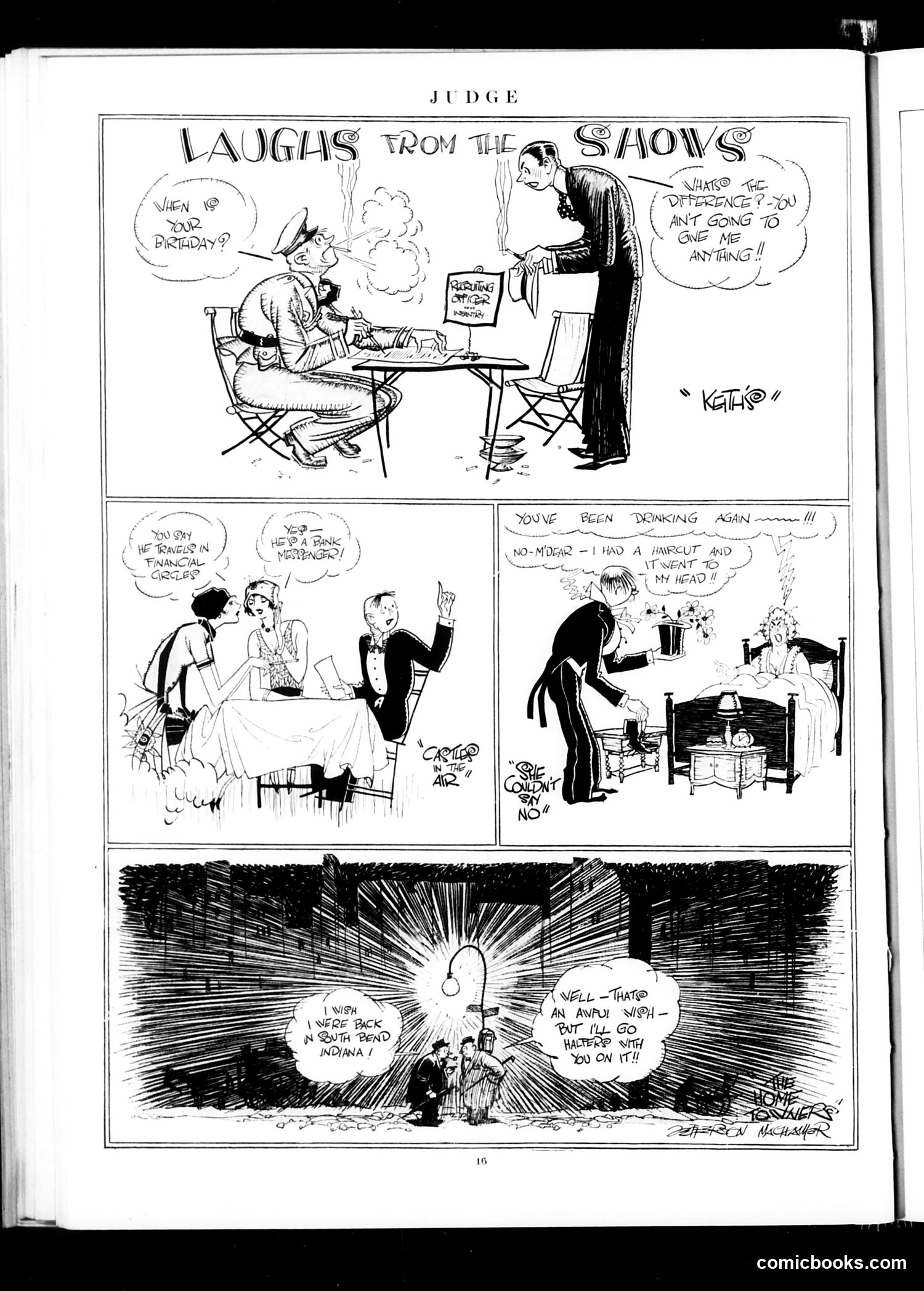
This page collects three brief comic sketches satirizing marital and social behavior: 1. **Top panel**: A man in formal wear confronts a woman at what appears to be a theatrical or show setting. The humor derives from domestic conflict—he accuses her of not giving him anything, she retorts he won't get anything from her either. 2. **Middle panels**: Social commentary on drinking and financial irresponsibility. One sketch shows a woman discovering her husband's drinking problem ("You've been drinking again"), while another depicts a man blaming alcohol for poor judgment ("I had a haircut and it went to my head"). 3. **Bottom panel**: A dramatic, heavily-inked finale showing figures in distress, wishing to escape to "South Bend, Indiana," suggesting they've reached marital or personal crisis. The overall theme satirizes Jazz Age domestic troubles—particularly male drinking, infidelity, and financial mismanagement—common subjects for Judge magazine's humor targeting middle and upper-class readers.
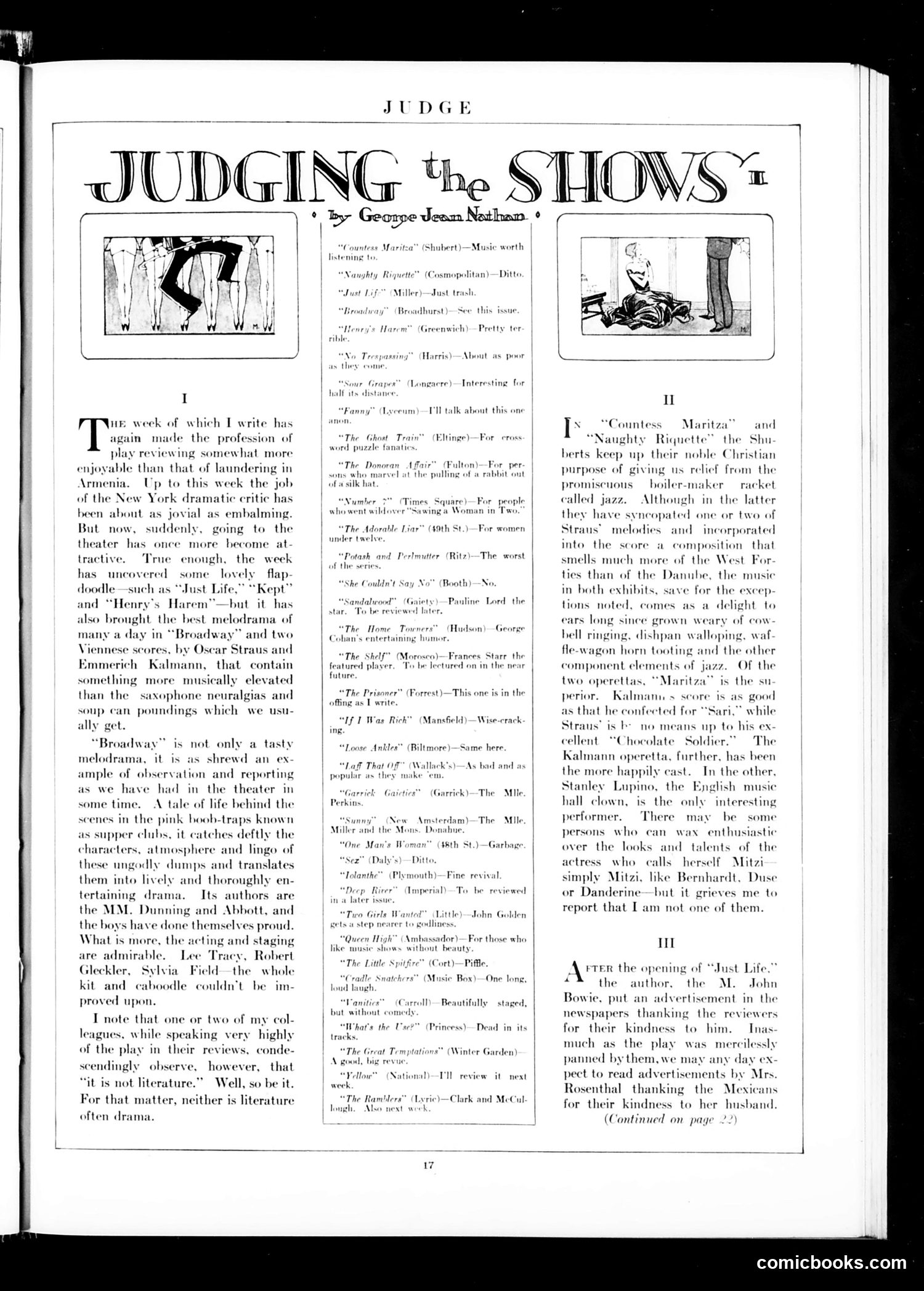
This is a theater review column by George Jean Nathan, a prominent drama critic. The page contains two illustrations and Nathan's brief, caustic assessments of current Broadway productions (plays, operettas, and musicals). The satire targets contemporary theatrical offerings with dismissive one-liners: shows are labeled "just trash," "garbage," or "as bad and as popular as they make 'em." Nathan particularly criticizes operettas by Oscar Straus and Emmerich Kalmann, finding them musically inferior to their earlier work—complaining the scores contain "saxophone neuralgias and soup can poundings" rather than genuine artistry. The column mocks performers too, notably an actress billed as "Mitzi" who claims comparison to Bernhardt and Duse but doesn't merit it. The tone reflects early 20th-century highbrow theater criticism: dismissive, witty, and contemptuous of both commercial mediocrity and performers' pretensions. Nathan positions himself as the arbiter of theatrical quality against Broadway's degraded tastes.
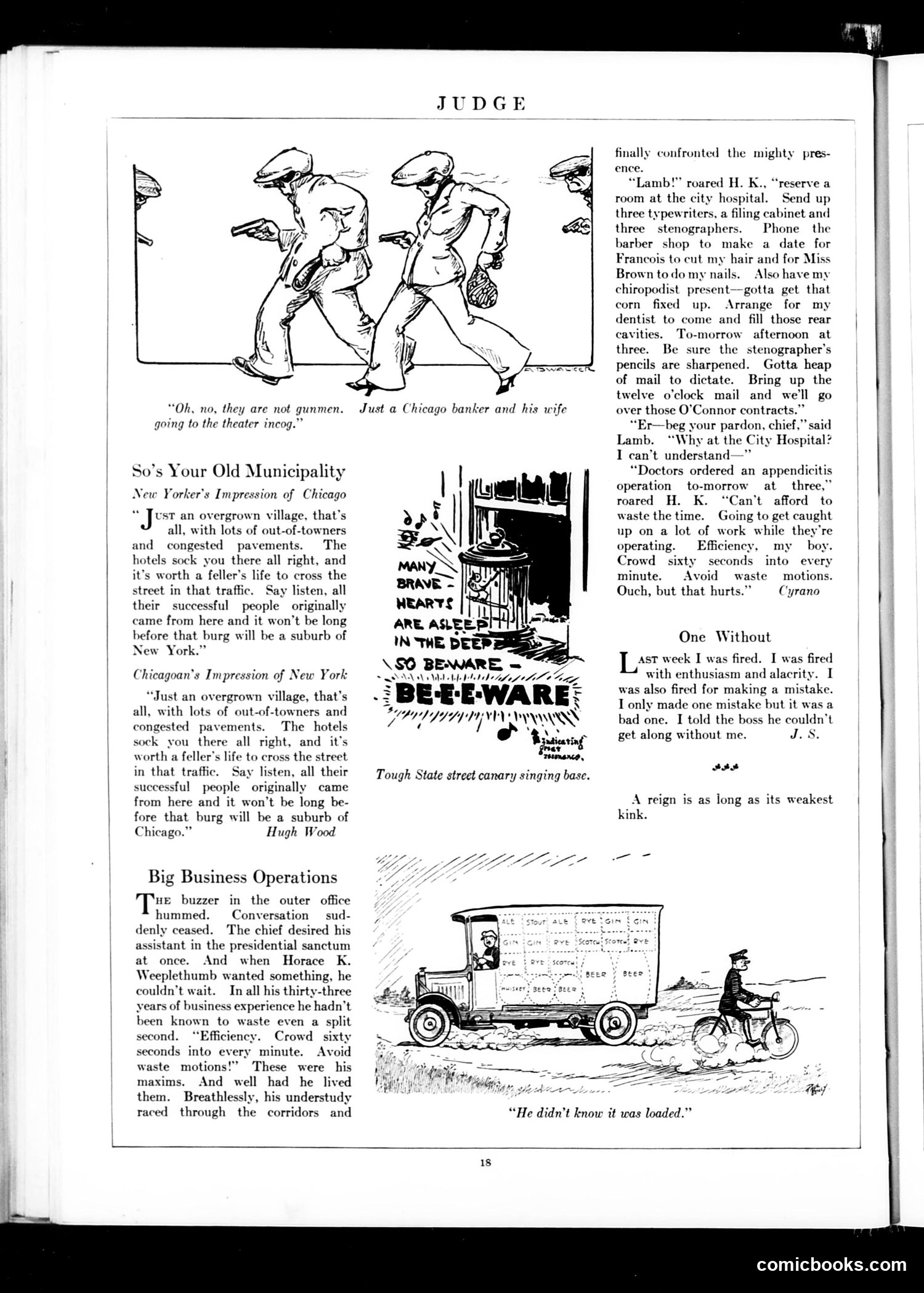
This page contains several satirical pieces mocking American business culture and urban rivalry: **"So's Your Old Municipality"** presents a humorous exchange between New Yorkers and Chicagoans, each dismissing the other city as an overgrown village while predicting it will become their city's suburb. The satire highlights mutual contempt between America's two largest cities and provincial boosterism. **"Big Business Operations"** mocks obsessive efficiency culture. Executive H.K. Weeplethumb, devoted to squeezing "sixty seconds into every minute," schedules business meetings during his appendicitis operation—maximizing "productivity" even while unconscious. The satire targets the industrial-era obsession with efficiency and time-management taken to absurd extremes. **Other brief pieces** include workplace humor ("One Without") and cynical observations about power ("A reign is as long as its weakest kink"). The cartoons use exaggeration to critique early 20th-century American capitalism's dehumanizing emphasis on relentless productivity over human wellbeing.
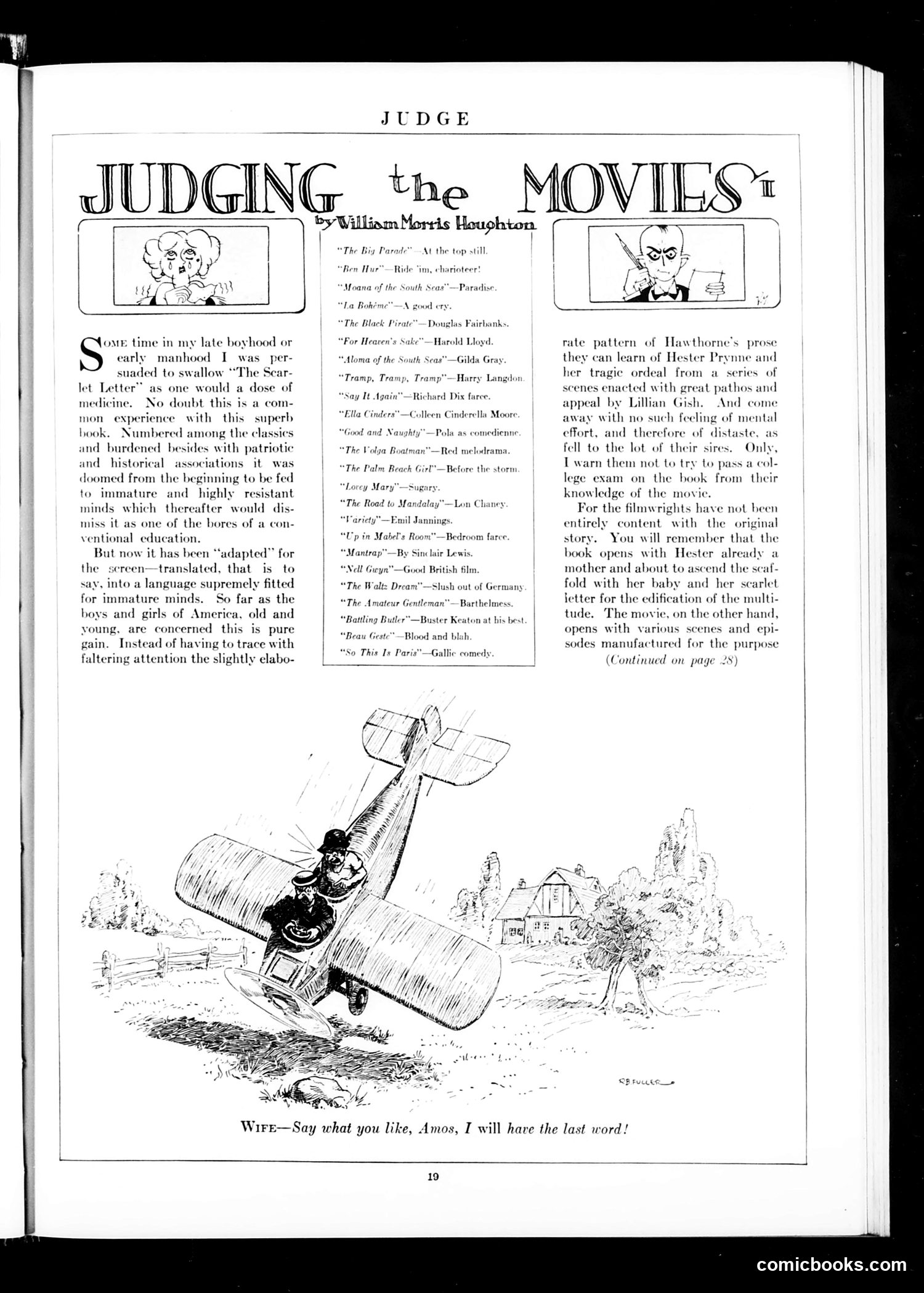
This article by William Morris Houghton critiques how Hollywood has adapted classic literature—specifically *The Scarlet Letter*—for mass audiences. The author nostalgically recalls being forced to read Hawthorne's novel as a boy, finding it tedious. He notes that film versions, while more accessible to young people than the original text, fundamentally distort the source material. Filmmakers add entertainment-focused scenes and episodes rather than faithfully translating the book's literary merit and moral complexity. The cartoon below illustrates the tension humorously: a couple in a crashing airplane, with the wife asserting dominance—a comedic domestic scene typical of silent-film entertainment, bearing no relation to serious literary adaptation. Houghton's point: movies make classics digestible but intellectually hollow. Students shouldn't mistake watching a film for understanding the actual book.
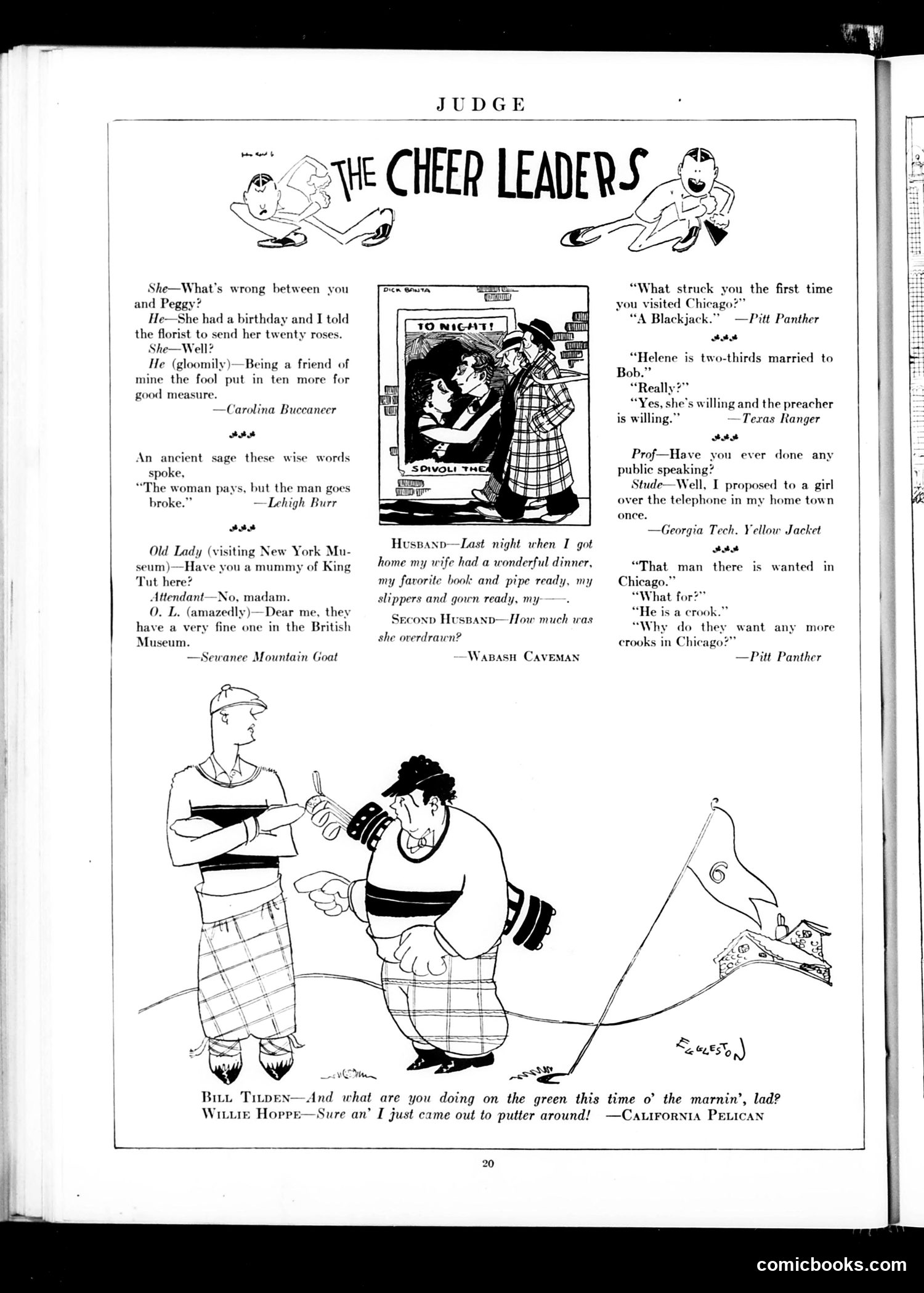
This page from *Judge* magazine collects brief humorous anecdotes and jokes from college publications, arranged around two cartoons. **The jokes** satirize common social situations: a man's romantic gesture backfiring (too many roses), the expense of marriage, museum snobbery, wives' extravagance, and Chicago's criminal reputation. These are gentle, observational humor typical of early 20th-century American comedy. **The cartoons** feature: 1. **Top**: A man proposing while his date embraces another suitor—commenting on romantic complications. 2. **Bottom**: Two Scottish golfers (identified by kilts and accents)—one asks why the other is putting on the golf green in the morning. The humor relies on the absurdity of golf etiquette and Scottish dialect ("marnin'," "putter around"). The page represents *Judge*'s format of reprinting college humor from various universities (credited sources like "Pitt Panther," "Texas Ranger," "Georgia Tech"), serving as a national clearinghouse for collegiate wit. The humor is clean, domestic, and focused on gender relations and social missteps rather than political satire.
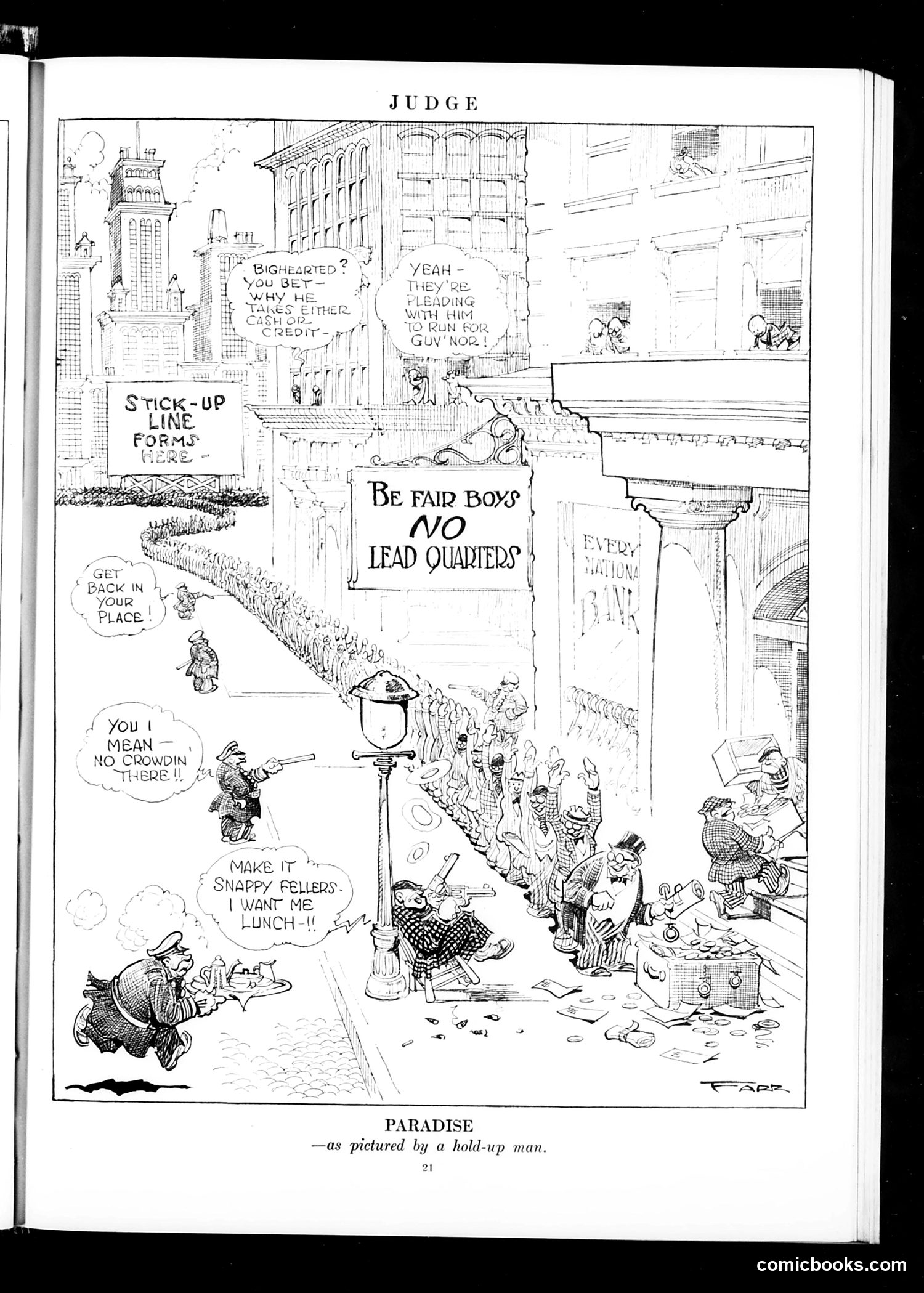
This single-panel cartoon satirizes a street criminal's fantasy of an ideal world. A robber daydreams of "paradise" where a large crowd of people stands passively in organized lines with money spilling out, while uniformed officers maintain order with signs reading "BE FAIR BOYS NO LEAD QUARTERS" (no shooting). The joke targets both the criminal's delusional thinking and contemporary concerns about urban crime and mob violence. The robber imagines an impossible scenario where victims cooperate peacefully during theft, and police refrain from using weapons. The crowded street setting and period clothing suggest early 20th-century urban America. The cartoon mocks criminal mentality while satirizing real tensions between police brutality and public safety in that era.
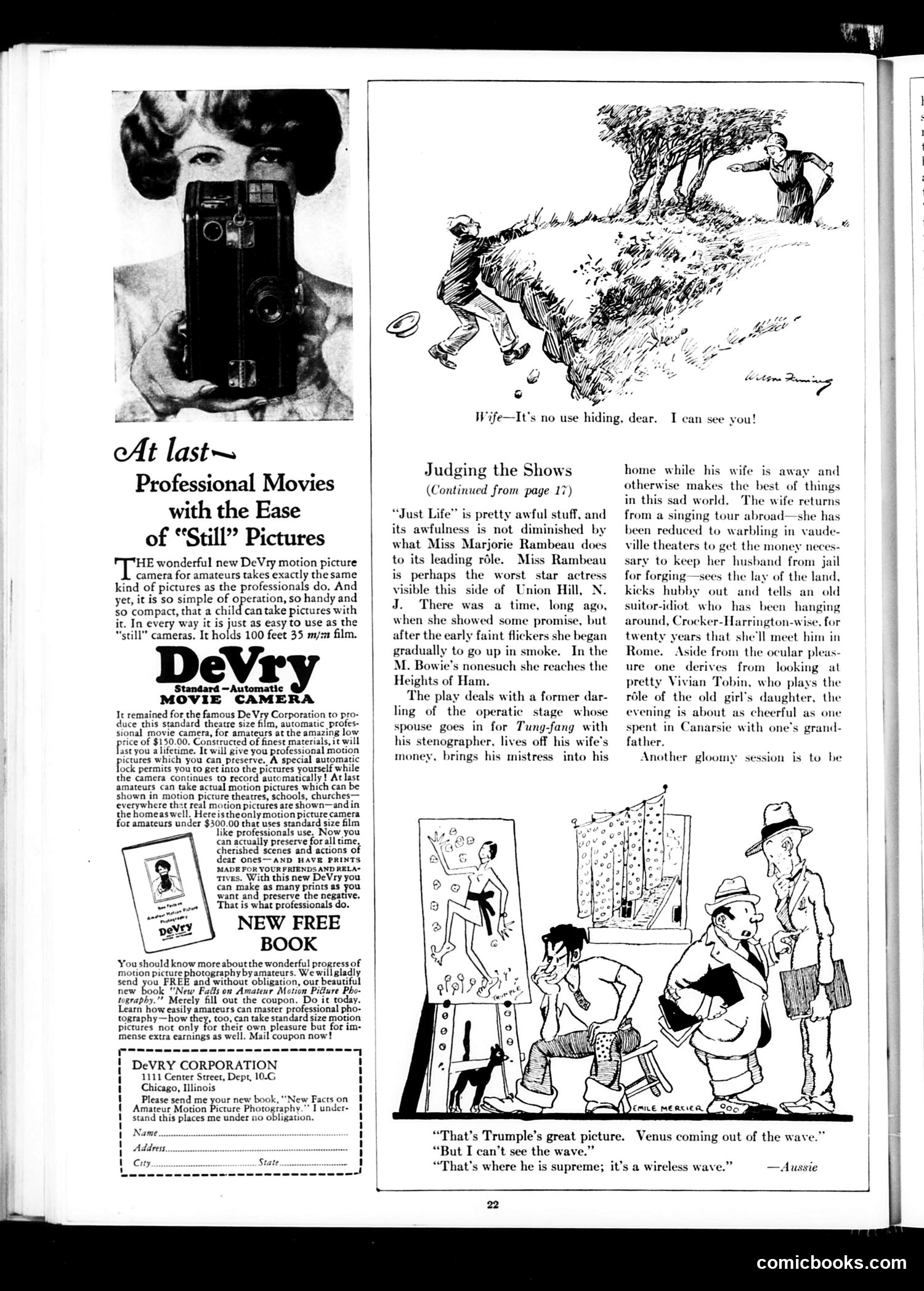
This page contains two distinct elements: a **DeVry camera advertisement** (left) and **theater review cartoons** (right). The **advertisement** promotes an affordable motion-picture camera for amateurs, emphasizing it operates as easily as a still camera—a significant technological advancement for 1920s consumers. The pitch targets middle-class Americans wanting to preserve family moments professionally. The **cartoons** satirize theater productions. The top sketch mocks a wife discovering her hiding husband during a romantic scene. The bottom cartoon illustrates a scene from a play where characters discuss an artwork—the joke being the husband's "wireless wave" (invisible mistress) parallels the wife's inability to see the painted Venus. This ridicules both the theatrical melodrama and the marital infidelity plot. The review text harshly criticizes actress Marjorie Rambeau's performance in "Just Life," calling her "perhaps the worst star actress" and her acting excessive ("Heights of Ham")—typical of Judge's caustic entertainment criticism.
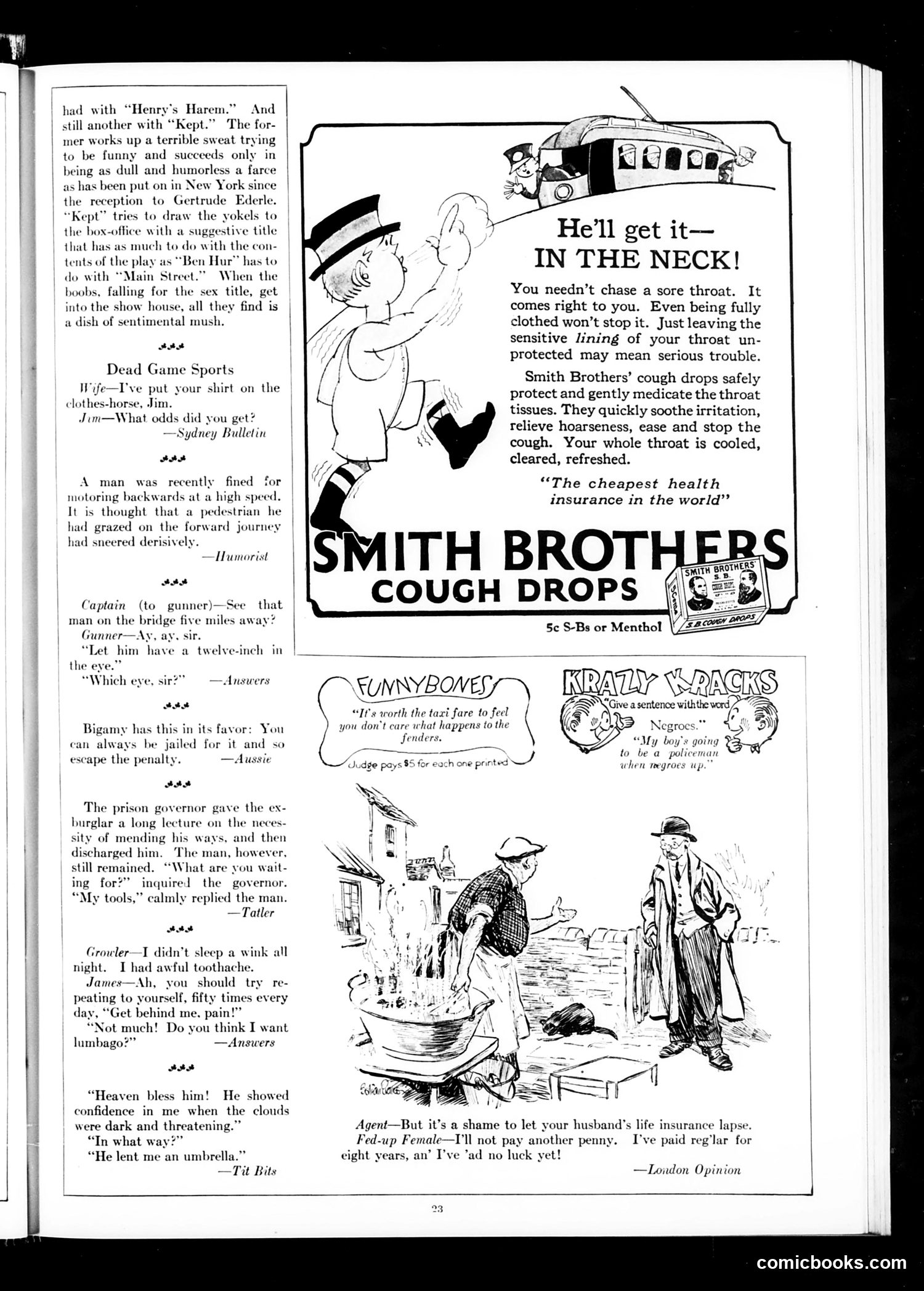
This is primarily a **humor/jokes page with advertising**, typical of Judge's format. The content includes: **Humor Sections:** - Brief jokes about theater reviews, motoring fines, and military mishaps - A "Funnybones" section with short gags about taxi fares and a child's career ambitions - A "Krazy Wracks" puzzle feature **Cartoons:** - A sketch of a man doing laundry, illustrating a joke about life insurance: a working-class woman refuses to continue insurance payments after eight years with "no luck"—satirizing the frustration of paying premiums without claims - An illustration for Smith Brothers cough drops advertising **Social Satire:** The insurance cartoon mocks both the insurance industry's profit model and working-class financial hardship during this era. The woman's complaint reflects real economic anxiety about whether insurance provided actual value to ordinary people, not just to insurers. The page reflects Judge's mix of light humor and subtle social commentary aimed at middle-class readers.
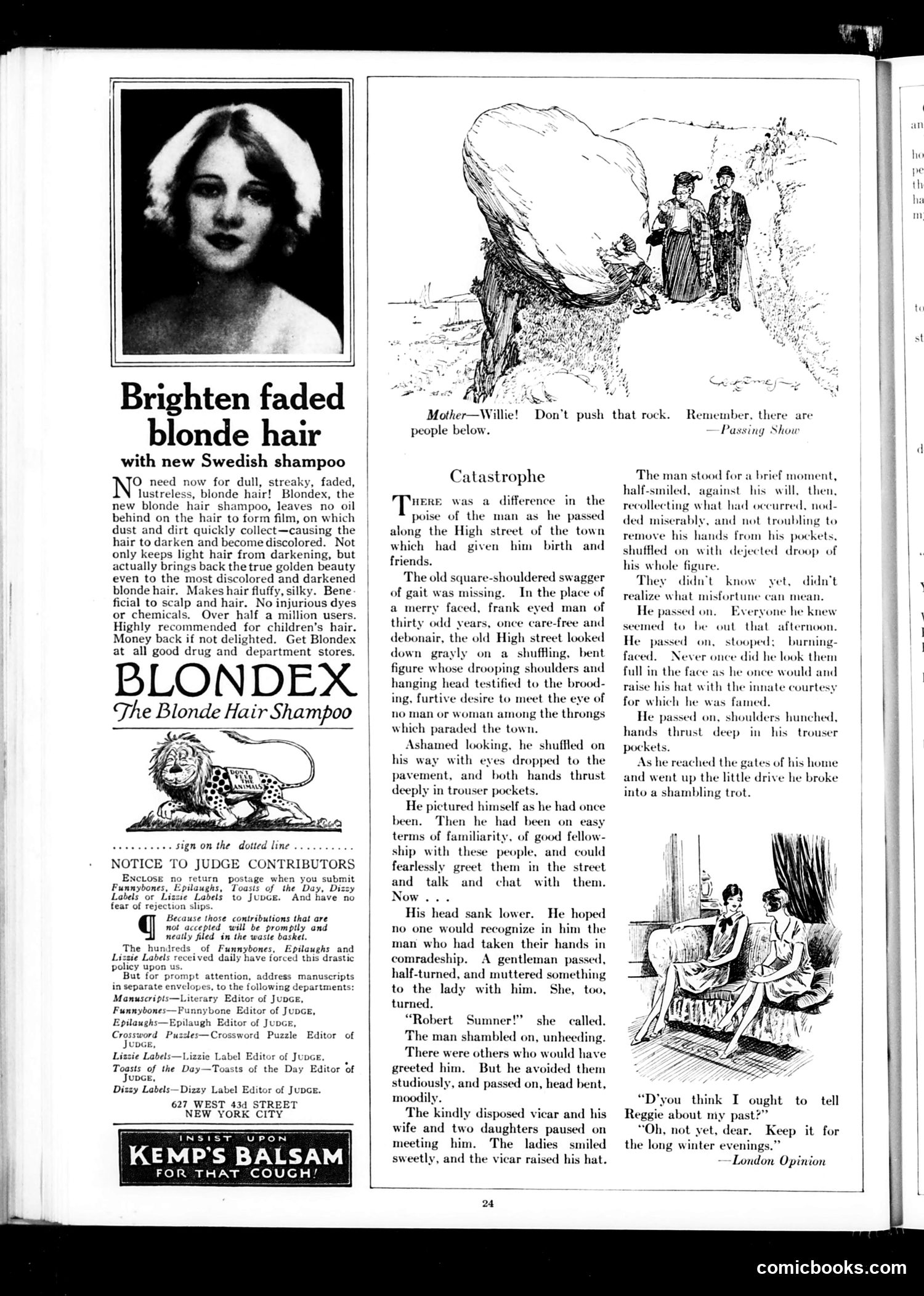
This Judge magazine page (page 24) is primarily **advertising and editorial content**, not political satire. The dominant feature is a **Blondex shampoo advertisement** targeting women who want to maintain blonde hair color—a concern reflecting early 20th-century beauty standards and the emerging consumer culture around hair care products. The main story, titled "Catastrophe," depicts a man named Robert Sumner returning to his hometown in disgrace. He avoids former friends and acquaintances, walking with his head down, unwilling to meet their eyes. Though the text is incomplete, the narrative suggests he has experienced some scandal or social ruin that has reversed his once-confident social standing. The accompanying illustrations show the contrast: him isolated at a large rock, then later in conversation with a woman, suggesting either romantic complications or social judgment as the source of his "catastrophe." This reflects period concerns about **social respectability and the permanence of public shame**—themes common in early 20th-century literature and social commentary.
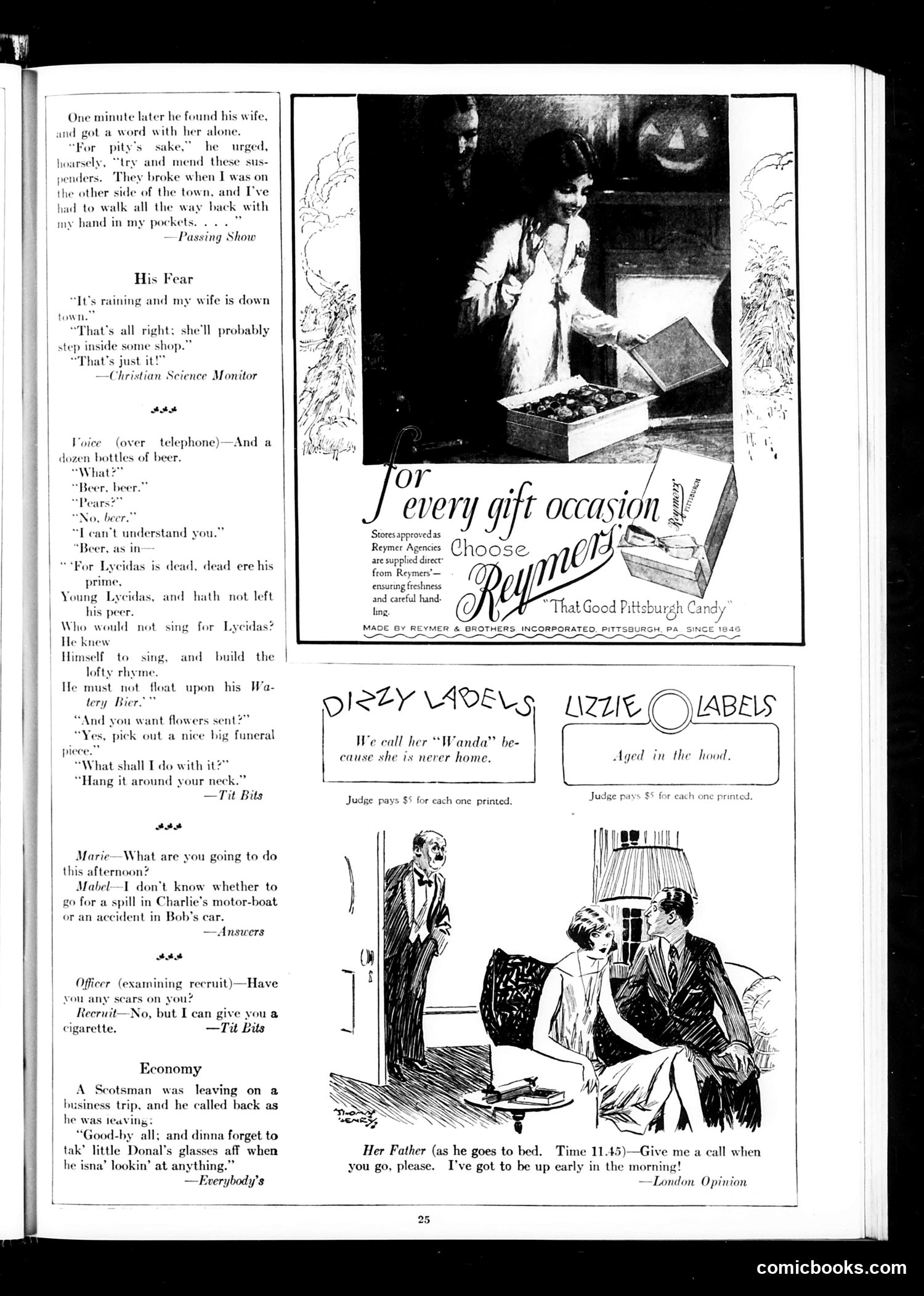
This page from Judge (a satirical weekly) contains miscellaneous humor shorts and an advertisement, rather than a unified political cartoon. **The Advertisement** dominates the right side: Reyner candy ("That Good Pittsburgh Candy") shows a woman selecting chocolates—straightforward product marketing. **The Humor Shorts** are brief jokes about everyday situations: - A man's complaint about broken suspenders while his wife shops in rain - A telephone miscommunication about beer orders - A Scottish father's absent-minded farewell about removing his son's eyeglasses - Various domestic comedy sketches **"Dizzy Labels" and "Lizzie Labels"** are reader-submitted joke contests where Judge paid $5 for each accepted caption. **Context for Modern Readers**: This appears to be filler content—light domestic humor typical of early 20th-century magazines, focusing on marital misunderstandings, class-based comedy (the Scottish miser), and everyday mishaps rather than political satire. The page reflects contemporary concerns about shopping, motor-boats, and military recruitment, but lacks sharp social commentary.
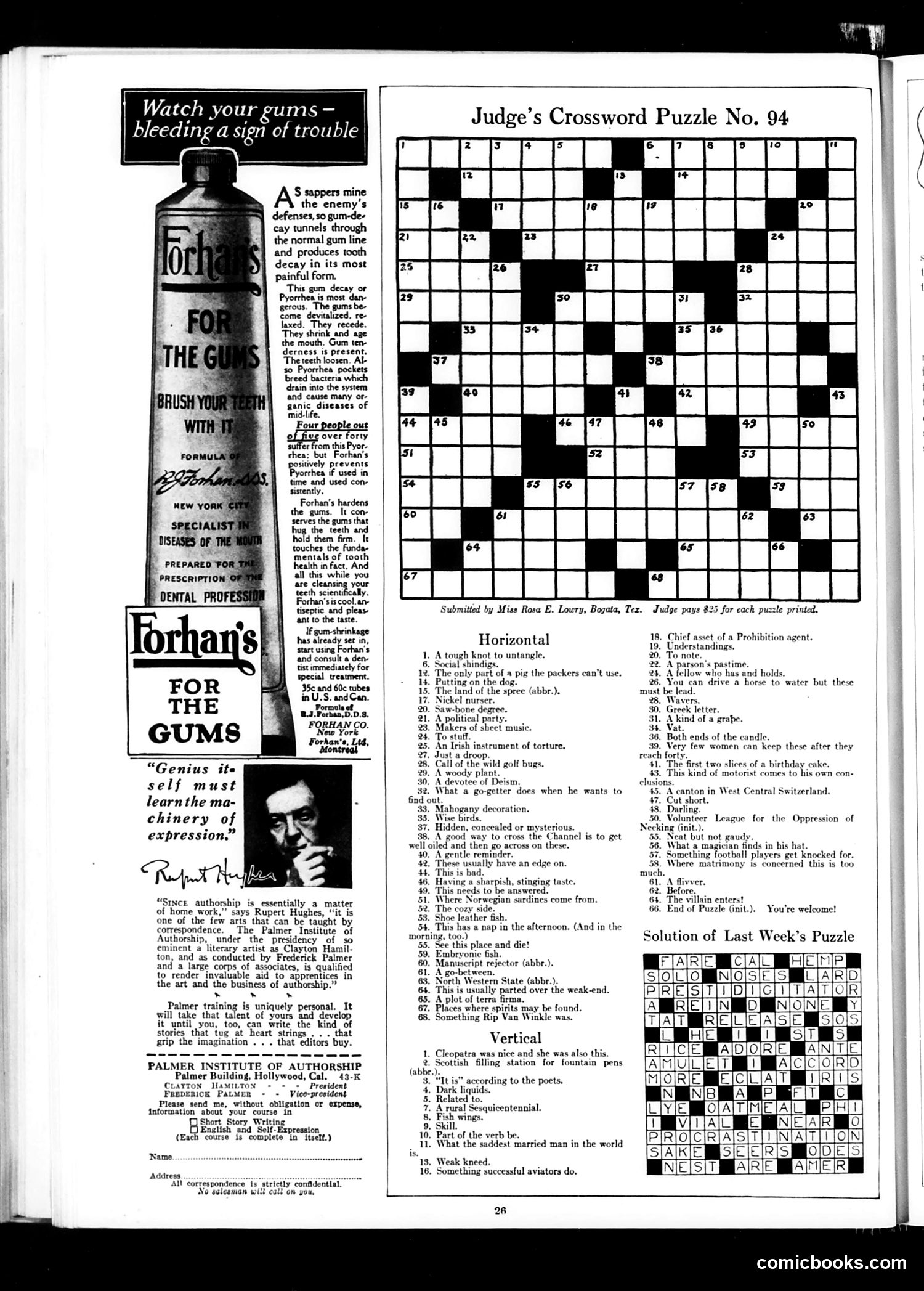
This page contains two distinct elements: **Left Side:** Advertisements for Forhan's toothpaste and the Palmer Institute of Authorship. The Forhan's ad warns of pyorrhea (gum disease), using medical language to promote their product as a preventative treatment. The Palmer Institute advertises correspondence courses in writing, quoting literary figure Rupert Hughes about learning authorship through home study. **Right Side:** Judge's Crossword Puzzle No. 94, a standard crossword with clever, punny clues typical of 1920s-era humor magazines. The clues contain period-specific references and wordplay—for example, horizontal clues like "Nickel nurser" (streetcar operator), "An Irish instrument of torture" (harp), and "Mahogany decoration" (wood grain). **Overall Context:** This is a typical Judge magazine interior page mixing advertisements, instructional content, and entertainment. No political satire or caricature appears here—it's primarily commercial and recreational content aimed at the magazine's middle-class readership during what appears to be the 1920s-1930s era.
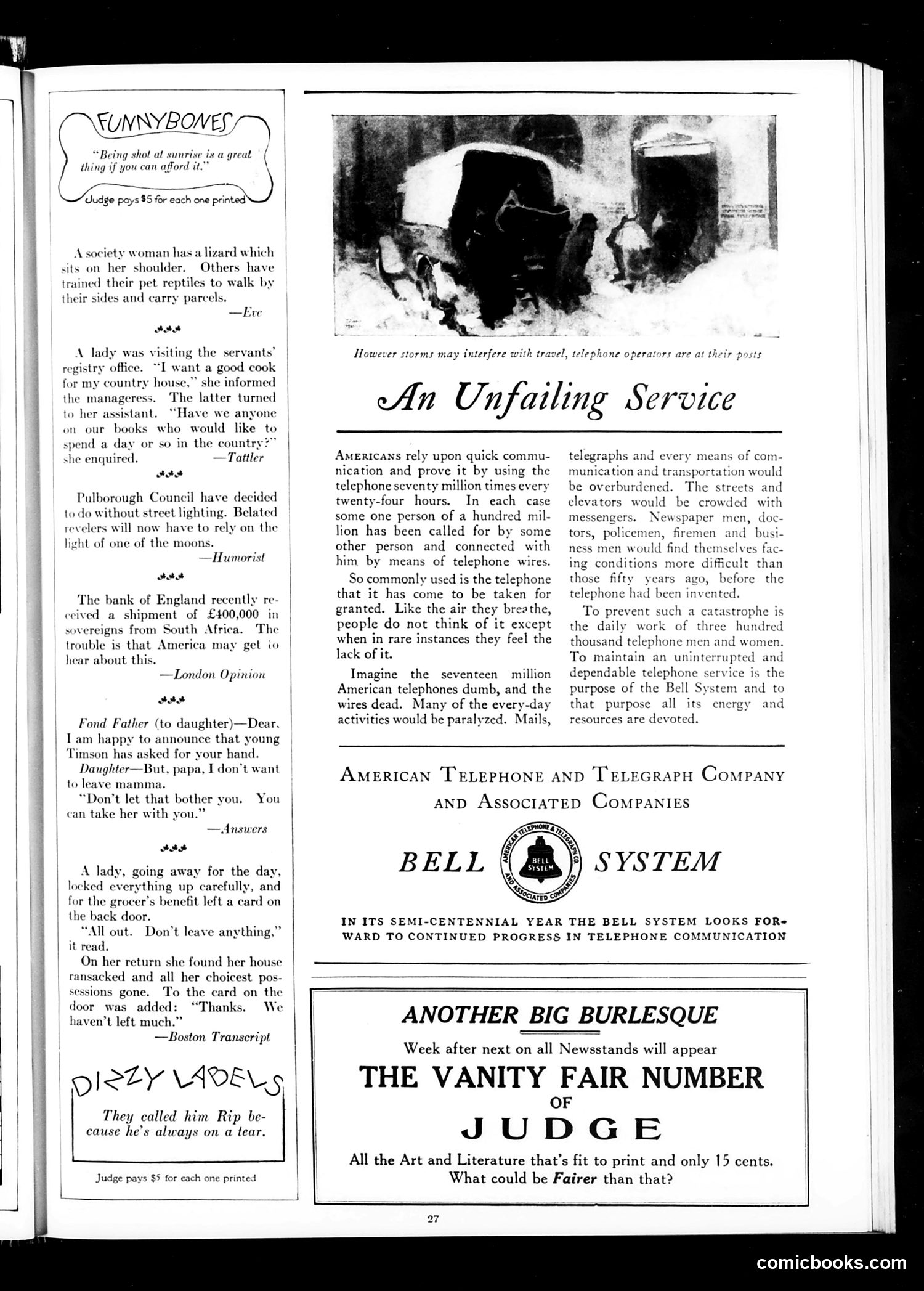
This page combines short humorous anecdotes ("Funny Bones") with a Bell System telephone advertisement. The jokes reflect early 20th-century upper-class British and American society: a wealthy woman keeping a pet lizard as fashion, servants seeking domestic work, and a father casually offering to let his daughter bring her mother along after marriage—all satirizing social conventions and domestic life. The "Dizzy Labels" section mocks a character nicknamed "Rip" for constant drunkenness ("always on a tear"). The main advertisement promotes the Bell Telephone System's reliability during weather emergencies, claiming 300,000 telephone workers maintain service. It emphasizes how dependent Americans have become on telephones—comparing their importance to air—and suggests telephone disruption would paralyze daily life, mail, transportation, and emergency services. The ad appears designed to justify the Bell System's importance to readers during its "semi-centennial year" (50th anniversary).
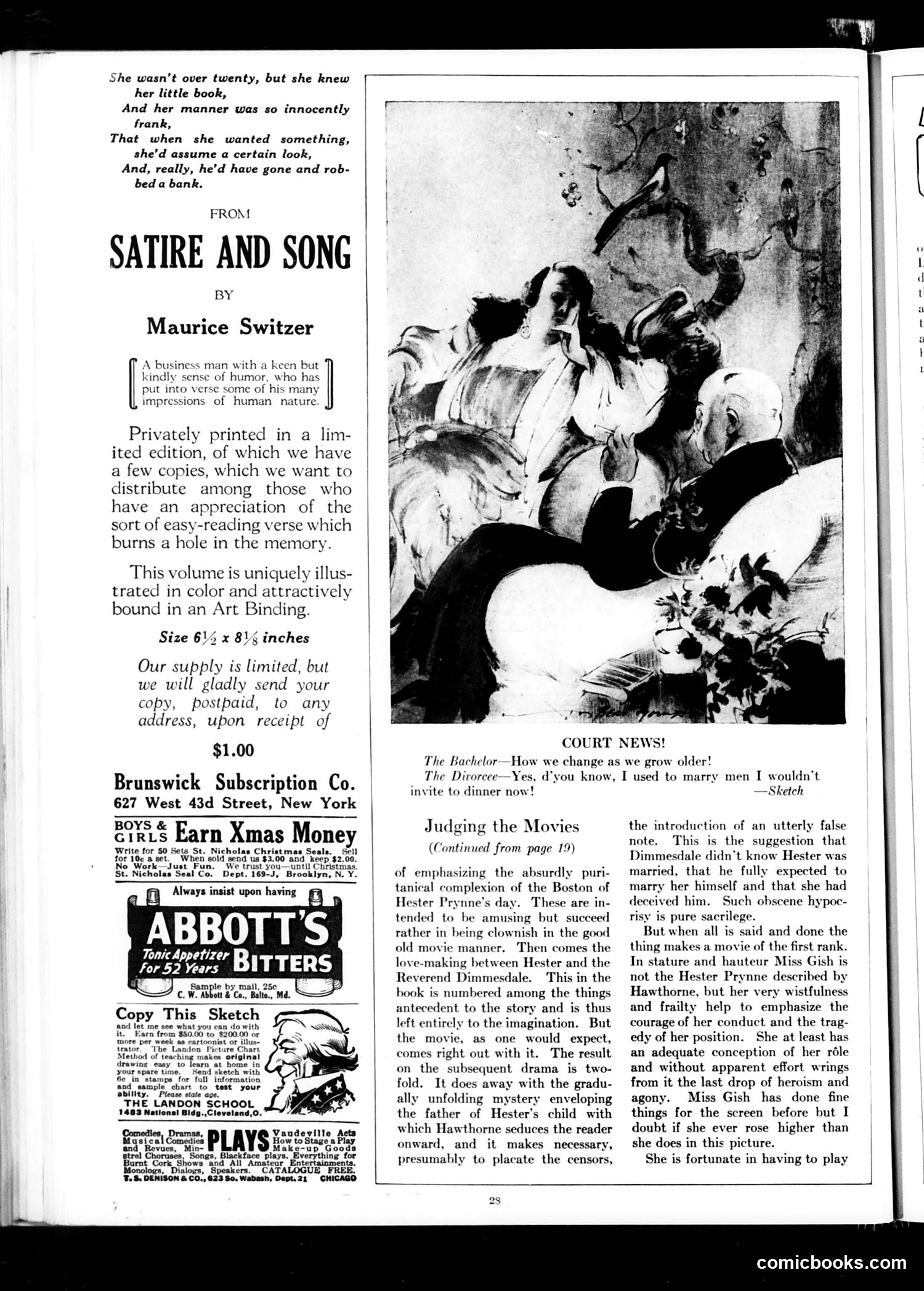
This page is primarily **advertising and editorial content**, not political satire. The main visual is a sketch labeled "COURT NEWS!" depicting a humorous social exchange between "The Bachelor" and "The Divorcee"—a woman claiming she once married men she wouldn't now invite to dinner, satirizing how people's standards and choices change with age and experience. The joke targets the fickleness of romantic judgment. The bulk of the page promotes Maurice Switzer's book *Satire and Song*, a limited-edition collection of humorous verse about human nature. Additional advertisements include Abbott's Bitters tonic, a boys' Christmas seal fundraiser, and theatrical supplies. The lower section continues a film review (from page 19) critiquing a movie adaptation of *The Scarlet Letter*, praising actress Lillian Gish's performance while noting the film added invented plot elements absent from Hawthorne's novel for censorship purposes.
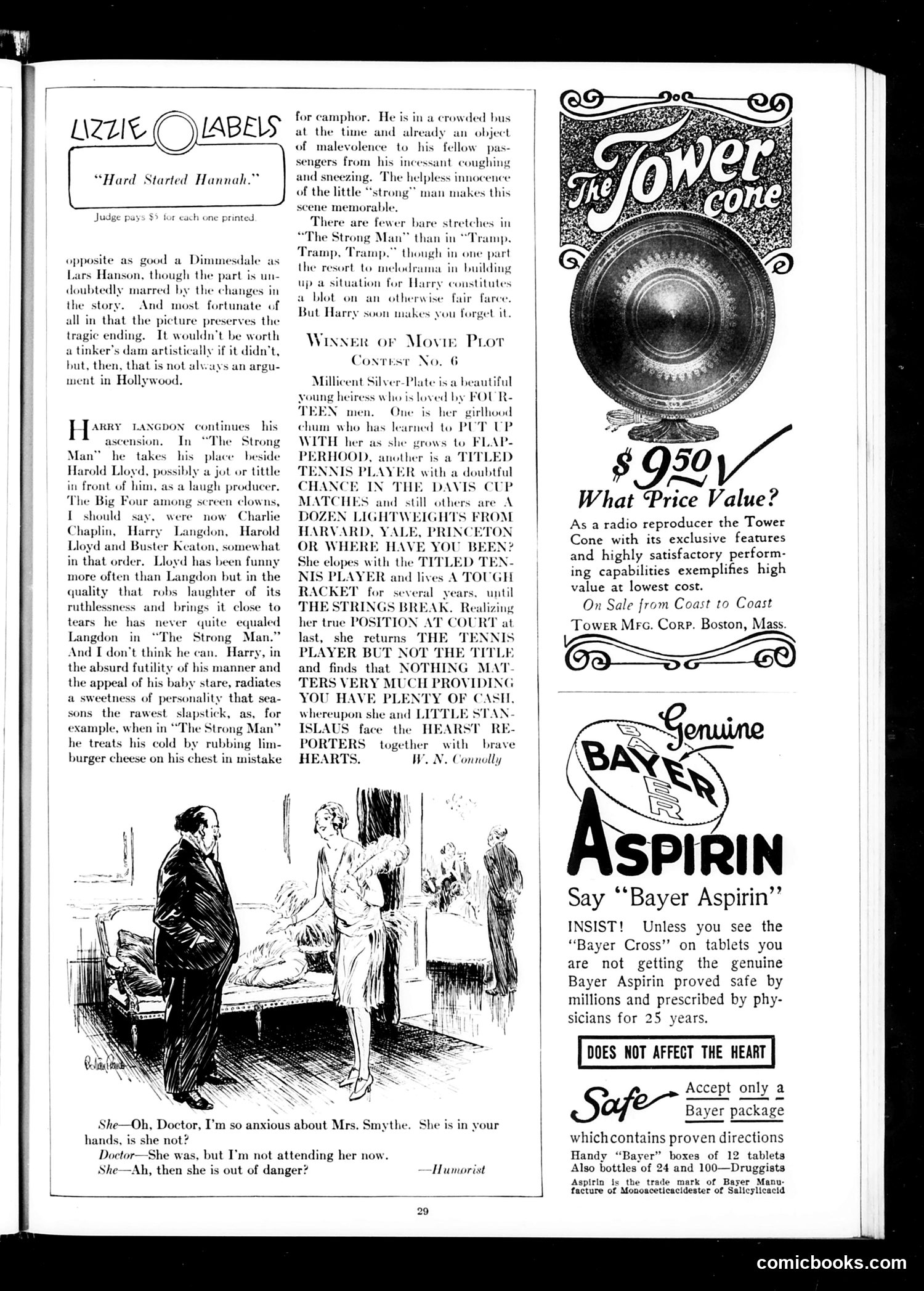
This page contains film criticism, a movie plot contest, a humor cartoon, and period advertisements. **Film Criticism**: The text reviews silent-film comedians, ranking them as "The Big Four": Charlie Chaplin, Harry Langdon, Harold Lloyd, and Buster Keaton. It praises Langdon's sweetness and pathos in "The Strong Man," arguing his appeal transcends mere slapstick—even mundane scenes (like rubbing limburger cheese on his chest for a cold) become touching through his innocent performance. **Movie Plot Contest**: A playful parody of melodramatic romance plots, using capitalized words as visual puns ("PUT UP," "FLAPPER," "POSITION AT COURT"). **Cartoon Humor**: A doctor-patient joke: A woman worries about Mrs. Smythe's health, but the doctor assures her he's not treating her anymore. The punchline: "Then she is out of danger?"—implying the doctor's incompetence was the danger. **Advertisements**: Period products (Tower radio cone, Bayer Aspirin) with typical early-1920s marketing claims about safety and value.
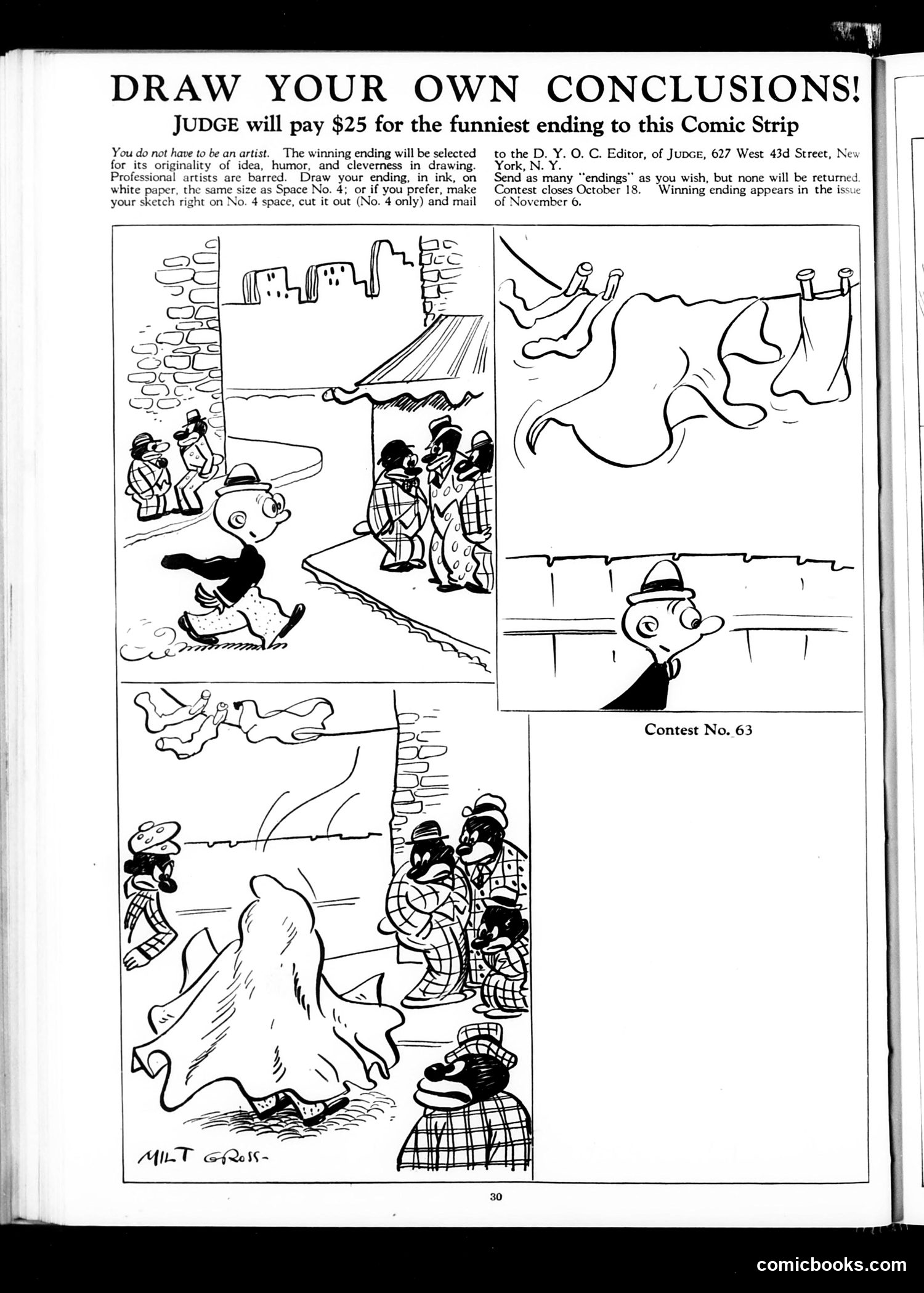
This page presents a **reader-participation contest** from Judge magazine, not a completed political cartoon. Readers are invited to create humorous endings to an unfinished comic strip, with the winner receiving $25. The existing panels show a small man in a hat encountering increasingly chaotic situations: people on a street, clotheslines with flapping laundry, and what appears to be a large creature or ghost emerging from behind a fence, causing panic among onlookers. The joke's payoff is intentionally missing—readers must supply the punchline. The strip appears to be physical comedy/slapstick in nature rather than political satire. The contest explicitly excludes professional artists, democratizing humor-creation for ordinary readers. This was a common engagement strategy for satirical magazines of this era, encouraging audience participation while generating fresh content.
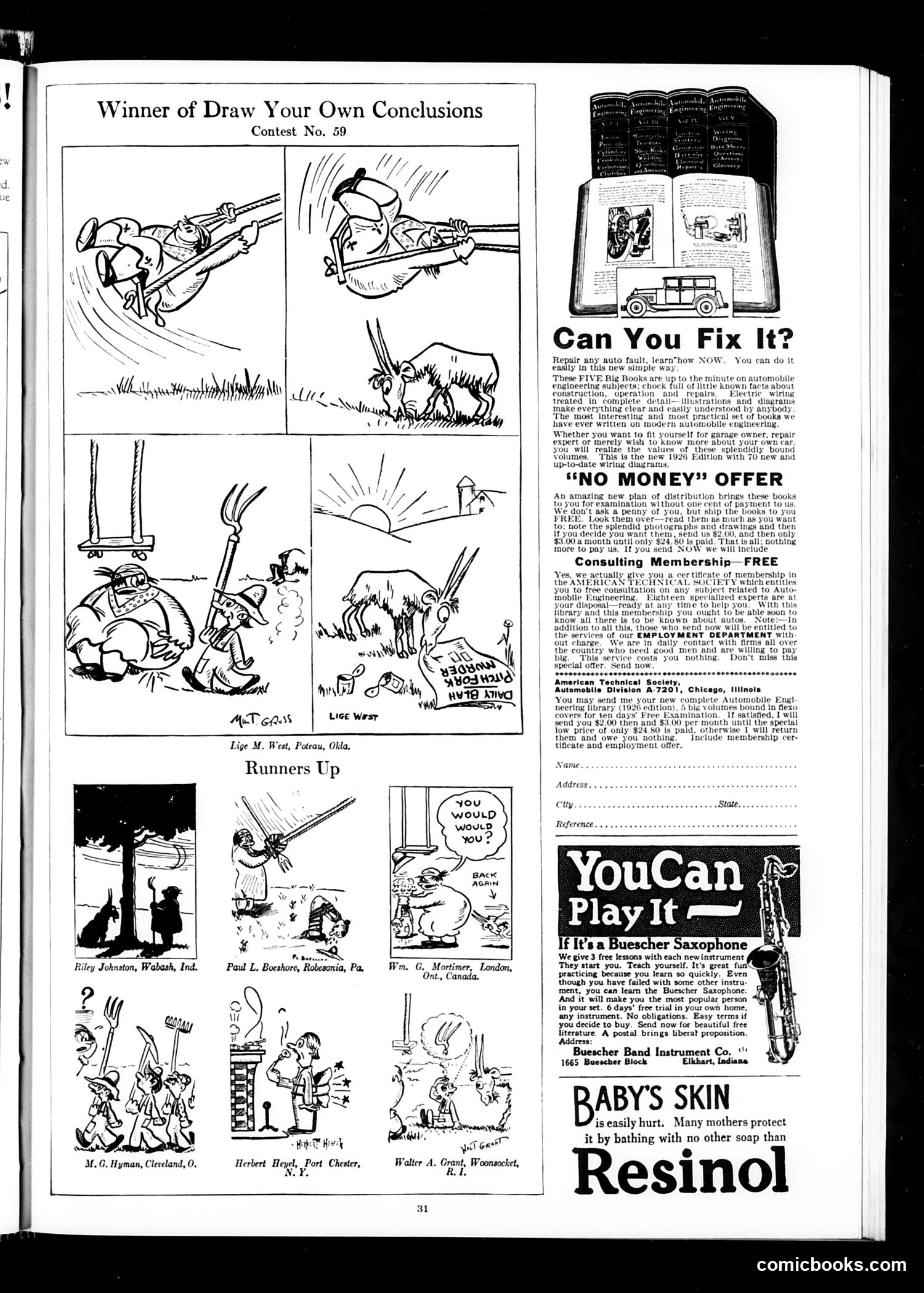
This page showcases winning entries from Judge's "Draw Your Own Conclusions" comic contest—a feature where readers submitted humorous cartoon panels for publication and prizes. The **winner** (top left, signed "Art Coss") depicts physical slapstick: a character being flung from a seesaw, landing in grass, then appearing suspended in mid-air as if shot upward. The humor relies on exaggerated motion lines and the wordless, purely visual gag format typical of early-20th-century comics. The **runners-up** below follow similar patterns: domestic mishaps, people caught in awkward predicaments (a man dangling from ropes, children in chaotic situations). The captions identify contributors by name and location—suggesting this was a nationwide amateur submission contest. The satire isn't political but rather **social/domestic**: poking fun at everyday accidents and family comedy, reflecting Judge's general audience of middle-class Americans amused by relatable mishaps. The surrounding advertisements (automobile repair books, saxophone lessons, baby soap) are typical period magazine filler, unrelated to the editorial content.
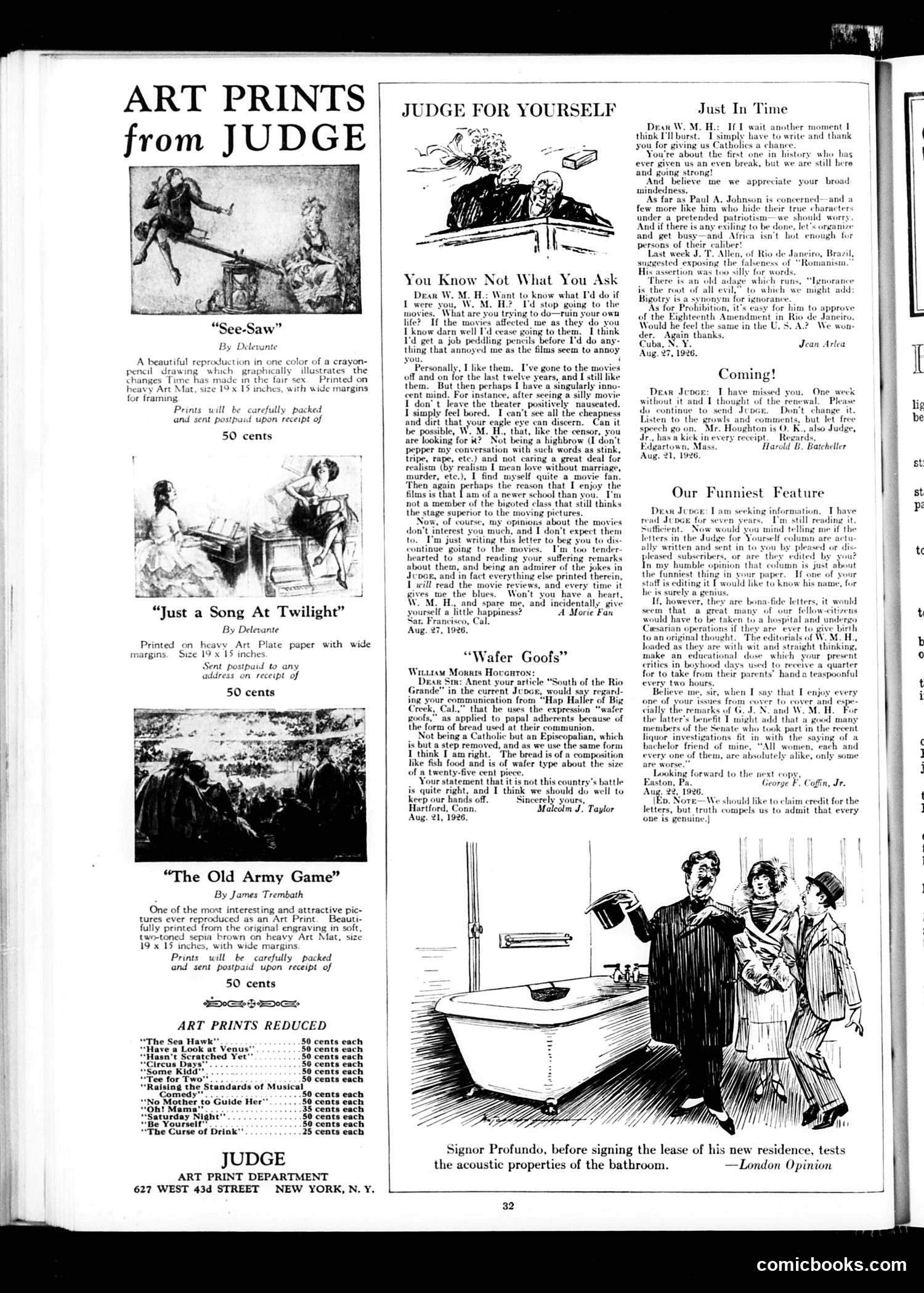
This page is primarily a **merchandise/advertising section** for Judge's art print department, showcasing reproducible artwork at 50 cents each. The prints feature scenes from popular culture—"Just a Song at Twilight," "The Old Army Game"—reflecting early 20th-century entertainment. The right column contains a **"Judge for Yourself"** advice section where readers submit letters. Notable content includes: - A reader criticizing movie attendance as frivolous (W.M.H.), countered by a defense of cinema as legitimate entertainment - A discussion of the term "wafer goofs" regarding Catholic communion bread, clarifying religious terminology The bottom cartoon depicts "Signor Profundo" testing bathroom acoustics before leasing a residence—likely satirizing either pretentious tenants, fastidious property inspectors, or the absurdity of overly meticulous lease negotiations. The humor relies on the unexpectedness of testing bathroom sound properties. The page reflects 1926 concerns: film's cultural legitimacy, religious terminology debates, and middle-class tenant culture.
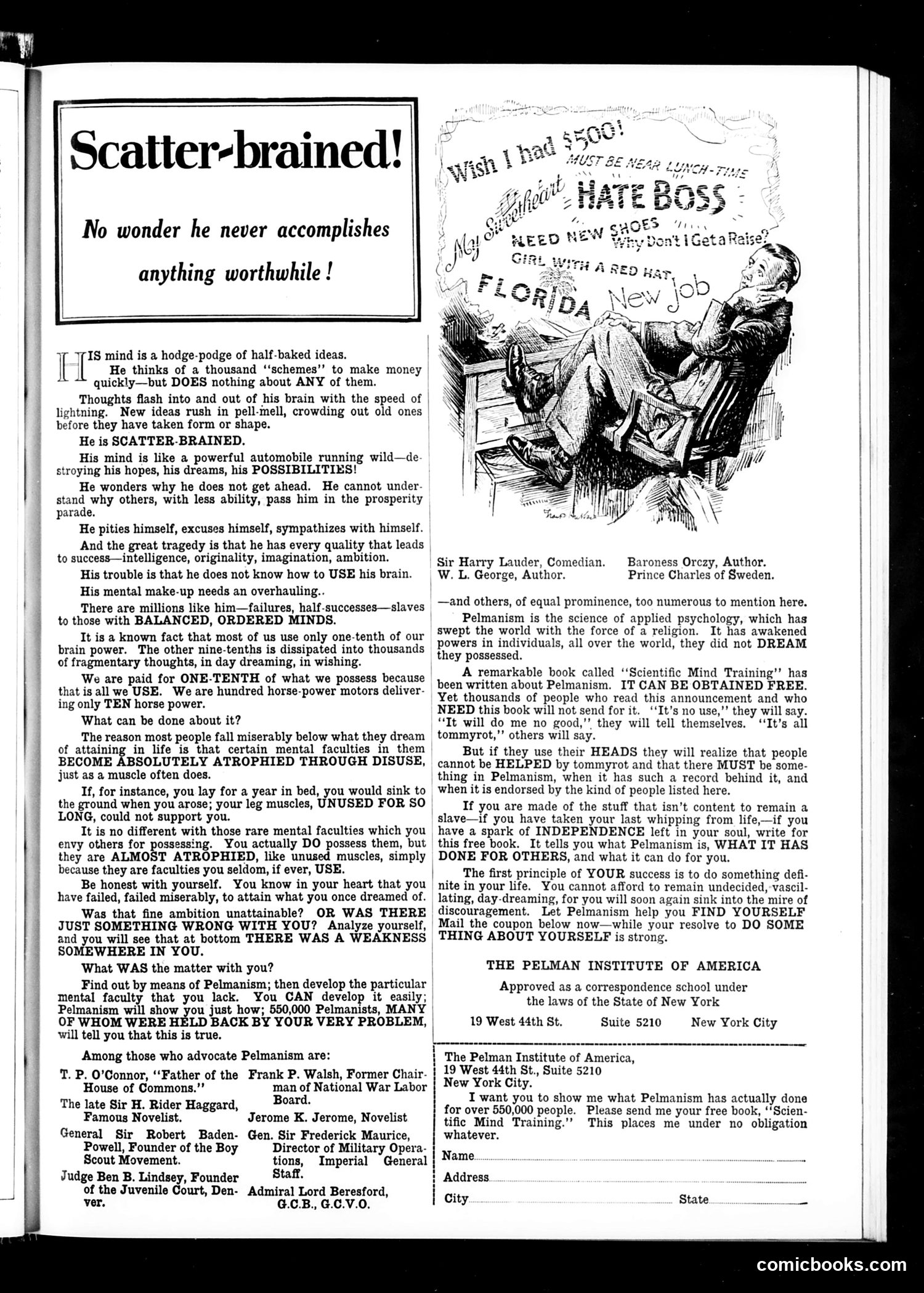
This page combines satire with advertising for the Pelman Institute's "Scientific Mind Training" correspondence course. The left column satirizes a scattered, unfocused man who generates countless half-baked moneymaking schemes but accomplishes nothing. The cartoon (right) depicts him drowning in competing thoughts—"hate boss," "need new shoes," "Florida," "new job"—illustrating mental chaos. The satire argues he possesses intelligence and ambition but lacks mental discipline; his brain is "atrophied through disuse" like an unused muscle. The advertisement then pivots: Pelmanism supposedly teaches mental focus and organization. It references endorsers (Sir Harry Lauder, W.L. George, Baroness Orczy), claiming thousands benefit from this "science of applied psychology." This represents early 20th-century self-improvement marketing—combining editorial criticism of "scatter-brained" failures with a correspondence-school pitch promising to fix precisely those flaws through mental training.
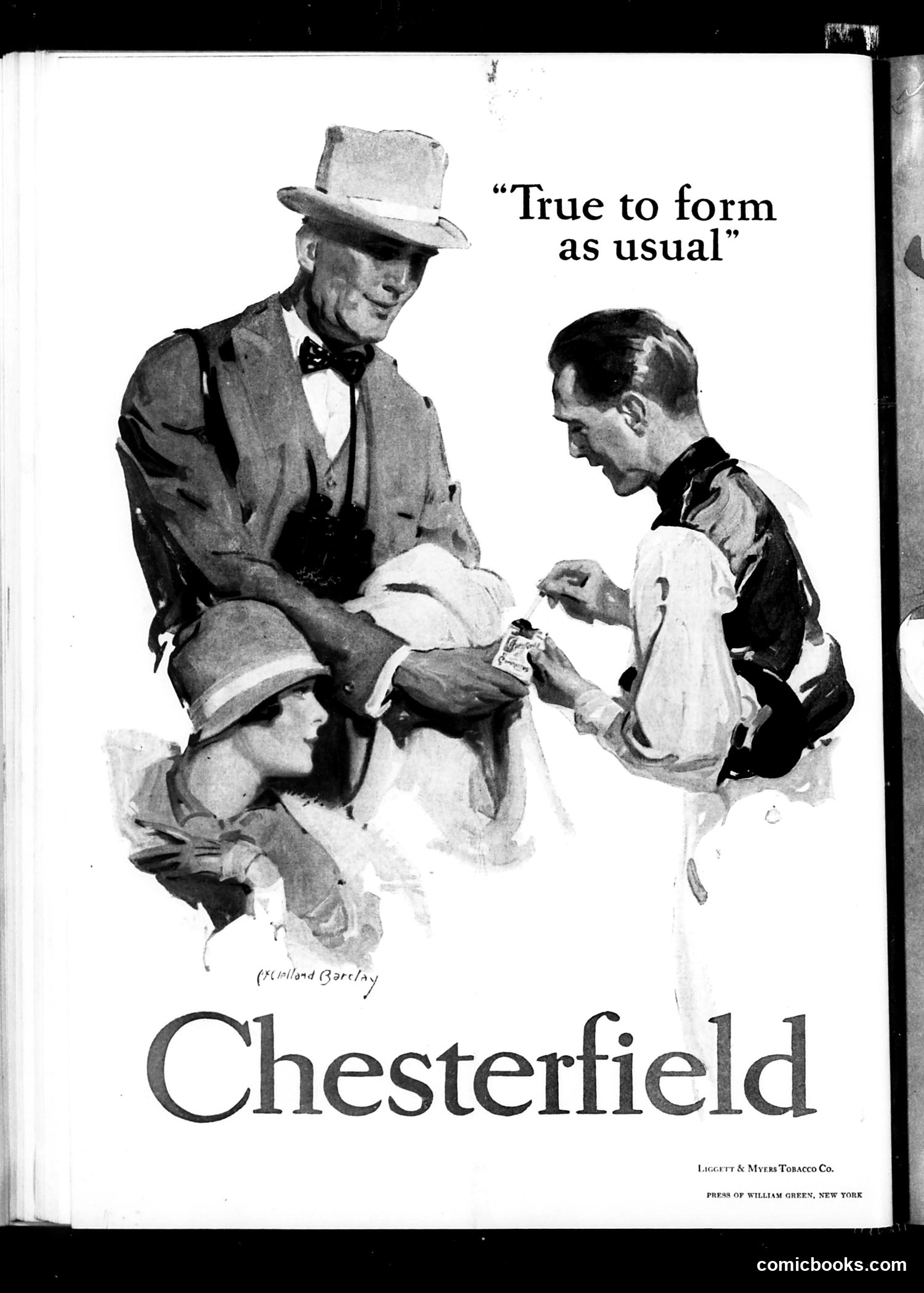
This is a **Chesterfield cigarette advertisement**, not political satire. The image shows an elegantly dressed man in a hat and bow tie with two younger figures, apparently demonstrating or presenting cigarettes. The phrase "True to form as usual" suggests the ad is emphasizing product consistency and reliability. The illustration is credited to "Willard Garlick" (or similar). Published by Liggett & Myers Tobacco Company, this represents vintage cigarette marketing that normalized smoking across social contexts and age groups—practices now illegal in advertising. The "true to form" slogan emphasizes brand loyalty and consistency, a common early-20th-century advertising approach. This reflects pre-regulation tobacco marketing when such ads appeared regularly in mainstream publications.