
Judge, 1926-10-09 · page 7 of 36
Judge — October 9, 1926 — page 7: what you’re looking at
What you’re looking at
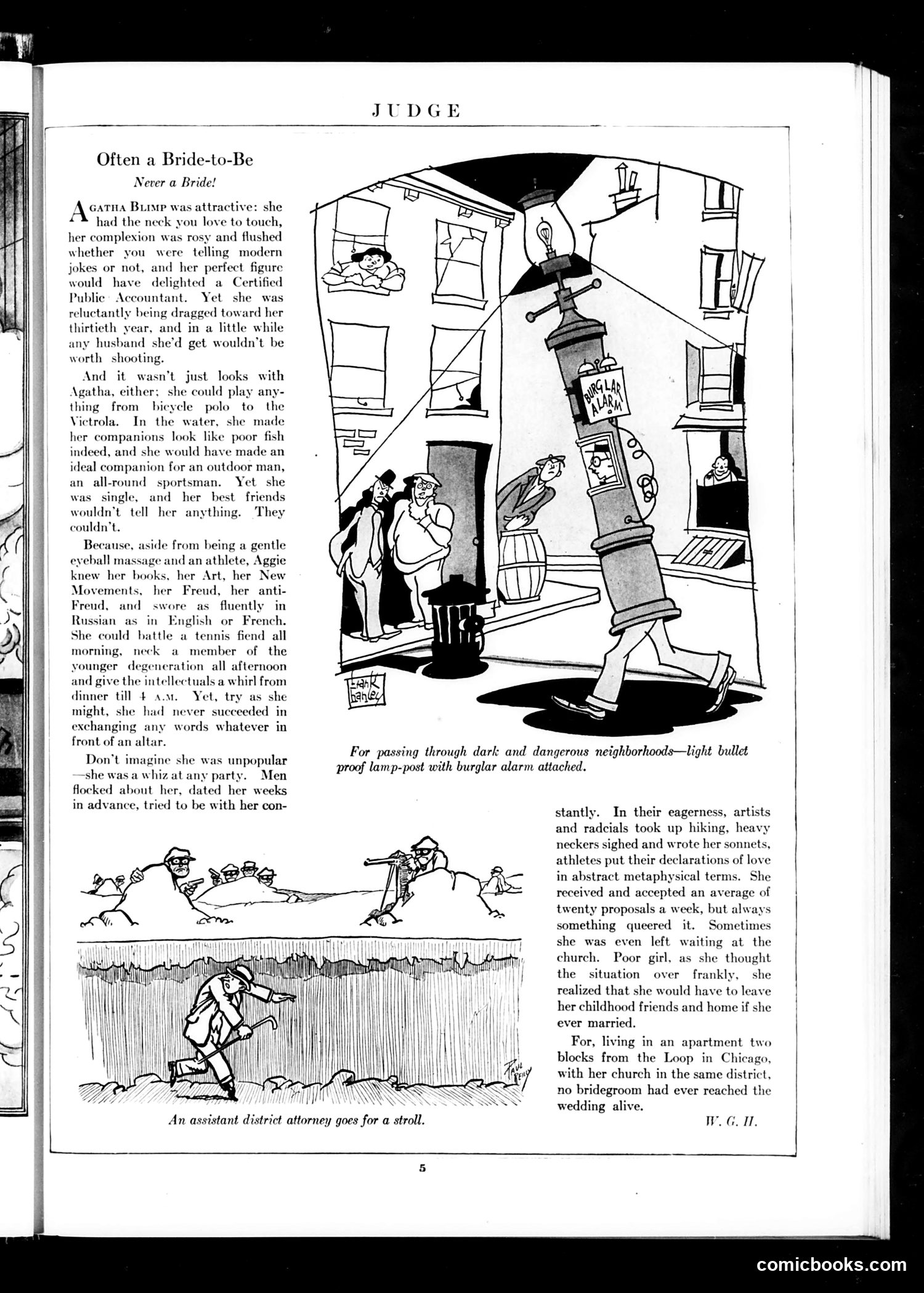
This satirical piece mocks Agatha Blimp, an attractive woman with excellent qualifications (athletic, well-read, intellectually engaged) who is perpetually engaged but never actually marries. The story suggests she receives constant marriage proposals from men, yet something always prevents each engagement from reaching the altar. The accompanying cartoons satirize professional men—an attorney and others—depicted in undignified situations, suggesting the absurdity of romantic pursuits disrupting serious professional life. The central joke targets the era's marriage-obsessed culture: despite being an ideal catch by every measurable standard, Agatha remains single. The satire critiques both her suitors' inability to commit and society's narrow focus on women's marriageability as their primary social value.
📄 Transcribed text from this page (OCR, searchable)
Machine-transcribed from the original scan — historical spelling and the odd misread are preserved.
JUDGE — ~ 7 Often a Bride-to-Be Never a Bride! AcatHa Bump was attractive: she 4% had the neck you love to touch, her complexion was rosy and flushed whether you were telling modern jokes or not, and her perfect figure would have delighted a Certified Public Accountant. Yet she was reluctantly being dragged toward her thirtieth year, and in a little while any husband she'd get wouldn't be worth shooting. | And it wasn’t just looks with | Agatha, either; she could play any- thing from bicycle polo to the | Victrola. In the water, she made | her companions look like poor fish indeed, and she would have made an ideal companion for an outdoor man, an all-round sportsman. Yet she was single, and her best friends wouldn't tell her anything. They couldn't. Because, aside from being a gentle eyeball massage and an athlete, Aggie knew her books, her Art, her New Movements, her Freud, her anti- Freud, and swore as fluently in Russian as in English or French. She could battle a tennis fiend all morning, neck a member of the younger degeneration all afternoon and give the intellectuals a whirl from dinner till 4 a.m. Yet, try as she might, she had never succeeded in exchanging any words whatever in _ of a altar. For passing through dark and dangerous neighborhoods—light bullet jon’t imagine she was unpopular of lamp-post with burglar alarm attached. -she was a whiz at any party. Men a ae at 9 ‘ flocked about her, dated her weeks in advance, tried to be with her con- stantly. In their eagerness, artists and radcials took up hiking, heavy neckers sighed and wrote her sonnets, athletes put their declarations of love in abstract metaphysical terms. She received and accepted an average of | twenty proposals a week, but always something queered it. Sometimes | she was even left waiting at the church. Poor girl, as she thought the situation over frankly, she realized that she would have to leave | her childhood friends and home if she ever married. For, living in an apartment two blocks from the Loop in Chicago, with her church in the same district, no bridegroom had ever reached the | . . wedding alive. | An assistant district attorney goes for a stroll. W. Go, z 5 comicbooks.com