
A complete issue · 36 pages · 1926
Judge — September 25, 1926
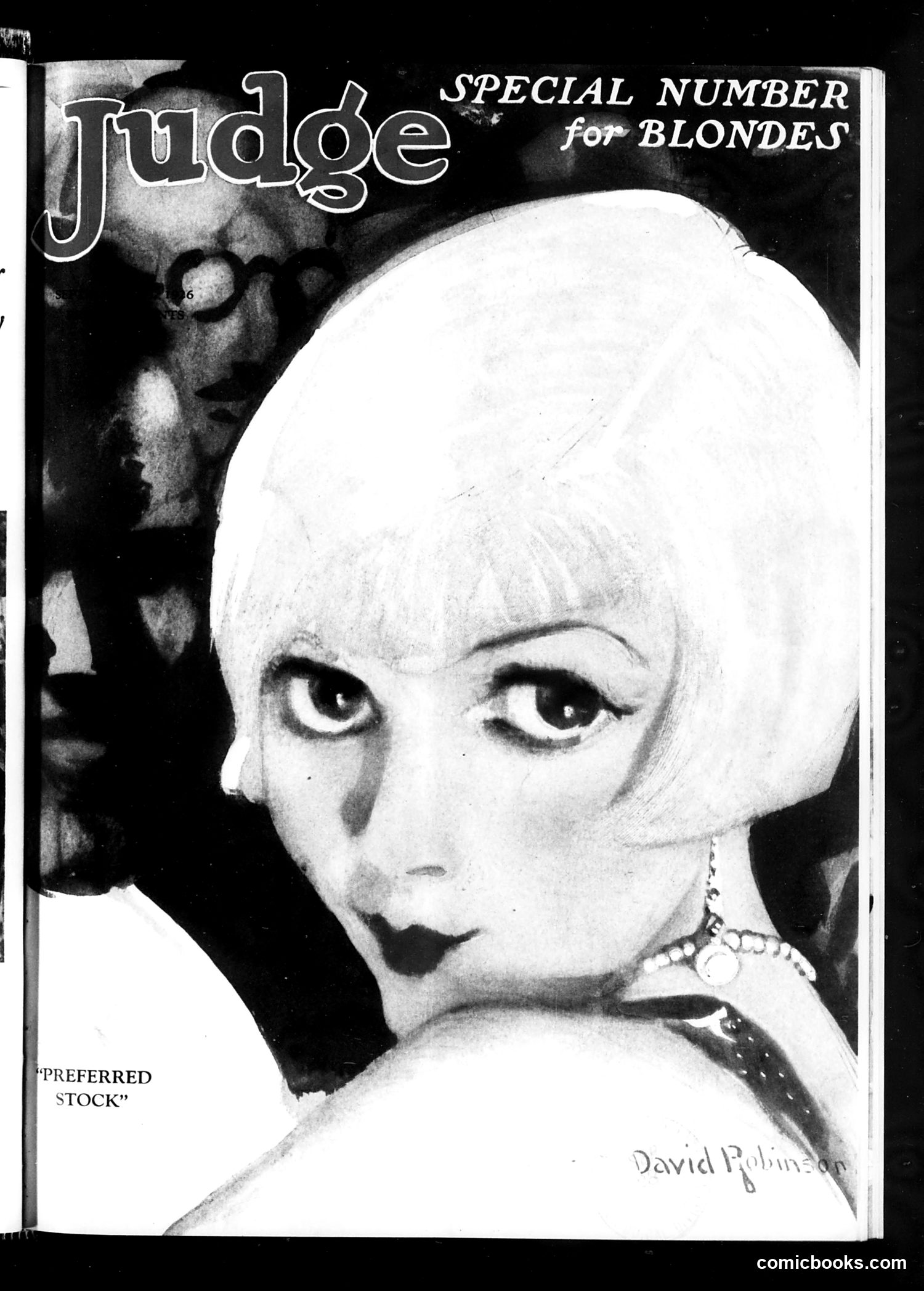
This is a Judge magazine cover featuring a portrait illustration signed by David Robinson. The cover announces a "Special Number for Blondes," suggesting the issue targeted or celebrated blonde women as a theme or demographic. The image shows a woman with a distinctive 1920s-style blonde bob haircut, heavy eye makeup, and pearl necklace—typical flapper aesthetics of that era. The "Preferred Stock" notation in the lower left appears to be a financial/commercial pun, treating the featured woman as a commodity or investment. The satire likely mocks the commercialization of beauty standards and the objectification of women during the Jazz Age, while also poking fun at the era's obsession with blonde hair and flapper fashion as status symbols.
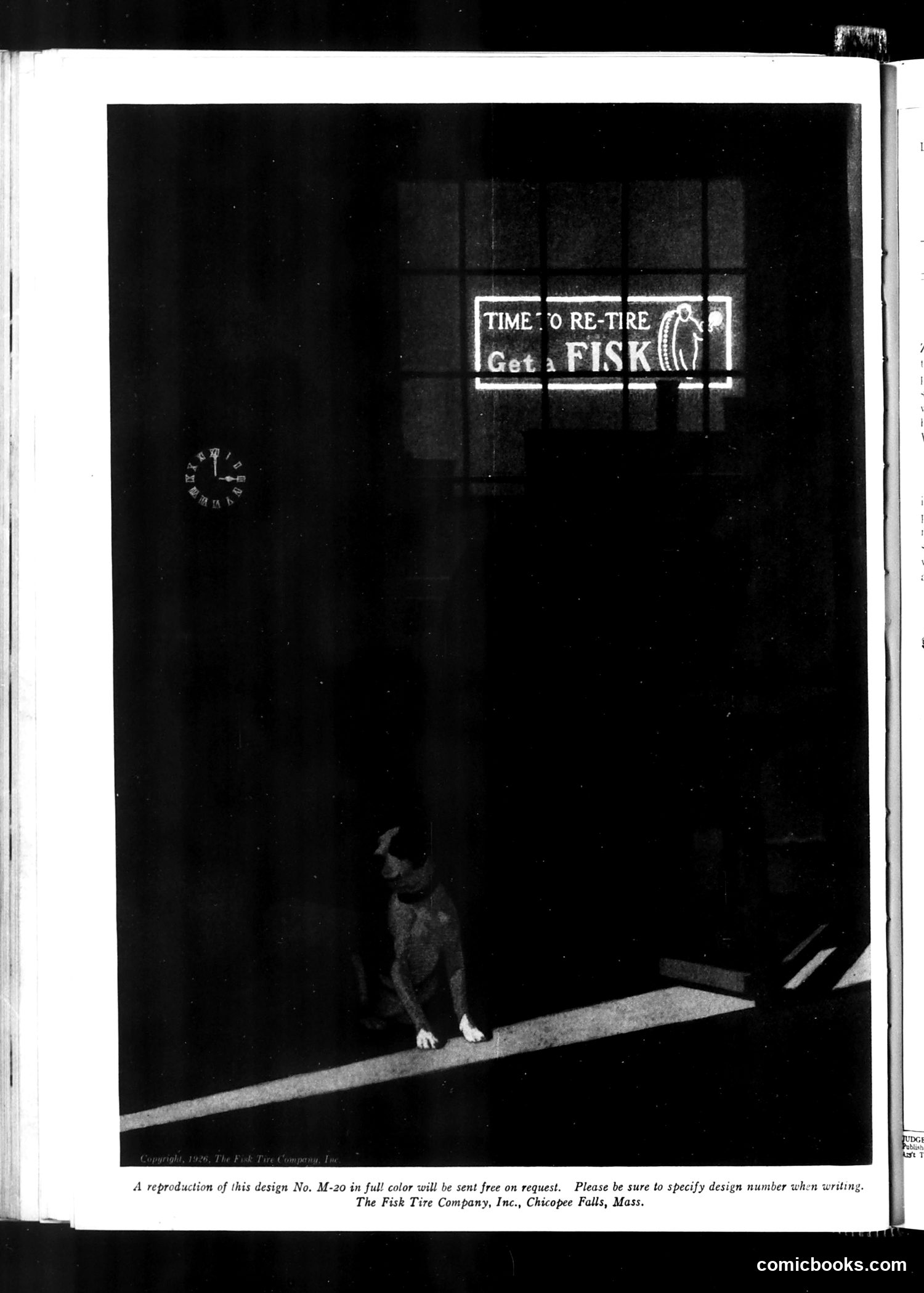
This page is primarily **advertising**, not editorial satire. It displays Design No. M-20, a Fisk Tire Company advertisement featuring a neon sign reading "TIME TO RE-TIRE / Get a FISK" visible through a dark storefront window. A dog sits on the floor below the sign, looking up at it. The humor is a **visual pun**: the dog appears to be heeding the advertisement's call to "retire" — the dog looks tired or weary, making the tagline work on multiple levels. It's a clever play on the double meaning of "tire" (exhaustion vs. the product). This is a commercial advertisement using anthropomorphized animal appeal typical of early 20th-century marketing, not political or social satire. The copyright notice attributes it to The Fisk Tire Company, Inc., Chicopee Falls, Massachusetts.
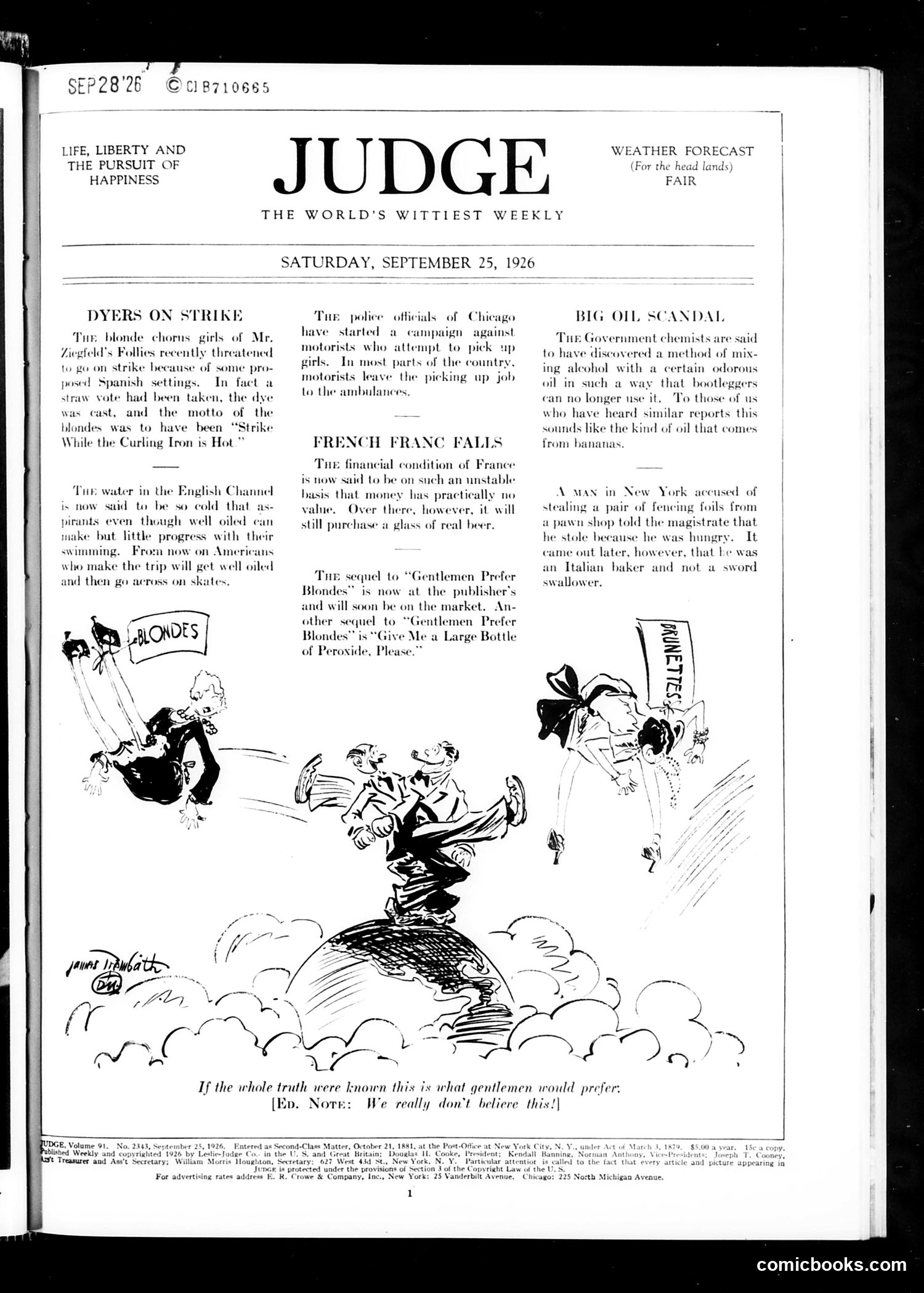
The main cartoon depicts a figure balancing precariously on a globe amid clouds, labeled "If the whole truth were known this is what gentlemen would prefer." This appears to be satirizing the "Gentlemen Prefer Blondes" cultural phenomenon—the popular 1925 Anita Loos novel and recent stage adaptation referenced in the text. The cartoon suggests that beneath polite society's pretenses, men's actual preferences are unstable or absurd. The surrounding smaller vignettes show chaos and disorder, reinforcing the joke that reality contradicts genteel appearances. The page's headline articles mock various social issues: dyers' strike, French financial troubles, and an oil scandal. The publication positions itself as witty social commentary on contemporary American life and politics through satire and caricature.
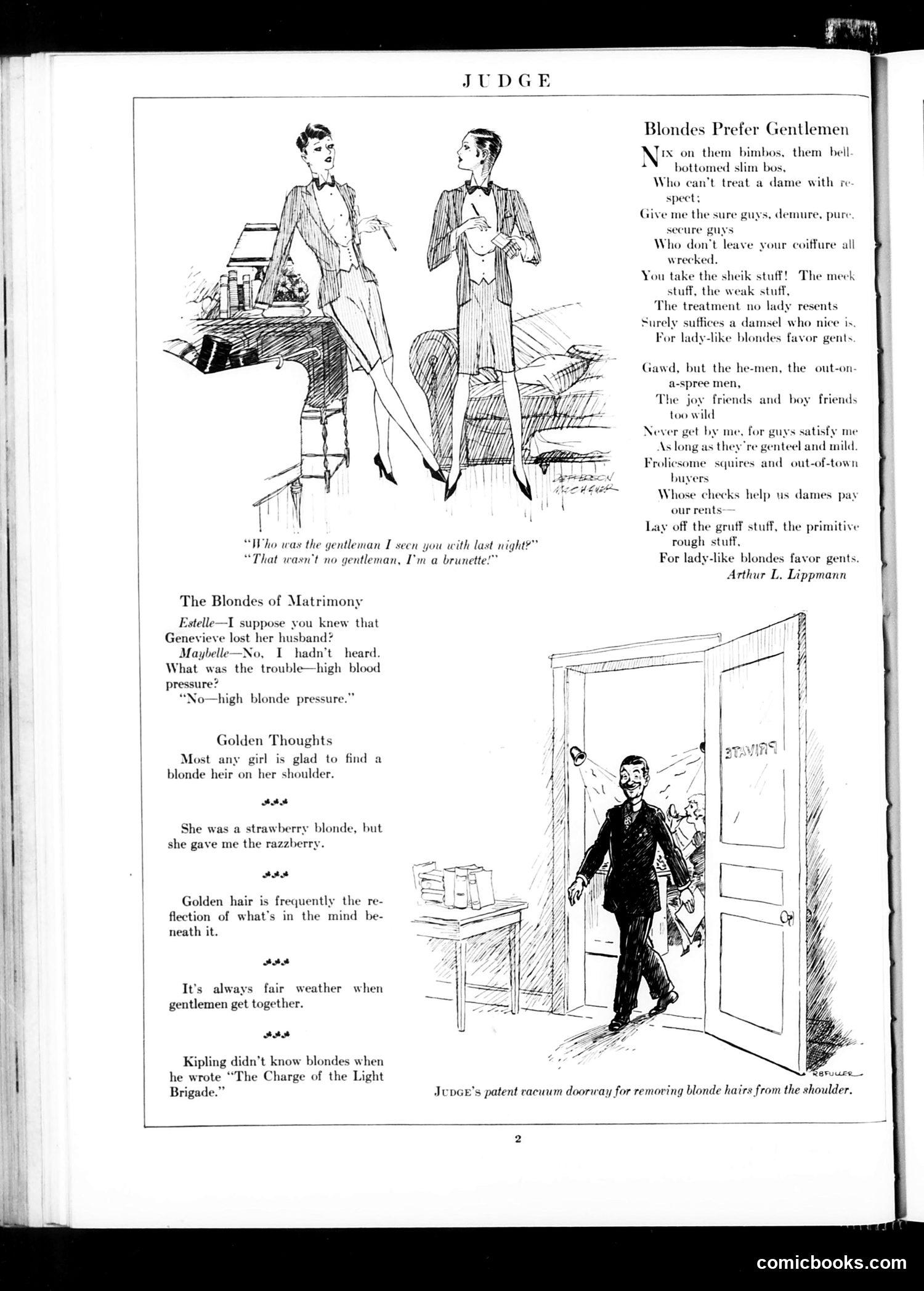
This page contains social humor about blonde women and dating preferences, typical of 1920s-30s American magazines. The top cartoon shows two well-dressed men, with dialogue suggesting one encountered the other with a woman. The accompanying poem "Blondes Prefer Gentlemen" humorously argues that blonde women favor respectable, mild-mannered men over rough characters—contrary to the stereotype that women prefer "bad boys." The lower sections offer brief jokes about blonde women ("The Blondes of Matrimony," "Golden Thoughts"), playing on period assumptions about blonde hair signaling attractiveness or simple-mindedness. The bottom illustration shows a vacuum doorway device—apparently Judge's satirical invention for removing blonde hair from gentlemen's shoulders, a joking reference to infidelity or romantic entanglements. The overall theme: lighthearted commentary on dating, attractiveness, and romantic behavior.
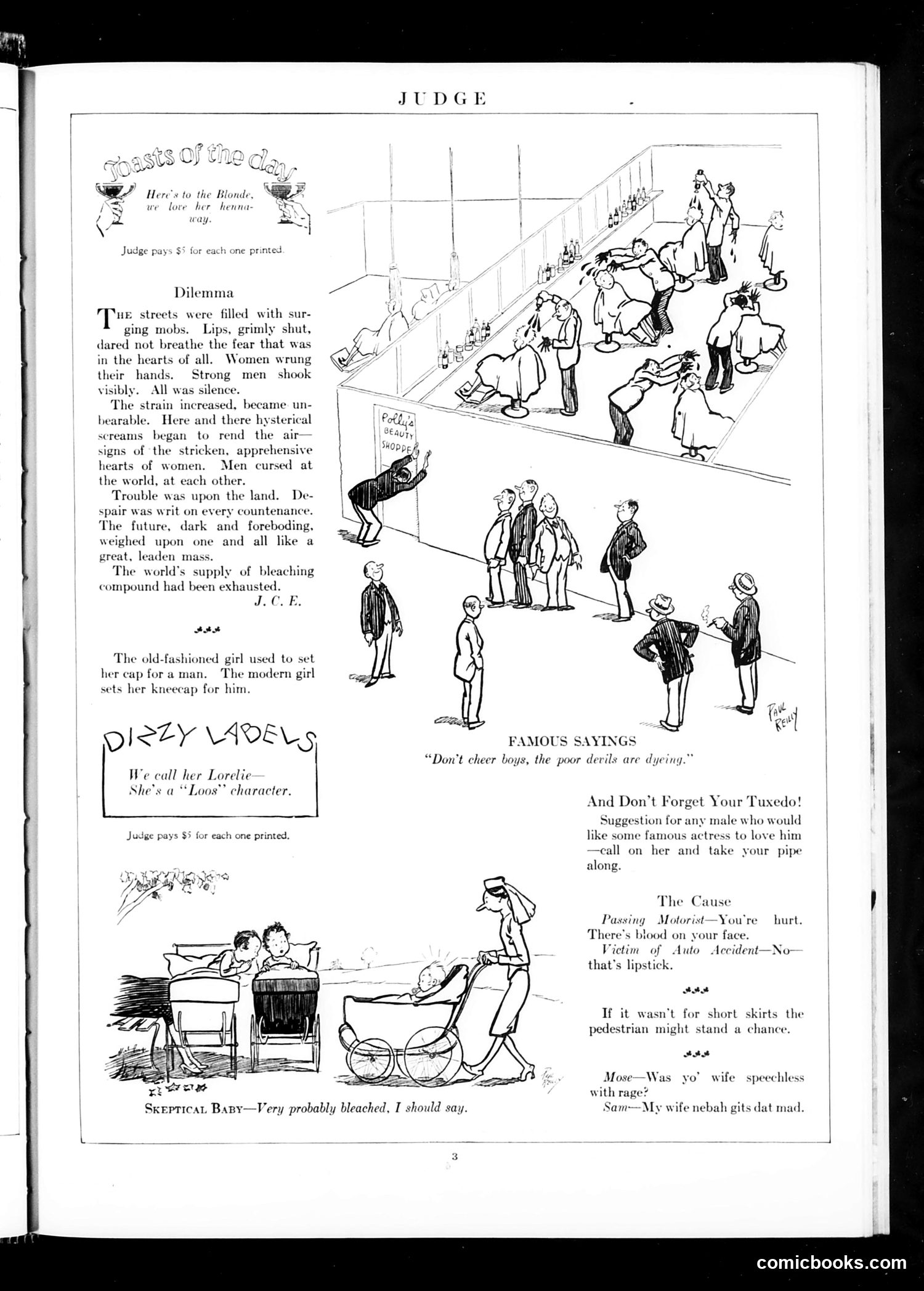
This page contains several satirical sketches and humorous observations about early 20th-century American life. The main cartoon "Dilemma" depicts a crowded, chaotic scene—apparently referencing bleaching compound shortages (noted in the text). The text describes societal distress: "streets were filled with surging mobs," suggesting widespread concern about a consumer product shortage affecting daily life. The secondary cartoons mock social conventions: "Dizzy Labels" jokes about modern versus old-fashioned courtship rituals; "Skeptical Baby" satirizes overuse of bleach on infant clothing; and "Famous Sayings" includes dark humor about people dying during what appears to be a public health crisis. The page mixes social commentary with period-specific anxieties about consumer goods availability and changing gender roles, typical of Judge's satirical approach to contemporary concerns.
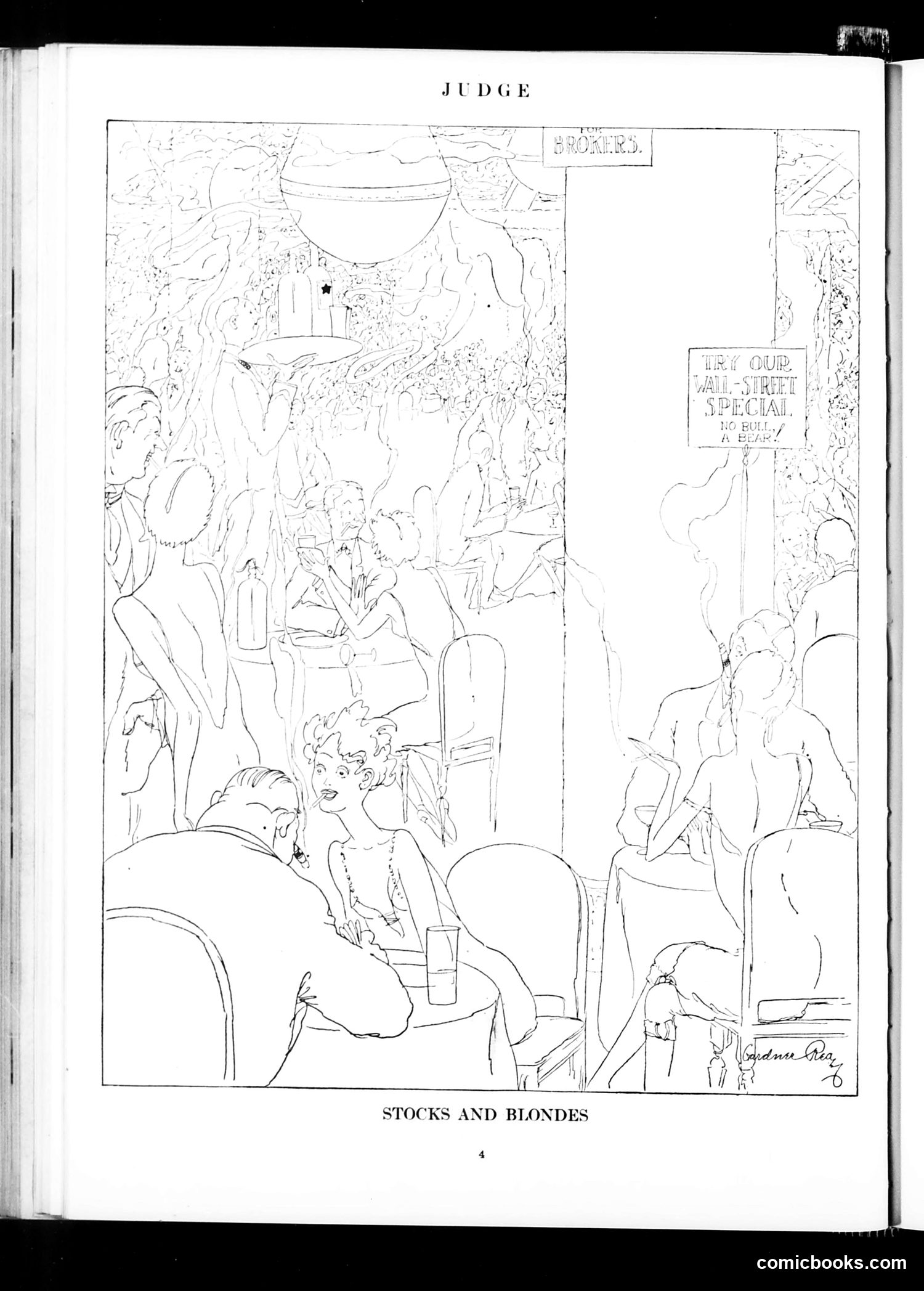
This cartoon depicts a nightclub or speakeasy scene, likely from the Prohibition era (1920s-30s). The title "Stocks and Blondes" appears to satirize the disconnect between two male patrons: one absorbed in financial/stock market concerns while surrounded by attractive women and alcohol. The scene suggests social commentary on American materialism and leisure culture during the Jazz Age—wealthy men prioritizing both investment portfolios and entertainment. The crowded, hedonistic setting with scantily-clad figures reflects Judge magazine's satirical take on either the excesses of the wealthy or the perceived moral decline of the period. The cartoon likely mocks either financial speculation mania or the contrast between serious economic concerns and frivolous nightlife pursuits among the affluent.
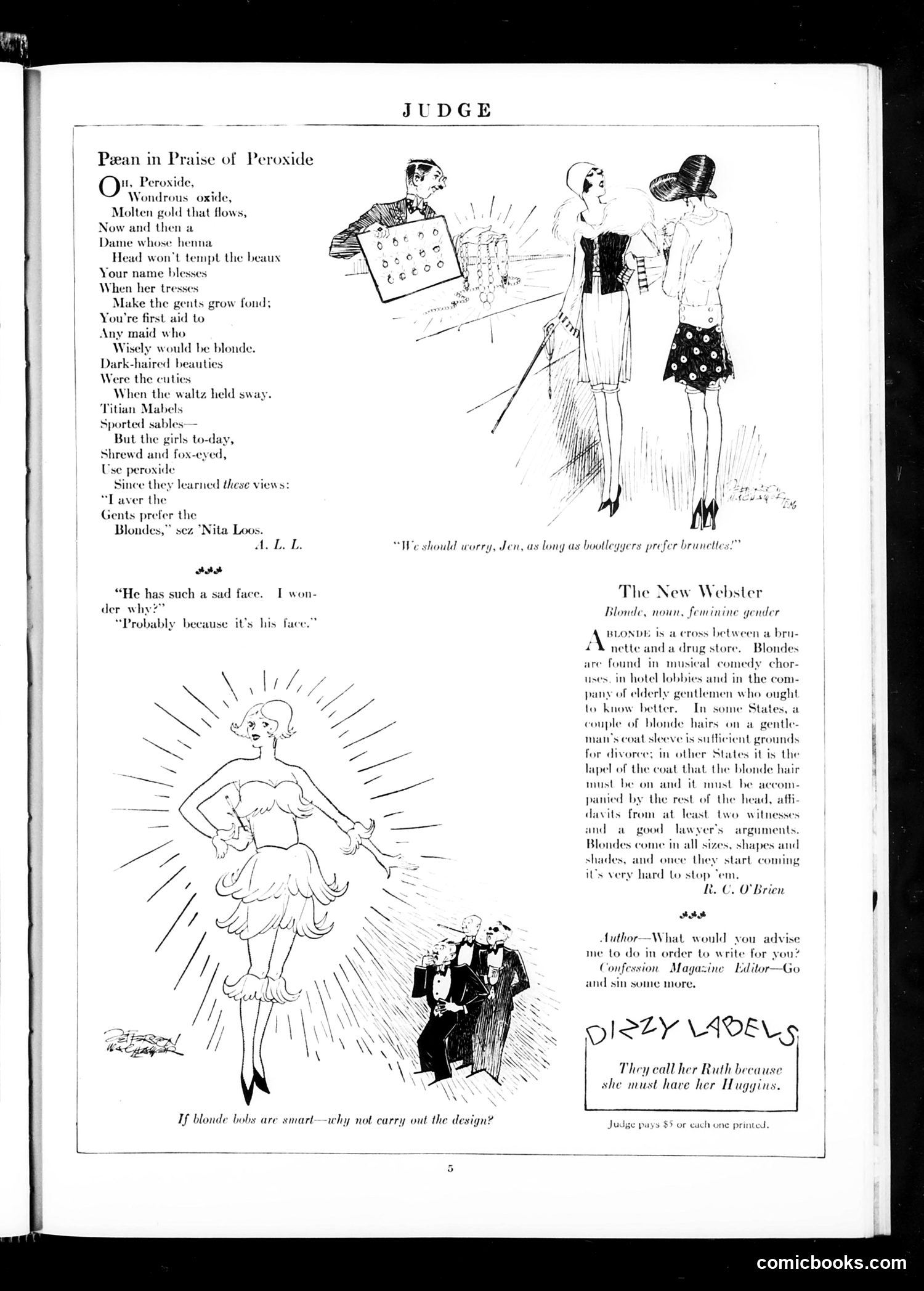
This page satirizes 1920s beauty standards and blonde hair as a fashion trend. "Paean in Praise of Peroxide" mocks the widespread use of hair bleaching, suggesting blonde hair has become artificially manufactured rather than natural. The poem criticizes how blonde women are idolized while dark-haired women are dismissed. "The New Webster" section humorously redefines "blonde" as "a cross between a brunette and a drug store"—suggesting blonde hair is an artificial cosmetic product, not genuine. The cartoon showing a radiant blonde woman surrounded by admiring men emphasizes how aggressively this beauty standard was being pursued and marketed. The satire targets both the commercial promotion of hair-bleaching products and society's shallow worship of a single, artificial beauty ideal.
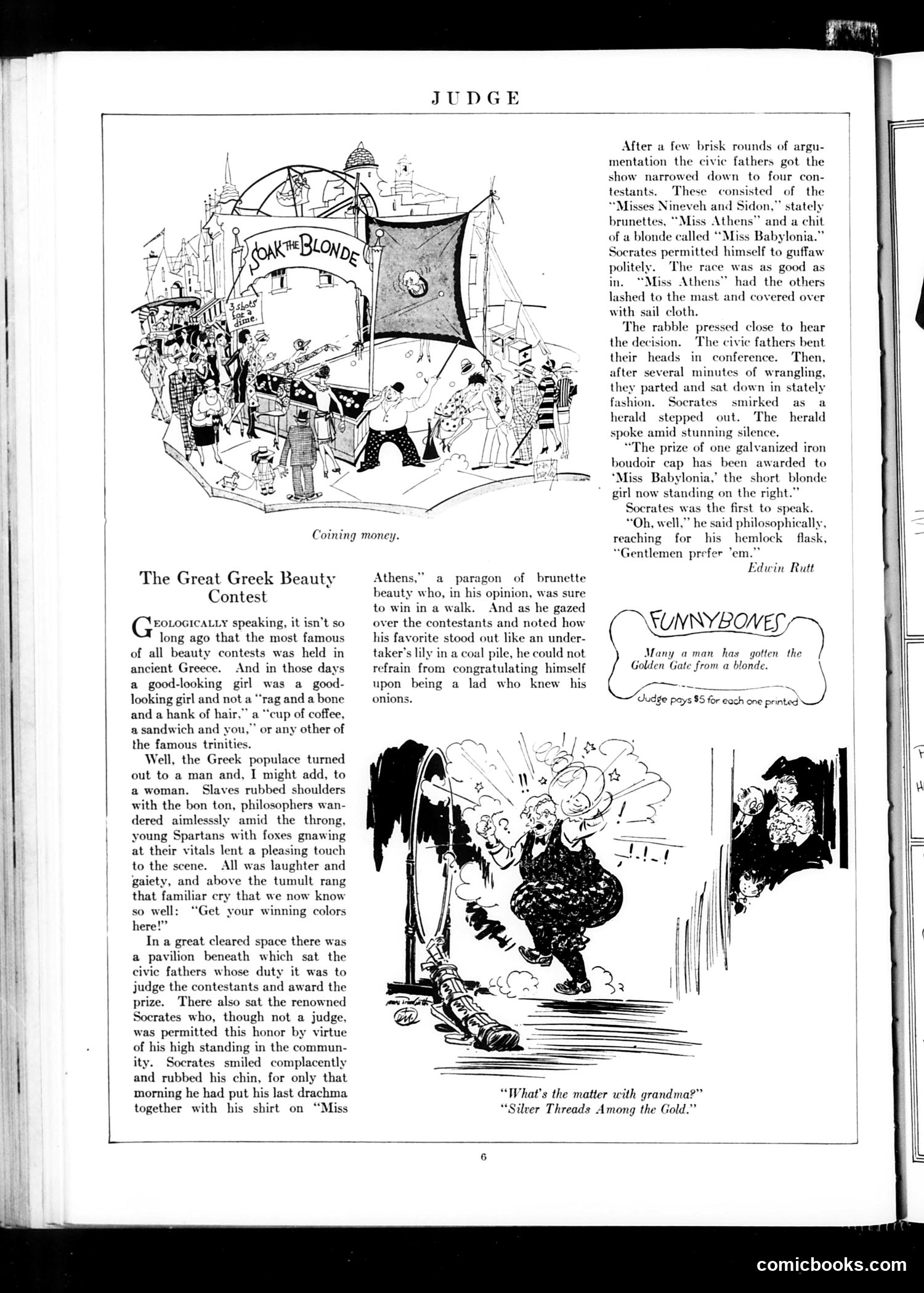
This satirical piece mocks both ancient Greek philosophy and contemporary beauty standards. Socrates, the famous philosopher, is portrayed as foolishly betting his money on "Miss Athens," a brunette he's confident will win. However, the judges award the prize to "Miss Babylonia," a blonde, causing Socrates to lose his wager. The joke plays on the phrase "Gentlemen prefer 'em"—likely referencing the popular saying "Gentlemen Prefer Blondes." By setting this in ancient Greece with the philosopher Socrates as the dupe, Judge magazine satirizes both classical learning (making the wise Socrates foolish about women) and contemporary preferences for blonde beauty over brunette. The cartoon mocks male predictability regarding women's appearance while poking fun at both high philosophy and low gambling instincts.
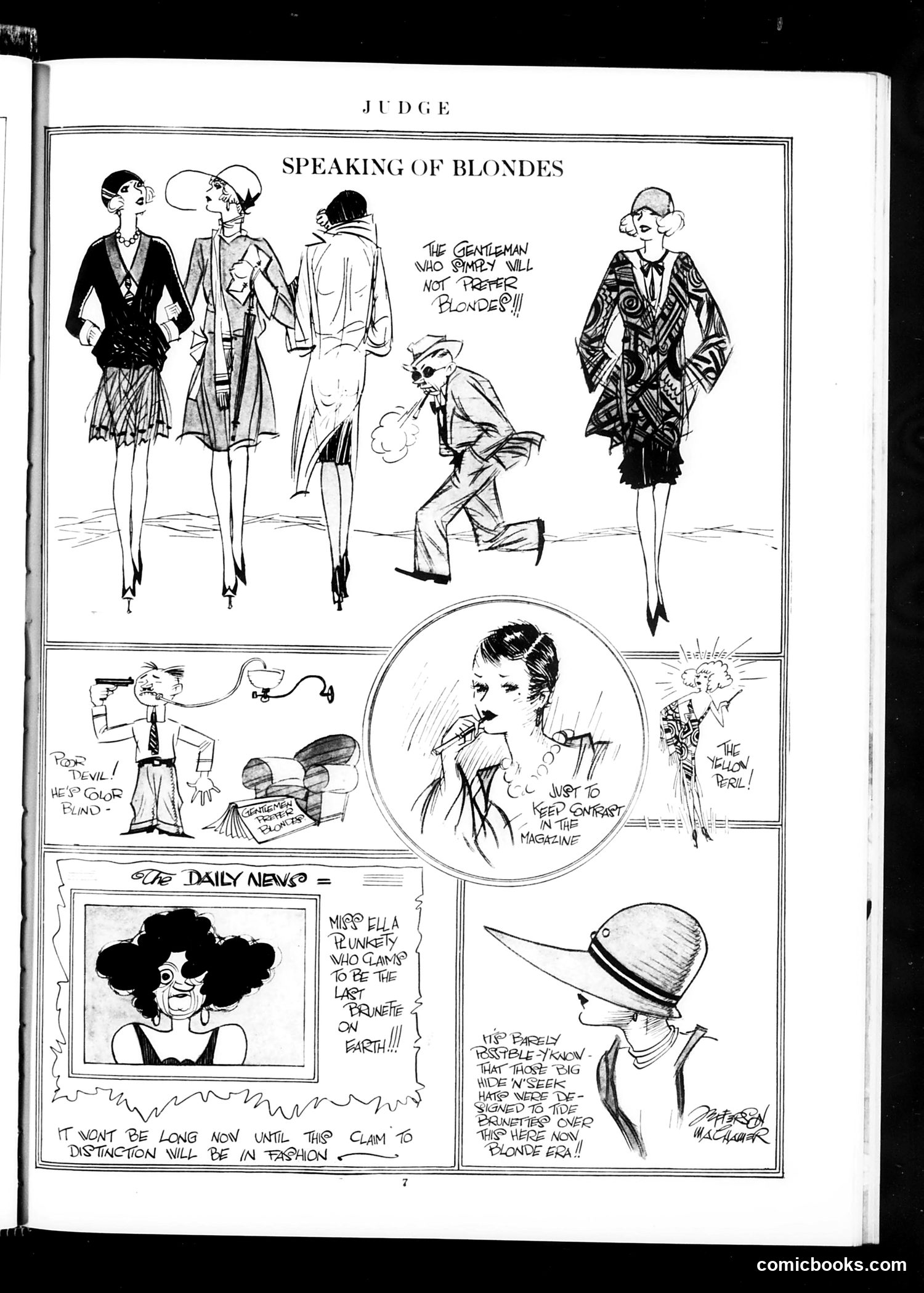
This page satirizes 1920s fashion trends and blonde women's social prominence. The top panel shows fashionably dressed blonde women while a man declares he won't prefer blondes—immediately contradicted by his obvious interest. The humor mocks men's stated preferences versus actual behavior. The "Daily News" section features Miss Ella Trunkey, who claims to be "the last brunette on Earth," satirizing the era's apparent obsession with blonde hair as a status symbol and fashion standard. The joke suggests blondes have become so culturally dominant that brunettes face extinction. Bottom panels reference wide-brimmed hats as fashion accessories designed to cover and protect "proprieties"—likely alluding to the flapper era's loosening of social mores and women's increasing visibility in public life. The overall satire critiques both the shallow materialism of 1920s fashion obsession and society's fixation on blonde women as the beauty ideal.
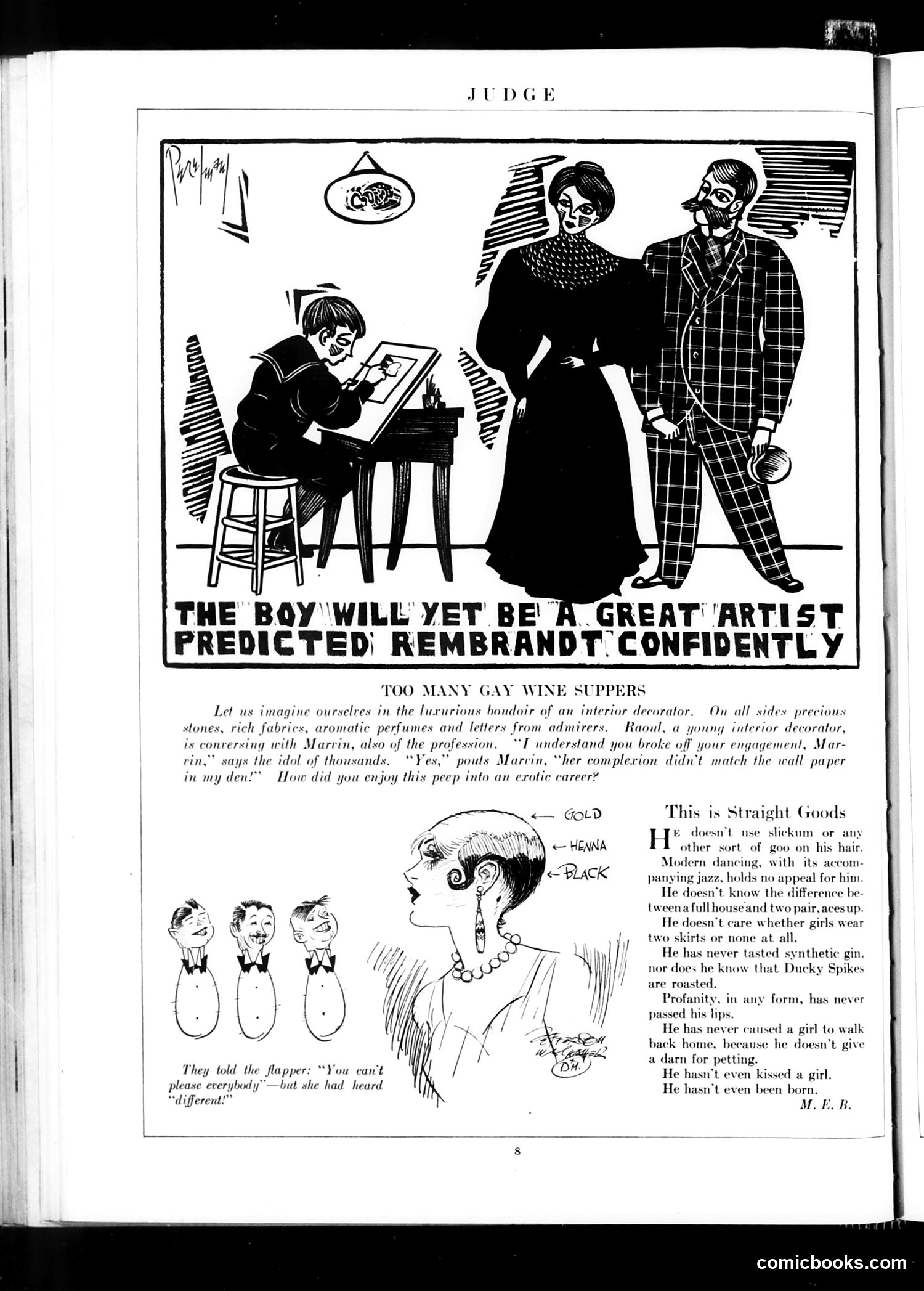
This page from *Judge* magazine satirizes 1920s social trends through two separate pieces: **Top cartoon**: Mocks interior decorators and aesthetic pretension. A young boy sketches while two fashionable adults observe. The caption references Rembrandt predicting greatness, but the joke—revealed in the article below—is that the decorator "Marvin" broke his engagement because his fiancée's complexion didn't match his den's wallpaper. The satire targets how absurdly shallow and materialistic these professionals were, prioritizing décor over human relationships. **Bottom section ("Straight Goods")**: Describes an idealized young man who avoids all 1920s vices—slicked hair, jazz, gambling, gin, profanity, and sexual activity. The punchline: "He hasn't even been born." This mocks puritanical moralists who condemned modern youth culture (flappers, jazz, drinking post-Prohibition). By making the "good boy" literally non-existent, *Judge* suggests such moral purity is impossible in contemporary society. Both pieces satirize excess: one targeting aesthetic obsession, the other targeting moral prudishness.
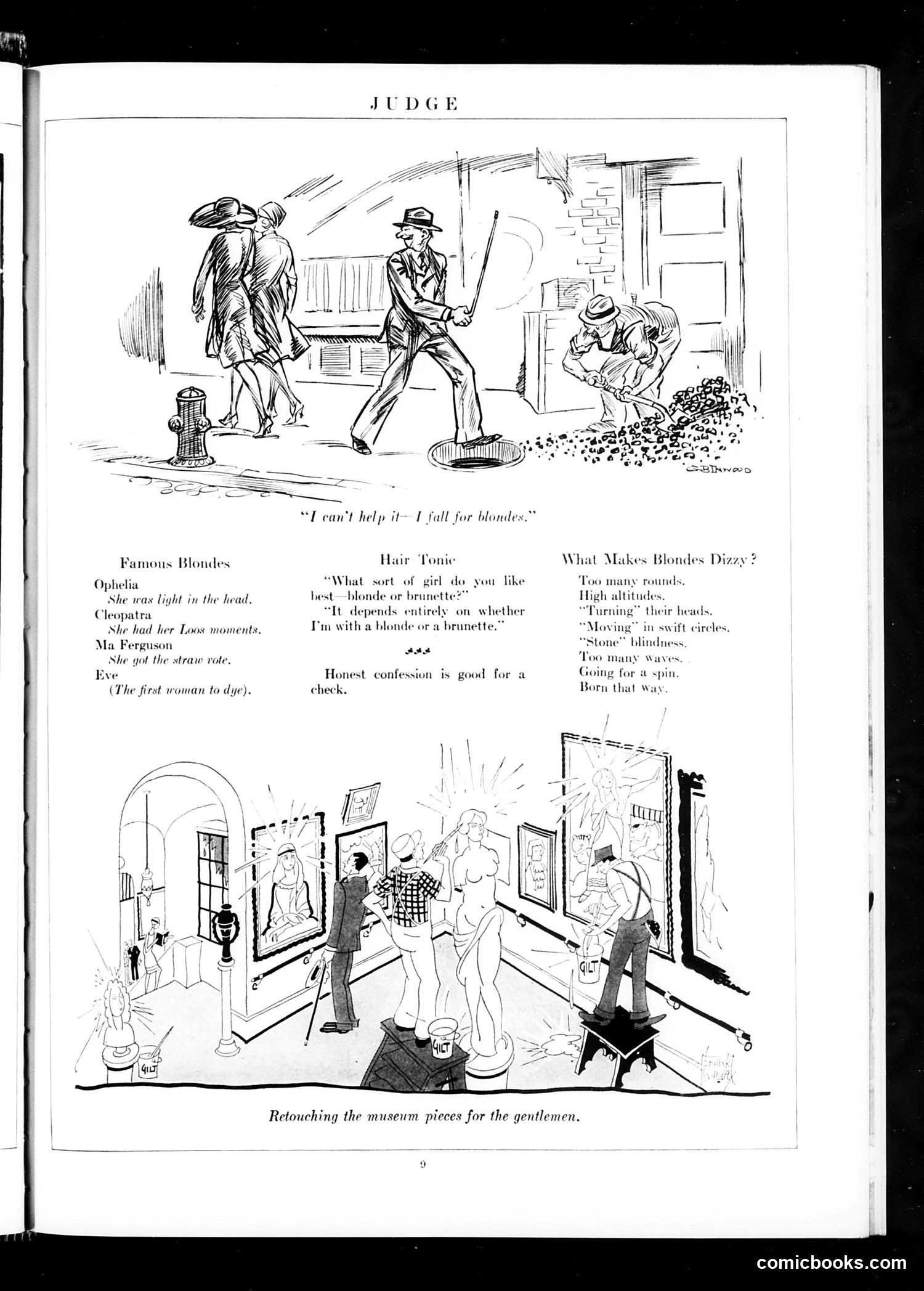
This page contains two satirical cartoons mocking gender stereotypes of the 1920s era. **Top cartoon**: A man admits "I fall for blondes," establishing the page's theme. The accompanying text lists "Famous Blondes" (Ophelia, Cleopatra, Ma Ferguson, Eve) with jokes emphasizing female stereotypes—Ophelia was "light in the head," Eve was "the first woman to dye" (hair). A "Hair Tonic" section jokes about blonde preferences, while "What Makes Blondes Dizzy?" lists frivolous causes: "high altitudes," "turning their heads," and "going for a spin." **Bottom cartoon**: Titled "Retouching the museum pieces for the gentlemen," it shows male artists literally retouching classical nude statues and paintings to make them more attractive. This satirizes men's obsession with female appearance and suggests they artificially enhance or distort women's images. Overall, the page ridicules male fascination with blondes and superficial beauty standards while implying women are intellectually vapid.
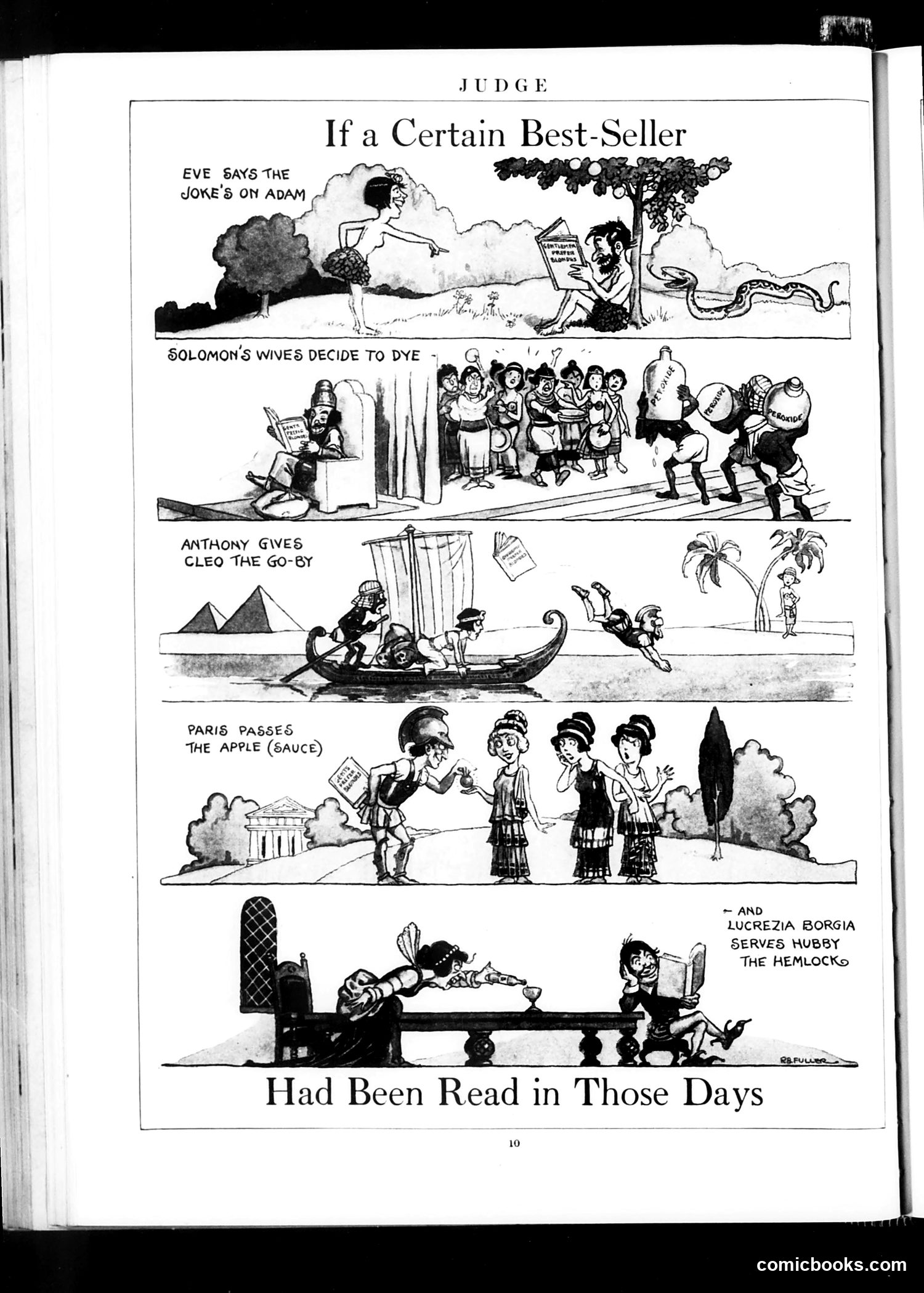
This satirical page imagines how biblical and historical events would have unfolded differently if a popular "best-seller" (likely a contemporary book about women's rights or female empowerment) had existed in ancient times. Each panel humorously reverses traditional narratives: - **Eve blames Adam** for the Fall rather than accepting blame - **Solomon's wives rebel** instead of passively accepting polygamy - **Cleopatra rejects Antony** rather than pursuing him - **Paris passes up Helen** (the apple/Helen of Troy pun) - **Lucrezia Borgia poisons her husband** instead of being victimized The satire mocks anxieties about women's independence and changing gender roles. By showing famous women taking control of their fates, the cartoonist suggests that modern feminist ideas would fundamentally disrupt historical "order." The tone is comedic but carries an undertone of concern about women's liberation movements of the era.
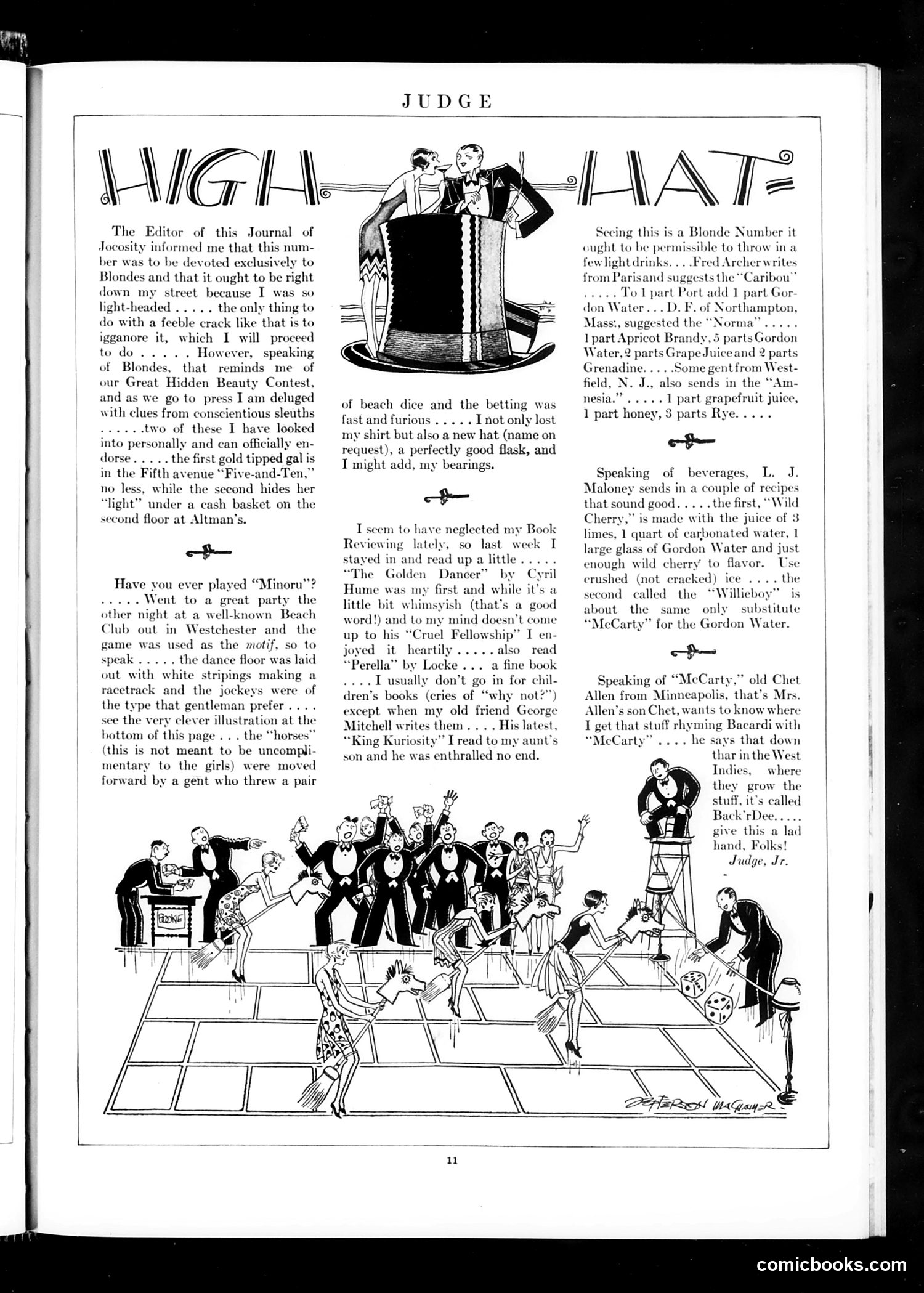
This is a humor column from Judge's "Blonde Number" issue. The main illustrated cartoon depicts "Minoru," a parlor game played at a Westchester beach club where women serve as "horses" on a racetrack drawn on the dance floor, moved forward by dice throws. Men bet on their movement—the writer humorously reports losing his shirt, hat, and flask in the gambling. The text discusses literary reviews (books by Cyril Hume and Locke), cocktail recipes submitted by readers (the "Wild Cherry," "Willieboy," and "Caribou" drinks), and a playful correction from a reader about rhyming "Bacardi" with "McCarty." The satire gently mocks upper-class leisure activities, excessive drinking during Prohibition, and the frivolous nature of high-society games. The "Blonde Number" designation is the issue's theme, allowing the author to make light-headed puns throughout.
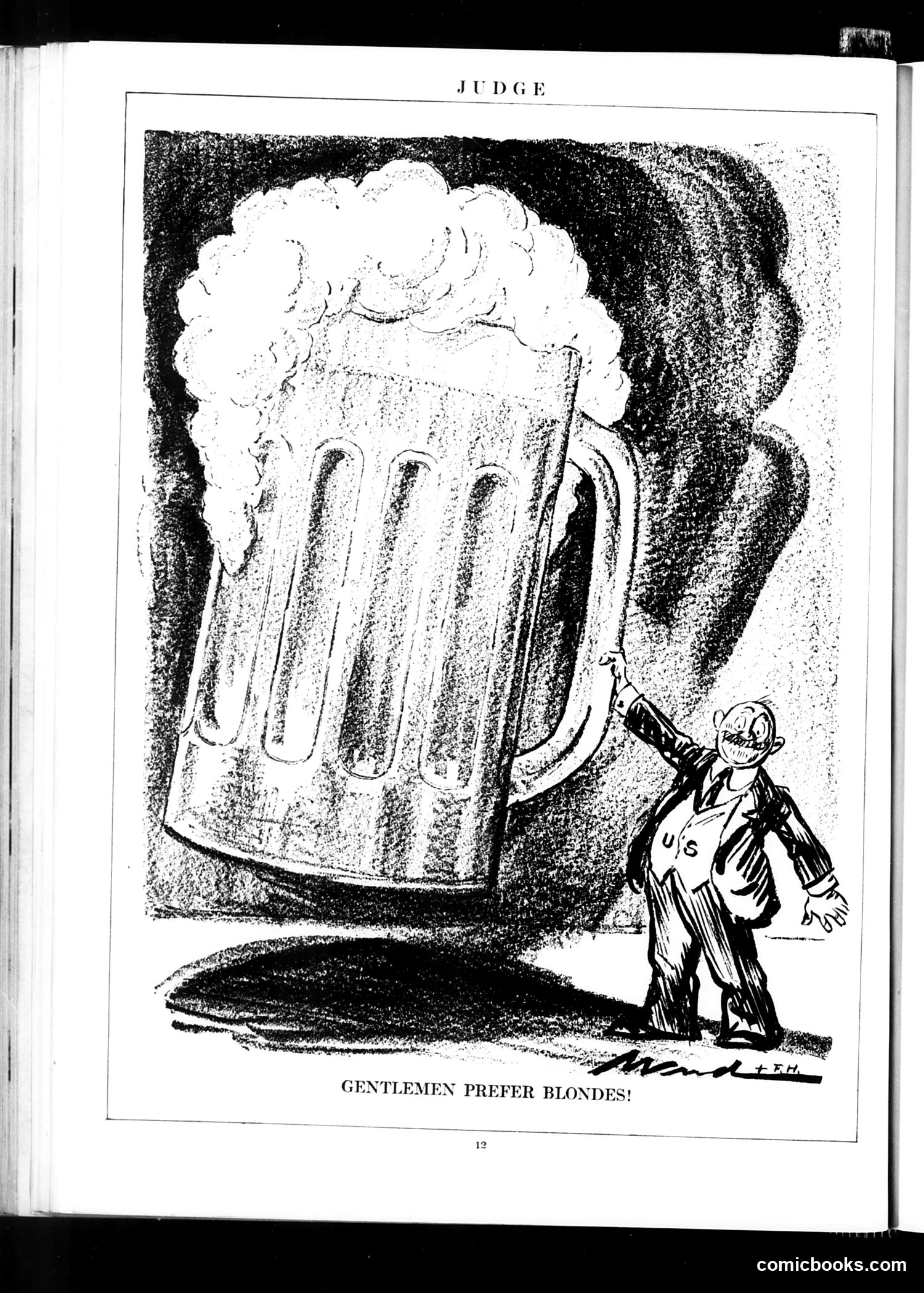
This is a single-panel cartoon from *Judge* magazine titled "Gentlemen Prefer Blondes!" The image shows a small man in formal attire (marked with "U.S.") gazing up admiringly at an enormous beer mug with foam overflowing from the top. The cartoon appears to satirize American preferences, particularly post-Prohibition attitudes toward beer consumption. The "U.S." marking on the figure suggests commentary on American national character or behavior. The exaggerated size of the beer mug compared to the tiny man reinforces the joke—the implication being that Americans (or American gentlemen, playing on the popular phrase "Gentlemen Prefer Blondes") have an enormous appetite for beer, treating it as their preferred indulgence. The humor relies on the visual contrast and the double meaning of the famous phrase.
This page contains two editorial pieces satirizing American political culture and humorously speculating about U.S.-Canadian relations. **"Who Cares?"** criticizes voters' actual priorities in elections. The editors note people elect officials based on party affiliation, ethnic background, or religious views—not competence. The piece defends Senator Jimmy Wadsworth as genuinely "useful" because he actually understands government and does the unglamorous work required. However, the editors mock themselves for even suggesting this matters to voters ("But who cares?"), implying the public won't reward actual competence. **"S-s-s-s-h!"** jokingly speculates about hypothetical U.S.-Canadian political union, concluding Canadians would run it because northern populations historically dominate political unions (Scotland with England, northern Italy, northern Germany). The editors suggest northern peoples are toughened by climate and more ambitious. The tone is satirical—mocking both American electoral indifference and playfully poking at continental dynamics, while maintaining the magazine's characteristic irreverent, knowing humor about politics and governance.
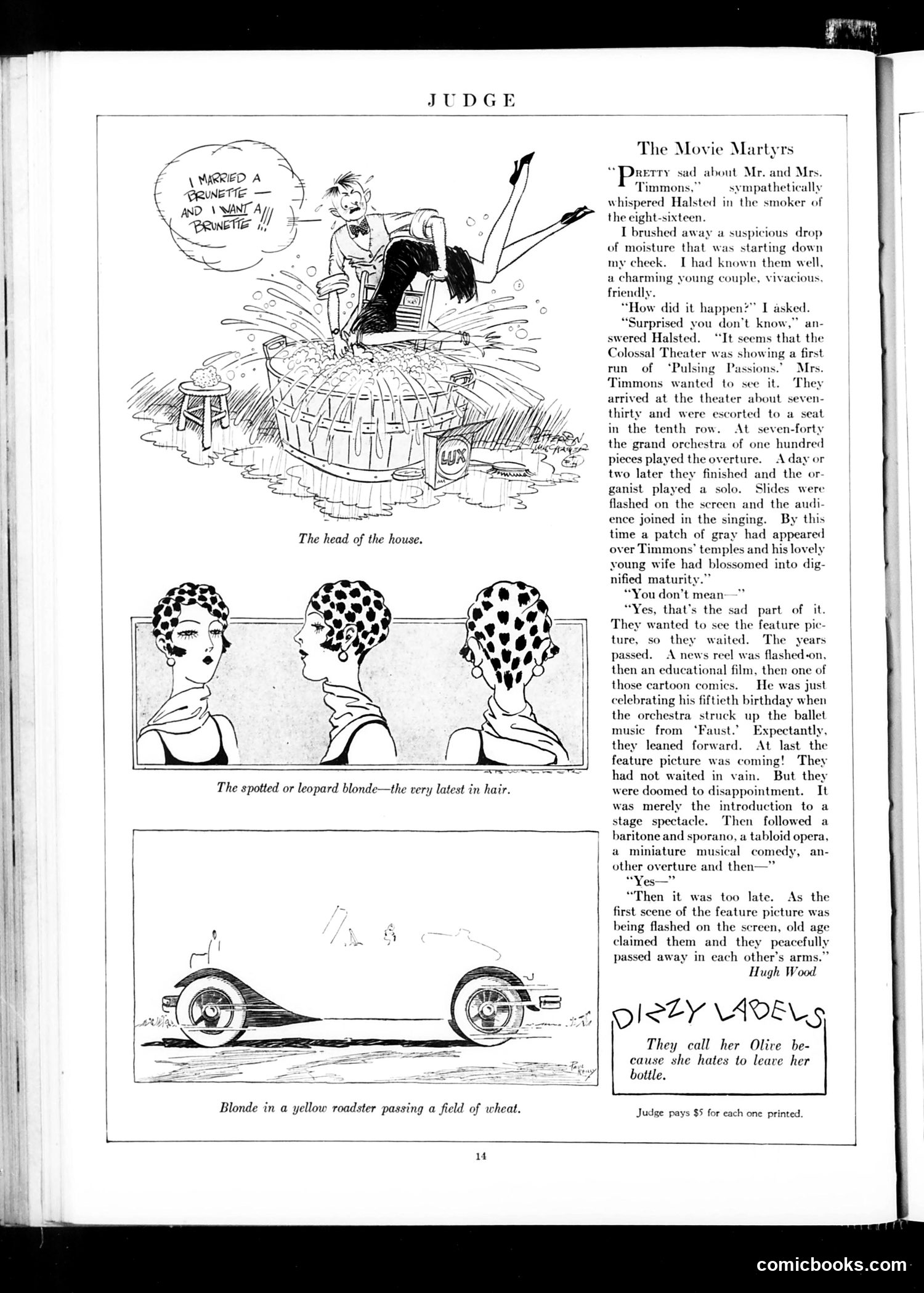
This satirical piece mocks the bloated, excessive programming of movie theaters in the 1920s. The humor centers on Mr. and Mrs. Timmons, who arrive at the Colossal Theater to see the feature film "Pulsing Passions" but must endure an absurdly long sequence of preliminaries: a 100-piece orchestra overture, organ solo, sing-along slides, newsreel, educational film, cartoon comics, ballet music, tabloid opera, and miniature musical comedy. By the time the actual feature begins, so much time has passed that the elderly Timmons have literally aged and died waiting. The satire critiques how theaters padded programs with entertainment filler, frustrating patrons who simply wanted to see the advertised feature film. The accompanying illustrations showing "Dizzy Doels" (a flapper blonde character) are typical Judge humor about modern fashions and social types. The joke reflects genuine contemporary complaints about excessive theater prologues during the silent film era.
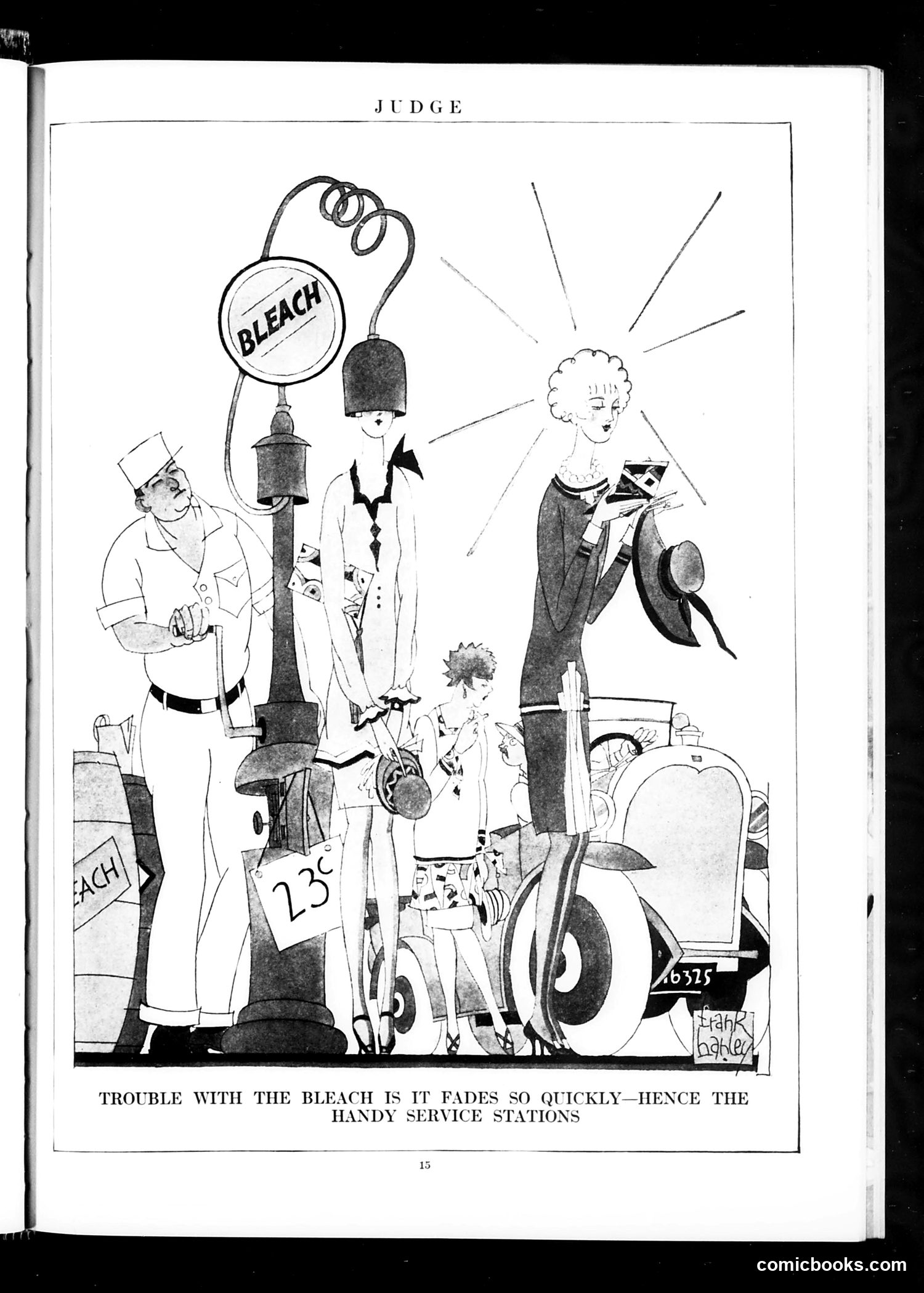
This satirical cartoon critiques the rapid fading of bleach as a cleaning product. The illustration shows a "service station" concept—ironically mimicking the gas stations proliferating in the 1920s-30s—where customers can quickly obtain bleach refills. The caricatured figures include a doctor or scientist (left), fashionably dressed women, and children, all gathered around a bleach dispenser styled like a gas pump, marked "23¢." The joke satirizes both the bleach product's poor durability and American consumer culture's embrace of convenient "service stations" for everyday goods. The cartoon pokes fun at advertising claims and product quality while commenting on how rapidly new retail conveniences were becoming normalized in American life.
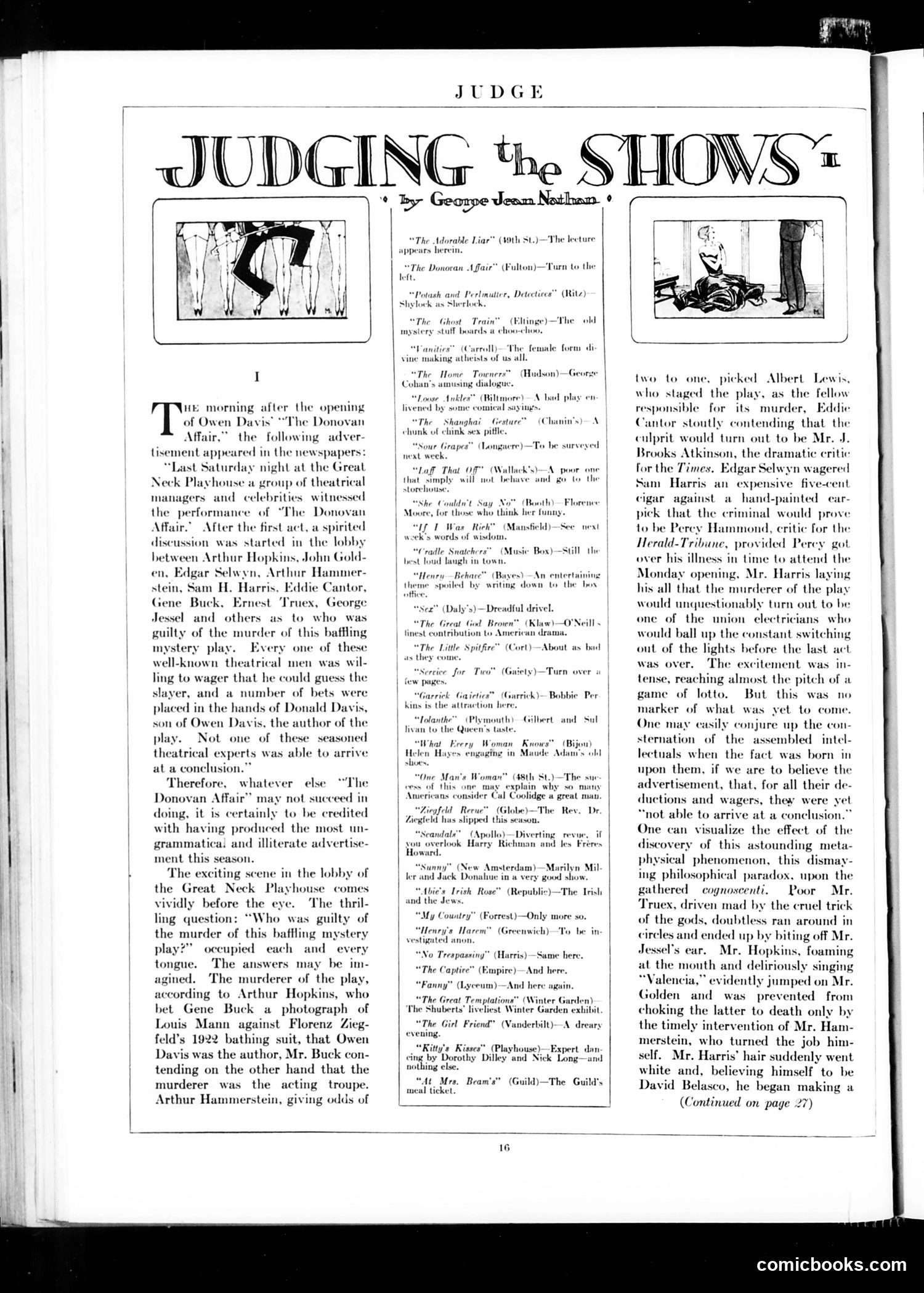
This page satirizes the critical response to Owen Davis's play "The Donovan Affair," a mystery drama. The joke centers on a fake newspaper advertisement claiming that prominent theatrical figures (producers Arthur Hopkins, John Golden, and others; comedian Eddie Cantor; and other Broadway insiders) gathered after opening night and couldn't solve who committed the play's murder—wagering bets on the answer. The satire mocks the advertisement's terrible grammar and syntax, suggesting the play itself is so poorly constructed that even experienced theater professionals can't follow its plot. By extension, Judge ridicules the play's quality through this device: if Broadway's smartest minds can't determine basic plot points, the play must be incompetent. The right column contains brief, caustic reviews of current Broadway shows, typical of George Jean Nathan's theater criticism style, offering context for the competitive theatrical landscape being satirized.
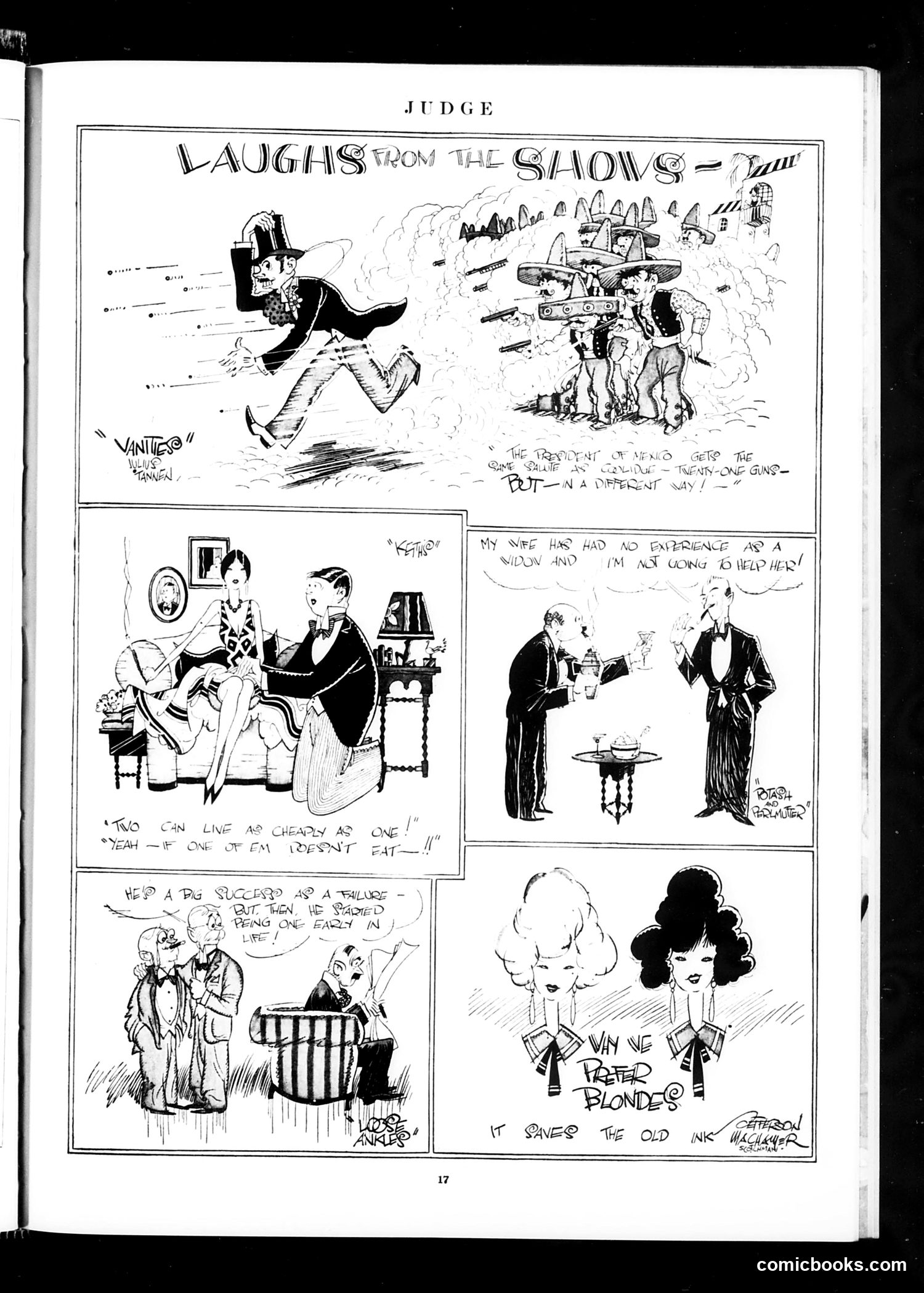
This page collects satirical cartoons mocking various social situations and attitudes of the era (likely 1920s-30s based on style): **Top panel**: A man flees from domestic chaos—likely satirizing marital discord or domestic violence as comedy fodder. **Middle-left**: A couple's conversation about living "cheaply" and avoiding restaurant meals—poking fun at economizing during hard times or miserliness. **Middle-right**: Two men discussing a widow's remarriage, with one offering to "help her"—crude innuendo about widow-hunting or opportunistic suitors. **Bottom-left**: A scene involving "a pig squealed" and "a village idiot"—the joke appears to reference rural/rustic humor, though details are unclear. **Bottom-right**: "Wine Better Blondes"—a pun-based joke about hair dye preferences, satirizing contemporary beauty standards and women's fashion choices. The overall theme targets domestic life, courtship, economic struggles, and changing women's roles through period-typical comedic stereotypes.
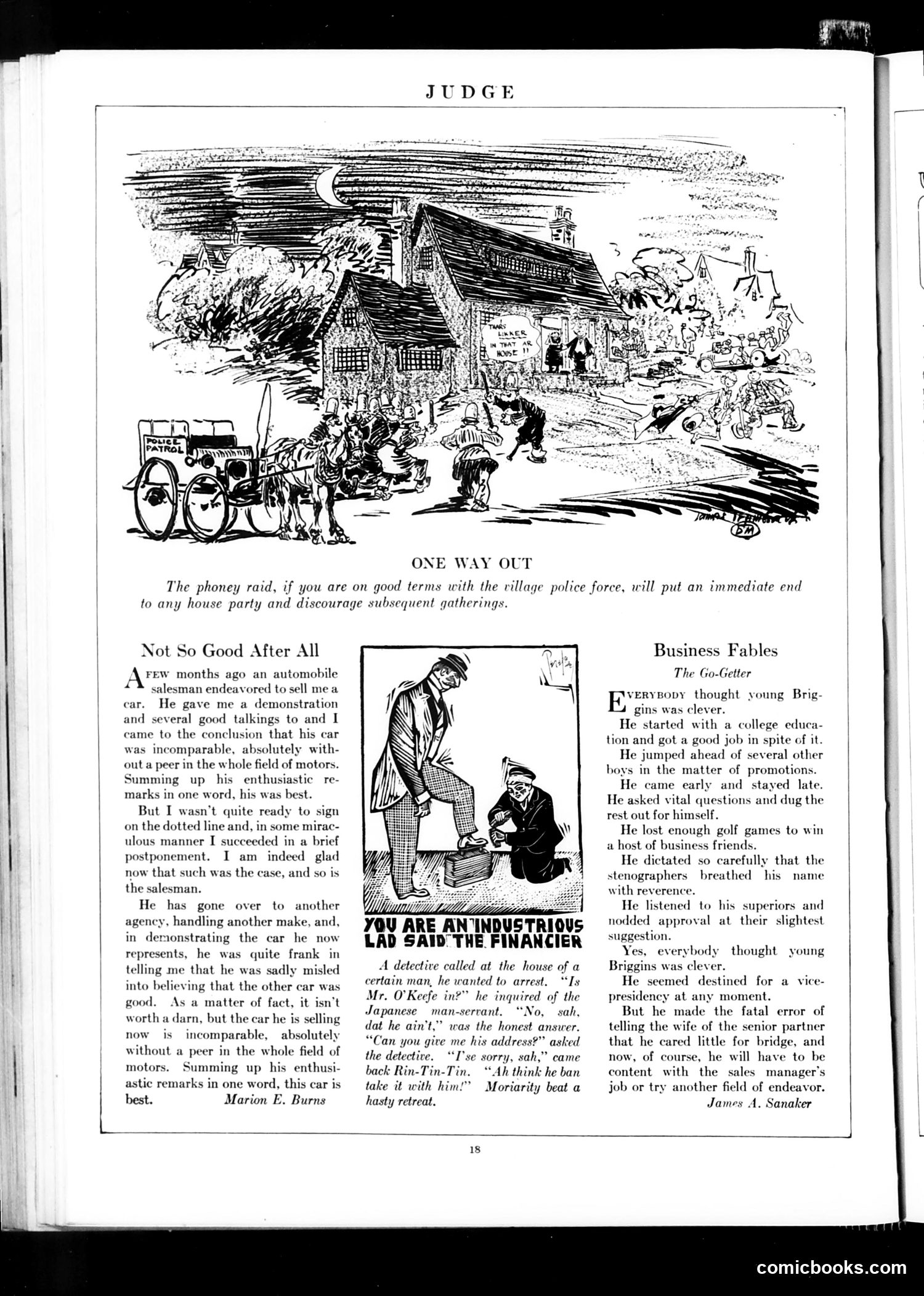
This page contains three pieces of satirical humor typical of early-20th-century Judge magazine: **"One Way Out"** (top cartoon): A humorous illustration about avoiding unwanted house parties by anonymously tipping off the village police to raid them—a joke about prohibition-era enforcement and social etiquette. **"Not So Good After All"** (left): Satirizes car salesmen's dishonesty. A salesman previously praised one automobile as "incomparable"; after switching employers, he now claims that same car is worthless and his new model is superior. The satire targets salesmen's mercenary nature and customers' gullibility—they'll say anything to make a sale regardless of truth. **"Business Fables: The Go-Getter"** (right): A cautionary tale mocking corporate advancement. Young Briggins does everything "right"—works hard, arrives early, stays late, asks good questions—yet undermines himself by casually telling the senior partner's wife he dislikes bridge. Social conformity matters more than merit; he's relegated to sales instead of vice-presidency. The satire critiques how corporate success depends on social performance and flattery rather than actual competence.
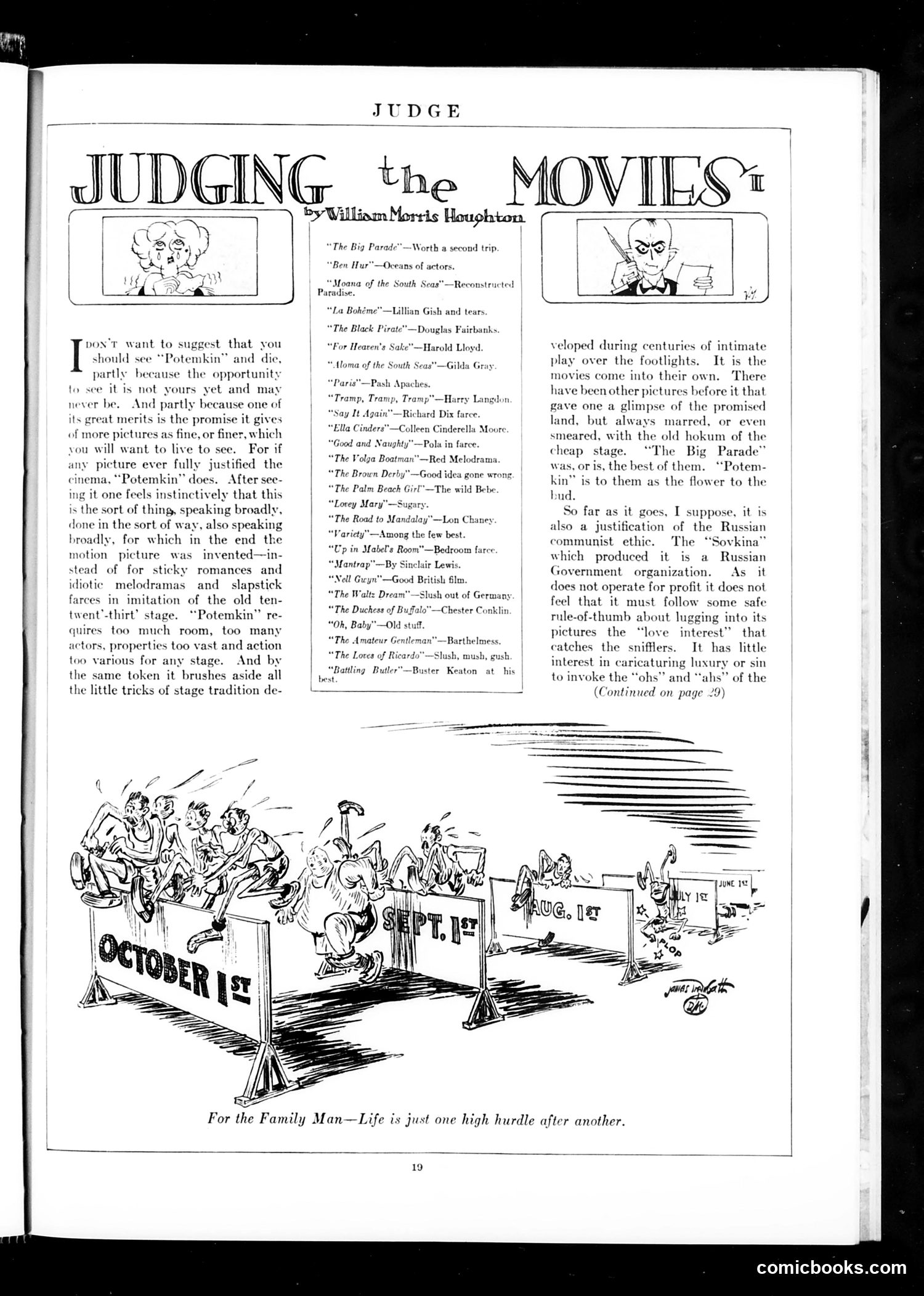
This is a film review column by William Morris Houghton evaluating current movies. The main essay praises the Soviet film "Potemkin," arguing it justifies cinema as an art form—unlike American movies that rely on tired stage conventions and "sticky romances." The cartoon below depicts the chaotic "family man" jumping between monthly film releases (August through October), showing how movies provide endless entertainment but demand constant attention—"life is just one high hurdle after another." The accompanying list reviews current releases: *The Big Parade*, *Ben Hur*, *Ella Cinders*, and others. Houghton contrasts *Potemkin*'s artistic merit with Hollywood's commercial formulas. He notably doesn't discourage seeing *Potemkin* despite its Russian communist origin, praising its genuine artistic achievement over profit-driven American studio pictures with their reliance on romance, melodrama, and slapstick.
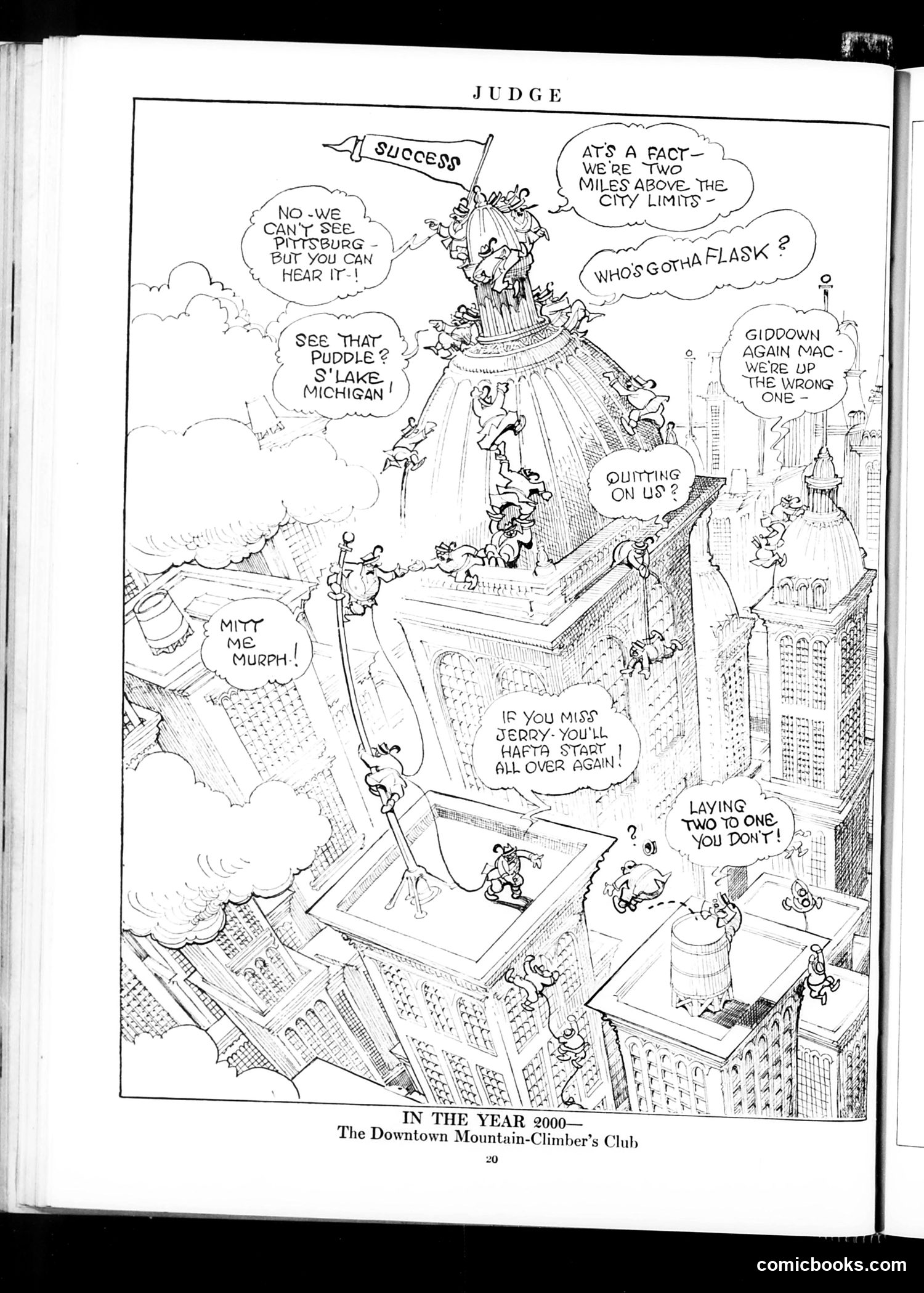
This satirical cartoon imagines the year 2000, depicting city skyscrapers so tall that climbers treat them like mountains. The joke plays on turn-of-the-century anxieties about urban growth and towering industrial architecture. The climbers ascend a massive building while discussing landmarks visible from extreme height—Lake Michigan and Pittsburgh are referenced as geographic markers. Characters complain about pollution obscuring visibility ("Can't see Pittsburgh"), missed turns, and exhaustion ("quitting on us?"). The satire mocks both the competitive culture of mountaineering clubs and the rapid, almost absurd vertical expansion of American cities like Chicago. By literalizing skyscrapers as mountains, the cartoonist critiques how urban development was reshaping American geography and leisure activities. The 2000 date suggests this was speculative futurism—likely from Judge's late 1800s publication period.
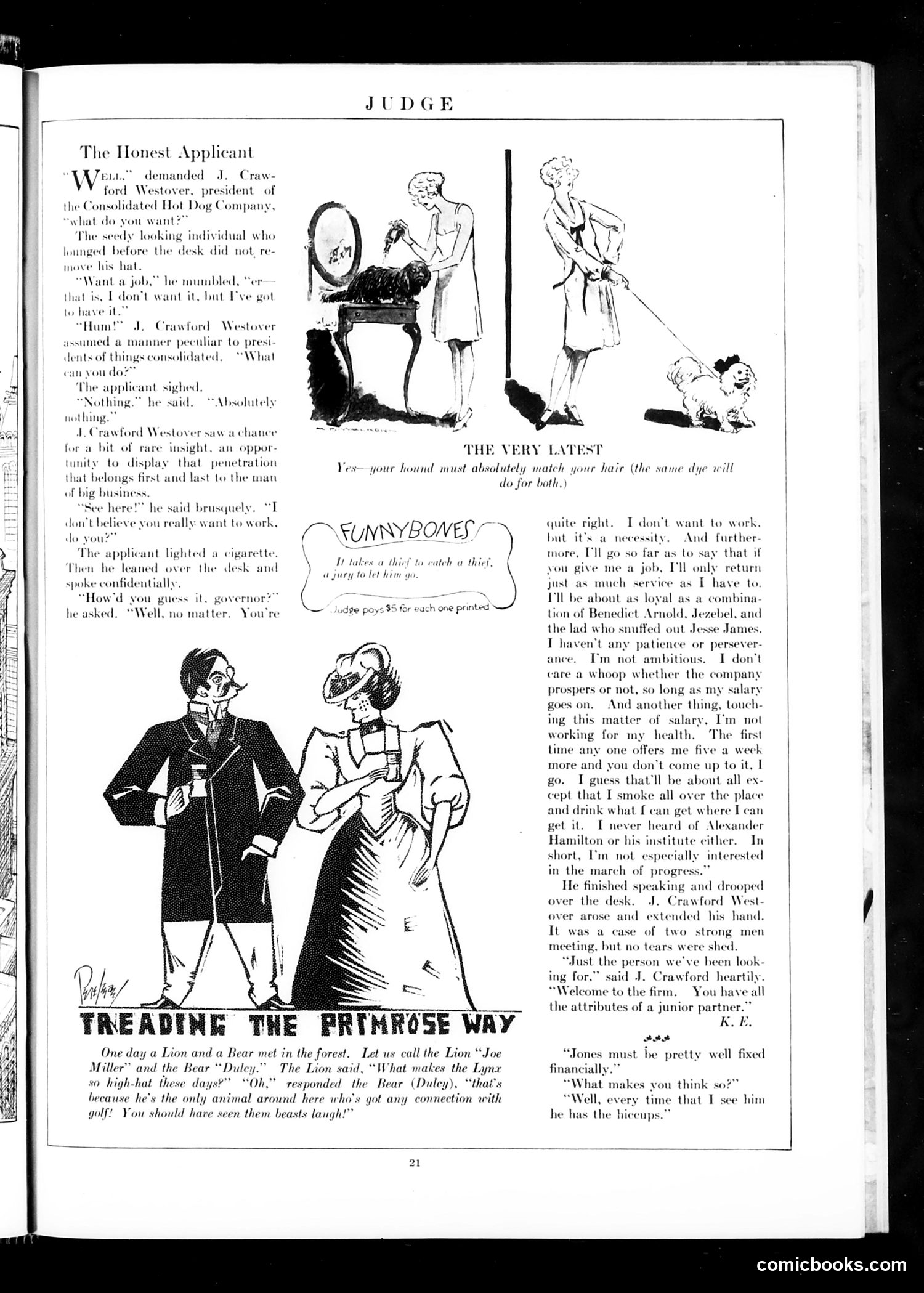
This page satirizes corporate hiring practices and workplace cynicism. A job applicant candidly tells J. Crawford Westover (president of a hot dog company) that he's lazy, disloyal, ambitious only for higher pay, smokes and drinks on the job, and has no interest in company success. Rather than reject him, Westover is delighted—apparently viewing such brutal honesty as a rare virtue in business. The satire cuts two ways: it mocks both the applicant's shameless self-interest and the executive's shallow judgment in rewarding frankness over actual competence or ethics. The humor suggests that American business culture valued appearance and candor over genuine merit. The secondary cartoons on the page use animal fables to joke about social pretension (the "high-hat" lynx and golf snobbery) and matrimonial hiccups, offering lighter fare typical of Judge's humor.
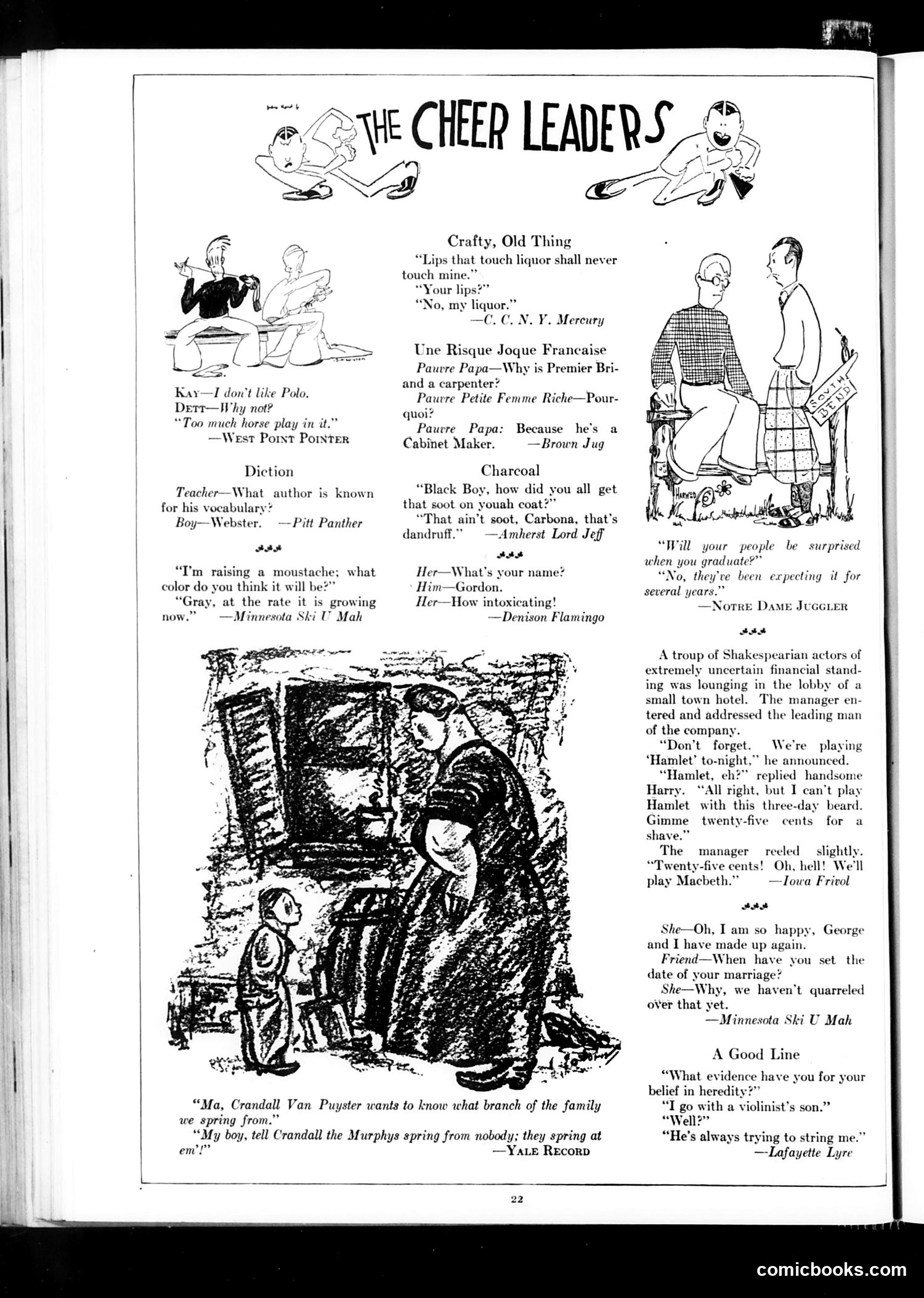
This page collects humorous one-liners and brief jokes attributed to college humor magazines (Yale Record, Pitt Panther, Denison Flamingo, etc.), a common format in early 20th-century Judge. The jokes target familiar campus and social stereotypes: romantic banter ("lips that touch liquor"), wordplay (Webster/vocabulary pun), ethnic humor (the "Black Boy" and "Murphys" jokes reflect period racial and Irish stereotypes), and courtship comedy. A longer narrative humor piece describes struggling Shakespearean actors so broke they can't afford shaving supplies—the manager chooses *Macbeth* over *Hamlet* because the lead needs a 25-cent shave, playing on theater economics during hard times. The page's satire is gentle, aimed at college life, romance, and theatrical pretension rather than political targets. The ethnic jokes now read as offensive period artifacts reflecting Judge's audience assumptions about humor.
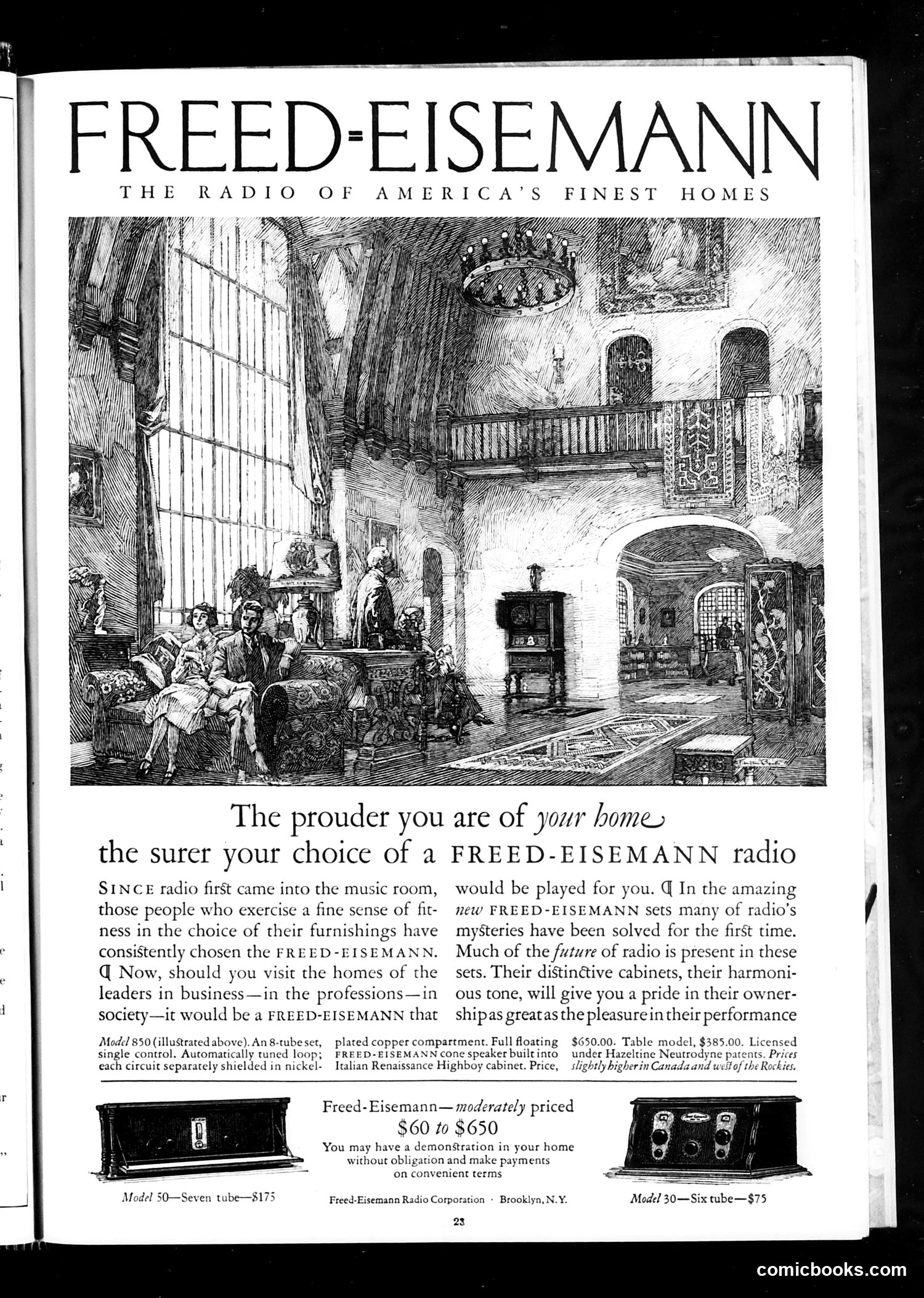
This page is primarily **advertising, not satire or political commentary**. It's a Freed-Eisemann Radio advertisement from Judge magazine. The large illustration depicts an elegant interior—likely meant to represent a wealthy home's drawing room—with period-dressed figures enjoying leisure time. This serves as aspirational imagery for the advertisement's message. The ad's pitch is straightforward status anxiety: it claims that affluent business leaders, professionals, and society figures choose Freed-Eisemann radios, implying that consumers who purchase this brand will associate themselves with the wealthy elite. The copy emphasizes luxury ("finest homes," "Italian Renaissance Highboy cabinet") and technological sophistication ("mysteries of radio...solved"). The price range ($60-$650) suggests models for different income levels, making exclusivity accessible to middle-class buyers. There is no political cartoon or satire visible on this page—it's purely a consumer product advertisement using class aspiration as its sales strategy.
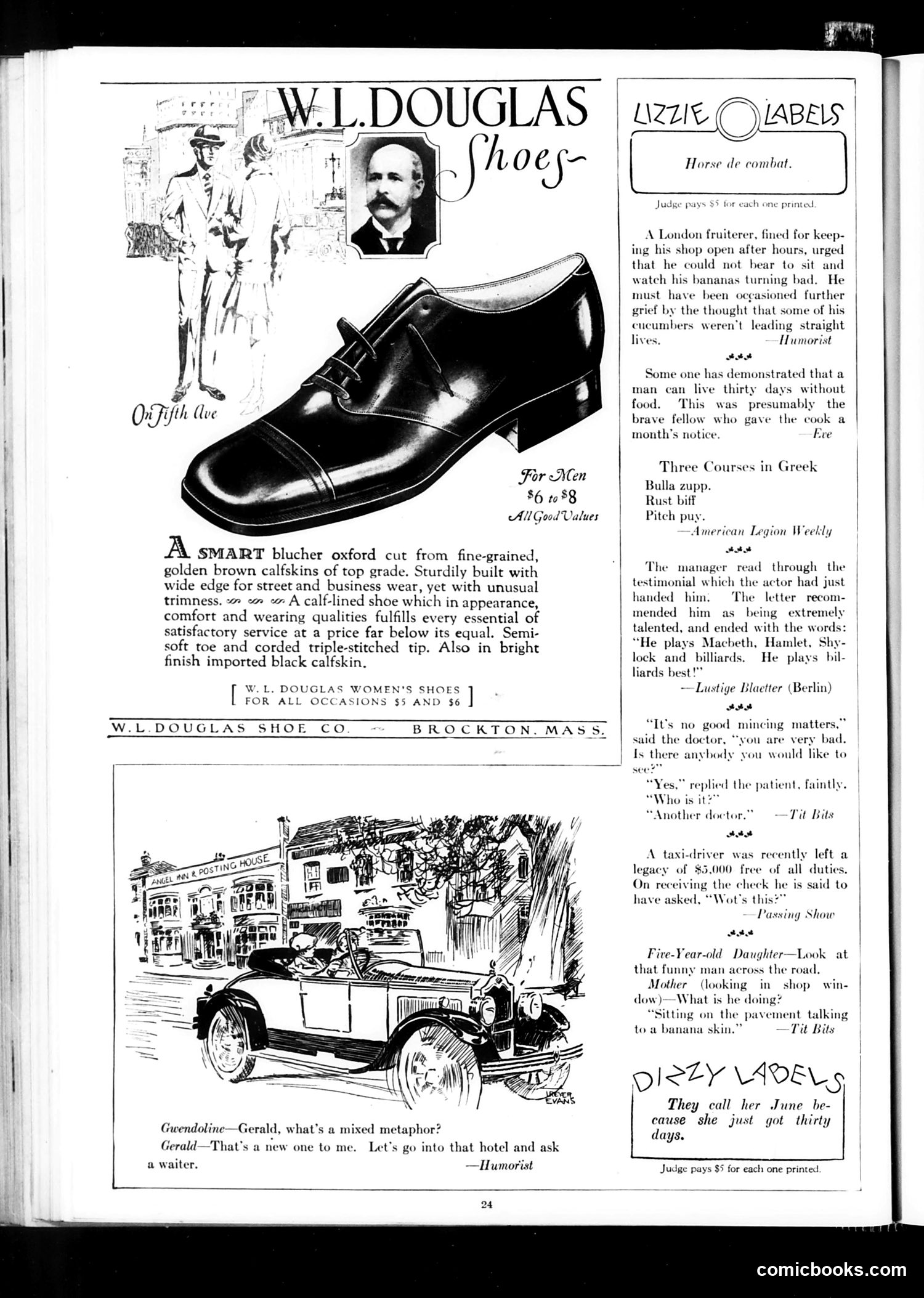
This page is primarily **advertising and humor content**, not political satire. The top half features a W.L. Douglas Shoes advertisement with product details and pricing ($6-$8 for men's shoes). The bottom half collects brief jokes under "Lizzie Labels" and "Dizzy Labels" sections: - **Mixed metaphor joke**: A couple confused about terminology agrees to ask a waiter for clarification—gentle wordplay humor. - **Recurring themes**: The jokes traffic in common early-20th-century tropes—lazy servants, food spoilage, theatrical pretension, bureaucratic mishaps, and women receiving jail sentences ("thirty days"). - **Notable**: Several jokes reference London life and are reprinted from European publications (Lustige Blaetter, Tit Bits), indicating transatlantic humor circulation. The humor is lightweight and domestic rather than political. The "Dizzy Labels" reference—mocking a woman named June who received a 30-day jail sentence—reflects era attitudes toward women's criminality presented as amusing rather than serious.
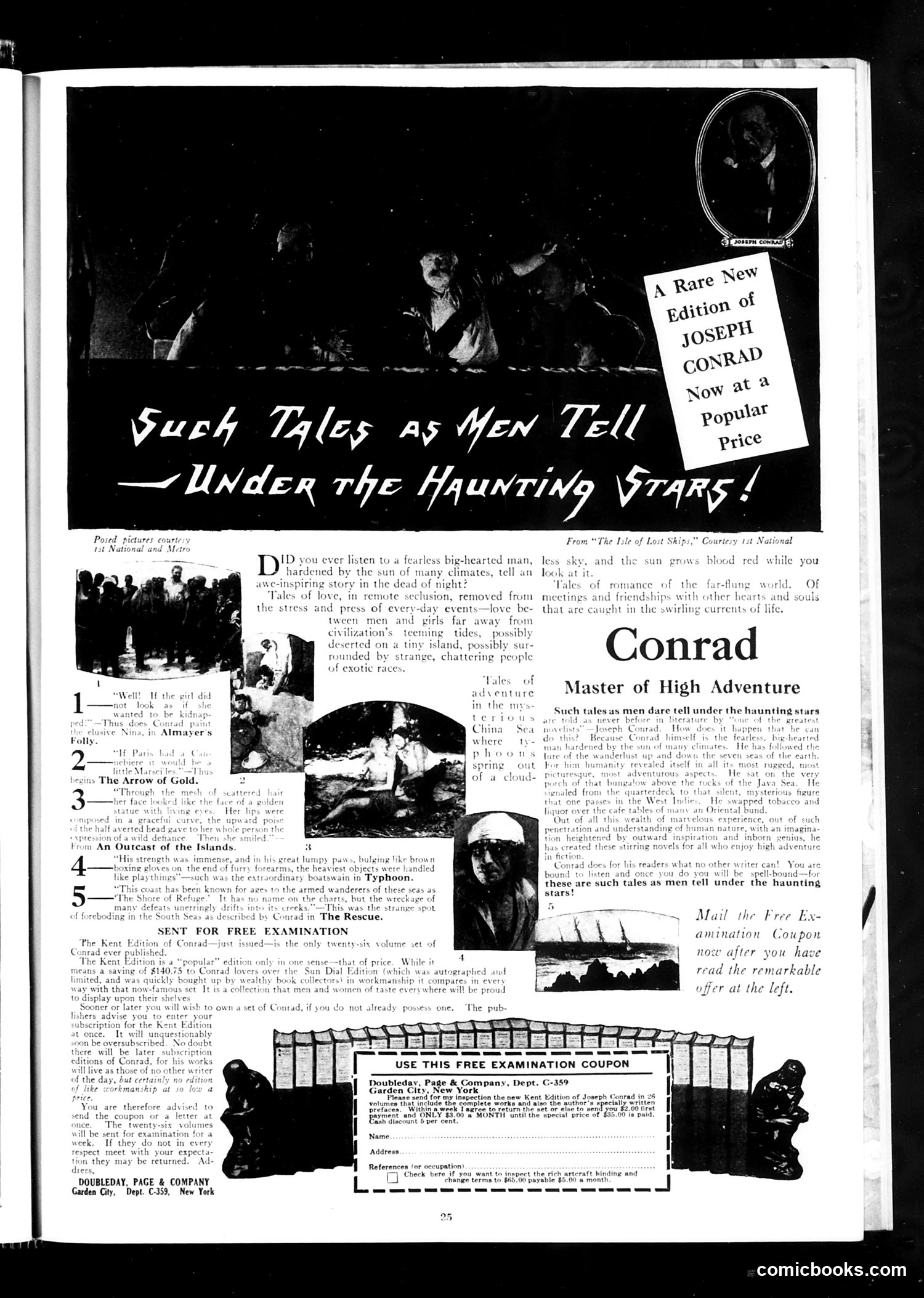
This page is primarily **advertising rather than satire or political commentary**. It promotes a book collection of Joseph Conrad's works through Doubleday, Page & Company publishers. The content emphasizes Conrad as a "Master of High Adventure," featuring atmospheric images of exotic locations and dramatic scenes to appeal to readers seeking adventure narratives. The text describes tales of romance, exploration in China and the China Sea, and adventures "under the haunting stars." A "Free Examination Coupon" occupies the bottom, allowing readers to request the special Kent Edition at a discounted price ($3.00/month or $65.00 total) rather than regular pricing. The small inset portrait (upper right) identifies Conrad himself. The numbered list on the left appears to reference specific adventure tales from his works. **This is essentially a mail-order book advertisement using romantic imagery and text to attract Judge magazine's readers to a prestige literature collection.**
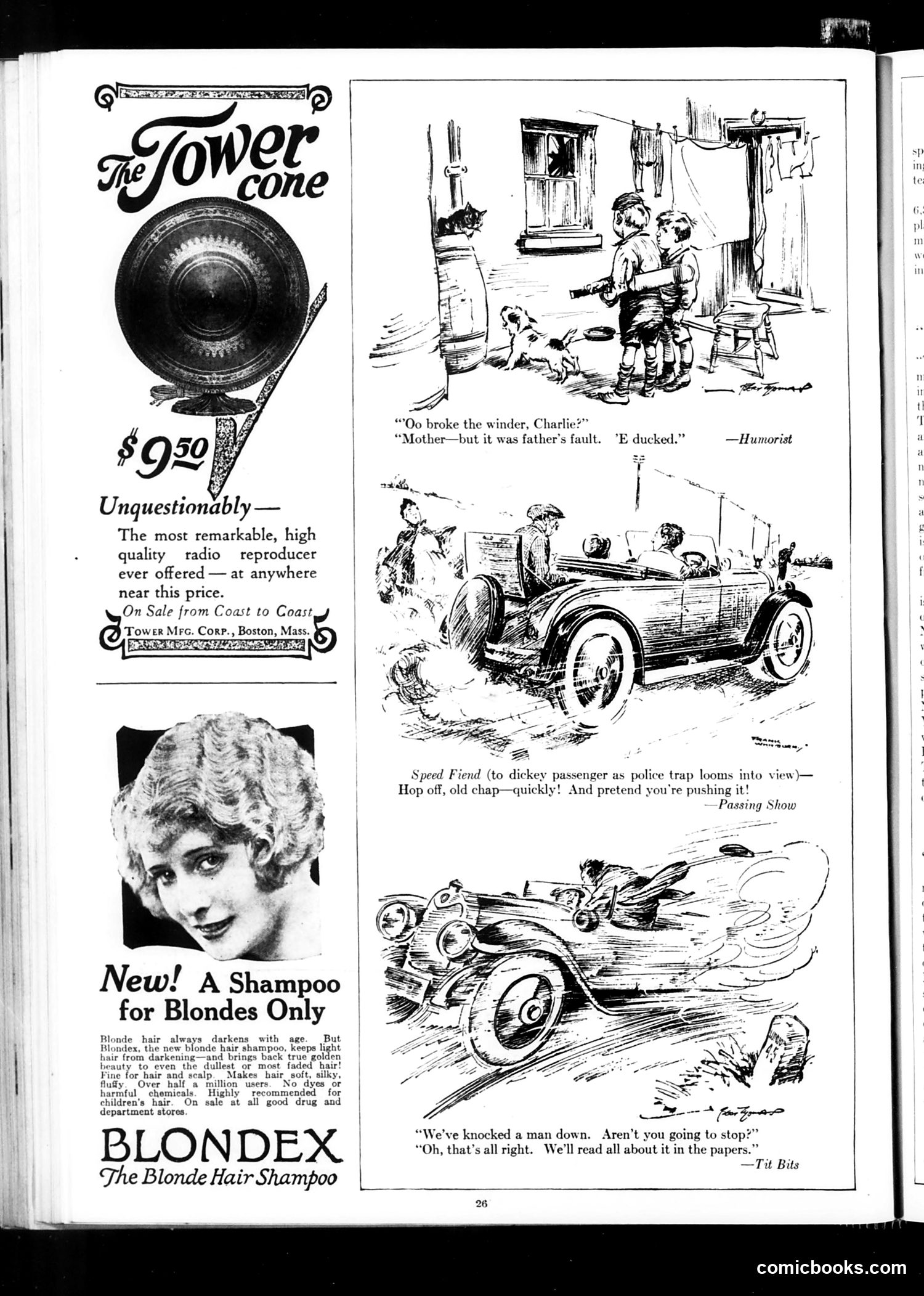
This page mixes advertisements with three humor cartoons, all reflecting 1920s social anxieties. **The cartoons satirize:** 1. **"Oo broke the winder, Charlie?"** – A child's domestic scene poking fun at parental discipline and blame-shifting between spouses. 2. **"Speed Fiend"** – Mocks reckless motorists and traffic enforcement. The driver instructs his passenger to jump out and *pretend* to push the car to avoid a police speed trap—satirizing both dangerous speeding and the dishonesty drivers used to evade cops. 3. **"We've knocked a man down"** – The darkest joke: callous wealthy motorists hit a pedestrian but don't stop, planning instead to read about it in newspapers later. This reflects genuine public outrage over hit-and-run incidents involving automobiles—a new and deadly technology causing social tension between classes. **Context:** These cartoons express period concerns about automobiles as reckless, destructive machines driven by the indifferent wealthy, and the inadequacy of law enforcement to control them.
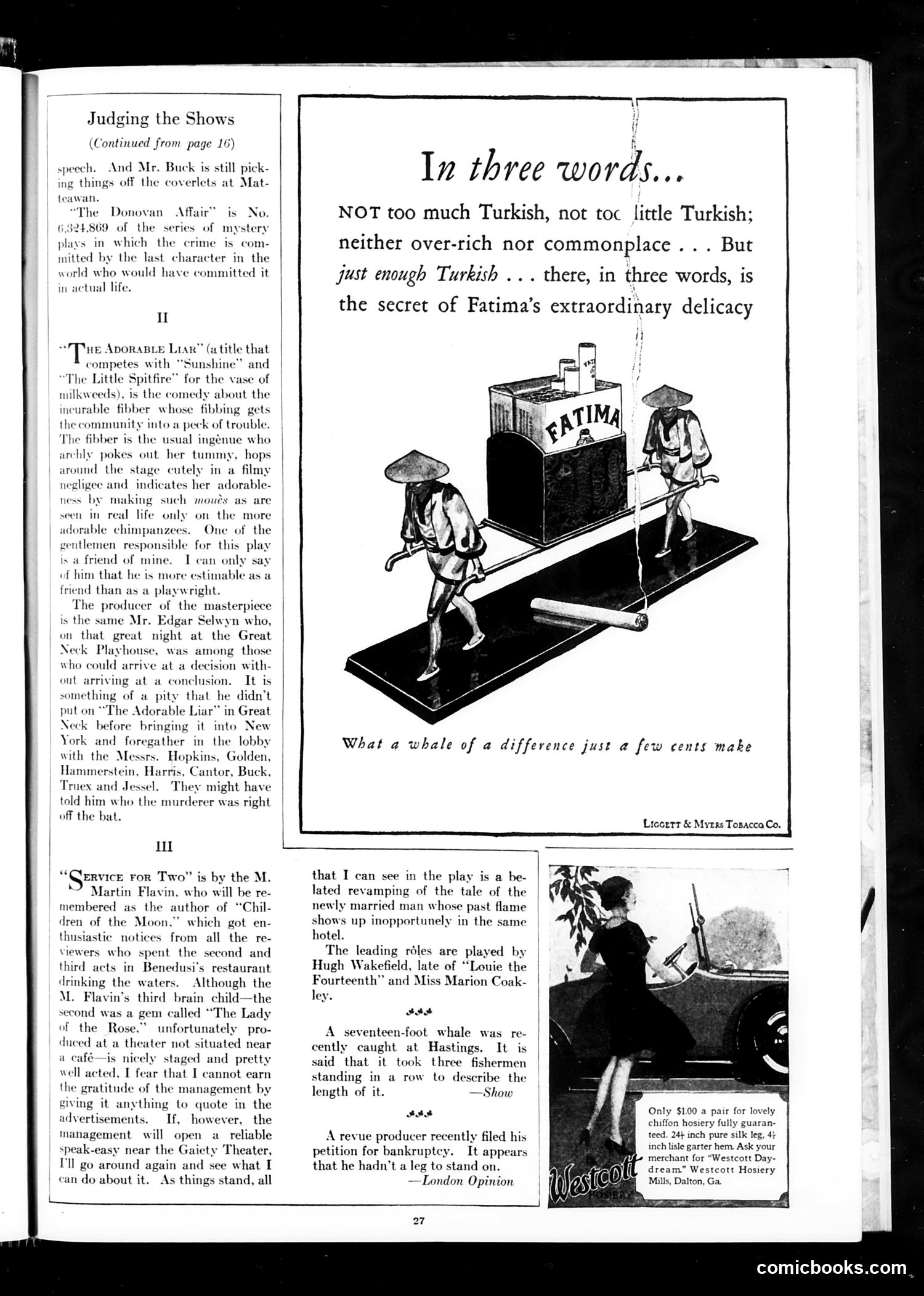
This page contains theater reviews from Judge magazine's "Judging the Shows" column, critiquing current Broadway productions. The main content discusses three plays: "The Donovan Affair" (a mystery where the culprit is improbably the last person you'd suspect), "The Adorable Liar" (a comedy about a lying ingénue), and "Service for Two" (a marital mix-up farce). The reviewer is notably acerbic, mocking the plays' formulaic plots and the ingénue's exaggerated mannerisms. The page also features a **Fatima Cigarettes advertisement**—the prominent illustration showing two figures in conical hats carrying a large cigarette package. The ad's tagline emphasizes the brand's "just enough" Turkish tobacco quality. Below are smaller items: theater gossip (a seventeen-foot whale caught at Hastings; a bankrupt revue producer), plus a **Westcott Hosiery ad** for women's chiffon stockings at $1.00. The humor relies on insider theater knowledge and period-specific references unfamiliar to modern readers.
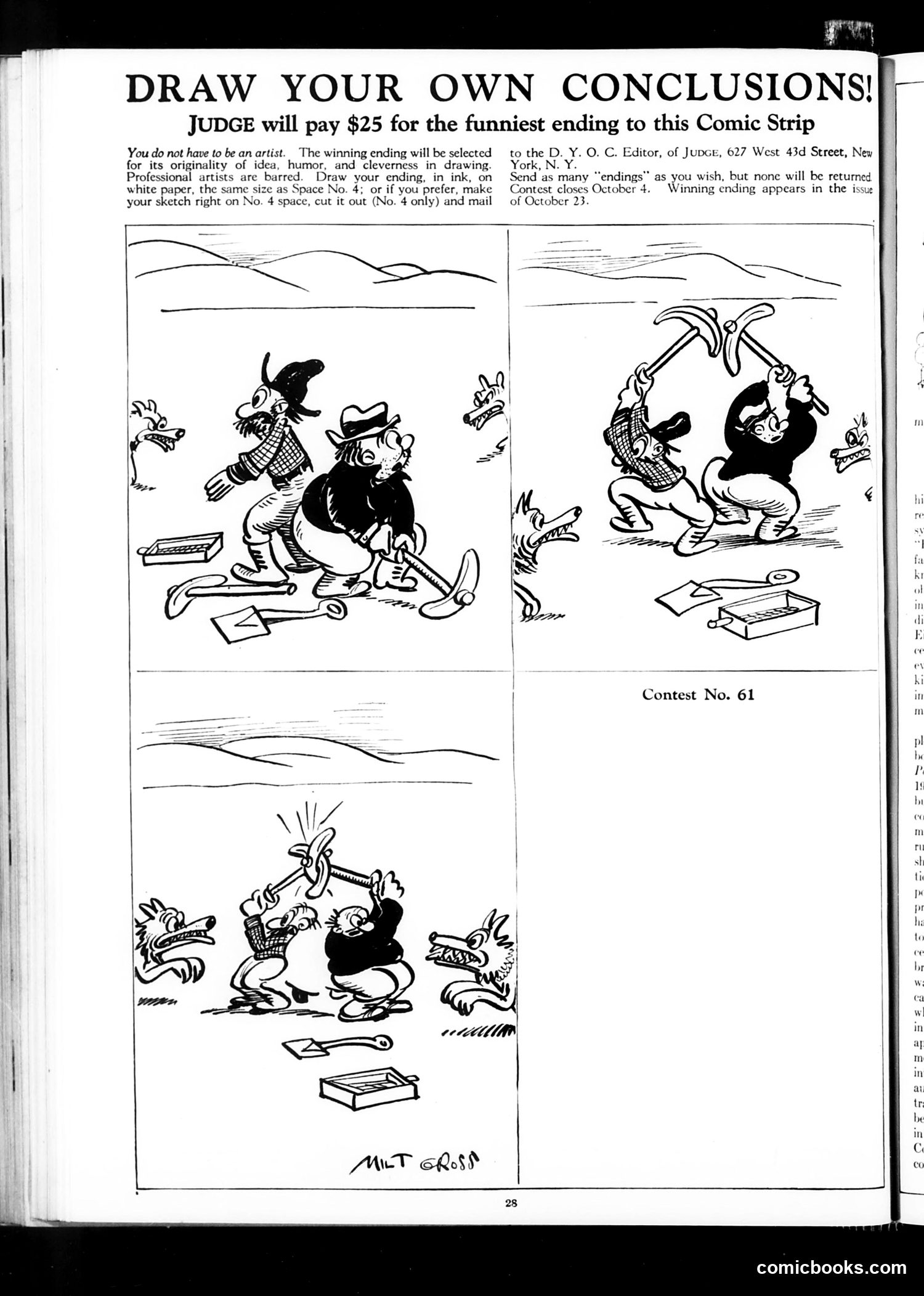
This is a reader-participation contest where *Judge* magazine invites amateur submissions to complete a comic strip. The three existing panels show anthropomorphic animals (appearing to be rabbits or similar creatures) engaged in what looks like carpentry or construction work, with tools scattered about. The humor setup is unclear from the panels alone—the animals appear to be building or working on something, possibly a toolbox or wooden structure. The joke's premise isn't explicit, making readers' creative endings essential. The contest itself is notable: professional artists are *barred*, emphasizing this as entertainment for ordinary readers. The $25 prize was substantial for the era. One panel is already credited to "Milt Gross," a well-known cartoonist of the period, suggesting *Judge* paired professional setup artwork with amateur conclusions—a democratizing gesture that also generated reader engagement and cost-free content ideas.
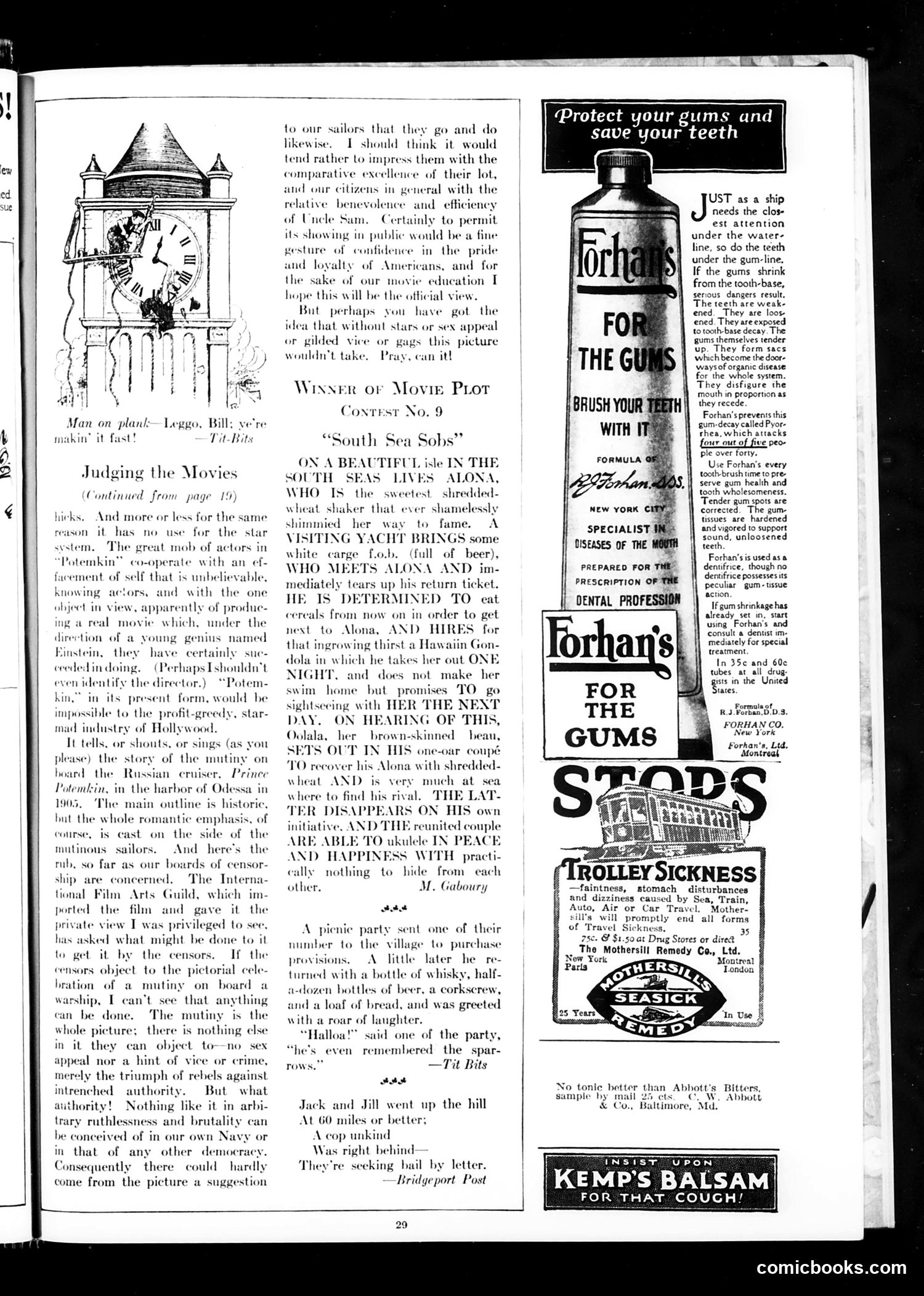
This page mixes editorial content with period advertisements. The main article "Judging the Movies" discusses Sergei Eisenstein's *Potemkin* (1925), praising its artistic merit while criticizing Hollywood's profit-driven star system. The author argues *Potemkin* succeeds precisely because it eschews famous actors and focuses on collective human drama—depicting the 1905 Russian naval mutiny without commercial compromise. He contrasts this with American cinema's reliance on sex appeal and spectacle. The right side features advertisements for Forhan's gum treatment and other products, typical of Judge's revenue model. A movie-plot contest entry satirizes melodramatic silent-film tropes through "South Sea Sobs," mocking exotic-locale romances with absurdist humor. The page reflects 1920s tensions between artistic cinema and commercial entertainment, celebrating Soviet filmmaking's revolutionary aesthetics against Hollywood's conventionalism.
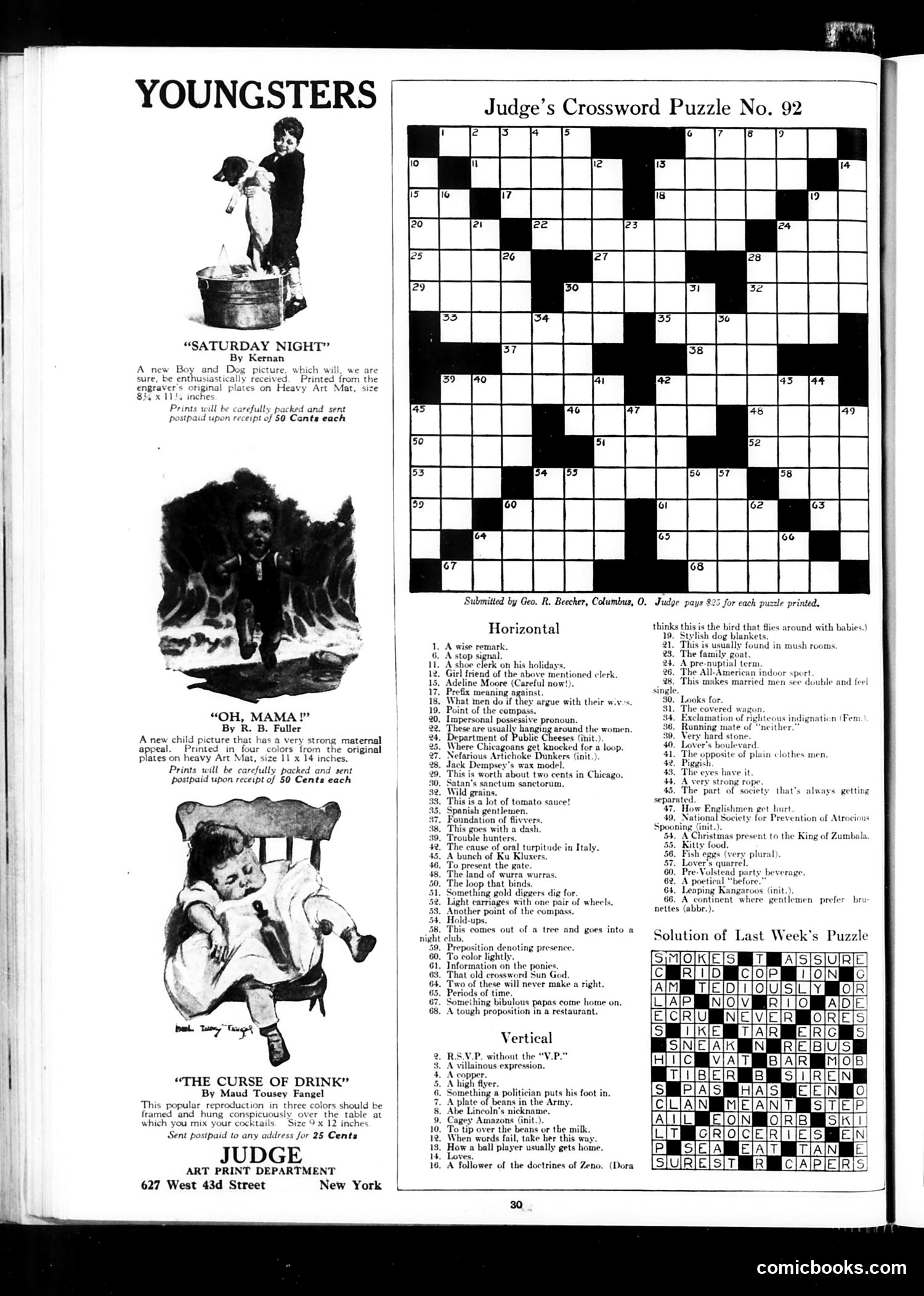
This page showcases **three children's picture prints** available for mail order from Judge's Art Print Department—a common monetization strategy for magazines in this era. The three offerings are: 1. **"Saturday Night"** by Kernan—a boy and dog scene 2. **"Oh, Mama!"** by R.B. Fuller—depicting maternal affection 3. **"The Curse of Drink"** by Maud Tousey Fangel—a temperance-themed image The last item is noteworthy: the advertisement humorously suggests hanging this prohibition-era cautionary image "over the table at which you mix your cocktails"—likely satirizing the hypocrisy of middle-class Americans who publicly supported Prohibition while privately drinking. The page also includes Judge's **crossword puzzle**, with clues reflecting 1920s-1930s contemporary references (Ku Klux Klan, "flivvers," speakeasies, gold diggers). These puzzles were popular features for reader engagement. This is primarily a **commercial/entertainment page** rather than political satire, though the temperance image reflects ongoing cultural debates of the Prohibition era.
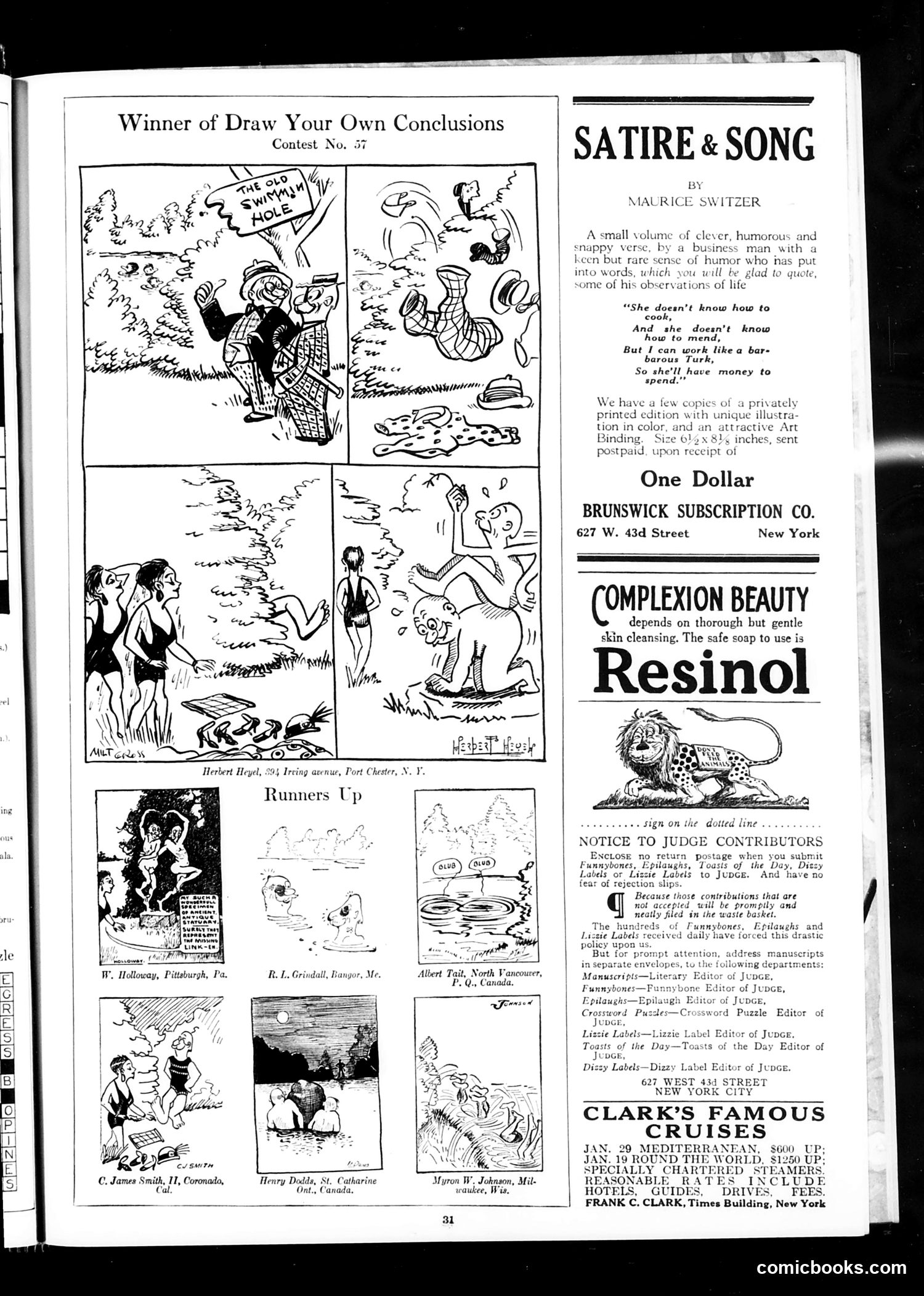
This page primarily features a **contest-winning cartoon** by C. James Smith titled "Draw Your Own Conclusions" (Contest No. 57). The four-panel comic appears to depict a humorous domestic scenario involving a couple at what looks like a seaside or recreational setting, though the specific narrative is difficult to determine from the image quality. The cartoon satirizes **everyday married life**, a common Judge magazine theme. The humor likely plays on gender roles and marital dynamics typical of early 20th-century American satire. The remainder of the page is **advertising and editorial content**, including Maurice Switzer's book of satirical verse (with a joke about wives who can't cook but whose husbands work hard so "she'll have money to spend"—mocking economic dependency), beauty product ads (Resinol soap), and cruise line advertisements. The "Runners Up" section shows other contest submissions, maintaining Judge's interactive relationship with readers through competitions.
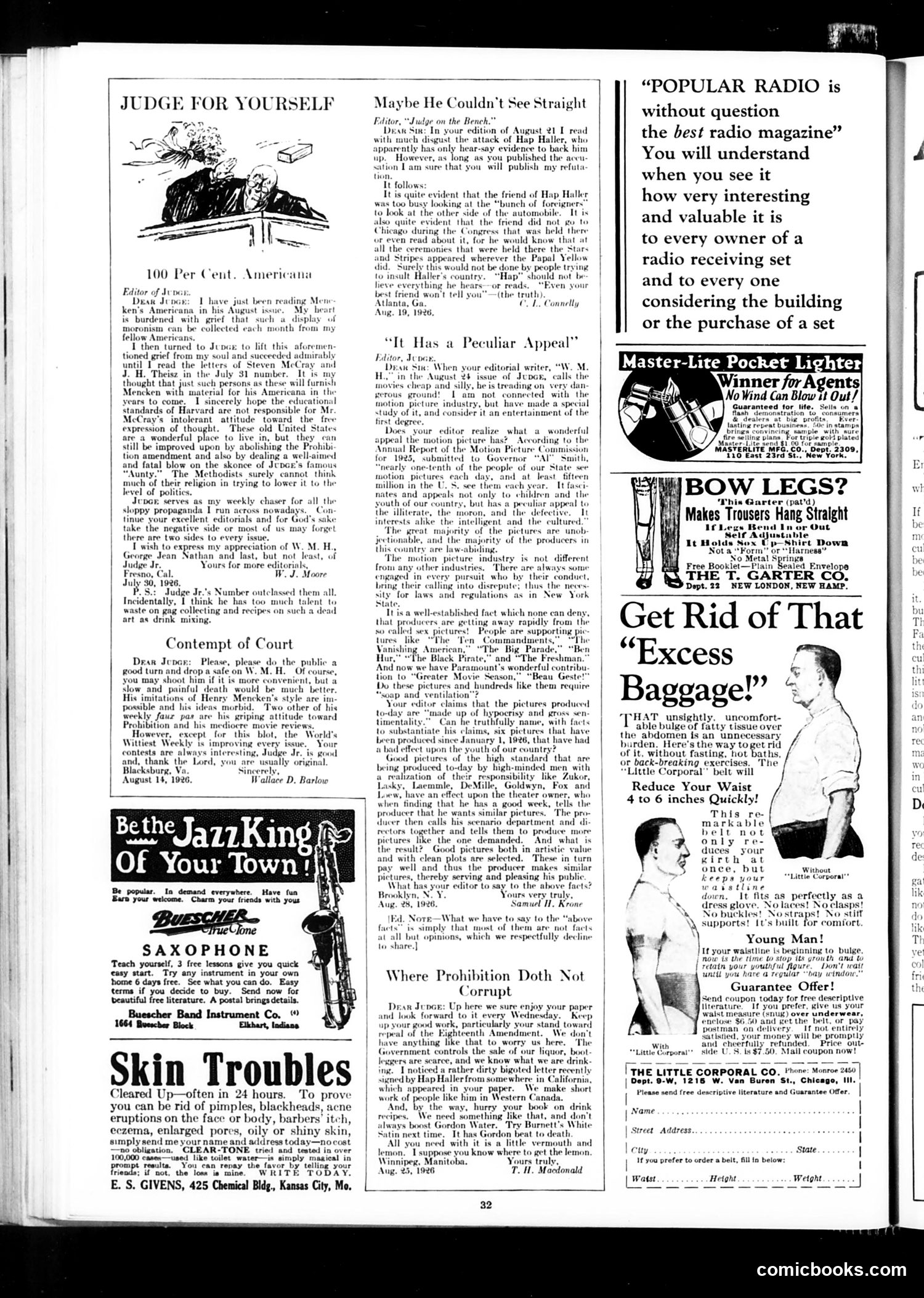
This page consists primarily of **reader letters** to Judge magazine's editors, discussing published articles. The main cartoon at top-left ("Judge for Yourself") is a small sketch of what appears to be an editorial figure reviewing submissions. The letters reveal typical satirical magazine controversies of 1926: 1. **First letter** defends American culture against H.L. Mencken's critical "Americana" column, while praising Judge's editorials as superior and requesting they criticize Prohibition. 2. **Second letter** harshly attacks an editor (W.M.H.) for poor imitations of Mencken and unfavorable attitudes toward Prohibition. 3. **Final visible letter** defends the Catholic Church and Italian-Americans against an earlier article by "Hap Haller," arguing that pro-American patriotism was displayed during a Chicago Congress alongside papal symbols. The page is mostly **advertisement filler** (saxophone lessons, skin treatments, "excess baggage" corsets). The satirical substance—defending traditional values, Catholicism, and Americanism against modern cynicism—reflects 1920s cultural tensions.
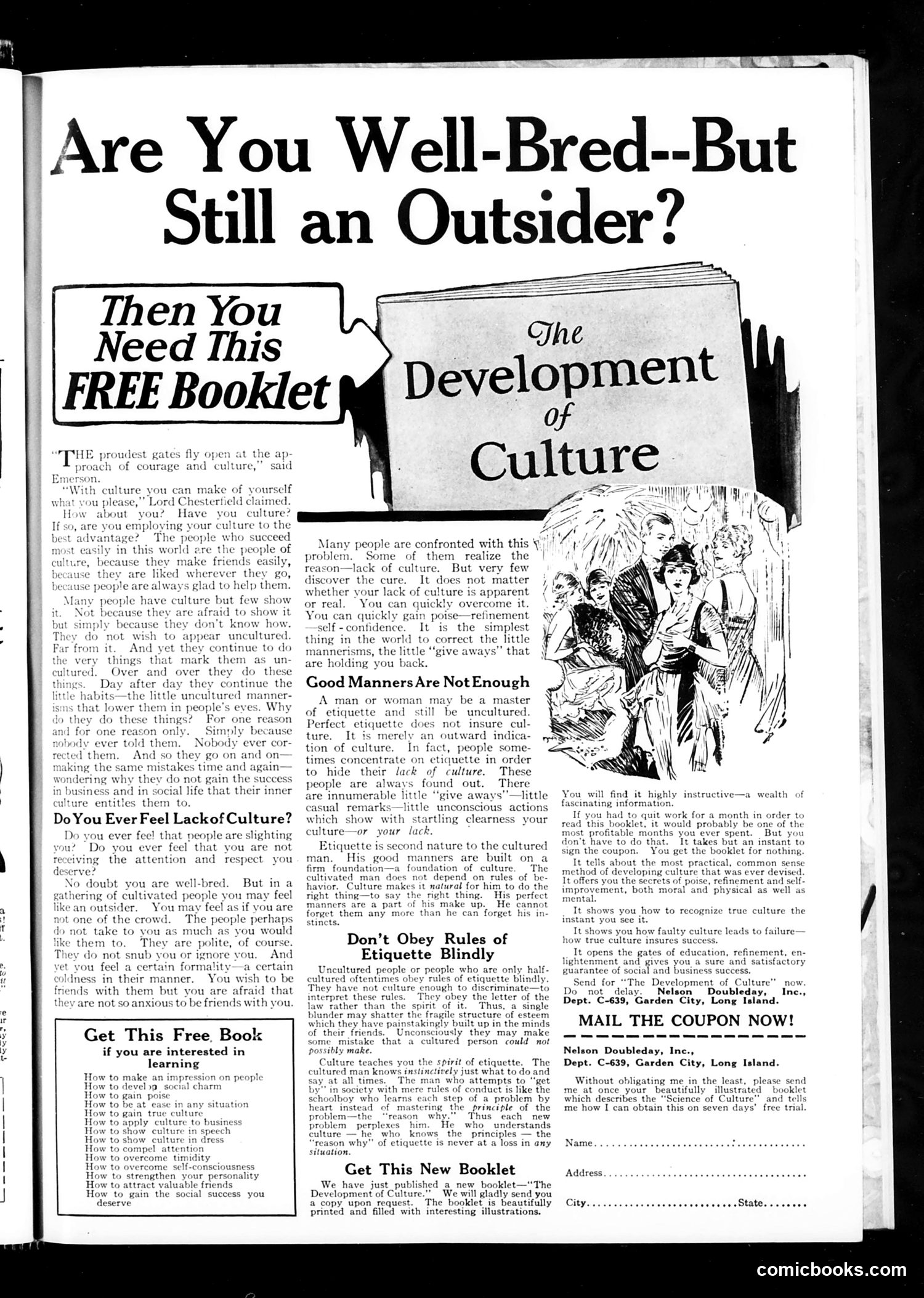
This is a **full-page advertisement** disguised as editorial content in Judge magazine, promoting a free booklet titled "The Development of Culture" from Nelson Doubleday, Inc. The satire targets **class anxiety and social climbing** in early 20th-century America. The advertisement exploits insecurity by suggesting that well-bred people can still be social "outsiders" due to subtle cultural missteps—little "give aways" that betray lack of refinement. The pitch argues that good manners alone aren't enough; true "culture" requires understanding underlying principles of etiquette, not just following rules blindly. The illustration shows fashionably dressed people socializing, implying that culture brings social acceptance and success. The humor lies in the **contradiction**: the ad simultaneously claims culture is easily acquired (via a free booklet) yet requires deep, instinctive knowledge. It's selling the dream that reading one pamphlet can transform social status—a classic pitch exploiting middle-class fears of exclusion from elite circles.
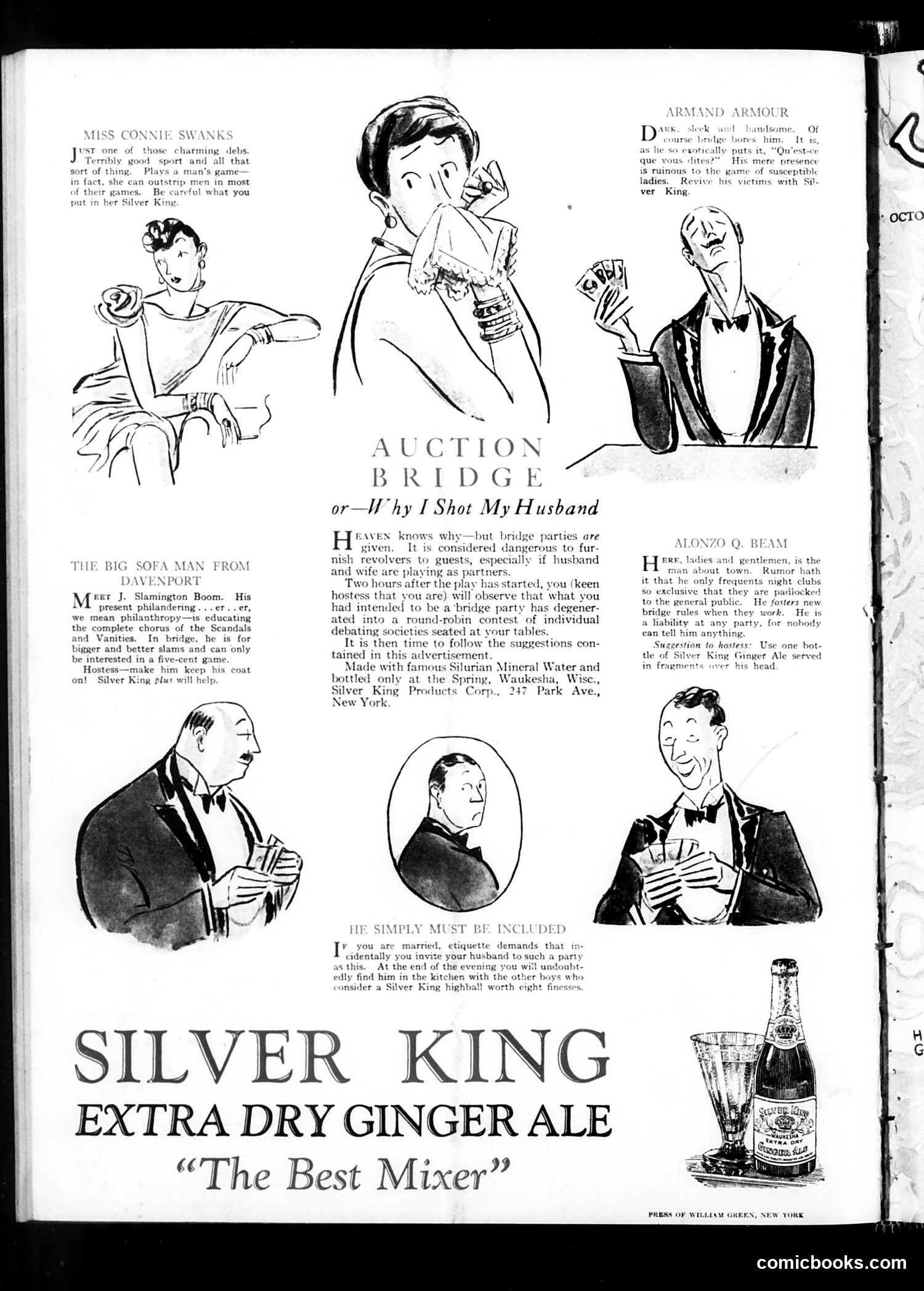
This is primarily an **advertisement for Silver King Ginger Ale**, disguised as humorous social commentary about 1920s bridge parties. The satirical framing mocks the era's obsession with auction bridge—a newly popular card game that allegedly caused such heated arguments between married couples that the ad jokingly suggests alcohol is necessary to prevent domestic violence ("Why I Shot My Husband"). The page includes character sketches of recognizable social types: "Miss Connie Swanks" (a modern woman who plays cards competitively), "The Big Sofa Man from Davenport" (a philanthropist who flirts with female bridge players), and "Alonzo Q. Beam" (an untrustworthy character who frequents speakeasies). The humor targets 1920s anxieties about changing gender roles, marital tension, and bridge-party culture. The underlying message: serve Silver King Ginger Ale at your bridge parties to smooth over conflicts and keep guests entertained. The advertisement frames the product as essential to successful social entertaining.