
Judge, 1926-09-25 · page 15 of 36
Judge — September 25, 1926 — page 15: what you’re looking at
What you’re looking at
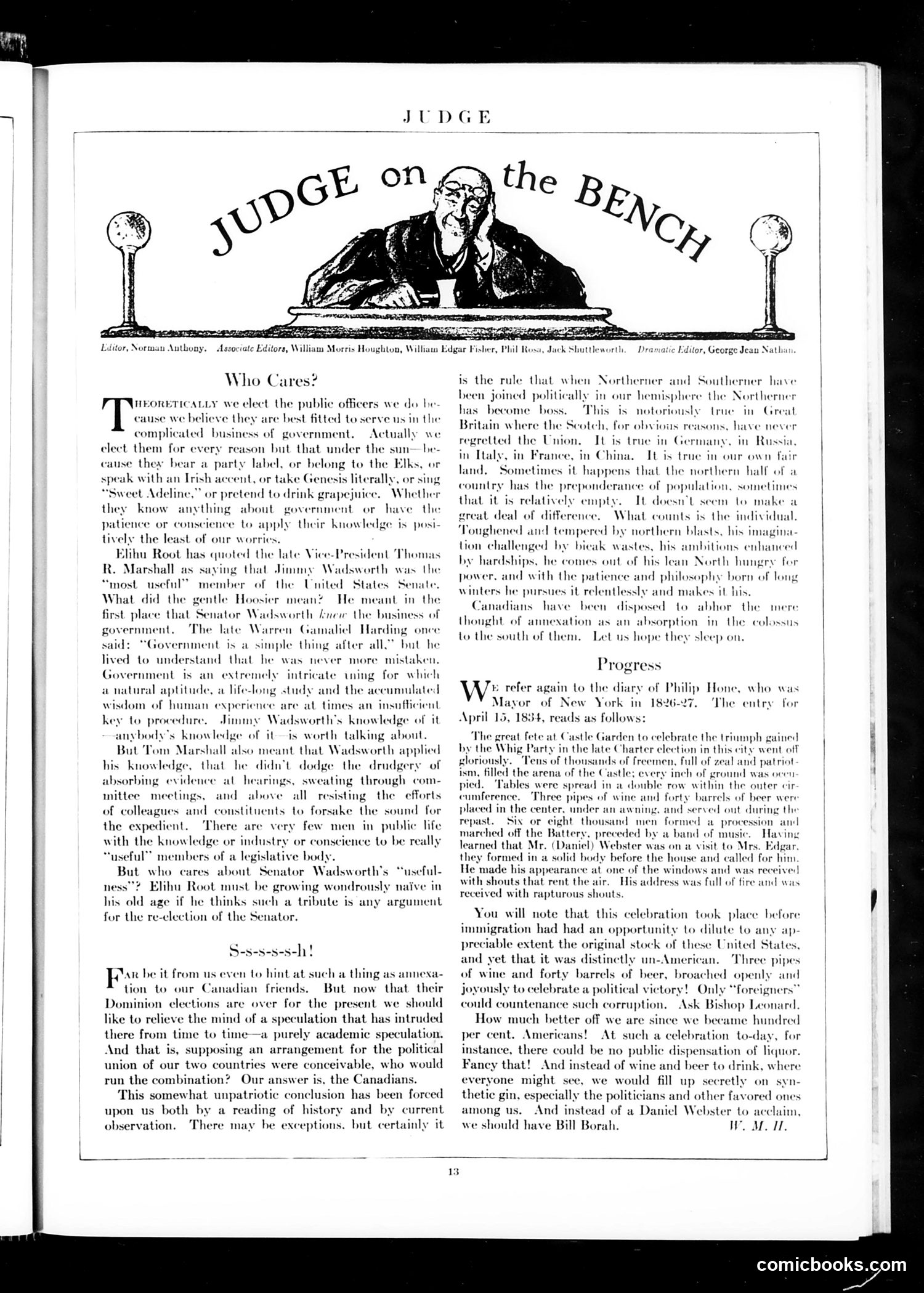
This page contains two editorial pieces satirizing American political culture and humorously speculating about U.S.-Canadian relations. **"Who Cares?"** criticizes voters' actual priorities in elections. The editors note people elect officials based on party affiliation, ethnic background, or religious views—not competence. The piece defends Senator Jimmy Wadsworth as genuinely "useful" because he actually understands government and does the unglamorous work required. However, the editors mock themselves for even suggesting this matters to voters ("But who cares?"), implying the public won't reward actual competence. **"S-s-s-s-h!"** jokingly speculates about hypothetical U.S.-Canadian political union, concluding Canadians would run it because northern populations historically dominate political unions (Scotland with England, northern Italy, northern Germany). The editors suggest northern peoples are toughened by climate and more ambitious. The tone is satirical—mocking both American electoral indifference and playfully poking at continental dynamics, while maintaining the magazine's characteristic irreverent, knowing humor about politics and governance.
📄 Transcribed text from this page (OCR, searchable)
Machine-transcribed from the original scan — historical spelling and the odd misread are preserved.
Lditor, Norman Authony. Who Car HEORETICALLY we elect the public officers we do be cause we believe they complic: are best fitted to serve us in the d business of government. Actually we elect them for every reason but that under the sun—be- ause they bear a party label, or belong to the Elks, or speak with an Trish accent, or take Genesis literally, or sing “Sweet Adeline,” or pretend to drink grapejuice. Whether they know have the Ss posi- anything about government or patience or conscience to apply their knowledg tively the least of our worries. Elihu Root has quoted the late Vice-President Thomas R. Marshall as saying that Jimmy Wadsworth was the “most useful” member of the United States What did the gentle Hoosier mean? He meant in the first place that Senator Wadsworth new the business of government. Senate. The late Warren Gamatliel Harding once said: “Government is a simple thing after all” but he lived to understand that Government he was never more mistaken. is an extremely intricate ining for which a natural aptitude, a life-long study and the accumulated wisdom of human experience are at times an insufficient key to procedure, Jimmy Wadsworth’s knowledge of it knowledge of itis worth talking about. But Tom Marshall also meant that Wadsworth applied his knowledge, that anybods he didwt dodge the drudgery of absorbing evidence at hearings, sweating through com- mittee meetings, and resisting the efforts of colleagues and constituents to forsake the sound for the expedient. above all There are very few men in public life with the knowledge or industry or conscience to be really “useful” members of a leg But who cares about his old age if he thinks such a tribute is any argument for the re-election of the Senator. tive body. Senator Wadsworth’s “useful- Elihu Root must be growing wondrously naive in S-s-s-s-s-h! an he it from us even to hint at such a thing as annexa- tion to our Canadian friends. But now that their Dominion elections are over for the present we should like to relieve the mind of a speculation that has intruded there from time to time—a purely academic speculation. And that is, supposing an arrangement for the political union of our two countries were conceivable, who would run the combination? Our answer is, the Canadians. This somewhat unpatriotic conclusion has been forced upon us both by a reading of history and by current observation. There may he exceptions. but certainly it _— ee Associate Editors, William Morris Houghton, William Edgar Fisher, Phil Ro: jack Shuttleworth, Dramatic Editor, George Jean Nathia is the rule that been joined politically in our hemisphere the when Northerner and Southerner have Northerner This is notoriously true in Britain where the Scotch, for obvious re regretted the Union. in Ttaly, in Franc land. has become boss. Great sons, have never It is true in Germany, in Russia, sin China, Tt is true in our own fair Sometimes it happens that the northern half of a country has the preponderance of population, sometimes that it is relatively empty. great deal of difference. TL doesn’t seem to make a What counts is the individual. ‘Toughened and tempered by northern blasts. his imagina tion challenged by bieak wastes, his ambitions enhanced by hardships, he comes out of his lean North hungry for power, and with the patience and philosophy born of long winters he pursues it relentlessly and makes it his. Canadians have been disposed to abhor the mere thought of annexation as an absorption in’ the colossus to the south of them. Let us hope they sleep on. Progress V © refer again to the diary of Philip Hone, who wi Mayor of New York in 1826 The entry for April 15, 1834, reads as follows: The great fete at Castle Garden to celebrate the triumph gained by the Whig Party in the late Charter clection in this city went off gloriously. ‘Tens of thousands of freemen, full of zeal and patriot ism, filled the arena of the Castle; every inch of ground was occu pied ples were spread in a double row within the outer cir cumference. ‘Three pipes of wine and forty barrels of beer werr placed in the center, under an awning, and served out during the repast. Six or eight thousand men formed a procession an marched off the Battery, preceded by a band of music. Having learned that Mr. (Daniel) Webster was on a visit to Mrs. Edgar. they formed in a solid body before the house and called for him He made his appearance at one of the windows and was received with shouts that rent the air. His address was full of fire and was. received with rapturous shouts: You will note that this celebration took place before immigration had had an opportunity to dilute to any ap- preciable extent the original stock of these United States, nd yet that it was distinctly un-American. ‘Three pipes wine and forty barrels of beer, broached openly and joyously to celebrate a political victory! Only “foreigners” Ask Bishop Leonard. How much better off we are since we became hundred per cent. Americans! At such a celebration to-day, for instance, there could be no public dispensation of liquor. Fancy that! And instead of wine and beer to drink, where everyone might see, we would fill up secretly on syn- thetic gin, especially the politicians and other favored ones among us. And instead of a Daniel Webster to acclaim, we should have Bill Borah. W.M. HW. could countenance such corruption. comicbooks