
Judge, 1926-09-25 · page 21 of 36
Judge — September 25, 1926 — page 21: what you’re looking at
What you’re looking at
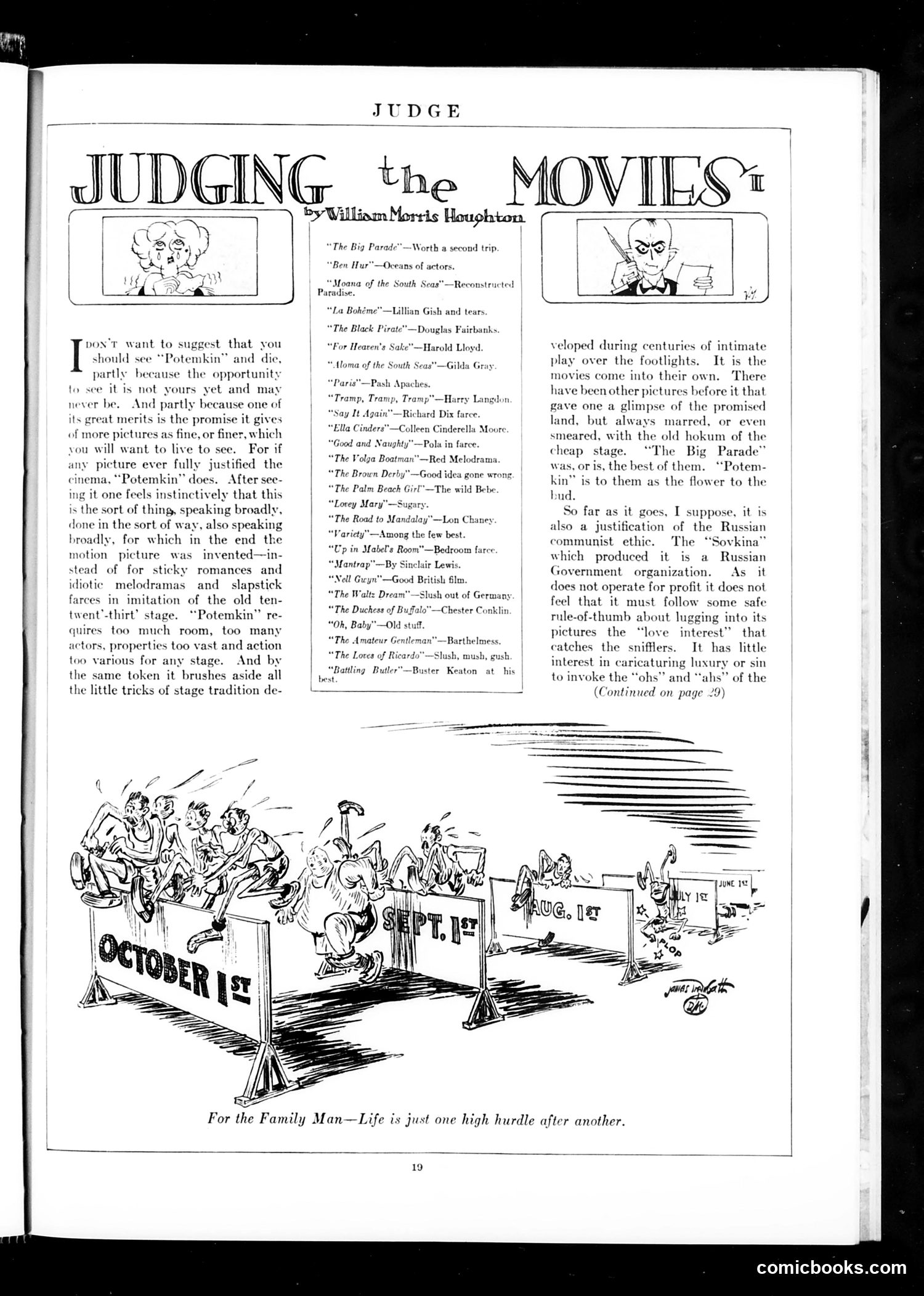
This is a film review column by William Morris Houghton evaluating current movies. The main essay praises the Soviet film "Potemkin," arguing it justifies cinema as an art form—unlike American movies that rely on tired stage conventions and "sticky romances." The cartoon below depicts the chaotic "family man" jumping between monthly film releases (August through October), showing how movies provide endless entertainment but demand constant attention—"life is just one high hurdle after another." The accompanying list reviews current releases: *The Big Parade*, *Ben Hur*, *Ella Cinders*, and others. Houghton contrasts *Potemkin*'s artistic merit with Hollywood's commercial formulas. He notably doesn't discourage seeing *Potemkin* despite its Russian communist origin, praising its genuine artistic achievement over profit-driven American studio pictures with their reliance on romance, melodrama, and slapstick.
📄 Transcribed text from this page (OCR, searchable)
Machine-transcribed from the original scan — historical spelling and the odd misread are preserved.
JUDGE JUDGING. ‘he MO ®yVilliom Morris ae | —— \ “The Big Parade” —Worth a second trip. Xb oor “Ben Hur" —Oceans of actors. "Moana of the South Seas"—Reconstructes Paradise. “La Bohéme"—Lillian Gish and te: “The Black Pirate’—Douglas Fairbanks. bos't want to suggest. that you “For Heaven's Sake"—Harold Lloyd veloped during centuries of intimate should see “Potemkin” and die, “ats nd eacin Reig GSS play over the footlights. It is the partly because the opportunity movies come into their own. There . “Paris"—Pash Apaches. to see itis not yours yet and may “Tramp, Tramp, Tran Harry Langdon. “Say It Again"—Richard Dix farce. “Ella Cinders” —Colleen Cinderella Moore have been other pictures before it that gave one a glimpse of the promised land, but always marred, or even smeared, with the old hokum of the “Git cheap stage. “The Big Parade” The Volga BeGinan'— Hed Melodranss was, or is, the best of them. ‘‘Potem- “The Brown Derhy—Good ides gone wrens | Lin is to them as the flower to the “The Palm Beach Girl’—The wild Bebe bud “Lovey Mary” “The Road to Mandalay"—Lon Chaney “Variety"—Among the few best. “Up in Mabel’s Room"—Bedroom farce “Mantrap"—By Sinclair Lewis. “Nell Gyn" —Good British film. never be. And partly because one of its great merits is the promise it gives of more pictures as fine, or finer, which , ‘ you will want to live to see. any picture ever fully justified the cinema, “Potemkin” does. After see- ing it one feels instinctively that this is the sort of thing, speaking broadly, done in the sort of way, also speaking broadly, for which in the end the motion picture was invented—in- stead of for sticky romances and So far as it goes, I suppose, it is also a justification of the Russian communist ethic. The “Sovki which produced it is a Rus Government organization. As_ it idiotic. melodramas and slapstick Sieben de does not operate for profit it does not farces in imitation of the old ten- aa ar as plan feel that it must follow some safe twent’-thirt’ stage. “Potemkin” re- e Duchess Be pesver Conti rule-of-thumb about lugging into its “Oh, Baby” —Old stuf. z oe . i quires too much room, too many «the dasa cet orthet pictures the “love interest” that actors, properties too vast and action le Amita, Conlin Barthelaiess catches the sniffers. It has little . a “The Loves of Rit Slush, mush, gush. : . : Gj too various for any stage. And by seine K interest in caricaturing luxury or sin the same token it brushes aside all cate Builer'—Buster Keaton at his to invoke the “ohs” and “ahs” of the the little tricks of stage tradition de- (Continued on page 29) comicbooks.com