
Judge, 1926-09-25 · page 20 of 36
Judge — September 25, 1926 — page 20: what you’re looking at
What you’re looking at
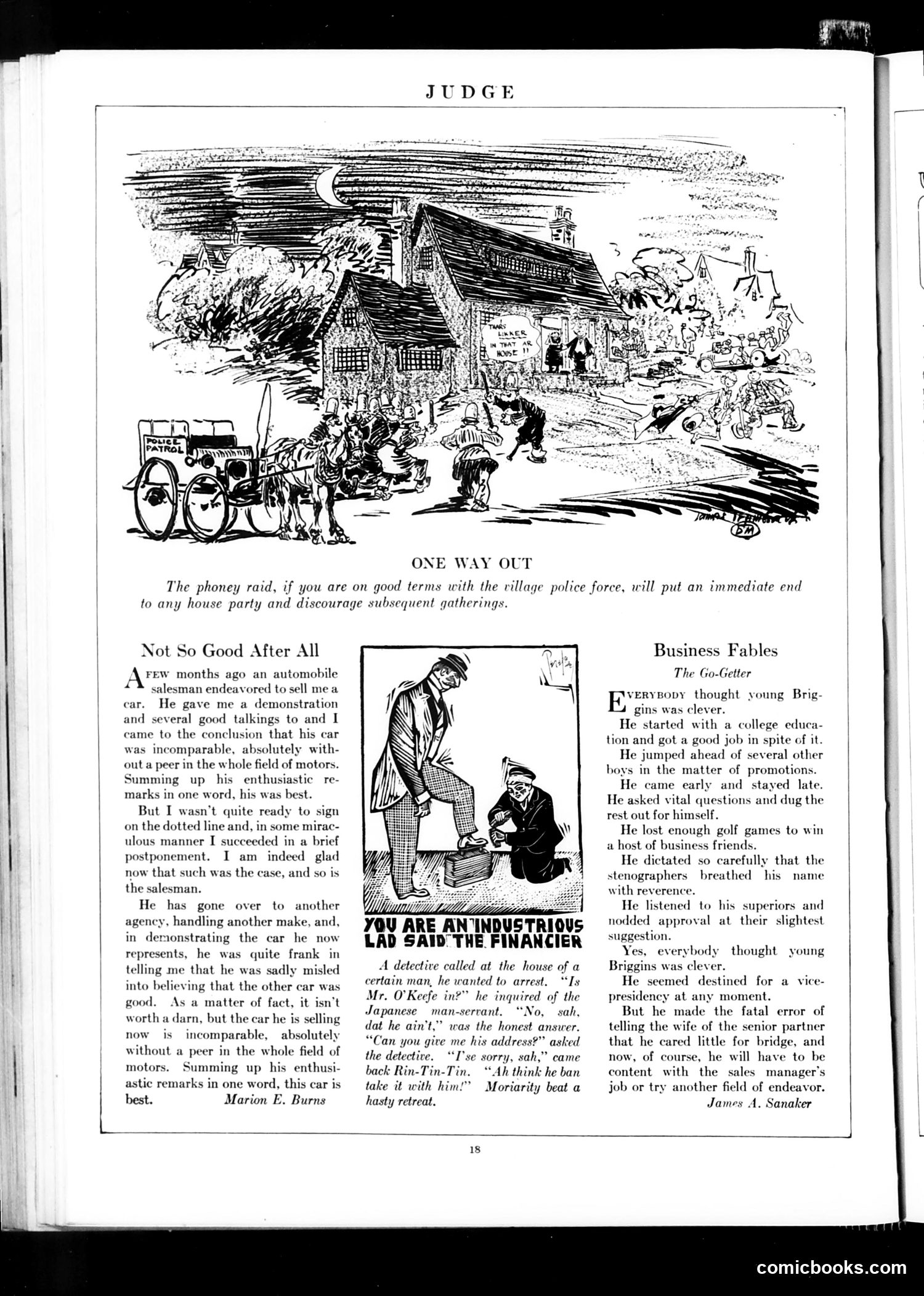
This page contains three pieces of satirical humor typical of early-20th-century Judge magazine: **"One Way Out"** (top cartoon): A humorous illustration about avoiding unwanted house parties by anonymously tipping off the village police to raid them—a joke about prohibition-era enforcement and social etiquette. **"Not So Good After All"** (left): Satirizes car salesmen's dishonesty. A salesman previously praised one automobile as "incomparable"; after switching employers, he now claims that same car is worthless and his new model is superior. The satire targets salesmen's mercenary nature and customers' gullibility—they'll say anything to make a sale regardless of truth. **"Business Fables: The Go-Getter"** (right): A cautionary tale mocking corporate advancement. Young Briggins does everything "right"—works hard, arrives early, stays late, asks good questions—yet undermines himself by casually telling the senior partner's wife he dislikes bridge. Social conformity matters more than merit; he's relegated to sales instead of vice-presidency. The satire critiques how corporate success depends on social performance and flattery rather than actual competence.
📄 Transcribed text from this page (OCR, searchable)
Machine-transcribed from the original scan — historical spelling and the odd misread are preserved.
JUDGE ONE WAY OUT The phoney raid, if you are on good terms with the village police force, will put an immediate end to any house party and discourage subsequent gatherings. Not So Good After All Arew months ago an automobile + * salesman endeavored to sell mea car. He gave me a demonstration and several good talkings to and I came to the conclusion that his car was incomparable, absolutely with- out a peer in the whole field of motors. Summing up his enthusiastic re- marks in one word, his was best. But I wasn’t quite ready to sign on the dotted line and, in some mire ulous manner I succeeded in a brief postponement. I am indeed glad now that such was the case, and so is the salesman. He has gone over to another agency, handling another make, and, in demonstrating the car he now represents, he was quite frank in telling me that he was sadly misled into believing that the other car was good. As a matter of fact, it isn’t worth a darn, but the car he is selling now is incomparable, absolutely without a peer in the whole field of motors. Summing up his enthusi- astic remarks in one word, this car is best. Marion E. Burns YOV ARE AN INDUSTRIOUS LAD SAID THE FINANCIER A detective called at the house of a certain man, he wanted to arrest. “Is Mr. O'Keefe in?” he inquired of the Japanese servant. “No, sah, dat he ain't,” was the hone: , “Can you give me his address?” asked the detective. “‘I’se sorry, sah,” came back Rin-Tin-Tin. ‘Ah think he ban take it with him!” Moriarity beat a hasty retreat. answ Business Fables The Go-Getter Bye thought young Brig- gins was clever. He started with a college educa- tion and got a good job in spite of it. He jumped ahead of several other boys in the matter of promotions. He came early and stayed late. He asked vital questions and dug the rest out for himself. He lost enough golf games to win a host of business friends. He dictated so carefully that the stenographers breathed his name with reverence. He listened to his superiors and nodded approvi suggestion. Yes, everybody thought young Briggins was clever. He seemed destined for a vice- presidency at any moment. But he made the fatal error of telling the wife of the senior partner that he cared little for bridge, and now, of course, he will have to be content with the sales manager's job or try another field of endeavor. James A. Sanaker at their slightest comicbooks.com