
A complete issue · 36 pages · 1926
Judge — August 28, 1926
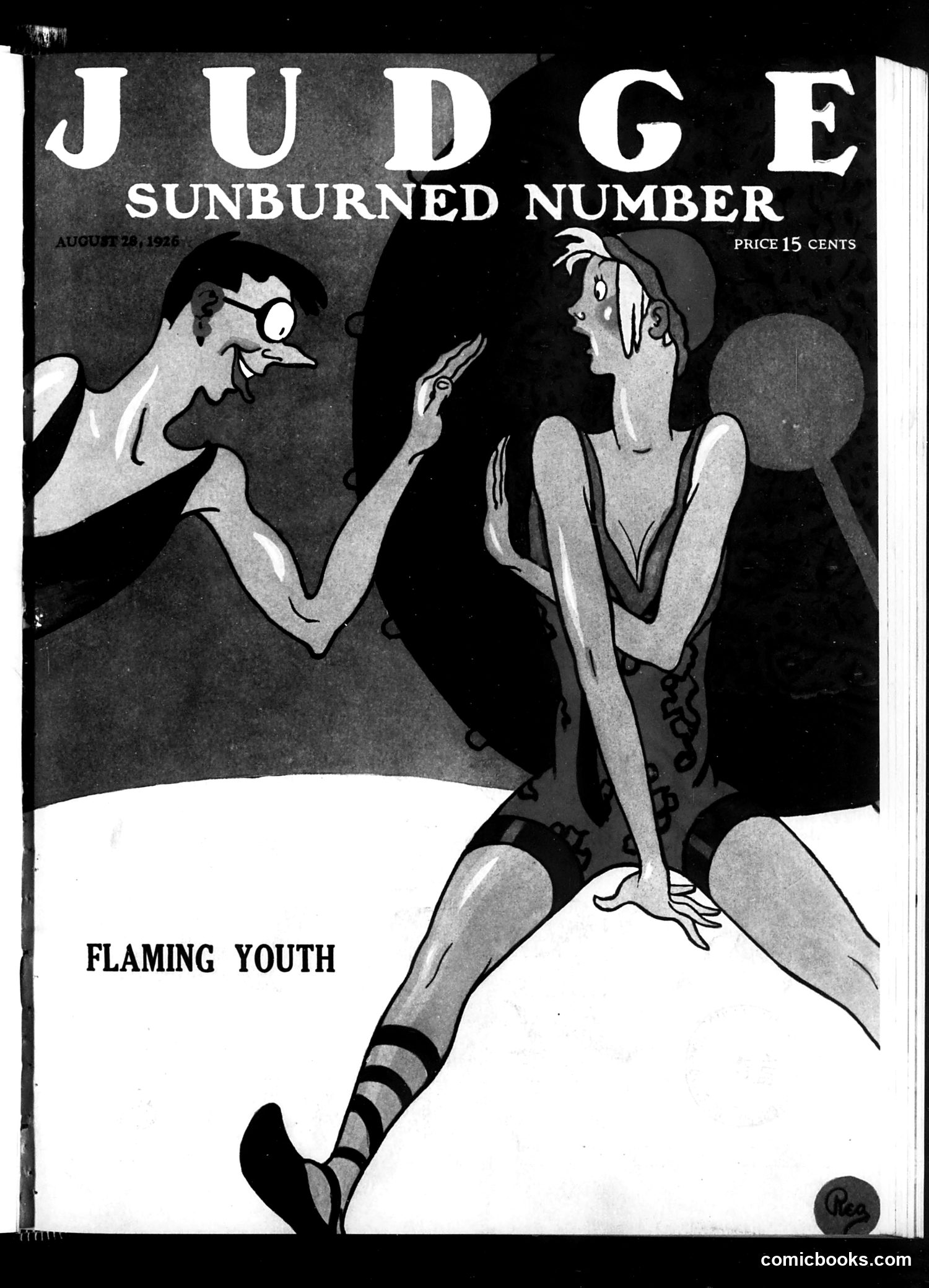
This cover illustrates the "Flaming Youth" phenomenon—a 1920s social panic about young people, particularly women, rejecting Victorian morality. The caricatured male figure on the left appears to represent disapproving older generations or moralists, depicted with exaggerated features suggesting judgment and concern. The young woman embodies the "modern flapper"—characterized by short hair, revealing clothing, and bold behavior that scandalized conservatives. Her sunburn was a status symbol indicating leisure and freedom, contrasting sharply with the pale ideal of previous generations. The satire mocks both the rebellious youth and their alarmed critics. The magazine's title "Judge" ironically positions it as an arbiter of taste while documenting generational conflict over women's autonomy, fashion, and social conduct during the Jazz Age.
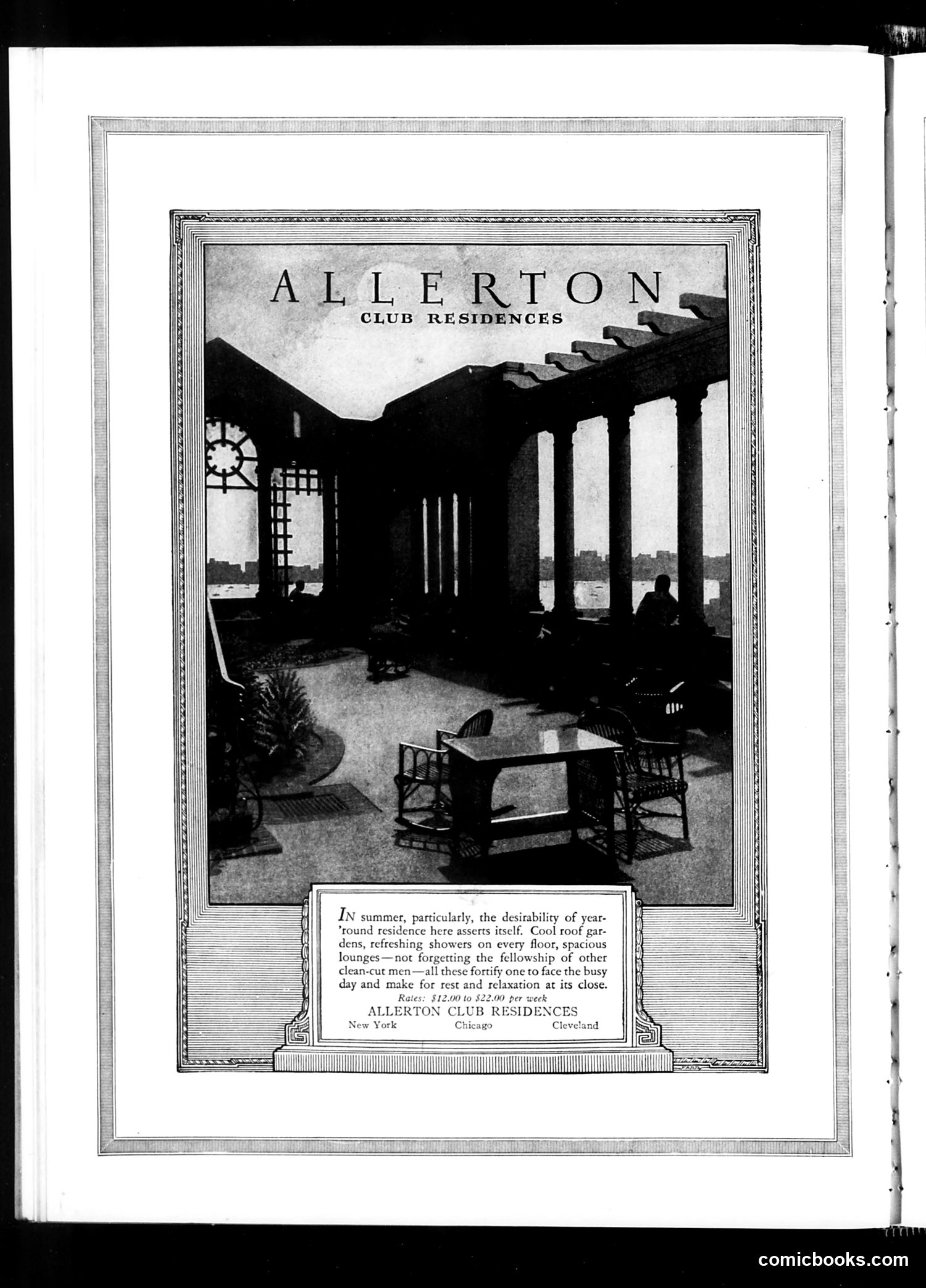
This page is **primarily an advertisement**, not satirical content. It promotes Allerton Club Residences, upscale residential facilities located in New York, Chicago, and Cleveland. The ad features an architectural photograph of an elegant covered terrace or loggia with classical columns, comfortable furniture, and refined furnishings. The accompanying text emphasizes summer amenities: "cool roof gardens, refreshing showers on every floor, spacious lounges" and "fellowship of other clean-cut men." The rates listed are "$12.00 to $22.00 per week"—positioning this as an exclusive gentleman's residence club. The marketing appeals to urban professionals seeking respite from busy city life while maintaining social connections with similarly situated men. This reflects early 20th-century class hierarchies and gender norms regarding segregated, upscale urban accommodation.
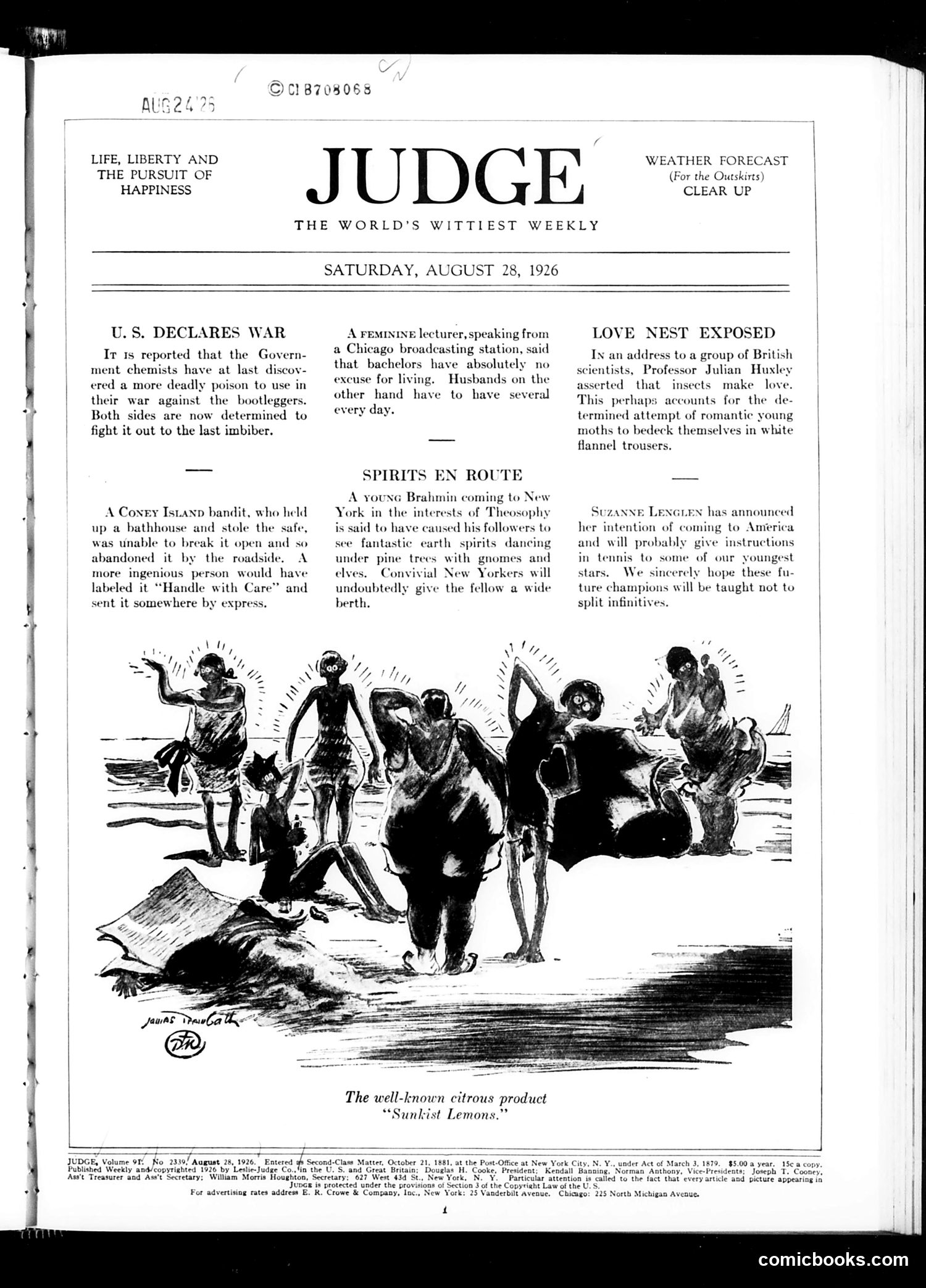
The main cartoon depicts beachgoers in 1920s bathing attire discovering what appears to be a dead body or sea creature washed ashore. The illustration satirizes the era's beach culture and public reaction to such discoveries. The page's articles reference contemporary concerns: a Government chemist's work against bootleggers (Prohibition-era), a Coney Island bathhouse abandonment, and a Brahmin promoting Theosophical spiritualism in New York. The "Love Nest Exposed" article references Professor Julian Huxley's scientific assertion about insect behavior—likely mocking sensationalized reporting of scientific findings. The central cartoon caption mentions "Sunkist Lemons," suggesting the image functions primarily as an advertisement integrated with editorial content, typical of Judge's format.
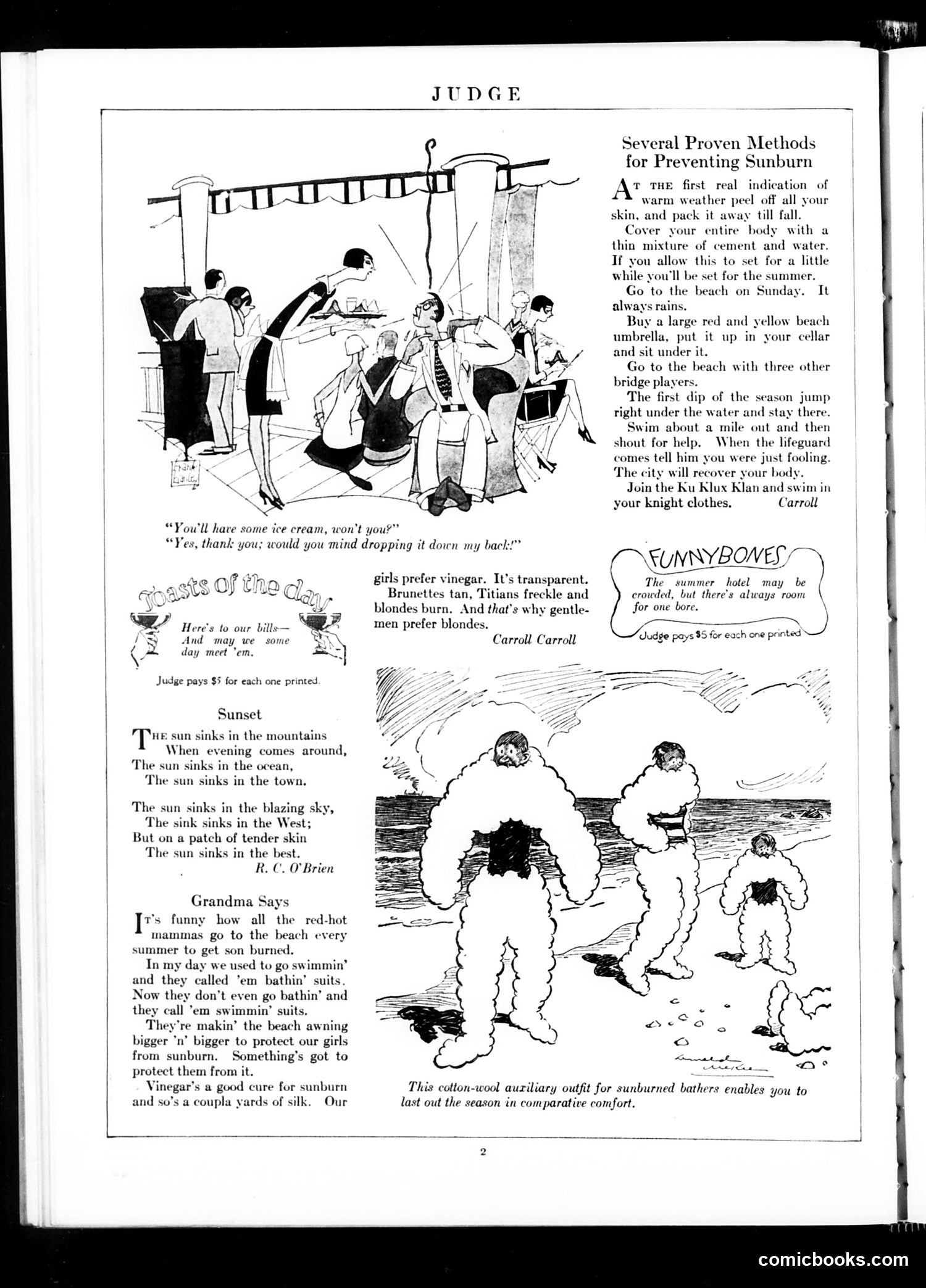
This page contains **humorous lifestyle advice rather than political satire**. The main cartoon depicts people at a beach or social gathering discussing ice cream and sunburn prevention—typical leisure-class concerns of the era. The content includes: - **"Several Proven Methods for Preventing Sunburn"**: Satirizes contemporary beauty standards and sun-protection methods (cement mixtures, beach visits, umbrellas), poking fun at elaborate skincare rituals and the social anxiety around tanning. - **"Taste of the Day"**: A brief joke about blonde vs. brunette women's attractiveness preferences. - **"Grandma Says"**: Folk wisdom about beach safety and sunburn remedies (vinegar, silk). The cartoon with figures in baggy swimsuits illustrates impractical protective clothing for swimmers—visual humor about the tension between modesty and comfort.
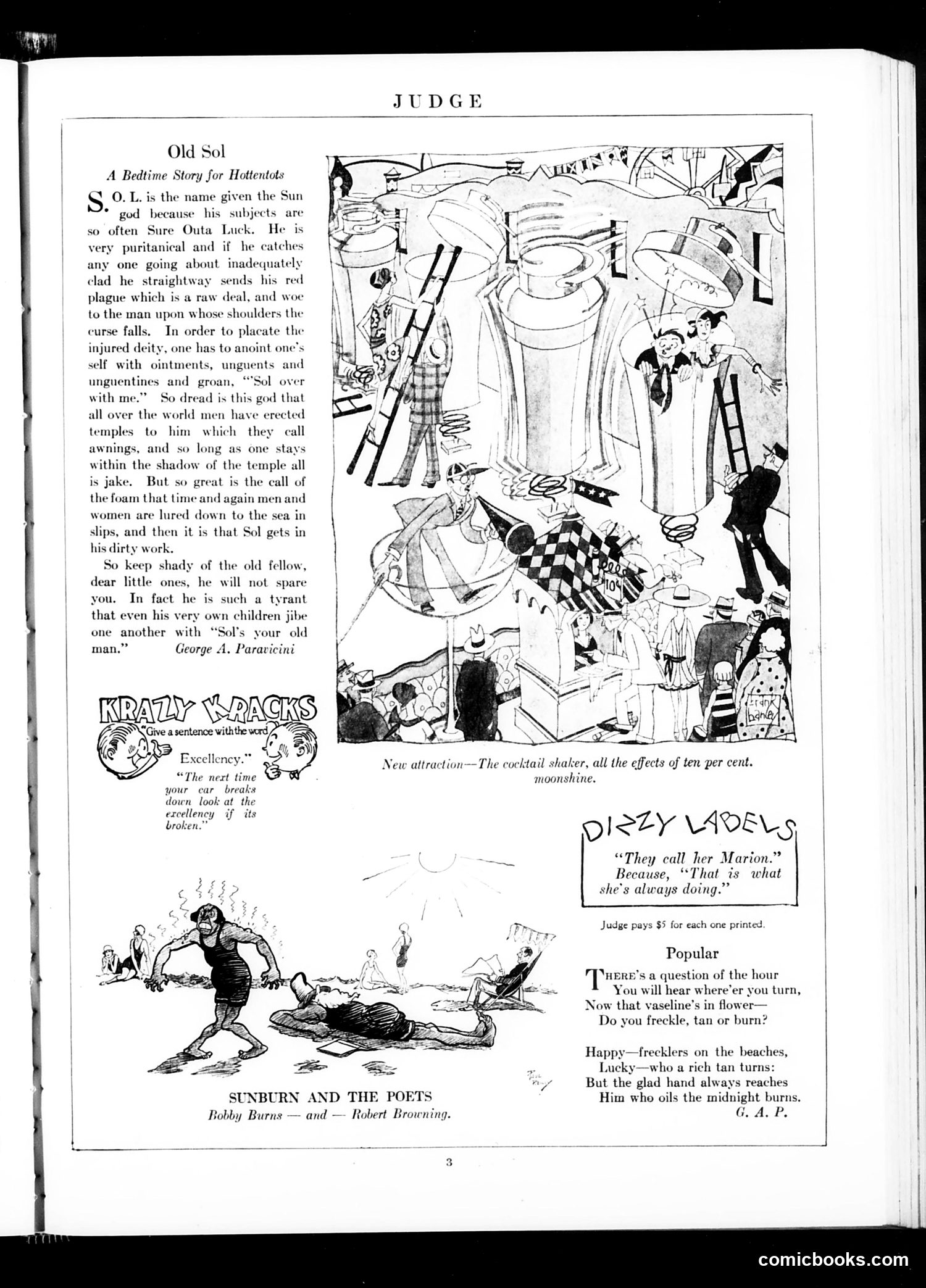
This page from *Judge* contains primarily humorous content rather than political satire: **"Old Sol"** is a bedtime story personifying the sun as an unreliable character who neglects his duties, told by George A. Paracini. The accompanying illustration shows a chaotic domestic scene with ladders and figures, likely depicting Sol's messy household. **"Krazy Kracks"** is a word-puzzle feature asking readers to form sentences using given words (here, "Excellency"). **"Dizzy Labels"** presents a visual joke about a woman named Marion. **"Sunburn and the Poets"** is a illustrated poem by Bobby Burns and Robert Browning, contrasting lucky people with freckles against those who burn in the sun. The page is primarily light entertainment rather than topical satire.
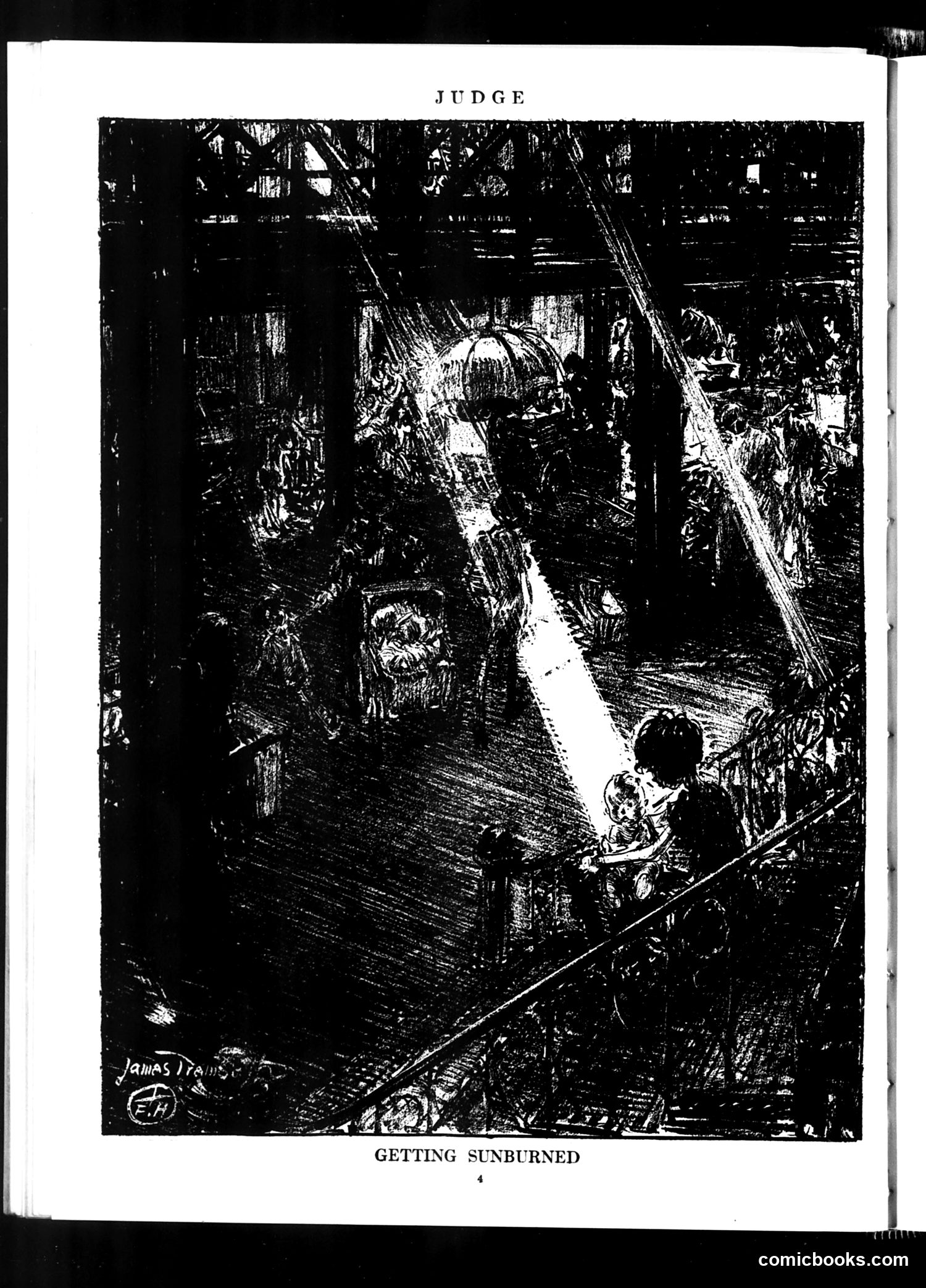
This Judge magazine page depicts "Getting Sunburned" — a satirical illustration showing a figure being subjected to intense heat and light in what appears to be a courtroom or judicial setting. The title and dramatic rendering suggest this is social commentary about legal proceedings or public scrutiny. The scene's theatrical composition, with architectural elements and multiple figures visible in the background, indicates this likely satirizes a prominent trial or legal case of the era. The figure's apparent distress from the "sunburning" — intense exposure — may mock someone forced into the glare of public attention or judicial examination. Without additional context about Judge's publication date, I cannot identify the specific historical case or public figure referenced. The satire's exact meaning requires knowing which contemporary legal proceeding inspired this commentary.
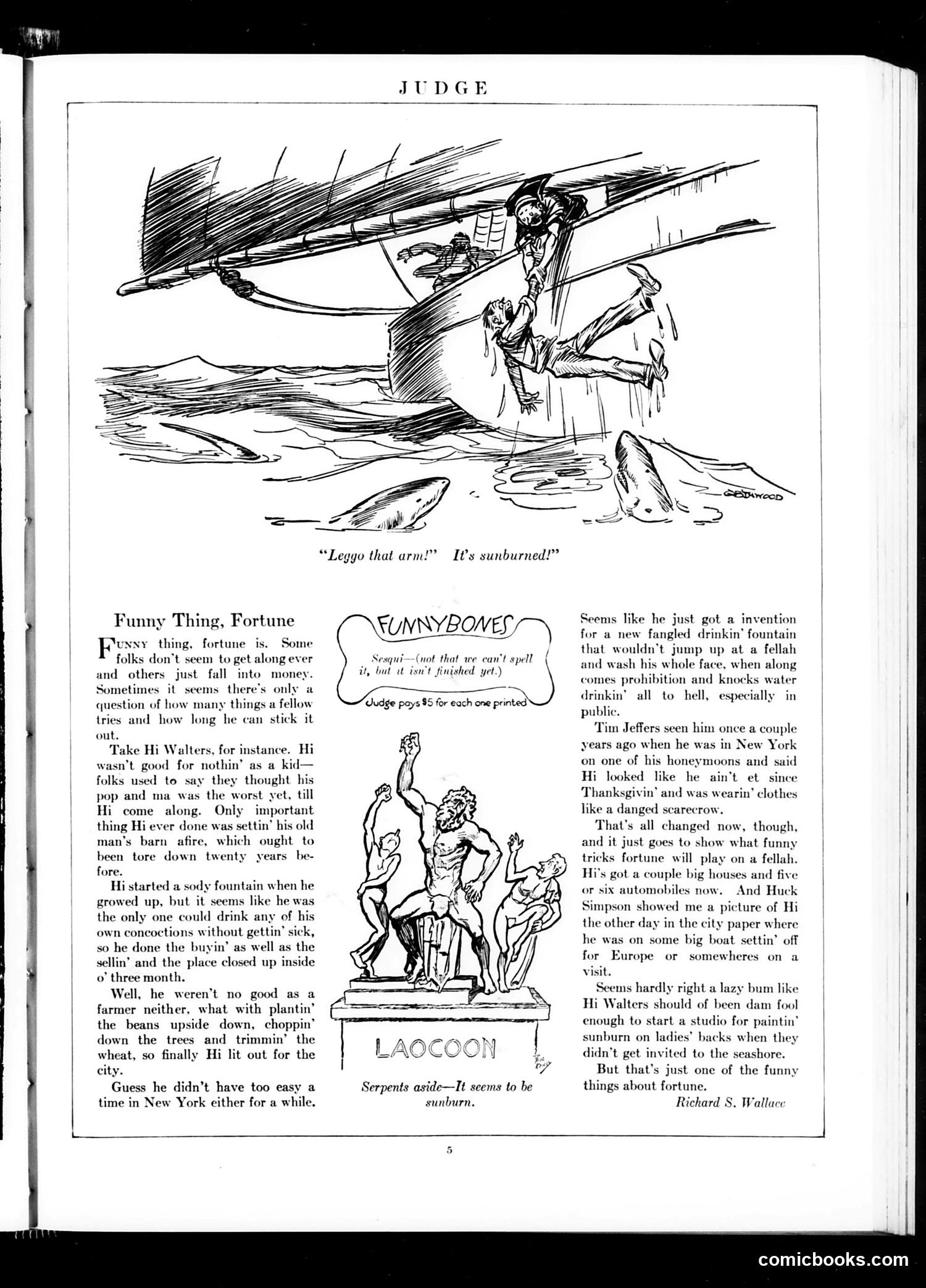
The top cartoon depicts someone exclaiming "Leggo that arm! It's sunburned!" — apparently a visual gag about sunburned skin being mistaken for something else or someone else's arm. The main article, "Funny Thing, Fortune," is a humorous commentary on wealthy individuals whose fortunes seem unearned or poorly managed. It specifically profiles "Hi Walters," a man who started a soda fountain but has since become wealthy through unclear means. The satire mocks his transformation from unsuccessful farmer and businessman to affluent socialite with multiple properties and automobiles. The accompanying "Laocoon" statue illustration appears to reinforce themes of fortune's capriciousness and human folly. The piece is fundamentally satirizing how American wealth accumulation often defies logic or merit.
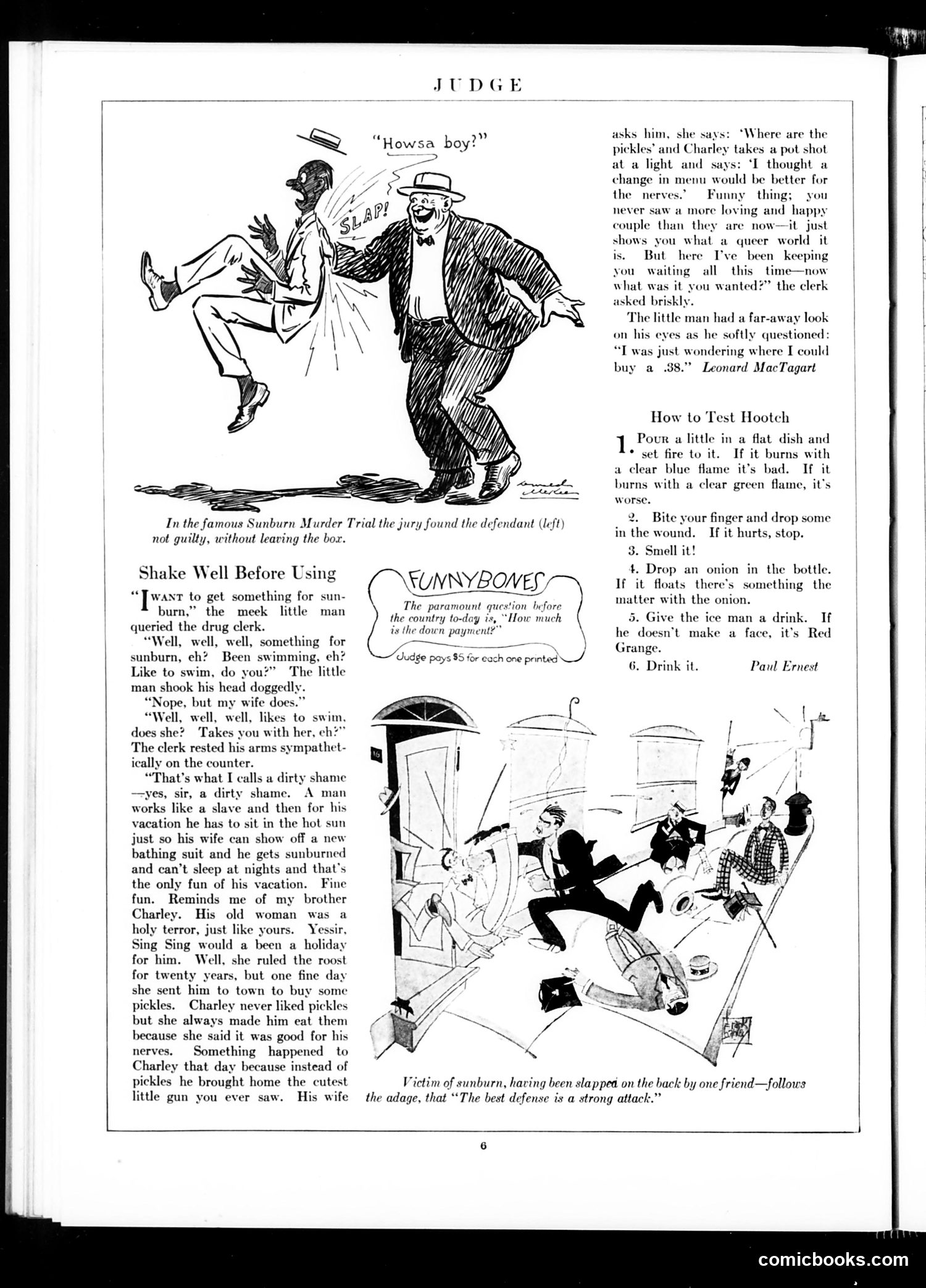
This page contains three satirical pieces reflecting early 20th-century American concerns: **"Shake Well Before Using"**: A darkly comic story where a drug clerk tells a lengthy anecdote about his brother Charley, whose domineering wife forced him to eat pickles for his nerves. The punchline: Charley bought a gun instead, shot at a light, and claimed it would be "better for the nerves." The couple became loving afterward. The listener, a sunburned man, responds by asking where to buy a .38 revolver—implying he wants to shoot his own nagging wife. The satire mocks domestic unhappiness and marital discord. **"Funny Bones"**: A one-liner joke about the era's economic preoccupation with down payments, suggesting widespread consumer debt anxiety. **"How to Test Hootch"**: Humorous instructions for testing bootleg alcohol quality during Prohibition, reflecting the era's illegal drinking culture. The visual cartoons humorously depict sunburn victims and courtroom proceedings, supporting these themes of domestic frustration and period-specific social issues.
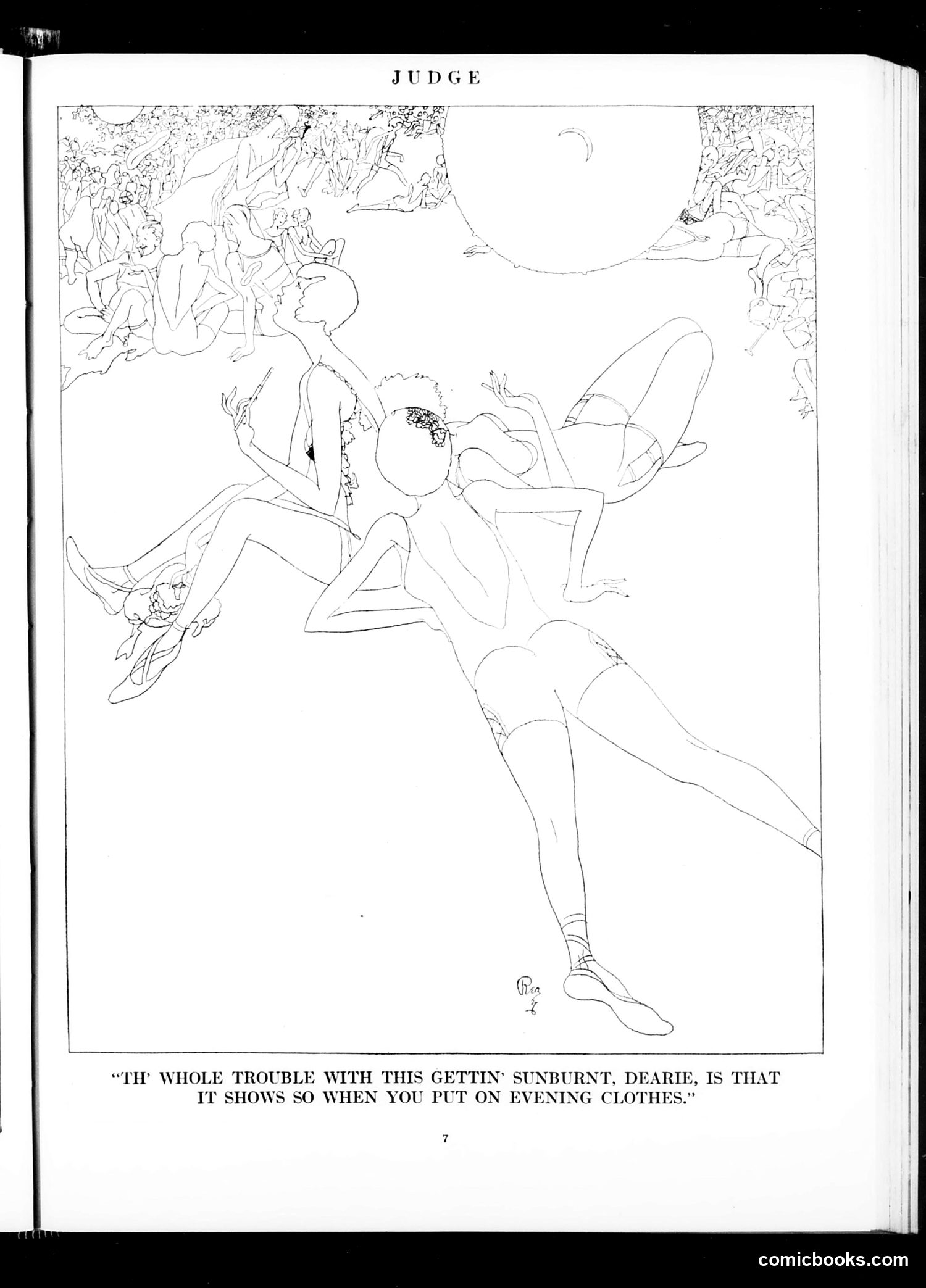
This is a single-panel cartoon satirizing vanity and fashion concerns among women. The drawing shows a woman in evening wear complaining about visible sunburn marks—the contrast between tanned and untanned skin reveals her beach activities when she dresses formally. The humor targets the social tension between outdoor recreation (fashionable for health) and formal evening appearance (requiring unmarked skin). The phrase "gettin' sunburnt" uses colloquial speech, suggesting the speaker is commenting on a friend's predicament. The satire mocks women's preoccupation with appearance and the difficulty of maintaining social respectability while pursuing leisure activities that leave visible marks. This reflects early 20th-century anxieties about changing women's roles—the freedom to sunbathe conflicting with traditional standards of pale, protected femininity required for evening society.
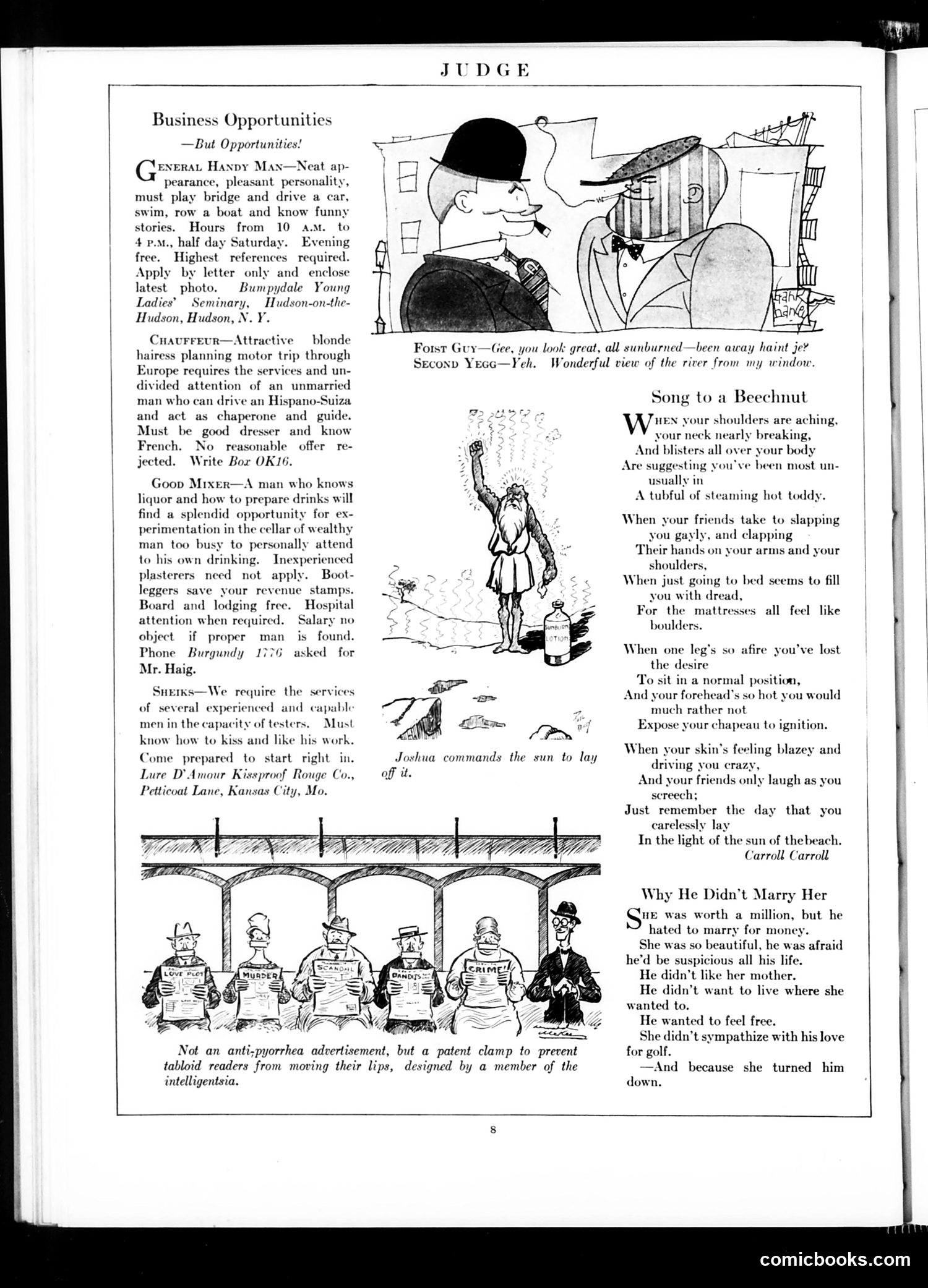
This page from *Judge* (a major American satirical magazine) satirizes early 20th-century employment advertisements through absurdist humor. The "Business Opportunities" section parodies classified ads by presenting ridiculous job postings with impossible or immoral requirements: a "General Handy Man" needing to be a bridge player and comedian; a chauffeur for a woman's European motor trip who must also serve as romantic chaperone; a "Good Mixer" seeking a man to secretly sample a wealthy employer's liquor; and "Shrieks"—testers needed to evaluate "kissproof rouge" by kissing. The cartoons below mock tabloid culture and leisure-class romance. One shows two tourists discussing sunburns; another depicts men reading newspapers with a caption about a "patent clamp" to prevent lip-moving while reading—mocking tabloid readers' animated expressions. The remaining poems and stories humorously chronicle romantic disappointments and physical ailments, reflecting period humor about courtship and social pretension typical of *Judge*'s satirical style.
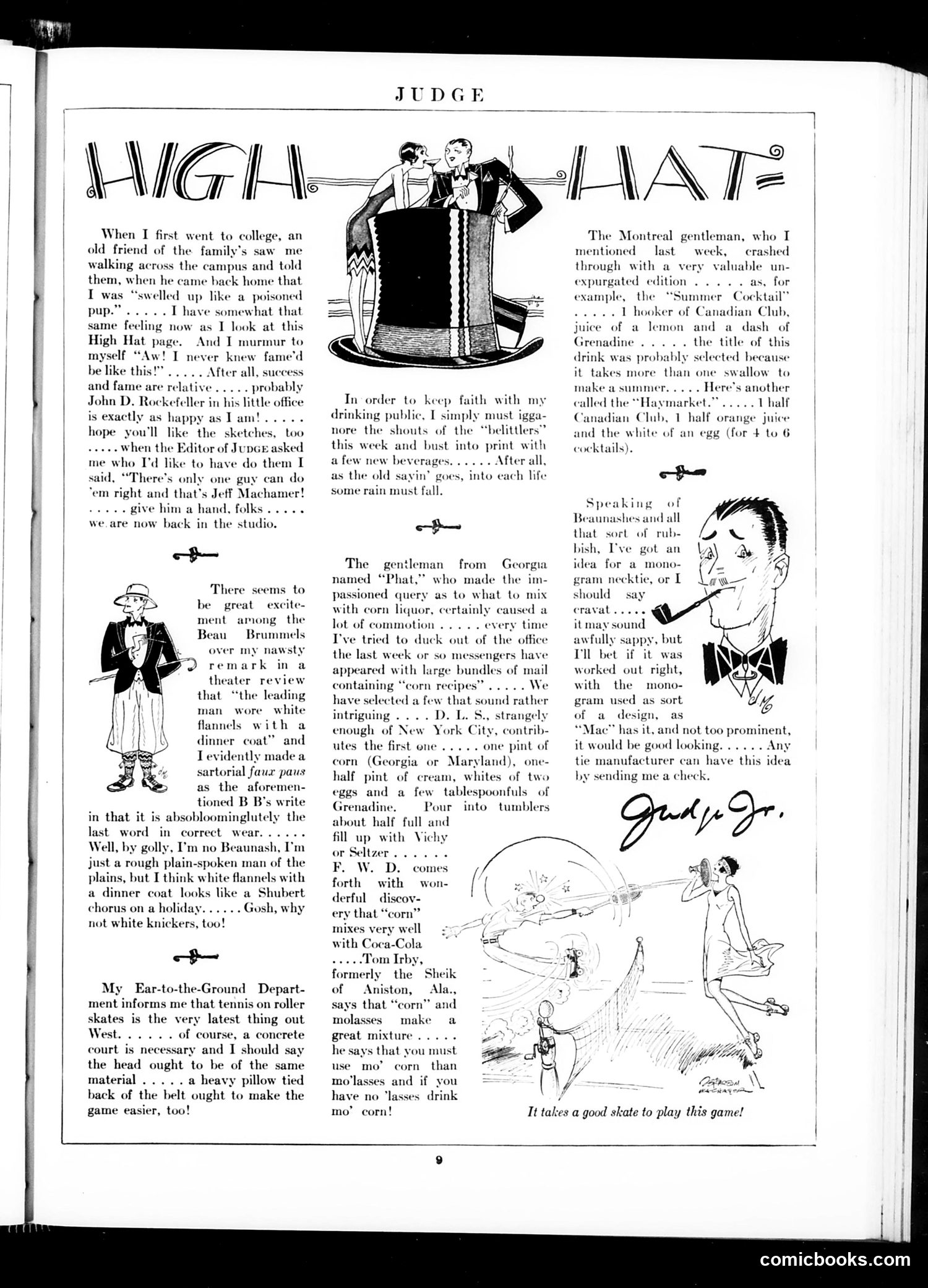
This is a humorous column by Judge magazine's social commentator, likely from the Prohibition era (given repeated references to "corn liquor" and creative cocktail recipes). The page satirizes several 1920s social anxieties: 1. **Fashion pedantry**: The writer mocks "Beau Brummels" (fashion-conscious men) who criticized his theater review mentioning white flannel trousers with dinner jackets—then sarcastically suggests white knickers would be equally ridiculous. 2. **Prohibition workarounds**: Multiple readers submit homemade "corn" (moonshine) cocktail recipes—mixing illegal whiskey with cream, Coca-Cola, and molasses. The satire highlights how openly people discussed bootleg alcohol despite the ban. 3. **Absurd trends**: A joke about tennis played on roller skates with concrete courts mocks faddish Western behavior. 4. **Monogram neckties**: A minor design suggestion treated as potentially fashionable. The overall tone is irreverent social commentary on upper-class manners, fashion obsessions, and the era's widespread flouting of Prohibition laws through joking correspondence.
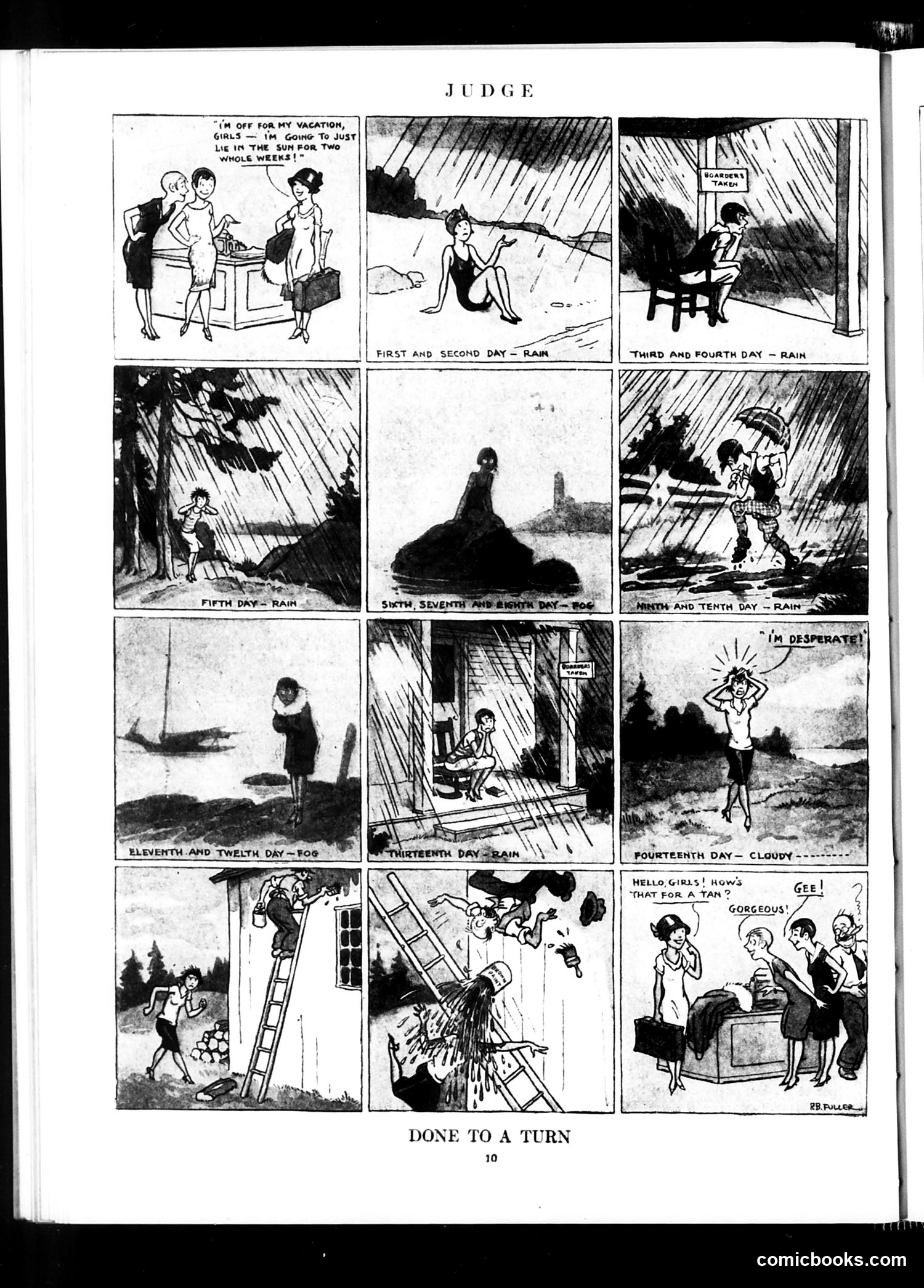
This comic strip satirizes a woman's disastrous two-week vacation attempt. The opening panel shows her bragging about spending "two whole weeks" in the sun. The subsequent panels chronicle her misery: constant rain for the first ten days, fog on day fourteen, and ultimately—upon returning home—she's been "done to a turn" (a cooking metaphor meaning thoroughly cooked/ruined). The final panel's punchline shows her friends admiring her tan, not realizing it resulted from comedic bad luck rather than relaxation. The satire targets vacation expectations versus reality, and perhaps the 1920s-era obsession with fashionable sun tans as status symbols. The humor lies in how she endured relentless weather only to achieve the desired appearance by accident.
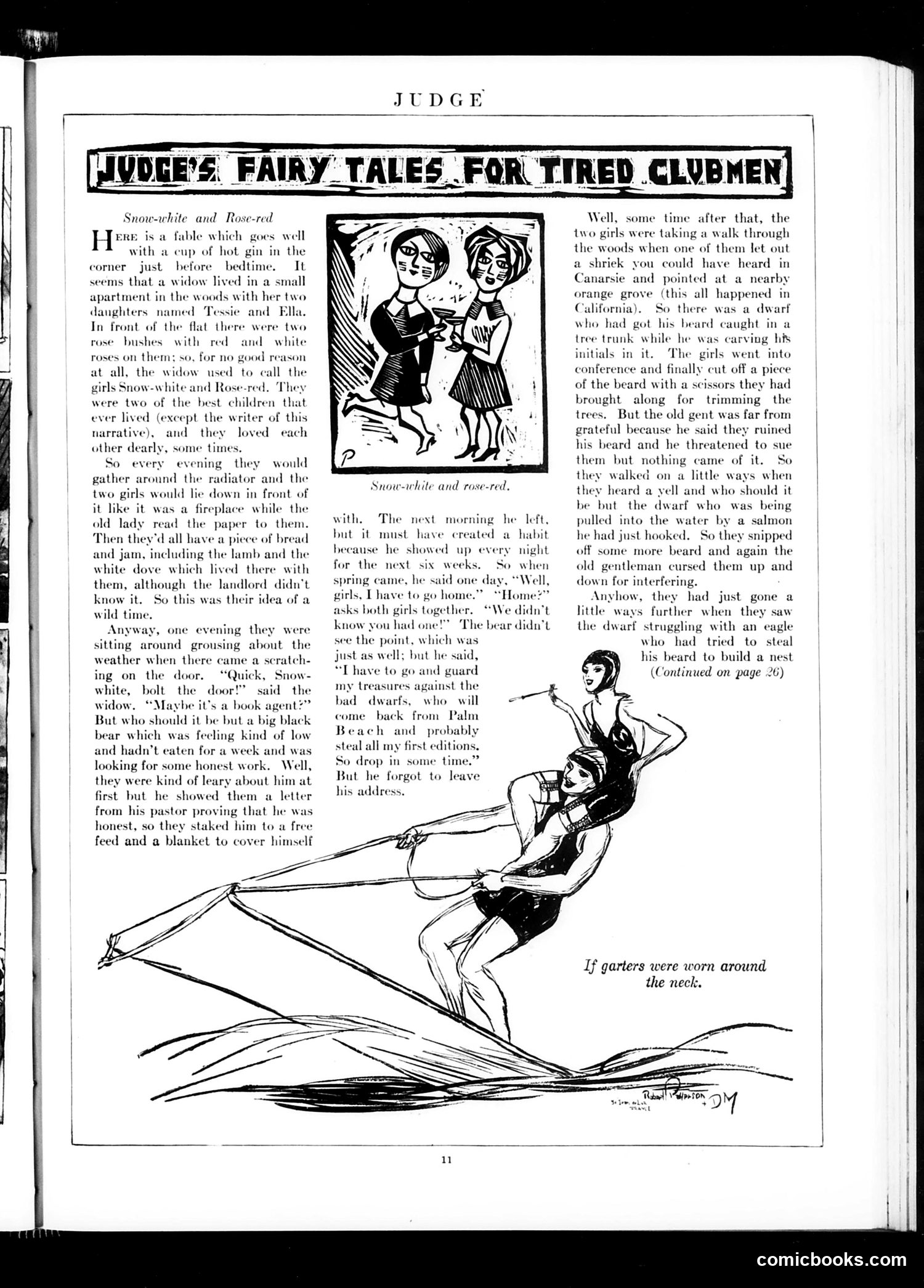
This is a humorous fairy tale retelling in Judge magazine, a satirical publication. The story appears to be a comedic modernization of the classic Brothers Grimm tale, set in contemporary America (references to "Canarsie" and "California" ground it in the 1920s-30s era). The satire mocks several things: - **Urban poverty**: The widow and daughters live in a cramped apartment, not a forest cottage - **Social climbing/respectability**: The bear carries a pastor's letter to prove honesty before being fed - **Entitled wealthy people**: The dwarf guards "first editions" from Palm Beach, suggesting affluent dwarfs as comic antagonists - **The dwarf's ingratitude**: Despite rescue, he threatens lawsuits rather than expressing thanks The joke relies on incongruity—transplanting a fairy tale into dingy modern urban life with petty, materialistic characters. The illustration labeled "If garters were worn around the neck" appears to be a separate humorous visual gag unrelated to the main story.
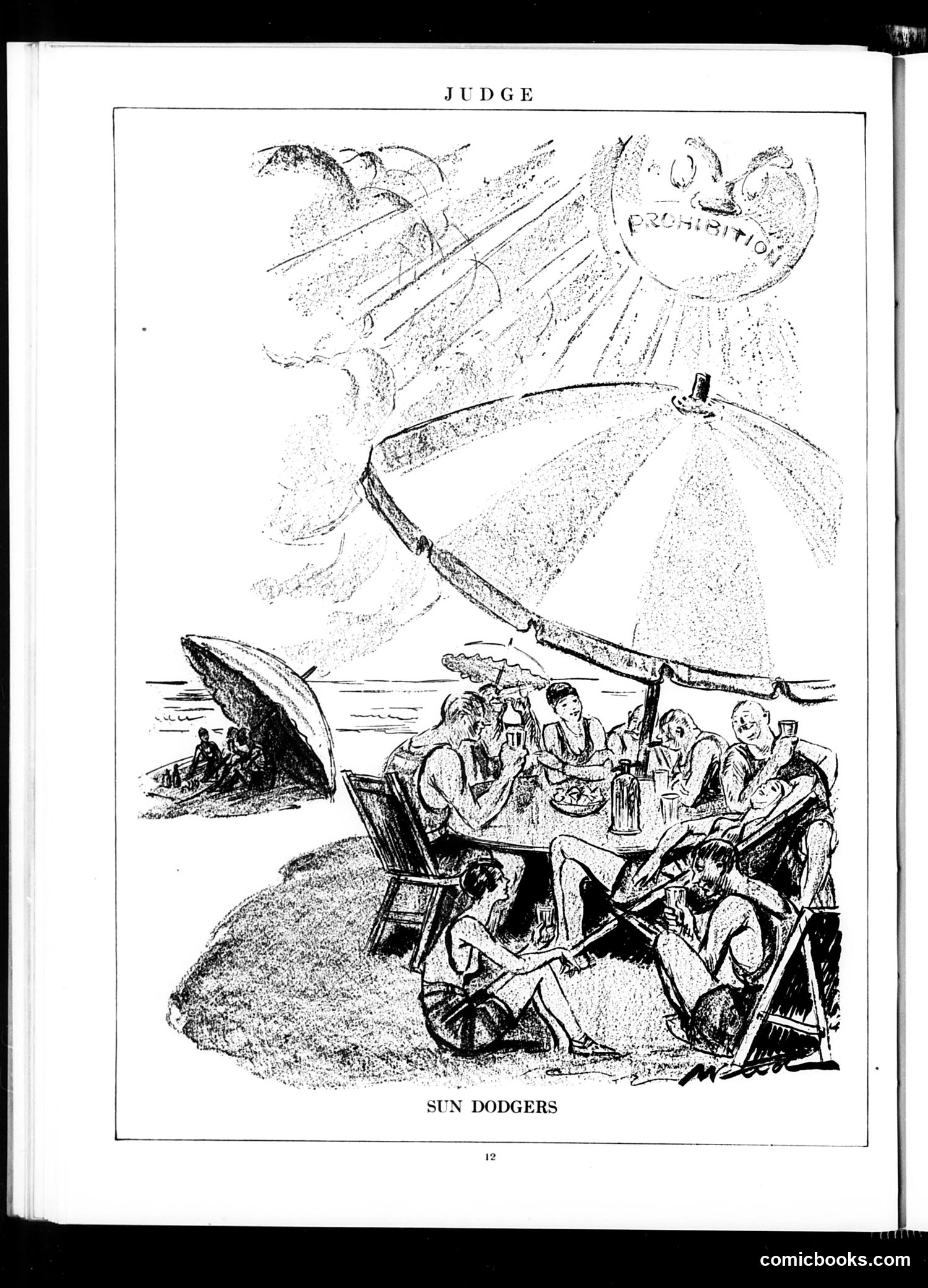
This cartoon satirizes people evading the sun, likely referencing Prohibition era concerns about public behavior. The illustration shows beachgoers huddled under umbrellas and makeshift shelters while a whales spout and "Prohibition" sun beam down from above. The title "Sun Dodgers" suggests people actively avoiding something—possibly sun exposure, but more likely a metaphor for those dodging Prohibition laws or evading authorities during the Prohibition period (1920-1933). The beach setting with multiple figures seeking shelter creates an absurdist image mocking either public paranoia or deliberate avoidance of scrutiny. The cartoon's style and Judge magazine's satirical nature suggest social commentary on American behavior during this era, though the exact target—whether sun-worshippers, Prohibition enforcers, or law-breakers—remains somewhat ambiguous from the visual alone.
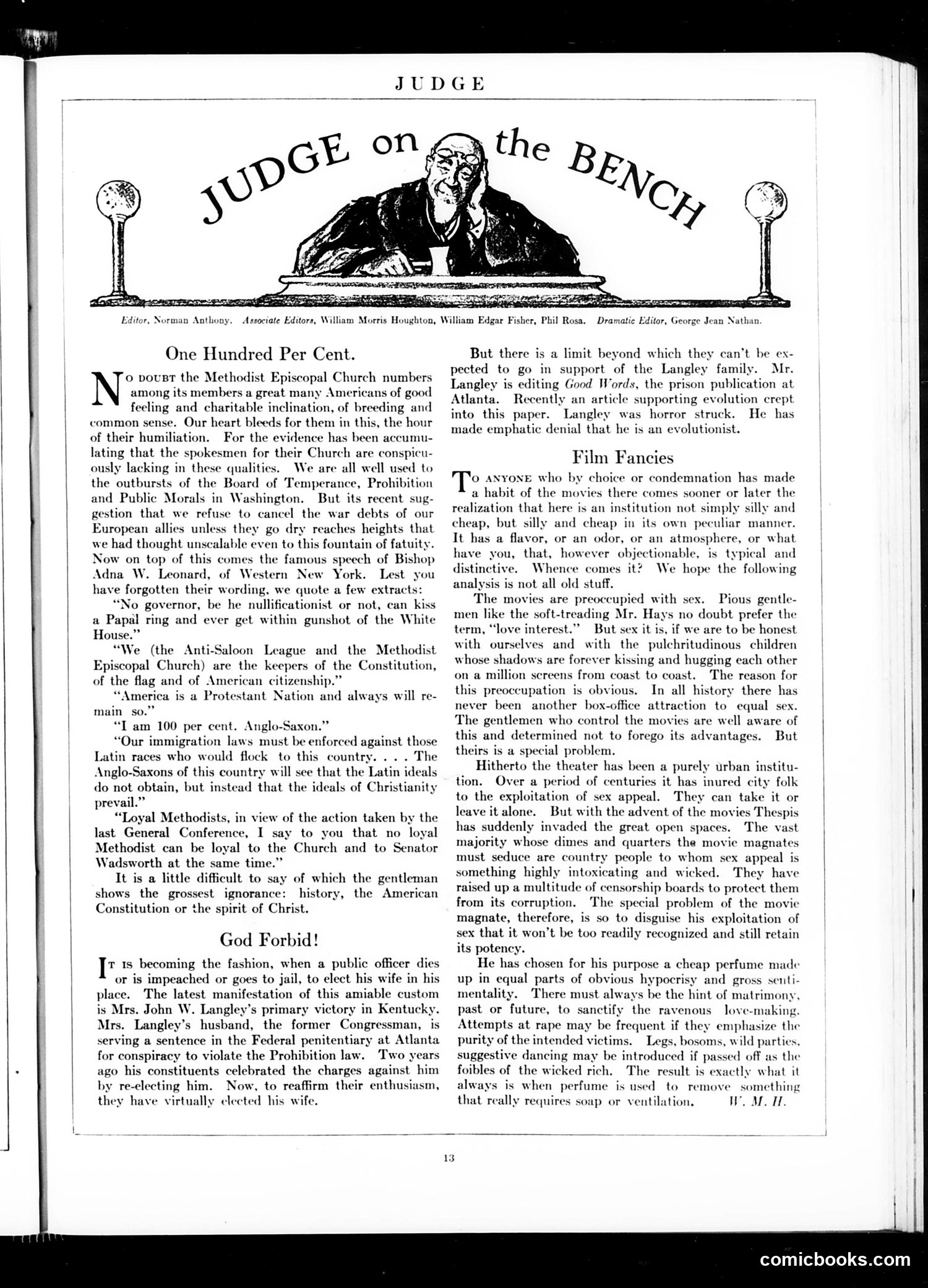
This editorial attacks Bishop Adna W. Leonard of the Methodist Episcopal Church for inflammatory statements mixing religious dogmatism with nativism. Leonard claimed Methodists were "keepers of the Constitution," declared America "a Protestant Nation," and opposed "Latin races" in immigration—positions the satirist finds absurdly hypocritical and historically ignorant. The cartoon ridicules Methodist leaders' recent activism, particularly their demand that the U.S. refuse to forgive European war debts unless those nations went dry (prohibition). Judge argues this demonstrates breathtaking arrogance and fatuity. A secondary piece mocks Mrs. John W. Langley's Kentucky primary victory—constituents elected a congressman's wife while he served federal prison time for Prohibition violations. The absurdity deepens when the imprisoned husband, editing the prison newspaper, denounced an evolution article as heretical, revealing his dogmatism extends even into incarceration. The satire targets 1920s Methodist political overreach and xenophobic nativism disguised as Christian morality.
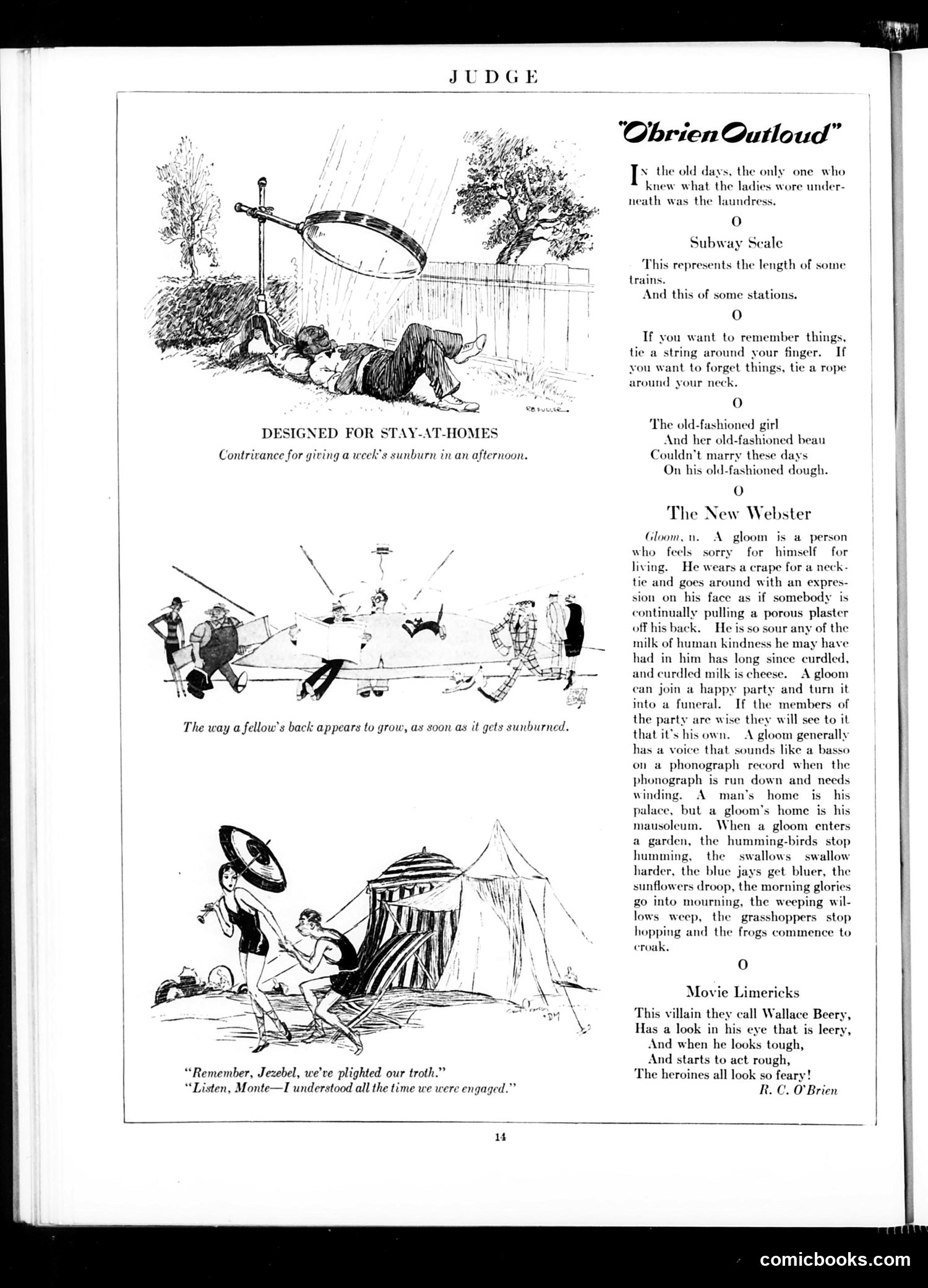
This page contains humorous illustrations and satirical commentary typical of early 20th-century American humor. The main cartoons mock social conventions and modern anxieties: **"Designed for Stay-at-Homes"** depicts a makeshift sunburn device—a satirical jab at people seeking shortcuts to fashionable tanned skin without leaving home. **The backburning cartoon** jokes about how sunburns make men's backs appear unusually large or distorted. **The dialogue sketch** ("Remember, Jezebel...") appears to mock miscommunication between romantic partners. The page also includes **"The New Webster,"** a mock dictionary entry defining "gloom" as a perpetually miserable person whose presence ruins any social gathering—a character type the magazine found worth ridiculing for his self-pitying attitude. **"Movie Limericks"** references actor Wallace Beery, whose tough-guy persona and distinctive appearance made him recognizable enough for contemporary readers to appreciate the joke about his intimidating screen presence. Overall, the content reflects period concerns about fashion, sunbathing, courtship, and personality types.
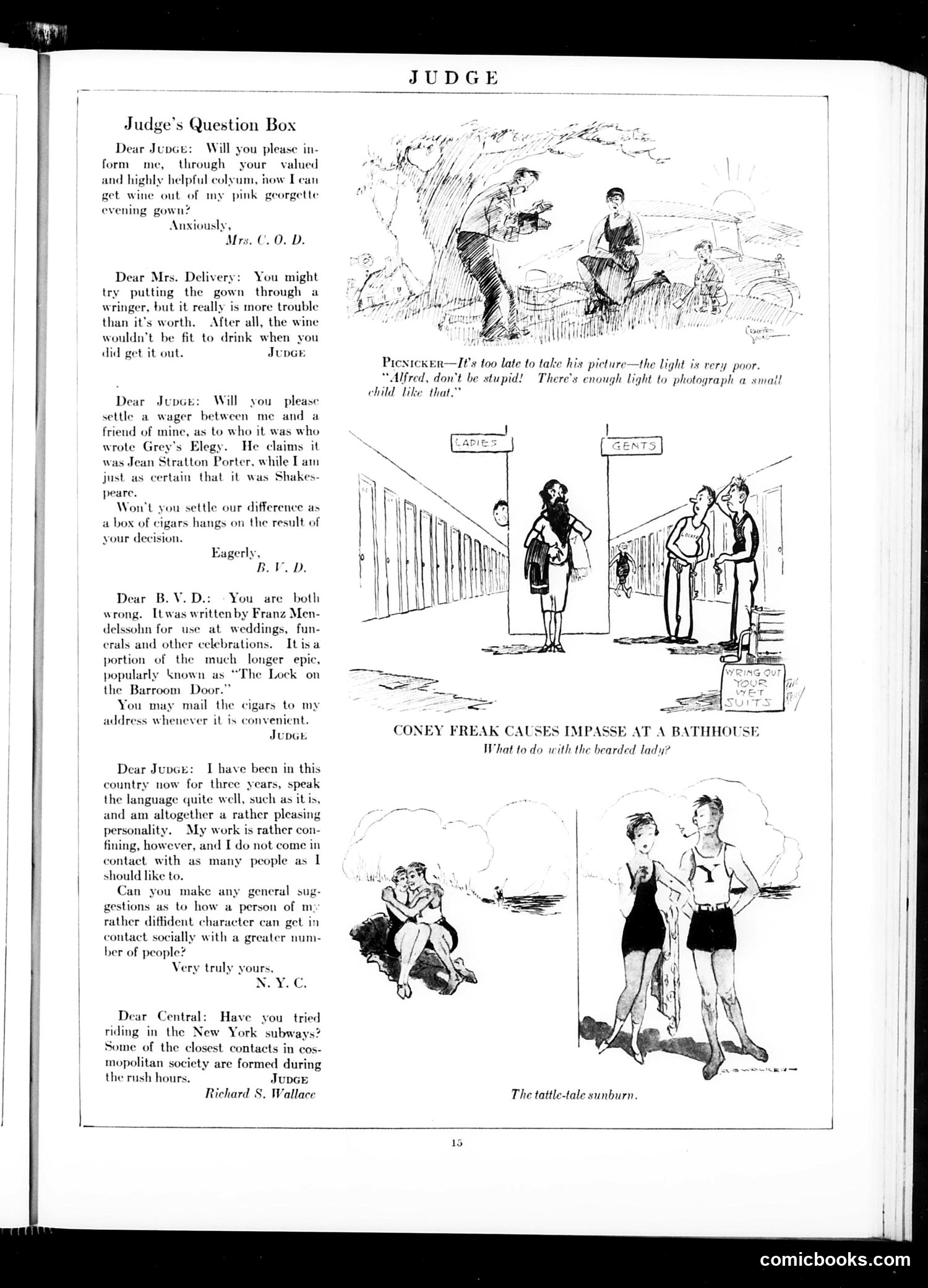
This page from **Judge** magazine contains a humorous "advice column" section and two cartoon illustrations satirizing early 20th-century American social situations. **The Question Box** features mock-serious responses to reader inquiries, with the humor lying in deliberately absurd or literal-minded answers. Notable is a joke about authorship of "Grey's Elegy"—the writer confuses the famous poem by Thomas Gray with fictitious authors, attributing it instead to composer Mendelssohn and a non-existent epic called "The Lock on the Barroom Door." **The cartoons** depict social awkwardness: 1. **"Coney Freak Causes Impasse"** satirizes the bearded lady sideshow attraction at Coney Island, showing bathhouse confusion about restroom placement. 2. **"The Tattle-Tale Sunburn"** jokes about uneven tanning revealing tan lines—likely referencing beachwear's revealing nature. The page mocks period anxieties about etiquette, social contact, and the emerging leisure culture around Coney Island.
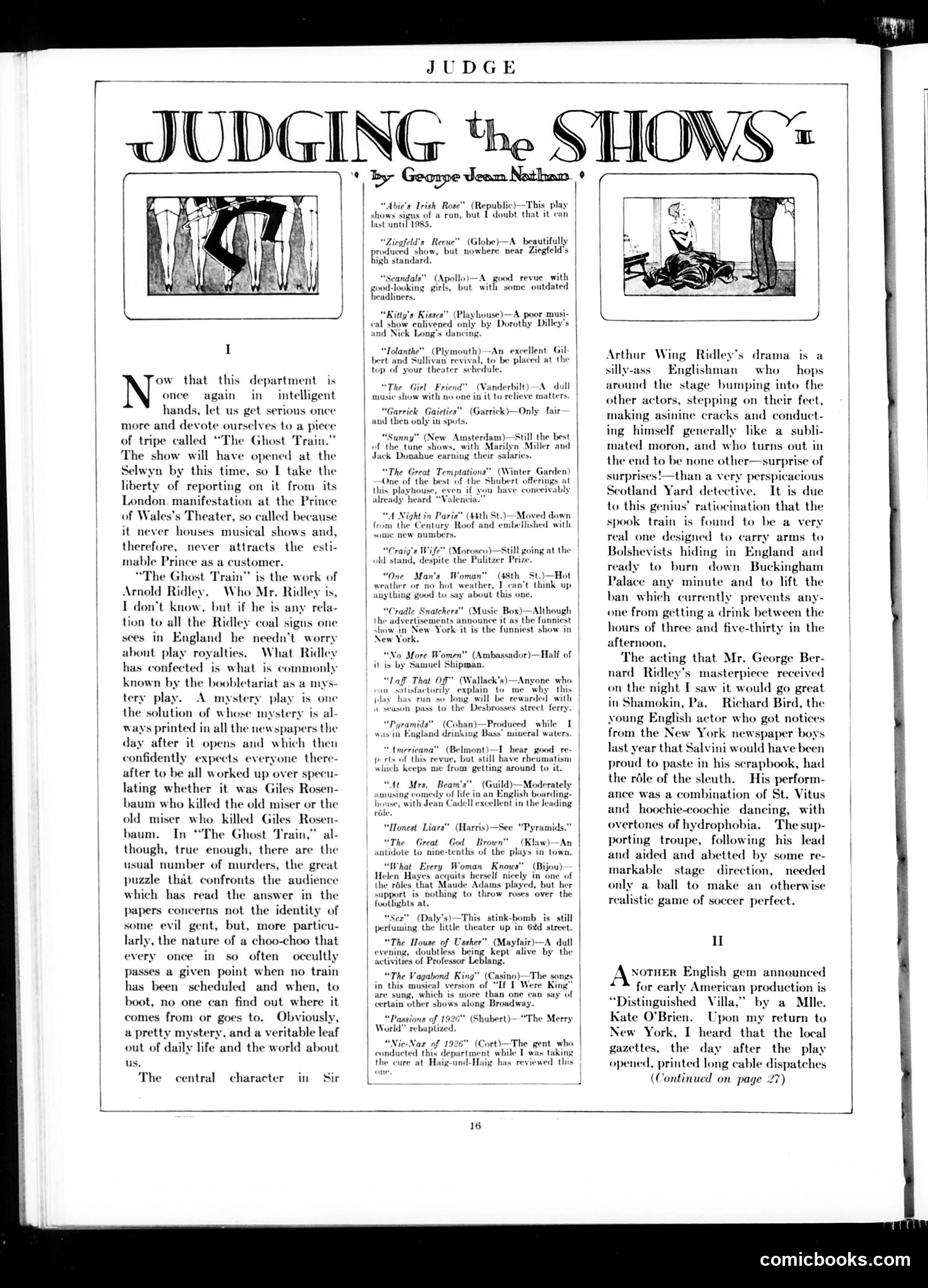
This is a theater review column by George Jean Nathan, a prominent drama critic of the 1920s. The page surveys current Broadway productions with Nathan's characteristic acerbic wit. The column critiques shows like "The Ghost Train," a mystery play by Arnold Ridley featuring an unexplained ghost train as its central puzzle. Nathan mocks mystery plays generally, noting that audiences read spoilers in newspapers before attending, reducing suspense to speculation about plot mechanics rather than genuine surprise. Nathan's reviews of other shows—"Abie's Irish Rose," "Ziegfeld's Follies," "Scandals," and various musicals—employ sharp one-liners dismissing productions as dull, outdated, or poorly cast. His tone is dismissively witty rather than constructively critical. The two small illustrations appear to be theatrical stills, typical of entertainment journalism of this era. Nathan's column represents Judge's satirical approach: using theatrical criticism to mock both plays and audience tastes.
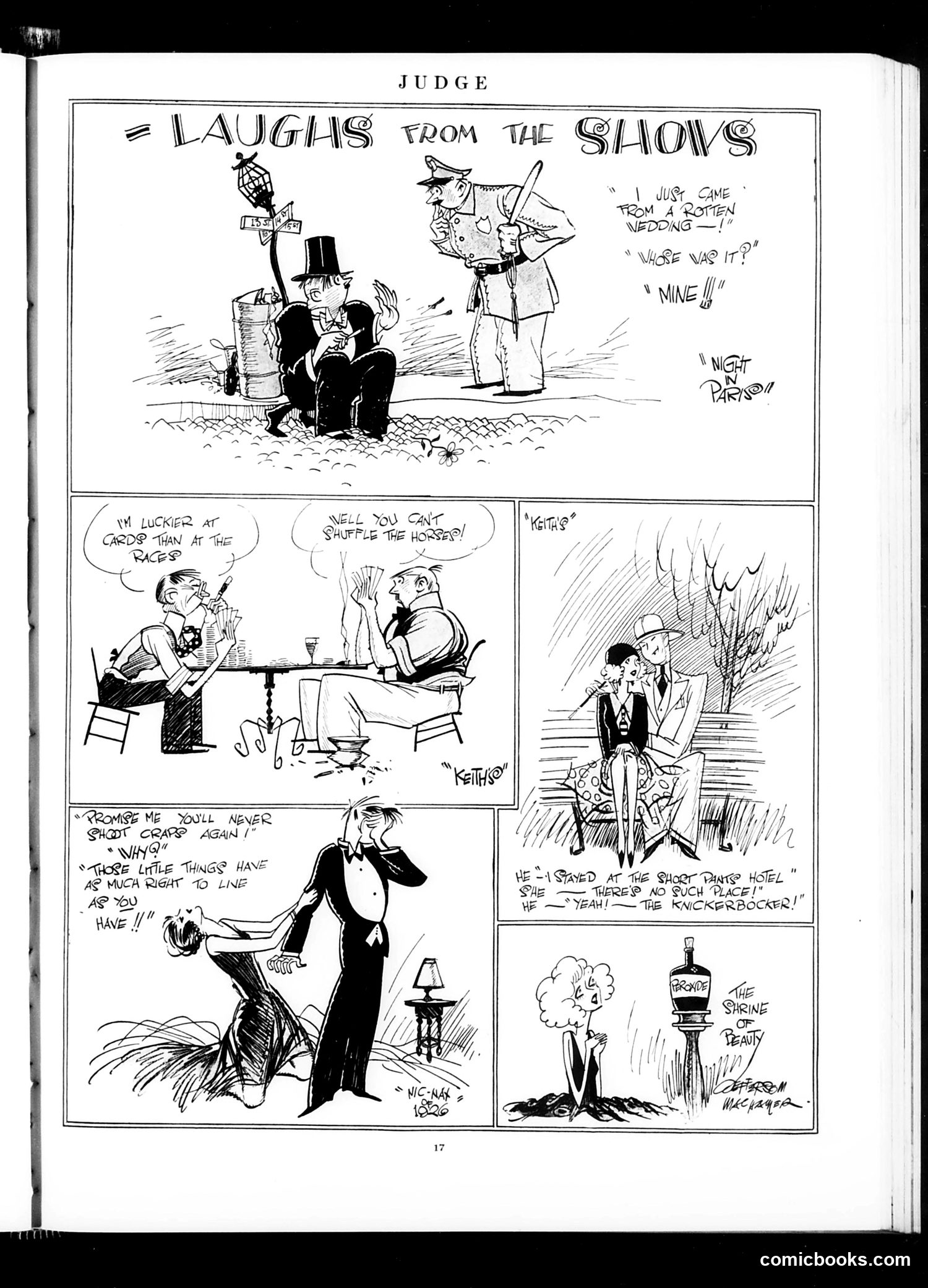
This page collects theatrical humor from Broadway productions. The top panel depicts a shabby street performer entertaining a well-dressed couple, contrasting poverty with wealth. The middle strips show gambling and card-playing scenes with period-typical dialogue about luck and games. The bottom panels reference specific shows: one mentions the "Short Pants Hotel" (a theatrical production), and the final panel references the Knickerbocker Hotel, a real New York establishment. The humor centers on theatrical mishaps, romantic entanglements, and social embarrassments common to stage comedies of the era. The cartoons satirize show-business culture and the contrast between on-stage fantasy and real-world consequences. The artwork style and references suggest this is from the early-to-mid 20th century, when Judge magazine regularly featured theater-related comedy and gossip.
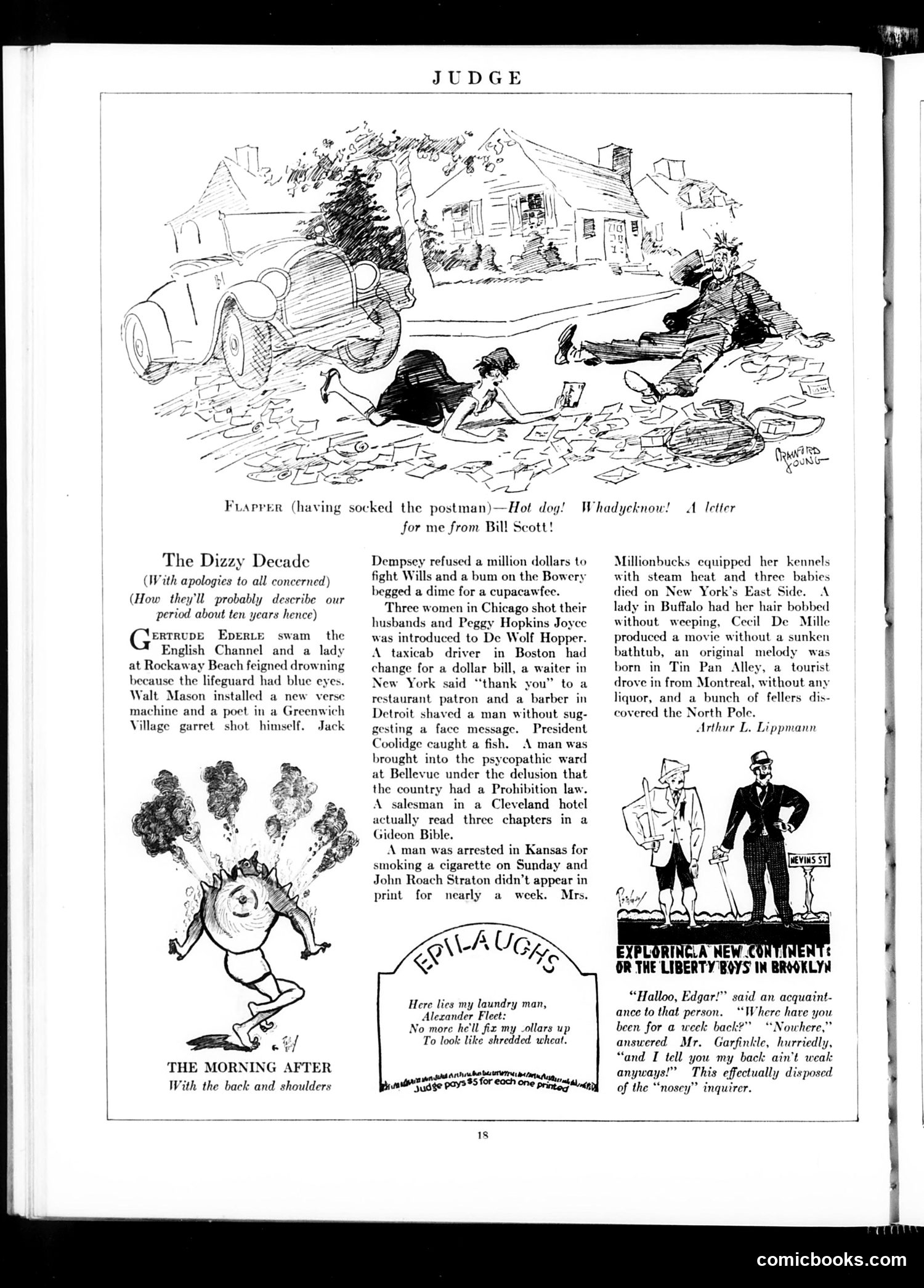
This page satirizes 1920s American life as absurdly topsy-turvy. "The Dizzy Decade" lists incongruous, impossible scenarios: Gertrude Ederle swimming the English Channel (real event), Jack Dempsey refusing fight money, a waiter saying "thank you," President Coolidge catching a fish—mundane or contradictory occurrences presented as news-worthy anomalies. The satire's point: the era is so chaotic and norm-breaking that normal behavior becomes shocking. References include Prohibition (presented as a delusion), Peggy Hopkins Joyce (socialite), and De Wolf Hopper (actor). The top cartoon shows "Flapper" (the modern rebellious woman type) having knocked out a postman, receiving fan mail—mocking the era's shocking new female independence. The Brooklyn vignette ridicules affected speech patterns. Overall, the page captures 1920s satirical commentary on rapid social change, celebrity culture, and generational upheaval.
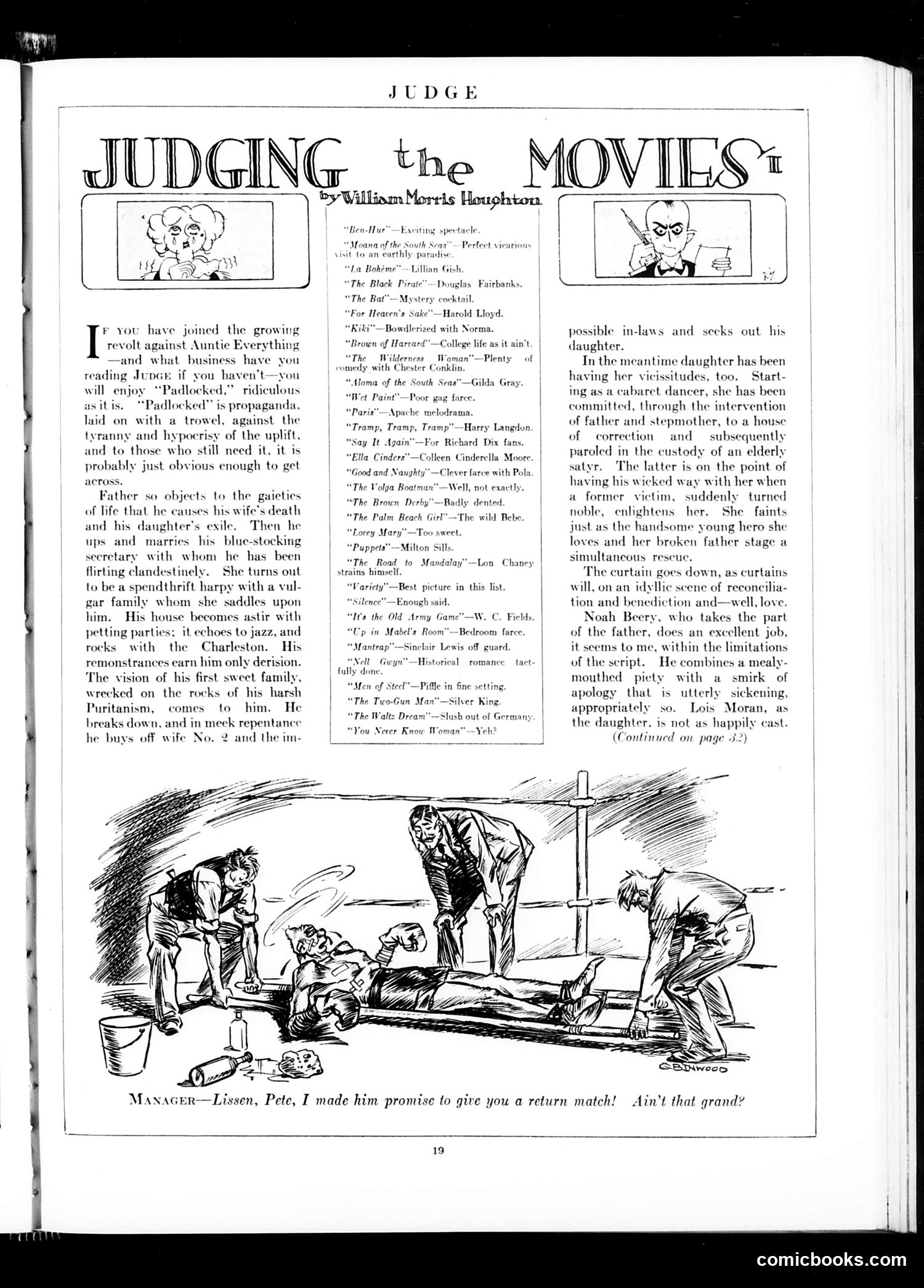
This page reviews the 1925 film "Padlocked," directed by William Morris Houghton. The article criticizes the film as heavy-handed propaganda against "uplift" morality movements—likely temperance and Prohibition era puritanism. The plot concerns a rigid, puritanical father whose strict morality destroys his family. He remarries a spendthrift woman who introduces jazz, Charleston dancing, and permissiveness to his household. After witnessing the consequences of his harsh philosophy, he repents and reconciles with his estranged daughter. The reviewer praises the film's critique of hypocritical moralism while noting that actor Noah Beery effectively embodies sanctimonious hypocrisy. The cartoon caption below jokes about a boxing manager promising a "return match"—likely satirizing Hollywood's formulaic happy endings and the film industry's promise of perpetual entertainment. The accompanying movie list provides brief, witty contemporary film reviews.
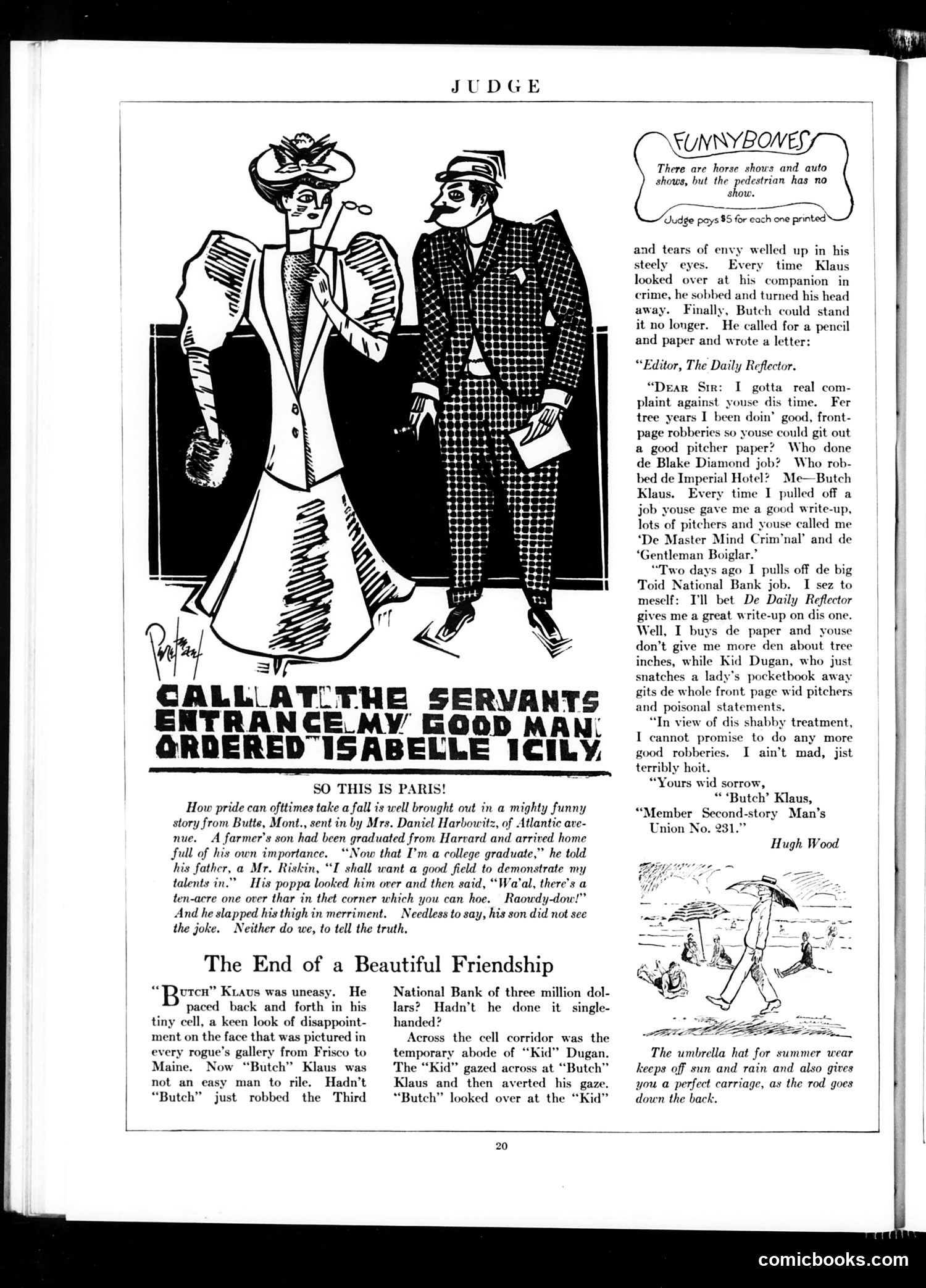
This Judge magazine page contains two distinct pieces: **Top cartoon:** Satirizes snobbish Harvard graduates. A farmer's son returns home boasting of his education, demanding impressive work to match his newfound status. His father's response—assigning him to hoe a ten-acre field—deflates his pretensions through humbling manual labor. The joke mocks educated young men who overestimate their importance upon graduation. **"The End of a Beautiful Friendship" story:** A darkly comic crime narrative about two bank robbers, "Butch" Klaus and "Kid" Dugan, imprisoned together. Klaus grows jealous when a newspaper gives Dugan front-page coverage for a minor pocketbook theft while Klaus's three-million-dollar bank heist receives only brief mention. Klaus writes complaining that he's been denied proper criminal publicity, threatening to stop committing "good robberies." The satire mocks both criminal egotism and sensationalist newspaper coverage—suggesting robbers crave media attention the way celebrities do, and that papers arbitrarily determine newsworthiness based on factors beyond actual crime significance.
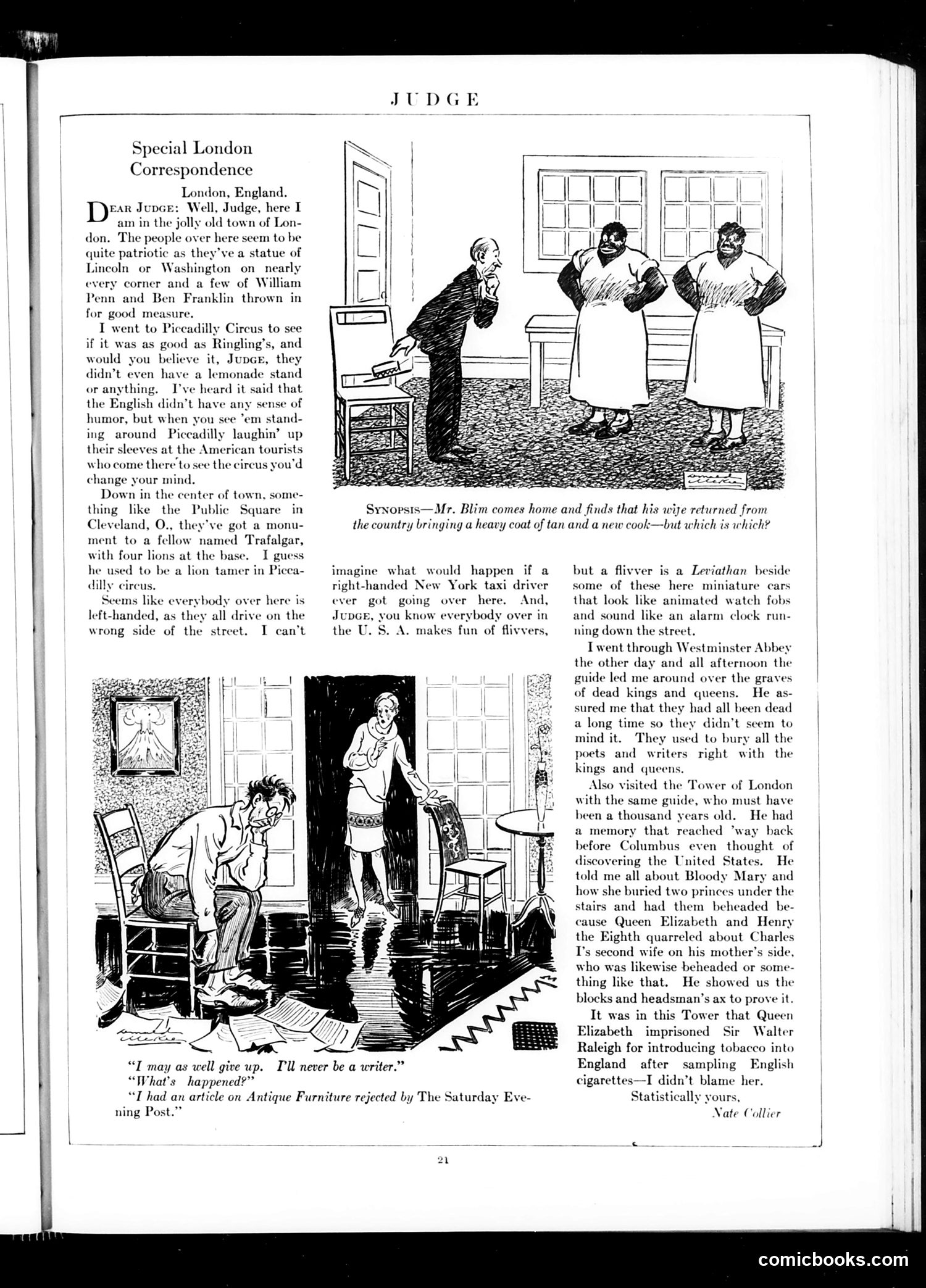
This page contains a humorous travel letter from London with two satirical cartoons. **Top cartoon**: A man returns home to find his wife transformed—heavily tanned from the country and accompanied by a new cook. The joke plays on the ambiguity of "which is which?"—implying the wife's tan has made her unrecognizable, or potentially mixing up the two women. **Bottom cartoon**: A rejected writer laments his unpublished furniture article. The satire mocks the frustration of literary rejection and perhaps commentary on what publications will accept. **The letter itself** satirizes American tourists' naïve observations about London: mistaking Piccadilly Circus for an actual circus, misunderstanding Trafalgar's monument (the lions weren't from circus work), joking about British left-hand driving, and the guide's impossibly ancient knowledge mixing up historical figures (Elizabeth and Charles I never coexisted as described). The humor targets both American ignorance abroad and British eccentricity, typical of *Judge* magazine's early 20th-century satirical approach.
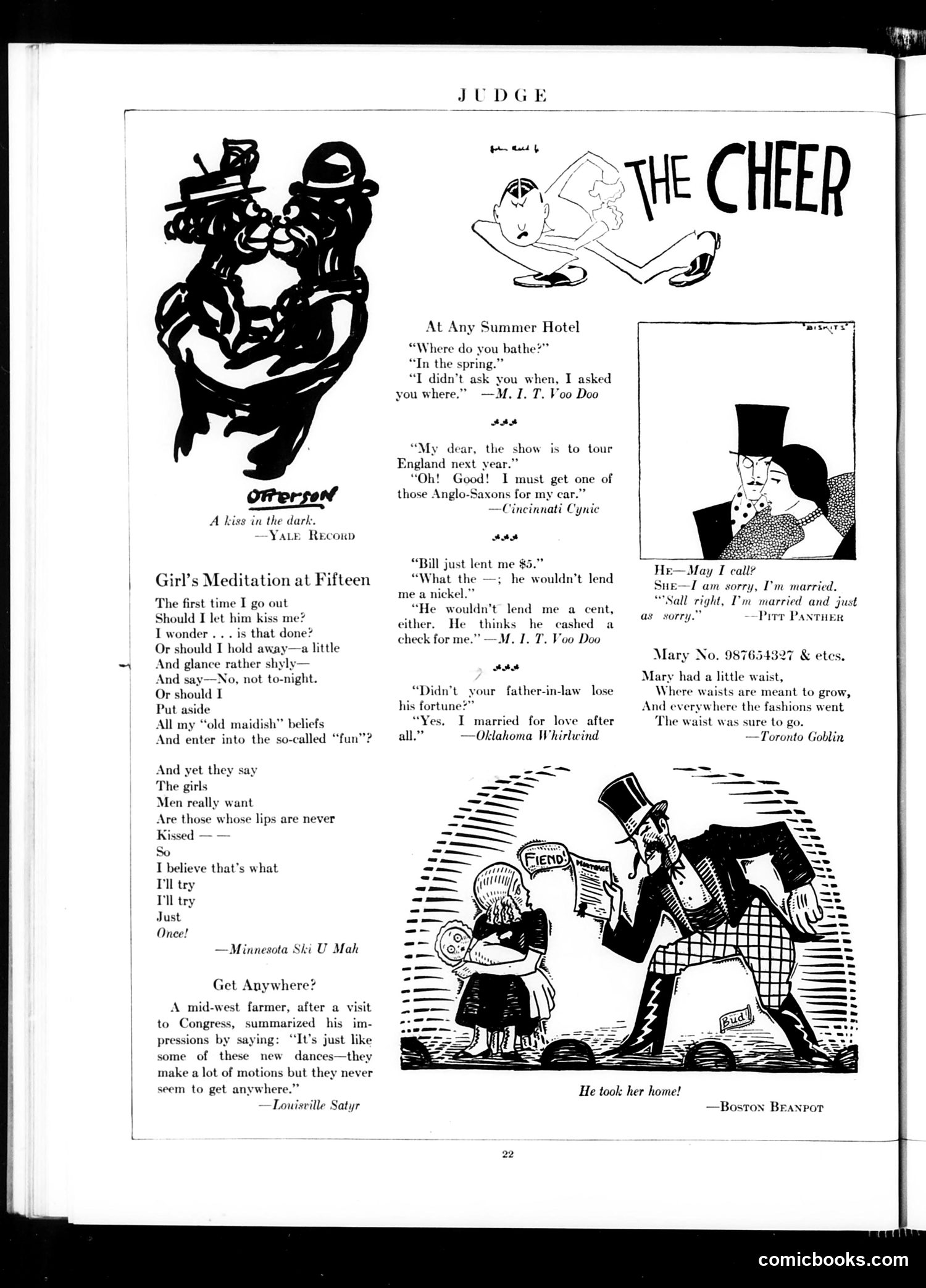
This is a humor compilation page mixing short jokes, poetry, and cartoons typical of 1920s American satirical magazines. **Key content:** The "Girl's Meditation at Fifteen" poem satirizes young women's confusion about dating etiquette—whether to allow kissing, appear modest, or embrace modern "fun"—while noting men supposedly prefer unkissed girls. Multiple one-liners mock social absurdities: a farmer compares Congress to modern dances that "make motions but never get anywhere"; jokes about bathing locations, lending money, and marriage reflect period anxieties about changing social norms. **The cartoons** feature: - A couple kissing (captioned from Yale Record) - A woman asking a man to "call" (dated courtship language) - A bottom illustration showing a man presenting a woman to what appears to be a suitor, captioned "He took her home!"—likely depicting arranged courtship or matchmaking The overall theme reflects 1920s concerns: modern dating practices, women's changing roles, and tension between traditional courtship and contemporary behavior.
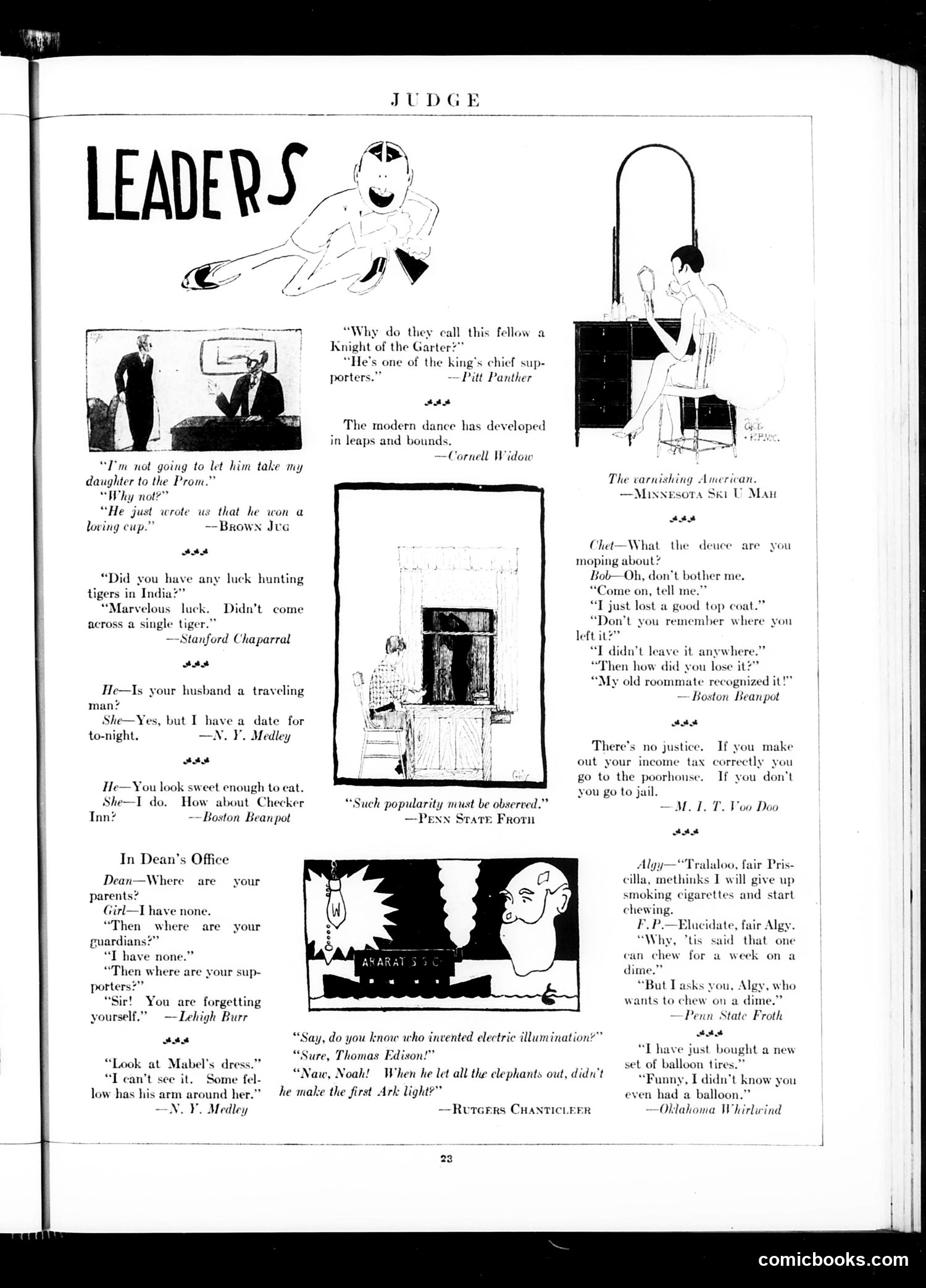
This page compiles short humorous items and cartoons from various college and satirical publications, typical of Judge's format. **Key Content:** The jokes target early 20th-century social absurdities: a man losing his coat without removing it (his roommate "recognized" it, implying it was stolen); income tax paradoxes (compliance leads to poverty, evasion to jail); and dating anxieties (a father forbidding a daughter's prom date because he won a "loving cup"). **Notable Satire:** One cartoon mocks religious/historical ignorance: a man credits Thomas Edison with "inventing" electric light by misinterpreting Noah's Ark as "Arc light"—conflating electricity with the biblical ark. Another targets bureaucratic absurdity: a dean's office exchange where a student has no parents, guardians, or "supporters" (financial backers), reducing higher education to mere patronage. The tone is lighthearted, collegiate, and aimed at educated readers familiar with American social pretensions and institutional ironies.
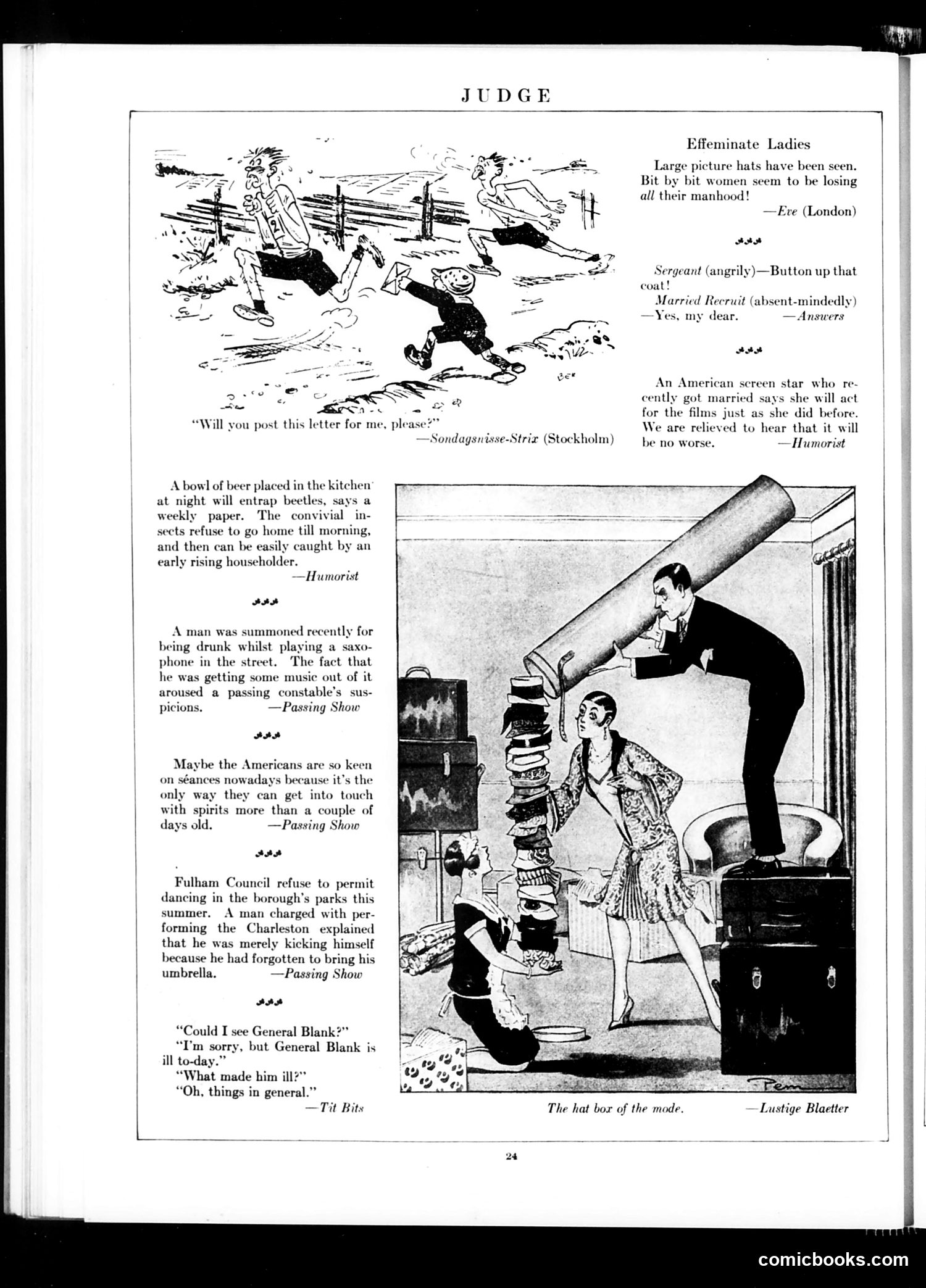
This page collects brief satirical items and jokes typical of 1920s-era Judge magazine, mostly poking fun at social changes and contemporary absurdities. **Top cartoon**: Shows a soldier being scolded by a sergeant about his uniform while a woman (his wife, based on the caption) stands nearby absent-mindedly. The joke mocks newly married soldiers whose wives distract them from military discipline. **Main cartoon** ("The hat tour of the mode"): Depicts a telescope pointed at a woman wearing an enormous, fashionable hat—so large it requires multiple people to manage it. This satirizes the exaggerated women's hat styles popular in the 1920s. **Text items**: Various quips from international publications mock: - Women losing "manhood" (traditional femininity) - American film stars' work habits after marriage - Prohibition-era drinking culture ("séances") - The Charleston dance craze - General modern social oddities The overall tone is lighthearted social commentary on 1920s fads, gender roles, and contemporary culture.
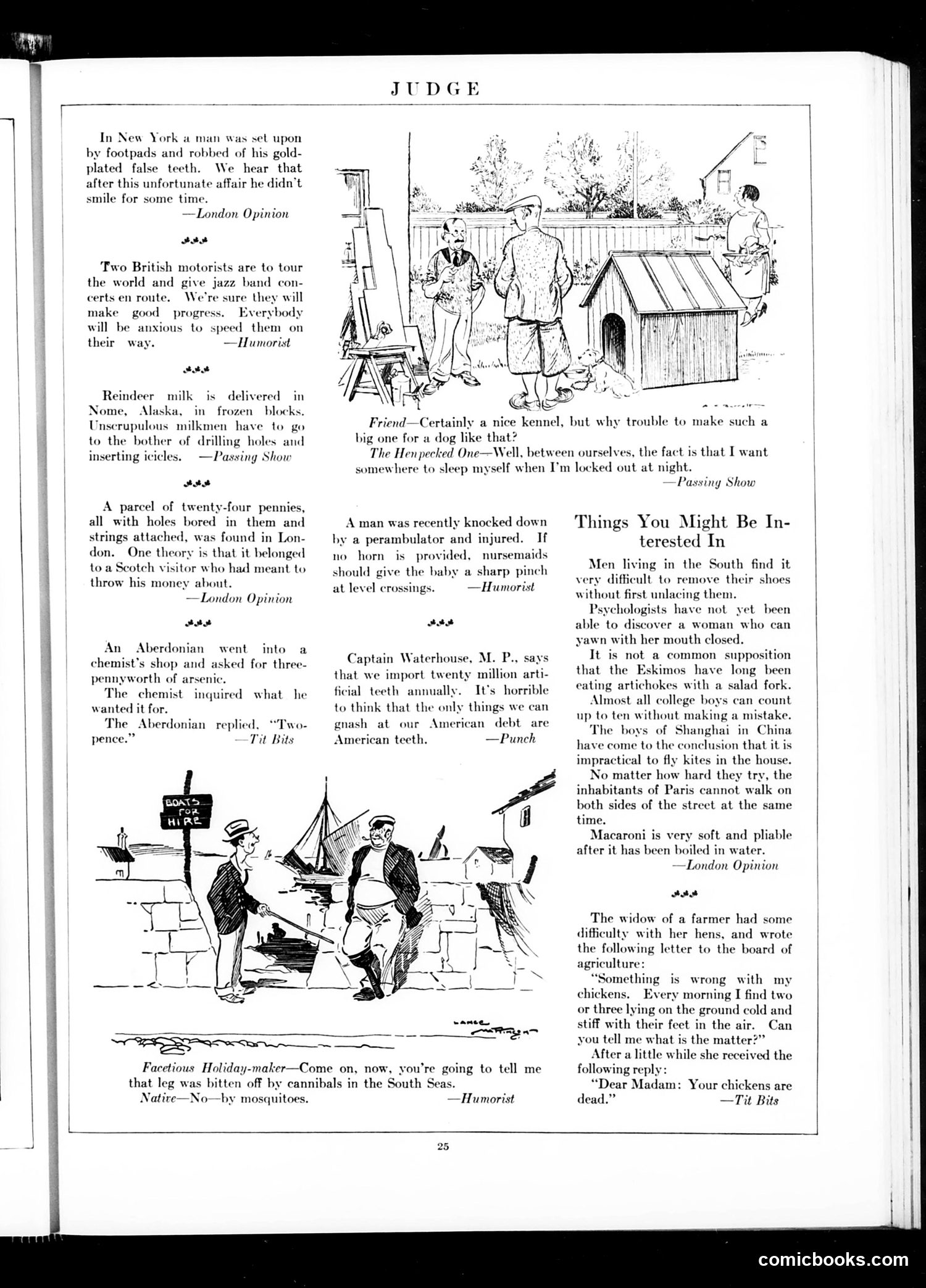
This page from *Judge* (a major American satirical magazine) collects brief humorous anecdotes and absurdist quips typical of early 20th-century humor. **Main cartoons:** - A seaside scene shows a man with a prosthetic leg claiming cannibals bit it off; a native corrects him—mosquitoes did. The joke mocks tourists' exaggeration of exotic dangers. - A domestic scene depicts a man explaining he needs a doghouse as his personal refuge when locked out by his wife—poking fun at henpecked husbands. **Recurring themes:** The short items mock national stereotypes (stingy Scots, bureaucratic absurdity), import issues (America's dental exports; reindeer milk delivery logistics), and everyday foolishness (removing shoes in the South; Paris street-walking paradoxes). One item references American debt repayment, suggesting post-WWI financial concerns. The humor relies on non-sequiturs, deadpan delivery, and gentle social observation rather than sharp political critique—typical of *Judge's* lighter editorial approach compared to fiercer contemporaries.
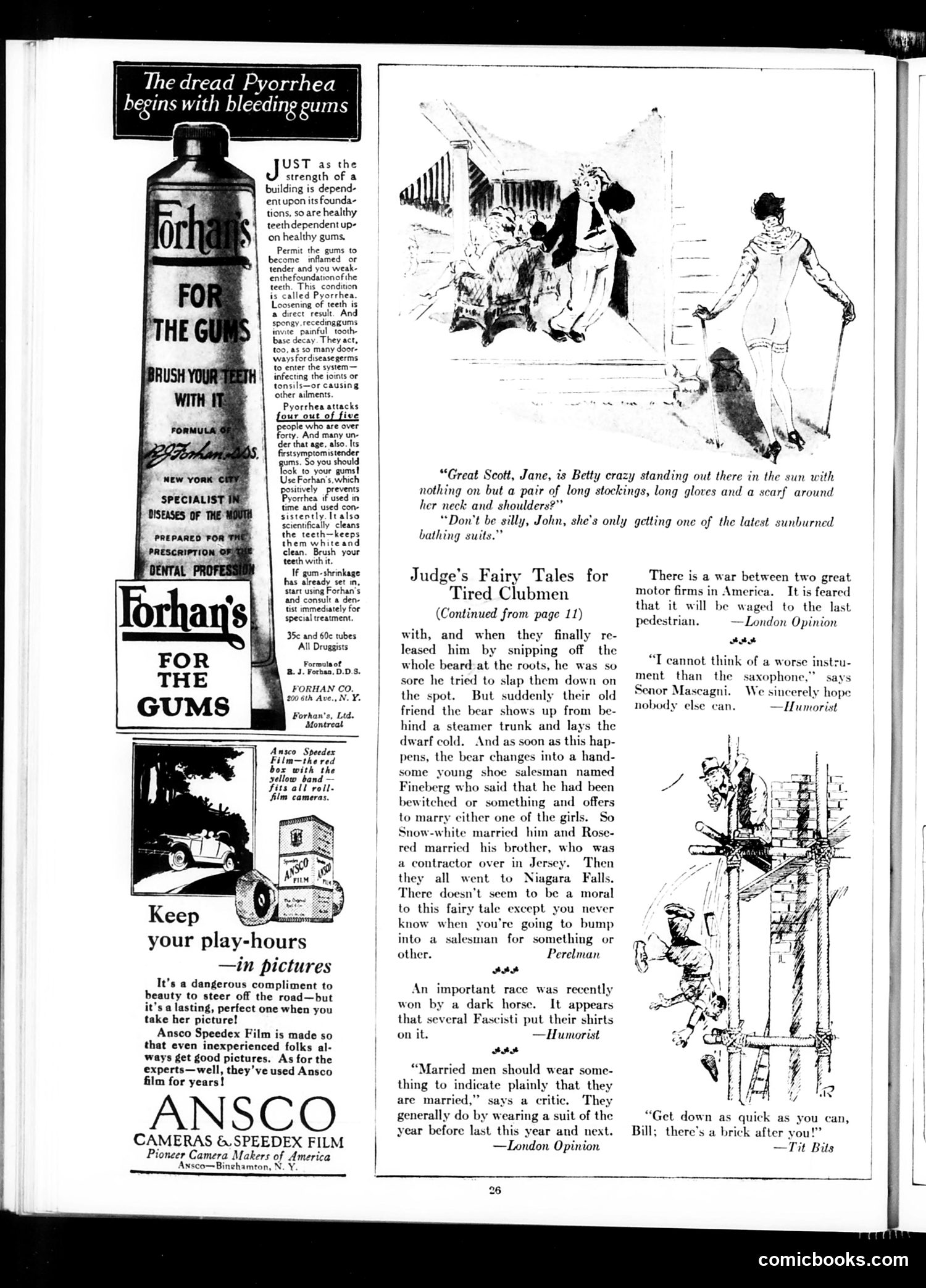
This page is primarily **advertising and humor content** rather than political satire. The main elements: **Advertisements:** - Forhan's toothpaste dominates the left side, warning about pyorrhea (gum disease) with medical authority - Ansco camera film advertises below, emphasizing ease of use **Humor Section - "Judge's Fairy Tales for Tired Clubmen":** A parody fairy tale (continuing from a previous page) modernizes Snow White with contemporary 1920s-30s references. The twist: a dwarf, bear, and shoe salesman character named Fineberg lead to marriages and a trip to Niagara Falls. The humor depends on subverting expectations of traditional fairy tales with mundane American commerce and Jewish surnames (suggesting working-class urban life). **Single-Panel Gags:** Brief jokes about Fascists betting on horses, saxophone criticism, and marital appearance—typical period humor drawing on current events (Fascism) and social commentary. The cartoon of Betty in sun-exposure clothing satirizes fashionable "sunburned" aesthetic as frivolously impractical.
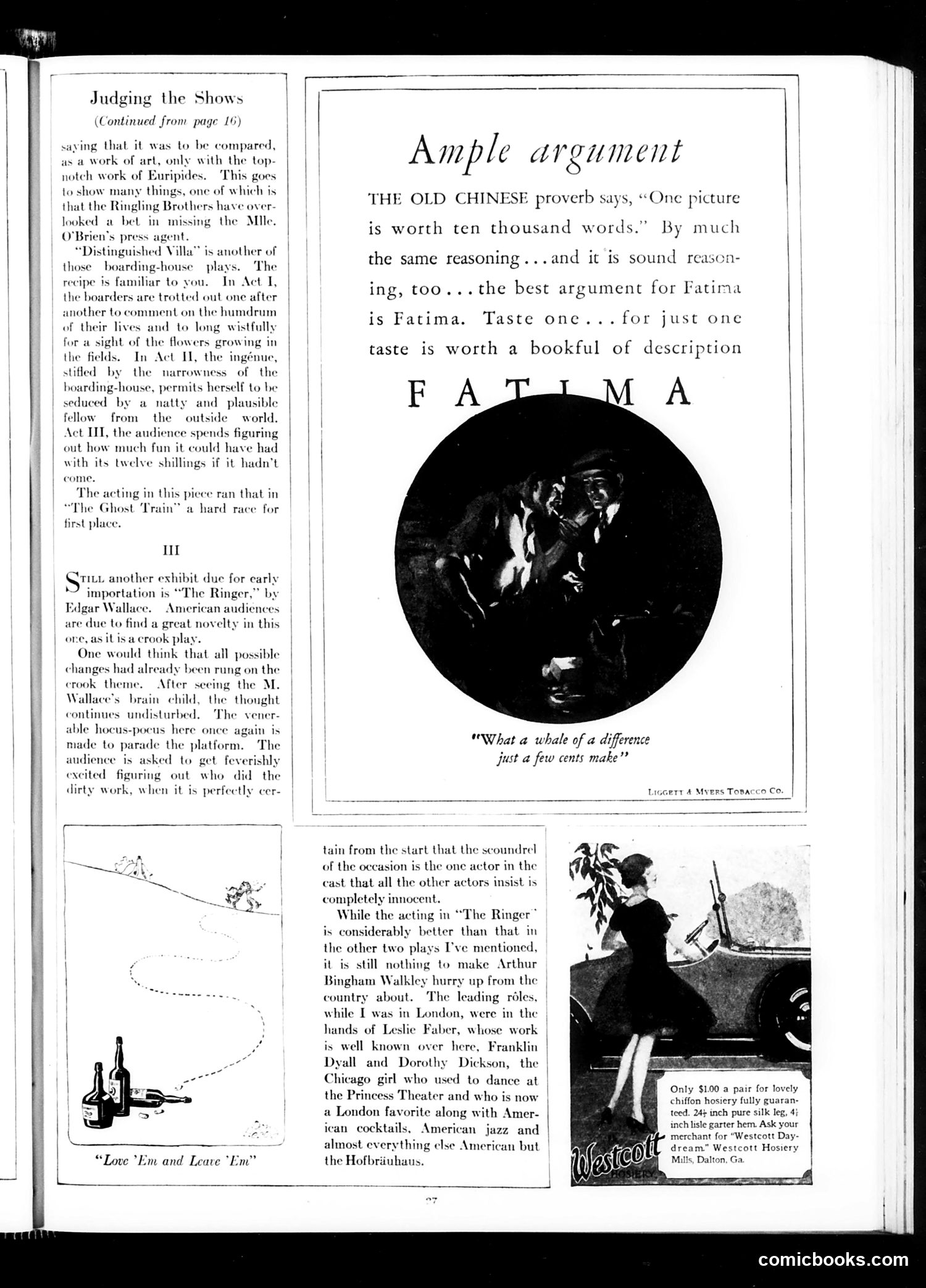
This page contains **theater reviews** rather than political cartoons. The left column critiques three Broadway productions: "Distinguished Villa" (a boarding-house drama), "The Ringer" (a crime play by Edgar Wallace), and references to "The Ghost Train." The critic dismisses them as formulaic—"Distinguished Villa" uses tired tropes about constrained boarding-house residents yearning for escape, while "The Ringer" retreads familiar detective-mystery conventions where audiences strain to guess the villain, though the answer is obvious from the start. The large **Fatima cigarette advertisement** on the right exploits the adage "one picture is worth ten thousand words," using a glamorous photograph to sell cigarettes more effectively than description could. Below is a **Westcott hosiery ad** featuring a woman in a car. The reviews reflect 1920s theatrical sophistication—the critic dismisses imported plays as derivative, suggesting American audiences shouldn't be impressed by mediocre London productions simply because they're foreign.
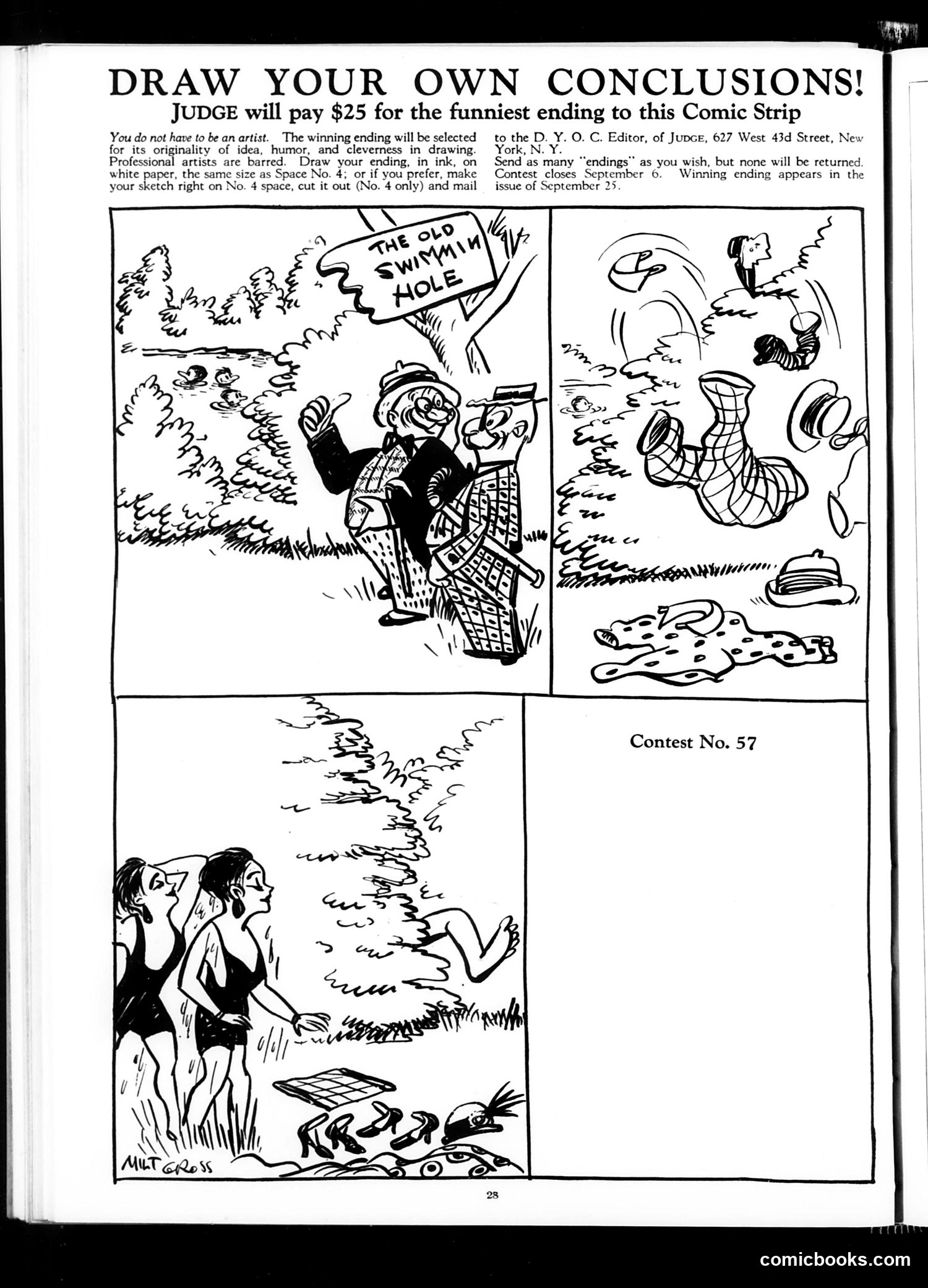
This page presents an interactive comic-strip contest rather than a completed satirical cartoon. Readers are invited to supply a humorous ending to an incomplete three-panel story. The setup shows: (1) an older man in formal dress discovering "the old swimming hole" and reminiscing; (2) the same man appearing to fall or stumble amid scattered clothing and objects; (3) two young people observing something in the water. The joke appears to hinge on slapstick or embarrassment—likely the man's undignified mishap while attempting to relive his youth. Judge offered $25 for the cleverest reader-submitted conclusion, with the winning entry to appear in the September 25 issue. This was a common engagement strategy for magazines of this era, combining humor with reader participation and modest monetary incentives.
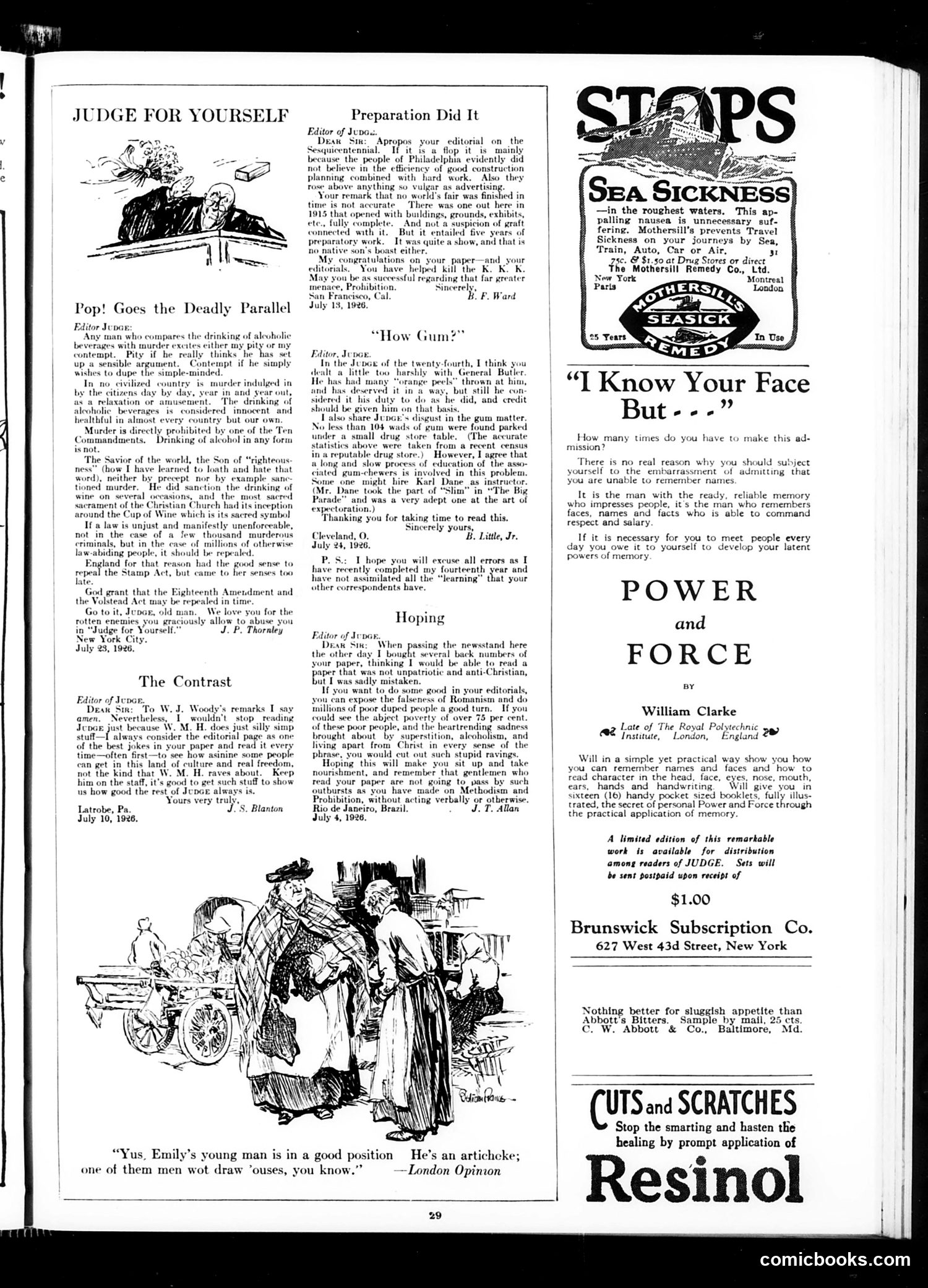
This is primarily a letters-to-the-editor page from *Judge* magazine (July 1926). The main cartoon depicts a street vendor or laborer surrounded by well-dressed figures, illustrating the caption about "men wot draw 'ouses" (men who draw houses—a working-class profession). The editorial letters debate serious social issues: one criticizes drinking and references Prohibition; another defends the magazine's editorial page against charges of being "silly" or "anti-Christian"; a third praises *Judge* for opposing the KKK. The "Deadly Parallel" title suggests the editor is contrasting viewpoints. A small illustration lower on the page shows street commerce, likely related to one correspondent's complaint about chewing gum sold from drug stores. The page reflects 1920s American concerns: Prohibition, religious morality, patriotism, and the KKK's contemporary prominence. Most content is reader correspondence rather than original satire.
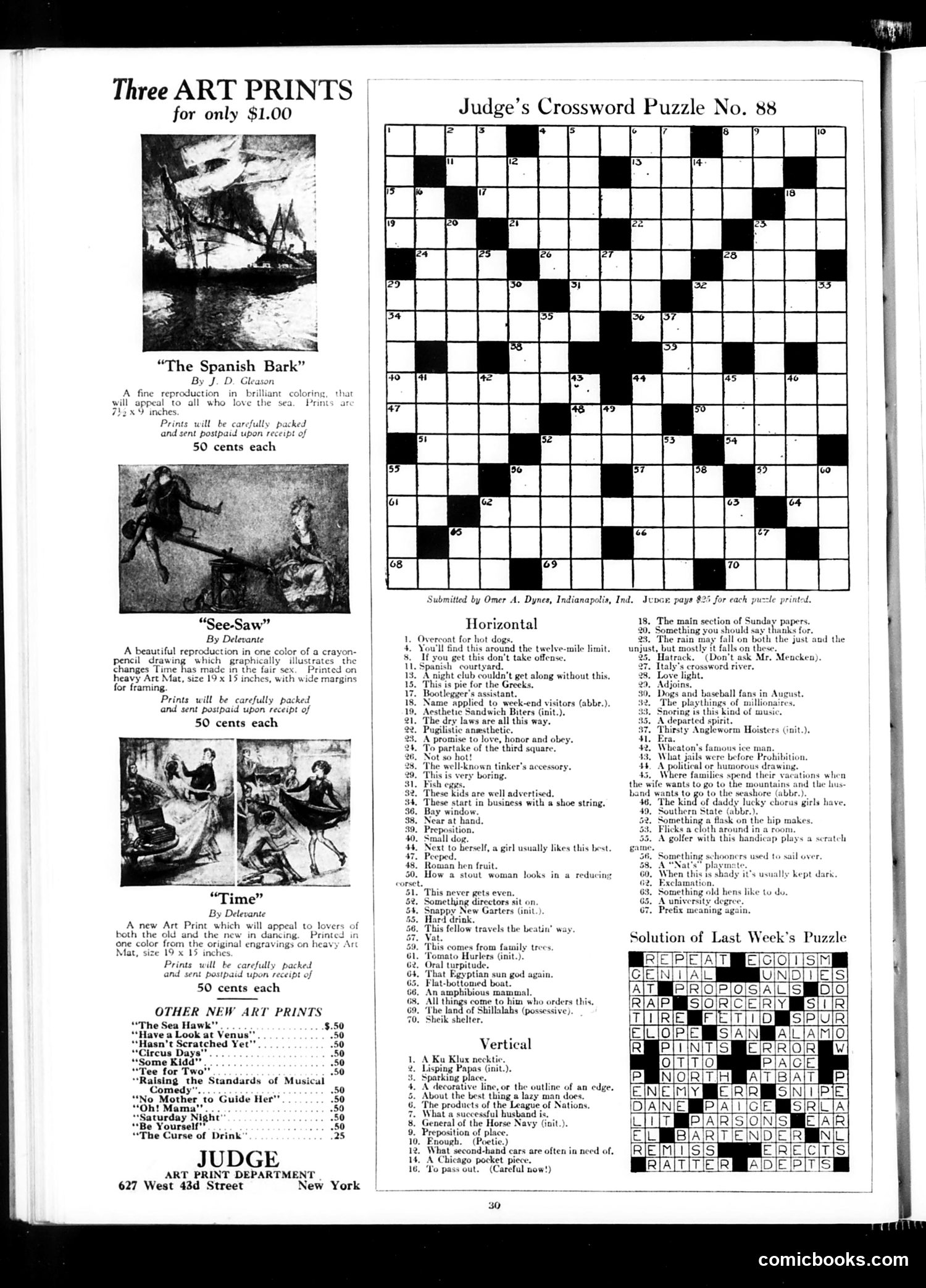
This page is primarily **advertising and puzzle content**, not political satire. The left side advertises three art prints for sale ($1.00 total): "The Spanish Bark," "See-Saw," and "Time"—romantic/aesthetic scenes by artists like Delevante. Below are listings for other available prints on themes like "The Sea Hawk" and "Mother to Guide Her." The right side features **Judge's Crossword Puzzle No. 88**, submitted by Omer A. Dynes of Indianapolis. The clues reflect 1920s-30s American life and slang: references to Prohibition ("dry laws"), the Ku Klux Klan ("A Ku Klux necktie"), hot dogs ("Overcoat for hot dogs"), and period culture ("Lisping Papas," "Tomato Hurlers"). Below the puzzle is the solution to the previous week's crossword. **This is essentially a service page**—offering merchandise and entertainment rather than editorial commentary or satire. The crossword's casual references to Prohibition and KKK suggest the magazine's readership and era, but without cartoon illustrations or pointed commentary.
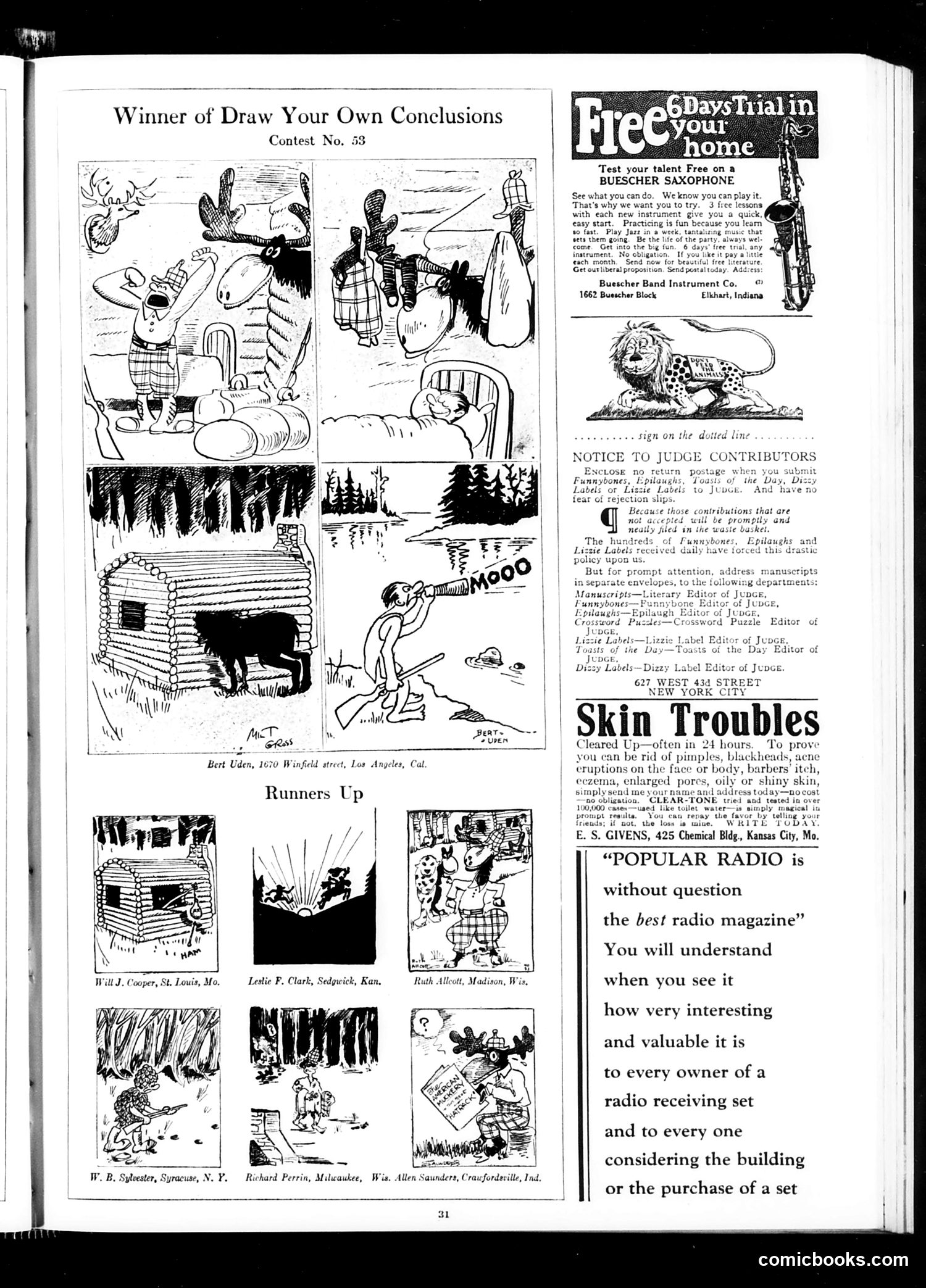
This page showcases the winner and runners-up of Judge magazine's drawing contest. The winning cartoon by Bert Uden depicts domestic/rural scenes: a person dealing with stubborn animals (a mule, a cow), domestic chaos, and a log cabin—typical rural comedic subjects. The humor relies on visual storytelling rather than political satire. The runners-up cartoons similarly feature slapstick scenarios: hunting mishaps, forest scenes, and physical comedy situations. The page is primarily **advertising-driven**, with substantial space devoted to product promotions: a Buescher saxophone offer, skin-trouble remedies, and Popular Radio magazine endorsements. This was typical for Judge—a satirical magazine that relied heavily on commercial advertising alongside editorial content. The cartoons themselves are lighthearted rather than politically pointed, appealing to general audiences through relatable domestic humor and physical comedy.
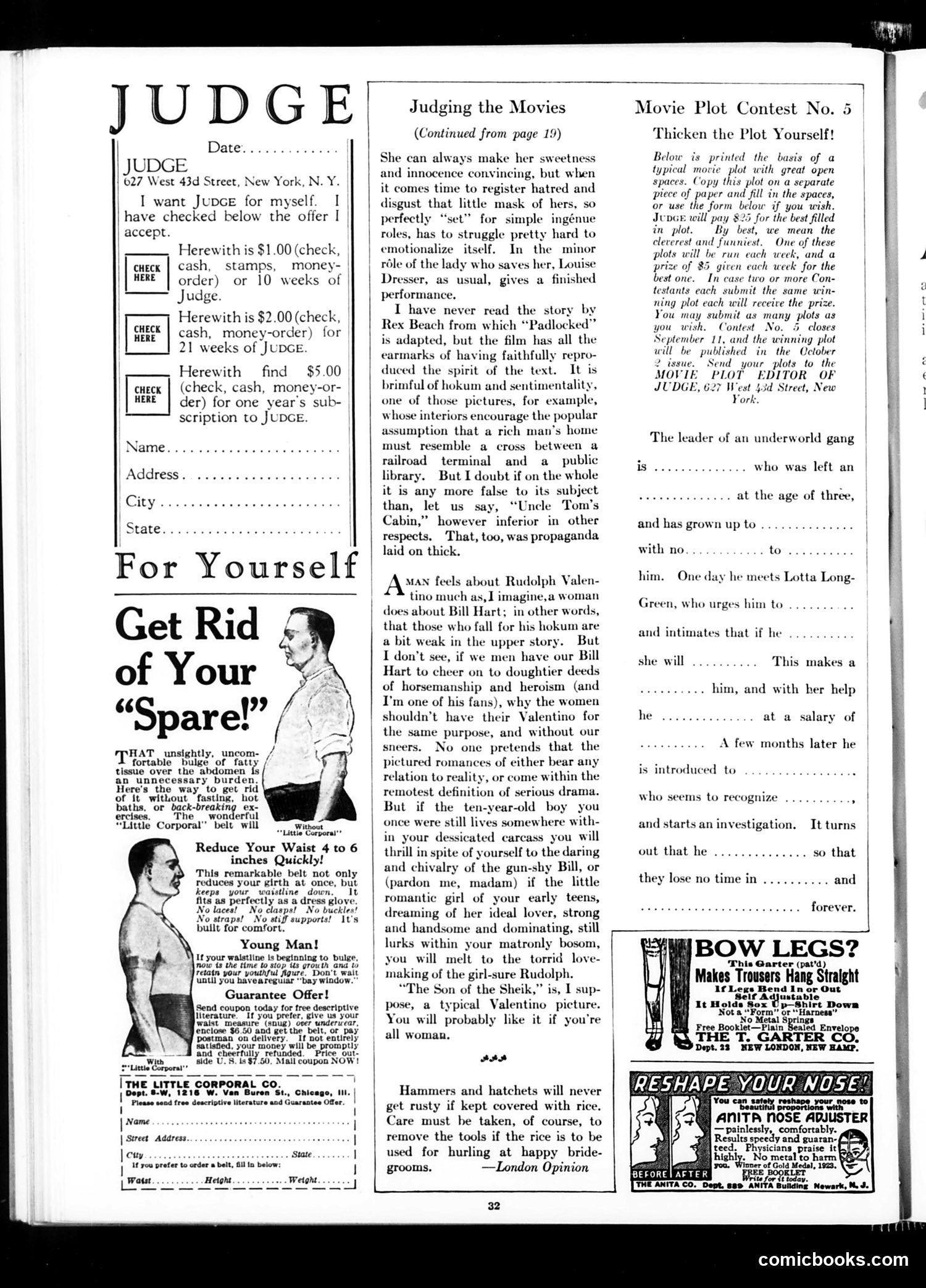
This is primarily an **advertising and subscription page** with some movie criticism content. The main visual elements are ads for body-shaping products: **"Little Corporal" Corset Belt**: Two illustrations show men with abdominal bulges being sold a miraculous belt to reduce waistlines "4 to 6 inches quickly." The satire targets both the product's absurd claims and the era's anxieties about male physiques—the ads promise results without exercise or diet, appealing to vanity and laziness. **Movie Review Content**: The "Judging the Movies" section critiques silent films, including discussion of actor Rudolph Valentino. The reviewer sardonically compares male and female movie fans—dismissing women who swoon for Valentino's "hokum" while admitting men equally enjoy Bill Hart's equally unrealistic westerns. This reflects 1920s gender attitudes about entertainment consumption. The page reflects Depression-era anxieties about appearance and early cinema's gender politics, packaged within Judge's satirical advertising model.
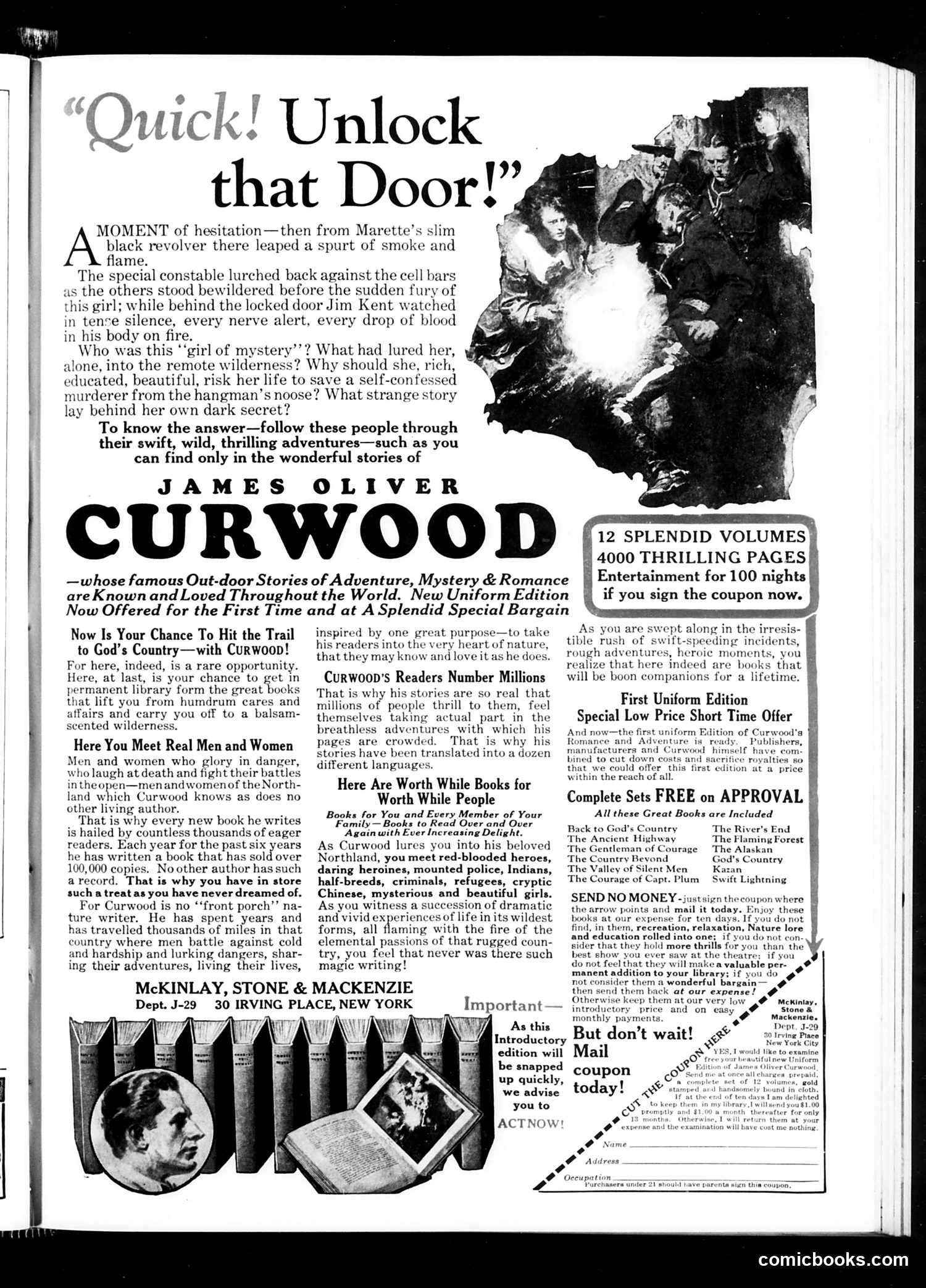
This is primarily **advertising, not political satire**. It's a full-page book advertisement for James Oliver Curwood's adventure novels, appearing in *Judge* magazine. The page promotes a special uniform edition of Curwood's "Out-door Stories of Adventure, Mystery & Romance"—12 volumes totaling 4,000 pages. The dramatic imagery at top (a woman with a revolver in a prison cell) illustrates the type of thrilling content: wilderness adventures featuring "red-blooded heroes," "daring heroines," mounted police, criminals, and "cryptic" (mysterious) beautiful women in Canada's Northland. The pitch targets middle-class readers seeking escapist entertainment from "humdrum cares." Curwood's books apparently sold over 100,000 copies annually and were translated into multiple languages—evidence of his mass popularity in this era. The urgent call to action ("ACT NOW!") and "mail coupon today" reflect early 20th-century direct-marketing tactics. This is commercial promotion, not satirical commentary.
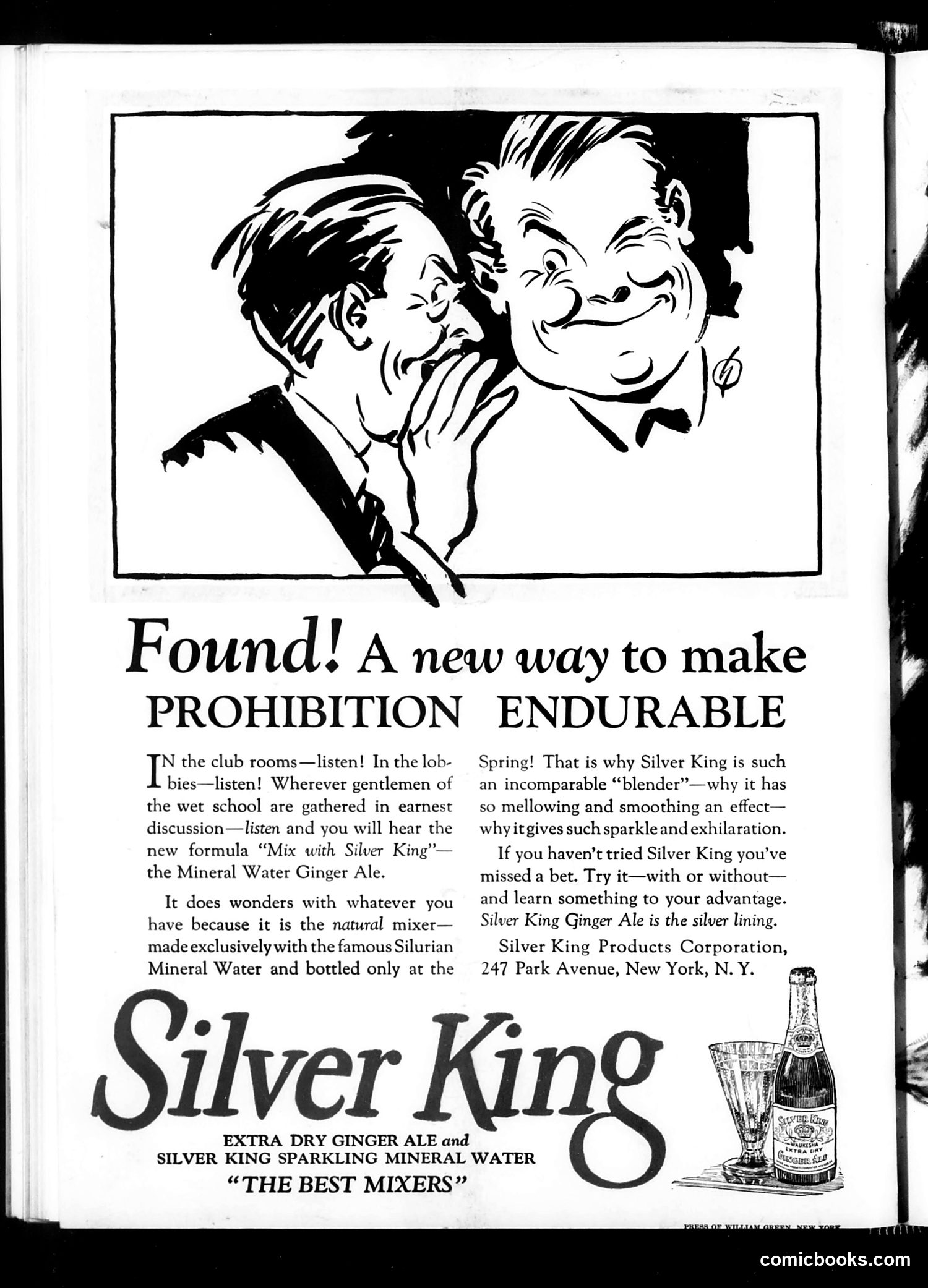
This is a **prohibition-era advertisement**, not political satire. The page mocks Prohibition (the nationwide ban on alcohol, 1920-1933) by suggesting that Silver King ginger ale and mineral water allow people to continue drinking socially during the dry era. The cartoon shows two well-dressed men in "club rooms" and "lobbies"—settings where gentlemen would traditionally gather to drink alcohol. The ad's joke: they've discovered how to make Prohibition "endurable" by mixing these non-alcoholic beverages, which will give drinking occasions "sparkle and exhilaration." The phrase "Mix with Silver King—with or without" contains a wink: suggesting the ginger ale works as a mixer with hidden alcohol ("without" implying it's unnecessary because people will spike it anyway). This advertisement exploits public frustration with Prohibition by positioning the product as a workaround to the law—a common marketing strategy during this period when alcohol remained popular despite illegality.