
A complete issue · 36 pages · 1926
Judge — June 19, 1926
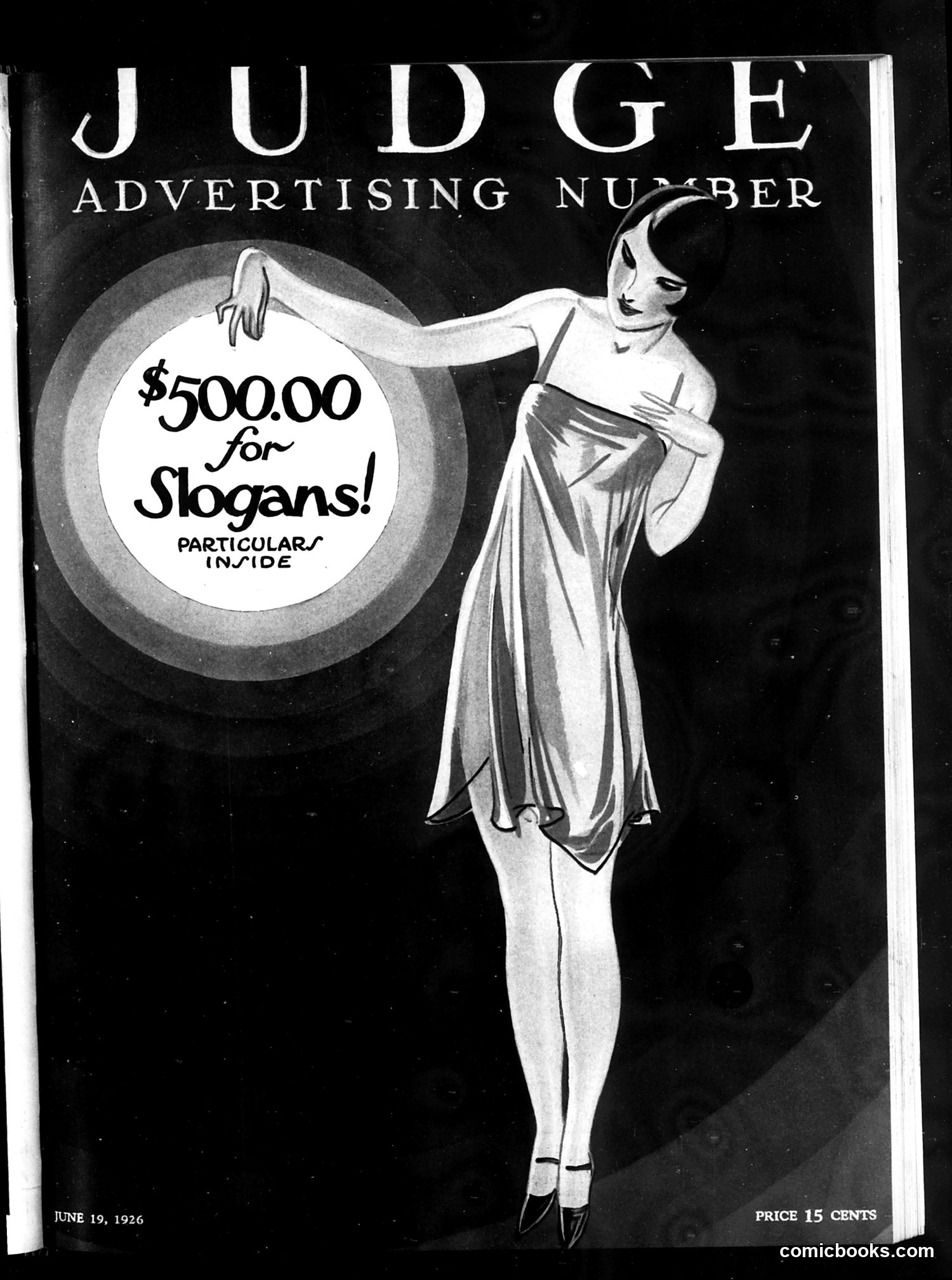
This is primarily an **advertising cover** for Judge magazine's "Advertising Number" issue, not political satire. The illustration depicts an elegant woman in 1920s fashion presenting a large circular object labeled "$500.00 for Slogans!" with "particulars inside." This advertises a **slogan-writing contest** offering $500 prize money—a substantial sum in 1926. The cover uses the glamorous "flapper" aesthetic typical of 1920s advertising to appeal to readers. The woman's pose and styling were designed to catch attention and encourage magazine purchase. Rather than satirizing politics or current events, this is a straightforward commercial promotion using attractive imagery and the promise of prize money to drive sales and reader engagement.
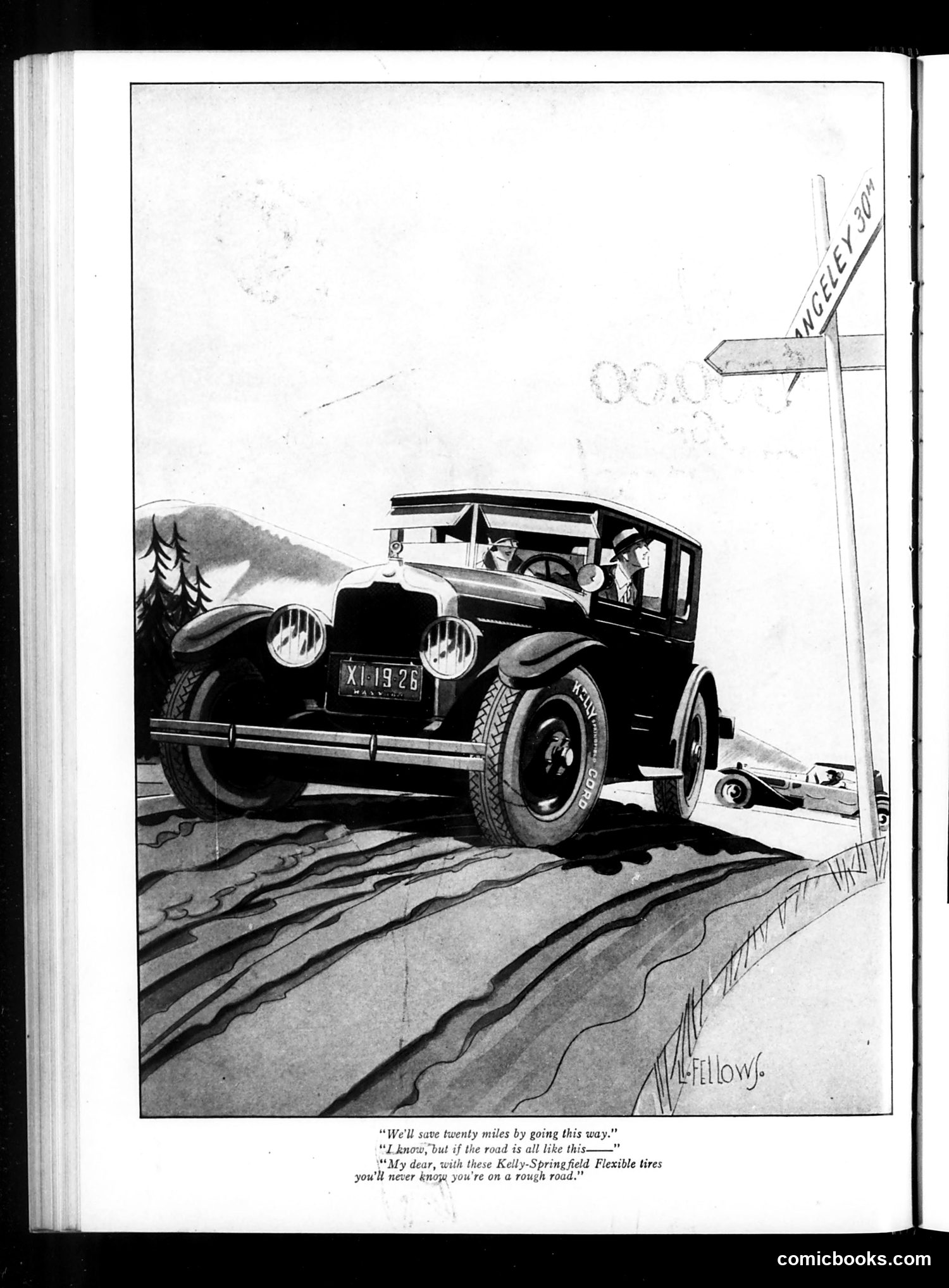
This is an advertisement for **Kellys-Springfield Flexible tires**, disguised as a cartoon joke. The image shows a 1920s automobile on a deeply rutted, rough road. Two men in the car discuss route options: one suggests a shortcut that would "save twenty miles," but the other counters that if the road is as bad as shown, "with these Kelly-Springfield Flexible tires you'll never know you're on a rough road." The satire is gentle product placement rather than political commentary. The humor relies on the exaggeration of the road's terrible condition (depicted with dramatic wavy lines) to showcase the tire's supposed shock-absorbing qualities. This reflects 1920s concerns about America's poor rural roads and the emerging automobile industry's competitive marketing through claims of superior suspension and comfort technology.
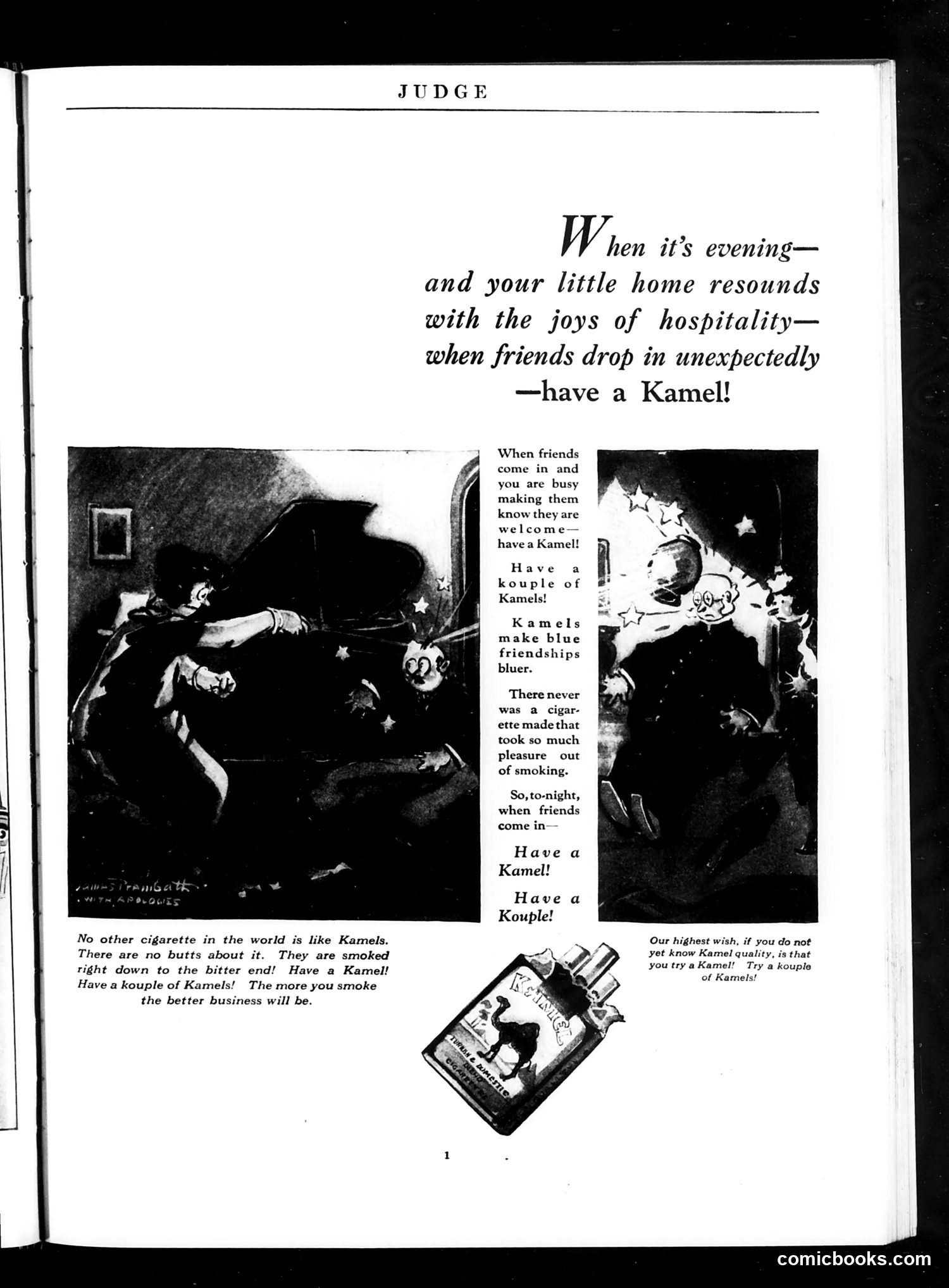
This is a **Camel cigarette advertisement**, not political satire. The page features two black-and-white photographs showing social scenes—people gathered in home settings during evening entertainment. The ad promotes Kamels (spelled as such) as the appropriate cigarette for hospitality and socializing with friends. The messaging emphasizes that offering Camel cigarettes to unexpected guests demonstrates they are "welcome," and that "Kamels make blue friendships bluer." The ad claims no other cigarette offers comparable smoking pleasure, encouraging readers to "have a Kamel" or "have a Kouple." This represents typical early-to-mid 20th century cigarette marketing normalizing smoking in social contexts. The page is commercial advertising rather than editorial content or satire.
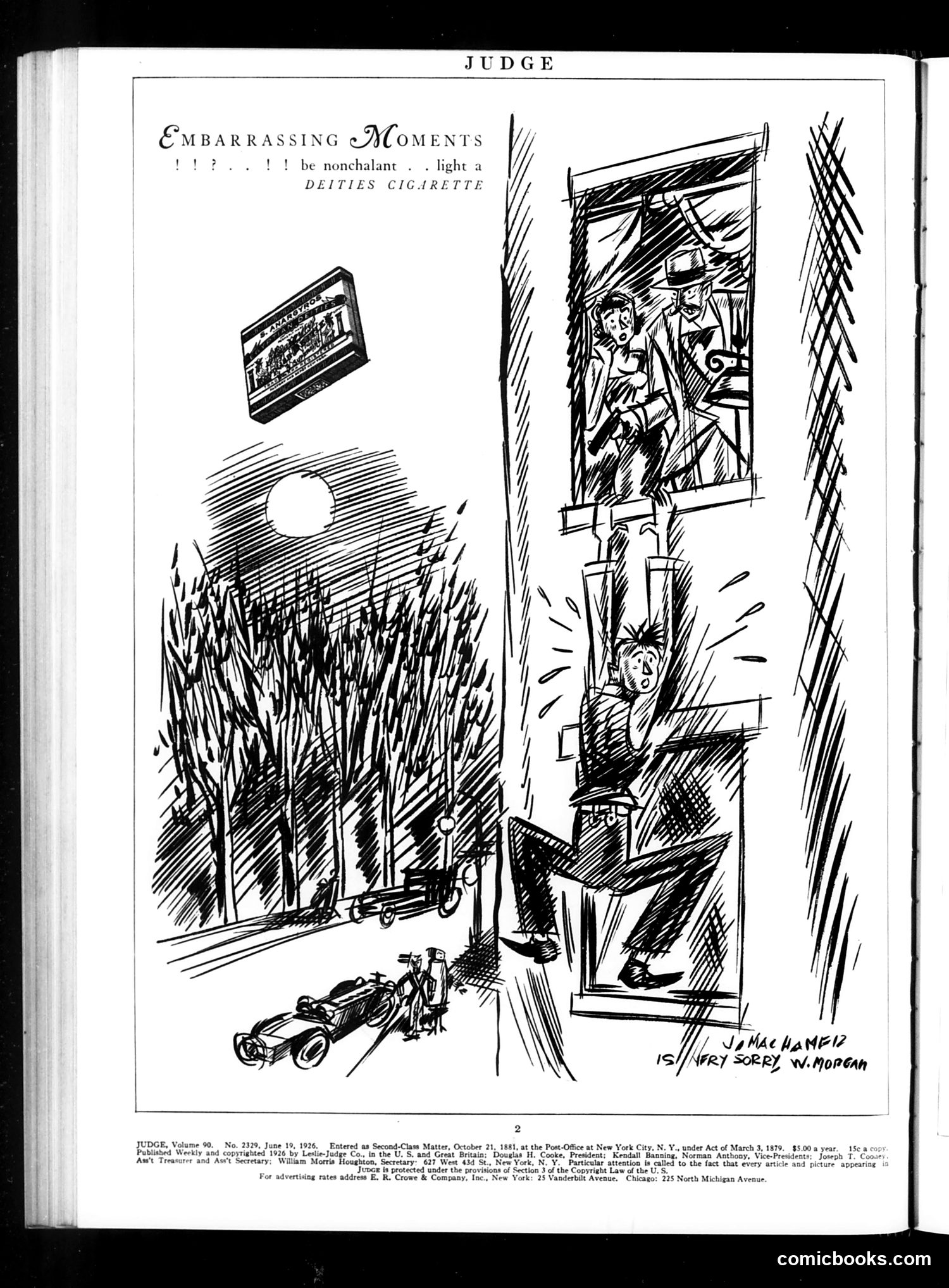
This is a humorous two-panel cartoon titled "Embarrassing Moments," with a subtitle referencing "be nonchalant... light a DEITIES CIGARETTE." The left panel shows a man attempting to light a cigarette while surrounded by fire—apparently he's accidentally set something ablaze. A package of "Deities Cigarettes" floats above. The right panel depicts the same or similar scenario: a man at a window above while passersby below react with alarm and distress to the chaos. The satire appears to mock both cigarette advertising and the notion of maintaining composure ("be nonchalant") in ridiculous situations. The joke suggests that smoking Deities cigarettes leads to embarrassing disasters, undercutting typical cigarette ads that promoted sophistication and coolness. It's satirizing both consumer culture and masculine posturing of the 1920s era.
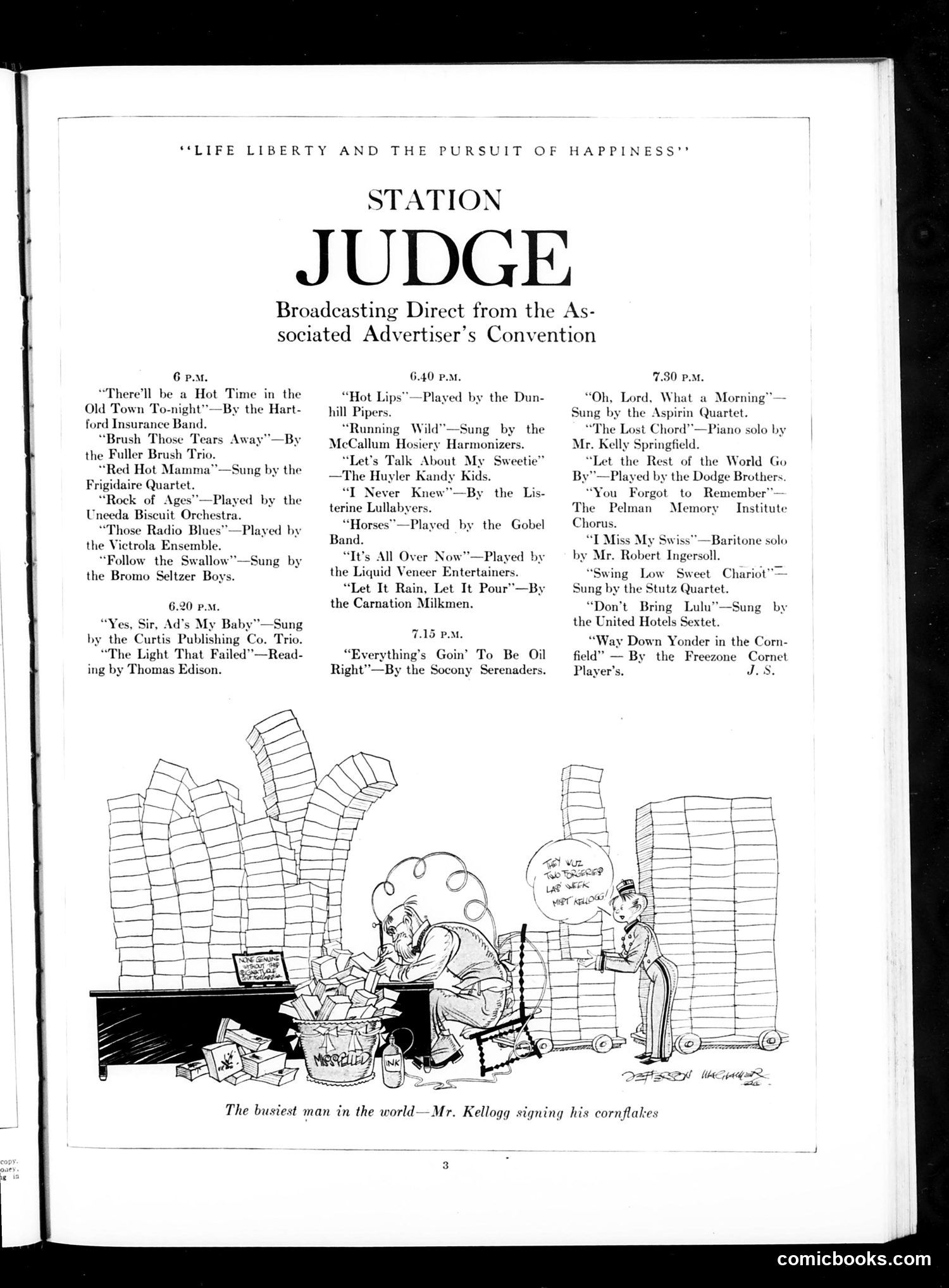
This page advertises a radio broadcast from the Associated Advertiser's Convention, with the cartoon depicting "the busiest man in the world—Mr. Kellogg signing his cornflakes." The satire targets **W.K. Kellogg**, founder of the Kellogg cereal company, mocking his ubiquitous corporate presence. The cartoon shows him drowning in paperwork and product boxes while signing cornflake boxes—suggesting he's so consumed by his business empire that signing his name on products represents his entire existence. The joke reflects early 20th-century anxiety about corporate consolidation and celebrity business figures whose names became inseparable from their products. The "busiest man" title is ironic; despite his wealth and success, Kellogg appears trapped rather than triumphant, buried under the machinery of his own enterprise.
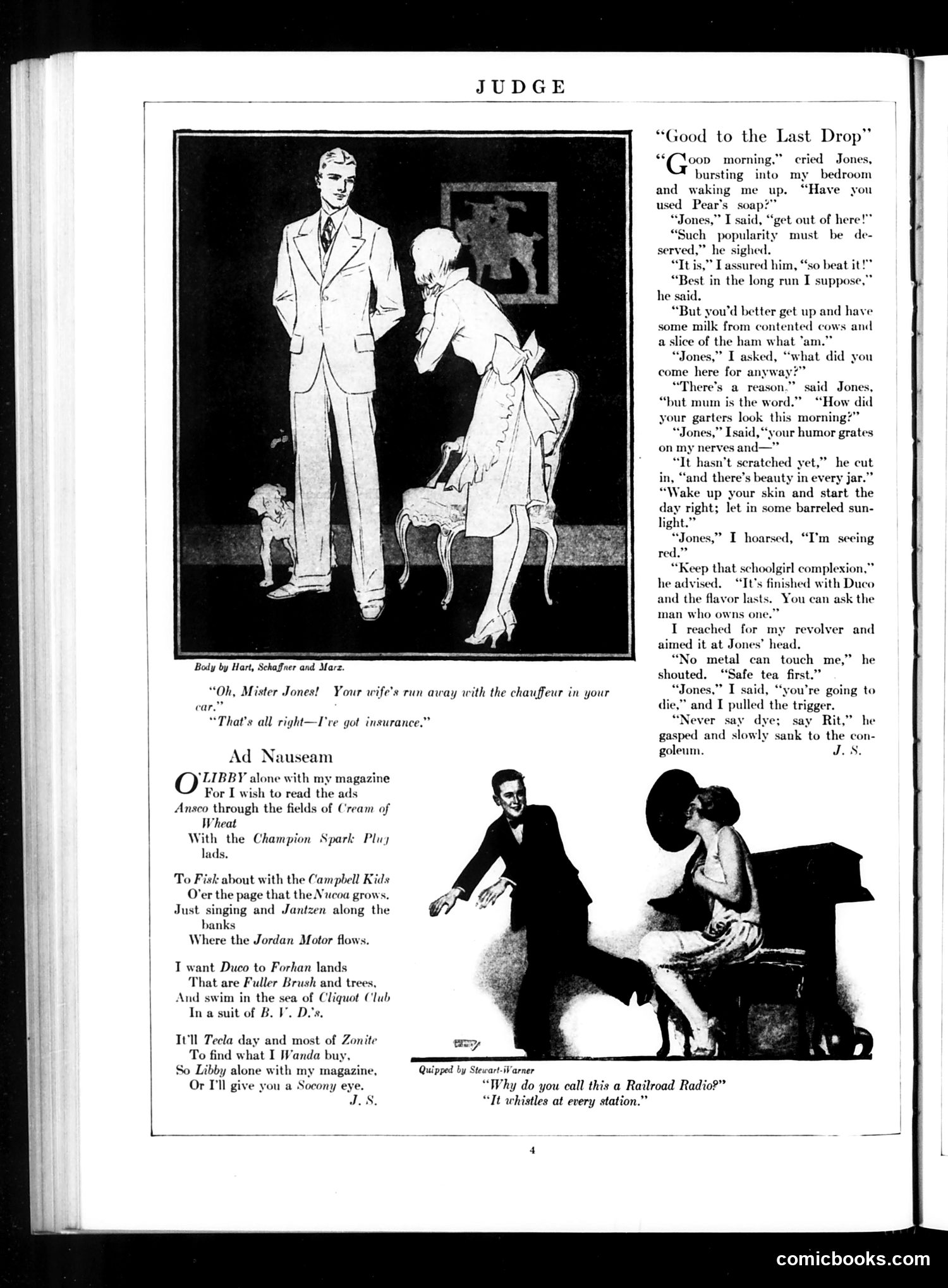
This page contains two separate pieces: **Top cartoon ("Good to the Last Drop"):** A domestic comedy sketch where a man named Jones wakes to find his wife has run away with the chauffeur, taking the car. The humor relies on early 20th-century class anxieties—the servant seducing the employer's wife was a common satirical trope. Jones's sardonic responses (about soap, milk, ham) suggest resignation to his fate. The final punchline involves Jones shooting himself, presented as dark comedy typical of the era. **Lower section:** "Ad Nauseam" is a poem satirizing magazine advertising culture, listing actual product brands (Cream of Wheat, Champion Spark Plugs, etc.). The accompanying cartoon shows a couple where the man explains a "Railroad Radio" whistles at every station—mocking how advertisements infiltrate entertainment. Both pieces target consumer culture and marital discord as satirical subjects.
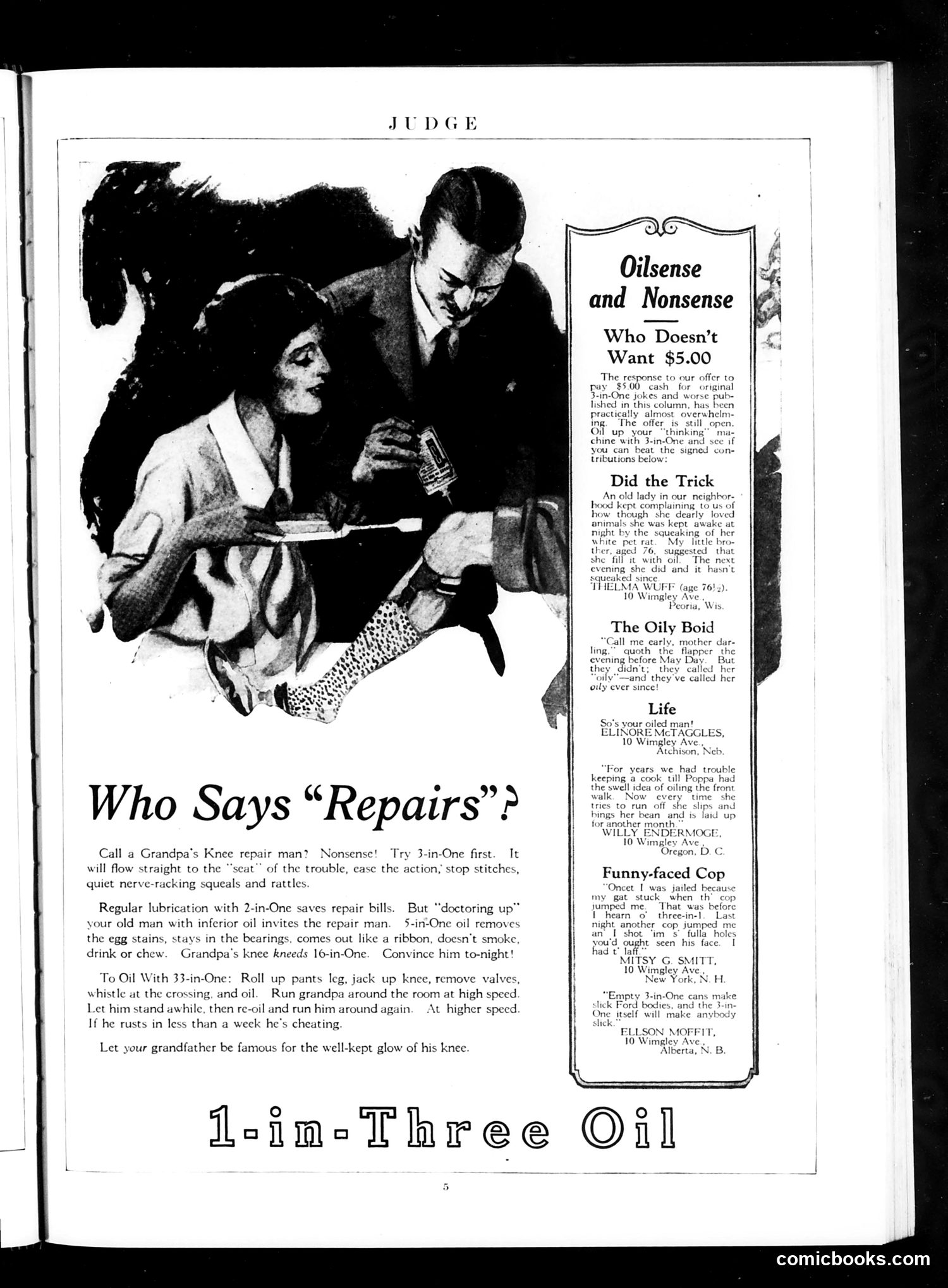
This page is primarily **advertising, not political satire**. The main content is a 1-in-One Oil advertisement ("Who Says 'Repairs'?") that humorously suggests the product can solve common household problems—specifically keeping an elderly man's knee joints lubricated and functional rather than requiring actual repairs. The right column, titled "Oilsense and Nonsense," contains humorous reader submissions (testimonials/jokes) about the product, including anecdotes about fixing squeaky hinges and other household items. The illustration shows a couple examining or applying the oil product. The satire is purely commercial—poking fun at how people justify using multipurpose oil as a catch-all solution for household maintenance, rather than addressing any political or social issue.
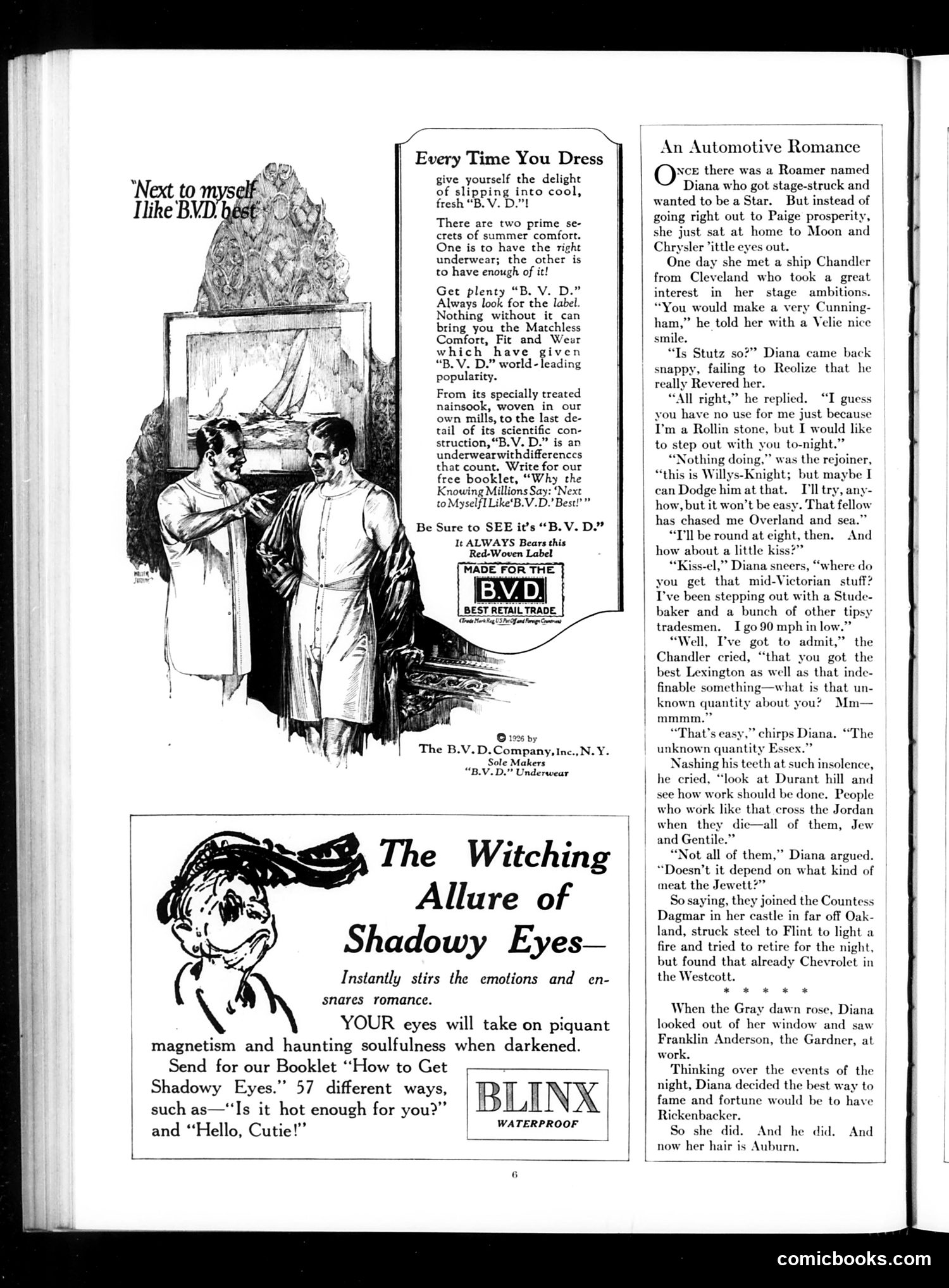
This page contains three distinct elements: **Top Advertisement (B.V.D. Underwear):** A straightforward commercial for men's underwear, featuring an illustration of two men in undergarments. The ad emphasizes comfort and quality construction. **Middle Advertisement (Blinx Waterproof):** A cosmetics ad promoting eye makeup, using romantic language about "shadowy eyes" and romance. The humor appears intentional—the booklet offers "57 different ways" to achieve the look, including joke phrases like "Is it hot enough for you?" and "Hello, Cutie!" **"An Automotive Romance" Story:** A humorous narrative using car brand names as puns throughout (Roamer, Moon, Chrysler, Stutz, Rollin stone, Studebaker, Lexington, Essex, Durant, Chevrolet, Westcott, Franklin, Rickenbacker, Auburn). The plot—a stage-struck woman named Diana meeting a Cleveland businessman—serves primarily as a framework for these automotive wordplay jokes, a popular form of 1920s-era humor. The page is primarily **advertising-driven** with entertainment value secondary.
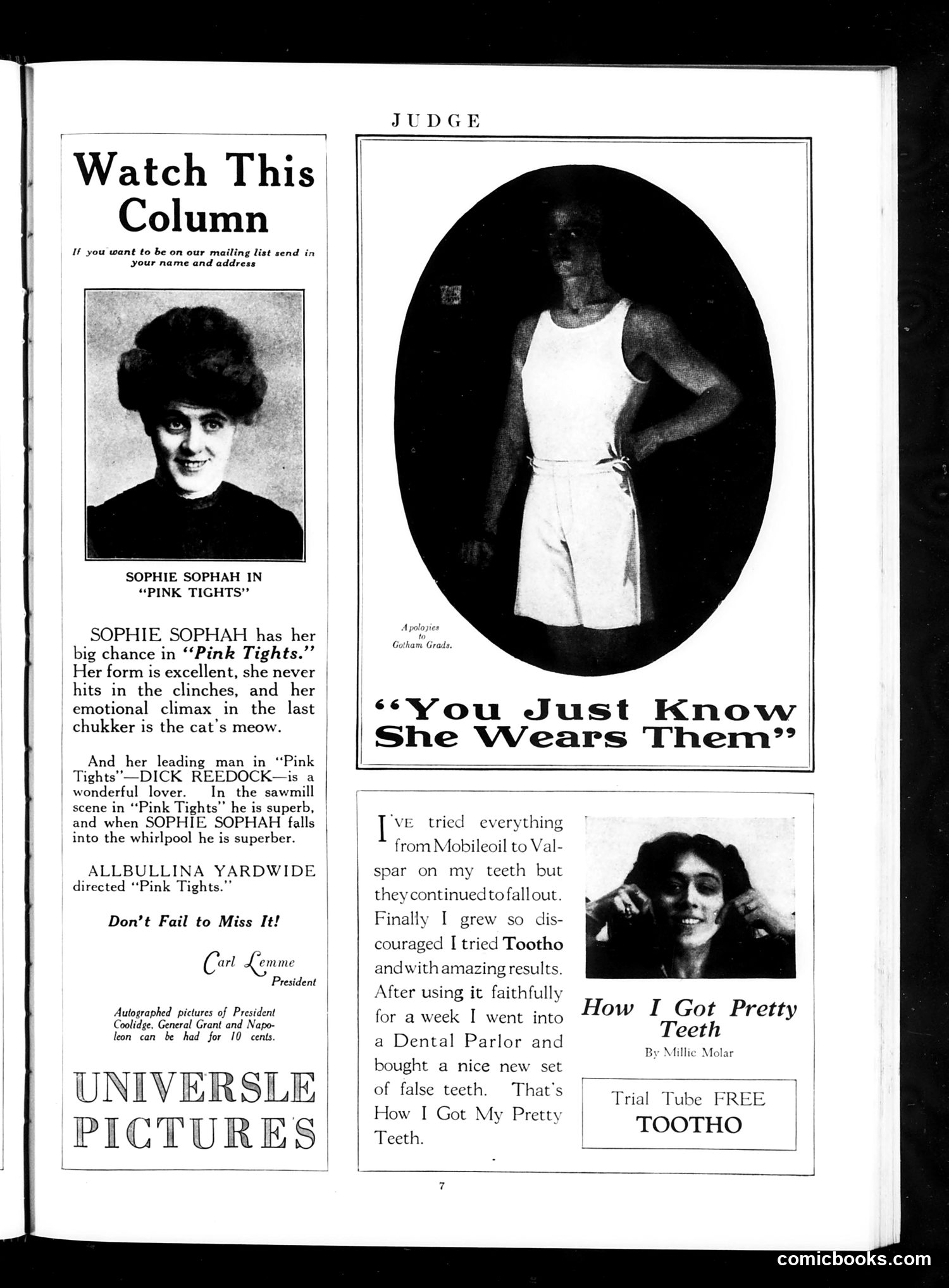
This page mixes entertainment coverage with period advertising. The left column reviews a film called "Pink Tights" starring Sophie Sophah and Dick Reedock, directed by Allbullina Yardwide—these appear to be fabricated or satirical names typical of Judge's humor. The review uses 1920s slang ("the cat's meow," "superb/superber") to mock overwrought film criticism. The main cartoon advertises "Tootho" toothpaste with the caption "You Just Know She Wears Them"—a suggestive double entendre implying the product enhances attractiveness to men. The testimonial "How I Got Pretty Teeth" humorously admits the product doesn't work; the narrator tried everything before simply buying dentures. This satirizes deceptive advertising claims common in the era, where products promised miraculous results they couldn't deliver. The joke mocks both the product and consumers' gullibility.
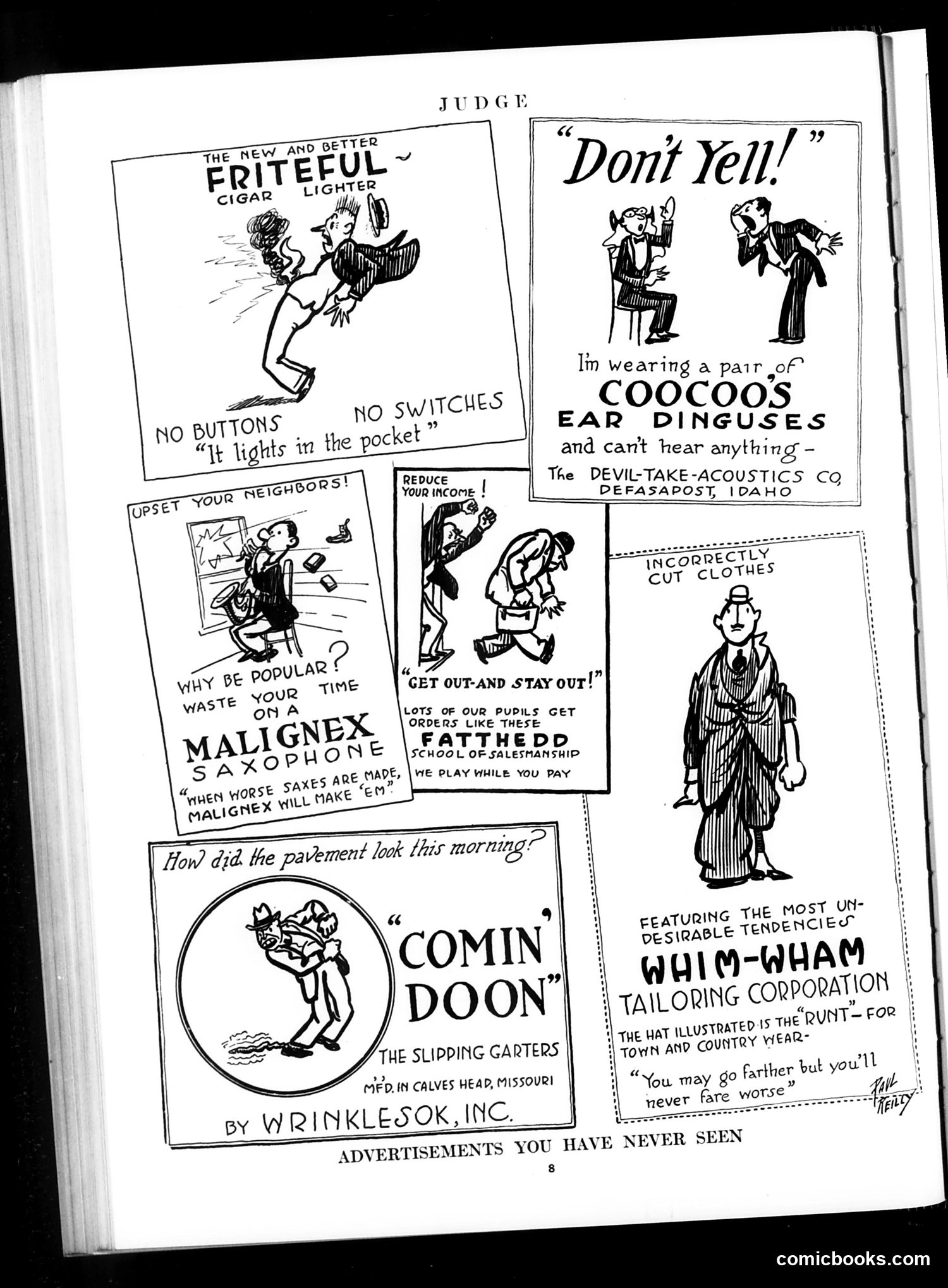
This Judge page presents mock advertisements satirizing contemporary products and services through absurdist humor. The "Friteful Cigar Lighter" jokes about a product with design flaws (no buttons, no switches). "Don't Yell!" advertises ear plugs that make the wearer deaf—mocking noise pollution complaints. "Malignex Saxophone" suggests the instrument makes horrible sounds. "Comin' Doon" slipping garters mock footwear failures. The "Fatthedd School of Salesmanship" and "Whim-Wham Tailoring Corporation" advertise dubious educational and clothing services. "Incorrectly Cut Clothes" simply advertises poorly-made garments. These are parodies of real advertising, mocking both the exaggerated claims of actual ads and consumer culture's gullibility. The satire suggests people will buy anything if marketed cleverly enough—a timeless critique of consumerism and advertising excess.
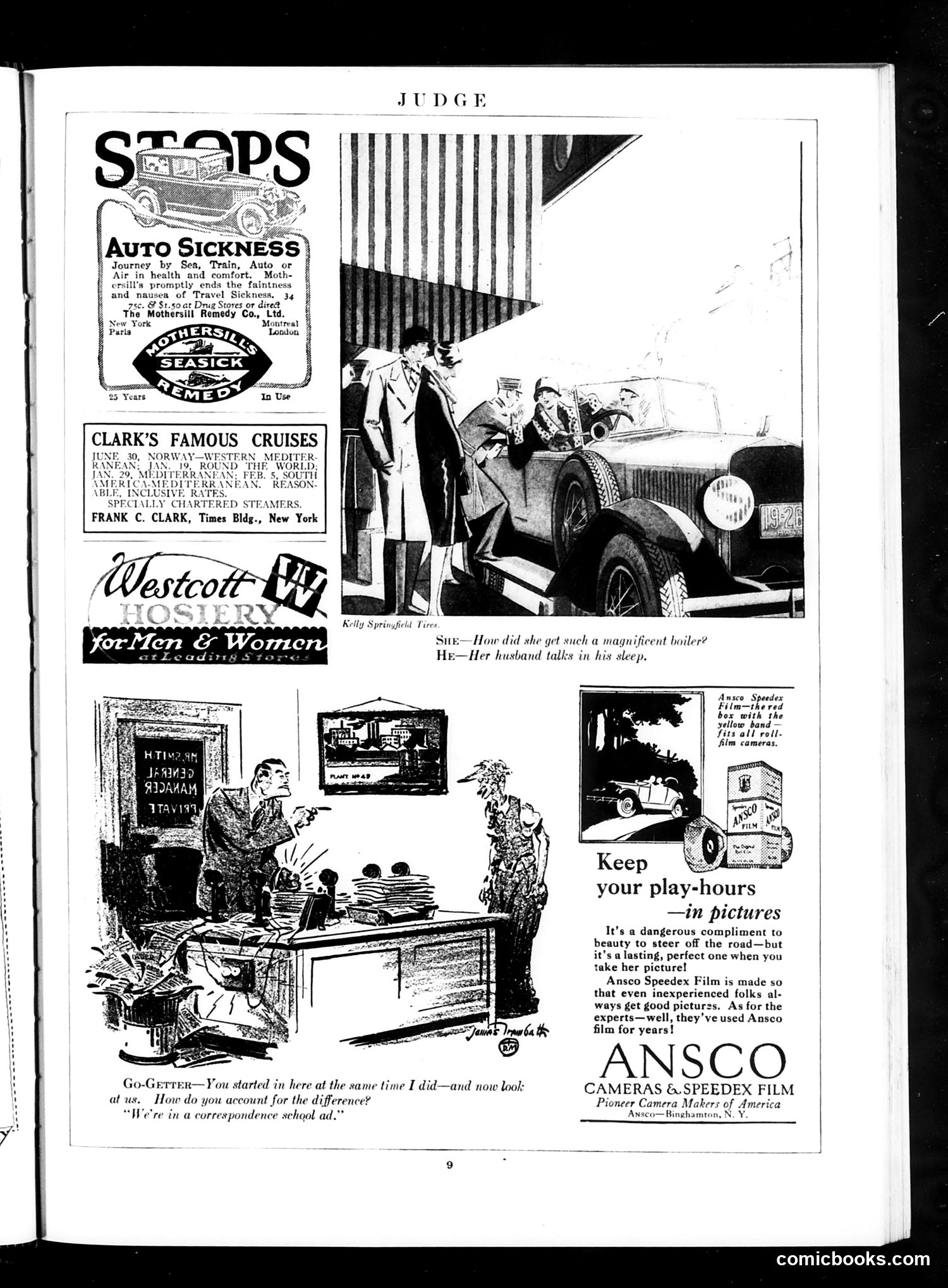
This page is primarily **advertising**, with two small cartoon jokes. The main visual joke (top) plays on marital dynamics: a woman asks how her friend got "such a magnificent boiler" (slang for an attractive body/figure). The answer—"Her husband talks in his sleep"—suggests the husband compliments her appearance unconsciously, implying she's vain or needs validation. The humor relies on the era's stereotypes about women's vanity and marital relationships. The bottom cartoon is a workplace joke: two men who started at the same time have diverged in success. The punchline reveals one works in "a correspondence school ad"—implying he's stagnated in a dead-end job while the other has progressed. It satirizes mail-order education's limited career prospects. The rest of the page consists of period advertisements for travel remedies, tire brands, and camera film—typical magazine filler of the era.
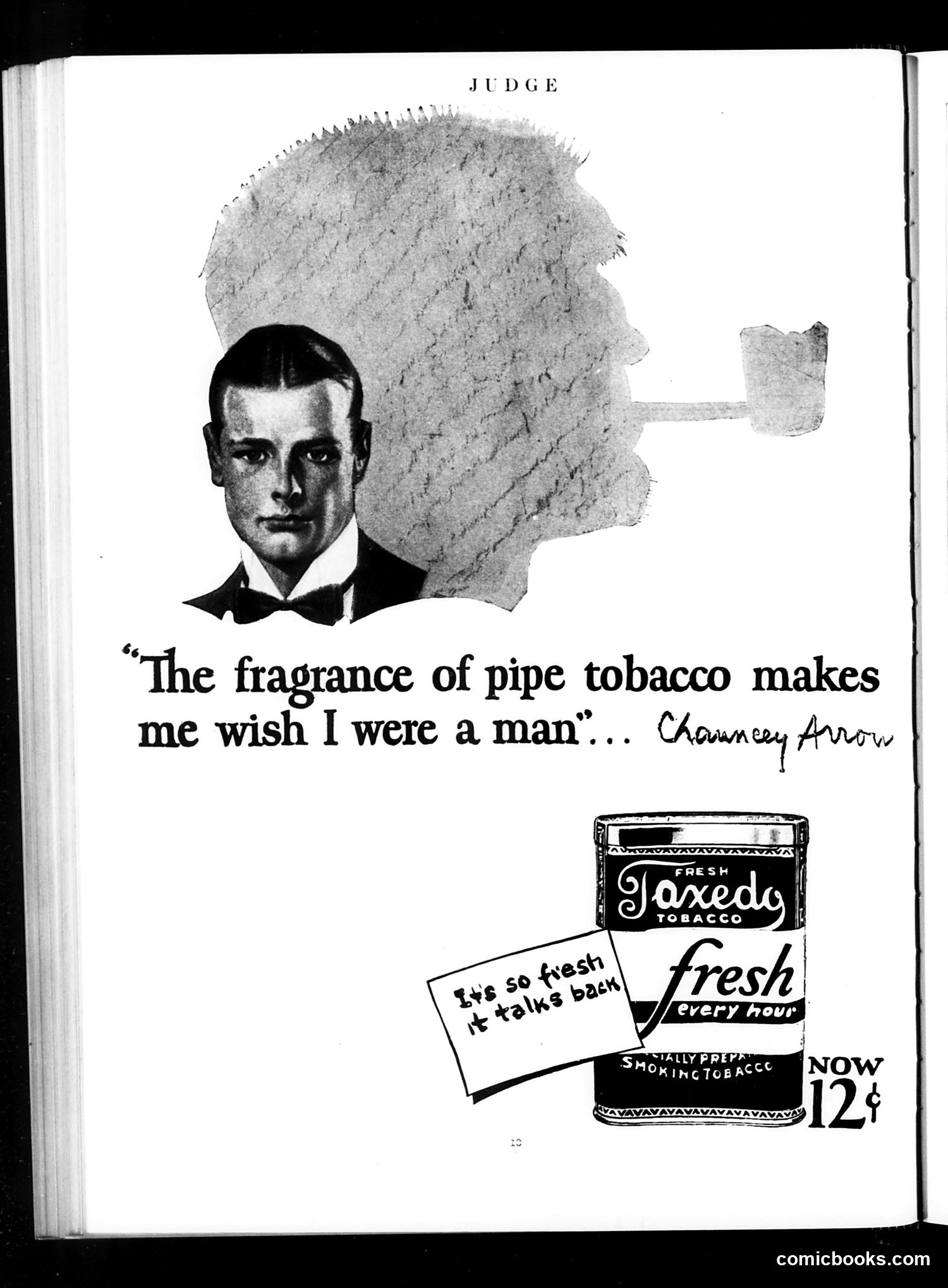
This is a **tobacco advertisement**, not a political cartoon. The page features an endorsement by "Chauncey Arrow" (likely a fictional or stage name) promoting Jaxedo pipe tobacco. The ad's humor—now jarring to modern readers—plays on early 20th-century gender norms: a woman's statement that pipe tobacco's appeal makes her wish she were male. This was meant as flattery to male smokers, suggesting the product's masculine sophistication was so desirable that even women envied men for access to it. The price point of 12¢ and claim of freshness ("it talks back") were standard advertising tactics of the era. The "Judge" magazine context suggests this ran in a humor/satire publication, though the ad itself is straightforward marketing rather than satirical commentary.
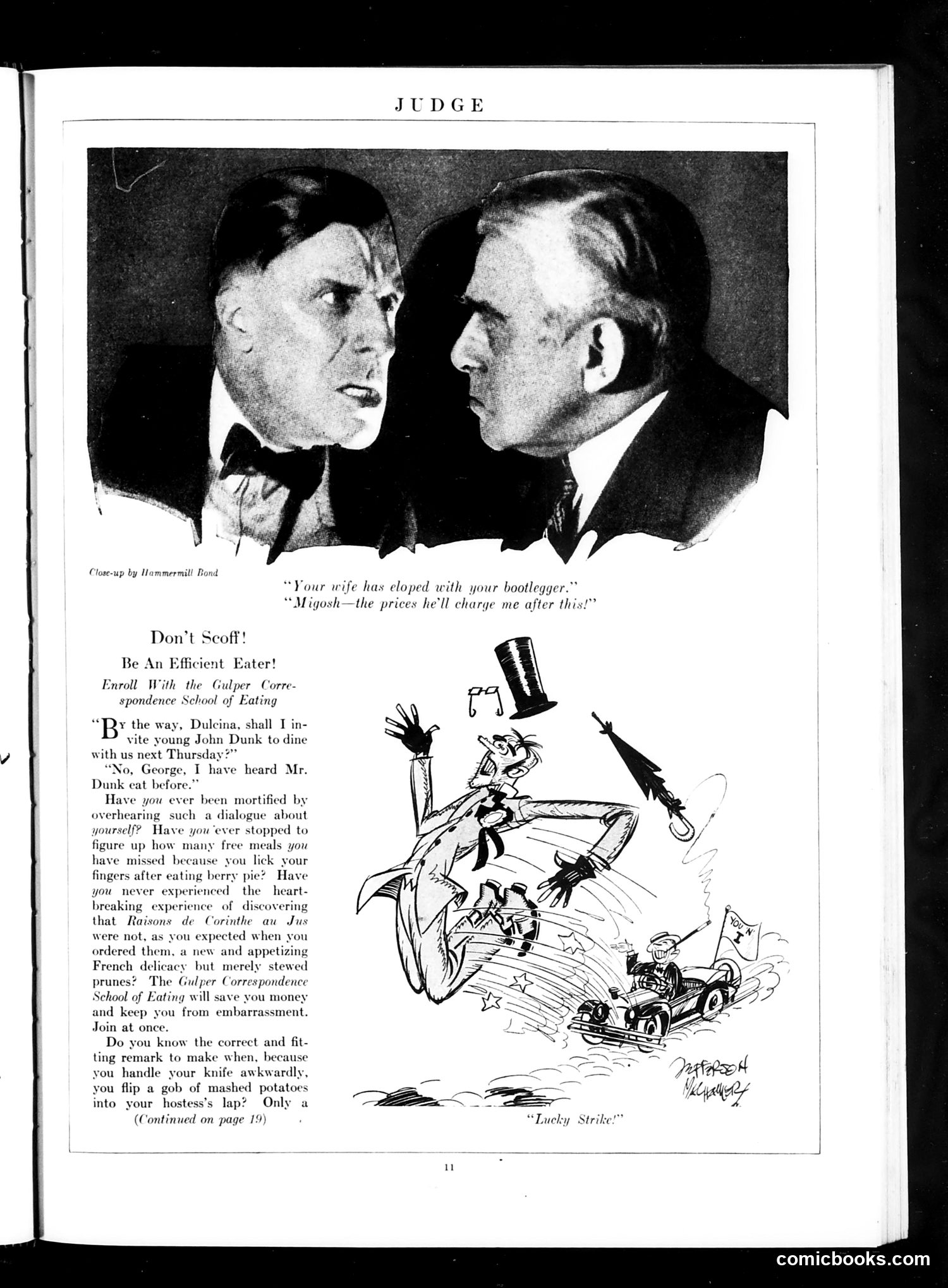
This Judge magazine page contains two satirical pieces about dining etiquette and social embarrassment during Prohibition (when alcohol was illegal). The top cartoon jokes about **bootlegging**—the illegal sale of alcohol during Prohibition. A man learns his wife has eloped with their bootlegger, but his main concern is the inflated prices he'll now face for black-market liquor. The satire mocks both marital infidelity and Americans' obsession with obtaining illegal alcohol despite its dangers. The lower section advertises a fake "Gulper Correspondence School of Eating," satirizing both correspondence schools (popular mail-order education) and social anxiety about proper dining manners. It humorously catalogs dining failures—licking fingers, awkward knife handling, spilling food on hosts—implying that many people lack basic table etiquette. The cartoon of a chaotic diner reinforces this theme of dining disaster. Together, these pieces mock American social pretensions and the era's anxieties about appearing refined.
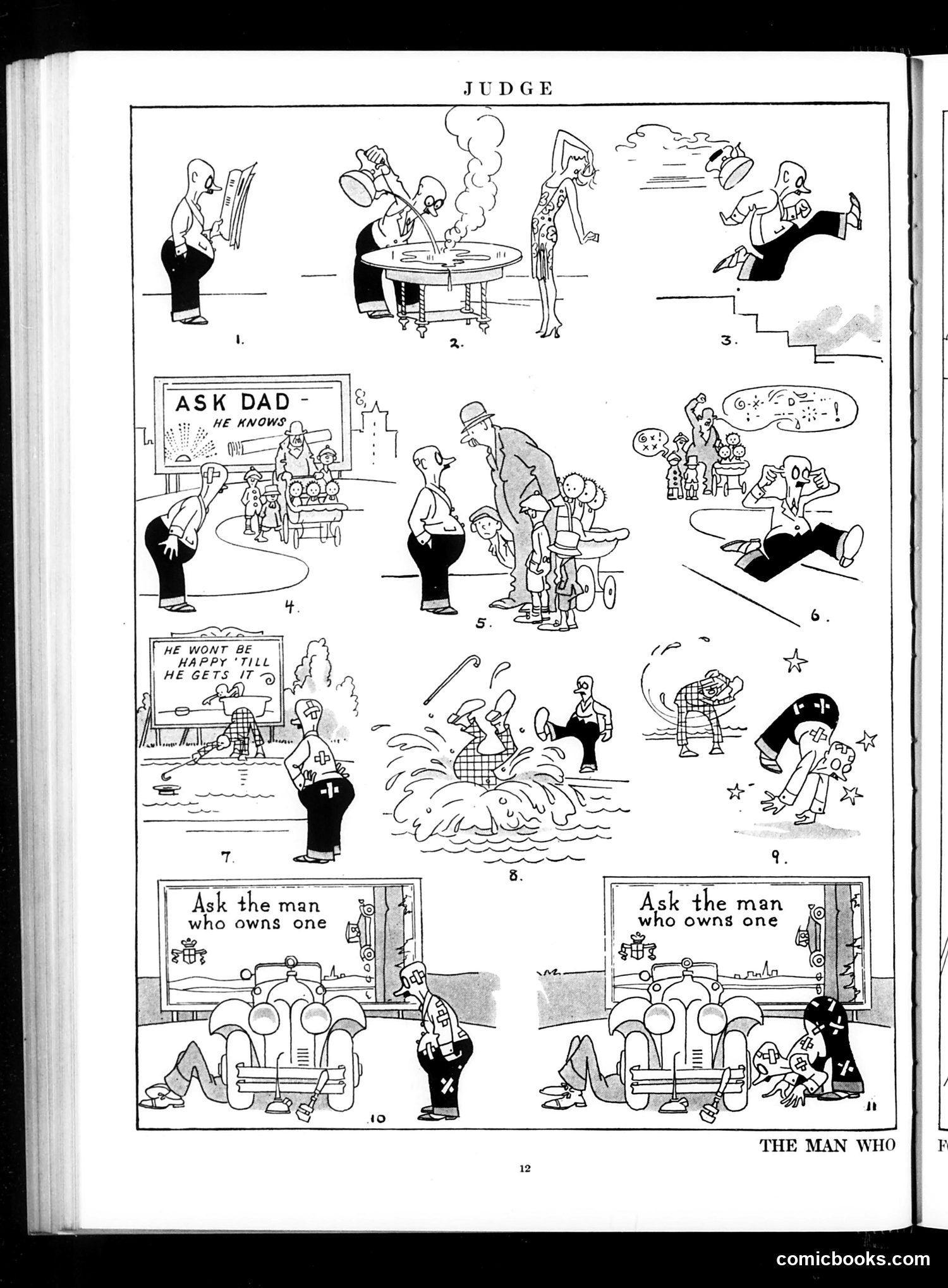
This is a multi-panel satirical comic titled "Judge" showing a father figure being pestered by children with increasingly absurd demands and questions. The recurring caption "Ask Dad—He Knows" mockingly portrays fathers as expected to have unlimited knowledge and resources. The repeated phrase "Ask the man who owns one" (panels 10-11) appears to reference advertising slogans of the era, satirizing consumer culture and the pressure on fathers to purchase expensive items to satisfy their families. The comic progresses through scenarios—children asking about school, finances, practical skills, and possessions—illustrating how fathers are stereotypically burdened with providing answers and material goods. The final panels show the father exhausted beneath a car, humorously suggesting he's been literally and figuratively crushed by these expectations. The satire targets both parental pressure and consumerism in American society.
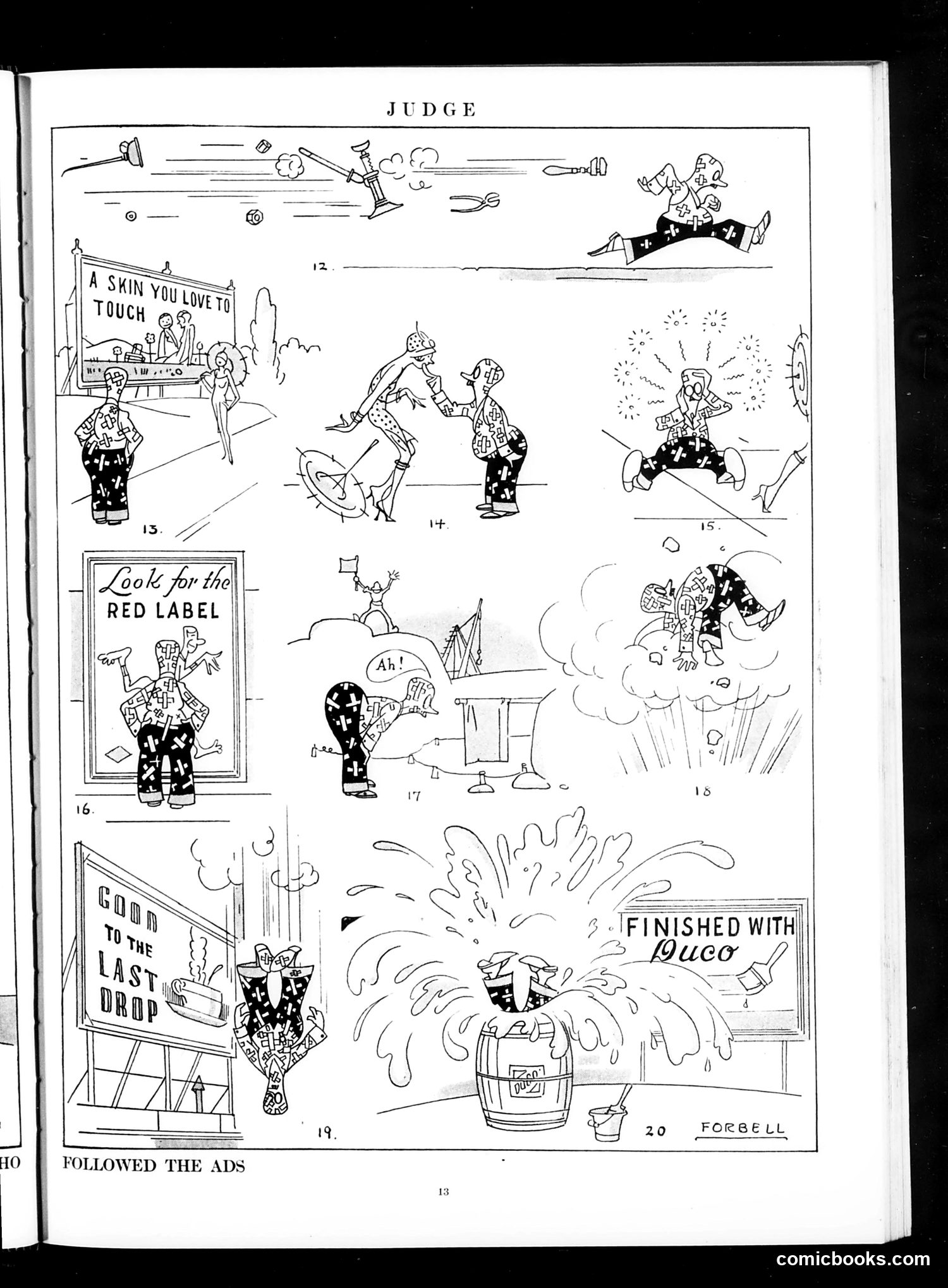
This page titled "JUDGE" presents a series of numbered comic panels (12-20) satirizing advertising and consumer culture. The recurring character—a man in patterned pants with crosses—appears to be following various advertisements literally. The visible ads reference "A Skin You Love to Touch," "Look for the Red Label," "Good to the Last Drop," and "Finished with Duco." The joke is that the character takes these slogans at face value, leading to absurd situations: he attempts to touch advertised skin, searches obsessively for red labels, and experiences explosive results from following beauty/product claims. This appears to be satirizing how consumers blindly follow advertising promises without questioning their validity—a common theme in early 20th-century satirical magazines critiquing mass marketing manipulation.
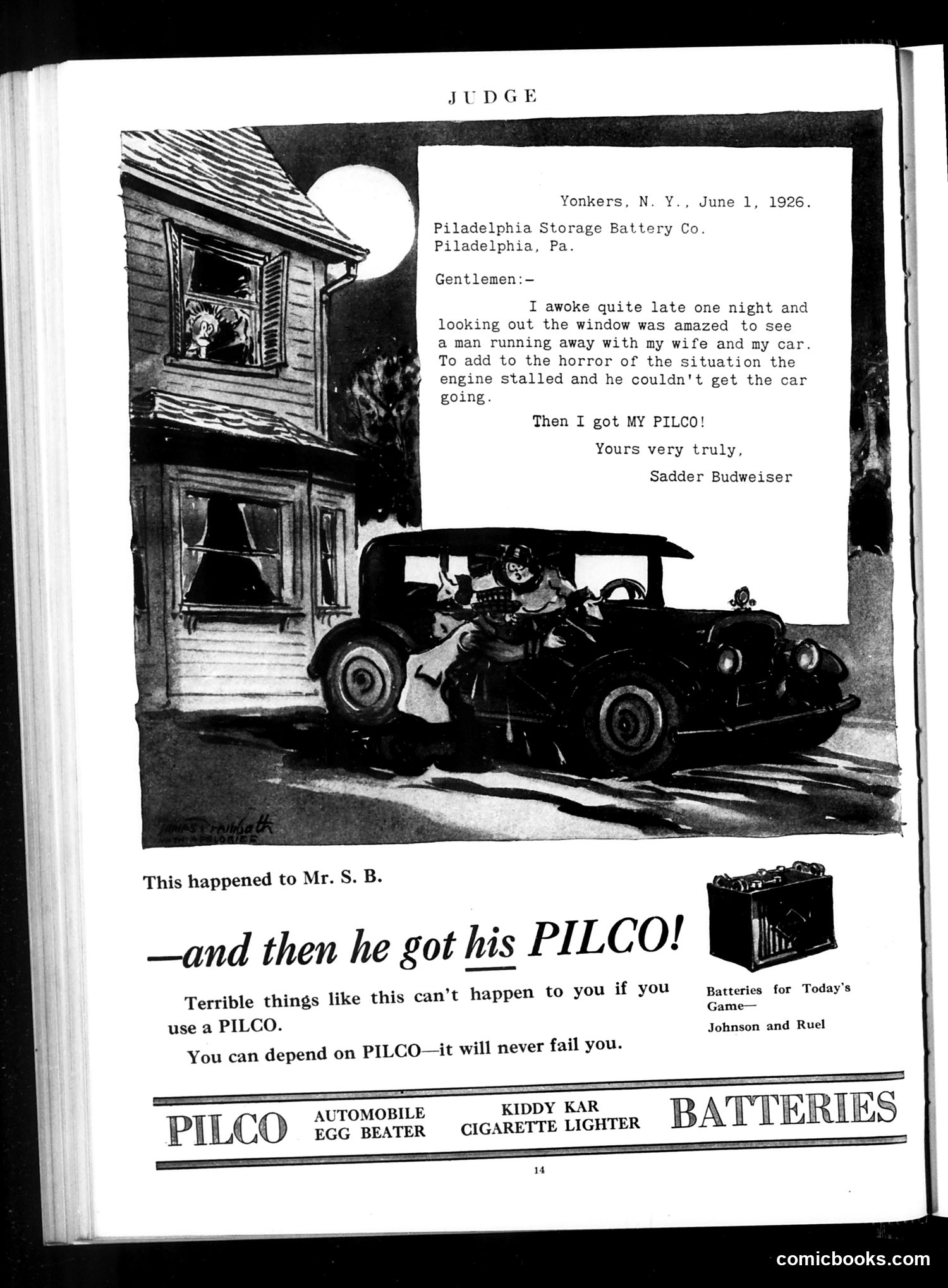
This is primarily a **Pilco battery advertisement** disguised as humorous editorial content. The "Judge" magazine format lends satirical credibility to sell the product. The joke plays on a domestic crisis: a man witnesses another man fleeing with his wife and car, but the stolen vehicle's engine fails. The letter-writer, "Sadder Budweiser" (a humorous name), states he then "got MY PILCO"—implying the reliable battery allowed him to pursue and recover his wife and automobile. The cartoon illustration shows a car crashed into a house, visualizing the comic catastrophe. The advertisement's appeal is straightforward for 1926: **Pilco batteries are so dependable they'll solve your problems**—even comic ones. The tagline "You can depend on PILCO—it will never fail you" contrasts with the villain's stalled engine, suggesting that reliable batteries prevent disasters. This represents early automotive-era advertising, when car batteries were novelty products requiring endorsement and trust-building.
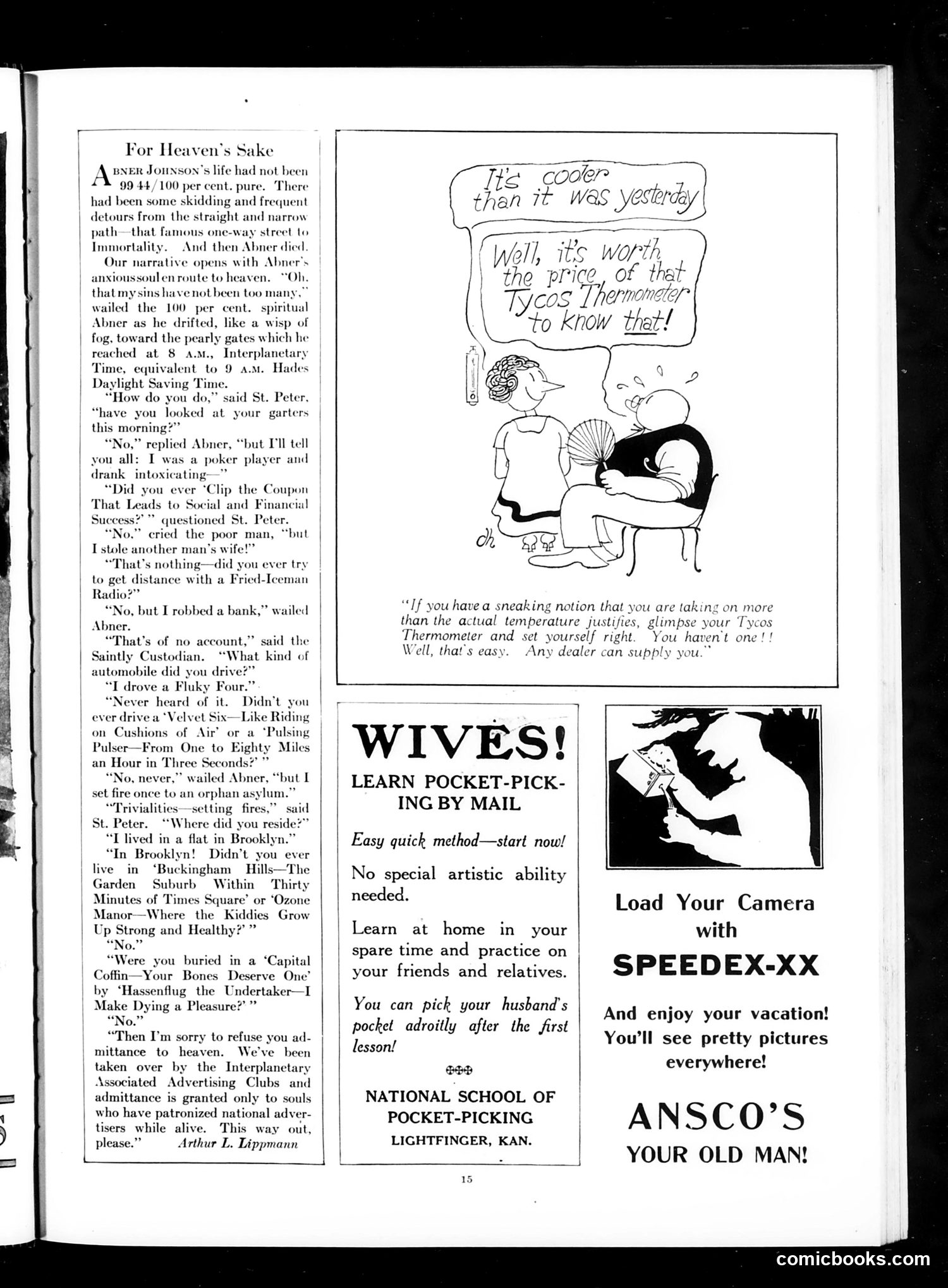
This story satirizes early 20th-century advertising's invasive reach. Abner Johnson, a sinner with minor moral failings (robbing a bank, setting an orphan asylum fire), arrives at heaven's gates. St. Peter dismisses these transgressions as trivial. Instead, Abner is denied entry because he failed to patronize advertised products during life—he didn't buy specific car brands ("Fluky Four," "Velvet Six"), didn't live in marketed suburban developments ("Buckingham Hills," "Ozone Manor"), and wasn't buried in an advertised coffin brand. The joke: Heaven has been "taken over by the Interplanetary Associated Advertising Clubs." Eternal salvation now requires consumer loyalty to brand names, not moral virtue. The surrounding ads (pocket-picking lessons, Tycos thermometers, Speedex cameras, Ansco film) reinforce the absurdist point—even ridiculous products dominate the advertising landscape. This reflects genuine 1920s anxiety about advertising's growing cultural dominance and commercialization of American life.
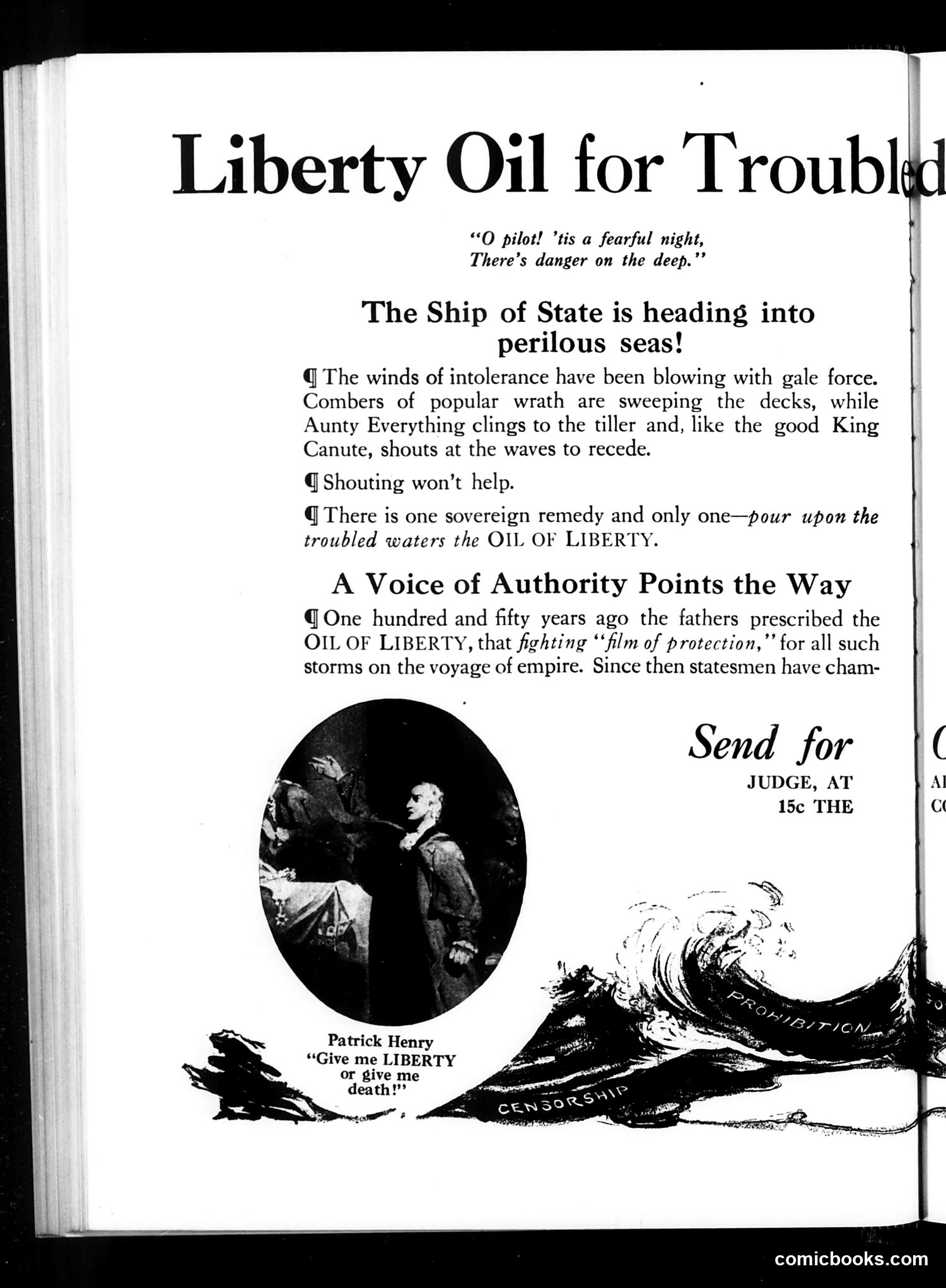
This Judge magazine page satirizes threats to American freedoms during a period of social upheaval (likely WWI or post-war era). The "Ship of State" metaphor depicts the nation endangered by "winds of intolerance" and "popular wrath." The cartoon invokes Patrick Henry's famous patriotic declaration ("Give me Liberty or give me death!") to advocate for constitutional protections against censorship and political suppression—symbolized as the "Oil of Liberty," a protective "film" the nation's founders prescribed. The imagery of waves labeled "Censorship" and "Prohibition" suggests Judge opposed these restrictions as threats to liberty. "Aunty Everything" (unclear reference, possibly to overzealous reformers) futilely tries controlling events, like King Canute commanding waves. The satire argues that invoking founding principles of freedom is the only solution to contemporary turmoil—a common libertarian argument against government overreach.
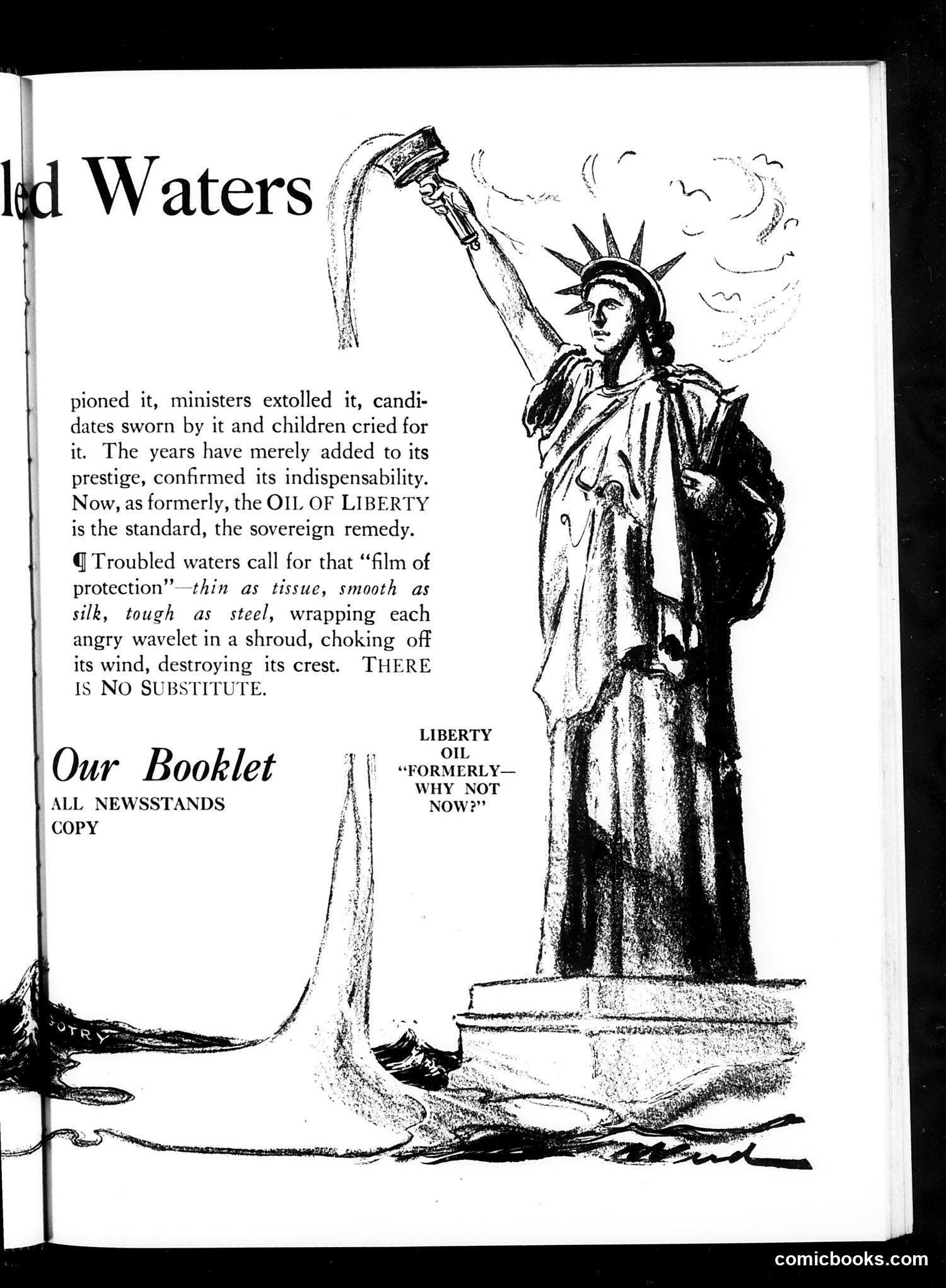
This is a satirical advertisement for "Liberty Oil," depicted through an image of the Statue of Liberty holding a torch-like oil can instead of her traditional torch. The text uses grandiose language to mock patent medicine advertising popular in early 20th-century America. It employs patriotic rhetoric—claiming the product has been "championed," "extolled," and is "indispensable"—while making absurd claims that the oil can calm "troubled waters" with a protective "film." The satire targets both the commercialization of American patriotic symbols and the deceptive advertising practices of the era, which promised miracle cures using vague, poetic descriptions ("thin as tissue, smooth as silk, tough as steel"). By substituting a commercial product for Lady Liberty's torch, the cartoon critiques how corporations exploit national symbols and patriotic sentiment to market dubious products to the public.
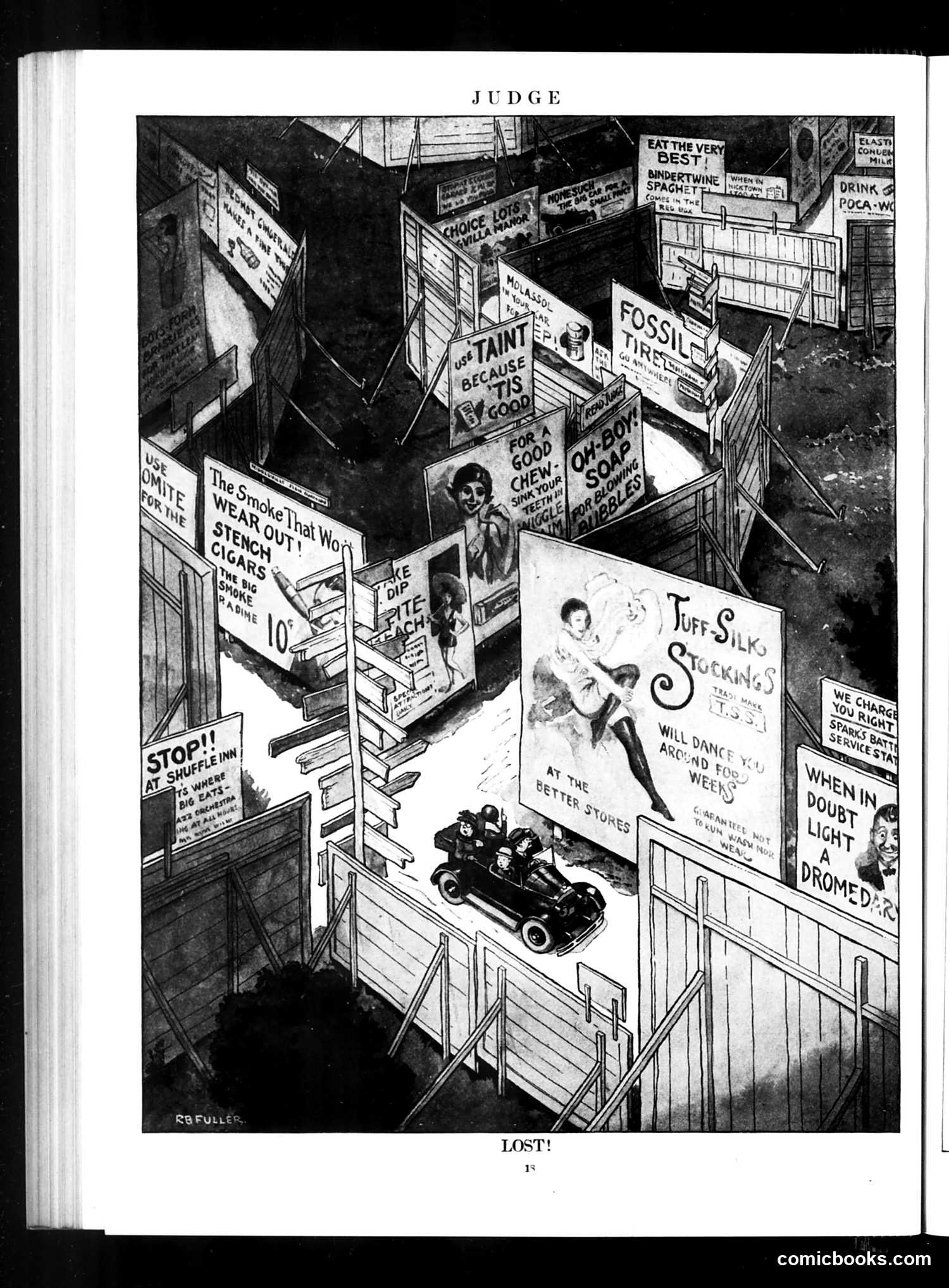
This is a bird's-eye view cartoon satirizing consumer behavior and advertising excess, likely from the 1920s. The street scene depicts storefronts cluttered with promotional signs and advertisements for various products: Fossil (first aid), Tuff-Silk Stockings, Omite (stencil sugars), and others. A small toy car with passengers drives through the commercial chaos, appearing lost amid the visual noise. The satire critiques how aggressive advertising and competing product promotions have created such a cluttered marketplace that consumers (represented by the car) become disoriented. The cartoon's title "Lost!" emphasizes the joke: modern commerce has become so advertisement-saturated that even a simple journey down a street requires navigation through a bewildering maze of marketing messages. It's commentary on early 20th-century consumerism's sensory overload.
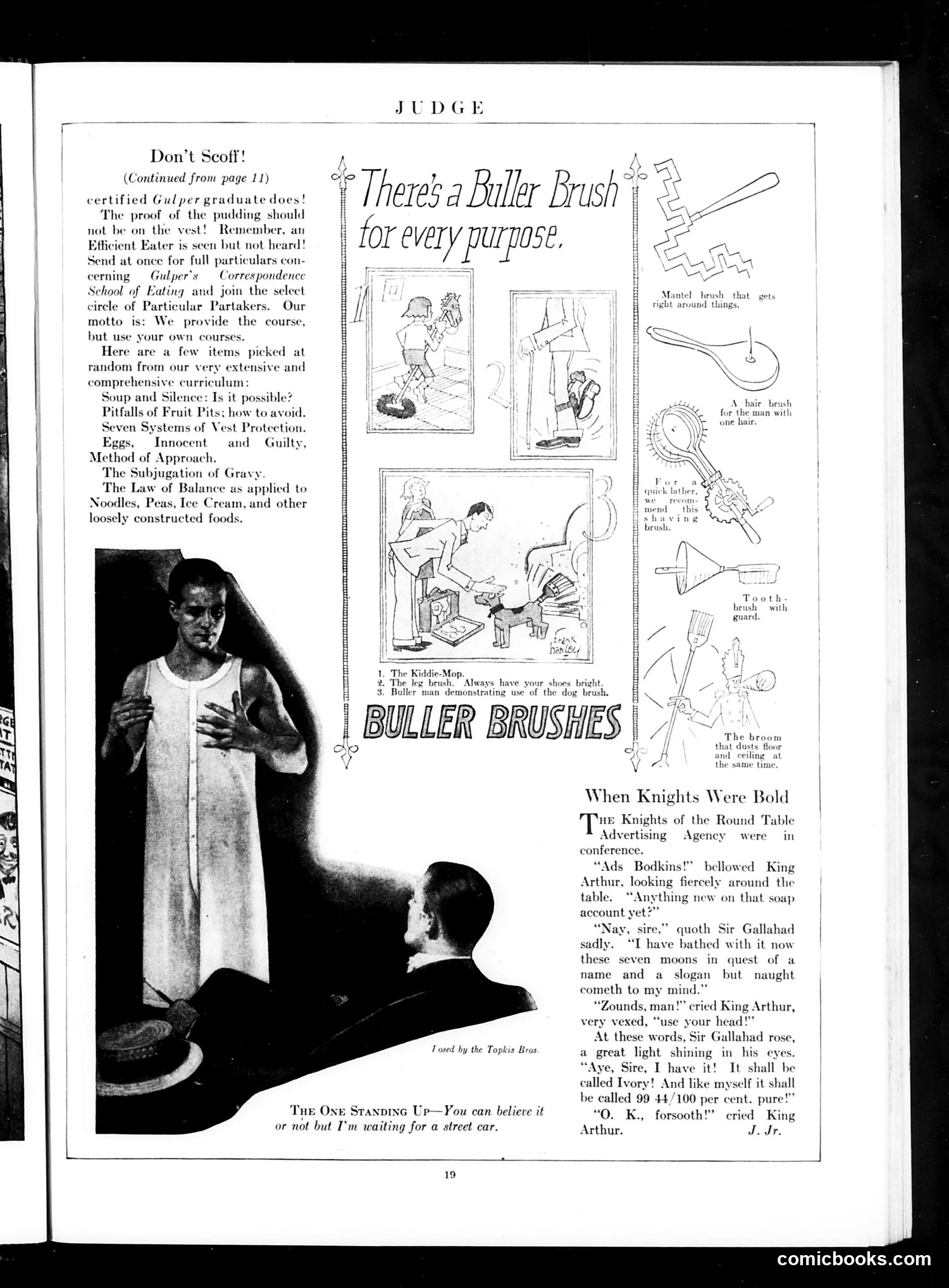
This Judge magazine page contains two distinct pieces of satire: **"Don't Scoff!" (top left):** A humorous advertisement parody for "Gulper's Correspondence School of Eating." The joke mocks overeating and poor table manners by offering absurd courses like "Soup and Silence" and "Seven Systems of Vest Protection"—suggesting diners get food on their clothing. This reflects early 20th-century anxieties about etiquette and social class. **"When Knights Were Bold" (bottom right):** A comedic skit reimagining King Arthur's Round Table as a modern advertising agency struggling to name a soap product. Sir Gallahad suddenly suggests "Ivory"—a real, famous soap brand. The "99 44/100 per cent. pure" tagline is Ivory's actual historical advertising slogan, making this an in-joke about corporate marketing and creative desperation. The medieval setting contrasts amusingly with contemporary business concerns. **"The One Standing Up"** (bottom): A brief cartoon joke about waiting for public transportation—likely mocking either impatience or the crowded conditions of street cars.
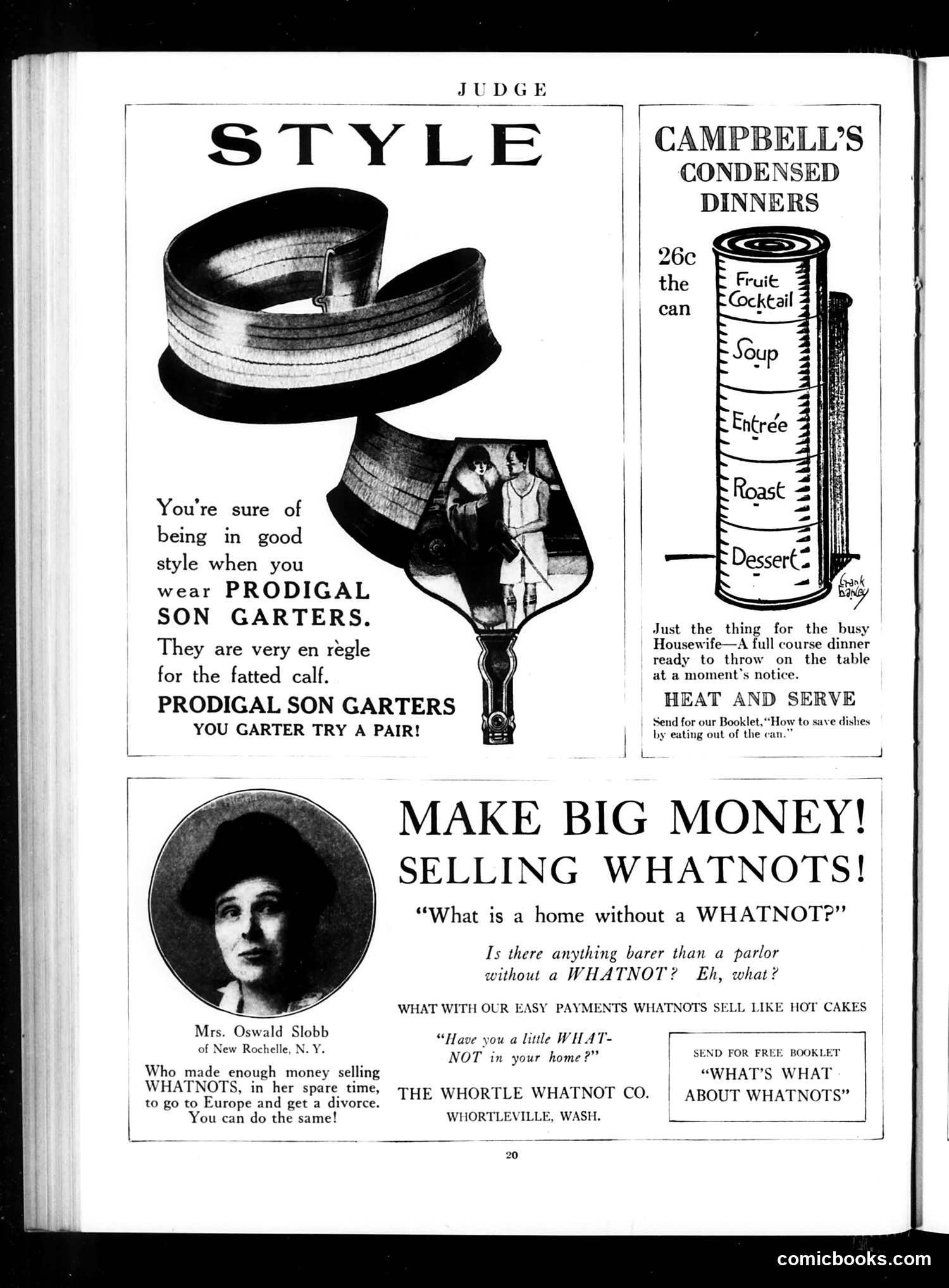
This page contains three separate advertisements satirizing consumer culture and domestic aspirations of the early 20th century. **Top left**: "Prodigal Son Garters" uses biblical reference (the parable of the prodigal son and the fatted calf) to humorously market men's garters as a fashion statement for the well-dressed man. **Top right**: Campbell's Condensed Dinners advertisement plays on the busy housewife trope, suggesting canned meals as convenient shortcuts—with comic undertones about saving dishes "by eating out of the can." **Bottom**: The "Whatnots" advertisement is the main satire. A whatnot was a Victorian ornamental shelf for displaying decorative items. The ad mockingly suggests that selling whatnots (useless decorative furniture) can make women wealthy enough to afford European travel and divorce—simultaneously satirizing both consumer materialism and women's limited economic opportunities. The fictional testimonial about "Mrs. Oswald Slobb" and the fake company location "Whortleville, Wash." emphasize the absurdity of the get-rich-quick scheme.
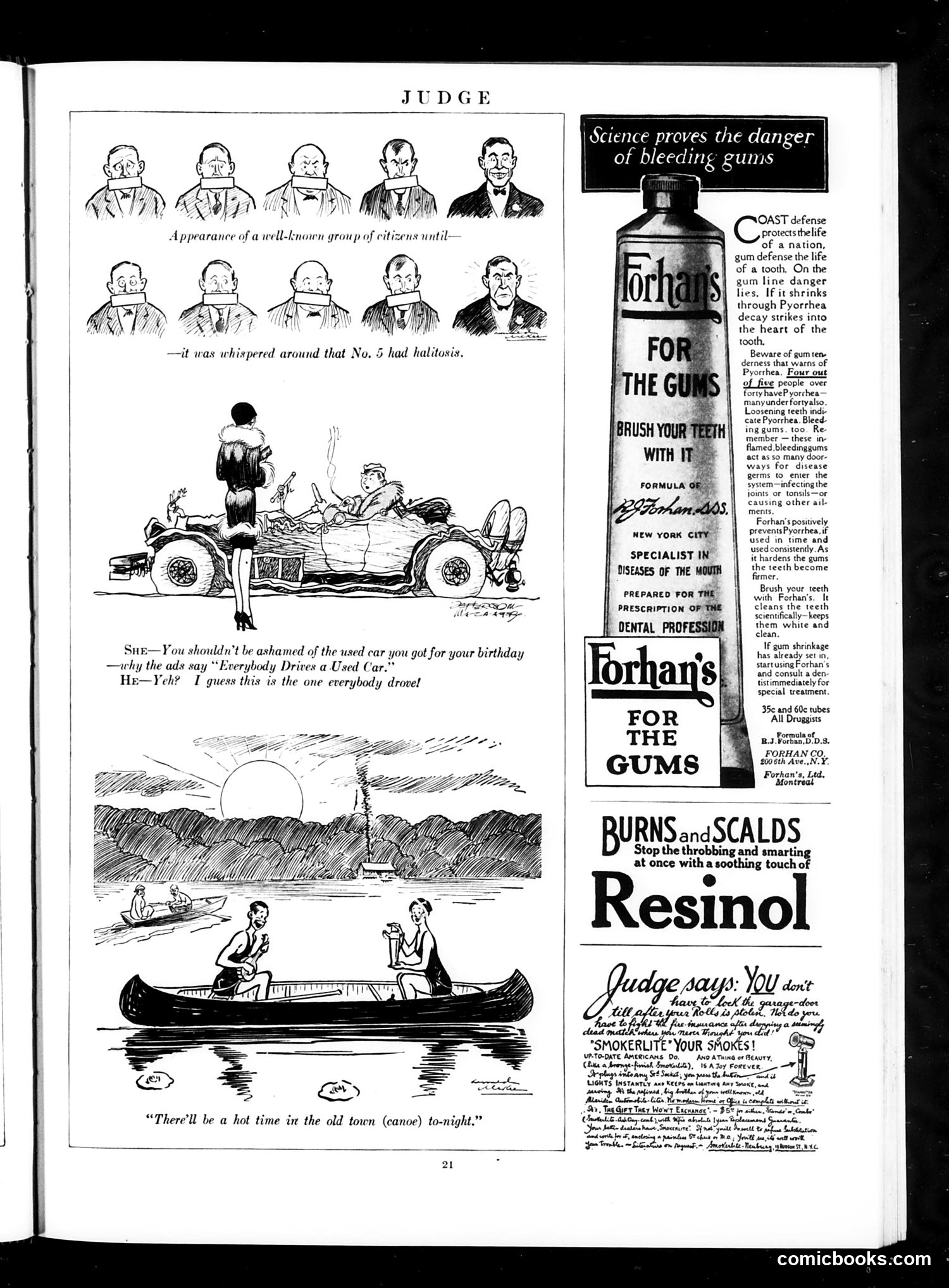
This page contains satirical cartoons and vintage advertisements typical of early 20th-century Judge magazine. **Main Cartoon (Top Left):** A "Judge" depicts ten similar-looking men in formal attire. The caption reveals gossip that "No. 5 had halitosis" (bad breath)—a social embarrassment that makes him indistinguishable from respectable citizens. The satire mocks how a common physical flaw can undermine social status. **Second Cartoon:** A woman receives a used car as a birthday gift and comments on its shabby condition. Her companion replies that everyone drives used cars. The joke plays on post-WWI consumer culture and the normalization of secondhand goods. **Third Cartoon:** A couple in a canoe with the caption "'There'll be a hot time in the old town (canoe) to-night'"—likely a romantic double entendre. **Advertisements:** The page is heavily dominated by product ads (Forhan's toothpaste, Resinol burn treatment, "Smokerlite" cigarettes) that use pseudo-scientific health claims typical of the era—before FDA regulations restricted such marketing.
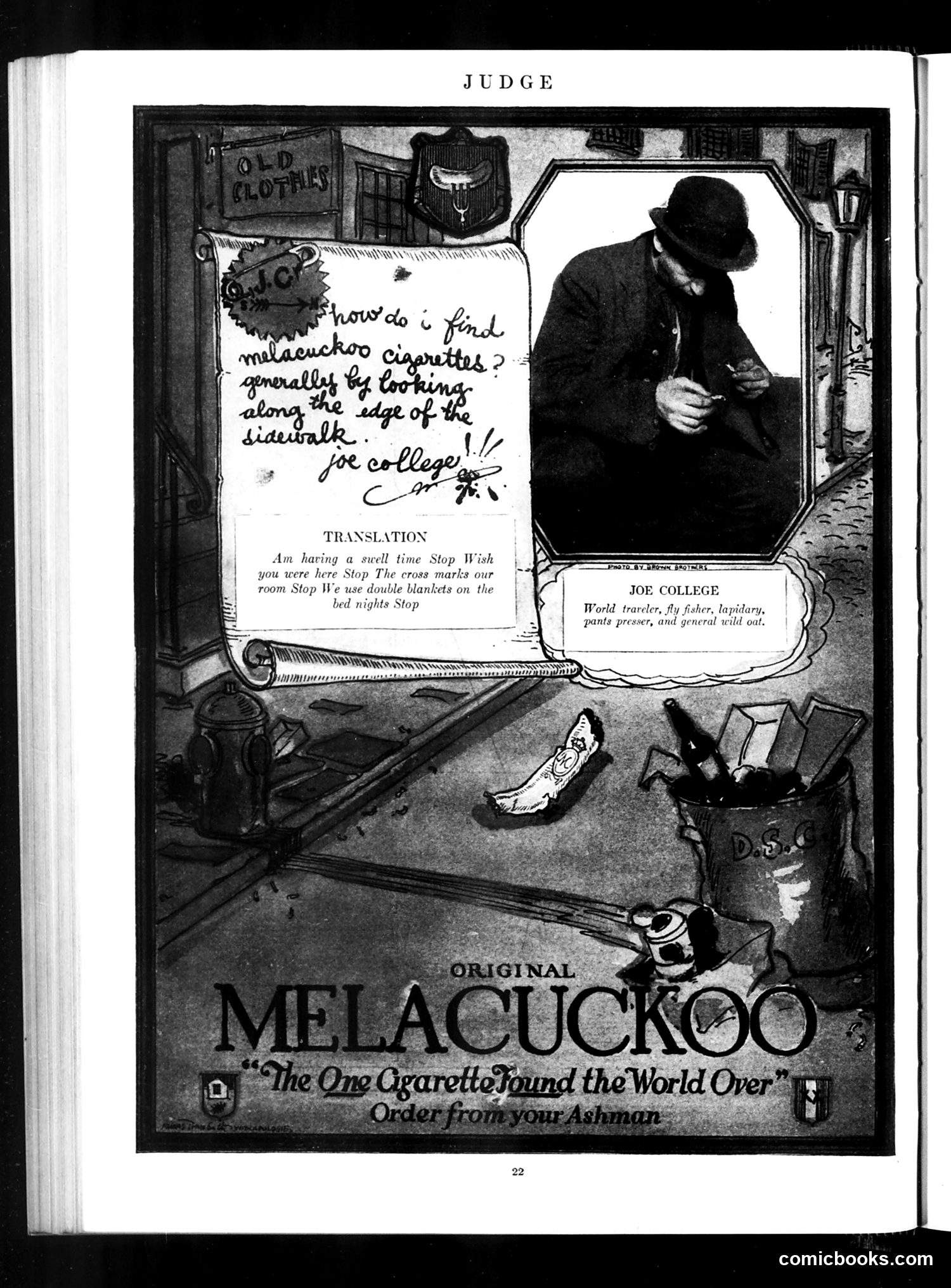
This page is primarily a **cigarette advertisement** for "Melacuckoo" brand, presented as a satirical postcard or travel note. The image shows a man in a bowler hat examining his empty wallet, accompanying a humorous message about finding "malachuckoo cigarettes" along a sidewalk. The satire mocks the absurdity of advertising claims—suggesting these cigarettes are so desirable they can be found discarded in public spaces. The character "Joe College" is described as a world traveler and general vagabond, positioned as the ideal consumer. The layout mimics genuine Judge magazine satirical content but functions as commercial product promotion. The humor derives from the exaggerated lifestyle promises and the incongruity of finding premium cigarettes casually abandoned outdoors. This represents early 20th-century advertising's brazen integration into editorial humor magazines.
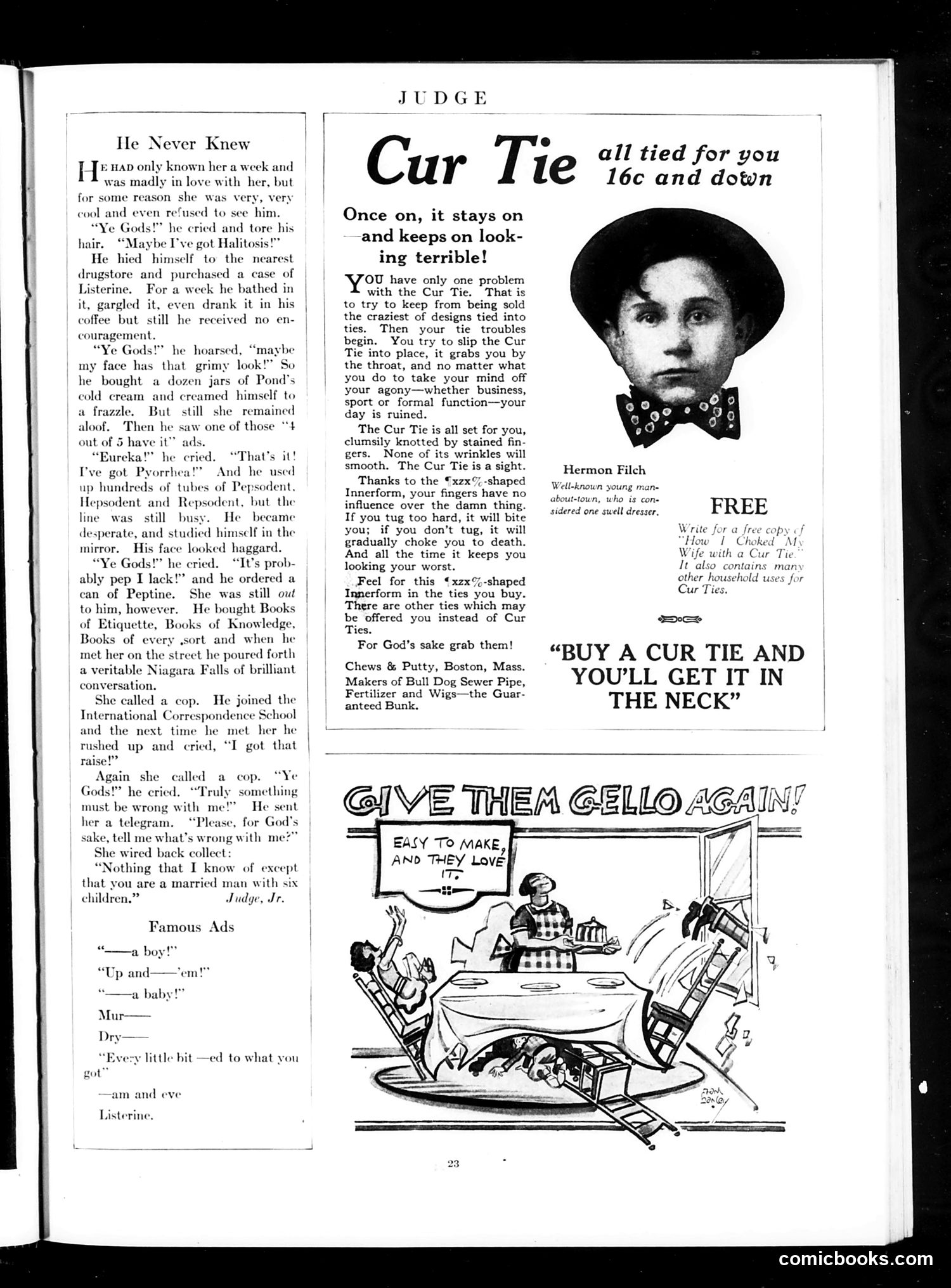
This page contains two satirical pieces from *Judge* magazine: **"He Never Knew"** (left): A humorous short story mocking over-reliance on advertised products. A man desperately buys Listerine, Pond's cold cream, Pepsodent toothpaste, and takes correspondence courses—all heavily advertised consumer products of the era—trying to win over an indifferent woman. The punchline: she finally reveals she can't see him because he's already married with six children. The satire targets both the man's gullibility and the era's aggressive advertising claims that products solve social problems. **"Cur Tie" Advertisement Parody** (right): A fake advertisement sarcastically "promoting" a terrible necktie with a defective design that chokes the wearer and won't stay neat. The grotesque illustration and over-the-top warnings ("gradually choke you to death") mock how real advertisements exaggerate product benefits while hiding flaws. The tagline "You'll get it in the neck" uses wordplay while suggesting the product literally harms you. Both pieces ridicule consumer culture and deceptive advertising prevalent in the 1920s-30s.
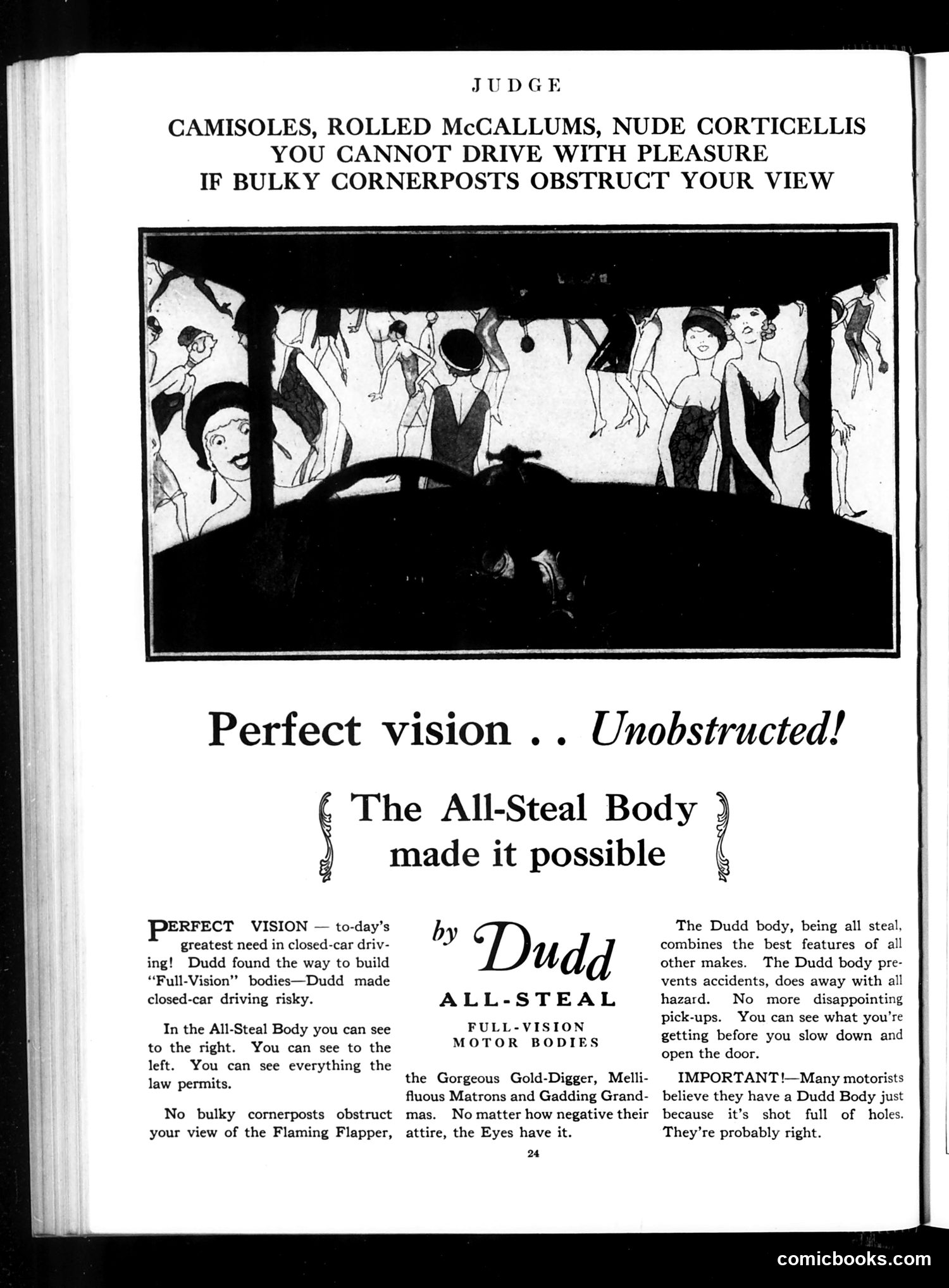
This is a **satirical advertisement** for "Dudd" automobiles from Judge magazine (a 1920s-era publication). The satire works on multiple levels: **The Setup:** The headline mocks women's fashion—camisoles, rolled stockings, and corsets—claiming they obstruct driving visibility. This is absurd; the real issue is the car's design. **The Joke:** Dudd's solution is an "All-Steel Body" with minimal structural posts, offering unobstructed views. But the satire reveals the actual appeal: drivers want clear sightlines to see attractive women pedestrians (the "Flaming Flapper," "Gold-Digger," etc.). **The Punchline:** The final section mockingly notes that many motorists think they have Dudd bodies simply because their cars are "shot full of holes"—implying Dudd's design is dangerously flimsy, not innovative. This satirizes both automobile advertising (which used sex appeal) and the era's obsession with the "Flapper" culture of the 1920s.
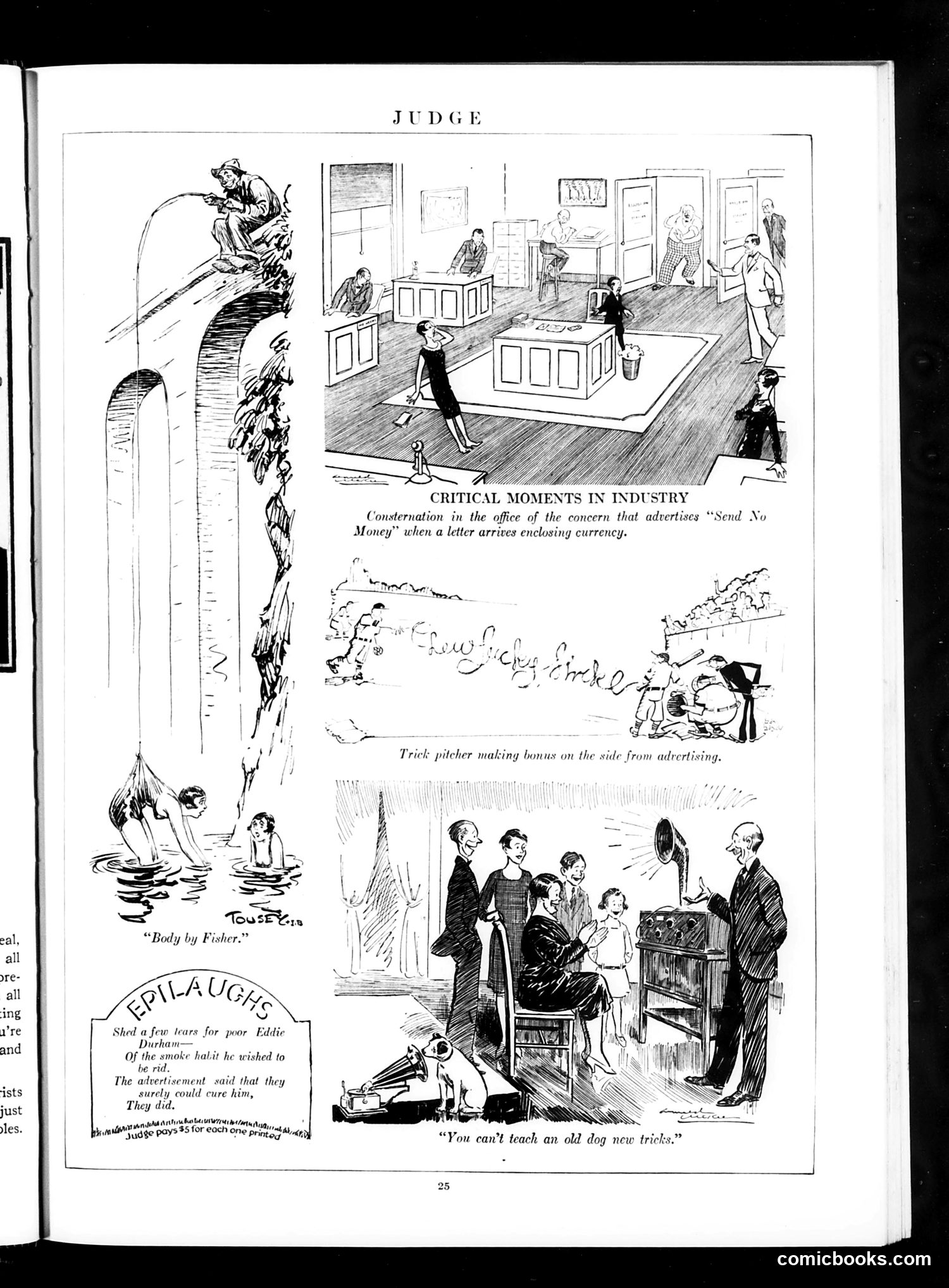
This page satirizes various business and advertising absurdities of the era: **Top cartoon**: A chaotic office scene mocking mail-order businesses advertising "Send No Money"—when actual currency arrives in letters, staff panic. The satire targets the disconnect between promotional claims and operational reality. **Left cartoon ("Body by Fisher")**: Shows a figure being pulled from water, likely mocking the Fisher Body automobile company's advertising slogan. The dark humor suggests tragic irony. **"Epilaughs" section**: A satirical epitaph for "Eddie Durham" who responded to a medical advertisement promising to cure smoking addiction. The grim punchline—"They did" (cure him, implying he died)—mocks fraudulent patent medicine ads common in this era. **Bottom cartoon**: Depicts a frustrated older man with a phonograph or radio device, captioning "You can't teach an old dog new tricks"—commentary on resistance to modern technology or advertising's inability to change entrenched behavior. Overall, the page critiques deceptive advertising, mail-order schemes, and dubious medical claims prevalent in early 20th-century American commerce.
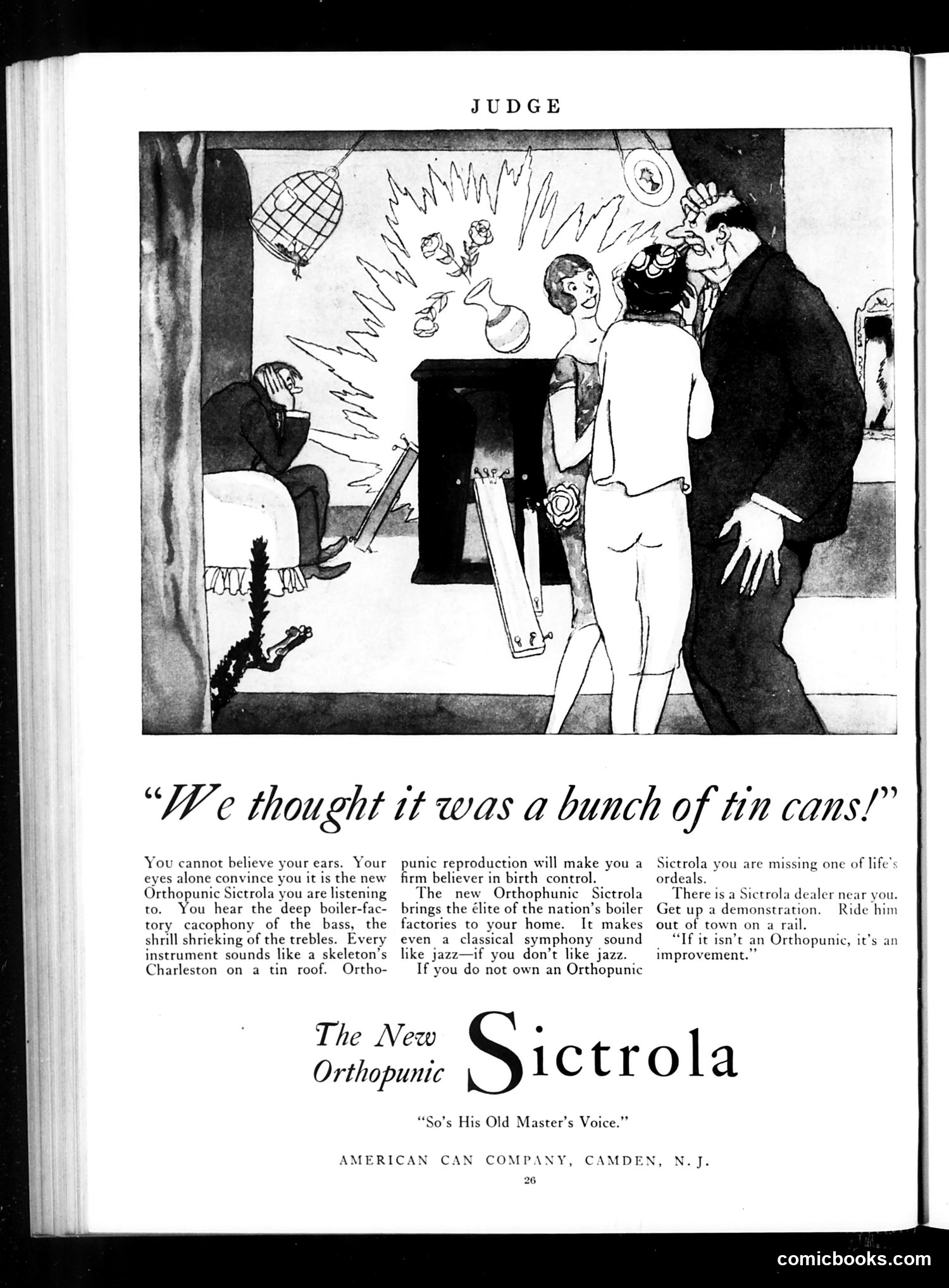
This is a **fake advertisement** satirizing the Orthophonic Victrola, an early phonograph brand. The cartoon depicts people recoiling in horror at the device's awful sound quality—guests mistaking the noise for "tin cans." The satire works through **mock praise**: the text hilariously insults the product while adopting advertising language. It claims the reproduction is so poor it will make listeners "firm believers in birth control" (suggesting the experience is torturous), and that even classical music sounds like jazz played on a tin roof. The punchline—"Ride him out of town on a rail" (a historical mob punishment)—suggests customers should drive the Sictrola dealer away violently. The closing tagline inverts the real Victrola slogan "His Master's Voice" to mock the brand further. This reflects **Judge's** tradition of irreverent consumer criticism, poking fun at emerging technology and advertising hype during the early 20th century.
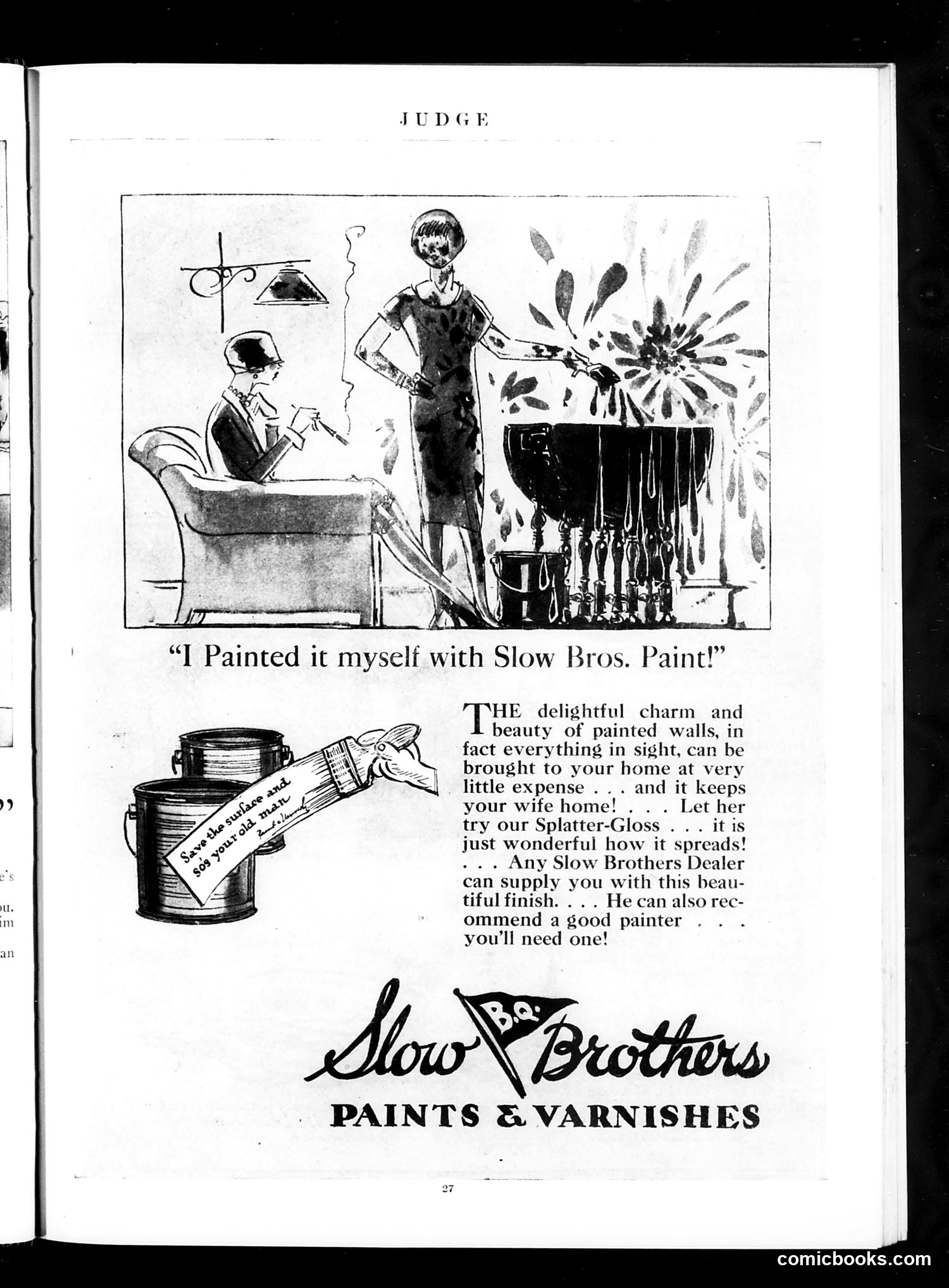
This page is primarily a **paint product advertisement** disguised as editorial cartoon content in Judge magazine. The cartoon depicts a domestic scene where a woman has enthusiastically painted her room with Slow Bros. Paint, creating an explosively messy result with paint splattering everywhere. A man (likely her husband) sits at a desk looking dismayed at the chaos. The joke is ironic: the ad claims the paint "spreads" wonderfully and will keep the wife happily occupied at home, yet the visual shows domestic disaster. The fine-print punchline—"He can also recommend a good painter . . . you'll need one!"—reveals the satire: amateur DIY painting creates such mess that professional painters become necessary. This reflects early-20th-century gender assumptions (women as homemakers) while subtly mocking both the product's quality and the advertising's patronizing tone toward female consumers.
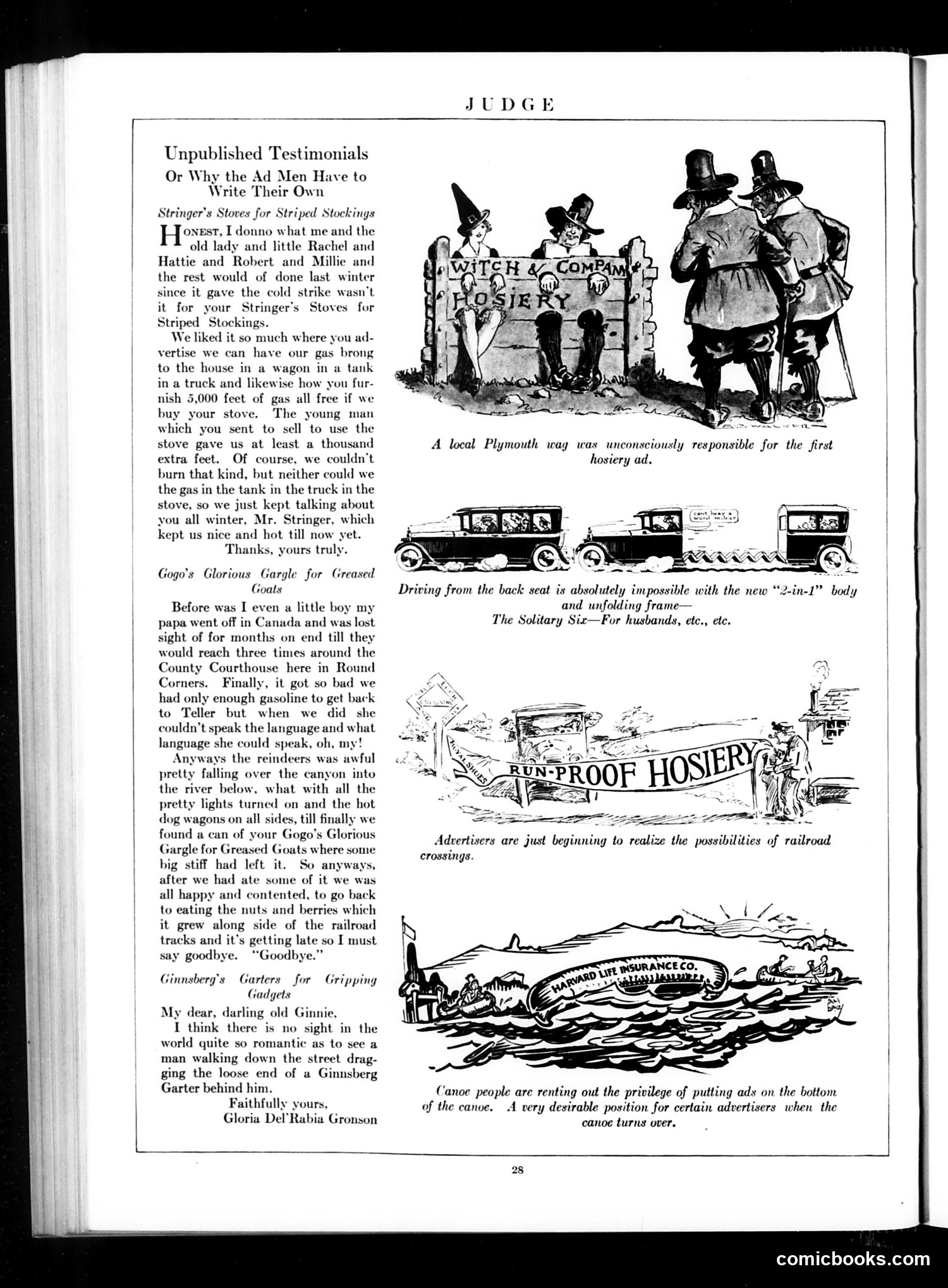
This page satirizes **fake testimonial advertising**—a common early 20th-century marketing practice. The "Unpublished Testimonials" header signals the joke: these are hilariously unconvincing customer endorsements that advertisers supposedly couldn't publish because they're too absurd or damaging. Each testimonial is deliberately incoherent, with rambling, poorly-written narratives that contradict the product's benefits. For example, Stringer's Stove testimonial describes customers who couldn't actually use the free gas but stayed happy anyway. Gogo's Gargle involves lost parents, reindeer, and random food—utterly unrelated to the product. The accompanying cartoon illustrations mock creative advertising desperation: ads on canoe bottoms (visible when capsized), hosiery sold via witch imagery, and trucks driving impossibly from back seats. The satire targets both **fraudulent testimonials** and **absurd ad placement strategies** that were becoming increasingly desperate as advertising exploded. The point: real customers won't endorse mediocre products, so advertisers fabricate testimonials—and readers weren't fooled.
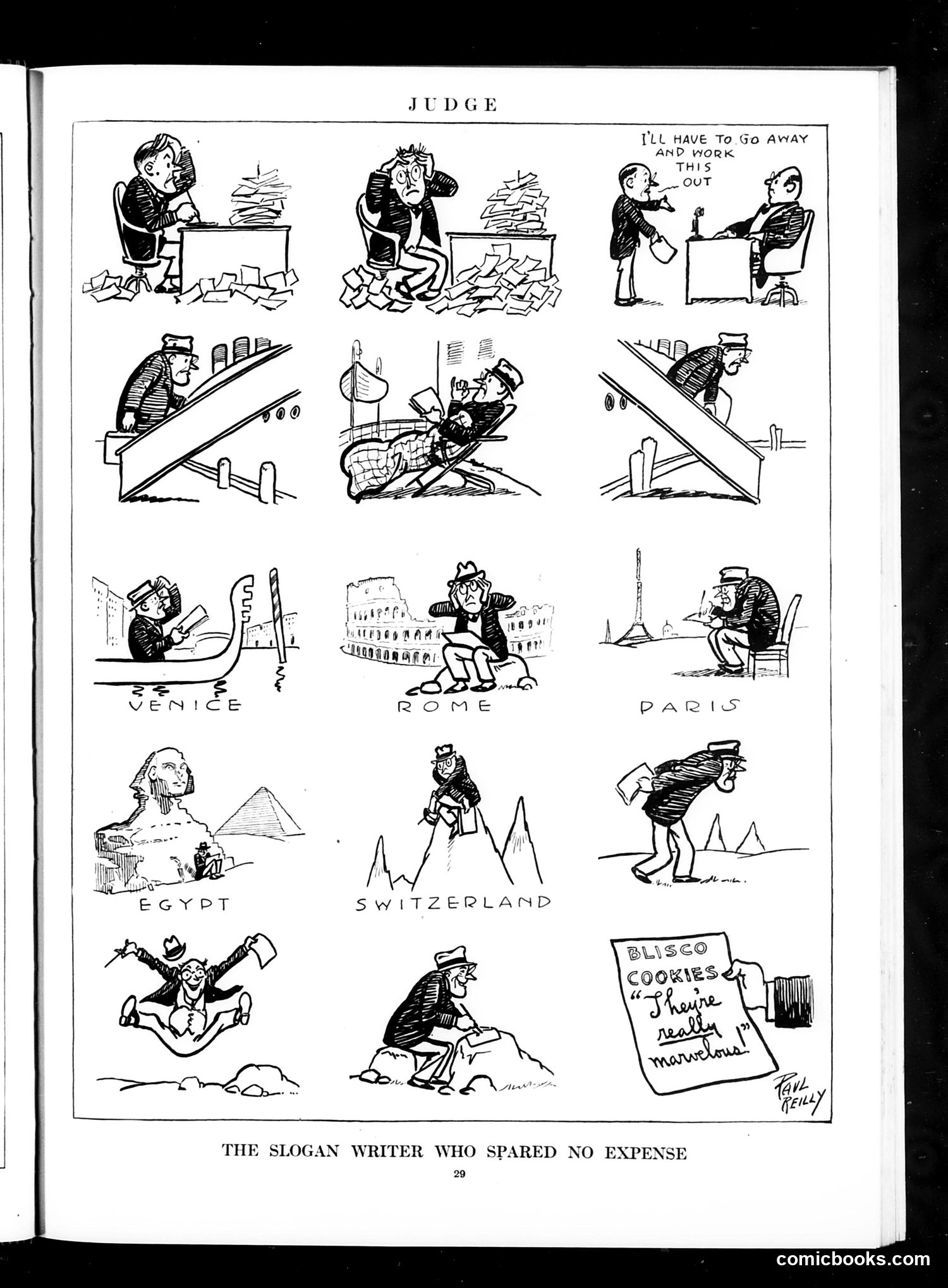
This page satirizes an advertising copywriter's extravagant approach to creating catchy slogans. The top panels show a harried judge at his desk, drowning in paperwork, telling someone he must work this out—establishing that the judge is overworked. The subsequent panels depict the same figure traveling extensively (Venice, Rome, Paris, Egypt, Switzerland) and engaging in various activities—rowing, climbing mountains, relaxing—supposedly to generate inspiration for a single cookie slogan. The final panel reveals the punchline: after all this global travel and expense, the slogan is simply "Blisco Cookies—they're really marvellous!"—a generic, uninspired phrase that could have been written without leaving the office. The satire mocks advertising industry excess and the pretense that creative work requires lavish spending to justify mediocre results.
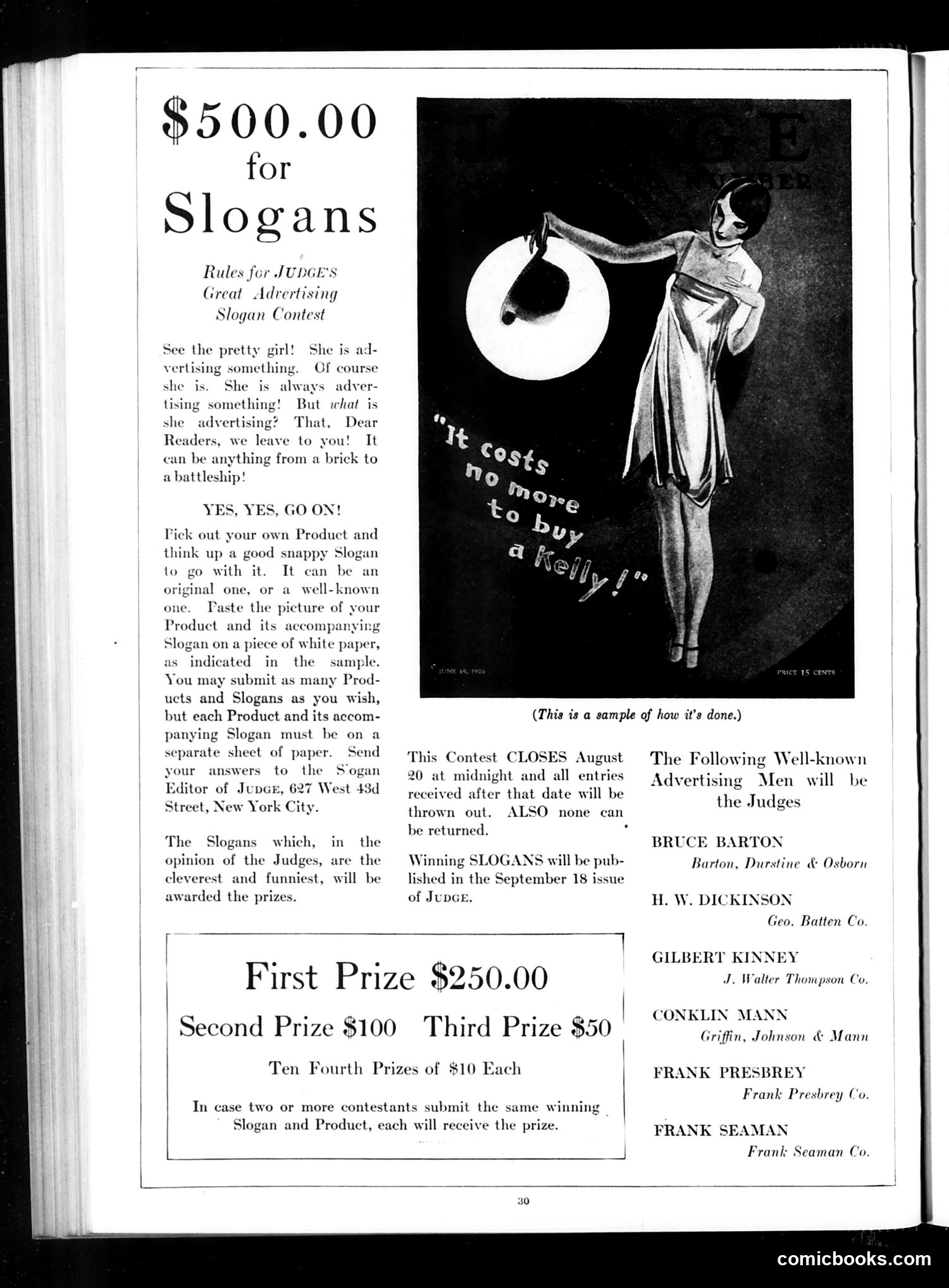
This page announces Judge magazine's contest offering $500 in total prizes for advertising slogans. Contestants submit a product and accompanying slogan for judging by prominent advertising executives of the era. The sample image shows a fashionable woman holding a large hat with the slogan "It costs no more to buy a Kelly!" — advertising Kelly brand hats. This illustrates the contest format: pair a recognizable product with a catchy, memorable phrase designed to boost sales. The contest reflects 1920s advertising culture, when slogans were becoming central to marketing strategy. Judge, a satirical magazine, monetizes reader engagement by crowdsourcing ad copy while celebrating commercial ingenuity. The "pretty girl" framing reflects period advertising's reliance on female imagery to sell products, a convention modern readers would recognize as gendered marketing.
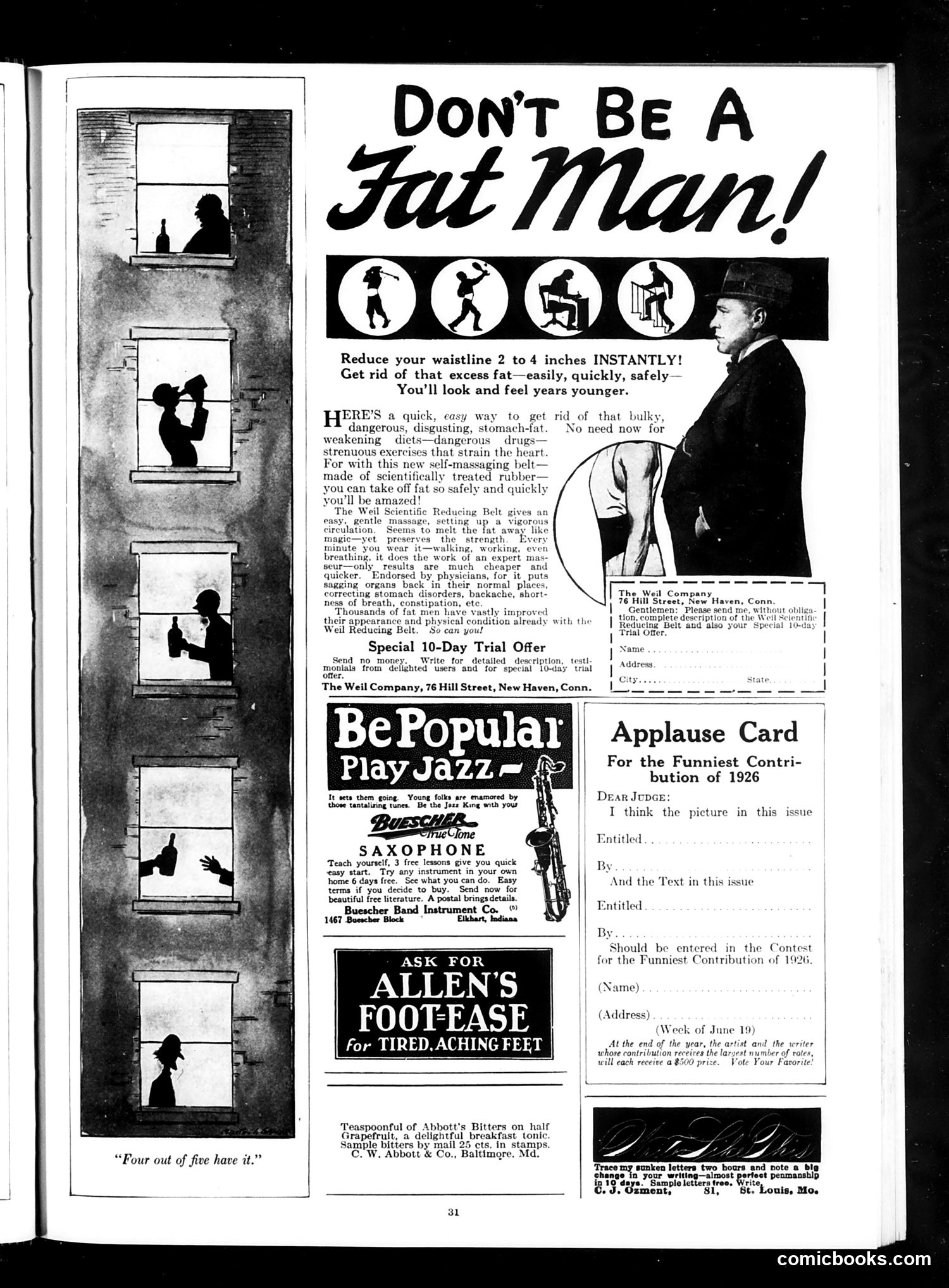
This page is primarily **advertising**, not editorial content. The main feature is a "Don't Be A Fat Man!" advertisement for the Weil Scientific Reducing Belt, a mechanical massage device marketed as an effortless weight-loss solution. **The satire/social commentary:** The left panel shows a silhouetted figure progressively getting thinner across building windows—illustrating the product's promised results. The ad's language ("disgusting, stomach-fat," "dangerous diets," "strenuous exercises") reflects 1920s anxieties about obesity and masculinity. **Supporting advertisements include:** - A Buesscher saxophone ad ("Be Popular / Play Jazz"), targeting youth culture - Allen's Foot-Ease for tired feet - Abbott's Bitters digestive tonic The page also includes an "Applause Card" inviting readers to vote on the funniest contributions to Judge magazine's 1926 contest. **Historical context:** These ads reveal 1920s consumer culture obsessed with quick-fix self-improvement products and leisure activities, with particular emphasis on appearing youthful and fashionable.
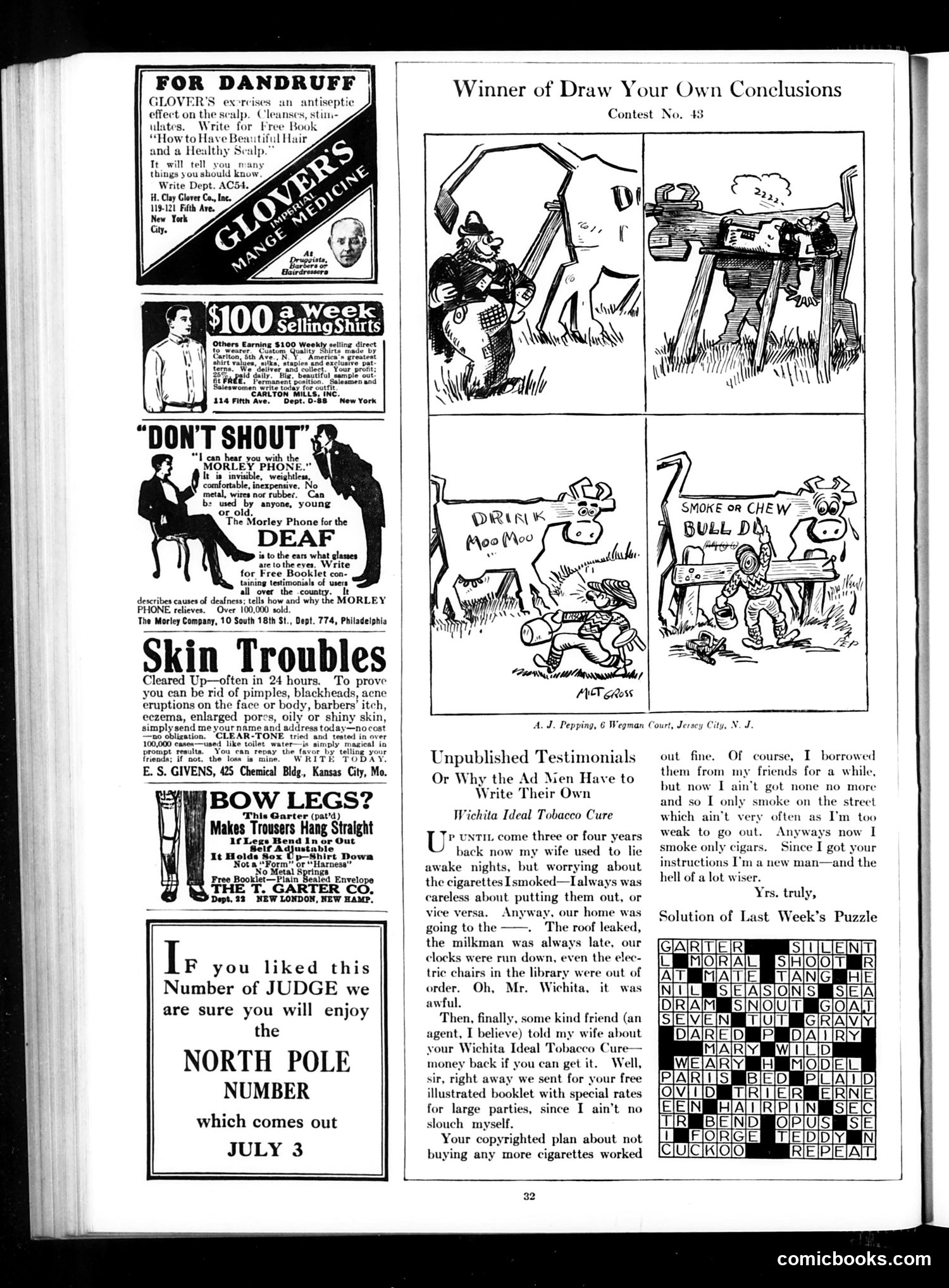
This page primarily consists of **advertisements and filler content** rather than political satire. The main elements include: **Advertisements** for various products: Glover's dandruff treatment, a "Morley Phone" hearing device for deaf users, skin condition remedies, a leg-straightening garter, and the "Wichita Ideal Tobacco Cure." **The satirical content** appears in the "Unpublished Testimonials" section, which mocks tobacco company advertising practices. A fictional testimonial describes how quitting cigarettes (via the Wichita cure) solved numerous household problems—leaky roofs, late milkmen, broken clocks. The absurdity escalates until the writer admits he simply borrowed cigarettes from friends instead, undermining the product's credibility. **The joke**: This section satirizes **fake testimonials** common in patent medicine and tobacco advertising of the era. The increasingly ridiculous claims and the admission that the "cure" didn't actually work expose how manufacturers fabricated customer endorsements. The title "Why the Ad Men Have to Write Their Own" suggests advertisers invented testimonials because no genuine satisfied customers existed. The cartoon contest winner above shows humorous cow drawings with tobacco-related captions.
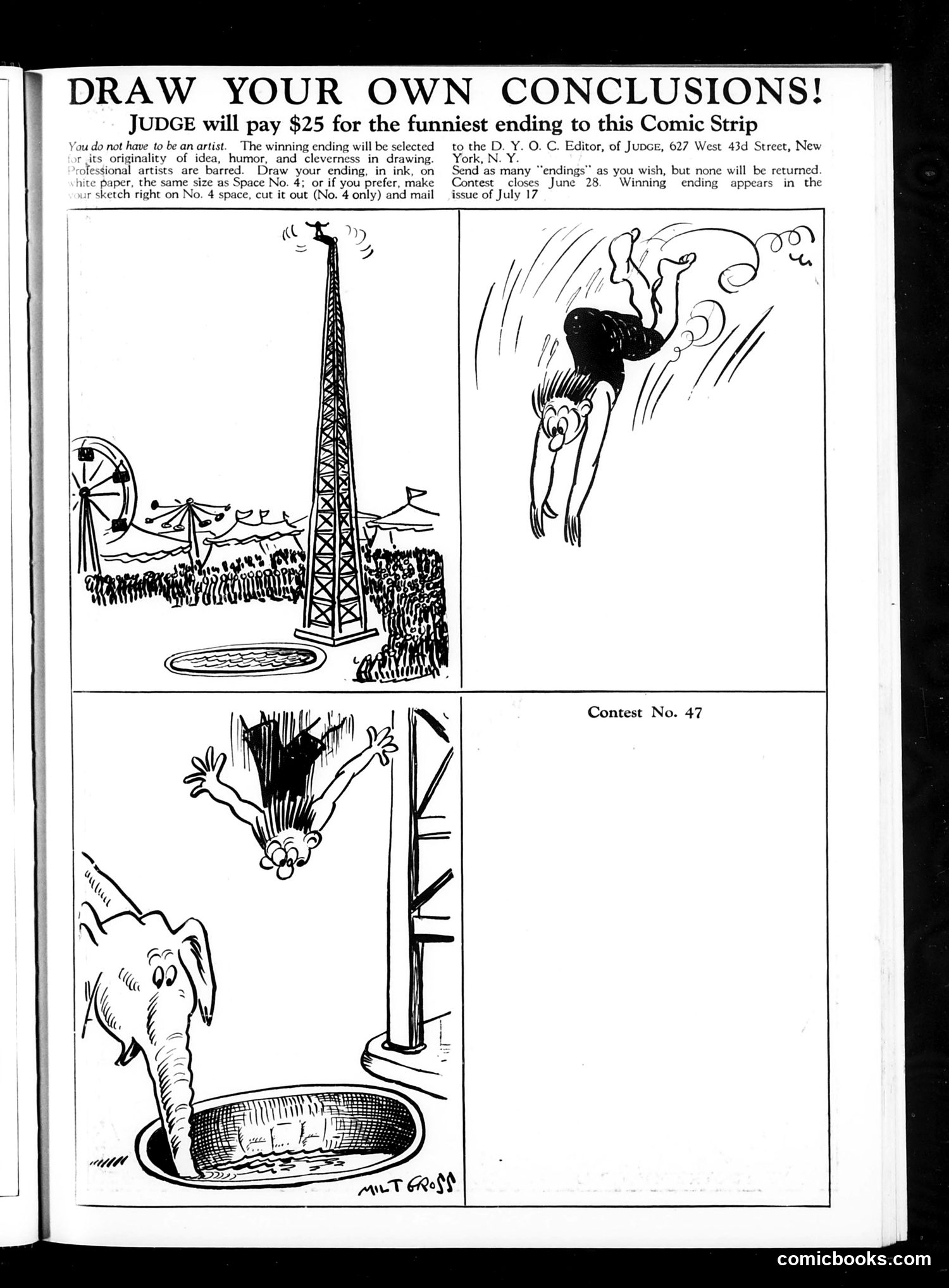
This is a reader-participation contest from *Judge* magazine offering $25 for the funniest ending to an incomplete comic strip. Three panels show absurdist situations: a tall tower at what appears to be a fair or circus with crowds; a person diving or falling through the air; and an elephant apparently bathing in or near a tub with a ladder. The humor relies on surreal, non-sequitur imagery typical of early-20th-century magazine comedy. The "conclusion" readers must draw remains deliberately obscure—the point being that submitters create their own punchline to connect these disparate, illogical scenes. This format was common in *Judge*, mixing professional cartoonists' work with amateur contributions. The cartoonist credit reads "Milt Gross," a known Judge contributor. The contest invites creative participation while maintaining editorial control.
This is a Lucky Strike cigarette advertisement, not satire or political commentary. The page features an ornate decorative border surrounding a circular photograph showing tobacco being toasted in what appears to be an industrial process. The ad's text emphasizes that toasting develops "hidden flavors of the world's finest tobaccos." "It's Toasted" was Lucky Strike's actual advertising slogan from this era, positioning the toasting process as a quality distinction. The decorative frame and professional photography suggest this ran in Judge magazine as a paid advertisement. From a modern perspective, this represents pre-regulation tobacco marketing that made health and quality claims without the warnings now required by law.