
A complete issue · 36 pages · 1926
Judge — June 5, 1926
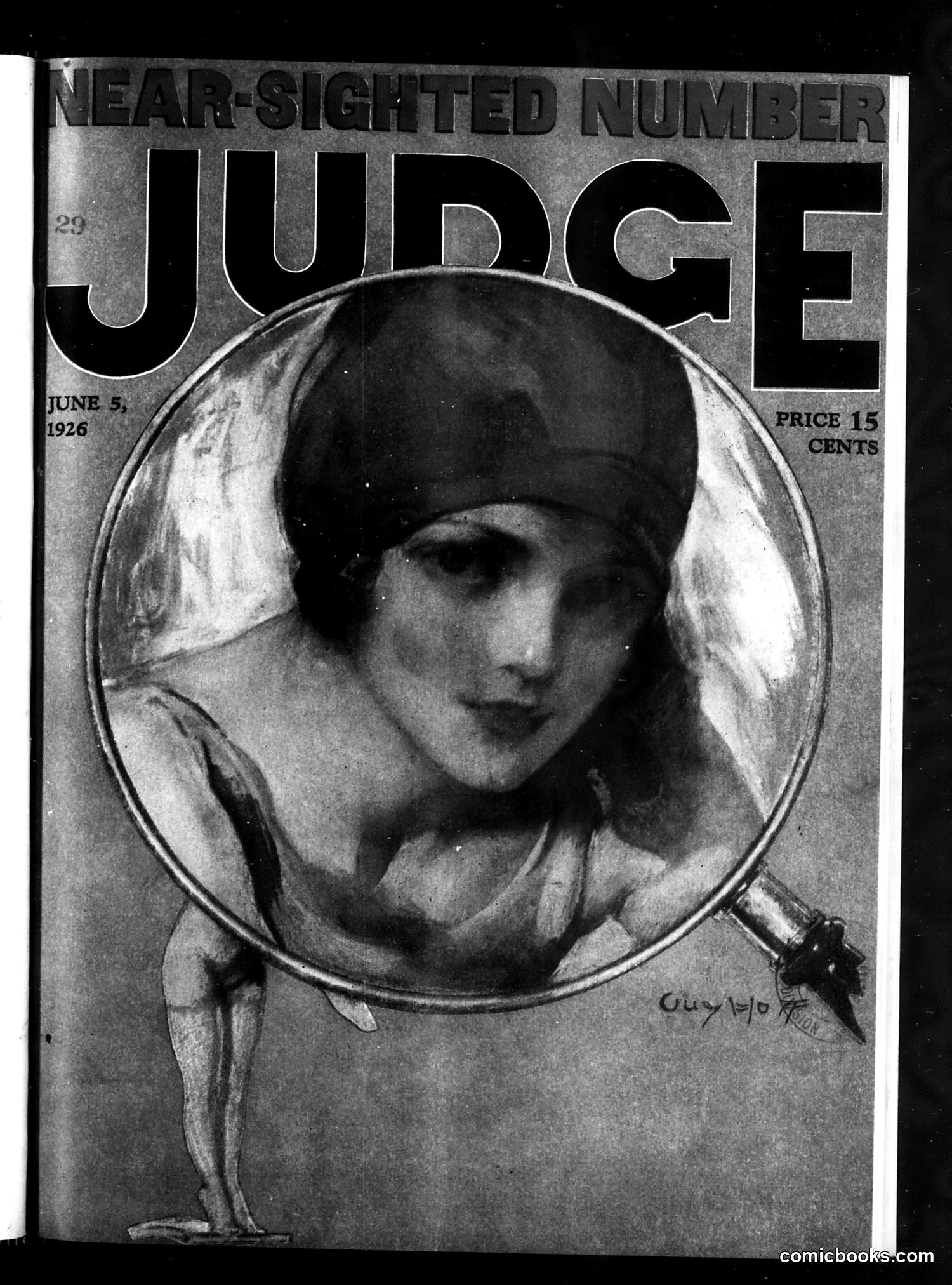
This is a magazine cover rather than a cartoon. It features a portrait illustration of a woman's face framed in a circular vignette, wearing a close-fitting cloche hat characteristic of 1920s fashion. The woman has a stylized, somewhat aloof expression typical of Art Deco portraiture. The cover's title "JUDGE" with the subtitle "NEAR-SIGHTED NUMBER" suggests the issue contains satire about contemporary social blindness or myopia—likely commentary on current events, politics, or cultural trends of mid-1920s America. The price of 15 cents and artist signature (appearing to read "Cory") are visible. Without additional text visible on this page, the specific satirical targets remain unclear, though the fashionable styling indicates commentary on modern urban life and women's culture.
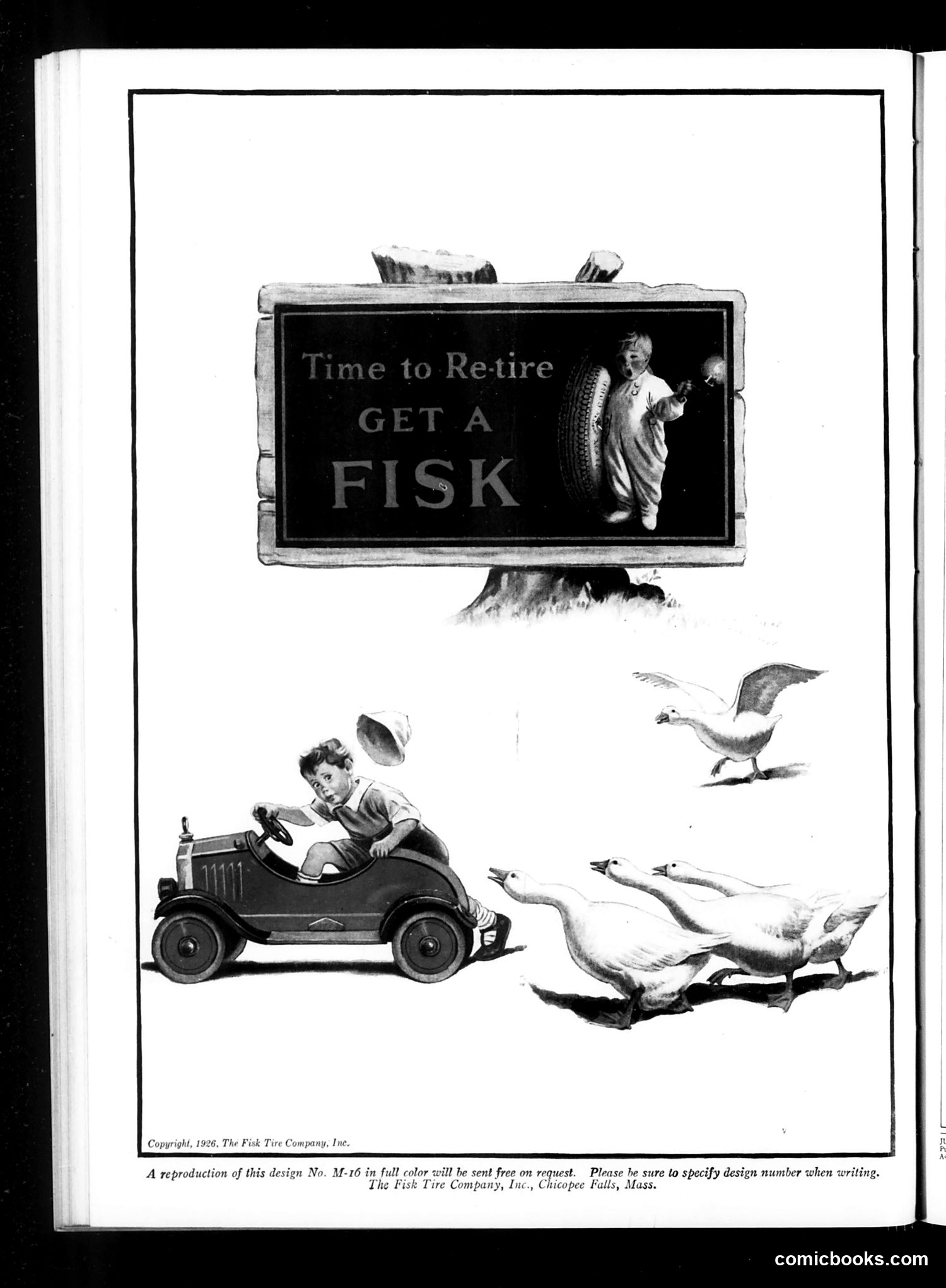
This is a 1926 Fisk Tire Company advertisement disguised as satirical content. The visual pun plays on the phrase "Time to Retire" — typically meaning it's time to stop working — but pivots to selling tires by showing a man literally retiring (resting) next to a large tire. The lower section depicts leisure activities: a child in a toy car and waterfowl, suggesting the carefree enjoyment enabled by reliable Fisk tires. The advertisement implies that quality tires allow one to enjoy retirement and leisure without worry. The "Judge" magazine context suggests this blends commercial messaging with the magazine's satirical tradition, though the primary purpose is product promotion rather than political or social commentary.
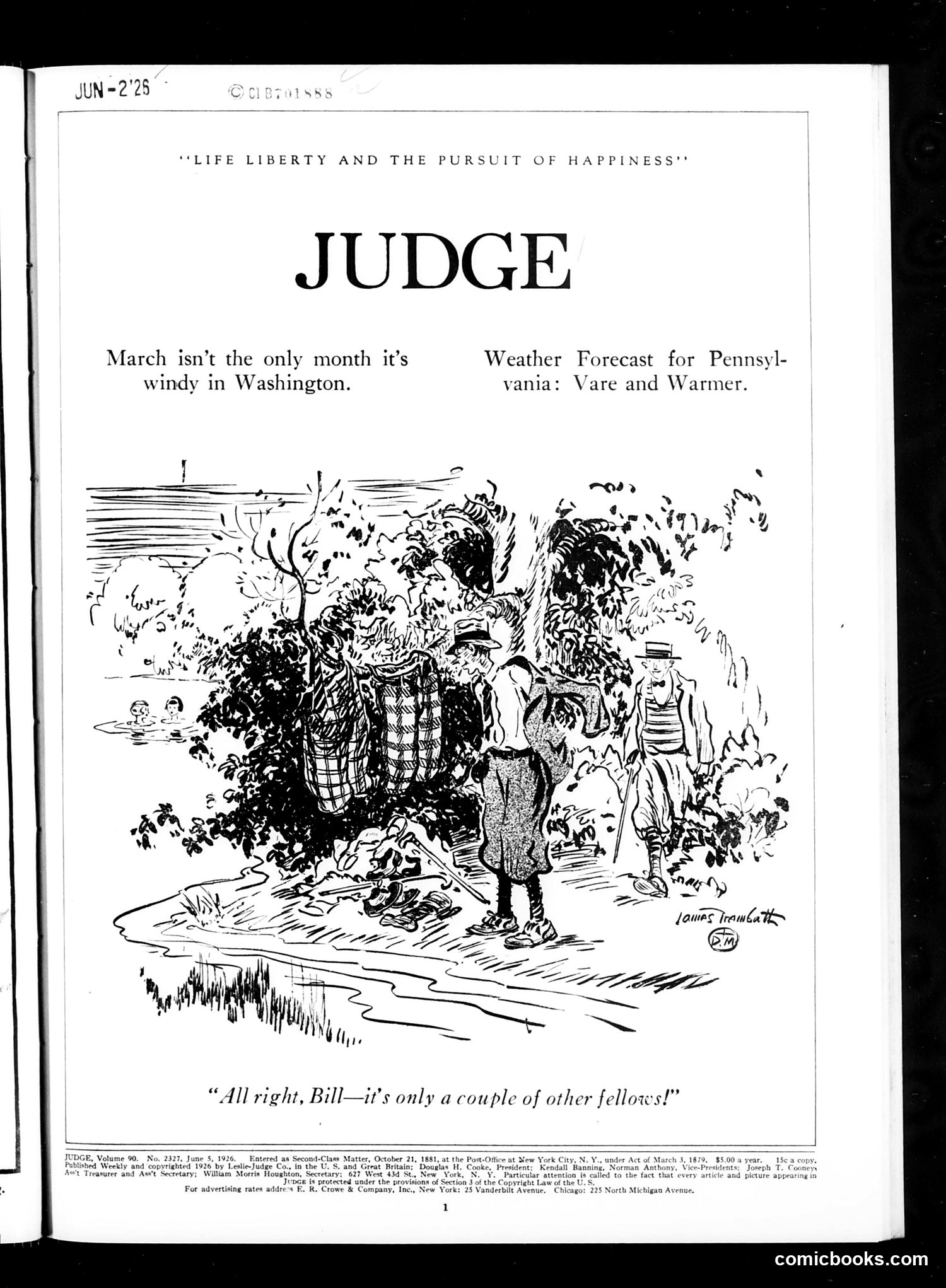
This cartoon satirizes unpredictable weather conditions in Washington, D.C. and Pennsylvania during March. The headline "March isn't the only month it's windy in Washington" uses "windy" as a double meaning—both literal weather and as slang for excessive talk or empty rhetoric from politicians. The illustration shows a group of people (appearing to include politicians or public figures based on their formal dress) caught in chaotic weather conditions with wind-blown vegetation. The caption "All right, Bill—it's only a couple of other fellows!" suggests someone named Bill is being reassured about competing voices or opinions, likely mocking the cacophony of political debate in Washington. The cartoon relies on contemporary understanding of Washington's reputation for political bluster.
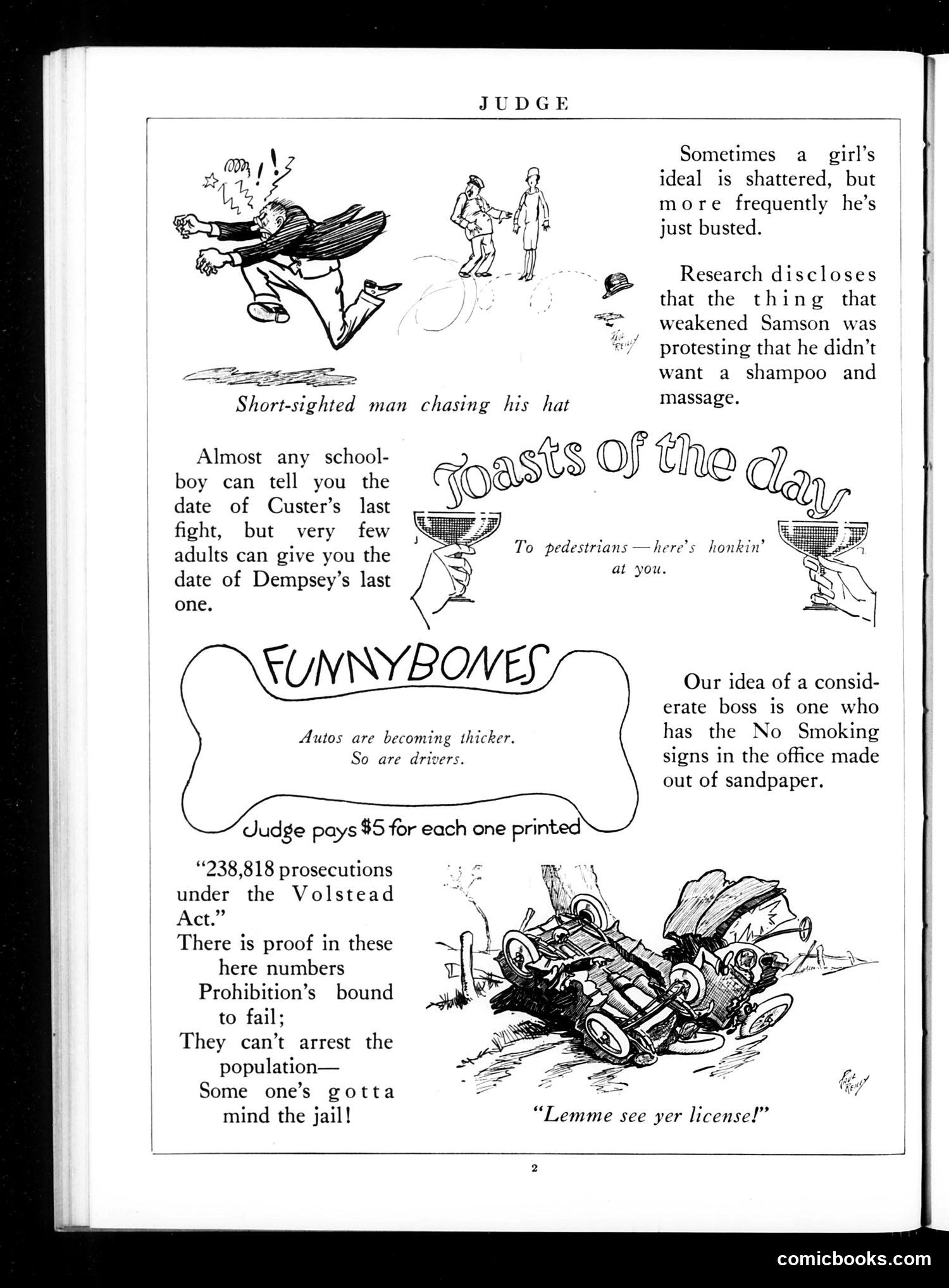
This page contains several satirical pieces from Judge magazine: **"Short-sighted man chasing his hat"** — A visual gag about a man losing his hat, with observers in the background. **"Toasts of the day"** — Drinking-themed jokes, including one directed at pedestrians, likely mocking reckless driving. **"Funnybones"** — A section with brief jokes, including observations about automobile and driver size, and a quip about considerate bosses using sandpaper for "No Smoking" signs. **Volstead Act commentary** — A poem criticizing Prohibition enforcement, noting 238,818 prosecutions under the law while arguing Prohibition will fail because authorities "can't arrest the population." **"Lemme see yer license!"** — A cartoon showing a car crash, satirizing traffic enforcement and reckless driving during the early automobile era. The page reflects 1920s concerns: Prohibition's failure, dangerous driving, and the chaos of early motoring.
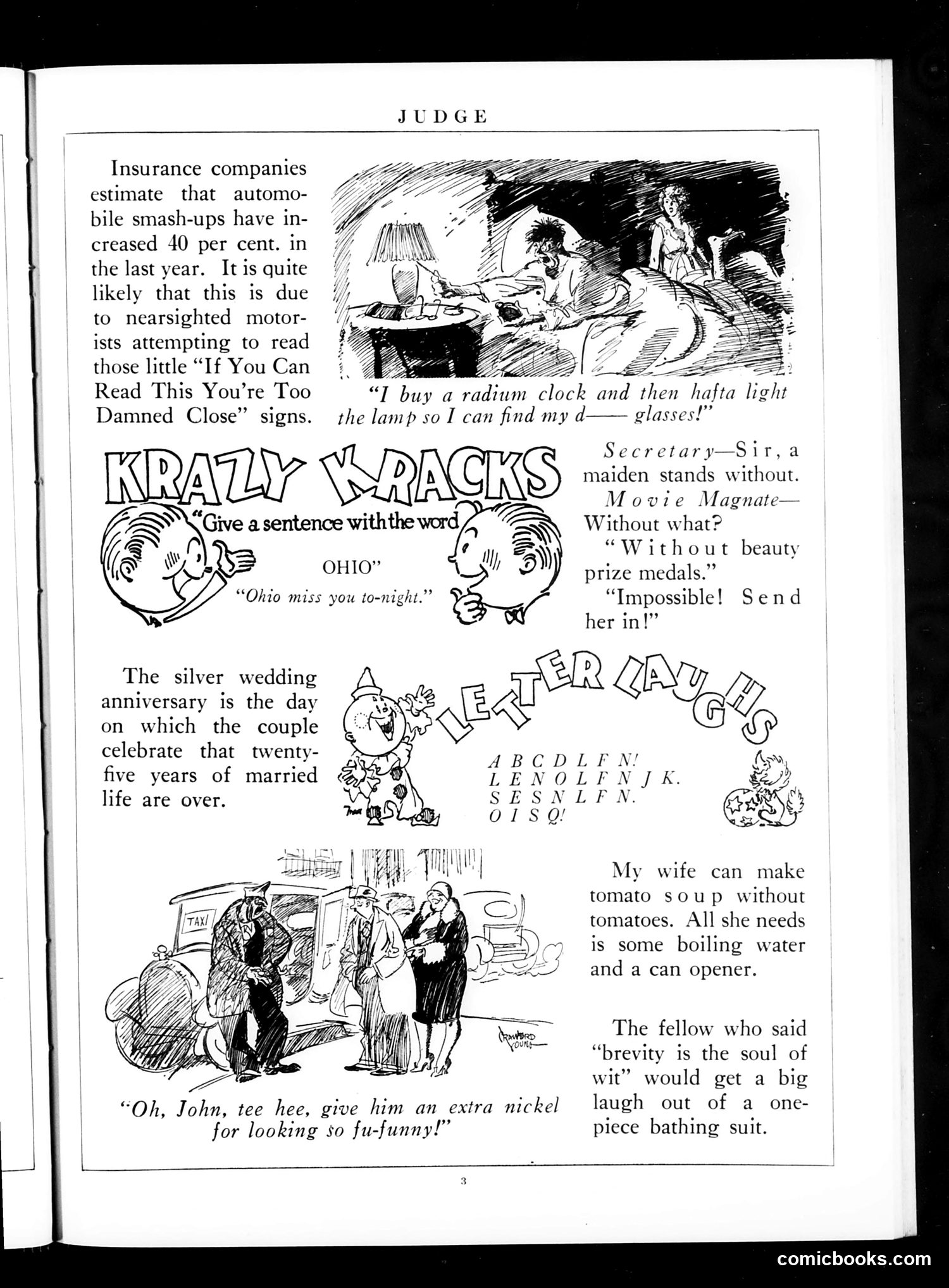
This page contains humor pieces rather than political cartoons. The content includes: **"Krazy Kracks"**: A word-game joke using "Ohio" with the pun "Ohio miss you to-night." **"Letter Laughs"**: A puzzle where letters spell hidden messages. **Humorous observations** about everyday life: - A joke about automobile accidents increasing due to unreadable road signs - A pun about radium clocks helping locate lost glasses - Commentary on wives' cooking abilities (making tomato soup without tomatoes) - A quip about brevity and one-piece bathing suits **A cartoon** showing a taxi driver receiving a tip for looking "ju-funny." The page reflects 1920s-30s American humor: wordplay, observations about domestic life, technology (radium products), and fashion. There are no political figures or events referenced—it's entertainment-focused humor typical of Judge magazine's lighter content.
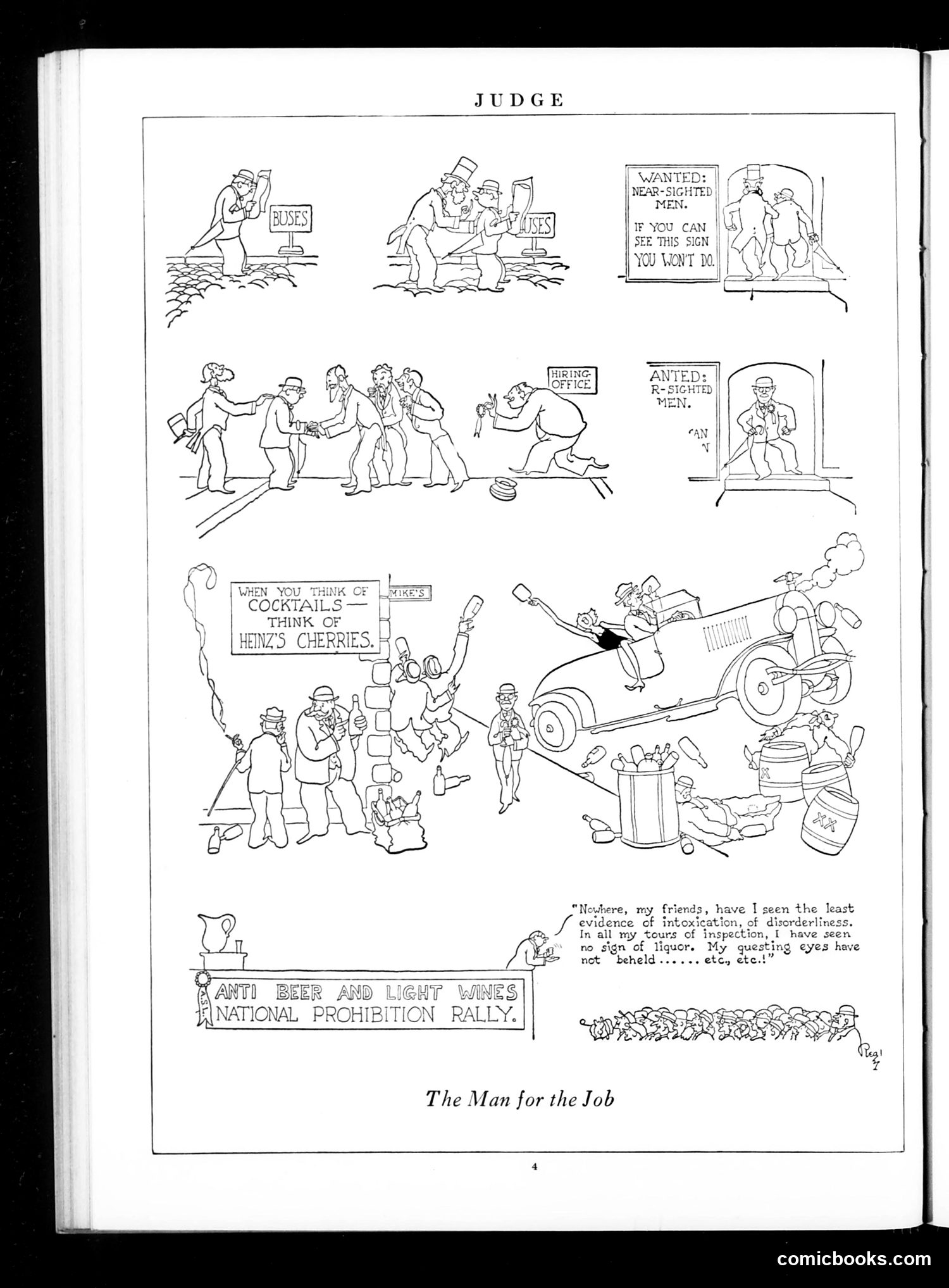
This satirical cartoon critiques Prohibition enforcement during the alcohol ban era (1920-1933). The page depicts the chaotic reality of finding someone qualified to enforce liquor laws. The top panels show recruitment attempts: men seeking jobs can't read signs advertising positions, suggesting incompetence among applicants. Middle panels illustrate the absurdity—hiring offices are mobbed while enforcement proves impossible. The lower section depicts rampant drinking and lawlessness, with a banner for an "Anti Beer and Light Wines National Prohibition Rally" amid widespread violations. The final quote mocks inspection failures: "Herefore, my friends, have I seen the least sign of liquor...etc." The overall message satirizes Prohibition's fundamental problem: finding honest, capable enforcement officials when corruption and public indifference made the law unenforceable.
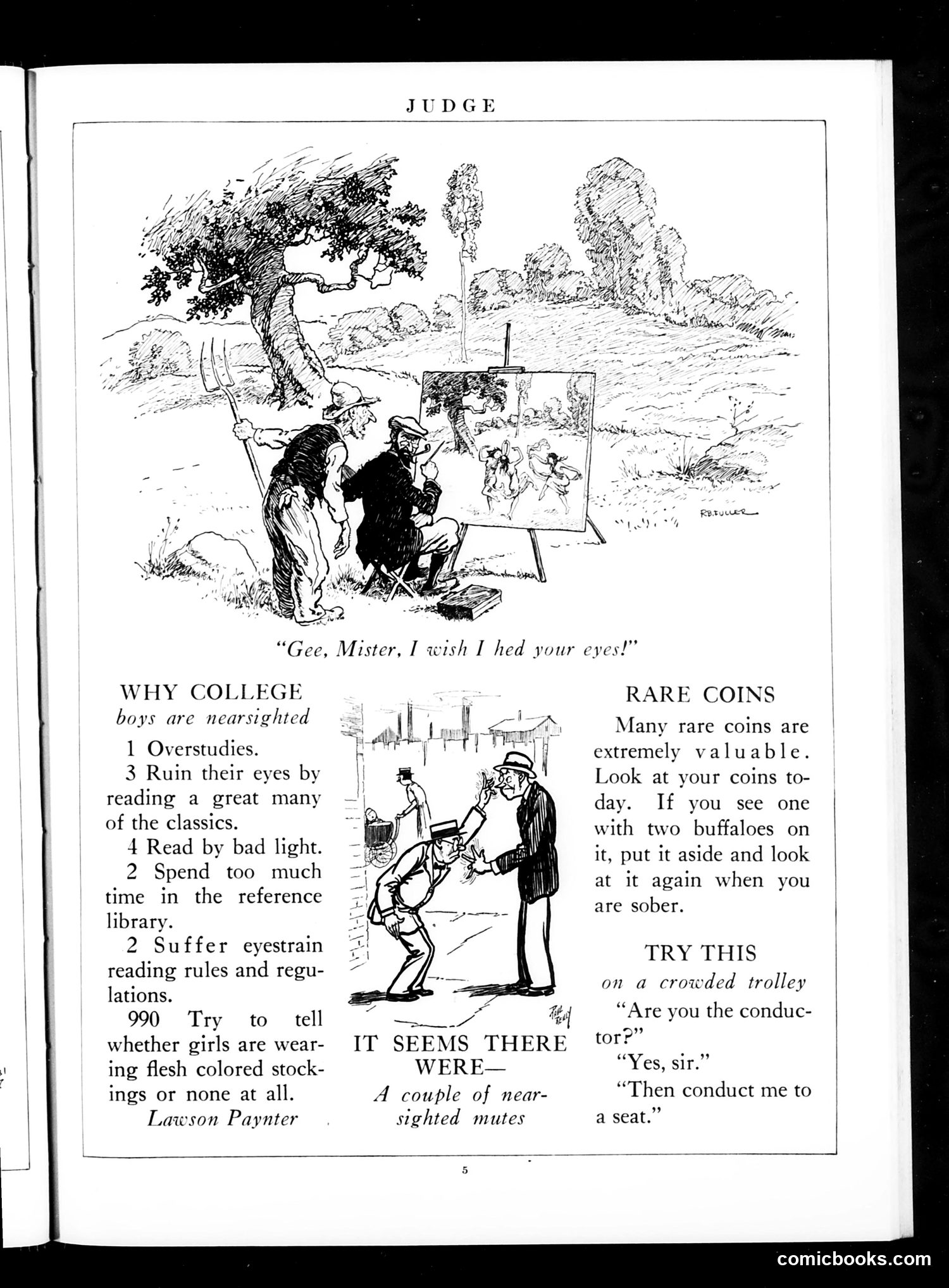
The top cartoon shows two nearsighted figures examining a painting outdoors—one wearing glasses, the other holding a monocle. The caption "Gee, Mister, I wish I hed your eyes!" is ironic, mocking both characters' vision problems. The page contains three separate humor items satirizing common issues: 1. **College nearsightedness**: Lists reasons college boys lose their eyesight (overstudying, poor lighting, excessive library time, reading restrictions). 2. **Rare coins**: Advises readers to examine their coins carefully, especially those with buffalo imagery, implying drunken mistakes in coin identification. 3. **Trolley conductor joke**: A brief punchline about mistaken identity on public transit. The satire targets academic strain, casual observation errors, and urban life absurdities typical of early 20th-century American humor.
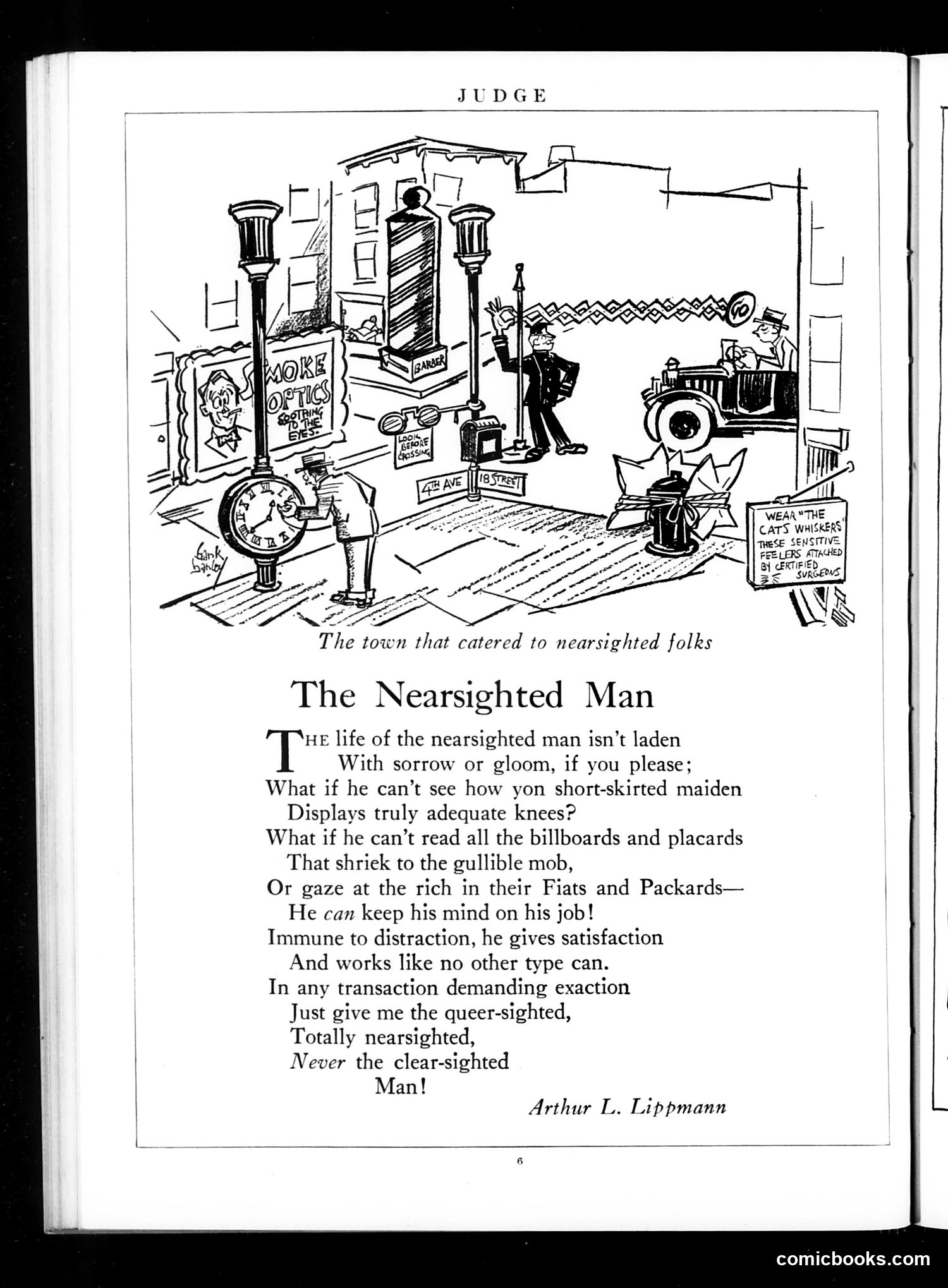
This is a humorous poem by Arthur L. Lippmann celebrating nearsighted men as superior workers. The satire mocks 1920s consumer culture and male distraction. The cartoon shows a town catering to nearsighted people with exaggerated signage, billboards, and advertisements. The poem's joke is ironic: while a nearsighted man *can't* see attractive women's legs, fancy cars (Fiats and Packards), or advertising billboards that distract others, this is actually *beneficial*. He stays focused on his job instead of being tempted by consumer goods and visual distractions. The author argues nearsighted men are more productive and reliable workers—they're "immune to distraction" in an increasingly advertisement-saturated society. It's satire on how modern life constantly competes for attention, suggesting that *inability* to see these temptations makes someone more dependable. The preference for "queer-sighted" and "totally nearsighted" men over "clear-sighted" ones inverts conventional thinking.
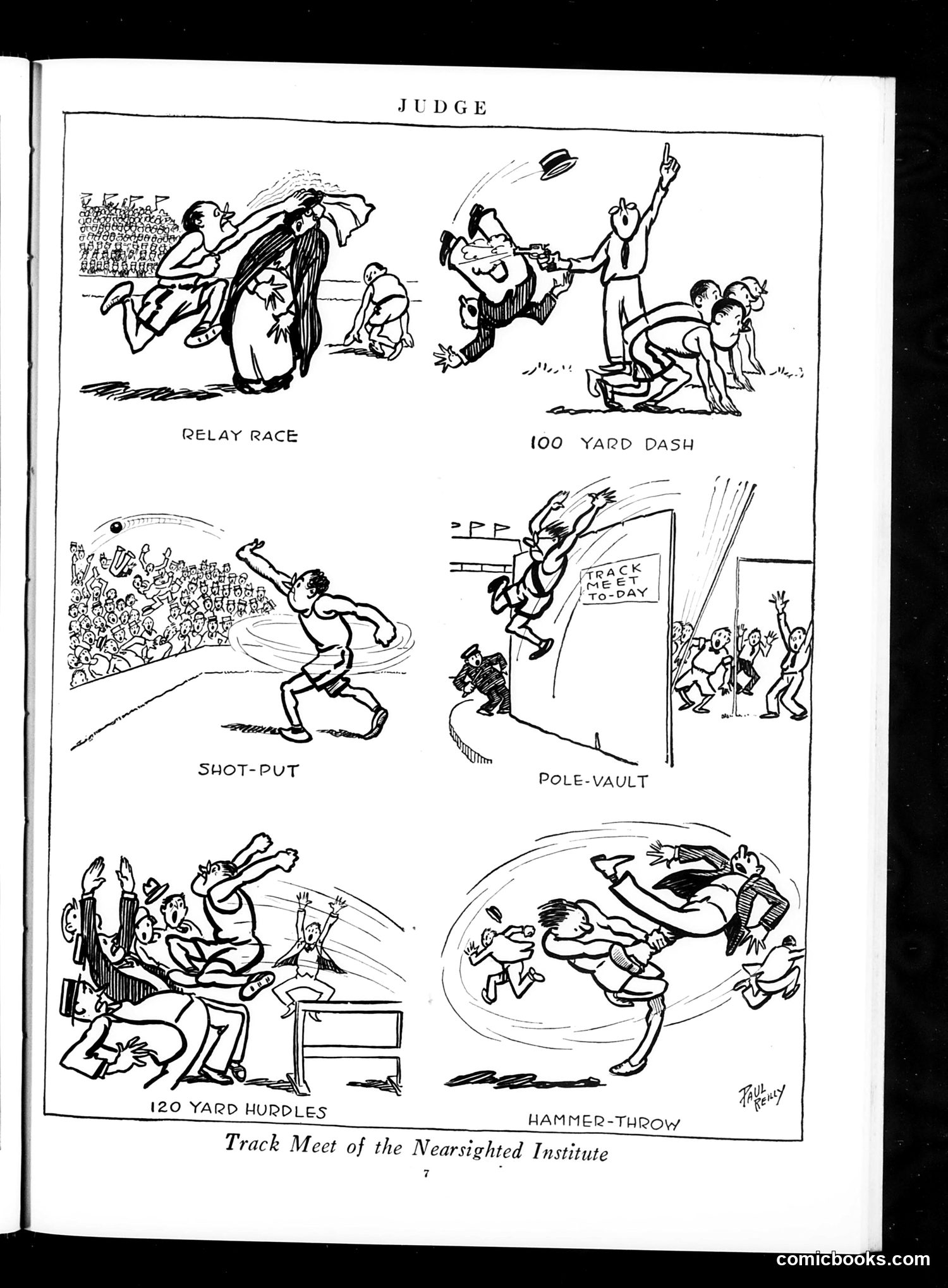
This is a satirical sports cartoon mocking people with poor eyesight. The page depicts six track-and-field events reimagined as chaotic disasters—a "Relay Race" where runners collide, a "100 Yard Dash" starting in confusion, a "Shot-Put" wildly off-target, "Pole-Vault" ending in a crash, "120 Yard Hurdles" with athletes tumbling over obstacles, and a "Hammer-Throw" spinning dangerously out of control. The joke relies on slapstick humor: nearsighted competitors cannot see properly, so standard athletic events become accidents waiting to happen. The crowded audience sketched in suggests this is a public spectacle of incompetence. The satire gently mocks vision impairment while delivering physical comedy typical of early 20th-century Judge magazine humor.
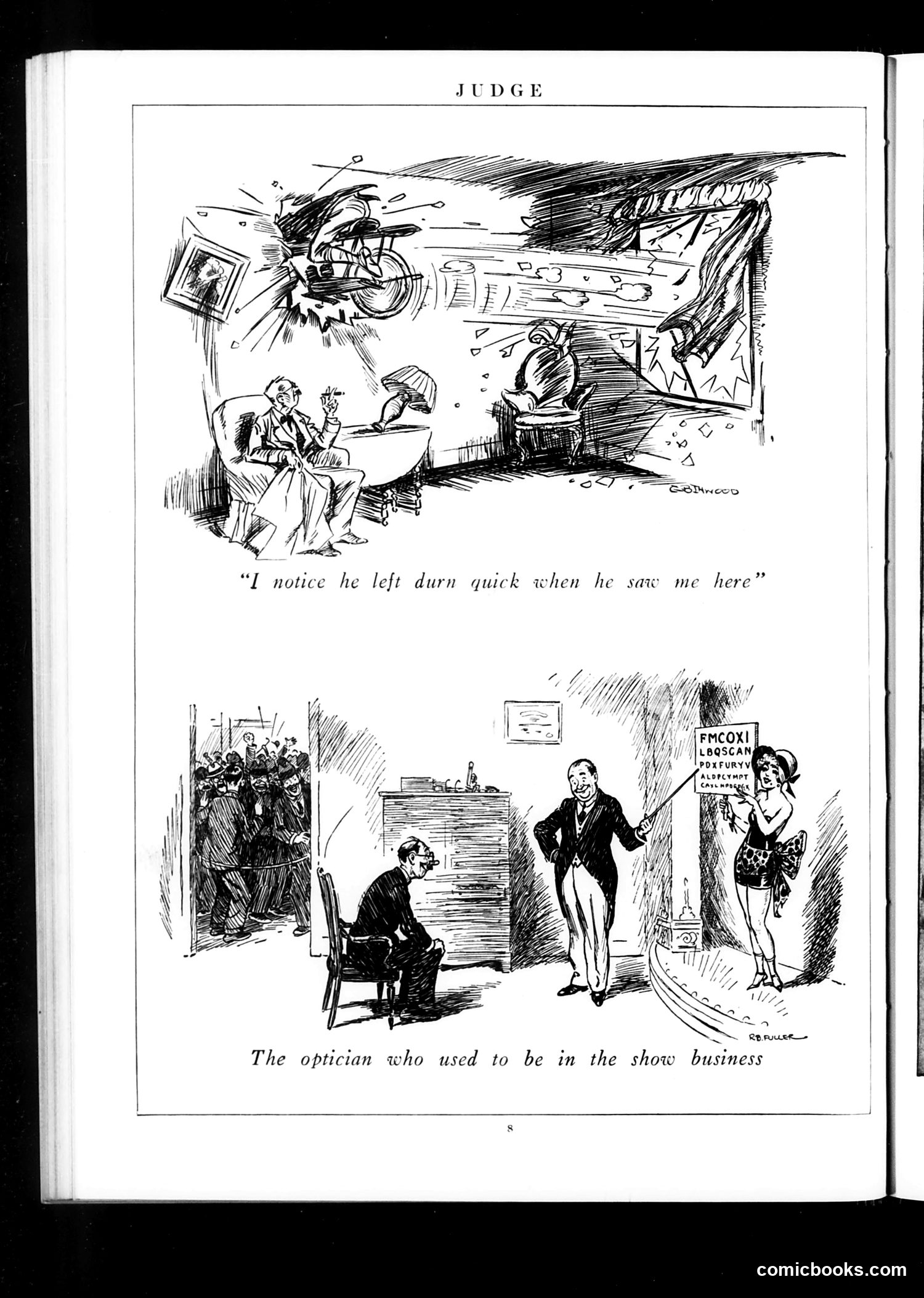
**Top cartoon:** A judge's chambers scene where a witness testifies that a defendant "left durn quick when he saw me here." The satire appears to target someone's guilty conscience or suspicious behavior upon encountering judicial authority. **Bottom cartoon:** Titled "The optician who used to be in the show business," this depicts a man in an optician's office with a sign advertising "Poxfury" (likely a patent medicine or theatrical product). The joke seems to satirize a former showman who has left entertainment for a more respectable profession—optometry. The woman on the right with theatrical appearance suggests the contrast between his former and current occupations. This mocks either the decline of vaudeville careers or the dubious legitimacy of patent medicine salesmanship.
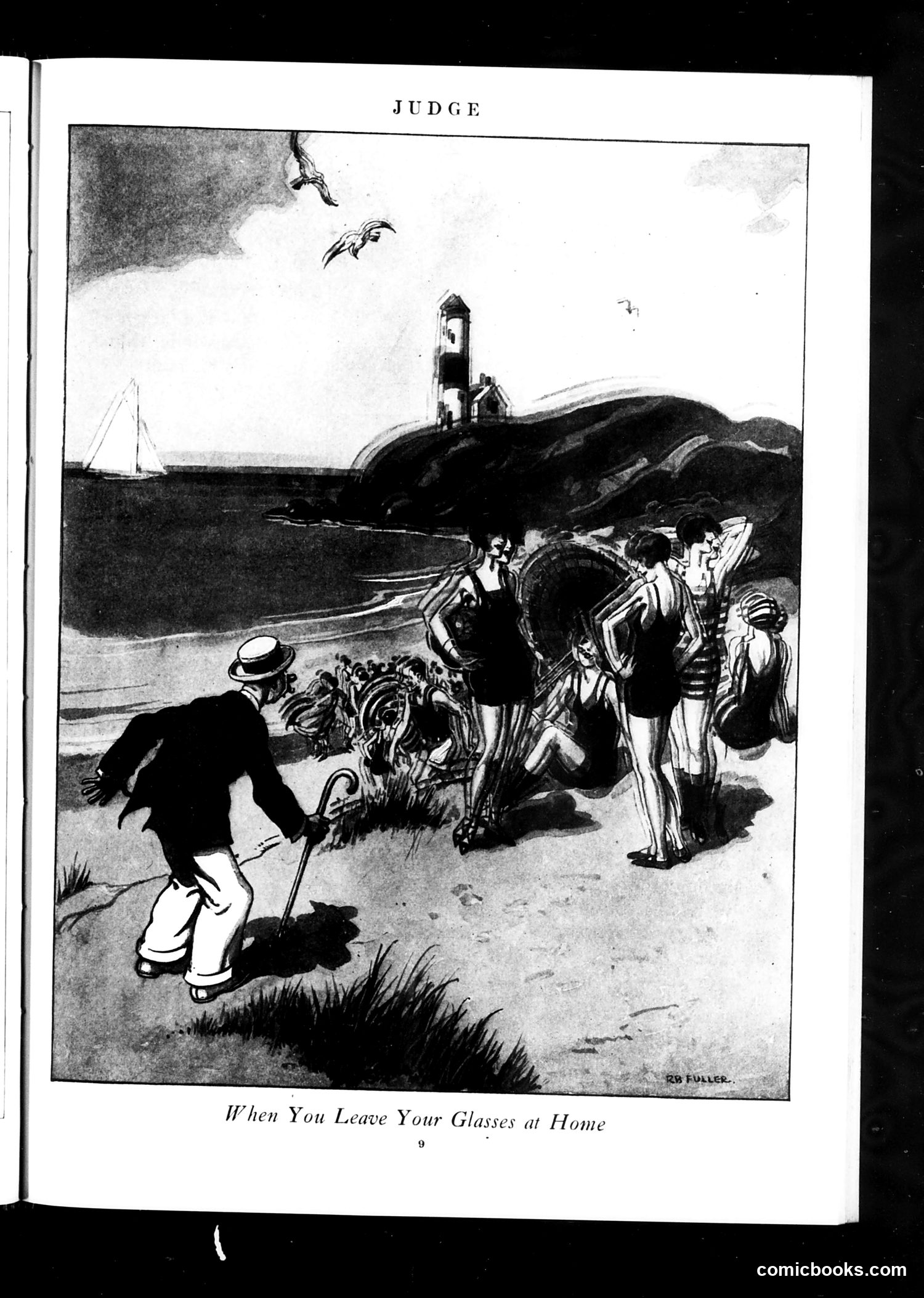
This Judge cartoon satirizes the consequences of poor eyesight or forgetfulness at the beach. An older gentleman in formal attire (suit and hat) squints confusedly at a group of women in 1920s-era bathing suits, apparently unable to see them clearly without his glasses. The humor targets the gentleman's predicament—he's socially out of place in formal dress among beachgoers, and his vision problems compound his discomfort. The joke likely plays on contemporary anxieties about aging, vanity (refusing to wear glasses in public), and the shock of modern women's increasingly revealing beach fashions of the era. The lighthouse and sailboat suggest a seaside resort setting. The cartoon relies on physical comedy and the visual gag of someone literally unable to see what's before him.
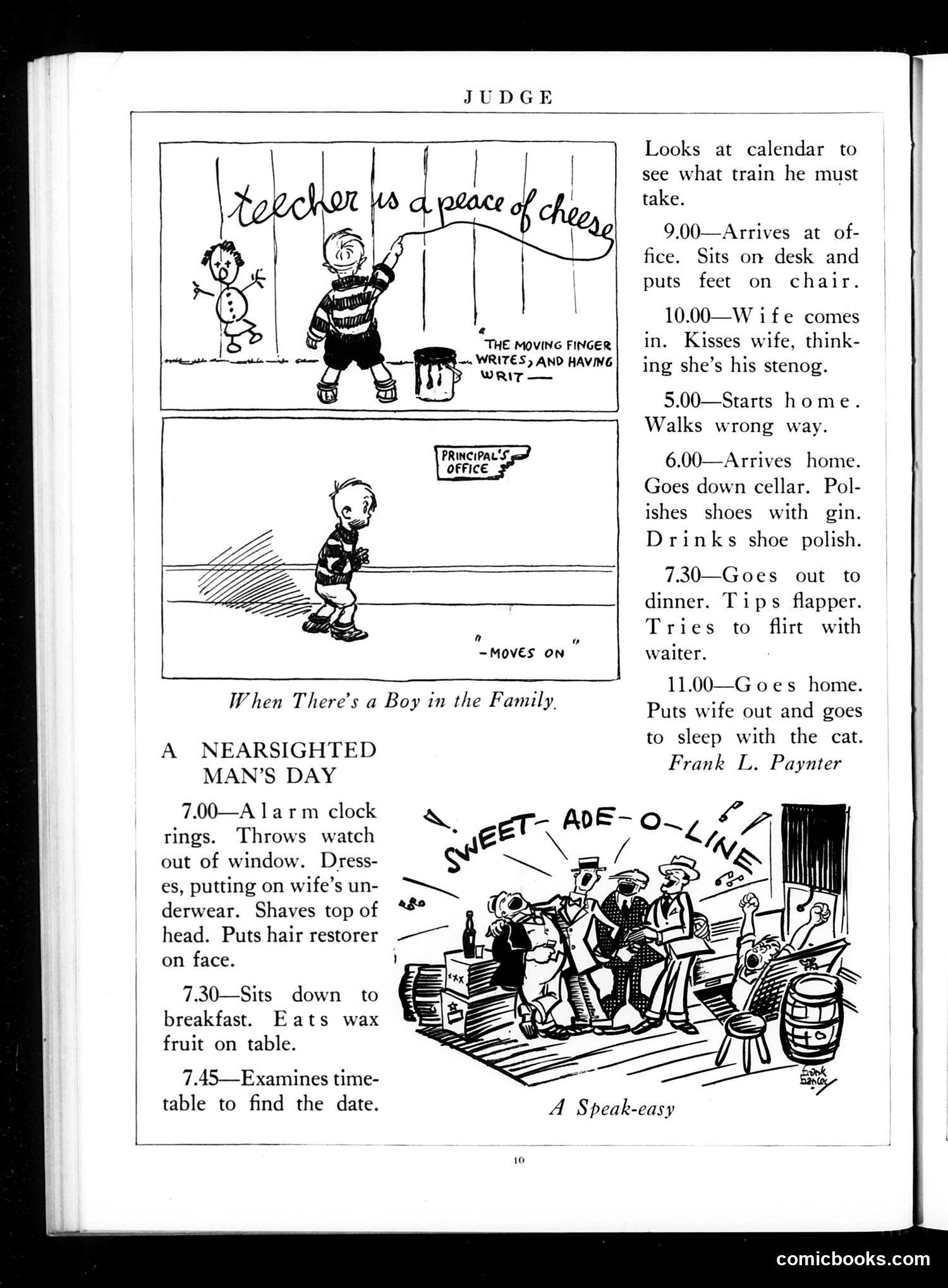
This page contains two satirical pieces mocking men's bumbling behavior, likely from the 1920s-1930s. **"When There's a Boy in the Family"** depicts a disheveled man creating chaos at a school—the caption "The moving finger writes—and having writ, moves on" (referencing Omar Khayyam's *Rubaiyat*) sarcastically compares his destructive behavior to fate itself. **"A Nearsighted Man's Day"** by Frank L. Paynter is a day-in-the-life joke mocking male incompetence: he dresses in his wife's underwear, eats wax fruit, gets drunk on shoe polish, mistakenly kisses his wife thinking she's his stenographer, and eventually sleeps with the cat. The humor targets absent-mindedness, alcoholism, and marital infidelity—common Judge targets. **"A Speak-easy"** (bottom right) appears to be a separate cartoon depicting Prohibition-era illegal bars, likely mocking speakeasy culture. These pieces use exaggeration to satirize contemporary masculine behavior during a period of social change.
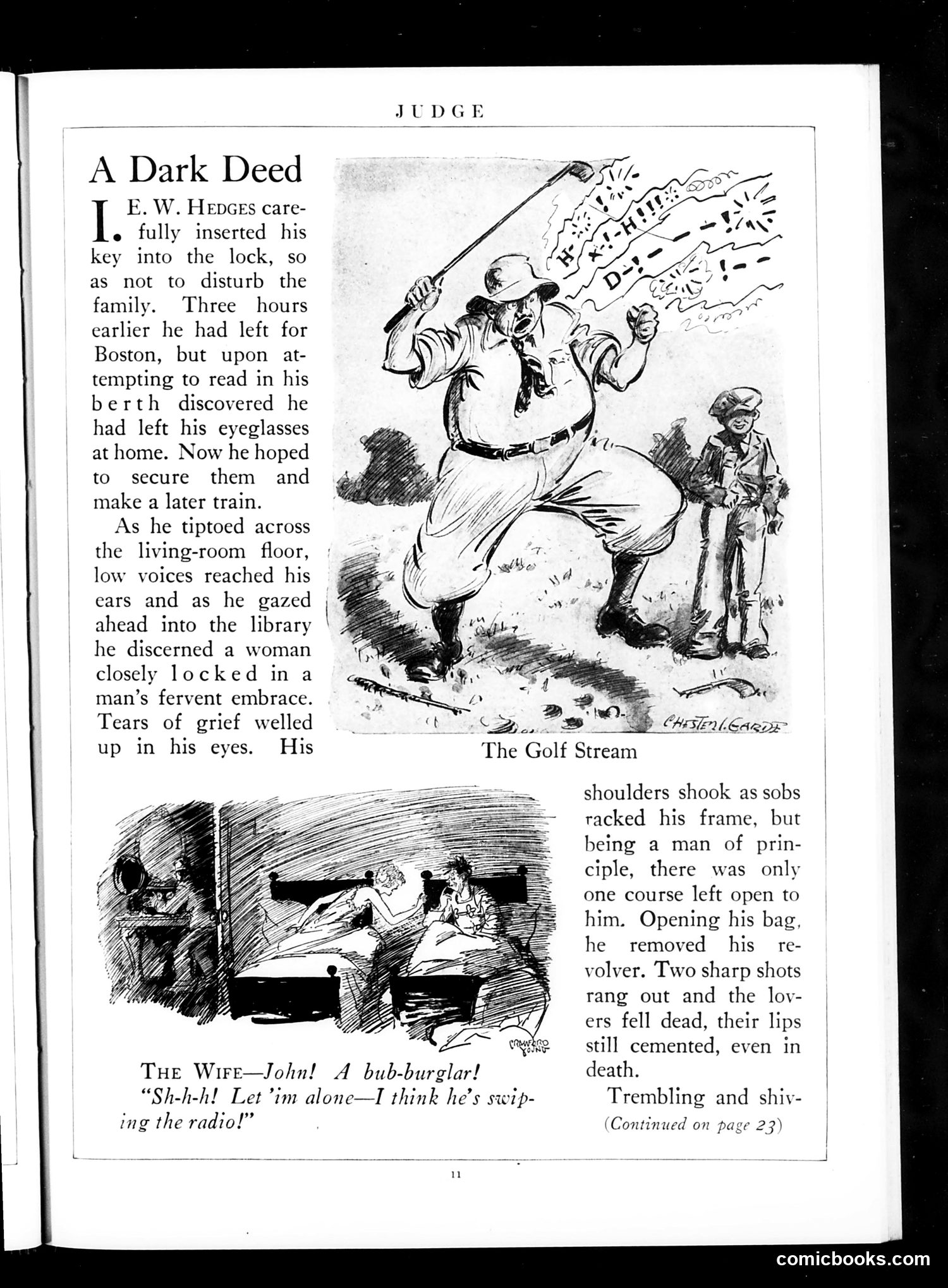
This story presents a dark domestic tragedy played for satirical humor. E.W. Hedges returns home unexpectedly after forgetting his eyeglasses, discovers his wife in an intimate embrace with another man in the library, and shoots them both dead in a crime of passion. The joke's cynicism lies in the bottom cartoon: while Hedges commits murder upstairs, his *wife* downstairs calls out to a burglar to leave the radio alone—implying she's the unfaithful party, yet her concern is petty theft, not her husband's violent discovery. The satire mocks both domestic hypocrisy and the melodramatic "man of principle" justification for murder. Judge magazine frequently satirized middle-class morality and marital infidelity as contemporary scandals. The juxtaposition of tragedy with mundane property crime creates dark comedy from the contrast between the couple's secret affair and the wife's casual priorities.
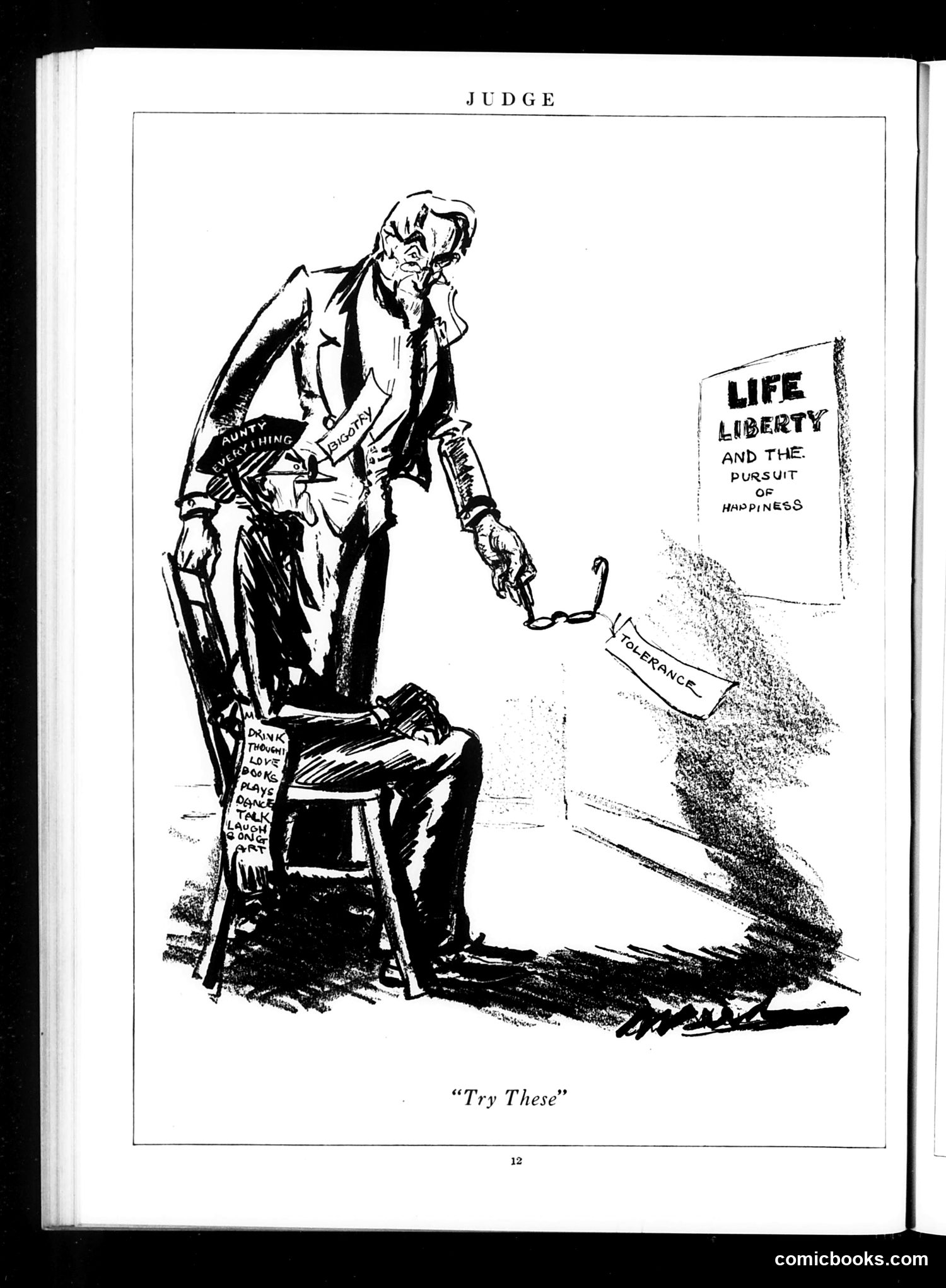
This cartoon titled "Try These" depicts a stern-faced **Judge** (personified as an older man in judicial robes) offering alternatives to American constitutional values. He holds a document labeled "LIFE LIBERTY AND THE PURSUIT OF HAPPINESS" (paraphrasing the Declaration of Independence) while gesturing toward a crumbling foundation labeled "TOLERANCE." The chair beneath him lists prohibited activities: "DRINK LOVE MUSIC PLAY CARDS TALK FREELY THINK"—suggesting governmental or social restrictions on personal freedoms. The satire critiques **judicial overreach or social restrictions** that undermine fundamental American liberties. The collapsing "tolerance" foundation implies that abandoning civil freedoms creates instability. The cartoon likely comments on Prohibition, censorship, or other early 20th-century restrictions that the satirist saw as contradicting American founding principles.
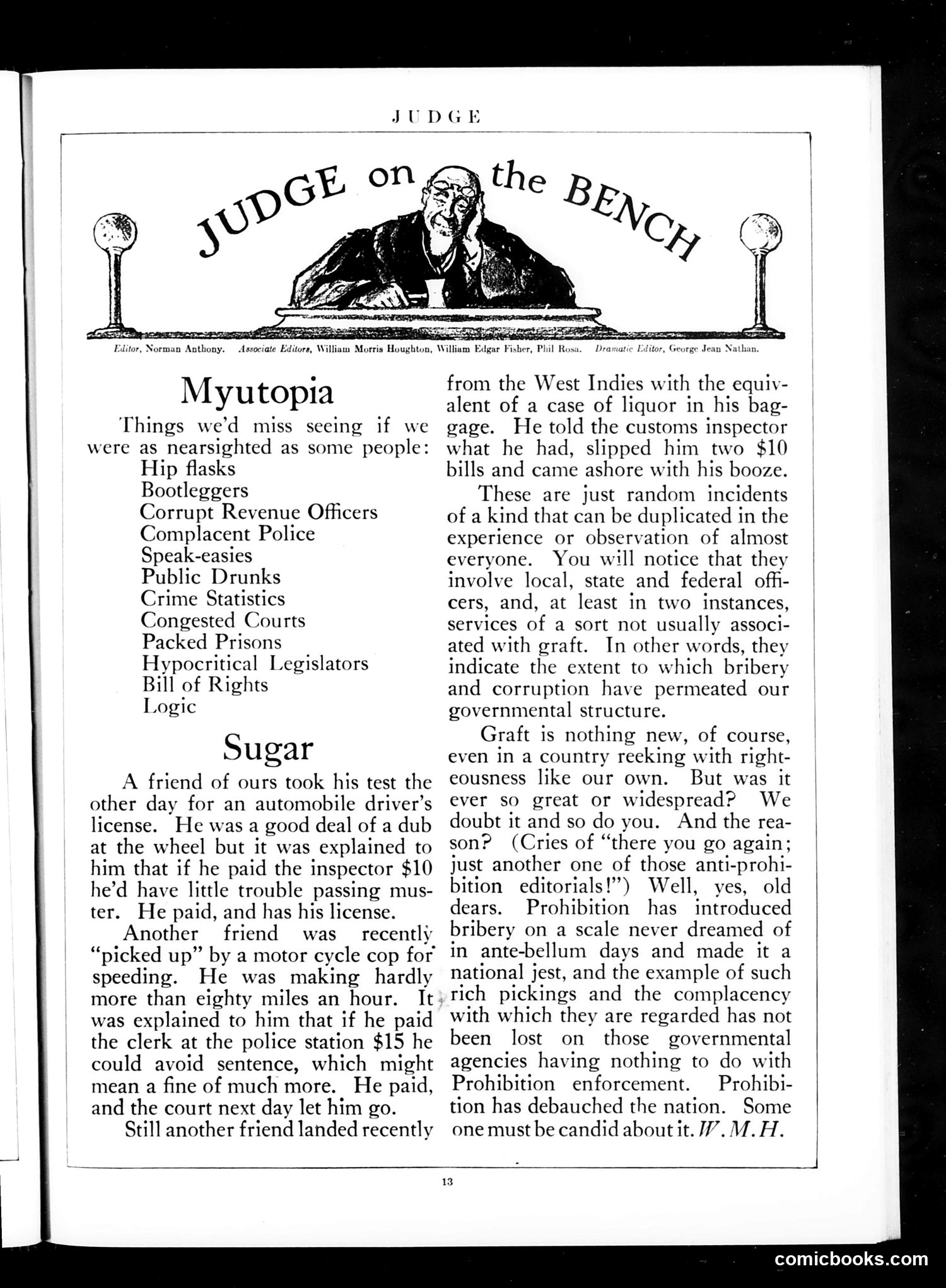
This page satirizes widespread governmental corruption during Prohibition (1920-1933). The masthead illustration shows a judge contemplating society's problems. The "Myutopia" column lists things society would "miss" if blind to corruption—a sarcastic inversion suggesting these evils are rampant and normalized. The main article, titled "Sugar," documents three anecdotes of casual bribery: a driving test passed for $10, a speeding ticket avoided for $15 to a police clerk, and a smuggler bribing customs inspectors $20 for bootleg liquor passage. The satire's point: Prohibition has made bribery endemic across federal, state, and local agencies. The author argues that while corruption existed before, Prohibition's enforcement created unprecedented opportunities and normalized graft so thoroughly that other government services adopted similar practices. The implicit critique: Prohibition itself—by criminalizing alcohol—created the corruption it spawned.
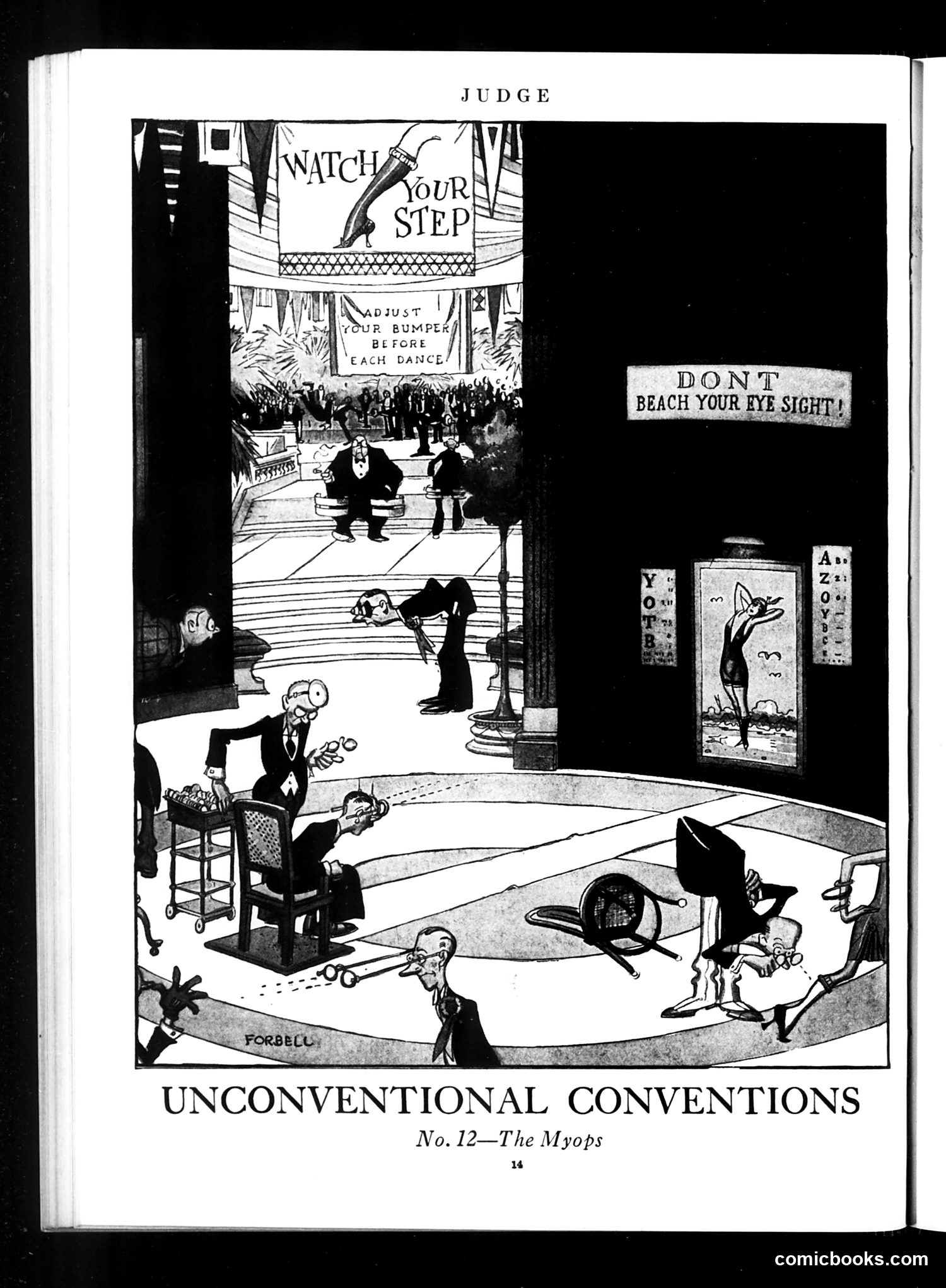
This is a satirical cartoon titled "Unconventional Conventions: No. 12—The Myops," appearing to mock short-sighted behavior at social gatherings or formal events. The scene depicts a ballroom or dance hall where attendees display various forms of myopia (nearsightedness)—both literal and figurative. Signs reading "Watch Your Step," "Adjust Your Bumper Before Each Dance," and "Don't Beach Your Eye Sight" suggest people are literally colliding or failing to notice their surroundings. An eye chart visible on the wall reinforces the vision-related humor. The cartoon satirizes how people at conventions or formal events fail to observe social awareness—they're metaphorically "blind" to proper etiquette and spatial awareness, bumping into one another despite obvious warnings. The title suggests this represents a particular social convention or type of attendee deemed comically myopic in their behavior.
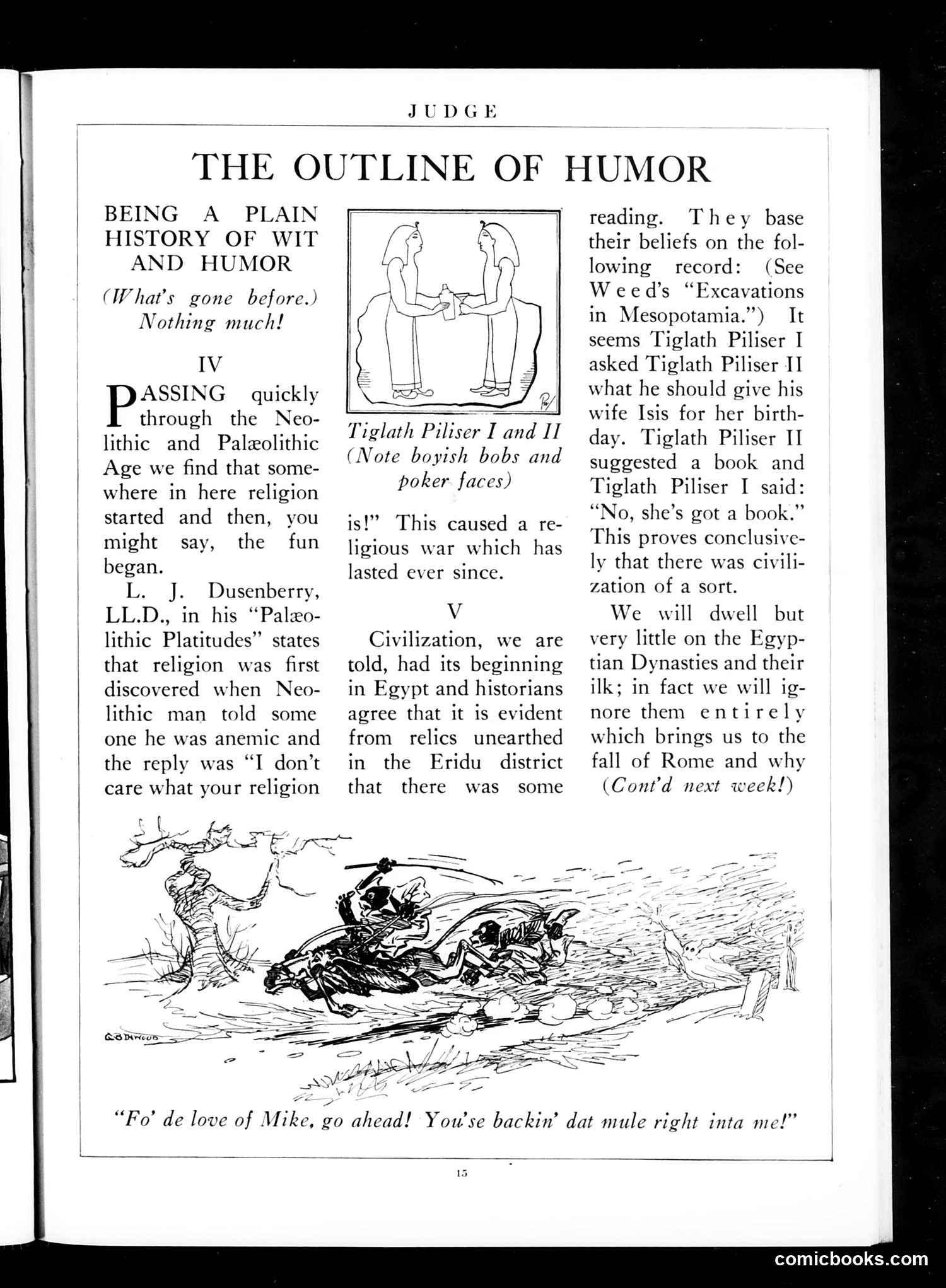
This is page 13 from Judge magazine's humorous historical series "The Outline of Humor." The content is satirical pseudo-history, mocking both scholarly pretension and human nature. **The Main Cartoon:** Shows a man being backed into by a mule while another man urges him forward with dialect speech ("Fo' de love of Mike"). This illustrates comic physical misfortune—a common vaudeville/slapstick trope of the era. **The Text Satire:** The article humorously traces humor's origins, claiming religion sparked the first "fun" when a Neolithic man's complaint about being anemic was dismissed. It then cites a fabricated archaeological "record" about ancient Assyrian kings Tiglath Piliser I and II, where the punchline is that civilization existed because a wife already owned a book—reducing "civilization" to mere book ownership. **The Joke:** Judge mocks both academic pomposity (fake scholarly citations) and the triviality of human achievement. The article's deadpan delivery of absurd claims creates the humor—nothing here is meant seriously.
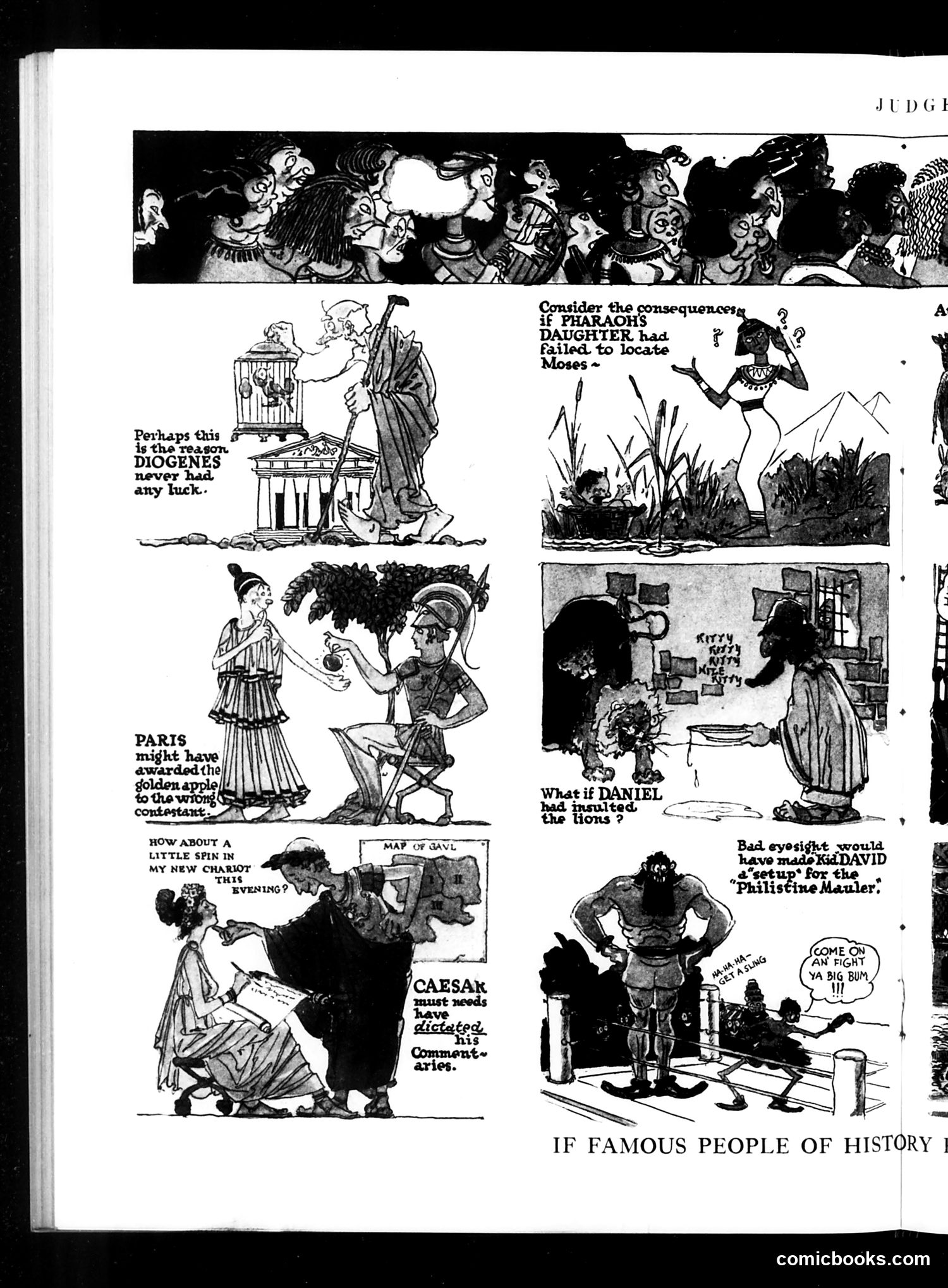
This Judge magazine page uses humorous "what-if" scenarios about historical figures to make a point about luck or chance in history. Each panel presents a famous biblical or classical figure and humorously imagines negative consequences if circumstances had been slightly different: - **Diogenes** (Greek philosopher) never had luck—implying his cynical lifestyle doomed him - **Pharaoh's daughter** finding Moses was crucial to history - **Daniel** insulting lions would have been fatal (rather than surviving the lion's den) - **David vs. Goliath**: poor eyesight would have handicapped him against the Philistine giant The satire suggests that historical "greatness" often depends on trivial circumstance rather than actual merit or ability. The cartoonist mocks how we mythologize historical figures while overlooking how much their success relied on luck rather than virtue. It's a comedic deflation of historical heroism.
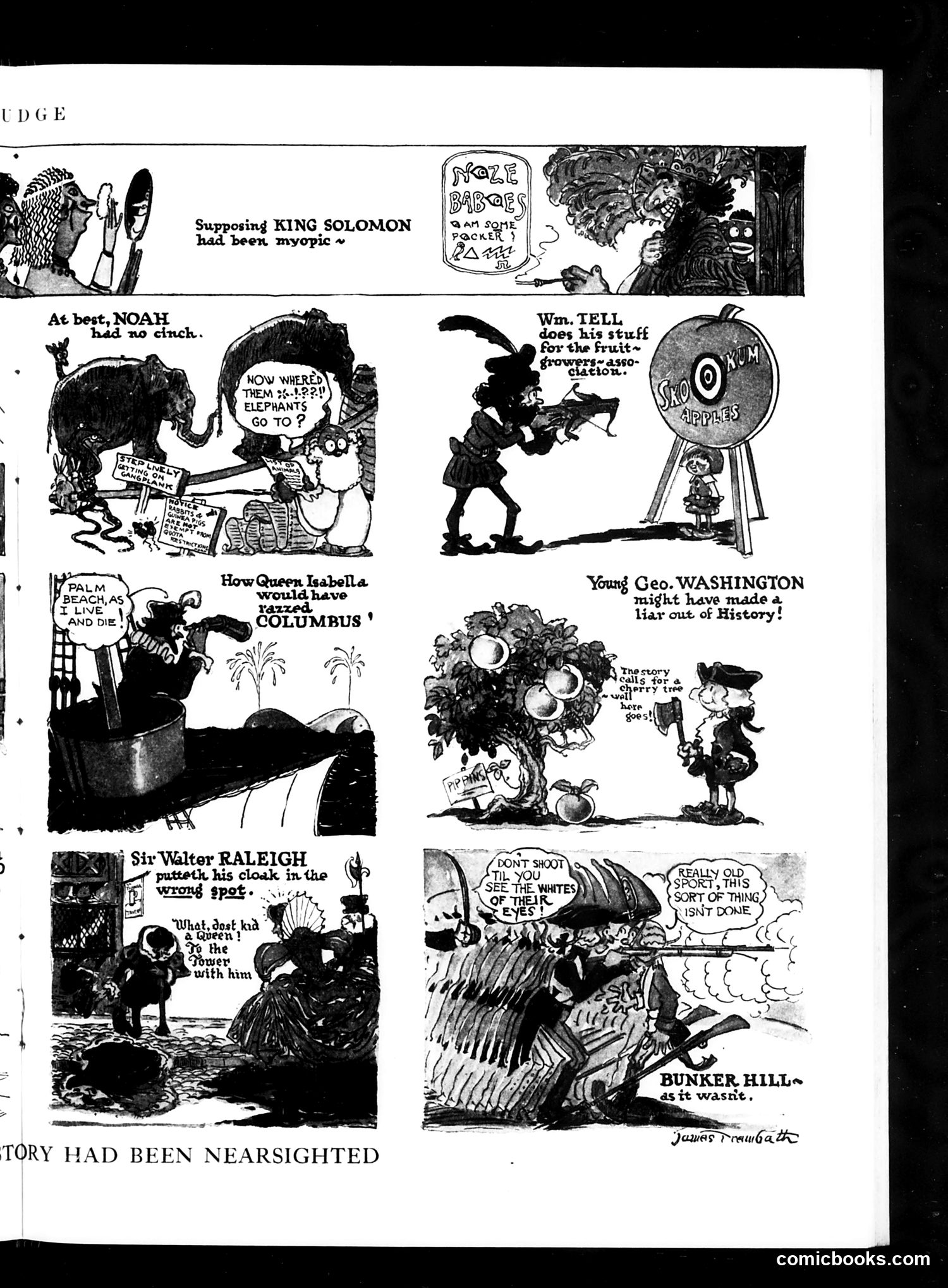
This Judge cartoon page presents a series of humorous "what-if" scenarios imagining famous historical figures as myopic (nearsighted). Each panel playfully reimagines well-known stories with vision problems as the punchline: - **King Solomon** (top): Suggests his legendary wisdom would fail without sight - **Noah**: References the difficulty of his ark-building task - **William Tell**: His famous apple-shooting feat becomes impossible - **Queen Isabella**: Her patronage of Columbus would be questioned - **George Washington**: References the cherry tree legend - **Sir Walter Raleigh**: His gallant cloak-spreading gesture wouldn't occur - **Bunker Hill** (bottom): A Revolutionary War battle would proceed differently The satire is gentle, playing on how these historical narratives depend on specific actions or visual accomplishments. The joke relies on readers' familiarity with these canonical stories and their absurdist consequences.
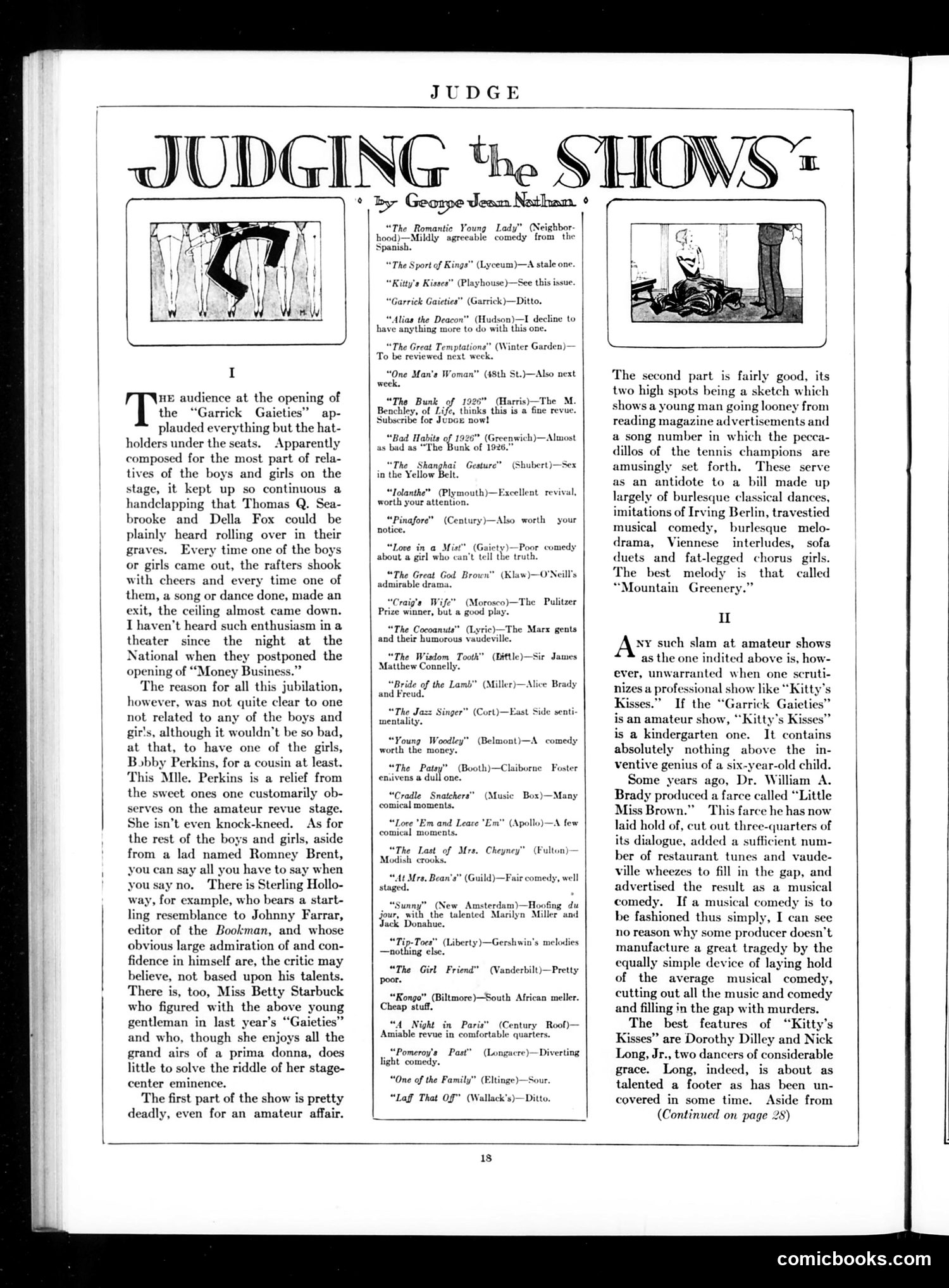
This page features theater critic George Jean Nathan's reviews of Broadway shows from the 1920s. The main article discusses the "Garrick Gaieties," an amateur theatrical revue, noting that audience enthusiasm came largely from relatives of performers rather than genuine merit. Nathan's critique is characteristically sharp: he praises dancer Bobby Perkins as refreshingly unglamorous, mocks Sterling Holloway's unwarranted self-confidence (comparing him unfavorably to Bookman editor Johnny Farrar), and dismisses Betty Starbuck's pretensions. He finds the first act "pretty deadly." The page also includes Nathan's capsule reviews of other current Broadway productions, ranging from praised offerings like "Craig's Wife" and O'Neill's "The Great God Brown" to dismissed shows like "Alias the Deacon." The cartoons (showing legs and a reclining figure) appear to illustrate the article's themes about amateur theatrical performance and audience behavior.
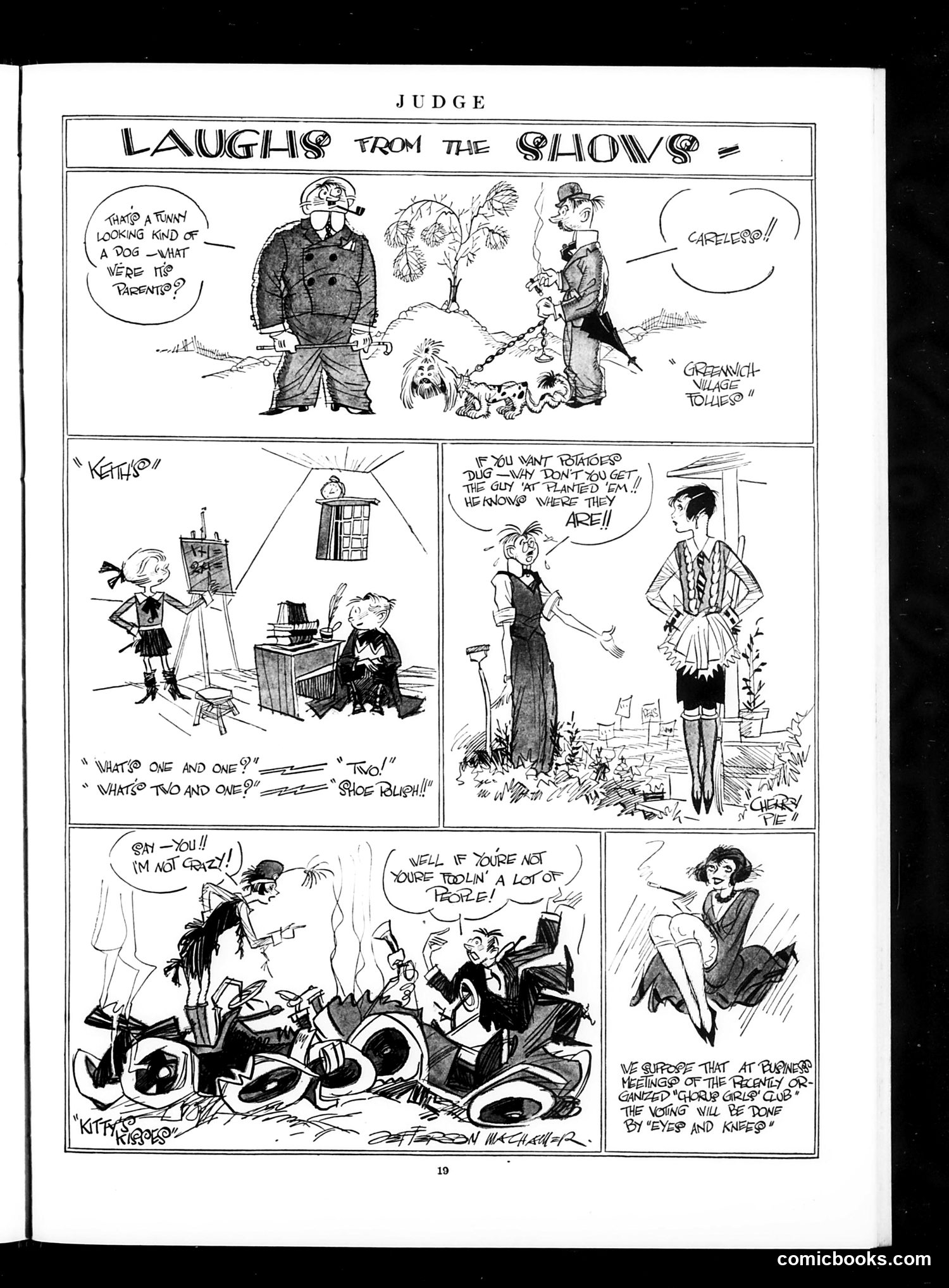
This page collects satirical humor allegedly drawn from theatrical performances. The top panel mocks military discipline with a stern soldier confronting civilians about a dog's parentage—a absurdist joke about authority taking itself too seriously. The middle panels lampoon vaudeville acts: one shows a mind-reading performance ("What's one and one?") with deliberately wrong answers creating comedy, while another depicts a woman explaining her revealing outfit as a "Greenwich Village" fashion statement—mocking bohemian artistic pretensions as mere exposure. The bottom section ridicules a "Girls' Club" presentation where women apparently planned violence ("eyes and knives"), suggesting satirical anxiety about women's organizations and changing social roles during this era. The overall page uses theatrical settings to mock contemporary concerns: military regimentation, fraudulent mentalism acts, bohemian culture, and emerging female independence. Judge used entertainment contexts to deliver sharp social criticism.
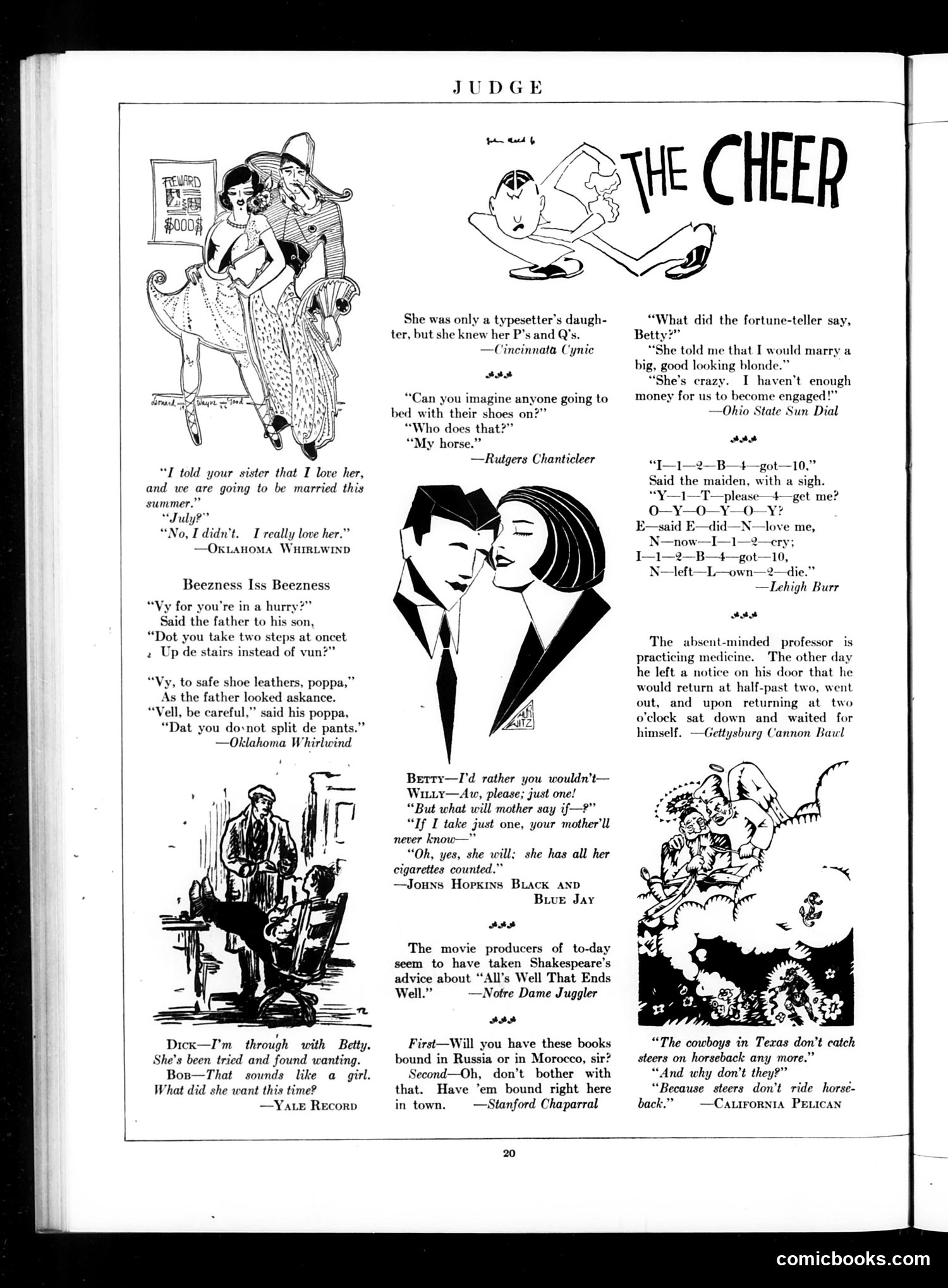
This page collects short jokes and humorous anecdotes from various college publications, typical of Judge's format. The cartoons illustrate popular comedic themes of the era: **Visual content** includes a couple in romantic embrace (top right) and domestic/courtship scenes that accompany the quips. **The jokes revolve around**: - Courtship misunderstandings and marriage anxieties (fortune-teller predicting a blonde; a man lacking money for engagement) - Immigrant/ethnic dialect humor (the "Beezness Iss Beezness" section uses Yiddish-inflected English for comic effect) - College-era romance and rejection - An absent-minded professor pratfall - Wordplay and coded messages in love notes **The satire targets** 1920s social concerns: marriage economics, generational behavior, and courtship rituals. The college attributions suggest Judge drew heavily from campus humor magazines, reflecting what educated youth found amusing. The overall tone is light, sentimental comedy rather than political satire—typical entertainment content for a general-audience magazine.
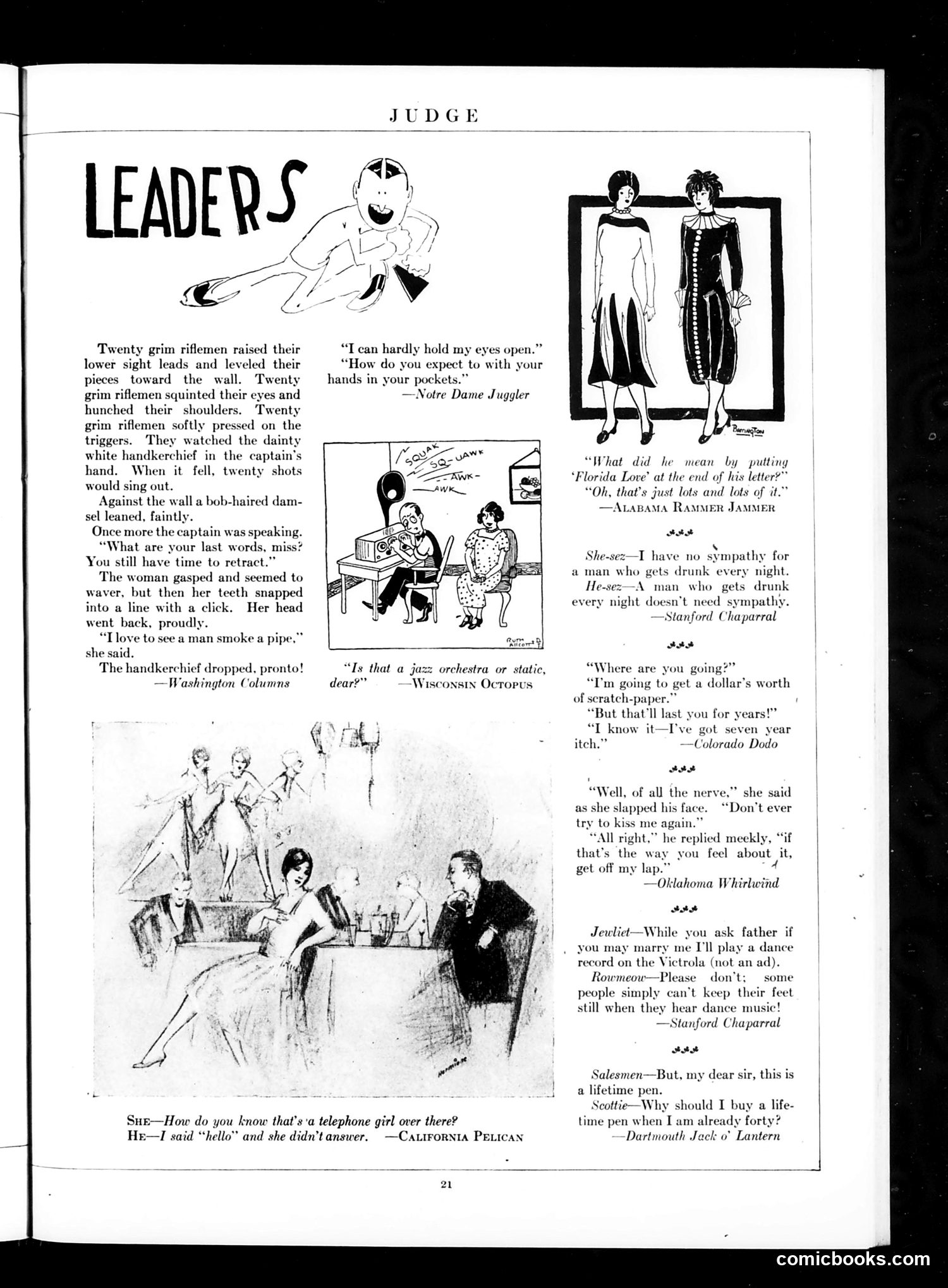
This page collects short humorous jokes and cartoons from college humor magazines (Stanford, Wisconsin, Alabama, etc.), typical of Judge's format. **Main content:** The lead story depicts a woman facing a firing squad, executed for the scandalous statement "I love to see a man smoke a pipe"—satirizing strict social morality and gender expectations of the era. Women smoking or associating with smoking was considered improper. **Other jokes target:** - Telephone operators' rudeness (the "hello" joke) - Drunk men and social drinking culture - Young men's romantic frustrations and physical boundaries with women - Materialism (lifetime pen sales pitch) - Jazz music's effect on dancing The recurring theme is **social propriety violations and courtship awkwardness**—typical 1920s preoccupations. The humor relies on period-specific anxieties about modernity, gender roles, and changing social norms, now largely incomprehensible without historical context.
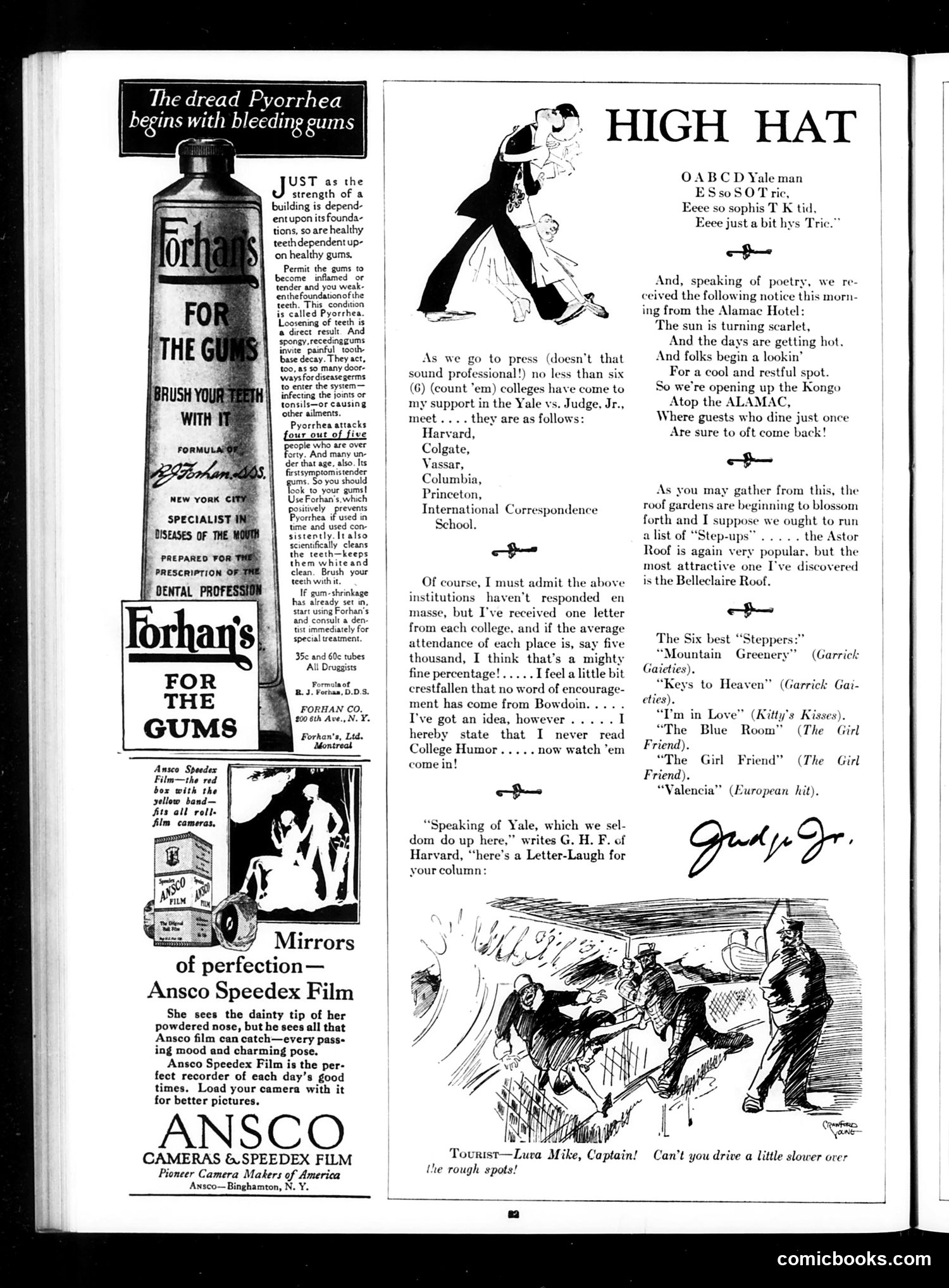
This page from Judge contains a humor column titled "High Hat" alongside period advertisements. The main satirical content is a brief exchange between a tourist and a taxi driver, captioned: "Tourist—Lura Mike, Captain! Can't you drive a little slower over the rough spots!" The joke relies on a play on the tourist's name sounding like "Lower, Mike" when spoken aloud, leading the driver to misinterpret the request as commentary on his driving speed rather than a plea for gentler handling of road conditions. The column also lists Yale-affiliated colleges supposedly supporting the author in a humorous rivalry with "Judge, Jr.," and recommends popular theatrical entertainment ("Steppers") including shows like "Keys to Heaven" and "I'm in Love." The advertisements—for Forhan's gum treatment, Ansco cameras, and film—are typical early 20th-century magazine content targeting middle-class readers.
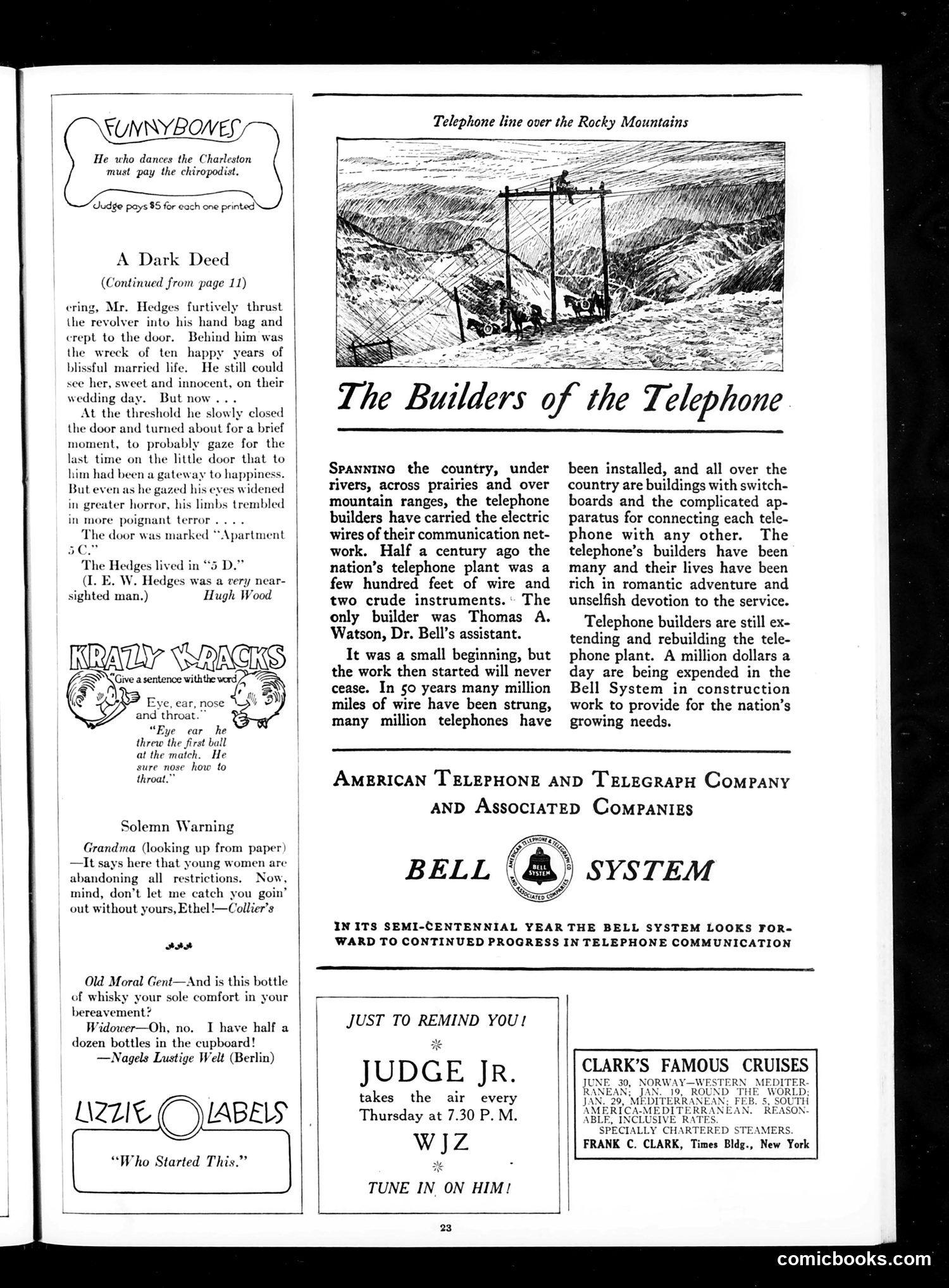
This page contains mixed content: a serialized story conclusion, several jokes, and advertising. **"A Dark Deed"** appears to be a melodramatic serial story about a man named Hedges discovering his wife's infidelity, culminating in him retrieving a revolver—clearly satirizing overwrought pulp fiction popular in the 1920s. **The humor pieces** include period jokes about the Charleston dance (requiring chiropody treatment), a grandmother warning a young woman about social restrictions (satirizing generational anxiety about women's newfound freedom in the Jazz Age), and wordplay about eyes, ears, and noses. **The main feature, "Builders of the Telephone,"** is a **Bell System advertisement** celebrating telephone infrastructure expansion. It credits Thomas A. Watson (Bell's assistant) as the original builder and emphasizes the massive capital investment ($1 million daily) in the growing network—essentially corporate propaganda portraying the telephone monopoly as a patriotic, romantic enterprise serving national progress. The page also advertises radio broadcasts and cruise vacations, typical 1920s advertising.
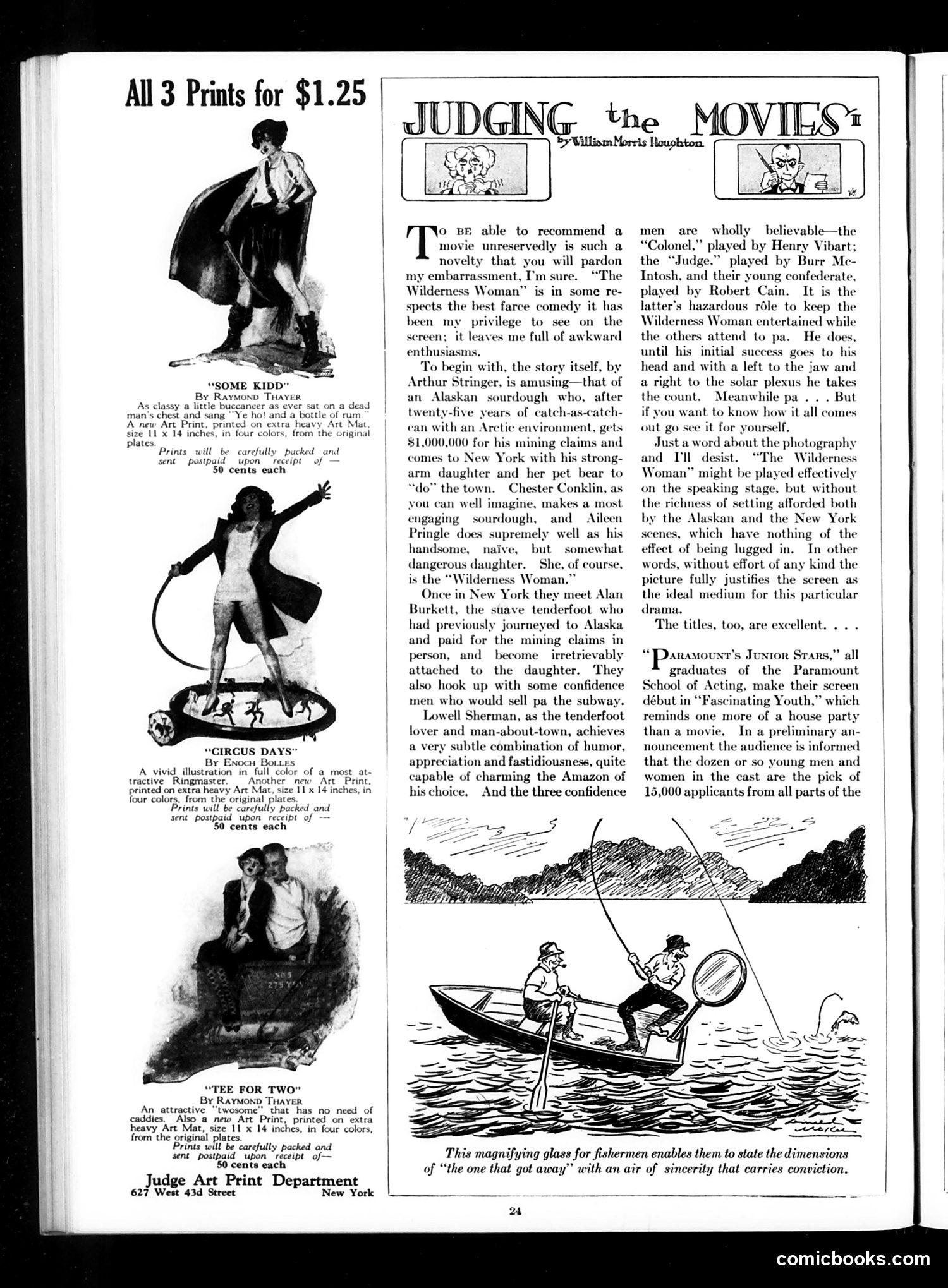
This page features a film review by William Morris Houghton critiquing "The Wilderness Woman," a comedy featuring Chester Conklin as an Alaskan prospector who strikes it rich and moves to New York with his daughter (Aileen Pringle). The plot involves culture clash humor—the rough miner and naive daughter navigating Manhattan society while entangled with con men and a refined "tenderfoot" love interest (Lowell Sherman). The reviewer praises the cast's performances and argues that the film's Alaskan and New York settings justify cinema as superior to stage adaptation, as the visual richness enhances the comedy. The left side advertises three separate art prints available for sale through Judge's print department—seemingly unrelated to the film review—representing typical magazine revenue diversification of the era.
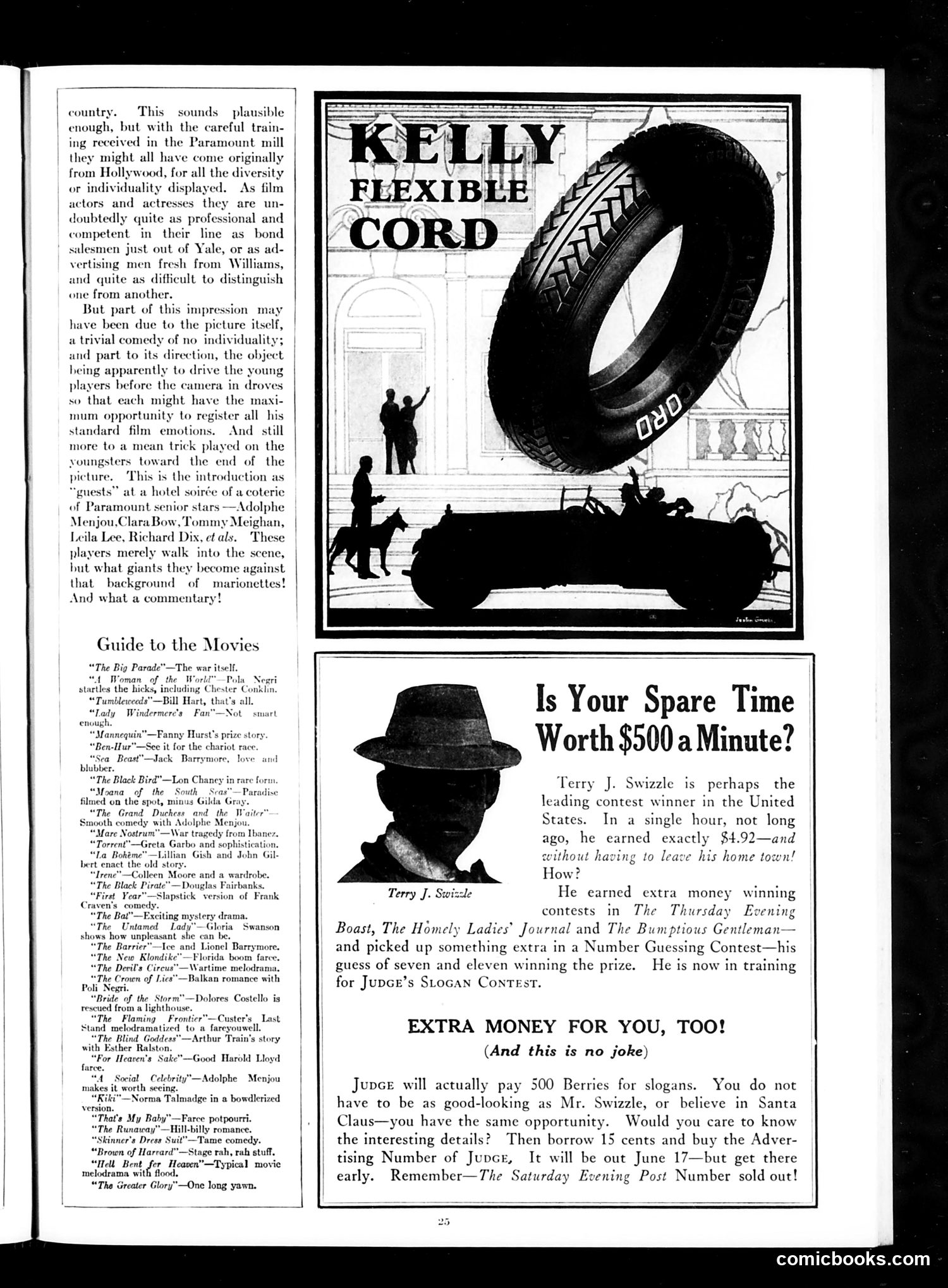
This page contains two distinct elements: **Left side:** A "Guide to the Movies"—a satirical film review section mocking contemporary Hollywood productions. The reviews are dismissive one-liners (e.g., "Ben-Hur"—"See it for the chariot race," "The Greater Glory"—"One long yawn"), typical of Judge magazine's film criticism. Notable is criticism of Paramount studio's assembly-line production of indistinguishable young actors. **Right side:** An advertisement disguised as editorial content, promoting Judge's slogan contest. The fictional "Terry J. Swizzle" is presented as a contest-winning success story who earned $4.92 in an hour—a satirical setup. Judge then pitches its own contest, offering "500 Berries" (slang for dollars) for slogans, urging readers to buy the June 17 Advertising Number. The satire conflates Hollywood's mass-production of interchangeable talent with Judge's own mass-appeal advertising scheme—both selling dreams of easy money to readers.
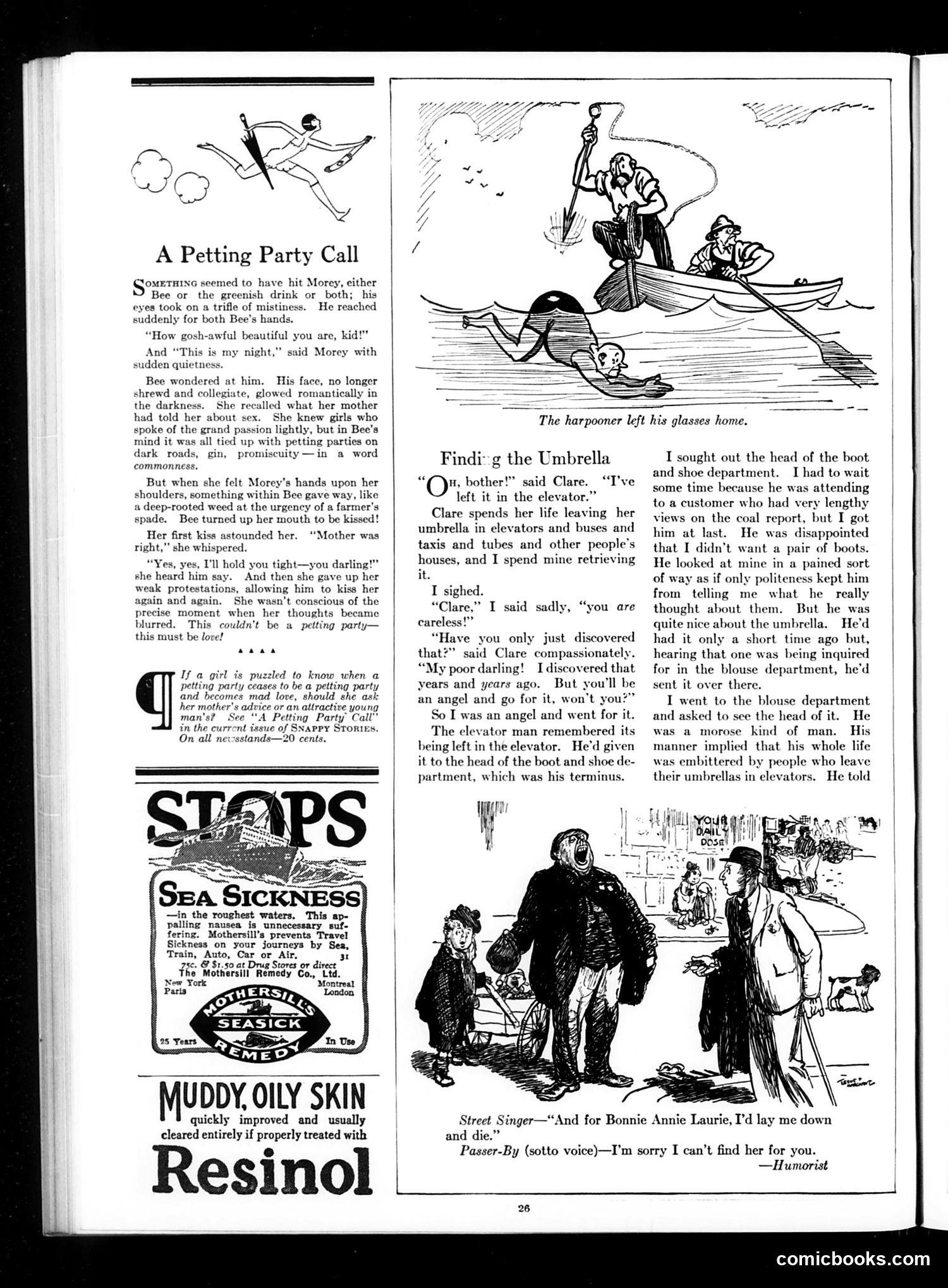
This page contains two satirical stories reflecting 1920s social anxieties. **"A Petting Party Call"** addresses the era's "petting party" phenomenon—unsupervised romantic encounters among youth. The story depicts a young man (Morey) becoming intoxicated and emotionally forward with a girl (Bee), who struggles between her mother's warnings about promiscuity and her own romantic impulses. The satire critiques both youth culture's casual physical intimacy and the generational clash over changing sexual mores. The concluding question—whether girls should consult mothers or attractive young men about distinguishing petting from "mad love"—mocks the confusion of 1920s dating conventions. **"Finding the Umbrella"** is lighter satirical commentary on absent-mindedness and bureaucratic inefficiency. Clare perpetually loses her umbrella in urban infrastructure (elevators, taxis, buses), forcing the narrator to retrieve it through a chain of increasingly irritable department heads. The humor lies in the escalating annoyance of clerks dealing with lost-and-found complaints—reflecting growing frustrations with modern city life and customer service. Both stories mock contemporary manners and social change.
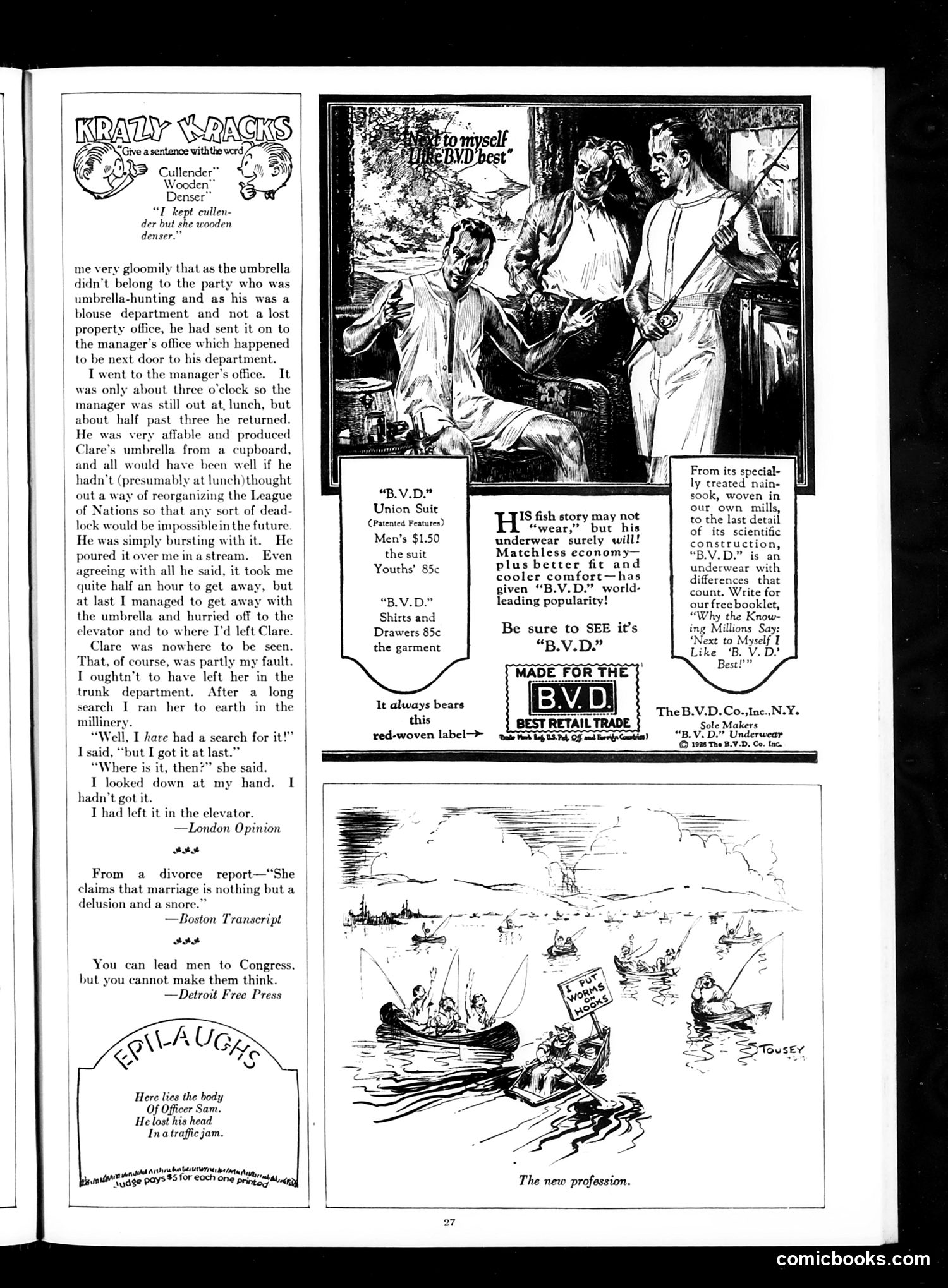
This page contains several satirical pieces typical of early 20th-century Judge magazine: **"Krazy Kracks"** (upper left): A mild pun about a "cullender" (colander) and "wooden denser"—simple wordplay humor. **B.V.D. Advertisement**: The large central illustration shows men discussing underwear, accompanied by product advertising. This appears to be a legitimate advertisement rather than satire. **"The New Profession"** (bottom cartoon): Depicts boats and figures in water with a sign reading "JOBS VACANT." The caption suggests this satirizes unemployment or people seeking work during an economic downturn—likely referencing post-WWI economic challenges or a recession. **Short quotes section** (left side): Includes observations about marriage ("delusion and a snore"), Congress and voter intelligence, and a dark joke about a traffic fatality ("Officer Sam"). These reflect Judge's characteristic cynical social commentary on American politics, relationships, and modern urban dangers. The overall page blends humor, advertising, and social critique typical of the era's satirical magazines.
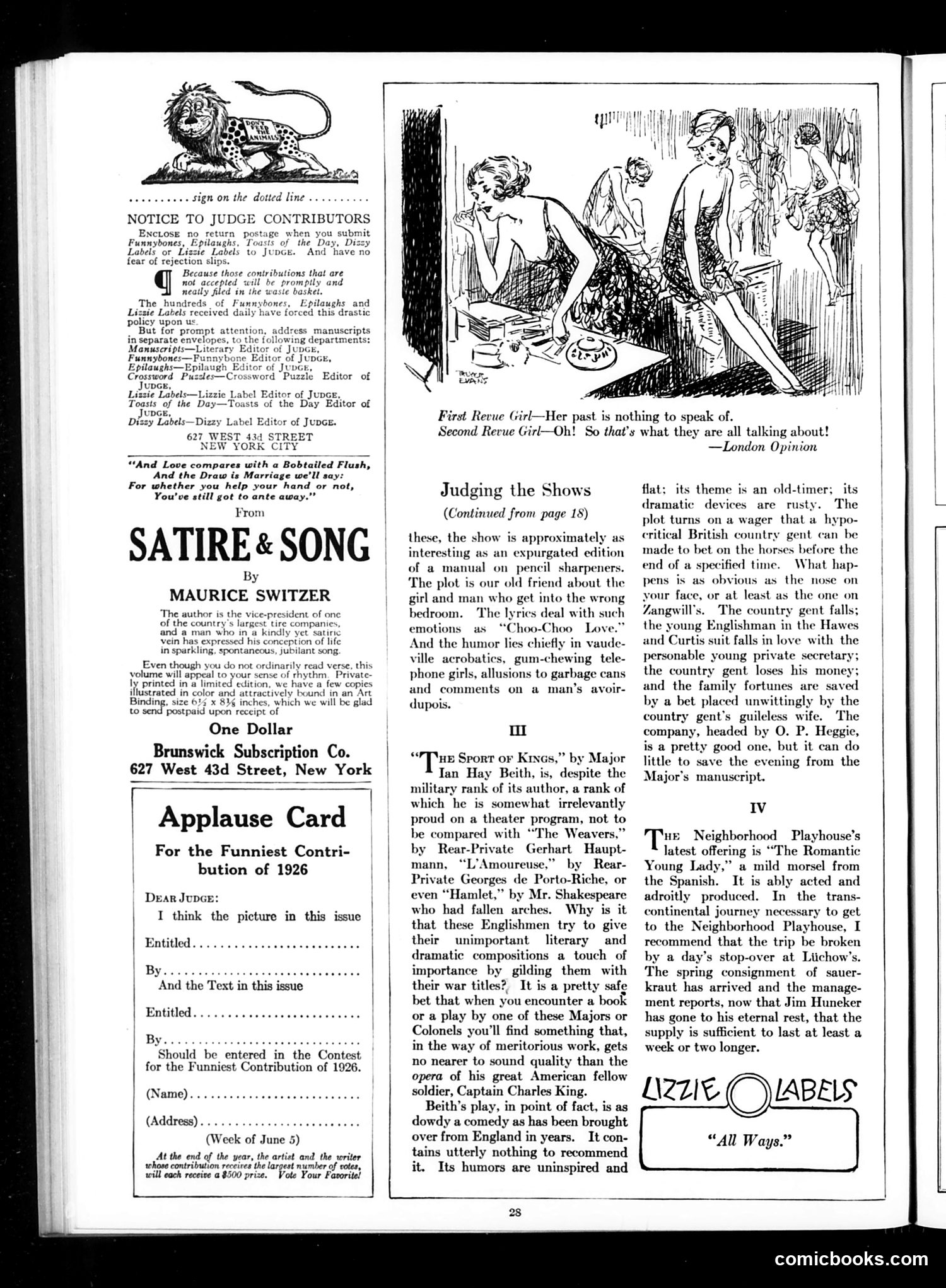
This page is primarily **administrative and advertising** rather than editorial satire. The main content includes: **Top cartoon**: A two-panel joke about "revue girls" discussing one's "past." The humor relies on a double entendre—the first girl claims her past is "nothing to speak of," which the second girl misinterprets as scandalous gossip ("So that's what they are all talking about!"). This reflects 1920s attitudes about women performers' reputations. **Theater reviews** ("Judging the Shows") critique contemporary British plays, mocking their pretentious military-ranked authors who "gild" unimportant works with war titles. The critic dismisses "The Sport of Kings" as "dowdy," comparing it unfavorably to serious drama. **Masthead content**: Mostly publishing notices for contributors and a subscription advertisement for Maurice Switzer's book of satirical verse. The page reflects Judge's 1926 era: post-WWI attitudes, vaudeville culture, and skepticism toward British theatrical imports.
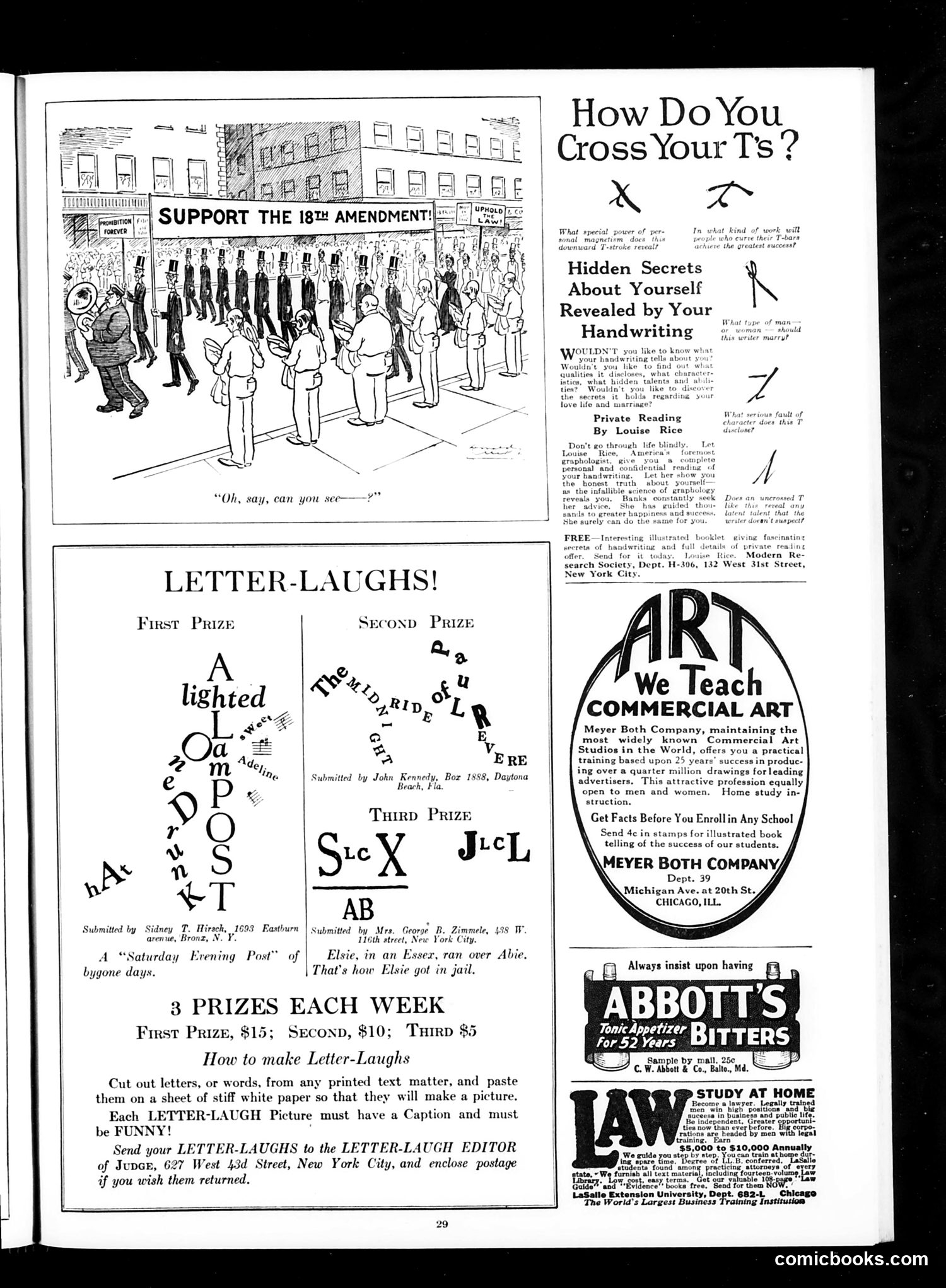
This page from *Judge* magazine features a political cartoon about the 18th Amendment (Prohibition) and several unrelated sections typical of the era. **Main Cartoon:** The illustration shows a large crowd with a banner reading "SUPPORT THE 18TH AMENDMENT!" The caption reads "Oh, say, can you see—?" This is satirical commentary on Prohibition, likely mocking either its supporters or the confusion/hypocrisy surrounding its enforcement. The reference to the national anthem suggests irony about patriotic appeals to support the amendment. **Other Content:** The page includes a "Letter-Laughs" contest (readers create pictures from cut-out letters), handwriting analysis by "Louise Rice," and period advertisements for commercial art schools, bitters tonic, and correspondence law courses. The cartoon's specific satirical point—whether pro- or anti-Prohibition—remains somewhat ambiguous without additional context, but it clearly references the contentious 18th Amendment debate of the Prohibition era.
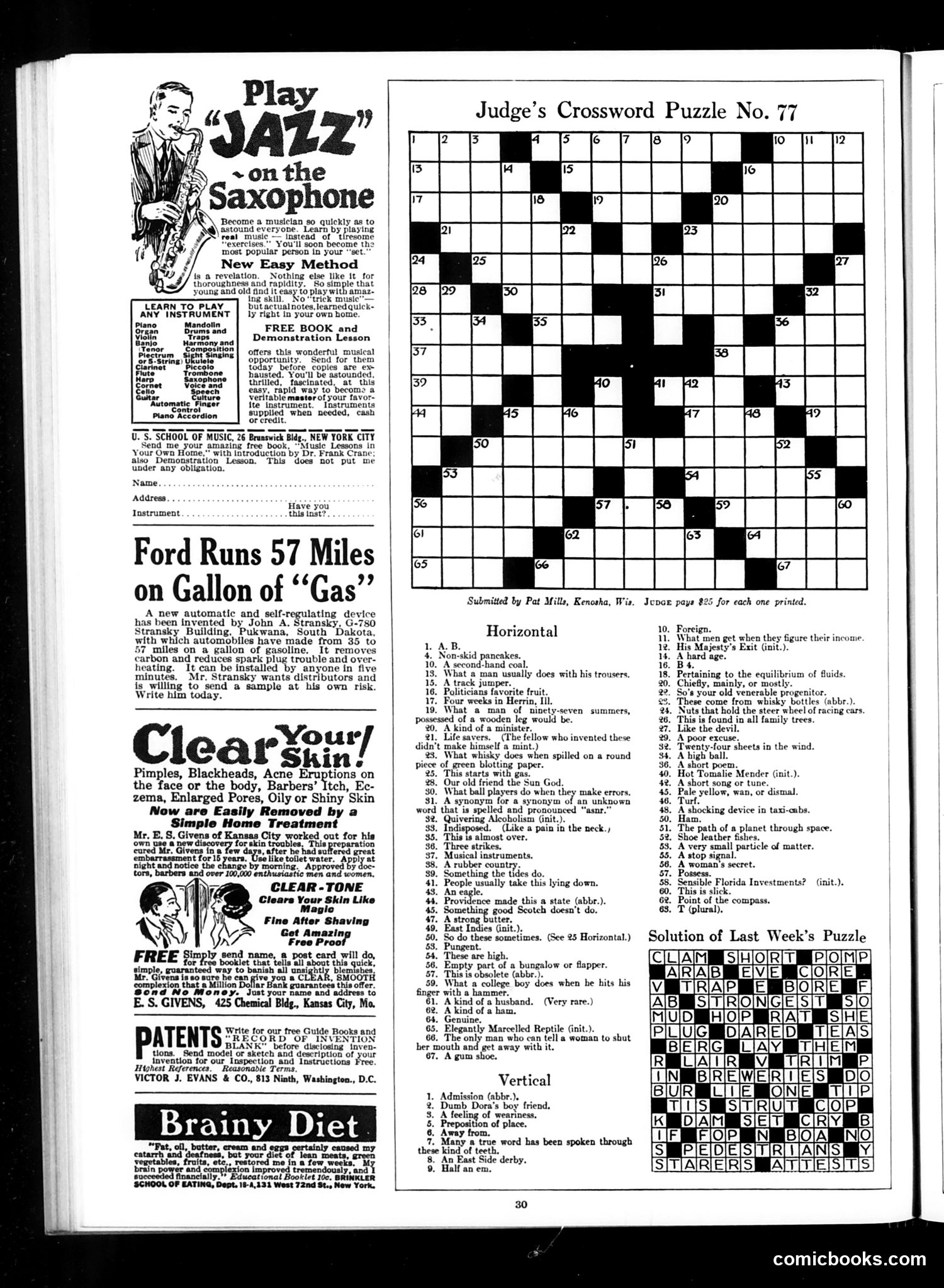
This page is primarily **advertisements and a crossword puzzle**, not political satire. The content reflects 1920s consumer culture. The ads promote: mail-order music lessons (learning saxophone and other instruments "at home"), a Ford fuel-efficiency device, and skin-clearing treatments. These represent common direct-mail marketing of the era. The crossword puzzle itself contains light wordplay typical of 1920s humor—puns and double meanings like "Non-skid pancakes" (a joke about Ford's non-skid tires) and "Politicians favorite fruit" (likely a pun). The page demonstrates how Judge magazine balanced satirical cartooning with revenue-generating advertisements. The "Play Jazz on the Saxophone" ad reflects the Jazz Age's cultural prominence, while the ads generally target readers seeking self-improvement through accessible, mail-order products—a distinctly American sales approach of that era. No significant political figures or events are referenced on this particular page.
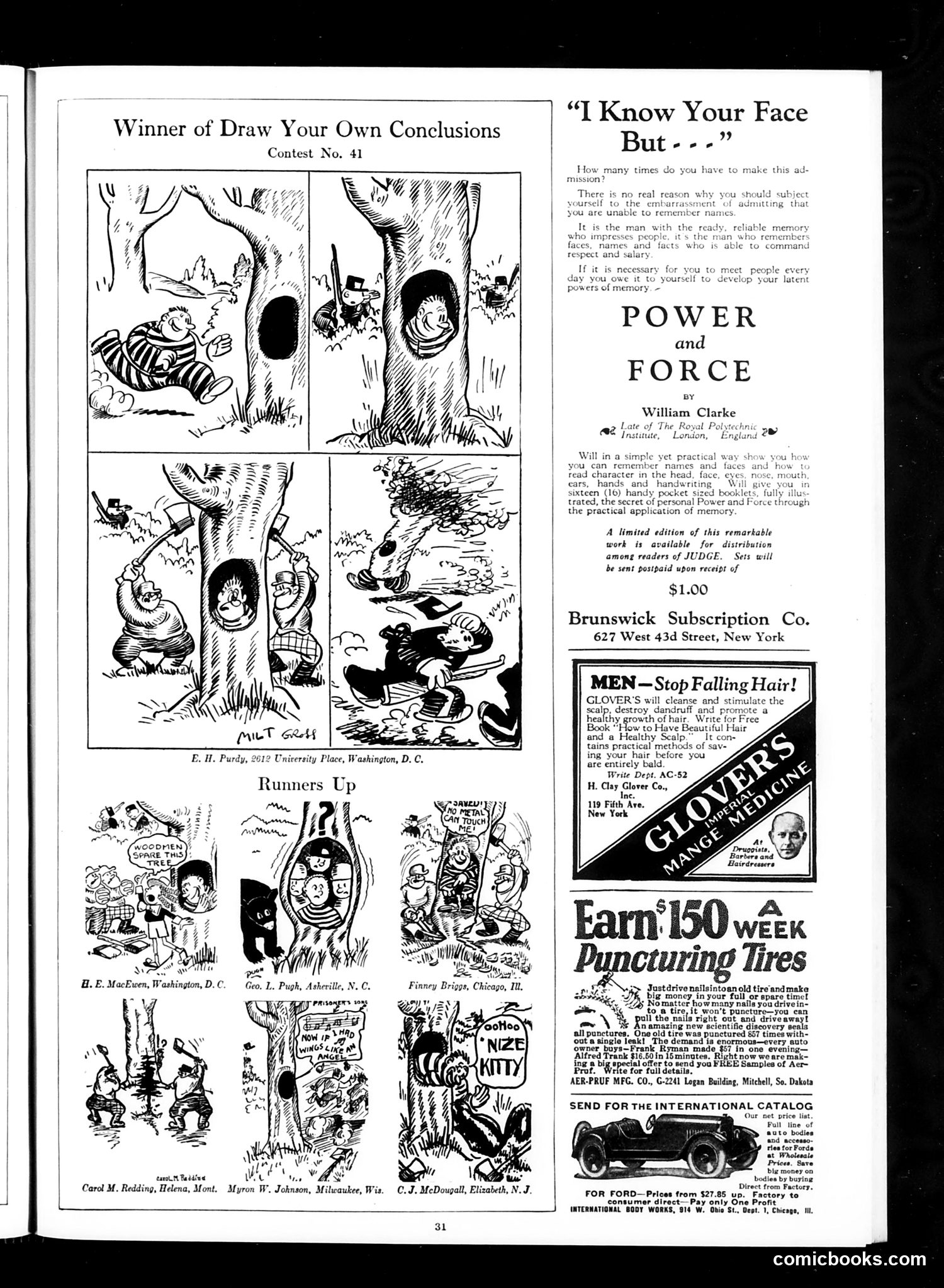
This page features the winning entry in Judge's "Draw Your Own Conclusions" Contest No. 41—a four-panel cartoon by E.H. Purdy depicting characters living inside a large tree trunk with holes. The humor appears to derive from the visual pun: the tree's natural openings become "faces" or living spaces for the cartoon figures, creating an absurdist domestic scene. The "Runners Up" section shows six additional cartoon entries playing with similar visual wordplay and surreal scenarios—anthropomorphized animals and exaggerated characters in unlikely situations typical of Judge's comedic style. The right side comprises advertisements for self-help products (memory training, hair loss treatment) and business opportunities (tire puncturing, auto body parts), typical of 1920s-era magazine advertising targeting male readers with promises of success and self-improvement. The cartoons themselves are purely whimsical rather than political or socially satirical—representing Judge's general humor content alongside its advertising revenue.
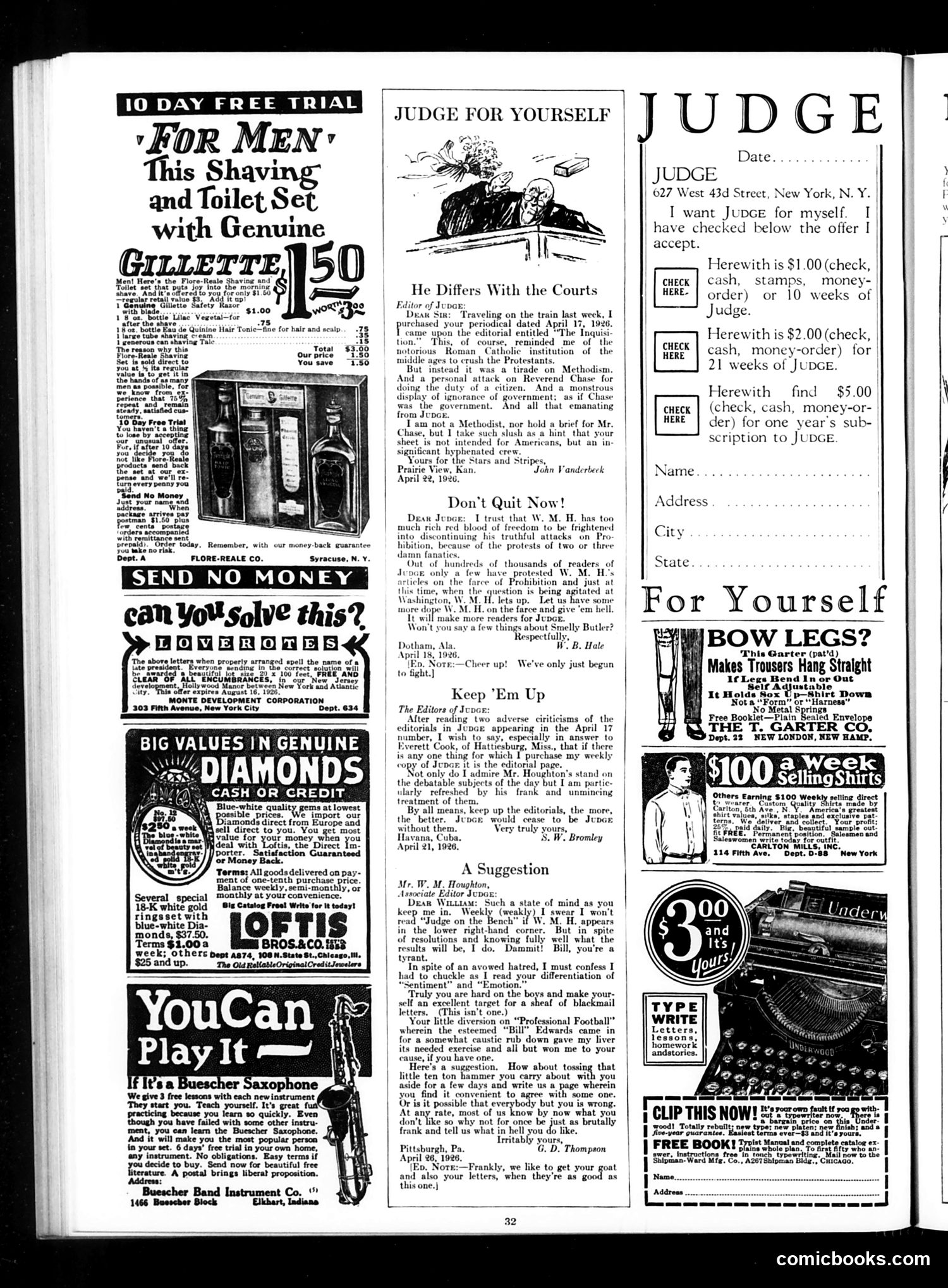
This page is primarily **advertising and reader correspondence**, not political satire. The main content includes: **Letters to the Editor** discussing recent Judge articles: readers debate an editorial about Methodism and another writer (W.M.H.) criticizing Prohibition. One correspondent defends W.M.H.'s anti-Prohibition stance, urging him to continue. **The cartoon** titled "He Differs With the Courts" (by John Vanderbeck) shows a judge at his bench, illustrating the lead letter—a dispute about whether a reverend overstepped by publicly criticizing government policy. **Numerous advertisements** for products (Gillette razors, diamonds, saxophones, garters, typewriters) dominate the page, reflecting 1926 magazine economics. The "Judge for Yourself" subscription box allows readers to purchase the magazine at various price points. There is **no significant political cartoon** or major satirical content visible here—this appears to be a typical interior page mixing reader feedback with commercial advertising.
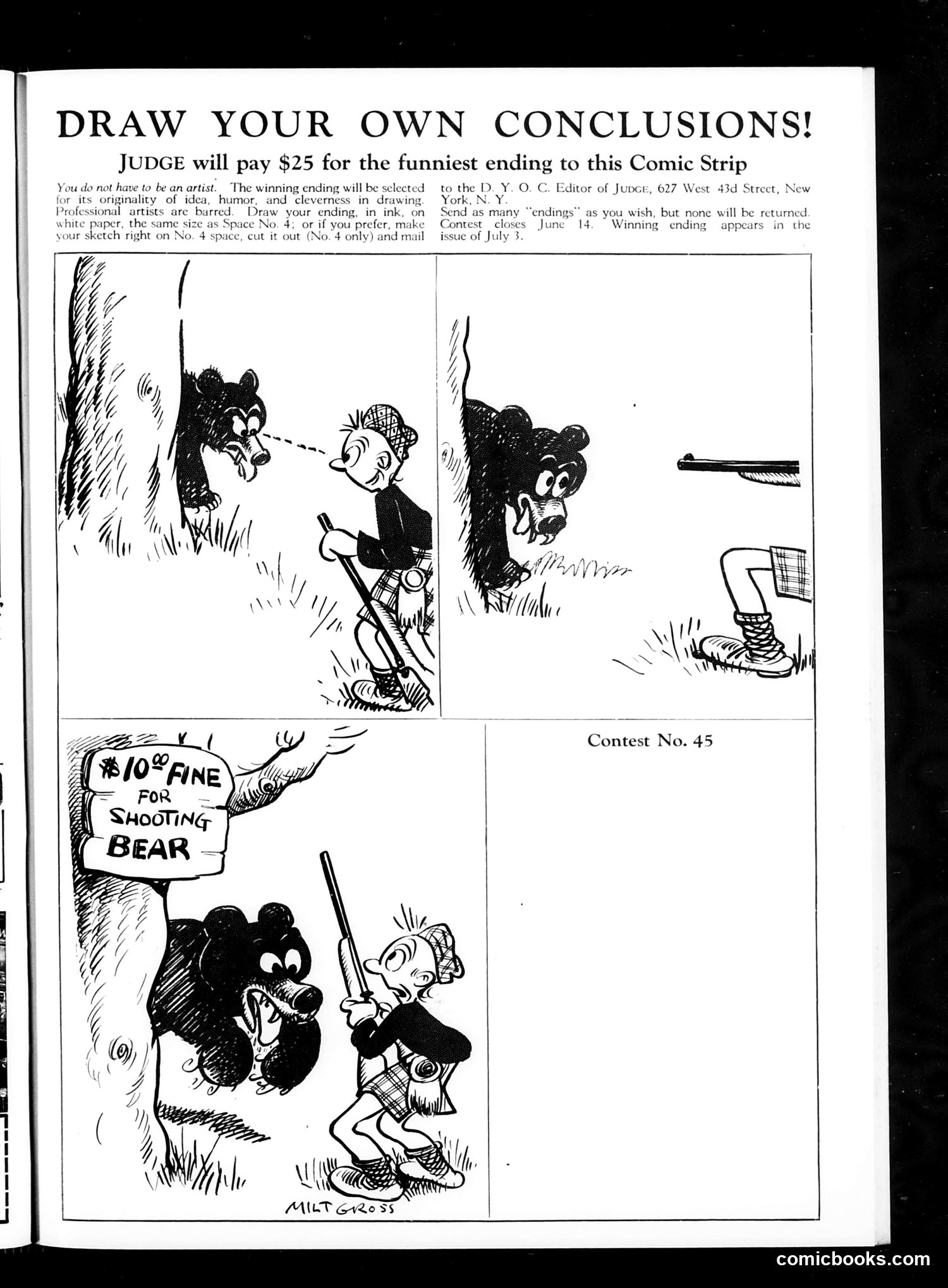
This page features a reader-participation contest where Judge magazine invites submissions to complete a comic strip's ending. The prize is $25—substantial money in this era. **The Comic Strip (Contest No. 45):** The three panels show a hunter encountering a bear in the woods. The first panels depict the confrontation; the final panel reveals a sign reading "$10 FINE FOR SHOOTING BEAR," with the hunter facing consequences. The joke setup appears to mock hunting regulations or the hunter's poor timing/judgment. Readers were invited to draw their own humorous conclusions to complete the narrative, with submissions judged on "originality of idea, humor, and cleverness in drawing." **Context:** This was a common Judge feature—democratizing cartooning by crowdsourcing comic endings while building reader engagement. The bear-hunting scenario likely satirizes conservation efforts or foolish sportsmen of the period, though the exact historical context remains unclear without additional dating information.
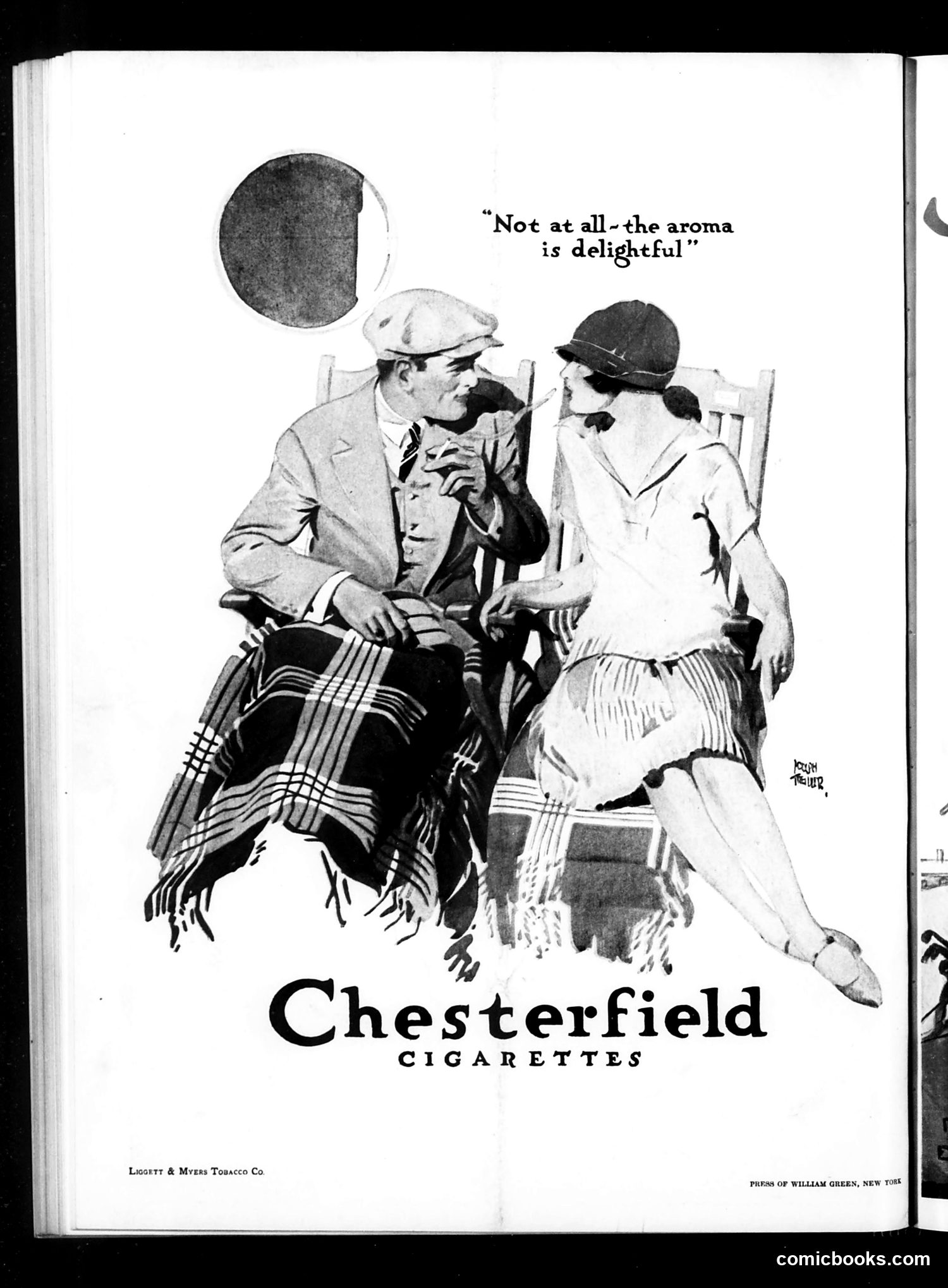
This is a vintage cigarette advertisement rather than political satire. Two men in 1920s attire sit together, with one appearing skeptical about cigarette smoke (suggested by his expression and posture), while the other reassures him that "the aroma is delightful." The ad's humor relies on the second man's confidence in defending the product against an obvious objection—the unpleasant smell of smoke. This reflects early-20th-century advertising strategy: addressing consumer concerns directly while maintaining that the product is actually pleasant. The illustration is signed by what appears to be a period cartoonist, and credits "Ligget & Myers Tobacco Co." The ad targets male consumers, playing on social bonding and masculine leisure culture typical of 1920s marketing.