
Judge, 1926-06-05 · page 20 of 36
Judge — June 5, 1926 — page 20: what you’re looking at
What you’re looking at
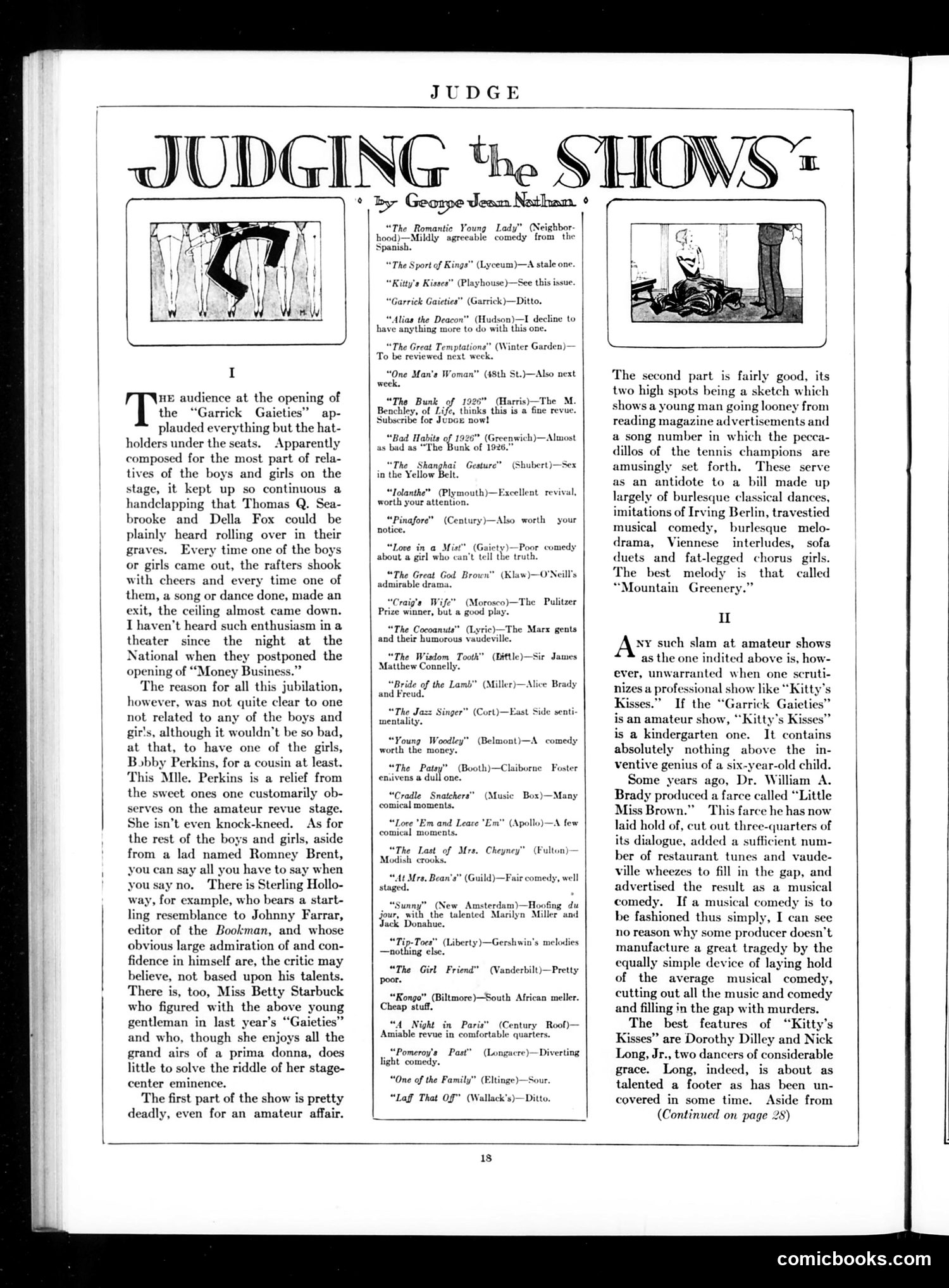
This page features theater critic George Jean Nathan's reviews of Broadway shows from the 1920s. The main article discusses the "Garrick Gaieties," an amateur theatrical revue, noting that audience enthusiasm came largely from relatives of performers rather than genuine merit. Nathan's critique is characteristically sharp: he praises dancer Bobby Perkins as refreshingly unglamorous, mocks Sterling Holloway's unwarranted self-confidence (comparing him unfavorably to Bookman editor Johnny Farrar), and dismisses Betty Starbuck's pretensions. He finds the first act "pretty deadly." The page also includes Nathan's capsule reviews of other current Broadway productions, ranging from praised offerings like "Craig's Wife" and O'Neill's "The Great God Brown" to dismissed shows like "Alias the Deacon." The cartoons (showing legs and a reclining figure) appear to illustrate the article's themes about amateur theatrical performance and audience behavior.
📄 Transcribed text from this page (OCR, searchable)
Machine-transcribed from the original scan — historical spelling and the odd misread are preserved.
JUDGE HE audience at the opening of the “Garrick Gaieties” ap- plauded everything but the hat- holders under the seats. Apparently composed for the most part of rela- tives of the boys and girls on the stage, it kept up so continuous a handclapping that Thomas Q. Sea- brooke and Della Fox could be plainly heard rolling over in their Every time one of the boys came out, the rafters shook with cheers and every time one of them, a song or dance done, made an it, the ceiling almost came down. I haven't heard such enthusiasm in a theater since the night at the National when they postponed the opening of “Money Business.” ‘The reason for all this jubilation, however, was not quite clear to one not related to any of the boys and girs, although it wouldn’t be so bad, at that, to have one of the girls, Bobby Perkins, for a cousin at least. This Mlle. Perkins is a relief from the sweet ones one customarily ob- serves on the amateur revue stage. She isn’t even knock-kneed. As for the rest of the boys and girls, aside from a lad named Romney Brent, you can say all you have to say when yno. There is Sterling Hollo- y, for example, who bears a start- ling resemblance to Johnny Farrar, editor of the Bookman, and whose obvious large admiration of and con- fidence in himself are, the critic may believe, not based upon his talents. There is, too, Miss Betty Starbuck who figured with the above young gentleman in last year’s “Gaieties” and who, though she enjoys all the grand airs of a prima donna, does little to solve the riddle of her stage- center eminence. The first part of the show is pretty deadly, even for an amateur affair. G the SHOWS * ¢ by ai imamate | “The Romantic Young Lady hood) Mildly agreeable comedy from the Spanish. “The Sport of Kings” (Lyceum)—A stale one. | “Kitty's Kisses” (Playhouse)—See this issue “Garrick Gaieties” (Garrick)—Ditto. “Alias the Deacon" (Hudson)—I decline to have anything more to do with this one. “The Great Temptations” (Winter Garden)— To be reviewed next week. “One Man's Woman" (48th St.}—Also next week, “The Bunk of 1926" (Harris)—The M. Benchley, of Life, thinks this is a fine revue. Subscribe for Jupce now! “Bad Habits of 1926" (Gi as bad as “The Bunk of 1926, wich)—Almost “The Shanghai Gesture” in the Yellow Belt. (Shubert )—Sex “Iolanthe” (Plymouth)—Excellent revival, worth your attention. “Pinafore” notice. (Century)—Also worth your “Love in a Mist” (Gaicty)—Poor comedy about a girl who can't tell the truth. “The Great God Brown" (Klaw)—O'Neill’s admirable drama. raig's Wife” (Morosco)—The Pulitzer winner, but a good play. “The Cocoanuts" (Lyric)—The Marx gents and their humorous vaudevill “The Wisdom Tooth” (Bittle)—Sir James Matthew Connelly. “Bride of the Lamb" (Miller)—Alice Brady and Freud. “The Jazz Singer” (Cort)—East Side senti- mentality. “Young Woodley” (Belmont)—A comedy worth the money. The Patsy” (Booth)—Claiborne Foster eniivens a dull one. “Cradle Snatchers" (Music Box)—Many comical moments. “Love "Em and Leare "Em" (Apollo)—A few comical moments. “The Last of Mrs. Cheyney” (Fulton Modish crooks. ‘At Mra, Bean's” (Guild)—Fair comedy, well staged. “Sunny” (New Amsterdam)—Hoofing du jour, with the talented Marilyn Miller and Jack Donahue. “Tip-Toes” (Liberty)—Gershwin's melodies —nothing else. “The Girl Friend” Poor. (Vanderbilt)—Pretty “Kongo” (Biltmore)—South African meller. Cheap stuff. “A Night in Paris” (Century Roof)— Amiable revue in comfortable quarters. “Pomeroy’s Past” (Longacre)—Diverting light comedy. “One of the Family” (Eltinge)—Sour. “Lag That Of" (Wallack’s)—Ditto. The second part is fairly good, its two high spots being a sketch which shows a young man going looney from reading magazin: advertisements and a song number in which the pecca- dillos of the tennis champions are amusingly set forth. These serve as an antidote to a bill made up largely of burlesque classical dances, imitations of Irving Berlin, travestied musical comedy, burlesque melo- drama, Viennese interludes, sofa duets and fat-legged chorus girls. The best’ melody is that called “Mountain Greenery.” Il A sy such slam at amateur shows as the one indited above is, how ever, unwarranted when one scrut nizes a professional show like “Kitt Kisses.” If the “Garrick Gaieti an amateur show, “Kitty's Kisses is a kindergarten one. It contains absolutely nothing above the in- ventive genius of a six-year-old child. Some years ago, Dr. William A. Brady produced a farce called “Little Miss Brown.” This farce he has now laid hold of, cut out three-quarters of its dialogue, added a sufficient num- ber of restaurant tunes and vaude- ville wheezes to fill in the gap, and advertised the result as a musical comedy. If a musical comed to be fashioned thus simply, I can see no reason why some producer doesn’t manufacture a great tragedy by the equally simple device of laying hold of the average musical comedy, cutting out all the music and comedy and filling in the gap with murders. The best features of “Kitty's Kisses” are Dorothy Dilley and Nick Long, Jr., two dancers of considerable grace. Long, indeed, is about as talented a footer as has been un- covered in some time. Aside from (Continued on page 28) comicbooks.com