
Judge, 1926-06-05 · page 15 of 36
Judge — June 5, 1926 — page 15: what you’re looking at
What you’re looking at
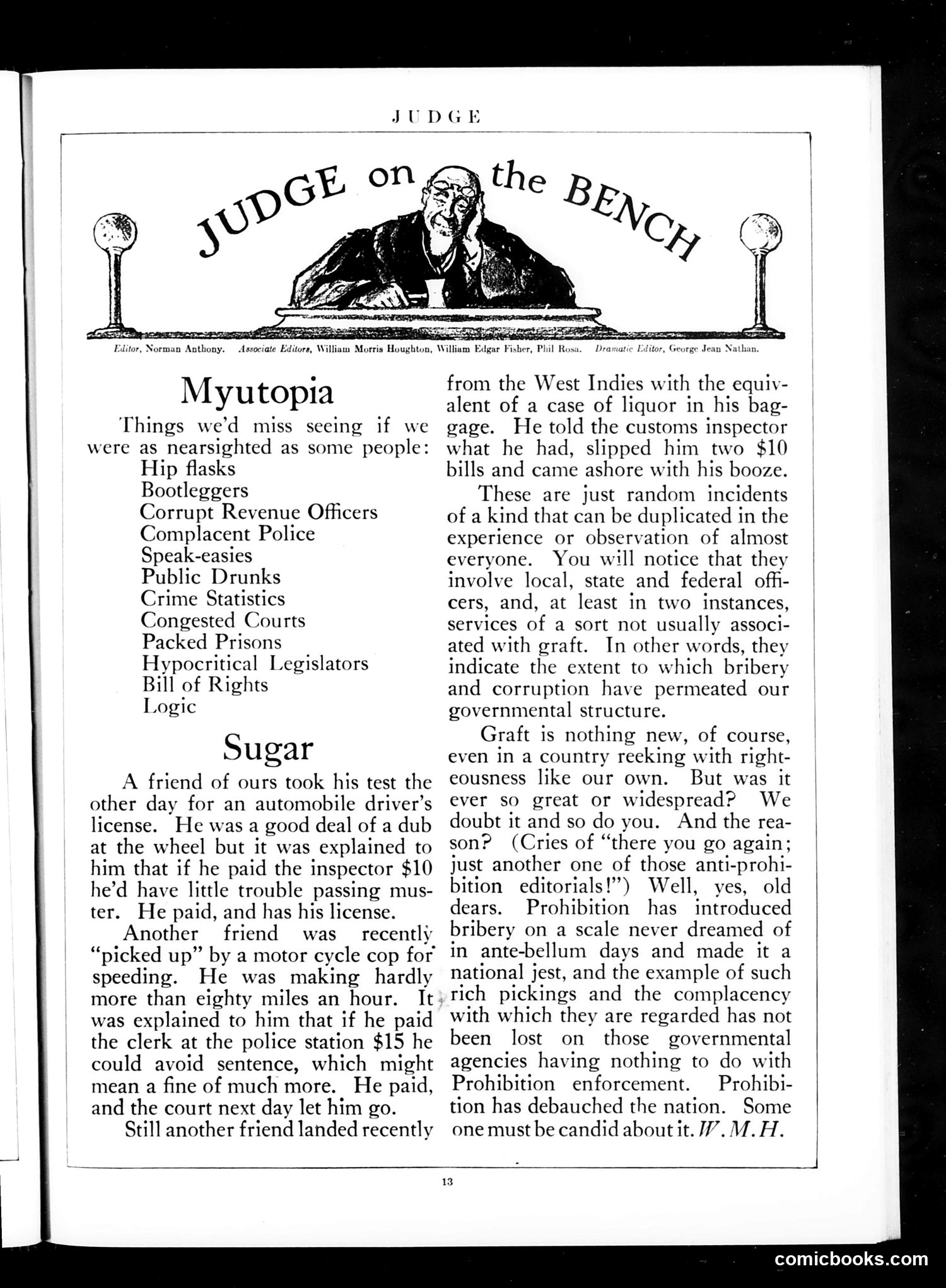
This page satirizes widespread governmental corruption during Prohibition (1920-1933). The masthead illustration shows a judge contemplating society's problems. The "Myutopia" column lists things society would "miss" if blind to corruption—a sarcastic inversion suggesting these evils are rampant and normalized. The main article, titled "Sugar," documents three anecdotes of casual bribery: a driving test passed for $10, a speeding ticket avoided for $15 to a police clerk, and a smuggler bribing customs inspectors $20 for bootleg liquor passage. The satire's point: Prohibition has made bribery endemic across federal, state, and local agencies. The author argues that while corruption existed before, Prohibition's enforcement created unprecedented opportunities and normalized graft so thoroughly that other government services adopted similar practices. The implicit critique: Prohibition itself—by criminalizing alcohol—created the corruption it spawned.
📄 Transcribed text from this page (OCR, searchable)
Machine-transcribed from the original scan — historical spelling and the odd misread are preserved.
JUDGE Myutopia Things we’d miss seeing if we were as nearsighted as some people: Hip flasks Bootleggers Corrupt Revenue Officers Complacent Police Speak-easies Public Drunks Crime Statistics Congested Courts Packed Prisons Hypocritical Legislators Bill of Rights Logic Sugar A friend of ours took his test the other day for an automobile driver's license. He was a good deal of a dub at the wheel but it was explained to him that if he paid the inspector $10 he’d have little trouble passing mus- ter. He paid, and has his license. Another friend was recently “picked up” by a motor cycle cop for speeding. He was making hardly more than eighty miles an hour. It was explained to him that if he paid the clerk at the police station $15 he could avoid sentence, which might mean a fine of much more. He paid, and the court next day let him go. Still another friend landed recently from the West Indies with the equiv- alent of a case of liquor in his bag- gage. He told the customs inspector what he had, slipped him two $10 bills and came ashore with his booze. These are just random incidents of a kind that can be duplicated in the experience or observation of almost everyone. You will notice that they involve local, state and federal off- cers, and, at least in two instances, services of a sort not usually associ- ated with graft. In other words, they indicate the extent to which bribery and corruption have permeated our governmental structure. Graft is nothing new, of course, even in a country reeking with right- eousness like our own. But was it ever so great or widespread? We doubt it and so do you. And the rea- son? (Cries of “there you go again; just another one of those anti-prohi- bition editorials!”) Well, yes, old dears. Prohibition has introduced bribery on a scale never dreamed of in ante-bellum days and made it a national jest, and the example of such rich pickings and the complacency with which they are regarded has not been lost on those governmental agencies having nothing to do with Prohibition enforcement. Prohibi- tion has debauched the nation. Some one must be candid about it. /”.M.H. comicbooks.com