
A complete issue · 36 pages · 1926
Judge — April 10, 1926
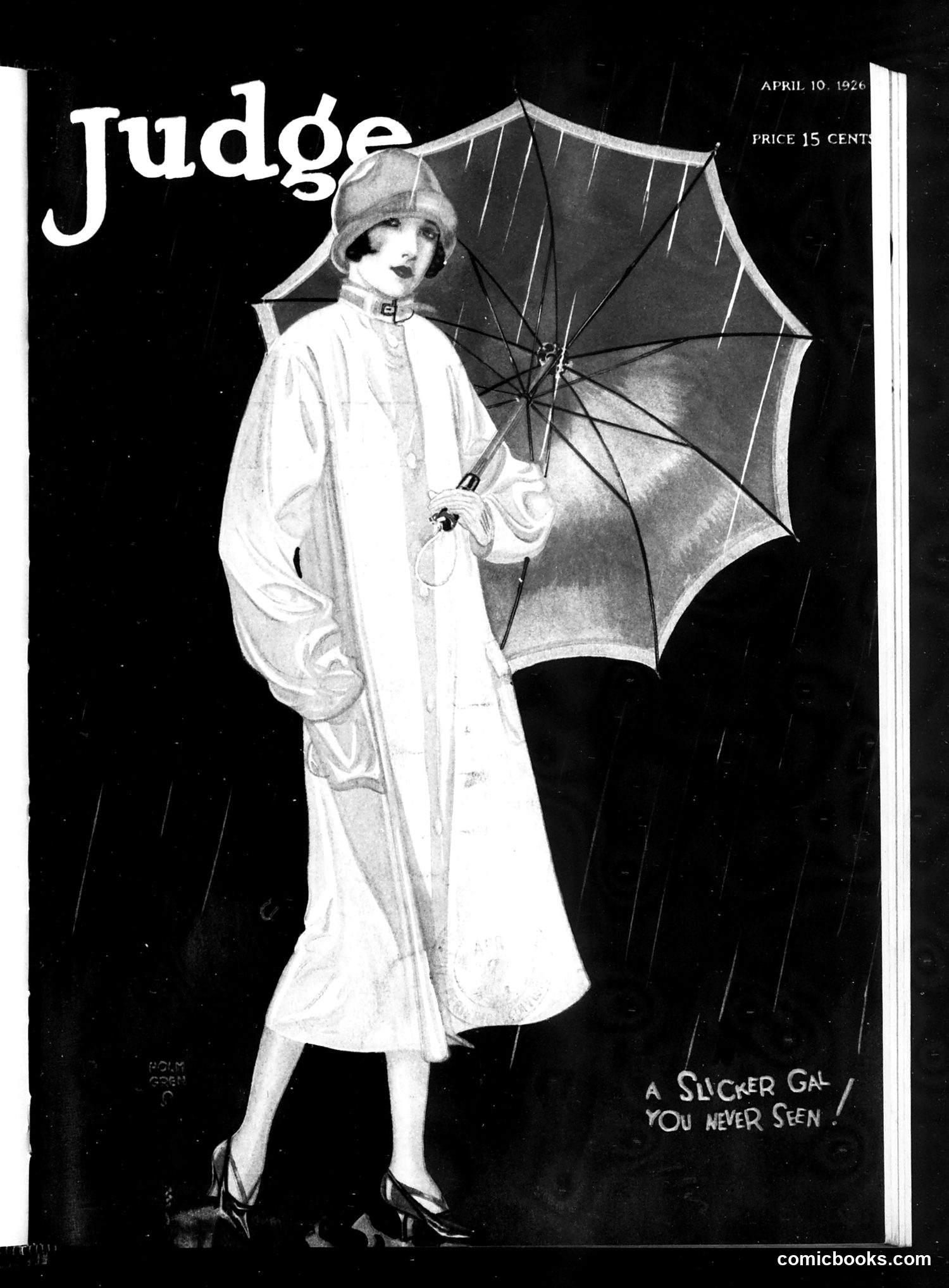
This is a magazine cover, not a political cartoon. It depicts a fashionably dressed woman in 1920s attire—a light coat, cloche hat, and heels—holding an umbrella in stylized rain. The caption reads "A Slicker Gal You Never Seen!" The humor plays on the double meaning of "slicker": both a waterproof raincoat and a clever, sophisticated person. The illustration celebrates the modern "flapper" woman of the Jazz Age—independent, fashionable, and quick-witted. This represents 1920s cultural attitudes about liberated femininity, contrasting traditional domesticity with the urban, cosmopolitan woman. The cover is primarily illustrative rather than overtly satirical or political.
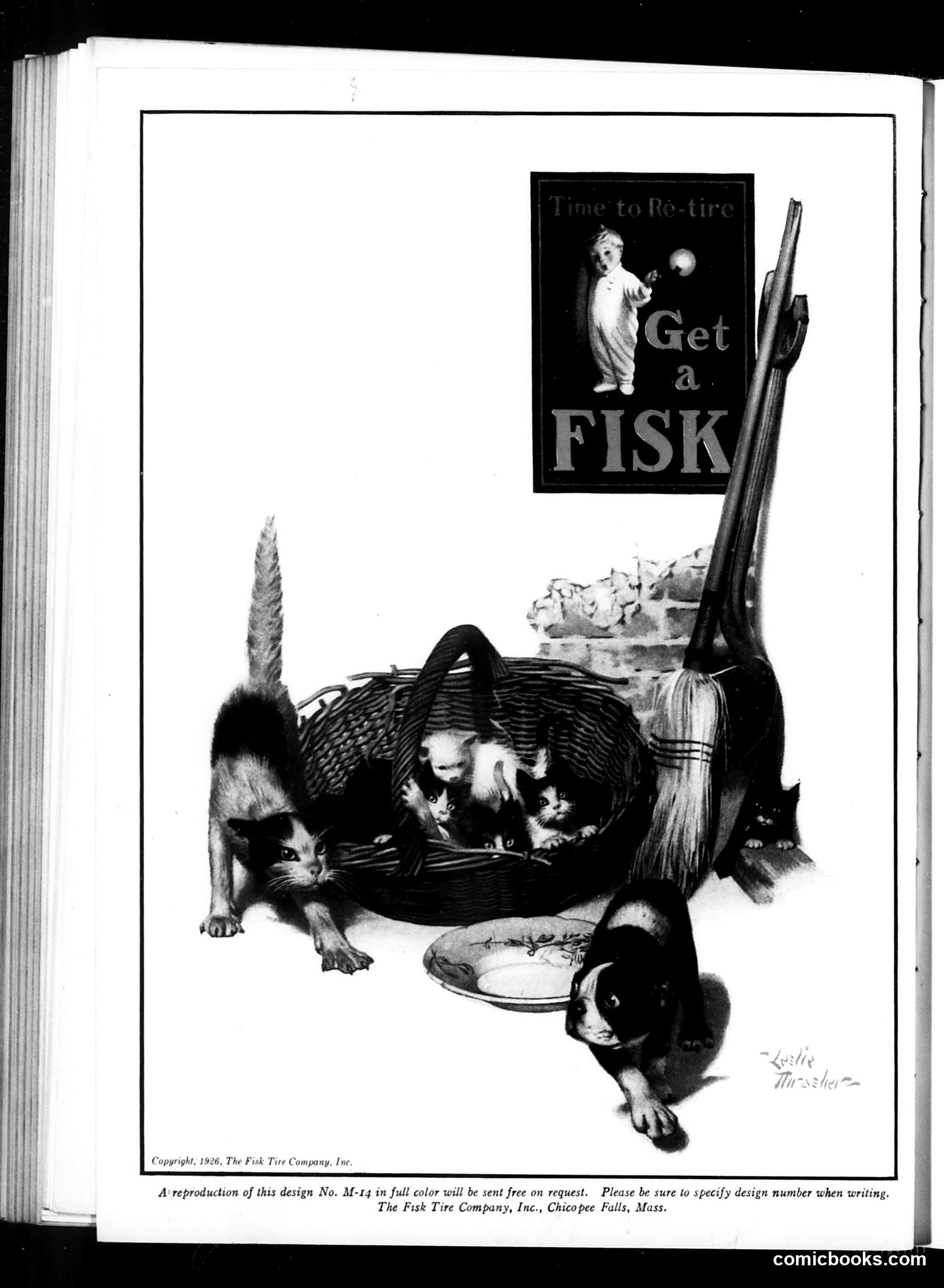
This is primarily a **commercial advertisement** for Fisk Tires, not political satire. The image depicts cats and kittens gathered around a wicker basket, with an adult cat appearing exhausted or worn out. Above hangs a sign reading "Time to Re-tire / Get a FISK." The advertisement exploits a visual pun: the worn-out cat suggests a tire in need of replacement ("re-tire"), while the homophone creates wordplay between the cat being tired and needing new tires. The humorous family scene with multiple kittens emphasizes the product's durability for active use. The copyright date is 1926, and this represents typical early-twentieth-century American advertising strategy using animals and humor to sell consumer goods.
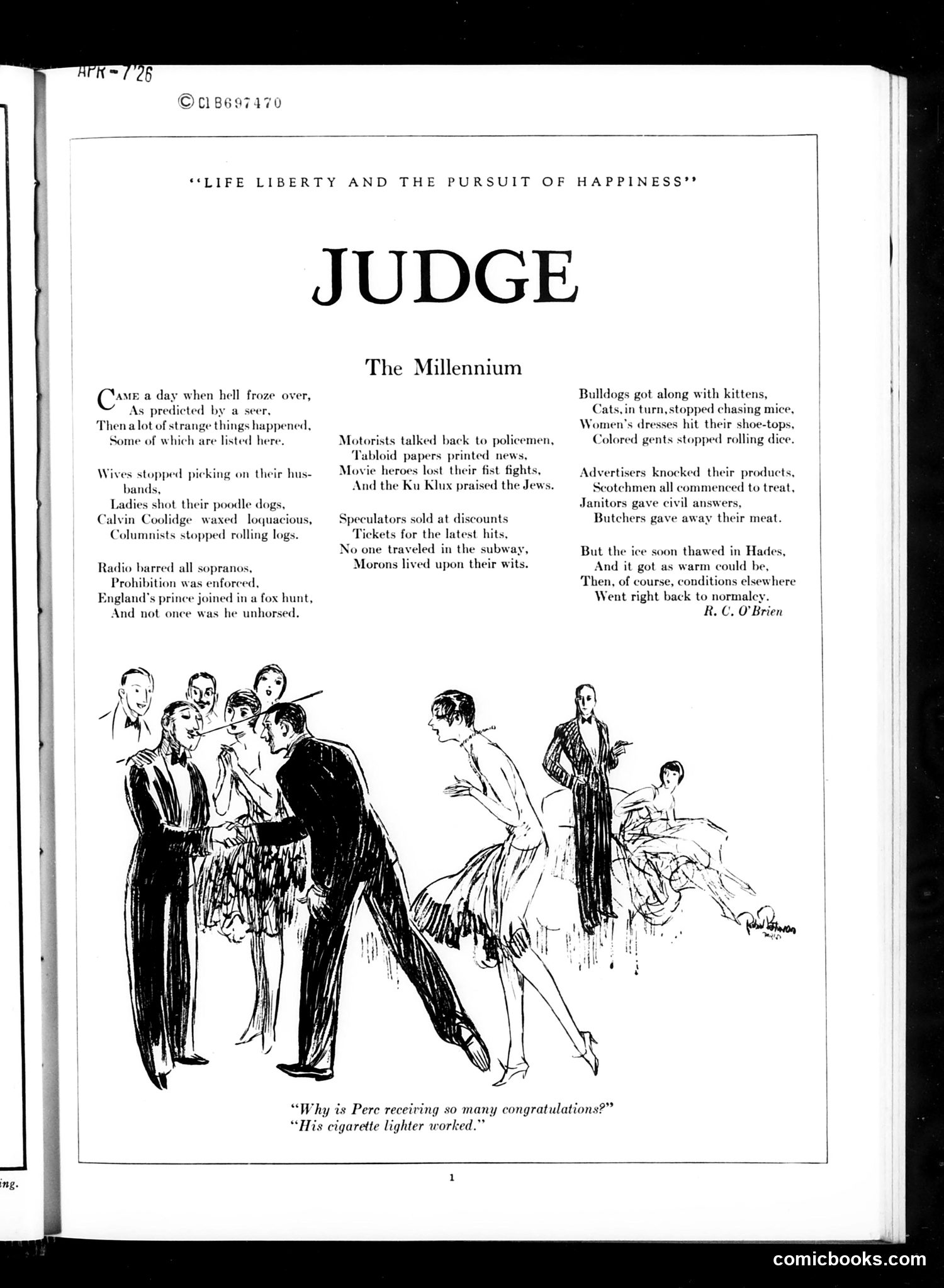
This page satirizes early 1920s social changes during Prohibition and the Jazz Age. The poem "The Millennium" by R.C. O'Brien lists absurd reversals: wives stop nagging husbands, ladies abandon poodles, columnists cease writing, radio bans sopranos, England's prime minister joins a fox hunt "unlorsed." The accompanying cartoon shows a man receiving congratulations—captioned "His cigarette lighter worked"—a joke about the unreliability of new consumer products or technology of the era. The satire mocks optimistic predictions about modern progress and social improvement. The "millennium" title is ironic; instead of utopian change, Judge suggests society will experience the same chaos and small frustrations, just in new forms. The piece reflects 1920s anxiety about rapid technological and social transformation.
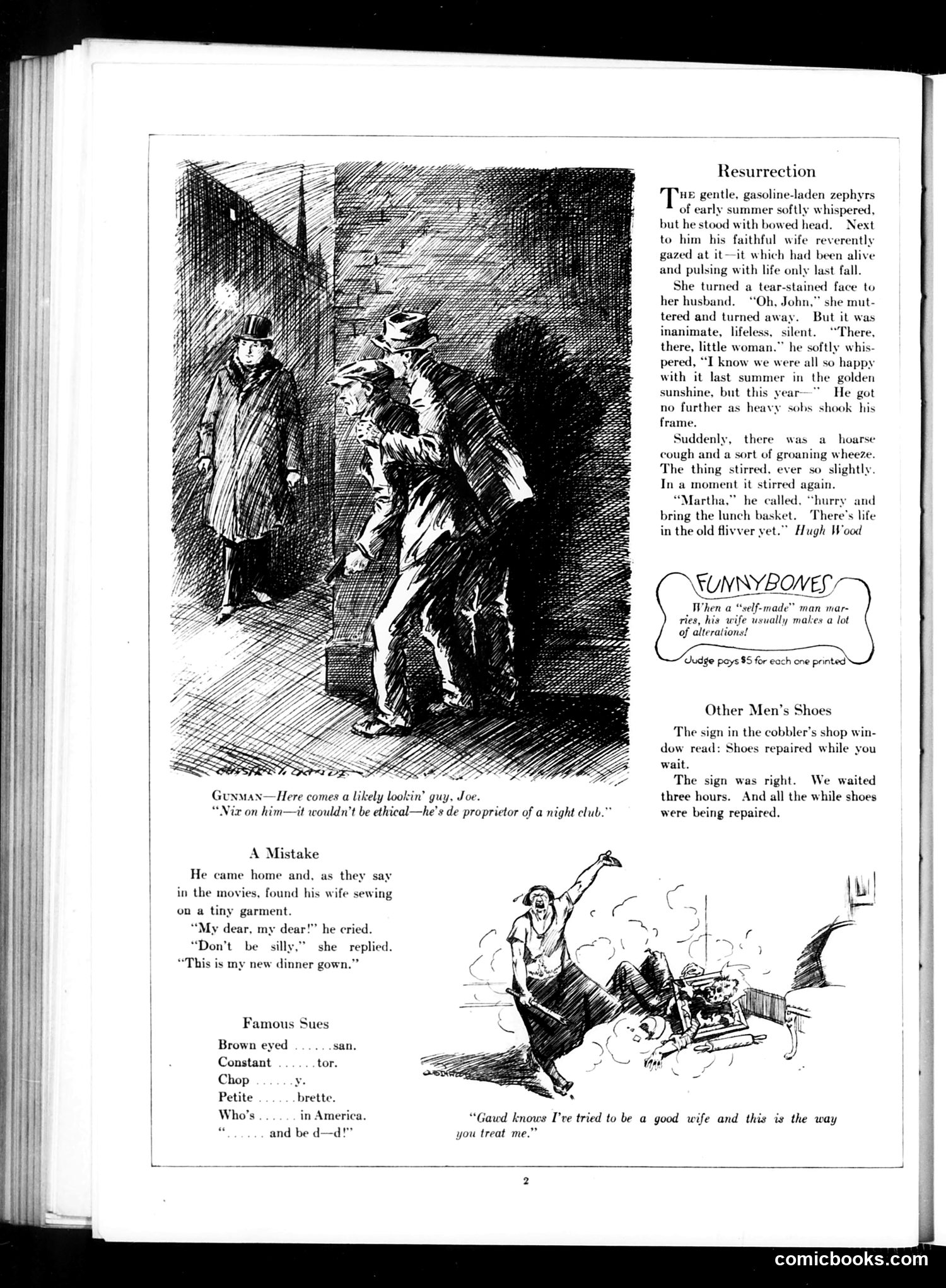
This page contains three separate humorous pieces rather than unified political satire: 1. **"Resurrection"** (top): A literary excerpt by Hugh Wood about a couple discovering their horse is still alive, accompanied by an illustration. This is domestic humor, not political commentary. 2. **"Funny Bones"** (middle): A joke about "self-made" men whose wives make "alterations"—typical marital humor of the era with no political content. 3. **"A Mistake"** and **"Other Men's Shoes"** (bottom): Domestic comedy sketches about husbands misunderstanding their wives' activities—standard early 20th-century magazine humor focused on gender relations and marriage misunderstandings. The page is primarily light entertainment rather than political satire, featuring relatable domestic situations for Judge's middle-class readership.
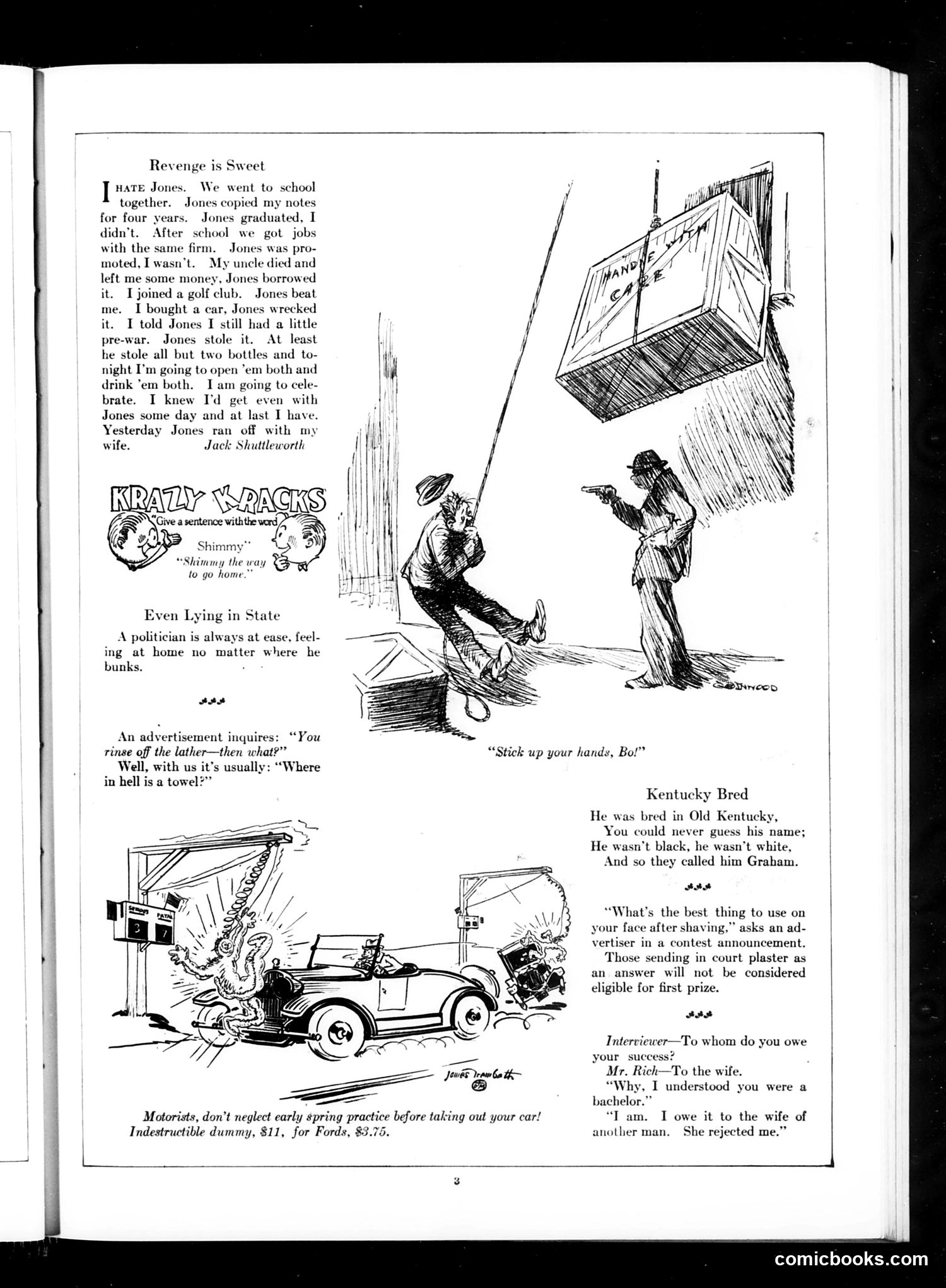
This page contains several separate humor items rather than a unified political cartoon: 1. **"Revenge is Sweet"** - A personal anecdote about a man named Jones who borrowed money, stole a car, and ran off with the narrator's wife. The humor lies in the narrator's delayed revenge fantasy. 2. **"Krazy Kracks"** - A joke section with brief one-liners, including wordplay about politicians ("always at ease, feeling at home no matter where he bunks"). 3. **The main cartoon** depicts a man fishing at what appears to be a "Cabaret" sign, with the caption "Stick up your hands, Bo!" - suggesting a robbery or stickup scenario treated comically. 4. **"Kentucky Bred"** - A poem about a racehorse, followed by advertising content about shaving products and automobiles. The page is primarily light humor and advertising rather than serious political satire.
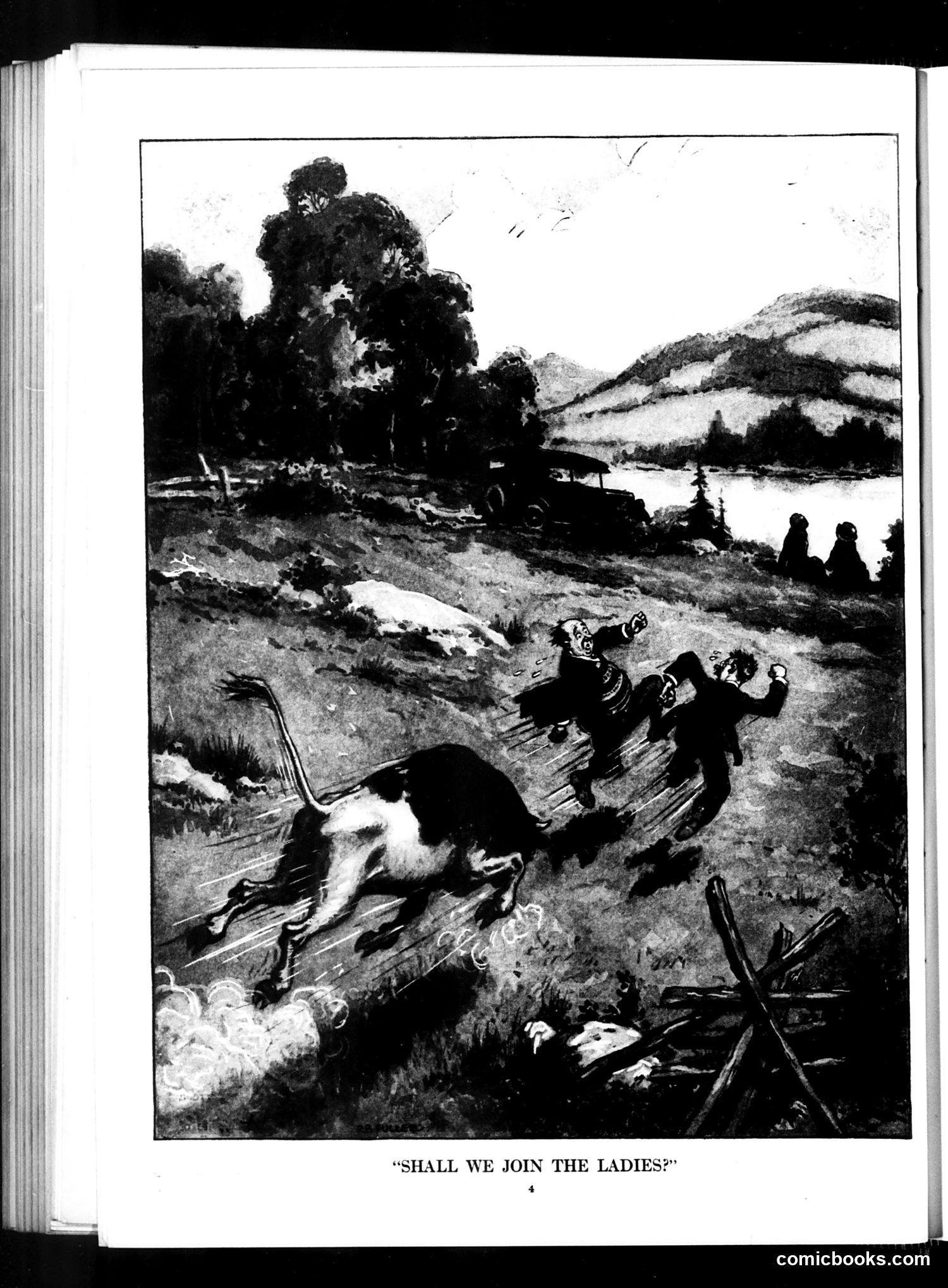
This cartoon depicts a hunting scene with two male hunters pursuing game (appears to be a deer or similar wildlife) across a mountainous landscape. The caption "Shall We Join the Ladies?" suggests social satire about gender roles and outdoor activities. The joke likely mocks either: the idea of women participating in traditionally male-dominated hunting, or conversely, men abandoning hunting to socialize with women. The energetic, somewhat chaotic scene—with the hunters in active pursuit—contrasts with the caption's polite, social question, creating humorous incongruity. Without additional context about specific contemporary events or figures in Judge magazine's publication period, the precise satirical target remains unclear, though it clearly comments on evolving social conventions around gender and leisure activities.
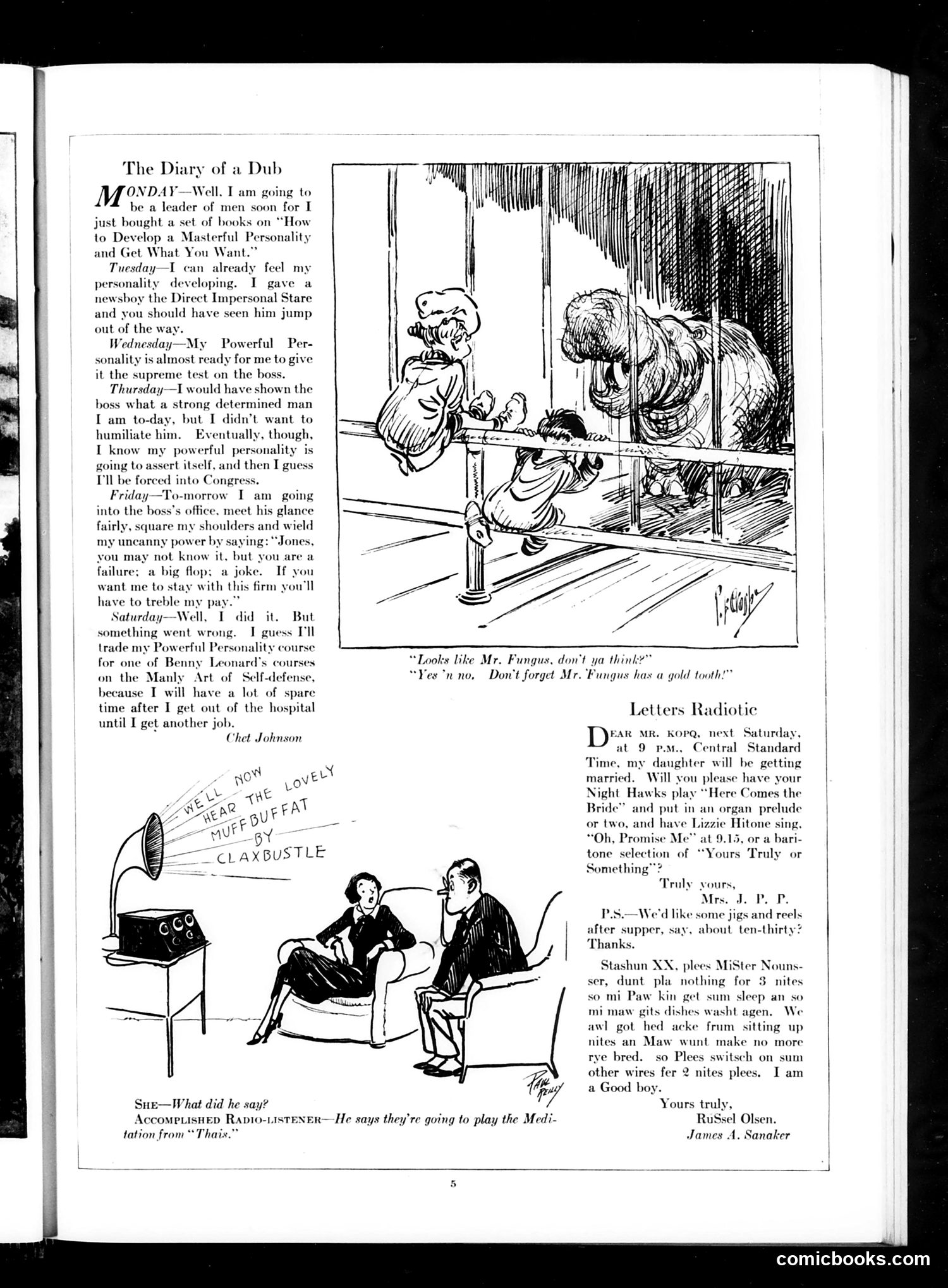
This page contains three distinct pieces of humor: 1. **"The Diary of a Dub"** (left column): A satirical diary by "Chet Johnson" mocking self-help culture. The writer purchases books on "Masterful Personality" and attempts to assert dominance over his boss, only to fail repeatedly and end up hospitalized. The satire targets the popular self-improvement industry of the era, suggesting such courses are fraudulent. 2. **Top cartoon**: Office workers discussing a colleague named "Mr. Fungus," with a joke about his gold tooth—simple workplace humor. 3. **Bottom cartoon and radio joke**: Satirizes radio listeners' enthusiasm, showing a couple eagerly tuning in. The joke plays on "Thais" (the opera), with the punchline suggesting radio drama mediocrity. The page primarily mocks contemporary fads—self-help schemes and radio broadcasting—reflecting 1920s-30s popular anxieties.
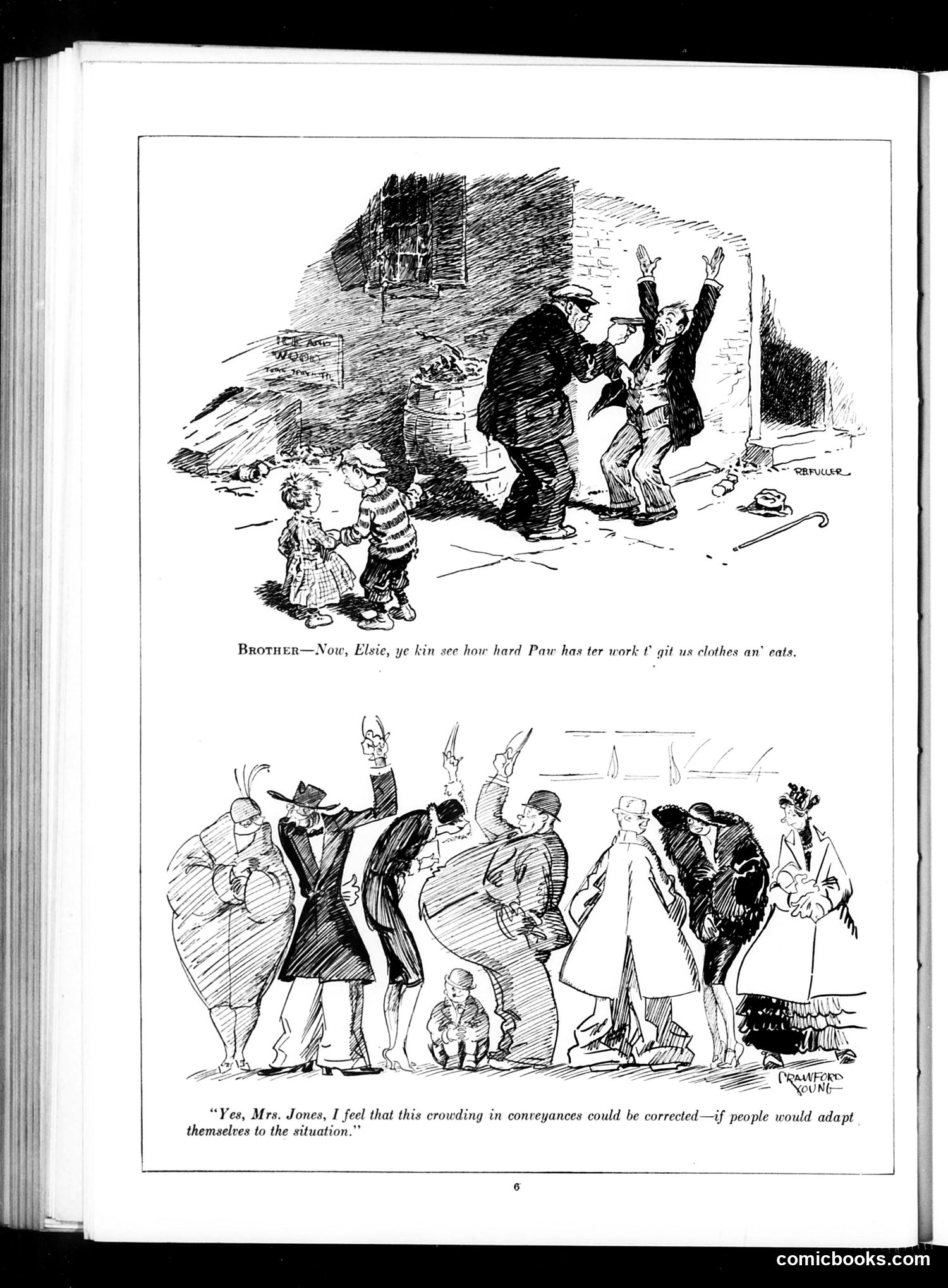
**Top cartoon** (by Cesare): A well-dressed man lectures two poor children about their father's hard work, while the family appears to live in squalid conditions. The satire mocks condescending paternalism—the wealthy offering moral platitudes rather than actual help. **Bottom cartoon** (by Cesare Wyne): A well-to-do woman tells Mrs. Jones that overcrowding on public transportation could be solved if people would "adapt themselves." The satire is biting: the affluent woman, comfortable in her space, suggests poor passengers simply adjust rather than acknowledging systemic causes—inadequate transit, low wages forcing crowded living conditions. The cartoon critiques class blindness and victim-blaming attitudes toward poverty and urban congestion during the Industrial Era.
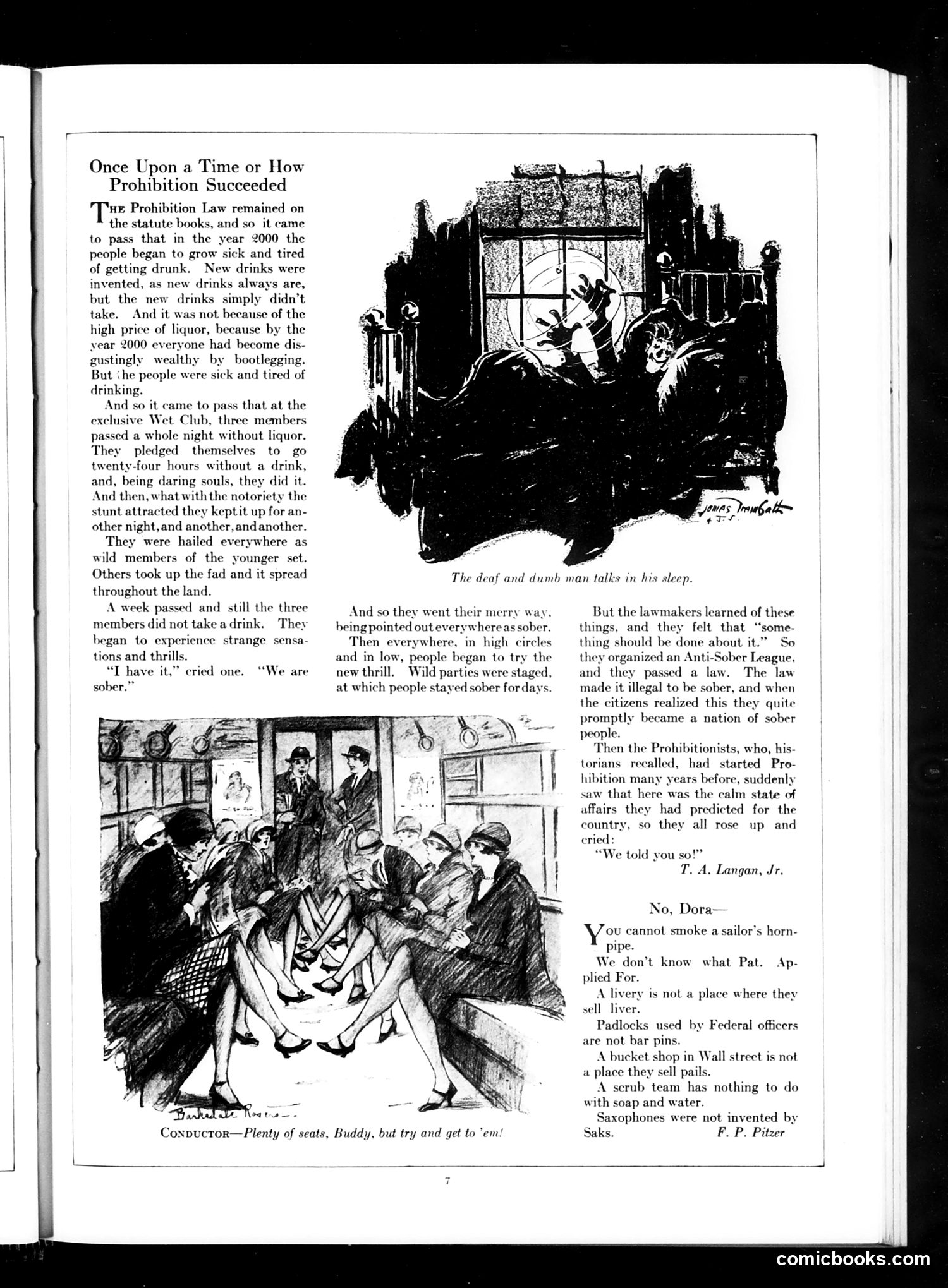
This 1920s-era satirical story mocks Prohibition's actual failure by imagining an absurd future (year 2000) where it paradoxically *succeeds*—but in reverse. The satire works by inversion: instead of people drinking illegally despite the ban, wealthy bootleggers become bored with alcohol. Sobriety becomes fashionable as a daring "thrill." Alarmed lawmakers then pass a law *requiring* sobriety, which ironically makes everyone actually sober—the original Prohibitionists' goal. The joke targets Prohibition's hypocrisy and unintended consequences: the law created wealthy bootleggers while failing to stop drinking. The cartoons illustrate the speakeasy culture and crowded transit scenes of the era. The lower section ("No, Dora") is unrelated wordplay humor mocking double meanings in common phrases—typical filler content for satirical magazines. The piece's core message: Prohibition was so fundamentally flawed that only absurd fictional logic could make it "work."
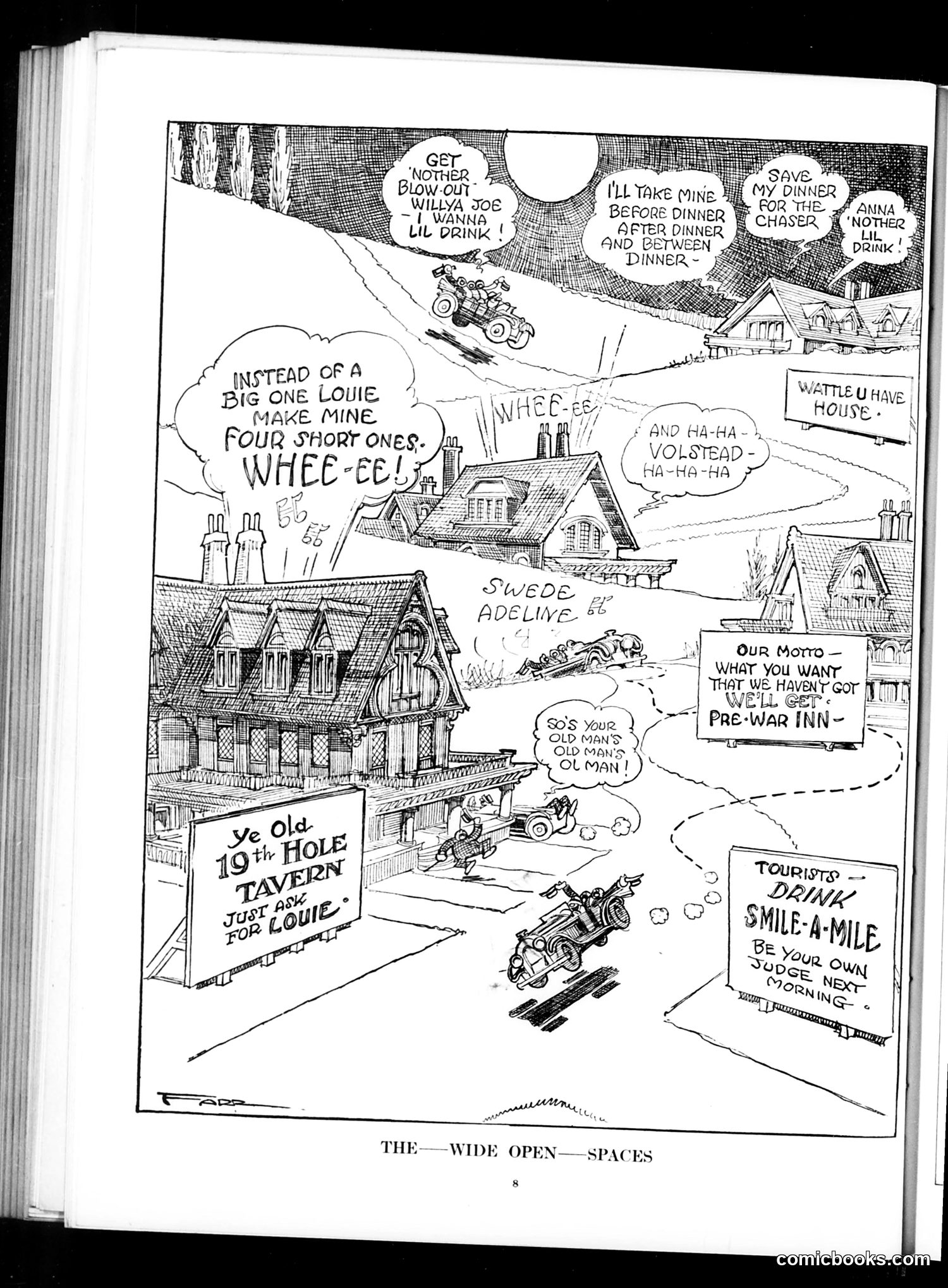
This Judge magazine cartoon satirizes drinking culture during Prohibition (the "Volstead" Act is referenced). The scene depicts a rural English village where tourists and locals openly flout American alcohol restrictions. The humor centers on the contrast: while Americans faced strict prohibition enforcement, British establishments advertised drinks freely. Characters discuss obtaining liquor multiple ways—"four short ones" instead of one large drink to avoid detection, or simply waiting until after dinner. The signs mock American hypocrisy: "Ye Olde 19th Hole Tavern" asks for "Louie," the "Smile-a-Mile" tourist spot promises "your own sludge next morning," and the cottage motto boasts they have pre-Prohibition liquor the Americans can't get. The joke critiques Prohibition's ineffectiveness and Americans' desperate measures to circumvent it, while highlighting how freely alcohol flowed across the Atlantic—making the American "wide open spaces" ironically more restrictive than actual foreign lands.
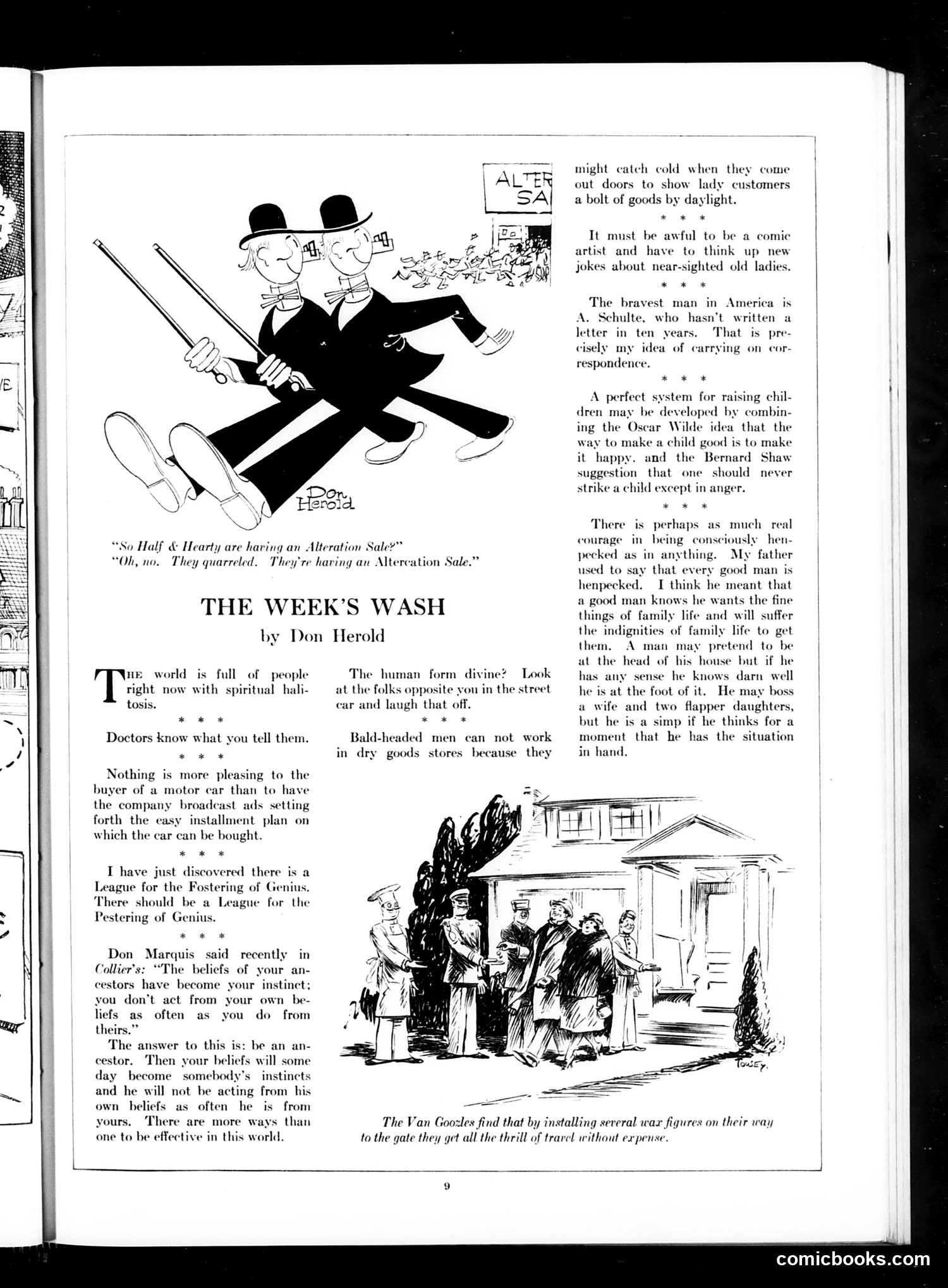
This is a humor column with two cartoons. The top cartoon jokes about a store's "Alteration Sale" versus "Altercation Sale"—a pun where two business partners having a quarrel is presented as the actual reason for the sale. The column itself consists of brief witticisms about American life. Herold satirizes common annoyances: bad breath ("halitosis"), bald men's employment struggles, car salesmen's installation-plan pitches, and the prevalence of "near-sighted old ladies" in comic strips. He references cultural figures like Oscar Wilde and Bernard Shaw regarding child-rearing philosophy, and Don Marquis on inherited beliefs versus personal conviction. The lower cartoon depicts the "Van Goozles" using wax figures at their gate to simulate the thrill of travel—mocking shallow status-seeking or tourism pretense without actual effort. The satire targets everyday social pretense, consumer culture, and middle-class anxieties in early 20th-century America.
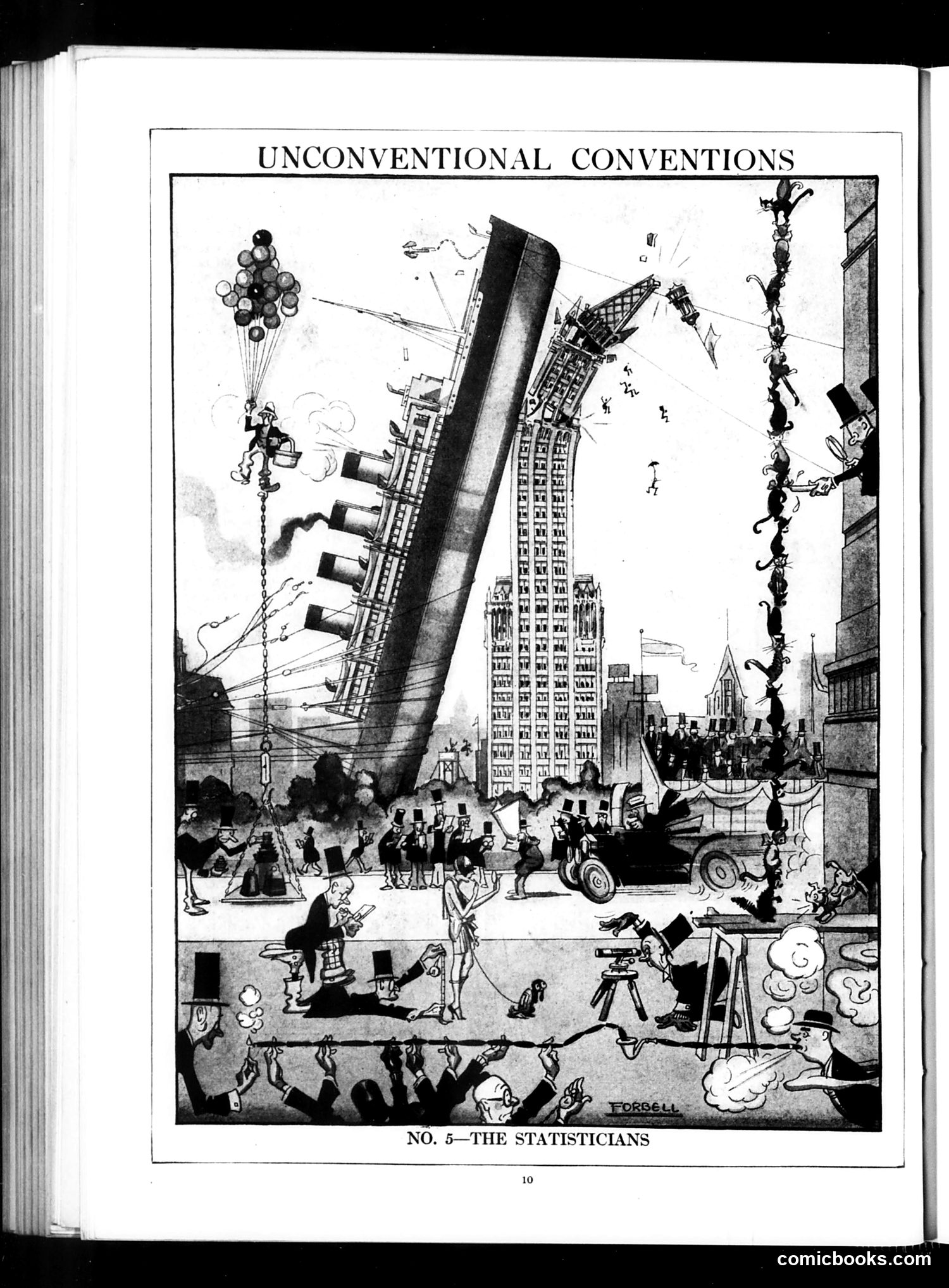
This cartoon satirizes statisticians and data analysts of the early 20th century. The image depicts a chaotic urban scene where statisticians are literally measuring and analyzing everything—buildings, people, vehicles, even the sky. A tilted ship in the background suggests they measure disasters; people dangle from chains being counted; telescopes and measuring instruments proliferate. The satire criticizes the era's obsession with quantification and statistical analysis as a solution to social problems. The "unconventional conventions" title suggests these data-obsessed experts operate in absurd, impractical ways. Rather than solving real urban problems (suggested by the crowded, disordered cityscape), they merely catalog and measure them endlessly. The cartoon mocks the assumption that numbers alone can address complex social issues.
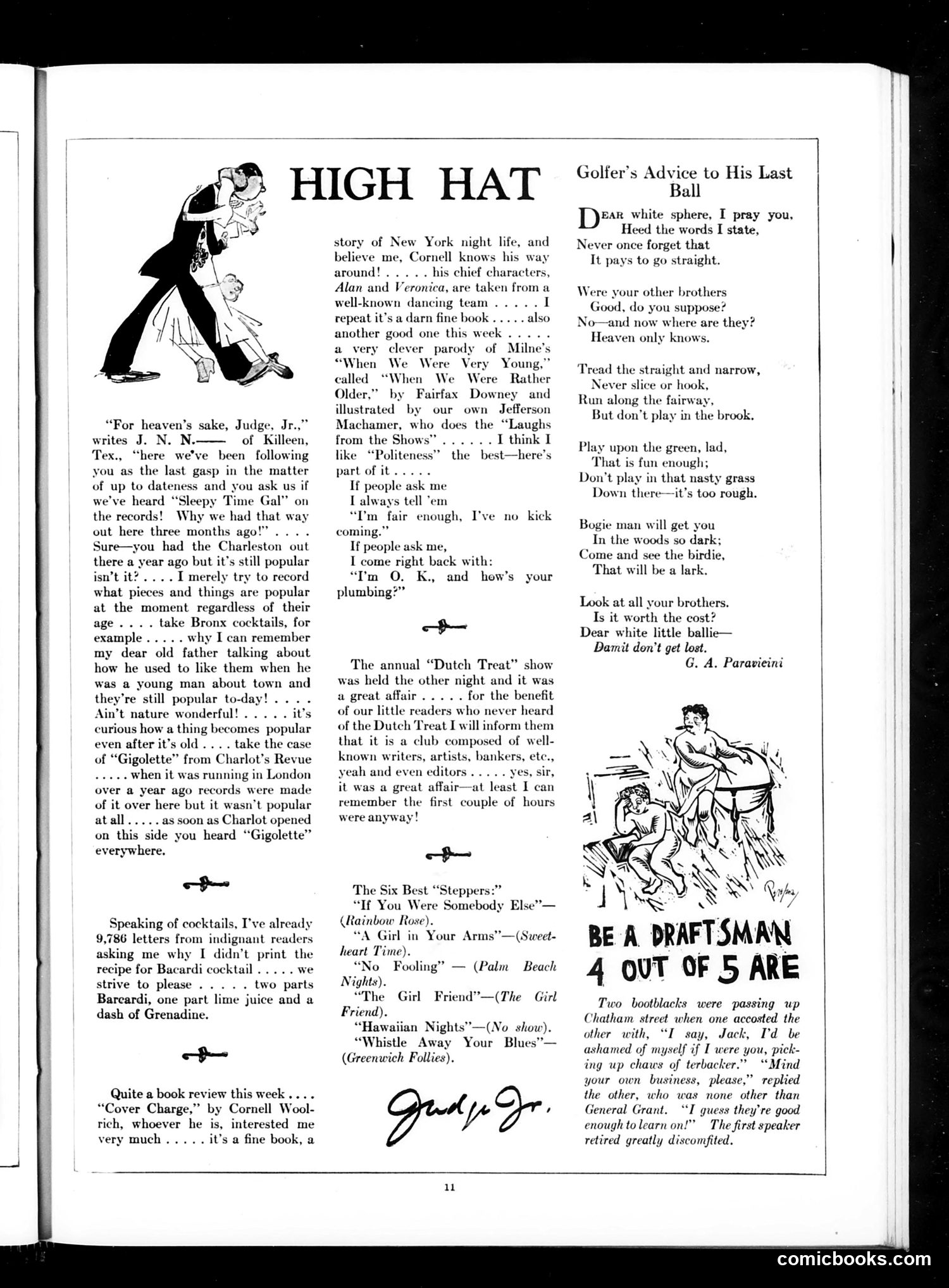
This page from Judge magazine (circa 1920s, based on references to "Sleepy Time Gal" and Charleston dancing) is a humor/gossip column by the editor addressing reader correspondence. **Main Content:** The column discusses what's currently popular in entertainment and culture—songs, cocktails, Broadway shows. It notes the irony that older trends (like Bronx cocktails or the song "Gigolette") become fashionable again once they're discovered by New York audiences. **The Cartoons:** - Upper left: A couple dancing (illustrating New York nightlife) - Right side: "Golfer's Advice to His Last Ball"—a humorous poem personifying a golf ball, using moral language ("go straight," "narrow path") as puns on golf terminology (slice, hook, fairway) - Lower right: "Be a Draftsman: 4 Out of 5 Are"—an incomplete joke about bootblacks (street shoe-shiners), apparently contrasting their profession with draftsmanship **The Tone:** Light, witty commentary on New York entertainment trends for Judge's educated, urban readership.
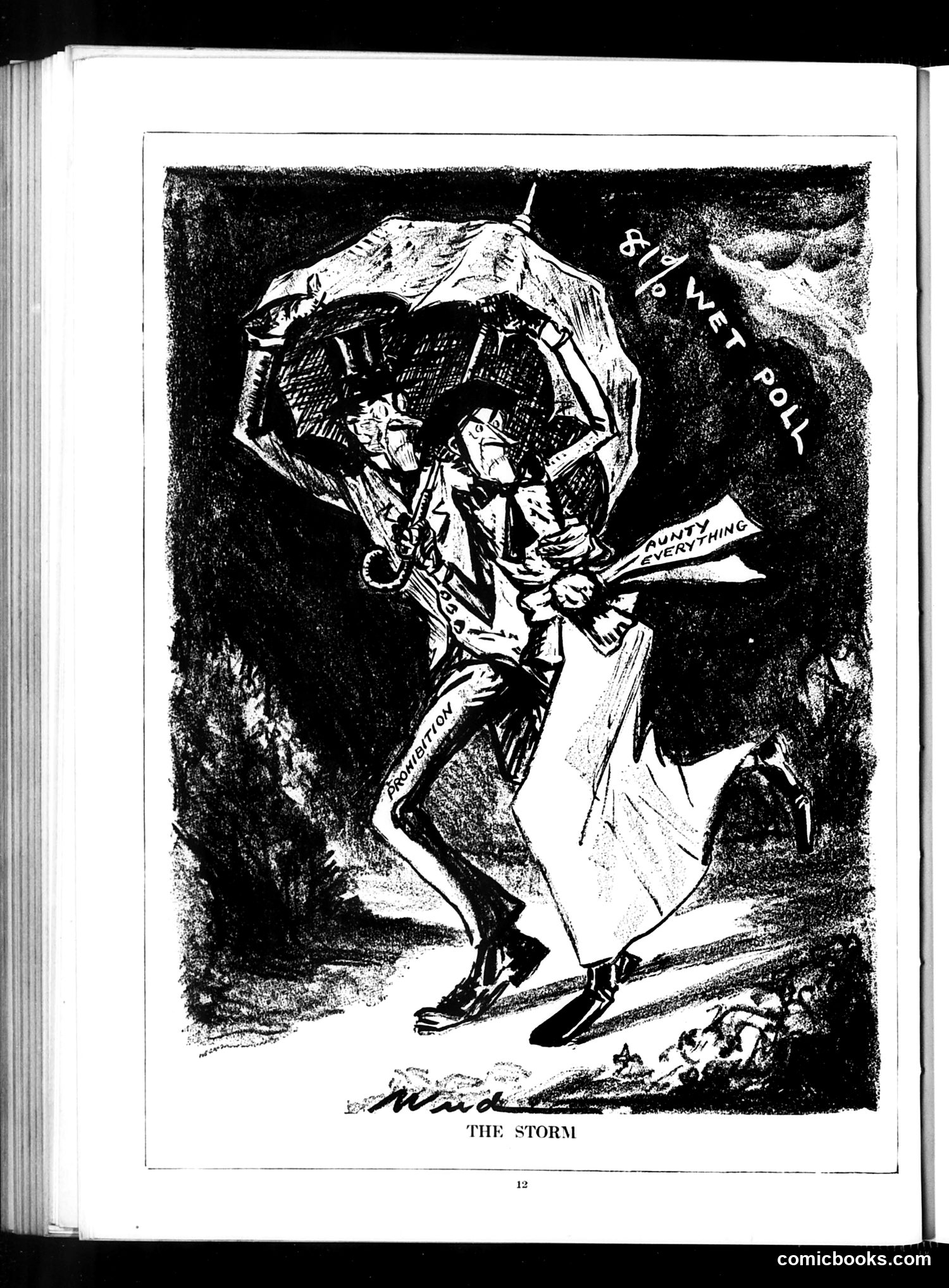
This cartoon depicts a figure struggling against a violent storm while holding an umbrella labeled "A WET POLL" and carrying papers labeled "CORRUPTION" and "RUNNING EVERYTHING." The character appears to be a politician or political figure being buffeted by adverse circumstances. The satire suggests that despite attempts to shield oneself (the umbrella/wet poll), corruption and overreach in governance cannot be protected from public scrutiny or electoral consequences. The "wet poll" likely references polling data or public opinion that contradicts the figure's political position. Without the magazine's date visible, the specific political figures or events referenced remain unclear, though this appears to critique abuse of political power during an era when Judge magazine regularly lampooned corrupt politicians and patronage systems.
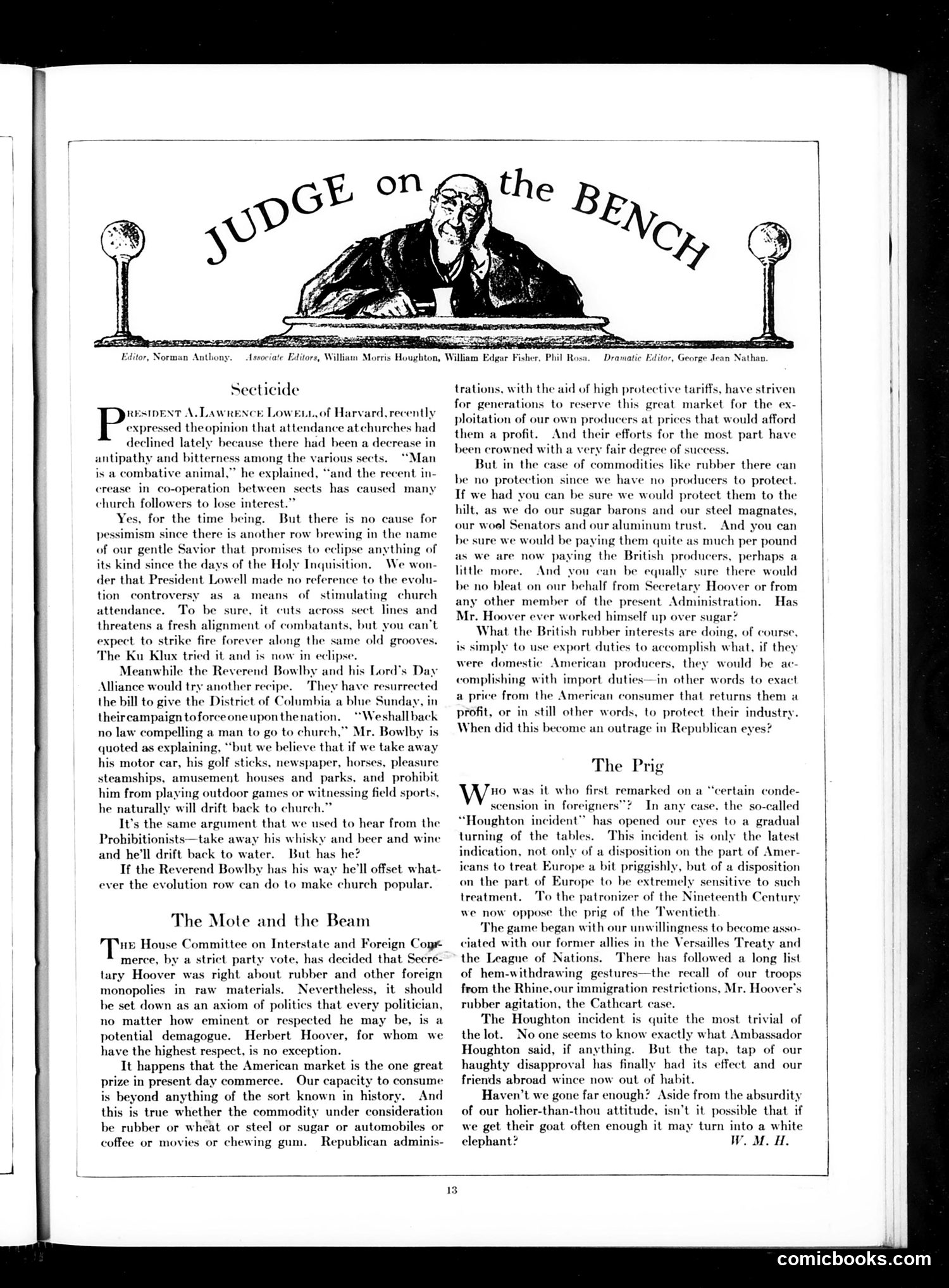
This page contains three editorial pieces satirizing American political and social hypocrisy in what appears to be the 1920s. **"Secticide"** mocks Harvard President A. Lawrence Lowell's optimistic claim that religious cooperation has increased. The author argues the real stimulus for church attendance comes from conflict (like evolution debates), not peace—comparing it to how Prohibition failed to reform drinkers. It also ridicules Reverend Bowlby's "Lord's Day Alliance," which proposes blue laws restricting Sunday leisure (cars, golf, newspapers) to force churchgoing, calling this coercive moralism absurd. **"The Mote and the Beam"** criticizes Secretary Herbert Hoover's complaints about British rubber monopolies. The author argues Republicans have consistently used tariffs to protect American producers from foreign competition—yet conveniently oppose tariffs when *we* lack domestic producers. This exposes Republican hypocrisy: they'll protect sugar and steel interests but criticize Britain for doing exactly what American tariff policy does. Both pieces use ironic satire to expose contradictions between stated principles and actual practice.
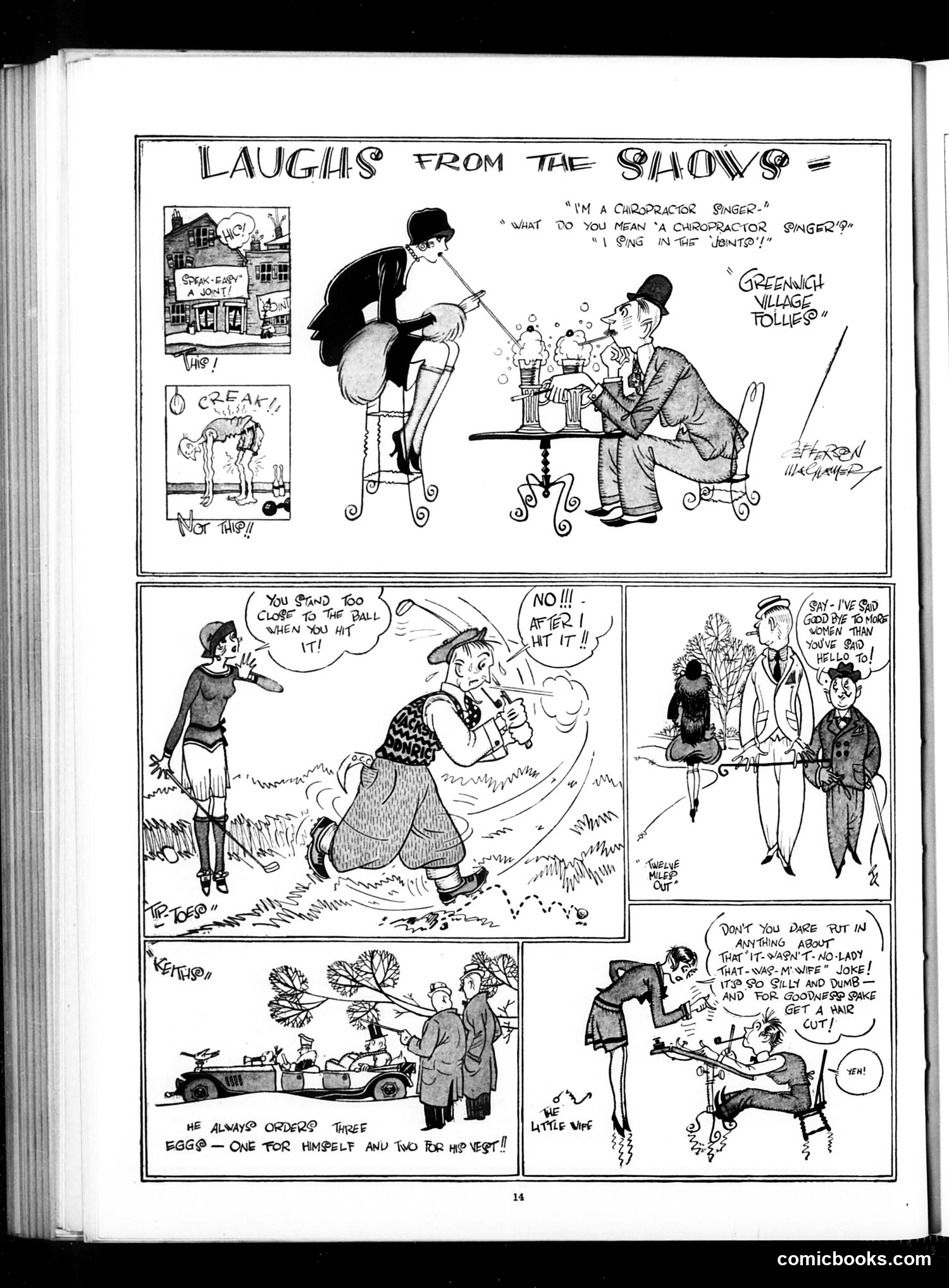
This page collects theatrical humor from Broadway productions, particularly *Greenwich Village Follies*. The top panel jokes about a chiropractor who calls himself a "singer"—the humor lies in the malapropism and the character's confused self-description. The subsequent comic strips satirize domestic life and social pretensions of the era. The running gags target: marital disputes (a wife scolding her husband about his silly jokes), class consciousness (references to sophisticated New York venues), and gender dynamics. One panel mocks a henpecked husband whose wife dominates him; another shows a man ordering eggs with oddly specific instructions ("one for himself and two for his vest"). The cartoons reflect 1920s-era satirical humor emphasizing wordplay, domestic conflict, and gentle mockery of bourgeois married life. The style and subjects are typical of *Judge* magazine's comedic approach to contemporary theater and social behavior.
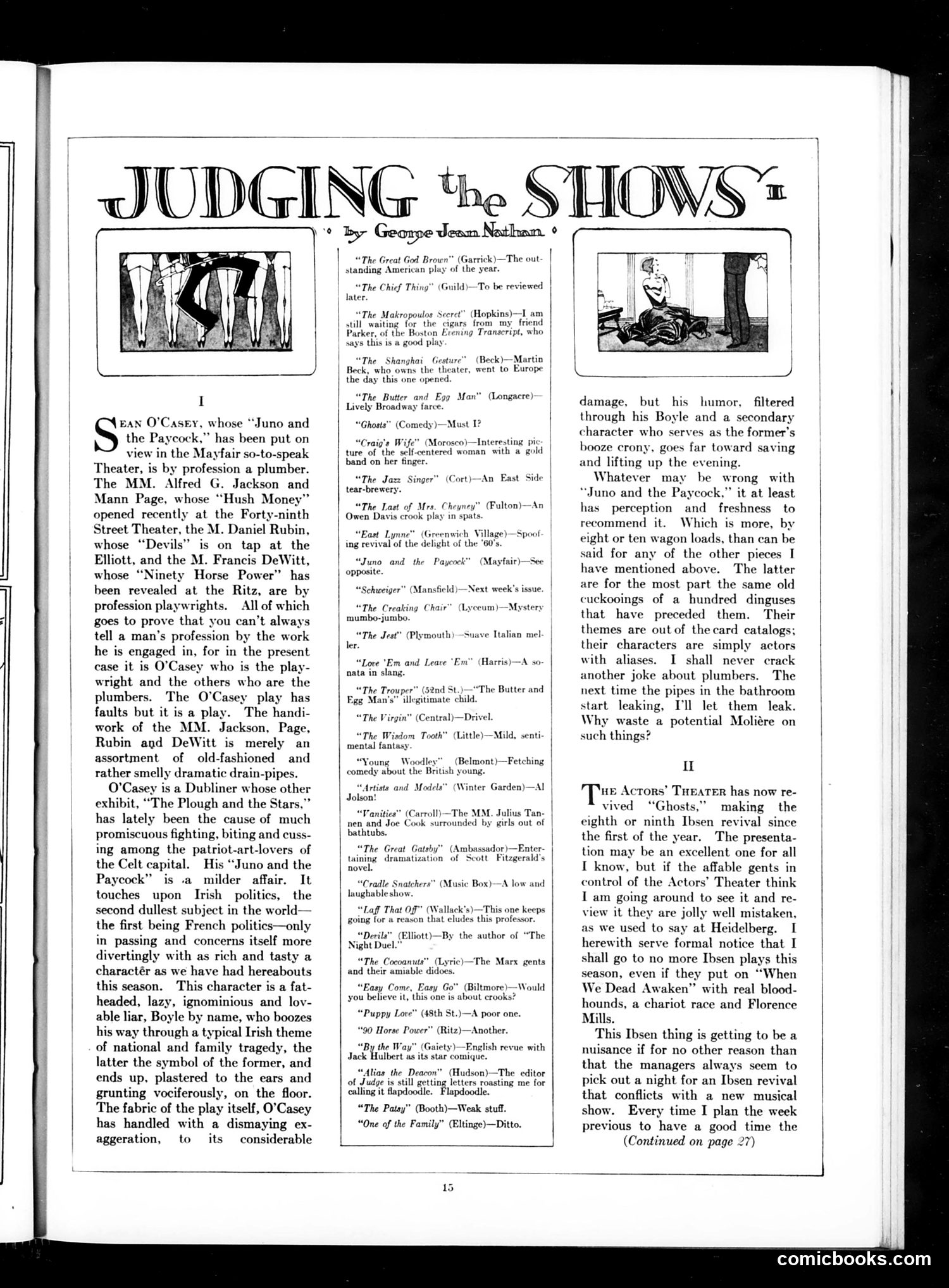
This is a theater review column by George Jean Nathan, a prominent drama critic. The main article compares Sean O'Casey, an Irish playwright whose work "Juno and the Paycock" is reviewed, to several professional playwrights (Jackson, Page, Rubin, DeWitt) whose current Broadway plays are criticized as mediocre. **The satire's point**: Nathan uses a paradox for comedic effect—O'Casey is a plumber by trade but produces genuine dramatic art, while the professional playwrights produce work Nathan dismisses as "old-fashioned and rather smelly dramatic drain-pipes." The plumbing metaphor extends the joke: the professionals are the real "plumbers," fixing nothing while producing theatrical waste. O'Casey's play deals with Irish politics and family tragedy, featuring a sympathetic but alcoholic, dishonest character (Boyle). Nathan praises its freshness despite "dismaying exaggeration." The accompanying listing reviews other current Broadway productions, mostly dismissively.
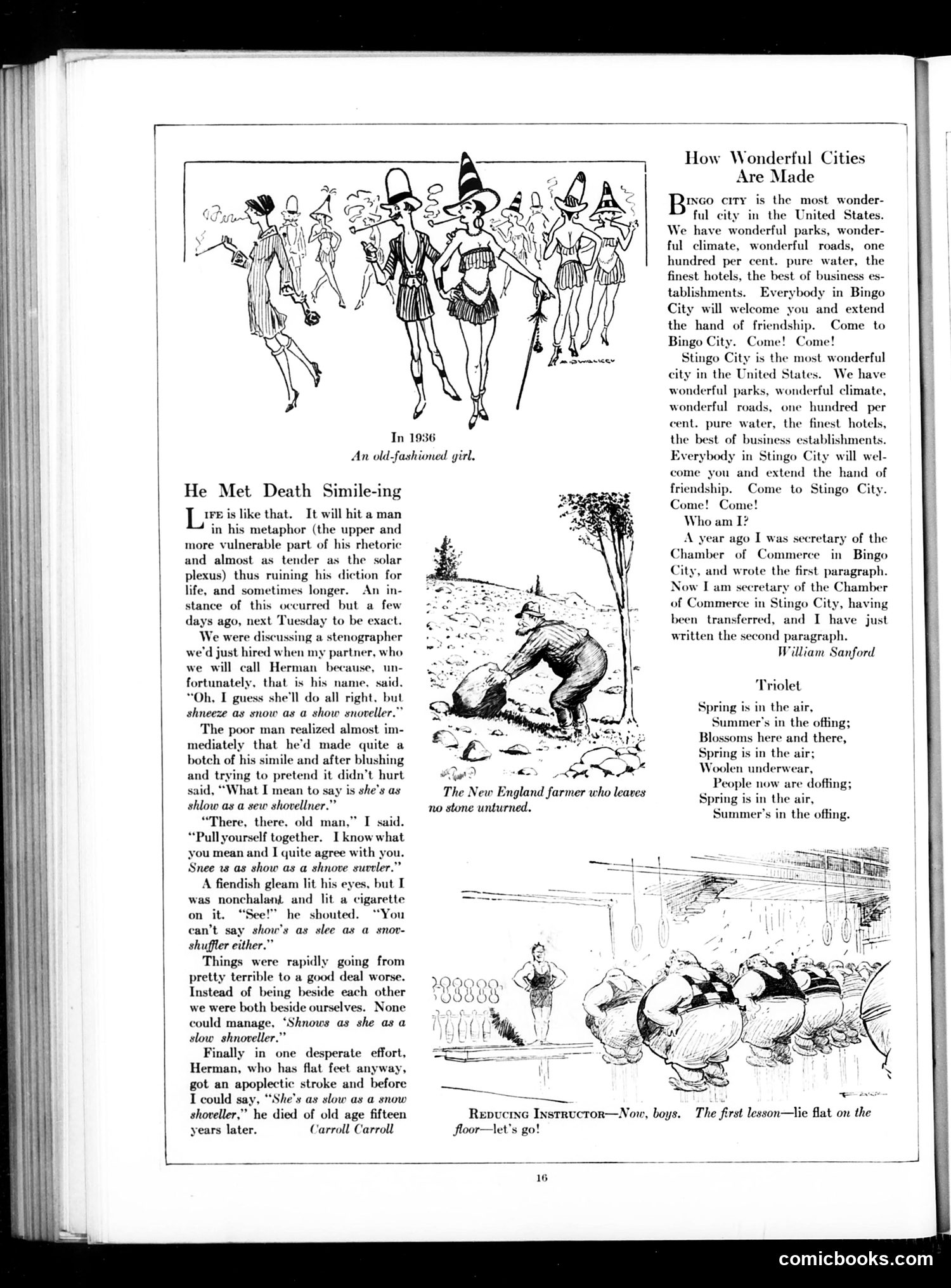
**"How Wonderful Cities Are Made"** satirizes Chamber of Commerce promotional writing. Two fictional cities—Bingo City and Stingo City—receive identical, hyperbolic praise ("wonderful parks," "pure water," "finest hotels"). The joke: William Sanford, a Chamber secretary, wrote both descriptions after being transferred between cities, revealing the generic, interchangeable nature of municipal boosterism. This mocks 1930s civic promotion as formulaic propaganda divorced from actual distinction. **"He Met Death Simile-ing"** is a humorous language piece by Carroll Carroll about verbal mishaps. A man attempts a simile ("she's as slow as a snow shoveller") but mangles it repeatedly through tongue-twisting errors. His embarrassment cascades into absurdity until he dies "fifteen years later"—comic exaggeration of dying from linguistic humiliation. It satirizes overwrought speech and the social anxiety of public verbal failure. The cartoons accompanying these pieces are illustrative rather than politically pointed.
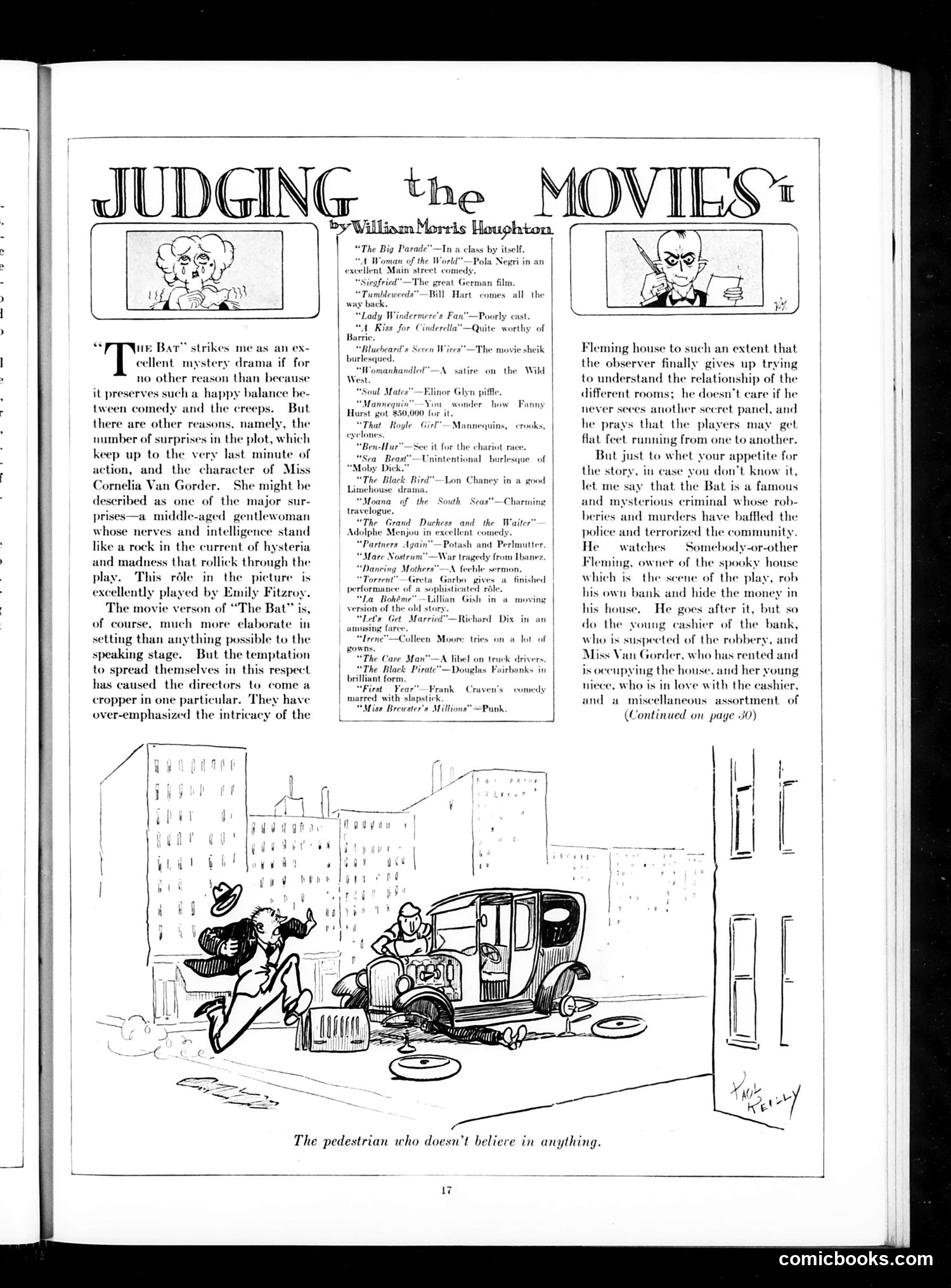
This is a film criticism column by William Morris Houghton reviewing current movies, circa mid-1920s. The main cartoon illustrates a comedic car accident scene captioned "The pedestrian who doesn't believe in anything" — a satirical jab at skepticism or fatalism, suggesting disbelief in safety precautions leads to disaster. The column reviews films including "The Bat" (praised as an excellent mystery), "Ben-Hur" (notable for its chariot race), and various other contemporary releases. Houghton criticizes "The Bat" for over-elaborating its set design with too many secret panels and confusing room layouts, making the plot hard to follow. He offers brief, witty assessments of each film's merits or flaws, reflecting typical 1920s film criticism focused on plot, acting quality, and spectacle.
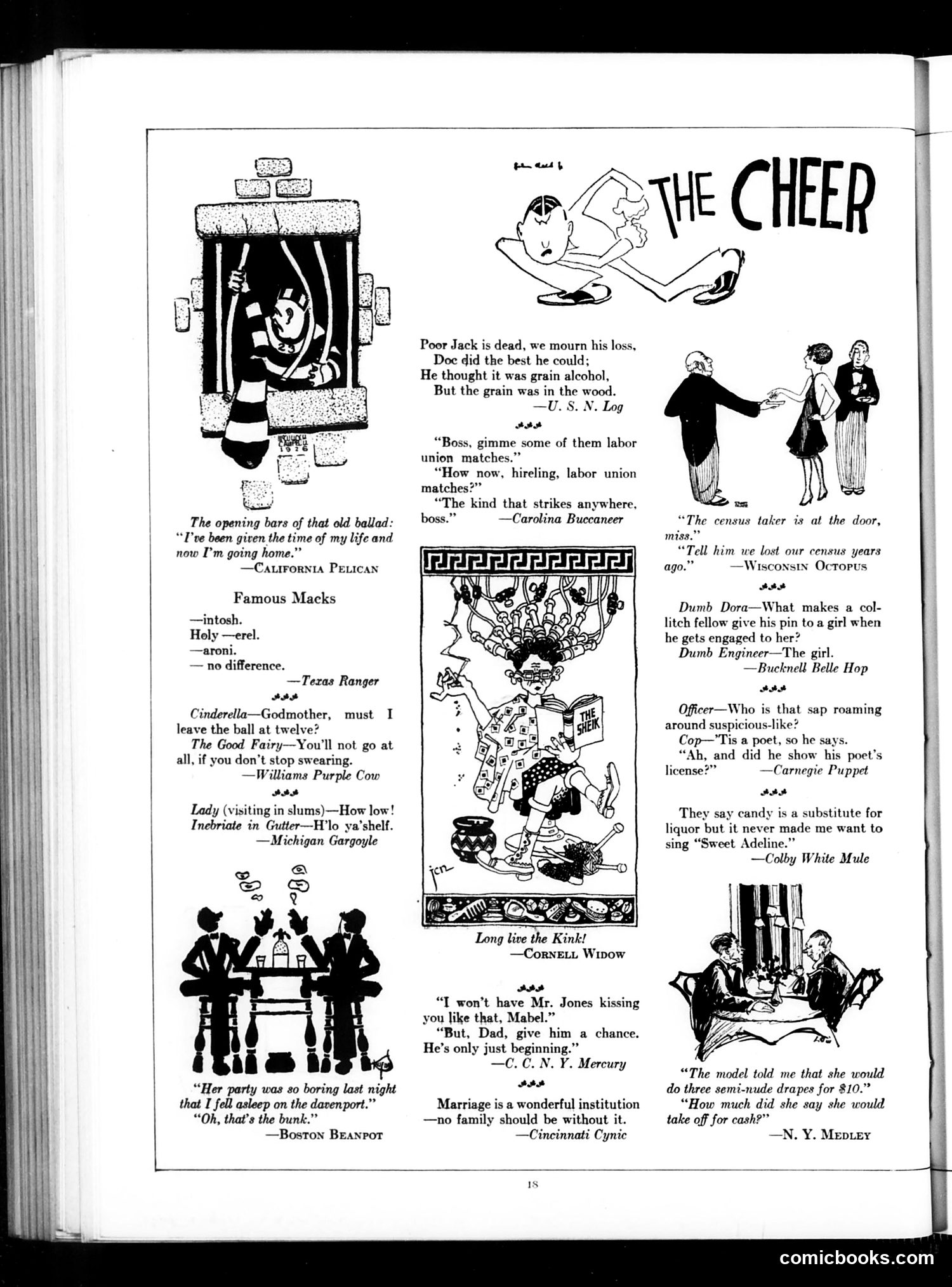
This is a humor compilation page from Judge magazine featuring jokes and cartoons from various college publications. The content reflects 1920s-era collegiate and social satire: **Main themes:** - **Prohibition-era drinking jokes**: References to "grain alcohol" and liquor substitutes (candy), reflecting the dry law's unpopularity - **Labor union mockery**: A joke about union "matches that strike anywhere," satirizing labor organizing - **College life humor**: Dumb Dora and engineer jokes, fraternity pins, poets, models - **Dating/courtship**: Jokes about kissing, engagements, and parental disapproval - **Marriage satire**: A quip that marriage is "wonderful" but families shouldn't have one—inverting the institutional praise The cartoons use simple line drawings typical of 1920s college humor. The sourcing from various college papers (Cornell Widow, Texas Ranger, Carnegie Puppet, etc.) shows this was a national collegiate humor compilation. The overall tone is mildly risqué for the era while remaining family-appropriate.
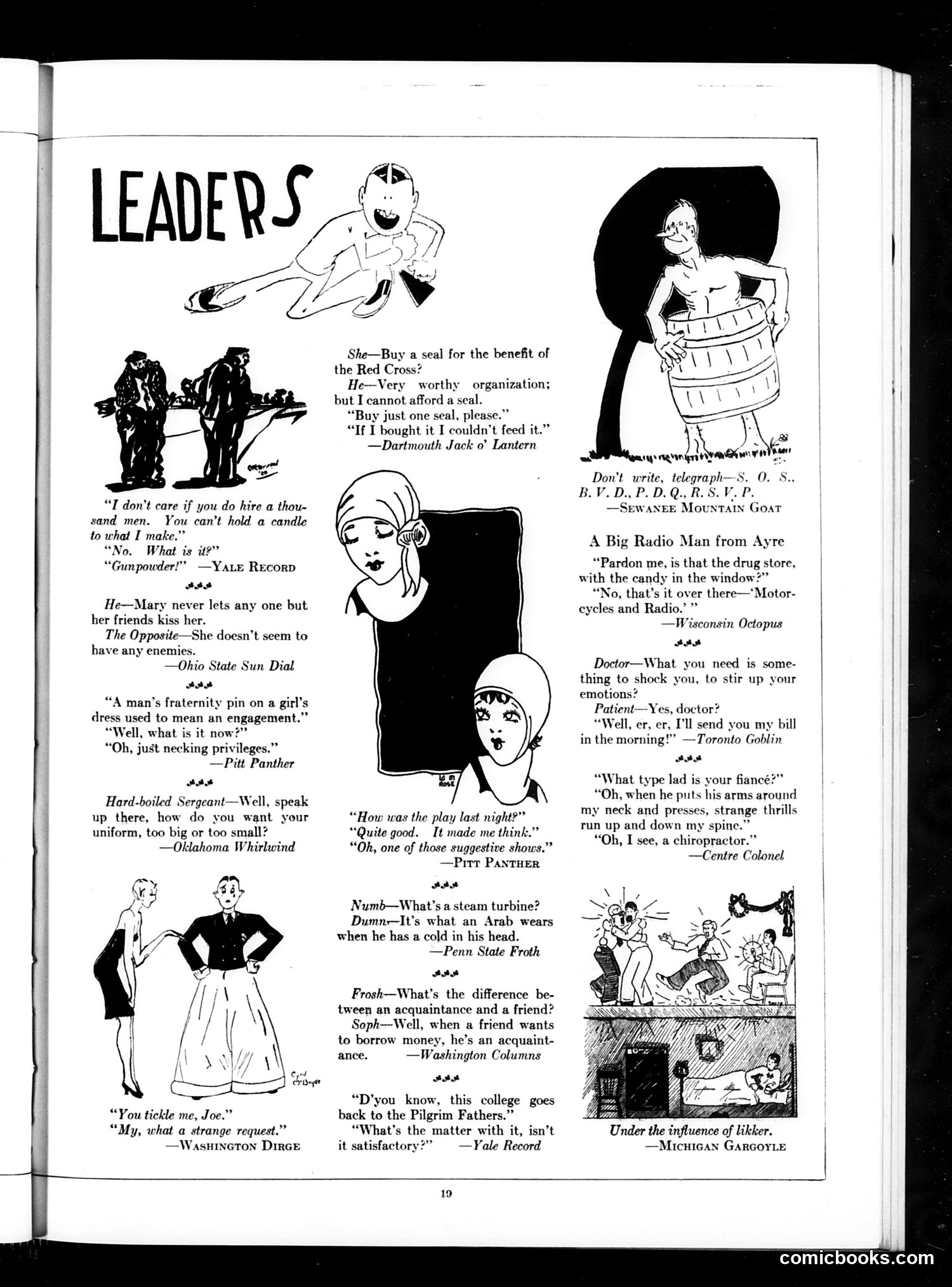
This page collects brief jokes and cartoons from college humor magazines circa the 1920s-30s, organized under the heading "Leaders." The humor targets typical college social situations and romantic dynamics of the era. The jokes mock dating conventions (fraternity pins as engagement indicators, "necking privileges"), military absurdities (uniform sizing), and student stereotypes (freshmen vs. sophomores). Several play on double meanings: a soldier's "gunpowder" boast, an Arab's "steam turbine" (turban pun), and mistaking a chiropractor's physical pressure for romantic excitement. The Red Cross seal joke reflects Depression-era financial hardship. References to "suggestive shows" and being "under the influence of likker" indicate prohibition-era social commentary. The cartoons use simple line drawings typical of college publications. Most jokes are attributed to specific university papers (Yale, Penn State, Wisconsin), suggesting this compiled collegiate humor from across American campuses—appealing to Judge's educated readership.
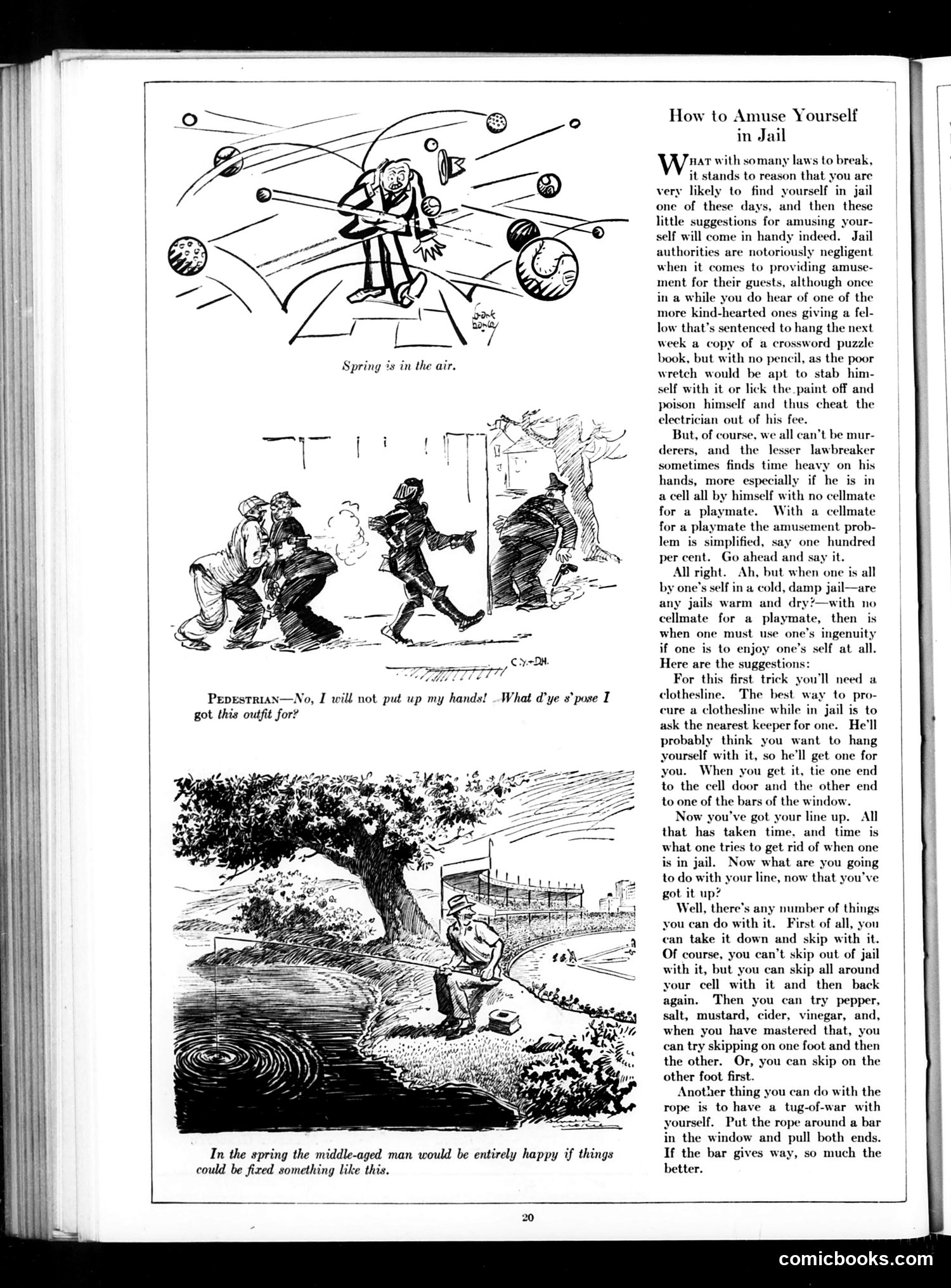
This is a humorous advice column satirizing both the poor conditions of American jails and the absurdity of trying to maintain morale in incarceration. The piece mocks jail authorities for providing no entertainment while acknowledging that prisoners—from murderers to "lesser lawbreakers"—need ways to pass time. The satire works on multiple levels: it treats imprisonment as inevitable ("with so many laws to break"), presents darkly comic suggestions (a crossword puzzle book with no pencil to prevent suicide), and offers genuinely ridiculous activities like skipping rope around a cell or having a tug-of-war with oneself. The accompanying cartoons illustrate the absurdity: one shows a man juggling while surrounded by orbiting objects (spring chaos), another depicts a pedestrian refusing to raise his hands while seemingly dressed like a criminal, and a third shows an idealized rural scene—the fantasy escape from confinement. The overall message critiques the callousness of the penal system while using dark humor to acknowledge widespread incarceration.
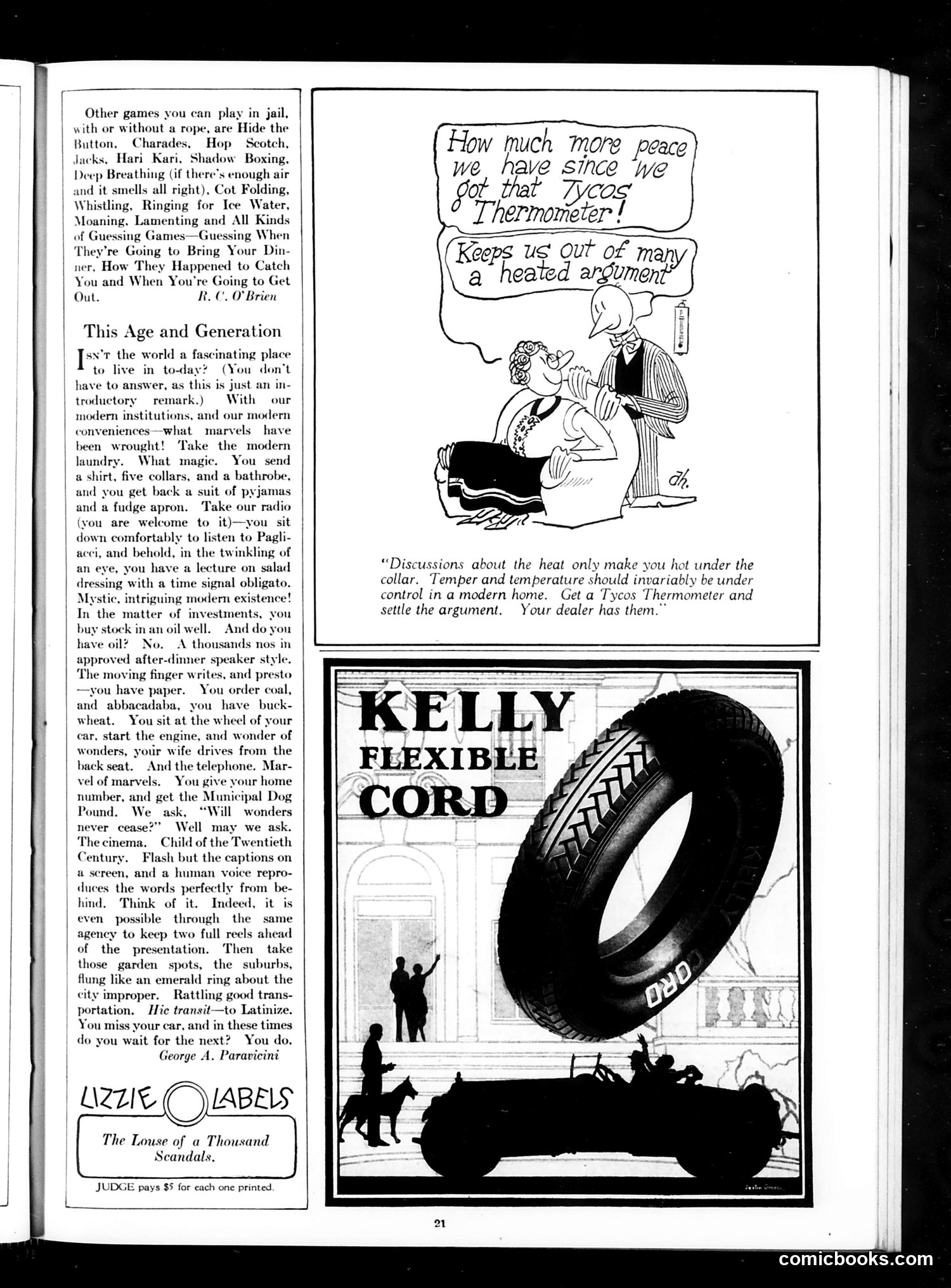
This page contains satirical commentary on modern American life circa the 1920s, plus an advertisement. **The Main Cartoon (top right):** A couple argues about home temperature while holding a thermometer. The husband suggests a Tycos thermometer will "settle the argument" by providing objective temperature readings, preventing heated domestic disputes. This is both humor and product placement—satirizing how modern conveniences promise to solve everyday marital conflicts through technology. **"This Age and Generation" Essay (left):** Author George A. Paravicini satirizes modern conveniences that paradoxically malfunction or produce opposite results: laundry mixes up orders, radios interrupt music with lectures, stock investments yield nothing, coal orders arrive as buckwheat, wives drive from backseats, phone calls reach wrong numbers, movie dialogue falls out of sync with film, and suburban commutes involve endless waiting. The satire suggests that despite technological "marvels," modern life remains chaotic and frustrating—progress is illusory. **Bottom Advertisement:** Kelly Flexible Cord product placement featuring a vintage automobile. The overall theme mocks 1920s consumerism and the gap between promised technological solutions and lived reality.
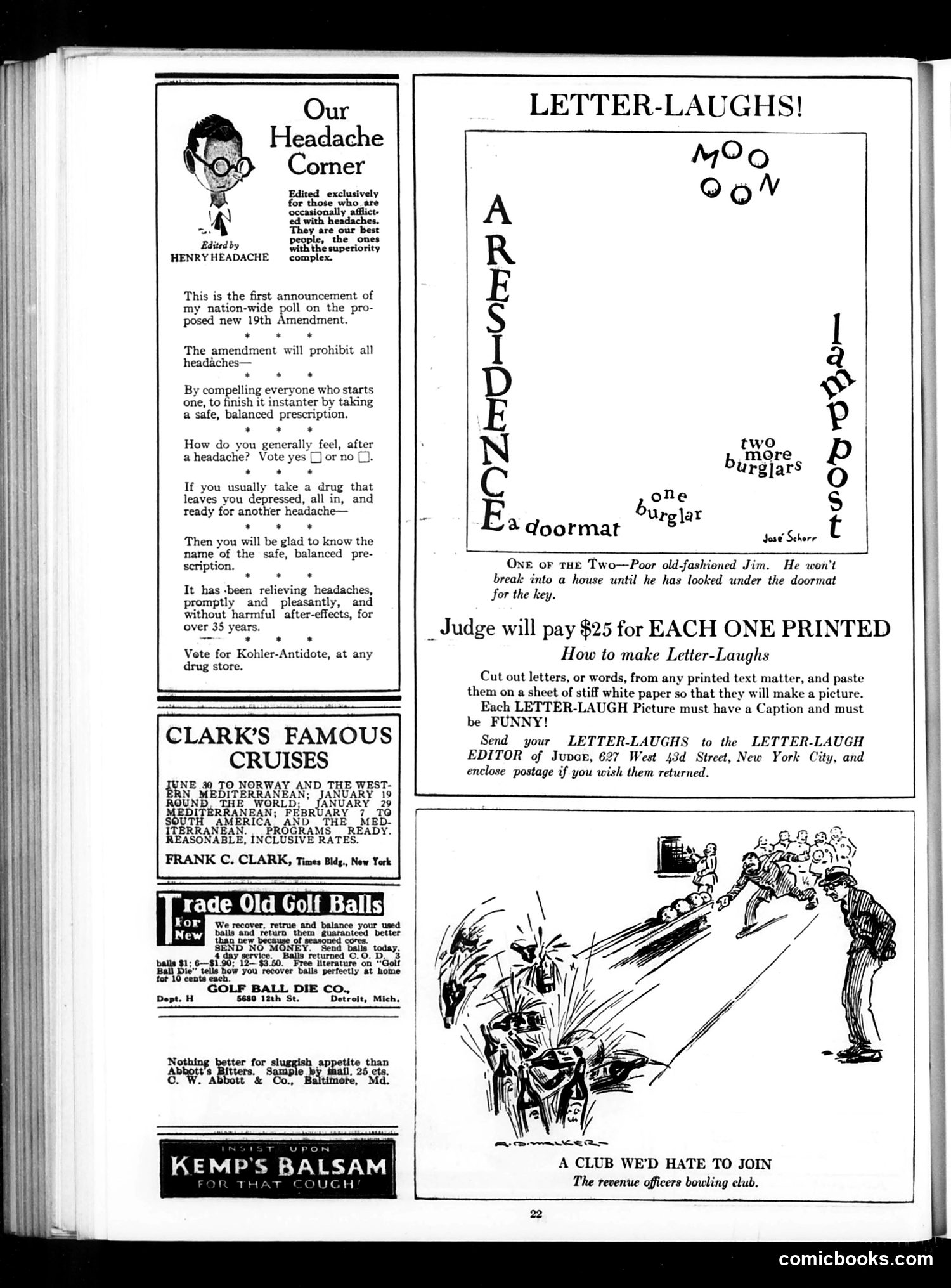
This page contains satirical content and advertisements typical of early 20th-century *Judge* magazine. **"Our Headache Corner"** is a faux-serious editorial mocking patent medicine advertising by proposing a fictional "19th Amendment" prohibiting headaches. It humorously promotes "Kohler-Antidote," a real product, as a safe alternative to depression-causing drugs. The satire targets both headache sufferers and the medical industry's dubious claims. **"Letter-Laughs"** is a reader-participation section where people create visual puns by cutting letters from printed text to form images. The example shows a burglar looking under a doormat—the joke being this "old-fashioned" criminal searches for hidden door keys before breaking in. **"A Club We'd Hate to Join"** cartoon satirizes Prohibition-era federal revenue officers (who enforced alcohol laws) by depicting them in a bowling club—likely mocking their authority or suggesting they deserve recreational mockery. The remaining content consists of era-appropriate advertisements for cruises, golf balls, and cough medicine.
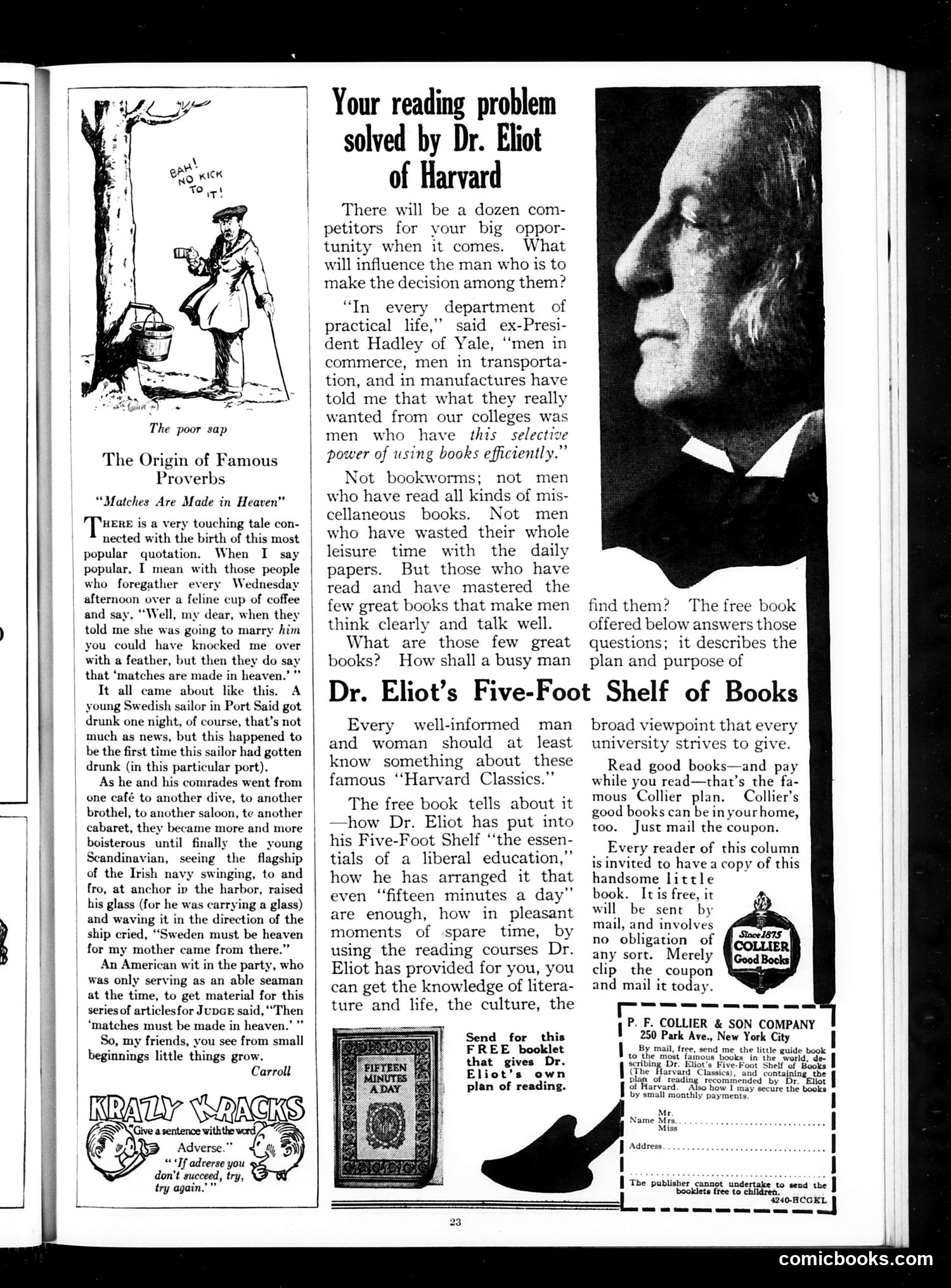
This page contains two distinct pieces: **Left side — "The Origin of Famous Proverbs":** A humorous filler by Carroll explaining how the saying "matches are made in heaven" supposedly originated. A drunken Swedish sailor, seeing an Irish navy ship, toasted Sweden as heaven; an American wit present then quipped that "matches must be made in heaven." It's gentle satire on how popular sayings arise from trivial, often dubious origins—mocking both the saying's prevalence among gossiping coffee-drinkers and the implausibility of its origin story. **Right side — Advertisement:** Promotes Dr. Charles W. Eliot's "Five-Foot Shelf of Books" (Harvard Classics). The ad quotes ex-Yale President Hadley endorsing selective, efficient reading of great books over general newspaper consumption. It frames reading as practical self-improvement for business success. This reflects early 20th-century anxiety about education meeting commercial demands, presenting curated "classics" as a shortcut to cultural literacy and professional advantage—a response to competitive job markets.
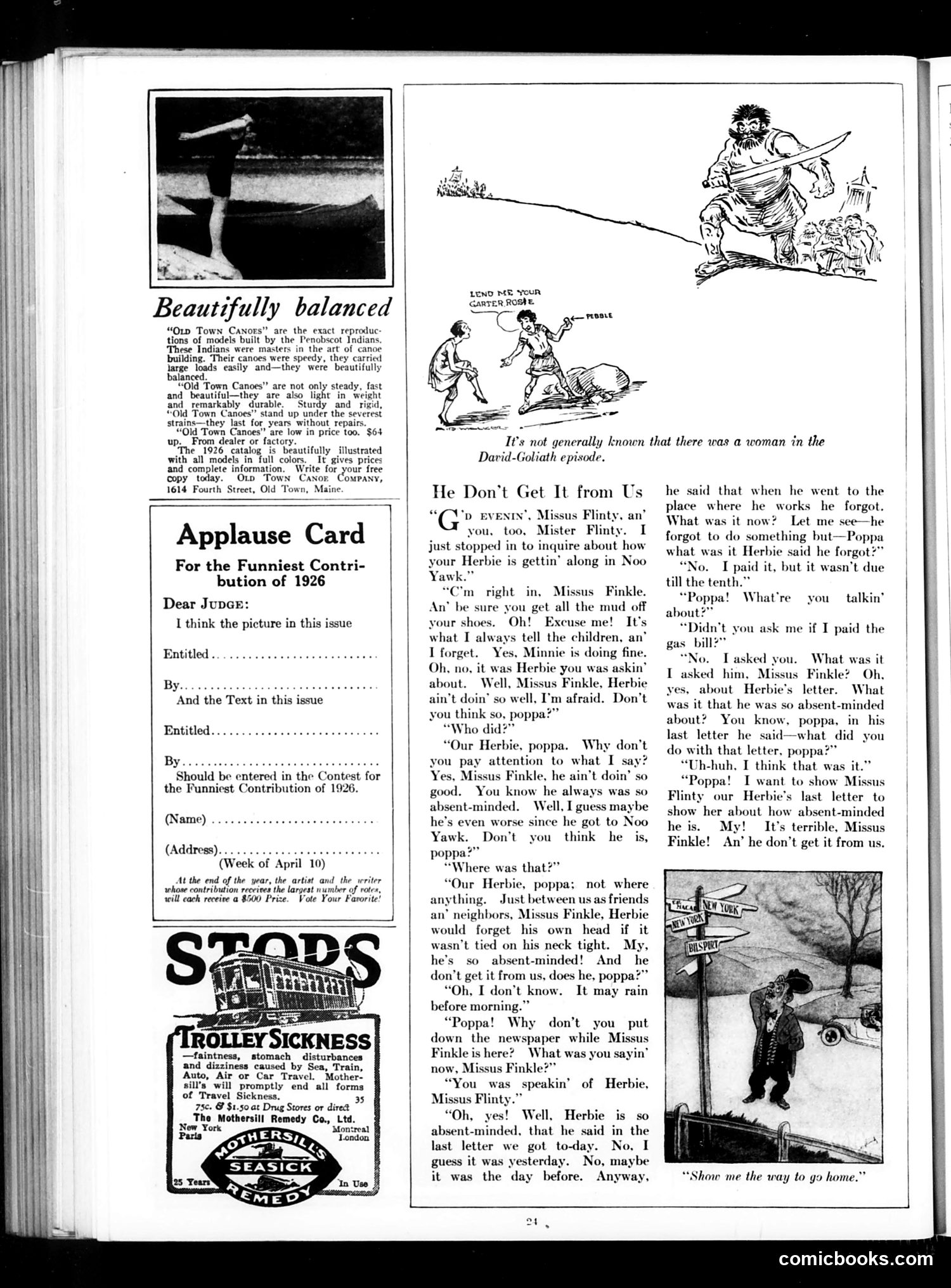
This page contains a domestic comedy sketch titled "He Don't Get It from Us," depicting a married couple (the Finkleys) discussing their absent-minded son Herbie, who works in New York. The humor centers on the parents' ironic inability to recognize their own forgetfulness while blaming Herbie's absentmindedness on external factors. The joke's mechanism: Mrs. Finkley repeatedly complains that Herbie "don't get it from us," yet throughout their conversation, Mr. Finkley demonstrates classic forgetfulness—he ignores his wife's questions, reads the newspaper inattentively, and confuses details about what Herbie supposedly forgot. The couple cannot locate Herbie's letter they want to show their guest, further proving they share the very trait they deny possessing. The "David-Goliath" reference at the top appears unrelated—likely a separate cartoon or editorial comment. The photograph captioned "Show me the way to go home" suggests homesickness or travel themes typical of 1926 periodicals.
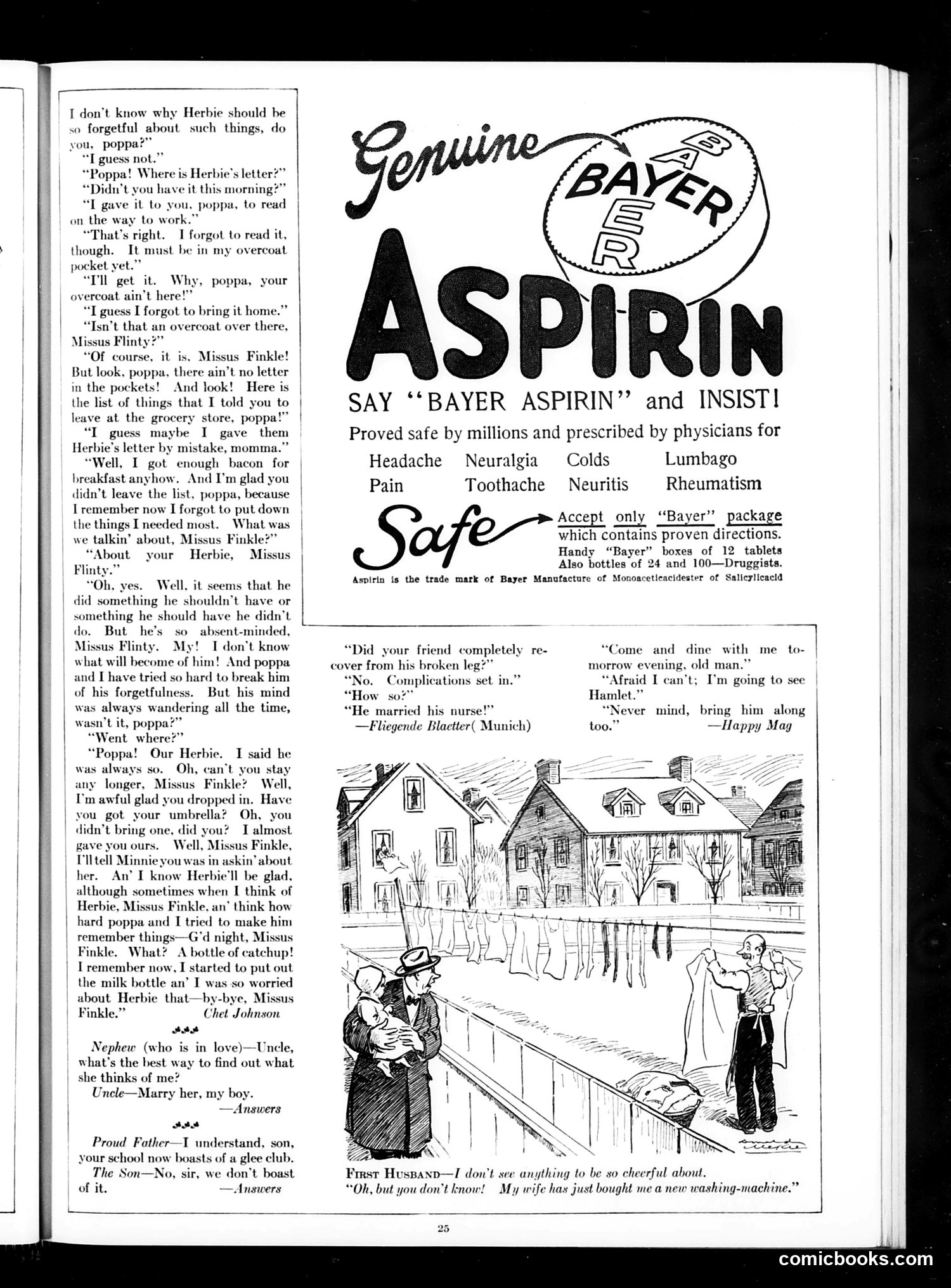
This page contains several unrelated humor pieces typical of early 20th-century Judge magazine: **Main Comic Strip** (top left): A domestic scene where a forgetful father and chatty mother discuss their absent-minded son Herbie. The humor derives from the parents themselves being equally forgetful—the father forgot to read the letter, forgot to bring home his overcoat, and can't remember where he went. It's gentle satire on family absentmindedness and the mother's gossipy nature. **Illustration** (bottom right): A domestic scene with a husband and wife by a fence, captioned about a washing machine purchase, implying the husband is cheerful because a new appliance will benefit him (likely by reducing his wife's workload/complaints). **Brief Joke Items**: Standard "Uncle and nephew" and "Proud Father" jokes about courtship and school pride. **Large Advertisement**: A Bayer Aspirin ad claiming it's "proved safe by millions and prescribed by physicians"—typical early pharmaceutical marketing before modern drug regulation. No political figures or specific historical events are referenced; this is primarily domestic humor and advertising.
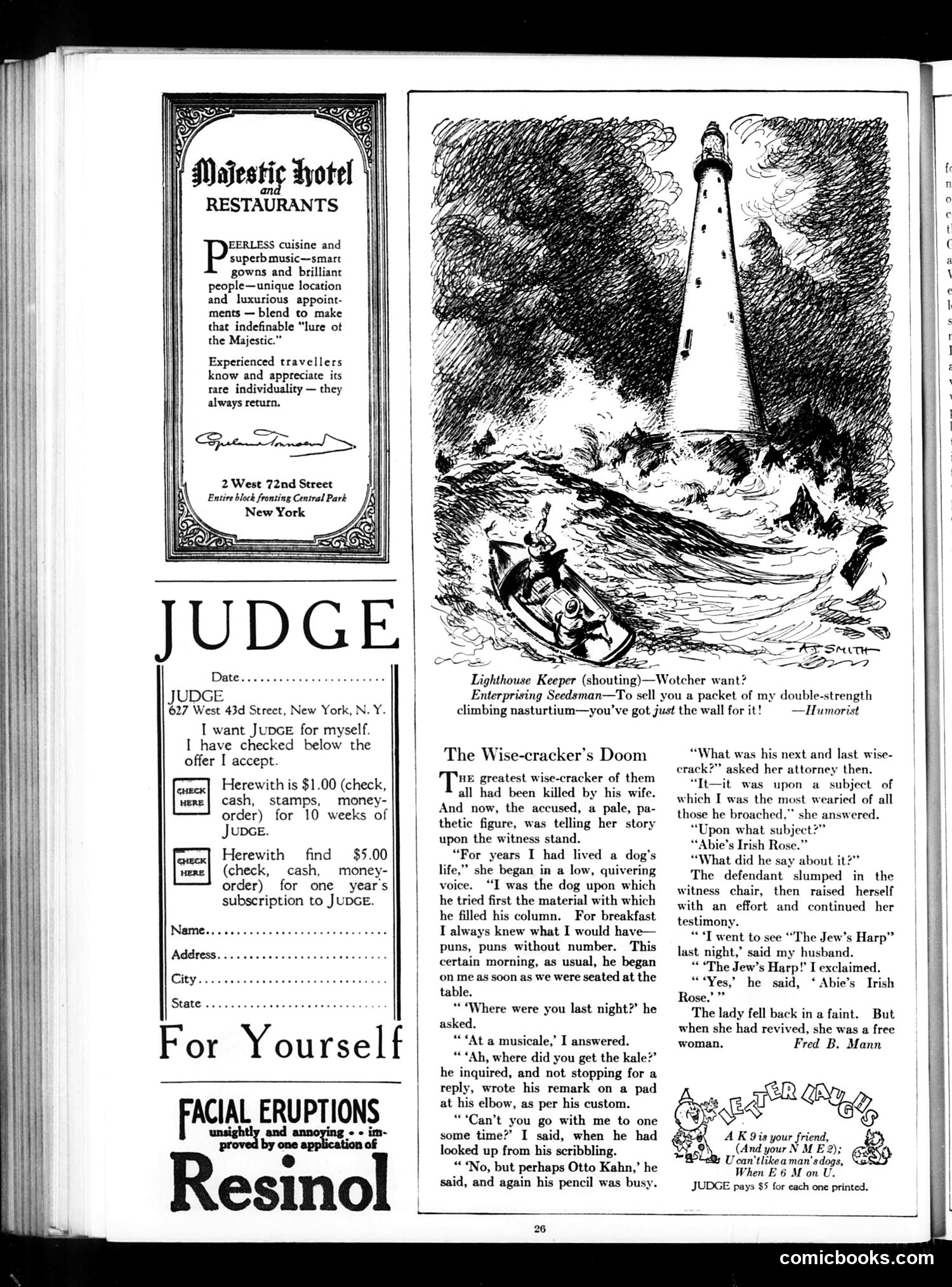
This humorous story satirizes a newspaper columnist (likely a "wise-cracker" or joke writer) who was killed by his exasperated wife. The satire targets two specific things: 1. **Repetitive joke-writing**: The columnist constantly mines his own life for material, subjecting his wife to endless puns and forced wordplay at breakfast. He won't engage in genuine conversation—he just scribbles observations for his column. 2. **The "Abie's Irish Rose" joke**: His final, fatal wisecrack involves calling the play "The Jew's Harp" (a pun on the musical instrument) and then explaining it as a reference to "Abie's Irish Rose"—a popular 1920s play about interfaith romance. The wife, driven mad by years of this relentless comedic exploitation, finally kills him. The joke mocks both the columnist's mechanical humor-extraction and the dated, exhausted state of that particular reference by the time this was published. The verdict is effectively that some jokes deserve a death sentence.
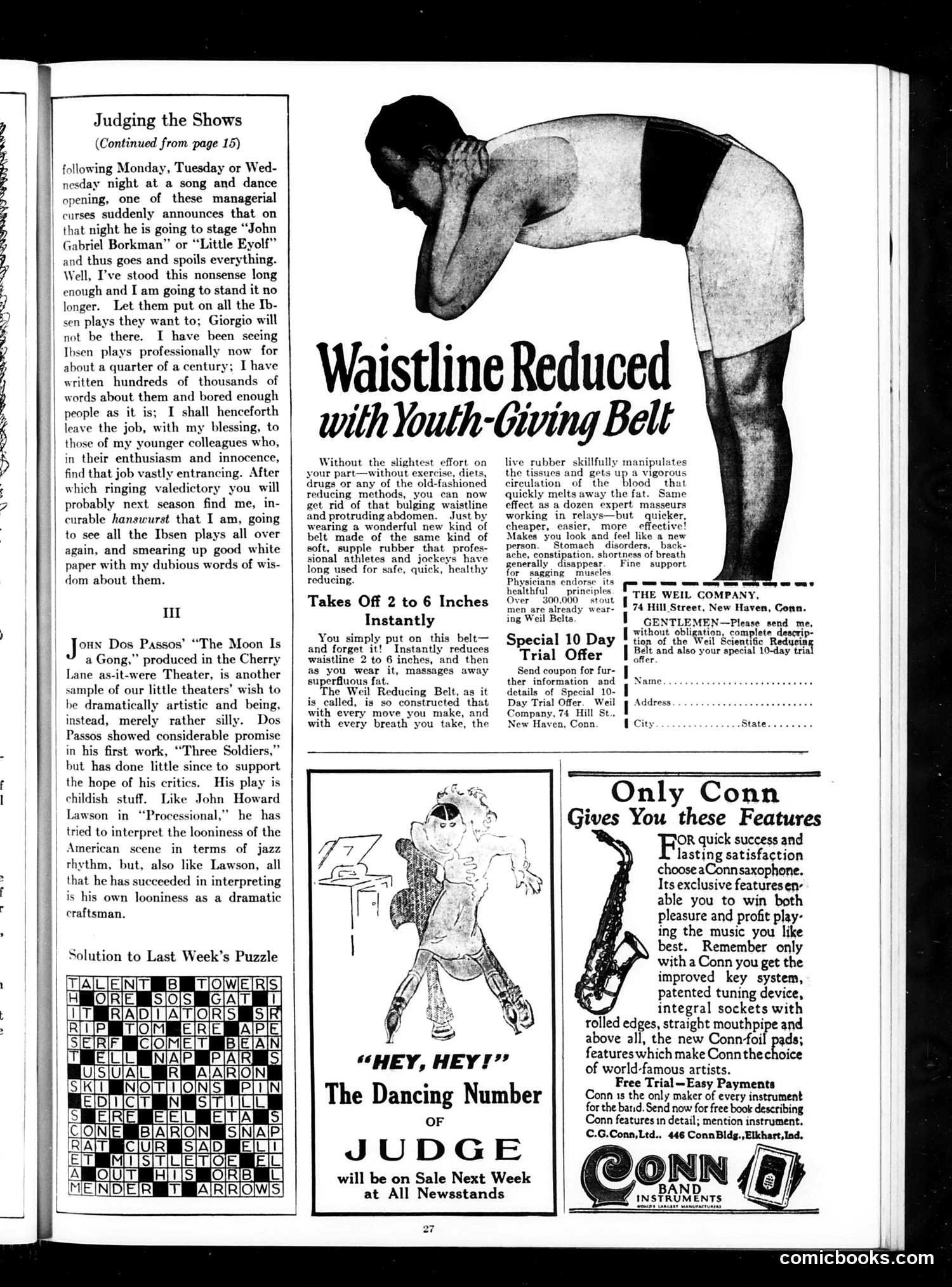
This page mixes theater criticism with period advertising. The main editorial content is a theater critic's column dismissing contemporary avant-garde plays—specifically works by John Dos Passos and references to Ibsen productions—as pretentious and silly, despite the critic's admission he'll likely attend them anyway. The dominant visual is a large advertisement for the "Weil Reducing Belt," a pseudo-scientific weight-loss device claiming to reduce waistlines 2-6 inches through passive rubber "massage" while wearing it. The ad promises elimination of stomach issues and general rejuvenation without exercise or dieting—typical 1920s-era dubious health claims. Secondary ads promote Judge magazine's upcoming "Dancing Number" issue and Conn musical instruments. The page reflects 1920s consumer culture: experimental theater as social commentary, pseudoscientific health products marketed to anxious consumers, and entertainment advertising. The puzzle solution grid occupies the bottom left.
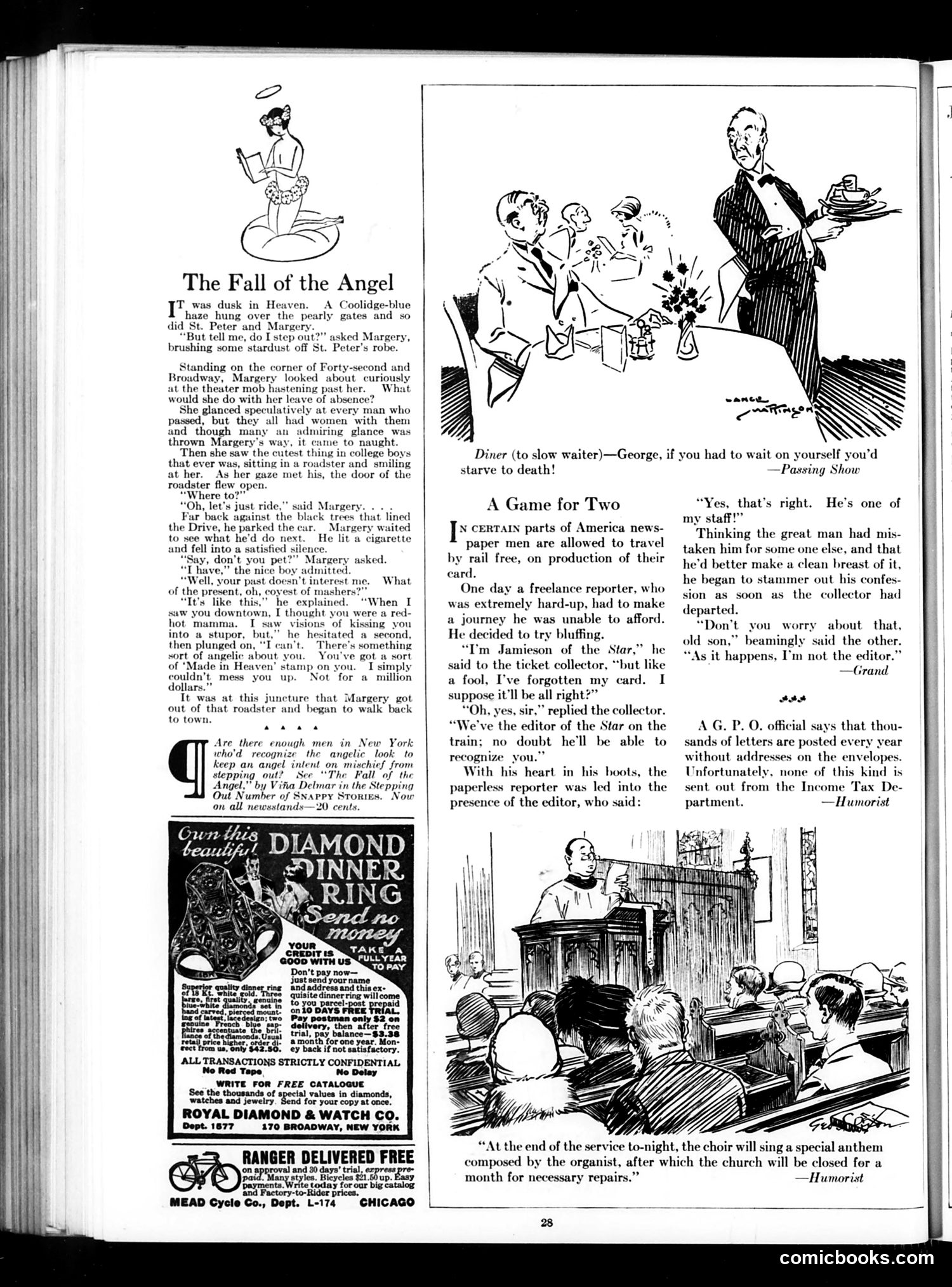
This page contains three separate humorous stories typical of 1920s satirical magazines: **"The Fall of the Angel"** (left): A young woman named Margery, described as having an angelic appearance, leaves Heaven. A college boy picks her up but restrains himself from seducing her, claiming she has a "Made in Heaven" quality he won't corrupt. Margery, disappointed by his passivity, walks back to town. The joke subverts expectations—the "angel" wants to sin, but the young man's restraint ironically proves her downfall. **"A Game for Two"** (right): A freelance reporter bluffs his way onto a train using a fake press card, claiming to work for "the Star." He's led to meet the actual editor of that newspaper, creating comedic tension about his deception being exposed. The editor unknowingly compliments him as staff. **"Diner"** (top right): A waiter is told he'd starve if forced to wait on himself—a simple jab at slow service. The page also contains period advertisements for diamond rings and bicycles, typical of Judge's revenue model.
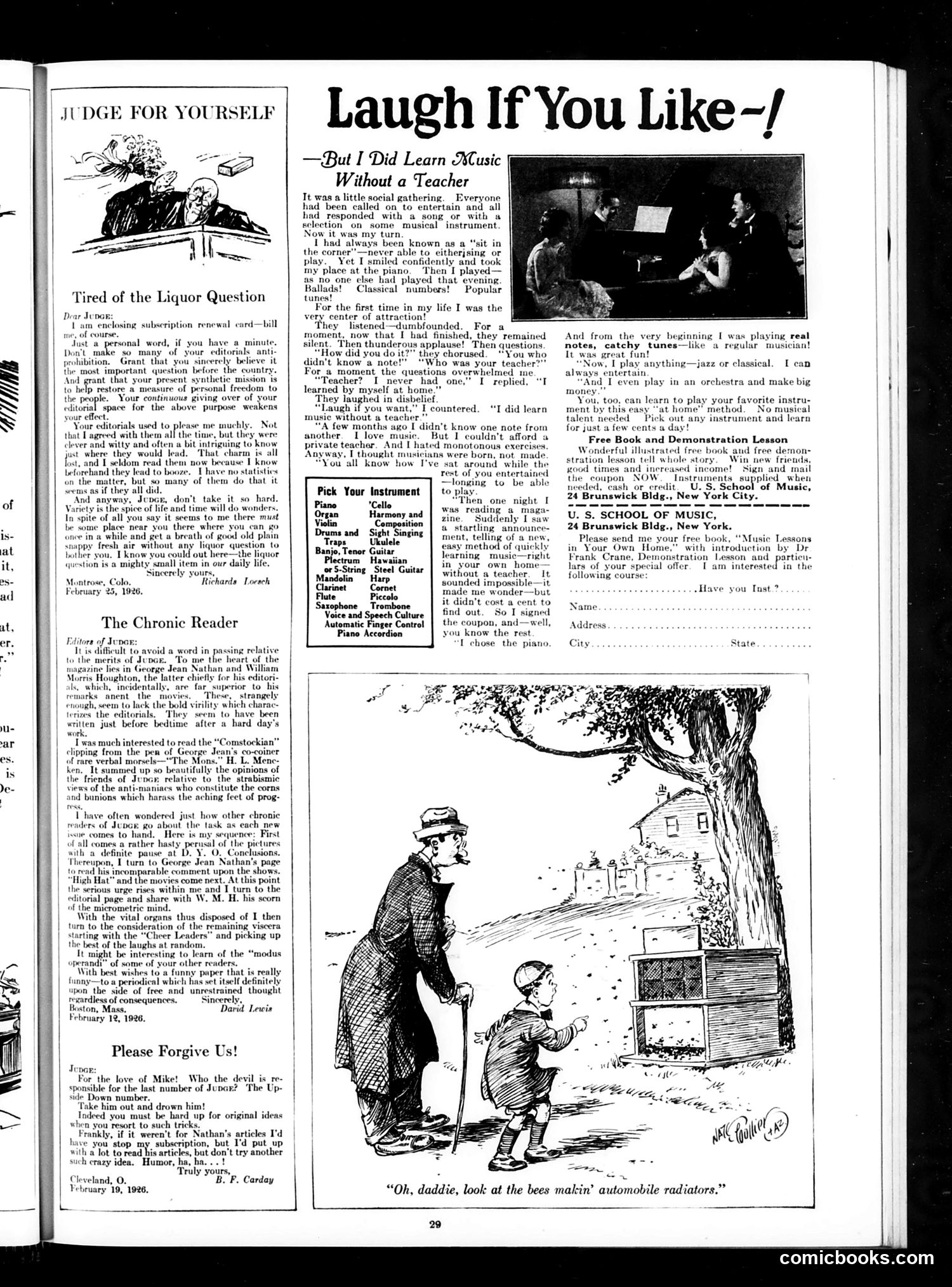
This page contains two distinct elements: **Main Content: "Laugh If You Like—But I Did Learn Music Without a Teacher"** This is primarily an **advertisement** (disguised as a testimonial) for the U.S. School of Music's mail-order music instruction course. The narrative presents a person who claims to have learned piano entirely from home using the school's method, surprising friends at a social gathering. The "story" emphasizes that no natural talent, expensive private teachers, or formal training is necessary—just the advertised correspondence course costing "just a few cents a day." **Supporting Articles:** Three brief reader letters address editorial topics: liquor prohibition ("Tired of the Liquor Question"), chronic reader concerns about editorial style, and a plea for humor content. **Historical Context:** This reflects 1926 America's mail-order education boom and the social aspiration to acquire middle-class cultural accomplishment (musical ability) affordably. The advertisement exploits both economic anxiety and social climbing desires. The page is essentially **commercial content presented as lifestyle editorial**—a common magazine practice of that era.
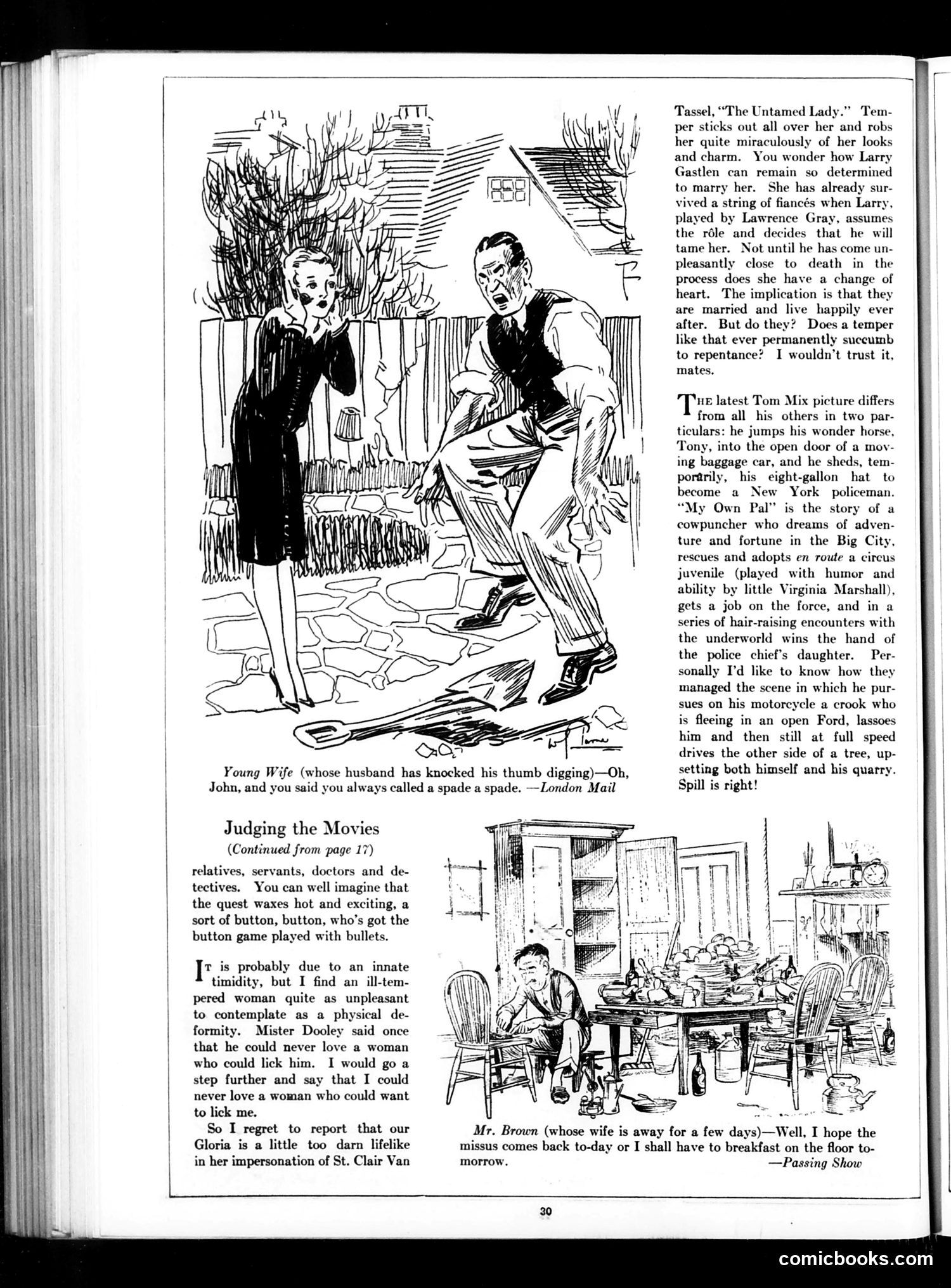
This page contains satirical film reviews from Judge magazine's "Judging the Movies" column. The critic discusses several 1920s movies: **"The Untamed Lady"** starring Lawrence Gray: The reviewer expresses skepticism about the narrative that a temperamental woman can be permanently "tamed" by marriage, questioning whether such fundamental personality flaws truly change. **Tom Mix westerns** ("My Own Pal"): The critic notes Mix's signature stunt work—jumping his horse Tony into moving trains and performing motorcycle lassoing sequences—while commenting on the cowboy-turned-cop plot. The cartoons provide comedic relief: one shows a wife making a pun about her husband hitting his thumb; another depicts a slovenly husband expecting breakfast on the floor after his wife leaves. The reviews reflect 1920s attitudes toward gender and marriage while showcasing Judge's blend of film criticism with visual humor aimed at middle-class readers.
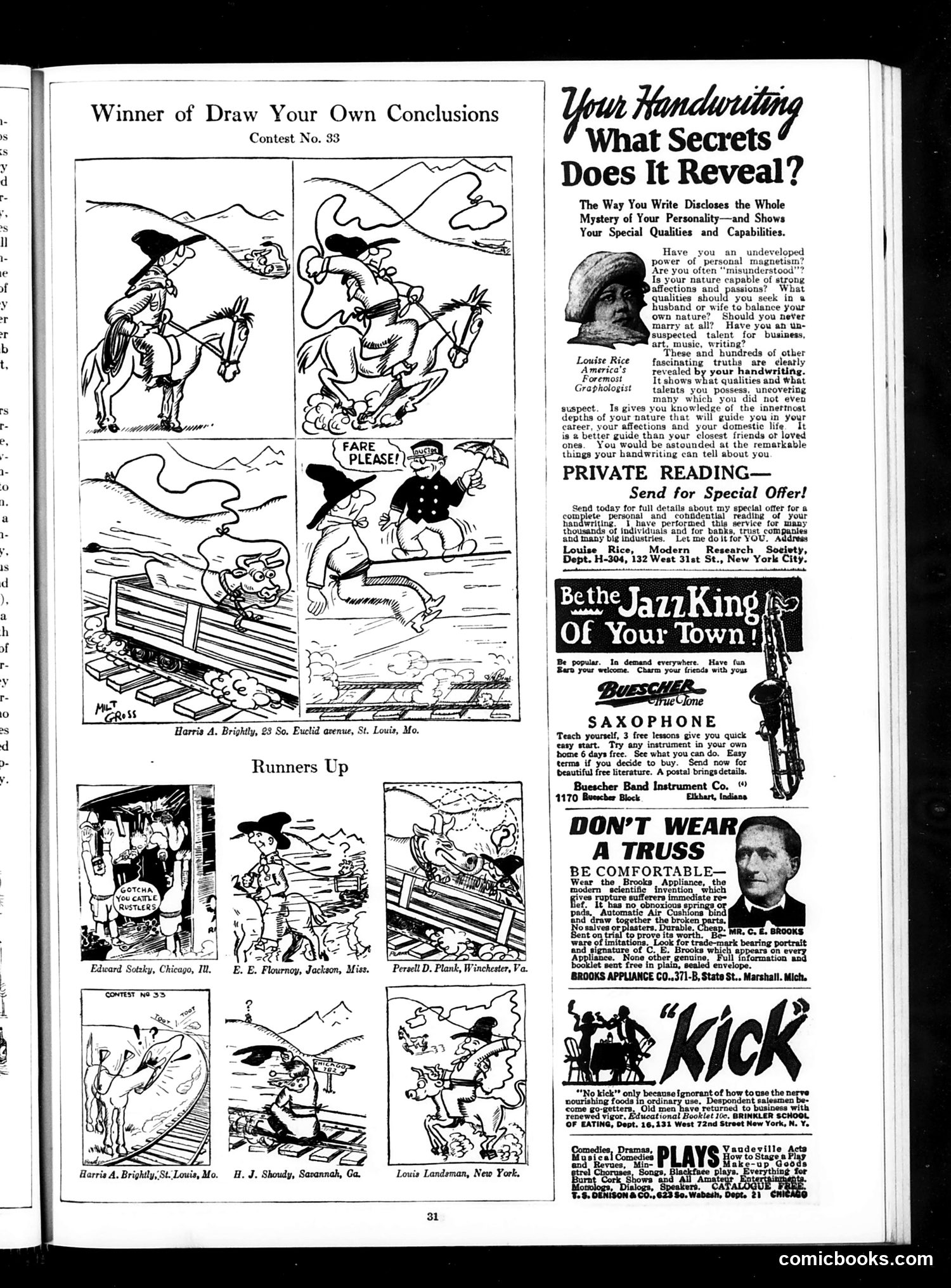
This page features the winning entry from "Draw Your Own Conclusions Contest No. 33"—a cartoon competition where readers submitted comics. **The Winning Cartoon** (top): Harris A. Brightly's comic depicts a cowboy on horseback encountering increasingly absurd situations: a snake, a falling figure, and ultimately disaster in a wooden structure. The humor relies on visual gags and slapstick—classic comic strip style of the era. **The "Runners Up"** show similar Western/adventure-themed cartoons by other contestants, suggesting the contest theme involved comedic interpretations of frontier or action scenarios. **The Advertisements** dominate the right side—typical of Judge magazine's revenue model. These include handwriting analysis (graphology), saxophone lessons, medical appliances, and theatrical materials. These ads reveal period interests: pseudoscientific personality analysis, self-improvement schemes, and entertainment. The cartoons themselves lack specific political satire; they're simply humorous drawings. The page's primary function was contest presentation plus advertising revenue.
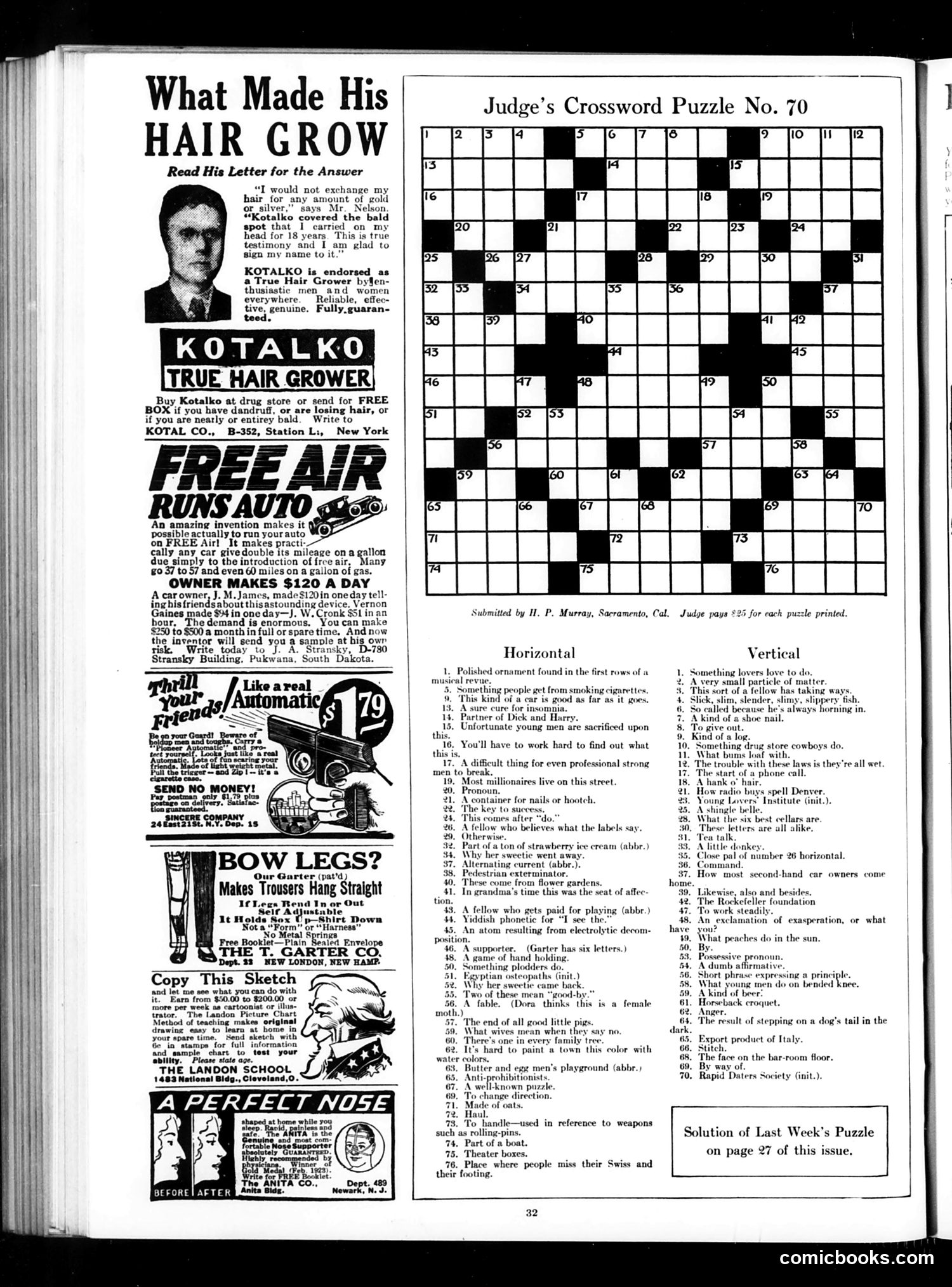
This page is primarily **advertising**, not political satire. It contains multiple product advertisements common to early-to-mid 20th century magazines: 1. **Kotalko True Hair Grower** — A hair restoration product using testimonials (a man claiming 18 years of baldness cured) 2. **Free Air Auto Device** — A dubious invention claiming to double car mileage by using "free air," with exaggerated income claims from supposed users 3. **Bow Legs Garter** — A device to help trousers hang straight 4. **Landon School** — Art instruction correspondence course 5. **Perfect Nose Device** — Cosmetic "nose shaper" for home use The page also features **Judge's Crossword Puzzle No. 70**, a standard feature of the magazine. These are typical mail-order advertisements targeting readers' insecurities about appearance and promising easy money—characteristic of publications from this era, which monetized such appeals heavily.
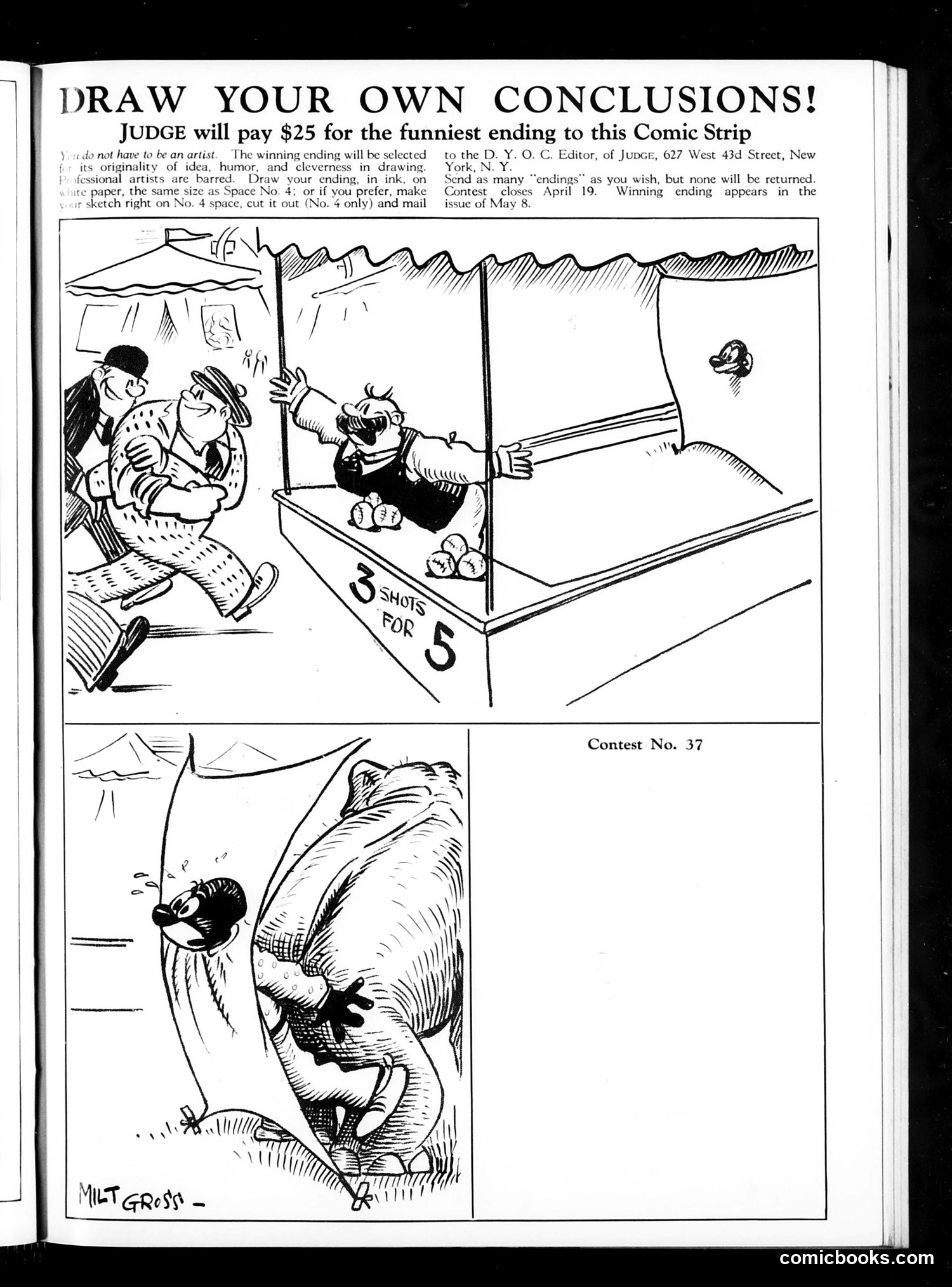
This page from *Judge* magazine features a reader-participation contest where viewers submit funny endings to an incomplete comic strip. **The Setup (Top Panel):** The comic shows a carnival or fair scene with people at a "3 Shots for 5" game booth—likely a ball-throwing game. A child is about to throw while adults watch. The strip is deliberately left incomplete, inviting readers to imagine what happens next. **The Contest:** *Judge* offered $25 (substantial money in this era) for the funniest proposed ending. Readers could draw their own conclusions without artistic training required. The winning entry would be published in the May 8 issue. **Bottom Panel:** This appears to be a separate cartoon (Contest No. 37) showing a bear—unclear if it's related or unrelated content. This type of participatory humor was popular in early-to-mid 20th century magazines, engaging readers while generating content.
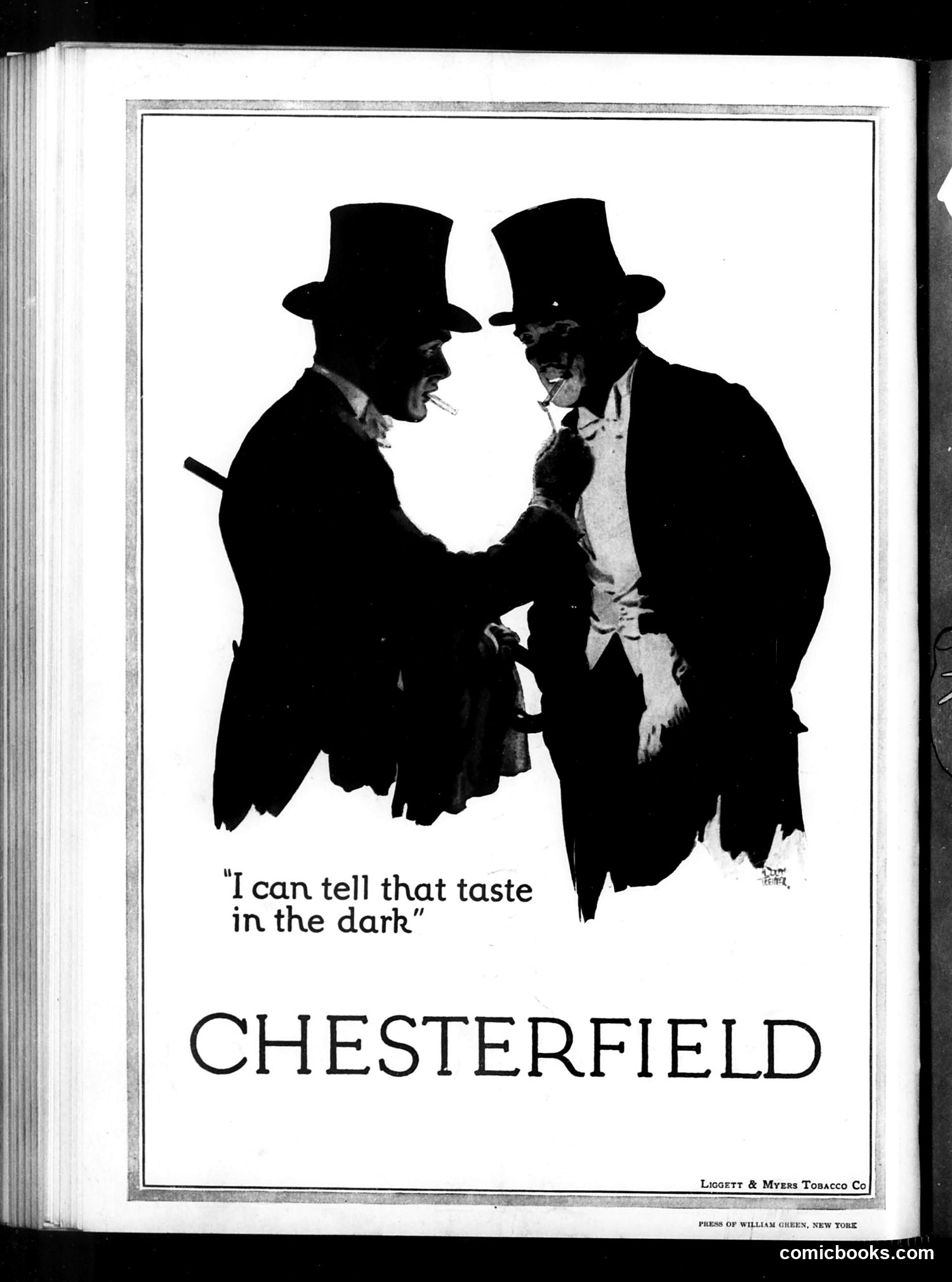
This is a cigarette advertisement, not political satire. Two silhouetted gentlemen in top hats and formal wear are shown in conversation, with one smoking. The tagline "I can tell that taste in the dark" promotes Chesterfield cigarettes' supposed quality—implying the brand is so distinctively good that one could identify it by taste alone, even without seeing it. The ad appears designed to appeal to a sophisticated, upper-class male audience through the formal dress and gentlemanly setting. Published by Liggett & Myers Tobacco Co., this represents typical early-to-mid 20th century cigarette marketing before health warnings existed. The silhouette technique was common in vintage advertising to create elegant, stylized imagery.