
Judge, 1926-04-10 · page 17 of 36
Judge — April 10, 1926 — page 17: what you’re looking at
What you’re looking at
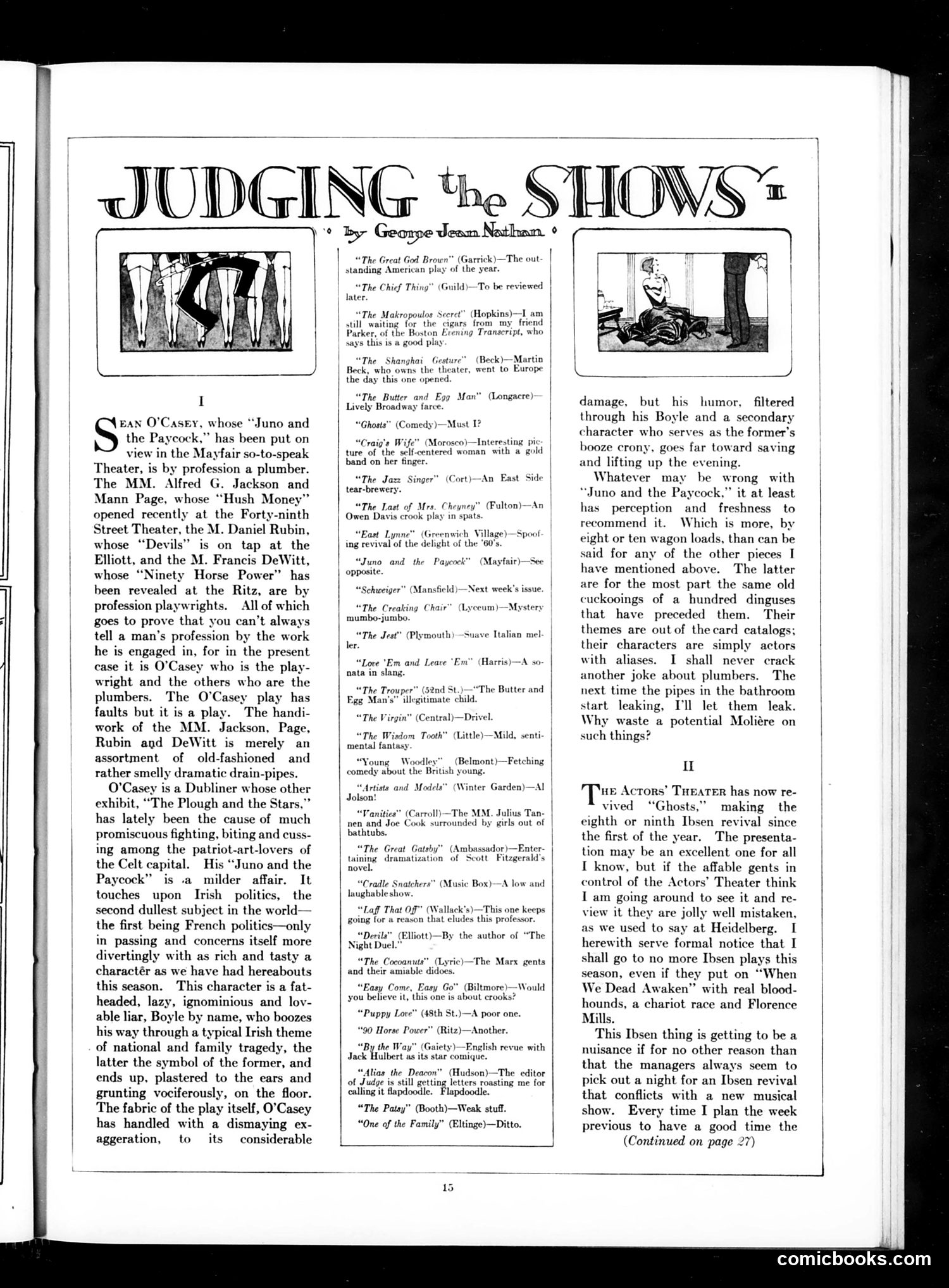
This is a theater review column by George Jean Nathan, a prominent drama critic. The main article compares Sean O'Casey, an Irish playwright whose work "Juno and the Paycock" is reviewed, to several professional playwrights (Jackson, Page, Rubin, DeWitt) whose current Broadway plays are criticized as mediocre. **The satire's point**: Nathan uses a paradox for comedic effect—O'Casey is a plumber by trade but produces genuine dramatic art, while the professional playwrights produce work Nathan dismisses as "old-fashioned and rather smelly dramatic drain-pipes." The plumbing metaphor extends the joke: the professionals are the real "plumbers," fixing nothing while producing theatrical waste. O'Casey's play deals with Irish politics and family tragedy, featuring a sympathetic but alcoholic, dishonest character (Boyle). Nathan praises its freshness despite "dismaying exaggeration." The accompanying listing reviews other current Broadway productions, mostly dismissively.
📄 Transcribed text from this page (OCR, searchable)
Machine-transcribed from the original scan — historical spelling and the odd misread are preserved.
| still waiting for the ciga EAN O'Casey, whose “Juno and S the Paycock,” has been put on view in the Mayfair so-to-speak Theater, is by profession a plumber. The MM. Alfred Jackson and Mann Page, whose “Hush Money” opened recently at the Forty-ninth Street Theater, the M. Daniel Rubin, whose “Devils” is on tap at the Elliott, and the M. Francis DeWitt, whose “Ninety Horse Power” has been revealed at the Ritz, are by profession playwrights. All of which goes to prove that you can’t always tell a man’s profession by the work he is engaged in, for in the present case it is O'Casey who is the play- wright and the others who are the plumbers. The O’Casey play has faults but it is a play. The handi- work of the MM. Jackson, Page, Rubin and DeWitt is merely an assortment of old-fashioned and rather smelly dramatic drain-pipes. O'Casey is a Dubliner whose other exhibit, “The Plough and the Stars,” has lately been the cause of much promiscuous fighting, biting and cuss- ing among the patriot-art-lovers of the Celt capital. His “Juno and the Paycock” is .a milder affair. It touches upon Irish politics, the second dullest subject in the world— the first being French politics—only in passing and concerns itself more divertingly with as rich and tasty a charactér as we have had hereabouts this season. This character is a fat- headed, lazy, ignominious and lov- able liar, Boyle by name, who boozes his way through a typical Irish theme of national and family tragedy, the latter the symbol of the former, and ends up, plastered to the ears and grunting vociferously, on the floor. The fabric of the play itself, O’Casey has handled with a dismaying ex- aggeration, to its considerable “The Great God Brown’ (Garrick) —The out standing American play of the year. “The Chief Thing” (Guild)—To be reviewed later. “The Makropoulos Secret” (Hopkins)—I am from my friend Parker, of the Boston Evening Transcript, who say’ this is a good play “The Shanghai Gesture” (Beck)—Martin | Beck, who owns the theater, went to Europe the day this one opened. “The Butter and Egg Man" (Longacre) Lively Broadway farce. “Ghosts” (Comedy)—Must 1? “Craig's Wife” (Morosco)—Interesting pic ture of the self-centered woman with a gold | band on her finger. Singer” (Cort)—An East Side “The Last of Mrs. Cheyney” (Fulton)—An Owen Davis crook play in spats. “East Lynne” (Greenwich Village)—Spoot ing revival of the delight of the ‘60's. “Juno and the Paycock (Mayfair)—See opposite. “Schweiger” (Mansfield) —Next week's issue. | “The Creaking Chair” (Lyceum)—Mystery mumbo-jumbo, “The Jest” (Plymouth) —Suave Italian mel ler. “Love ‘Em and Leave ‘Em (Harris) —A so- nata in slang. “The Trouper” (52nd St.)—"The Butter and Egg Man's” illegitimate child, “The Virgin” (Central) —Drivel. “The Wisdom Tooth" (Little)—Mild, senti: mental fantasy “Young Woodley” comedy about the British young. “Artists and Models” (Winter Garden)—Al Jolson! “Vanities” (Carroll) The MM. Julius Tan- nen and Joe Cook surrounded by girls out of bathtubs. | “The Great Gatsby" (Ambassador)—Enter- taining dramatization of Scott Fitzgerald's | novel. adle Snatchers” (Music Box)—A low and laughable show. Laff That Off" (Wallack's)—This one keeps going for a reason that eludes this professor. “Derils” (Elliott)—By the author of “The Night Duel. “The Cocoanuts” (Lytic)—The Marx gents and their amiable did “Easy Come, Easy Go" (Biltmore)—Would you believe it, this one is about crooks? “Puppy Love” (48th St.)—A poor one. “90 Horse Power” (Ritz)—Another. “By the Way" (Gaiety)—English revue with Jack Hulbert as its star comique. “Alias the Deacon” (Hudson)—The editor of Judge is still getting letters roasting me for calling it flapdoodle. Flapdoodle. “The Patsy" (Booth)—Weak stuf. “One of the Family” (Eltinge)—Ditto. (Belmont )—Fetching damage, but his humor, filtered through his Boyle and a secondary character who serves as the former's booze crony, goes far toward saving and lifting up the evening. Whatever may be wrong with “Juno and the Paycock,” it at least has perception and freshness to recommend it. Which is more, by eight or ten wagon loads, than can be said for any of the other pieces I have mentioned above. The latter are for the most part the same old cuckooings of a hundred dinguses that have preceded them. Their themes are out of thecard catalogs; their characters are simply actors with aliases. I shall never crack another joke about plumbers. The next time the pipes in the bathroom start leaking, I'll let them leak. Why waste a potential Moliére on such things? il Te Actors’ THEATER has now re- vived “Ghosts,” making the eighth or ninth Ibsen revival since the first of the year. The presenta- tion may be an excellent one for all I know, but if the affable gents in control of the Actors’ Theater think I am going around to see it and re- view it they are jolly well mistaken, as we used to say at Heidelberg. I herewith serve formal notice that I shall go to no more Ibsen plays this season, even if they put on “When We Dead Awaken” with real blood- hounds, a chariot race and Florence Mills This Ibsen thing is getting to be a nuisance if for no other reason than that the managers always seem to pick out a night for an Ibsen revival that conflicts with a new musical show. Every time I plan the week previous to have a good time the (Continued on page 27) comicbooks.com