
Judge, 1926-04-10 · page 9 of 36
Judge — April 10, 1926 — page 9: what you’re looking at
What you’re looking at
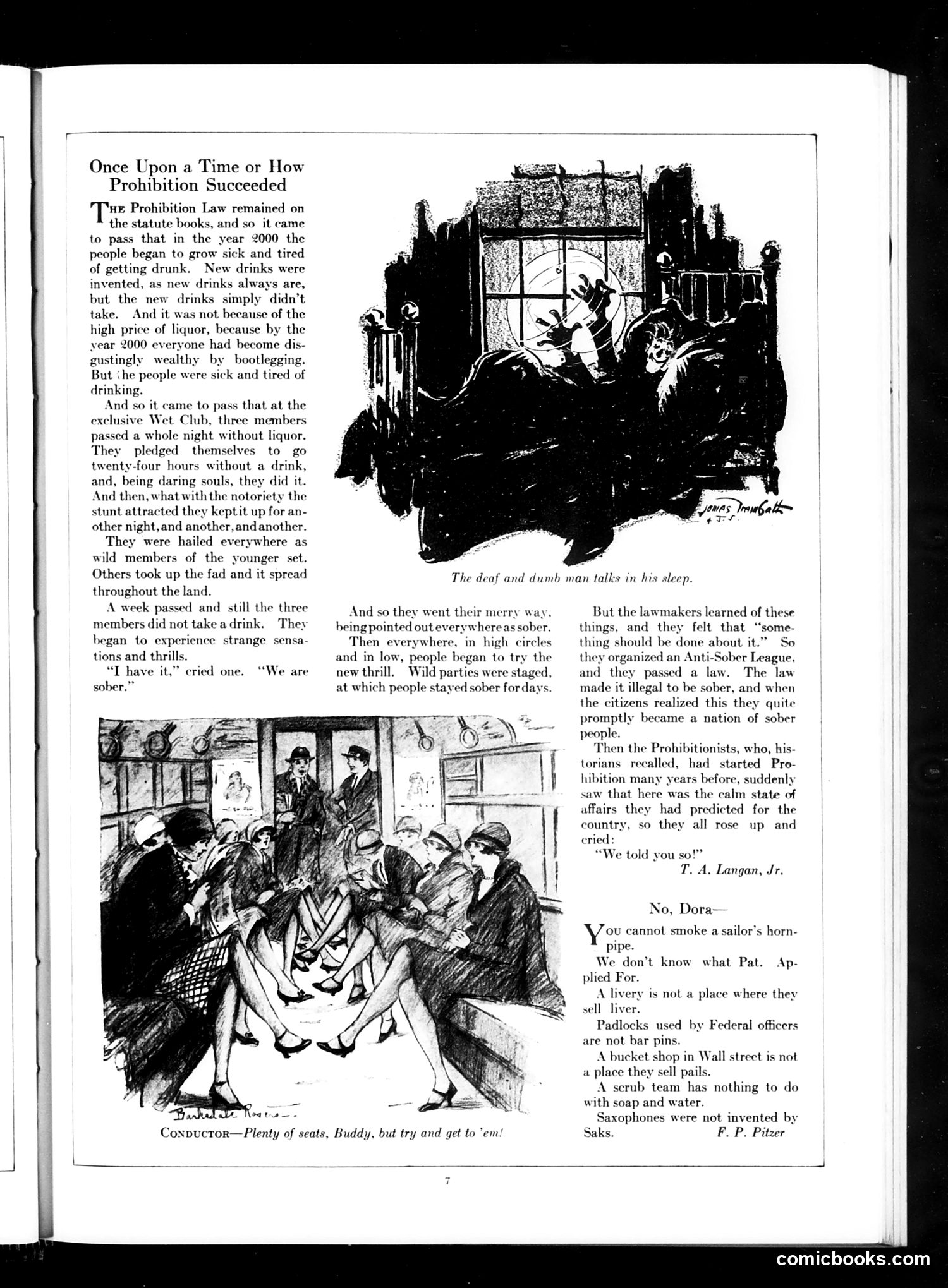
This 1920s-era satirical story mocks Prohibition's actual failure by imagining an absurd future (year 2000) where it paradoxically *succeeds*—but in reverse. The satire works by inversion: instead of people drinking illegally despite the ban, wealthy bootleggers become bored with alcohol. Sobriety becomes fashionable as a daring "thrill." Alarmed lawmakers then pass a law *requiring* sobriety, which ironically makes everyone actually sober—the original Prohibitionists' goal. The joke targets Prohibition's hypocrisy and unintended consequences: the law created wealthy bootleggers while failing to stop drinking. The cartoons illustrate the speakeasy culture and crowded transit scenes of the era. The lower section ("No, Dora") is unrelated wordplay humor mocking double meanings in common phrases—typical filler content for satirical magazines. The piece's core message: Prohibition was so fundamentally flawed that only absurd fictional logic could make it "work."
📄 Transcribed text from this page (OCR, searchable)
Machine-transcribed from the original scan — historical spelling and the odd misread are preserved.
Once Upon a Time or How Prohibition Succeeded 'HE Prohibition Law remained on the statute books, and so it came to pass that in the year 2000 the people began to grow sick and tired of getting drunk. New drinks were invented, as new drinks always are, but the new drinks simply didn’t take. And it was not because of the high price of liquor, because by the year 2000 everyone had become dis- gustingly wealthy by bootlegging. But ihe people were sick and tired of drinking. And so it came to pass that at the exclusive Wet Club, three members passed a whole night without liquor. They pledged themselves to go twenty-four hours without a drink, and, being daring souls, they did it. And then, what with the notoriety the stunt attracted they keptit up for an- other night, and another, and another. They were hailed everywhere as wild members of the younger set. Others took up the fad and it spread throughout the land. A week passed and still the three members did not take a drink. They began to experience strange sensa- tions and thrills. “T have it,” cried one. sober.” “We are The deaf and dumb man talks in his sleep. And so they went their merry way, being pointed out everywhere as sober. Then everywhere, in high circles and in low, people began to try the new thrill. Wild parties were staged, at which people stayed sober fordays. But the lawmakers learned of these things, and they felt that “some- thing should be done about it.” § they organized an Anti-Sober League. and they passed a law. The law made it illegal to be sober, and when the citizens realized this they quite promptly became a nation of sober people. Then the Prohibitionists, who, his- torians recalled, had started Pro- hibition many years before, suddenly saw that here was the calm state of affairs they had predicted for the country, so they all rose up and cried: “We told you so!” T. A. Langan, Jr. No, Dora— Yo cannot smoke a sailor's horn- pipe. We don’t know what Pat. Ap- plied For. A livery is not a place where they sell. liver. Padlocks used by Federal officers are not bar pins. \ bucket shop in Wall street is not a place they sell pails. A scrub team has nothing to do with soap and water. xophones were not invented by F. P. Pitzer comicbooks.com