
Judge, 1926-04-10 · page 15 of 36
Judge — April 10, 1926 — page 15: what you’re looking at
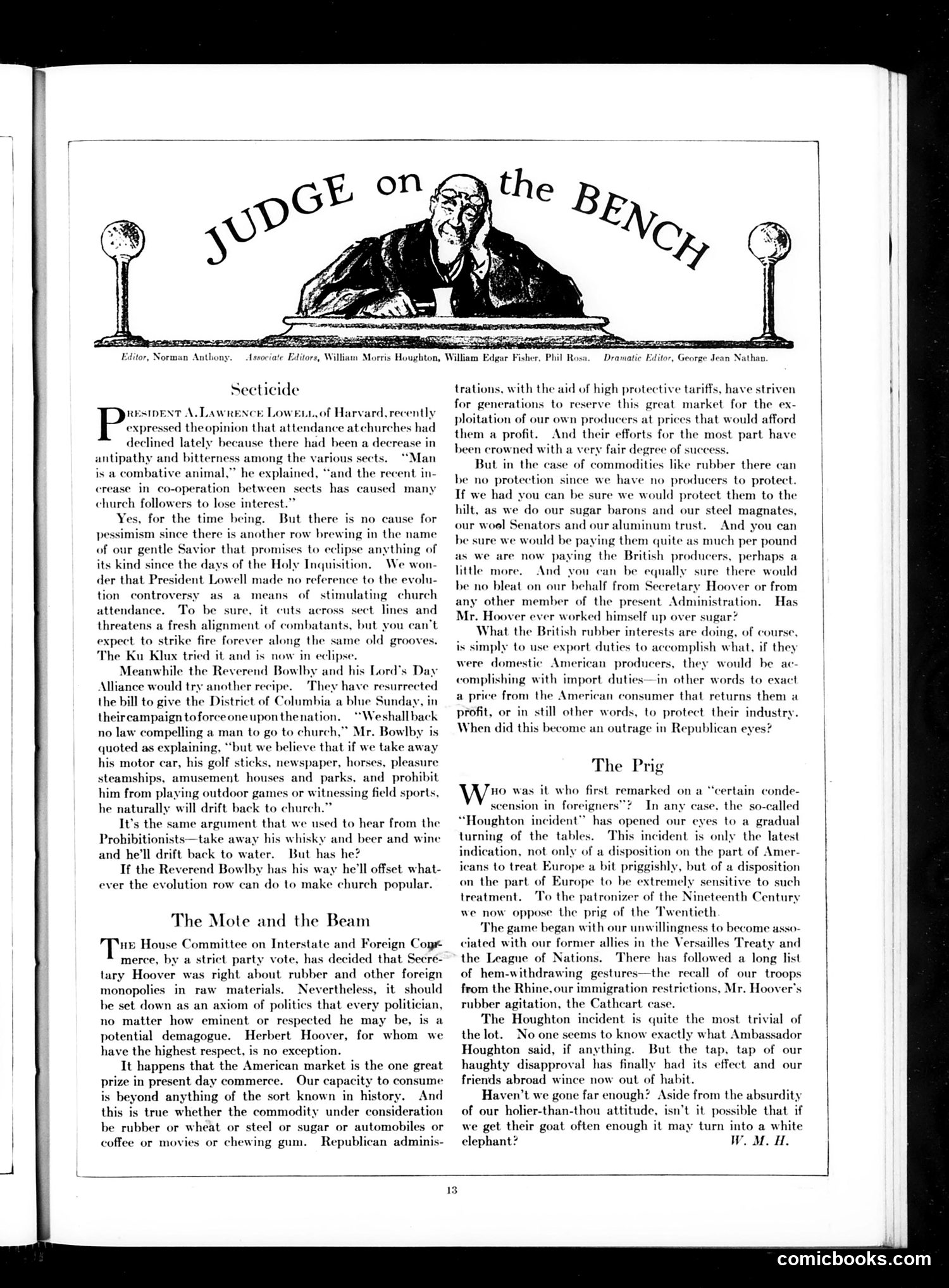
What you’re looking at
This page contains three editorial pieces satirizing American political and social hypocrisy in what appears to be the 1920s. **"Secticide"** mocks Harvard President A. Lawrence Lowell's optimistic claim that religious cooperation has increased. The author argues the real stimulus for church attendance comes from conflict (like evolution debates), not peace—comparing it to how Prohibition failed to reform drinkers. It also ridicules Reverend Bowlby's "Lord's Day Alliance," which proposes blue laws restricting Sunday leisure (cars, golf, newspapers) to force churchgoing, calling this coercive moralism absurd. **"The Mote and the Beam"** criticizes Secretary Herbert Hoover's complaints about British rubber monopolies. The author argues Republicans have consistently used tariffs to protect American producers from foreign competition—yet conveniently oppose tariffs when *we* lack domestic producers. This exposes Republican hypocrisy: they'll protect sugar and steel interests but criticize Britain for doing exactly what American tariff policy does. Both pieces use ironic satire to expose contradictions between stated principles and actual practice.
📄 Transcribed text from this page (OCR, searchable)
Machine-transcribed from the original scan — historical spelling and the odd misread are preserved.
Secticide RESIDENT A. Lawrence Lowent,of Harvard, recently sed theopinion that attendance atchurches had been a decrease in antipathy and bitterness among the various sects. “Man is a combative animal,” he explained, “and the recent in- srease in co-operation between sects has church followers to lose intere: Yes, for the time being. ised many But there is no cause for pessimism since there is another row brewing in the name of gentle Savior that promises to eclipse anything of its kind since the days of the Holy Inquisition. We won- der that President Lowell made no reference to the evolu- tion means of stimulating church attendance. To be sure, it cuts across sect lines and threatens a fresh alignment of combatants, but you can't expect to strike fire forever along the same old grooves. The Ku Klux tried it and is now in eclipse. Meanwhile the Reverend Bowlby and his Lord’s Day Alliance would try another recipe. They have resurrected the bill to give the District of Columbia a blue Sunday, in theircampaign toforceoneuponthenation. “Weshall back no law compelling a man to go to church,” Mr. Bowlby is quoted as explaining, “but we believe that if we take away his motor car, his golf sticks, newspaper, horses, pleasure steamships, amusement hous: id parks, and. prohibit him from playing outdoor games or witnessing field sports, he naturally will drift back to church.” It’s the same argument that we used to hear from the Prohibitionists—take away his whisky and beer and wine and he'll drift back to water. But has he? If the Reverend Bowlby has his y he'll offset what- ever the evolution row can do to make church popular. controversy as a The Mote and the Beam Te House Committee on Interstate and Foreign Cot merce, by a strict party vote, has decided that Secré- tary Hoover was right about rubber and other foreign monopolies in raw materi Nevertheless, it should be set down as an axiom of polities that every politician, no matter how eminent or respected he may be, is a potential demagogue. Herbert Hoover, for whom we have the highest respect, is no exception. It happens that the American market is prize in present day commerce. Our capacit) is beyond anything of the sort known in history, And this is true whether the commodity under consideration be rubber or wheat or steel or sugar or automobiles or coffee or movies or chewing gum. Republican adminis- the one great to consume trations, with the aid of high protective tariffs, have striven for generations to reserve this great market for the ex- ploitation of our own producers at prices that would afford them a profit. And their efforts for the most part have been crowned with a very fair degree of success. But in the case of commodities like rubber there can he no protection since we have no producers to protect. If we had you can be sure we would protect them to the hilt, as we do our sugar barons and our steel magnates, our wool Senators and our aluminum trust. And you can he sure we would be paying them quite as much per pound as we are now paying the British producers, perhaps a little more. And you can be equally sure there would be no bleat on our behalf from Secretary Hoover or from any other member of the present Administration. Has Mr. Hoover ever worked himself up over sugar? What the British rubber interests are doing, of course, is simply to use export duties to accomplish what, if they were domestic American producers, they would be ac- complishing with import duties—in other words to exact a price from the American consumer that returns them a profit, or in still other words, to protect their industry. When did this become an outrage in Republican eyes? The Prig HO was it who first remarked on a scension in foreigners’? “certain conde- In any case. the so-called “Houghton incident” has opened our eyes to a gradual turning of the tables. This incident is only the latest indication, not only of a disposition on the part of Amer- icans to treat Europe a bit priggishly, but of a disposition on the part of Europe to be extremely sensitive to such treatment. To the patronizer of the Nineteenth Century we now oppose the prig of the Twentieth The game began with our unwillingness to become asso- ciated with our former allies in the Versailles Treaty and the League of Nations. There has followed a long list of hem-withdrawing gestures—the recall of our troops from the Rhine, our immigration restrictions, Mr. Hoover's rubber agitation, the Cathcart case. The Houghton incident is quite the most trivial of the lot. No one seems to know exactly what Ambassador Houghton said, if anything. But the tap, tap of our haughty disapproval has finally had its effect and our friends abroad wince now out of habit. Haven't we gone far enough? Aside from the absurdity of our holier-than-thou attitude, isn’t it possible that if we get their goat often enough it may turn into a white elephant? W. M. H. comicbooks.com