
A complete issue · 36 pages · 1926
Judge — April 3, 1926
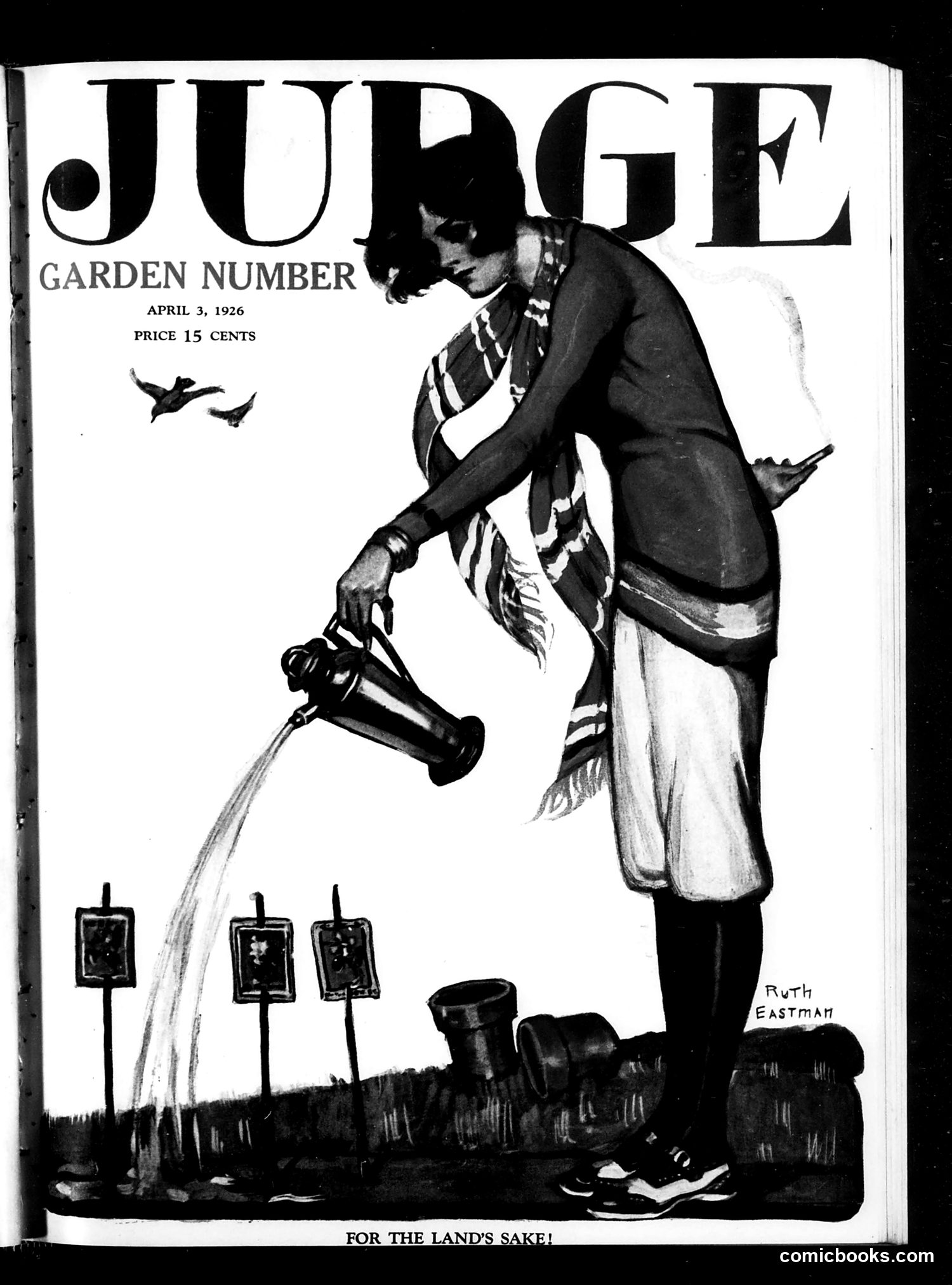
This is a "Garden Number" cover by artist Ruth Eastman depicting a woman watering plants with the caption "FOR THE LAND'S SAKE!" The illustration appears to be a straightforward gardening promotion rather than political satire—celebrating home gardening, likely reflecting post-WWI interest in domestic food production and self-sufficiency. The woman's fashionable 1920s attire (bobbed hair, Art Deco-patterned garments) suggests gardening as a modern leisure activity for women, consistent with the era's evolving gender roles. The small plant markers and watering can emphasize practical horticulture. No specific political figures or events appear referenced. This seems promotional content for a special gardening-themed issue, typical of Judge's seasonal publication variations.
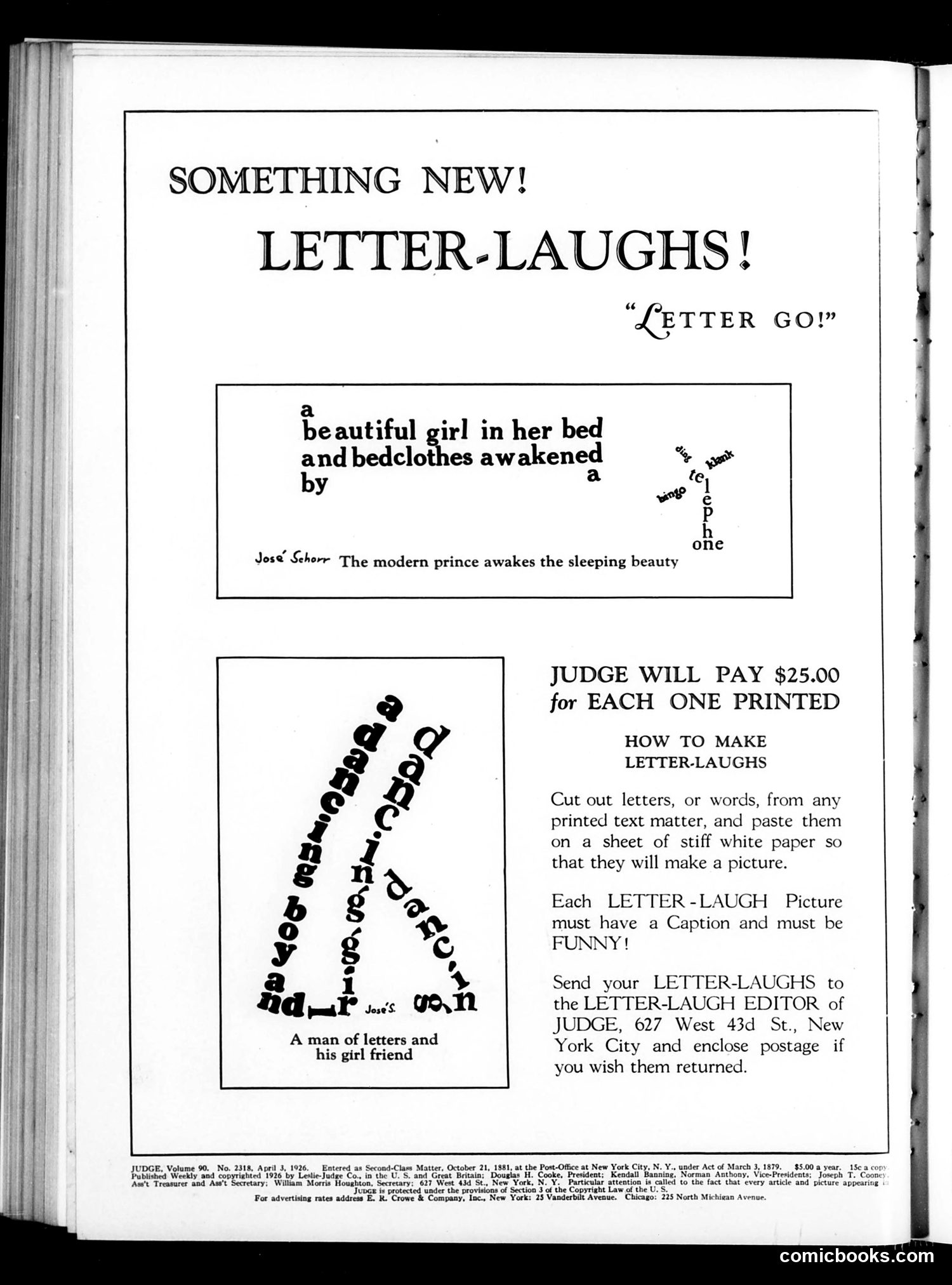
This page announces a new feature called "Letter-Laughs" for Judge magazine—a humorous visual game rather than political satire. Readers were invited to cut letters or words from printed text and paste them on paper to create pictures, with captions required to make them funny. The page shows two examples: one depicting a girl awakening in bed (with letters arranged to suggest a "phone" and "p one"), and another showing a man composed of letters with his girlfriend. Judge offered $25 per accepted Letter-Laugh sent to their New York office. This was an early form of participatory humor—essentially a reader-submitted joke contest using cut-and-paste collage techniques, predating modern mail-in comic contests.
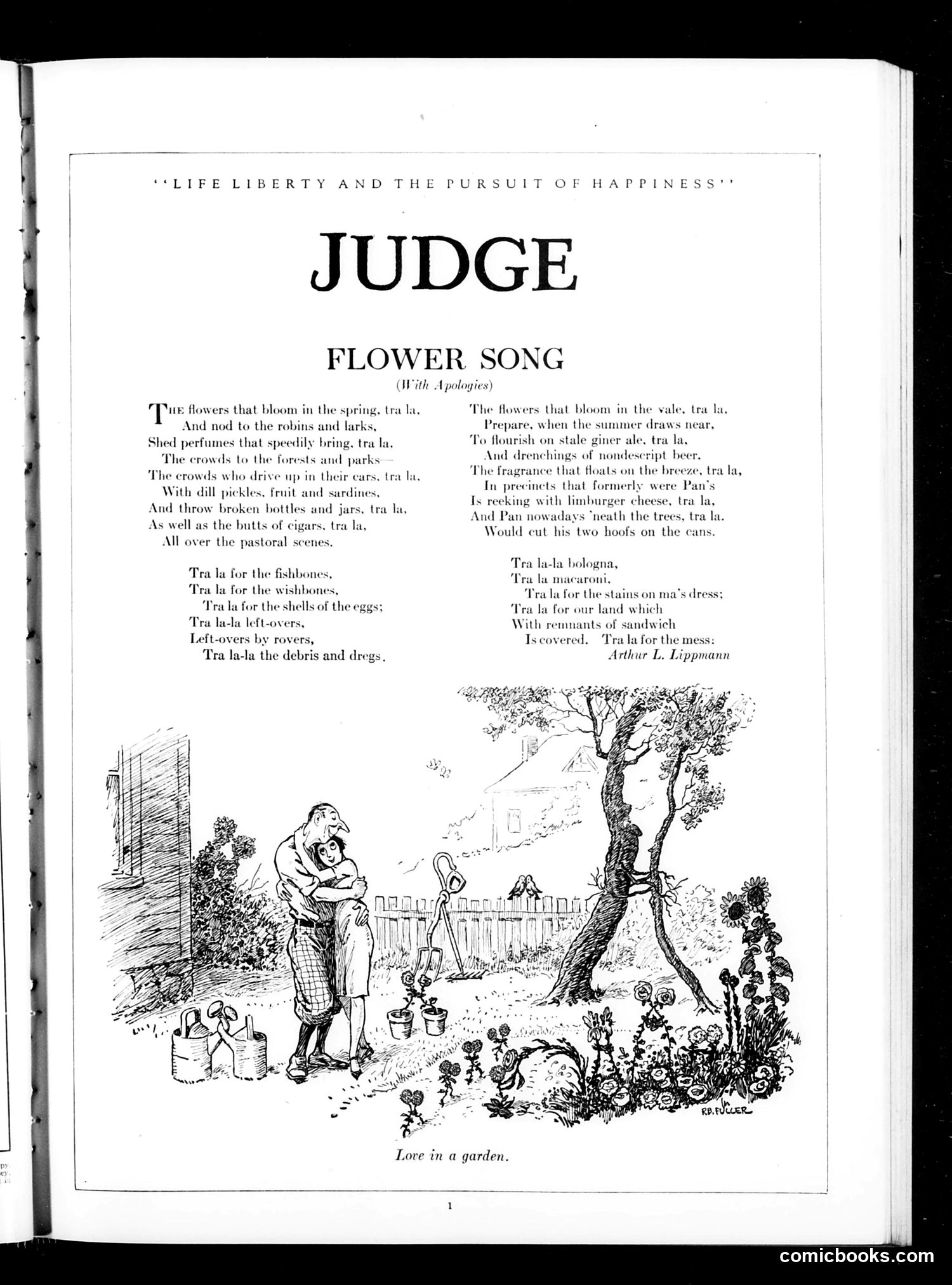
This page contains a poem titled "Flower Song (With Apologies)" by Arthur L. Lippmann, not a political cartoon. The poem is a satirical parody that contrasts idealized nature with modern consumer culture and urban problems. The opening stanzas ironically juxtapose pastoral imagery ("flowers that bloom in the spring") with contemporary annoyances: crowded parks, automobiles, litter, and broken bottles. The repeated refrain "Tra la" undercuts the romance of nature. The second half catalogs modern grievances—processed foods, stained clothing, industrialized landscapes—using the same whimsical musical framework. The accompanying illustration depicts a couple in a garden, romanticizing domestic life, which the poem's ironic tone suggests is largely escapist fantasy given the realities of 1920s urban industrial society that Judge's readers would recognize.
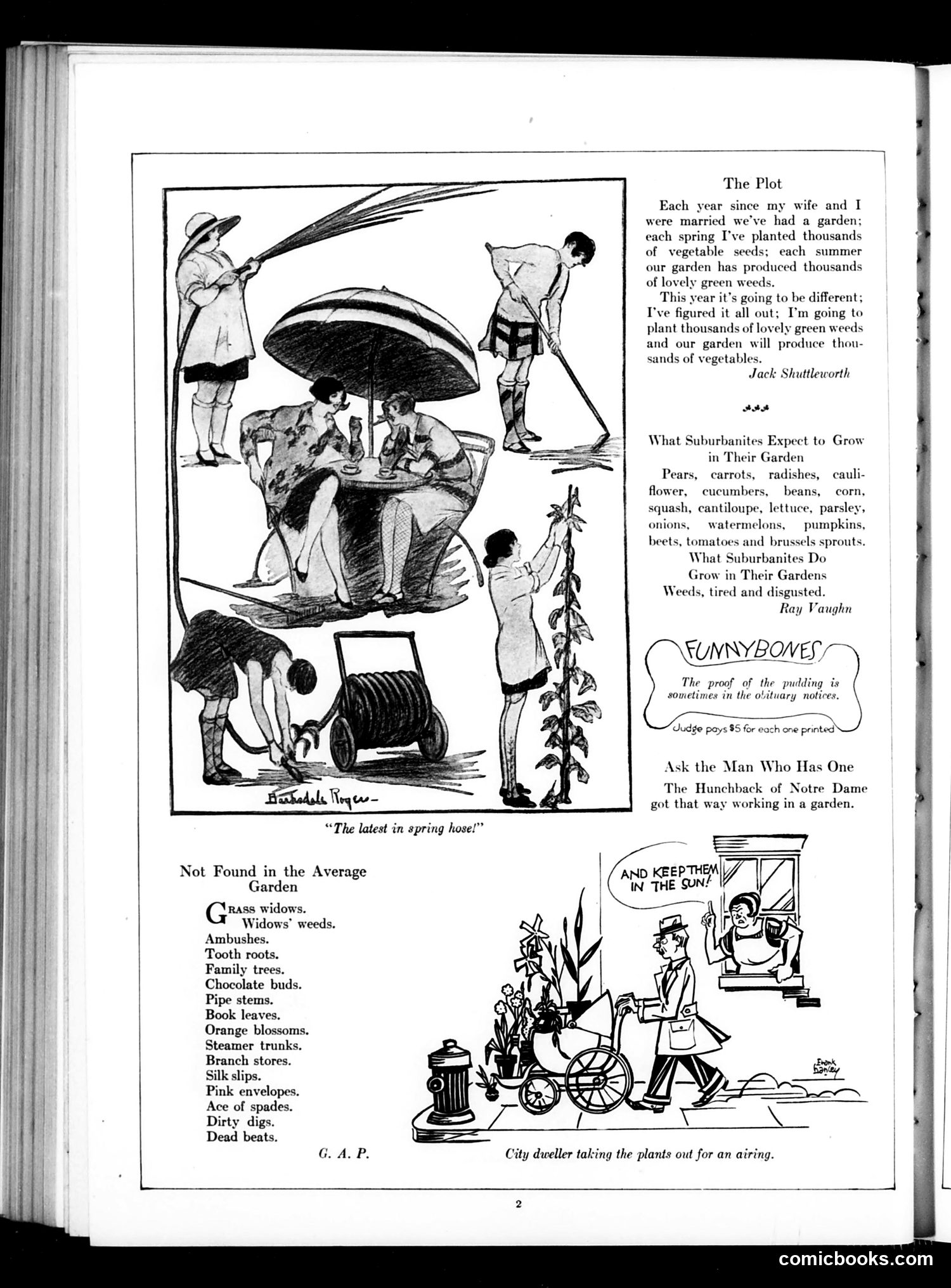
This page satirizes suburban gardening aspirations during what appears to be the early 20th century. **Main cartoon** ("The latest in spring hose"): Mocks suburban homeowners' overly ambitious gardening plans. The exaggerated spring hose contraption suggests gardeners are overcomplicating simple tasks—a recurring theme in the accompanying text. **"The Plot"** section quotes Jack Shuttleworth's grandiose plan to grow thousands of vegetables, contrasted with Ray Vaughn's observation that suburbanites actually grow "weeds, tired and disgusted." **"Not Found in the Average Garden"** humorously lists items like "Grass widows" and "Chocolate buds"—wordplay suggesting suburban gardeners lack both skill and realistic expectations. The overall satire targets middle-class suburban pretension and the gap between gardening ambitions and actual results.
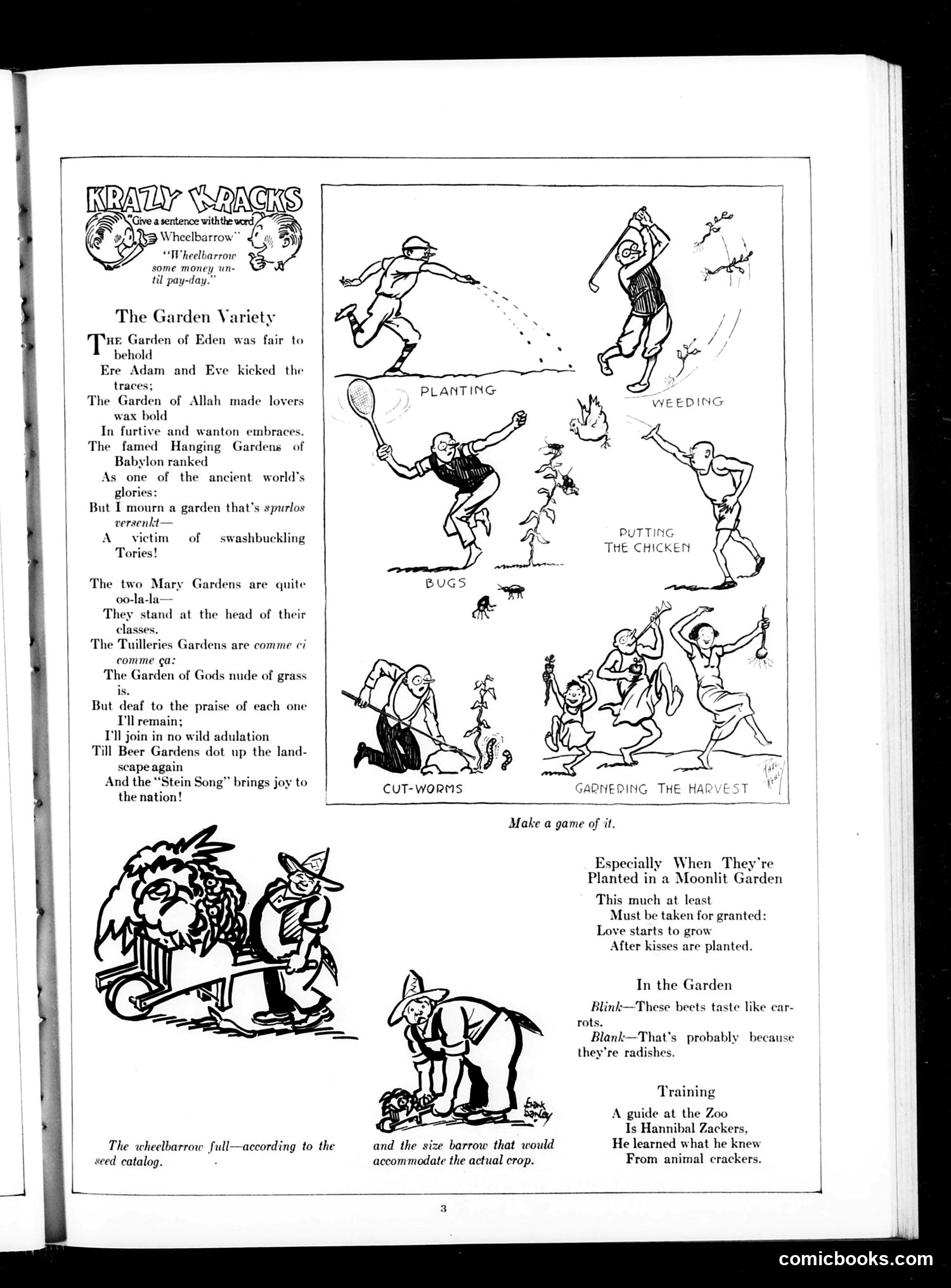
This page satirizes British politics through gardening metaphors. The poem mocks various London gardens (Mary Gardens, Tuileries Gardens, Garden of Gods) as representing different political factions or constituencies. The central cartoon illustrations humorously depict garden tasks—planting, weeding, bug control, harvesting—as physical comedy performed by people, suggesting politicians "making a game of" governance. The title "Krazy Kracks" and the wheelbarrow mascot frame this as lighthearted social commentary. References to "swashbuckling Tories" indicate this targets British Conservative Party politics, while garden neglect serves as metaphor for political mismanagement. The bottom section includes unrelated wordplay jokes about gardens and zoo training, typical of Judge's mixed-content format combining political satire with general humor.
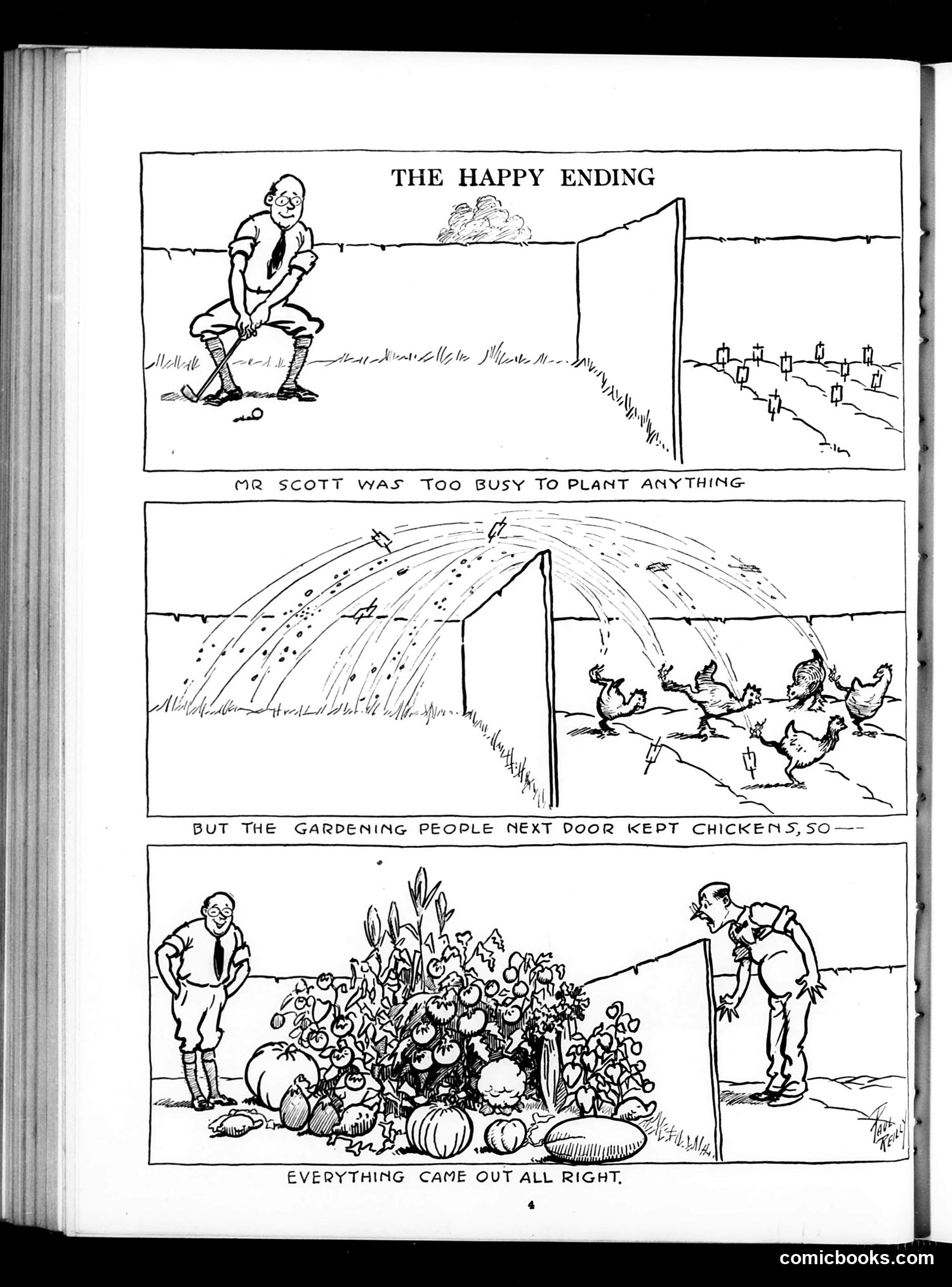
This appears to be a humorous comic strip from *Judge* magazine satirizing wartime or Depression-era gardening efforts. The narrative is straightforward: **Panel 1:** "Mr Scott" is too busy to plant a vegetable garden; he stands idle while neighbors' gardens thrive across a fence. **Panel 2:** The neighbors keep chickens that escape and destroy Scott's property through a makeshift shelter. **Panel 3:** The "happy ending"—Scott's garden unexpectedly flourishes abundantly with vegetables, apparently fertilized by the neighboring chickens' droppings. The joke is a practical one: what seemed like a nuisance (escaped chickens) actually benefited Scott's garden through natural fertilization. It's gentle satire about unintended consequences and ironic outcomes during a period when home food production was socially encouraged.
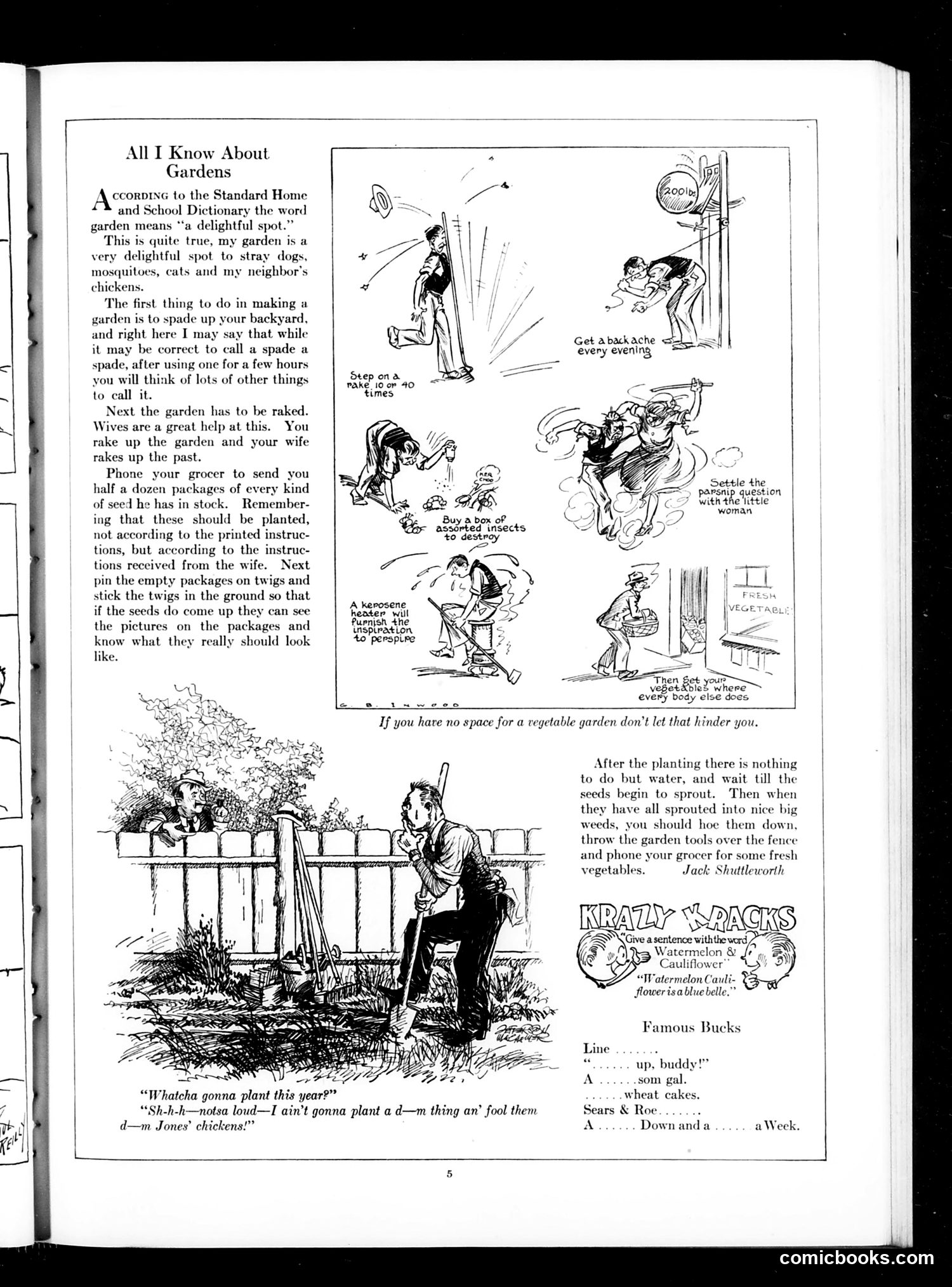
This page is primarily humorous instructional content rather than political satire. It offers comedic advice on starting a vegetable garden, illustrated with exaggerated cartoon scenarios showing common gardening mishaps. The jokes center on typical urban/suburban gardening failures: accidentally stepping on rakes repeatedly, encountering persistent insects, dealing with neighborhood interference, and struggling with seed-planting logistics. The humor derives from physical comedy and relatable domestic frustration rather than political commentary. The bottom illustration shows a couple discussing planting plans, with dialogue poking fun at over-ambitious gardeners and neighbors' skepticism about vegetable cultivation. This appears to be lifestyle satire—mocking earnest but incompetent amateur gardeners—rather than commentary on political events or figures. The tone is gentle domestic humor typical of Judge's lighter editorial content.
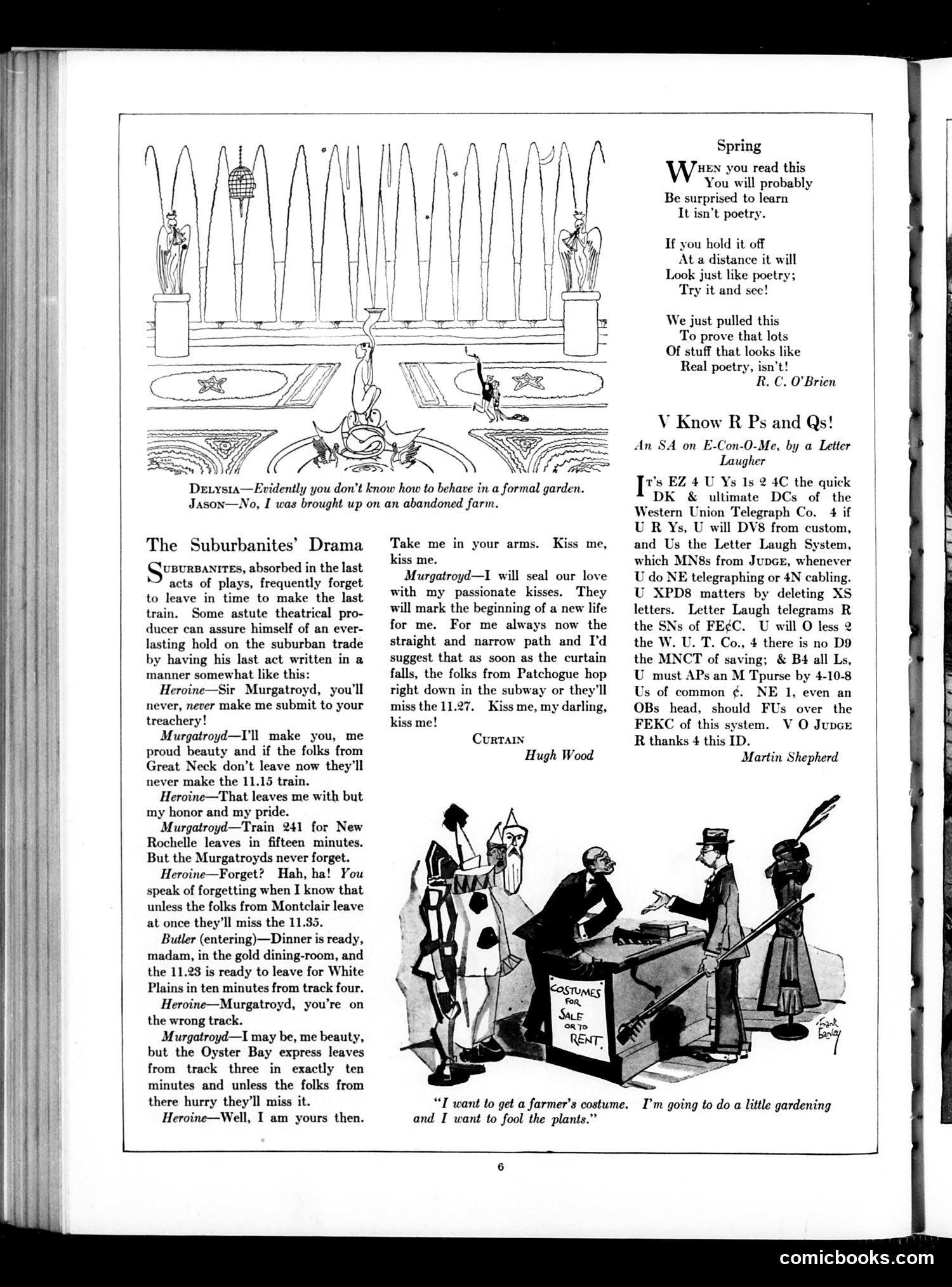
This page contains three satirical pieces from *Judge* magazine: **"The Suburbanites' Drama"** mocks middle-class commuters obsessed with catching trains home. The joke: a playwright could guarantee suburban audiences stay through entire plays by inserting train departure times into dramatic scenes. Characters interrupt romantic moments with reminders like "the 11.15 train" and "Oyster Bay express leaves from track three in exactly ten minutes." It satirizes how suburban commuters prioritize schedules over theater. **"Spring"** is meta-satire: the piece itself parodies pretentious poetry that "looks like poetry" when held at distance but isn't. It mocks readers who mistake elaborate formatting for genuine literary merit. **The bottom cartoon** shows someone shopping for theatrical costumes, wanting a "farmer's costume" to "fool the plants"—a simple visual pun about fooling vegetation with fake farmer attire. All three pieces target early 20th-century American urban/suburban culture and literary affectations with gentle ridicule typical of *Judge*'s satirical approach.
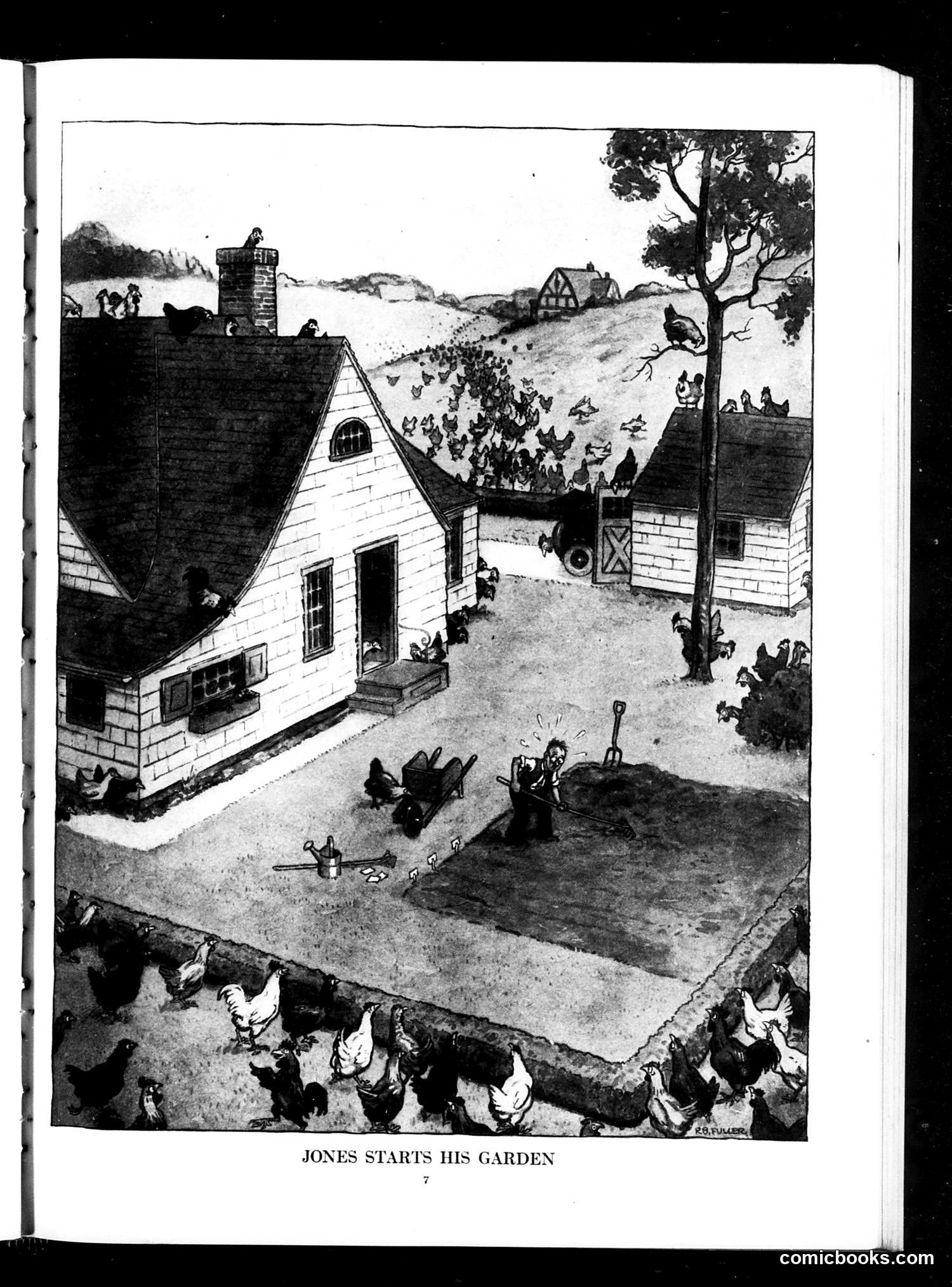
This illustration depicts a domestic scene where a man named Jones begins gardening while his property is overrun with chickens. The satire appears to target the early 20th-century "back-to-the-land" or home gardening movement—likely poking fun at urban or suburban men attempting agricultural self-sufficiency. The humor stems from the contrast between Jones's organized, deliberate garden-starting efforts (visible tools, prepared soil) and the chaotic reality surrounding him: numerous chickens freely roaming his yard and property. The title suggests good intentions, but the visual joke suggests his actual circumstances are already messy and uncontrollable. This reflects Judge magazine's frequent satirizing of middle-class aspirations and the gap between what people planned versus what they actually managed.
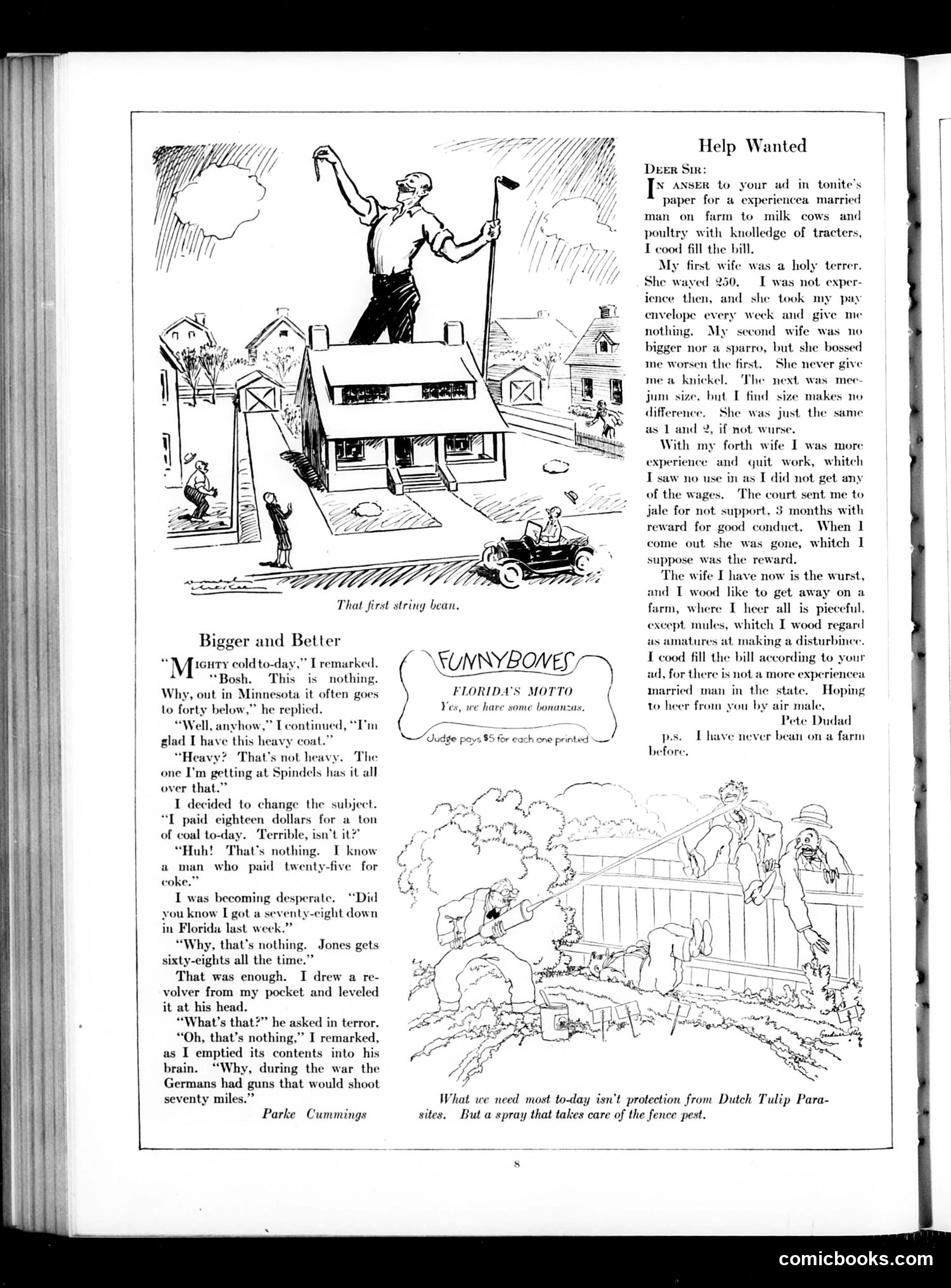
This cartoon satirizes the American habit of **competitive one-upmanship**—the compulsion to top everyone else's story. The narrator attempts casual conversation about cold weather, heating costs, and golf scores, but his companion reflexively counters each remark with an exaggerated claim ("forty below," "twenty-five for coke," better golf scores). The joke escalates absurdly: the frustrated narrator shoots his companion, then casually dismisses it using the same one-upping logic—by claiming German WWI guns could shoot seventy miles. The humor lies in the social critique: some people's need to appear superior and impressive is so pathological that even murder becomes just another story to be trumped. The accompanying "Help Wanted" letter parodies poorly educated rural job applicants, written in broken English, detailing his successive failed marriages and legal troubles—a gentle mockery of farming desperation during economically hard times.
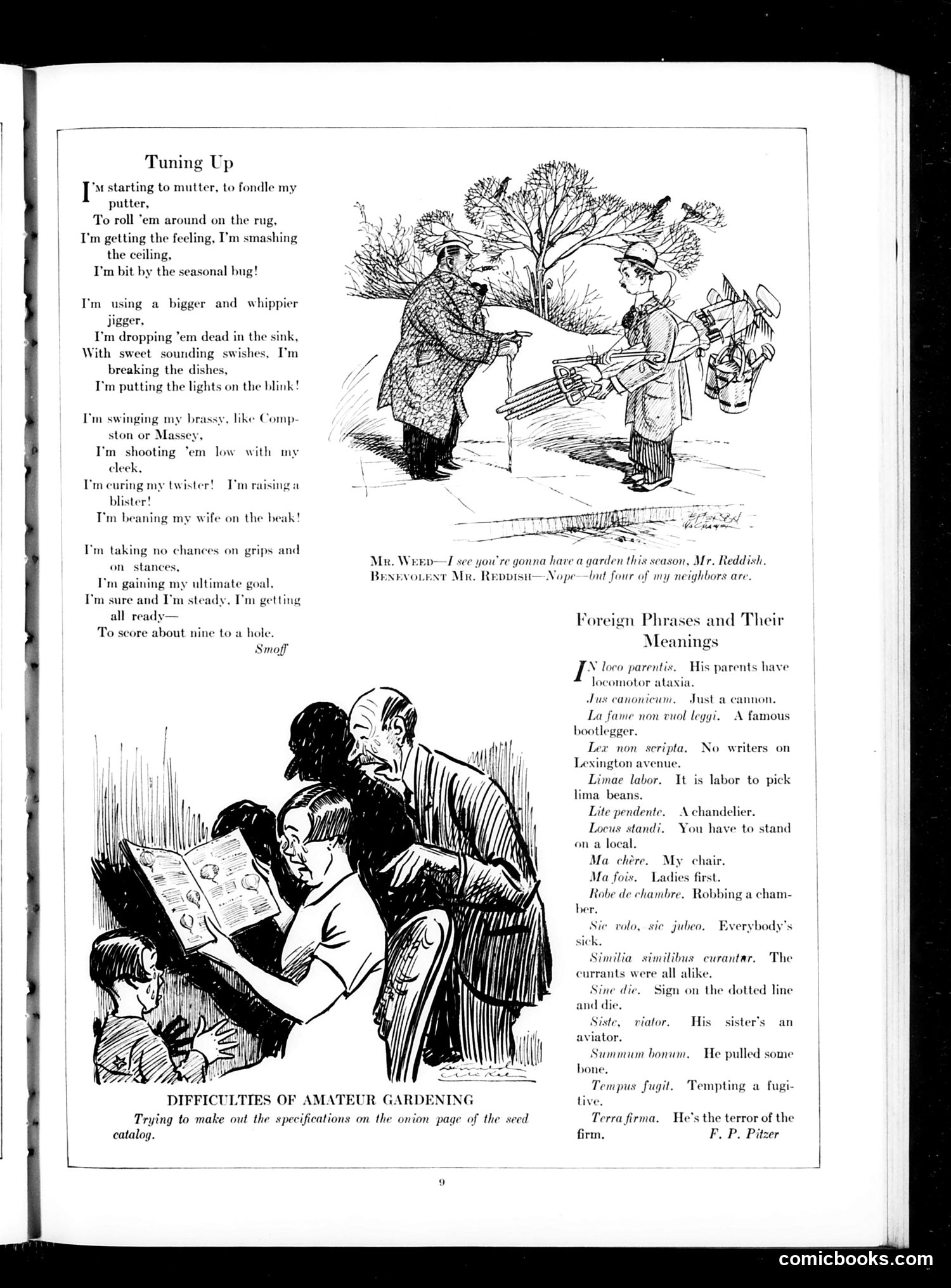
This Judge magazine page contains three distinct humor pieces: **"Tuning Up"** (top left): A comic poem about golf season's arrival. The speaker describes obsessively practicing golf indoors—damaging his home in the process—while humorously invoking famous golfers' names (Compston, Massey). The joke is the amateur's delusional confidence despite his chaotic preparation and terrible actual skill ("score about nine to a hole"—meaning nine strokes over par). **Garden Cartoon** (top right): Mr. Weed tells Mr. Reddish he'll have a garden—but the punchline is that four neighbors will instead, implying Reddish's gardening efforts will fail or spread destruction. **"Foreign Phrases and Their Meanings"** (right side): Puns translating actual Latin/French legal and classical phrases into mock-English homonyms. Examples: "*Lex non scripta*" (unwritten law) becomes "No writers on Lexington avenue"; "*Terra firma*" (solid earth) becomes "He's the terror of the firm." This satirizes pretentious use of foreign phrases by offering absurd alternative interpretations. The bottom illustration shows amateur confusion reading seed catalogs—another gardening incompetence joke.
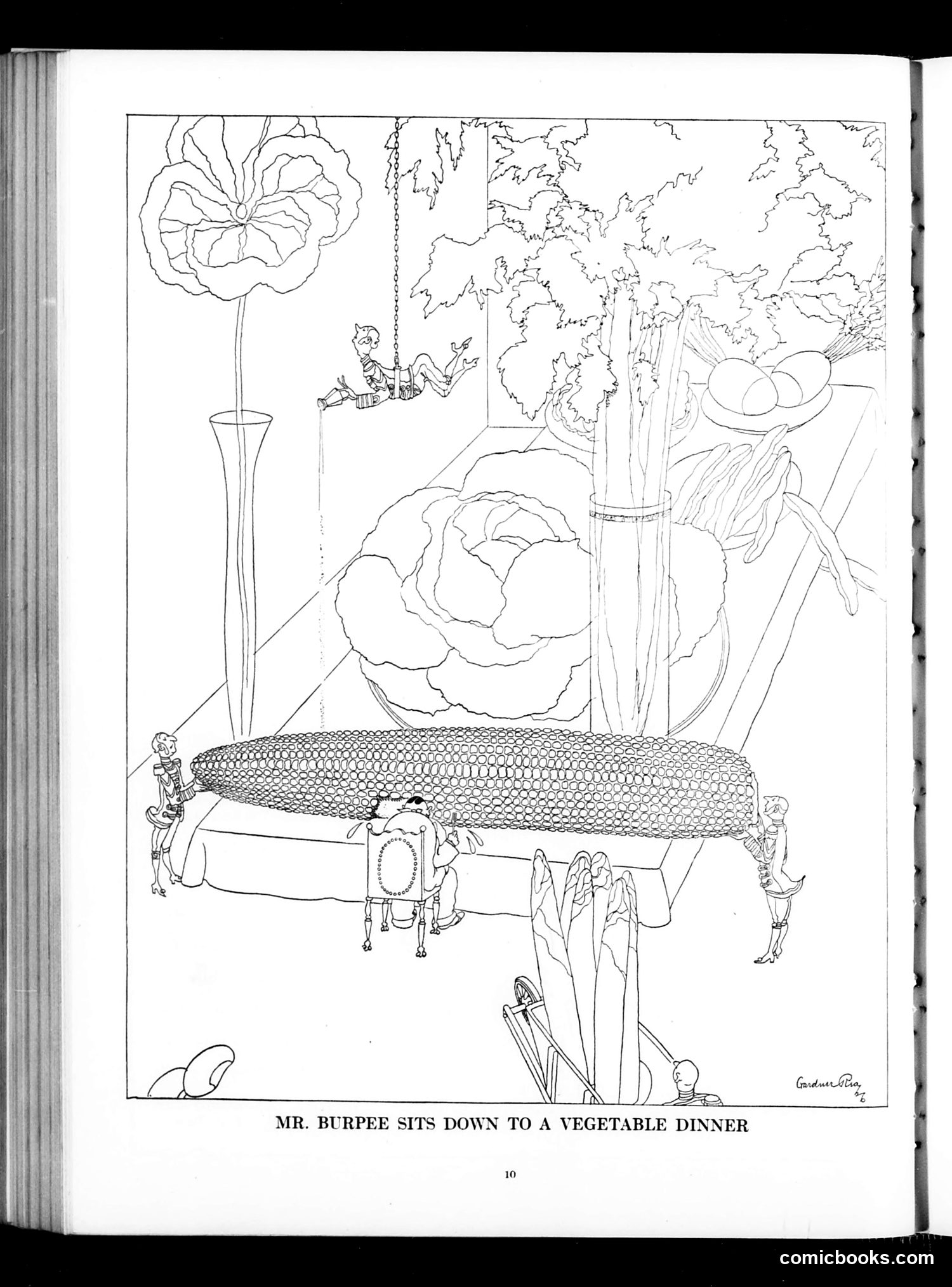
This cartoon depicts a man labeled "Mr. Burpee" sitting down to an enormous dinner table laden with oversized vegetables—a giant cucumber dominates the center, surrounded by flowering plants, leafy vegetables, and other produce. Tiny human figures are positioned around and on the vegetables, emphasizing their gigantic scale. "Burpee" appears to reference W. Atlee Burpee, the famous American seed company founder and vegetable breeder. The satire likely mocks either the company's promotional claims about vegetable size/quality, or contemporary enthusiasm for industrial agriculture and plant breeding. The absurdist humor comes from depicting a man literally consumed by the fruits of his labor—or the exaggerated success of his vegetables.
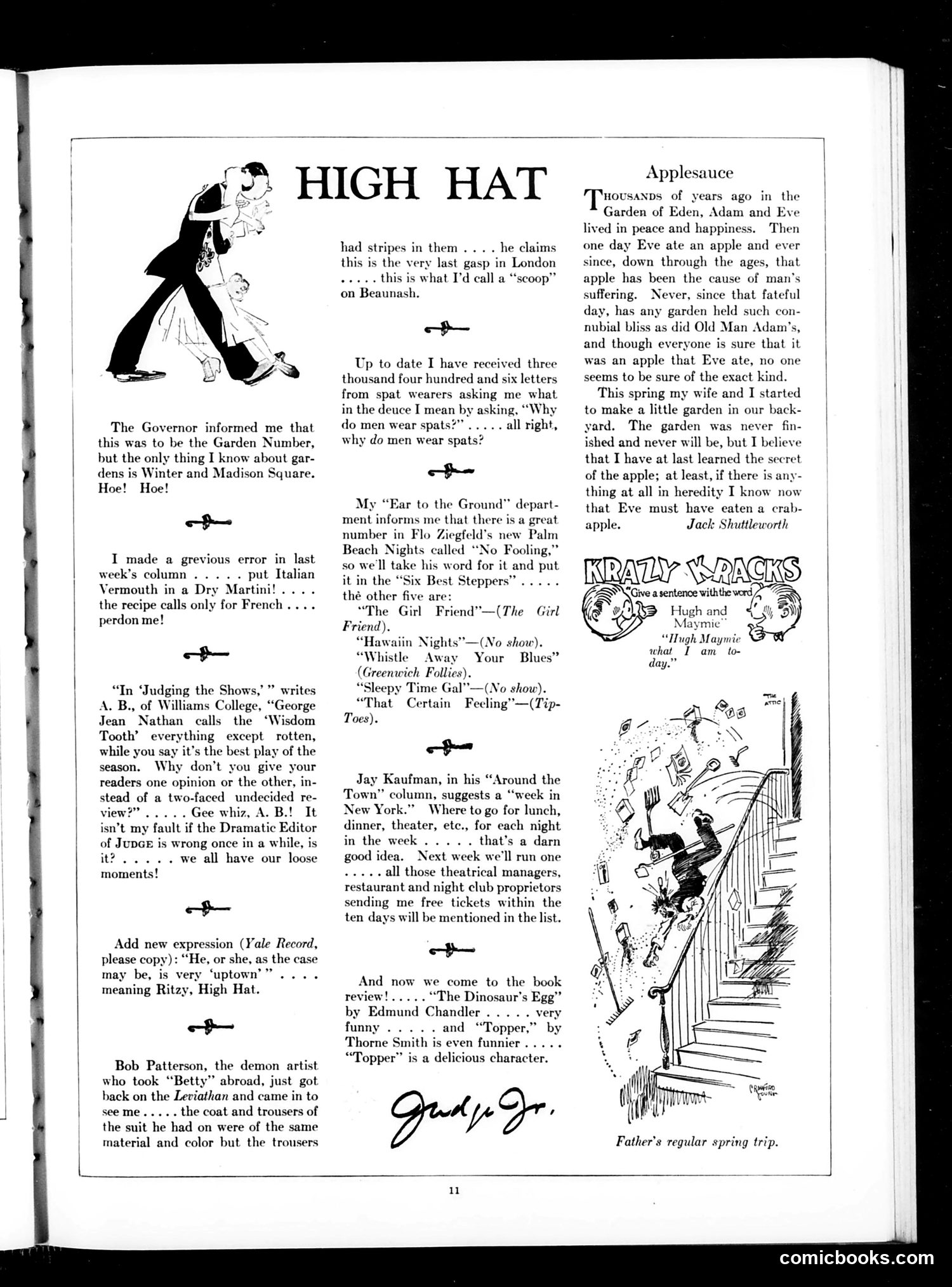
This is primarily a **humor column** by the magazine's editor rather than political satire. The page collects miscellaneous observations and reader correspondence about 1920s social trends and entertainment. **Key content:** The main cartoons are modest illustrations accompanying commentary—notably one about "Father's regular spring trip" showing a man tumbling down stairs, a visual gag about domestic mishaps. **Social references:** - "Spats" (ankle coverings)—the editor humorously questions why men wear them - Fashion commentary on London trends (matching suit material with striped trousers) - Contemporary Broadway shows and Flo Ziegfeld's revues - References to critic George Jean Nathan and theatrical coverage **The humor is conversational and self-deprecating**: the editor admits mistakes (adding Italian vermouth to martinis), acknowledges contradicting his own drama critic, and jokes about knowing nothing about gardens except urban parks. The piece reflects 1920s entertainment culture and fashion minutiae rather than political commentary—it's primarily **social satire aimed at urban sophistication and theater-going audiences**.
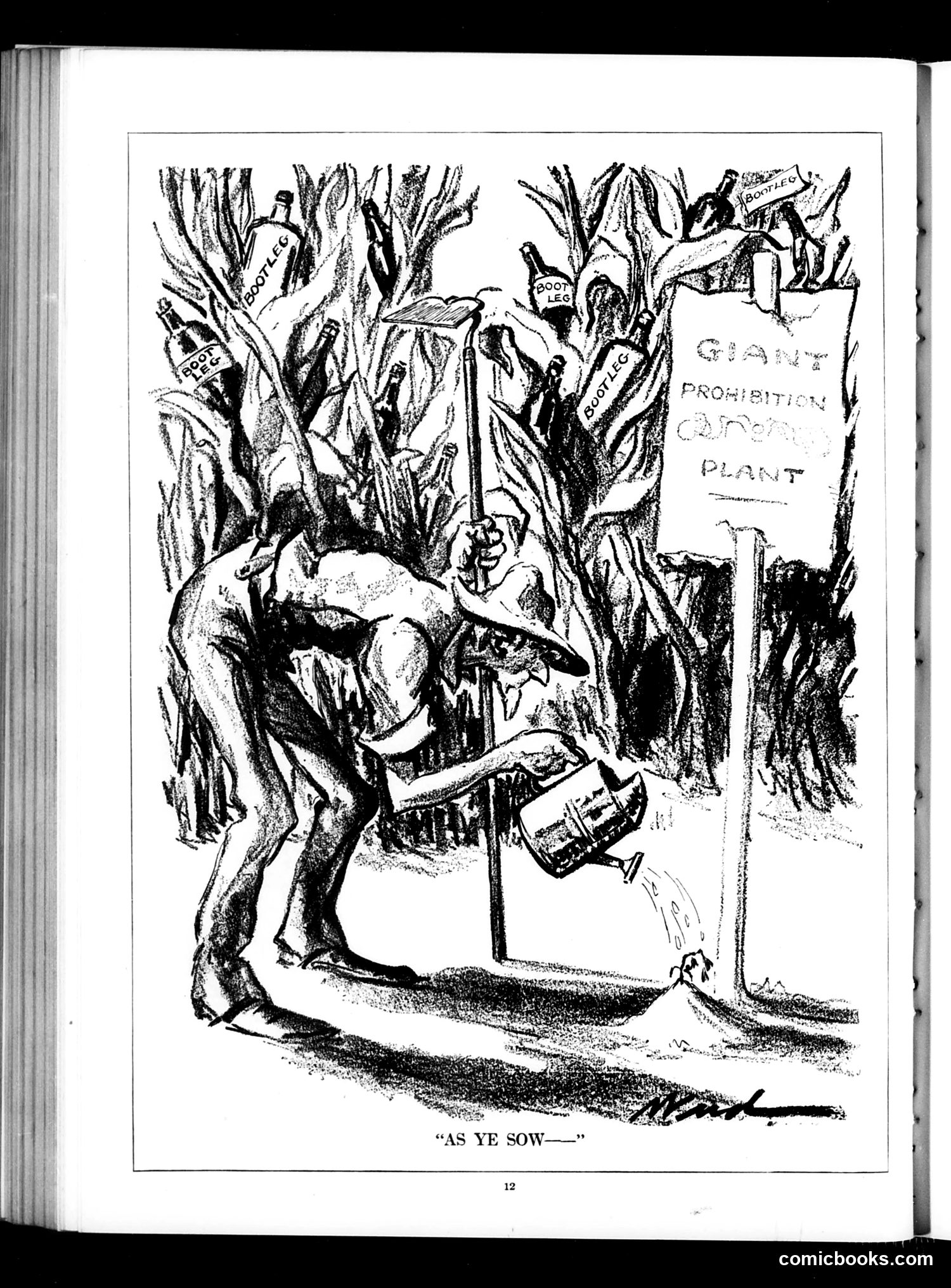
This political cartoon depicts a figure in a cornfield examining plants labeled "Giant Prohibition" while holding alcohol bottles. The sign reads "Giant Prohibition Corn Plant," and bottles are visible both in the corn and on the ground. The cartoon satirizes Prohibition policy through agricultural metaphor. The phrase "As ye sow" (biblical reference to reaping consequences) suggests that Prohibition's strict enforcement is producing unintended results—specifically, the proliferation of illegal alcohol production and bootlegging. The figure appears to be inspecting or harvesting these illicit "crops." The satire critiques how Prohibition, rather than eliminating alcohol, actually spawned black-market operations and organized crime. The cartoon implies that strict laws "planted" the seeds for widespread lawbreaking and illegal alcohol distribution.
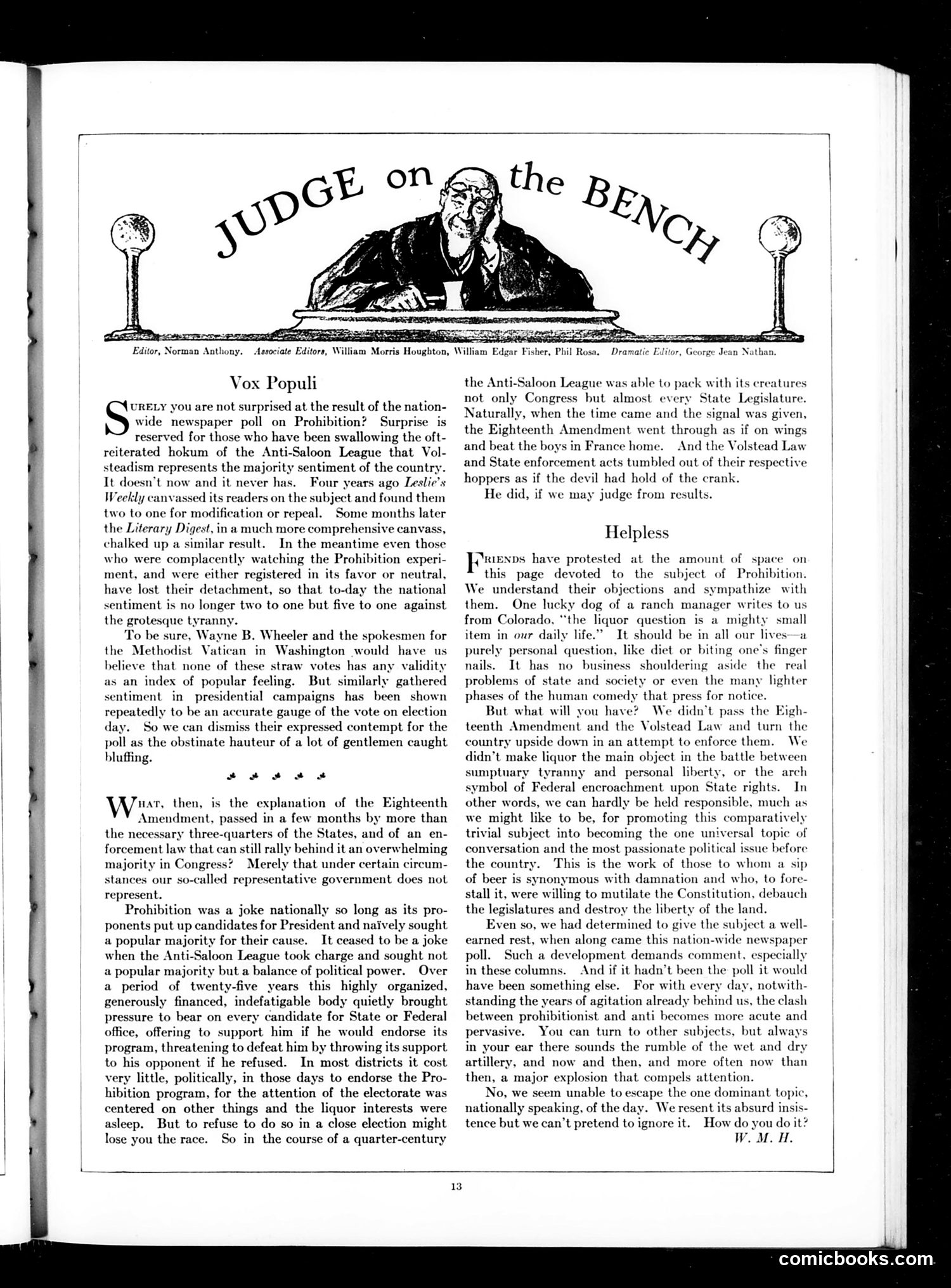
This page contains two editorial pieces criticizing Prohibition and the Anti-Saloon League's political tactics. **The Main Argument:** The editor argues that despite the Eighteenth Amendment's passage, multiple newspaper polls show 5-to-1 public opposition to Prohibition. The paradox: how did an unpopular law pass? **The Explanation:** The Anti-Saloon League didn't seek majority support; instead, it wielded "balance of political power" by strategically backing or opposing candidates over 25 years. Politicians endorsed Prohibition cheaply when other issues dominated public attention. Once the League "packed" legislatures with supporters, passage became inevitable. **"Helpless" Section:** The editor acknowledges reader complaints about excessive Prohibition coverage, arguing it should be a minor personal matter (like diet), not dominating political discourse. **The Satire:** The cartoon depicts a stern judge—likely representing the Anti-Saloon League or Federal enforcement—sitting imperiously above the bench, symbolizing how a organized minority imposed its will on the unwilling majority.
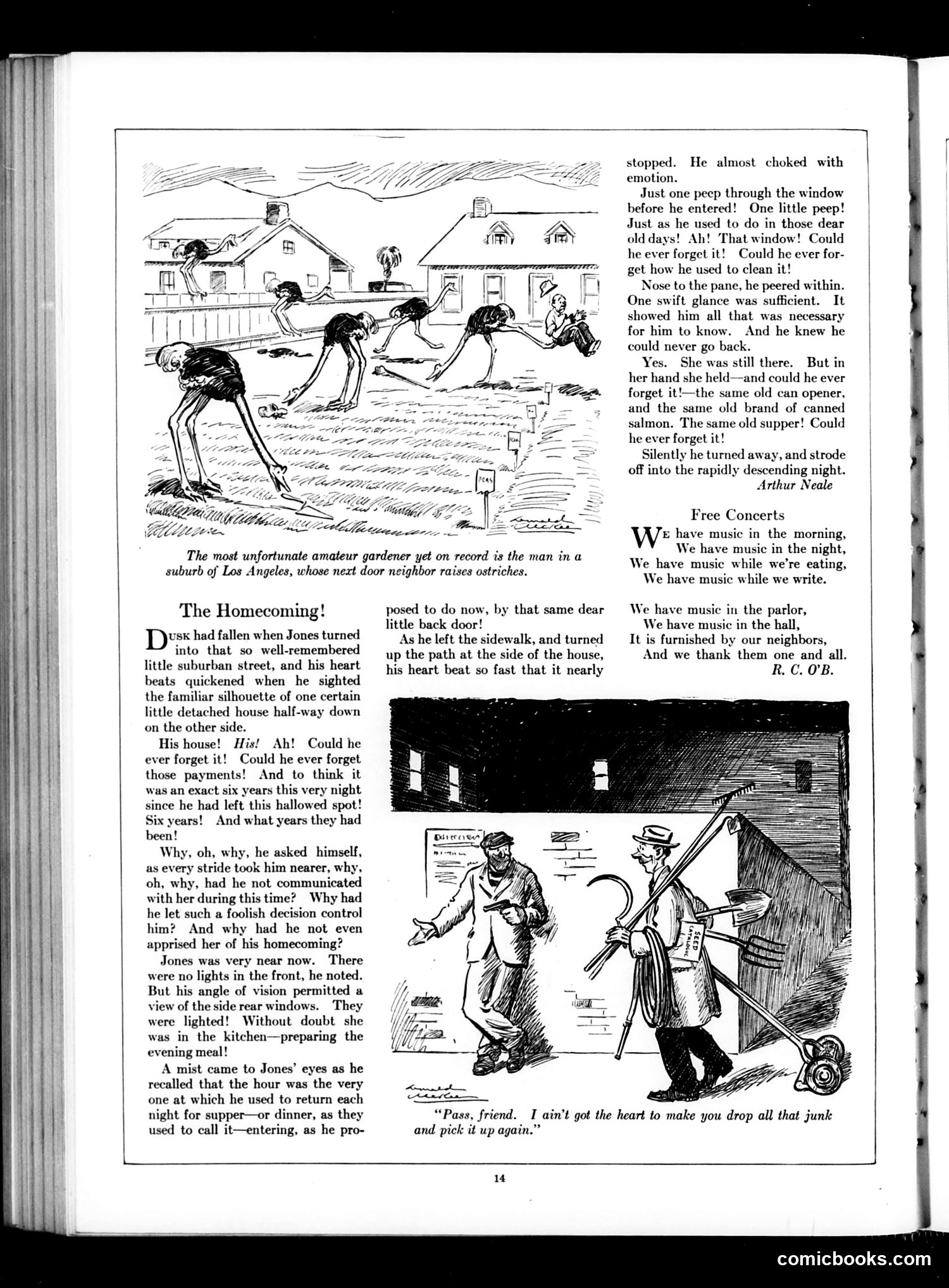
This page contains two satirical pieces from Judge magazine: **"The Homecoming!"** by Arthur Neale is a humorous short story about a man returning home after six years. The joke centers on domestic disappointment: he anticipates a romantic reunion with his wife, only to glimpse her through the kitchen window preparing the same monotonous meal—canned salmon—she always made. The satire mocks suburban married life's tedium and routine, suggesting his six-year absence was motivated by escape from domestic boredom rather than adventure. **The top cartoon** depicts a suburbanite's gardening ruined by his neighbor's ostrich farm, satirizing the absurdity of keeping exotic animals in residential areas and the nuisance they create for neighbors. **"Free Concerts"** is a light poem (by R.C. O'B.) sarcastically celebrating constant music from neighbors—likely referring to early 20th-century phonographs or radios that disturbed household peace, a common urban/suburban complaint. The overall theme: suburban life's petty frustrations and the claustrophobic reality behind the era's idealized domesticity.
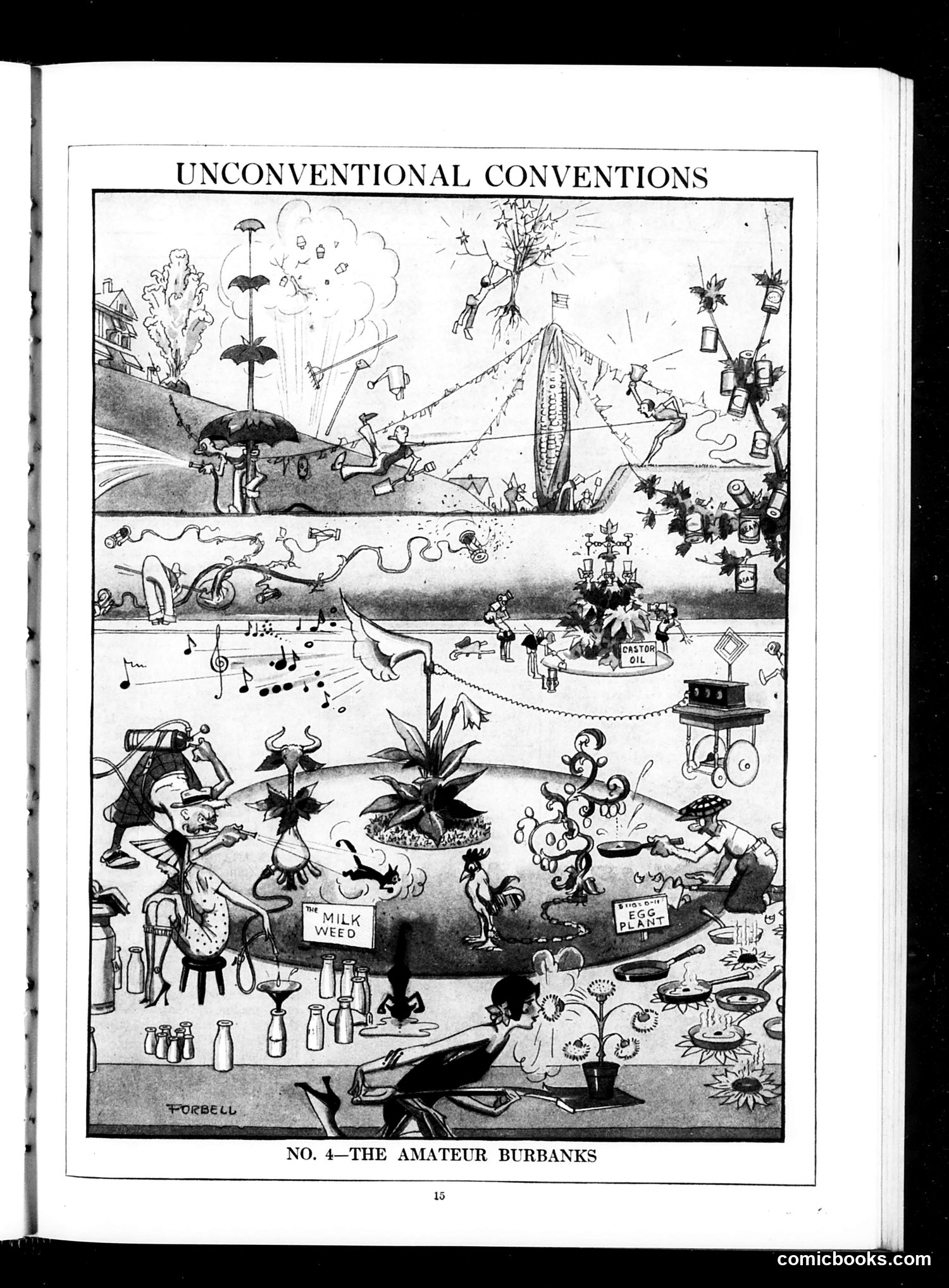
This satirical cartoon depicts a chaotic, fantastical garden scene mocking amateur horticulturists. The title references Luther Burbank, the famous botanist/plant breeder, suggesting these are bumbling amateurs attempting his work. The scene shows gardeners surrounded by absurd hybrid plants, strange creatures, and bizarre contraptions. Musical notes, milk weeds, and other labeled oddities suggest failed agricultural experiments. The surreal composition—with figures performing unconventional gardening methods—ridicules both the pretensions of amateur plant enthusiasts and perhaps early 20th-century fascination with scientific experimentation. The "unconventional conventions" framing suggests this mocks people who reject traditional gardening practices in favor of dubious amateur science. The artist is Forbell (signature visible).
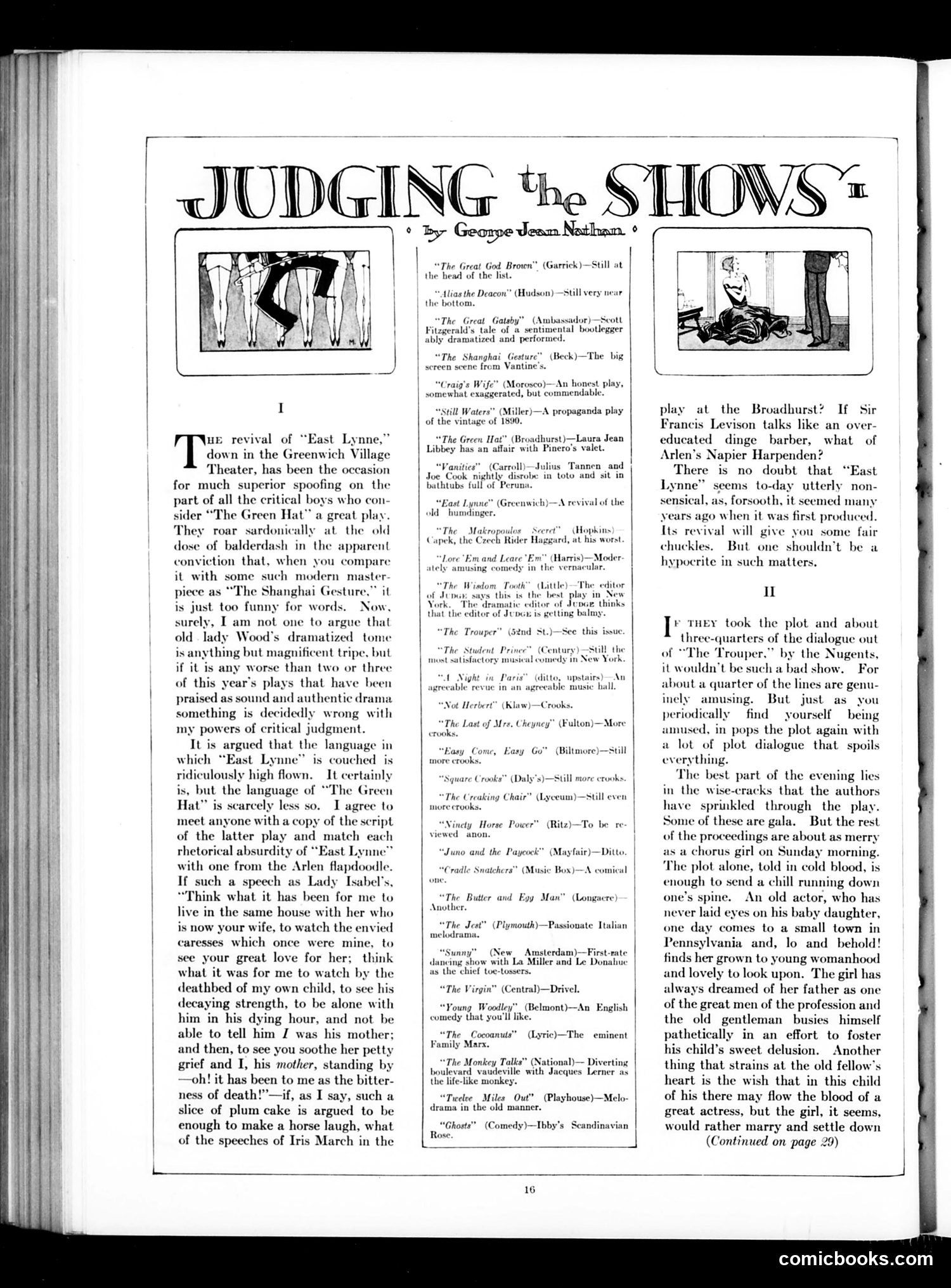
This page contains theater criticism from Judge magazine, comparing two melodramas: the revival of "East Lynne" (a 19th-century play) and "The Green Hat" (a contemporary 1920s play by Michael Arlen, likely featuring the character Iris March). Nathan argues that critics unfairly mock "East Lynne" as absurdly overwrought while praising "The Green Hat" as sophisticated modern drama. His point: both plays contain equally ridiculous, flowery dialogue and melodramatic speeches. He challenges anyone to match "The Green Hat's" rhetorical excesses against "East Lynne's"—suggesting modern critics are hypocritical snobs who dismiss older works based on age rather than actual quality. The surrounding list catalogs current Broadway productions, many dismissed with jokes about "crooks" and dated plots, reinforcing Nathan's theme that contemporary theater often lacks real merit.
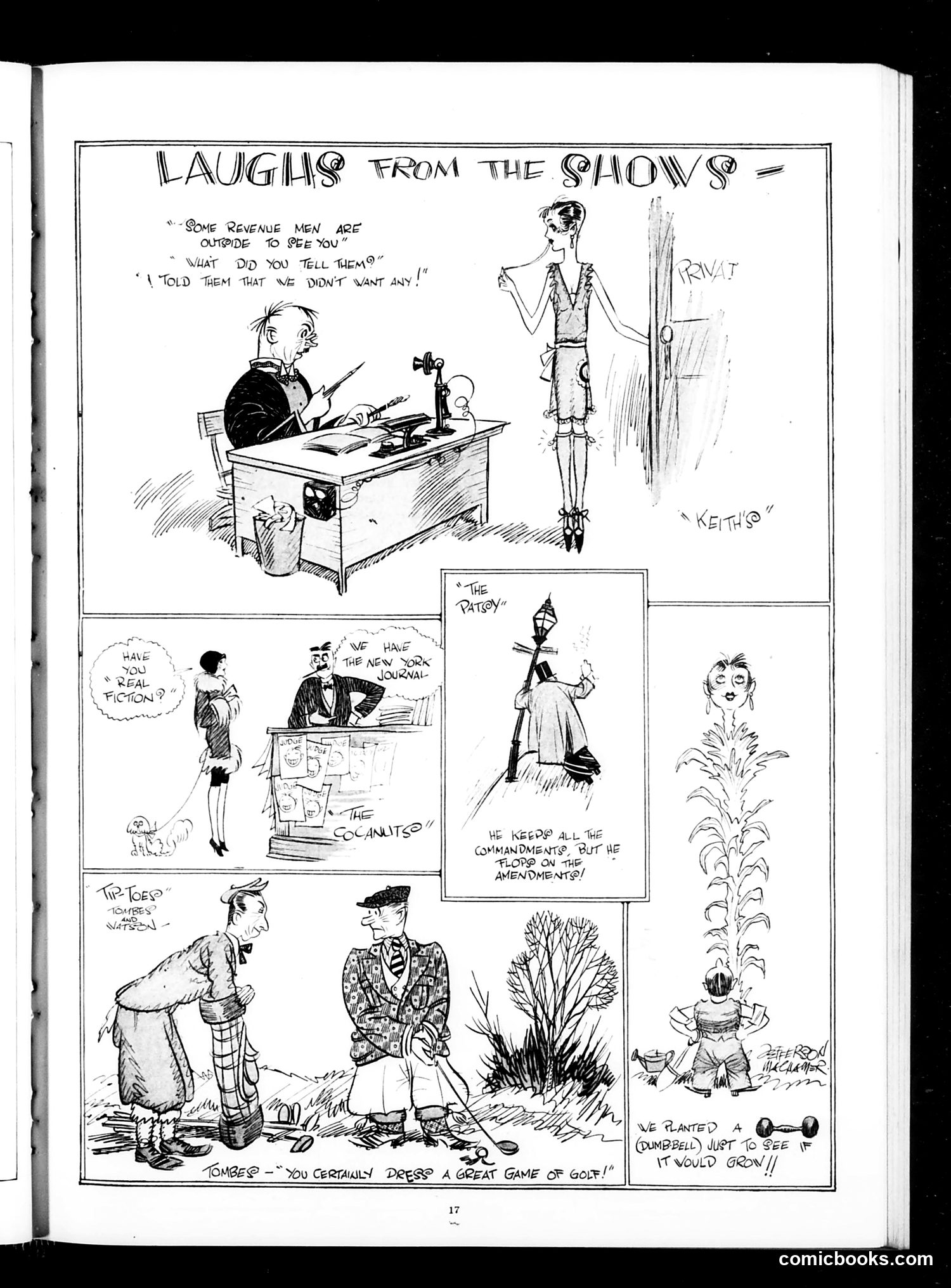
This page collects theatrical sketches satirizing contemporary figures and issues. The top panel mocks a theatrical revenue official who turns away unwanted guests—likely referencing Prohibition-era tax enforcement or theater licensing disputes. The middle panels reference a "New York Journal" editor (possibly William Randolph Hearst's publication) and satirize religious hypocrisy: a figure "keeps all the commandments, but flops on the amendments"—a jab at those claiming moral authority while ignoring constitutional protections (likely the 18th Amendment/Prohibition or voting rights amendments). The bottom panel appears to reference a character named "Tombes" in a golf-themed sketch, possibly mocking theatrical stereotypes or specific actors' mannerisms. The right panel shows a woman with an absurdly tall plant labeled as a "dumbbell" experiment in growth—satirizing either pseudoscientific claims or theatrical overacting. These are loosely connected vaudeville-style comedy sketches rather than unified political commentary.
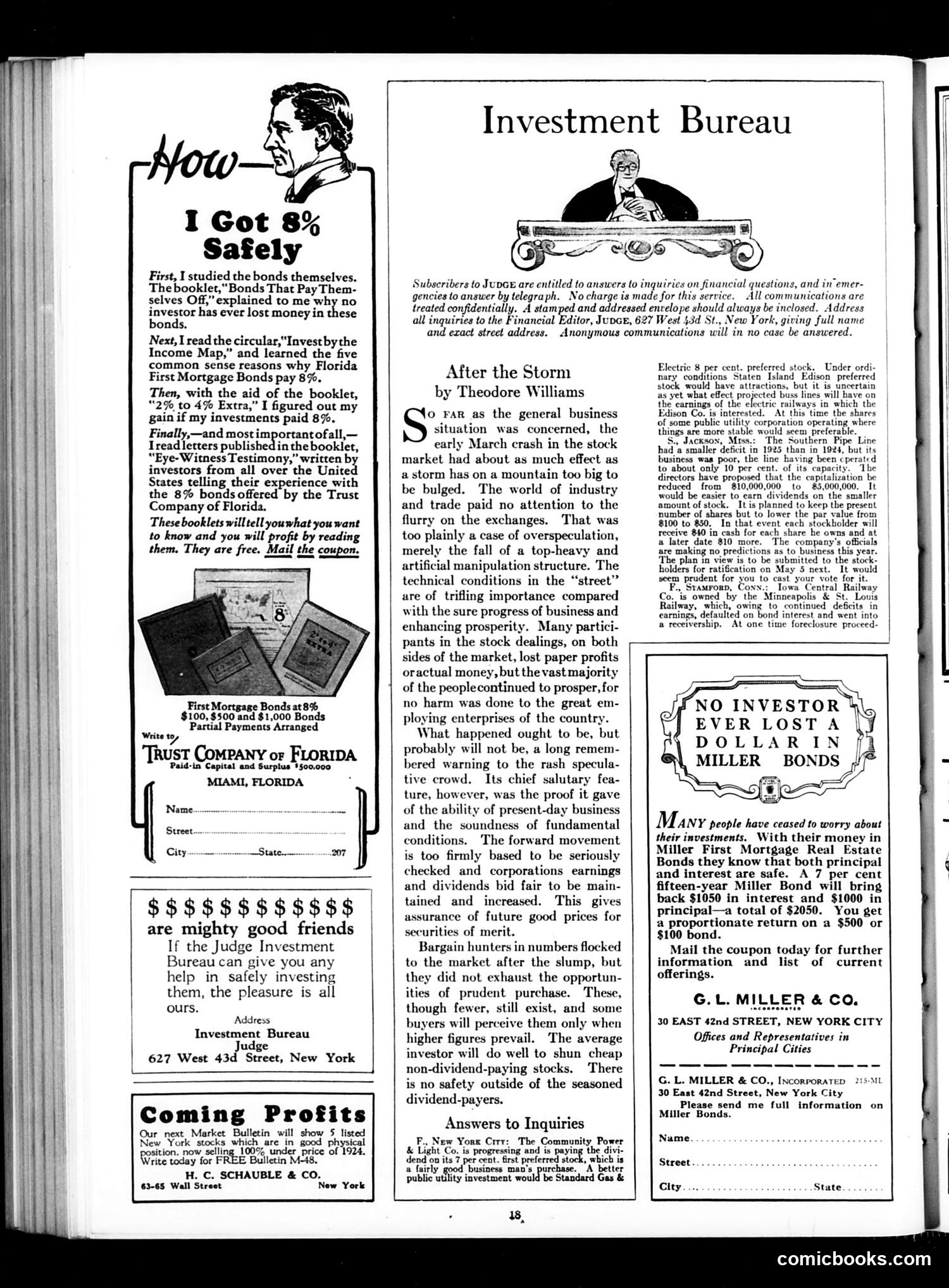
This page is primarily **advertisements for investment products**, reflecting the 1920s financial boom preceding the 1929 crash. The left side promotes **Trust Company of Florida bonds** offering 8% returns, using testimonial letters ("Eye-Witness Testimony") to build investor confidence. This appears designed to appeal to ordinary savers seeking safe, high-yield investments. The center article, "After the Storm" by Theodore Williams, discusses the **March 1924 stock market crash**, dismissing it as mere speculation that didn't harm real industry. The author reassures readers that solid businesses remain sound and that only foolish speculators lost money—a common narrative of the era downplaying market volatility. The right side features **G.L. Miller & Co.'s advertisement for their first mortgage bonds**, similarly emphasizing safety and steady returns (7%). For modern readers: this represents pre-Depression financial marketing promising safety through products that would later prove risky. The paternalistic investment advice and testimonial-based persuasion reflect an era before modern securities regulation or disclosure requirements.
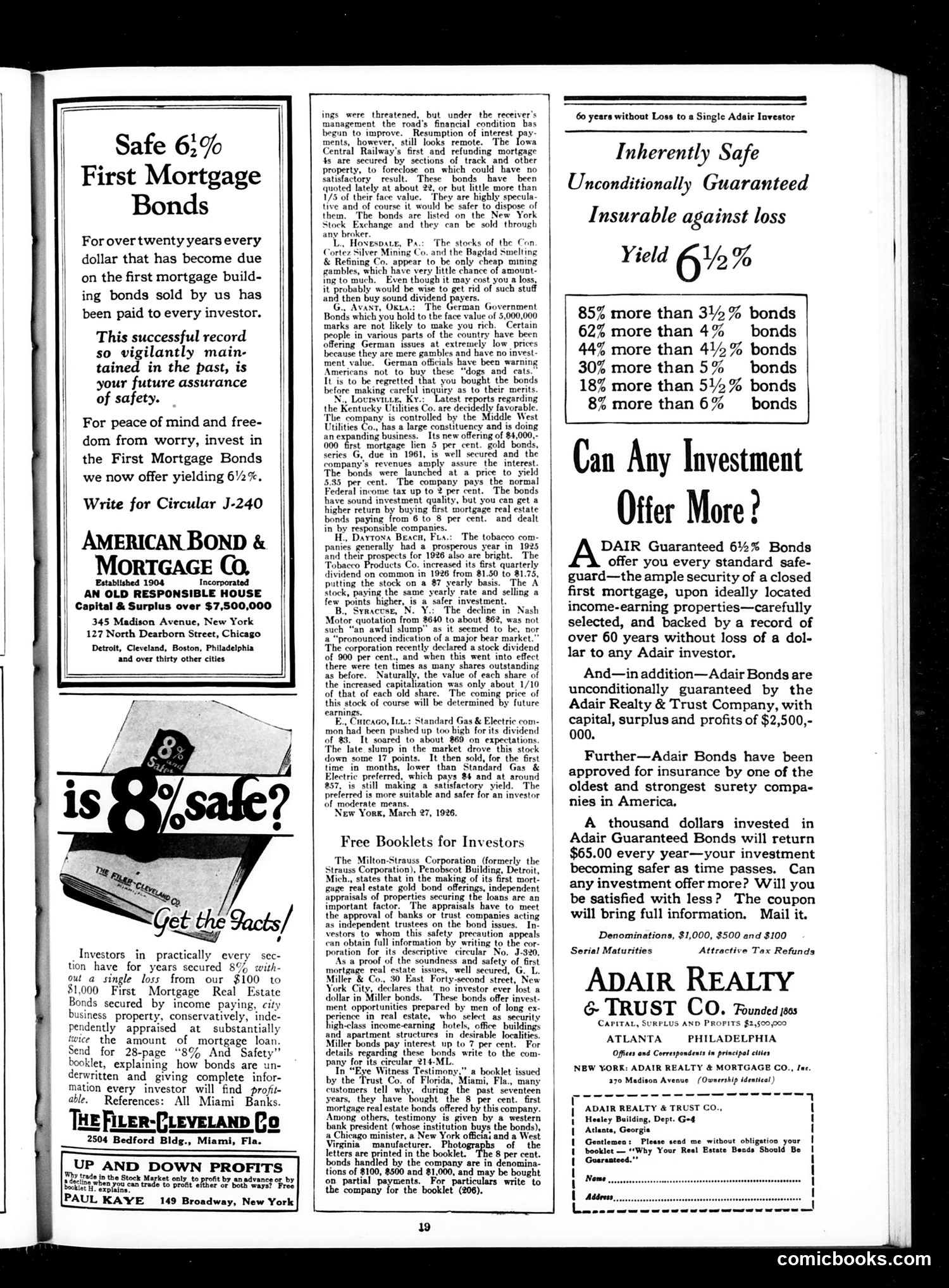
This page from **Judge magazine** is primarily **advertising**, not satire or political commentary. The page showcases investment advertisements from the 1920s era, promoting various bonds and mortgage securities. The key content includes: - **American Bond & Mortgage Co.** and **Adair Realty & Trust Co.** advertisements promoting "safe" first mortgage bonds yielding 6-6.5% - A small section titled **"Get the Facts"** from The Filer-Cleveland Co. in Miami, offering 8% returns - A financial advice column answering investor questions about problematic investments (Iowa Central Railway bonds, German government bonds, mining stocks) The implicit humor—likely satirical to contemporary readers—is that these ads promise safety and guaranteed returns during what appears to be a speculative investment period. The repeated emphasis on "safety" and "guaranteed" protection suggests investors were nervous about financial risk, possibly reflecting post-WWI economic uncertainty or early signs of the 1929 crash mentality. The page reveals how differently investment marketing worked a century ago.
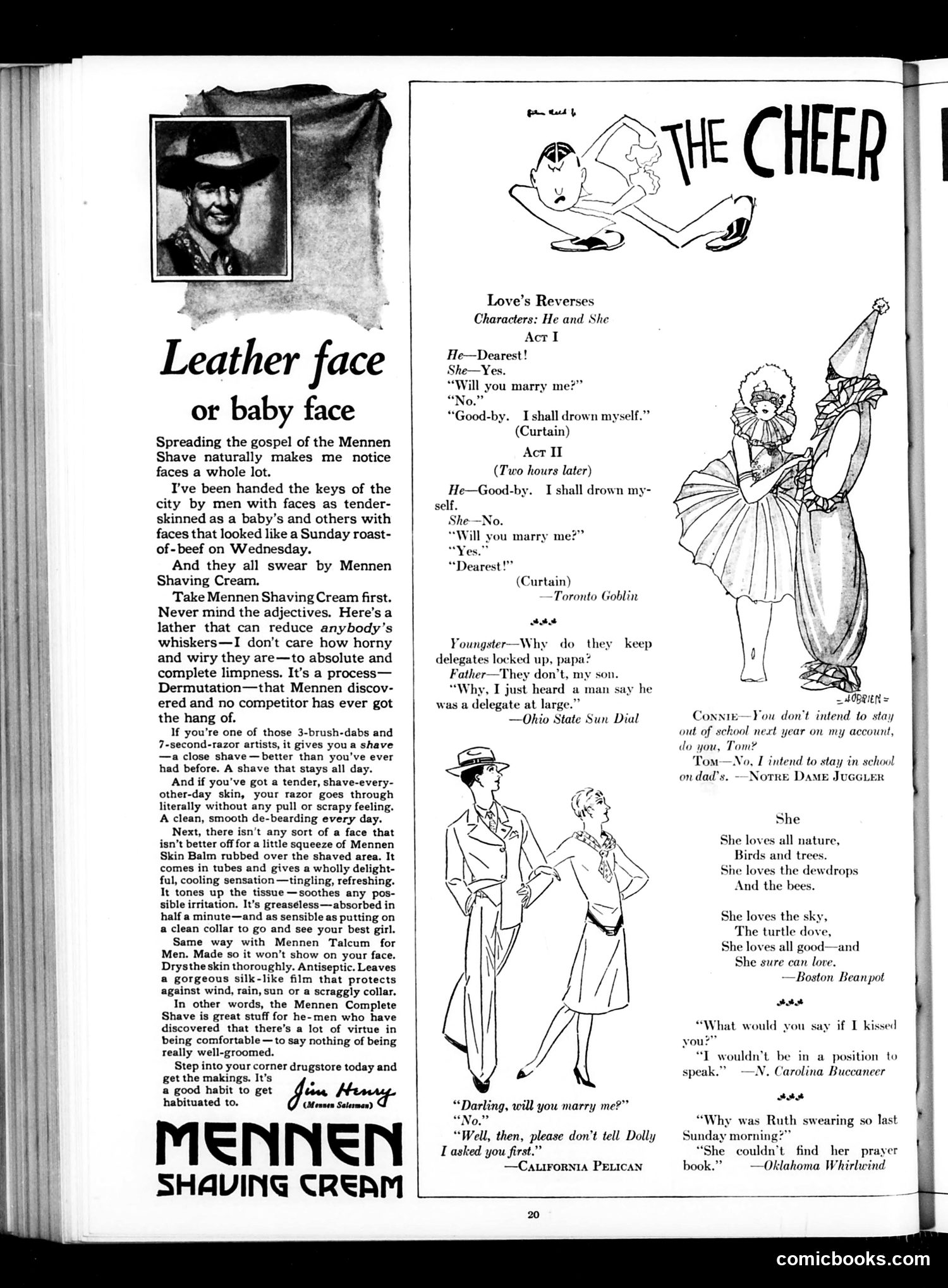
This page combines **advertising with humor content**, typical of Judge magazine's format. The left side is a **Mennen Shaving Cream advertisement** disguised as editorial commentary. It uses the conceit of a traveling salesman observing different "types" of faces (tough/"leather face" vs. soft/"baby face") to pitch the product's versatility. The ad emphasizes comfort and grooming as markers of modern masculinity—appealing to men concerned with appearing well-groomed and professional. The right side, titled "**The Cheer**," contains brief comedic sketches and jokes: - **"Love's Reverses"**: A satirical skit reversing gender dynamics—a man proposes, gets rejected, then reversed hours later when the woman accepts. The humor plays on romantic role-reversals. - Multiple short jokes about college life, political delegates, and domestic situations—standard collegiate and family humor of the era. The overall page reflects early 20th-century attitudes: masculinity linked to grooming, romantic courtship conventions, and genteel humor focused on social awkwardness and role-reversals.
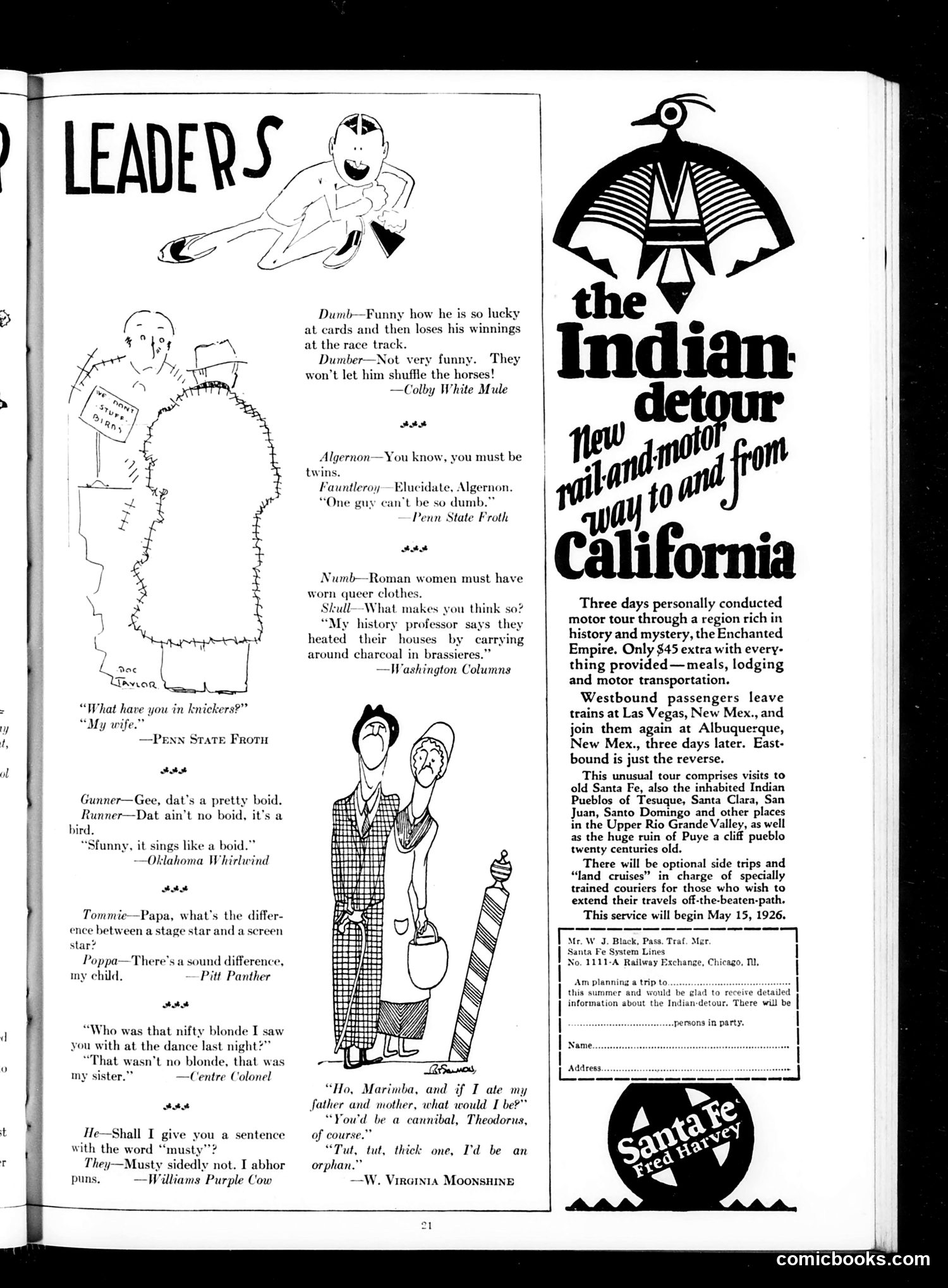
This page features humor pieces ("Leaders") that were typical of Judge magazine—collections of short jokes submitted by college humor publications. The jokes rely on wordplay and mild social observation rather than political satire. The content includes: **Left side jokes:** Mostly puns and observational humor about differences in pronunciation ("boid" vs. "bird"), stage versus screen actors, and a riddle about cannibalism. These represent the lighthearted college humor that Judge regularly published. **Right side:** A Santa Fe Railway advertisement for "The Indian Detour"—a 1926 motor tour package through New Mexico and Native American pueblos. This reflects early 20th-century tourism marketing, where Indigenous communities were presented as historical attractions and tourist destinations. The page overall is primarily **advertising and light entertainment** rather than satirical commentary. It captures period attitudes toward both humor and tourism.
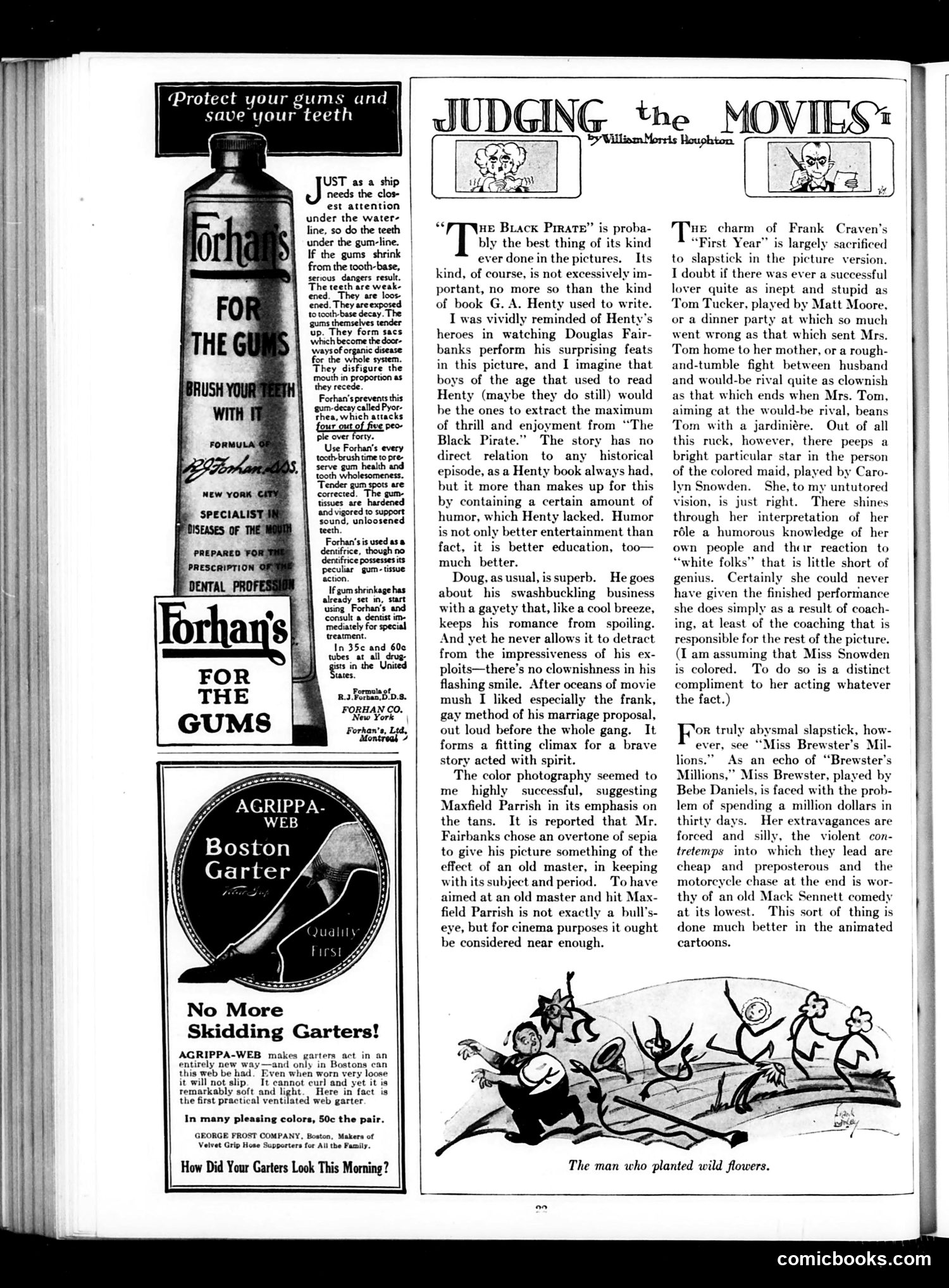
This page contains two film reviews by William Morris Houghton critiquing silent movies. The reviews discuss: **"The Black Pirate"** - A Douglas Fairbanks swashbuckling adventure film. Houghton compares it favorably to G.A. Henty's adventure novels, praising Fairbanks's performance, the humor, and notably the color photography (which he says resembles Maxfield Parrish's artistic style). He applauds the film's frank marriage proposal scene as refreshingly honest compared to typical sentimental movie fare. **"First Year"** - An adaptation of Frank Craven's play, criticized for losing the original's charm by over-relying on slapstick comedy, particularly in scenes involving the bumbling protagonist Tom Tucker (Matt Moore) and a domestic quarrel. The page also contains period advertisements for Forhan's toothpaste and Boston Garter stockings—typical commercial content in this era's magazines.
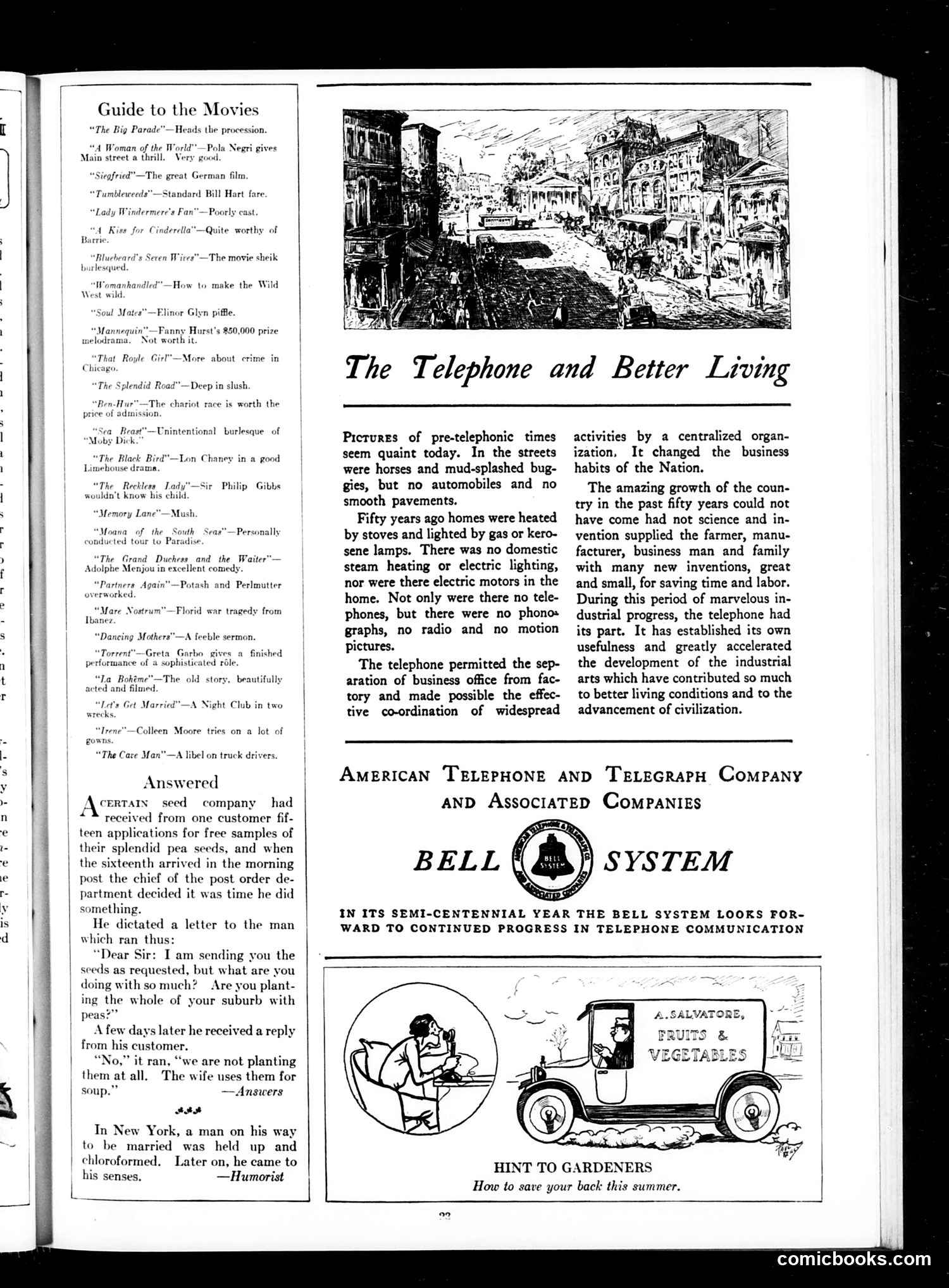
This page contains a **movie review column** and an **AT&T advertisement**—not political satire. The "Guide to the Movies" lists 1920s films with brief critiques, mostly dismissive ("Poorly cast," "Not worth it," "Deep in slush"). Notable titles include *The Big Parade* and films starring Lillian Gish and Lon Chaney—major stars of silent cinema. Below are two **humor anecdotes**: one about a seed company customer repeatedly ordering free pea samples (revealed to be for soup, not planting), and another about a man chloroformed before his wedding. The bulk of the page is a **Bell System advertisement** positioning the telephone as driver of American progress. It nostalgically contrasts pre-telephone life (horses, gas lamps) with modern industrial coordination enabled by telephony. The accompanying cartoon shows a woman using a telephone and a delivery truck, illustrating how the telephone improves business efficiency and daily life. This is corporate propaganda dressed as social commentary—typical of 1920s advertising that framed commercial technology as civilization itself.
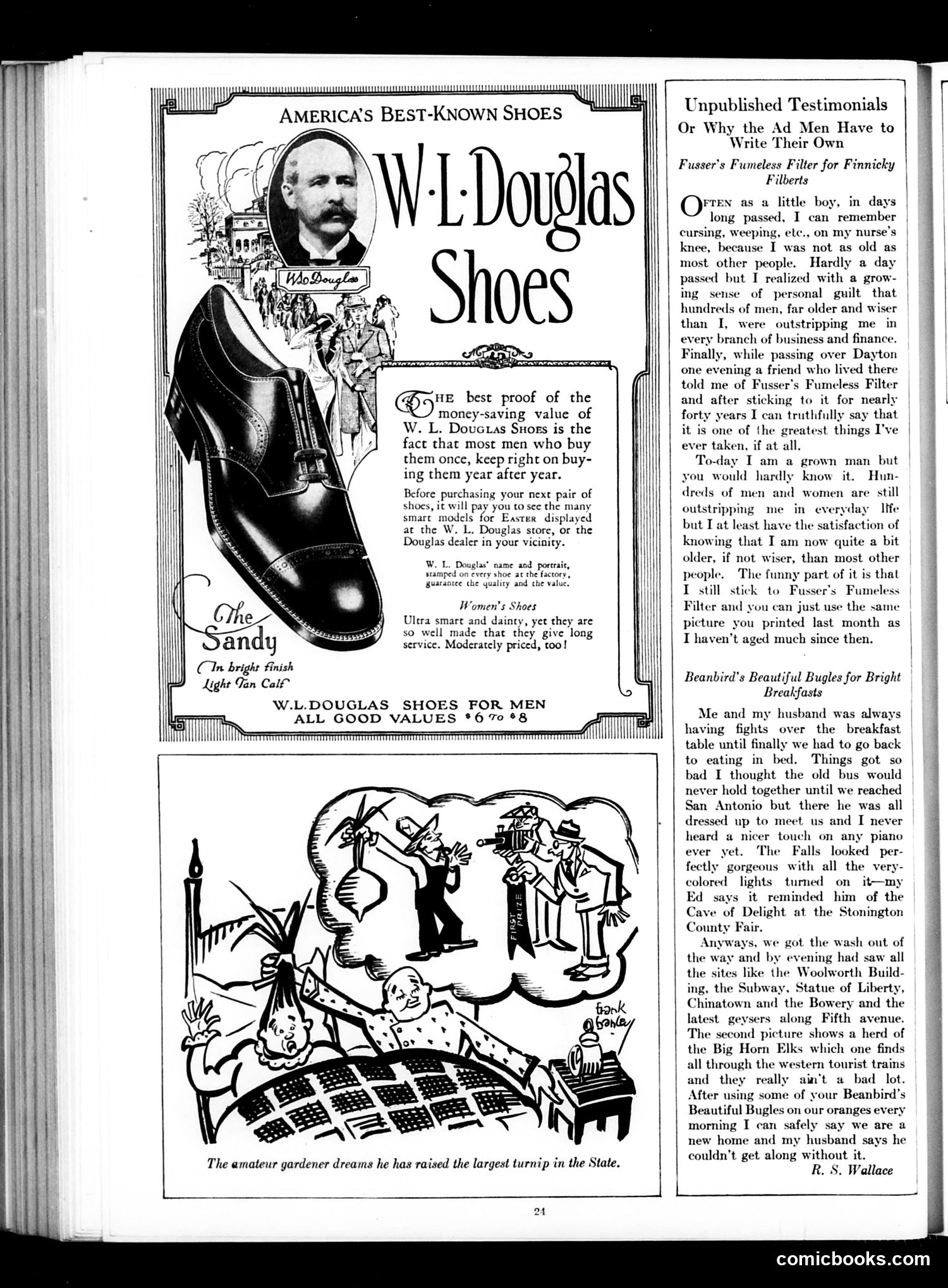
This page combines **genuine advertising** with **satirical fake testimonials** mocking advertising practices. The top half features a legitimate W.L. Douglas Shoes ad, a real brand from the era. The right column, titled "Unpublished Testimonials: Or Why the Ad Men Have to Write Their Own," is the satire. Judge ridicules how advertisers invented customer testimonials rather than publishing genuine ones. The three fake testimonials parody the absurdity of fabricated endorsements: 1. **Fusser's Fumeless Filter** — A man claims a product made him feel older and wiser despite no visible change, an obvious non-endorsement presented as praise. 2. **Beanbird's Beautiful Bugles** — A woman's rambling account of a honeymoon trip somehow credits breakfast cereal for marital harmony, showcasing how testimonials force irrelevant products into unrelated life narratives. The humor targets **deceptive advertising** of the era, where companies routinely invented customer stories. Judge exposes this by showing how absurd such manufactured testimonials actually are when written without editorial restraint.
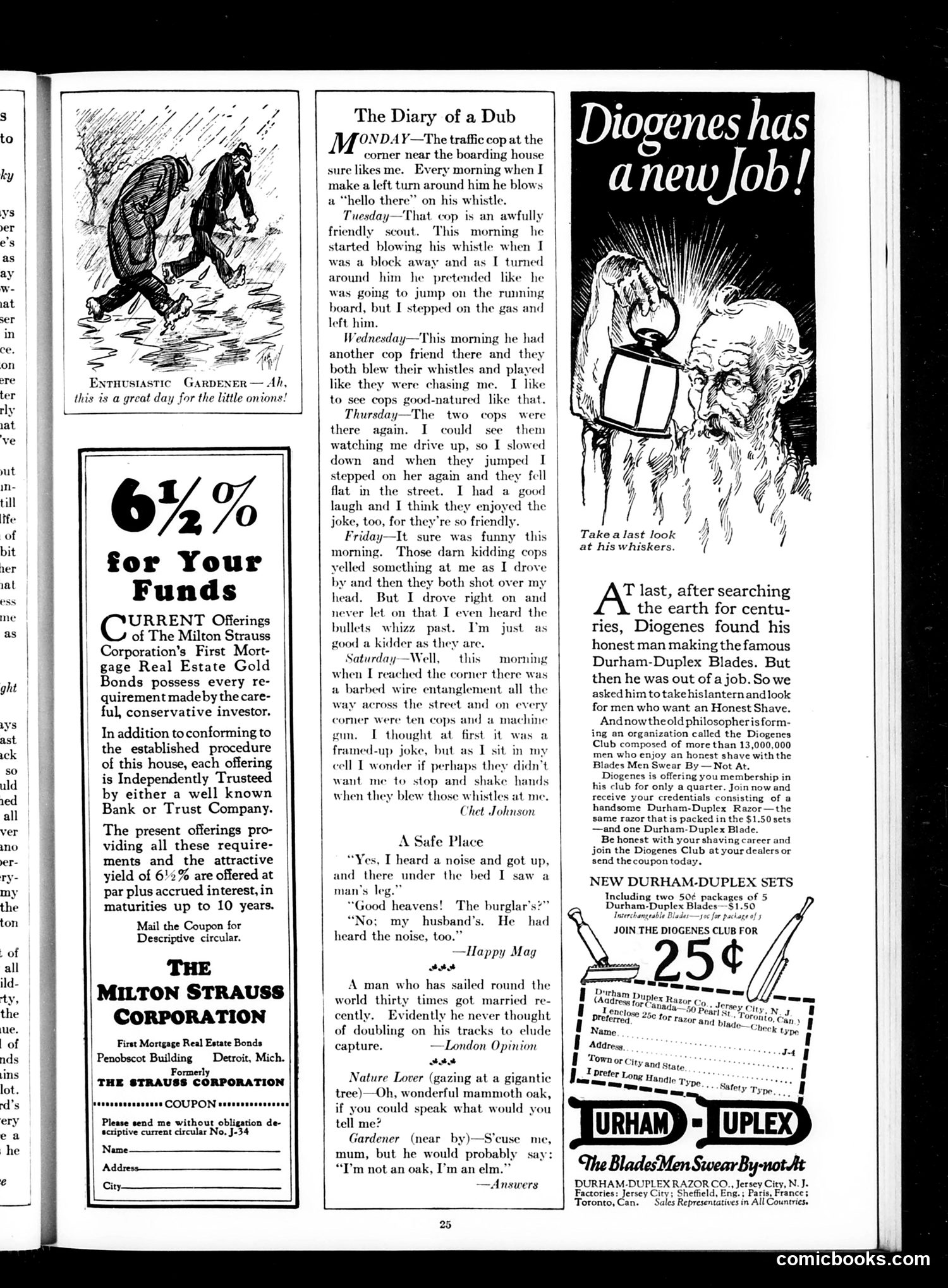
This page mixes humor and advertising typical of Judge magazine. The main content includes: **"The Diary of a Dub"** satirizes a naive driver who repeatedly misinterprets traffic cops' increasingly aggressive attempts to stop him—whistles, chasing, and eventually gunfire—as friendly pranks. The joke's dark humor lies in the protagonist's obliviousness to obvious danger signals. **"Diogenes Has a New Job"** is an advertisement for Durham-Duplex razor blades. It references Diogenes, the ancient Greek philosopher famous for seeking an honest man with a lantern. The ad humorously claims the blade's quality is so honest it puts Diogenes out of work, then recruits him to find men who appreciate honest shaves. This plays on the brand name's promise of integrity. The page also contains unrelated comic shorts and a financial advertisement for Milton Strauss Corporation bonds. The overall tone reflects early 20th-century American humor: somewhat crude, relying on misunderstandings and slapstick, with classical references used for commercial purposes.
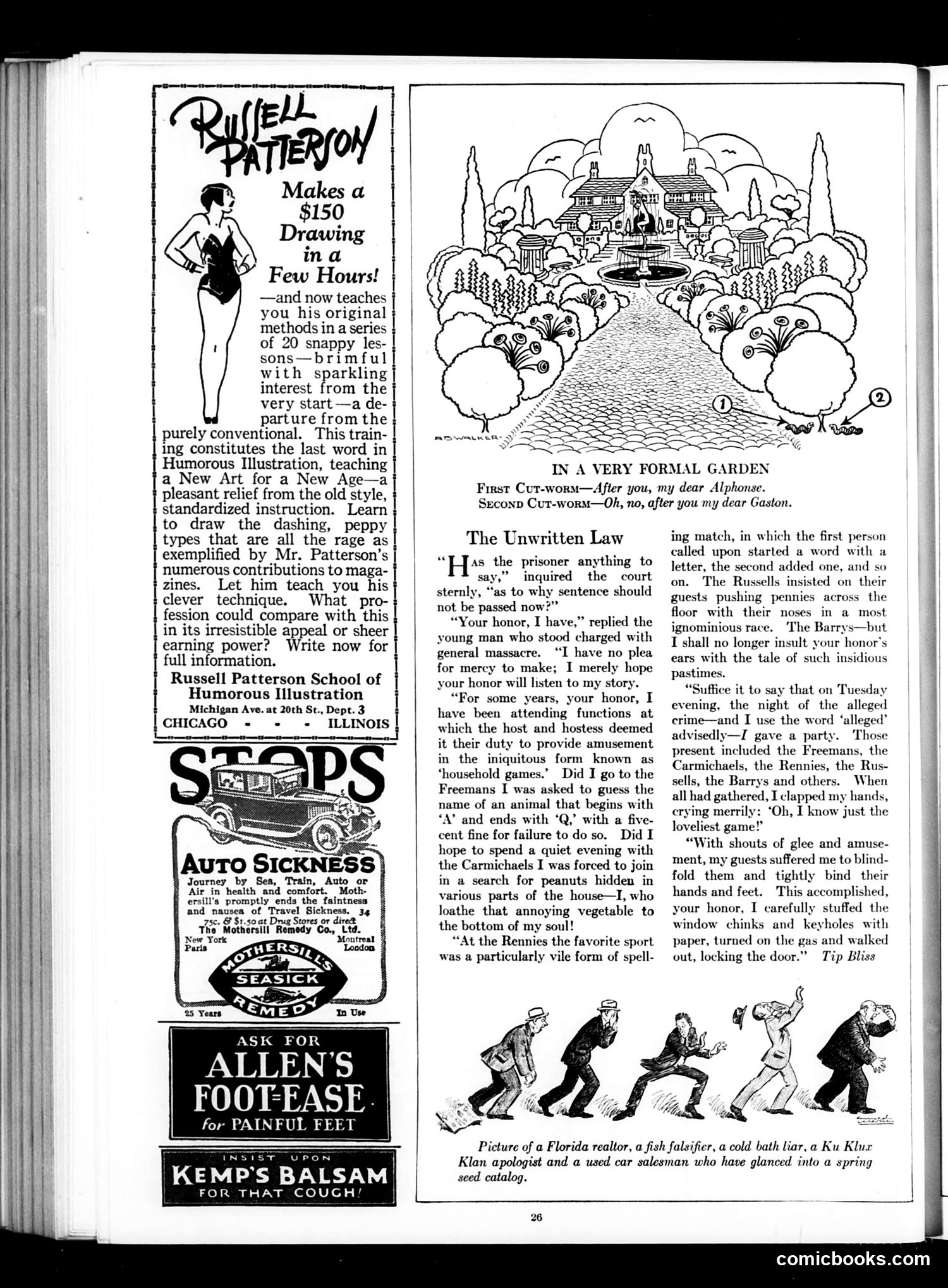
This satirical story mocks early 20th-century parlor games—tedious "household games" that hosts forced upon guests as entertainment. The protagonist, on trial for "general massacre," argues that his victims deserved it because they subjected him to unbearable social torments: guessing games with fines, forced peanut hunts, spelling matches, and penny-pushing races. The satire targets two things: (1) the elaborate, often ridiculous social obligations of the era's upper-middle class, and (2) the legal concept of "crimes of passion" being excusable. By presenting mass murder as justified retaliation against bad party games, Judge mocks both the absurdity of these mandatory entertainments and the courtroom defense that personal grievance outweighs criminal responsibility. The joke's dark humor depends on readers recognizing these games as genuinely annoying social fixtures of the time.
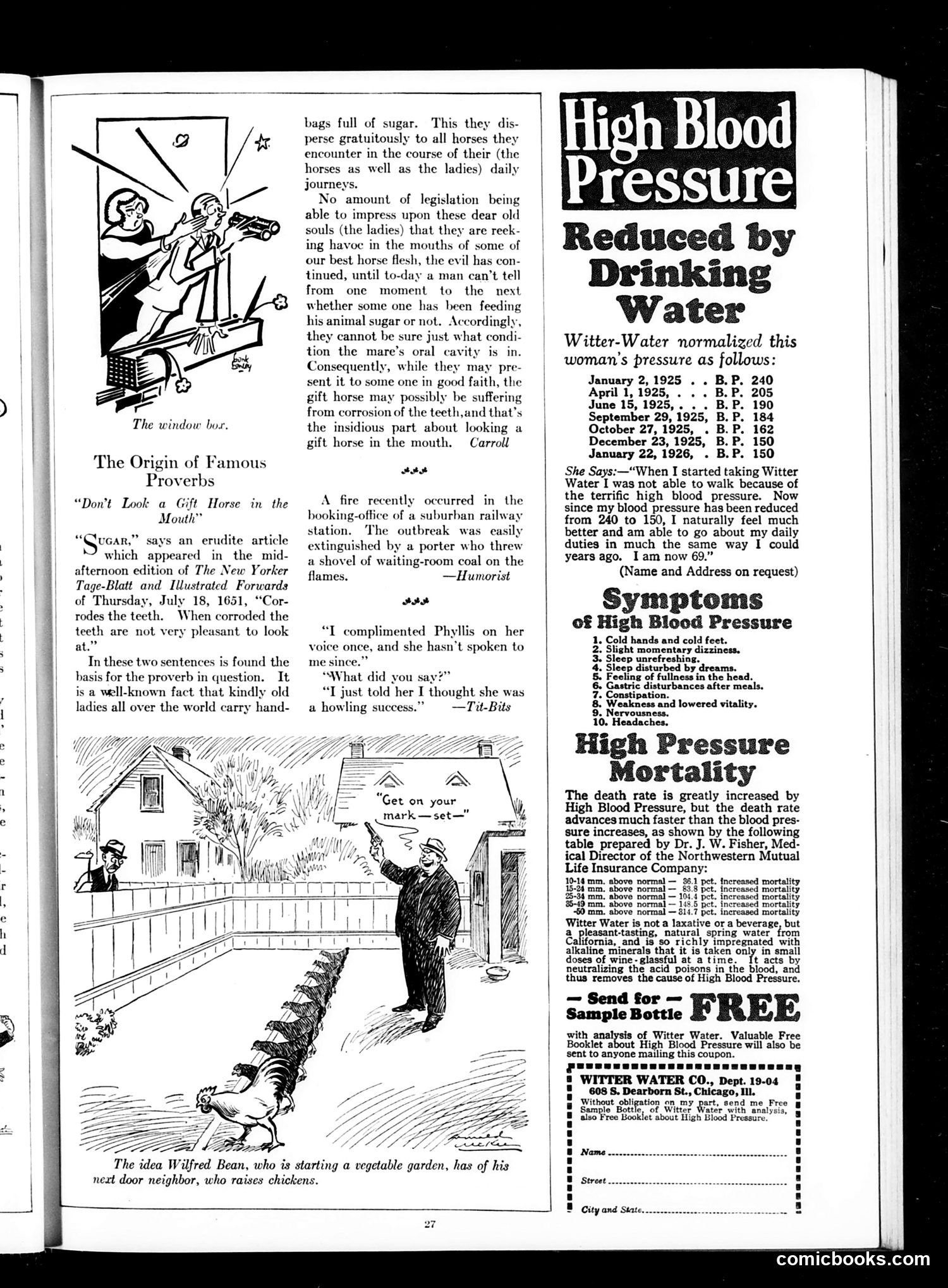
This page combines satirical articles with period advertising. The main cartoon features "The Origin of Famous Proverbs," humorously tracing "Don't Look a Gift Horse in the Mouth" to a 1651 newspaper article claiming that kindly elderly ladies distribute sugar to horses during their daily outings, unknowingly causing tooth decay. The satire mocks how this supposed historical origin explains why one cannot trust a gift horse's dental condition. A secondary cartoon shows a man starting a vegetable garden, nervously eyeing his neighbor's chickens—apparently fearing crop destruction. The right side contains a substantial advertisement for "Witter Water," a California spring water marketed as a high blood pressure cure. It includes testimonial data from a woman whose blood pressure allegedly dropped from 240 to 150, and mortality statistics from a life insurance company. This represents typical 1920s medical advertising before FDA regulation, making unsubstantiated health claims that would be illegal today.
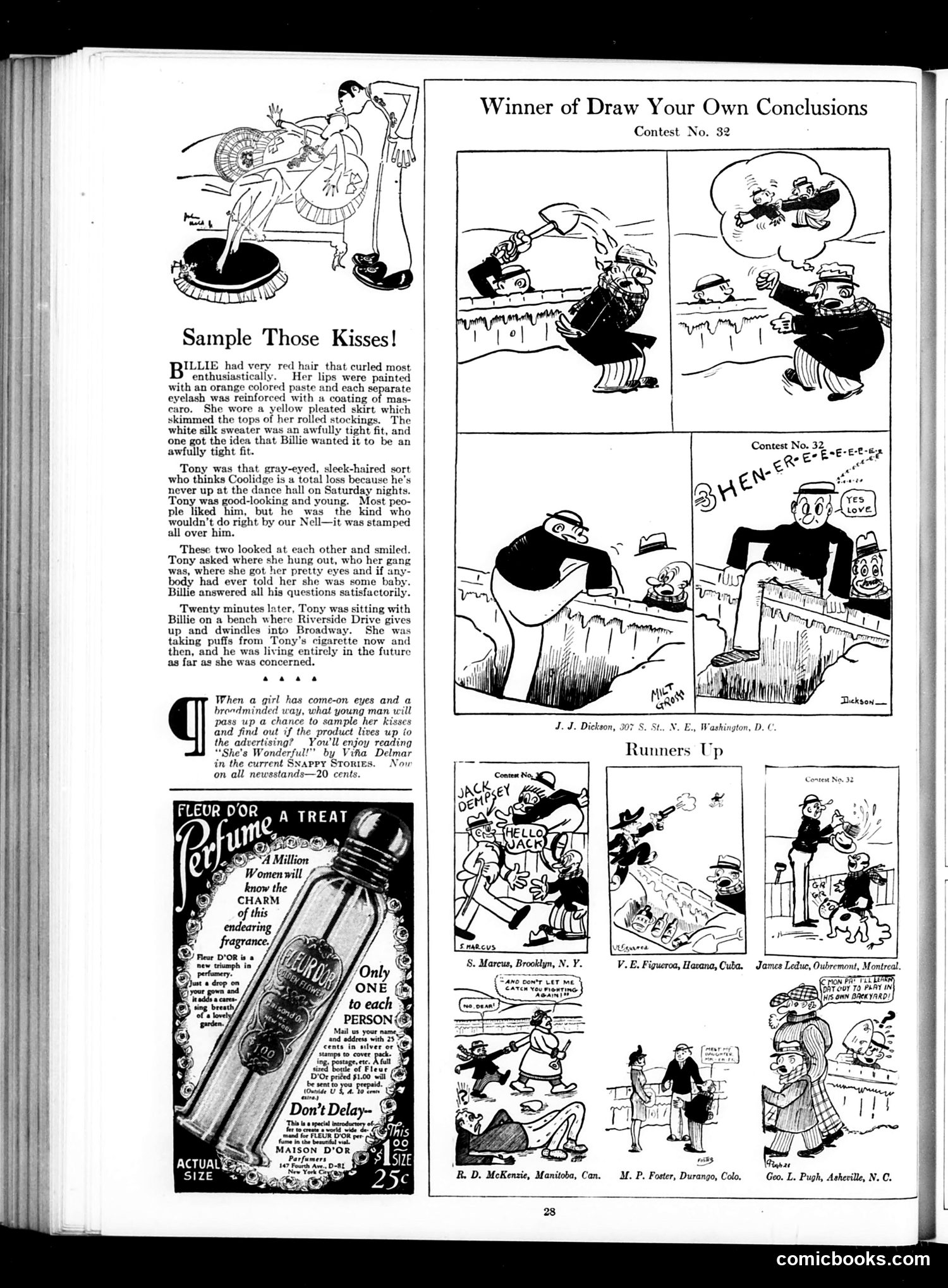
This page features a story titled "Sample Those Kisses!" depicting a 1920s courtship scenario. The narrative follows "Billie," a flapper characterized by red curled hair, orange lipstick, rolled stockings, and a tight sweater—visual markers of the "modern woman" that conservative audiences found scandalous. She encounters "Tony," a young man who dismisses President Coolidge and lacks moral restraint. The story's satire targets anxieties about changing sexual morality: Tony takes advantage of Billie's openness, and the narrative implicitly warns about girls who advertise availability through appearance and behavior. The text promotes *Snappy Stories* magazine, suggesting readers consume more such cautionary tales. The "Draw Your Own Conclusions" contest below invites readers to interpret cartoon scenarios, likely with similar moral messaging about modern dating and propriety. The *Fleur d'Or* perfume advertisement completes the page, appealing to women's desire for sophistication.
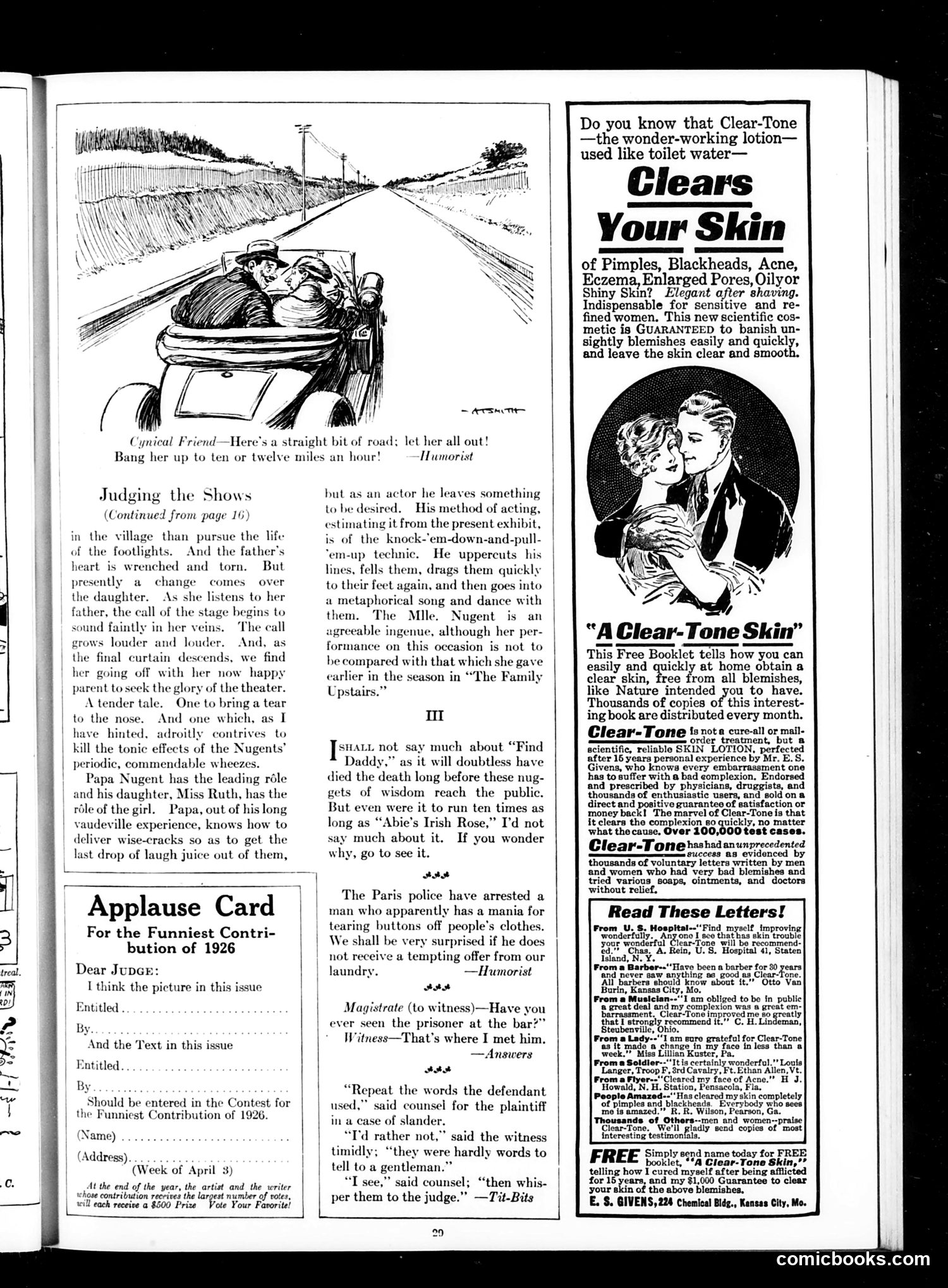
The main cartoon depicts a "cynical friend" urging a couple in a car to speed recklessly down a country road—"Bang her up to ten or twelve miles an hour!"—humorously suggesting this as entertainment. The joke plays on early 1920s automobile culture and the thrill-seeking attitude of the era. The page primarily contains theater reviews discussing performances by actors named Nugent and their daughter in plays like "Find Daddy" and "The Family Upstairs." Mixed throughout are brief humorous anecdotes about Parisian police, courtroom exchanges, and legal humor typical of Judge's satirical style. The right side features a substantial **Clear-Tone skin lotion advertisement**—a period product claiming to cure pimples, acne, and eczema. This reflects common early-20th-century medical skepticism: pseudoscientific cosmetics marketed with dubious health claims and "guaranteed" results. The page also includes an "Applause Card" contest inviting readers to vote for the funniest contribution in the magazine.
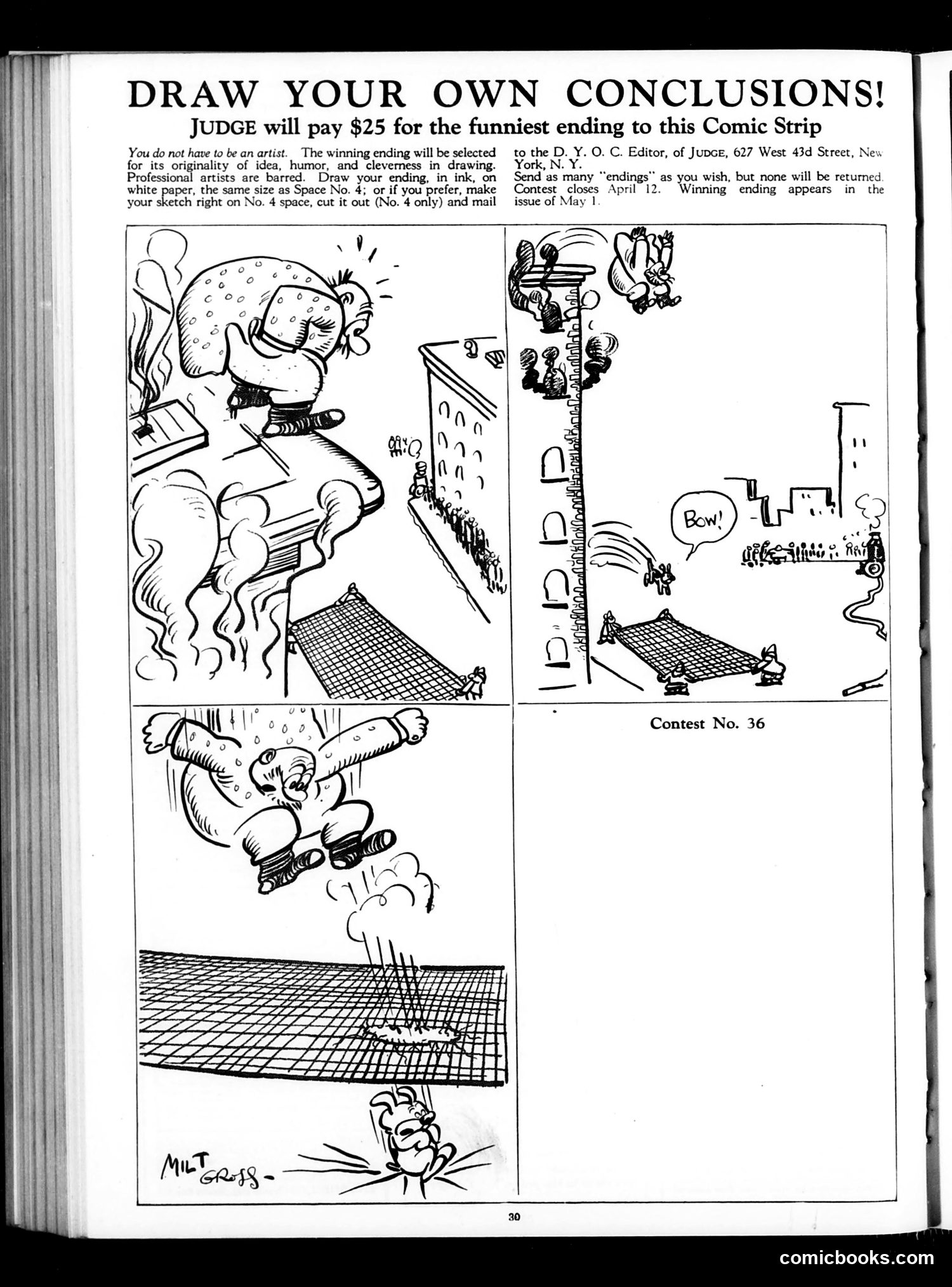
This is a reader-participation feature from *Judge* magazine inviting amateur artists and humorists to complete an unfinished comic strip. The strip shows a rotund man with a large belly engaging in increasingly chaotic physical comedy—jumping, falling through what appears to be a net or trampoline, and landing with impact. The contest reflects early 20th-century magazine culture, where *Judge* engaged readers directly in creating content. The $25 prize was substantial for the era. The humor appears to rely on slapstick and physical comedy typical of the period—the joke is the man's misadventures, though the specific setup and context remain unclear without seeing earlier panels. The contest excluded professional artists, emphasizing amateur contributions and democratic participation in humor-making.
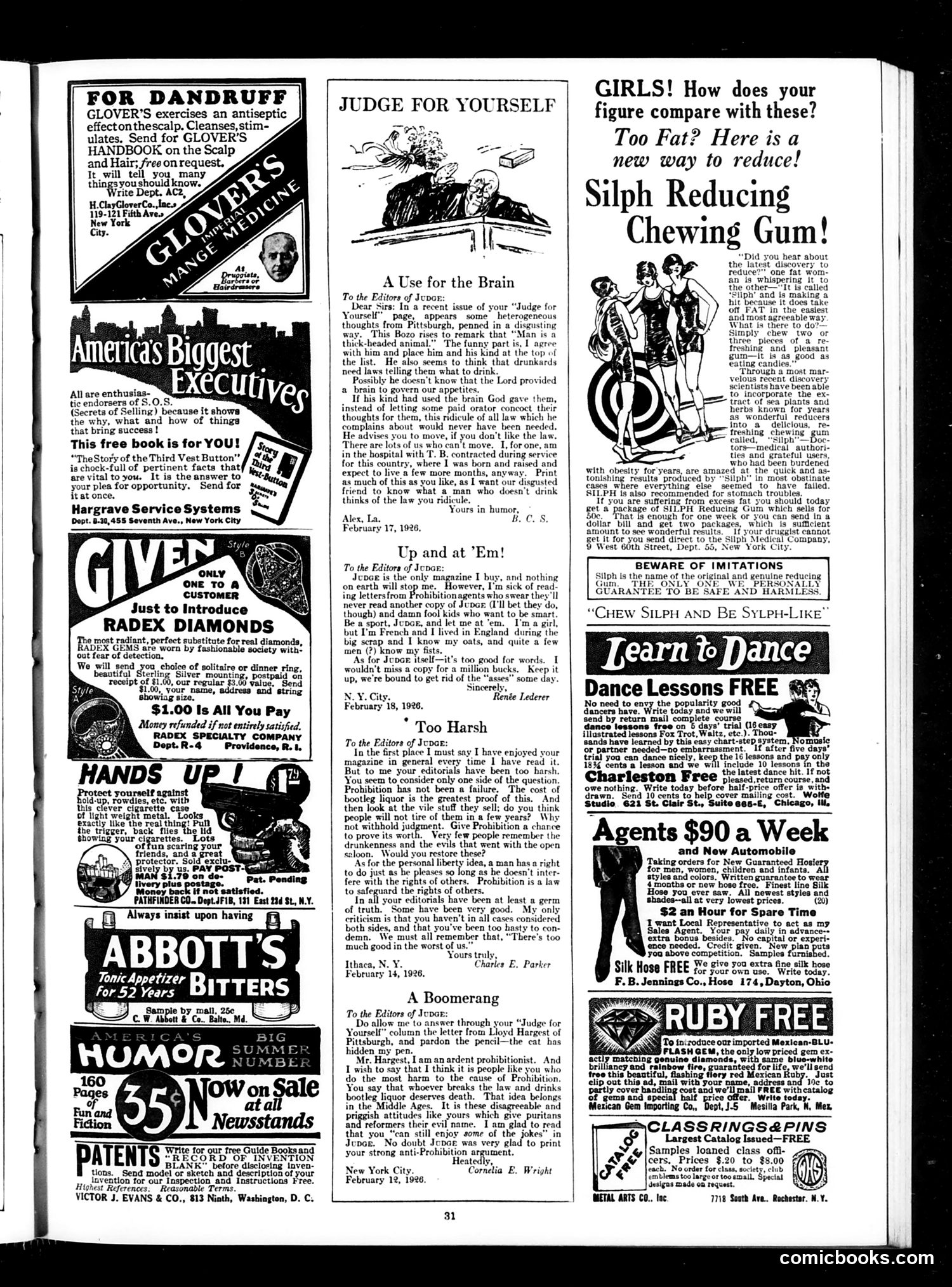
This page is primarily **advertising** interspersed with readers' letters to the editor. The main satirical content is the "Judge for Yourself" section, which features two contrasting letters about Prohibition: **The Satire:** One letter mocks a Pittsburgh reader who complained about drunks, suggesting such people lack self-control and blame laws rather than personal responsibility. The response sarcastically champions the correspondent's logic while implying Prohibition itself is misguided. **The Advertisements:** The page heavily promotes weight-loss products ("Silph Reducing Chewing Gum"), dandruff remedies, and other patent medicines—typical of 1920s magazines. These ads often made exaggerated health claims. **Historical Context:** This reflects 1926 America: post-Prohibition implementation (1920), widespread skepticism about alcohol bans, patent medicine marketing (before FDA regulation), and period beauty standards emphasizing thinness. The page demonstrates how Judge used reader letters as a vehicle for social commentary while profiting from dubious commercial products.
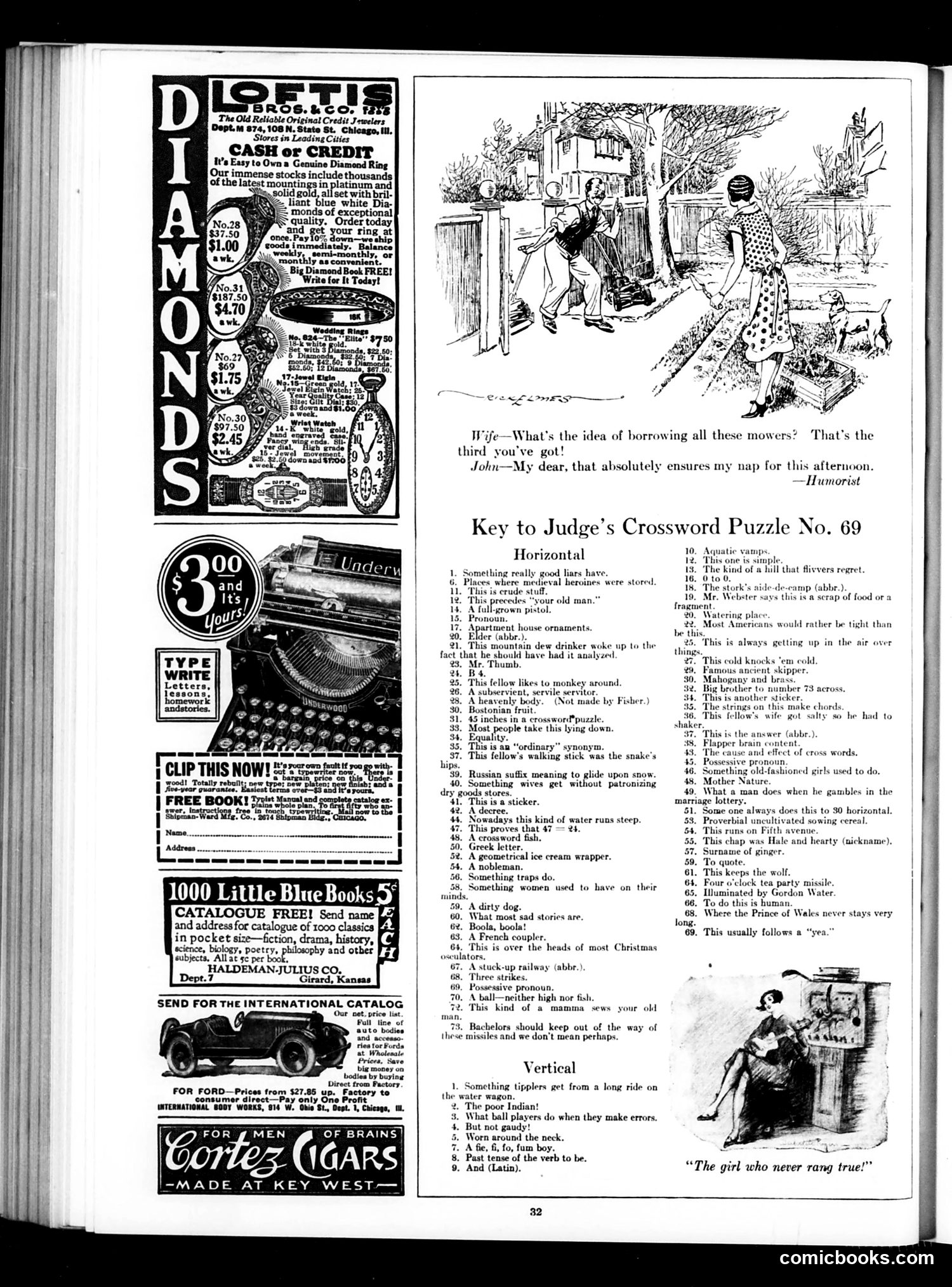
This single-panel cartoon jokes about a husband's laziness masquerading as practicality. The husband John borrows multiple lawn mowers, claiming this ensures he'll nap that afternoon—the logic being that by having so many mowers available, he avoids actually having to mow the lawn himself (perhaps neighbors will do it, or he'll be too busy managing them). The humor targets a common domestic dynamic: a husband's creative excuses to avoid chores. The wife's exasperation ("That's the third!") underscores how transparent his scheme is. **Context for modern readers:** This reflects early 20th-century suburban American life where lawn maintenance was becoming a male homeowner responsibility. The joke plays on the tension between marital expectations and masculine shirking—a timeless domestic comedy premise. The page itself is primarily **advertisements** (diamond rings, typewriters, books, cigars) with the crossword puzzle answer key, typical of Judge magazine's revenue model.
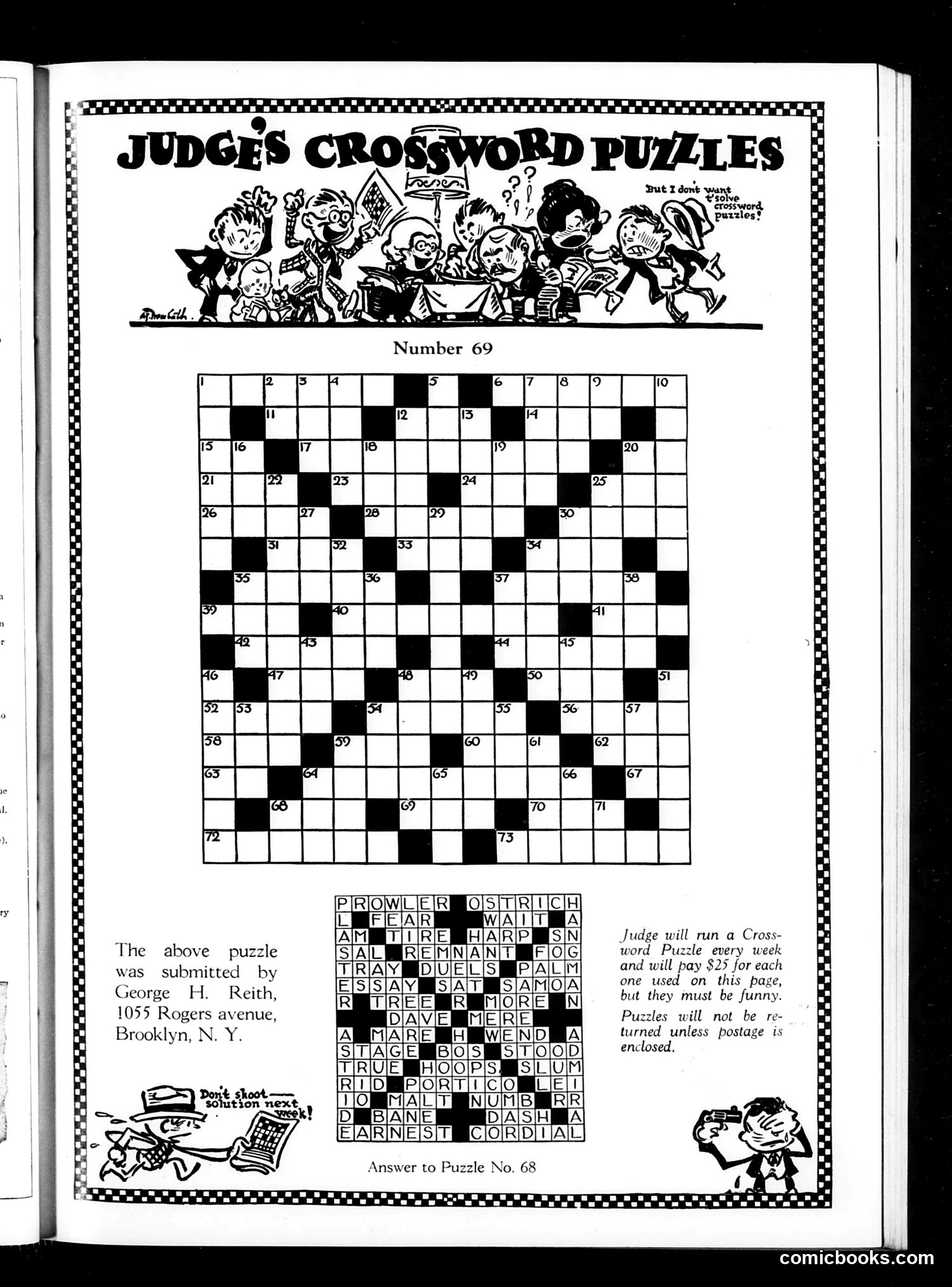
This page from *Judge* magazine features crossword puzzle Number 69, submitted by reader George H. Reith of Brooklyn. The puzzle itself appears to be a standard crossword grid with numbered squares. The key content is the "Answer to Puzzle No. 68" printed below, which shows a completed crossword containing phrases like "PROWLER," "OSTRICH," "HARP," "TIRE," "REMNANT," "DUELS," "ESSAY," "DAVE," "MARE," "STAGE," "HOOPS," "PORTICO," "MALT," "NUMB," "CORDIAL"—typical crossword vocabulary with no apparent political or satirical meaning. The page announces that *Judge* will publish weekly crossword puzzles and pay $25 for accepted submissions. This represents the magazine diversifying into puzzle content—a popular entertainment format of the era—rather than relying solely on satirical cartoons and commentary. No specific satire or political reference is evident on this particular page.
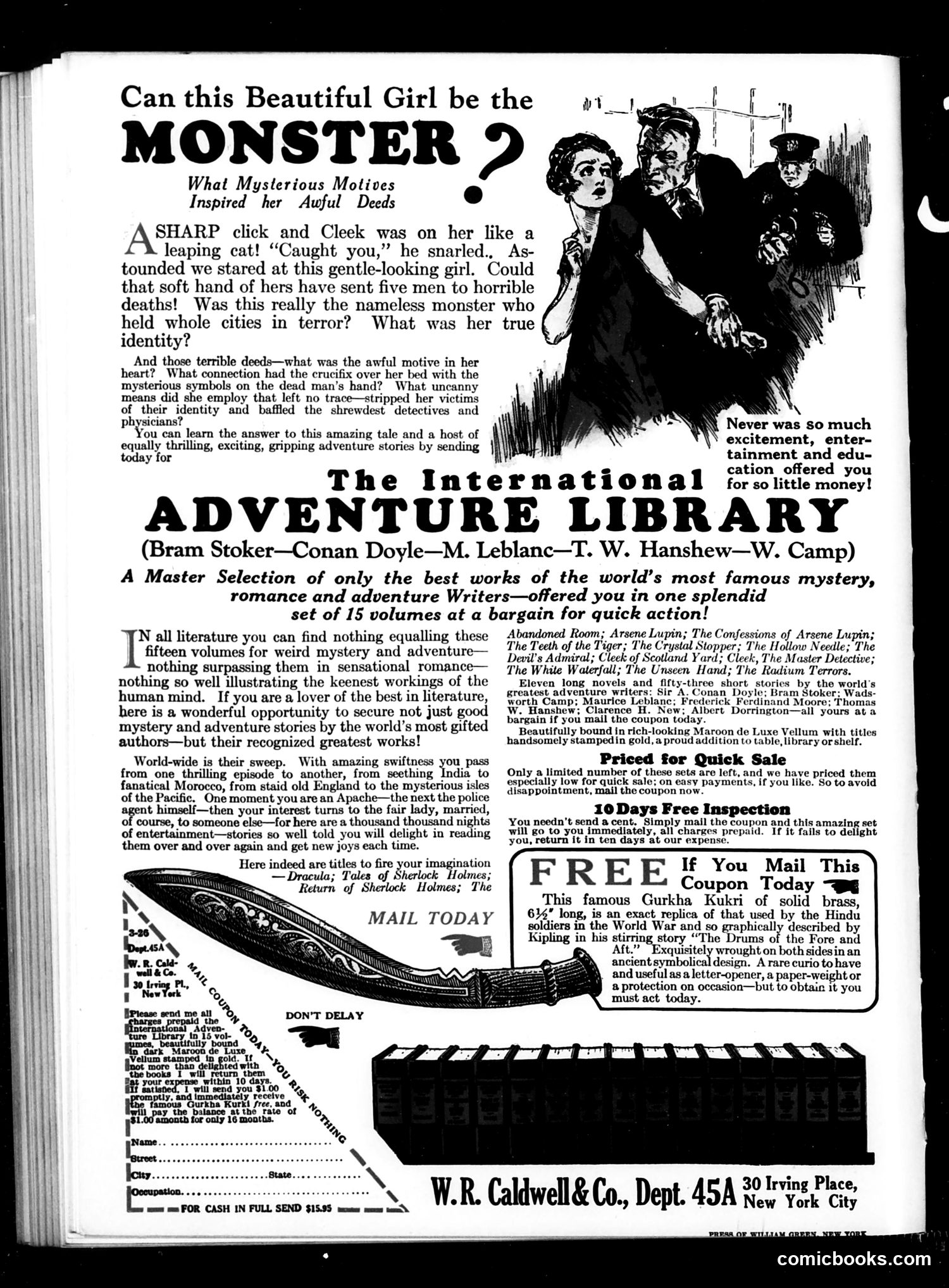
This page is primarily a **book advertisement**, not a political cartoon. It promotes a 15-volume collection of classic mystery and adventure literature by famous authors (Conan Doyle, Bram Stoker, Maurice Leblanc, etc.). The heading "Can this Beautiful Girl be the MONSTER?" is a **teaser advertisement** designed to intrigue readers—it references a plot from one of the included works (likely "Cleek of Scotland Yard"), showing a seemingly innocent woman who may be a serial killer. The dramatic illustration and rhetoric ("sent five men to horrible deaths," "held whole cities in terror") are meant to hook potential customers with the promise of thrilling mystery stories. The page includes a mail-order coupon offering the set on installment payments, with a free Gurkha Kukri (curved dagger) as an incentive. This reflects early-20th-century direct-mail marketing tactics. There is no political satire or social commentary—it's straightforward commercial advertising targeting readers interested in adventure and mystery fiction.