
Judge, 1926-04-03 · page 15 of 36
Judge — April 3, 1926 — page 15: what you’re looking at
What you’re looking at
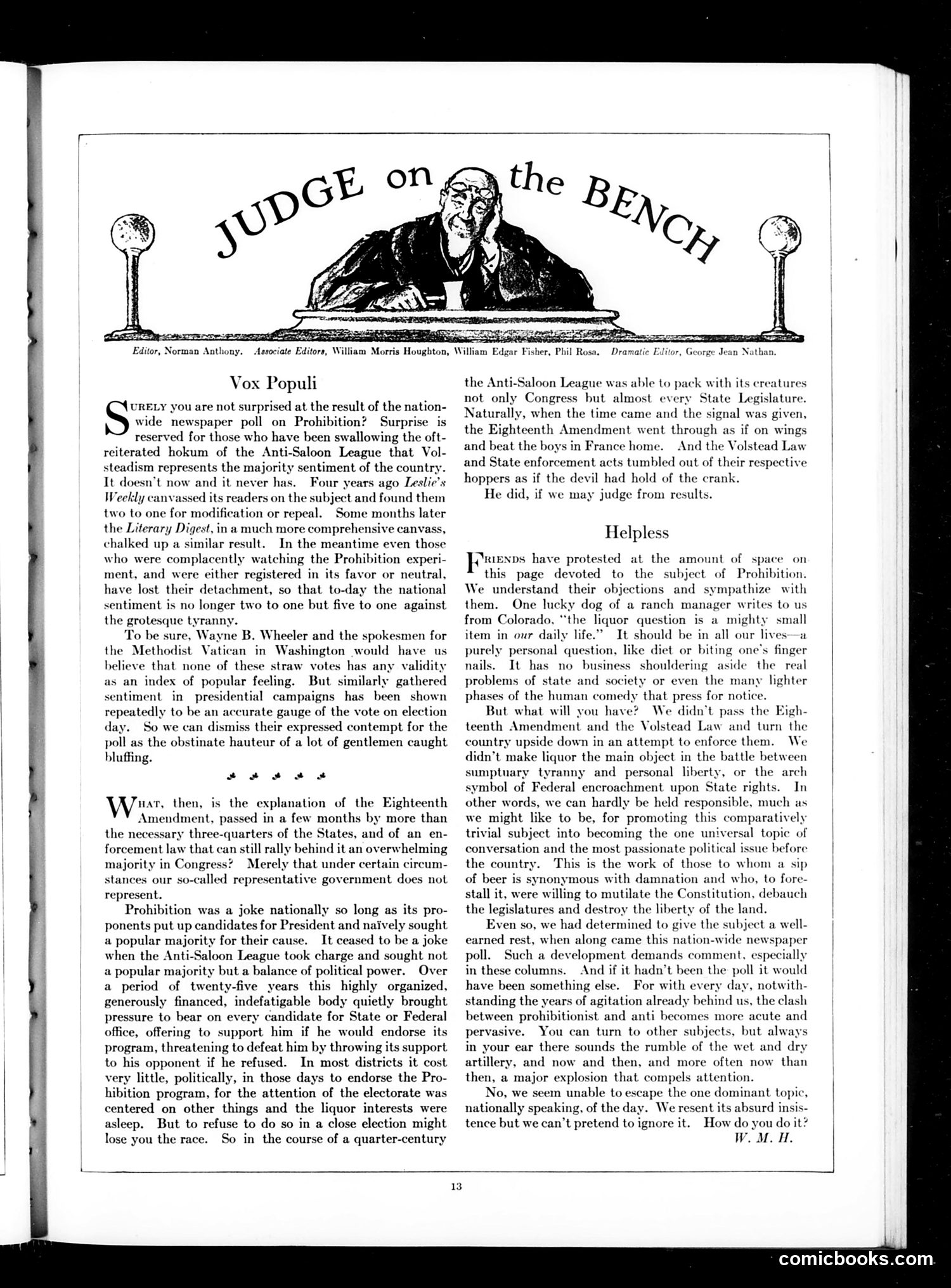
This page contains two editorial pieces criticizing Prohibition and the Anti-Saloon League's political tactics. **The Main Argument:** The editor argues that despite the Eighteenth Amendment's passage, multiple newspaper polls show 5-to-1 public opposition to Prohibition. The paradox: how did an unpopular law pass? **The Explanation:** The Anti-Saloon League didn't seek majority support; instead, it wielded "balance of political power" by strategically backing or opposing candidates over 25 years. Politicians endorsed Prohibition cheaply when other issues dominated public attention. Once the League "packed" legislatures with supporters, passage became inevitable. **"Helpless" Section:** The editor acknowledges reader complaints about excessive Prohibition coverage, arguing it should be a minor personal matter (like diet), not dominating political discourse. **The Satire:** The cartoon depicts a stern judge—likely representing the Anti-Saloon League or Federal enforcement—sitting imperiously above the bench, symbolizing how a organized minority imposed its will on the unwilling majority.
📄 Transcribed text from this page (OCR, searchable)
Machine-transcribed from the original scan — historical spelling and the odd misread are preserved.
litor, Norman Anthony. Associate Vox Populi URELY you are not surprised at the result of the nation- wide newspaper poll on Prohibition? Surprise is reserved for those who have been swallowing the oft- reiterated hokum of the Anti-Saloon League that Vol- steadism represents the majority sentiment of the country. It doesn’t now and it never has. Four years ago Leslie's Week nvassed its readers on the subject and found them two to one for modification or repeal. Some months later the Literary Digest, in a much more comprehensive canv: chalked up a similar result. In the meantime even those who were complacently watching the Prohibition experi- ment, and were either registered in its favor or neutral, have lost their detachment, so that to-day the national sentiment is no longer two to one but five to one against the grotesque tyrann To be sure, Wayne B. Wheeler and the spokesmen for the Methodist Vatican in Washington would have us believe that none of these straw votes has any validity as an index of popular feeling. But similarly gathered sentiment in presidential campaigns has been shown repeatedly to be an accurate gauge of the vote on election day. So we can dismiss their expressed contempt for the poll as the obstinate hauteur of a lot of gentlemen caught bluffing. 223 2 2 We then, is the explanation of the Eighteenth Amendment, passed in a few months by more than the necessary three-quarters of the States, and of an en- forcement law that can still rally behind it an overwhelming majority in Congress? Merely that under certain circum- stances our so-called representative government does not represent. Prohibition was a joke nationally so long as its pro- ponents put up candidates for President and naively sought a popular majority for their cause. It ceased to be a joke when the Anti-Saloon League took charge and sought not a popular majority but a balance of political power. Over a period of twenty-five years this highly organized, generously financed, indefatigable body quietly brought pressure to bear on every candidate for State or Federal office, offering to support him if he would endorse its program, threatening to defeat him by throwing its support to his opponent if he refused. In most districts it cost very little, politically, in those days to endorse the Pro- hibition program, for the attention of the electorate was centered on other things and the liquor interests were asleep. But to refuse to do so in a close election might lose you the race. So in the course of a quarter-century the Anti- not only Congress but almost every State Legislature. Naturally, when the time came and the signal was given, the Eighteenth Amendment went through as if on wings and beat the boys in France home. And the Volstead Law and State enforcement acts tumbled out of their respective hoppers as if the devil had hold of the crank. He did, if we may judge from results. loon League was able to pack with its creatures Helpless 4*RIENDS have protested at the amount of space on this page devoted to the subject of Prohibition. We understand their objections and sympathize with them. One lucky dog of a ranch manager writes to us from Colorado, “the liquor question is a mighty small item in our daily life.” It should be in all our lives—a purely personal question, like diet or biting one’s finger nails. It has no business shouldering aside the real problems of state and society or even the many lighter phases of the human comedy that press for notice. But what will you have? We didn’t pass the Eigh- teenth Amendment and the Volstead Law and turn the country upside down in an attempt to enforce them. We didn’t make liquor the main object in the battle between sumptuary tyranny and personal liberty, or the arch symbol of Federal encroachment upon State rights. In other words, we can hardly be held responsible, much as we might like to be, for promoting this comparatively trivial subject into becoming the one w conversation and the most passionate political issue before the country. This is the work of those to whom a sip of beer is synonymous with damnation and who, to fore- stall it, were willing to mutilate the Constitution, debauch the legislatures and destroy the liberty of the land. Even so, we had determined to give the subject a well- earned rest, when along came this nation-wide newspaper poll. Such a development demands comment, especially in these columns. And if it hadn’t been the poll it would have been something else. For with every day, notwith- standing the years of agitation already behind us, the clash between prohibitionist and anti becomes more acute and pervasive. You can turn to other subjects, but always in your ear there sounds the rumble of the wet and dry artillery, and now and then, and more often now than then, a major explosion that compels attention. No, we seem unable to escape the one dominant topic, nationally speaking, of the day. We resent its absurd insis- tence but we can’t pretend to ignore it. How do you do it? W. M. H. iversal topic of comicbooks.com