
Judge, 1926-04-03 · page 3 of 36
Judge — April 3, 1926 — page 3: what you’re looking at
What you’re looking at
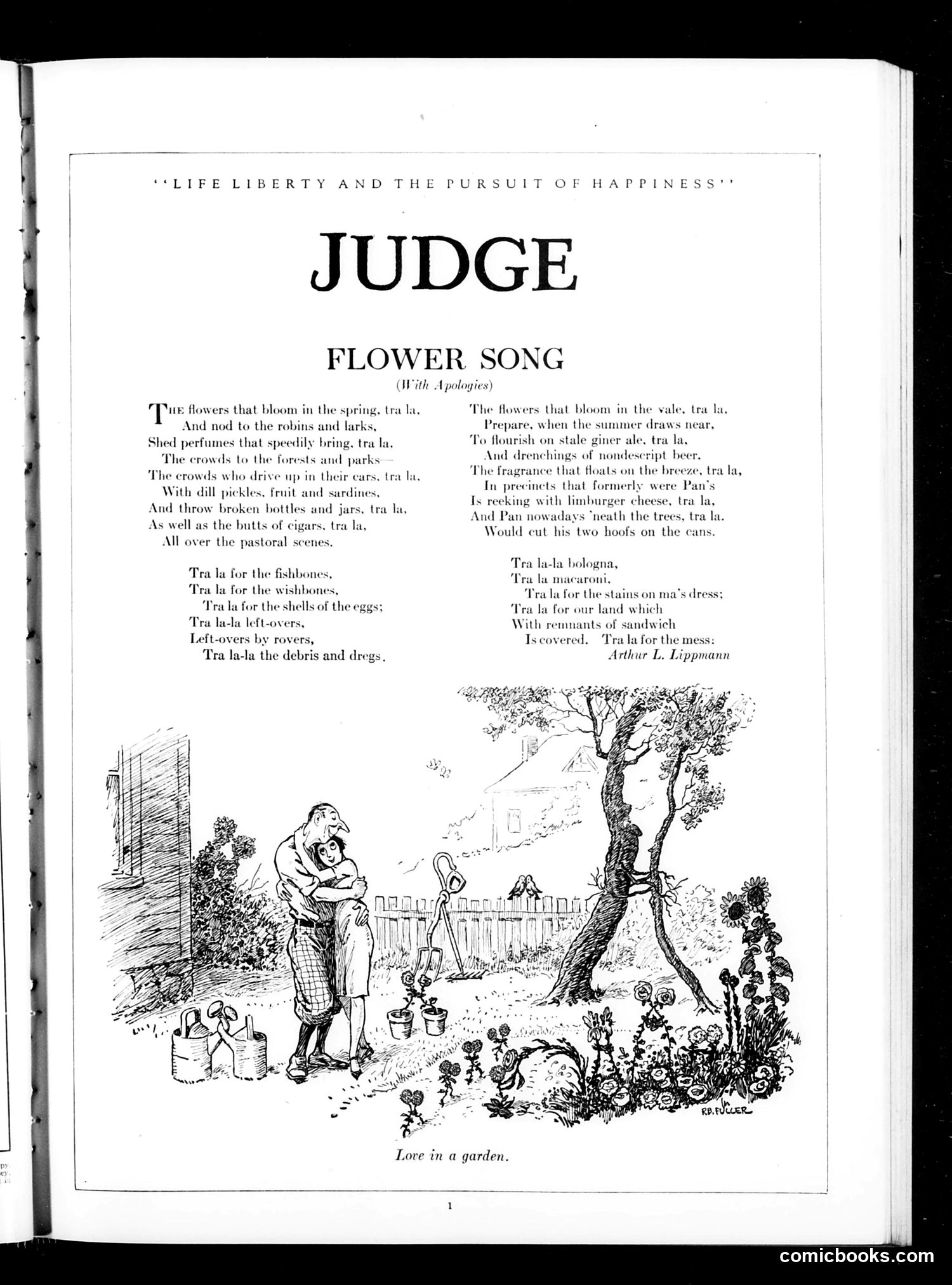
This page contains a poem titled "Flower Song (With Apologies)" by Arthur L. Lippmann, not a political cartoon. The poem is a satirical parody that contrasts idealized nature with modern consumer culture and urban problems. The opening stanzas ironically juxtapose pastoral imagery ("flowers that bloom in the spring") with contemporary annoyances: crowded parks, automobiles, litter, and broken bottles. The repeated refrain "Tra la" undercuts the romance of nature. The second half catalogs modern grievances—processed foods, stained clothing, industrialized landscapes—using the same whimsical musical framework. The accompanying illustration depicts a couple in a garden, romanticizing domestic life, which the poem's ironic tone suggests is largely escapist fantasy given the realities of 1920s urban industrial society that Judge's readers would recognize.
📄 Transcribed text from this page (OCR, searchable)
Machine-transcribed from the original scan — historical spelling and the odd misread are preserved.
ffLIFE LIBERTY AND THE PURSUIT OF OHA BPN ES St JUDGE FLOWER SONG (With Apologies) te flowers that bloom in the spring, tra la, The flowers that bloom in the vale. tra la, And nod to the robins and larks, Prepare, when the summer draws ne Shed perfumes that speedily bring, tra la. To flourish on stale giner ale, tra la, And drenchings of nondescript. be The fragrance that floats on the br In precincts that formerly were } The crowds to the forests and parks The crowds who drive up in their ears. tra la, With dill pickles, fruit and sardin And throw broken bottles and j As well as the butts of cig All over the pastoral scenes. Is reeking with limburger cheese, tra la, And Pan nowadays ‘neath the trees, tra la. Would cut his two hoofs on the cans. ‘Tra la-la bologna, Tra la for the fishbones, ra la-la gna. ‘Tra la for the wishbones, macaroni, Ja for the stains on ma’s dress; ‘Tra la for the shells of the eggs; "ra la for our land which la-la left-overs, With remnants of sandwich overs by rovers, Is covered. Tra la for the mess: Tra la-la the debris and dregs. Arthur L. Lippmann comicbooks.com