
A complete issue · 36 pages · 1926
Judge — March 20, 1926
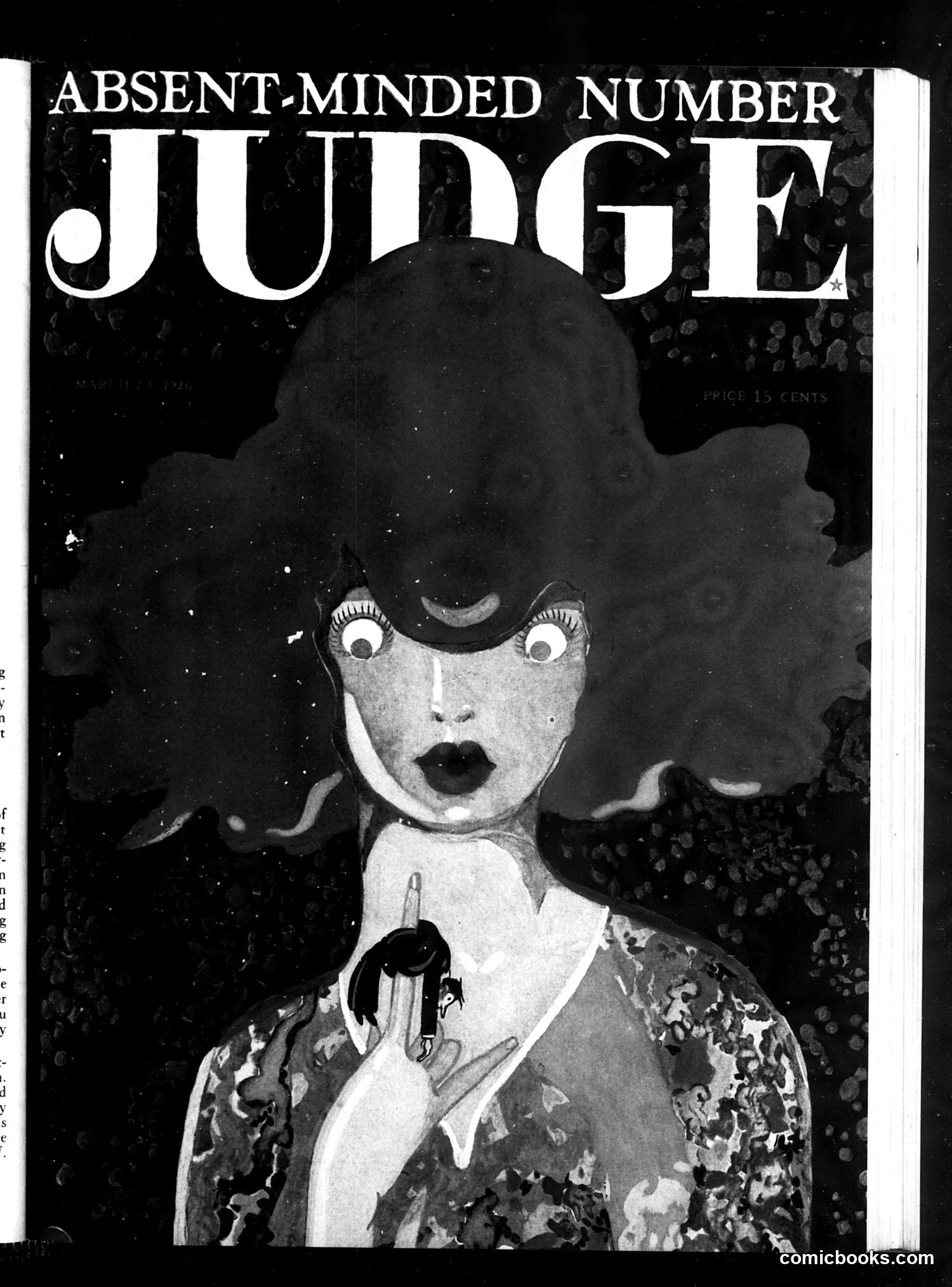
This is the cover of **Judge** magazine, a satirical publication costing 15 cents. The illustration depicts a figure with an exaggerated, shocked expression—wide eyes and open mouth—wearing elaborate clothing with patterned fabric and an ornate hat with large feathers or plumes. The title "ABSENT-MINDED NUMBER JUDGE" suggests this issue's satirical theme centers on judicial incompetence or forgetfulness. The grotesque caricature style was typical of early-20th-century Judge covers. However, without OCR text content from inside the magazine or a visible date, I cannot identify the specific judicial figure being mocked or what particular legal scandal or decision prompted this cover. The absurdist visual style indicates satirical commentary on a contemporary political or legal figure.
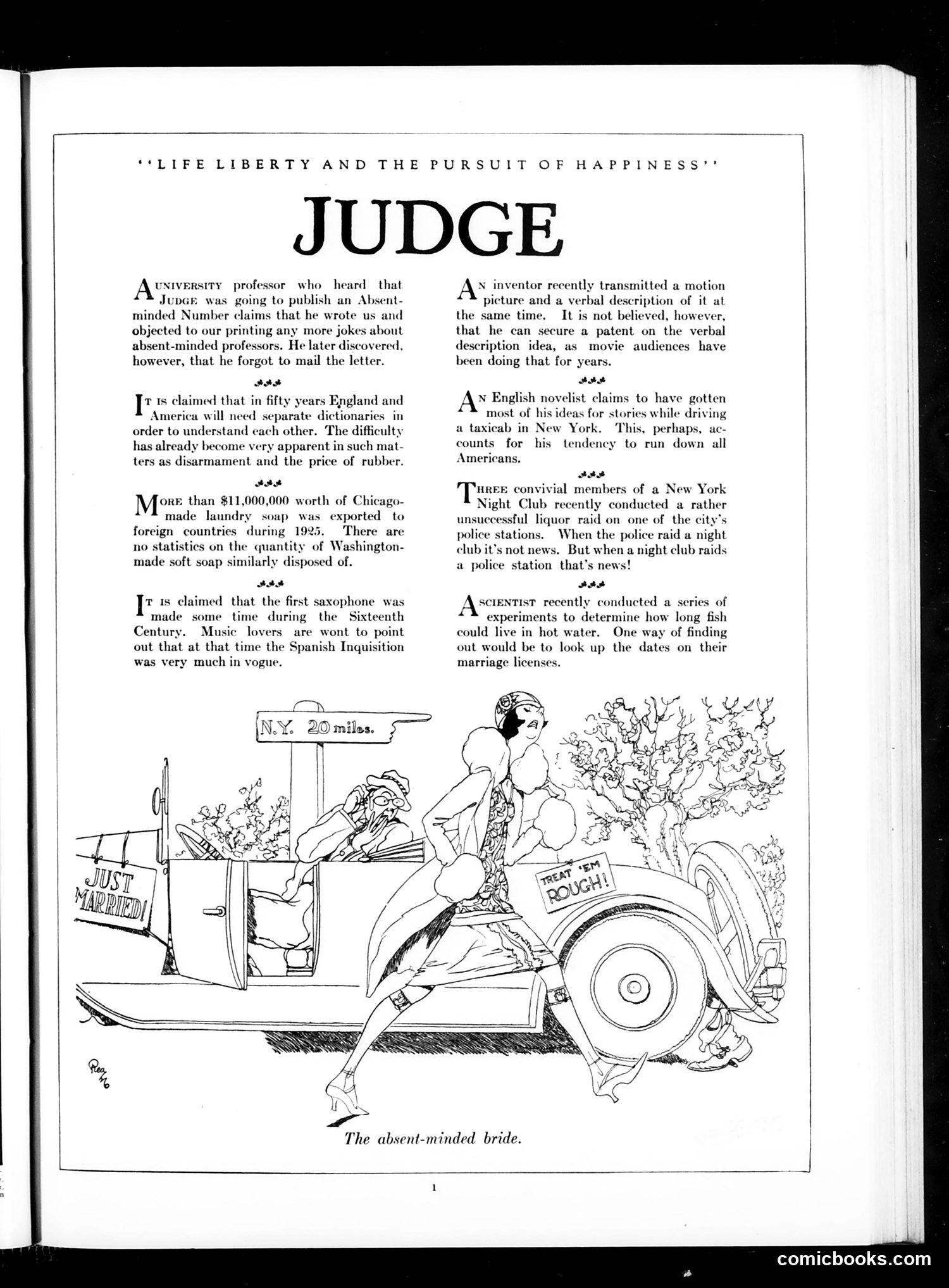
This cartoon satirizes the absent-mindedness of a newly married woman. The illustration shows a bride (identifiable by her wedding dress and "Just Married" sign on the car) who has apparently forgotten her groom—he's still in the car while she walks away with a bouquet, seemingly unaware of what she's supposed to be doing. The humor plays on the stereotype of brides being so absorbed in wedding festivities or romance that they lose situational awareness. The cartoon accompanies a page of brief humorous anecdotes titled "Judge," typical of this satirical magazine's format. The joke relies on exaggeration of female distraction and the absurdity of forgetting one's spouse immediately after marriage.
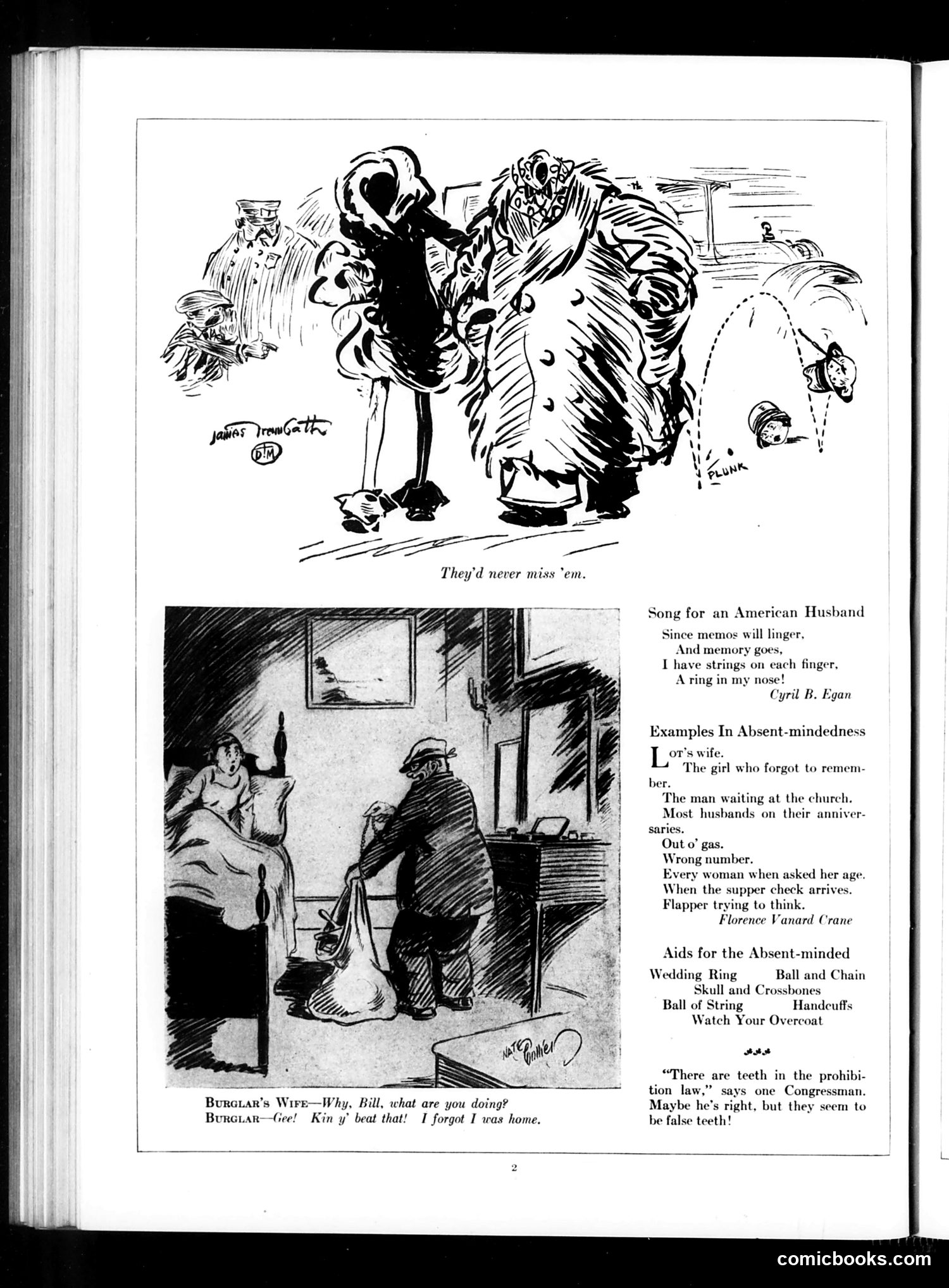
The top cartoon depicts a thin woman being assisted by a portly man, captioned "They'd never miss 'em." This appears to satirize absent-mindedness among married couples, likely referencing wartime concerns about infidelity or inattention in relationships. The lower cartoon shows a burglar confronting a woman at home, with dialogue: "Why, Bill, what are you doing? I forgot I was home." This joke plays on the theme of absent-minded spouses—the wife's distraction is so complete she's forgotten her own home situation, allowing a burglar to operate undetected. The accompanying text lists "Examples in Absent-mindedness" and "Aids for the Absent-minded," continuing the satirical theme of scattered, forgetful behavior in American domestic life, presented as a widespread social phenomenon worthy of humor.
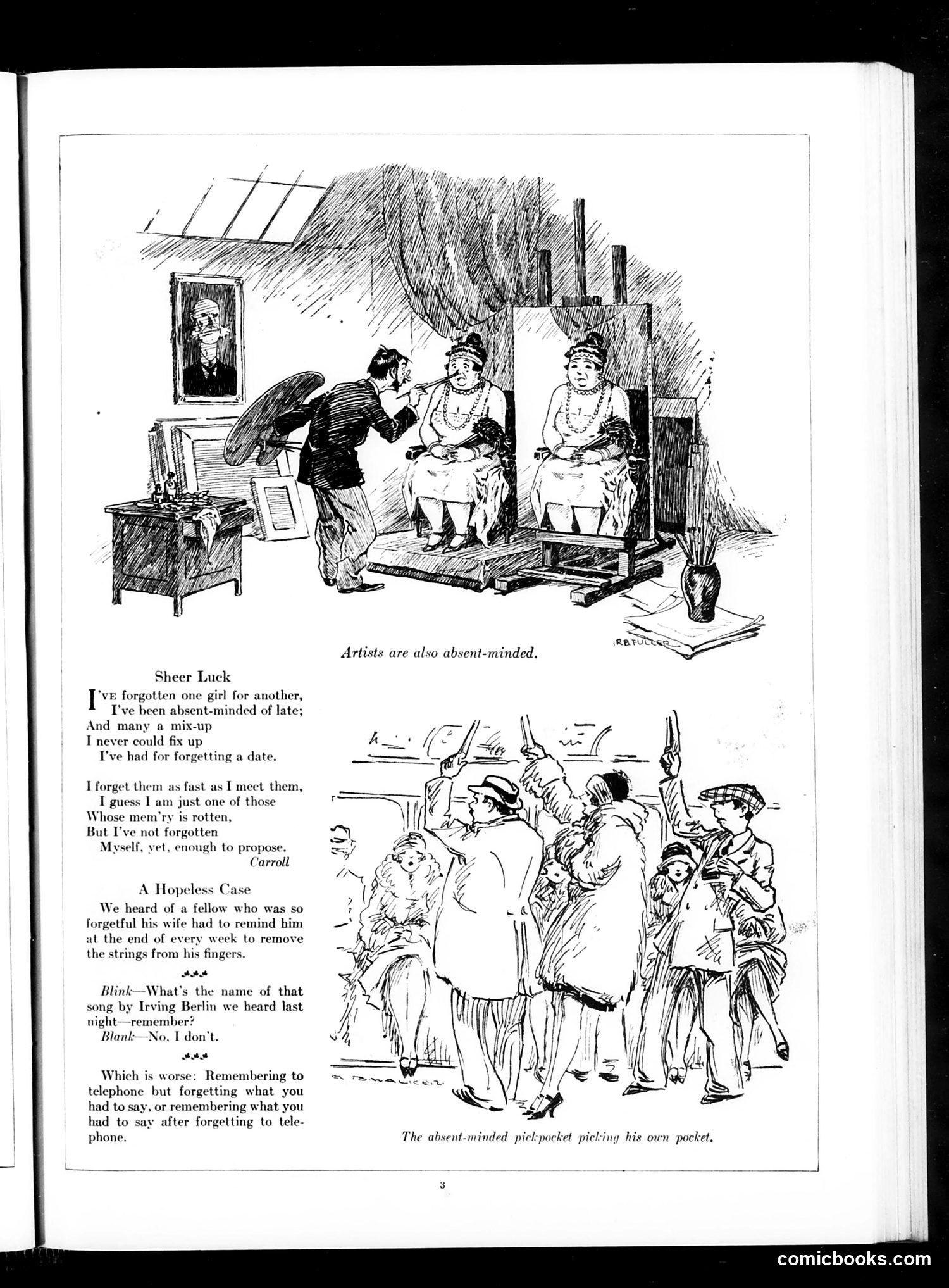
This page contains three humor pieces about absent-mindedness, a common theme in early 20th-century comedy. **"Sheer Luck"** (top): An artist, depicted with wings and classical styling, flirts with two women while forgetting previous romantic conquests. The caption "Artists are also absent-minded" suggests bohemian artists were stereotyped as forgetful about romantic entanglements. **"A Hopeless Case"** and dialogue snippets mock someone so forgetful his wife must tie strings on his fingers as reminders—a reference to the common folk practice of tying knots to remember things. **Bottom illustration**: Shows a pickpocket ironically stealing from an absent-minded man's own pocket, playing on the idea that distracted people are vulnerable to theft. The humor relies on exaggerated character types and physical comedy rather than political satire.
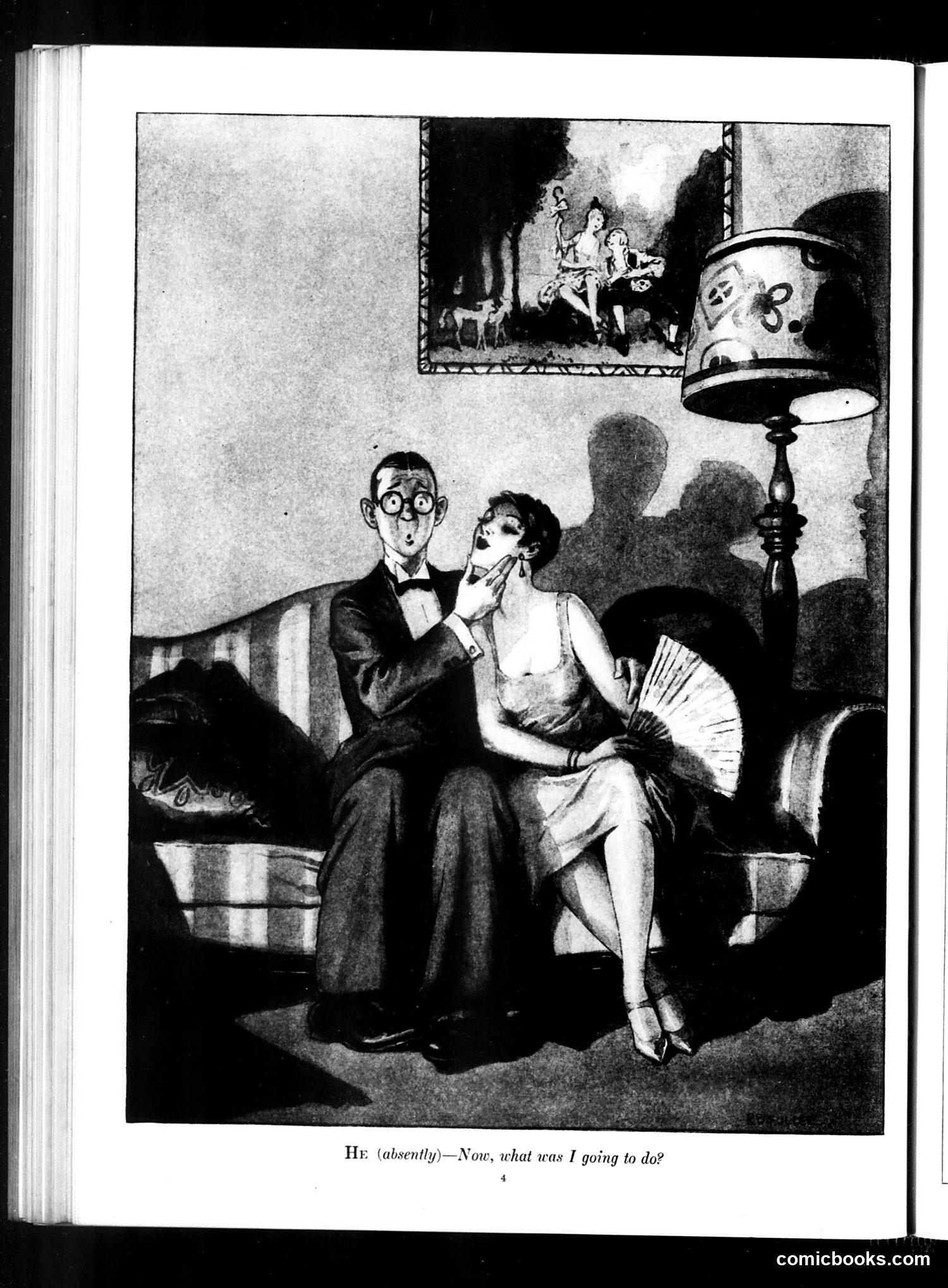
This is a domestic comedy cartoon from *Judge* magazine. The scene shows a couple in an intimate moment on a sofa—a man in formal attire (tuxedo and glasses) looking startled, and a woman in an elegant dress fanning herself. A decorative lamp stands nearby, and a framed painting hangs on the wall above. The caption reads: "HE (absently)—Now, what was I going to do?" The joke satirizes absent-mindedness in romance. The man, apparently distracted or preoccupied despite being in a romantic situation with his female companion, asks aloud what he was about to do—suggesting he's forgotten the moment entirely. This pokes fun at male inattentiveness and the comedic collision between domestic intimacy and male forgetfulness, a common theme in early 20th-century humor.
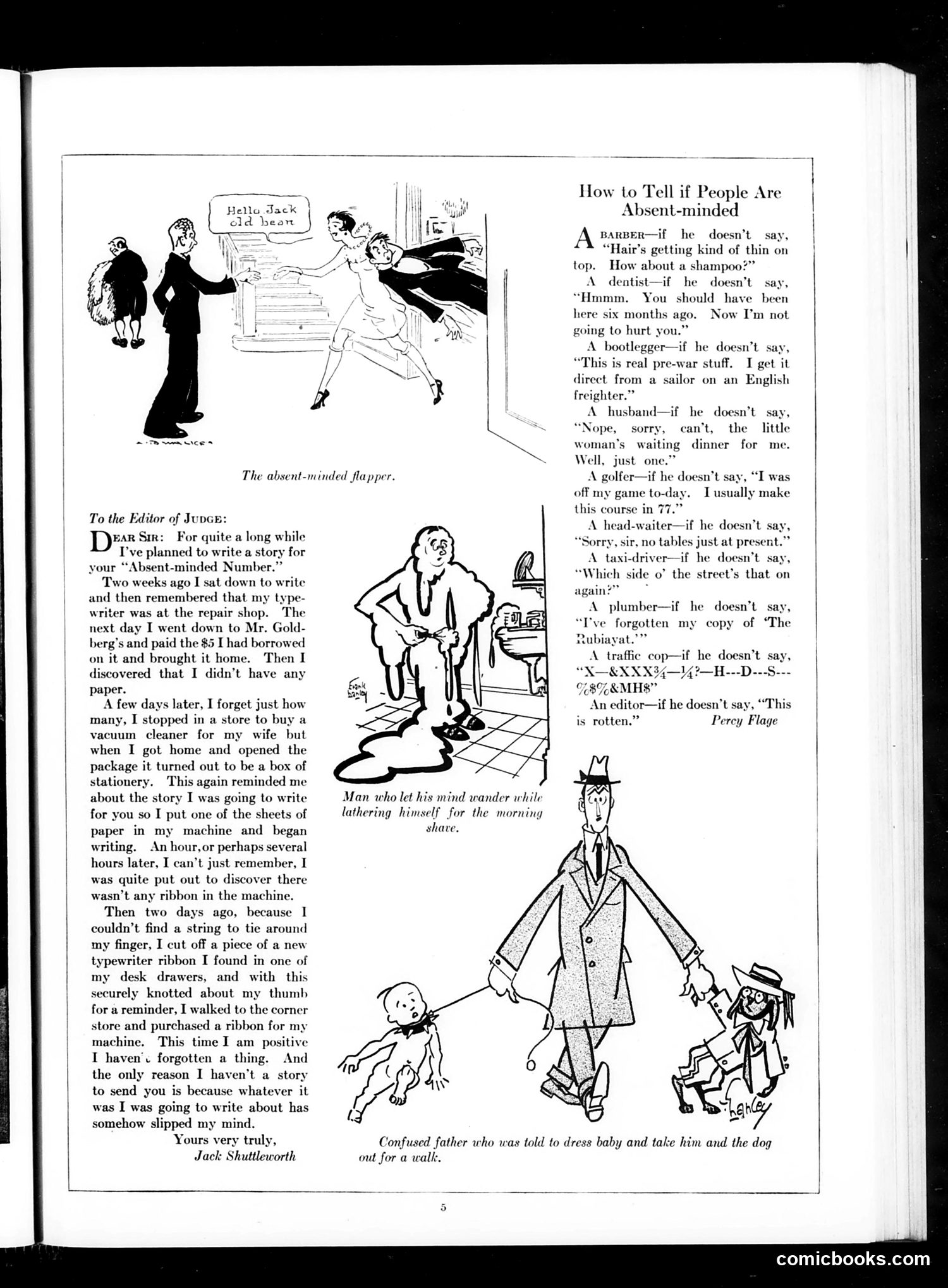
This page contains three distinct pieces: 1. **"The absent-minded flapper"** (top): A cartoon mocking a young woman of the 1920s for her scatterbrained nature—a common stereotype of the era's "flapper" generation. 2. **Letter to the editor** (left): A reader recounts repeatedly forgetting to buy typewriter ribbon, discovering a box of stationery instead, then cutting up new ribbon as a reminder—only to forget the ribbon anyway. It's a humorous anecdote about absent-mindedness. 3. **"How to Tell if People Are Absent-minded"** (right): A satirical list showing various professions (barber, dentist, bootlegger, etc.) and their telltale signs of distraction. The bootlegger reference suggests Prohibition-era context. The page satirizes absent-mindedness as a widespread social affliction across all professions and classes.
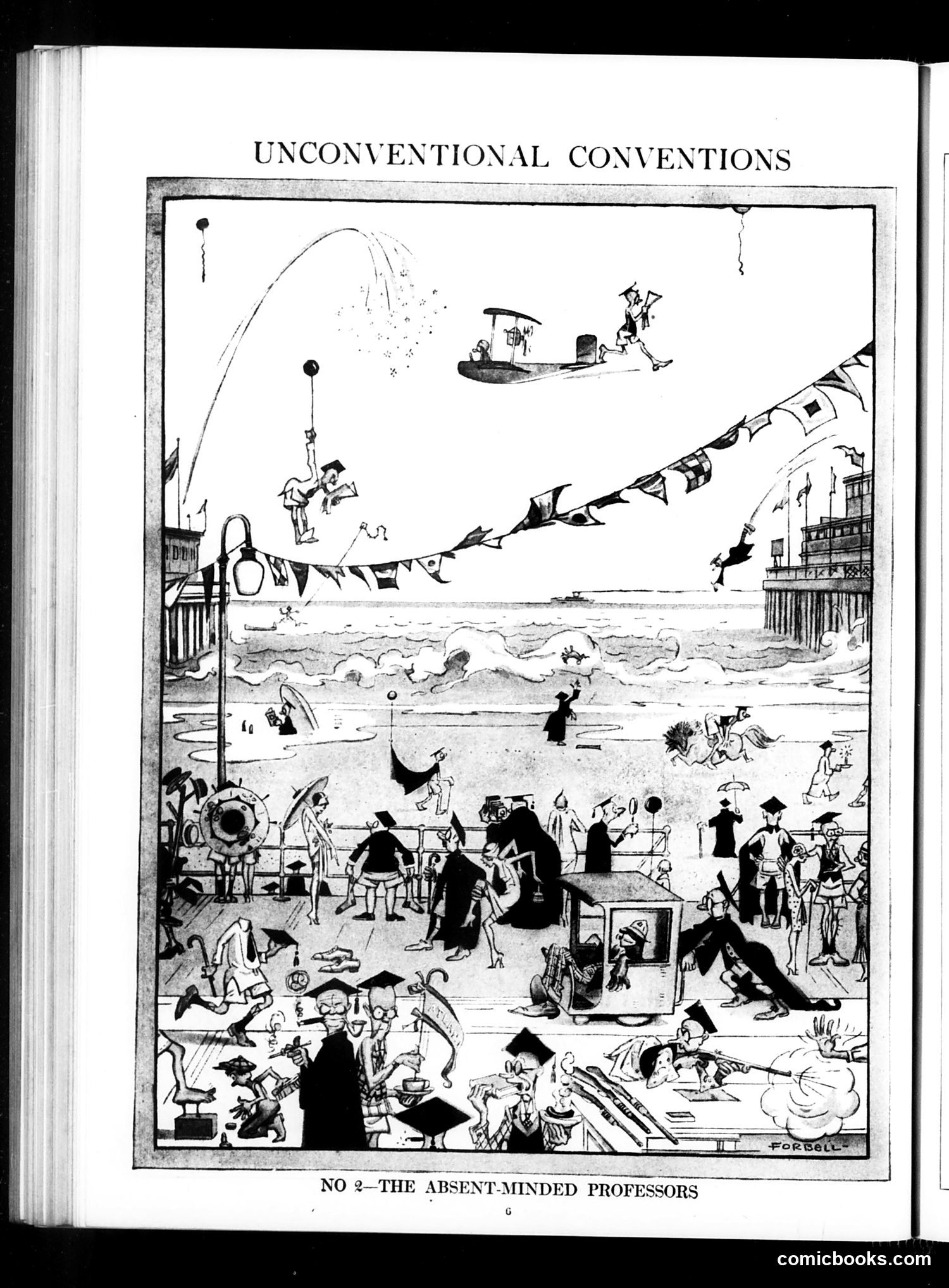
This cartoon satirizes absent-minded professors through a chaotic beach scene. The title "Unconventional Conventions" suggests professors at some gathering behaving unconventionally. The humor centers on academic absent-mindedness: scholars are depicted engaged in ridiculous, impractical activities amid beach crowds—flying kites, using strange contraptions, appearing oblivious to normal social behavior. One figure appears to be suspended by a kite; others operate peculiar devices. The satire plays on the stereotype of intellectuals as impractical and disconnected from reality, so absorbed in their thoughts or eccentric pursuits that they ignore proper social conventions and common sense. The crowded beach setting emphasizes the professors' odd behavior contrasting sharply with ordinary beachgoers below. The cartoonist (signed "Forbel") mocks academic culture's reputation for being otherworldly and socially awkward.
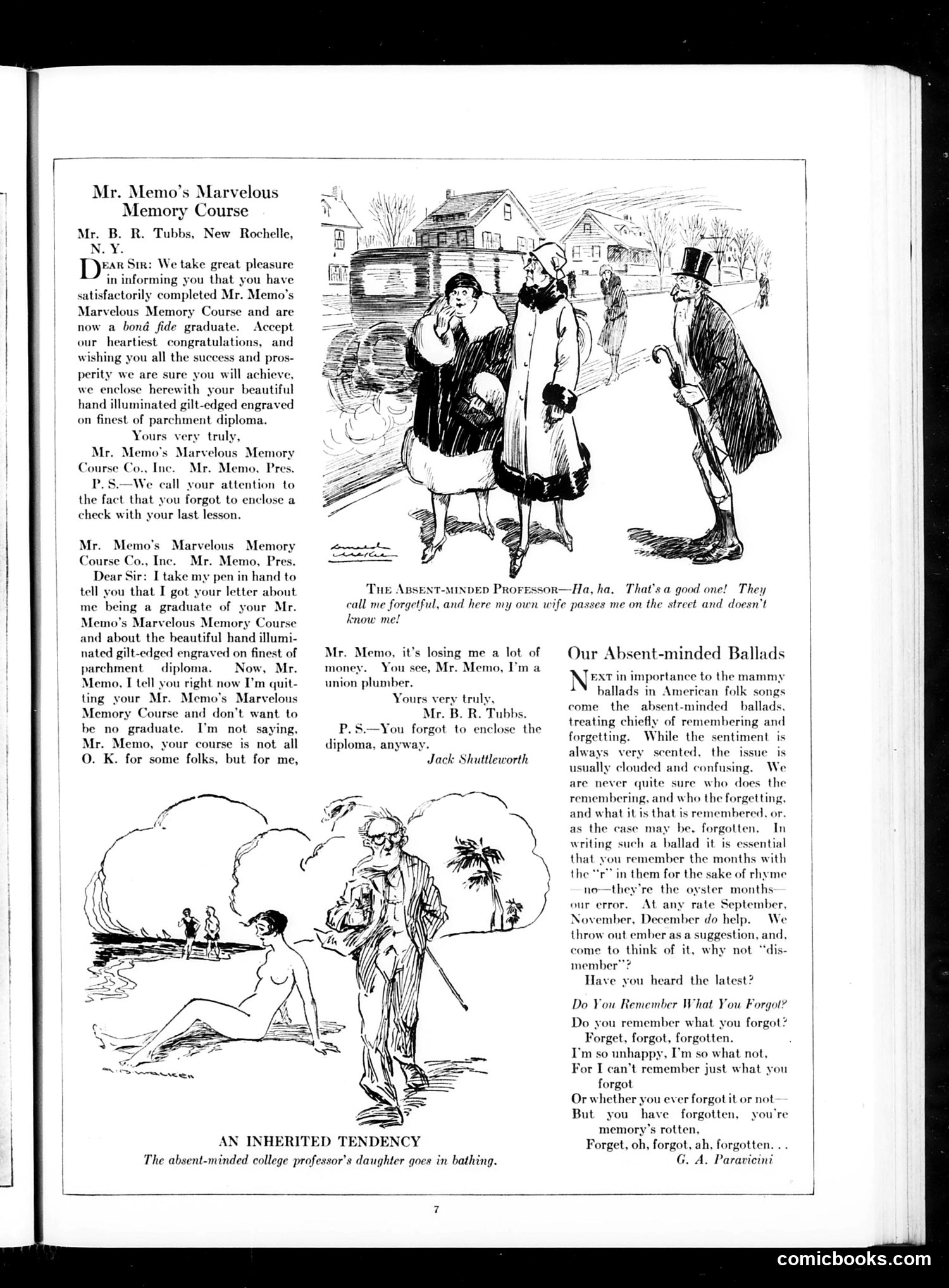
This page satirizes mail-order self-improvement scams through fake correspondence. A company sells a "memory course" diploma to Mr. B.R. Tubbs, a union plumber, who complains the course backfired—he's now so forgetful he's losing money and can't remember clients. The ironic punchline: the company forgot to enclose the actual diploma with their congratulatory letter. The accompanying cartoon about an "absent-minded professor" whose daughter forgets her clothes while bathing continues the theme of absent-mindedness as an inherited trait. The "Absent-minded Ballads" section parodies folk songs treating forgetfulness as a comedic subject, with a deliberately confused poem about remembering what one forgot. Overall, the page mocks both dubious self-help marketing and the popular literary/comedic fascination with absent-mindedness as character type.
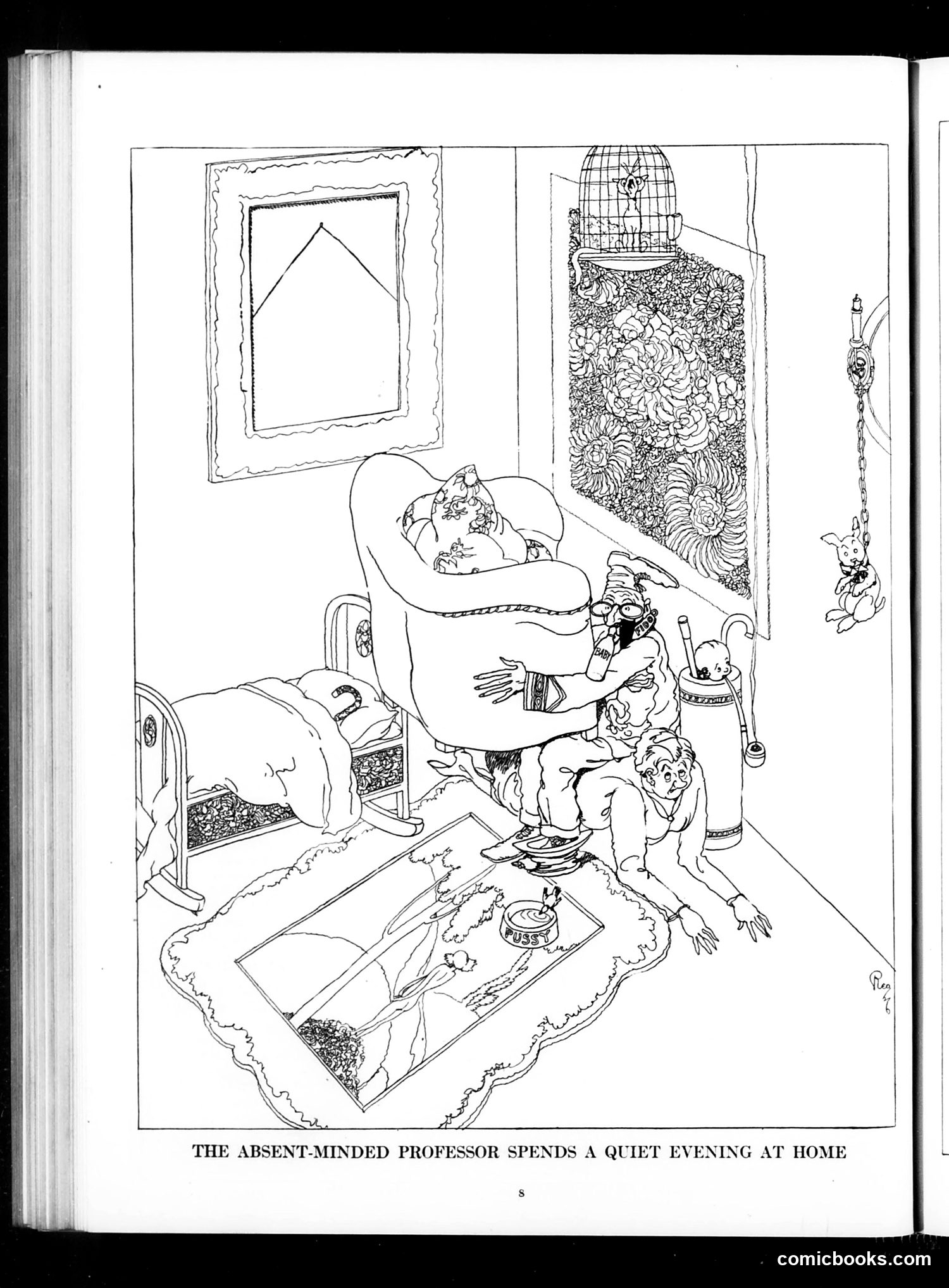
This is a satirical illustration from Judge magazine depicting "The Absent-Minded Professor Spends a Quiet Evening at Home." The humor centers on the stereotype of the impractical academic who is completely oblivious to domestic chaos. While the professor sits peacefully in a chair, his home is in absurd disorder: children appear to be running wild, furniture is askew, there's a birdcage on his head, and various objects are scattered about in disarray. A figure in the background wears an elaborate floral dress, and a toy hangs from above. The satire mocks the "absent-minded professor" archetype—suggesting that while intellectuals may be brilliant in their fields, they're hopelessly incompetent at managing everyday life and household responsibilities. The joke relies on the contrast between the professor's serene obliviousness and the mayhem surrounding him.
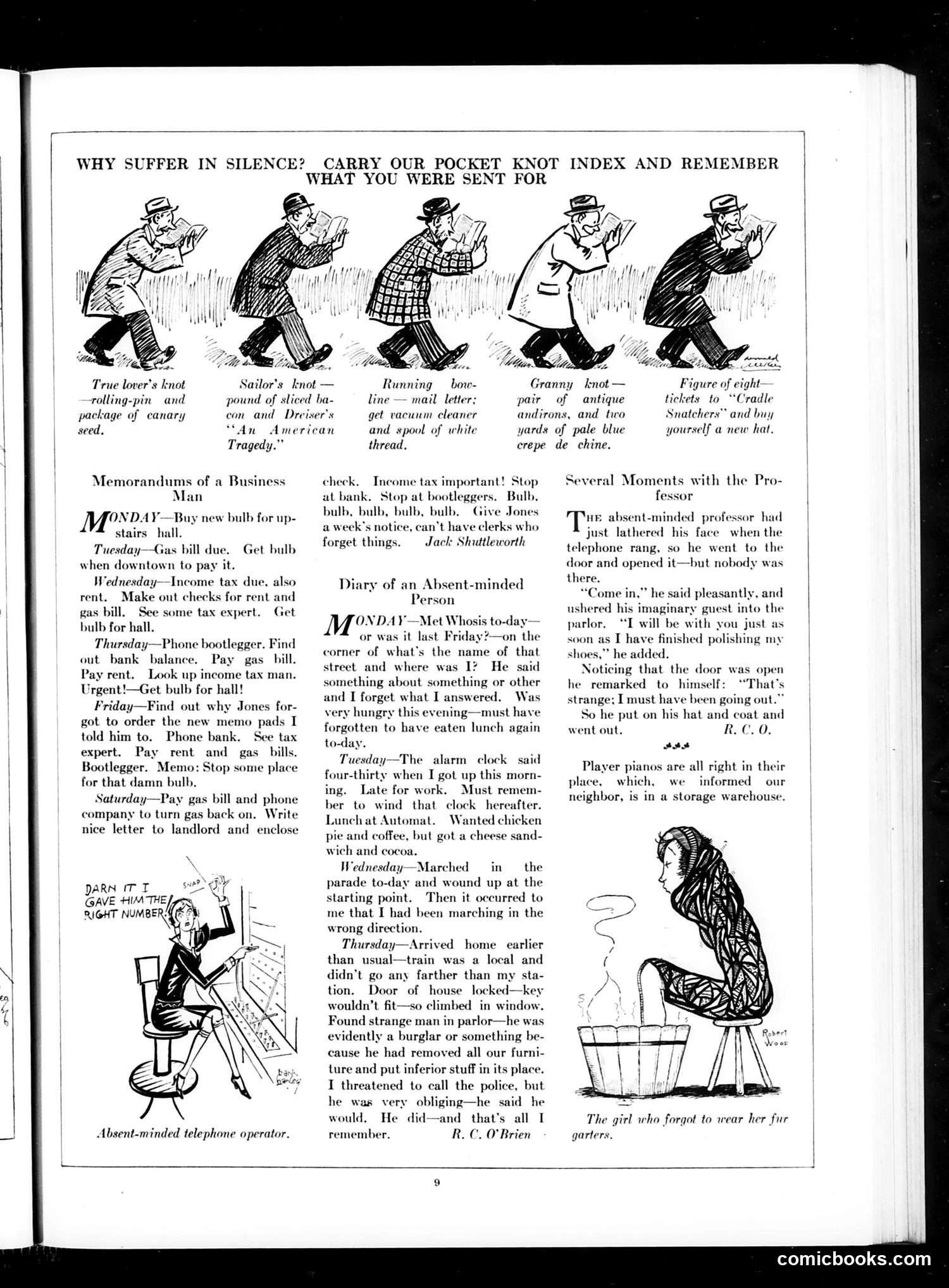
This page satirizes **forgetfulness and absentmindedness** as recurring modern problems. The top section shows five whimsical "pocket knots"—memory aids people tied in handkerchiefs to remember mundane tasks (lover's knots, sailor's knots, etc.)—mocking the era's struggle with daily organization. Three prose pieces follow, each escalating the absurdity: 1. **"Memorandums of a Business Man"** depicts a man obsessed with bureaucratic tasks (taxes, rent, gas bills, bootleggers during Prohibition) who repeatedly forgets to buy a lightbulb—satirizing how modern commerce creates endless obligations. 2. **"Diary of an Absent-minded Person"** chronicles someone so scattered he forgets meals, marching directions, and even distinguishes burglars from furniture movers. 3. **"Several Moments with the Professor"** shows an absent-minded academic who invites an invisible guest into his home. The humor targets how **modern life's complexity**—bills, taxes, schedules—makes people mentally disorganized. The cartoons accompanying each piece reinforce this with visual gags (the telephone operator, the girl forgetting her garters).
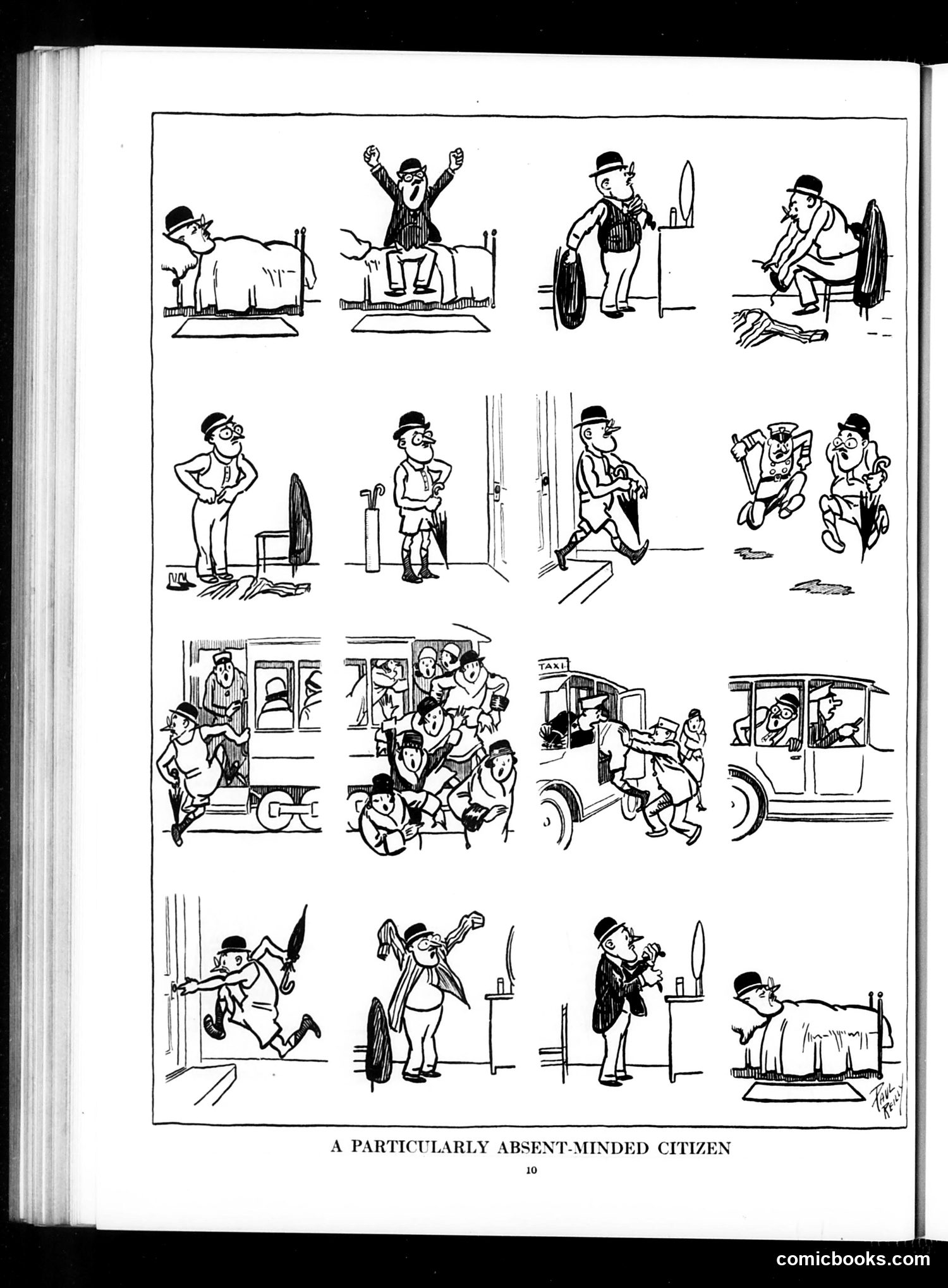
This multi-panel comic from Judge magazine depicts a man who consistently forgets basic aspects of daily life. The sequence shows him: oversleeping in bed, jubilantly waking up, shaving with a tire, attempting to shave again, exercising with swords, chasing money, fencing with a sword, boarding crowded public transport vehicles, and finally returning to bed confused. The satire appears to mock absent-mindedness as a character flaw—showing how a distracted person might confuse ordinary objects (using a tire as a razor), mistake activities, or generally fumble through life's routines. This was likely relatable humor for early 20th-century audiences familiar with slapstick comedy. The title emphasizes that such absentmindedness marks someone as a problematic "citizen," suggesting the social consequences of inattention and carelessness.
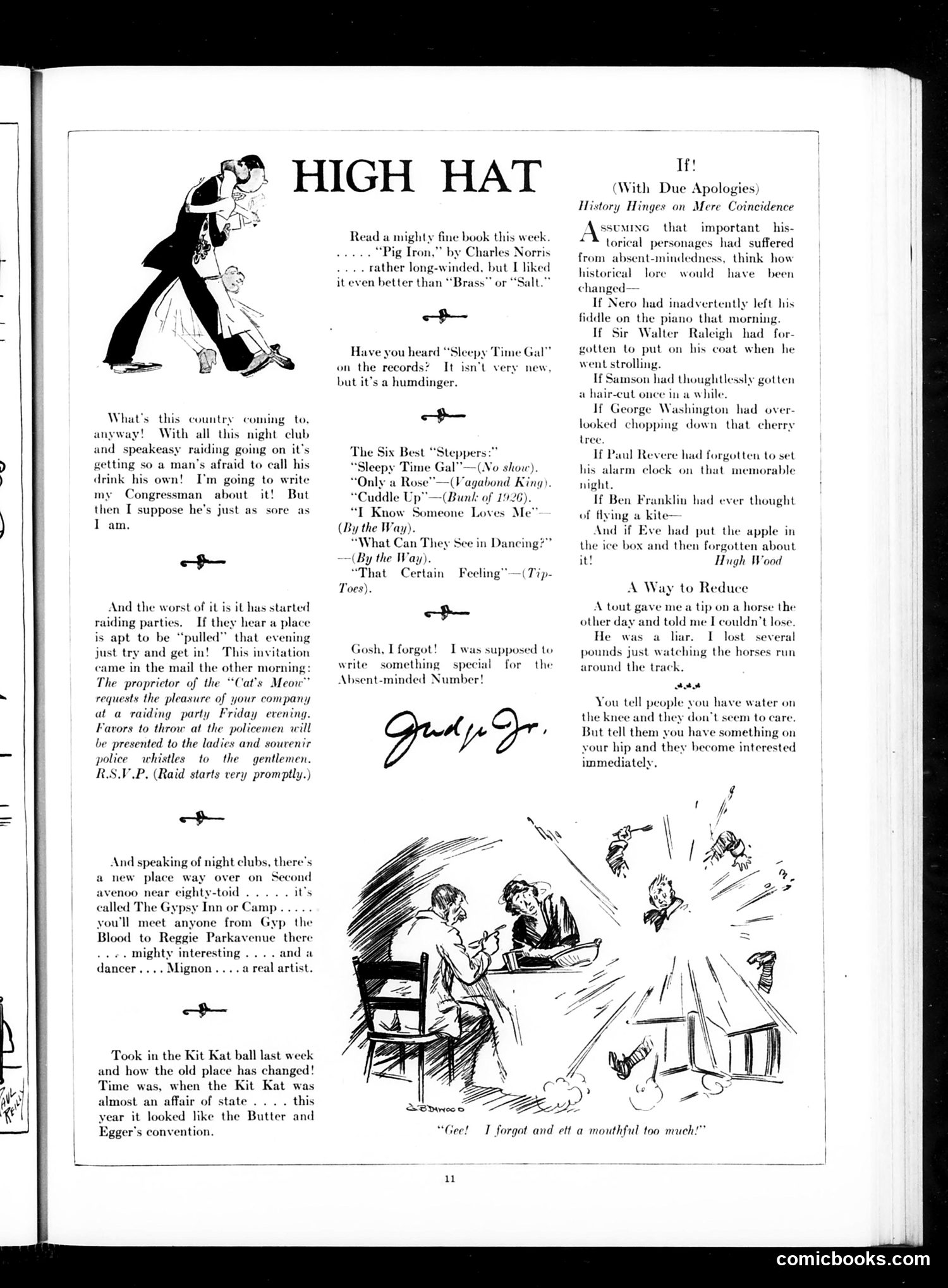
This is a satirical humor column mocking Prohibition-era nightlife and absent-mindedness. The main joke addresses speakeasy raids: during Prohibition (1920-1933), police conducted surprise raids on illegal bars, yet the column absurdly describes receiving a formal invitation to a "raiding party" where guests bring favors for police—satirizing how normalized and almost social these raids had become. The piece references popular 1920s jazz records and dance crazes ("Sleepy Time Gal," "Vagabond King"), establishing contemporary context. The right-side section humorously imagines historical figures undermined by forgetfulness—Nero forgetting his fiddle, Eve putting the apple in an ice box—creating absurdist parallels to modern absentmindedness. The bottom cartoon shows someone overwhelmed at a social gathering, illustrating one of the column's humorous anecdotes. Overall, the page satirizes both Prohibition's enforcement and Jazz Age social pretensions through gentle, observational humor typical of Judge magazine's style.
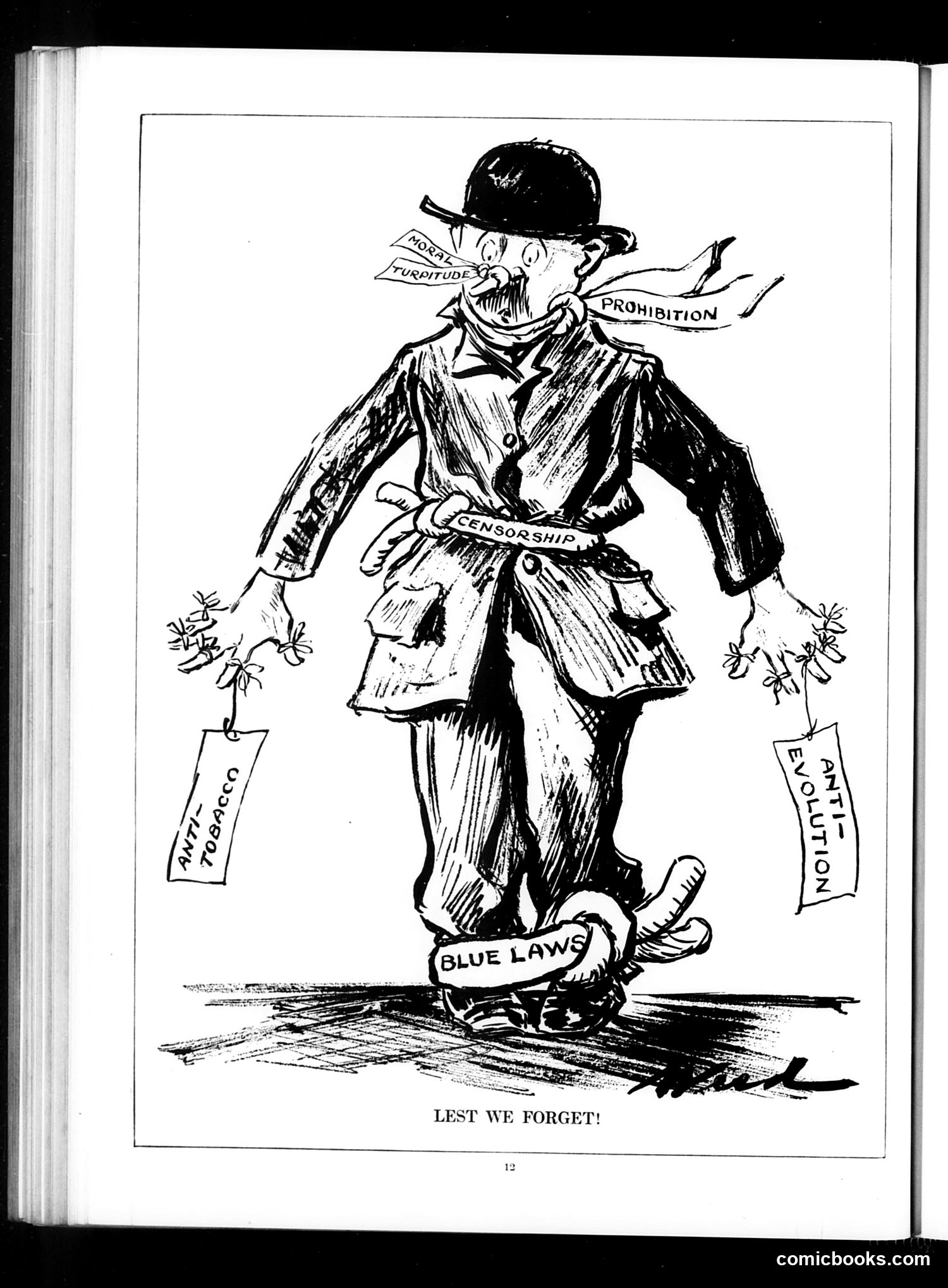
This **Judge magazine** editorial cartoon depicts Uncle Sam juggling multiple controversial restrictions while standing on "Blue Laws." The labels on the ribbons he holds include "Moral Turpitude," "Prohibition," and "Censorship," along with what appears to be "Anti-Evolution" legislation. The cartoon satirizes government overreach during the early 20th century—a period when America witnessed simultaneous waves of moral legislation (Prohibition, obscenity laws, evolution teaching bans). Uncle Sam struggles to maintain balance while enforcing these competing restrictions. The caption "Lest We Forget!" suggests ironic commentary: the artist warns readers not to forget these freedom-limiting policies. The wilting plants in Sam's hands imply these restrictions damage rather than cultivate American society.
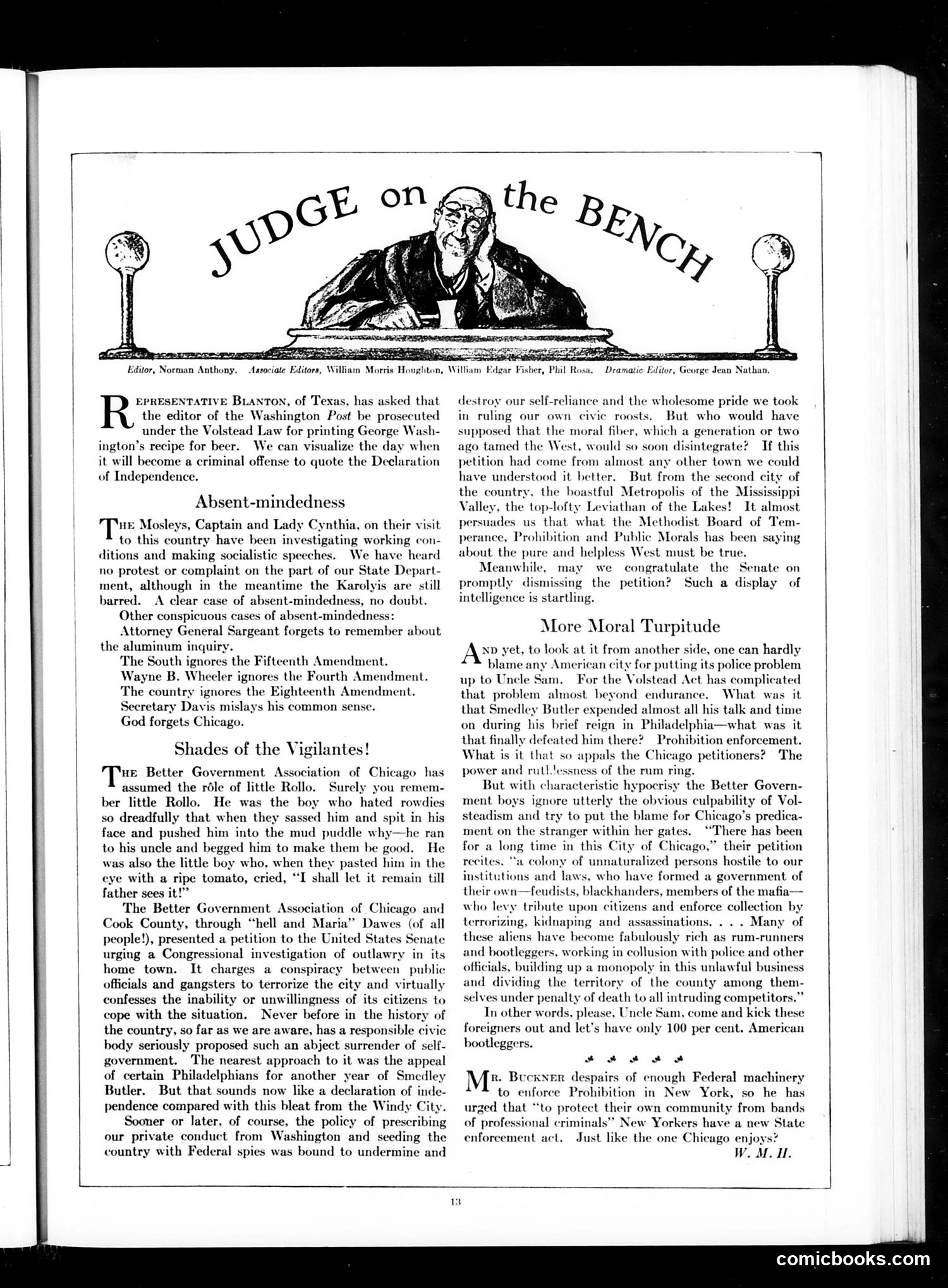
This page satirizes Prohibition-era governance and perceived hypocrisy. The header features a stern judge presiding over commentary. **Key targets:** - **Rep. Blanton's prosecution request**: Attacking a Texas politician's attempt to prosecute the *Washington Post* for printing George Washington's beer recipe under the Volstead Act (Prohibition law)—absurdly expanding federal overreach. - **The Mosley visit vs. Karolyi ban**: Critiquing inconsistent State Department policy—investigating British labor activists face no protest, while Hungarian Karolyis remain barred (likely anti-communist bias). - **Chicago's "Better Government Association"**: Mocking Chicago's appeal to the Senate for federal help combating gangster-police corruption. The satire compares citizens reporting their own city's problems to a weak child (little Rollo) tattling to his uncle—suggesting moral weakness and surrendering civic self-reliance. - **General theme**: The page denounces federal micro-management destroying American self-reliance while gangsterism thrives because Prohibition itself complicated law enforcement.
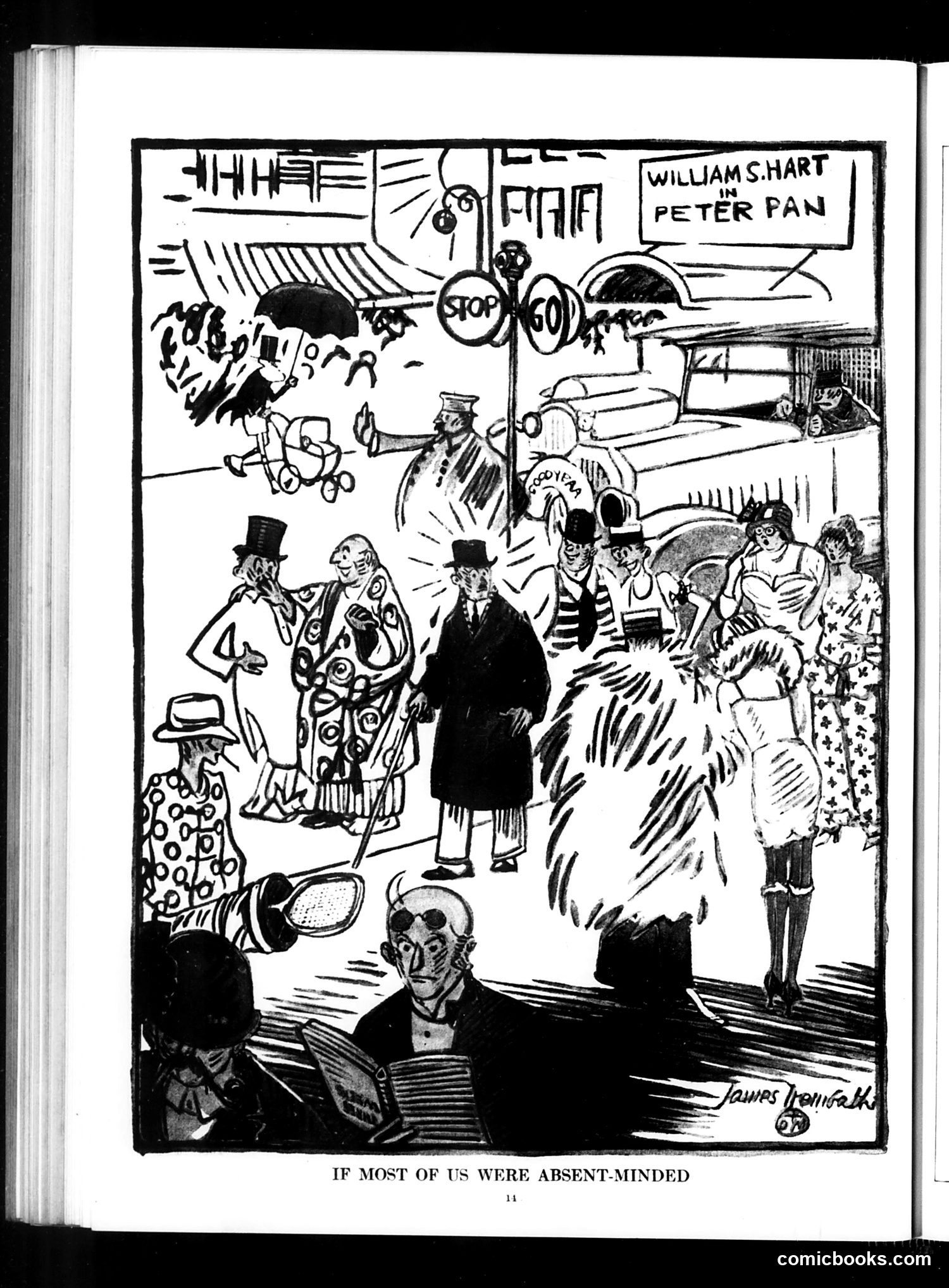
This is a single cartoon by James Montgomery Flagg satirizing theatrical absentmindedness. The caption "If Most of Us Were Absent-Minded" suggests a humorous premise about what would happen if people generally lost focus. The cartoon depicts a street scene with a traffic stop sign where chaos erupts. A large figure in fur appears to be the central absurd element—likely referencing Peter Pan's fantastical nature. The gathering crowd, vehicles, and street activity suggest everyday urban life disrupted by someone's absent-mindedness, probably the performer William S. Hart (noted at top), though his role in this scenario isn't entirely clear from the image alone. The satire targets theatrical personalities' reputation for being distracted or impractical in real-world situations.
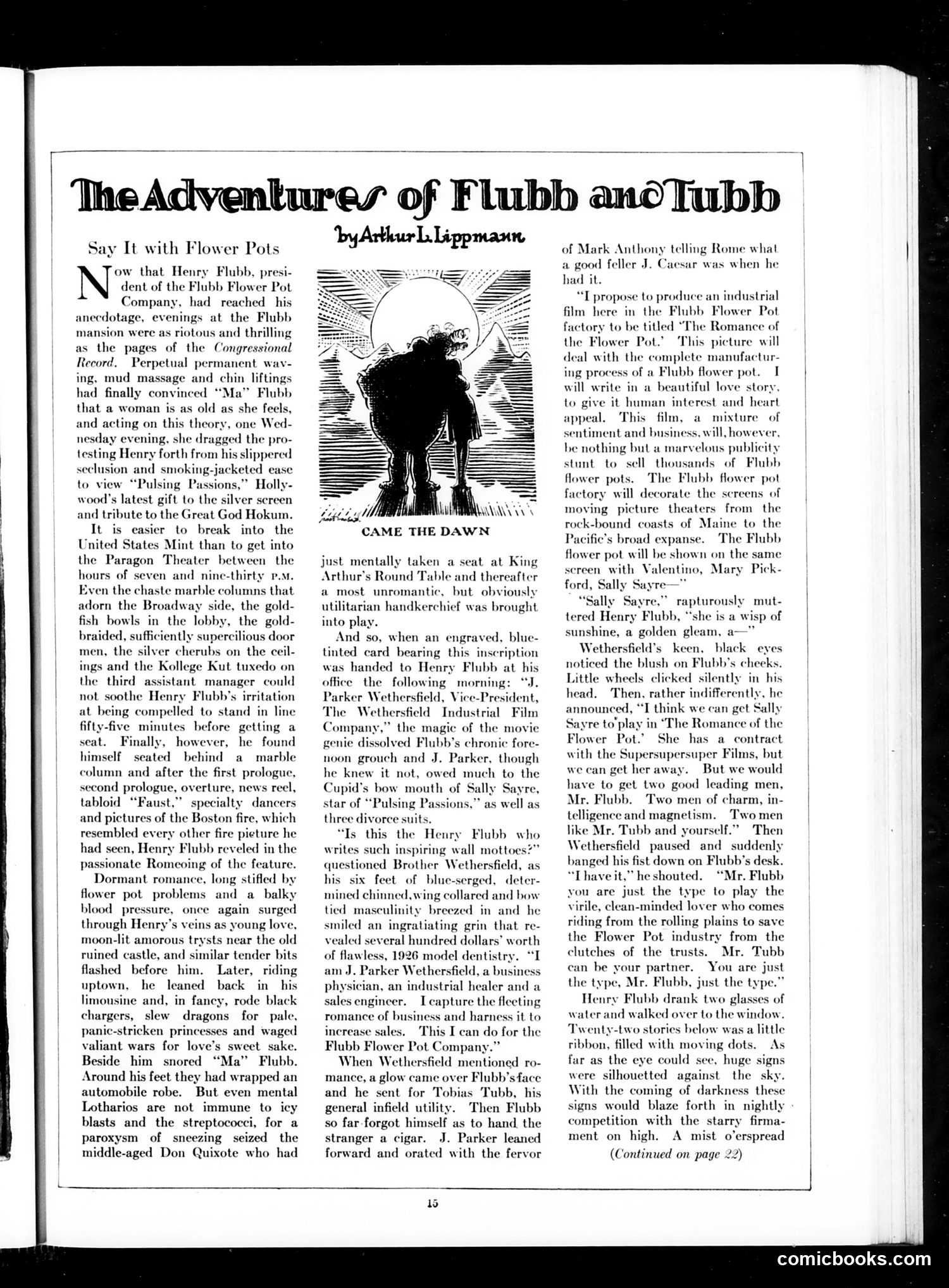
This is a humorous serial story (not a political cartoon) from Judge magazine about Henry Flubb, president of a flower pot company. The satire targets early 1920s American commercial culture and advertising. **The Setup:** Flubb and his wife ("Ma") attend a movie ("Pulsing Passions"), where the film rekindles Flubb's romantic fantasies. The next day, a slick businessman named J. Parker Wethersfield visits, claiming he can boost flower pot sales through "romance" and inspirational messaging. **The Joke:** The story mocks how easily businessmen are swayed by Hollywood sentimentality and high-pressure sales tactics. Wethersfield is a prototypical 1920s "industrial healer"—a type of motivational consultant who uses flowery language to sell dubious services. Flubb's romantic reverie from the movie makes him susceptible to this pitch. **Social Reference:** The piece satirizes the era's craze for "inspirational wall mottoes" (motivational posters) and the emerging advertising industry's manipulation of emotion for commercial gain. The detailed mockery of the movie theater experience reflects contemporary anxiety about mass entertainment's influence.
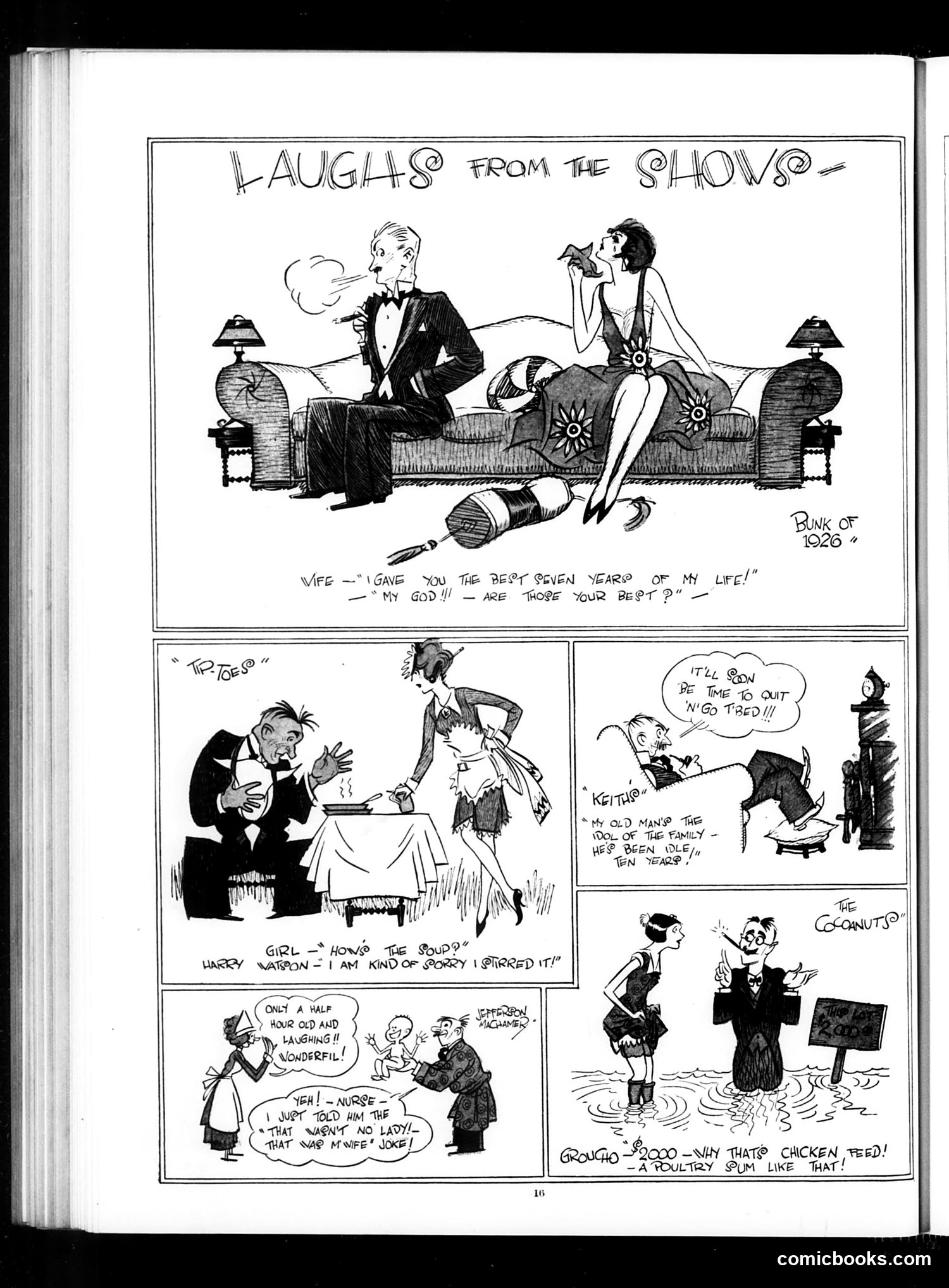
This page collects jokes supposedly heard at theatrical performances, presented as comic vignettes. The humor reflects 1920s attitudes about marriage and gender roles. The top panel depicts a domestic quarrel where a husband complains his wife gave him "the best seven years" of his life, implying marriage has since deteriorated. Below are separate jokes: one about a man's idle father-in-law; another where a woman admits sabotaging her husband's joke at a dinner party; a third involving a nurse who apparently didn't understand a marital reference; and finally, a play on words about "chicken feed" (small money) that someone confuses with actual poultry. The humor targets marital discord, nagging wives, incompetent family members, and miscommunication. These represent typical vaudeville/stage comedy tropes of the era—formulaic jokes about domestic unhappiness and gender conflict that audiences apparently found entertaining.
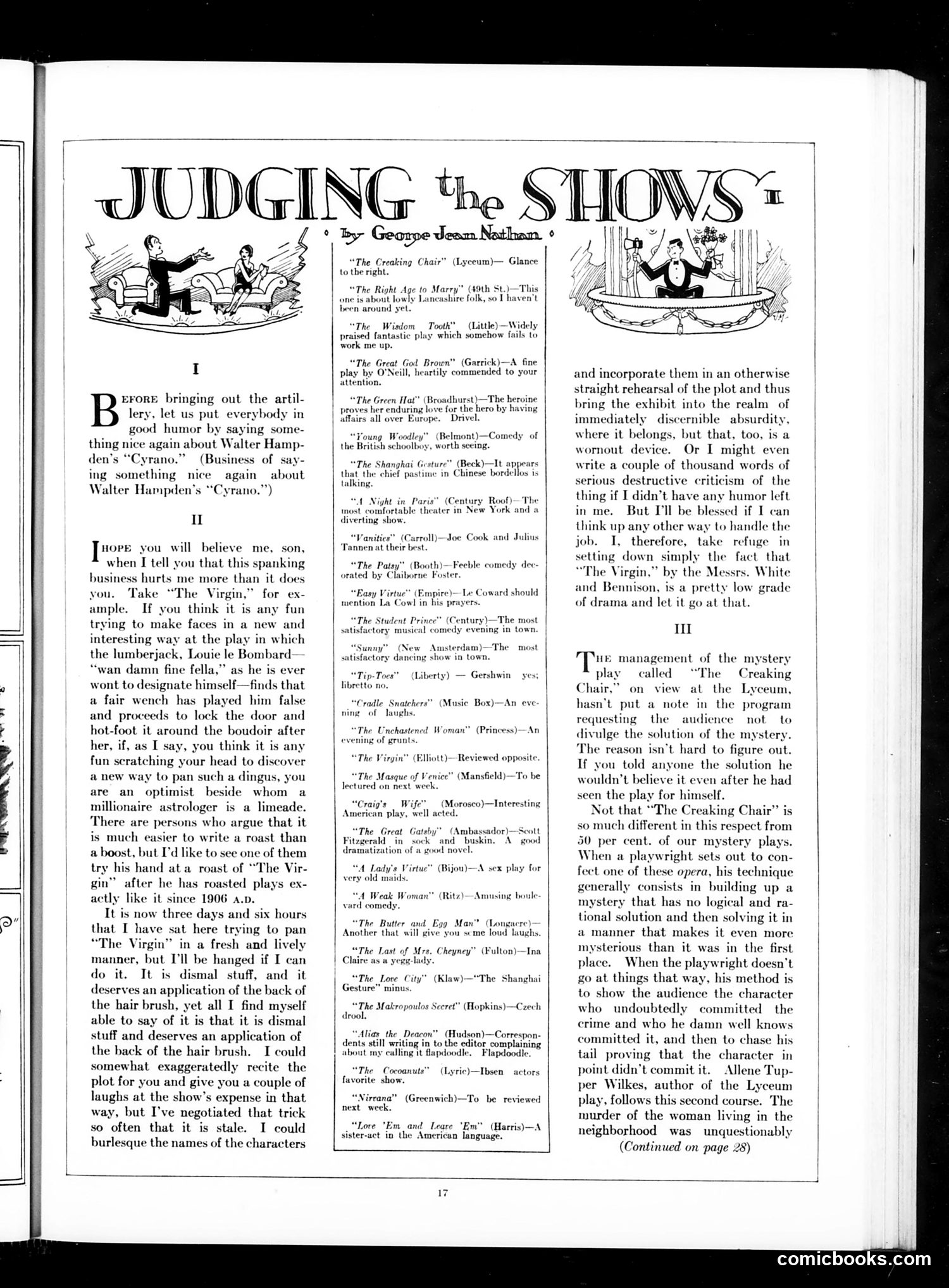
This is a theater criticism column, not a political cartoon. Nathan, a prominent drama critic of the 1920s, uses self-deprecating humor to discuss his difficulty reviewing plays. The central joke: Nathan admits he's exhausted from reviewing similar plots repeatedly since 1906 and struggles to find fresh criticism of "The Virgin"—a mediocre play about a lumberjack pursuing a woman. He ironically suggests it's easier to write praise than genuine critique, yet finds himself circling back to the same tired observations. The accompanying illustrations depict theatrical scenes rather than political satire. The list reviews current Broadway productions, with Nathan's pithy judgments (praising O'Neill's "The Great God Brown," dismissing "The Shanghai Gesture" as characters merely talking in bordellos). This represents early 20th-century theater criticism's self-aware frustration with formulaic drama and the critic's repetitive task.
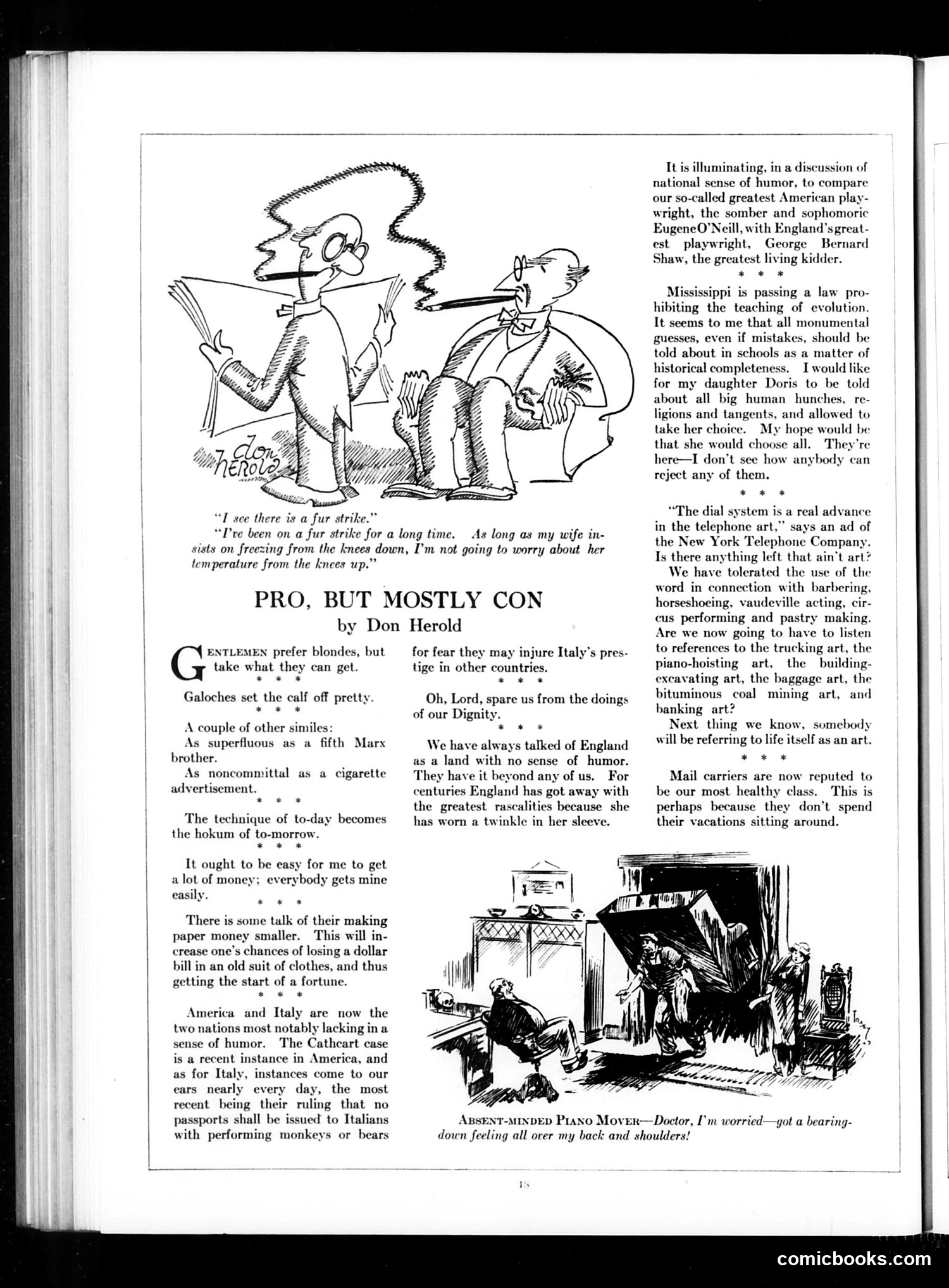
This is a humor column with two cartoons satirizing American society. The top cartoon depicts a marital argument about a fur coat: a husband refuses to buy his wife furs because she won't heat their home adequately, so he won't worry about her comfort "from the knees up." The column itself is a collection of brief satirical observations. Herold critiques: - **American humorlessness**: He compares American playwright Eugene O'Neill (deemed "somber and sophomoric") unfavorably to George Bernard Shaw, suggesting America lacks comedic sophistication. - **Mississippi's evolution ban**: He argues all major human ideas—religions included—deserve teaching as historical knowledge, not censorship. - **"Art" inflation**: He mocks calling everything "art" (barbering, telephone dials, banking), predicting life itself will soon be called art. The bottom cartoon shows a piano mover visiting a doctor with back pain—a visual punchline about occupational hazards. The satire targets American prudishness, censorship, and linguistic pretension while celebrating English wit and intellectual openness.
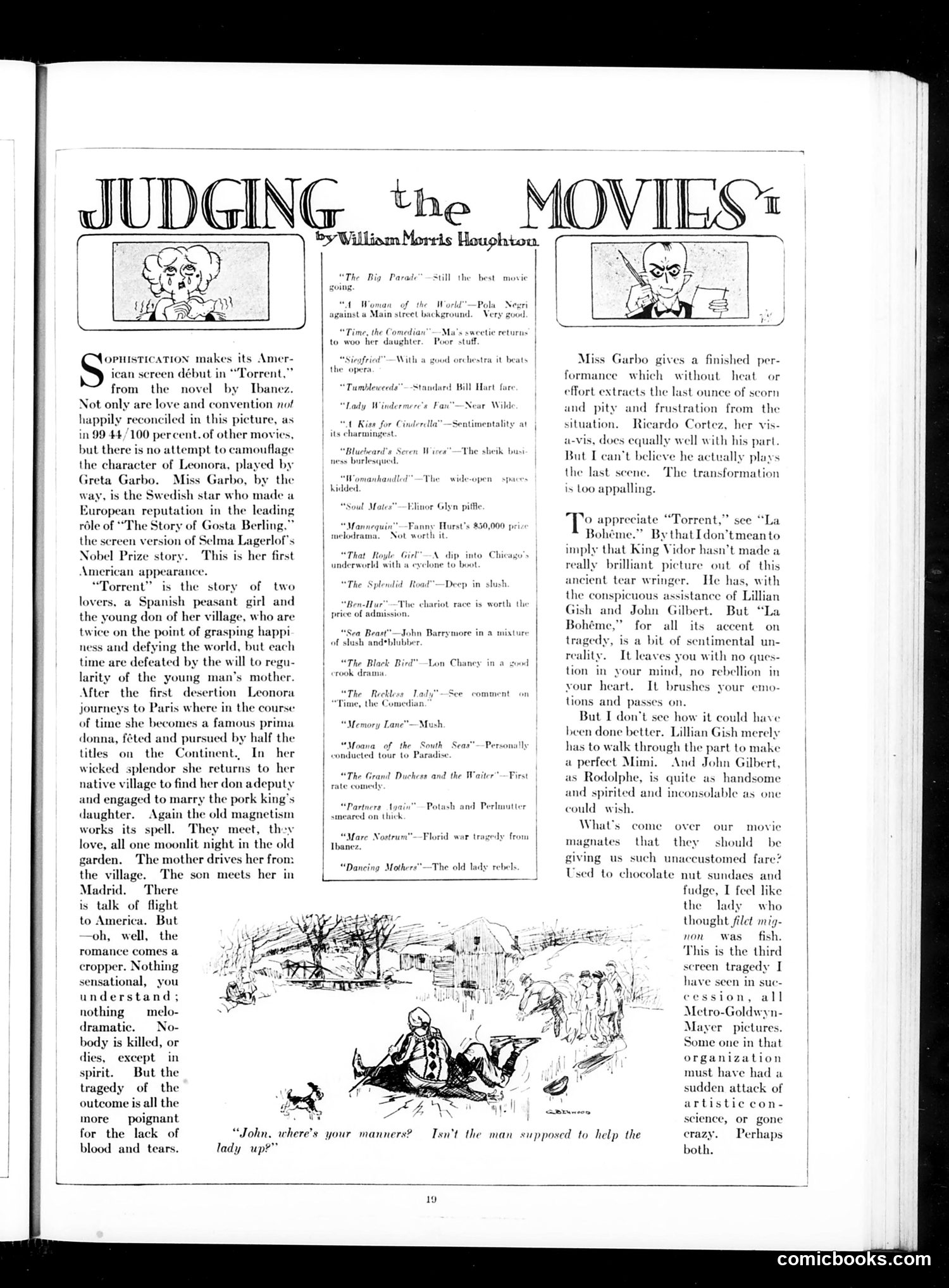
This page reviews several 1920s films, with primary focus on **"Torrent,"** starring **Greta Garbo** in her American film debut. The critic praises Garbo's sophisticated European performance—she plays a Spanish peasant who becomes a famous opera singer, creating a tragic romantic drama without melodramatic deaths or violence, relying instead on emotional restraint. The piece celebrates Garbo's naturalistic acting style, contrasting it favorably with contemporaneous American cinema's tendency toward sensationalism. It also favorably compares King Vidor's direction of "La Bohéme" (with Lillian Gish and John Gilbert). The cartoon at bottom satirizes etiquette: a man sprawls on the ground while a woman stands nearby, with the caption questioning whether "the man supposed to help the lady up"—inverting typical chivalric expectations for comedic effect. The page demonstrates Judge's dual function as both film criticism and humor publication during Hollywood's silent era.
This page consists primarily of **financial advertising and investment advice**, not political satire. The left side advertises the Milton Strauss Corporation's real estate bonds, emphasizing "independent appraisals" as a conservative safeguard—a selling point during the 1920s when investment fraud was common. The right side features Theodore Williams's article "Concerning Bonds," which argues that bonds are safer investments than speculative stocks ("dog-cheap mining, oil"). Williams praises bonds' predictability and guaranteed returns, positioning them as prudent alternatives to the riskier stock market gambling that characterized the 1920s boom era. The Investment Bureau section (bottom right) and other ads promote various stock tips and trading services. **Context**: This reflects pre-1929 crash optimism about "safe" investments, before many such bonds proved worthless. The repeated emphasis on safety suggests investor anxiety about fraud and speculation.
This page from Judge magazine is primarily **financial advertising and investment advice**, not political satire. The main content consists of letters answering investor questions about stocks and bonds, followed by advertisements for investment securities. The notable visual element is a large illustration of a man's face accompanying an advertisement for the "Trust Company of Florida," which promises first-mortgage bonds at 6-8% interest. The phrase "NO INVESTOR EVER LOST A DOLLAR IN MILLER BONDS" (prominently displayed) is a marketing claim, not satire. Similarly, C.L. Miller & Co.'s ad emphasizes their expertise in real estate evaluation and the safety record of their bonds. The content reflects 1920s investment culture—discussing stocks like Woolworth, Victor Talking Machine, and railroads. There is **no apparent political cartoon or satire** on this page; it is straightforwardly commercial advertising typical of Judge's content during this period.
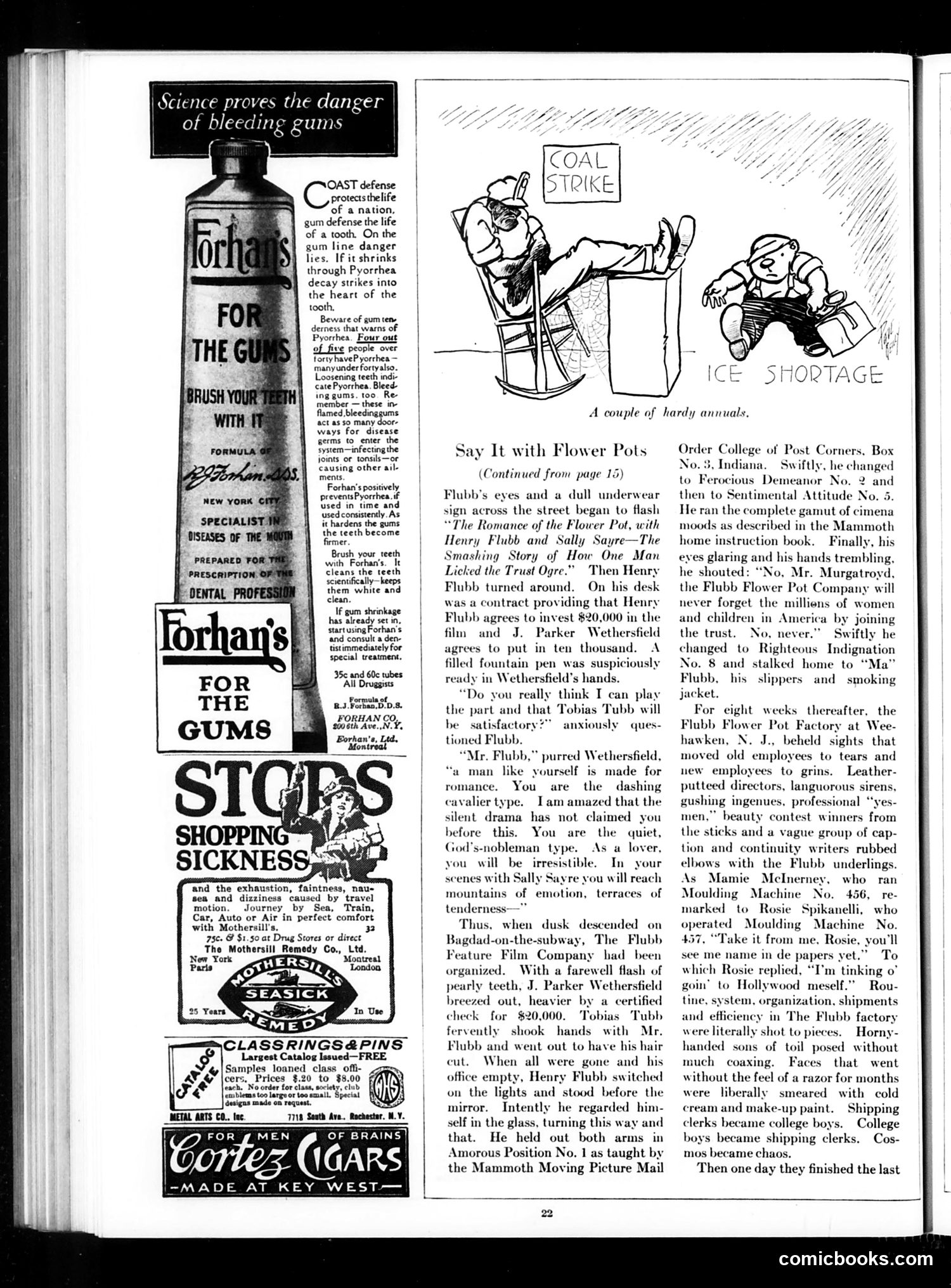
This page contains **primarily advertisements** (Forhan's toothpaste, Mothersill's motion sickness remedy, class rings, Cortez cigars) alongside a **serialized humorous story** titled "Say It with Flower Pots." The story satirizes **get-rich-quick movie schemes and financial manipulation** common in 1920s America. Henry Flubb, an ordinary man, is persuaded by J. Parker Wethersfield to invest $20,000 in a film company. Wethersfield flatters Flubb about his romantic potential as a film actor, then immediately secures his investment. Meanwhile, Flubb practices dramatic poses from a mail-order acting course, apparently delusional about becoming a movie star. The satire targets **gullible investors**, **slick promoters**, and the **nascent film industry's dubious financing schemes**. The reference to defeating a "trust ogre" echoes Progressive Era anti-monopoly rhetoric. The "Flower Pot" title itself appears intentionally absurd—suggesting an equally absurd business venture preying on dreamers.
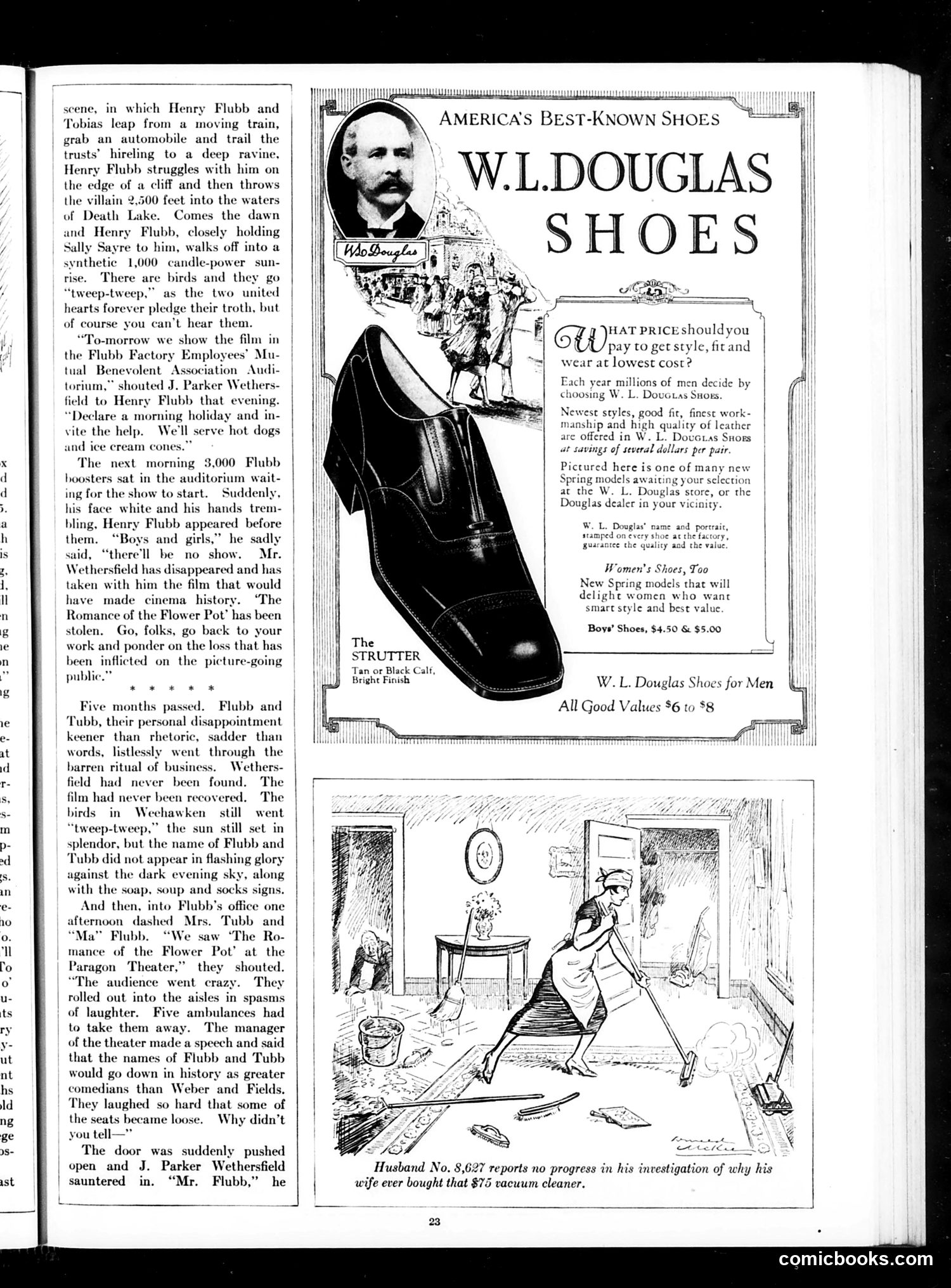
This page combines a serialized comedic story with period advertising. **The Story ("The Romance of the Flower Pot"):** A melodramatic narrative about Henry Flubb and his partner creating a film, only to have it stolen by the villain J. Parker Wethersfield. Five months later, the film mysteriously appears in theaters, causing audiences to laugh so hard they need ambulances. The satire mocks overwrought silent film plots and their melodramatic conventions—the "synthetic 1,000 candle-power sunrise," birds going "tweep-tweep," and villains thrown into ravines exemplify absurd film tropes being parodied. **The Cartoons:** A W.L. Douglas shoe advertisement occupies the upper right. Below it, a cartoon shows a woman scrubbing floors with a vacuum cleaner nearby, captioned: "Husband No. 8,627 reports no progress in his investigation of why his wife ever bought that $75 vacuum cleaner." This satirizes consumer spending and marital frustration over expensive household gadgets—suggesting wives buy impractical products. The page primarily parodies silent cinema conventions and conjugal domestic humor typical of 1910s Judge magazine.
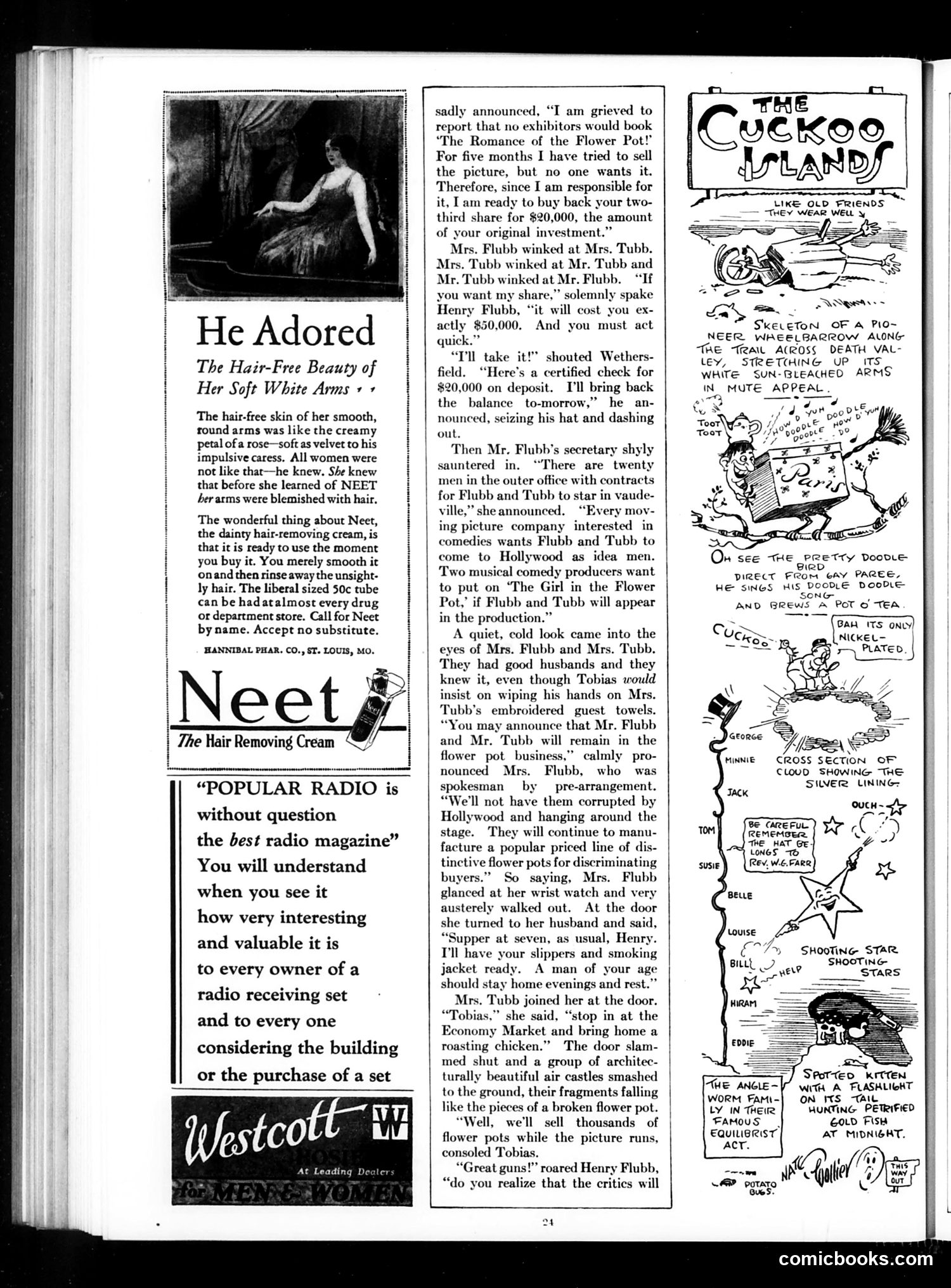
This page contains two distinct pieces: **Left side:** Advertisements for Neet hair-removal cream and Westcott radio products—standard commercial content typical of 1920s magazines. **Center/Right:** A satirical story mocking Hollywood's corrupting influence and get-rich-quick schemes. Two couples (the Flubbs and Tubbs) manufacture flower pots. When a failed film producer tries to buy back his investment in their terrible movie "The Romance of the Flower Pot," he's outwitted—the couples demand $50,000. Once film studios and vaudeville producers become interested, the wives firmly reject Hollywood opportunities, insisting their husbands remain in the humble flower-pot business. The satire suggests that staying grounded in honest work is preferable to chasing show-business fame and fortune. **Right margin:** "The Cuckoo Land"—a comic strip featuring anthropomorphic animals in absurdist scenarios, unrelated to the main story. The central humor targets Hollywood's instability and the American obsession with sudden wealth, contrasting it with domestic virtue and steady employment.
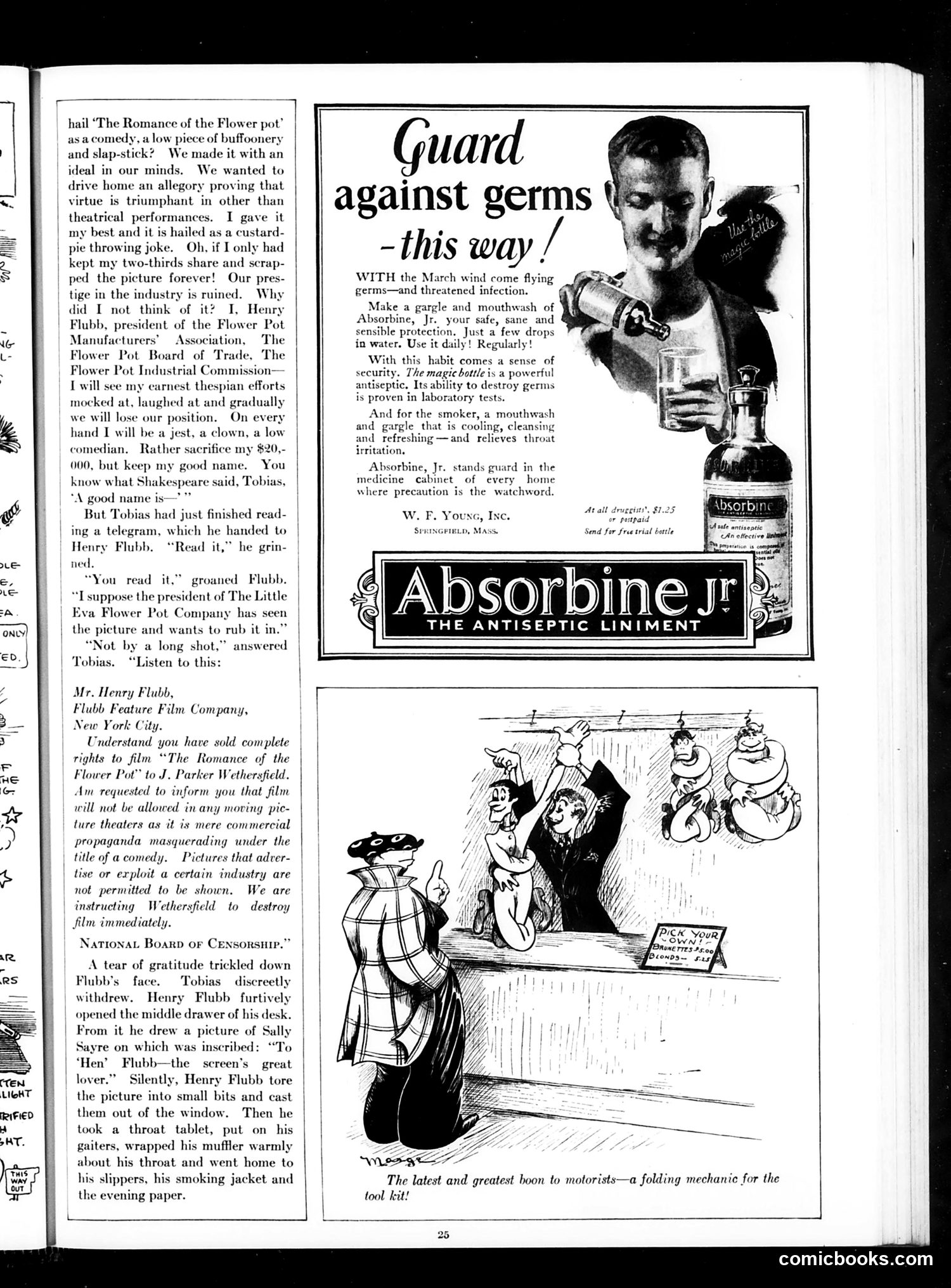
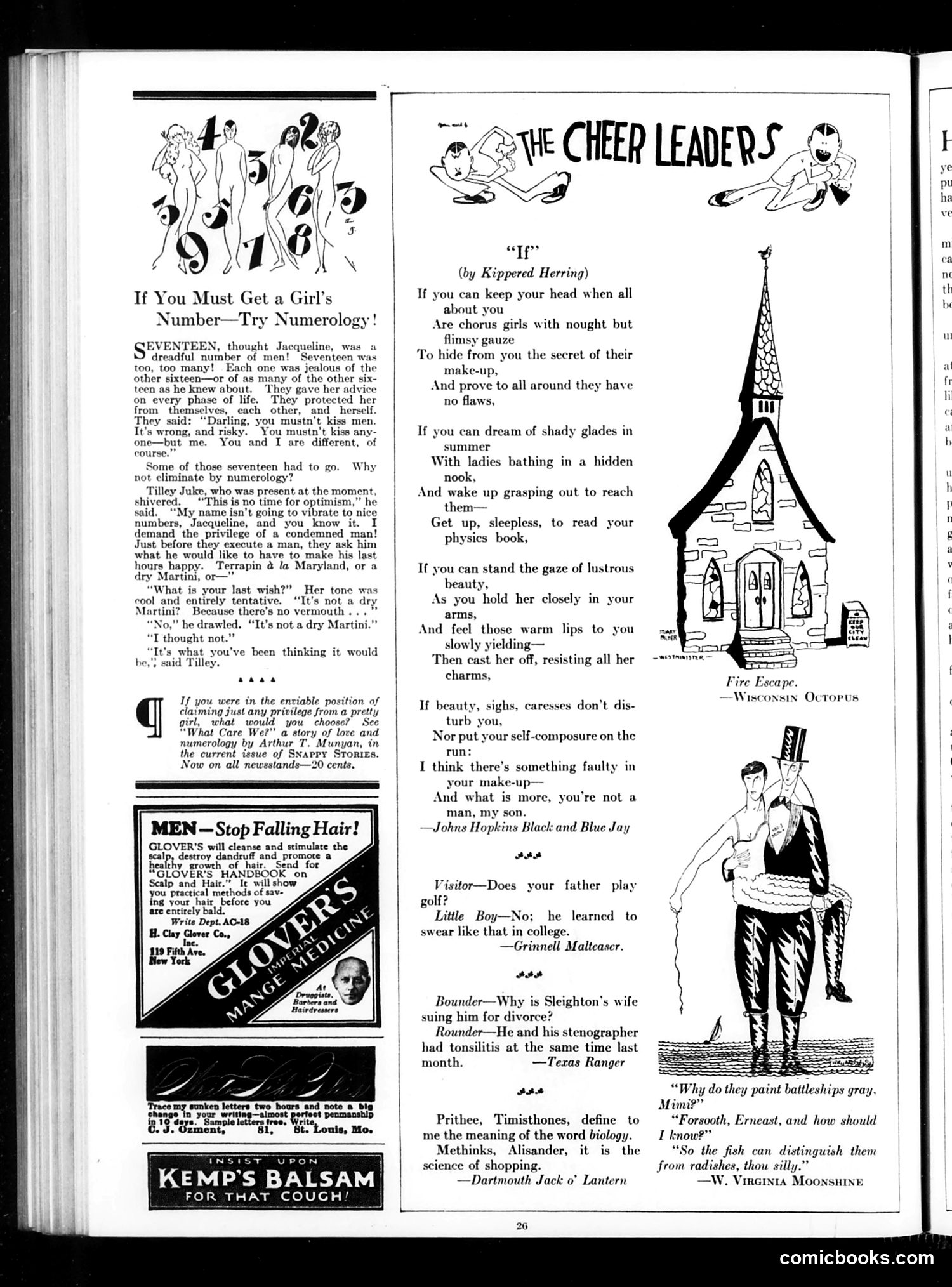
The page contains two main pieces of humor: **"If You Must Get a Girl's Number—Try Numerology!"** satirizes 1920s dating culture and the era's fascination with numerology (belief that numbers hold mystical significance). A young woman named Jacqueline has seventeen male suitors, each demanding exclusivity. The joke plays on numerology as a humorous solution to an exaggerated dating problem—reflecting period anxiety about modern courtship and changing gender relations as women gained more social freedom. **"The Cheerleaders"** parodies Rudyard Kipling's famous poem "If—," substituting chorus girls for moral virtue. It mocks the impossible standard of maintaining composure around scantily-clad performers, ultimately suggesting any man who succeeds isn't truly a man. This satirizes both the objectification of chorus girls and masculine self-control rhetoric of the Jazz Age. The advertisements (hair loss treatment, cough medicine) and ribald jokes about golf and divorce reflect typical Judge magazine content targeting male readers with light humor about contemporary life.
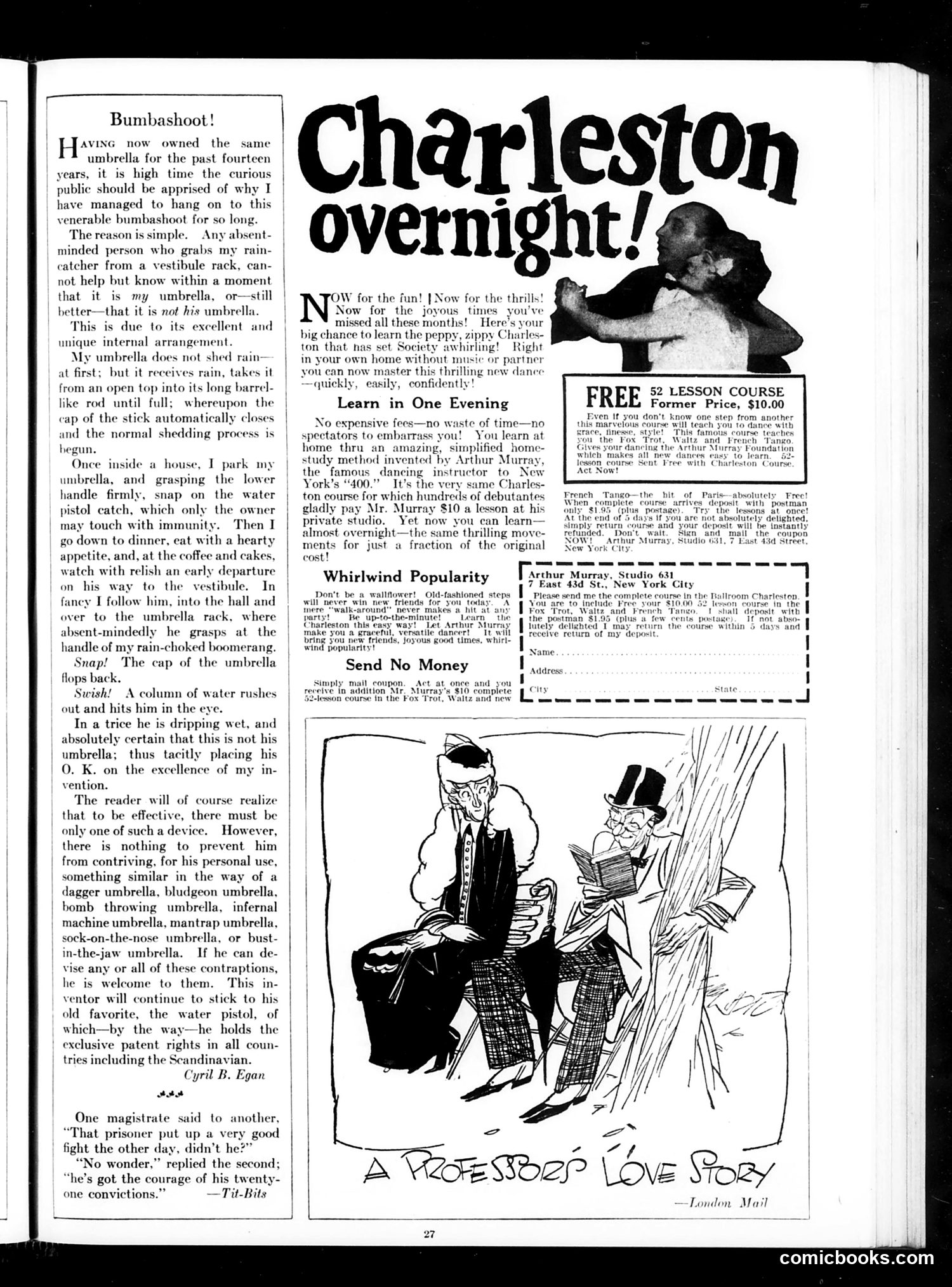
This page contains two distinct pieces: **"Bumbashoot!" (left):** A humorous essay by Cyril B. Egan describing an "anti-theft" umbrella mechanism. The author's umbrella collects rainwater in its shaft, then—when someone else grabs it from a vestibule rack—automatically sprays water in their face when they open it. The joke is both practical (deterring theft of a 14-year-old umbrella) and absurdist, with Egan playfully suggesting readers devise similar weaponized umbrellas (bombs, daggers, etc.). The satire mocks absent-minded coat-check behavior while celebrating clever, mischievous invention. **"Charleston Overnight!" (right):** An advertisement for Arthur Murray's mail-order Charleston dance course. This capitalizes on 1920s "Charleston craze" popularity—the dance was shockingly modern and scandalous to older generations. Murray's $10.00 course (reduced to $1.95) promised quick mastery at home without embarrassment, appealing to socially anxious people wanting to join fashionable society. The cartoon shows two men learning together indoors. Both pieces reflect 1920s preoccupations: social climbing, modern entertainment, and consumer-driven self-improvement.
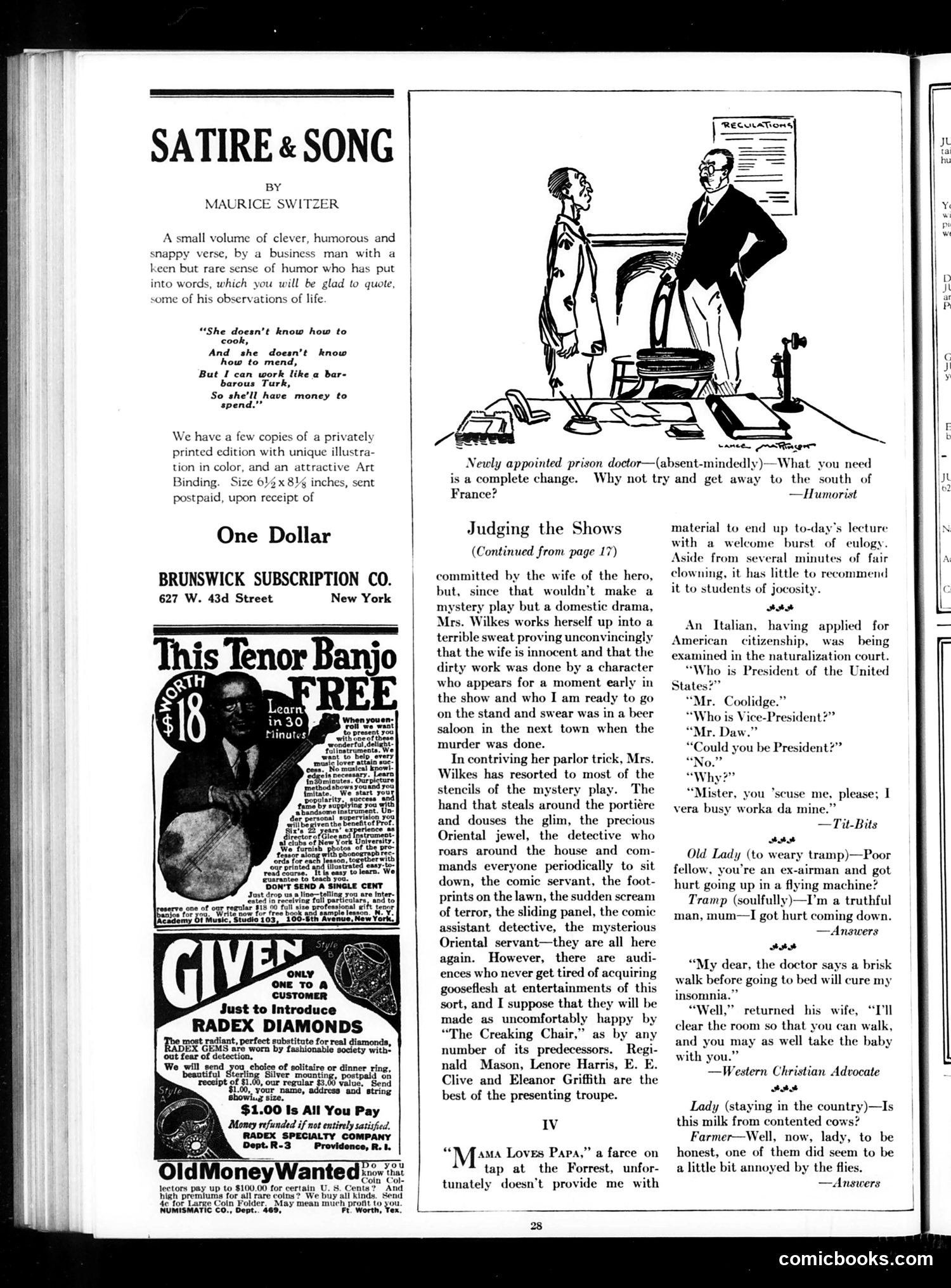
This page mixes advertising with theatrical criticism and humor. The main content includes: **Advertisement Section:** Book promotion for Maurice Switzer's "Satire & Song" (verse about domestic life), plus ads for a tenor banjo course, fake diamonds ("Radex"), and coin collecting—typical early 20th-century magazine fare. **Political/Social Cartoon:** The top illustration shows a prison doctor advising a woman to "get away to the south of France"—satirizing how the wealthy escape consequences through travel while ordinary citizens face imprisonment. The "Regulations" poster suggests this is commentary on justice system inequality. **Theater Reviews:** The bulk discusses mystery plays, particularly criticism of formulaic staging using clichéd elements (sliding panels, mysterious servants, jewel theft plots). The Italian citizenship exam joke references 1920s immigration testing and ethnic stereotyping of Italian immigrants' work habits. **Humor snippets** address marriage, infidelity, and class differences—typical Judge fare mocking domestic life and pretension. The page reflects 1920s concerns: wealth disparities, theatrical conventions, and immigration debates.
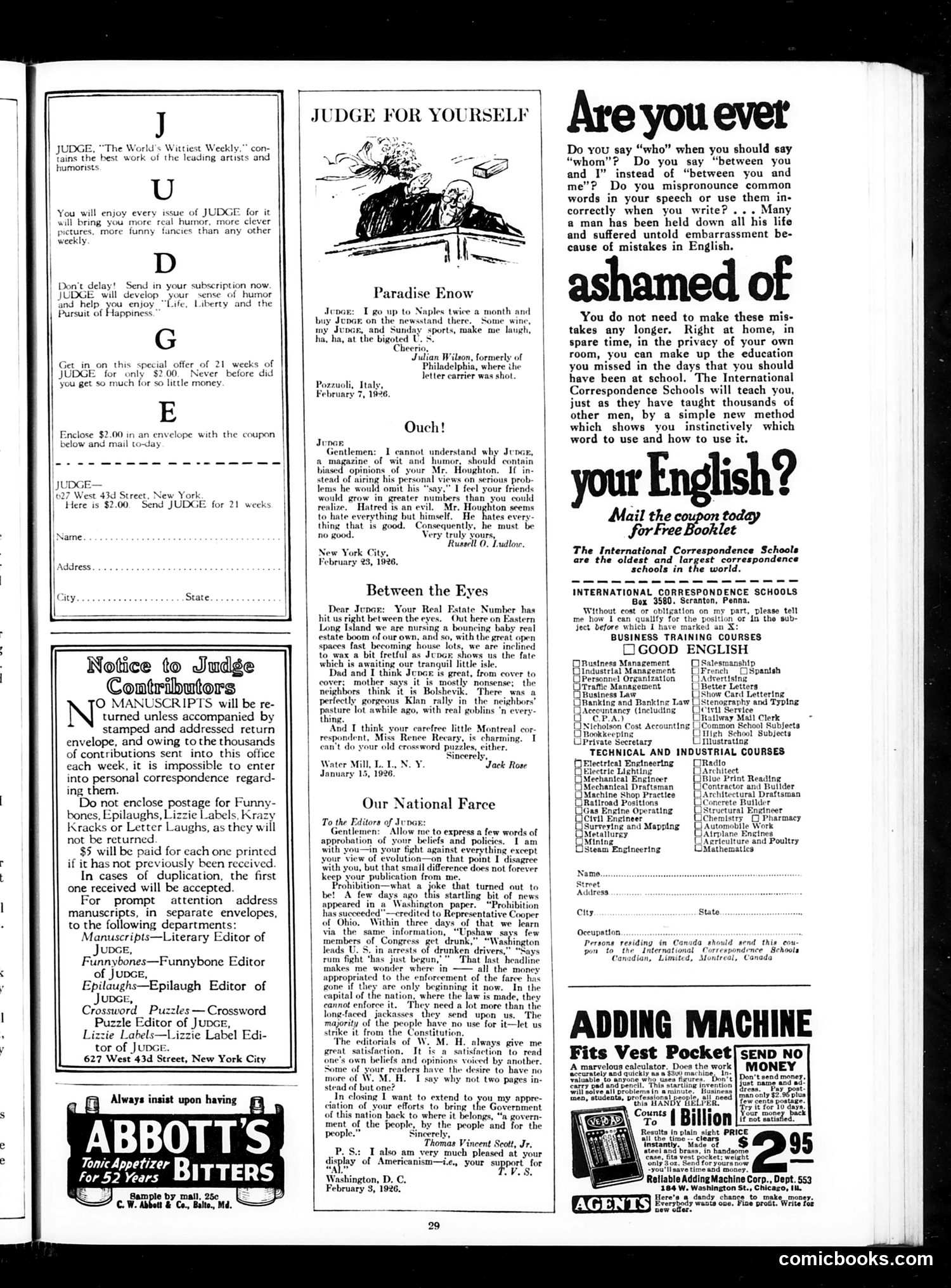
This page is primarily **subscription advertising and reader letters**, not political satire. The left side promotes Judge magazine subscriptions and contributor guidelines. The right side features reader correspondence responding to previous Judge articles. The "**Between the Eyes**" letter praises Judge's "Real Estate Number" for satirizing the Long Island real estate boom. The "**Our National Farce**" letter discusses Prohibition enforcement—a major 1920s political issue—praising Judge's anti-Prohibition editorial stance while mocking the contradiction between official policy and actual enforcement (Congress members drinking despite the law). These letters reflect Judge's role as a satirical magazine commenting on contemporary social issues: real estate speculation and Prohibition's failed implementation during the Jazz Age. The reader engagement demonstrates the magazine's influence in shaping public discourse about these topics. The page also advertises Abbott's Bitters and an adding machine—typical period advertisements.
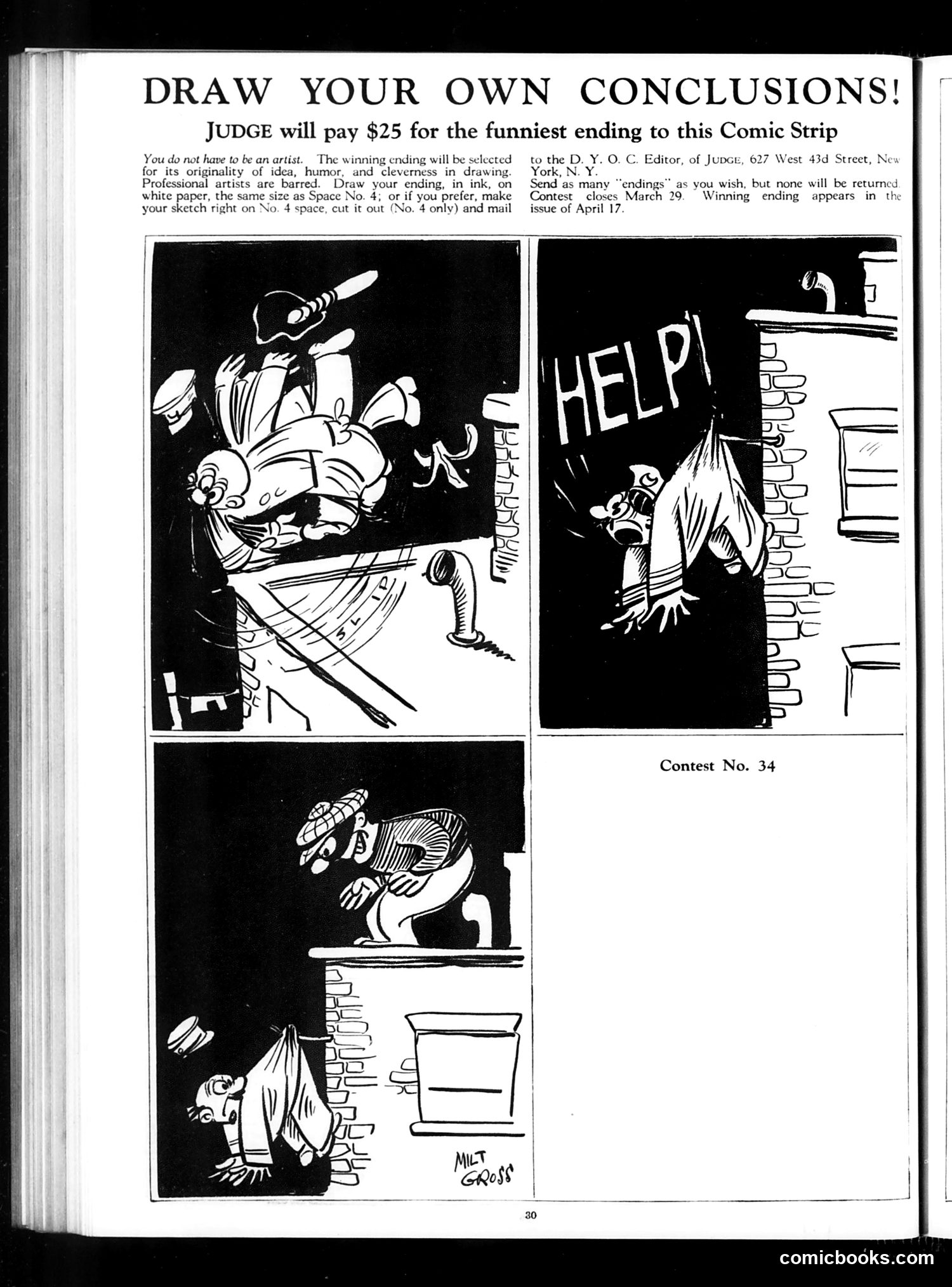
This is a reader-participation contest from *Judge* magazine offering $25 for the funniest ending to an incomplete comic strip. The three existing panels show a slapstick domestic scene: a chef or cook is being attacked with kitchen implements by what appears to be a woman, creating chaos in a kitchen setting. The final panel (Space No. 4) is blank—readers must supply their own humorous conclusion. The contest is explicitly open to non-professionals, encouraging amateur submissions based on originality and humor rather than artistic skill. This reflects early 20th-century *Judge's* populist approach to comedy. The incomplete narrative setup—with physical comedy as its basis—invites readers to imagine various punchlines or resolutions to the domestic conflict depicted.
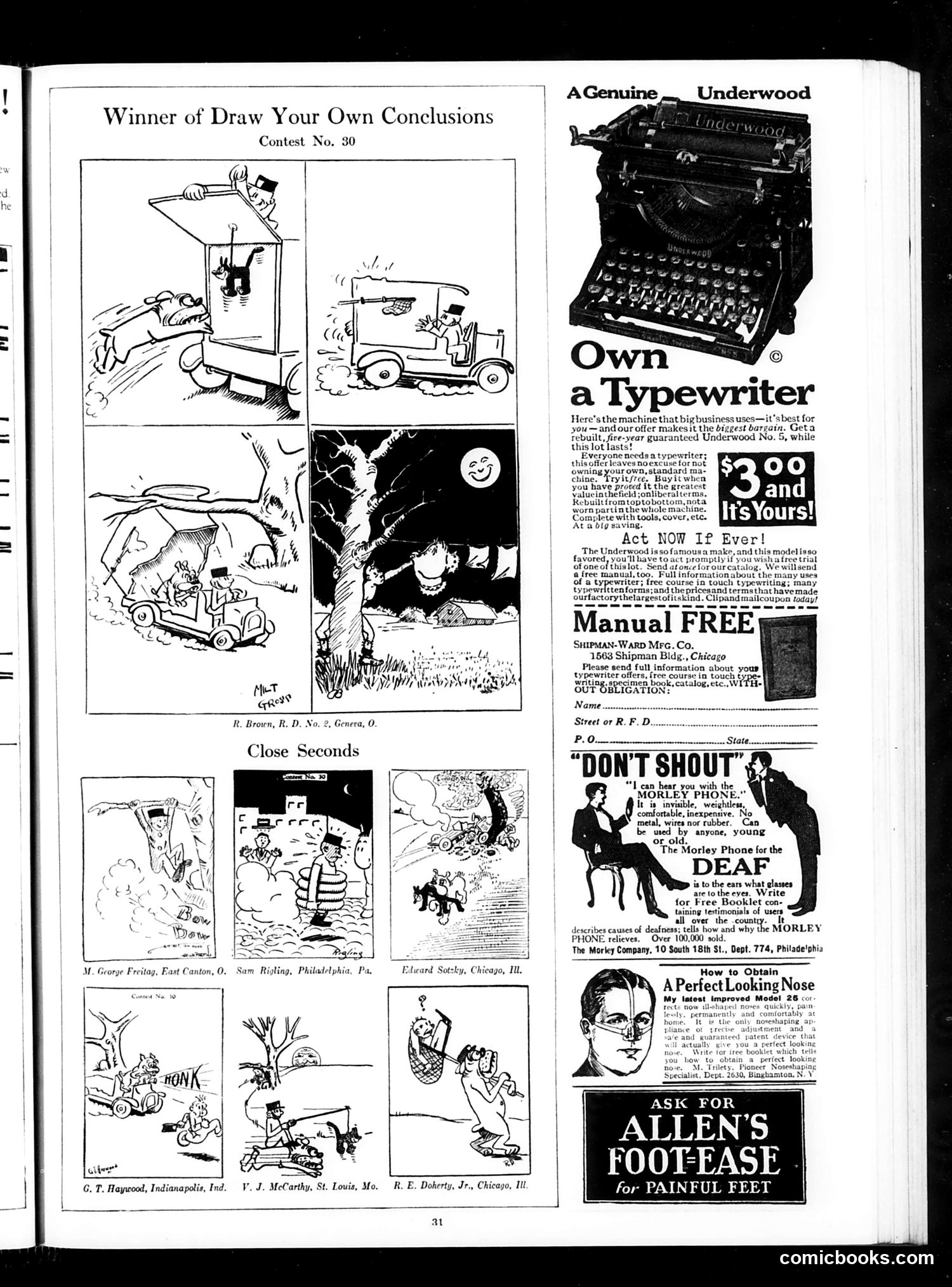
This is primarily an **advertising page** from Judge magazine (a satirical publication), featuring a contest results section and multiple product advertisements. The top section showcases winning cartoon submissions from "Draw Your Own Conclusions Contest No. 30"—humorous single and multi-panel comics by amateur contributors showing everyday scenarios with absurdist twists (cars causing chaos, nighttime mishaps, etc.). Below are "Close Seconds"—additional contest entries. The right side contains period advertisements: - **Underwood Typewriter** ("Own a Typewriter for $3") - **Morley Phone for the Deaf** (an early hearing aid device) - **Nose correction product** ("A Perfect Looking Nose") - **Allen's Foot-Ease** (foot pain remedy) These ads reflect early 20th-century consumer culture and remedial products. The Morley Phone is particularly notable as an assistive device predating modern hearing aids. The overall page mixes amateur humor contests with commercial appeals—typical of Judge's revenue model blending satirical content with advertising.
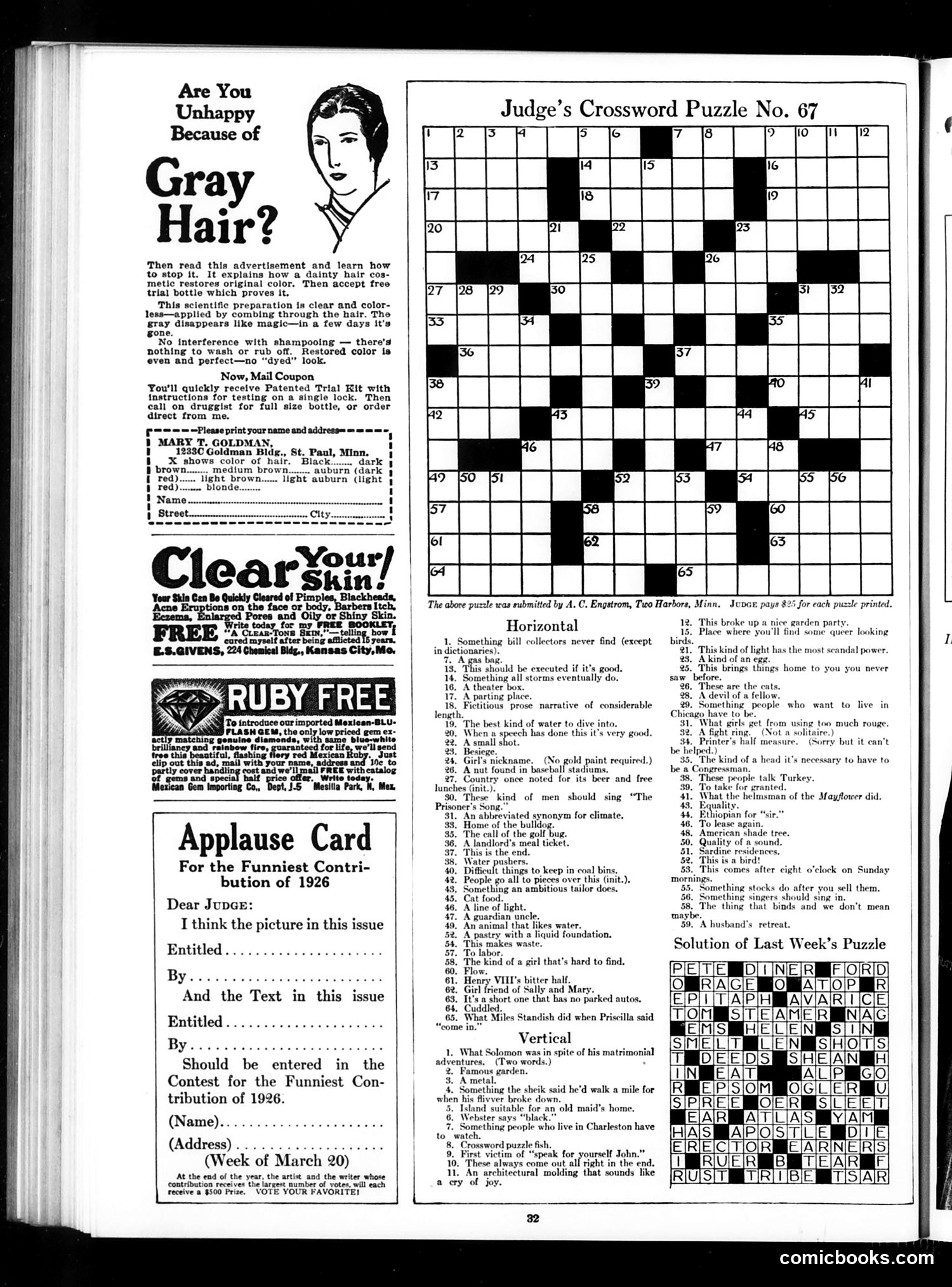
This page is primarily **advertisements and puzzles** rather than political satire. The upper left contains a hair-dye advertisement ("Are You Unhappy Because of Gray Hair?") and a skin-care ad ("Clearskin"), typical commercial content from the 1920s. A ruby gemstone pitch follows. The dominant feature is **"Judge's Crossword Puzzle No. 67"**—the crossword was a major fad in the mid-1920s, and Judge capitalized on its popularity. Below it is the solution to the previous week's puzzle. An **"Applause Card"** section invites readers to nominate the funniest contribution published that year, with prizes offered—this was Judge's engagement strategy with its audience. The page reflects 1920s consumer culture and mass-market appeal rather than satirical commentary. The content assumes readers valued entertainment, self-improvement products, and participatory contests typical of popular magazines of this era.
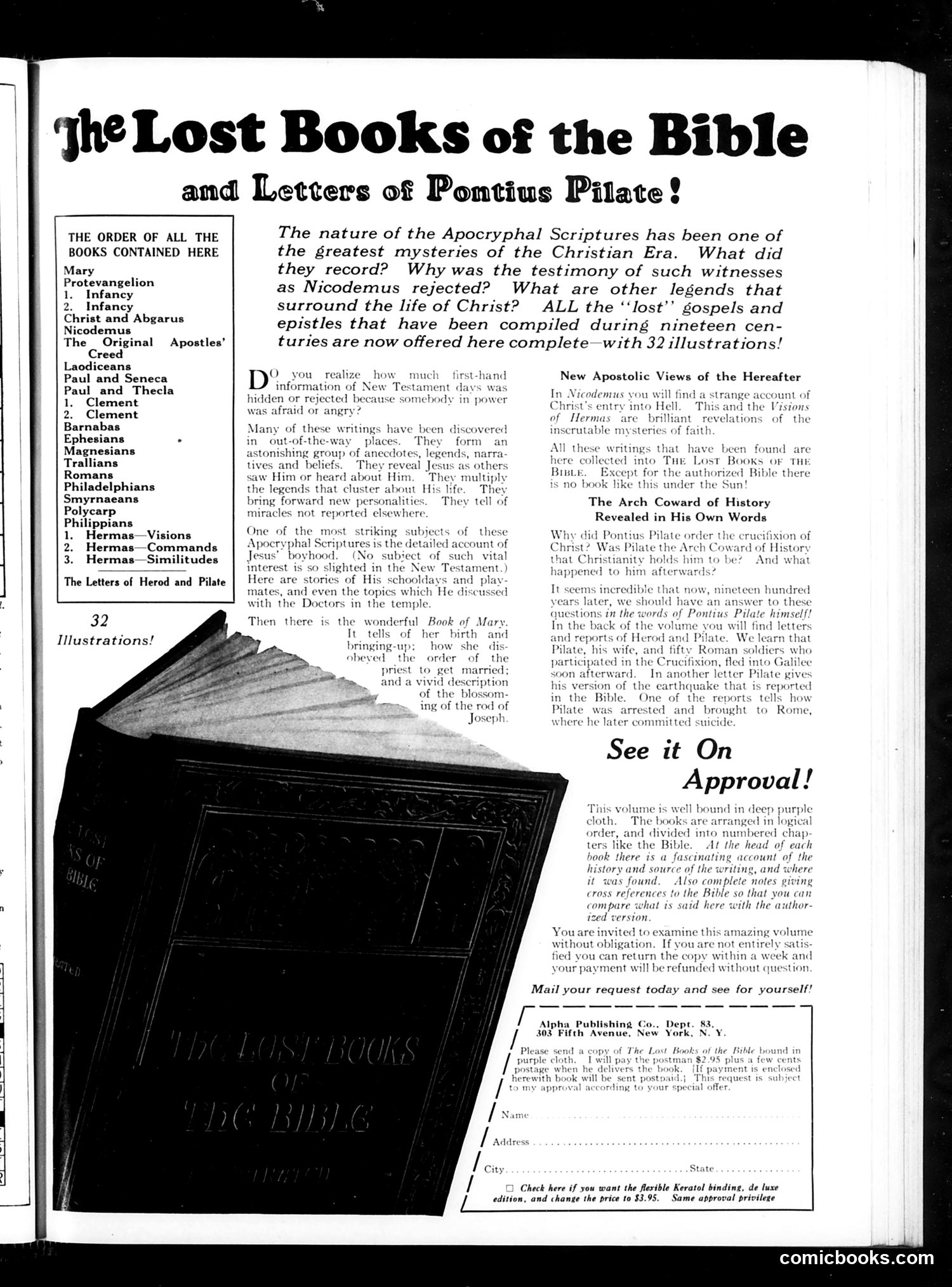
This is **not a cartoon or satire**—it's a **mail-order advertisement** for a book titled *The Lost Books of the Bible and Letters of Pontius Pilate*, published by Alpha Publishing Co. The page promotes an apocryphal religious text collection, claiming to compile "lost" gospels and epistles excluded from the canonical Bible. It emphasizes sensational content: Jesus's childhood (absent from official Gospels), Mary's biography, and—most dramatically—letters allegedly written by Pontius Pilate confessing his cowardice in the Crucifixion. The marketing strategy targets curiosity about religious mysteries and hidden knowledge. The phrase "Arch Coward of History / Revealed in His Own Words" uses melodramatic language to attract readers. **Historical context**: Such apocryphal collections were common mail-order products in early-to-mid 20th century America, appealing to readers interested in alternative religious narratives outside mainstream Christianity. The ad's tone reflects period advertising conventions—bold claims, appeal to forbidden knowledge, and a "examine without obligation" sales technique. This represents commercial religious publishing, not editorial commentary.
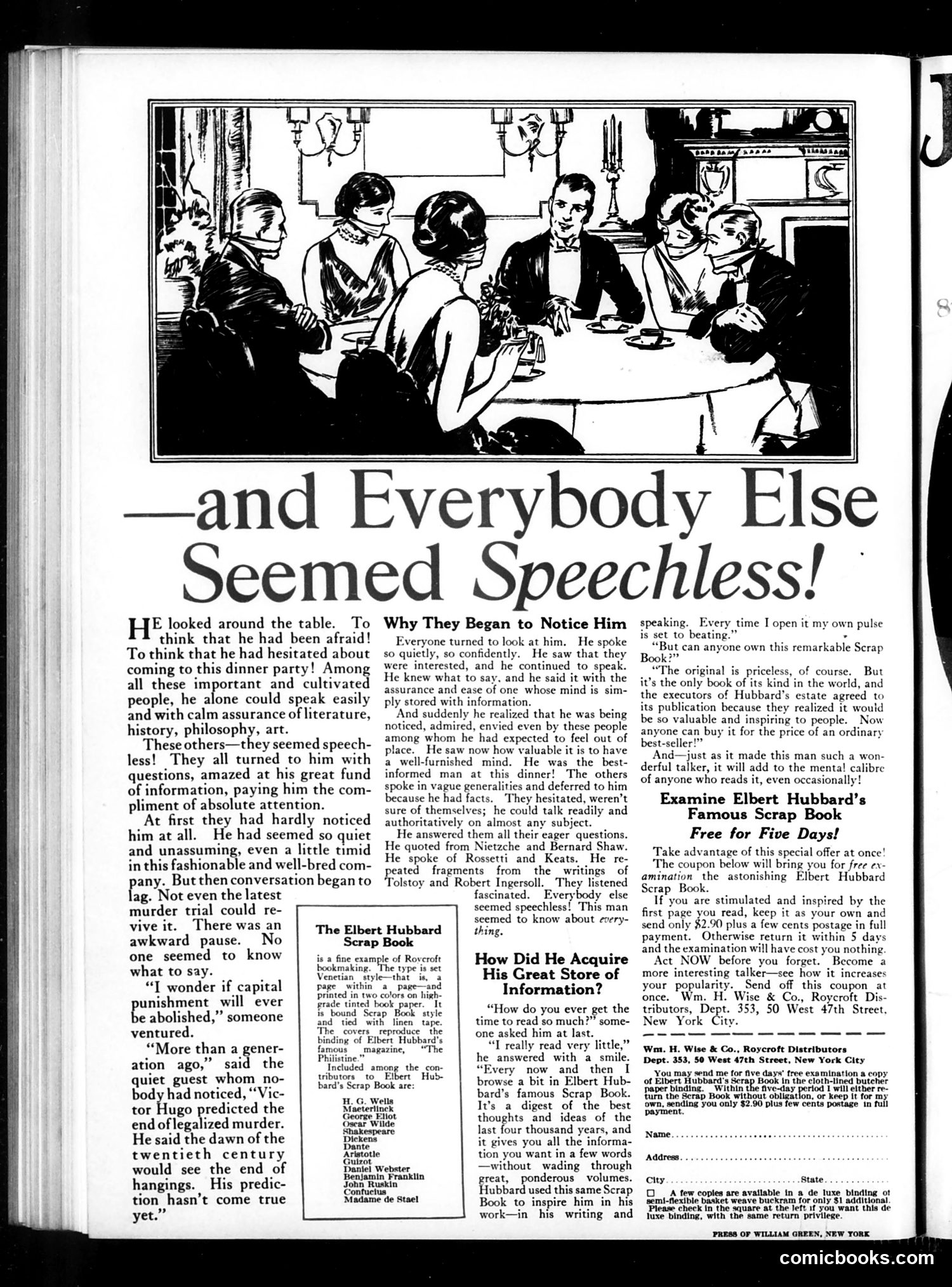
This page combines **satire with advertising**. The cartoon depicts a dinner party where a previously overlooked, quiet guest suddenly commands attention by discussing literature, philosophy, and history with confidence and specificity—quoting Nietzsche, Shaw, Rossetti, and others. The satire targets **social insecurity and intellectual pretension**: the other guests are portrayed as vapid conversationalists relieved when someone provides "facts" to discuss. The joke is that this guest's apparent erudition comes not from deep reading but from browsing *Elbert Hubbard's Scrap Book*—a digest of famous quotations and ideas. The second half is **direct advertising** for this Scrap Book, claiming it contains "the best thoughts and ideas of the last four thousand years" in digestible form. The implicit message: you too can impress dinner guests by appearing well-read without actually reading substantial works. The satire criticizes both social pretension and intellectual laziness, while the ad cynically exploits exactly those impulses it mocks.