
Judge, 1926-03-20 · page 15 of 36
Judge — March 20, 1926 — page 15: what you’re looking at
What you’re looking at
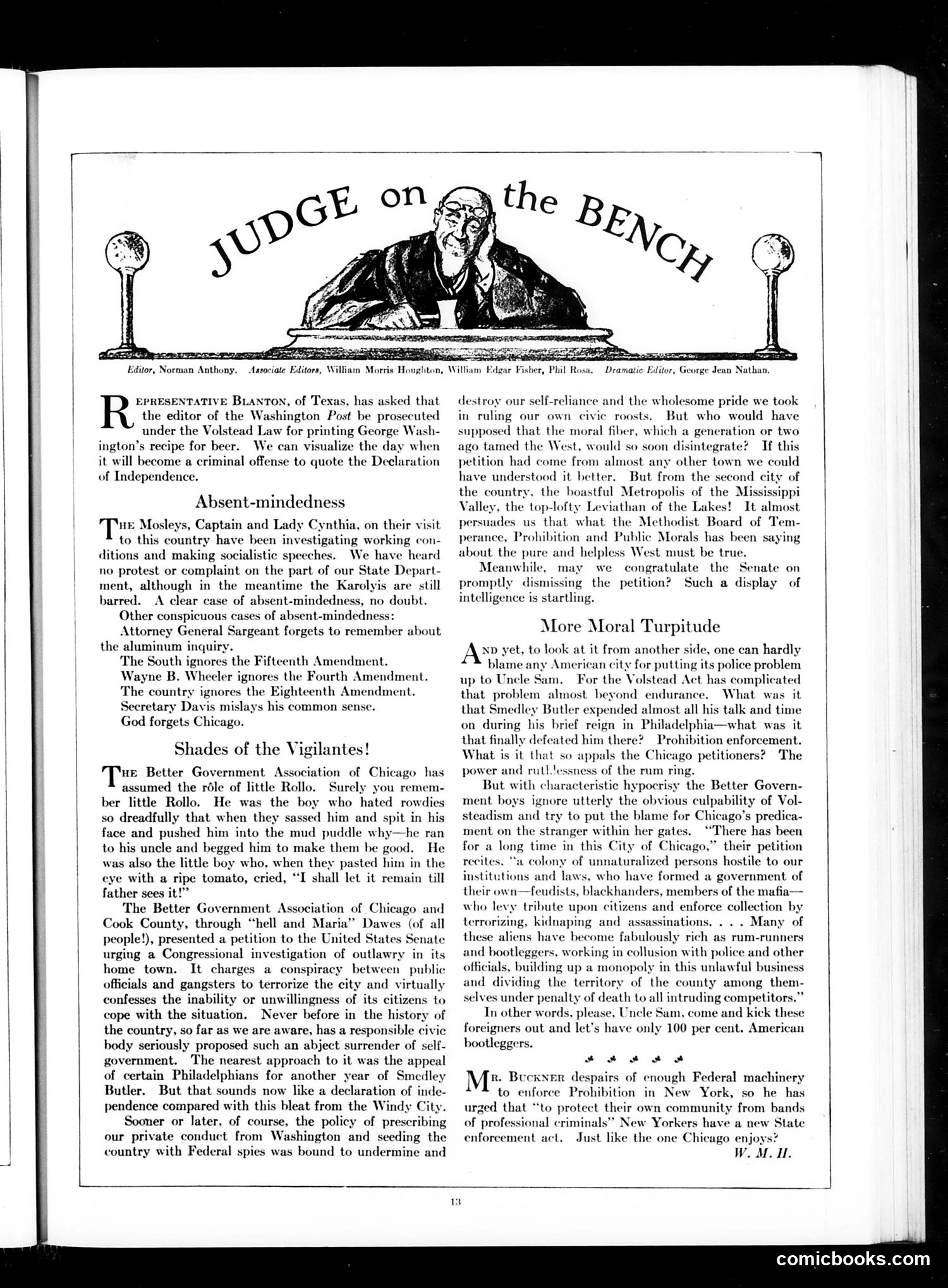
This page satirizes Prohibition-era governance and perceived hypocrisy. The header features a stern judge presiding over commentary. **Key targets:** - **Rep. Blanton's prosecution request**: Attacking a Texas politician's attempt to prosecute the *Washington Post* for printing George Washington's beer recipe under the Volstead Act (Prohibition law)—absurdly expanding federal overreach. - **The Mosley visit vs. Karolyi ban**: Critiquing inconsistent State Department policy—investigating British labor activists face no protest, while Hungarian Karolyis remain barred (likely anti-communist bias). - **Chicago's "Better Government Association"**: Mocking Chicago's appeal to the Senate for federal help combating gangster-police corruption. The satire compares citizens reporting their own city's problems to a weak child (little Rollo) tattling to his uncle—suggesting moral weakness and surrendering civic self-reliance. - **General theme**: The page denounces federal micro-management destroying American self-reliance while gangsterism thrives because Prohibition itself complicated law enforcement.
📄 Transcribed text from this page (OCR, searchable)
Machine-transcribed from the original scan — historical spelling and the odd misread are preserved.
Editor, Norman Anthony. EPRESENTATIVE BLanTON, of Texas, has asked that R the editor of the Washington Post be prosecuted under the Volstead Law for printing George Wash- ington’s recipe for beer. We can visualize the day when it will become a criminal offense to quote the Declaration of Independence. Absent-mindedness Te Mosleys, Captain and Lady Cynthia, on their visit to this country have been investigating working con- ditions and making socialistic speeches. We have heard no protest or complaint on the part of our State Depart- ment, although in the meantime the Karolyis are still barred. A clear case of absent-mindedness, no doubt. Other conspicuous cases of absent-mindednes: Attorney General Sargeant forgets to remember about the aluminum inquir The South ignores the Fifteenth Amendment. Wayne B. Wheeler ignores the Fourth Amendment. The country ignores the Eighteenth Amendment. Secretary Davis mislays his common sense. God forgets Chicago. Shades of the Vigilantes! HE Better Government Association of Chicago has assumed the réle of little Rollo. Surely you remem- ber little Rollo. He was the boy who hated rowdies so dreadfully that when they sed him and spit in his face and pushed him into the mud puddle why—he ran to his uncle and begged him to make them be good. He was also the little boy who, when they pasted him in the eye with a ripe tomato, cried, “I shall let it remain till father sees it!” The Better Government Association of Chicago and Cook County, through “hell and Maria” Dawes (of all people!), presented a petition to the United States Senate urging a Congressional investigation of outlawry in its home town. It charges a conspiracy between public officials and gangsters to terrorize the city and virtually confesses the inability or unwillingness of its citizens to cope with the situation. Never before in the history of the country, so far as we are aware, has a responsible c body seriously proposed such an abject surrender of self- government. The nearest approach to it was the appeal of certain Philadelphians for another year of Smedley Butler. But that sounds now like a declaration of inde- pendence compared with this bleat from the Windy City. Sooner or later, of course, the policy of prescribing our private conduct from Washington and seeding the country with Federal spies was bound to undermine and Aesociate Editors, William Morris Houghton, William Edgar Fisher, Phil R. Dramatic Editor, George Jean Nathan. destroy our self-reliance and the wholesome pride we took in ruling our own civic But who would have supposed that the moral fiber, which a generation or two ago tamed the West, would so soon disintegrate? If this petition had come from almost any other town we could have understood it better. But from the second city of the country, the boastful Metropolis of the Mississippi Valley, the top-lofty Leviathan of the Lakes! It almost persuades us that what the Methodist Board of Tem- perance, Prohibition and Public Morals has been saying about the pure and helpless West must be true. Meanwhile, may we congratulate the Senate on promptly dismissing the petition? Such a display of intelligence is startling. roosts. More Moral Turpitude ND yet, to look at it from another side, one can hardly blame any American city for putting its police problem up to Uncle Sam. For the Volstead Act has complicated that problem almost beyond endurance. What was it that Smedley Butler expended almost all his talk and time on during his brief reign in Philadelphia—what was it that finally defeated him there? What is it that so appals the Chicago petitioners? power and rutl.'essness of the rum ring. But with characteristic hypocrisy the Better Govern- ment boys ignore utterly the obvious culpability of Vol- steadism and try to put the blame for Chicago's predica- ment on the stranger within her gates. ‘There has been for a long time in this City of Chicago,” their petition recites. “a colony of unnaturalized persons hostile to our institutions and laws, who have formed a government of their own—feudists, blackhanders, members of the mafia— who levy tribute upon citizens and enforce collection by , kidnaping and assassinations. . . . Many of these aliens have become fabulously rich as rum-runners and bootleggers, working in collusion with police and other officials, building up a monopoly in this unlawful business and dividing the territory of the county among them- selves under penalty of death to all intruding competitors In other words, please, Uncle Sam, come and kick these foreigners out and let’s have only 100 per cent. American bootleggers. M: Buckner desp: Prohibition enforcement. The se s of enough Federal machinery to enforce in New York, so he has urged that “to protect their own community from bands of professional criminals” New Yorkers have a new State enforcement act. Just like the one Chic Prohibition go enjo W.M. UW. comicbooks.com