
Judge, 1926-03-20 · page 19 of 36
Judge — March 20, 1926 — page 19: what you’re looking at
What you’re looking at
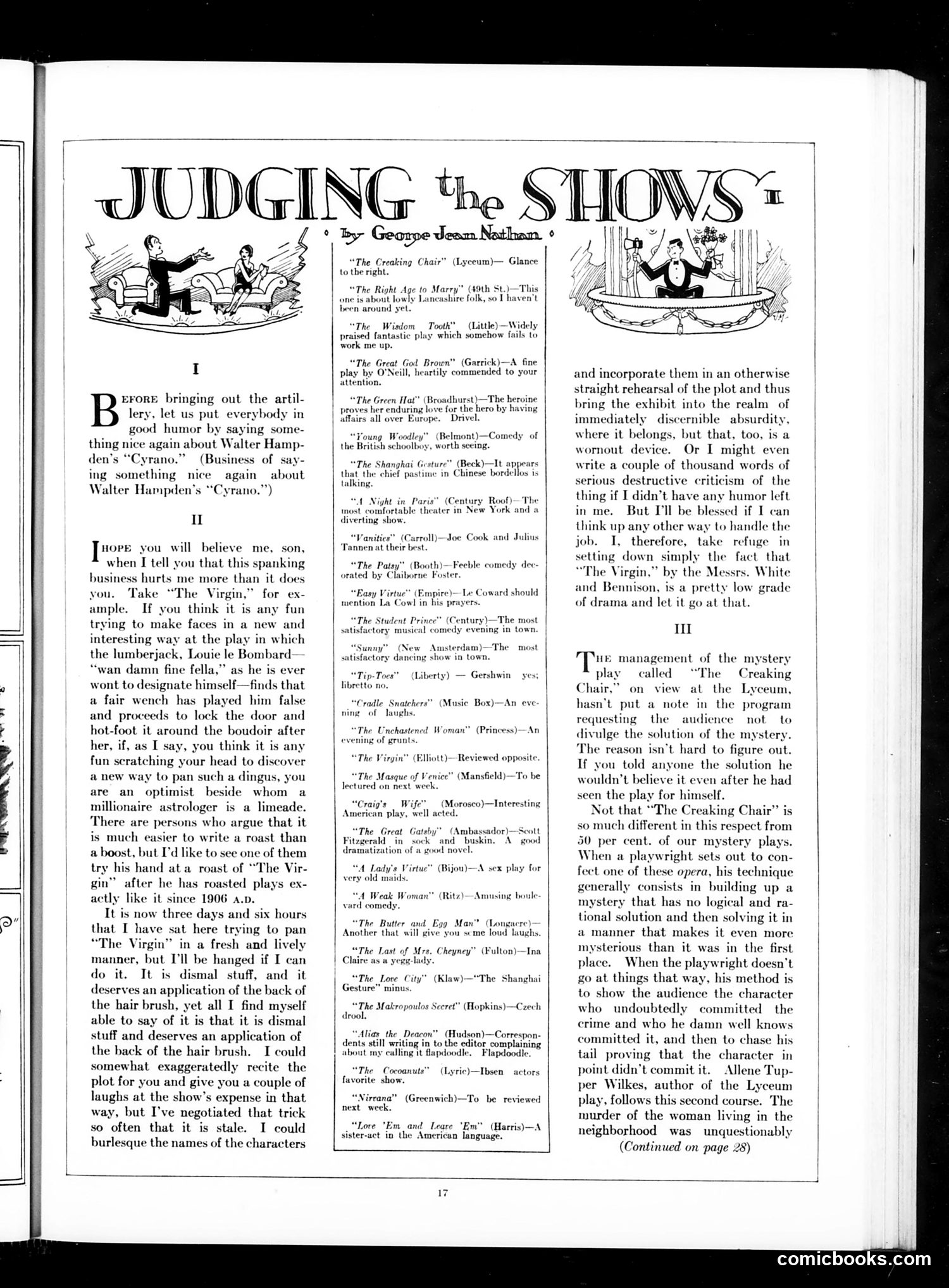
This is a theater criticism column, not a political cartoon. Nathan, a prominent drama critic of the 1920s, uses self-deprecating humor to discuss his difficulty reviewing plays. The central joke: Nathan admits he's exhausted from reviewing similar plots repeatedly since 1906 and struggles to find fresh criticism of "The Virgin"—a mediocre play about a lumberjack pursuing a woman. He ironically suggests it's easier to write praise than genuine critique, yet finds himself circling back to the same tired observations. The accompanying illustrations depict theatrical scenes rather than political satire. The list reviews current Broadway productions, with Nathan's pithy judgments (praising O'Neill's "The Great God Brown," dismissing "The Shanghai Gesture" as characters merely talking in bordellos). This represents early 20th-century theater criticism's self-aware frustration with formulaic drama and the critic's repetitive task.
📄 Transcribed text from this page (OCR, searchable)
Machine-transcribed from the original scan — historical spelling and the odd misread are preserved.
EFORE bringing out the artil- lery, let us put. everybody in good humor by saying some- thing nice again about Walter Hamp- (Business of say ing something nice again about Walter Hampden’s “Cyrano. den’s “ no. II HOPE you will believe me, son, when I tell you that this spanking business hurts me more than it does you. Take “The Virgin,” for ex- ample. If you think it is any fun trying to make faces in a new and interesting way at the play in which the lumberjack, Louie le Bombard van damn fine fella,” as he is ever wont to designate himself—finds that a fair wench has played him false and proceeds to lock the door and hot-foot it around the boudoir after her, if, as I say, you think it is any fun scratching your head to discover a new way to pan such a dingus, you are an optimist beside whom a millionaire astrologer is a limeade. There are persons who argue that it is much easier to write a roast th: a boost, but I'd like to see one of them try his hand ata roast of “The V gin” after he has roasted plays ex- actly like it since 1906 a.p. It is now three days and six hours that I have sat here trying to pan “The Virgin” in a fresh and lively manner, but I'll be hanged if I can do it. It is dismal stuff, and_ it deserves an application of the back of the hair brush, yet all I find myself able to say of it is that it is dismal stuff and deserves an application of the back of the hair brush. I could somewhat exaggeratedly recite the plot for you and give you a couple of laughs at the show’s expense in that way, but I've negotiated that trick so often that it is stale. I could burlesque the names of the characters NG ‘he SHOWS * by Geanpe Jean Nathan ¢ The Creaking Chair” (Lyceum)— Glance to the right. “The Right Age to Marry” (49th St.)—This | one is about lowly Lancashire folk, so T haven't been around yet. “The Wisdom — Tooth” (Little) —Widely praised fantastic play which somehow fails to work me up. “The Great Gol Brown” (Garrick)—A fine play by O'Neill, heartily commended to your attention, “The Green Hat” (Broadhurst)—The heroine proves her enduring love for the hero by having irs a c e. Driv Belmont)—Comedy of worth seeing. Young Woodley" the British schoolb “The Shanghai Gesture” (Beck)—It appea that the chief pastime in Chinese bordellos is talking, “A Night in Paris” (Century Roof)—The most comfortable theater in New York and a diverting show ‘nities (Carroll)—Joe Cook and Julius ‘Tannen at their best. “The Patsy” (Booth orated by Claiborne Fo: tasy Virtue" (Empire)— Le Coward should mention La Cowl in his prayers. “The Student Prince” (Century)—The most | satisfactory musical comedy evening in town, “Sunny” (New Amsterdam)—The most isfactory dancing show in town. “Tip-Toes Liberty) — Gershwin yes; libretto no. “Cradle Snatchers” (M ning of laughs. Box)—An eve the Unchastencd Woman” (Princess)—An ing of grunts. “The Virgin” (Elliott)—Reviewed opposite The Masque of Venice” (Mansfield) —To be lectured on next week. “Craig's Wife” (Morosco)—Interesting American play, well acted. “The Great Gatsby” (Ambassador)—Scott Fitzy sock and buskin. A good dramat mi novel. “A Lady's Virtue” (Bijou)—A sex play for very old maids. Weak Woman’ (Ritz)—Amusing boule f Mrs. Cheyney” (Fulton) —Ina 4 “The Lore City” (Klaw)—"The Shanghai Gesture” minus. he Mal:ropoulos Secret” (Hopkins)—Czech drool. lie the Deacon (Hudson)—Correspon- dents still writing in to the editor complaining about my calling it fapdoodle. - Flapdoodle. “The Cocoanuts” ( Thsen actors favorite show. Vireana” (Greenwich)—To be reviewed next week. ore "Em and Leare ‘Em" (Harris)— the American language. and incorporate them in an otherwise straight rehearsal of the plot and thus bring the exhibit into the realm of immediately discernible absurdity where it belongs, but that, too, is a wornout device. Or I might even write a couple of thousand words of serious destructive criticism of the thing if I didn’t have any humor left in me. But I'll be blessed if I ean think up any other way to handle the job. I, therefore, take refuge in setting down simply the fact that “The Virgin,” by the Messrs. White and Bennison, is a pretty low grade of drama and let it go at that. Il Te management of the mystery play called he Creaking Chair,” on view at the Lyceum, hasn't put a note in the program requesting the audience not to divulge the solution of the mystery. The reason isn’t hard to figure out. If you told anyone the solution he wouldn't believe it even after he had seen the play for himself. Not that “The Creaking Chair” is so much different in this respect from 50 per cent. of our mystery plays. When a playwright sets out to con- fect one of these opera, his technique generally consists in building up a y that has no logical and ra- solution and then solving it in a manner that makes it even more mysterious than it was in the first place. When the playwright doesn’t go at things that way, his method is to show the audience the character who undoubtedly committed the crime and who he damn well knows committed it, and then to chase his tail proving that the character in point didn’t commit it. Allene Tup- per Wilkes, author of the Lyceum play, follows this second course. The murder of the woman living in the neighborhood was unquestionably (Continued on page 28) comicbooks.com