
A complete issue · 36 pages · 1926
Judge — February 6, 1926
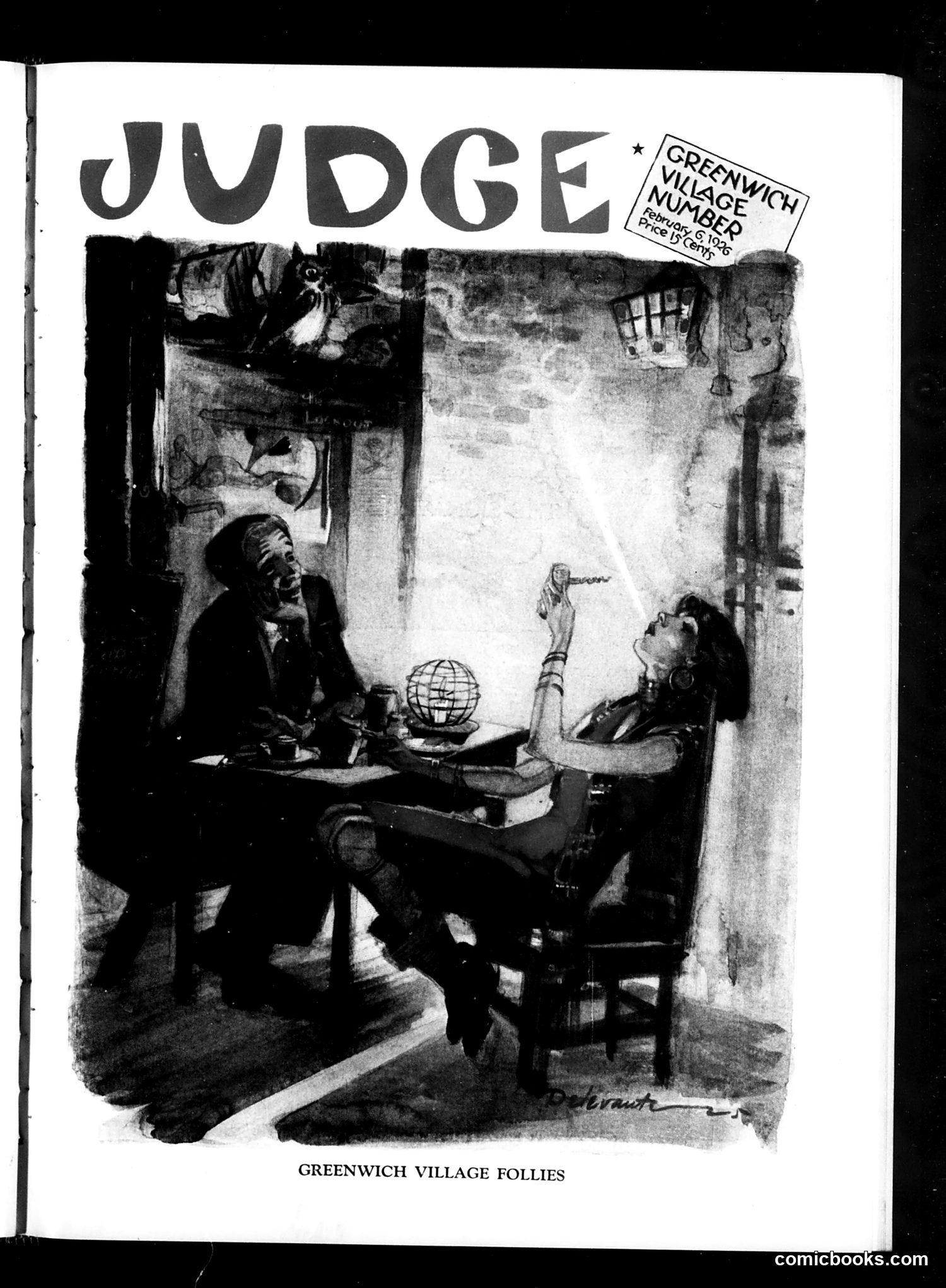
This page from *Judge* magazine features a cartoon titled "Greenwich Village Follies" (subtitle indicates it's from the Greenwich Village Follies theatrical production). The image shows two figures in what appears to be a cramped, run-down apartment or room, sitting at a small table with a globe between them. One figure appears to be gesturing upward dramatically. The satire likely mocks Greenwich Village's bohemian culture and artistic pretensions—a common target for Judge's conservative humor. The cramped setting, theatrical poses, and globe suggest commentary on intellectuals or would-be sophisticates engaged in pretentious conversation despite their modest circumstances. The "Follies" reference indicates this satirizes the actual theatrical revue celebrating Village life.
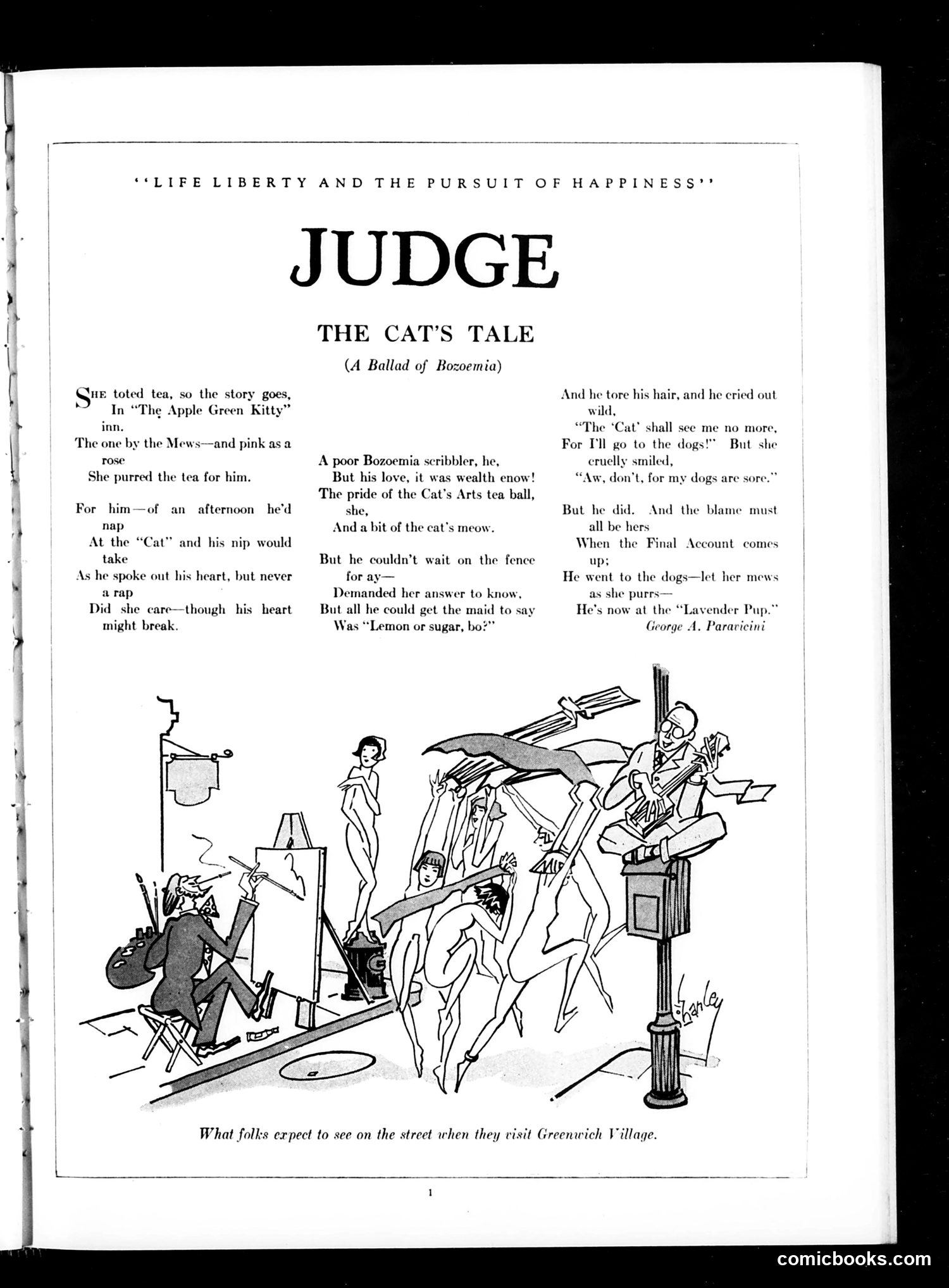
This page presents a humorous ballad about a poor Bohemian scribbler who frequents "The Cat" (likely a Greenwich Village establishment). The poem describes his unrequited affection for a waitress who serves his tea—he pines silently while she remains unaware of his feelings. The illustration depicts Greenwich Village street life: bohemians, artists, and bohemiennes in exaggerated poses. The caption notes "What folks expect to see on the street when they visit Greenwich Village"—suggesting the cartoon mocks outsiders' romanticized perceptions of Village bohemian culture as exotic and unconventional. The satire targets both the starving artist archetype and tourists' fascination with Greenwich Village's reputation as an artistic haven during this era.
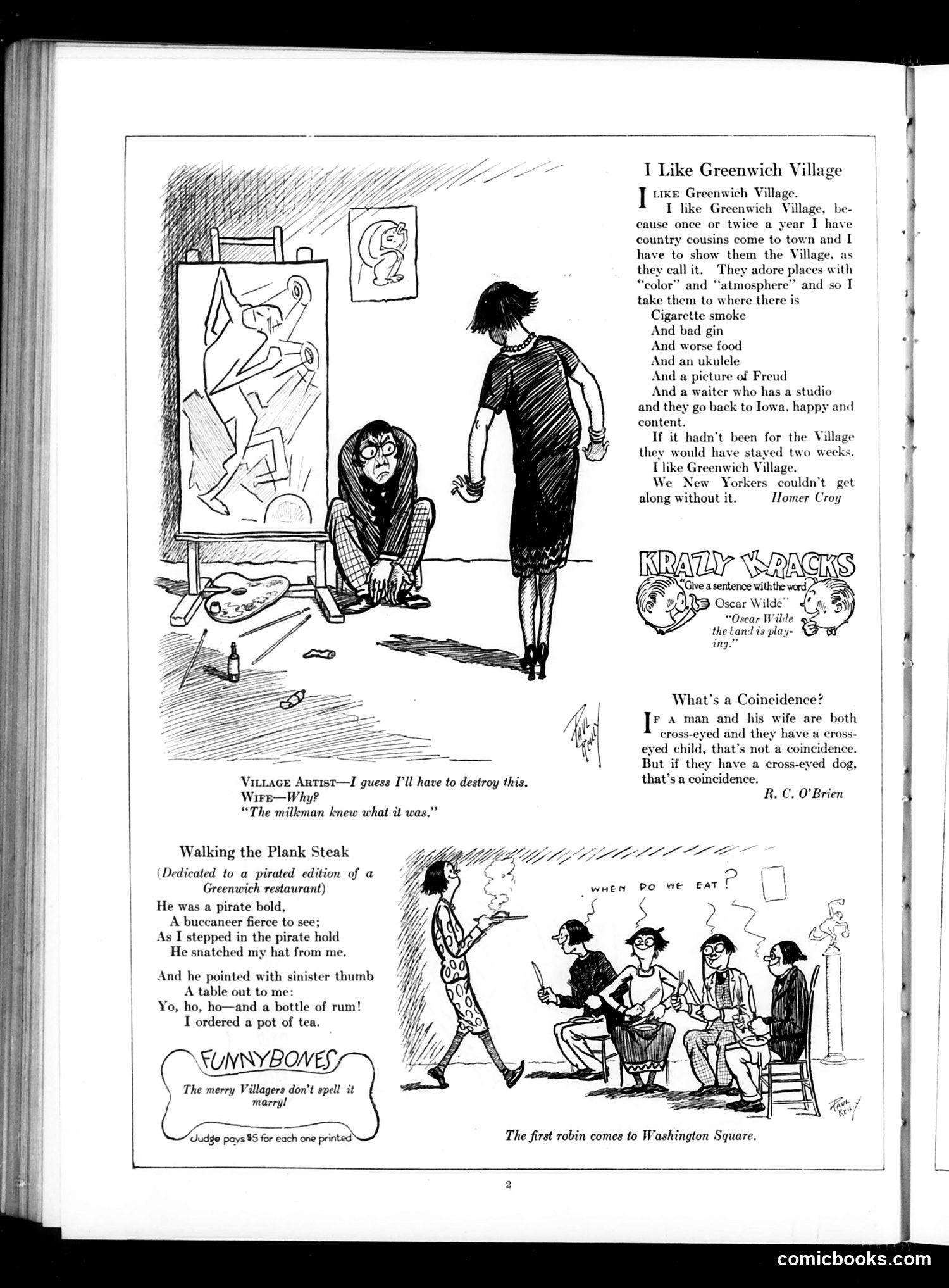
This page contains several humorous pieces targeting Greenwich Village bohemian culture. The main cartoon shows a village artist and a visitor viewing modernist artwork—likely cubist or abstract work—with the artist's dismissive caption suggesting the painting is intentionally destructive ("I guess I'll have to destroy this"). The satire mocks both pretentious modern art and the Village's artistic scene. The poem "I Like Greenwich Village" by Homer Croy affectionately catalogs the neighborhood's bohemian attractions: cigarettes, gin, bad food, and "a picture of Freud," suggesting Village residents' interest in psychoanalysis. Other pieces (the pirate poem, "Krazy Kracks," and the robin cartoon) are lighter humor pieces. Overall, the page satirizes 1920s-era Greenwich Village as a trendy destination for posturing intellectuals and artists.
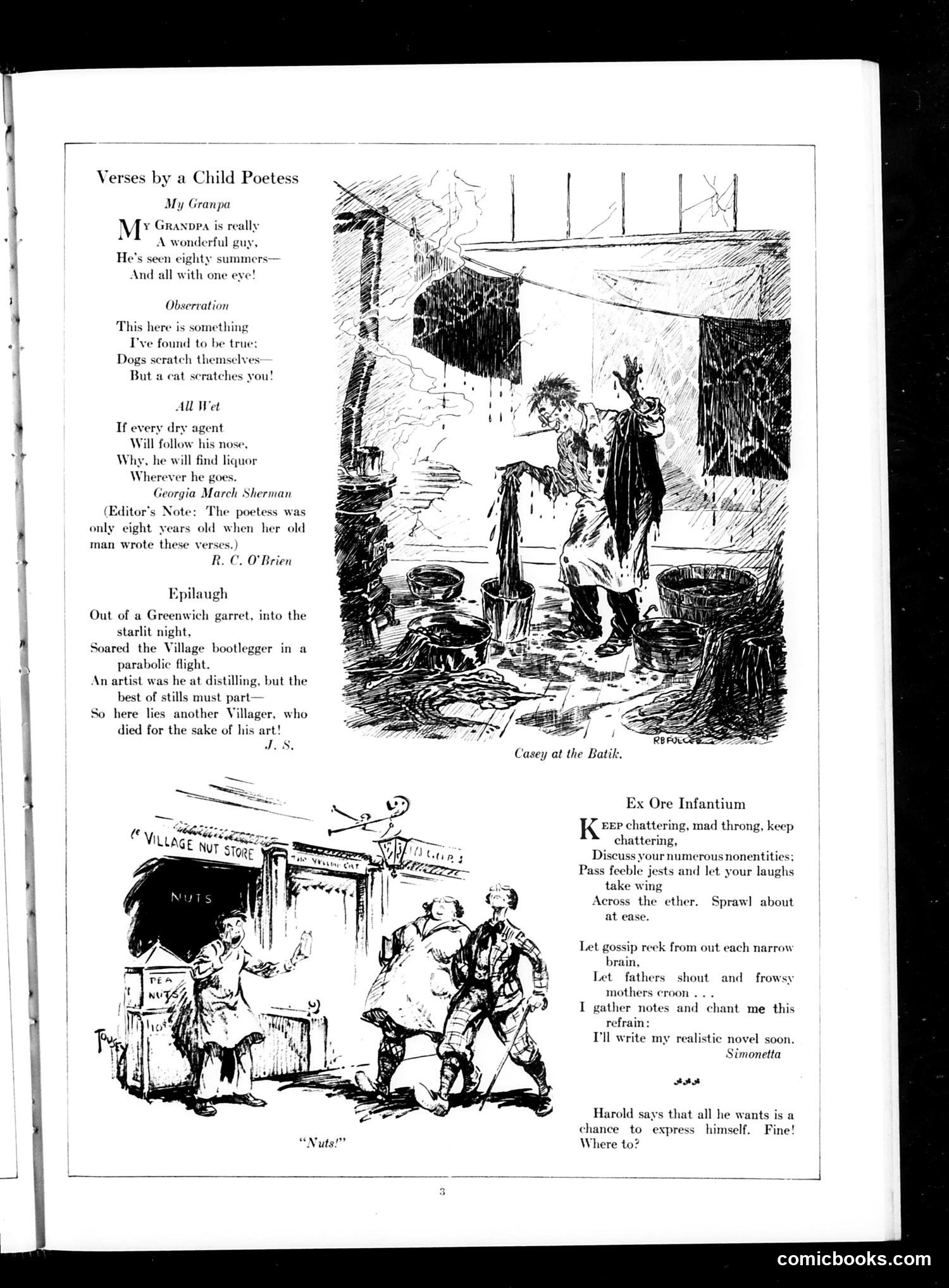
This page presents humorous children's poetry with accompanying illustrations. The content satirizes precocious child writers—a recurring cultural phenomenon of the era. The poems mock childish observations presented as profound wisdom: a granddaughter noting her elderly grandfather's appearance, a child's "scientific" observation that dogs scratch but cats don't, and a drunk man's predictable behavior. The illustrations show domestic scenes: children at a batik station, and a village nut store. The section "Ex Ore Infantium" (Latin: "From the Mouths of Infants") continues the satire, presenting juvenile musings on writing novels and self-expression as though they were philosophical insights. The humor relies on the contrast between children's simplistic observations and their presentation as serious literary output—likely parodying the period's fashion for publishing child prodigies' works.
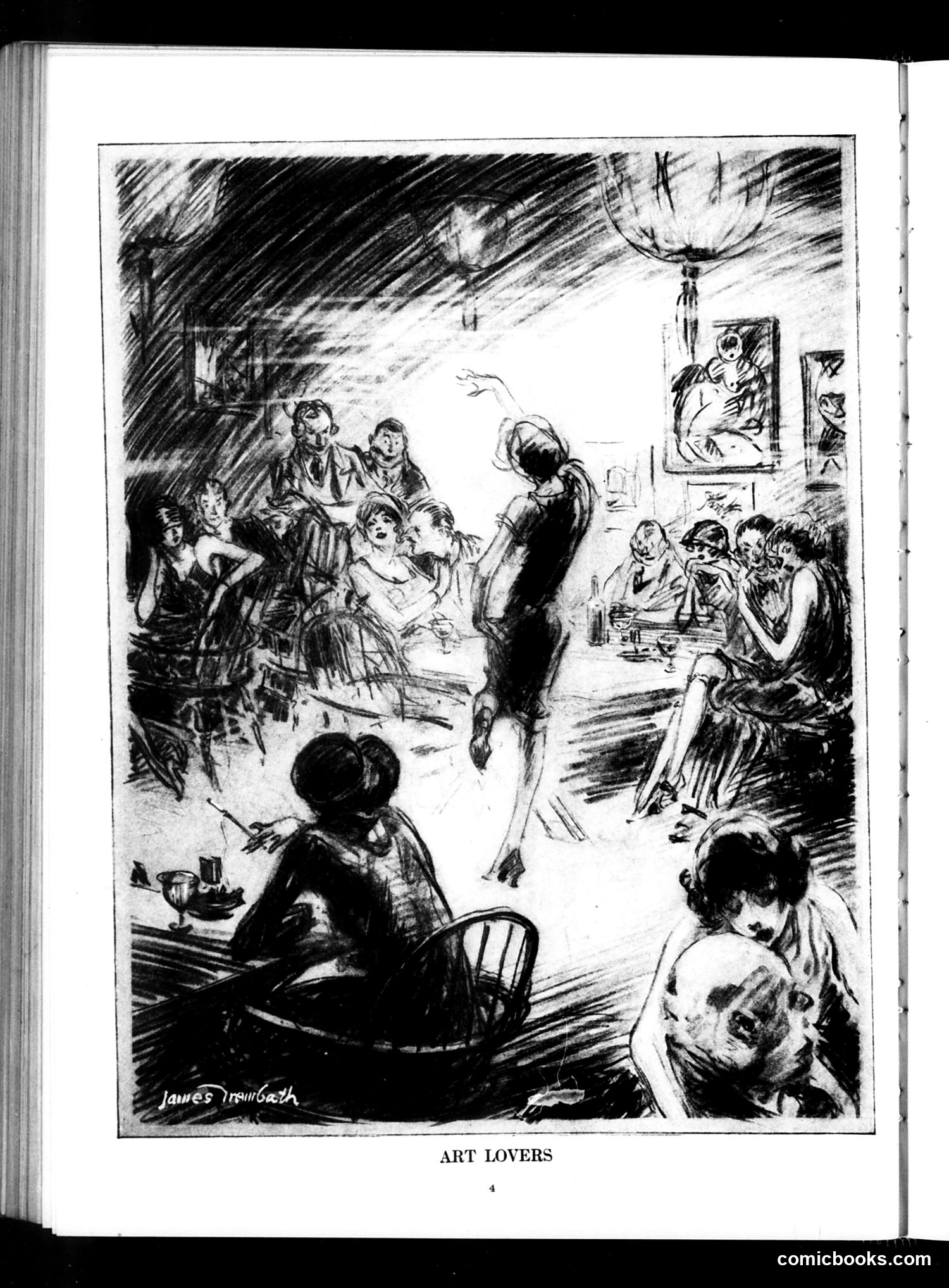
This sketch by James Britton depicts what appears to be a bohemian or artistic gathering in an attic studio space. The title "Art Lovers" suggests satire of the art world or pretentious artistic circles popular in early-to-mid 20th century America. The crowded, somewhat chaotic scene—with figures in various poses around the space, artwork on walls, and casual furnishings—likely mocks either: - Struggling artists and their cramped living conditions - Pretentious art enthusiasts gathering in bohemian spaces - The bohemian lifestyle itself The sketch's loose, energetic line work emphasizes the informal, cluttered nature of the scene. Without additional context, the specific target of satire remains unclear, though it comments on artistic or bohemian culture as Judge's readership would have understood it.
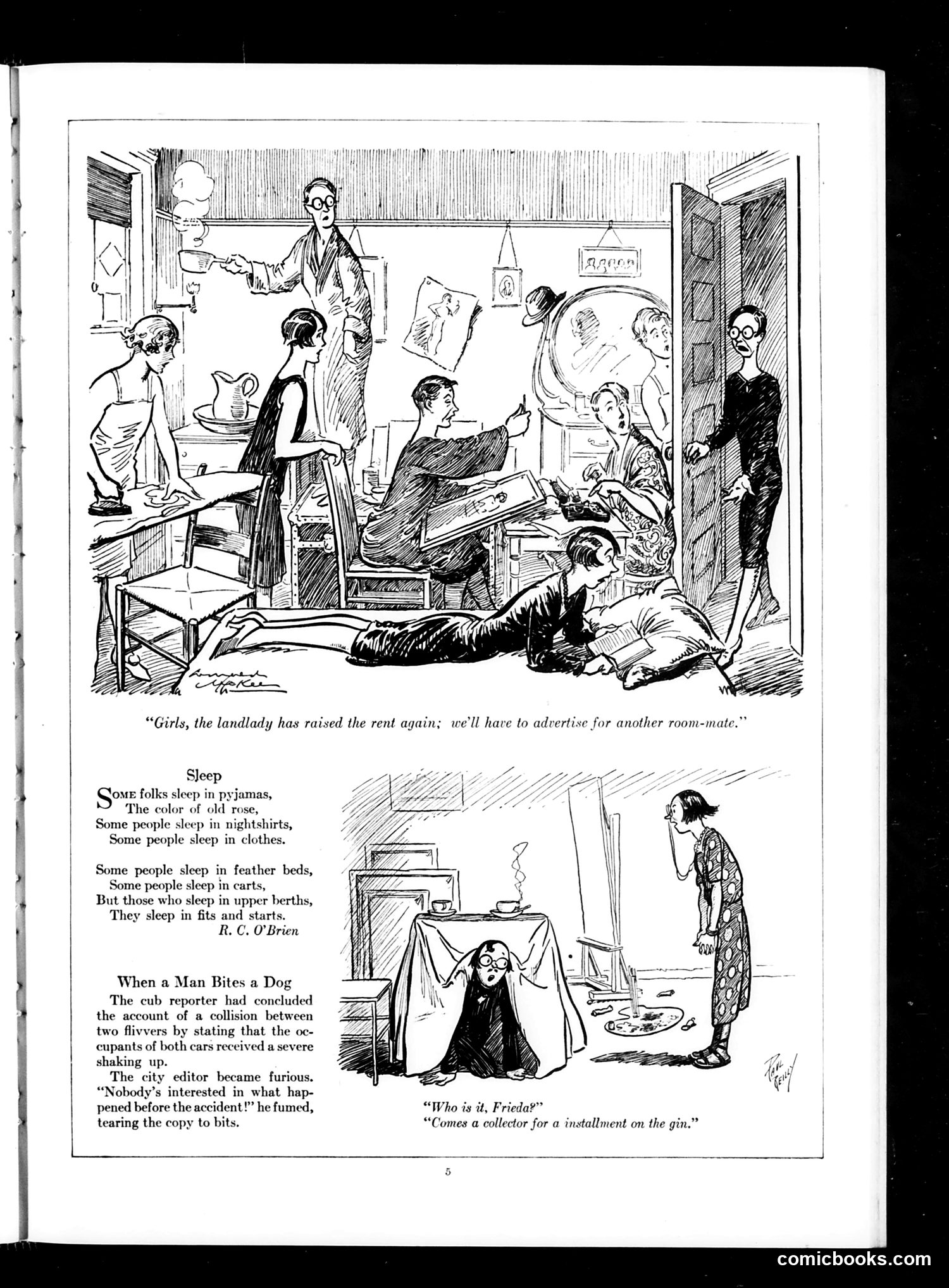
**Top Cartoon:** A crowded apartment scene depicts young women dealing with rising rent. The landlady announces another increase, forcing them to advertise for a roommate. This satirizes the housing crisis affecting working-class renters, particularly young women seeking affordable urban accommodation—a recurring social complaint in early 20th-century American cities. **"Sleep" Poem:** A humorous verse by R.C. O'Brien describing various sleeping arrangements, contrasting comfortable options (feather beds) with desperate ones (upper berths, fits and starts). **"When a Man Bites a Dog":** A newspaper editor dismisses a collision story as uninteresting unless it's sensational. The final cartoon shows a woman under a table ("collector for an installment on the gin"), satirizing Prohibition-era debt and illegal alcohol consumption.
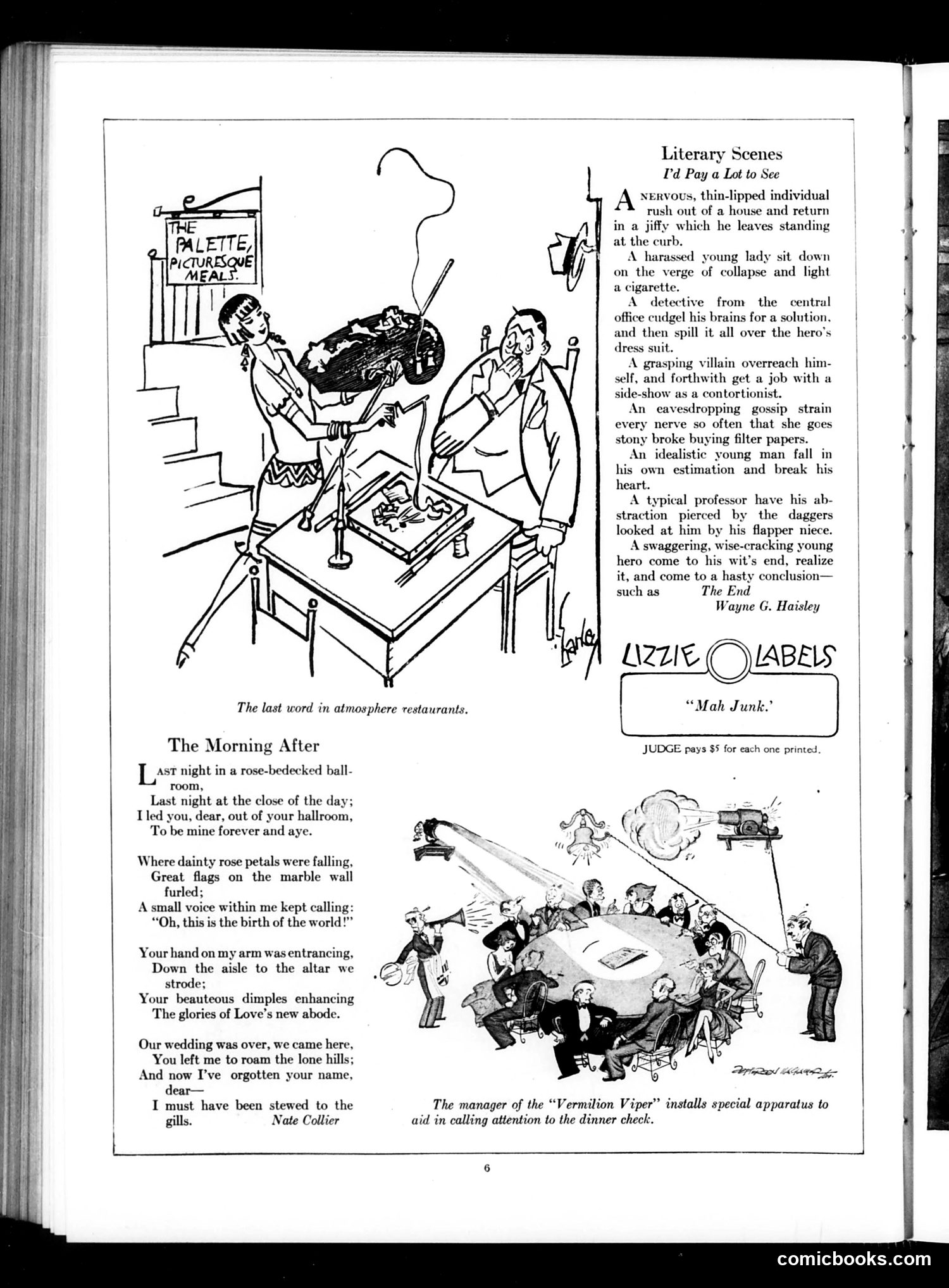
This page satirizes early 20th-century domestic and social conventions through humor and verse. **"I'd Pay a Lot to See"** mocks melodramatic plot devices common in period fiction and theater—nervous protagonists, fainting ladies, incompetent detectives, and overwrought emotional scenarios. It's gentle satire of hackneyed storytelling. **"The Morning After"** presents dark comedy: a romantic wedding night poem that pivots to the husband forgetting his bride's name because he was drunk ("stewed to the gills"). The humor lies in the contrast between flowery courtship language and crude reality. **The cartoons** depict restaurant scenes: one shows chaos at "The Palette, Picturesque Meal"; another illustrates a restaurant manager using exaggerated devices to get diners' attention about unpaid bills. Both mock pretentious dining establishments and their difficulties managing unruly patrons and payment collection. The overall theme targets the gap between romantic/refined aspirations and messy, embarrassing reality—typical Judge magazine fare satirizing middle-class social pretense.
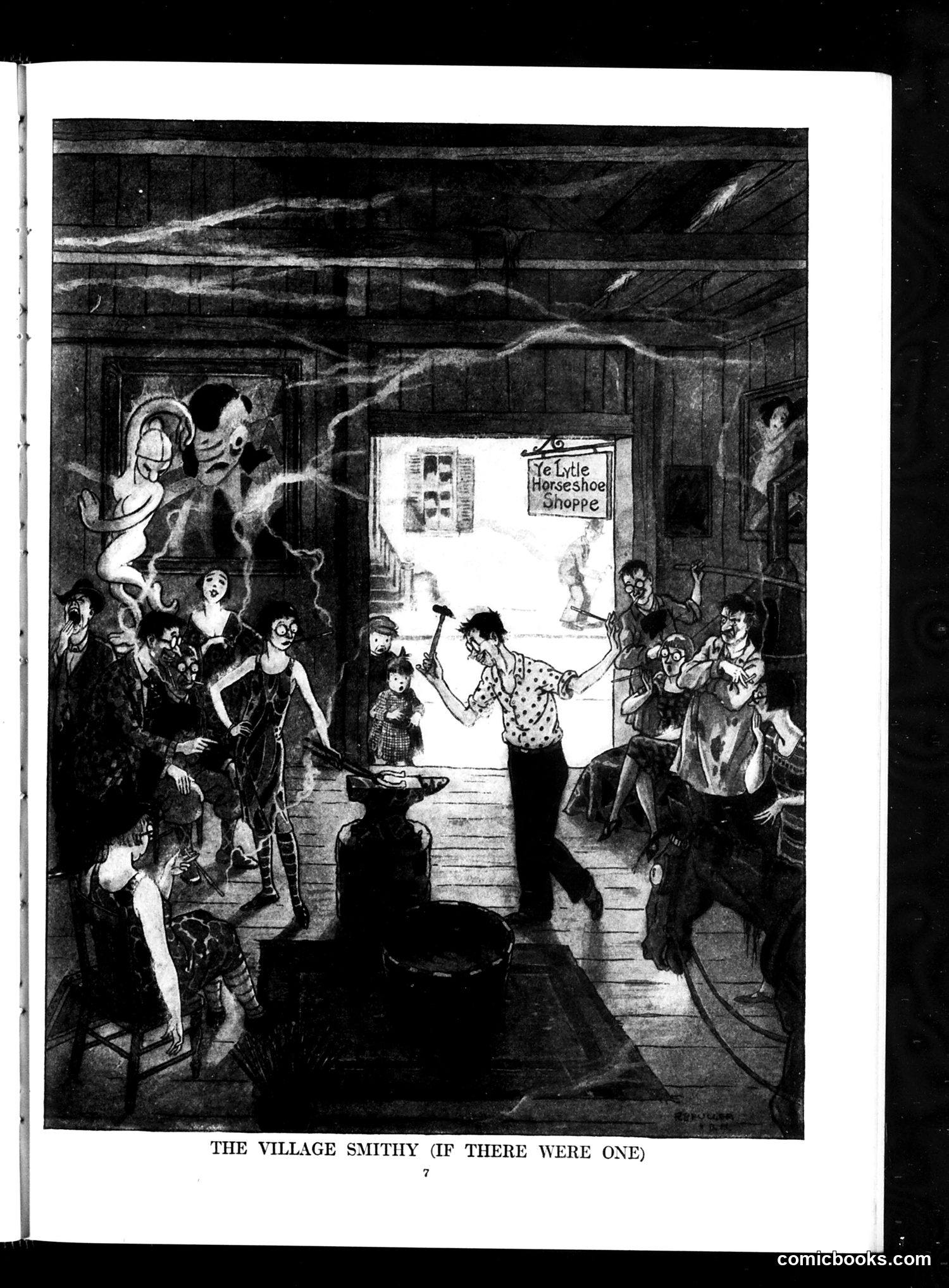
This is a satirical cartoon titled "The Village Smithy (If There Were One)," depicting a chaotic blacksmith shop scene. The image shows a blacksmith at an anvil surrounded by numerous figures engaged in various activities—some appear to be carousing, dancing, or socializing rather than conducting business. The satire likely mocks the romanticized ideal of the village blacksmith (referencing Longfellow's famous poem "The Village Blacksmith") by showing its actual reality would be far messier and more disorderly. Rather than the noble, hardworking craftsman of popular imagination, this depicts a rowdy, chaotic establishment filled with idle patrons and distractions—suggesting that nostalgic rural imagery doesn't match real-world conditions. The shop sign reads "Ye Olde Horseshoe Shoppe," reinforcing the nostalgic setting.
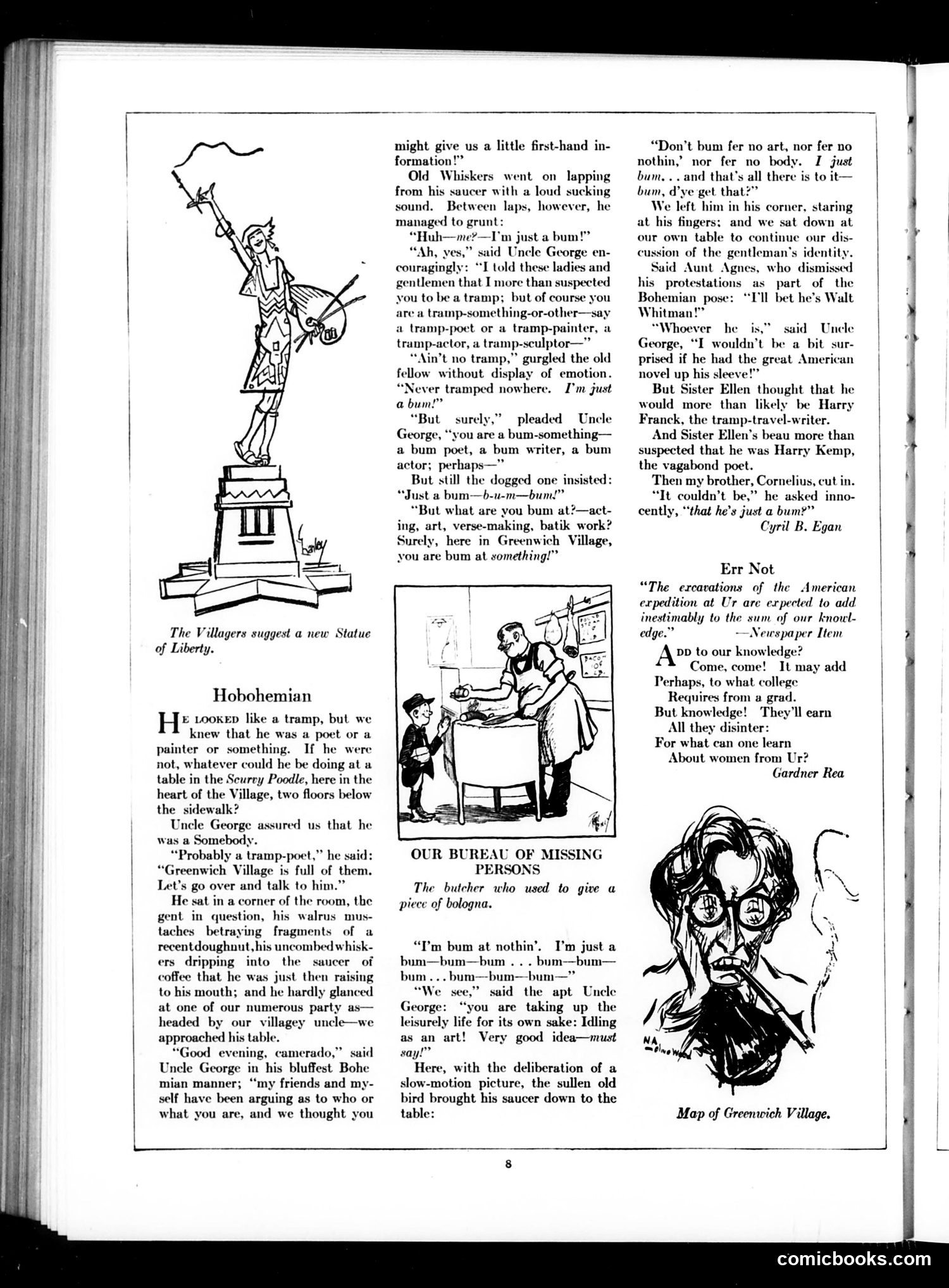
This cartoon mocks Greenwich Village's pretentious bohemian culture of 1920s New York. A shabby man sitting in a Village café is approached by "Uncle George" and his party, who assume his ragged appearance masks artistic genius—he *must* be a "tramp-poet" or "tramp-sculptor" because, as Uncle George reasons, what else would such a character be doing in the Village? The joke: the man insists repeatedly he's "just a bum"—not a bohemian artist, not a tortured writer, simply unemployed and broke. The Village socialites refuse to accept this literal truth, convinced his poverty is performative artistry. They speculate he's Walt Whitman, Harry Franck, or Harry Kemp (actual vagabond poet), unable to fathom that sometimes a bum is just a bum. The satire targets Greenwich Village's romanticization of poverty and bohemianism—the affectation that shabby appearance signals artistic authenticity—while highlighting the disconnect between aspiring bohemians and actual destitution.
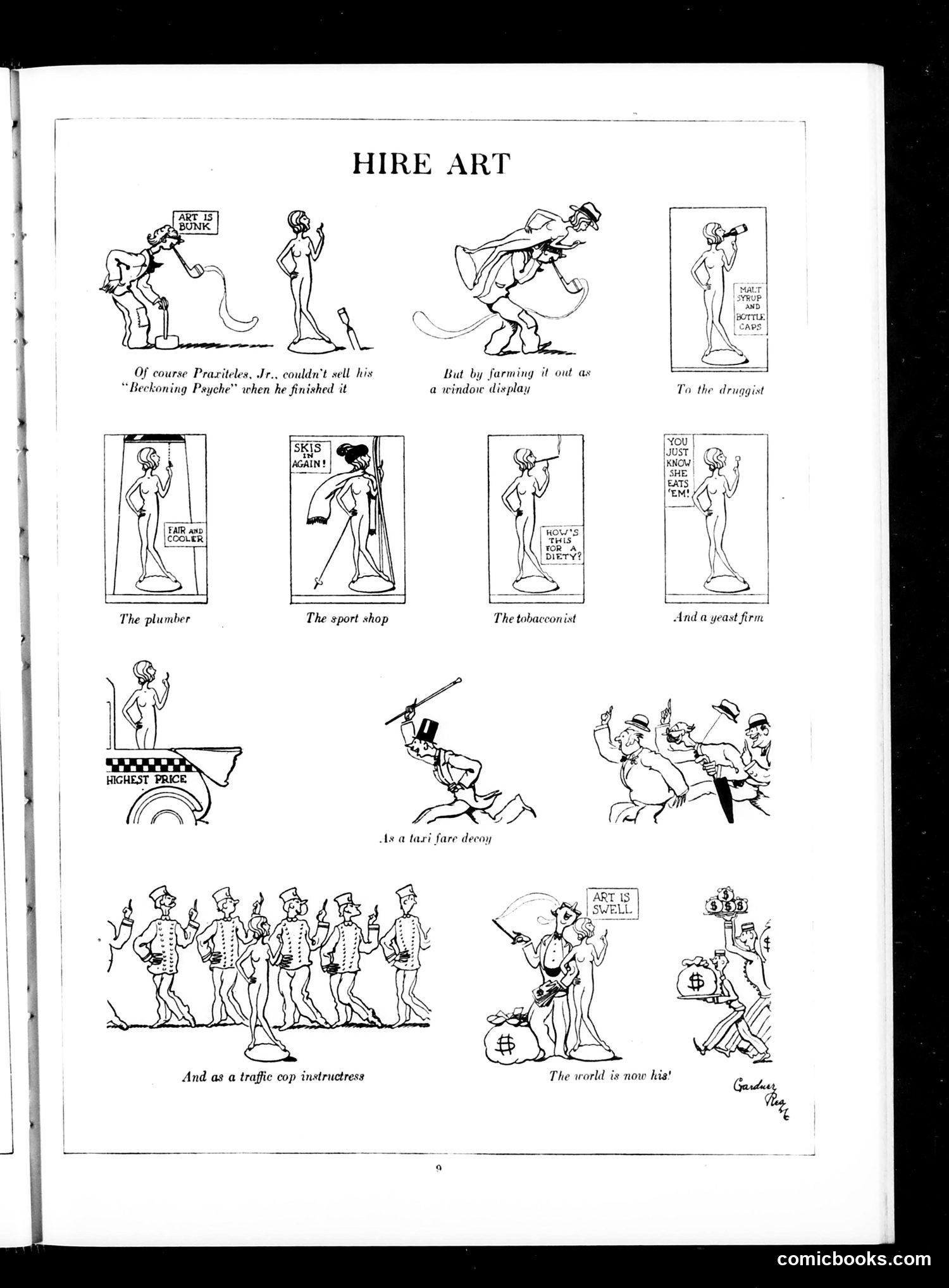
This page satirizes the commercialization and debasement of fine art in early 20th-century America. The opening panels reference Praxiteles (ancient Greek sculptor), suggesting even classical masterpieces couldn't sell without being repurposed as commercial displays. The cartoons mock art's degradation into advertising and window dressing: statues become props for plumbers, sport shops, tobacconists, and funeral homes. One panel shows art as "a lazy fare decoy" (likely "taxi fare decoy"). The final panels escalate the absurdity—a nude statue becomes a traffic cop instructing pedestrians, then generates wealth for dealers ("The world is now his"). The satire critiques how artists must commercialize their work for survival, and how high art becomes mere merchandise divorced from aesthetic value. The humor depends on recognizing the gap between art's supposed dignity and its practical, mundane applications in commerce.
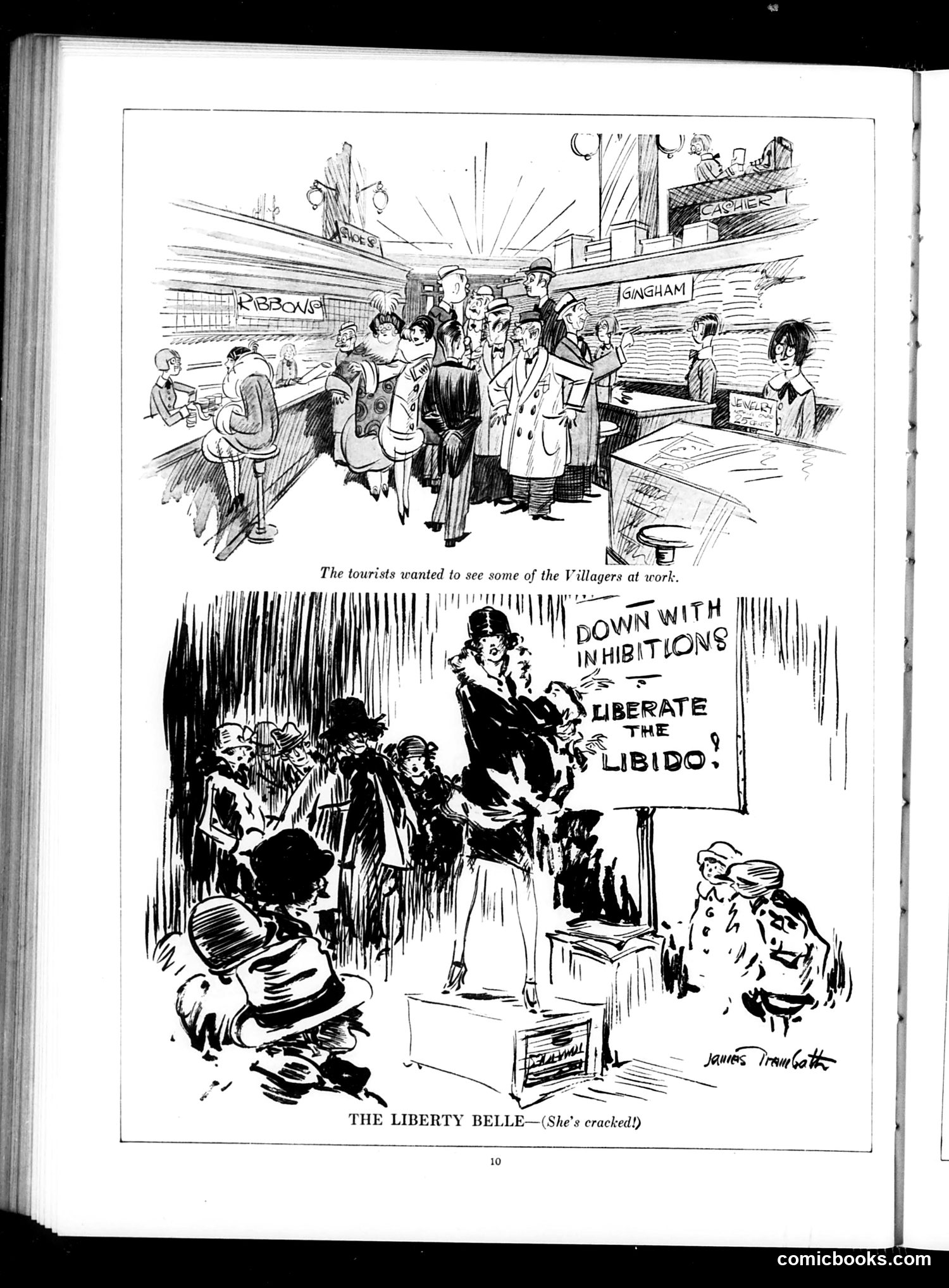
This page contains two satirical cartoons from *Judge* magazine critiquing early 20th-century social attitudes. The **top cartoon** shows tourists visiting "Villagers at work"—likely referencing utopian communities or experimental villages popular at the time. The **bottom cartoon**, titled "The Liberty Belle (She's cracked!)," is the primary satire. It depicts a woman holding a sign reading "Down with Inhibitions / Liberate the Libido!" surrounded by onlookers. The caption suggesting she's "cracked" mocks the emerging sexual liberation and Freudian psychology movements gaining traction in 1920s America. The cartoonist ridicules both the activist woman and the new psychological theories about sexual desire and social repression—portraying liberation advocates as mentally unstable rather than serious reformers. This reflects conservative anxieties about changing sexual morality and women's independence during the Jazz Age.
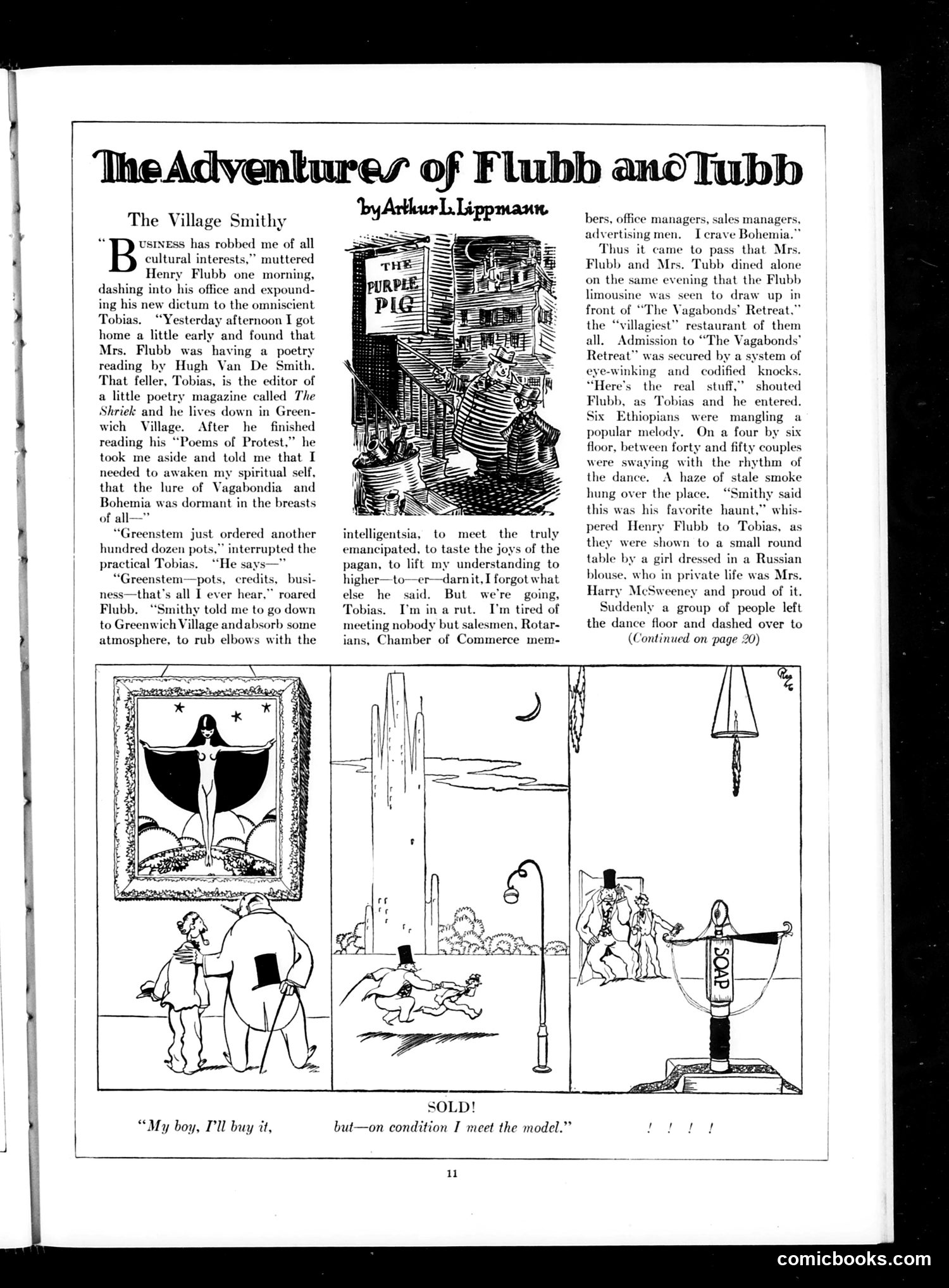
This is a serialized humor story satirizing the 1920s craze for "slumming" in Greenwich Village's bohemian scene. Henry Flubb, a practical businessman, is shamed by a poetry magazine editor named Van De Smith into seeking "spiritual awakening" and authentic bohemian experience. The joke targets the pretentiousness of wealthy businessmen trying to adopt bohemian culture—Flubb abandons his usual world of "salesmen, Rotarians, Chamber of Commerce members" to visit "The Vagabonds' Retreat," an artificially bohemian restaurant with coded entrance rituals. The cartoon below depicts selling art to the wealthy: a patron agrees to buy a painting conditionally ("on condition I meet the model"), satirizing how commercial interests corrupt artistic authenticity—precisely the tension Flubb is navigating. The satire mocks both the businessman's desire to appear cultured and the commercialization of bohemia itself.
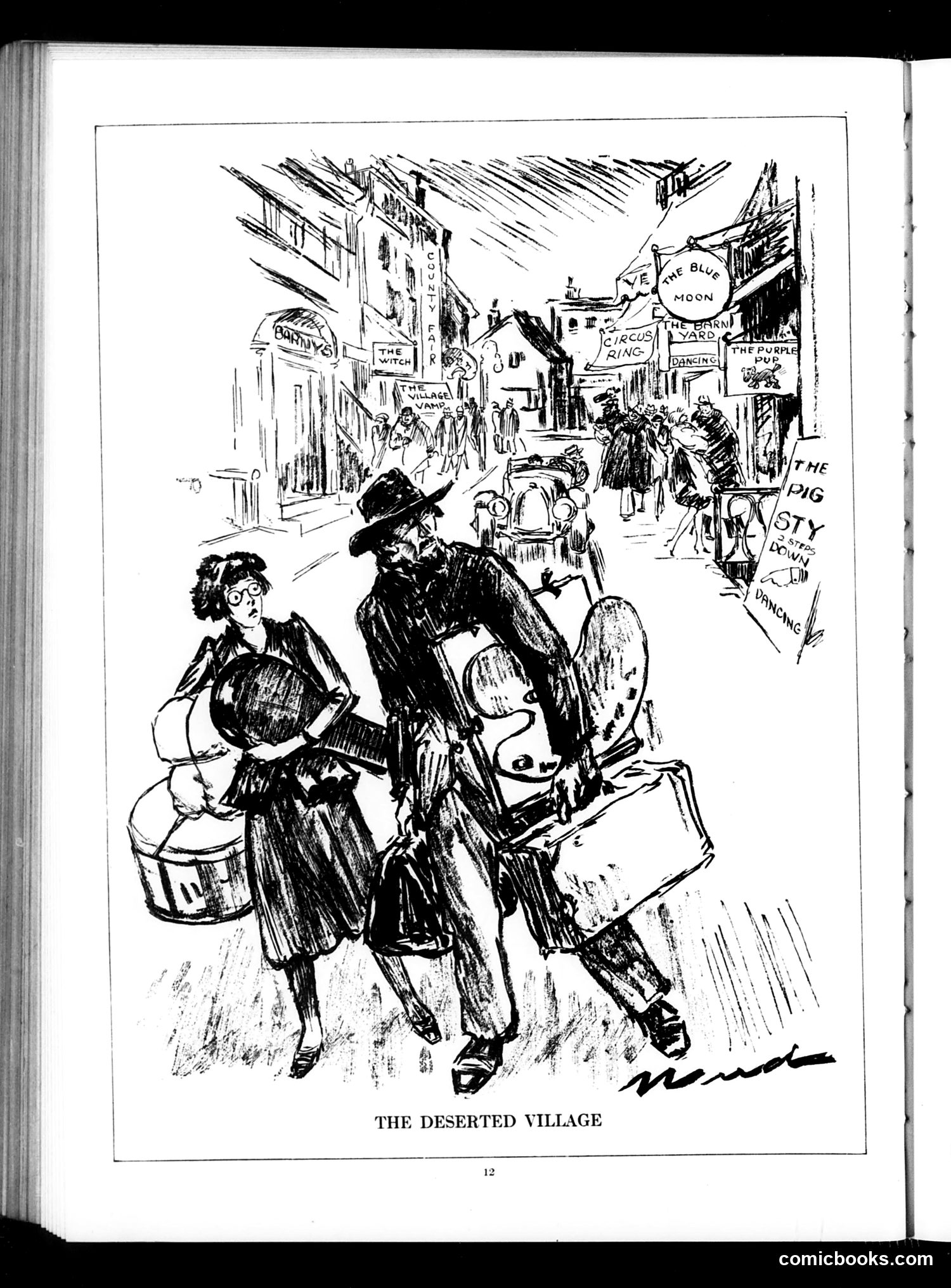
This cartoon depicts a street scene with storefronts and signs advertising entertainment venues ("The Blue Moon," "Circus Ring," "The Purple Pussy," "The Pigsty"). In the foreground, three figures carry large, empty containers—suggesting they're searching for or collecting something scarce. The title references Oliver Goldsmith's 1770 poem "The Deserted Village," which lamented rural depopulation and economic decline. The satire likely comments on **Prohibition-era America** (1920-1933), when alcohol sales were banned. The "deserted" entertainment district with empty vessels suggests the collapse of bars, clubs, and the nightlife industry under Prohibition's enforcement. The figures appear to be searching for illicit alcohol, mocking both the law's futility and the era's cultural drought.
This page from *Judge* magazine satirizes American conformity and the Ku Klux Klan through contrasting commentary on urban planning and Greenwich Village. **The KKK Reference**: The header quotes a Canadian KKK manifesto claiming loyalty to "God, our Canada and our homes," then dismisses it with "We're not the least bit jealous"—mocking the KKK's exclusionary nationalism and suggesting their concerns are petty. **The Main Satire**: The article argues that Manhattan's rigid grid-plan streets produce spiritually "dwarfed, unimaginative creatures of convention and routine"—standardized people in "canned houses." Greenwich Village, by contrast, developed organically with crooked streets and individualistic inhabitants, making it a haven for artists who reject conformity. **The Broader Point**: By juxtaposing KKK conformist nationalism with critique of America's standardized urban design, the piece suggests that enforced uniformity—whether through urban planning or racist ideology—stifles human creativity and individuality. Greenwich Village represents freedom and authentic self-expression against both corporate standardization and nationalist conformism.
This page is a theater critic's column reviewing current Broadway productions. The main article (Section I) is Nathan's commentary on how Eugene O'Neill's success inspired inferior imitators. Nathan argues that lesser playwrights, lacking O'Neill's genius, attempted to copy his style by simply taking existing plays, dressing characters as sailors or farmers, removing humor, and adding profanity at regular intervals. He cites "Down Stream" as an example of this failed imitation—it borrows O'Neill's waterfront setting and despair-focused themes but lacks authentic depth. The boxed list provides Nathan's capsule reviews of current Broadway shows, using characteristically sharp dismissals ("Commercial trash," "Weak stuff," "Wordy whangdoodle"). This reflects the irreverent, caustic tone Judge magazine was known for in theatrical criticism.
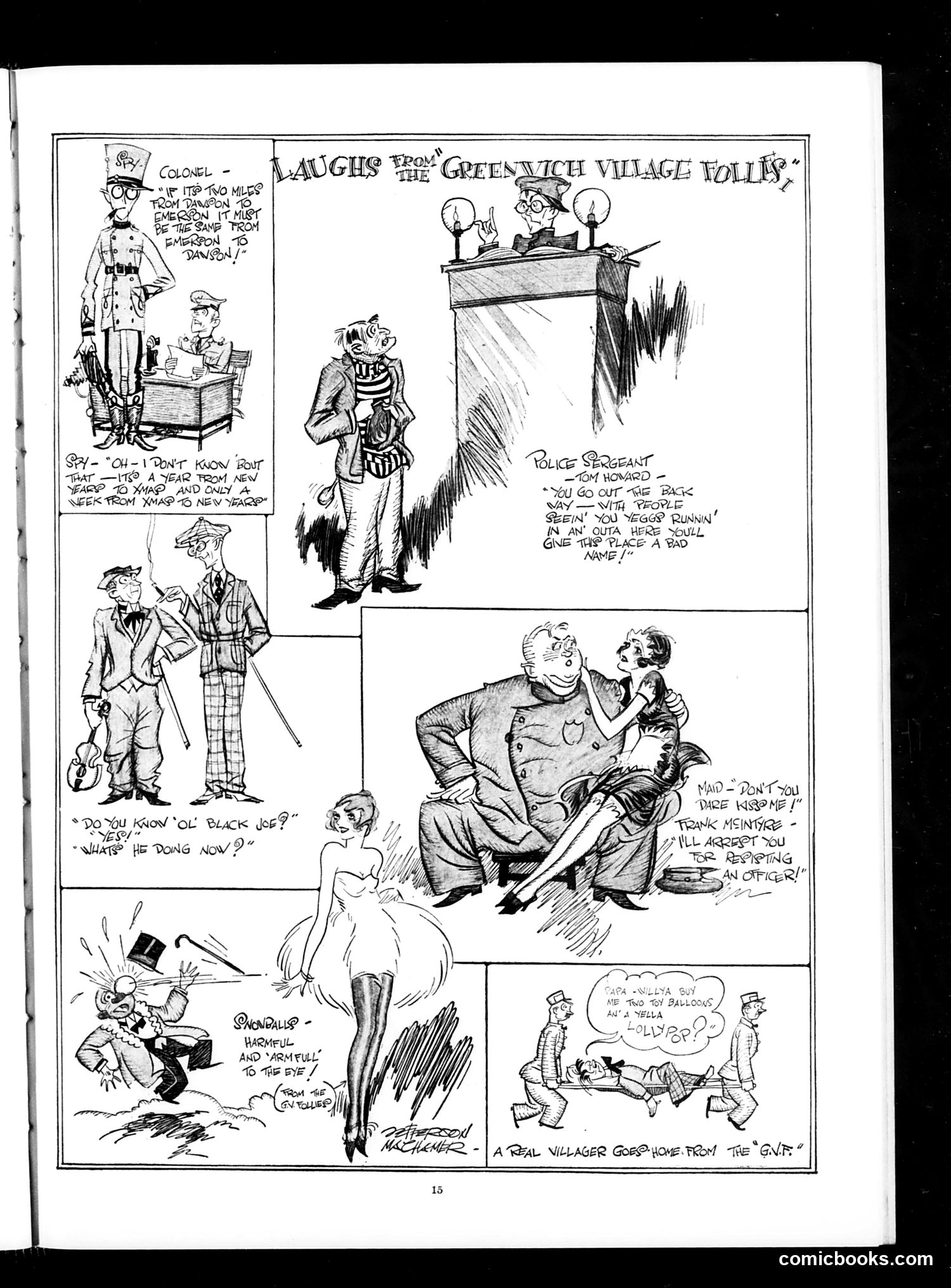
This Judge magazine page satirizes urban working-class characters and their concerns. The top strip features a Colonel lecturing someone about military discipline and New Year's resolutions. The main cartoon depicts Greenwich Village characters—recognizable by period dress and theatrical styling—engaging in humorous dialogue about employment, misconduct, and social respectability. The central scene shows a portly man (likely representing authority or a landlord) scolding a maid about proper behavior. The caption references a woman being seen "runnin' in and outa here," suggesting concern about her reputation and morality. The final panel shows men discussing a "real villager" returning home—implying mockery of Greenwich Village residents' lifestyles and questionable character. The satire targets both working-class behavior and bourgeois anxiety about urban village life and social propriety during this era.
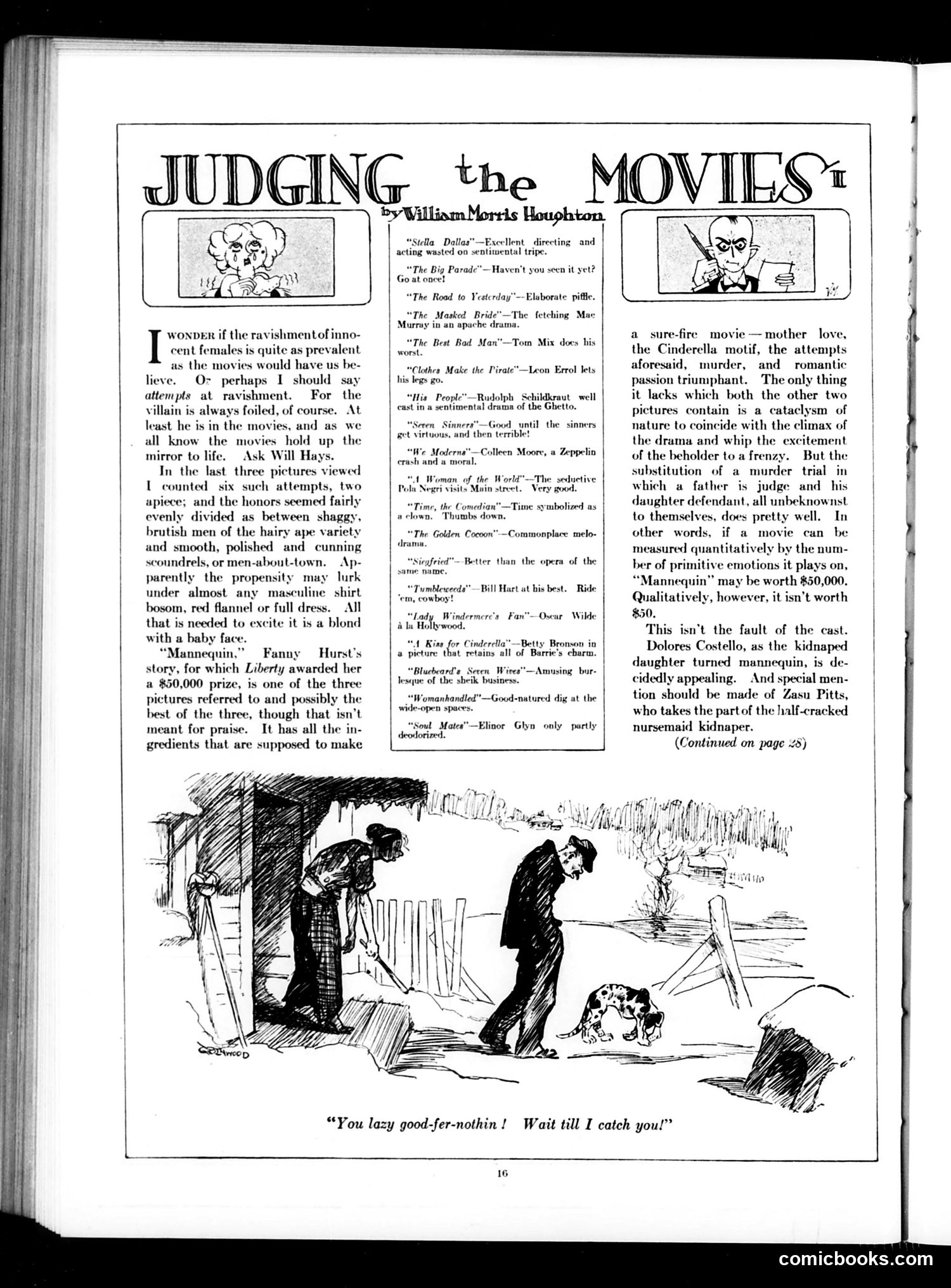
This is a film review column critiquing 1920s silent movies. The author argues that cinema relies excessively on depicting sexual assault to generate emotion—he notes counting "six such attempts" in three recent films, with violence distributed among various male archetypes (rough men, scoundrels, sophisticates). The column reviews specific films like *Mannequin* (based on a Fanny Hurst story that won a $50,000 Liberty magazine prize). While acknowledging the film contains melodramatic elements audiences crave—mother love, Cinderella narrative, murder trial—the author dismisses it as emotionally manipulative despite decent performances by Dolores Costello and Zasu Pitts. The satirical point: movies cynically exploit primitive emotions through formulaic plots centered on female endangerment, relying on sensation rather than artistic merit. The cartoon below (showing men in physical altercation) reinforces this critique of violent, crude entertainment.
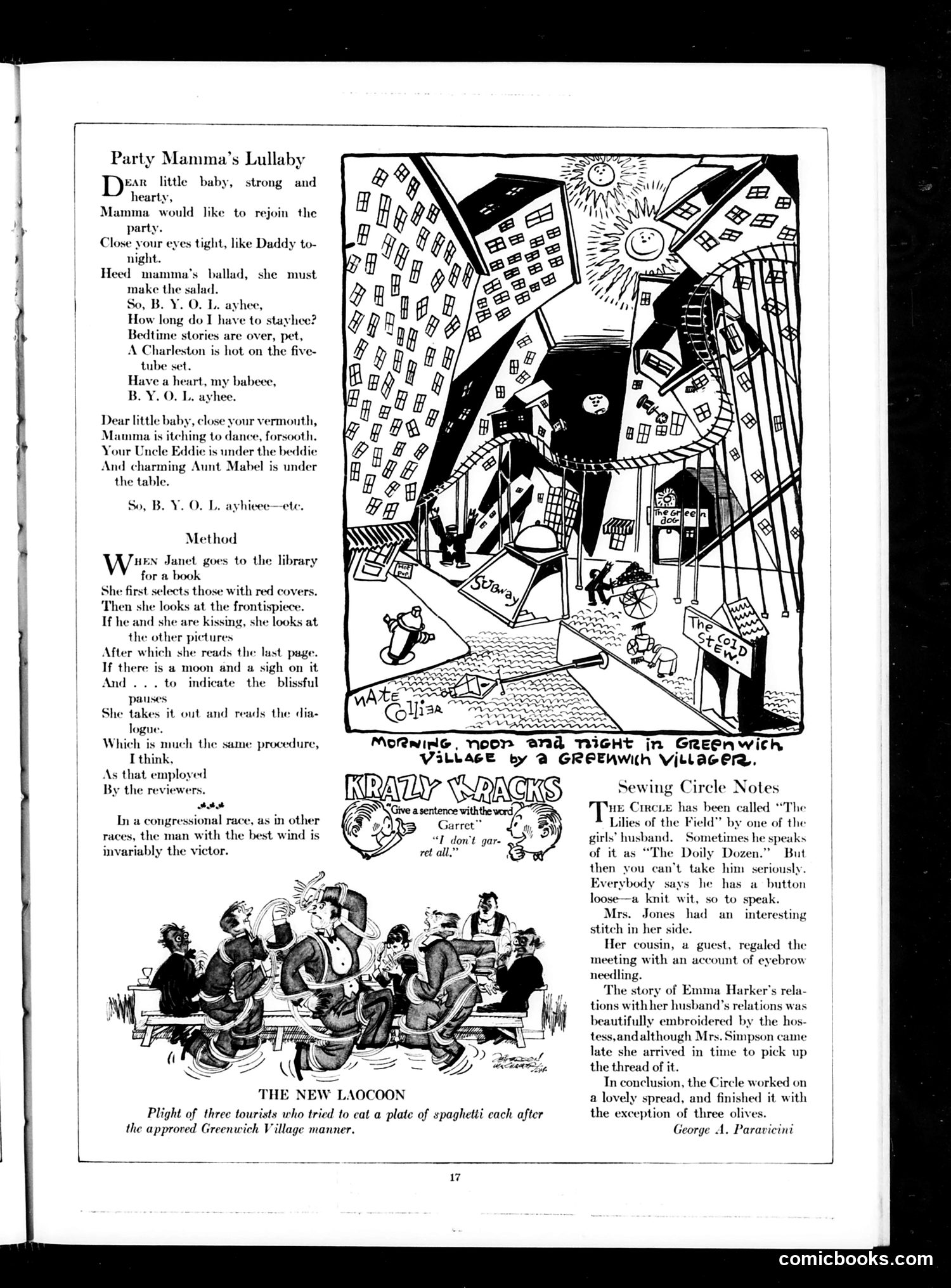
This page contains several satirical pieces mocking 1920s social trends: **"Party Mamma's Lullaby"** ridicules flappers and Jazz Age excess. The poem depicts a mother desperate to leave her baby and rejoin a wild party—referencing the Charleston dance, cocktails ("vermouth"), and the general hedonism of the era. The humor lies in parental neglect played for laughs. **"Method"** satirizes how women select library books, suggesting they choose based on romantic cover illustrations and skip to the ending rather than read genuinely. It then compares this to how book reviewers actually work—implying critics are equally superficial. **"The New Laocoon"** mocks Greenwich Village bohemians attempting to eat spaghetti "in the approved Greenwich Village manner"—likely referring to affected, pretentious behavior among artsy types. **"Sewing Circle Notes"** humorously describes women's social gatherings, using double-entendre ("interesting stitch," "embroidered") to suggest gossip masquerades as innocent needlework. Overall, the page satirizes modern social behavior: parental irresponsibility, superficial reading habits, pretentious bohemianism, and gossiping women.
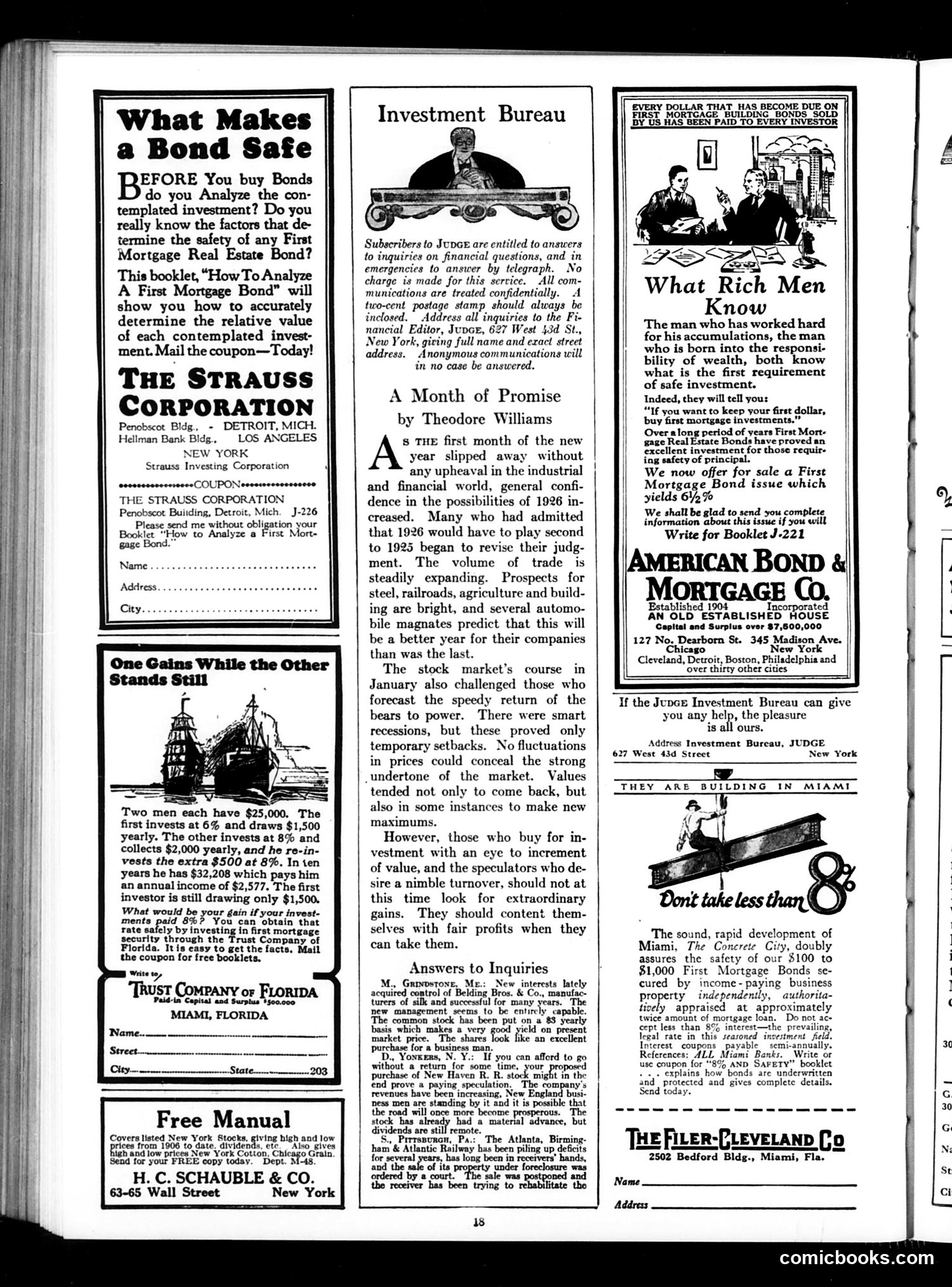
This is primarily a **financial advertising page** from Judge magazine, circa 1926. The cartoons and content address investment safety during the prosperous 1920s. The main visual element—"One Gains While the Other Stands Still"—illustrates compound interest: two men invest $25,000 equally, but one reinvests dividends at 8% annually, dramatically outpacing the other's static 6% return after a decade ($32,208 vs. staying flat). This was educational advertising for investment firms. The page reflects the era's **booming stock market confidence** and emerging consumer investment culture. Multiple bond and mortgage companies advertise "safe" investments—a concern given earlier financial instability. Theodore Williams's editorial "A Month of Promise" expresses optimistic sentiment about 1926's economic prospects. The "Investment Bureau" section offers Judge readers free financial advice—a service reflecting growing middle-class interest in wealth-building beyond savings accounts. Overall, this captures the **pre-1929 crash mentality**: confident, opportunity-focused, and promoting leveraged wealth through "smart" investing.
This page is primarily **financial advertising**, not satirical content. It features multiple investment firms promoting bonds and real estate securities during what appears to be the 1920s economic boom period. The advertisements emphasize guaranteed returns and safety—companies like United States Mortgage Bond Company, G.L. Miller & Co., and Adair Realty & Trust Co. tout their bonds as secure investments with high yields (6½-9%). The prominent declaration "NO INVESTOR EVER LOST A DOLLAR IN MILLER BONDS" exemplifies the era's optimistic (and, in retrospect, naive) investment messaging. The text column discusses various struggling corporations—railroad lines, copper companies, automobile manufacturers—offering investment advice to readers considering their stocks. **Historical context**: This page captures the pre-1929 crash mentality when such guaranteed-return promises were common and seemingly credible. The emphasis on "first mortgage" bonds and "safeguarded" investments reflects investor anxiety about previous financial losses, yet the very existence of these ads proves such guarantees were illusory.
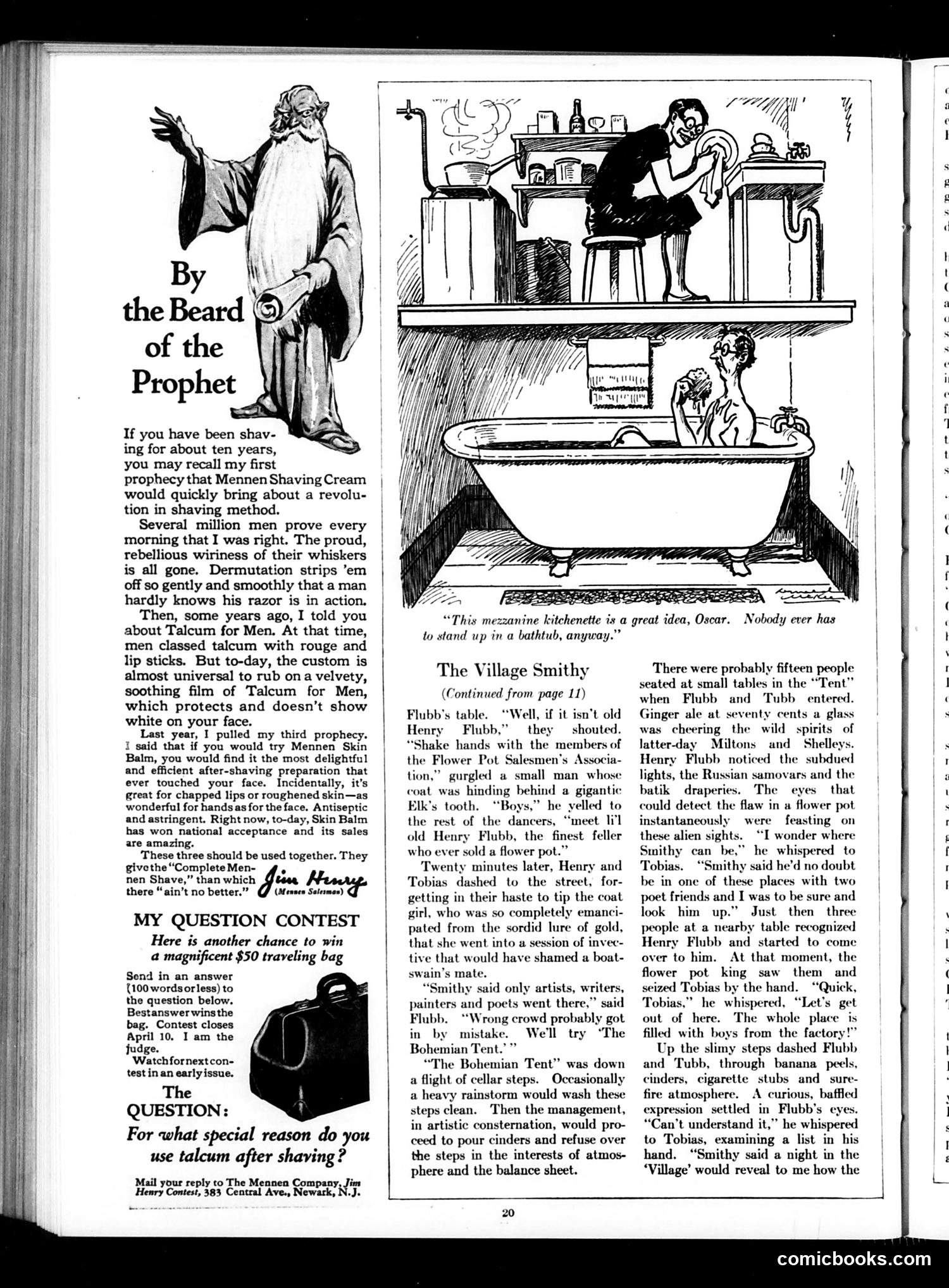
This page contains **advertising** and **fiction**, not political satire. **The Mennen Company advertisement** ("By the Beard of the Prophet") uses a bearded sage figure to promote shaving products—cream, talcum, and skin balm—claiming they've revolutionized men's grooming. The tone is mock-prophetic humor, positioning the advertiser as having predicted these products' success. A contest offers a $50 traveling bag for answers about talcum use. **"The Village Smithy" (continued story)** depicts Henry Flubb, a flower pot salesman, and his friend Tobias visiting bohemian nightclubs in search of someone named Smithy. The narrative satirizes trendy artistic establishments—the "Bohemian Tent" with its samovars and batik draperies—where mediocre patrons pose as poets and artists. The humor lies in Flubb's working-class discomfort among pretentious pseudo-intellectuals, and the revelation that even "bohemian" venues are commercialized and unglamorous.
This page combines two unrelated elements: a short story excerpt and an advertisement. **The Story Section** (left side): A satirical narrative about Henry Flubb and his friend Tobias touring bohemian Greenwich Village establishments around 1920s New York. The satire targets pseudo-artistic "bohemian" culture—places like "The Purple Pig" and "Club Vagabondia" that attract dilettantes and poseurs rather than genuine artists. The joke: these supposedly avant-garde venues are actually full of ordinary middle-class people (Flubb's relatives, business contacts, stenographers) pretending to be creative. The story mocks both the pretentiousness of bohemian aestheticism and the bourgeois people who imitate it. **The Advertisement** (right side): A Bell Telephone System advertisement celebrating the telephone's 50th anniversary (1876–1926). It emphasizes the technology's evolution from a mere novelty to an essential tool reshaping business and society—"a dynamic factor in human affairs." The ad uses Bell's famous first transmitted sentence to position the telephone as revolutionary infrastructure. These sections share no apparent connection.
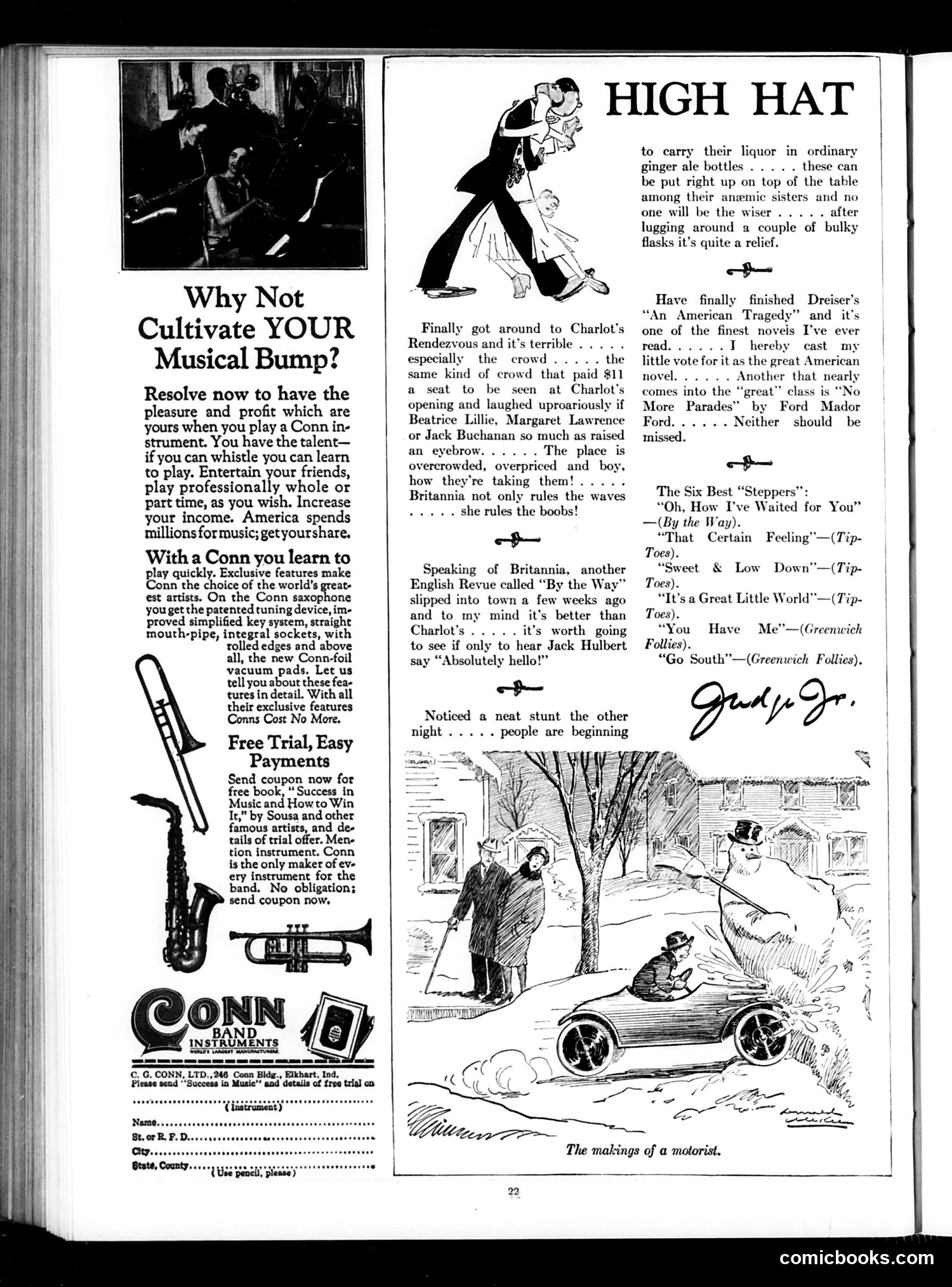
This page is primarily a **gossip/theater review column** signed by what appears to be "Judith Joy," a society columnist commenting on New York nightlife and entertainment. **The satire targets:** - **Charlot's Rendezvous**: A fashionable but overpriced nightclub attracting wealthy but unsophisticated patrons willing to pay $11 per seat (expensive for the era) to be seen, rather than genuinely enjoying entertainment - **British entertainers**: The column references English revues and performers (Jack Hulbert, Beatrice Lillie), comparing their quality - **Prohibition-era drinking culture**: A humorous aside about patrons smuggling liquor in ginger ale bottles to avoid detection **The broader point**: The column mocks the pretense of the wealthy elite—they attend exclusive venues not for artistic merit but for social status, while actual talent (like Jack Hulbert's comedic ability) goes underappreciated. "Britannia...rules the boobs" sarcastically suggests British performers appeal to the unintelligent crowd. The page also includes a **Conn musical instruments advertisement** promoting self-improvement through music lessons.
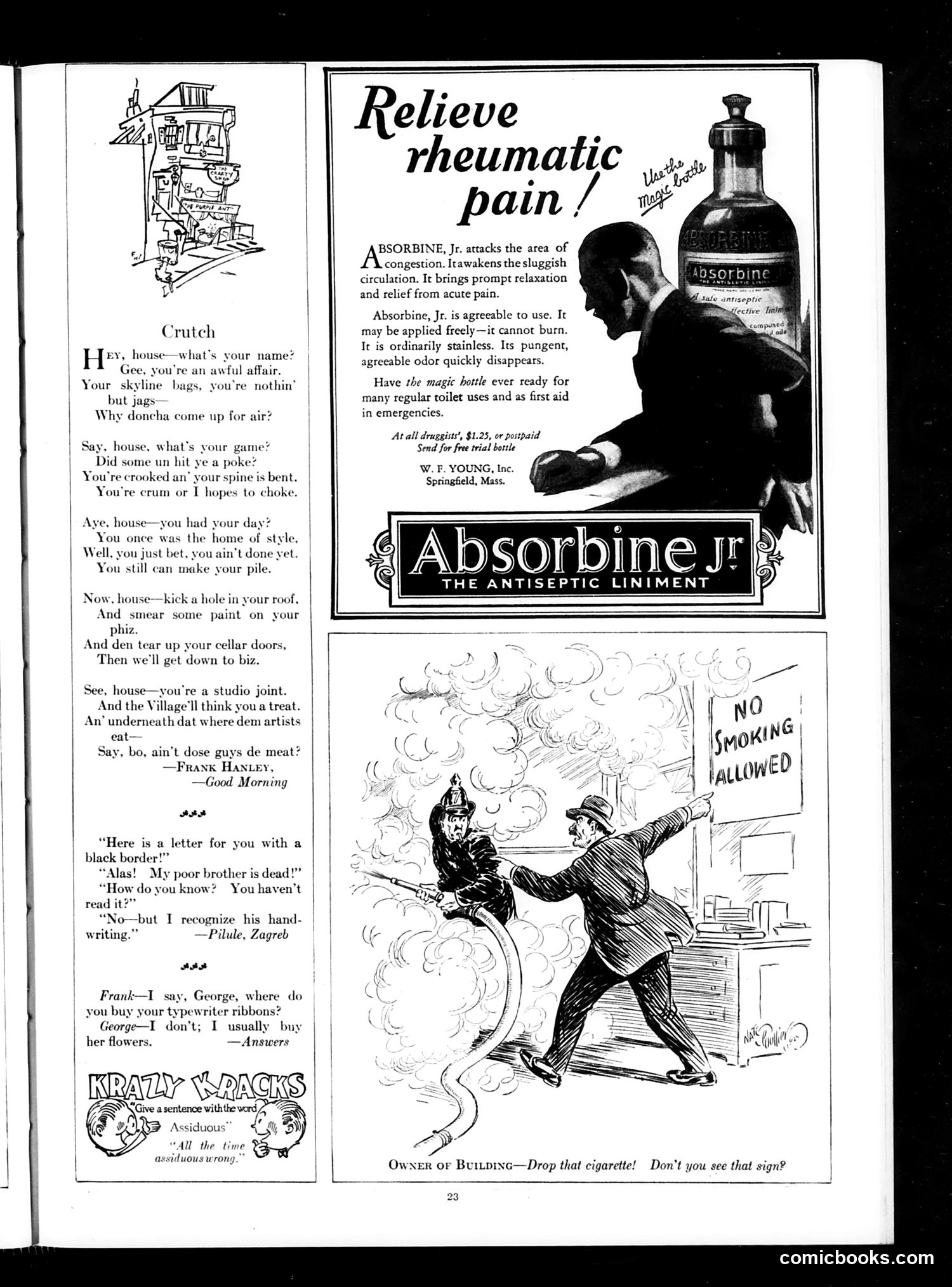
This page mixes humor content with advertising. The left side features **"Crutch,"** a poem by Frank Hanley that personifies an old, deteriorating house, addressing it conversationally as it urges renovation—turning it into a bohemian "studio joint" for Greenwich Village artists. The satire targets both urban decay and the commercialization of artistic neighborhoods, where shabby buildings are repackaged as trendy artist spaces. Below are brief humorous exchanges—one about recognizing handwriting on a letter with a black border, another about buying typewriter ribbons versus flowers. The right side is dominated by an **Absorbine Jr. advertisement** featuring a boxer in fighting stance, promoting the liniment for rheumatic pain relief. The bottom cartoon shows a building owner confronting a man smoking indoors beneath a "No Smoking" sign—straightforward workplace safety humor. The page is primarily **advertising-driven**, with humor serving as filler around commercial content.
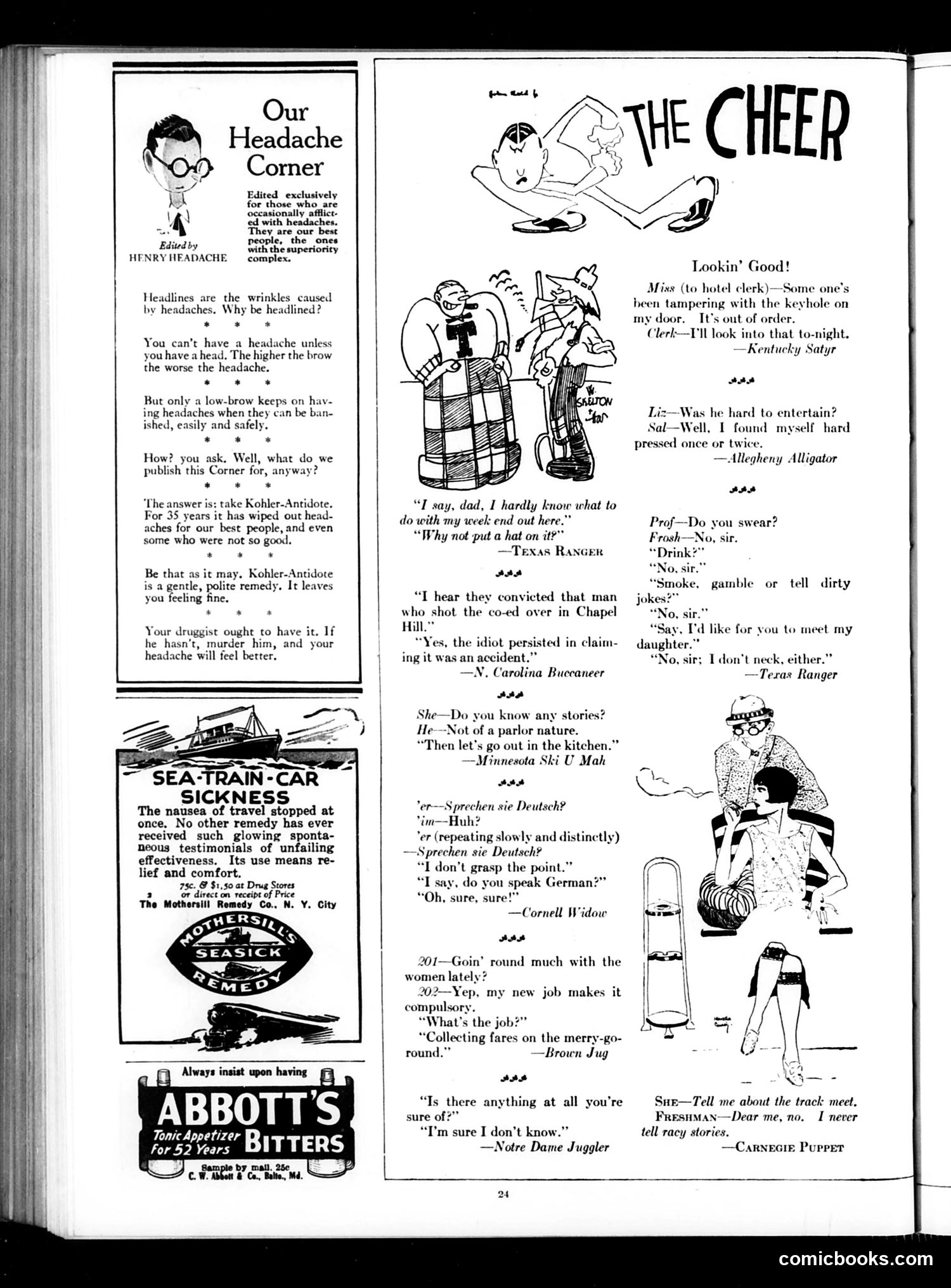
This page from *Judge* magazine presents a humor section featuring college jokes and witticisms from various university publications. The content reflects early 20th-century collegiate humor, emphasizing wordplay and mild social commentary. The jokes target predictable subjects: awkward courtship ("I'd like you to meet my daughter"/"No sir; I don't neck, either"), male obtuseness (the German language misunderstanding), and innocent double entendres (the "hard pressed" pun about entertainment). Notable is the ethnic/linguistic humor ("Sprechen sie Deutsch?") and casual references to serious events treated as punchlines—like the Chapel Hill shooting presented as a joke about an "idiot" claiming accident. The merry-go-round fare collector joke plays on women's promiscuity stereotypes. The sidebar "Headache Corner" is essentially an advertisement disguised as advice, promoting Kohler-Antidote remedy while satirizing "superior" intellectual types who suffer headaches. The overall tone is genteel, safe collegiate humor aimed at educated, white, upper-class readers.
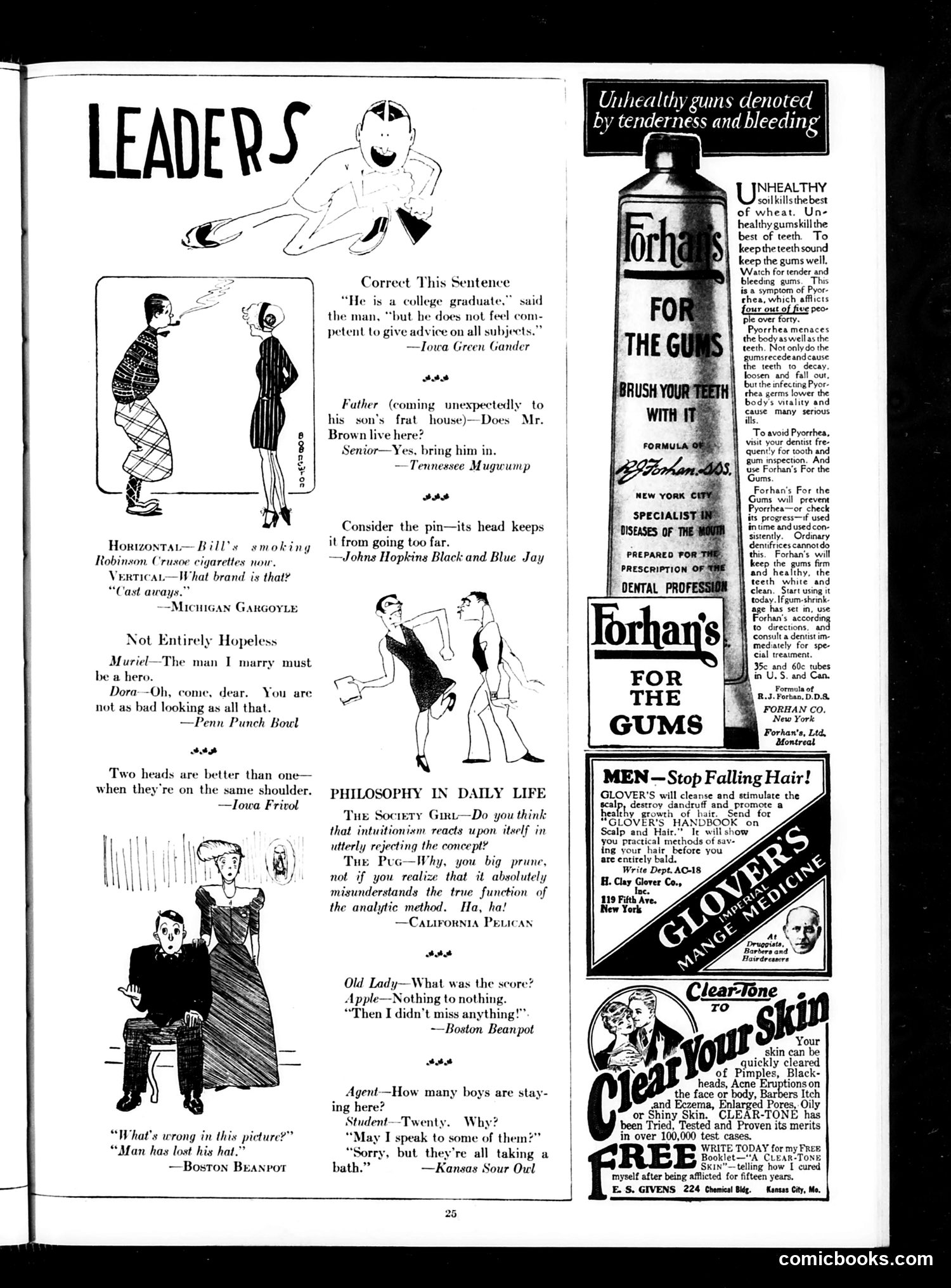
This page from *Judge* contains primarily **short humor pieces and advertisements** rather than political cartoons. The **humor section** ("Leaders") features college-focused jokes and witty one-liners common to early 20th-century satirical magazines. The jokes target familiar subjects: college graduates lacking common sense, fraternity life, relationships, and philosophical pretension. For instance, one quip mocks a society girl's overwrought intellectual discussion of "intuitionism" with a man who frankly admits he doesn't understand it either—satire of affected intellectualism. The **right side is dominated by advertisements** for personal care products: Forhan's toothpaste (targeting pyorrhea, a gum disease), Glover's hair treatment, and Clear-Tone skin cream. These ads reflect early 20th-century anxieties about hygiene and appearance, using medical language to sell solutions to common problems. There is no political content or identifiable caricatures of public figures on this page.
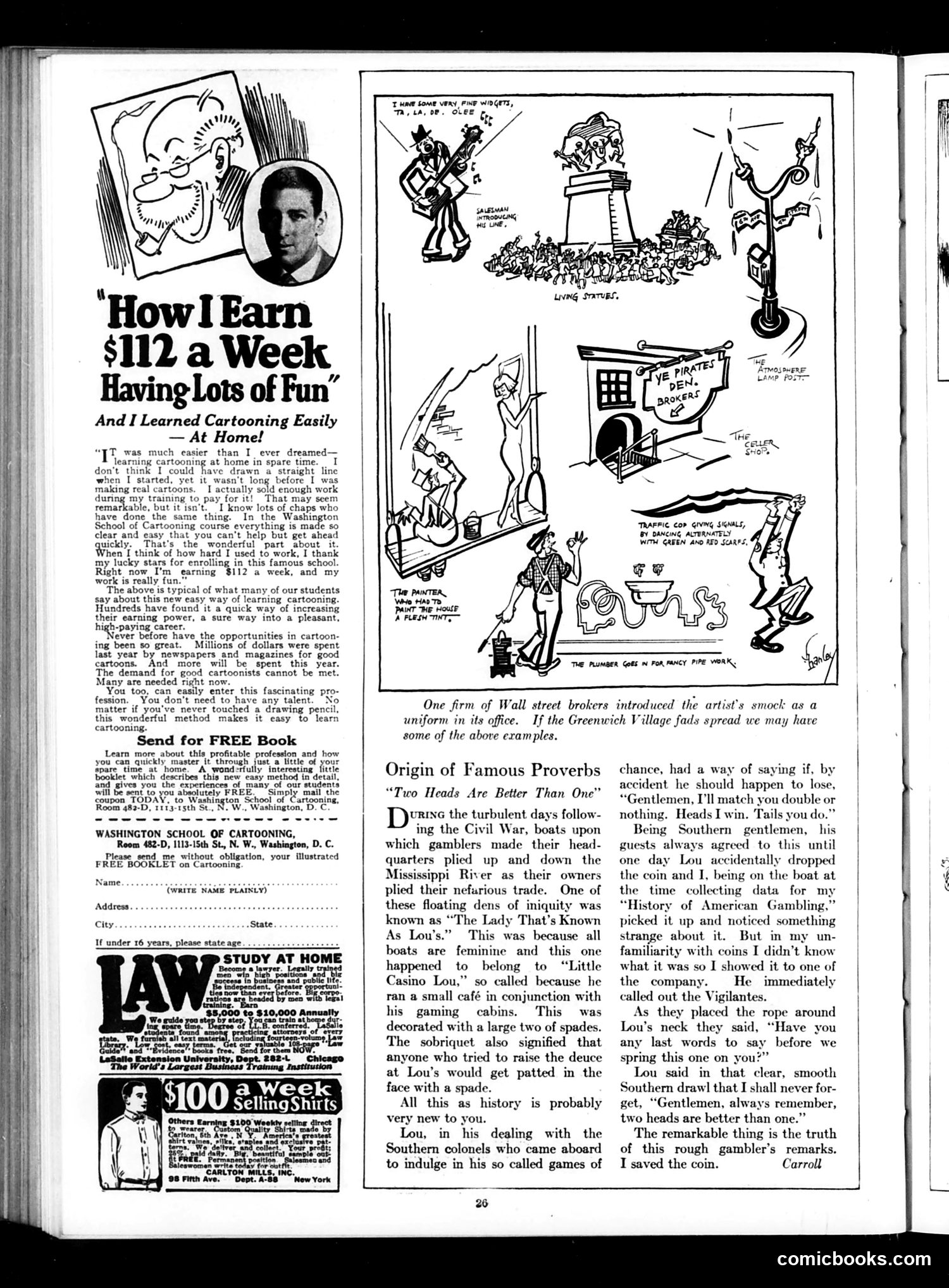
This Judge magazine page combines **advertising with satirical content**: The top-left features a **cartooning school advertisement**—a common early 20th-century pitch promising easy income ($112/week, substantial then) by learning to draw cartoons at home. The testimonial appeals to aspiring artists by claiming minimal talent needed. The right side displays **sample cartoon gags** showing typical Judge humor: pedestrians, traffic cops, pirates, and abstract visual jokes—the kind of disposable comic filler that filled magazines of the era. Below sits an **origin story** explaining the proverb "Two Heads Are Better Than One." It traces the phrase to riverboat gambling after the Civil War, specifically a riverboat called "Lou's" run by "Casino Lou." The satire mocks the fake "historical" explanation—clearly invented—attributing a common saying to an obscure (likely fictional) gambling den anecdote about coin-flips. This playfully demonstrates how folklore gets fabricated. The page exemplifies Judge's mix of **commercial promotion, sight gags, and tongue-in-cheek pseudo-history**.
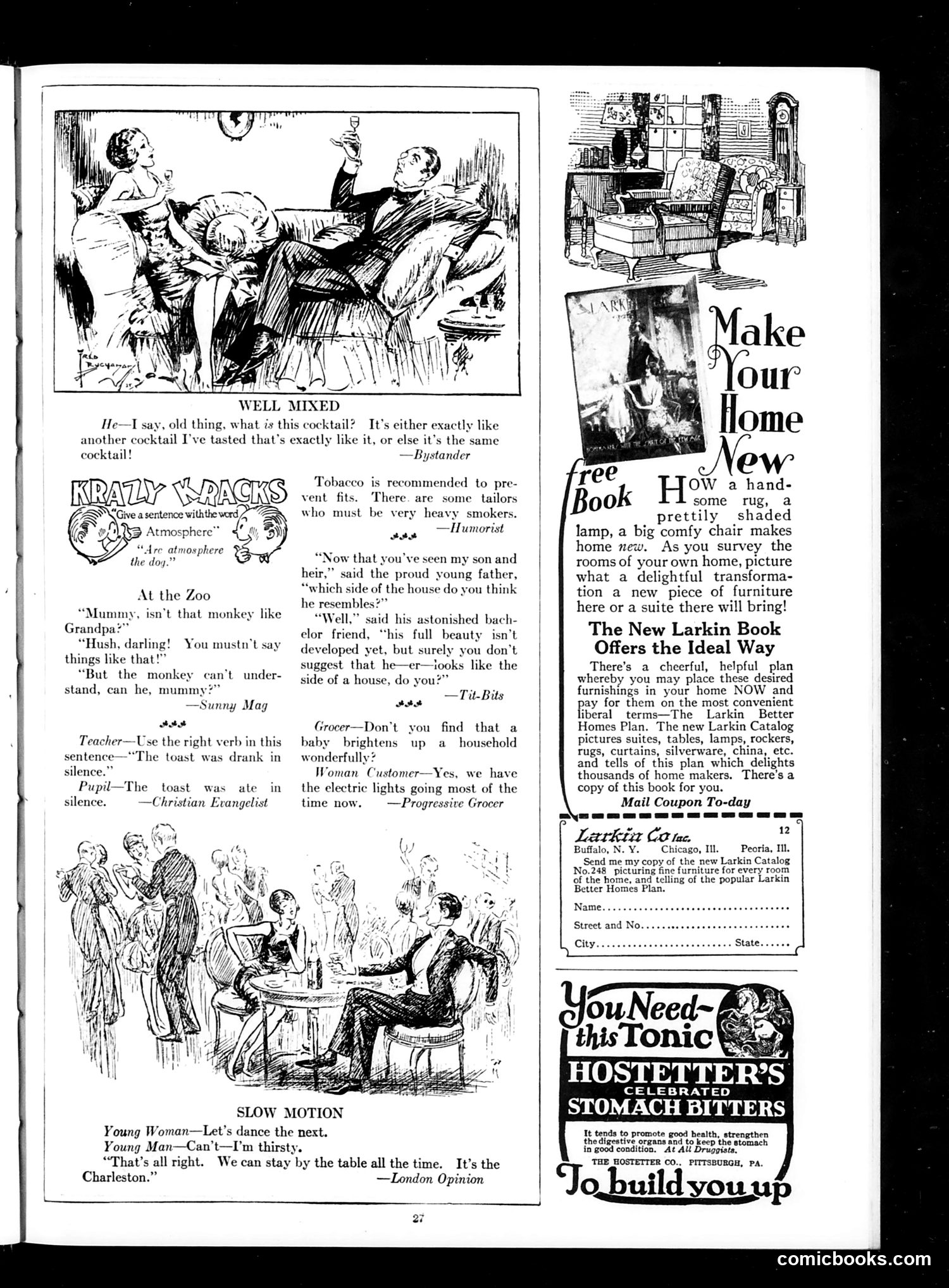
This page contains multiple brief satirical jokes typical of early 20th-century humor magazines, plus advertisements. **The cartoons** mock everyday absurdities: a man can't distinguish between identical cocktails; a child's innocent comparison of grandfather to a monkey; grammar errors; a father's vanity about his homely son; a grocer attributing babies' brightening effect to electric lights; and a young man who stays at the dance table to drink rather than move (the "Charleston" being a 1920s dance requiring vigorous movement—the joke is he defeats its purpose). **The satire** targets human pretension, poor reasoning, and social awkwardness rather than politics. The humor relies on wordplay, logical inversions, and embarrassing social situations. **The advertisements** for Larkin furniture and Hostetter's bitters represent typical period product placement, emphasizing home improvement and digestive health tonics popular in that era. No specific political figures or events are referenced; this is purely comedic content.
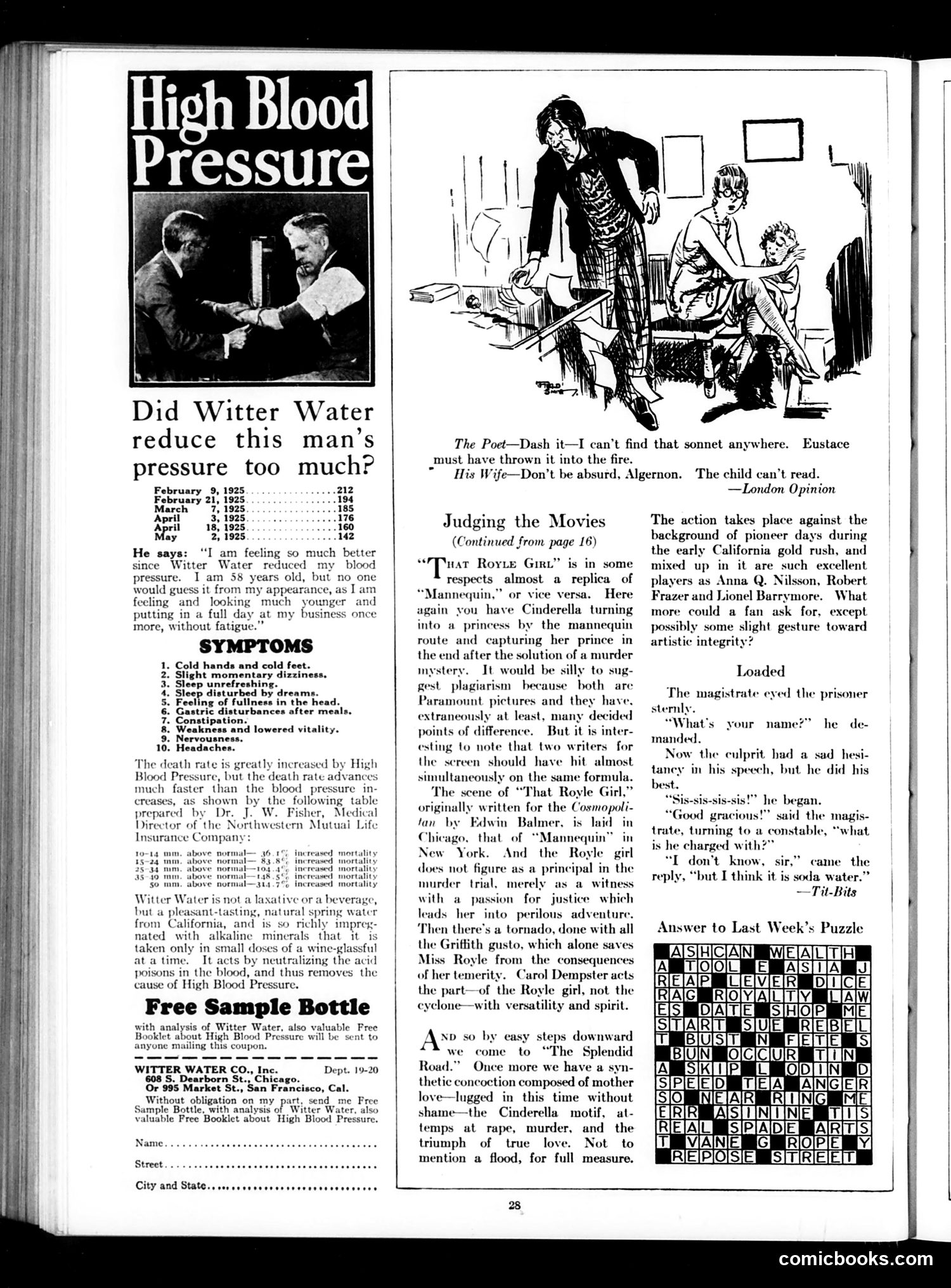
The left page is primarily a **patent medicine advertisement** for "Witter Water," a California spring water marketed to treat high blood pressure. It presents testimonial evidence—blood pressure readings declining over months—and lists symptoms of hypertension. The ad claims the mineral-rich water neutralizes "acid poisons in the blood." The right page contains **movie reviews** discussing three Paramount films: "That Royle Girl," "Mannequin," and "The Splendid Road." The critic notes these films follow nearly identical formulas—poor girls transformed into princesses through contrived circumstances (murder mysteries, tornadoes, floods)—questioning whether such repetitive plots constitute plagiarism, despite differences in setting and character roles. The reviews critique Hollywood's reliance on melodramatic conventions and artificial plot devices for dramatic effect.
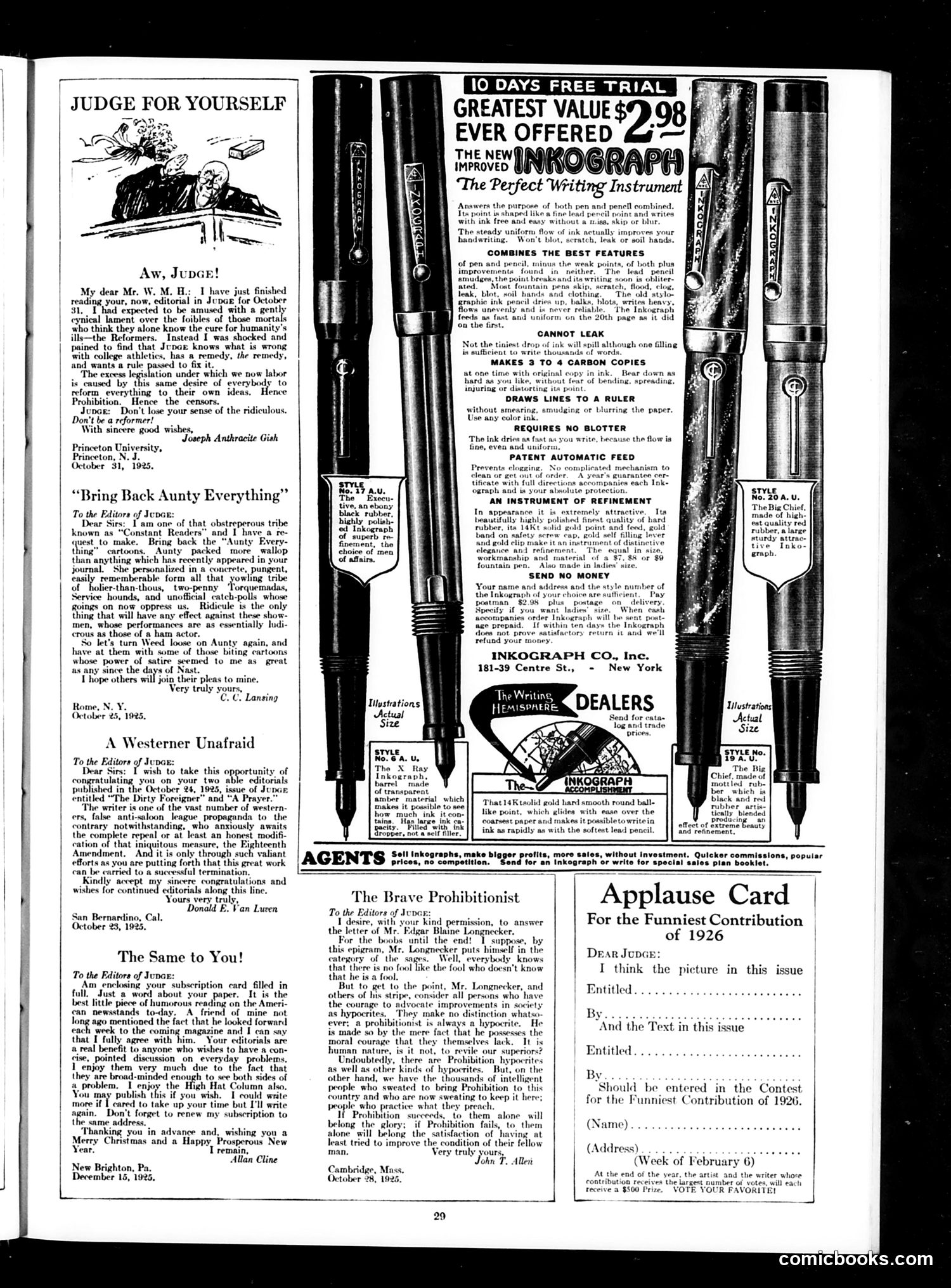
This page is primarily **advertising and reader letters**, not political cartoons. The dominant content is a full-page advertisement for the Inkograph fountain pen ($2.98, "10 days free trial"), which claims to offer superior writing features like automatic feed, no blotting, and carbon-copying capability. The left side contains **reader letters to the editor** discussing magazine content: - One writer praises Judge's satirist "Aunty Everything," requesting the magazine bring back this character who "personalized in concrete form" reformers and self-righteous social crusaders - Another celebrates Judge's recent editorials criticizing prohibition and hypocrisy The **political context**: These letters reflect 1925 debates over Prohibition (then in effect since 1920), temperance activists, and reform movements—themes Judge regularly satirized through characters attacking moralistic overreach. The page reflects Judge's dual purpose: **satirical commentary on social issues plus consumer advertising**. The letters show readers valued Judge's mockery of self-righteous reformers and Prohibition advocates.
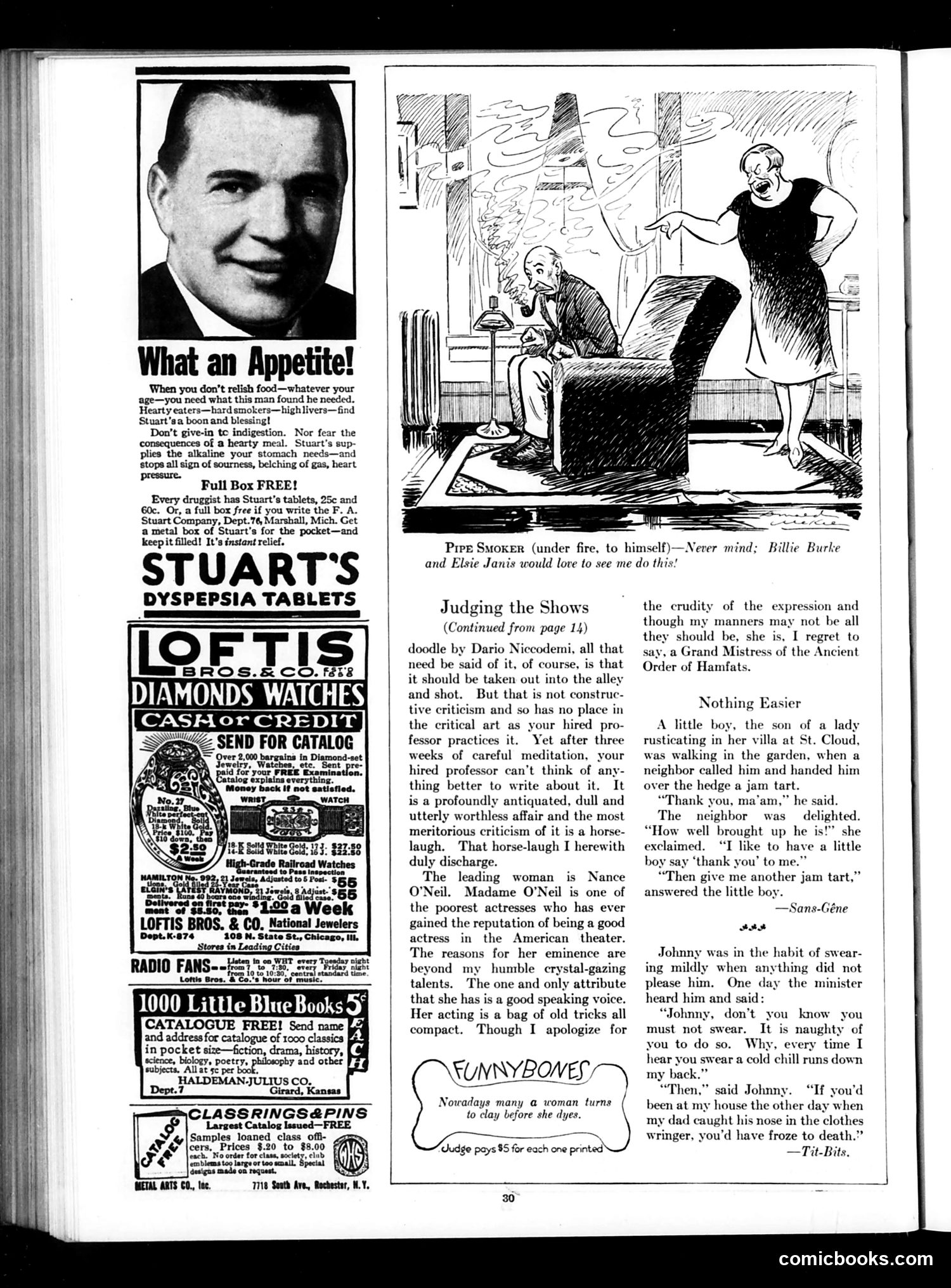
This page mixes advertisements with theatrical criticism and humor. The main cartoon depicts a pipe smoker imagining himself performing dramatic gestures, thinking actresses Billie Burke and Elsie Janis would admire his theatrical flair—a joke about amateur dramatics and self-delusion. The "Judging the Shows" column reviews a play (likely early 20th century) featuring actress Nance O'Neil, whom the critic dismisses as relying on outdated acting tricks and a good voice rather than genuine talent. He calls her a "Grand Mistress of the Ancient Order of Hamfats"—period slang for bad or amateurish actors. The humor pieces below include jokes about a child's politeness and a boy's colorful language when his father gets injured—gentle, family-friendly humor typical of the era. The advertisements promote patent medicines (Stuart's Dyspepsia Tablets for indigestion), jewelry, and correspondence courses—common early-20th-century marketing targeting middle-class readers concerned with health and self-improvement.
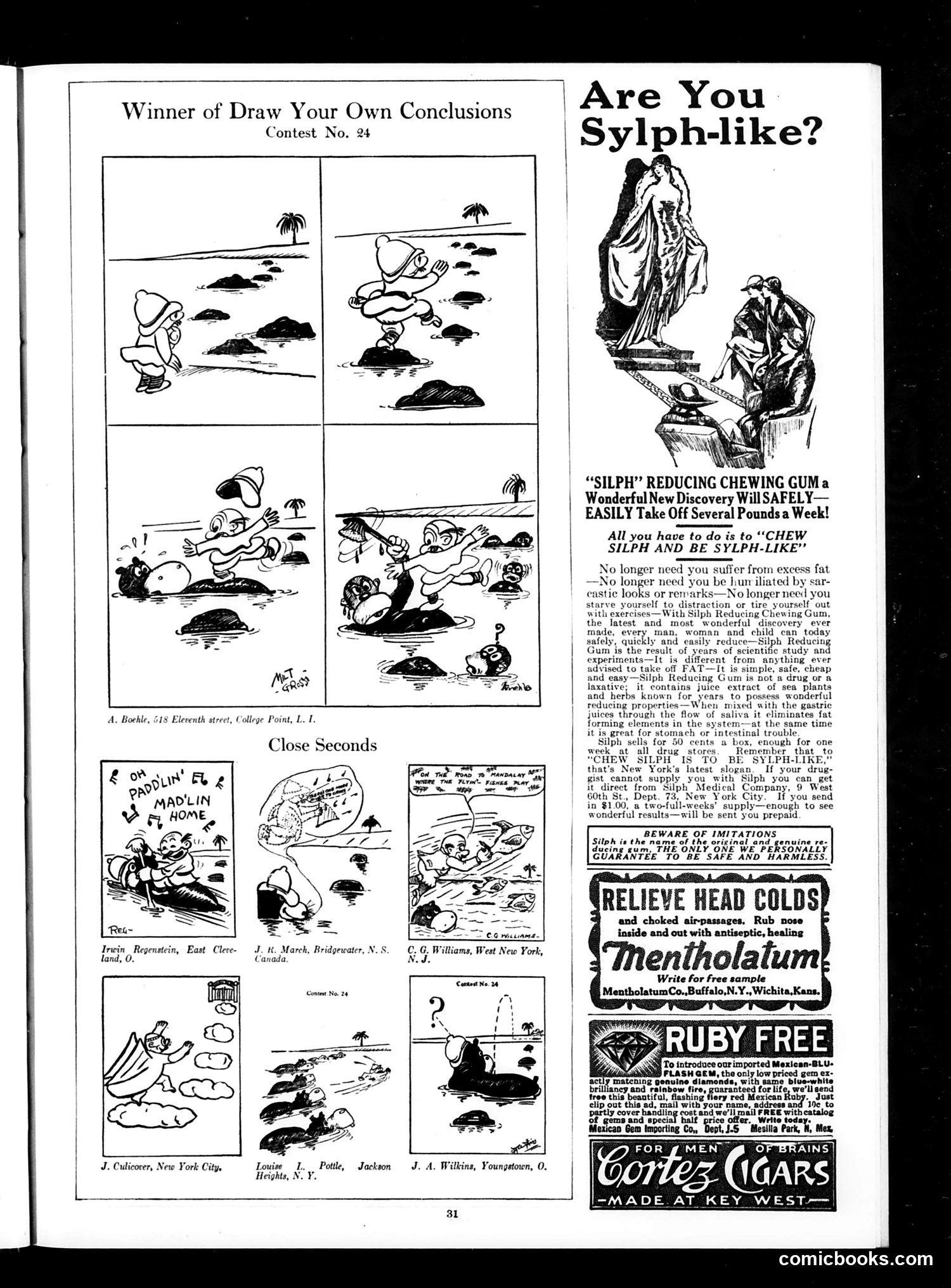
This page combines a cartoon contest winner with period advertisements, reflecting early 20th-century concerns about body image and weight loss. **The Cartoons ("Close Seconds"):** Six comic strips show people in various predicaments on tropical islands—appearing stranded, struggling with crocodiles, or in survival situations. These are entries in Judge's "Draw Your Own Conclusions" contest, likely humorous takes on island survival scenarios. **The Primary Advertisement:** The dominant content advertises "Silph" reducing chewing gum, a weight-loss product promising to make users "sylph-like" (slender and graceful). The ad's satirical appeal to vanity—claiming effortless weight loss through chewing gum—exemplifies the era's quack remedies. The illustration shows a woman consulting a doctor about the product's benefits. **Supporting Ads:** Additional dubious products include Mentholatum for colds, Mexican Ruby gems, and Cortes cigars—typical of magazines that accepted questionable patent medicine advertising with minimal regulation. **Historical Context:** This reflects pre-FDA oversight when magazines freely promoted unproven weight-loss and health products, exploiting anxieties about appearance and health.
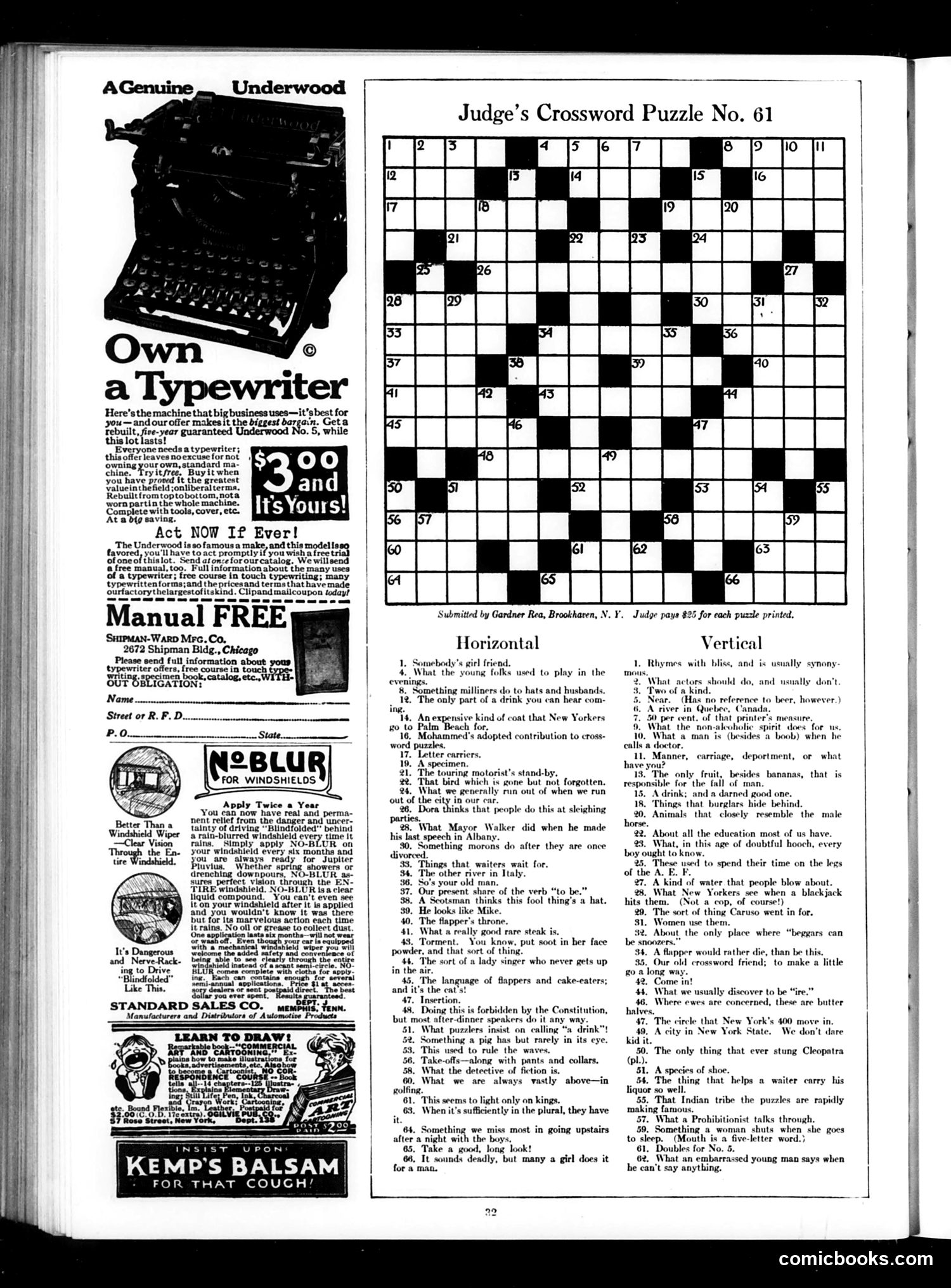
This page is primarily **advertising and a crossword puzzle**, with no political cartoon present. The left side features vintage advertisements typical of the 1920s-30s era: 1. **Underwood Typewriter**: Marketed as affordable ($3.99), targeting middle-class consumers who couldn't previously afford machines. The "rebuilt" angle emphasizes affordability and practicality. 2. **No-Blur windshield treatment**: A product solving rain visibility problems for early automobile drivers—a genuine safety concern of the era before modern windshield wipers. 3. **Kemp's Balsam**: A patent medicine "for that cough," reflecting the period when unregulated remedies were heavily advertised. The **crossword puzzle** contains contemporary references (Mayor Walker, flappers, "cake-eaters") reflecting 1920s urban slang and public figures, but contains no satire—it's purely recreational content. The page demonstrates how Judge mixed entertainment with commercial advertising to support publication costs.
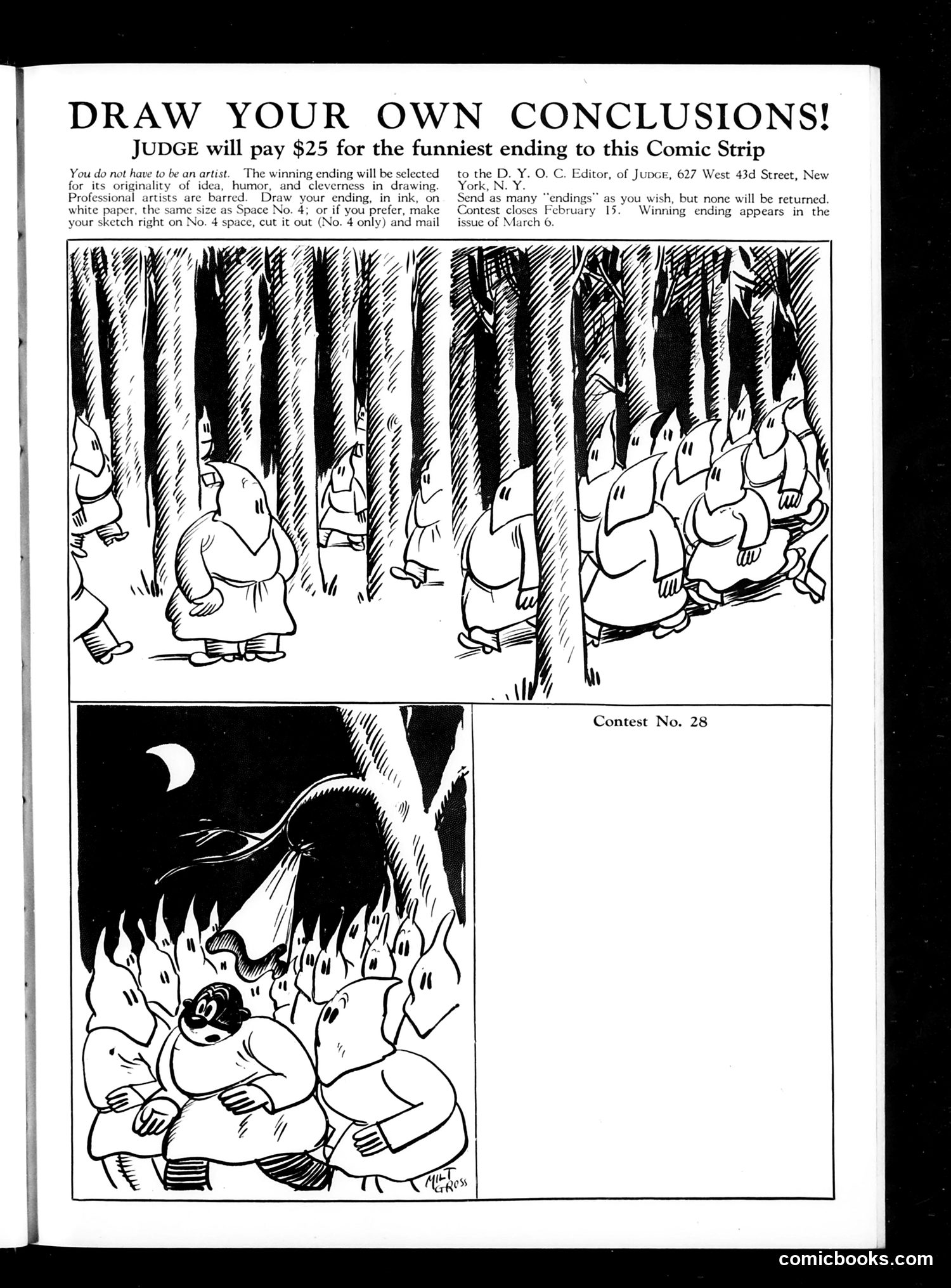
This page presents a reader-participation contest where Judge magazine invites amateur cartoonists to complete an unfinished comic strip. The top panel shows a group of rotund figures in a forest setting—the context and conclusion are deliberately omitted, leaving the punchline for readers to supply. The bottom panel shows what appears to be witches or supernatural figures around a fire under a crescent moon, suggesting the incomplete strip may involve folklore or horror themes, though the exact narrative connection is unclear from the image alone. Judge offered $25 (substantial money for the era) for the funniest ending, barring professional artists to encourage public participation. This represents early 20th-century interactive entertainment—a precursor to modern fan engagement. The contest closed February 15, with winners appearing in the March 6 issue. The specifics of what the top panel depicts and its intended satirical or comedic target remain unclear without the original setup or concluding entries.
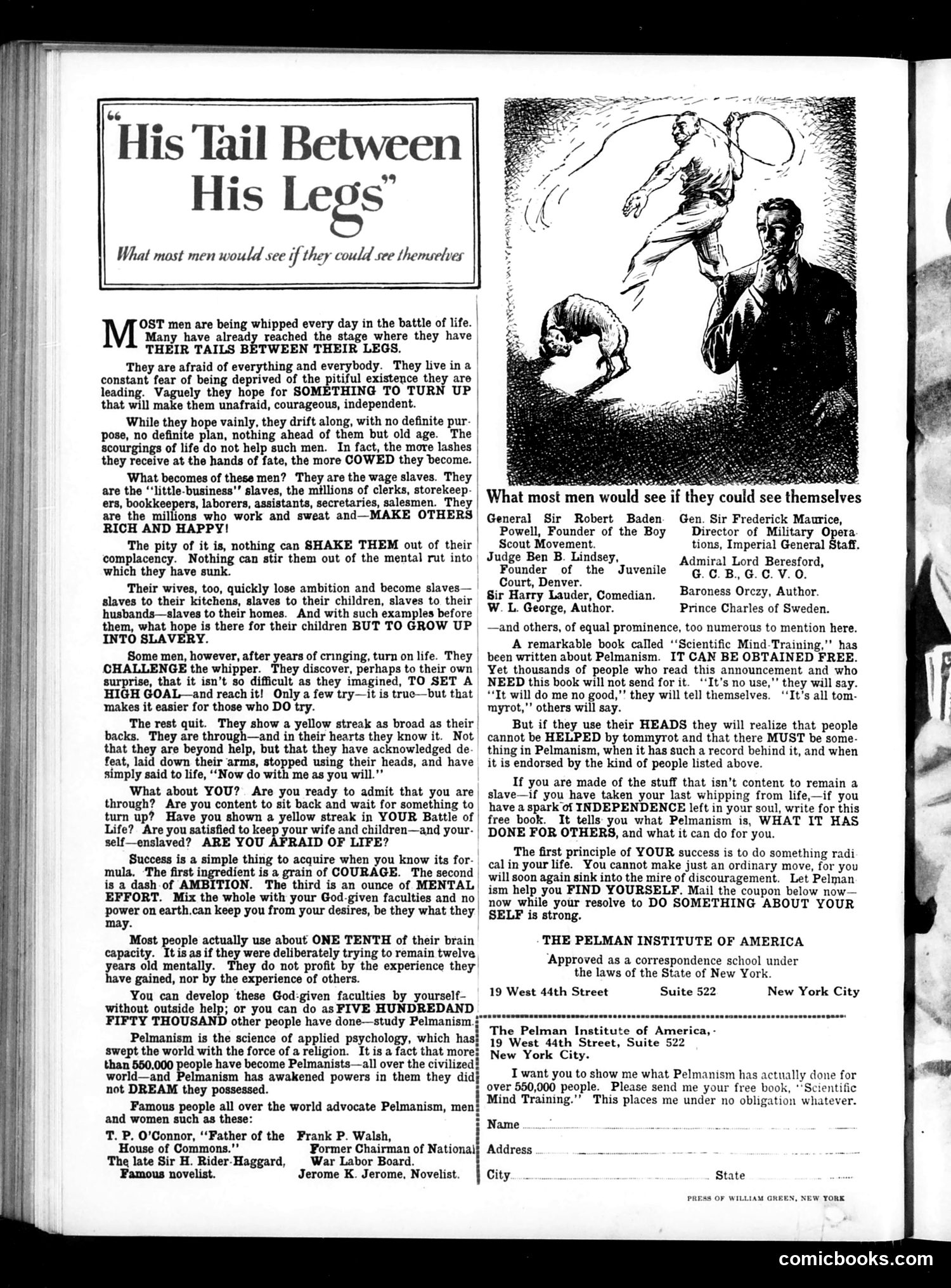
This satirical advertisement uses the metaphor of cowardly animals (with "tails between their legs") to shame men into self-improvement. The cartoon depicts a deflated man confronting his own image. The text targets "wage slaves"—working-class men, clerks, laborers—who passively accept their lot, hoping for rescue rather than taking action. It extends this critique to their wives and children, suggesting this cowardice perpetuates across generations. The piece functions as motivational pseudo-psychology advertising for "Pelmanism," a self-help correspondence course claiming 550,000 subscribers. It appeals to masculine pride and independence, arguing that success requires only courage, ambition, and "mental effort." The endorsements by public figures (though partly unclear in this OCR) lend credibility. This reflects early-20th-century self-help culture and capitalist ideology: poverty and powerlessness result from individual weakness, not systemic inequality—a philosophy Judge readers found persuasive.