
Judge, 1926-02-06 · page 16 of 36
Judge — February 6, 1926 — page 16: what you’re looking at
What you’re looking at
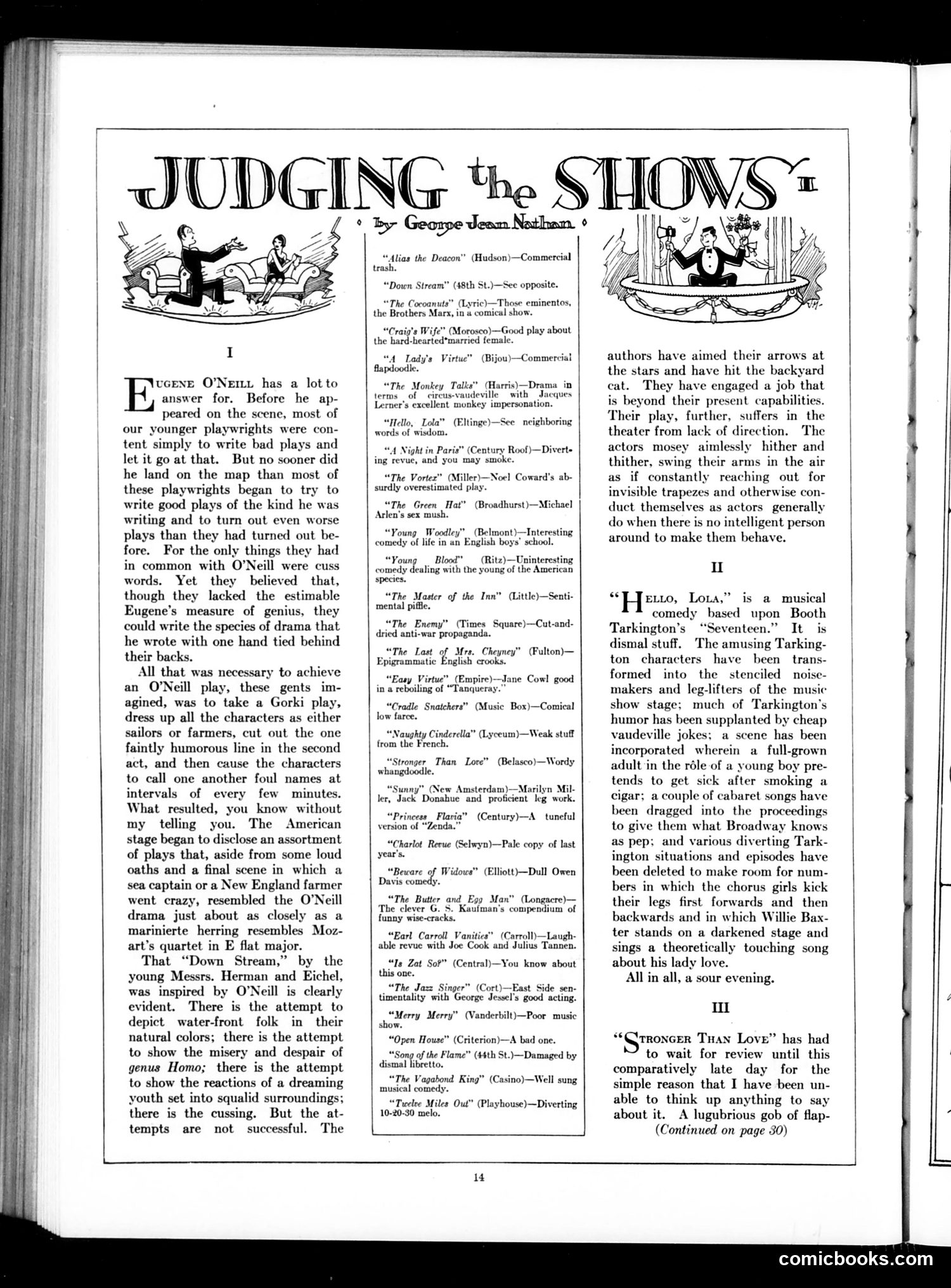
This page is a theater critic's column reviewing current Broadway productions. The main article (Section I) is Nathan's commentary on how Eugene O'Neill's success inspired inferior imitators. Nathan argues that lesser playwrights, lacking O'Neill's genius, attempted to copy his style by simply taking existing plays, dressing characters as sailors or farmers, removing humor, and adding profanity at regular intervals. He cites "Down Stream" as an example of this failed imitation—it borrows O'Neill's waterfront setting and despair-focused themes but lacks authentic depth. The boxed list provides Nathan's capsule reviews of current Broadway shows, using characteristically sharp dismissals ("Commercial trash," "Weak stuff," "Wordy whangdoodle"). This reflects the irreverent, caustic tone Judge magazine was known for in theatrical criticism.
📄 Transcribed text from this page (OCR, searchable)
Machine-transcribed from the original scan — historical spelling and the odd misread are preserved.
—EE UGENE O'NEILL has a lotto BE answer for. Before he ap- peared on the scene, most of our younger playwrights were con- tent simply to write bad plays and let it go at that. But no sooner did he land on the map than most of these playwrights began to try to write good plays of the kind he was writing and to turn out even worse plays than they had turned out be- fore. For the only things they had in common with O'Neill were cuss words. Yet they believed that, though they lacked the estimable Eugene’s measure of genius, they could write the species of drama that he wrote with one hand tied behind their backs. All that was necessary to achieve an O'Neill play, these gents im- agined, was to take a Gorki play, dress up all the characters as either sailors or farmers, cut out the one faintly humorous line in the second act, and then cause the characters to call one another foul names at intervals of every few minutes. What resulted, you know without my telling you. The American stage began to disclose an assortment of plays that, aside from some loud oaths and a final scene in which a sea captain or a New England farmer went crazy, resembled the O'Neill drama just about as closely as a marinierte herring resembles Moz- art’s quartet in E flat major. That “Down Stream,” by the young Messrs. Herman and Eichel, was inspired by O'Neill is clearly evident. There is the attempt to depict water-front folk in their natural colors; there is the attempt to show the misery and despair of genus Homo; there is the attempt to show the reactions of a dreaming youth set into squalid surroundings; there is the cussing. But the at- tempts are not successful. The by Geonpe Jeam Nathan ¢ “Alias the Deacon” (Hudson)—Commercial trash. “Down Stream” (48th St.)—See opposite. “The Cocoanuts” (Lytic)—Those eminentos, the Brothers Marx, in a comical show. “Craig's Wife” (Morosco)—Good play about the hard-hearted*married female. “A Lady's Virtue" (Bijou) —Commercial flapdoodle. “The Monkey Talks” (Harris) —Dr: in terms of circus-vaudeville wit! s Lerner’s excellent monkey impersonat “Hello, Lola” (Eltinge)—See neighboring words of wisdom. “4 Night in Paris” (Century Roof)—Divert= ing revue, and you may smoke. “The Vortex” (Miller surdly overestimated play. “The Green Hat” (Broadhurst)—Michael Arlen’s sex mush. Noel Coward's ab- “Young Woodley” (Belmont)—Interesting comedy of life in an English boys’ school. “Youn: Blood” (Ritz)—Uninteresting comedy dealing with the young of the American species. “The Master of the Inn” (Little)—Senti- mental piffie. “The Enemy” (Times Square)—Cut-and- dried anti-war propaganda, “The Last of Mrs. Cheyney” (Fulton)— Epigrammatic English’ crooks. Jane Cowl good “Easy Virtue” (Empire) in a reboiling of “Tanqueray. “Cradle Snatchers” (Music Box)—Comical low farce. “Naughty Cinderella” (Lyceum)—Weak stuff from the French. “Stronger Than Lore” (Belasco)—Wordy whangdoodle. “Sunny” (New Amsterdam)—Marily: ler, Jack Donahue and proficient leg “Princess Flavia” version of “Zenda.” vork. (Century)—A tuneful “Charlot Reewe (Selwyn)—Pale copy of last year's. create & Widows” (Elliott}—Dull Owen Davis come “The Butter and Egg Man" (Longacre)— ‘The clever G. S. Kaufman's compendium of funny wise-cracks. “Earl Carroll Vanities” (Carroll)—Laugh- able revue with Joe Cook and Julius Tannen. “Is Zat So?” (Central)—You know about this one. “The Jazz Singer” (Cort)—East Side sen- timentality with George Jessel’s good acting. “Merry Merry” (Vanderbilt)—Poor music show. “Open House” (Criterion)—A bad one. sone of the Flame” (44th St.)—Damaged by dismal libretto. “The Vagabond King” (Casino)—Well sung musical comedy. “Twelte Miles Out” (Playhouse)—Diverting 10-20-30 melo. it authors have aimed their arrows at the stars and have hit the backyard vat. They have engaged a job that is beyond their present capabilities. Their play, further, suffers in the theater from lack of direction. The actors mosey aimlessly hither and thither, ng their arms in the air as if constantly reaching out for invisible trapezes and otherwise con- duct themselves as actors generally do when there is no intelligent person around to make them behave. 0 = ELLO, Lota,” is a musical comedy based upon Booth Tarkington’s “Seventeen.” It is dismal stuff. The amusing Tarking- ton characters have been trans- formed into the stenciled noi: makers and leg-lifters of the music show stage; much of Tarkington's humor has been supplanted by cheap vaudeville jokes; a scene has been incorporated wherein a full-grown adult in the réle of a young boy pre- tends to get sick after smoking a cigar; a couple of cabaret songs have been dragged into the proceedings to give them what Broadway knows as pep; and various diverting Tark- ington situations and episodes have been deleted to make room for num- bers in which the chorus girls kick their legs first forwards and then backwards and in which Willie Bax- ter stands on a darkened stage and sings a theoretically touching song about his lady love. All in all, a sour evening. tt ‘TRONGER THAN Love” has had to wait for review until this comparatively late day for the simple reason that I have been un- able to think up anything to say about it. A lugubrious gob of flap- (Continued on page 30) comicbooks.com