
Judge, 1926-02-06 · page 13 of 36
Judge — February 6, 1926 — page 13: what you’re looking at
What you’re looking at
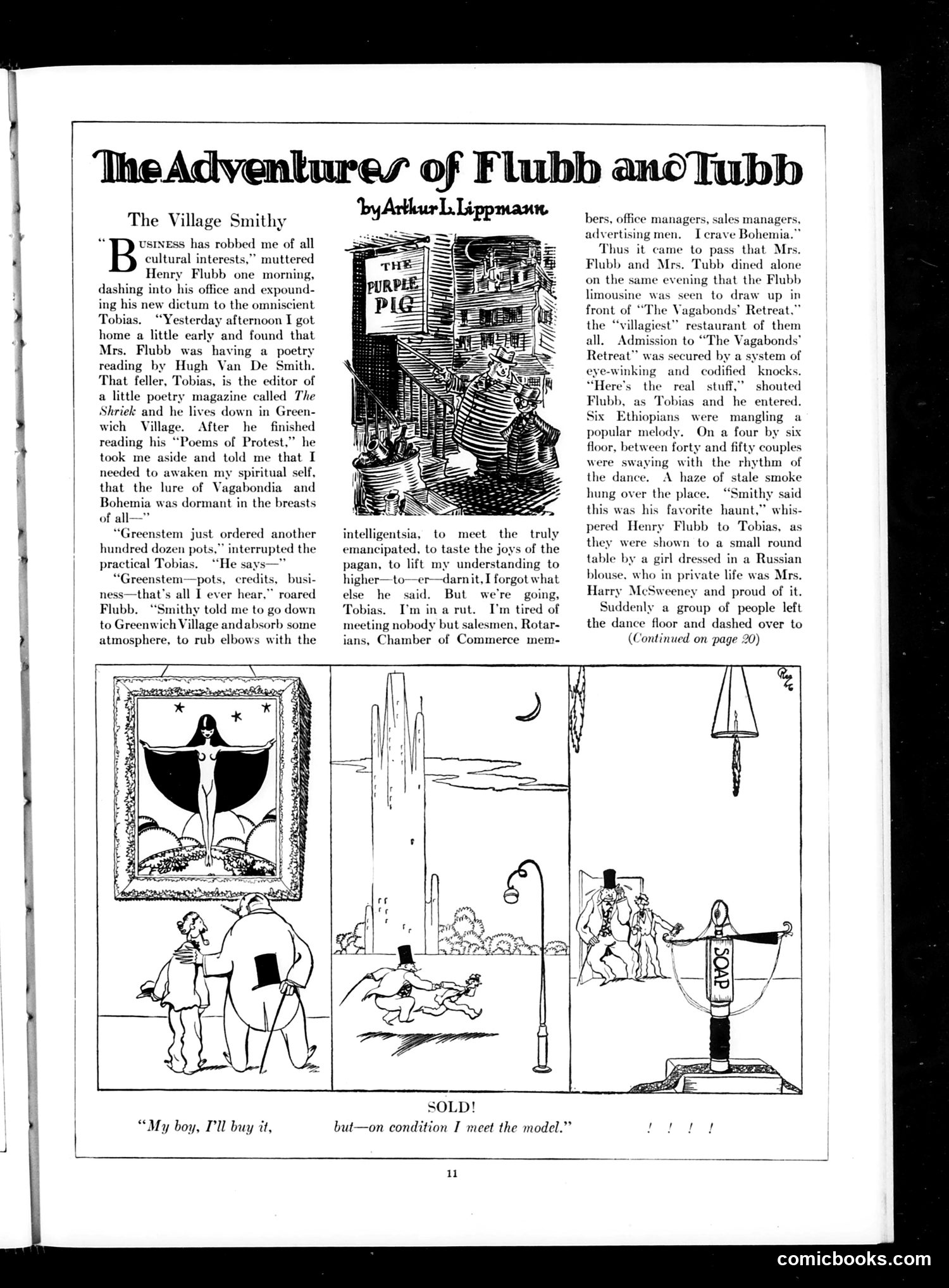
This is a serialized humor story satirizing the 1920s craze for "slumming" in Greenwich Village's bohemian scene. Henry Flubb, a practical businessman, is shamed by a poetry magazine editor named Van De Smith into seeking "spiritual awakening" and authentic bohemian experience. The joke targets the pretentiousness of wealthy businessmen trying to adopt bohemian culture—Flubb abandons his usual world of "salesmen, Rotarians, Chamber of Commerce members" to visit "The Vagabonds' Retreat," an artificially bohemian restaurant with coded entrance rituals. The cartoon below depicts selling art to the wealthy: a patron agrees to buy a painting conditionally ("on condition I meet the model"), satirizing how commercial interests corrupt artistic authenticity—precisely the tension Flubb is navigating. The satire mocks both the businessman's desire to appear cultured and the commercialization of bohemia itself.
📄 Transcribed text from this page (OCR, searchable)
Machine-transcribed from the original scan — historical spelling and the odd misread are preserved.
> iepecassasonmti a psu tananensan pati —<_— — TheAdventures of Flubb anoTubb The Village Smithy . ustvEss has robbed me of all B cultural interests,” muttered Henry Flubb one morning, dashing into his office and expound- ing his new dictum to the omniscient Tobias. “Yesterday afternoon I got home a little early and found that Mrs. Flubb was having a poetry reading by Hugh Van De Smith. That feller, Tok is the editor of a little poetry magazine called The Shriek and he lives down in Green- wich Village. After he finished reading his “Poems of Protest,” he took me aside and told me that I needed to awaken my spiritual self, that the lure of Vagabondia and Bohemia was dormant in the breasts of all “Greenstem just ordered another hundred dozen pots,” interrupted the practical Tobias. ‘‘He says—" “Greenstem—pots, credits, busi- ness—that’s all I ever hear,” roared Flubb. “Smithy told me to go down to Greenwich Village andabsorb some atmosphere, to rub elbows with the intelligentsia, to meet the truly emancipated, to taste the joys of the pagan, to lift my understanding to higher—to—er—darnit, I forgot what else he said. But we're going, Tobias. I'm ina rut. I'm tired of meeting nobody but salesmen, Rotar- ians, Chamber of Commerce mem- mee RN - 1 “My boy, Pll buy it, SOLD! but—on condition I meet the model.” bers, office managers, sales managers, advertising men. I crave Bohemia.” Thus it came to pass that Mrs. Flubb and Mrs. Tubb dined alone on the same evening that the Flubb limousine was seen to draw up in front of “The Vagabonds’ Retreat.” the “villagiest” restaurant of them all. Admission to “The Vagabonds’ Retreat” was secured by a system of eye-winking and codified knocks. “Here's the real stuff,” shouted Flubb, as Tobias and he entered. Six Ethiopians popular melody, were mangling a On a four by six floor, between forty and fifty couples were swaying with the rhythm of the dance. A haze of stale smoke hung over the pl “Smithy said this was his favorite haunt,” whis- pered Henry Flubb to Tobias, as they were shown to a small round table by a girl dressed in a Russian blouse. who in private life was Mrs. Harry McSweeney and proud of it. Suddenly a group of people left the dance floor and dashed over to (Continued on page 20) comicbooks.com