
Judge, 1926-02-06 · page 15 of 36
Judge — February 6, 1926 — page 15: what you’re looking at
What you’re looking at
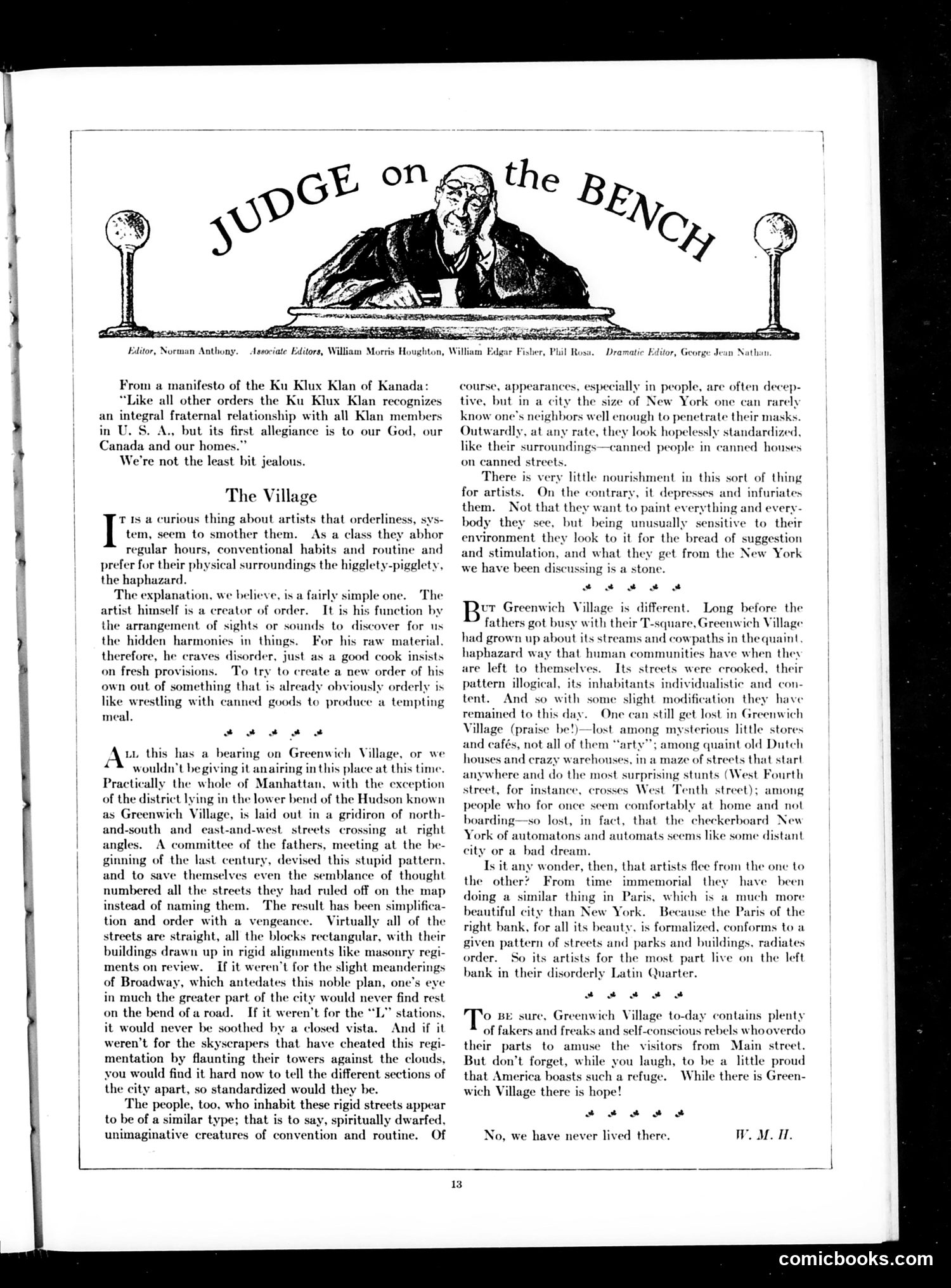
This page from *Judge* magazine satirizes American conformity and the Ku Klux Klan through contrasting commentary on urban planning and Greenwich Village. **The KKK Reference**: The header quotes a Canadian KKK manifesto claiming loyalty to "God, our Canada and our homes," then dismisses it with "We're not the least bit jealous"—mocking the KKK's exclusionary nationalism and suggesting their concerns are petty. **The Main Satire**: The article argues that Manhattan's rigid grid-plan streets produce spiritually "dwarfed, unimaginative creatures of convention and routine"—standardized people in "canned houses." Greenwich Village, by contrast, developed organically with crooked streets and individualistic inhabitants, making it a haven for artists who reject conformity. **The Broader Point**: By juxtaposing KKK conformist nationalism with critique of America's standardized urban design, the piece suggests that enforced uniformity—whether through urban planning or racist ideology—stifles human creativity and individuality. Greenwich Village represents freedom and authentic self-expression against both corporate standardization and nationalist conformism.
📄 Transcribed text from this page (OCR, searchable)
Machine-transcribed from the original scan — historical spelling and the odd misread are preserved.
ae er From a manifesto of the Ku Klux Klan of Kanada: “Like all other orders the Ku Klux Klan recognizes an integral fraternal relationship with all Klan members in U. S. A., but its first allegiance is to our God, our ada and our homes.” re not the least bit jealous. The Village T 1s a curious thing about artists that orderliness, sys- tem, seem to smother them. As a class they abhor regular hours, conventional habits and routine and prefer for their physical surroundings the higglety-pigglety, the haphazard. The explanation, we believe, is a fairly simple one. ‘The artist himself is a creator of order. It is his function by the arrangement of sights or sounds to discover for us the hidden harmonies in things. For his raw material. therefore, he craves disorder, just as a good cook insists on fresh provisions. To try to create a new order of his own out of something that is already obviously orderly is like wrestling with canned goods to produce a tempting meal. A“ this has a bearing on Greenwich Village, or we © wouldn't begiving it anairing inthis place at this time. Practically the whole of Manhattan, with the exception of the district lying in the lower bend of the Hudson known as Greenwich Village, is laid out in a gridiron of north- and-south and east-and-west streets crossing at right angles. A committee of the fathers, meeting at the be- ginning of the last century, devised this stupid pattern, and to save themselves even the semblance of thought numbered all the streets they had ruled off on the map instead of naming them. The result has been simplifica- tion and order with a vengeance. Virtually all of the streets are straight, all the blocks rectangular, with their buildings drawn up in rigid alignments like masonry regi- ments on review. If it weren't for the slight meanderings of Broadway, which antedates this noble plan, one’s eve in much the greater part of the city would never find rest on the bend of a road. If it weren't for the “L” it would never be soothed by a closed vista. And if it weren't for the skyscrapers that have cheated this regi- mentation by flaunting their towers against the clouds, you would find it hard now to tell the different sections of the city apart, so standardized would they be. The people, too, who inhabit these rigid streets appear to be of a similar type; that is to say, spiritually dwarfed, unimaginative creatures of convention and routine. Of stations, Editor, George Jean Nathan. course, appearances, ¢ - in people, are often decep- tive, but in a city the > of New York one can rarely know one’s neighbors well enough to penetrate their mask: Outwardly, at any rate, they look hopelessly standardiz like their surroundings—canned people in canned houses on canned streets. There is very little nourishment in this sort of thing for artists. On the contrary, it depresses and infuriates them. Not that they want to paint everything and every- body they see, but being unusually sensitive to their environment they look to it for the bread of suggestion and stimulation, and what they get from the New York we have been discussing is a stone. Cary ry ary Bu Greenwich Village is different. Long bef fathers got busy with their T-square, Greenwich V had grown up about its streams and cowpaths in the quaint. haphazard way that human communities have when they are left to themselves. Its streets were crooked, their pattern illogical, its inhabitants individualistic and con- tent. And so with some slight: modific remained to this d One can still get lost in Greenwich Village (praise be!)—lost among mysterious little stores and cafés, not all of them “arty mong quaint old Dutch houses and crazy warehouses, in a maze of streets that start anywhere and do the most surprising stunts (West Fourth street, for instance, crosses West ation they have Tenth street); among people who for once seem comfortably at home and not boarding—so lost, in fact, that the checkerboard New York of automatons and automats seems like some distant city or a bad dream. Is it any wonder, then, that artists flee from the one to the other? From time immemorial they have been doing a similar thing in Paris, which is a much more beautiful city than New York. Because the Paris of the right bank, for all its beauty, is formalized, conforms to a given pattern of streets and parks and buildings, radiates order. So its artists for the most part live on the left bank in their disorderly Latin Quarter. ry ry se 0 BE sure, Greenwich Village to-day contains plenty of fakers and freaks and self-conscious rebels whooverdo their parts to amuse the visitors from Main street. But don’t forget, while you laugh, to be a little proud that America boasts such a refuge. While there is Green- wich Village there is hope! ess AH A SD W.M.W. No, we have never lived there. comicbooks.com