
Judge, 1926-02-06 · page 23 of 36
Judge — February 6, 1926 — page 23: what you’re looking at
What you’re looking at
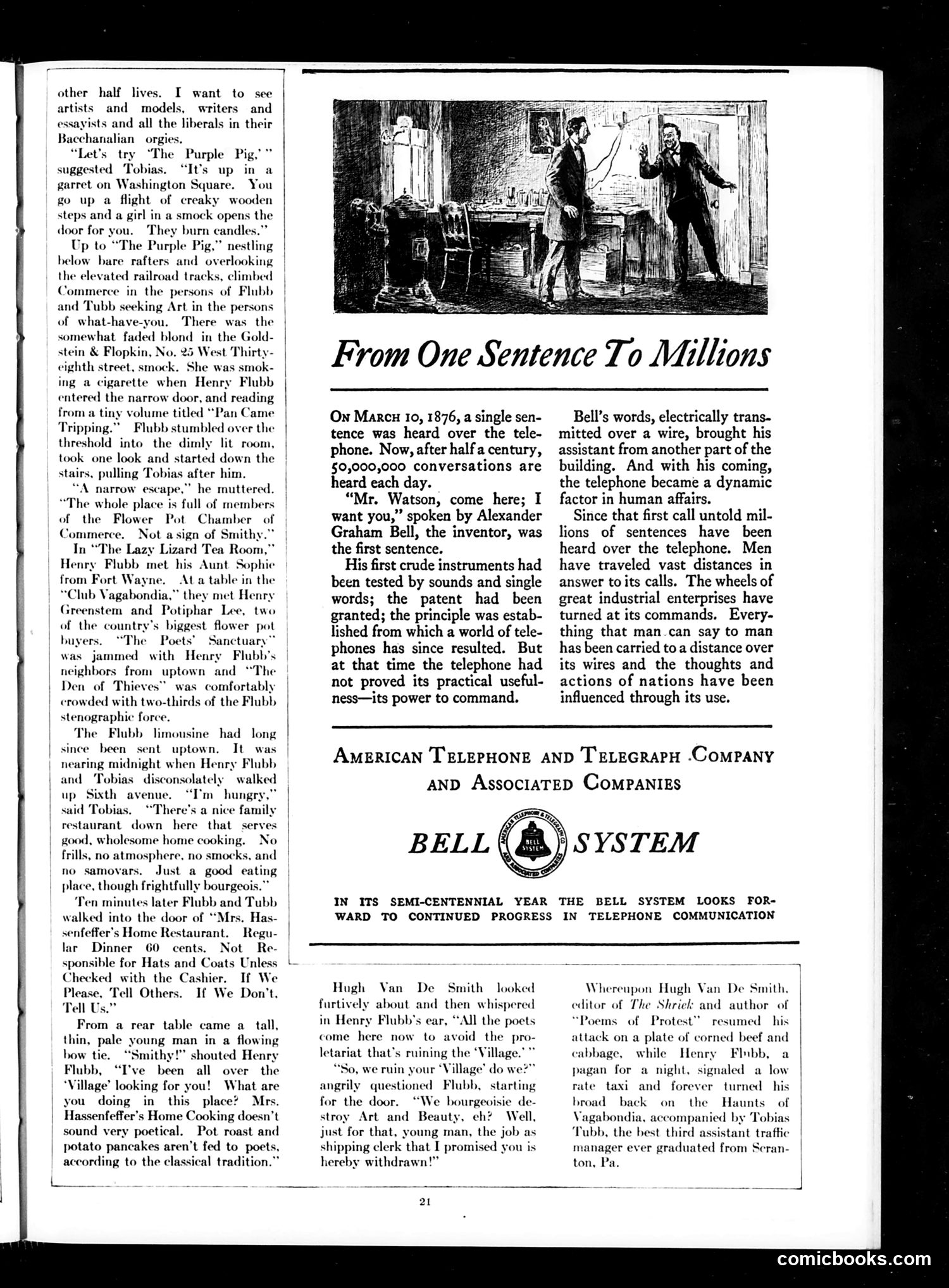
This page combines two unrelated elements: a short story excerpt and an advertisement. **The Story Section** (left side): A satirical narrative about Henry Flubb and his friend Tobias touring bohemian Greenwich Village establishments around 1920s New York. The satire targets pseudo-artistic "bohemian" culture—places like "The Purple Pig" and "Club Vagabondia" that attract dilettantes and poseurs rather than genuine artists. The joke: these supposedly avant-garde venues are actually full of ordinary middle-class people (Flubb's relatives, business contacts, stenographers) pretending to be creative. The story mocks both the pretentiousness of bohemian aestheticism and the bourgeois people who imitate it. **The Advertisement** (right side): A Bell Telephone System advertisement celebrating the telephone's 50th anniversary (1876–1926). It emphasizes the technology's evolution from a mere novelty to an essential tool reshaping business and society—"a dynamic factor in human affairs." The ad uses Bell's famous first transmitted sentence to position the telephone as revolutionary infrastructure. These sections share no apparent connection.
📄 Transcribed text from this page (OCR, searchable)
Machine-transcribed from the original scan — historical spelling and the odd misread are preserved.
other half lives. I want to see artists and models, writers and essayists and all the liberals in their lian orgie “Let's try “The Purple Pig suggested Tobias. “It’s up in a garret on Washington Square. You go up a flight of creaky wooden steps and a girl in a smock opens the door for you. They burn candles.” Up to * below bare rafters and overlooking the elevated railroad tracks, climbed Commerce in the persons of Flubb and Tubb seeking Art in the persons of what-have-you. somewhat faded blond in the Gold- stein & Flopkin, No cighth street, smock. She was smok- ing a cigarette when Henry Flubb entered the narrow door, and reading froma tiny volume titled “Pan Came Tripping.” Flubb stumbled over the threshold into the dimly lit room, took one look and started down the stairs, pulling Tobias after him. A narrow escape,” he muttered. “The whole place is full of members of the Flower Pot Chamber of Commerce. Not asign of Smithy In “The Lazy Lizard Tea Room, Henry Flubb met his Aunt Sophie from Fort Wayne. Ata table in the “Club Vagabondia,” they met Henry Greenstem and Potiphar Lee, two of the country’s biggest flower pot buyers. “The Poets’ Sanctuary” was jammed with Henry Flubb’s neighbors from uptown and ‘The Den of Thieves” was comfortably crowded with two-thirds of the Flubb | stenographie force. The Flubb limousine had long since been sent uptown. It_ was nearing midnight when Henry Flubb and Tobias disconsolately walked up Sixth avenu “I'm hungry,” said Tobias. “There's a nice family restaurant down here that serves good, wholesome home cooking. No frills, no atmosphere, no smocks, and no samovars. Just a good eating place, though frightfully bourgeois.” ‘Ten minutes later Flubb and Tubb walked into the door of “Mrs. Has- senfeffer's Home Restaurant. Regu- lar Dinner 60 cents. Not Re- sponsible for Hats and Coats Unless Checked with the Cashier. If We Please, Tell Others. If We Don't. Tell , From a rear table came a_ tall, thin, pale young man in a flowing how tie. nithy!”” shouted Henry Flubb, “I've been all over the ‘Village’ looking for you!' What are | you doing in this place? Mrs. Hassenfeffer’s Home Cooking doesn’t sound very poetical. Pot roast and potato pancakes aren't fed to poets, according to the classical tradition.” {__—— The Purple Pig,” nestling There was the | West Thirty- | From One Sentence To Millions On Marcu 10, 1876, a single sen- tence was heard over the tele- phone. Now, after halfa century, 50,000,000 conversations are heard each day. “Mr. Watson, come here; I want you,” spoken by Alexander Graham Bell, the inventor, was the first sentence. His first crude instruments had been tested by sounds and single words; the patent had been granted; the principle was estab- lished from which a world of tele- phones has since resulted. But at that time the telephone had not proved its practical useful- ness—its power to command. Bell’s words, electrically trans- mitted over a wire, brought his assistant from another part of the building. And with his coming, the telephone became a dynamic factor in human affairs. Since that first call untold mil- lions of sentences have been heard over the telephone. Men have traveled vast distances in answer to its calls. The wheels of great industrial enterprises have turned at its commands. Every- thing that man.can say to man has been carried to a distance over its wires and the thoughts and actions of nations have been influenced through its use. AMERICAN TELEPHONE AND TELEGRAPH -COMPANY AND AssociATED ComPANIES SYSTEM IN ITS SEMI-CENTENNIAL YEAR THE BELL SYSTEM LOOKS FOR- WARD TO CONTINUED PROGRESS IN TELEPHONE COMMUNICATION Hugh Van De Smith looked furtively about and then whispered in Henry Flubb’s ear, “All the poets come here now to avoid the pr iat that's ruining the ‘Village.’ >, we ruin your ‘Village’ do we? angrily questioned Flubb, starting for the door. “We bourgeoisie de- stroy Art and Beauty, eh? Well, just for that, young man, the job as shipping clerk that I promised you is hereby withdrawn!” Wherenpon Hugh Van De Smith, editor of The Shriek and author of “Poems of Protest’ resumed his attack on a plate of corned beef and Flubb, a pagan for a night, signaled a low rate taxi and forever turned his broad back on the Haunts of Vagabondia, a cabbage, while Henry ‘Tubb, the best third assistant traftic | scompanied by Tobias. | | manager ever graduated from Scran- | ton, Pa. _ comicbooks.com