
A complete issue · 36 pages · 1926
Judge — January 16, 1926
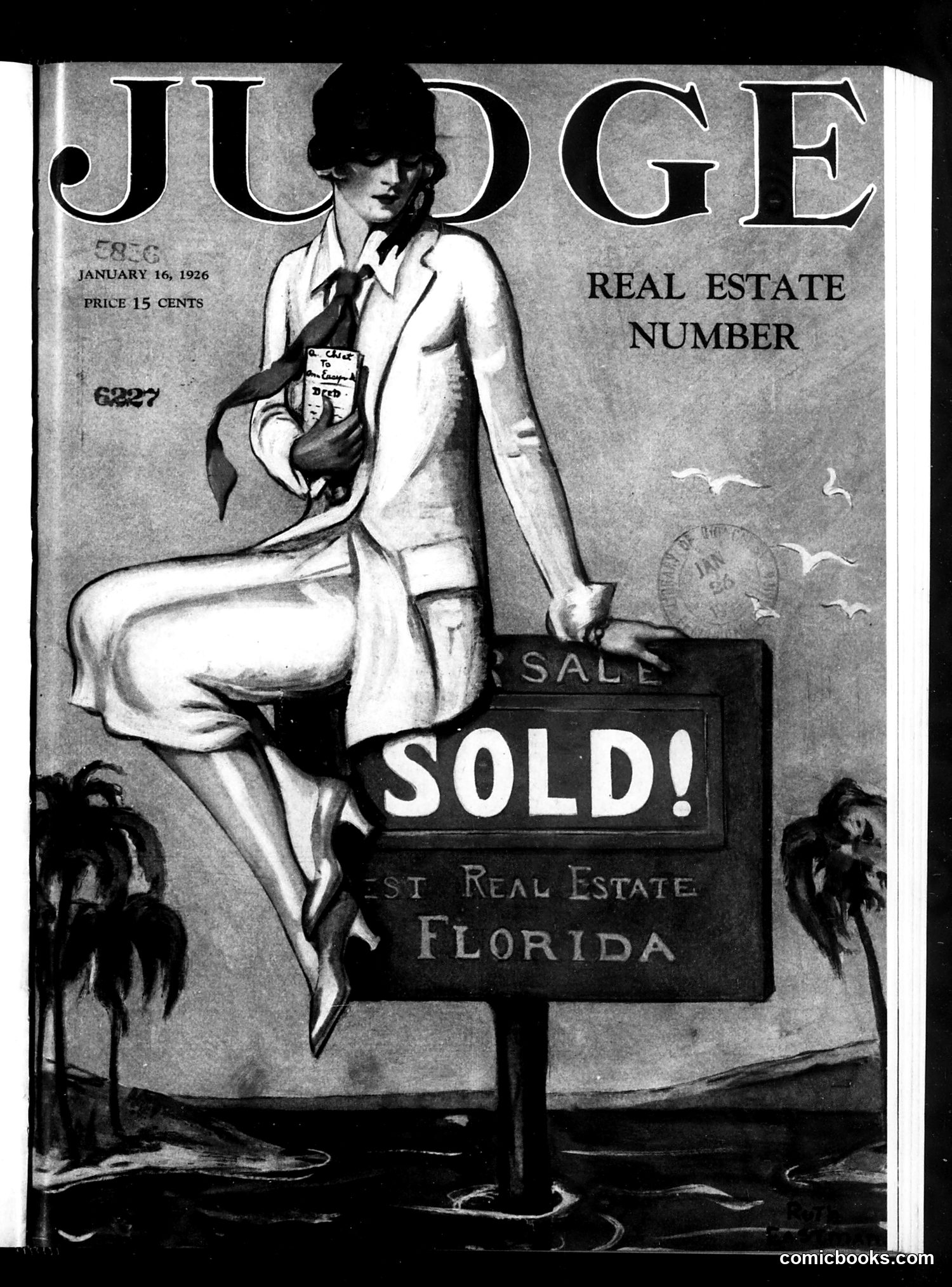
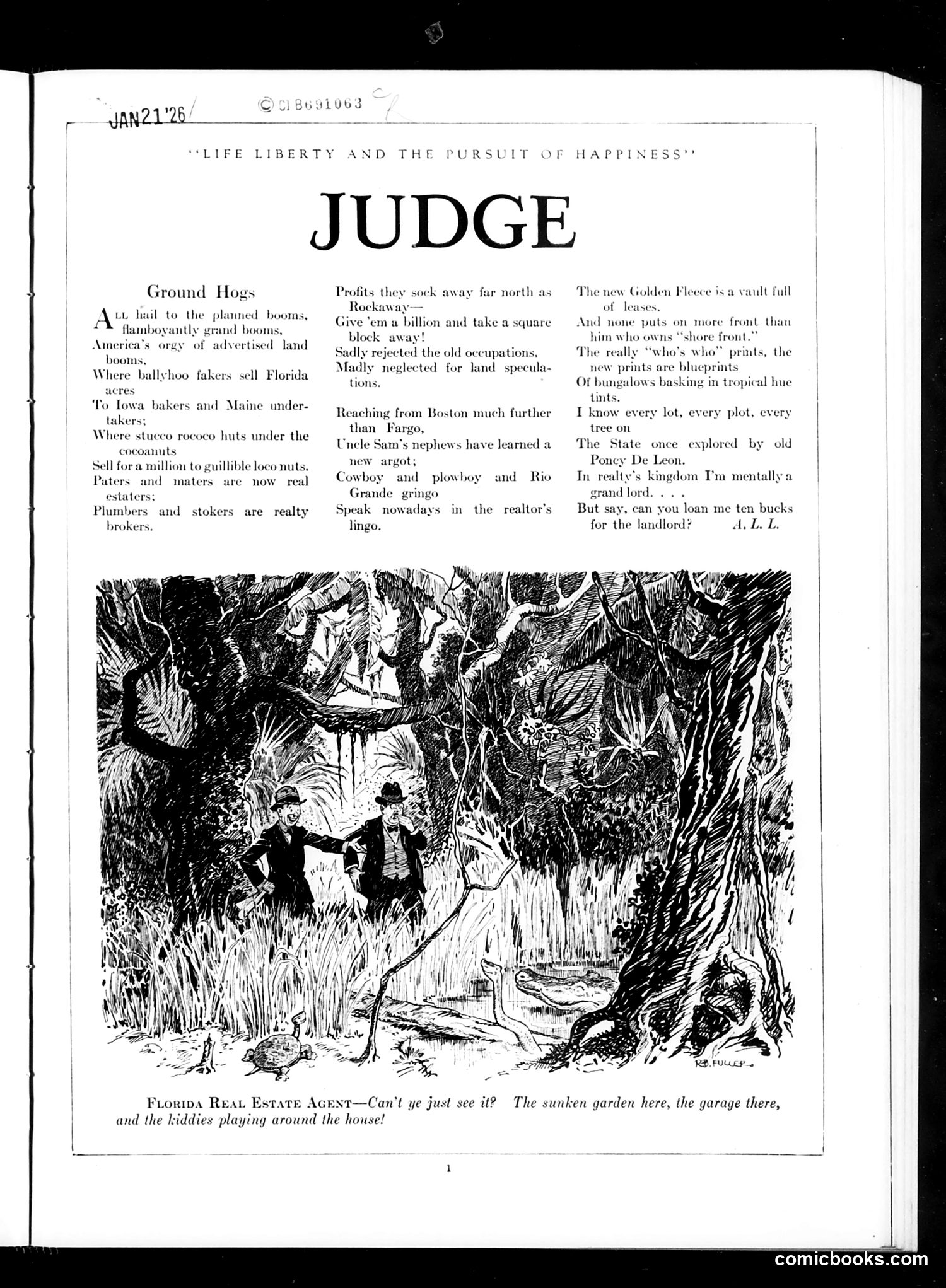
This satirical poem mocks the speculative Florida real estate boom, likely from the 1920s. The title "Ground Hogs" sarcastically refers to land speculators as animals blindly burrowing into schemes. The verse criticizes developers selling remote, worthless parcels as valuable property—"ballyhoo barkers sell Florida acres" to naive buyers. It lists absurd developments: coconut huts, guilible nut plots, and professions (plumbers, brokers) now acting as realtors. The accompanying cartoon shows a real estate agent pitching swampland to a couple in a jungle setting, claiming amenities ("sunken garden," "garage," "kiddies playing around the house")—the visual punchline to the poem's theme about fraudulent land sales to unsuspecting buyers.
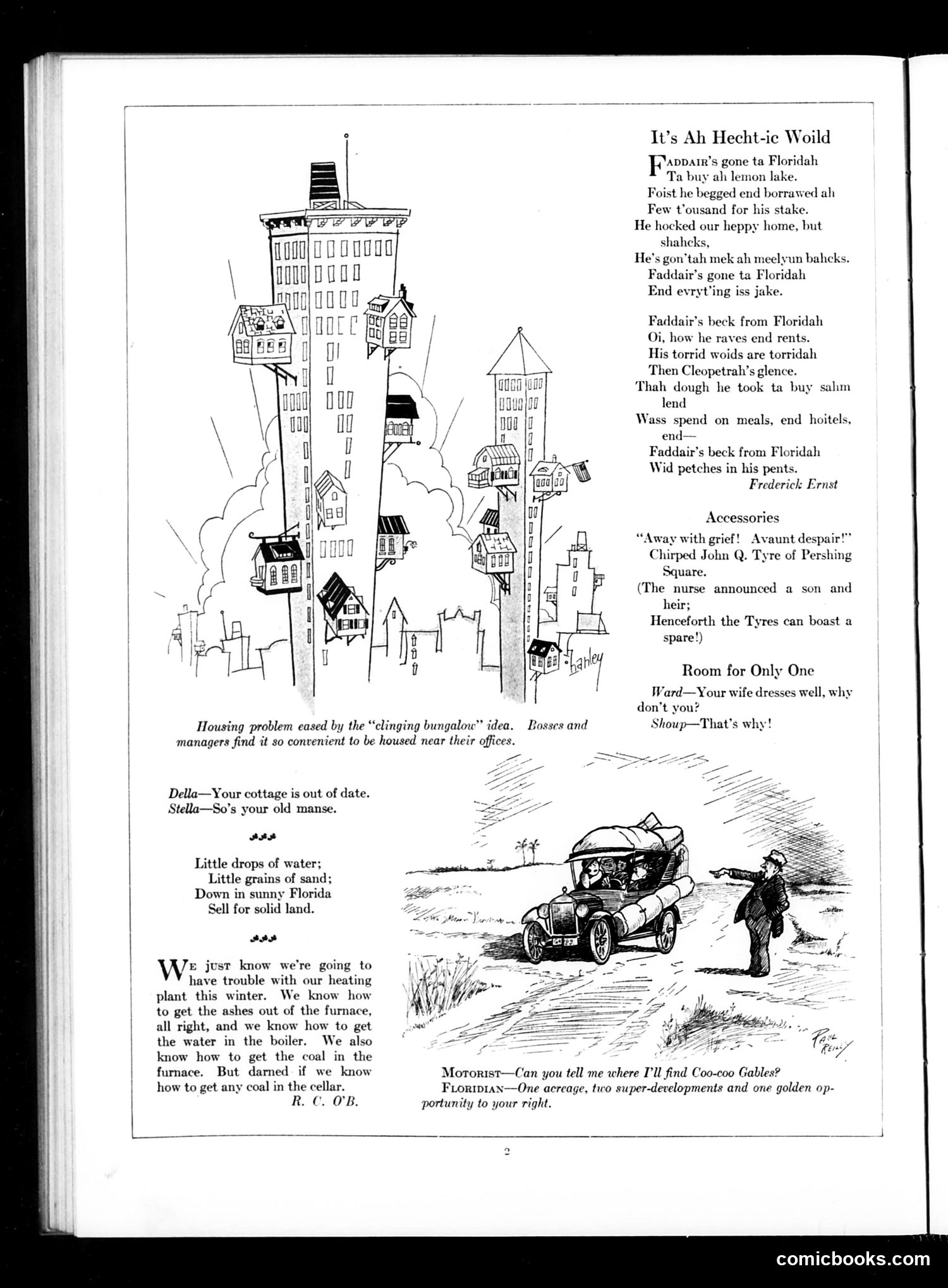
This page contains several unrelated humorous items typical of Judge magazine's format: 1. **"It's Ah Hecht-ie Woild"** - A poem by Frederick Ernst mocking someone named "Faddair" who went to Florida, borrowed money, and lost everything ("end everything iss jake"). This appears to satirize get-rich-quick schemes or poor financial decisions involving Florida real estate. 2. **"Housing problem" cartoon** - Shows overcrowded vertical apartment towers, satirizing urban housing density and the "clinging bungalow" concept where managers live near offices. 3. **"Room for Only One"** - A brief joke about a wife's appearance. 4. **Bottom cartoon** - Depicts a motorist asking a Floridian for directions to "Coo-coo Gables" (likely mocking "Coral Gables"), with the punchline about finding "one golden opportunity." The page satirizes 1920s Florida real estate speculation and urban living conditions.
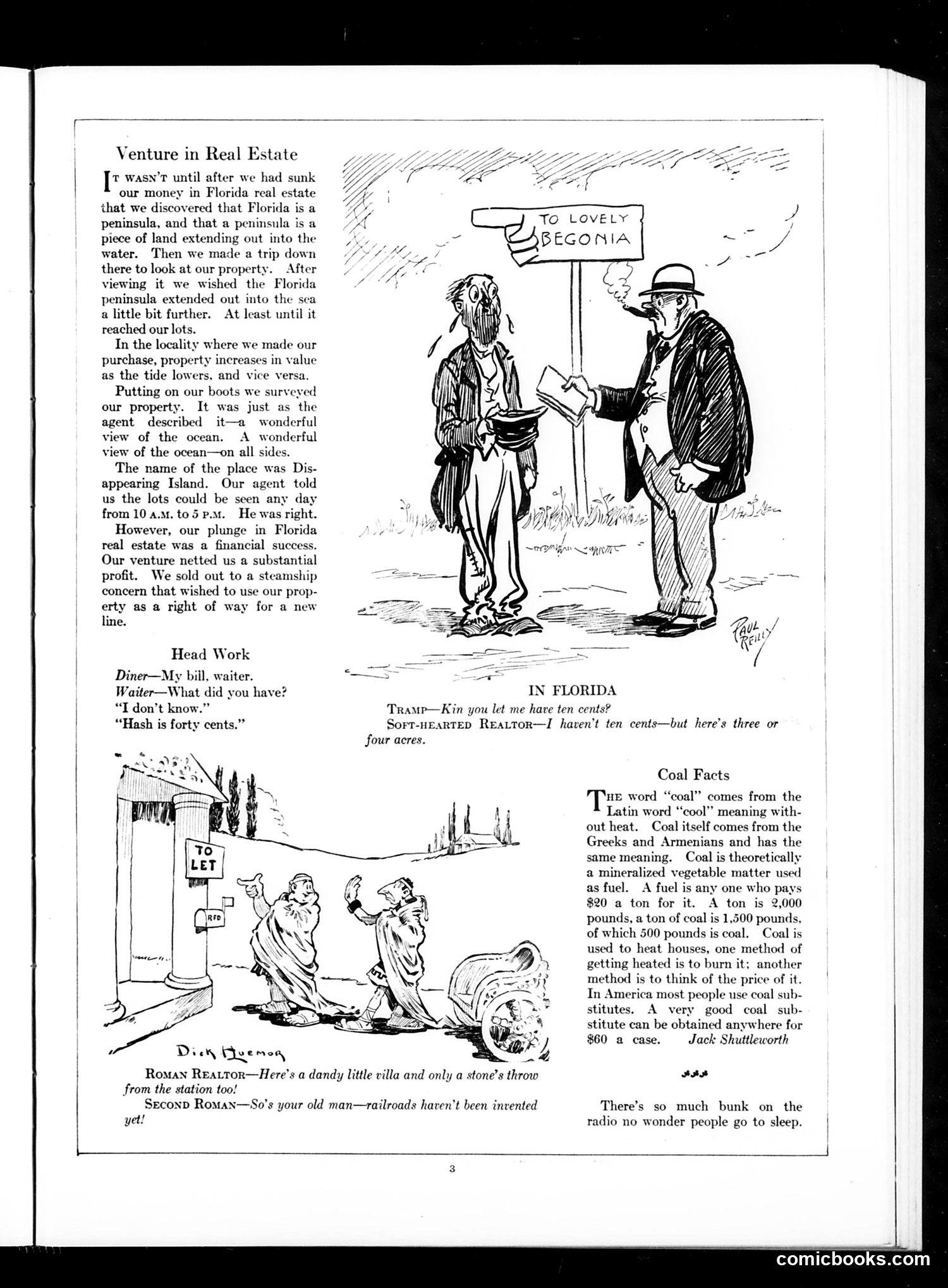
This page contains three distinct cartoons satirizing early 20th-century American life: 1. **"Venture in Real Estate"**: Mocks naive real estate speculation in Florida. A salesman sells worthless "Disapearing Island" property to a gullible buyer, with the punchline suggesting the land literally vanishes into the ocean—a jab at Florida's boom-era land schemes. 2. **"In Florida"**: Shows a tramp negotiating with a realtor over tiny parcels, satirizing inflated Florida real estate prices and dubious sales tactics. 3. **"Head Work"**: Depicts Roman tenants arguing with landlords about rent increases and poor conditions, criticizing urban housing exploitation. The "Coal Facts" educational sidebar appears unrelated to the cartoons' satirical intent, providing factual information about coal consumption.
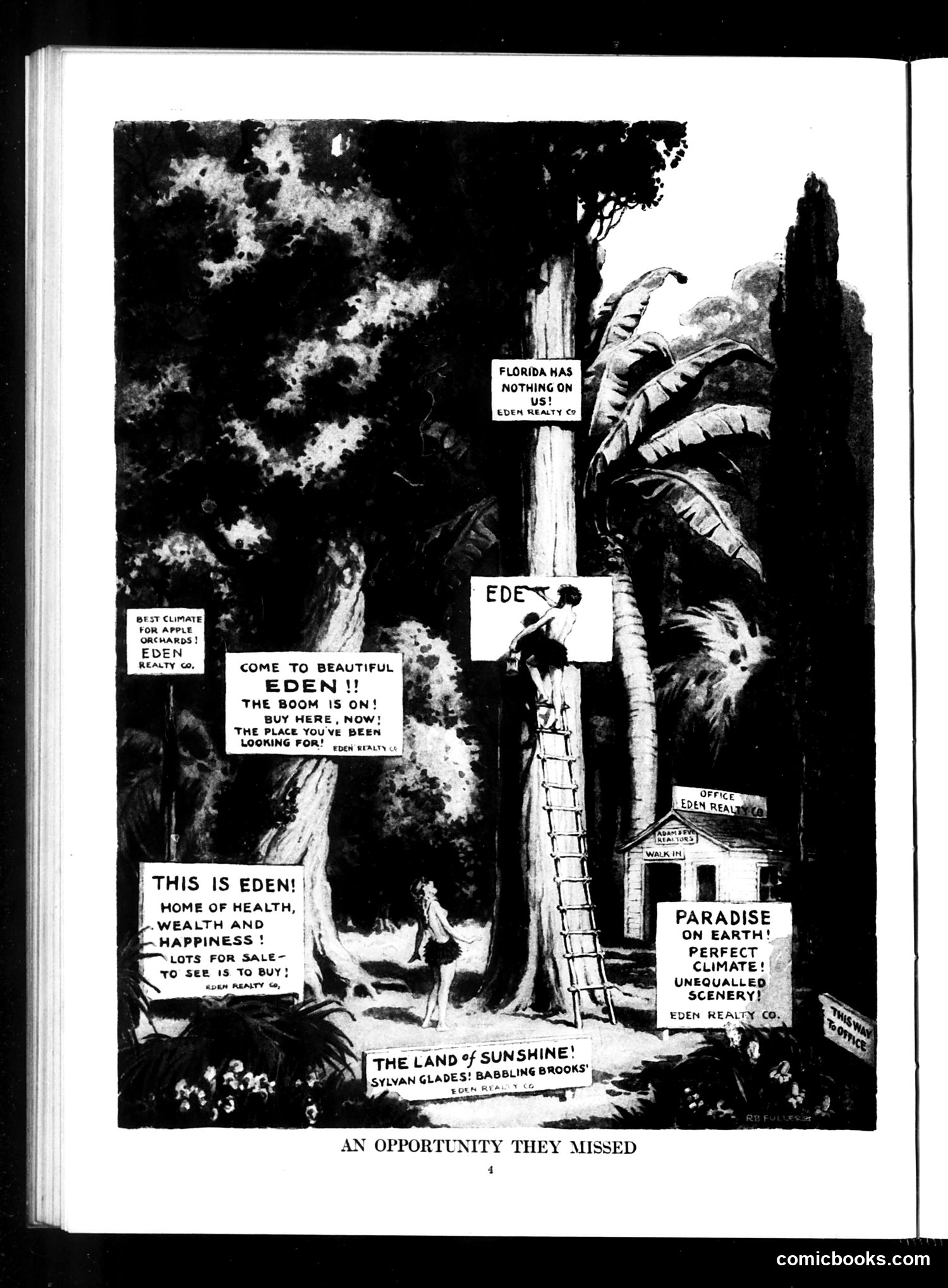
This Judge magazine satirical illustration critiques what appears to be a failed real-estate development scheme in Eden, Florida. The cartoon depicts salesmen from Eden Realty Co. aggressively promoting their development with signs promising "paradise," "perfect climate," and "unequaled scenery" amid an overgrown, swampy wilderness. The satire targets overzealous land promoters and false advertising common during Florida's real-estate booms. The contrast between grandiose marketing claims and the actual desolate landscape with tangled vegetation and sparse development mocks both the developers' exaggeration and presumably buyers who fell for such pitches. The title suggests investors "missed an opportunity"—ironically, as the land appears worthless. This reflects historical criticism of speculative Florida real-estate ventures.
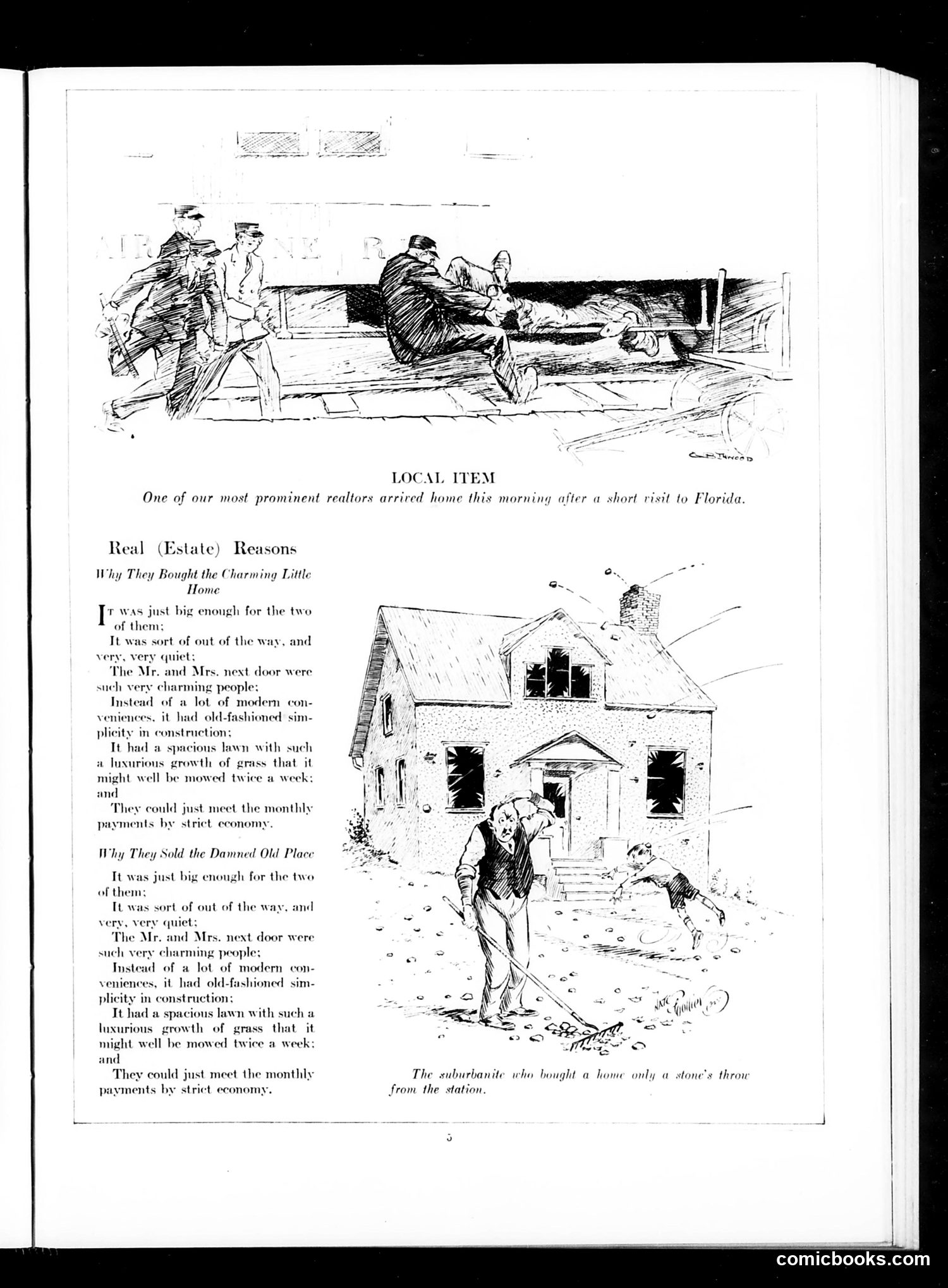
This satirical page from *Judge* magazine mocks suburban real estate marketing of the early 20th century. The top cartoon shows people arriving home from Florida, while the section "Real (Estate) Reasons" ridicules how realtors sell modest suburban homes to middle-class buyers. The satire targets deceptive marketing language: realtors describe cramped, old properties as "charming" and highlight imaginary benefits (luxurious grass, quiet neighborhoods) while glossing over the buyers' financial strain—they can "just meet the monthly payments by strict economy." The illustration of "The suburbanite who bought a home only a stone's throw from the station" depicts an exhausted homeowner, suggesting the reality behind the sales pitch: financial overextension and grueling commutes, not the promised domestic paradise.
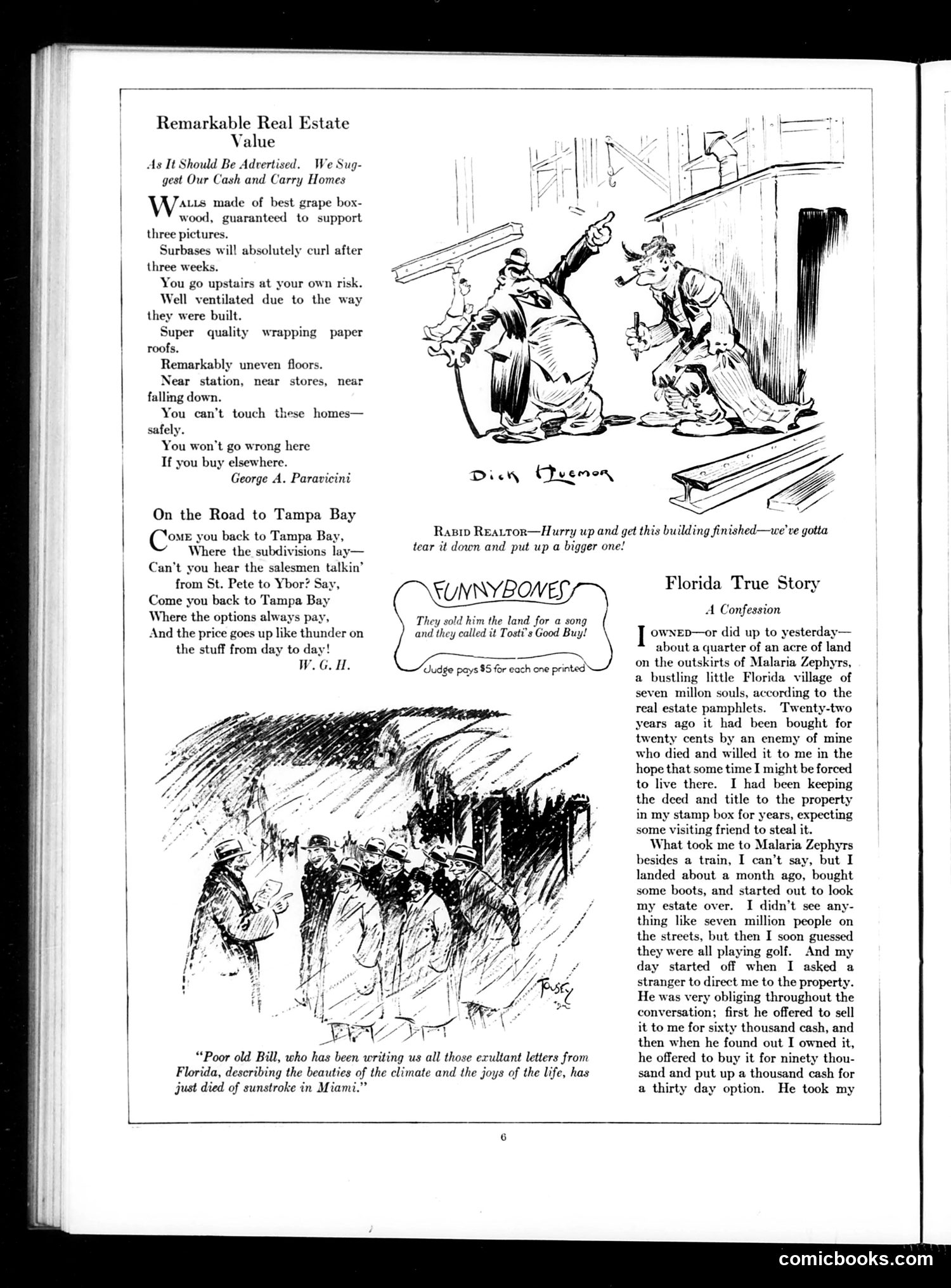
This page satirizes the Florida real estate boom of the 1920s through multiple pieces mocking predatory land sales practices. **"Remarkable Real Estate Value"** inverts typical real estate advertising by honestly describing shoddy construction—homes made of grape-box wood with curling trim, uneven floors, and wrapping-paper roofs. The joke: this brutal honesty contradicts the deceptive marketing that actually characterized Florida developments. **"On the Road to Tampa Bay"** and the cartoon showing a realtor urging construction completion before demolition mock the speculative frenzy, where developers rapidly built and demolished to inflate property values and resale opportunities. **"Florida True Story"** presents a confession about a quarter-acre purchased for twenty cents years ago. When the narrator finally visits "Malaria Zephyrs" (a fictional name satirizing the disease-prone swamplands), a stranger immediately attempts multiple sales schemes—offering to buy it for $90,000 with options—despite the narrator's obvious ownership. The cumulative message: Florida land sales involved systematic deception targeting naive investors, with speculators profiting from worthless property through aggressive, duplicitous tactics.
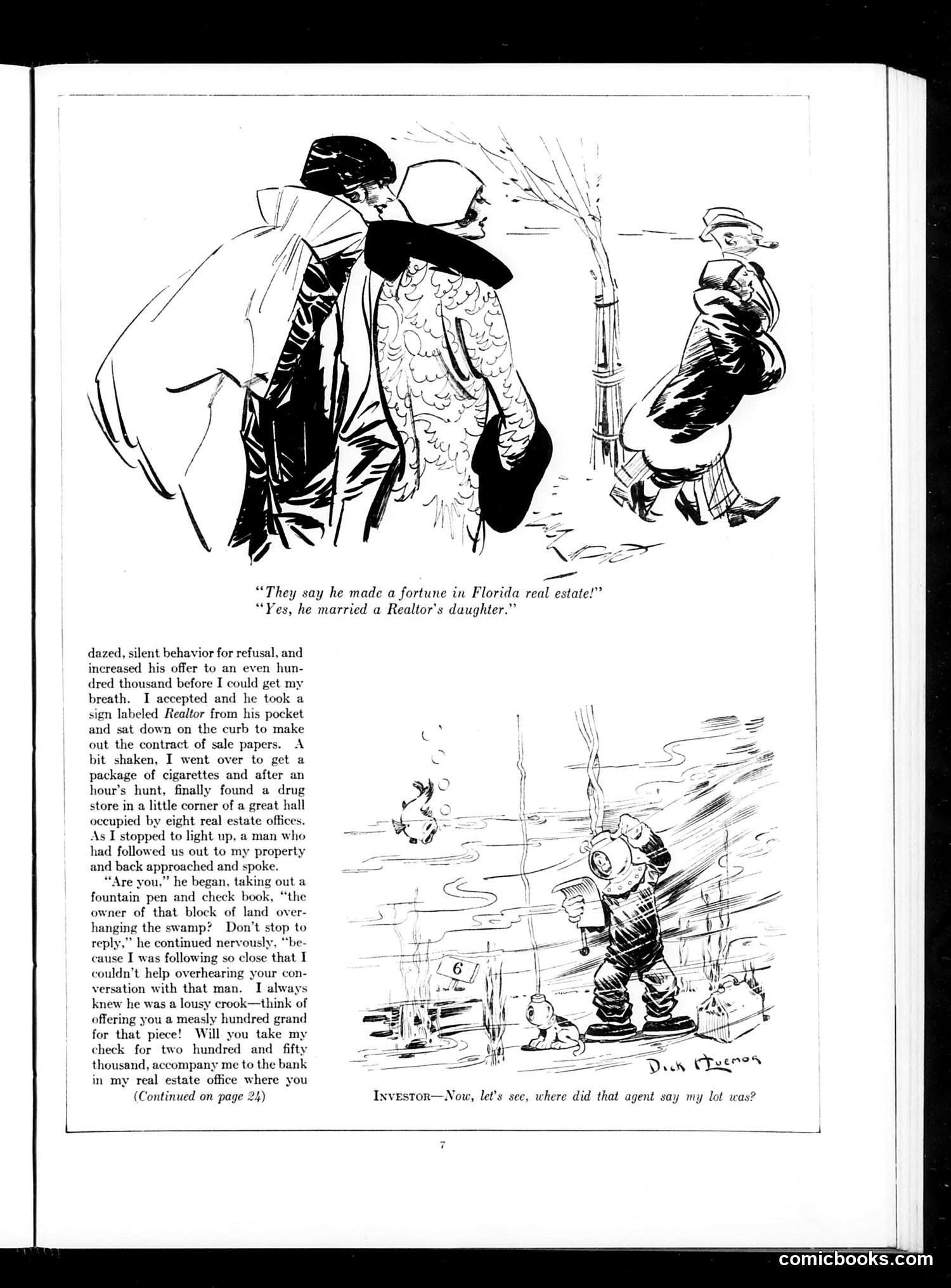
This page satirizes the speculative Florida real estate bubble of the 1920s. The top cartoon jokes that fortunes made in Florida real estate come through marrying a realtor's daughter—implying the deals themselves are dubious. The narrative below depicts absurd land-flipping practices: a protagonist sells swampland to increasingly aggressive buyers who outbid each other without seeing the property. One buyer admits following the previous transaction to eavesdrop and immediately offer more money. The bottom cartoon shows an investor unable to locate his own lot in a swampy landscape, suggesting properties were often unmarked, undeveloped, or worthless. The satire targets both unscrupulous real estate agents and gullible investors caught in speculative fever, where land values bore no relation to actual utility or location. The proliferation of eight real estate offices in one building emphasizes how the industry had become bloated and predatory during this boom period.
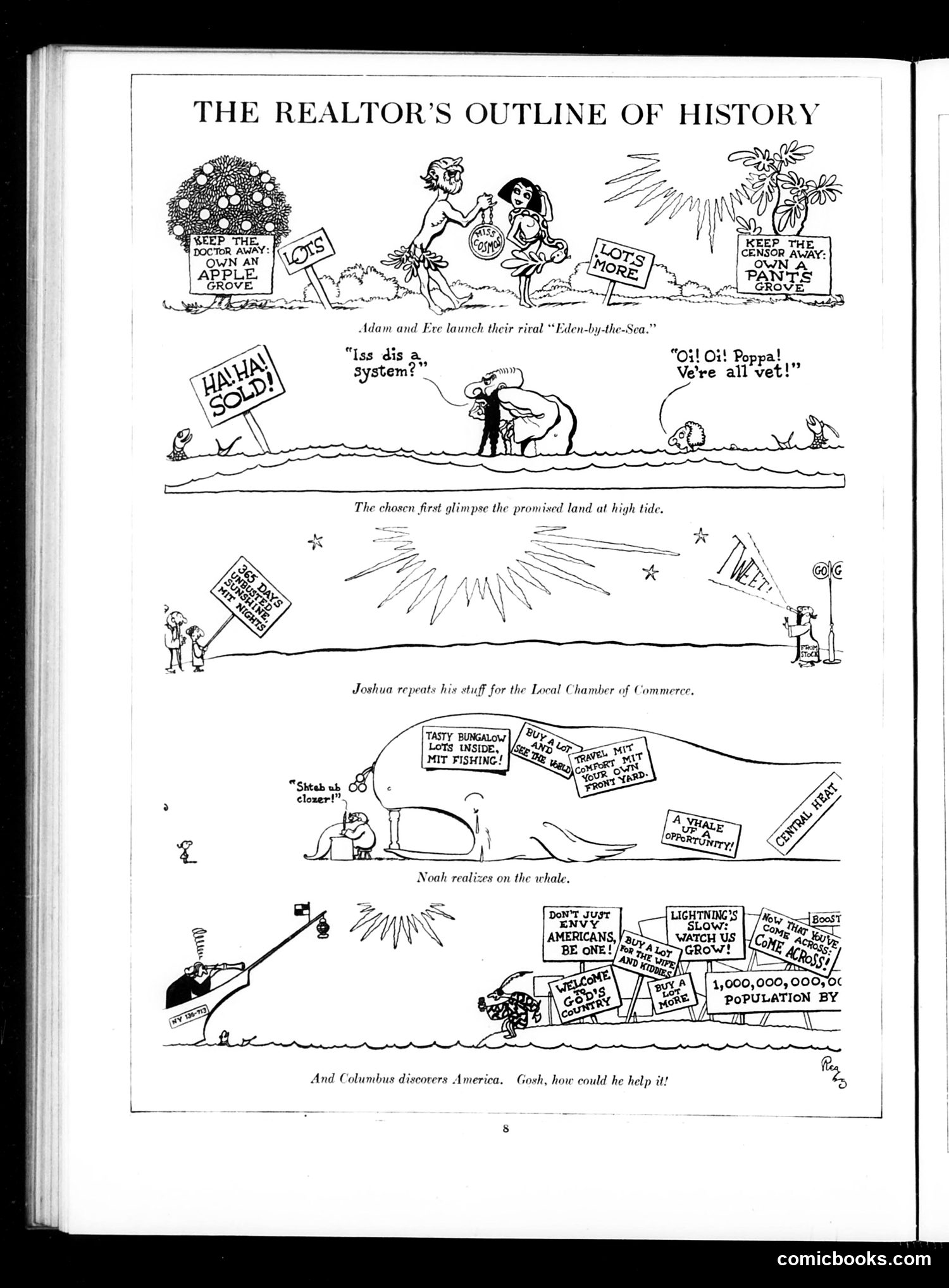
This satirical cartoon parodies real estate marketing by reimagining biblical and historical events through a 1920s property-development lens. Adam and Eve become competing real estate developers; Noah's ark becomes a real estate opportunity; Columbus's discovery is depicted as inevitable given America's commercial boom. The cartoon mocks the era's aggressive real estate speculation—particularly the Florida land boom of the 1920s. Advertisements for "tasty bungalows," lots with fishing, and rapid population growth pepper each panel, suggesting developers exploited grand historical narratives to sell property. The Yiddish-inflected dialogue ("Iss dis a system?" "Oi! Oi! Poppa!") appears to stereotype immigrant real estate sellers/buyers, a common period trope. The satire suggests that 1920s American real estate promoters viewed themselves as continuing humanity's grand historical progression—reducing monumental events to marketing opportunities.
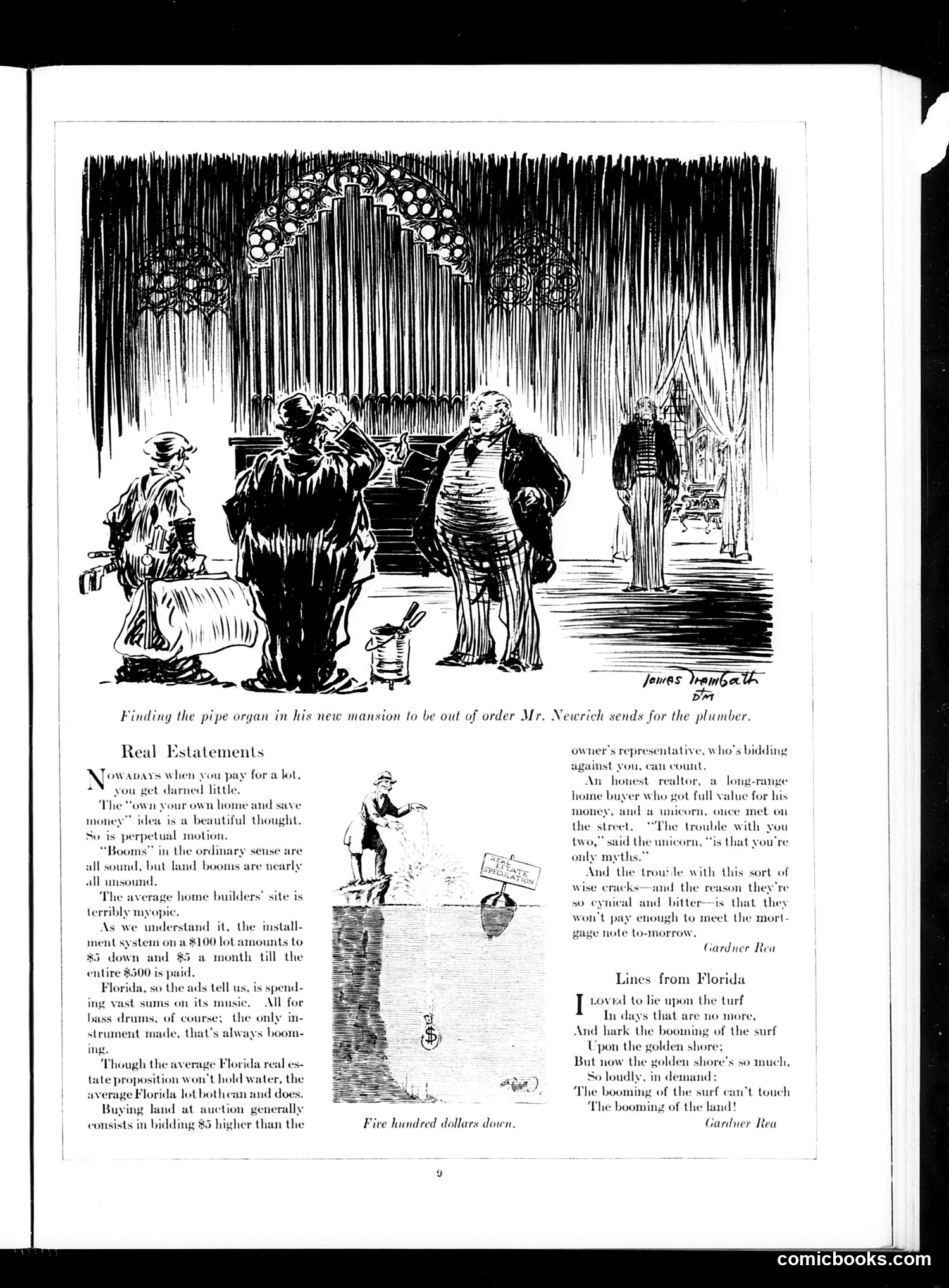
This page satirizes the early-20th-century Florida real estate boom through two pieces: **Top Cartoon:** A wealthy man ("Mr. Newrich"—a type character for the newly rich) discovers his pipe organ is broken in his mansion. The joke plays on "booms"—the text explains that while musical booms are real, "land booms are nearly all unsound." Newrich represents the gullible investor caught up in the speculative Florida land craze. **"Real Estatements" Article:** A cynical commentary on Florida real estate schemes. It mocks the "own your own home and save money" pitch as fantasy, criticizes developers' dubious financing (small down payments stretched over years), and notes that Florida land won't hold water—literally and figuratively (worthless investments). **"Lines from Florida" Poem:** Contrasts nostalgic beach memories with present-day reality: the golden shore is now so commercially valuable and "in demand" that the "booming of the land" (real estate sales hype) drowns out the actual ocean surf. The satire targets both shady developers and naive speculators during Florida's notorious 1920s boom-and-bust cycle.
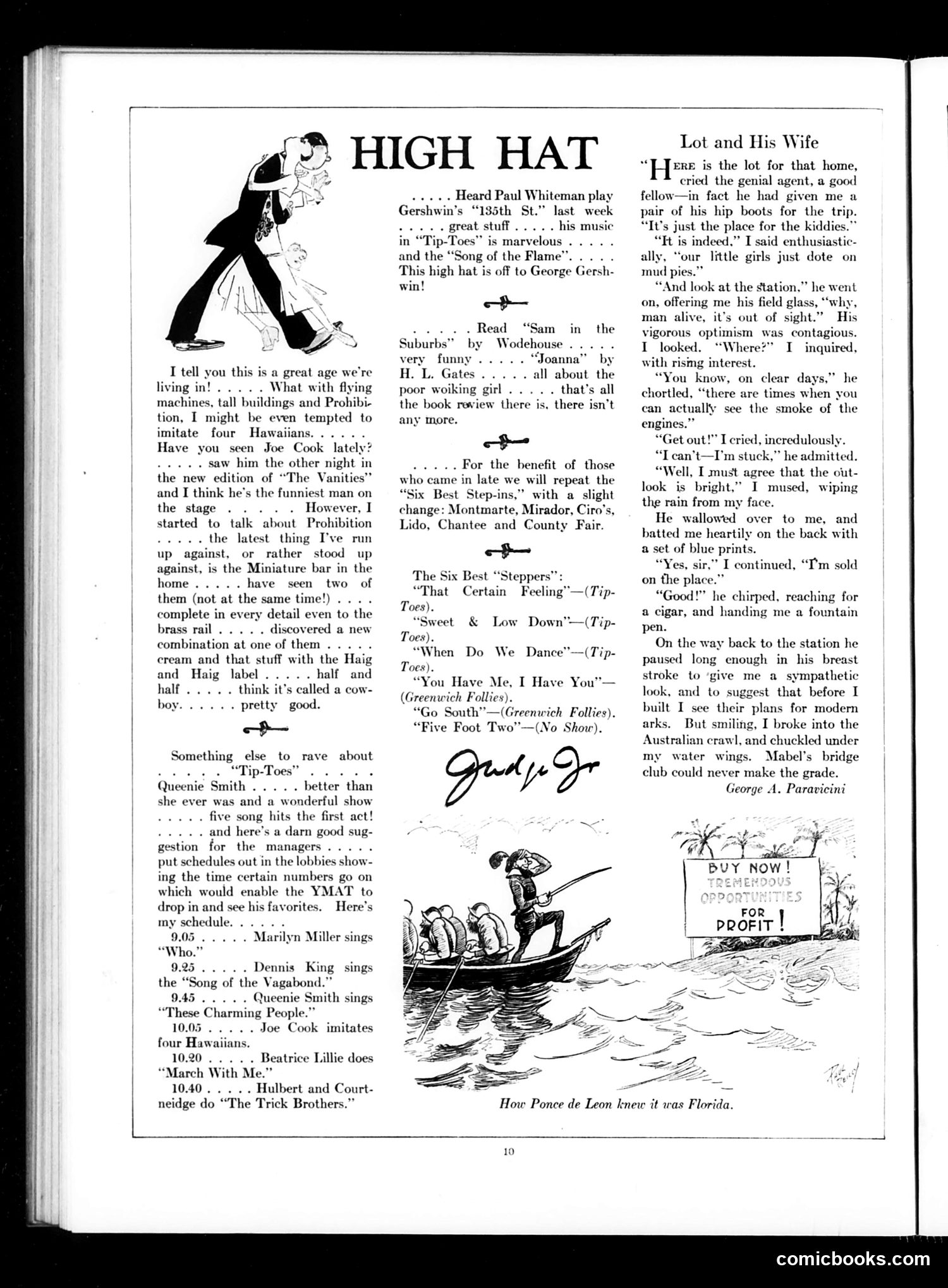
This page from *Judge* magazine showcases theatrical reviews and entertainment gossip typical of the 1920s. The main content discusses Broadway shows and performers: Paul Whiteman's performance of Gershwin's "135th St.," Joe Cook's comedy act, and various stage productions like "The Vanities" and "Tip-Toes." The illustration and accompanying story "Lot and His Wife" satirize real estate sales practices—specifically the deceptive pitches of overly optimistic agents. The agent's absurd claims (that you can see distant engine smoke "on clear days," that a swampy lot is ideal for children) mock the exaggerated marketing tactics used to sell undesirable properties, particularly during the 1920s real estate boom. The page also references Prohibition humorously, mentioning "miniature bars" in homes—a direct jab at the illegality of alcohol under the 18th Amendment. Overall, this reflects 1920s urban entertainment culture and contemporary consumer skepticism.
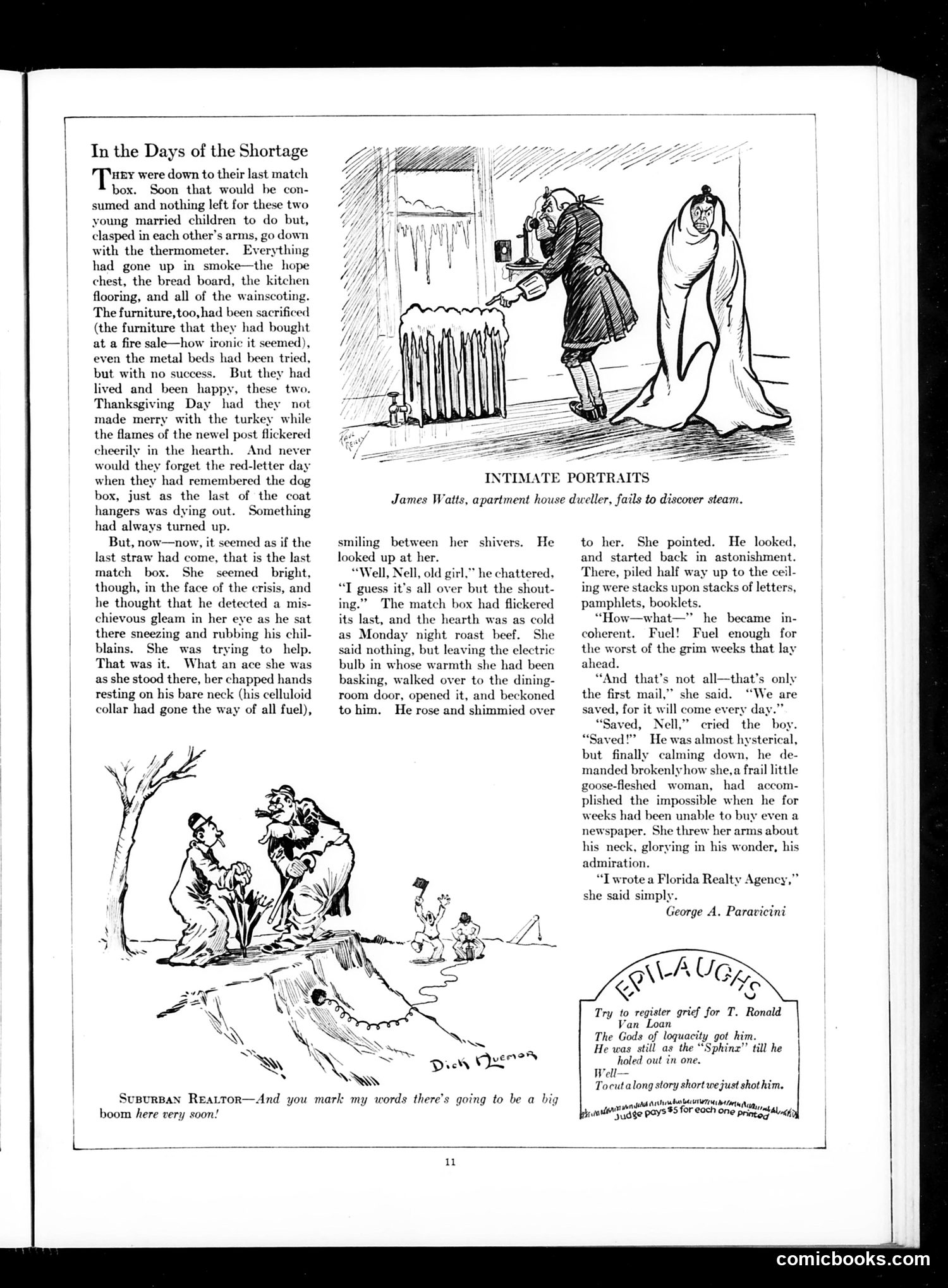
This page satirizes the **fuel shortage** during World War I rationing. The main story depicts a desperate young couple who've burned nearly everything—furniture, flooring, even metal beds—trying to stay warm as their last match box empties. The crisis is darkly comic: they're literally freezing. The twist punchline: the wife discovers salvation in unsolicited **junk mail from a Florida Realty Agency**—promotional letters and pamphlets arriving daily. She'll burn the mail to heat their apartment. The satire targets both the couple's desperation and the absurdity of real estate spam being genuinely useful during shortages. The secondary cartoon shows a realtor confidently predicting a "boom," oblivious to actual hardship. The "Epi-A-Ughs" box mocks a golfer's death, unrelated to the main content. This reflects genuine 1917-1918 American home heating crises when fuel was rationed for the war effort.
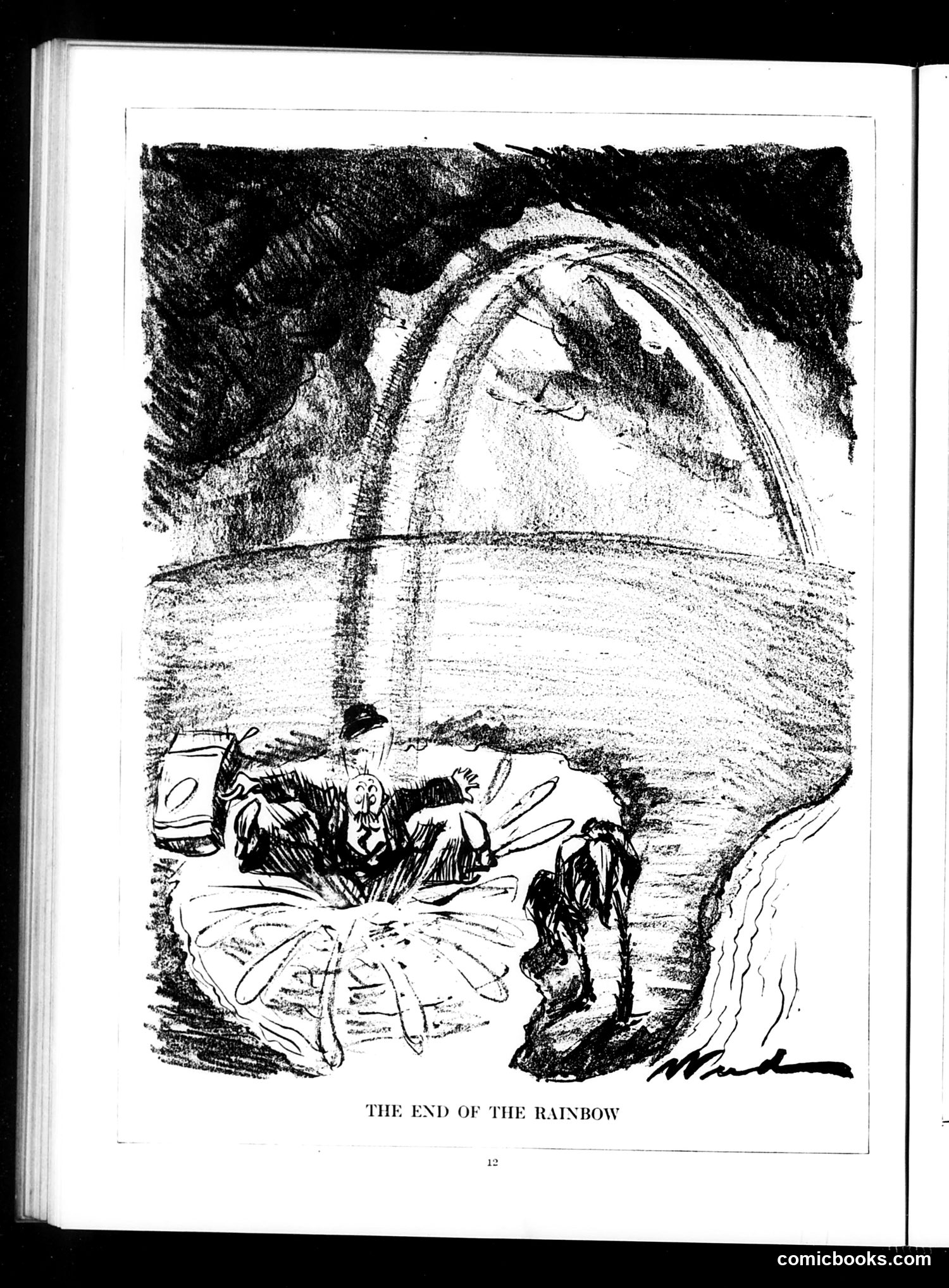
This cartoon depicts a figure who appears to be searching for or reaching toward the end of a rainbow—a metaphorical representation of an elusive goal or prize. The composition shows a landscape with dramatic sky and what looks like someone pursuing an impossible objective. The title "The End of the Rainbow" is a common idiom suggesting the pursuit of something unattainable or illusory—traditionally associated with seeking fortune or unrealistic wealth. Without additional context from *Judge* magazine's publication date or surrounding articles, the specific political or social target remains unclear. The satirical point likely comments on some contemporary pursuit of an impossible goal or false promise, though the precise reference would require knowing when this appeared.
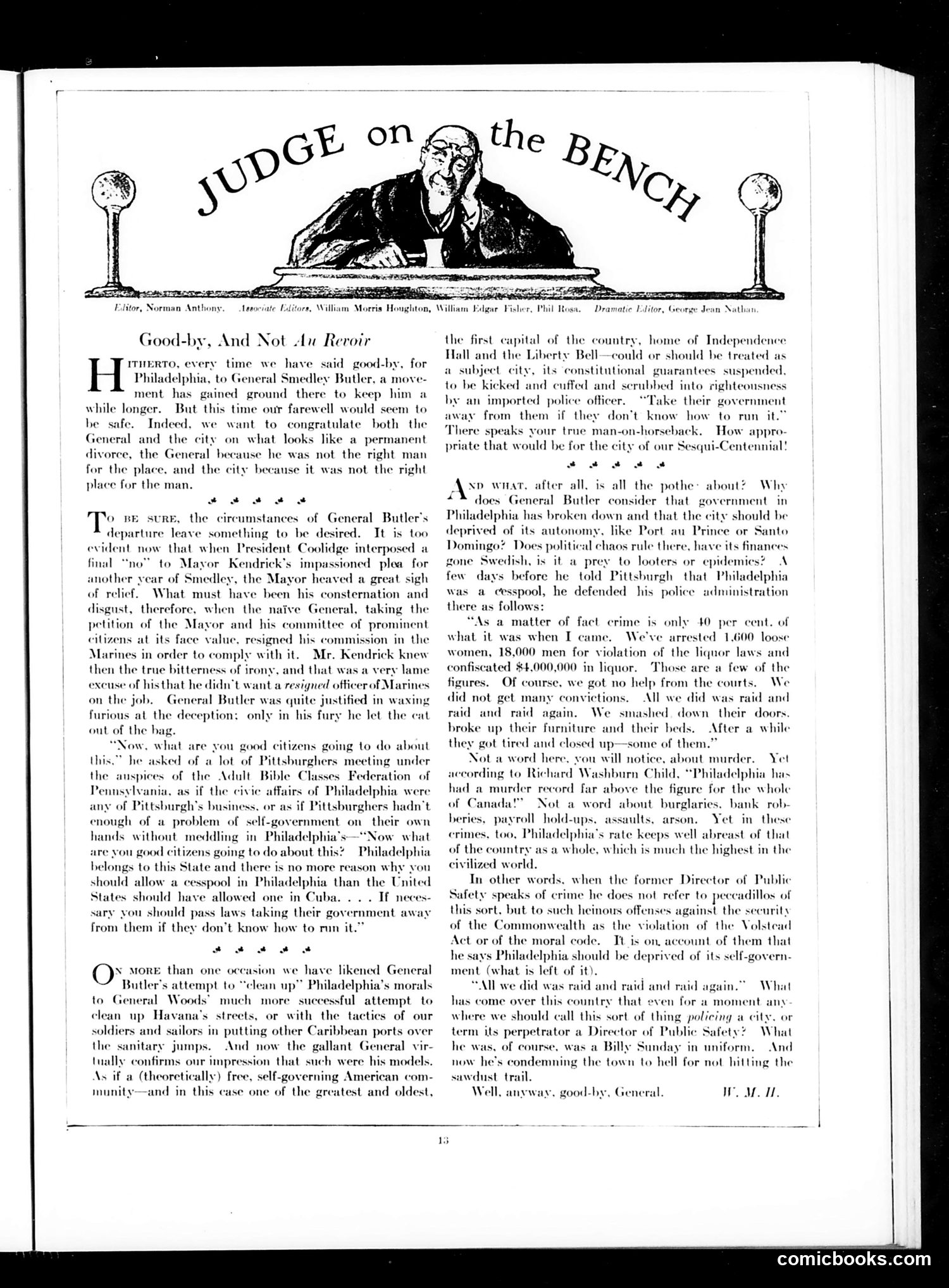
This editorial cartoon satirizes **General Smedley Butler's** departure from Philadelphia, where he served as Director of Public Safety. The piece mocks both Butler and Mayor Kendrick's handling of his resignation. **The Setup:** Butler, a famous Marine general, had been brought to Philadelphia to "clean up" the city's moral and crime problems. When President Coolidge rejected Kendrick's request to extend Butler's tenure, the Mayor appeared relieved—but Butler, taking the Mayor's petition at face value, resigned his commission to comply, embarrassing Kendrick. **The Satire:** Judge criticizes Butler's subsequent inflammatory rhetoric suggesting Philadelphia should lose self-governance "if they don't know how to run it"—comparing him to an authoritarian "man-on-horseback." The editorial notes Butler's contradictory claims: days before calling Philadelphia a "cesspool," he'd boasted of reducing crime by 60 percent. **The Point:** The piece defends Philadelphia's right to democratic self-rule while mocking both Butler's imperial pretensions and the empty spectacle of his "cleanup" campaign.
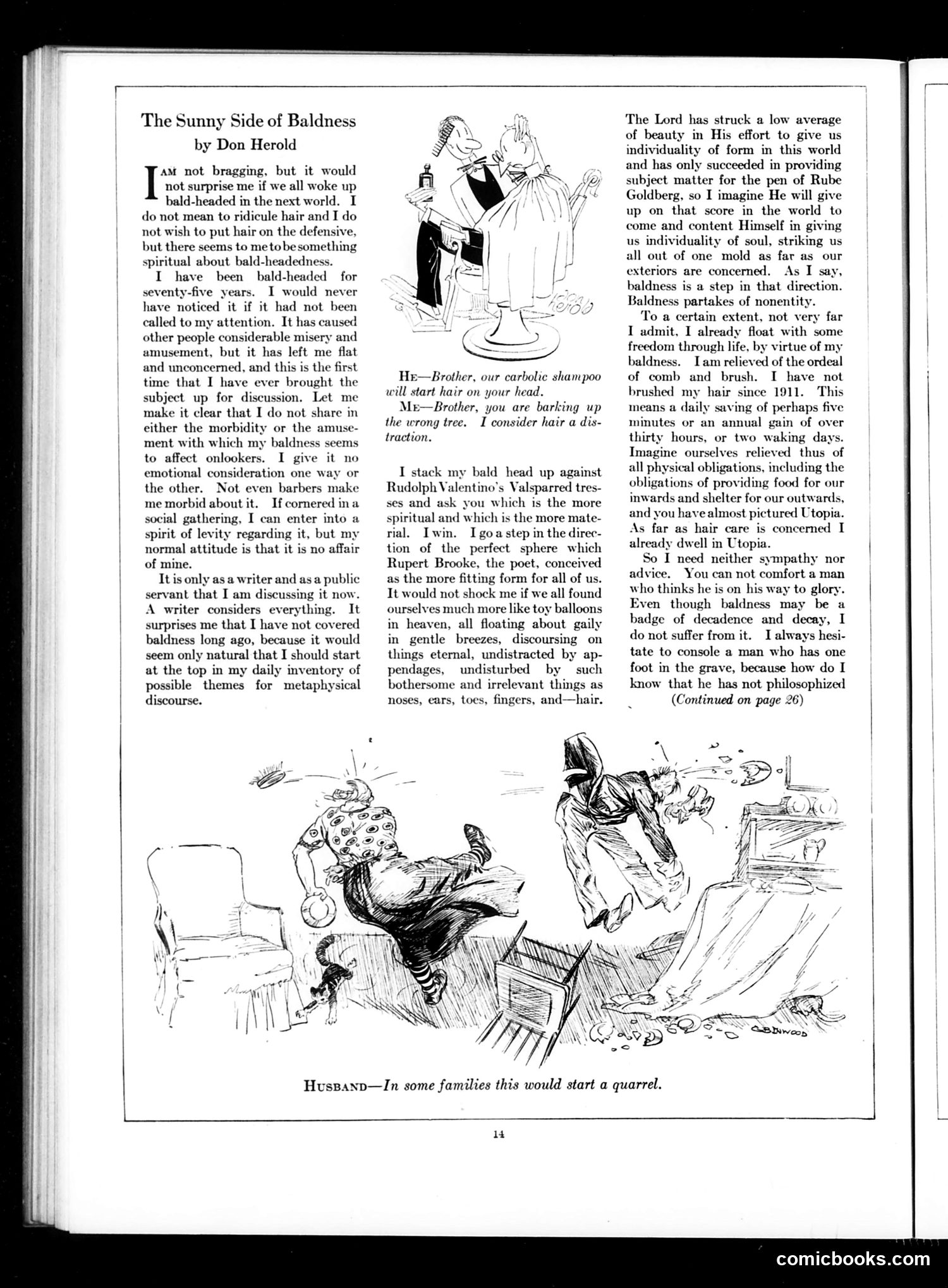
This is a humorous essay defending baldness as spiritually superior to having hair. Herold, writing as a 75-year-old bald man, argues baldness frees him from vanity and grooming obligations—he hasn't brushed his hair since 1911, gaining thirty hours annually. He compares his bald head favorably to Rudolph Valentino's famous pomaded hair and references poet Rupert Brooke's concept of the "perfect sphere," suggesting baldness approaches spiritual perfection. The accompanying cartoon depicts a husband casually lounging while his wife objects—captioned "In some families this would start a quarrel," implying wives' typical distress over husbands' baldness. The satire mocks both vanity culture and domestic friction over appearance, while celebrating baldness as liberation from social convention.
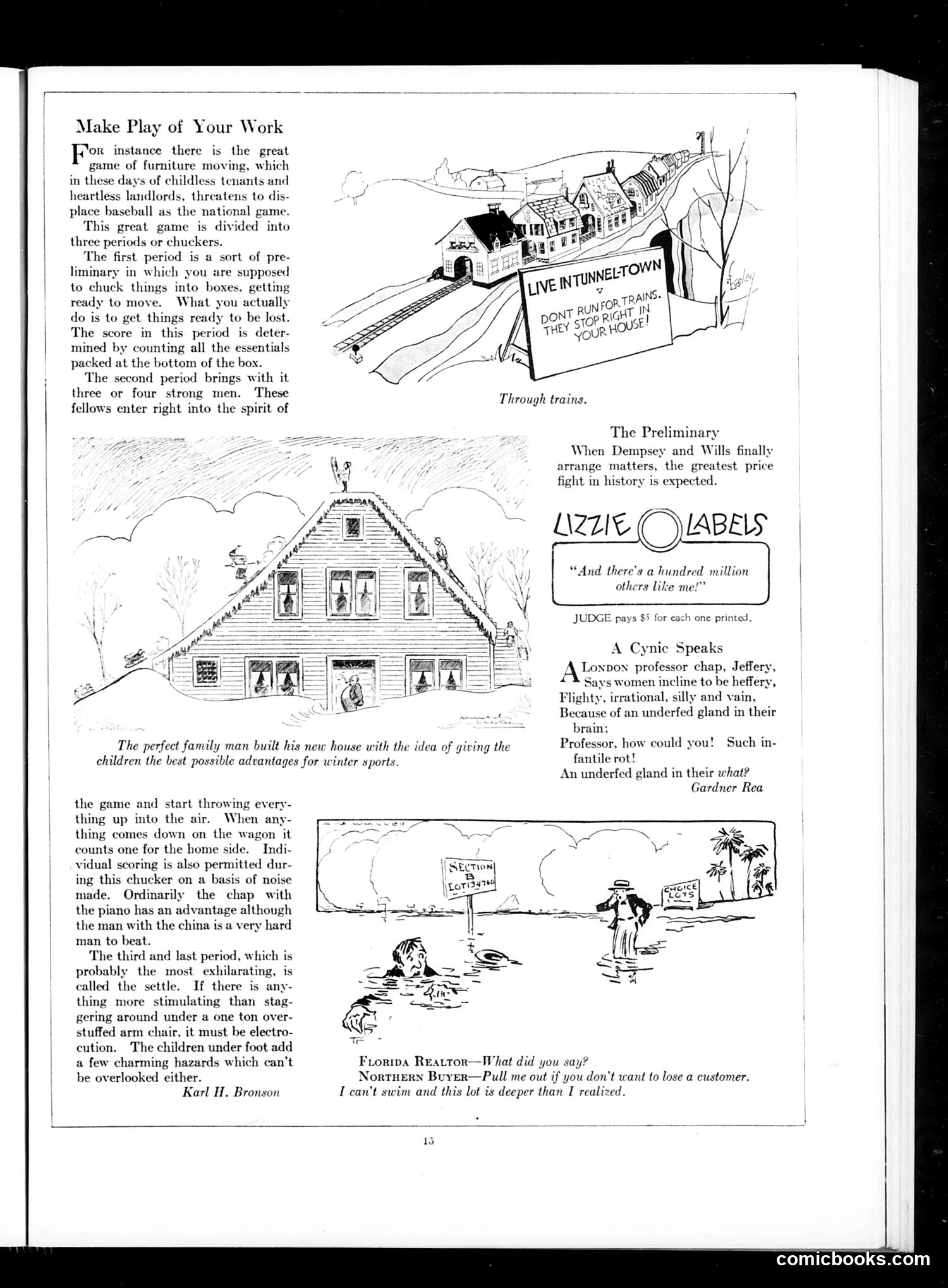
This page contains humorous commentary on early 20th-century American life: **"Make Play of Your Work"** satirizes furniture moving as a "national game" replacing baseball—reflecting the era's high tenant mobility and frequent relocations. The three "periods" humorously describe the chaos of packing, moving day with laborers, and settling into new homes, with children adding "charming hazards." **The house illustration** shows a family home designed with multiple windows—likely mocking wealthy homeowners who build elaborate structures for winter sports entertainment. **"Lizzie Labels"** is an advertisement offering payment for submitted labels/jokes. **"A Cynic Speaks"** ridicules a London professor's pseudoscientific claim that women's irrationality stems from an "underfed gland"—satirizing pseudo-scientific sexism of the period. "Gardner Rea" challenges this absurd reasoning. **The cartoon below** depicts a real estate transaction gone wrong—a Florida realtor and Northern buyer in a swamp, the buyer drowning while worried about losing the deal, mocking the era's land speculation and fraudulent real estate schemes.
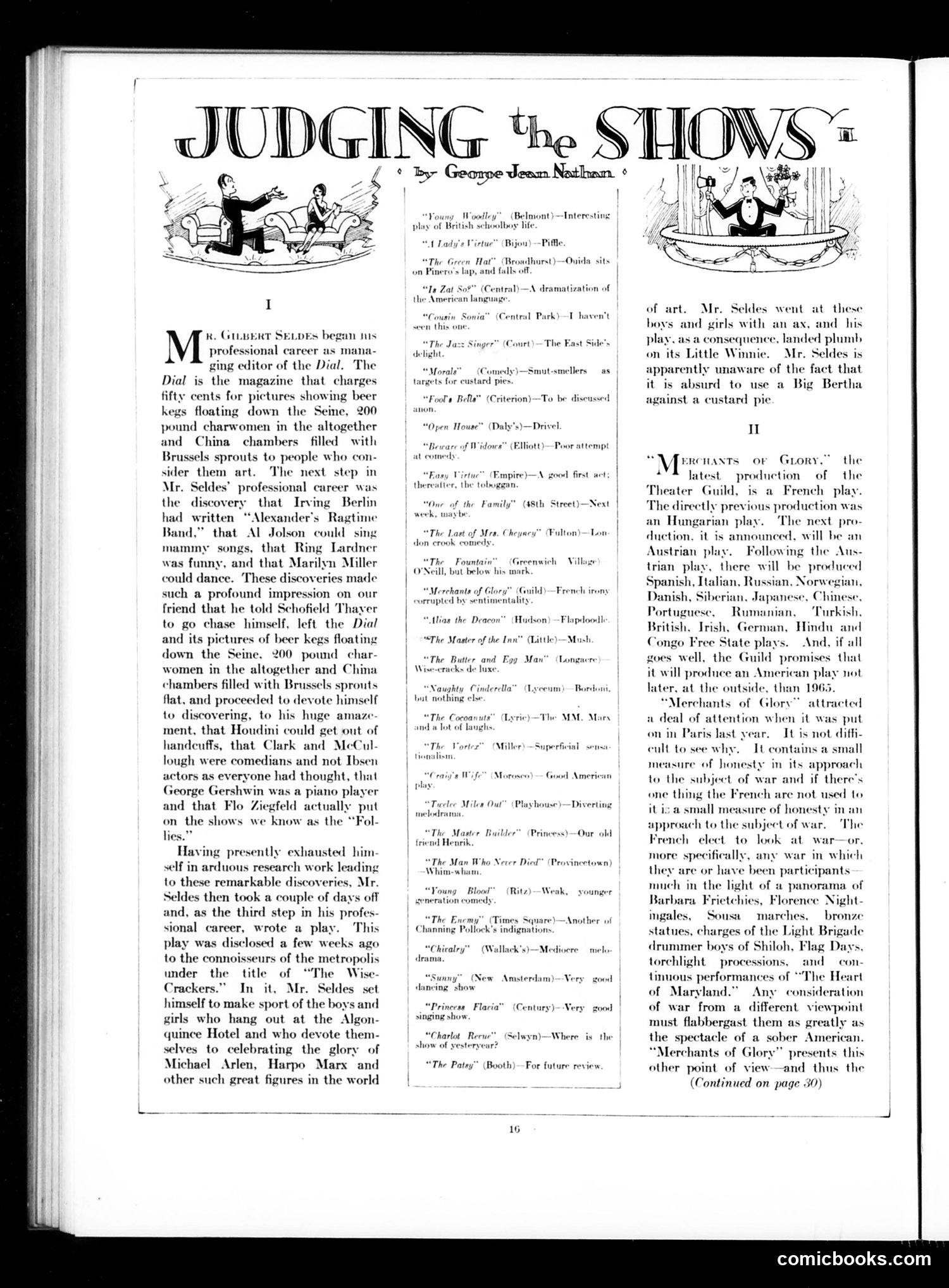
This article satirizes critic Gilbert Seldes' professional evolution. The author mocks Seldes' pretentious work at *The Dial* magazine—which charged fifty cents for "artistic" pictures (absurdly described as beer kegs on the Seine and naked charwomen). The satire traces Seldes' redemption: he discovered that Irving Berlin, Al Jolson, Ring Lardner, and Flo Ziegfeld were actually talented—revelations presented as if they were shocking intellectual breakthroughs requiring genuine research. The joke culminates in Seldes writing a play called "The Wise-Cracker" that ridicules the Algonquin Hotel's literary set (who celebrated Michael Arlen and other contemporary figures). The satire's point: Seldes attacked pretentious "smart" people while himself having been absurdly pretentious—like using heavy artillery ("Big Bertha") against a custard pie. The piece is a withering takedown of artistic posturing and critical hypocrisy.
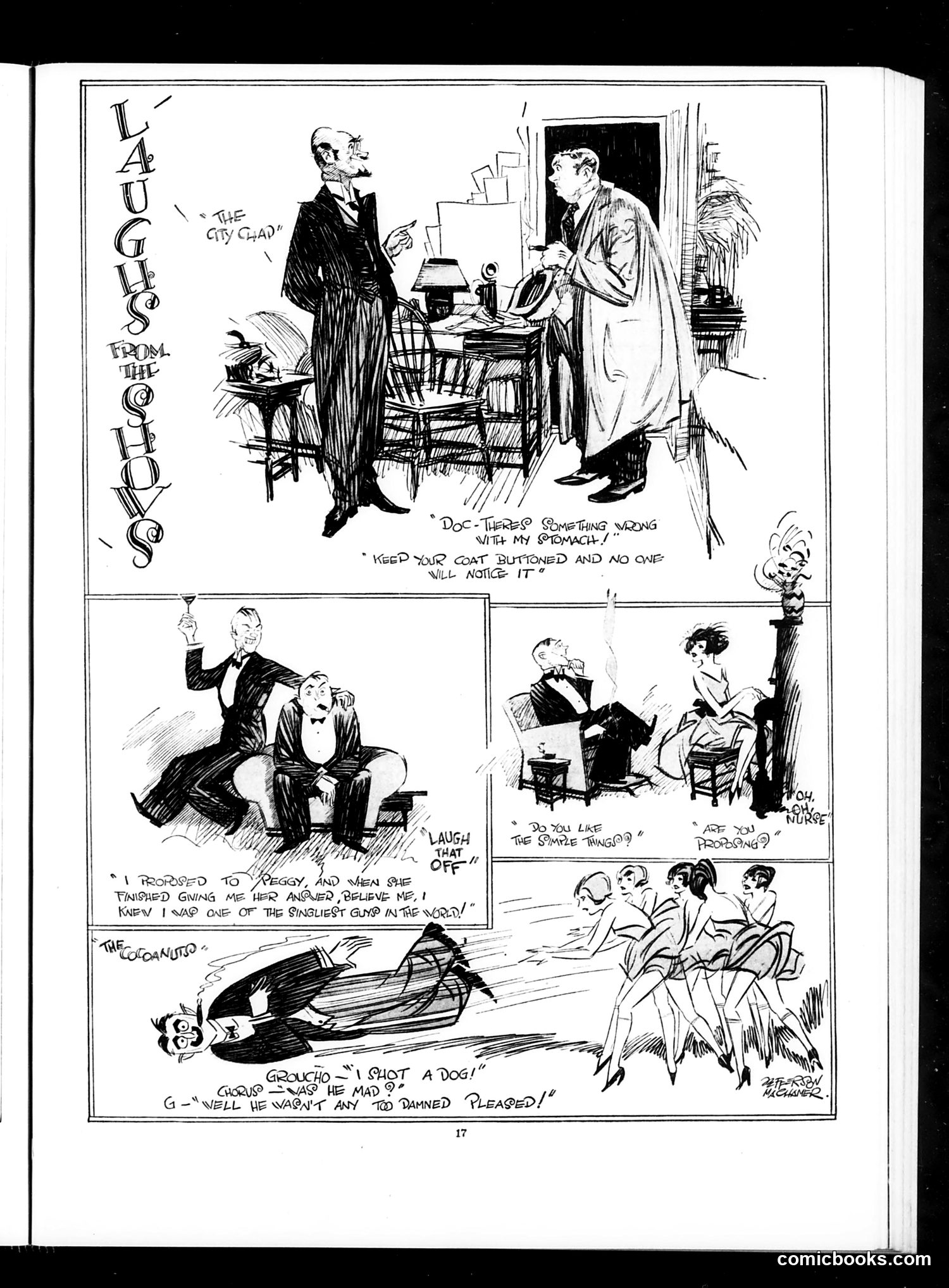
This page presents several interconnected jokes about wealthy men's social embarrassments. The top panel shows a doctor advising a gentleman to keep his coat buttoned to hide digestive distress at a social gathering—advice about maintaining composure and propriety despite bodily functions. The middle panels depict a man recounting an embarrassing incident: he allegedly shot a dog while hunting with a woman named Peggy, then fabricated a story claiming he'd killed "one of the smuggest guns in the county." The humor derives from his desperate attempt to save face through an absurd lie. The bottom panel shows Groucho (likely referencing Groucho Marx, the famous comedian) claiming he shot a dog, with reactions of shock ("Was he mad?"). The punchline suggests complete indifference to consequences. The satire targets upper-class masculine pretension—these men's obsessive concern with appearing dignified while repeatedly revealing their foolishness, poor judgment, and callousness. The recurring theme: social embarrassment and the transparent failures of their cover-up attempts.
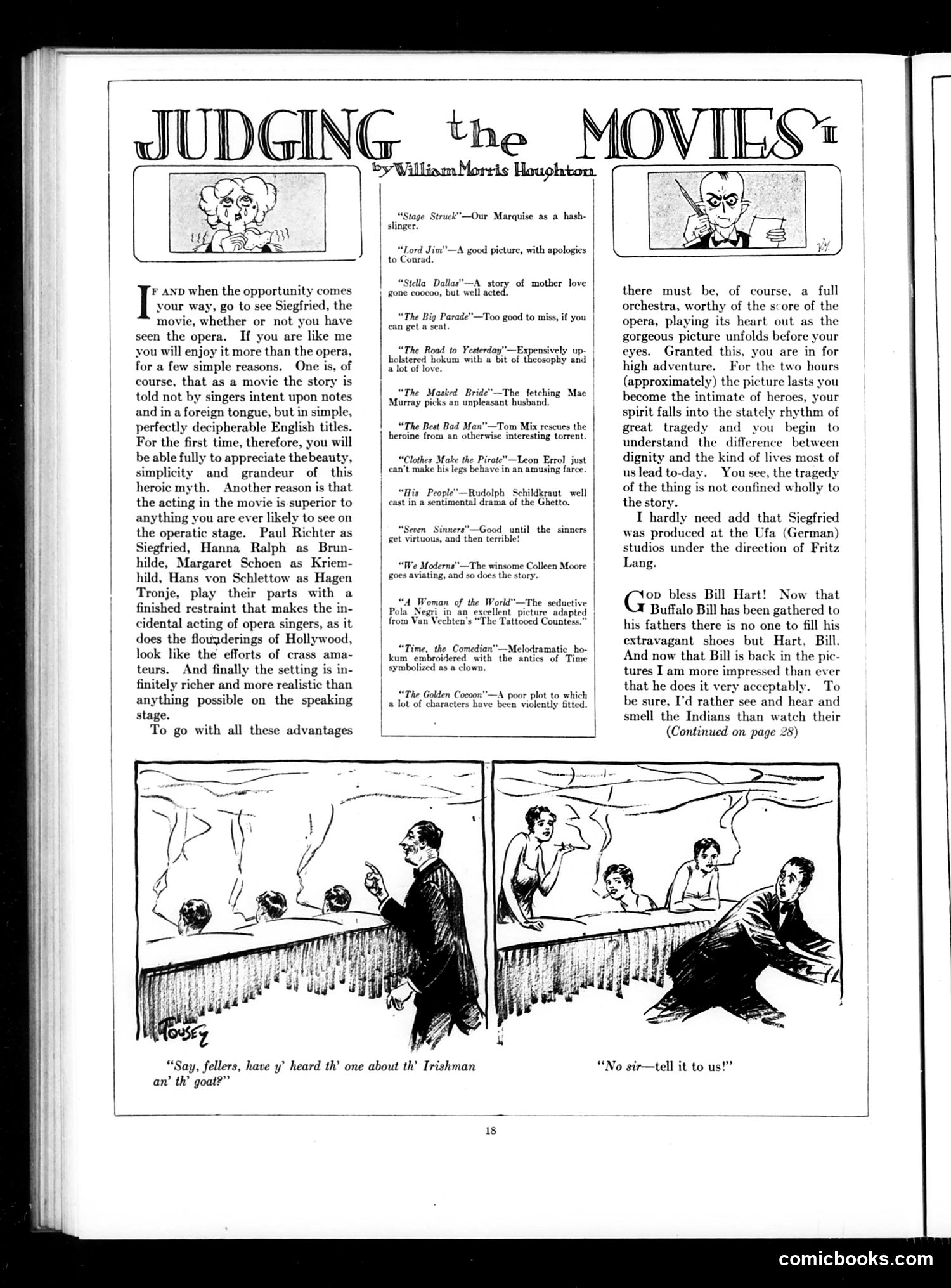
This page reviews contemporary 1920s films, with the main article praising the German silent film *Siegfried* (directed by Fritz Lang) as superior to its operatic source material—arguing cinema's visual storytelling surpasses sung opera's emotional restraint and comprehensibility. The sidebar lists brief reviews of popular films of the era (*The Big Parade*, *Stella Dallas*, *Stage Struck*, etc.), using sardonic one-liners to critique their plots and performances. The two cartoons below depict vaudeville or nightclub scenes with men telling jokes to audiences, captioned "Say, fellers, have y' heard th' one about th' Irishman an' th' goat?" and "No sir—tell it to us!" The humor appears to satirize lowbrow entertainment venues and their stock comedic material, possibly contrasting them with the "high art" cinema discussed above.
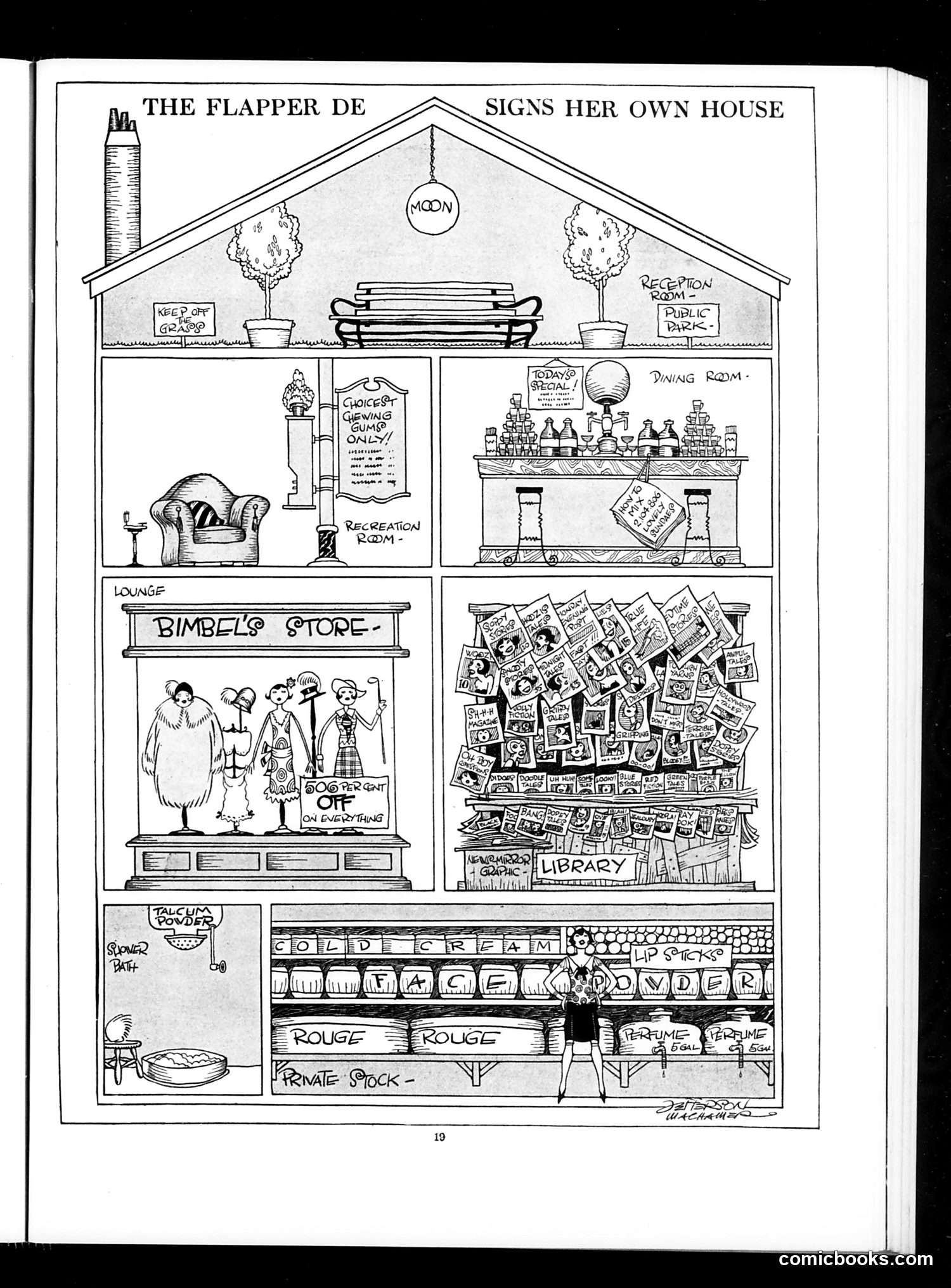
This cartoon satirizes the 1920s "flapper"—a modern, independent young woman rejecting Victorian conventions. The joke depicts her interior design choices as absurdly excessive and frivolous: a moon hanging from the ceiling, a "choicest chewing gum" display case, a library literally wallpapered with magazines and graphics, shelves overflowing with cosmetics (talcum powder, rouge, lipstick), and a "private stock" suggesting illegal alcohol (Prohibition-era reference). The satire mocks both the flapper's materialism and her rejection of "proper" domesticity. Rather than a traditionally decorated home, she fills it with mass-consumer goods and leisure items. The "Bimbel's Store" and "Cold Cream" sections emphasize shallow consumerism. This reflects conservative anxiety about women's newfound independence, purchasing power, and cultural influence in the Jazz Age.
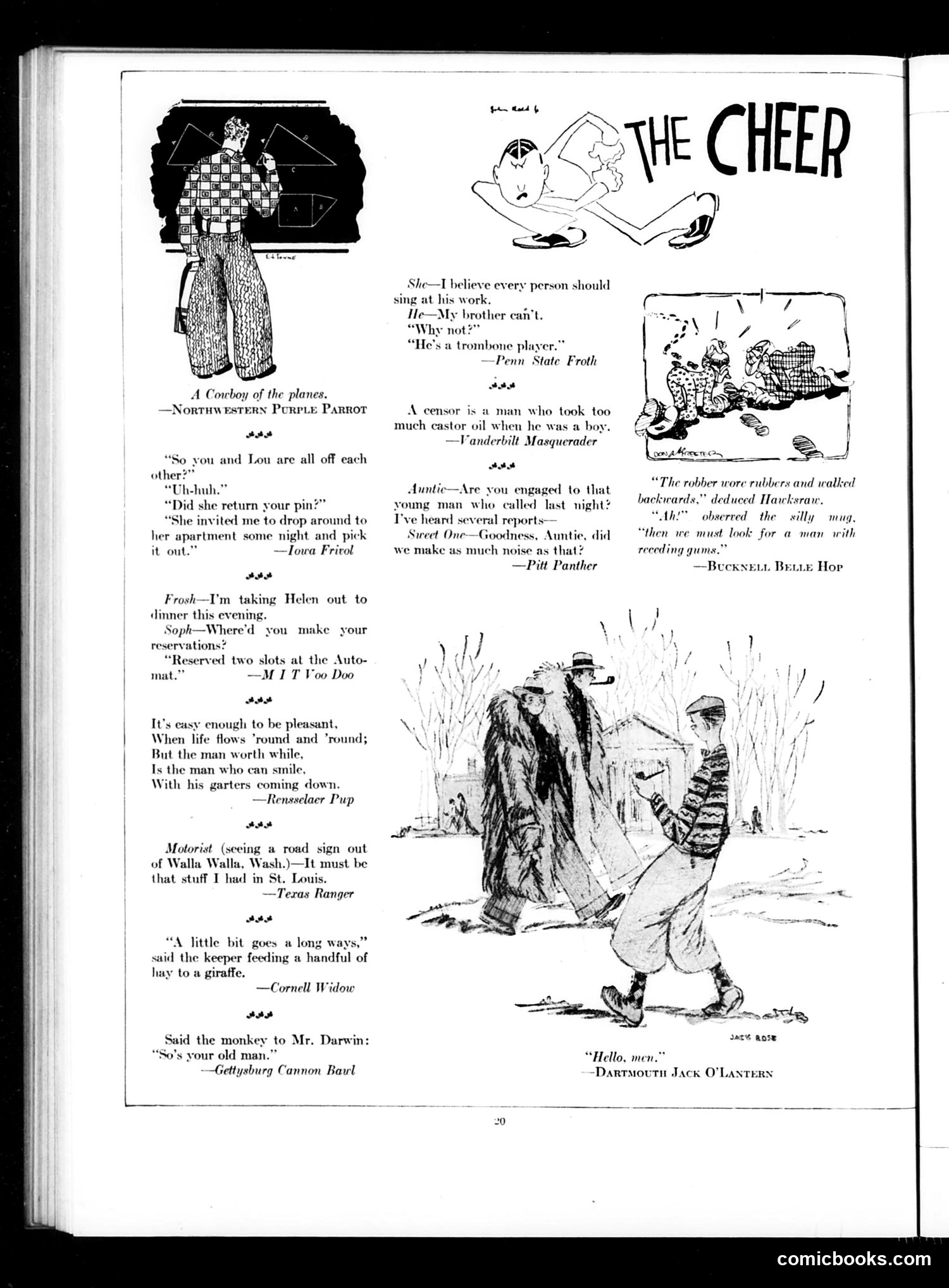
This is a compilation of brief jokes and witticisms from various college humor magazines, typical of early-to-mid 20th century collegiate publications. The content reflects period social attitudes: **Key themes:** - **Dating/Romance**: References to pins (fraternity/sorority tokens), apartment visits, and engagement rumors reflect courtship customs of the era - **Class humor**: Jokes about fraternity freshmen, trombone players, and social embarrassment - **Mild innuendo**: Several jokes hint at impropriety (the "pin" joke, apartment visits) with winking humor - **Absurdist wordplay**: Puns on censorship ("castor oil"), Darwin, and place names (Walla Walla) **The cartoons** show period illustrations: a cowboy figure and men in hats greeting each other outdoors. The page primarily celebrates college wit and student humor rather than political satire. The humor is genteel, focused on campus life, dating etiquette, and mild social observation rather than serious critique. Attribution to specific colleges suggests this represents inter-collegiate humor competition.
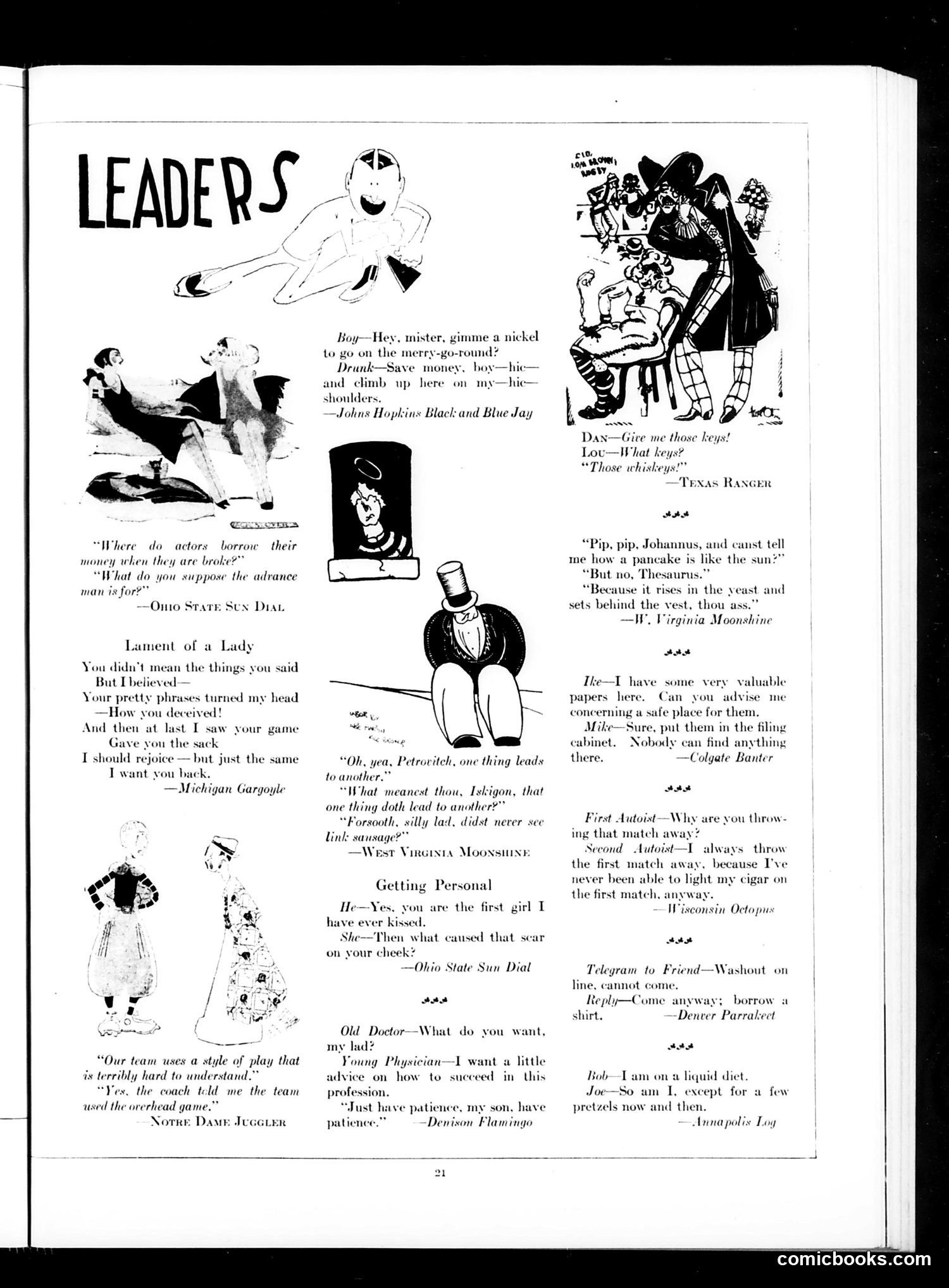
This page collects **humorous quotes and jokes** from college and university humor publications (Ohio State, Notre Dame, Michigan, etc.), rather than political cartoons. The content targets **social follies and romantic mishaps**: a woman lamenting a lover's deception; a drunk offering a child dangerous "transportation"; college students making bad decisions; romantic misunderstandings using archaic language for comic effect. The accompanying **sketch illustrations** are generic comedic drawings—a reclining couple, a drunk man, dancing figures, a seated gentleman—that visualize the jokes rather than making pointed political statements. **Notable**: The humor is largely **apolitical and timeless**—focused on universal themes of romance, drunkenness, and youthful foolishness. One joke references "Link sausage," a commercial product, suggesting **early 20th-century dating**. The college publication attributions indicate this was syndicated campus humor, a common Judge feature during this era. This is **light social satire**, not political commentary.
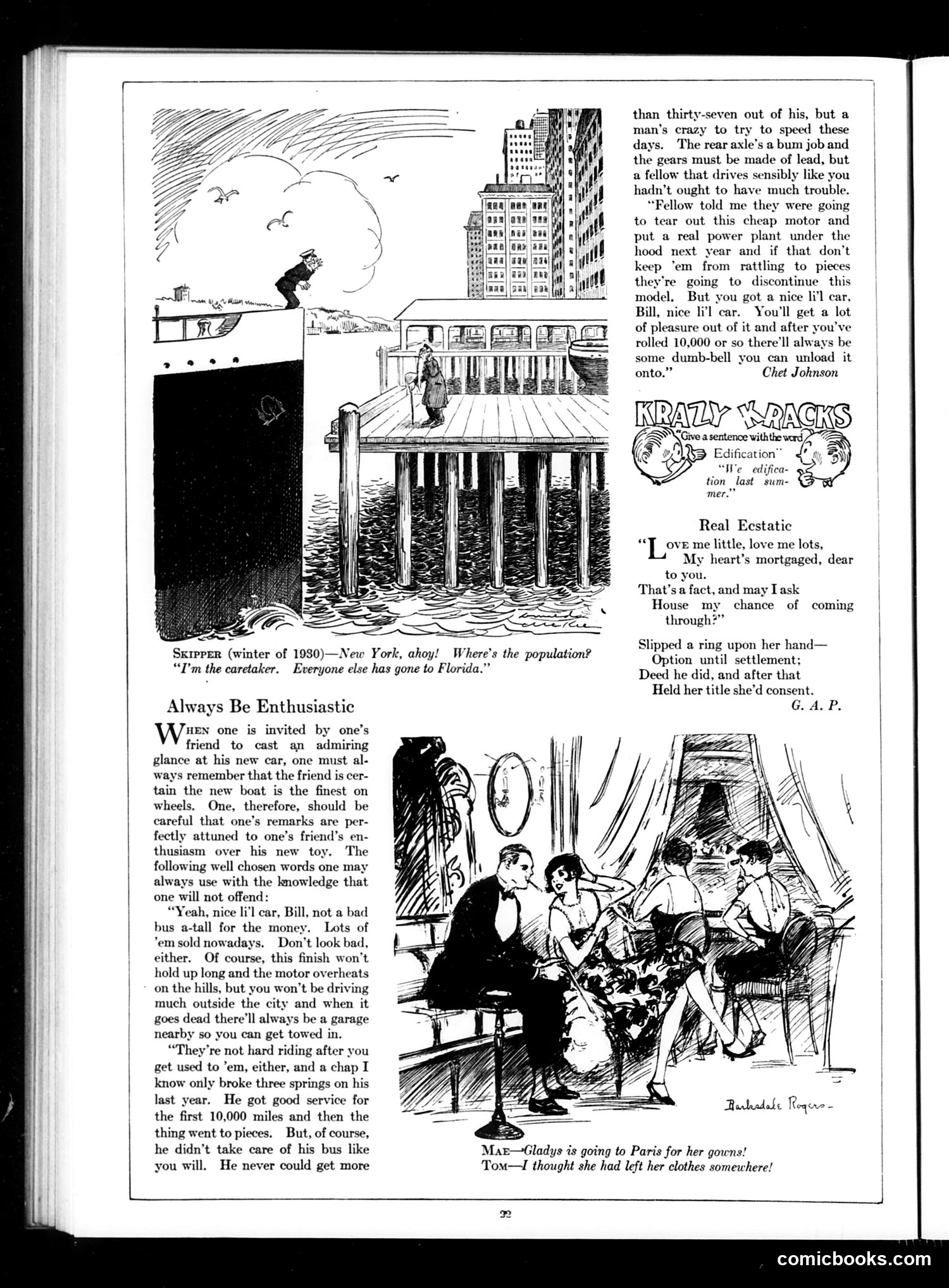
This page contains three satirical pieces about 1930s American consumer culture: **"Skipper" cartoon**: A caretaker stands alone in winter New York City, noting everyone has fled to Florida—satirizing the Depression-era migration trend and seasonal wealth disparity. **"Always Be Enthusiastic"**: A humorous etiquette guide advising how to compliment a friend's new car while diplomatically acknowledging its obvious defects (poor finish, overheating motor, weak springs). The satire mocks both aggressive car-salesmanship and the social performance required between friends—praising shoddy manufactured goods as symbols of status. **"Real Ecstatic" poem**: Mockingly romanticizes a marriage proposal using financial terminology ("mortgaged," "option," "deed")—satirizing how economic desperation reduced romantic relationships to business transactions during the Depression. The page reflects 1930s anxieties: economic uncertainty, consumer culture's hollow promises, and social pretense masking material hardship.
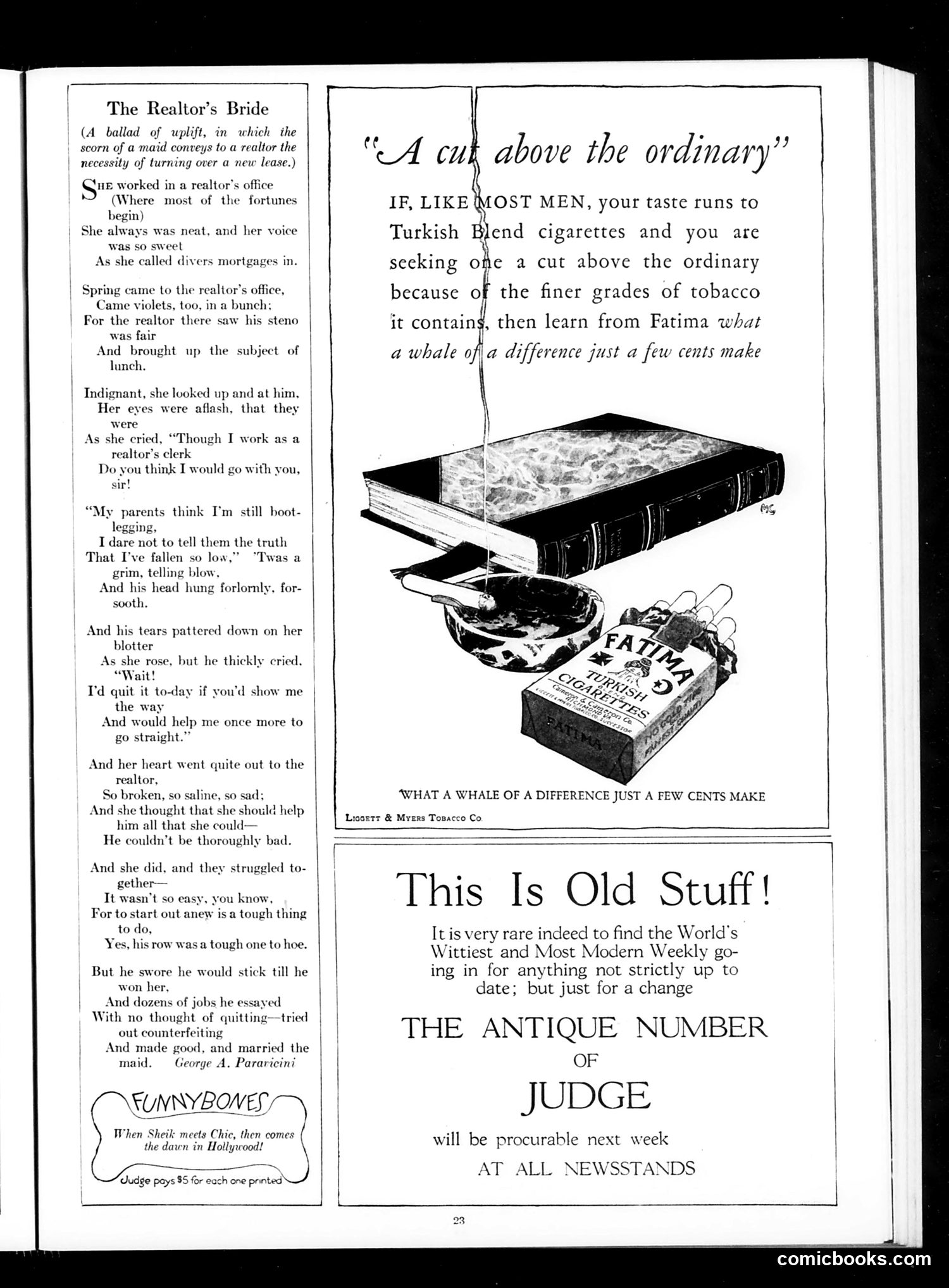
**The Main Content:** "The Realtor's Bride" is a satirical poem mocking the real estate industry and upward mobility myths. It features a stenographer who scorns a realtor's romantic advances because she believes his profession is disreputable—she thinks her parents still believe she's involved in bootlegging (Prohibition-era crime). The realtor then reforms through various jobs, eventually succeeding. The satire targets both the real estate world's reputation for moral questionability and the era's sentimentality about redemption through love and hard work. **The Advertisement:** Fatima cigarettes advertise themselves as "a cut above the ordinary," playing on the era's class consciousness and the idea that small price differences signify quality and social status—itself a subject of satirical commentary given the page's content about social climbing and reputation. **The Bottom Notice:** Judge announces an upcoming "Antique Number"—a nostalgia issue—noting this is unusual for a magazine proud of being modern and current.
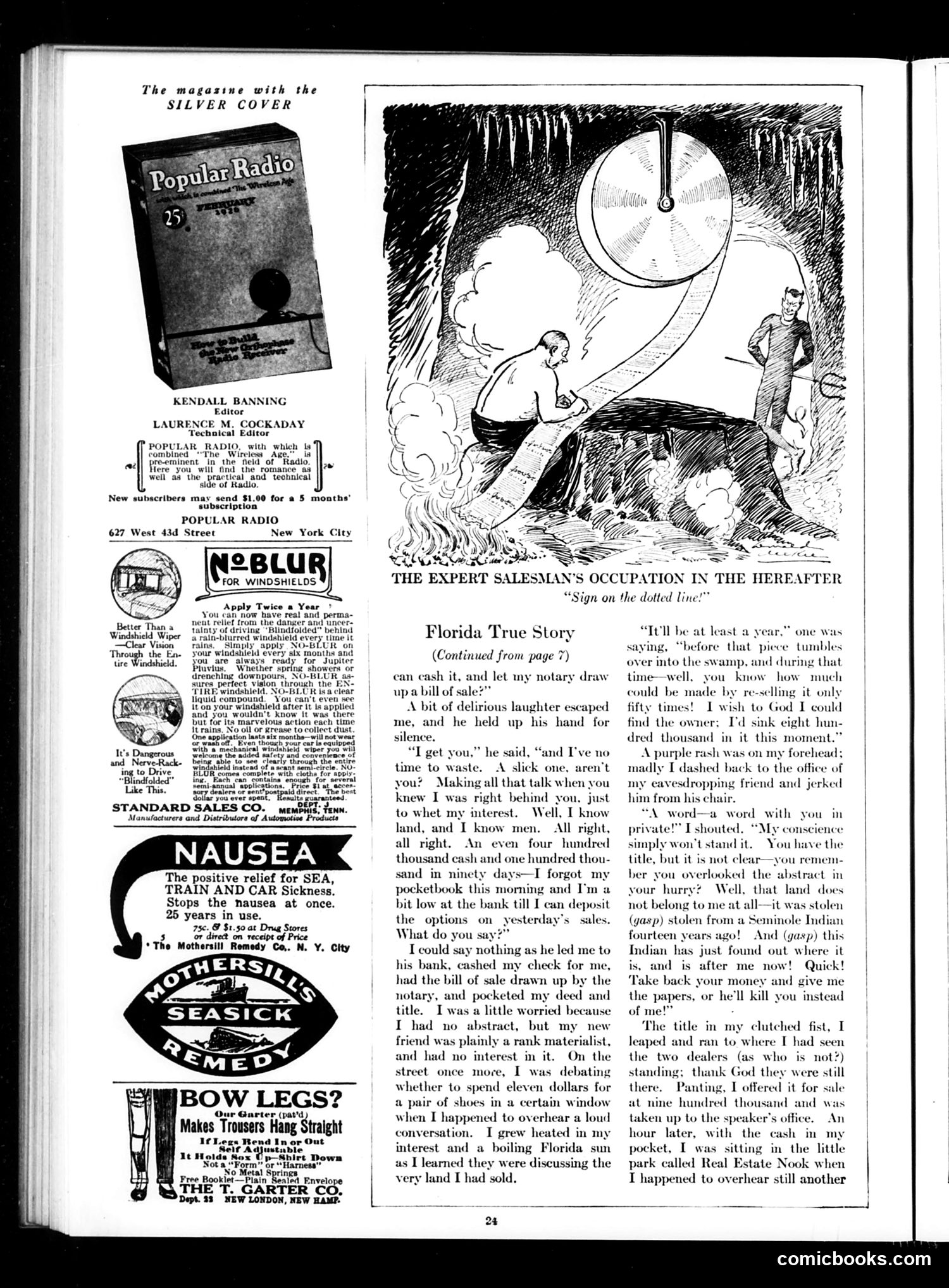
This cartoon depicts a salesman in hell or the afterlife, signing contracts at a desk while devils oversee him—a darkly comic punishment for his earthly deceptions. The caption "Sign on the dotted line!" suggests the irony that a man who made his living through manipulative contracts now faces eternal consequences for his dishonest dealings. The accompanying "Florida True Story" serialized narrative (continued from page 7) reinforces this theme: it describes a con artist who sells swampland to an unsuspecting buyer, only to discover the land is actually valuable—and stolen. The protagonist's panic and frantic attempts to undo the sale suggest both karmic comeuppance and the moral hazard of Florida's real-estate boom (likely 1920s-era). Together, the cartoon and story satirize smooth-talking salesmen and land speculators, suggesting their fraudulent practices deserve supernatural punishment.
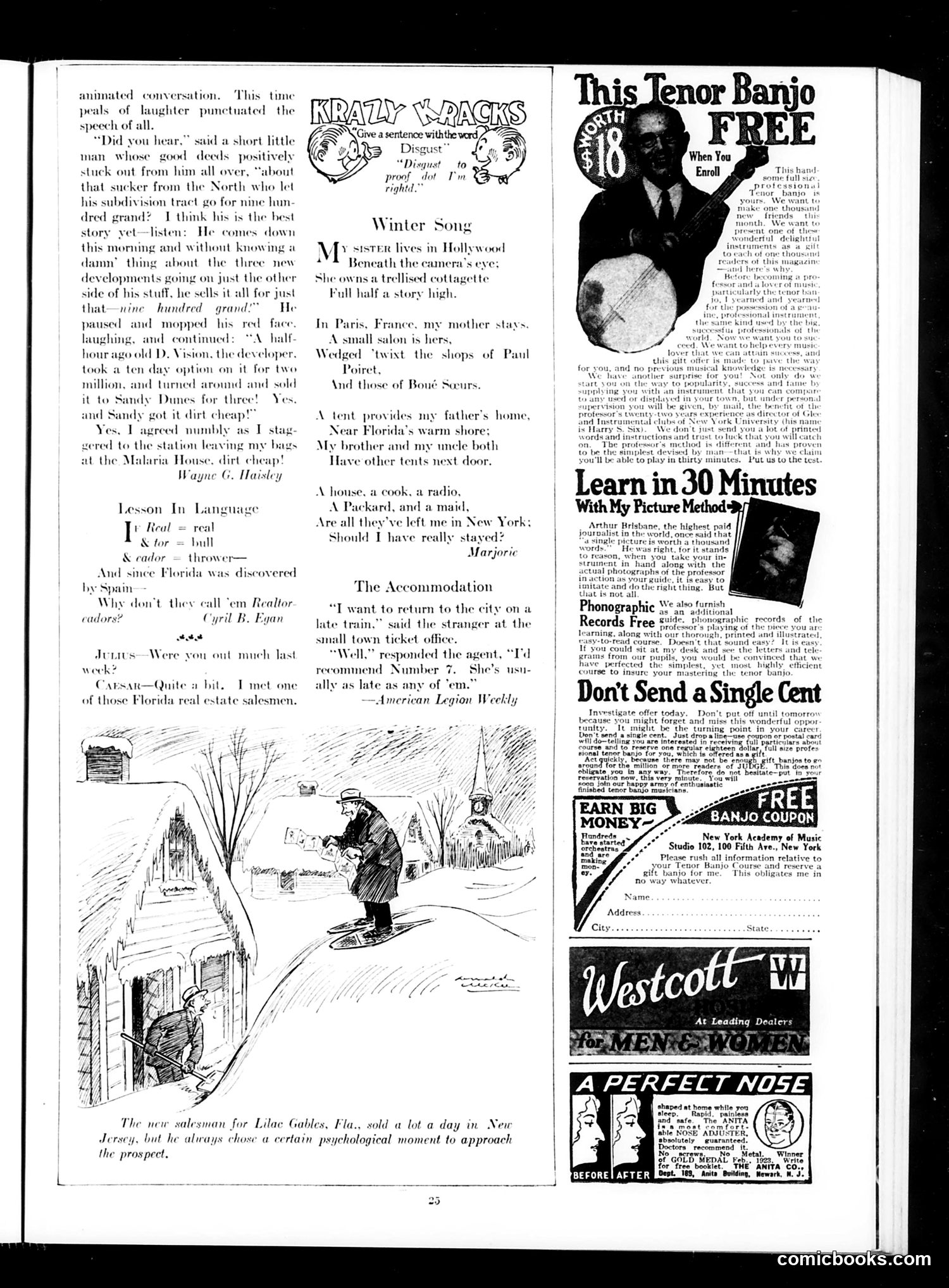
This page contains satirical content about the Florida real estate boom of the 1920s, a period of speculative frenzy that preceded the 1926 crash. **Main Cartoon/Story ("The new salesman for Lilac Gables"):** The anecdote mocks Florida land speculation, where an ignorant northerner sells valuable property for $900,000, unaware of three nearby developments. A local developer immediately flips it for $2 million, then resells to "Sandy Dunes" for even more. The joke: the original seller got "dirt cheap" prices while professionals made fortunes—satirizing both the absurdity of the boom and the gullibility of outsiders. **"Lesson in Language":** A brief satire on real estate terminology, suggesting "Realtor" (a term coined by the real estate industry) and "cador" are Spanish borrowings used to disguise the aggressive sales tactics of Florida real estate salesmen. **The page otherwise contains** period advertisements (banjo lessons, cosmetics) unrelated to political satire. The overarching theme: ridicule of get-rich-quick Florida land schemes and the salesmen exploiting northern investors.
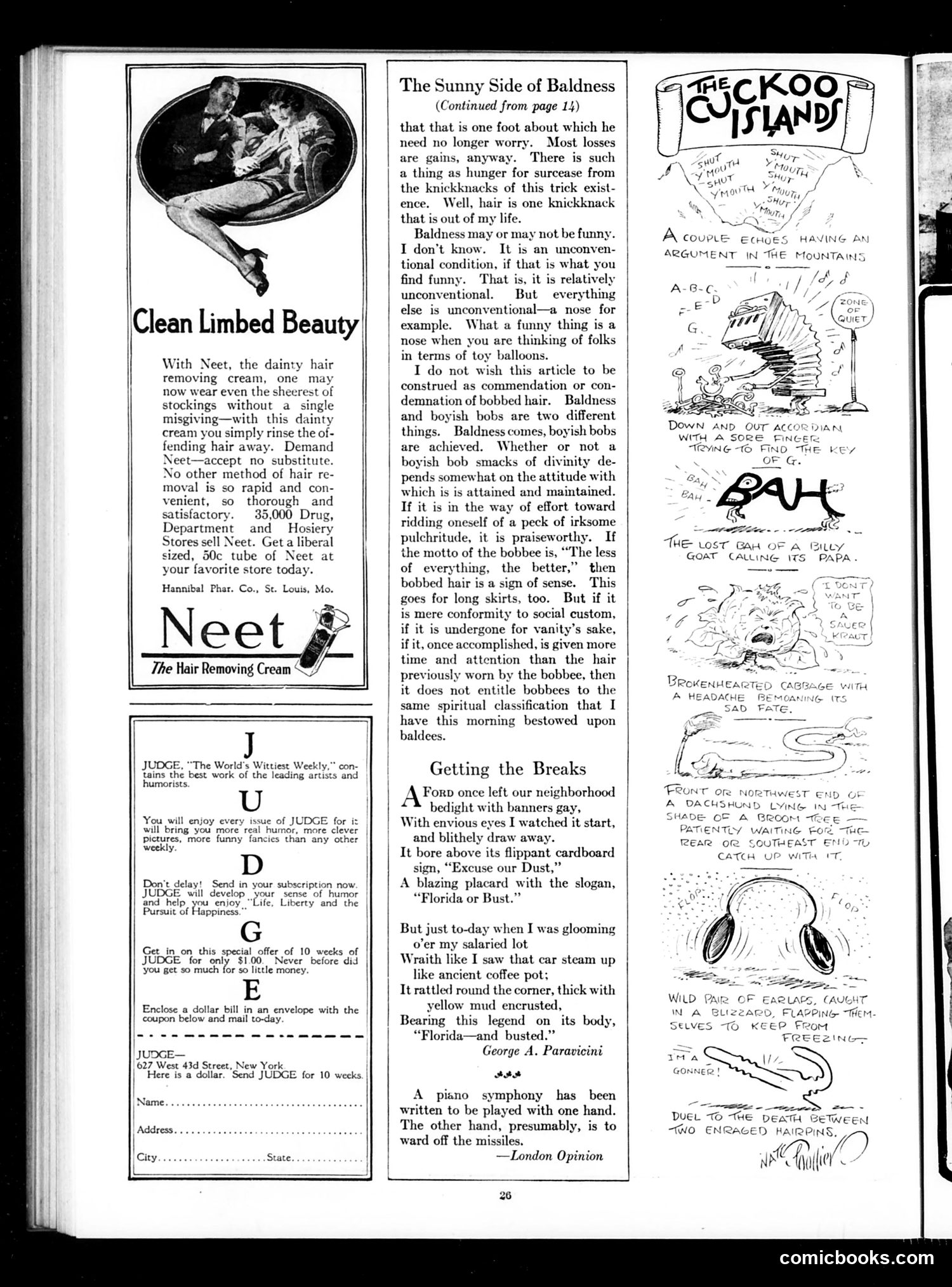
This page contains a humorous illustrated feature titled "The Cuckoo Island" that presents absurdist scenarios through simple line drawings. The cartoons depict comically implausible situations: a couple arguing with an injured finger in mountains, a lost billy goat calling for its father, wild birds caught in a blizzard, and a dachshund positioned awkwardly at a dock's edge. The humor relies on visual absurdity and exaggeration rather than political satire. These appear designed as light comedic filler typical of *Judge* magazine's editorial content—offering whimsical, nonsensical scenarios for entertainment. The page also includes advertisements (Neet hair removal cream) and magazine subscription promotions, plus continued essays on "The Sunny Side of Baldness" and "Getting the Breaks" (about a car trip to Florida). The overall effect is that of a typical 1920s-era humor magazine page mixing advertisements, essays, and illustrated jokes without sharp political commentary.
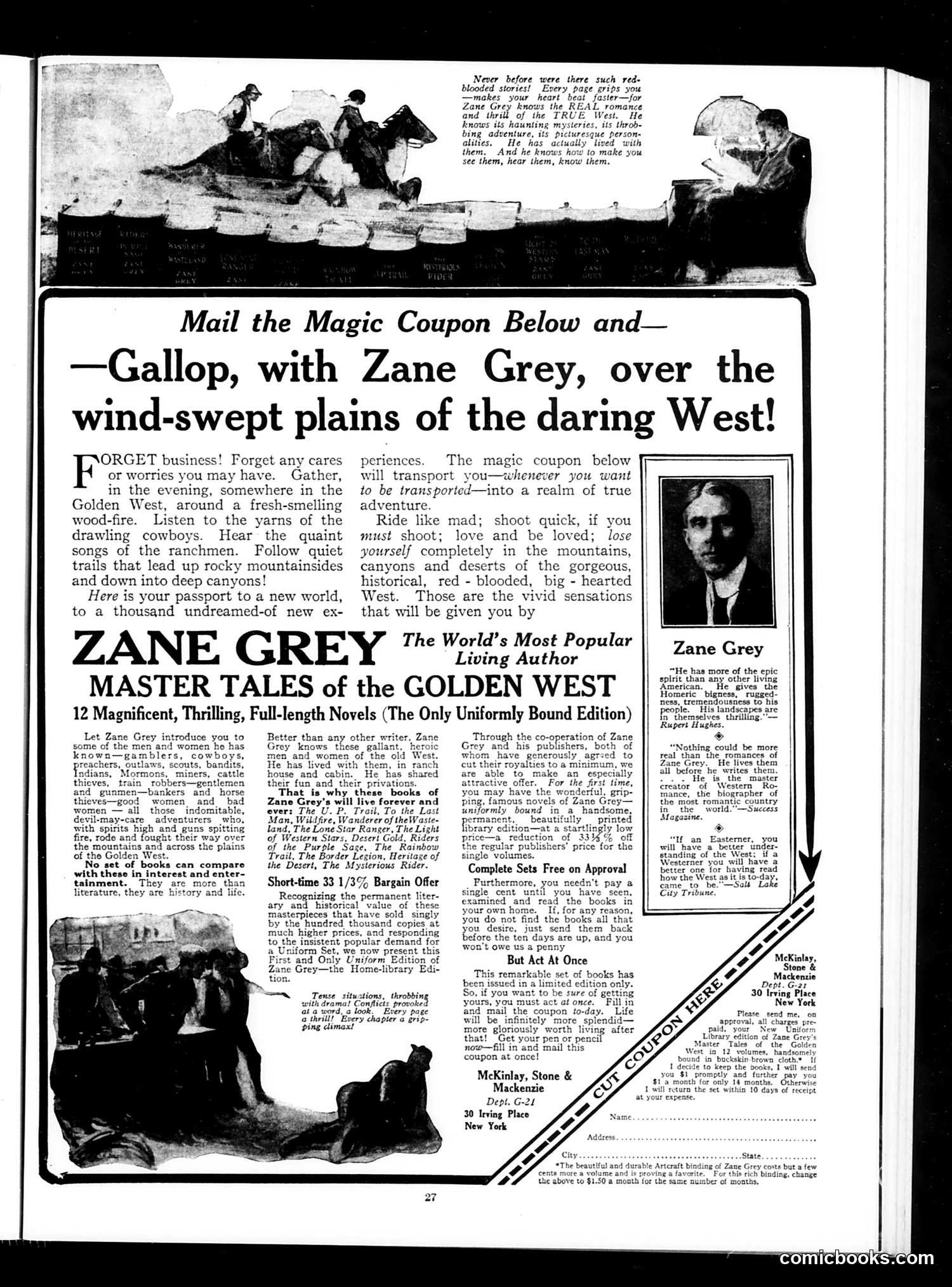
This is primarily a **book advertisement**, not political satire. The page promotes Zane Grey's "Master Tales of the Golden West"—a 12-novel collection published by McKinlay, Stone & Mackenzie. The advertisement uses romanticized Western imagery to appeal to readers seeking escape from mundane modern life ("Forget business! Forget any cares"). It emphasizes Grey's authenticity—he "has actually lived with them" (frontier characters)—positioning his novels as both literature and historical documentation. The illustrations show cowboys, gunfights, and dramatic scenes typical of Western adventure fiction of this era. The "magic coupon" is a mail-order sales device, offering a 33⅓% discount and ten-day approval period to encourage purchases. This reflects early 20th-century publishing strategies: luxury home libraries were status symbols, and mail-order book clubs were popular. The breathless language ("red-blooded," "throbbing adventure") targets readers seeking entertainment and vicarious adventure during what was likely the pre-Depression era.
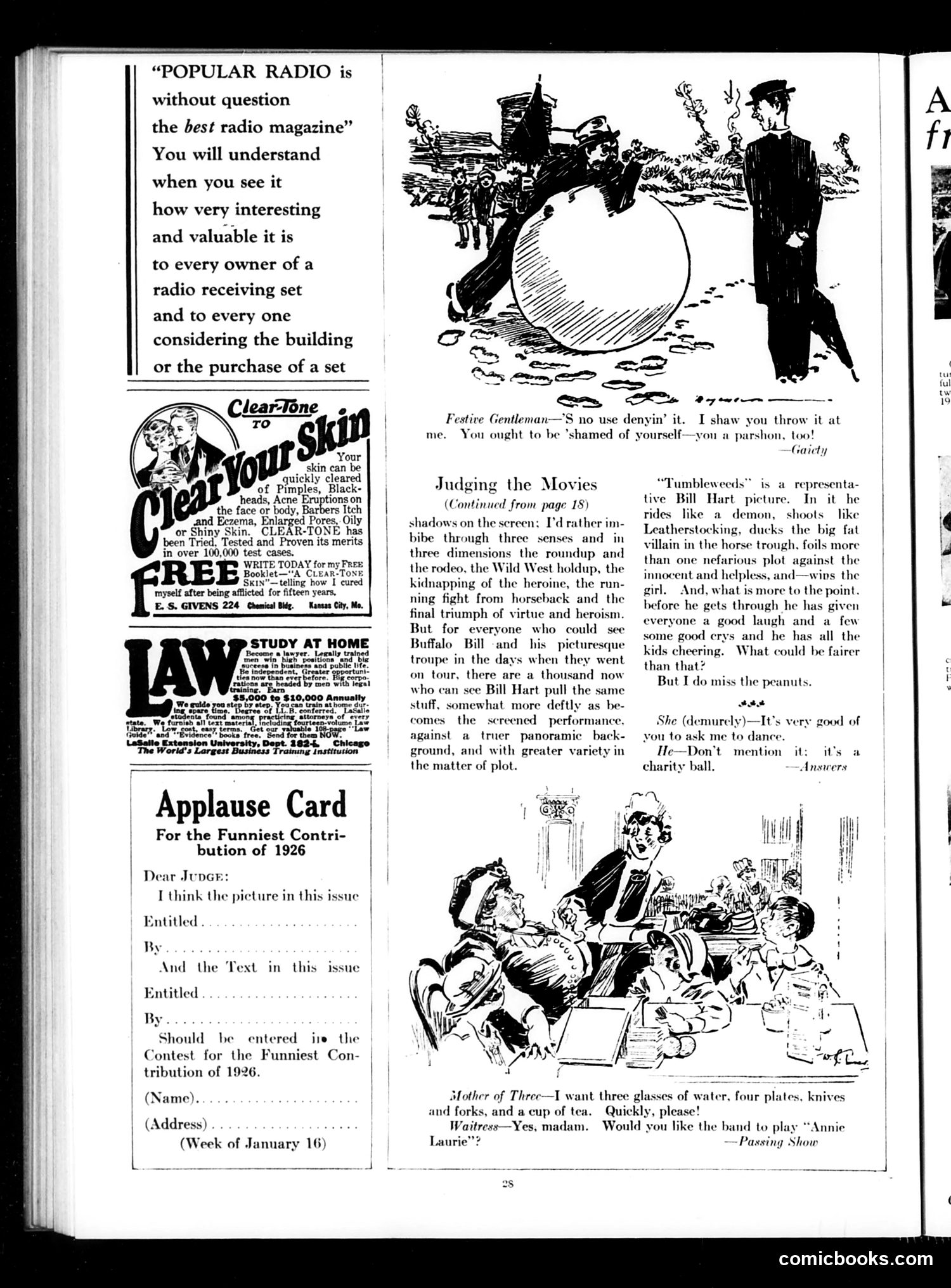
This page contains mixed advertisements and humor content typical of Judge magazine's format. **The Main Cartoon** (top center): Shows a festive gentleman who has apparently thrown something (likely a ball or similar object) at a parson (clergy member). The parson protests the rudeness, saying the gentleman should be ashamed—especially given his religious status. The joke plays on the contrast between expected propriety and actual behavior; it's a simple slapstick scenario with mild social commentary about hypocrisy. **The Humor Section** ("Judging the Movies"): Reviews Bill Hart Westerns, comparing live performances to film. The critic prefers Hart's movies for their cinematic advantages over seeing actual Wild West tours. **The Bottom Cartoon**: Depicts a domestic service scene where a demanding mother of three orders food and beverages from a harried waitress, then asks if the band will play a sentimental song—a absurdly inappropriate request given the chaotic situation. **Advertisements** dominate the left column (Clear-Tone skin cream, law studies, radio magazine), representing typical 1926 commercial content.
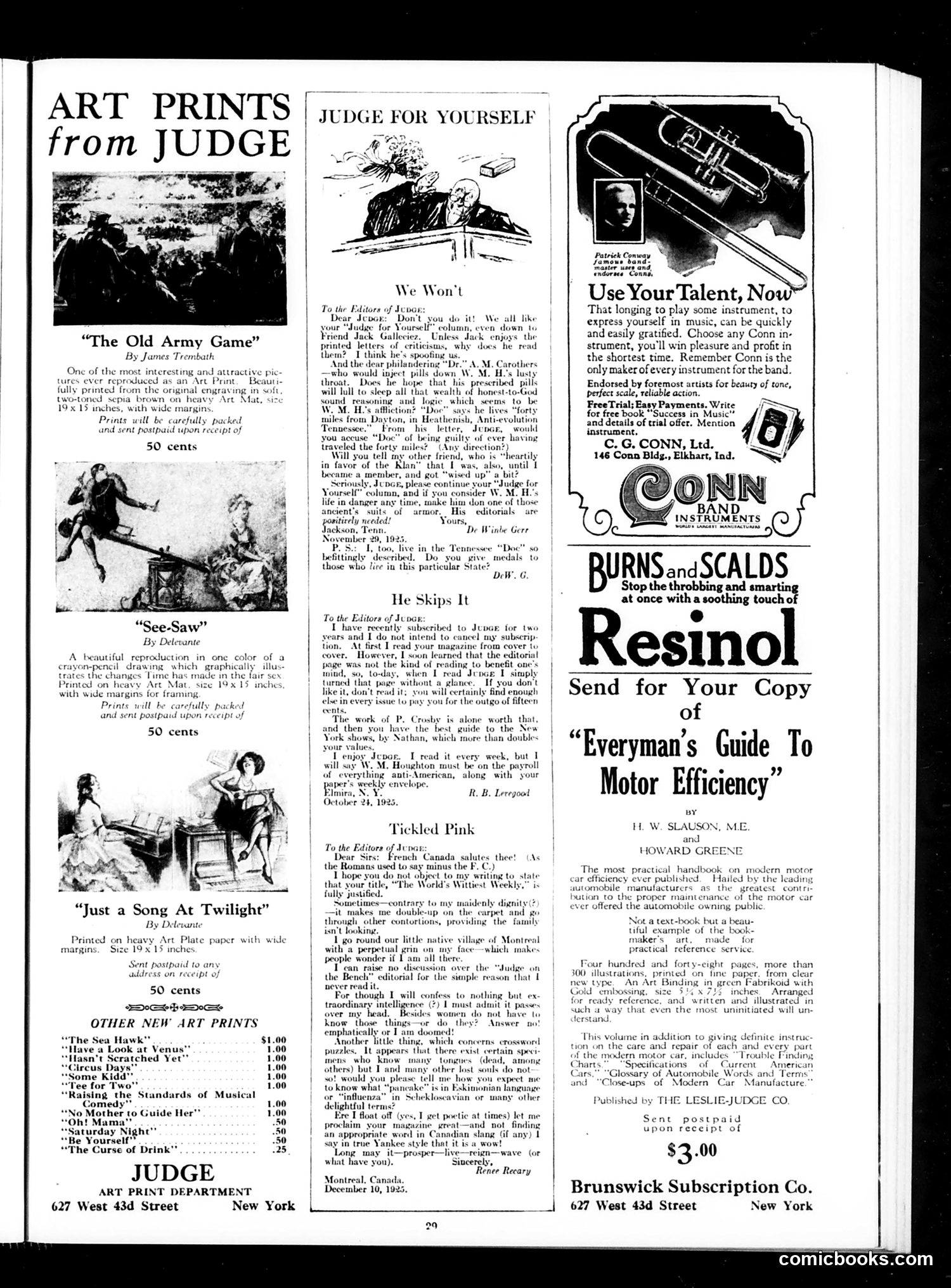
This page is primarily **advertisements and reader letters**, not political satire. The content includes: **Art prints for sale** (left column): reproductions of romantic/sentimental scenes like "The Old Army Game," "See-Saw," and "Just a Song at Twilight"—typical early 20th-century parlor art. **Reader letters to the editor** (center): mundane complaints and compliments about Judge magazine itself—one reader praising the "Judge for Yourself" column, another saying he skips the editorials but reads the Nathan comic strip, a third from French Canada praising the magazine's humor and crossword puzzles. **Product advertisements** (right side): a Conn musical instruments ad featuring Patrick Conway (an actual bandmaster/performer), and a Resinol skin cream ad. The page demonstrates Judge's format as a general-interest humor magazine supported by advertising revenue, rather than a focused political publication. The reader letters suggest the magazine's appeal was entertainment and comics rather than serious editorial commentary.
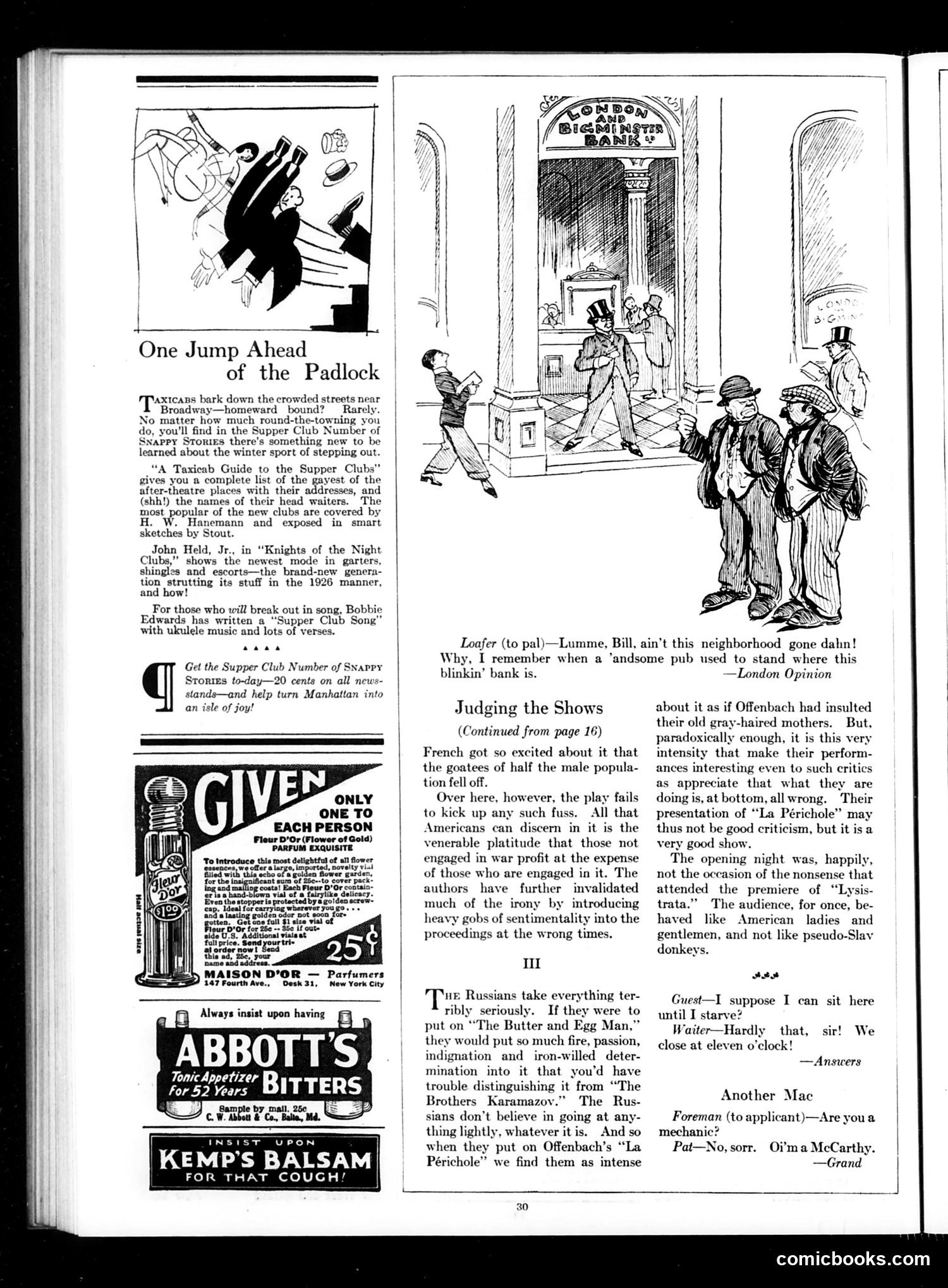
This page contains satirical commentary on 1920s Manhattan nightlife and theater criticism, alongside period advertisements. **"One Jump Ahead of the Padlock"** references the illegal speakeasies ("supper clubs") operating during Prohibition. The cartoon's title suggests staying ahead of police raids that would padlock establishments. The accompanying article promotes *Snappy Stories* magazine's guide to these hidden venues with their addresses and head waiters' names—essentially a speakeasy directory. This is satirical commentary on how openly Prohibition was flouted in New York. The **loafer cartoon** laments neighborhood decline: a man nostalgically recalls when a pub stood where a bank now operates, lamenting gentrification and the loss of working-class establishments. **Theater reviews** discuss French and Russian productions, with critics noting Russian performers' excessive intensity even in comedies like "The Butter and Egg Man." The advertisements (Abbott's Bitters, Kemp's Balsam, perfume) are period standard. The final joke plays on Irish stereotypes: an applicant named McCarthy claims not to be a mechanic, suggesting the surname implies certain working-class associations.
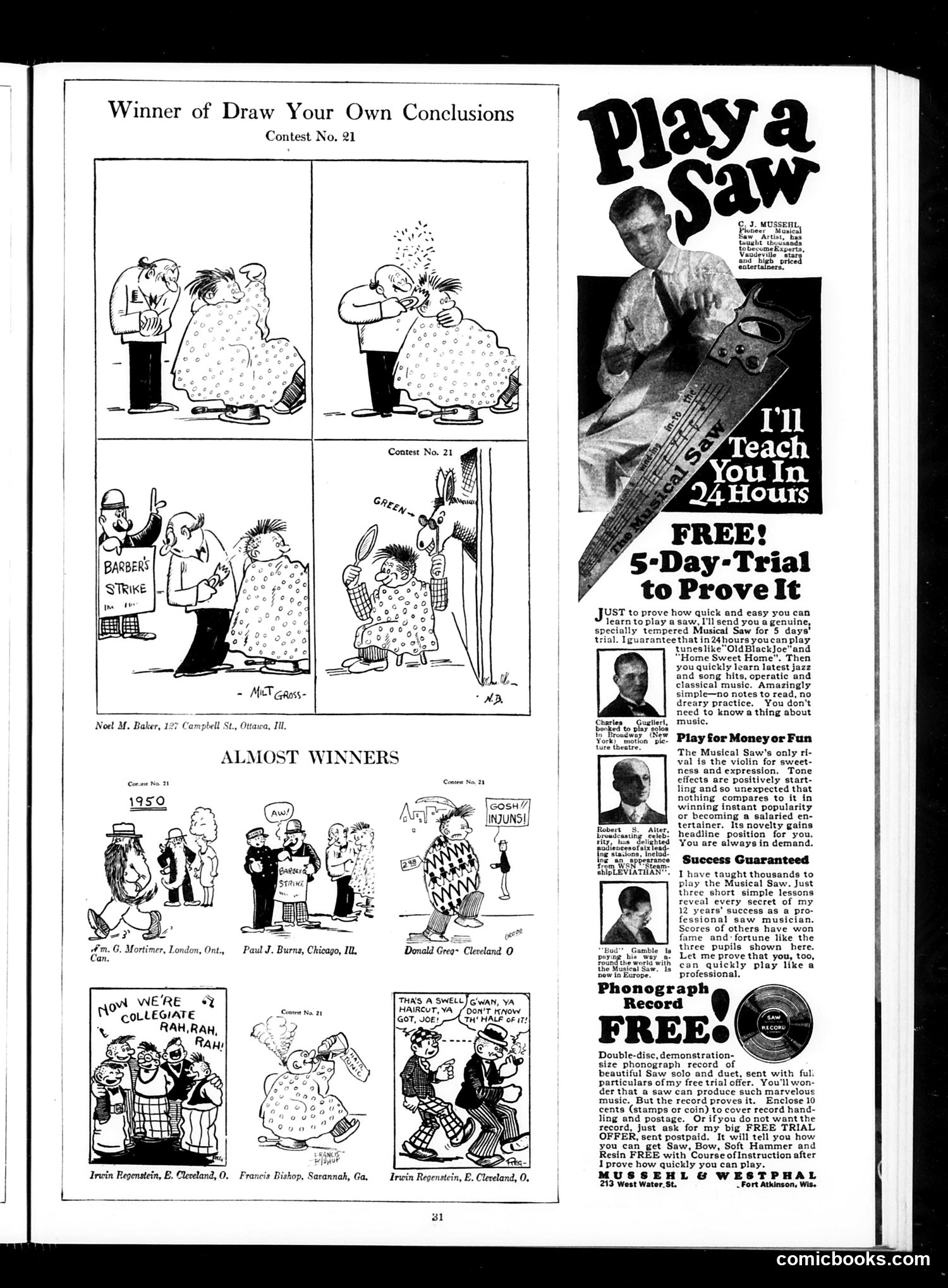
This page contains a contest-winning cartoon and "almost winners" from Judge's "Draw Your Own Conclusions" contest, plus an advertisement. **The Winning Cartoon** (by Noel M. Baker) depicts a barber strike through sequential panels: a barber confronts a customer, then cuts the customer's hair drastically short, followed by the customer striking back. The joke plays on the "barbers' strike" — a real labor action — by showing literal physical retaliation rather than typical strike activity. **The "Almost Winners"** show various humorous domestic and social situations: collegiate fraternity behavior, confused conversations about haircuts, and similar everyday comic scenarios. **The Advertisement** (right side) promotes a "Musical Saw" with a 5-day free trial, promising to teach saw-playing in 24 hours. It references vaudeville entertainment and includes testimonials from performers, reflecting early 20th-century popular entertainment culture where novelty musical instruments were marketed as paths to stage success and financial gain. The page reflects 1920s-era humor and commercial culture.
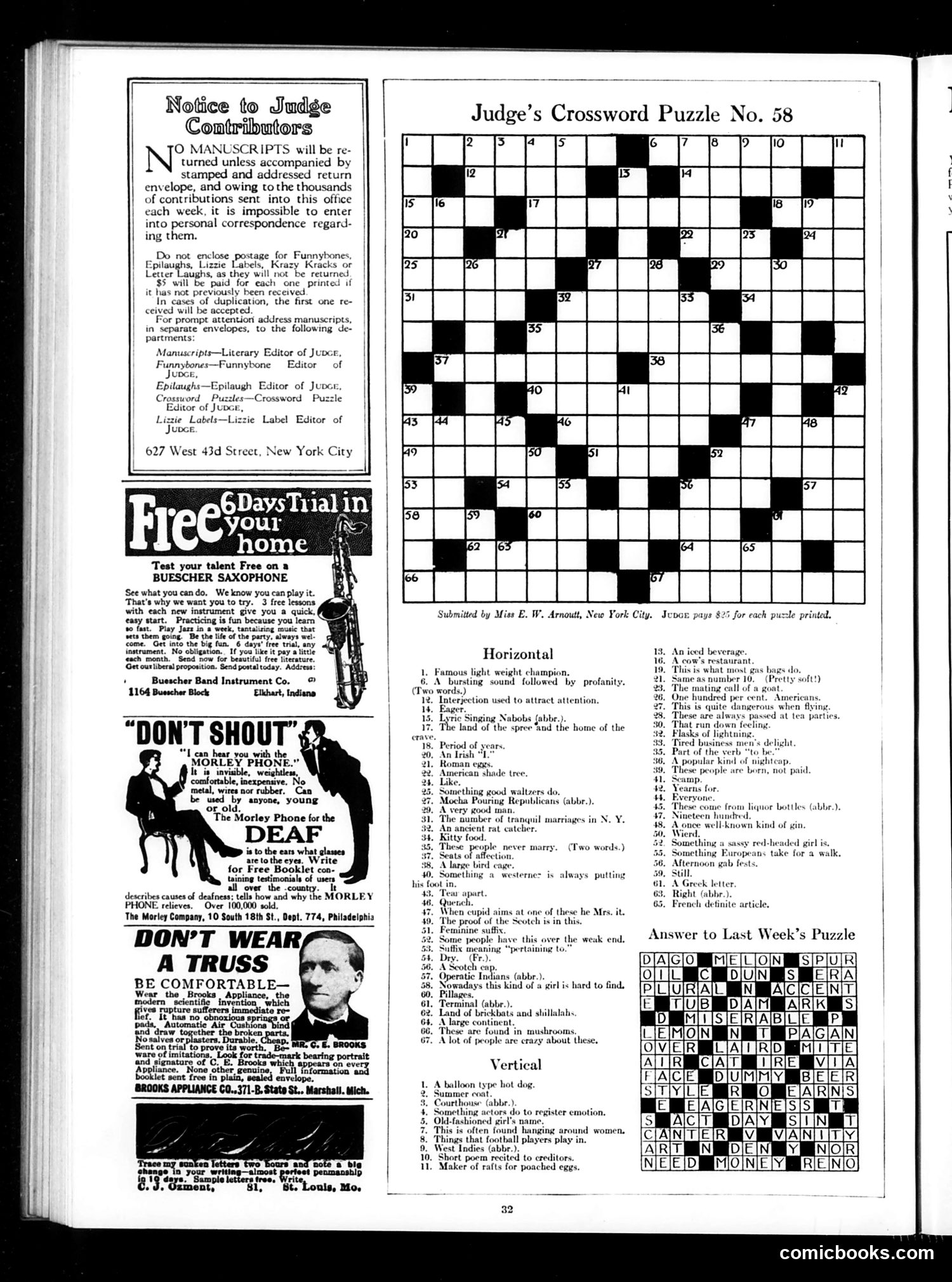
This page is primarily **administrative and advertising content** rather than political satire. The left side contains: - **Editorial notices** to manuscript contributors (submission guidelines) - **Three advertisements**: a Buescher saxophone offering free lessons; a "Morley Phone" hearing device claiming to relieve deafness; and a "Brooks Appliance" truss (a medical support garment for hernias) The right side features **Judge's Crossword Puzzle No. 58** with clues and a solved puzzle from the previous week. The advertisements reflect **early 20th-century commercial concerns**: musical instruments, emerging electrical communication devices, and medical remedies for common ailments. The tone is typical of period magazine ads—making bold health/performance claims. There is **no significant political or social satire** visible on this page. It's a standard magazine administrative/business page with crossword entertainment.
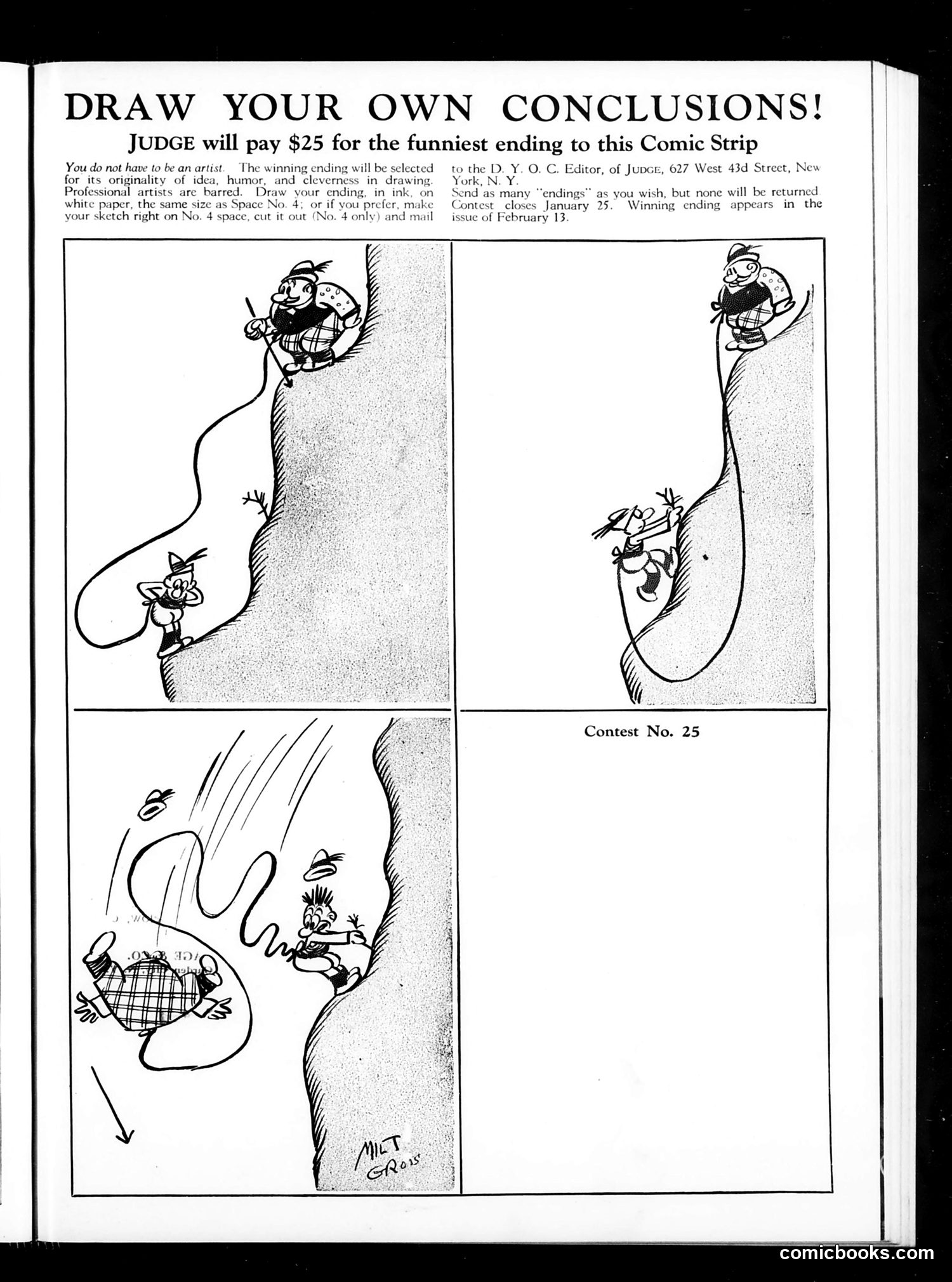
This is a reader-participation contest page, not political satire. Judge magazine invited readers to complete an unfinished comic strip for $25. The three existing panels show small cartoon characters (appearing to be elves or imps in period clothing) climbing a rope or rope-like object on a mountainside. Panel three depicts them apparently falling or tumbling downward in distress, with motion lines suggesting chaos. The humor premise is unclear from the image alone—it could involve the characters' fate, an unexpected twist, or slapstick consequences. Readers were asked to supply the fourth panel's conclusion (the blank space on the right) to complete the joke. This was a common early-20th-century magazine engagement strategy, combining reader participation with humor and modest monetary incentive. The contest closed January 25, with winners published February 13.
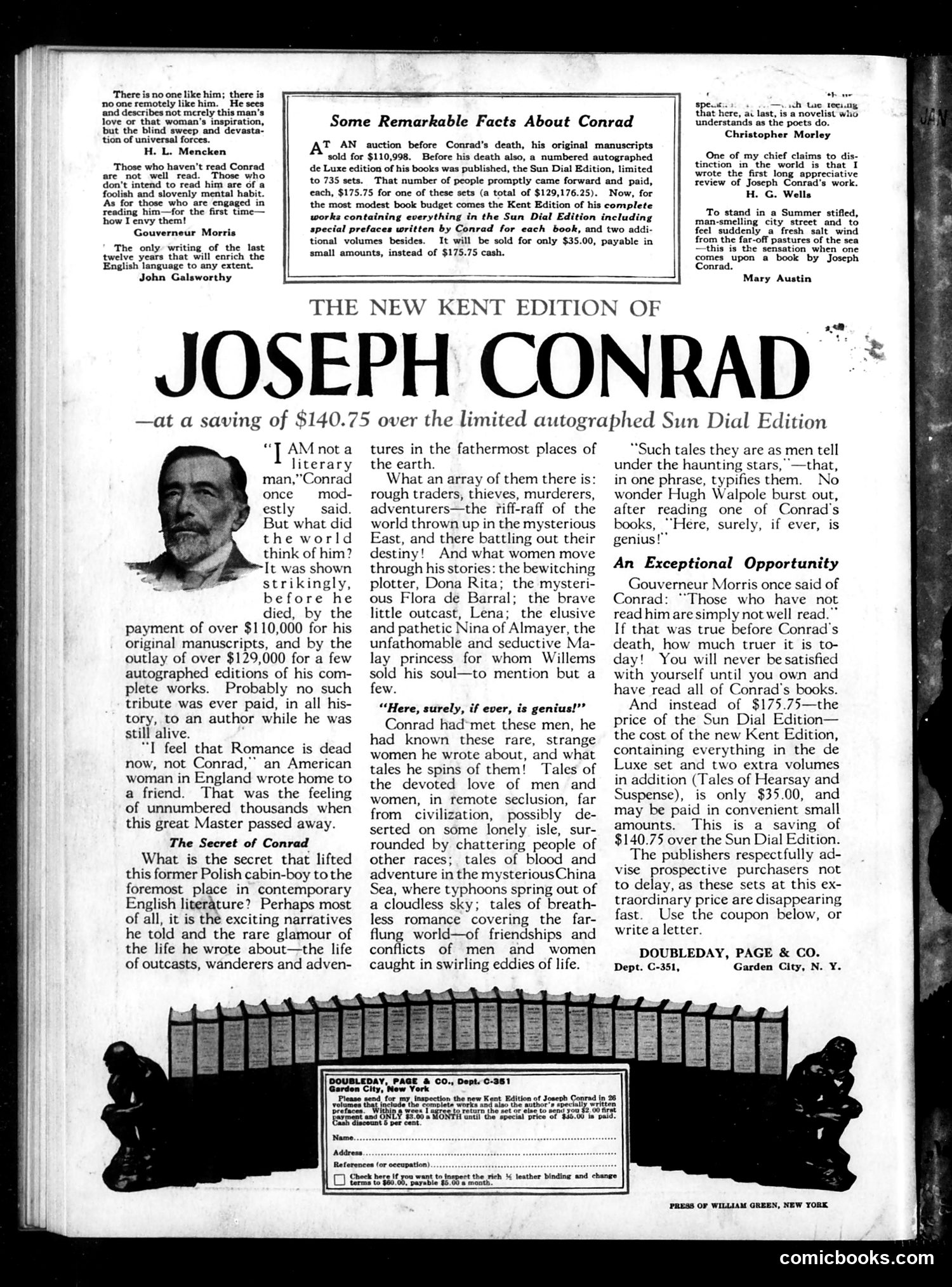
This is primarily a **book advertisement**, not a political cartoon. It promotes the newly released Kent Edition of Joseph Conrad's complete works at $35.00—a $140.75 savings versus the limited Sun Dial Edition ($175.75). The page features **testimonials from prominent literary figures** (H.L. Mencken, H.G. Wells, John Galsworthy, Christopher Morley) praising Conrad as a literary genius. These endorsements establish his cultural prestige. The advertisement emphasizes Conrad's market value: his manuscripts sold for $110,000 at auction; 735 people paid $175.75 each for the deluxe edition. This demonstrates his exceptional status—"Probably no such tribute was ever paid, in all history, to an author while he was still alive." The pitch targets budget-conscious readers: the Kent Edition offers "everything in the Sun Dial Edition" at a fraction of the cost, making Conrad's "complete works" newly accessible to ordinary readers, not just the wealthy elite.