
Judge, 1926-01-16 · page 20 of 36
Judge — January 16, 1926 — page 20: what you’re looking at
What you’re looking at
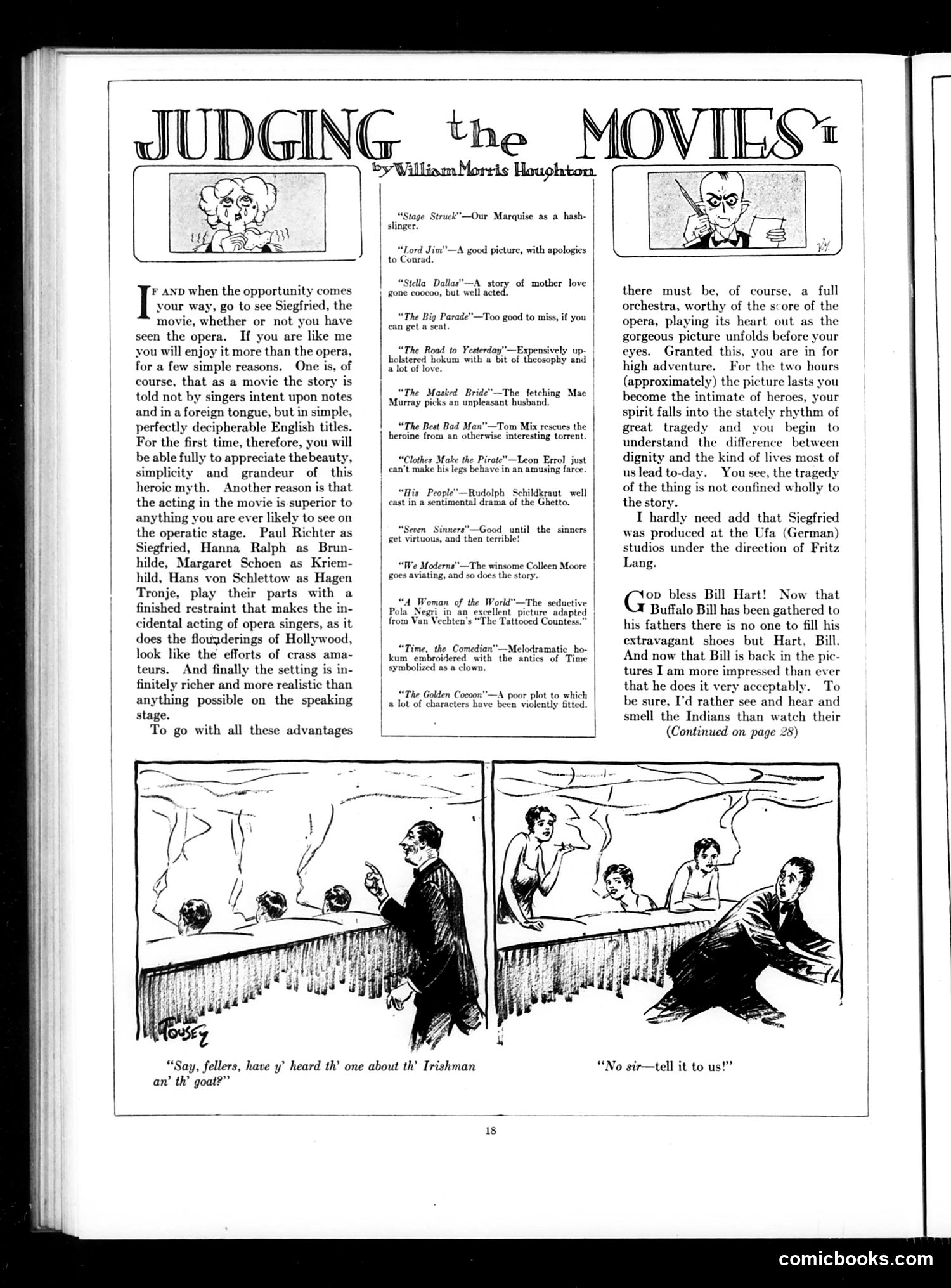
This page reviews contemporary 1920s films, with the main article praising the German silent film *Siegfried* (directed by Fritz Lang) as superior to its operatic source material—arguing cinema's visual storytelling surpasses sung opera's emotional restraint and comprehensibility. The sidebar lists brief reviews of popular films of the era (*The Big Parade*, *Stella Dallas*, *Stage Struck*, etc.), using sardonic one-liners to critique their plots and performances. The two cartoons below depict vaudeville or nightclub scenes with men telling jokes to audiences, captioned "Say, fellers, have y' heard th' one about th' Irishman an' th' goat?" and "No sir—tell it to us!" The humor appears to satirize lowbrow entertainment venues and their stock comedic material, possibly contrasting them with the "high art" cinema discussed above.
📄 Transcribed text from this page (OCR, searchable)
Machine-transcribed from the original scan — historical spelling and the odd misread are preserved.
AND when the opportunity comes your way, go to see Siegfried, the movie, whether or not you have seen the opera. If you are like me you will enjoy it more than the opera, for a few simple reasons. One is, of course, that as a movie the story is told not by singers intent upon notes and in a foreign tongue, but in simple, perfectly decipherable English titles. For the first time, therefore, you will be able fully to appreciate thebeauty, simplicity and grandeur of this heroic myth. Another reason is that the acting in the movie is superior to anything you are ever likely to see on the operatic stage. Paul Richter as Siegfried, Hanna Ralph as Brun- hilde, Margaret Schoen as Kriem- hild, Hans von Schlettow as Hagen Tronje, play their parts with a finished restraint that makes the in- cidental acting of opera singers, as it does the flougderings of Hollywood, look like the efforts of crass ama- teurs. And finally the setting is in- finitely richer and more realistic than anything possible on the speaking stage. To go with all these advantages “Stage Struck"—Our Marquise as a hash- slinger. “Lord Jim—A good picture, with apologies to Conrad. “Stella Dallas"—A sto gone coocoo, but well acted. of mother love “The Big Parade—Too good to miss, if you can get a seat. “The Road to Yesterday"—Expensively up- | holstered hokum with a bit of theosophy and a lot of love. “The Masked Bride”—The fetching Mae Murray picks an unpleasant husband. “The Best Bad Man" —Tom Mix rescues the heroine from an otherwise interesting torrent. | “Clothes Make the Pirate"—Leon Errol just can't make his legs bebave in an amusing farce. “His People"—Rudolph Schildkraut well cast in a sentimental drama of the Ghetto. “Seren Sinners”—Good until the sinners | | get virtuous, and then terrible! “We Moderns"—The winsome Colleen Moore | | goes aviating, and so does the story. Woman of the World"—The seductive | fegri_ in an excellent picture adapted | Van Vechten’s “The Tattooed Countess.” | “Time, the Comedian”—Melodramatic _ho- kum embroidered with the antics of Time | symbolized as a clown. “The Golden Cocoon"—A poor plot to which a lot of characters have been violently fitted. “Say, fellers, have y’ heard th’ one about th’ Irishman an’ th’ goat?” there must be, of course, a full orchestra, worthy of the score of the opera, playing its heart out as the gorgeous picture unfolds before your eyes. Granted this, you are in for high adventure. For the two hours (approximately) the picture lasts you become the intimate of heroes, your spirit falls into the stately rhythm of great tragedy and you begin to understand the difference between dignity and the kind of lives most of us lead to-day. You see, the tragedy of the thing is not confined wholly to the story. I hardly need add that Siegfried was produced at the Ufa (German) studios under the direction of Fritz Lang. Ge bless Bill Hart! Now that Buffalo Bill has been gathered to his fathers there is no one to fill his extravagant shoes but Hart, Bill. And now that Bill is back in the pic- tures I am more impressed than ever that he does it very acceptably. To be sure, I'd rather see and hear and smell the Indians than watch their (Continued on page 28) comicbooks.com