
Judge, 1926-01-16 · page 18 of 36
Judge — January 16, 1926 — page 18: what you’re looking at
What you’re looking at
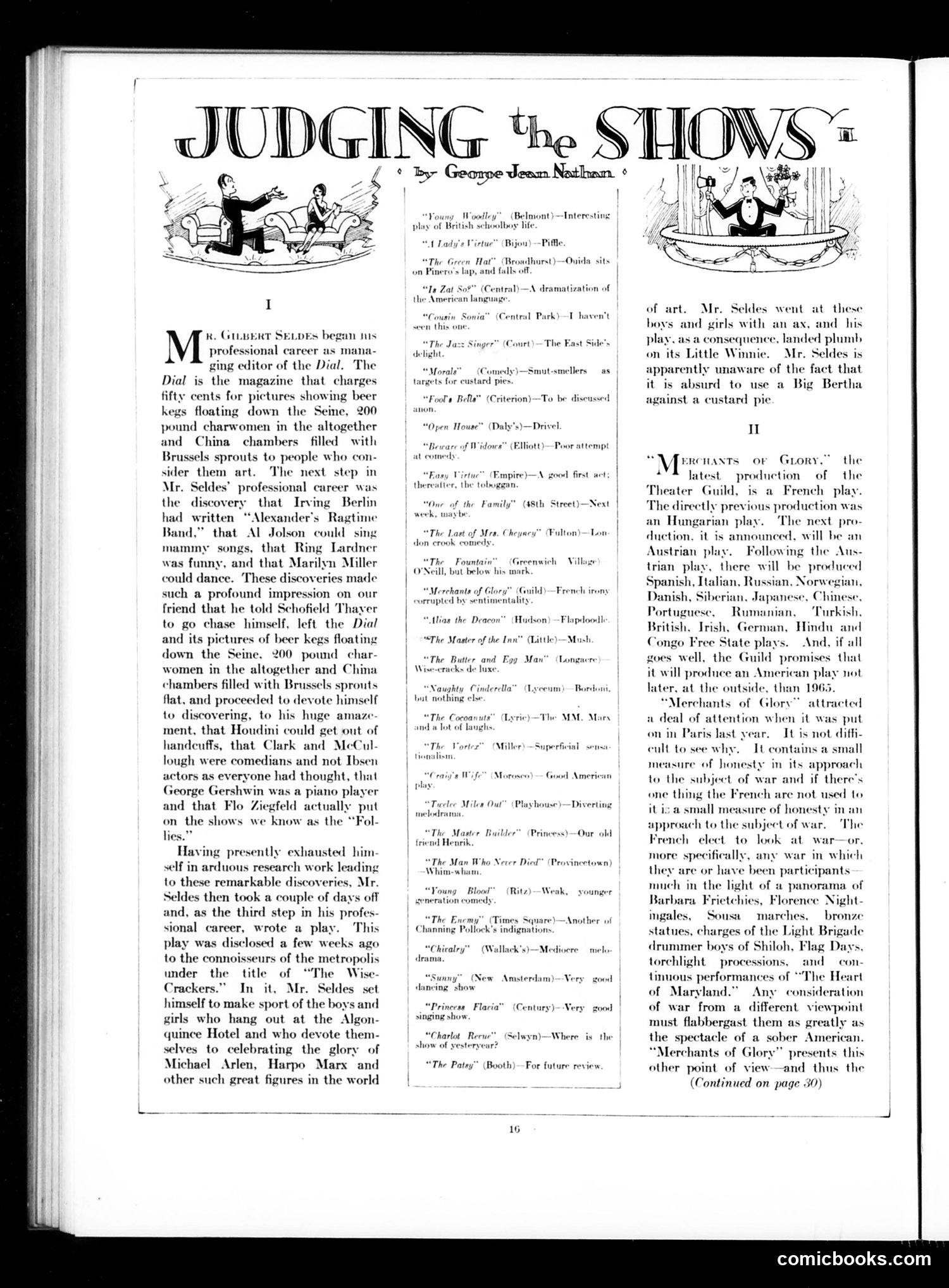
This article satirizes critic Gilbert Seldes' professional evolution. The author mocks Seldes' pretentious work at *The Dial* magazine—which charged fifty cents for "artistic" pictures (absurdly described as beer kegs on the Seine and naked charwomen). The satire traces Seldes' redemption: he discovered that Irving Berlin, Al Jolson, Ring Lardner, and Flo Ziegfeld were actually talented—revelations presented as if they were shocking intellectual breakthroughs requiring genuine research. The joke culminates in Seldes writing a play called "The Wise-Cracker" that ridicules the Algonquin Hotel's literary set (who celebrated Michael Arlen and other contemporary figures). The satire's point: Seldes attacked pretentious "smart" people while himself having been absurdly pretentious—like using heavy artillery ("Big Bertha") against a custard pie. The piece is a withering takedown of artistic posturing and critical hypocrisy.
📄 Transcribed text from this page (OCR, searchable)
Machine-transcribed from the original scan — historical spelling and the odd misread are preserved.
k. GILBERT SELDES began ts ging editor of the Dial. The Dial is the magazine that charges fifty cents for pictures showing beer kegs floating down the Seine, 200 pound charwomen in the altogether and China chambers filled with Brussels sprouts to people who con- sider them art. The next p in Mr. Seldes’ professional career was the discovery that Irving Berlin had written “Alexander's Ragtime Band,” that Al Jolson could. sing mammy songs, that Ring Lardner was funny, and that Marilyn Miller could dance. ‘These discoveries made such a profound impression on our friend that he told Schofield Thayer to go chase himself, left the Dial and its pictures of beer kegs floating down the Seine, 200 pound char- women in the altogether and China chambers filled with Brussels sprouts flat, and proceeded to devote himself to discovering, to his huge amaze ment, that Houdini could get out of handcuffs, that Clark and MeCul- lough were comedians and not Ibsen actors as everyone had thought, that George Gershwin was a piano player and that Flo Ziegfeld actually put on the shows we know as the “Fol- lies.” Having presently exhausted him self in arduous research work leading to these remarkable discoveries, Mr. Seldes then took a couple of days off and, as the third step in his profes- sional career, wrote a play. This play was disclosed a few weeks ago to the connoisseurs of the met sepals under the title of “The Wise- Cracker In it, Mr. Seldes set himself to make sport of the boys and girls who hang out at the Algon- quince Hotel and who devote them- selves to celebrating the glory of Michael Arlen, Harpo Marx and other such great figures in the world ny Woodley" (Belmont) —Interesting play of British schoolboy “1 Lady's Virtue” (B Pife n Hat adhurst)—Ouida sits p, and fall ntral)—A dramatization of we Americ Central Park) haven't “Cousin Sonia Court) —The East Side’s Th delight “Morals” (Comedy)—Smut-smellers as targets for custard pies, + Bells” (Criterion) —To be diseussed “Open House” (Daly’s)—Dr f Widows” (EMiott or attemp at comedy “Easy Virtue” (Empire)—S good first act thereafter, the toboggan f the Family” (48th Street)—Next | week, maybe “The Last of Mra. Cheyney” (Fulton) —Lan Jon crook comedy “The Fountain” (Greenwich Villase O'Neill, but below his mark “Merchante of Glory” (Guild) —Freneh irony wurrupted by sentimentality “Alias the Deacon” (Hudson) —Flapdoodl “The Master of the Inn (Little) —Mush “The Butter and Egg Man™ (La Wise-eracks de luxe “Naughty Cinderella” (Lyceum) Borden but nothing else “The Cocoans Lyric) The MM. Mary and a lot of laughs. ort Superfic a Wife OM, 1 Ameri Miles Out” (Playhouse)—Diverting melodram “The Master Builder” (Princess) —Our old friend Henrik, “The Man Who Never Died Whim-whi Provincetown “Young Blood” (Ritz)—Weak, yor generation comed: Square) —Another of ock's indignations i hicalry” —(Wallack’s)—Medivere — melo: unny” (New Amsterdam)—Very good dincing show “Princess Flaria” (Century)—Very good singing show piCharlat Rerue", (Selwyn) —Where is the show of yesteryear? “The Patey” (Booth)-—For future review of art. Mr. Seldes went at these boys and girls with an ax, and his asa consequence, landed plumb on its Little Winni Mr. Seldes is apparently unaware of the fact that it is absurd to use a Big Bertha against a custard pie II AY bo HANTS oF Grory,” the latest. production the Theater Guild, is a French play. The directly previous production was an Hungarian play. ‘The next. pro- duction, it is announced, will be an Austrian play. Following the Aus- trian play, there will be produc Spanish, Italian, Russian, Norwegii Danish, Siberian, Japanese, Chinese, Portuguese, Rumanian, ‘Turkish, British, Irish, German, Hindu and Congo Free State plays. And, if all goes well, the Guild promises that it will produce an American play not later, at the outside, than 196. “Merchants of Glory” attracted 1 of attention when it was put on in Paris last year. It is not diffi- cult to see why. It contains a small measure of honesty in its approach to the subject of war and if there's one thing the French are not used to it is a small measure of honesty in an approach to the subject of war. The French elect. to look at) war—or, more specifically, any war in which they are or have been participants much in the light of a panorama of Barbara Frietchies, Florence Night- ingales, Sousa marches, bronze statues, charges of the Light Brigade drummer boys of Shiloh, Flag Days, torchlight’ processions, and —con- tinuous performances of “The Heart of Maryland.” Any consideration of war from a different: viewpoint must flabbergast them as greatly the spectacle of a sober American. “Merchants of Glory” presents this other point of view —and thus the (Continued on page 30) comicbooks.com