
Judge, 1926-01-16 · page 32 of 36
Judge — January 16, 1926 — page 32: what you’re looking at
What you’re looking at
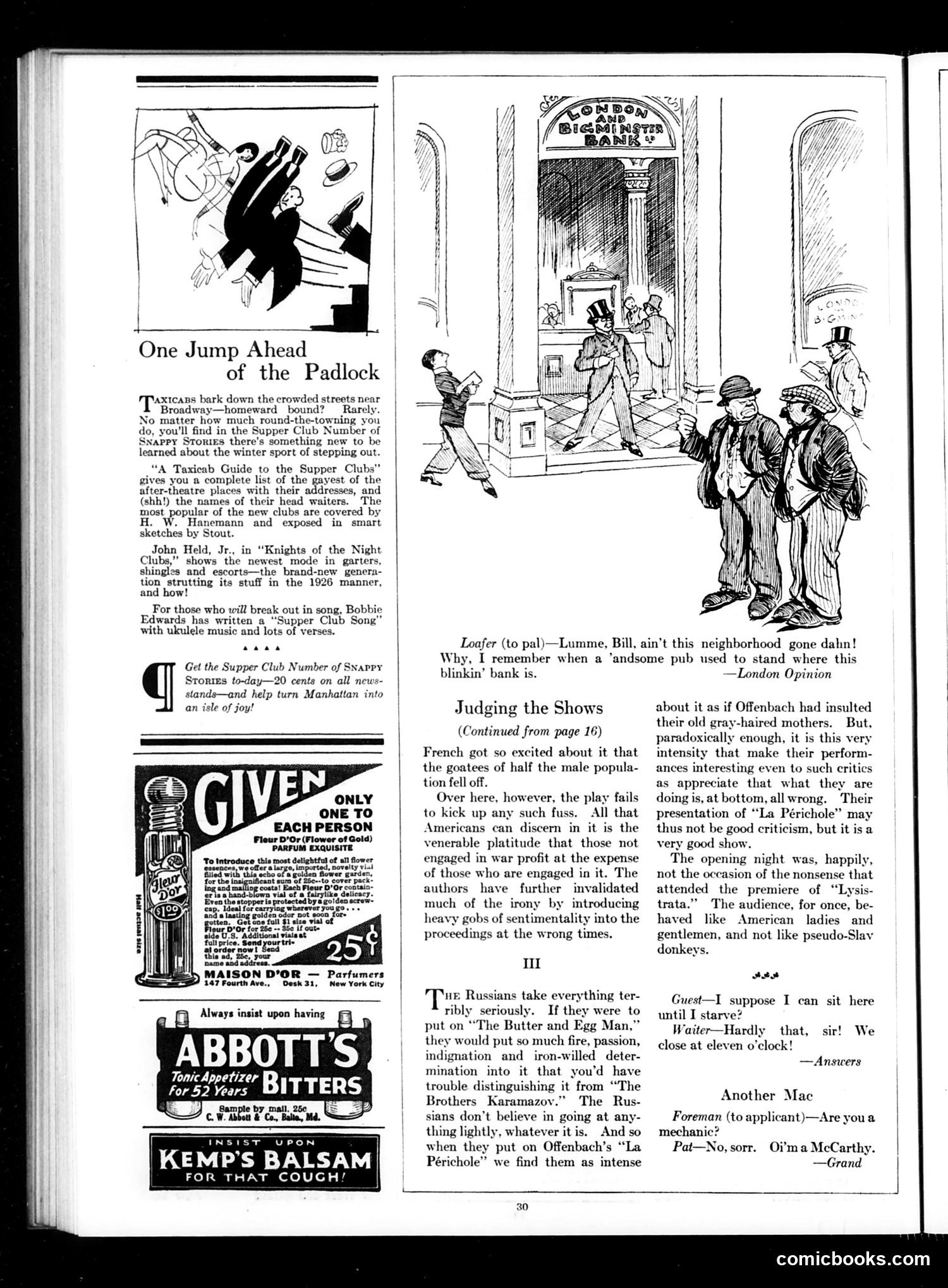
This page contains satirical commentary on 1920s Manhattan nightlife and theater criticism, alongside period advertisements. **"One Jump Ahead of the Padlock"** references the illegal speakeasies ("supper clubs") operating during Prohibition. The cartoon's title suggests staying ahead of police raids that would padlock establishments. The accompanying article promotes *Snappy Stories* magazine's guide to these hidden venues with their addresses and head waiters' names—essentially a speakeasy directory. This is satirical commentary on how openly Prohibition was flouted in New York. The **loafer cartoon** laments neighborhood decline: a man nostalgically recalls when a pub stood where a bank now operates, lamenting gentrification and the loss of working-class establishments. **Theater reviews** discuss French and Russian productions, with critics noting Russian performers' excessive intensity even in comedies like "The Butter and Egg Man." The advertisements (Abbott's Bitters, Kemp's Balsam, perfume) are period standard. The final joke plays on Irish stereotypes: an applicant named McCarthy claims not to be a mechanic, suggesting the surname implies certain working-class associations.
📄 Transcribed text from this page (OCR, searchable)
Machine-transcribed from the original scan — historical spelling and the odd misread are preserved.
One Jump Ahead of the Padlock axtcans bark down the crowded streets near Broadway—homeward bound? Rarely. No matter how much round-the-towning you do, you'll find in the Supper Club Number of Snappy Stories there's something new to be learned about the winter sport of stepping out. “A Taxicab Guide to the Supper Clubs” ives you a complete list of the gayest of the heatre places with their addresses, and (shh!) the names of their head waiters. The most popular of the new clubs are covered by H. W. Hanemann and exposed in smart sketches by Stout. John Held, Jr., in “Knights of the Night Clubs,” shows the newest mode in garters, shingles and escorts—the brand-new genera- tion strutting its stuff in the 1926 manner, and how! For those who will break out in song, Bobbie Edwards has written a “Supper Club Song” with ukulele music and lots of verses. Get the Supper Club Number of SNapry Srorres to-day—20 cents on all news- stands—and help turn Manhattan into an isle of joy! ONLY ONE TO EACH PERSON Flour D’Or (Flower of Gold) PARFUM EXQUISITE To Introduce this most delightful of all dower Bower garces, ‘echo of "the. it sum of 25e--to cover pack- ‘tod malfiog coutal Each Flour D'Or comtain~ ‘Vial of @ fairylike delicacy. tected by a golden ecrew- b MAISON D'OR — Parfumers 447 Fourth Ave., Desk 31, New York city Always insist upon having 5 f G | ABBOTT'S Tonic Appetizer For 52 Years BITTERS RT ras & Co, Balle, Ma. K MP's BALSAM| FOR THAT COUGH! Loafer (to pal)—Lumme, Bill, ain’t this neighborhood gone dahn! Why, I remember when a ’andsome pub used to stand where this blinkin’ bank is. Judging the Shows (Continued from page 16) French got so excited about it that the goatees of half the male popula- tion fell off. Over here, however, the play fails to kick up any such fuss. All that Americans can discern in it is the venerable platitude that those not engaged in war profit at the expense of those who are engaged in it. The authors have further invalidated much of the irony by introducing heavy gobs of sentimentality into the proceedings at the wrong times. Til Tt Russians take everything ter- ribly seriously. If they were to put on “The Butter and Egg Man,” they would put so much fire, passion, indignation and iron-willed deter- mination into it that you'd have trouble distinguishing it from “The Brothers Karamazov.” The Rus- sians don’t believe in going at any- thing lightly, whatever it is. And so when they put on Offenbach’s “La Périchole” we find them as intense —London Opinion about it as if Offenbach had insulted their old gray-haired mothers. But, paradoxically enough, it is this very intensity that make their perform- ances interesting even to such critics as appreciate that what they are doing is, at bottom, all wrong. Their presentation of “La Périchole” may thus not be good criticism, but it is a very good show. The opening night was, happily, not the occasion of the nonsense that attended the premiere of ‘‘Lysis- trata.” The audience, for once, be- haved like American ladies and gentlemen, and not like pseudo-Slav donkeys. see Guest—I suppose I can sit here until I starve? Waiter-—Hardly that, sir! We close at eleven o'clock! —Answers Another Mac Foreman (to applicant)—Are you a mechanic? Pat—No, sorr. Oi’ma McCarthy. —Grand | comicbooks.com