
A complete issue · 37 pages · 1925
Judge — October 31, 1925
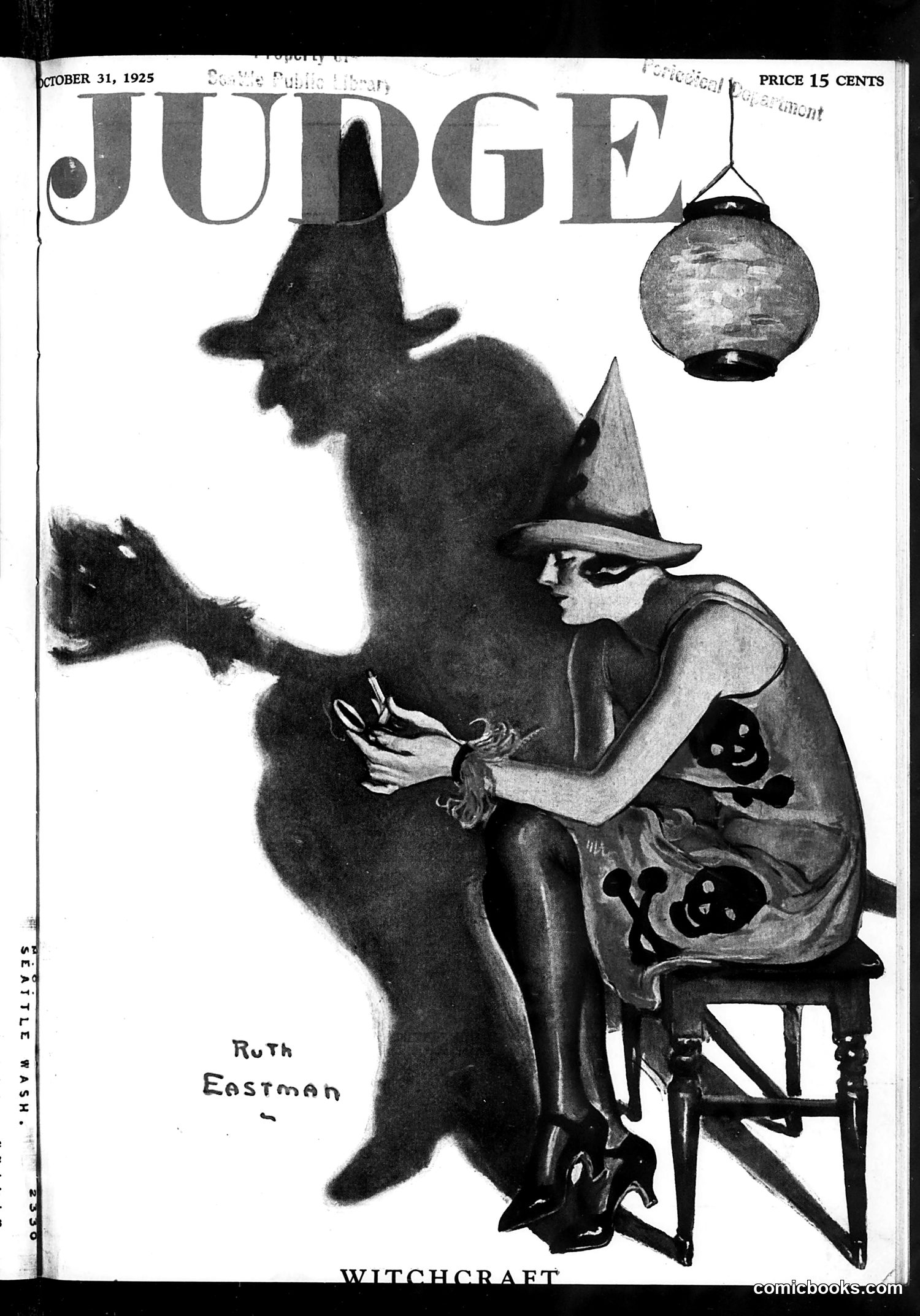
This Halloween-themed cover features actress **Ruth Eastman** as a witch performing magic. The silhouetted witch figure conjures a black cat and suspended lantern using a wand, while Eastman sits at a small table wearing a pointed witch hat and costume. The cover appears to be promotional rather than political satire—it's seasonal Halloween entertainment content. Judge magazine frequently featured theatrical personalities on covers during this era. The "Witchcraft" subtitle reinforces the holiday theme. This represents Judge's broader function as an entertainment and lifestyle publication alongside its satirical commentary, using contemporary actresses and cultural moments to appeal to readers during the 1920s.
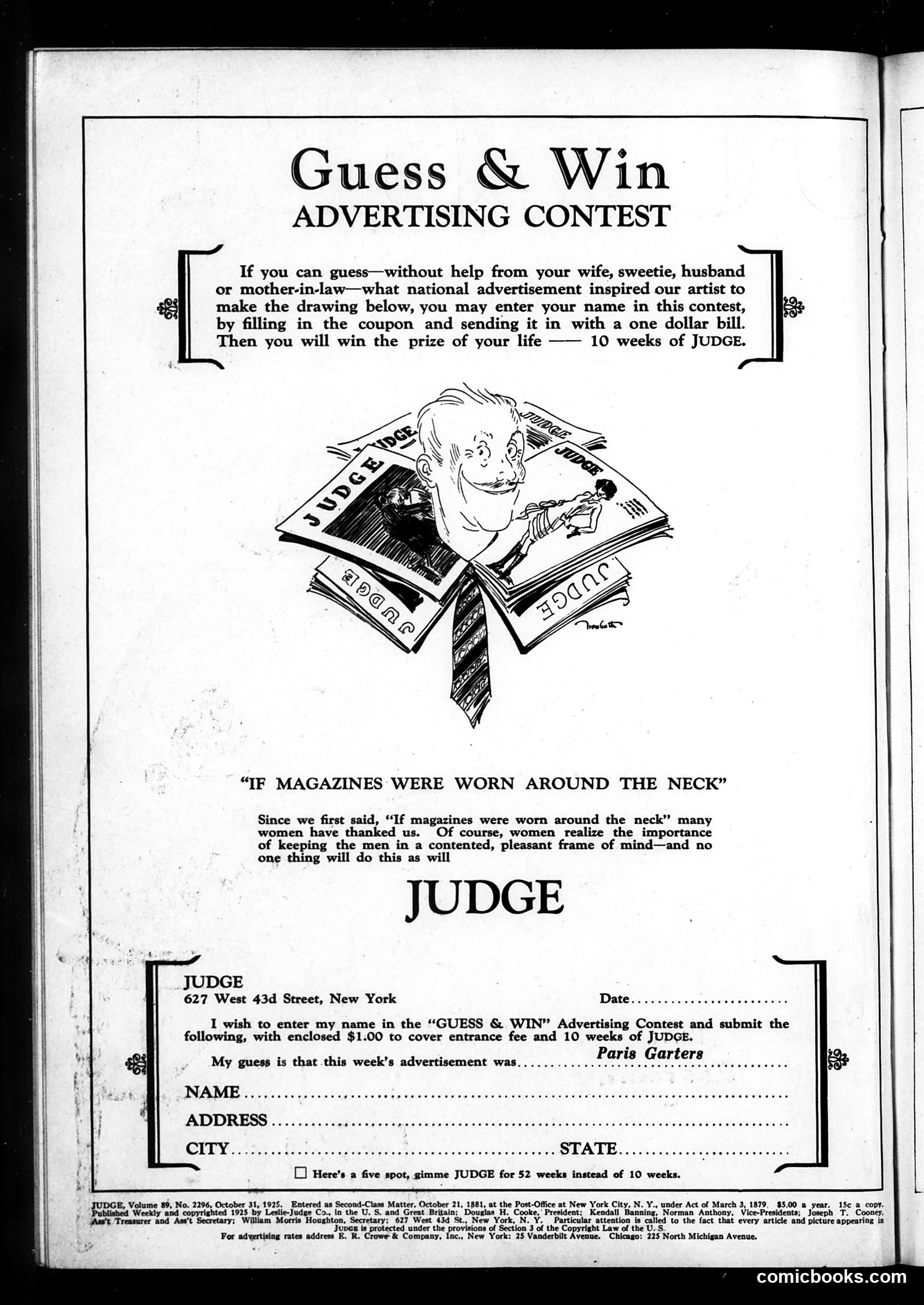
This page is primarily an **advertising contest** for *Judge* magazine itself, not political commentary. The cartoon depicts a man's head emerging from magazines worn as a necktie. The tagline reads: "If magazines were worn around the neck." The joke plays on the phrase that *Judge* apparently popularized about keeping men "in a contented, pleasant frame of mind." The visual gag suggests that surrounding oneself with magazines (particularly *Judge*) would accomplish this goal. The contest invites readers to guess which national advertisement inspired the drawing, offering 10 weeks of free *Judge* subscriptions as prizes. This is essentially a self-promotional gimmick—the ad encourages magazine readership by rewarding engagement with the magazine itself, while charging $1 entry fees to participate.
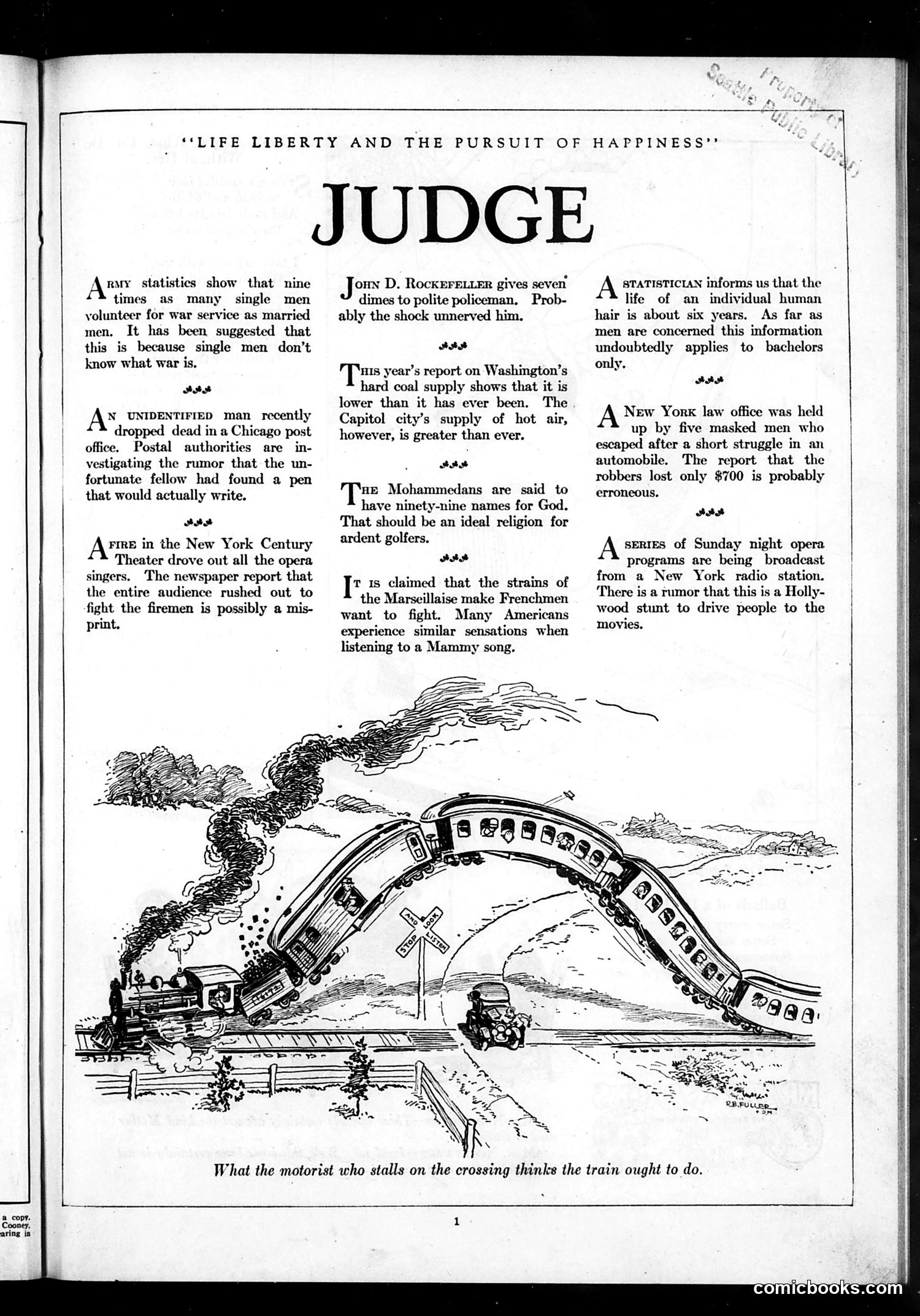
This page contains miscellaneous satirical items rather than a unified cartoon. The main illustration depicts a train derailing after hitting a stalled automobile—captioned "What the motorist who stalls on the crossing thinks the train ought to do." This is social satire about the dangerous conflict between new automobiles and established railroad traffic, mocking motorists who recklessly block train crossings. The surrounding text items are brief jokes touching on contemporary topics: military recruitment, coal shortages, religion, opera attendance, and a law office robbery. These appear to be general humor pieces reflecting early 20th-century urban anxieties—war service, utilities, safety concerns—rather than specific political commentary. The page reflects Judge's format of mixed satirical observations on modern American life.
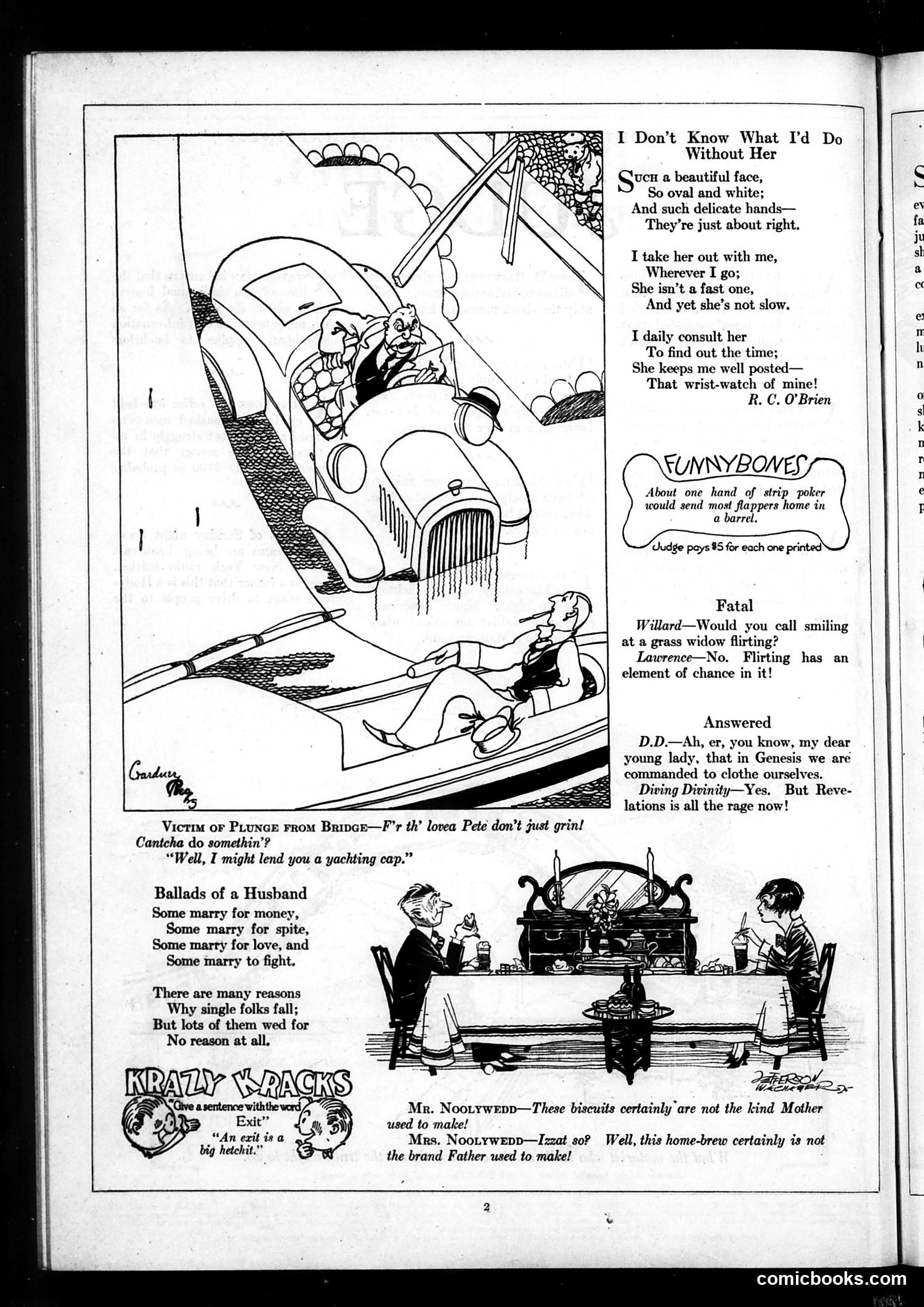
This page contains several humor items typical of Judge magazine's satirical content: **Main Cartoon ("Victim of Plunge from Bridge")**: Shows a man being pulled from water by a mechanical device, satirizing a contemporary news story about someone surviving a bridge plunge. The caption suggests Iowa Pete is involved in some scheme. **"I Don't Know What I'd Do Without Her"**: A poem praising a woman's appearance, intelligence, and usefulness—likely satirizing sentimental romantic verse popular at the time. **"Ballads of a Husband"**: Verse about marriage's various motivations, gently mocking matrimonial conventions. **"Noolyweed" Dialogue**: A domestic scene where spouses compare unfavorably the quality of food and drink to what their parents made—satirizing newlywed household management and nostalgia. The page exemplifies Judge's mix of visual gags, light romantic satire, and domestic humor aimed at middle-class readers.
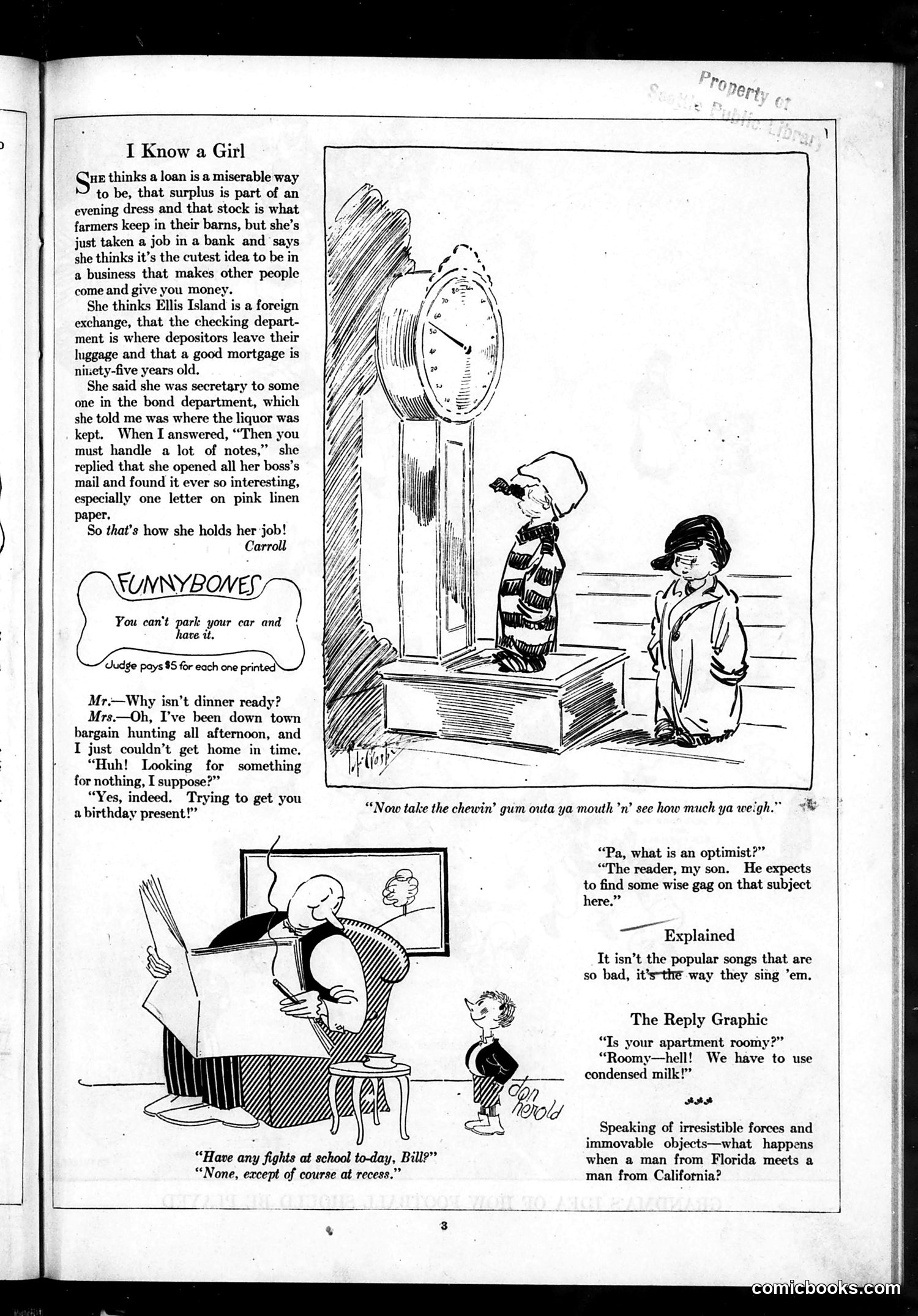
This page contains several unrelated humorous pieces typical of Judge's satirical format: **"I Know a Girl"** (top left): A prose satire mocking a woman's superficial understanding of banking terminology. She confuses financial concepts (loans, mortgages, Ellis Island) with completely unrelated things, suggesting women lack serious financial knowledge—a common 1920s-era sexist trope. **"Funnybones"**: Brief joke about parking violations and judge fines. **Other cartoons**: Include domestic humor (a wife's shopping excuses), definitions (an optimist expecting "wise gag"), and apartment living jokes about condensed milk and roominess. The humor relies on period stereotypes about gender roles, urban life, and financial/domestic incompetence. The overall tone is lighthearted rather than mean-spirited, typical of Judge's middle-class audience appeal.
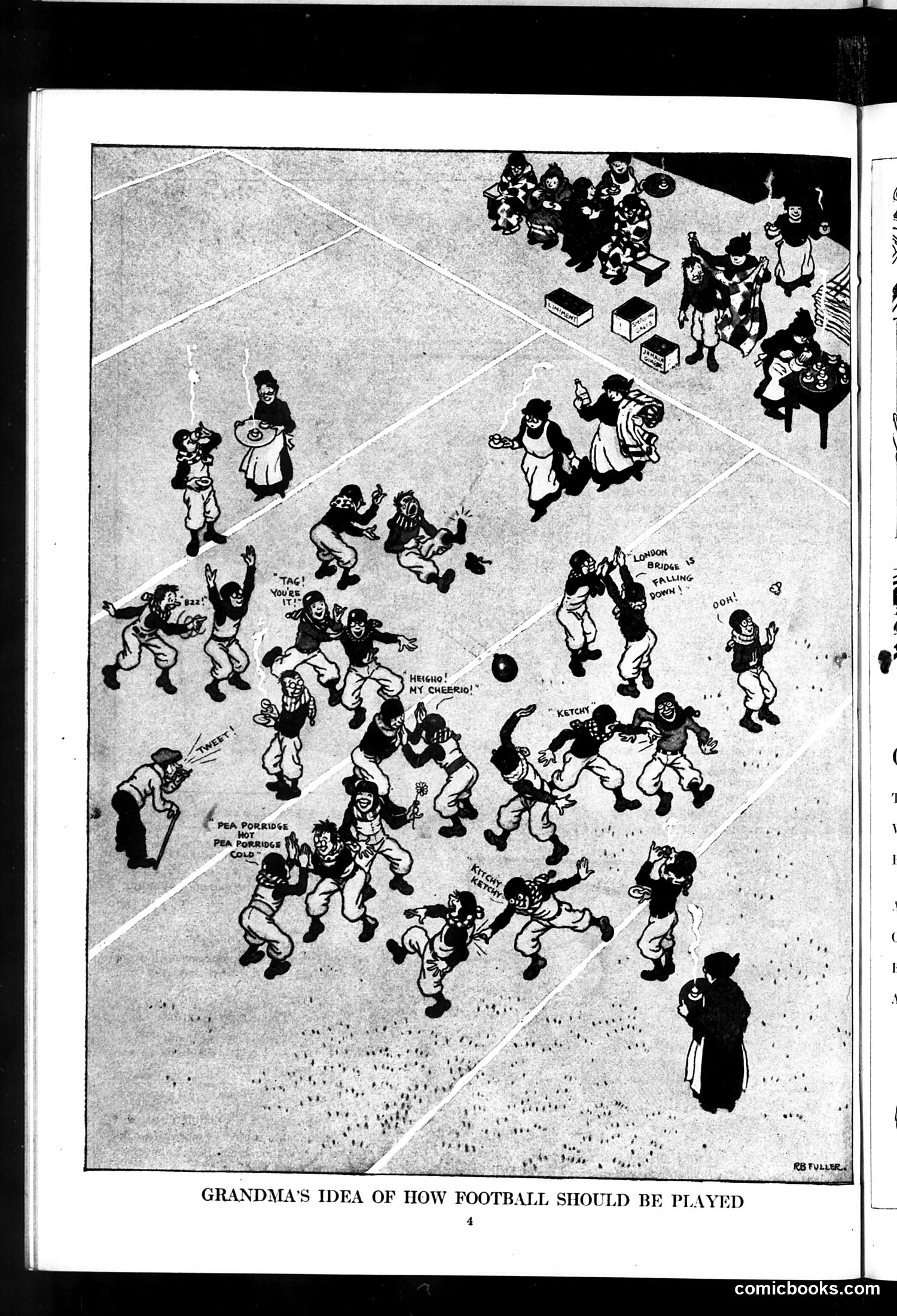
This is a humorous cartoon satirizing the generation gap regarding football. The image shows an elderly woman's reimagined version of the sport, depicted as a chaotic playground game rather than organized athletics. Instead of two teams competing strategically, the "game" features numerous children scattered across a field engaged in various activities—playing, running, falling, and generally playing tag or chase. The caption indicates this represents an older generation's (grandmother's) outdated or naive understanding of modern football rules and structure. The satire likely critiques how older people viewed contemporary sports (this appears to be early 20th century), suggesting they saw them as merely glorified children's games rather than the organized, rule-based competitions they had become. It's gentle mockery of generational misunderstanding.
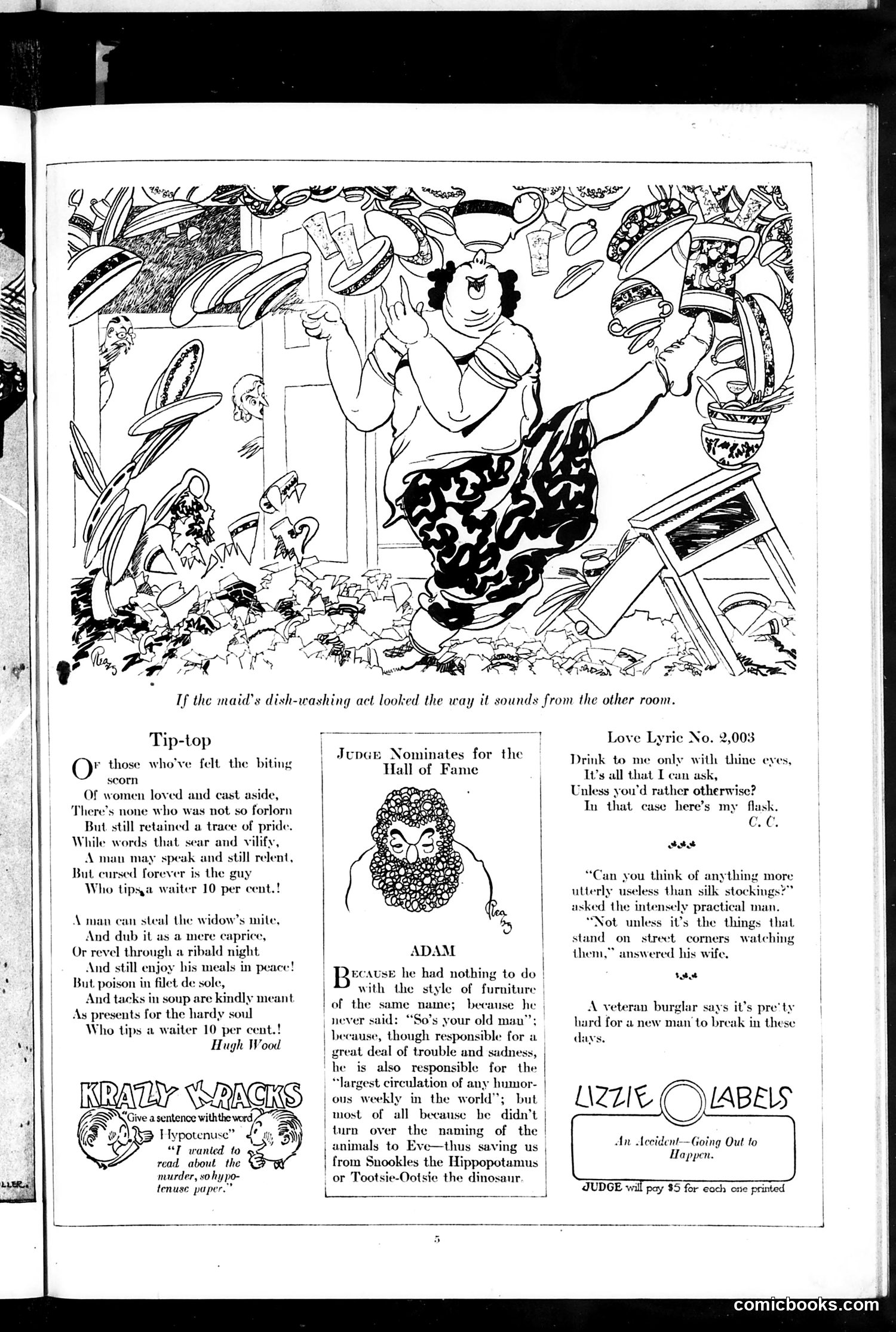
This page contains humor pieces and satirical content rather than political cartoons. The main illustration depicts a chaotic kitchen scene with a maid juggling flying food and dishes, captioned "If the maid's dish-washing act looked the way it sounds from the other room"—a visual joke about domestic noise. The text includes "Tip-top," a poem by Hugh Wood mocking men who complain about women, and a biographical entry for "Adam" that humorously blames him for humanity's problems, particularly for "turning over the naming of animals to Eve." Additional sections include "Krazy Kracks" (humorous one-liners), love lyrics, and "Lizzie Labels" (brief observations). These are primarily entertainment pieces rather than political satire, reflecting Judge's blend of domestic humor and social commentary typical of early 20th-century American magazines.
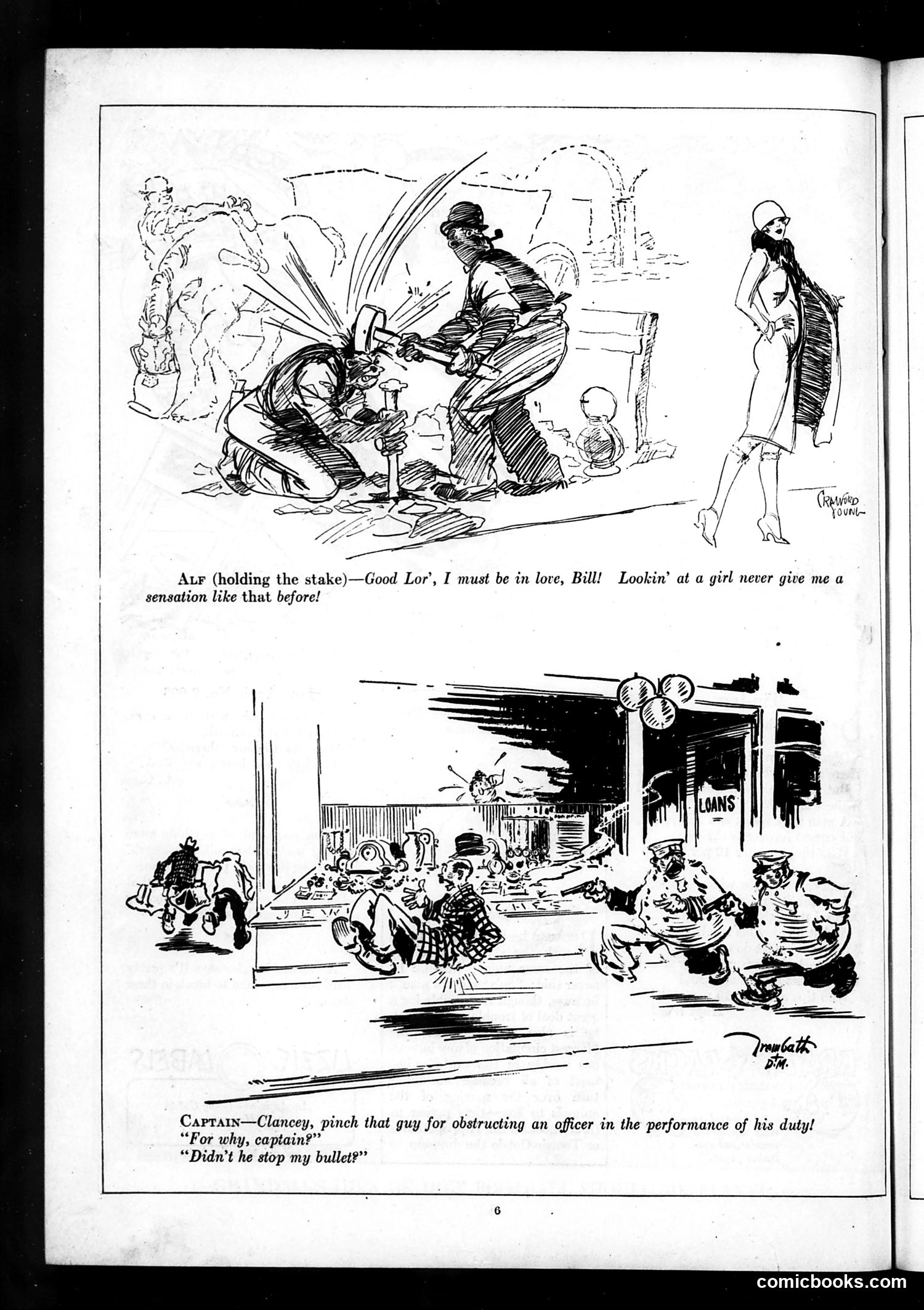
The page contains two separate cartoons satirizing military life and authority. The **top cartoon** depicts a soldier holding a stake while watching an attractive woman pass by. His companion Bill observes that looking at her excites him more than danger does—a joke about romantic distraction versus combat. The **bottom cartoon** shows a captain ordering an officer (Clancey) to arrest a man for "obstructing" his duty. The humor lies in the absurd logic: the captain wants to arrest someone because they happened to stop a bullet meant for him. The punchline plays on the double meaning of "stop"—the man physically blocked the bullet, thereby "obstructing" the captain's performance of duty by preventing his injury or death. Both cartoons mock military hierarchy and the arbitrary logic of commanding officers, typical of Judge magazine's satirical approach to institutional authority.
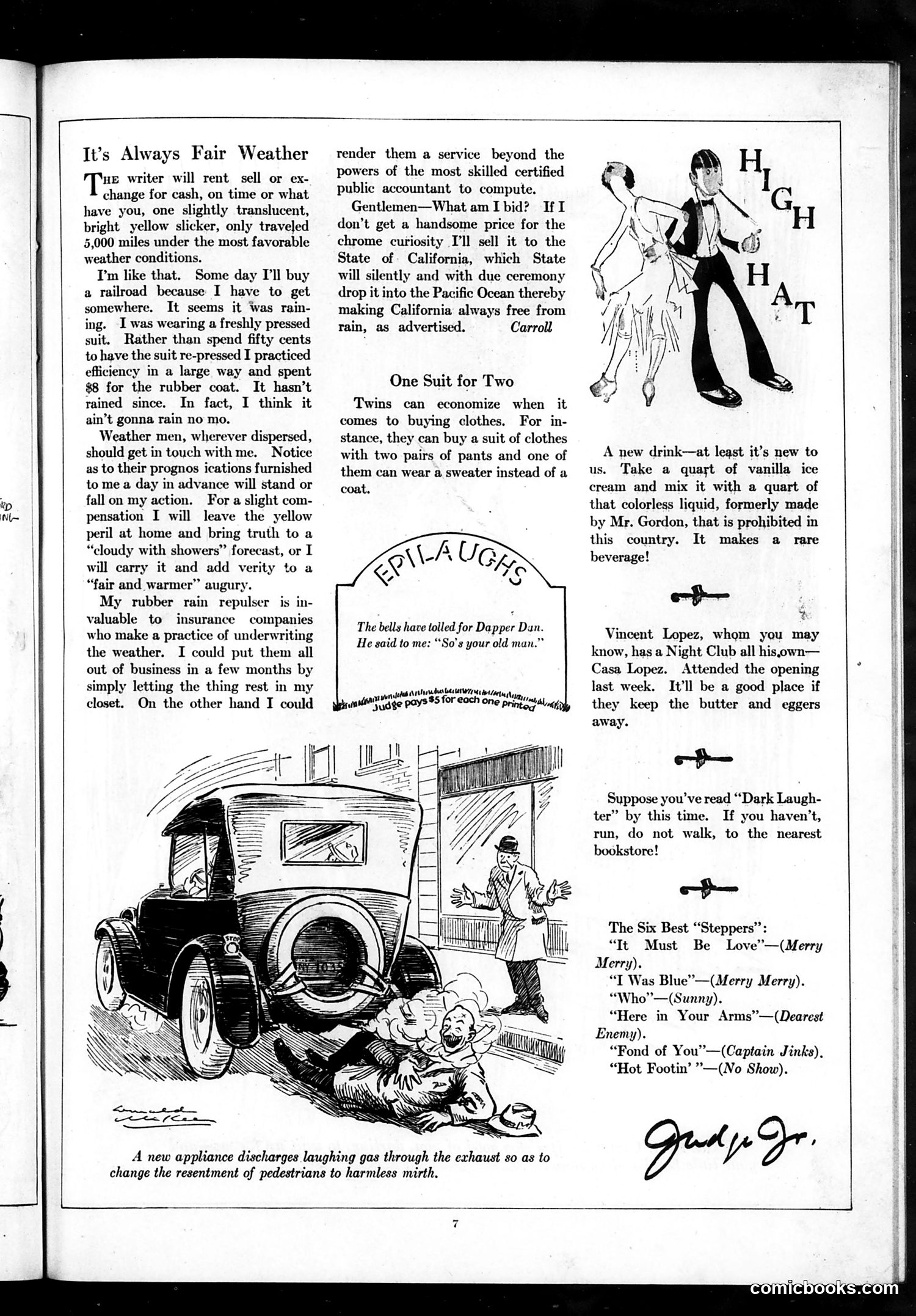
This page contains humorous satirical pieces typical of 1920s Judge magazine: **"It's Always Fair Weather"** mocks human irony and bad luck. The writer bought an expensive yellow rain slicker ($8), and it hasn't rained since. He sarcastically offers to rent it out to weather forecasters—suggesting their predictions are so unreliable that his slicker's mere presence determines whether rain occurs. The joke extends to offering the slicker to California to make it permanently rain-free (satirizing exaggerated state advertising claims). **The car cartoon** depicts a vehicle discharging "laughing gas" through its exhaust to transform pedestrians' anger into "harmless mirth"—dark satire about traffic dangers and pedestrian deaths during the automobile boom. **Remaining items** are brief gossip and product recommendations: a twins clothing economy tip, mention of Vincent Lopez's nightclub Casa Lopez, plugs for "Dark Laughter" (likely Sherwood Anderson's 1925 novel), and six popular songs from Broadway shows. The page reflects 1920s preoccupations: automobiles, Prohibition ("colorless liquid"), jazz-age entertainment, and consumer culture.
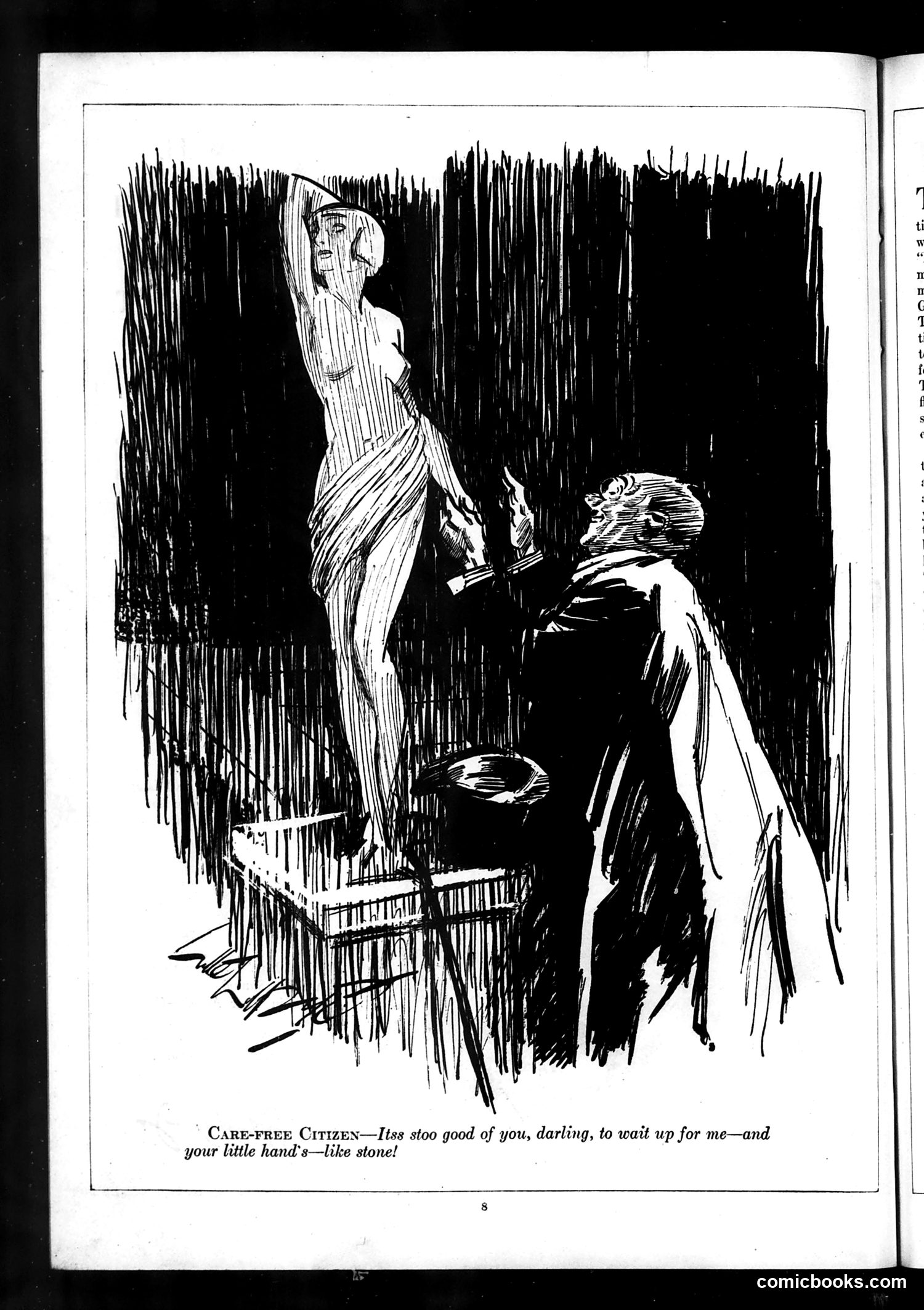
This single cartoon depicts a man in formal attire addressing a partially-draped female figure (likely a statue or artwork) in an intimate manner. The caption reads: "Care-free Citizen—Hss stoo good of you, darling, to wait up for me—and your little hand's—like stone!" The satire appears to mock a "care-free citizen"—possibly a wealthy or leisured man—who treats an inanimate object (statue/artwork) with romantic flattery as if it were a living woman. The joke plays on the phrase "like stone," highlighting the absurdity of his romantic gesture toward something literally made of stone. This likely satirizes either vanity, loneliness, or the superficiality of certain social types in the era. The specific political or social critique remains unclear without additional context from the magazine's publication date.
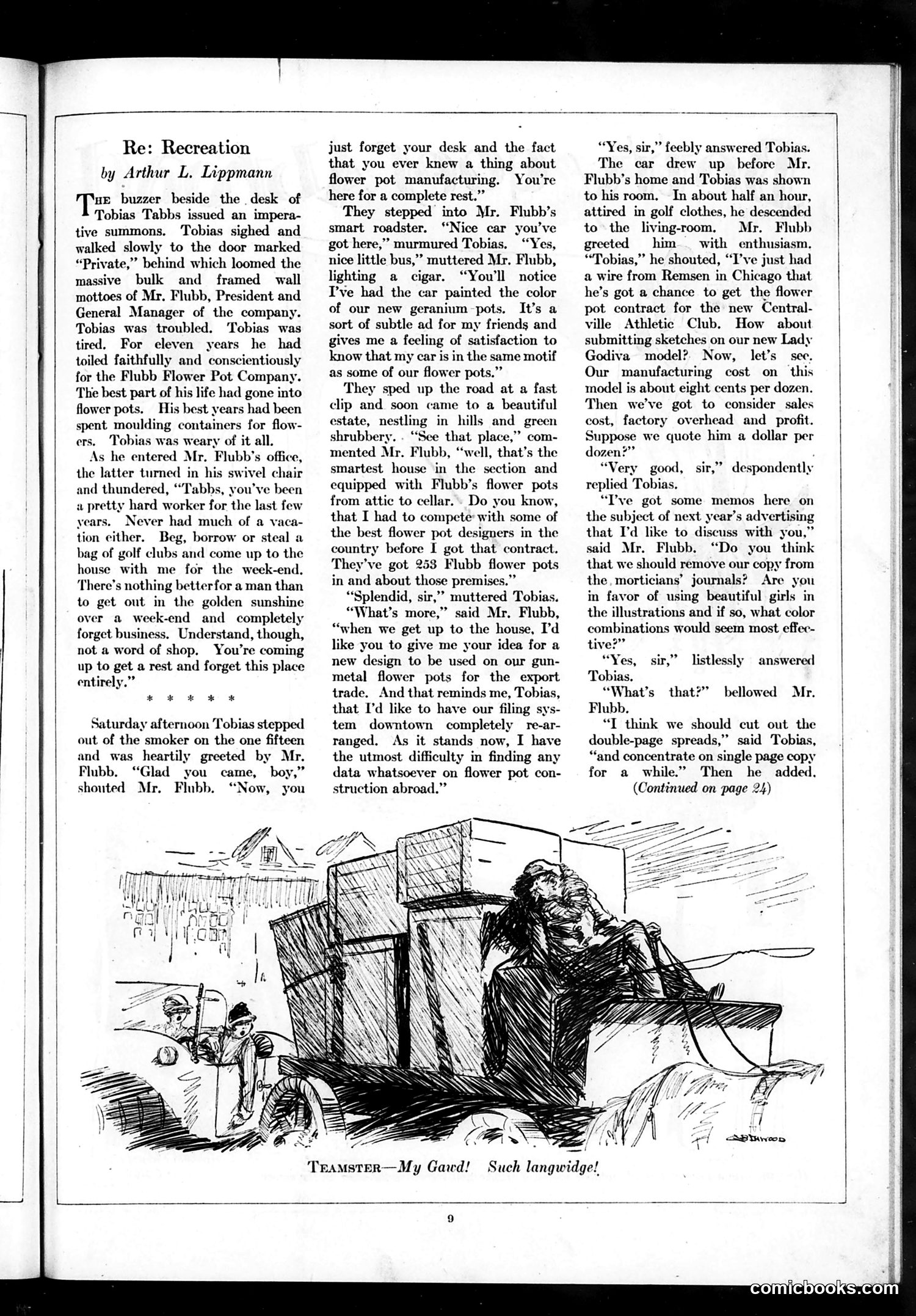
This satirical story mocks the hypocrisy of early 20th-century corporate paternalism. Mr. Flubb, a flower pot manufacturer, invites his exhausted employee Tobias to a weekend getaway, ostensibly for rest and relaxation—explicitly telling him not to discuss business. However, Flubb immediately violates this promise, using the trip to constantly discuss work: his geranium-pot-colored car, his 253 flower pots in a neighbor's house, requests for new designs, filing system reorganization, and a new contract opportunity. Even at his home, Flubb corners Tobias with memos about advertising strategy. The cartoon at bottom (showing a man crushed under boxes labeled "Teamster—My Gaurd! Such langwidge!") emphasizes the physical and mental burden of labor. The joke: bosses claimed to offer workers leisure and relief while actually using personal time to extract more unpaid labor. The "rest" was a ruse—Tobias remains enslaved to work even during vacation.
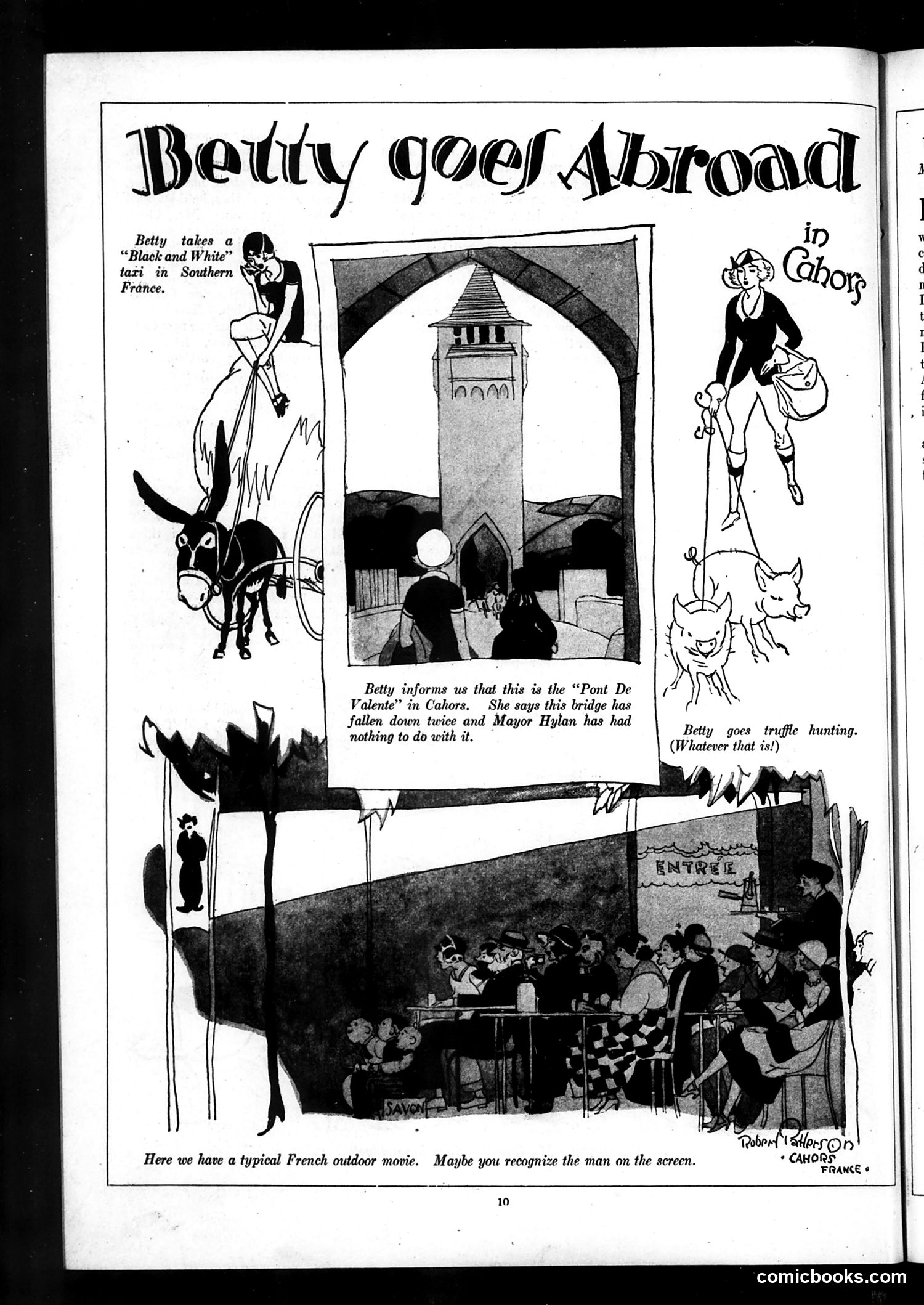
This is a multi-panel comic following "Betty" through France, using her experiences to satirize American politics and Franco-American differences. The central joke references **Mayor Hylan of New York**: Betty quips that a bridge in Cahors has "fallen down twice and Mayor Hylan has had nothing to do with it"—implying Hylan's incompetence with New York infrastructure. This is direct political satire targeting a contemporary municipal leader. The comic also mocks French culture stereotypes: outdoor cinema attendance, truffle hunting, and architectural decay. The phrase "Whatever that is!" regarding truffle hunting suggests American unfamiliarity with French customs. The overall premise satirizes American tourists abroad encountering "typical" French scenes while the humor depends on recognizing Hylan as a recognizable figure of civic mismanagement—a reference modern readers would need historical context to fully appreciate.
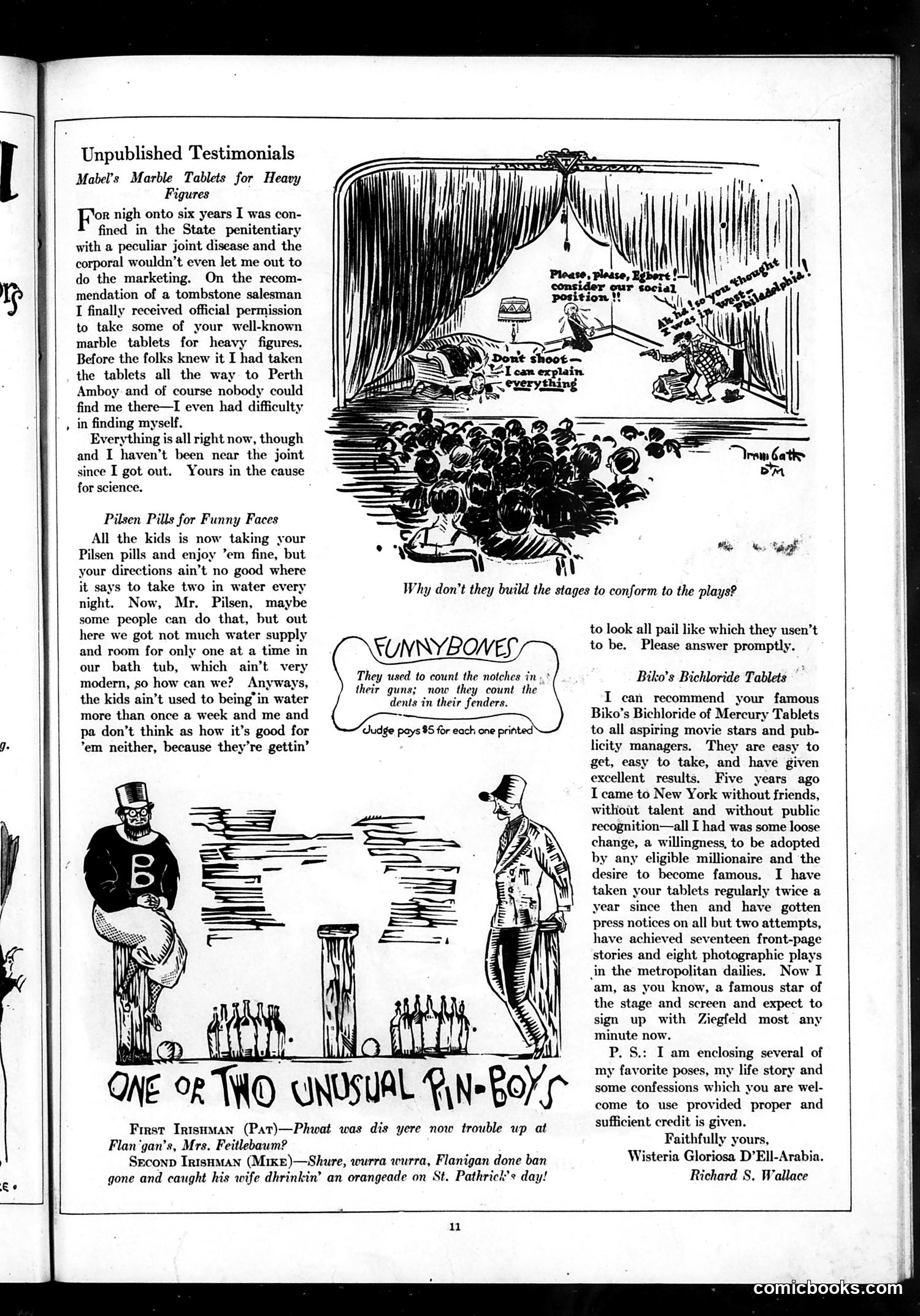
This page consists of mock testimonials and cartoons satirizing patent medicines and commercial products popular in early 20th-century America. **"Mabel's Marble Tablets for Heavy Figures"** and **"Pilsen Pills"** are fake advertisements mocking weight-loss and patent medicine claims through absurd testimonials. The first claims someone escaped prison using marble tablets; the second ridicules impossible dosing instructions. **"Funny Bones"** cartoon jokes about automobile culture: comparing how gunfighters once notched guns to count kills, now drivers count dents in car fenders—implying reckless driving. **The stage illustration** criticizes theatrical production design for not matching script demands. **"One or Two Unusual Pin-Boys"** features Irish stereotypes (indicated by dialect and names like Pat and Mike) joking about catching someone drinking orangeade on St. Patrick's Day—implying Catholics should drink alcohol on that holiday. **"Biko's Bichloride Tablets"** parodies Hollywood ambition, with a testimonial from someone claiming the product helped her become a famous actress through shameless self-promotion. All content lampoons American consumer culture and advertising excess.
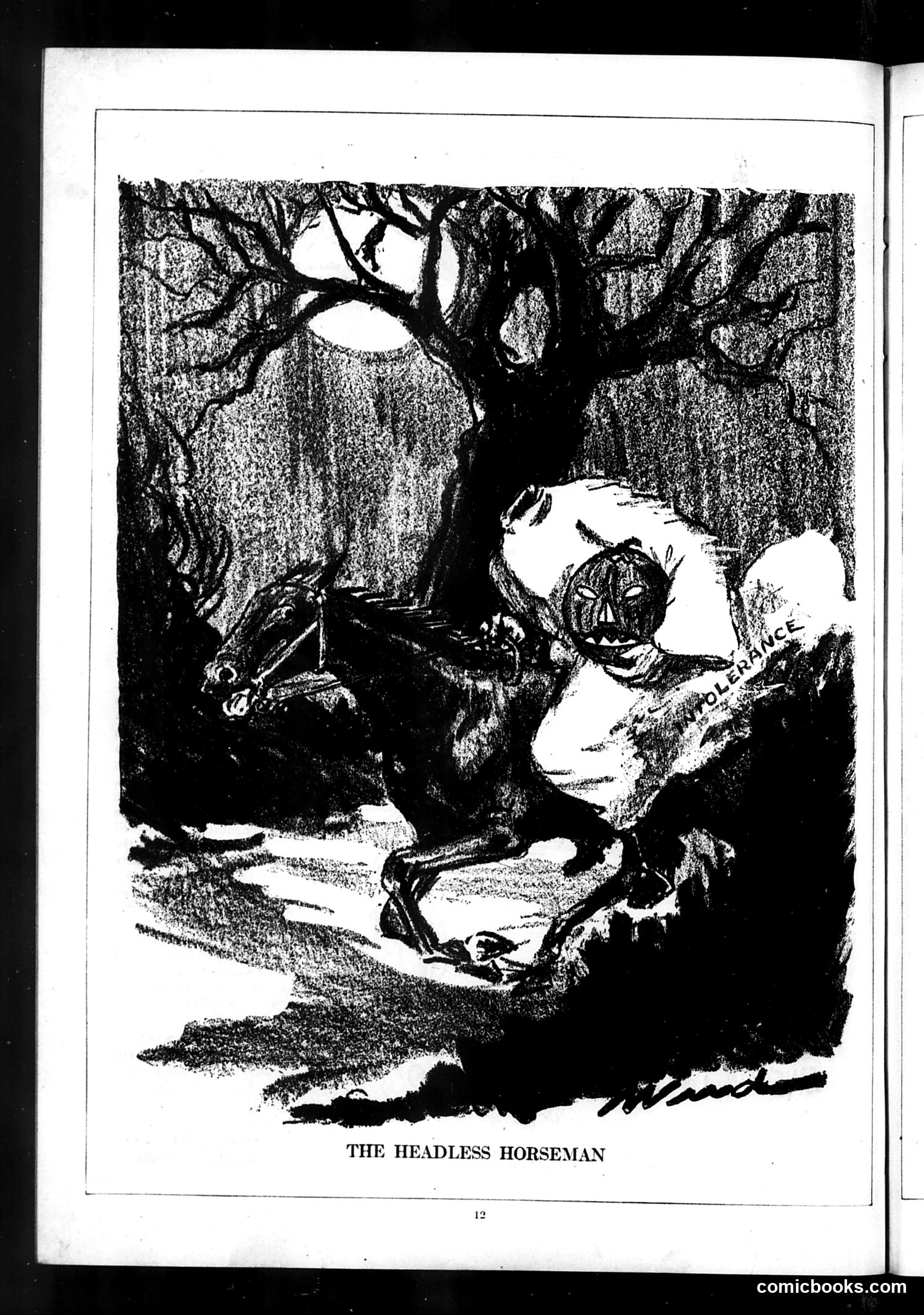
This illustration depicts the famous literary figure from Washington Irving's "The Legend of Sleepy Hollow" (1819)—the Headless Horseman, shown as a mounted, decapitated figure in a dark forest setting. The image is a dramatic rendering of this iconic American folklore character, who famously pursues Ichabod Crane through the story. The illustration appears to be a straightforward literary adaptation rather than political satire. It emphasizes the supernatural horror element: the horseman on his black steed, his missing head replaced by darkness, with gnarled trees looming in the background. This seems designed to evoke gothic atmosphere and literary nostalgia rather than comment on contemporary political events, making it typical of Judge magazine's occasional ventures into classic American literature illustration.
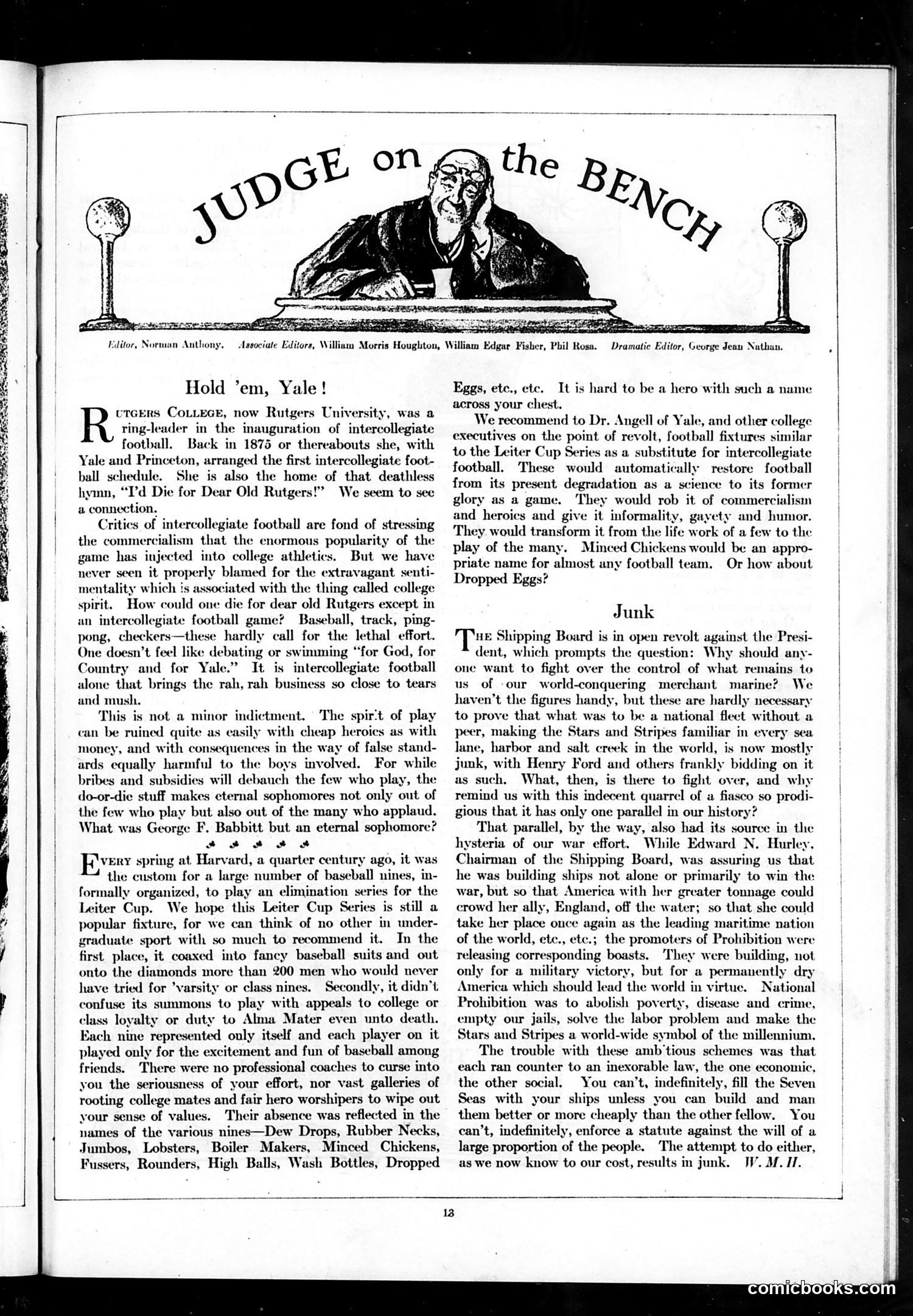
This page critiques **excessive sentimentality in American college football**. The editorial attacks how intercollegiate football has created dangerous "college spirit"—the willingness to die for one's school—rather than fostering genuine play. It argues this artificial heroics harms young men by turning them into permanent adolescents, citing George Babbitt (Sinclair Lewis's conformist protagonist) as the result. The piece proposes **Harvard's historical Leiter Cup Series as an alternative**: informal baseball tournaments with playfully irreverent team names (Dew Drops, Minced Chickens, Dropped Eggs) that prioritized fun over institutional loyalty and commercial spectacle. The satire suggests restoring football's joy by stripping away the mythology—renaming teams after breakfast foods would make heroic posturing impossible. A brief note about **Shipping Board revolt** against the President appears separately, likely referring to contemporary maritime policy disputes.
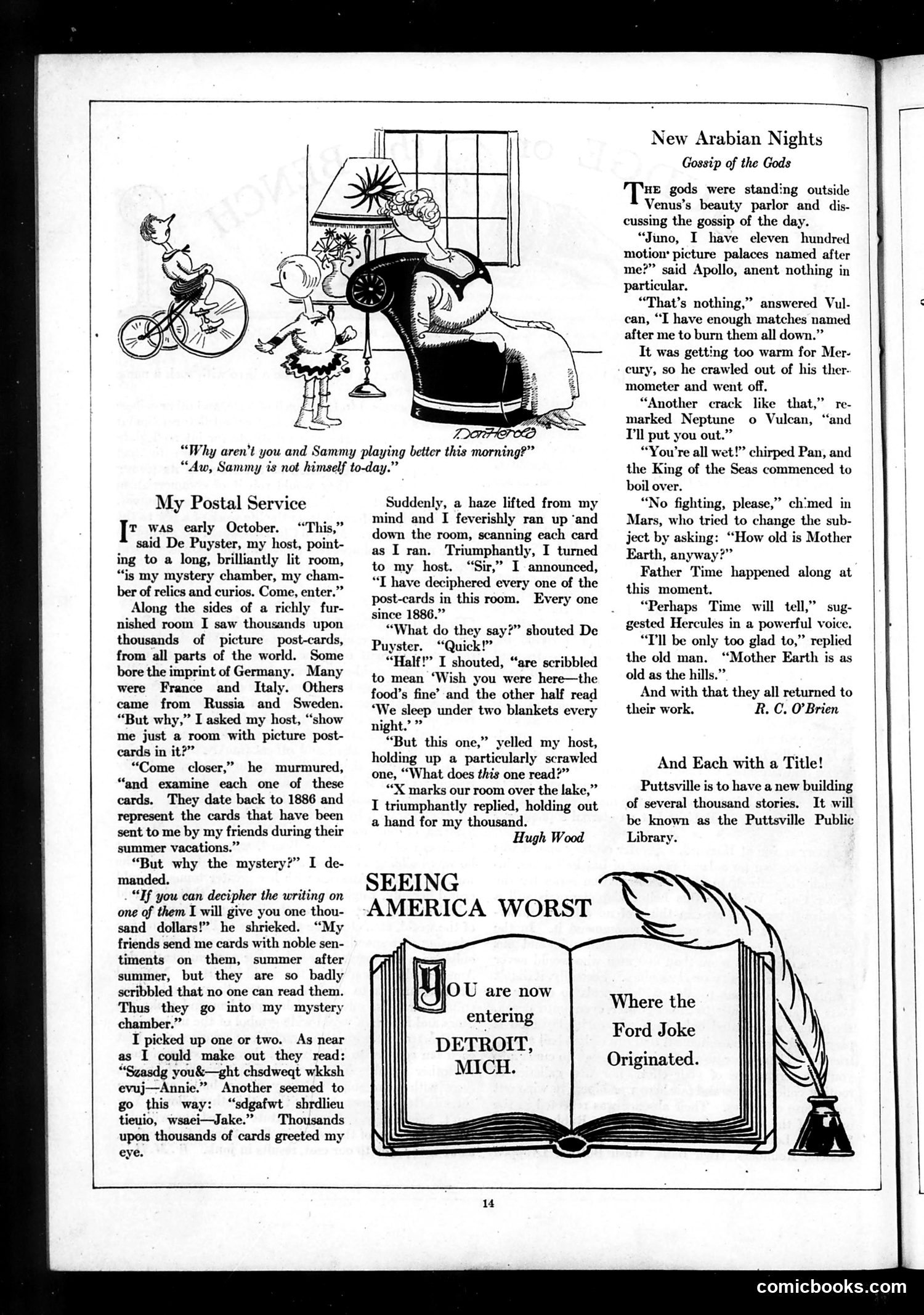
This page contains three satirical pieces typical of early 20th-century humor: **"My Postal Service"**: A humorous story mocking illegible handwriting on postcards. The host collects thousands of vacation postcards from friends since 1886, but their writing is so poor they're unreadable—the joke being that all postcards contain identical generic messages ("wish you were here," "sleeping under blankets"). This satirizes both tourism culture and the universal banality of vacation correspondence. **"Gossip of the Gods"**: A mythological comedy where classical gods boast about modern things named after them (Apollo's movie theaters, Vulcan's matches). The humor derives from the absurdity of ancient deities discussing contemporary commercial products and pop culture, poking fun at both advertising excess and how thoroughly commerce has colonized culture. **"Seeing America Worst"**: A brief joke about Detroit being "where the Ford Joke originated"—satirizing the Model T and Henry Ford's dominance in Detroit manufacturing and popular culture of the era.
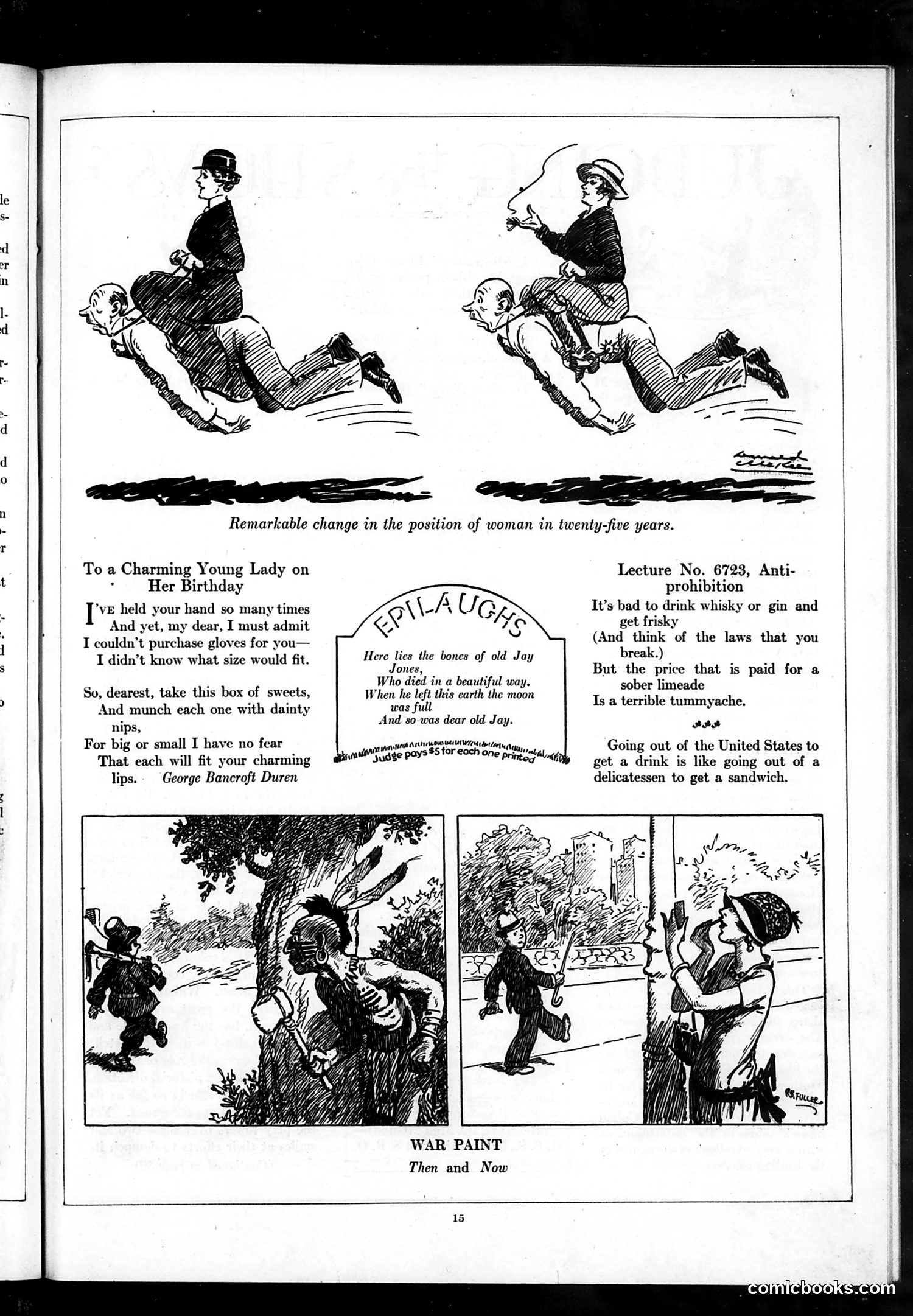
This page satirizes social changes in women's roles and Prohibition-era America (likely 1920s Judge magazine). **Top cartoon**: "Remarkable change in the position of woman in twenty-five years" shows a woman literally riding atop a man in both images, but with a subtle difference—suggesting women's increased social dominance or independence over 25 years. **Birthday poem**: A man laments he couldn't afford gloves for a woman years ago, now giving her sweets instead—satirizing changed courtship economics. **Anti-Prohibition lecture**: Mocks Prohibition enforcement by joking that leaving America for alcohol is like traveling abroad just to buy a sandwich—absurdly inefficient. **"War Paint" cartoons**: Compare how Native Americans and modern women painted themselves "Then and Now," likely satirizing women's increased use of cosmetics as a form of "war paint" or social warfare. Overall, the page reflects Judge's satirical tone toward women's changing social status, Prohibition's unpopularity, and modernizing American culture in the 1920s.
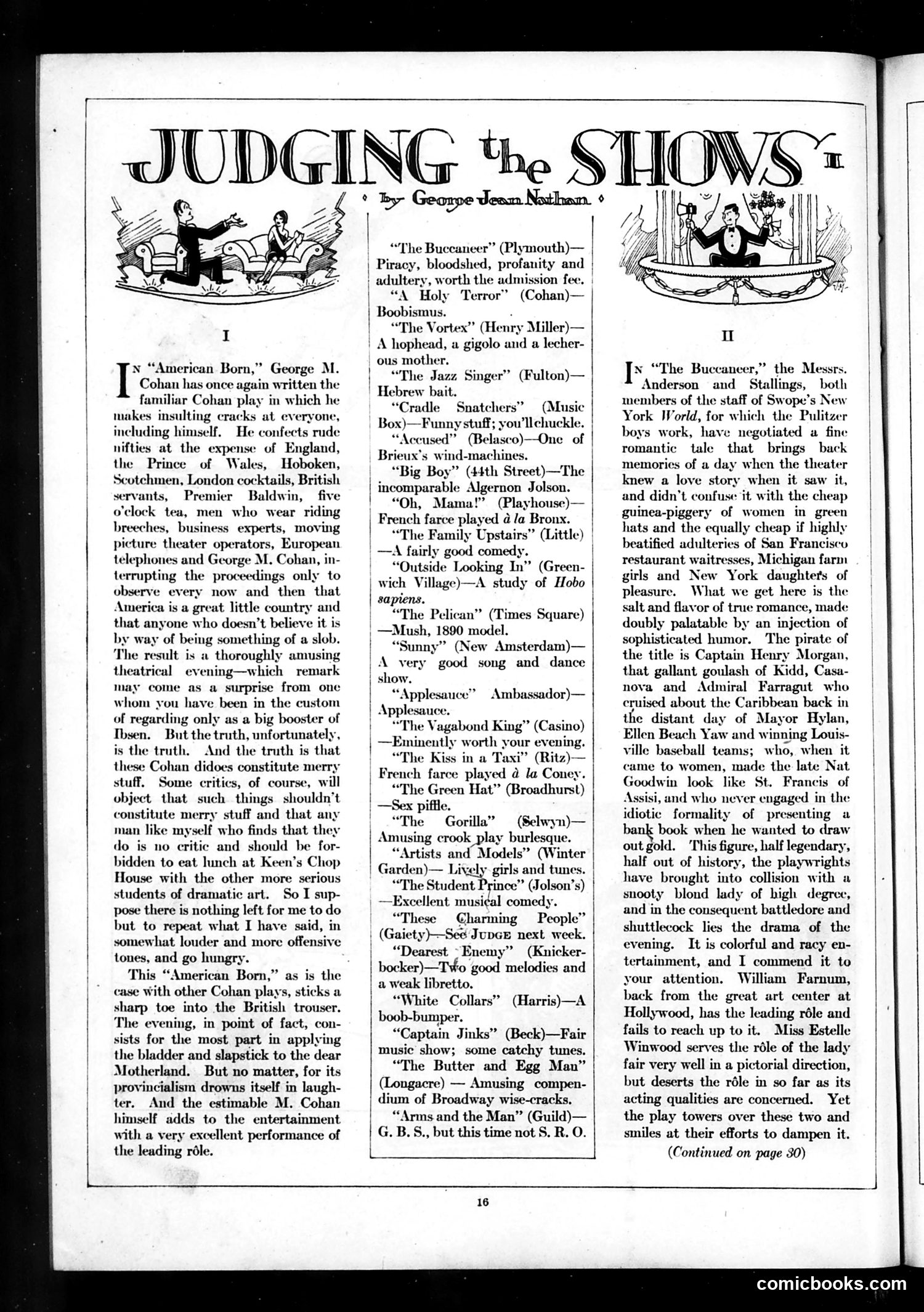
This is a theater review column by George Jean Nathan critiquing Broadway productions. The page contains two sections: **Section I** reviews George M. Cohan's "American Born," praising it as genuinely entertaining despite Cohan's reputation as a serious dramatist. Nathan defends enjoying comedic "merry stuff" while poking fun at critics who would disapprove. **Section II** is a rapid-fire listing of current Broadway shows with Nathan's pithy judgments—some complimentary ("A very good song and dance show"), others derisive ("Boobismus," "Mush, 1890 model"). He uses brief, often crude descriptors and ethnic stereotyping typical of 1920s criticism. The reviews praise "The Buccaneer" as a refreshing romantic play amid theater's current triviality, and highlight Al Jolson's performance in "Big Boy." The column exemplifies early 20th-century theater criticism's caustic wit and casual prejudice.
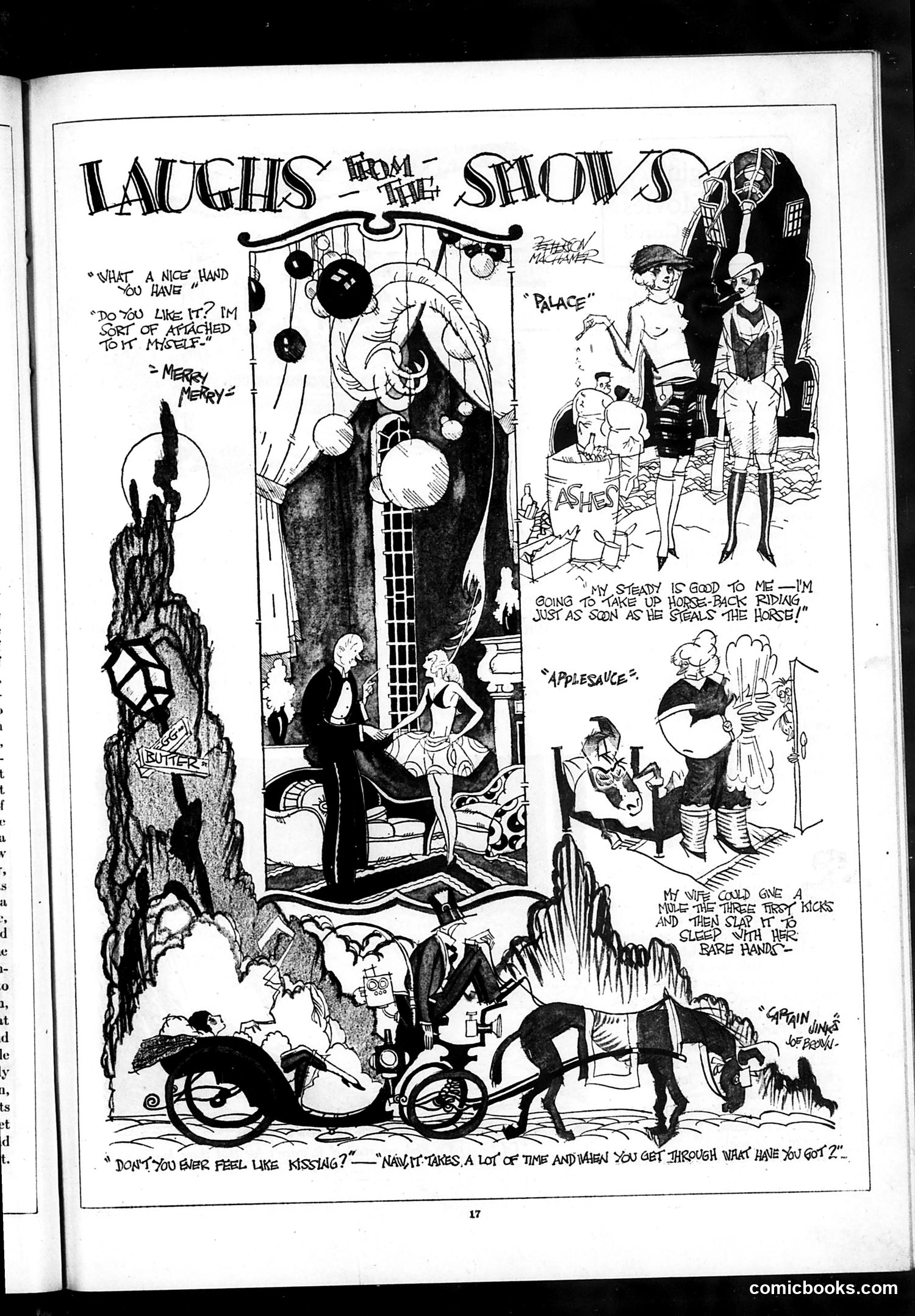
This page collects satirical vignettes lampooning theatrical and social scenarios of the Jazz Age era (likely 1920s). The sketches mock romantic encounters and courtship rituals: **"What a Nice Wand"** depicts a magician's seduction line—the "wand" is a transparent pickup attempt, with the woman feigning attachment to deflect him. **"Palace"** shows a woman rejecting a suitor's advances, claiming she'll take up horseback riding once he "steals the horse"—mocking his empty promises and her impatience. **"Don't You Ever Feel Like Kissing?"** presents a woman dismissing romance as time-consuming, suggesting she hasn't "gotten through" her previous romantic entanglements yet. **"Applesauce"** (slang for flattery) depicts a woman unimpressed by compliments about her sleepy demeanor and bare hands. The cartoons satirize the era's dating conventions, female independence, and male courtship tactics—poking fun at both flirtation failures and women's growing assertiveness in refusing unwanted advances.
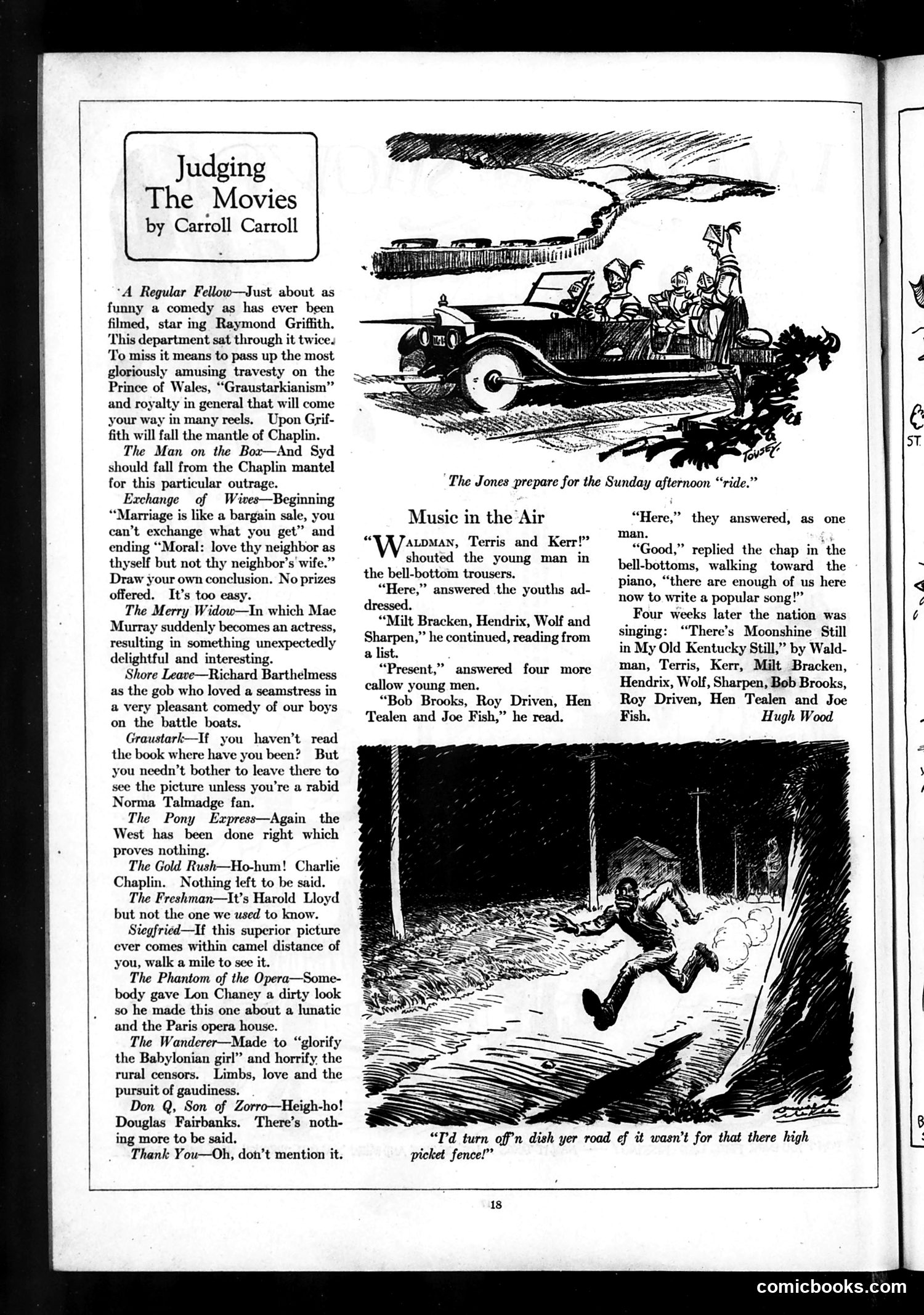
This page contains two distinct sections: **Left column:** Carroll Carroll's film review column critiquing silent movies from the mid-1920s. The reviews are brief, sarcastic assessments of popular films and stars (Chaplin, Harold Lloyd, Douglas Fairbanks, Lon Chaney). The satire targets both the films themselves and contemporary celebrity culture—he mocks Mae Murray's sudden "discovery" as an actress and dismisses several pictures as mediocre. **Right section:** Two unrelated items—an illustrated story titled "Music in the Air" about young men collaboratively writing a popular song (appears to reference actual songwriters of the era), and below it, a single-panel cartoon showing two figures on a rural road with a high picket fence, with the caption suggesting someone won't leave the road because of the fence. This appears to be rural/folksy humor typical of Judge's style. The page represents typical 1920s satirical magazine content mixing entertainment criticism with light humor.
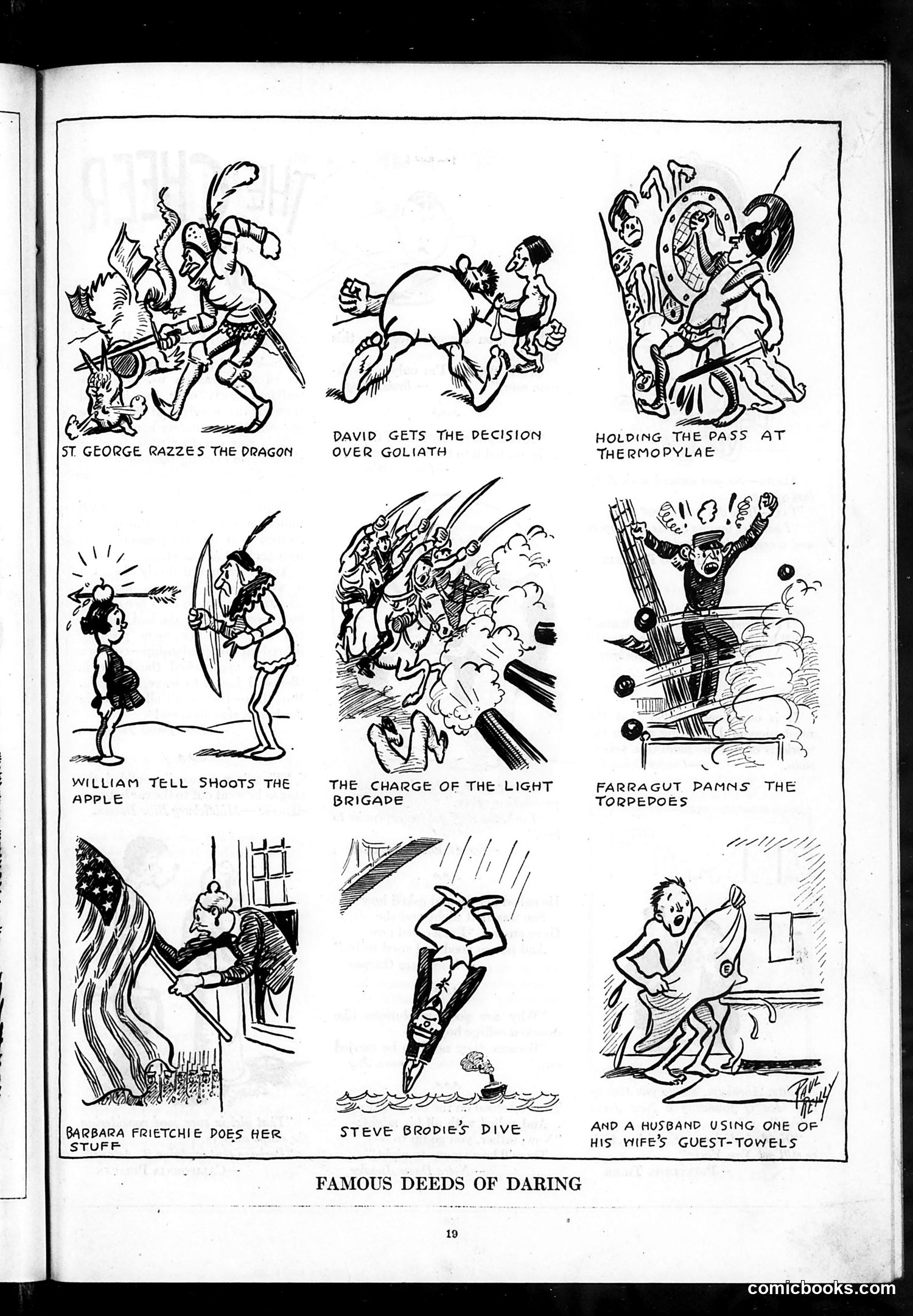
This Judge magazine page satirizes famous historical "daring deeds" by pairing them with contemporary mundane situations. The top panels reference actual historical events: St. George slaying the dragon, David defeating Goliath, and holding a military pass. Middle panels show William Tell's apple shot, the Charge of the Light Brigade, and Farragut panning torpedoes—all genuine historical moments. However, the bottom row shifts to everyday domestic scenarios treated with mock-heroic gravity: Barbara Fritchie's patriotic gesture becomes a woman doing housework, Steve Brodies's famous bridge dive becomes an actual dive, and the final panel depicts a husband using his wife's guest towels—presented as equivalent "daring deeds." The humor derives from elevating trivial domestic conflicts to the status of legendary historical exploits, satirizing both marital tension and the American tendency to mythologize historical events.
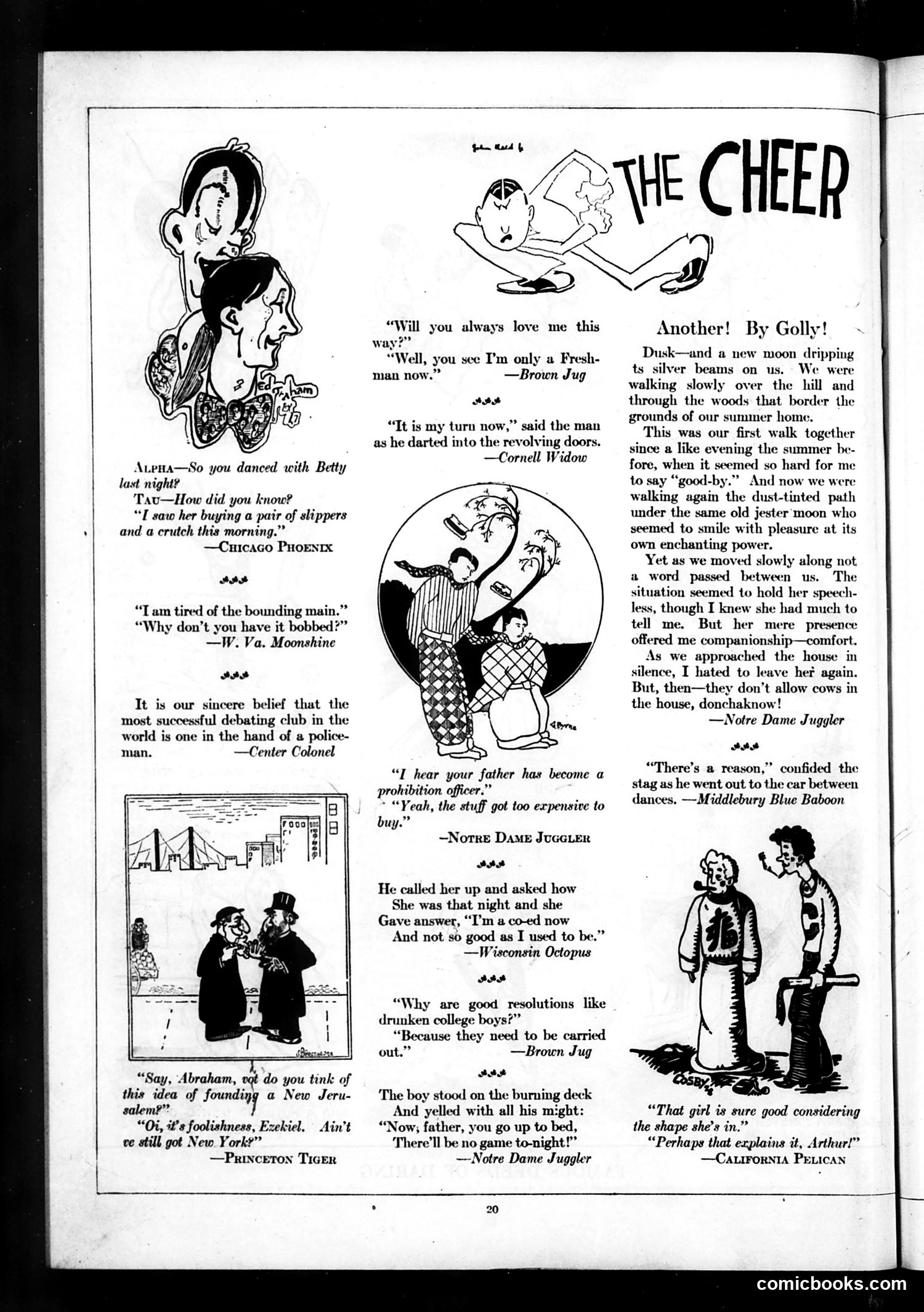
This page collects humorous quips and satirical cartoons typical of 1920s college humor magazines. The jokes target: **College Life**: Frequent references to freshman inexperience, prohibition-era drinking culture, and student romantic entanglements. One quip mocks a boy claiming he'll always love his girlfriend "this way"—but he's only a freshman, implying his feelings are transient. **Prohibition Era**: A joke about a father becoming a prohibition officer, with the son noting "the stuff got too expensive to buy"—satirizing how enforcement created economic hardship and continued alcohol consumption. **Gender/Courting**: Multiple jokes about dating mishaps (the girl needing slippers AND a crutch after dancing suggests injury from vigorous dancing; the punchline about a cow not being allowed in the house suggests the narrator's romantic interest is actually cattle). **Authority Figures**: A cartoon depicts two figures (labeled Abraham and Ezekiel, likely Jewish stereotypes common to era) discussing founding "New Jerusalem," mocking immigrant aspirations. The overall tone is lighthearted student humor, relying on period-specific cultural references now requiring historical context.
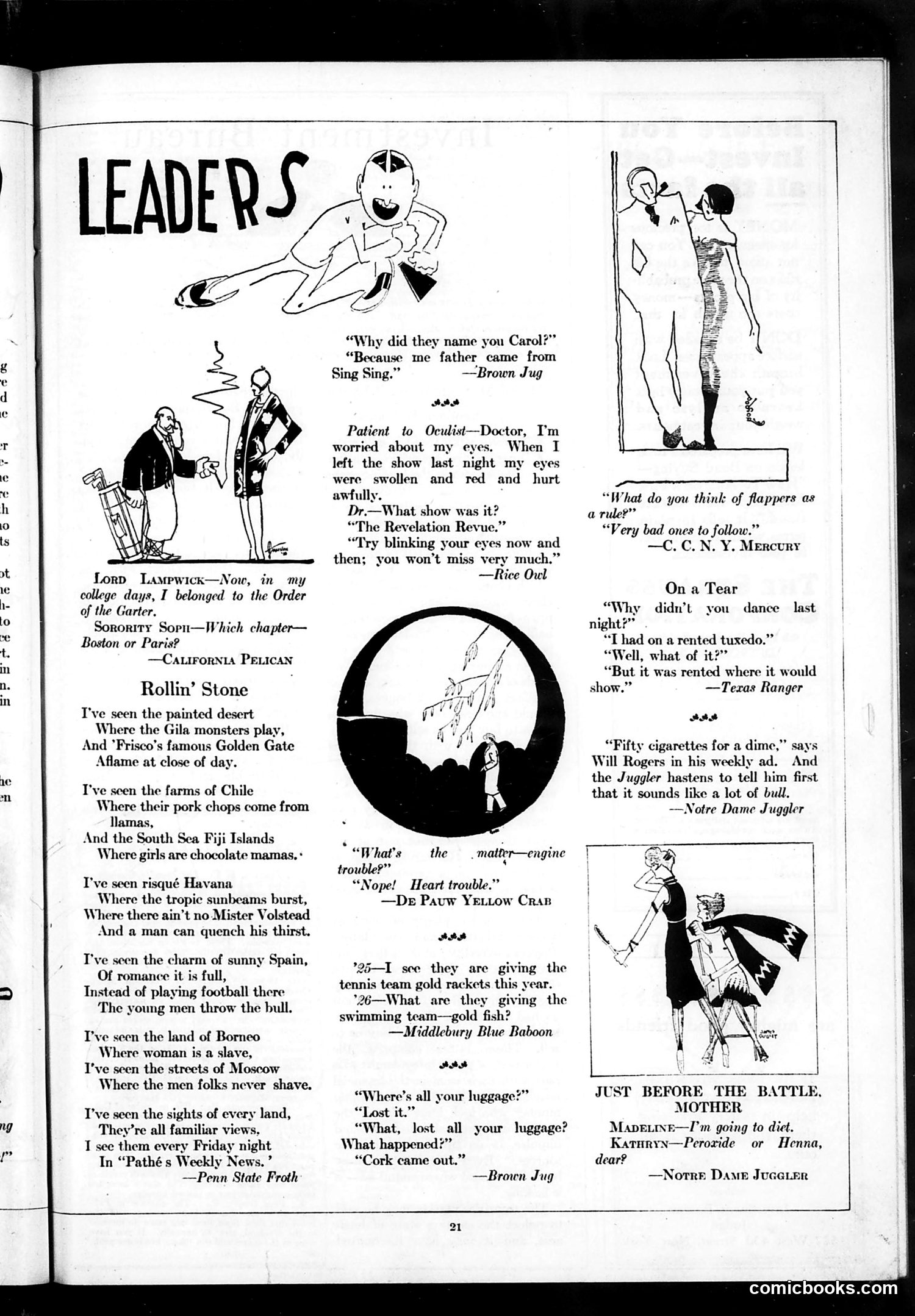
This page collects humorous quips and cartoons from college humor magazines of the 1920s Prohibition era. **Key jokes and references:** - **"Rollin' Stone"** poem mocks tourists who see exotic destinations only through newsreels ("Pathé's Weekly News"), not in person - **Volstead reference**: The poem mentions "Mister Volstead"—the Prohibition enforcement act—joking that Havana had legal alcohol America lacked - **Flapper jokes**: References to rented tuxedos, dancing, and women's fashion (peroxide vs. henna hair coloring) reflect 1920s youth culture anxieties - **College humor**: Multiple attributions to university publications (Penn State, Rice, Notre Dame) indicate this compiled collegiate wit - **"Sing Sing" joke**: Names the infamous New York prison, joking about criminal heritage - **Will Rogers reference**: Contemporary humorist's cigarette ad gets mocked as exaggerated The cartoons show period dress and social scenarios (dancing, theater, military themes). Overall, the page reflects 1920s student irreverence toward authority, travel, Prohibition, and modern social conventions.
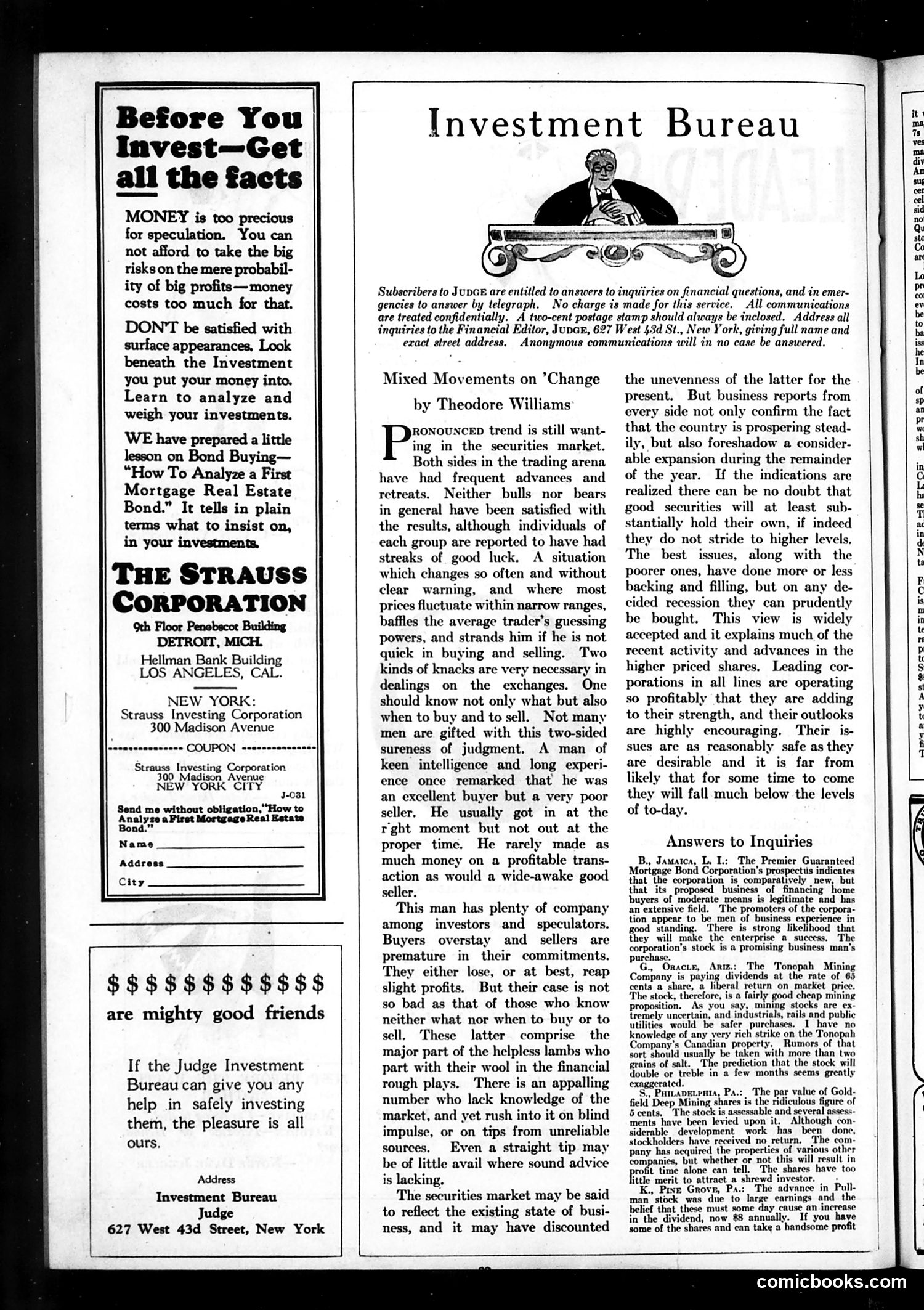
This page combines **financial advice advertising** with an **investment column**, reflecting early 20th-century concerns about stock market speculation. **The Advertisements:** The Strauss Corporation and Judge's own Investment Bureau urge readers to research investments carefully before committing money. The repeated warning "DON'T be satisfied with surface appearances" reflects anxiety about market manipulation and fraud—common during this era of loose securities regulation. **The Column:** Theodore Williams's "Mixed Movements on 'Change" discusses stock market volatility. He describes two investor types: those skilled at timing purchases AND sales (rare), and the "helpless lambs" who blindly follow tips and lack market knowledge, losing their "wool" (money) to financial operators. **The Satire:** The implicit criticism targets both amateur speculators who gamble recklessly and the broader financial system that exploits them. The irony is that Judge itself, while warning against speculation, profits by selling investment guidance—a self-interested stance typical of period financial journalism. The dollar signs at page bottom reinforce that money is the true subject throughout.
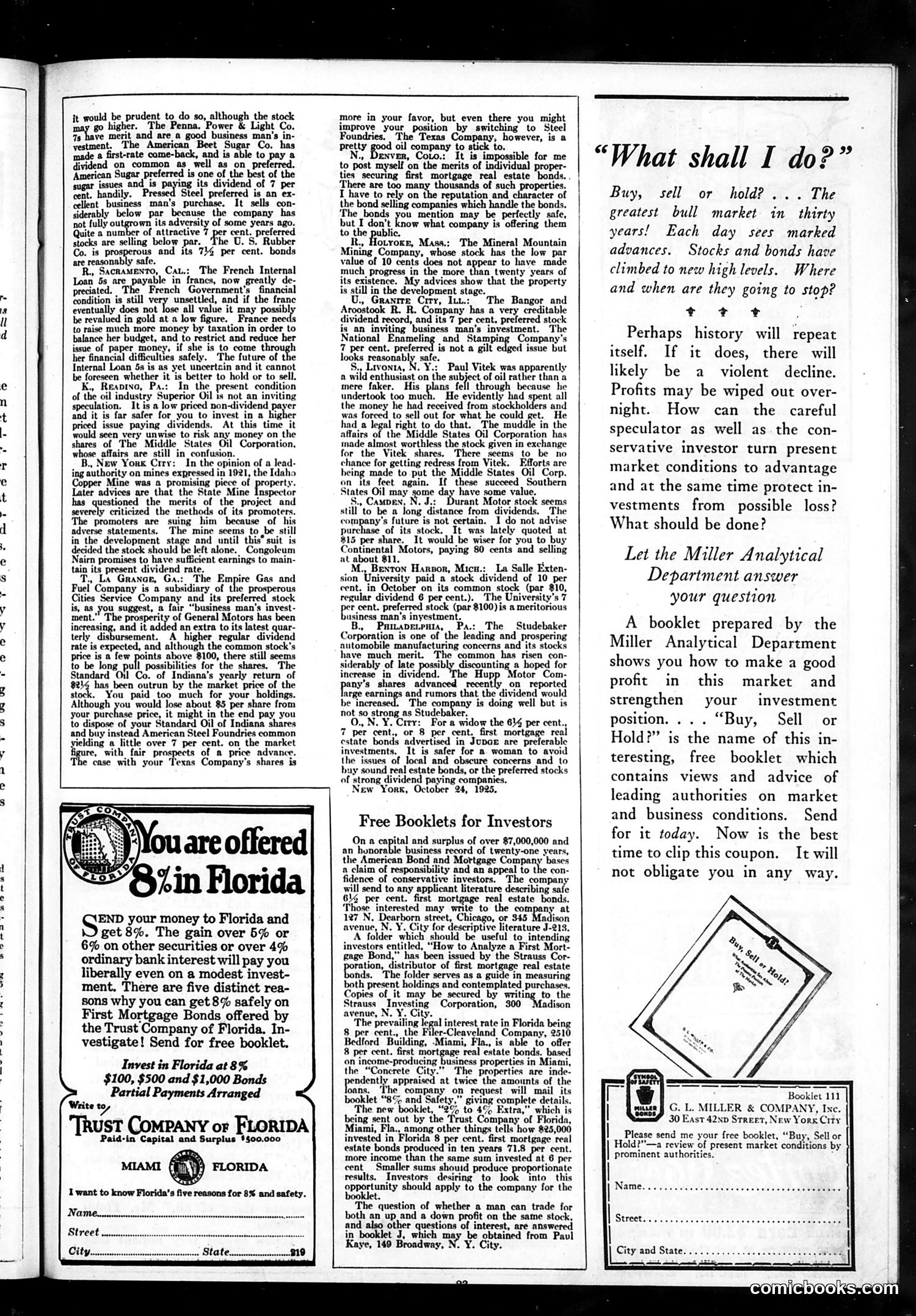
This page is **primarily investment advice**, not satire. It's from *Judge* magazine (October 24, 1925), a period when such magazines mixed humor with serious financial content. The main section features a financial advice column answering readers' questions about stock and bond investments—whether to buy Pennsylvania Power & Light, American Beet Sugar, French Internal Loans, and various oil and motor company shares. The advice is conservative, cautious about speculative holdings. The **left advertisement** promotes Florida real estate bonds at 8% returns—part of the 1920s Florida land boom that would spectacularly collapse. The **right panel** advertises C.L. Miller & Company's free booklet "*Buy, Sell or Hold?*" for investors. There is **no visible political cartoon** on this page. The content reflects 1920s economic optimism and the era's investment culture before the 1929 crash. The satire, if present, is subtle—possibly in the implicit warning that such seemingly safe investments could fail.
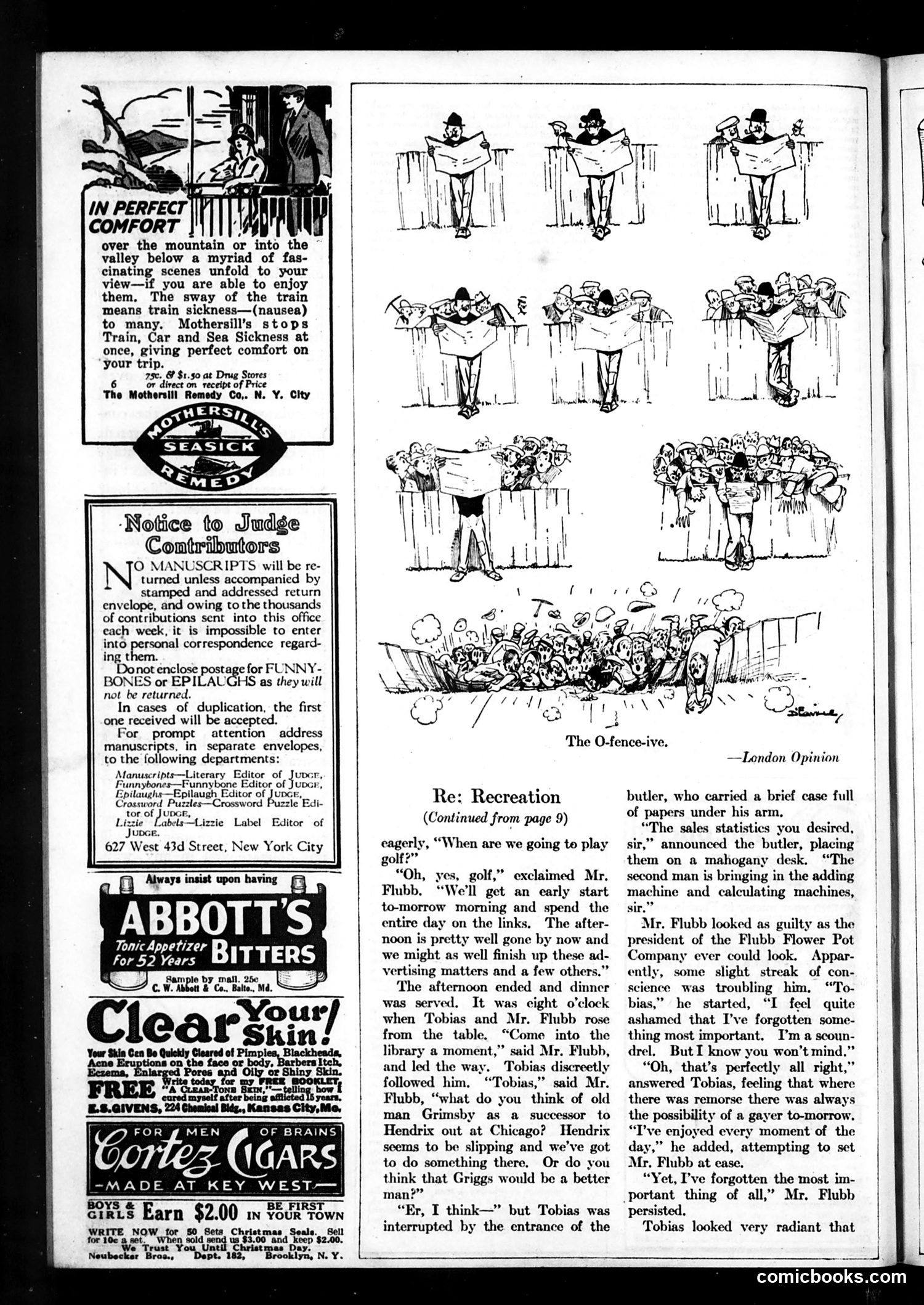
This page contains a London Opinion cartoon satirizing modern work culture and business priorities. The sequential cartoon shows a businessman (Mr. Flubb) repeatedly opening a newspaper to read while seated, with his expanding entourage of colleagues and staff crowding around him—visually representing how work obligations proliferate and consume leisure time. The accompanying story "Re: Recreation" reinforces the satire: Mr. Flubb promises his visitor Tobias a day of golf, but repeatedly postpones it with business matters. Even at dinner's end, instead of relaxation, Mr. Flubb brings out sales statistics and adding machines. The humor targets the inability of wealthy businessmen to actually enjoy recreation—they remain enslaved to commercial concerns despite having the leisure time and money to escape them. The cartoon's title "O-fence-ive" puns on "offense," suggesting business creates a defensive barrier against genuine rest.
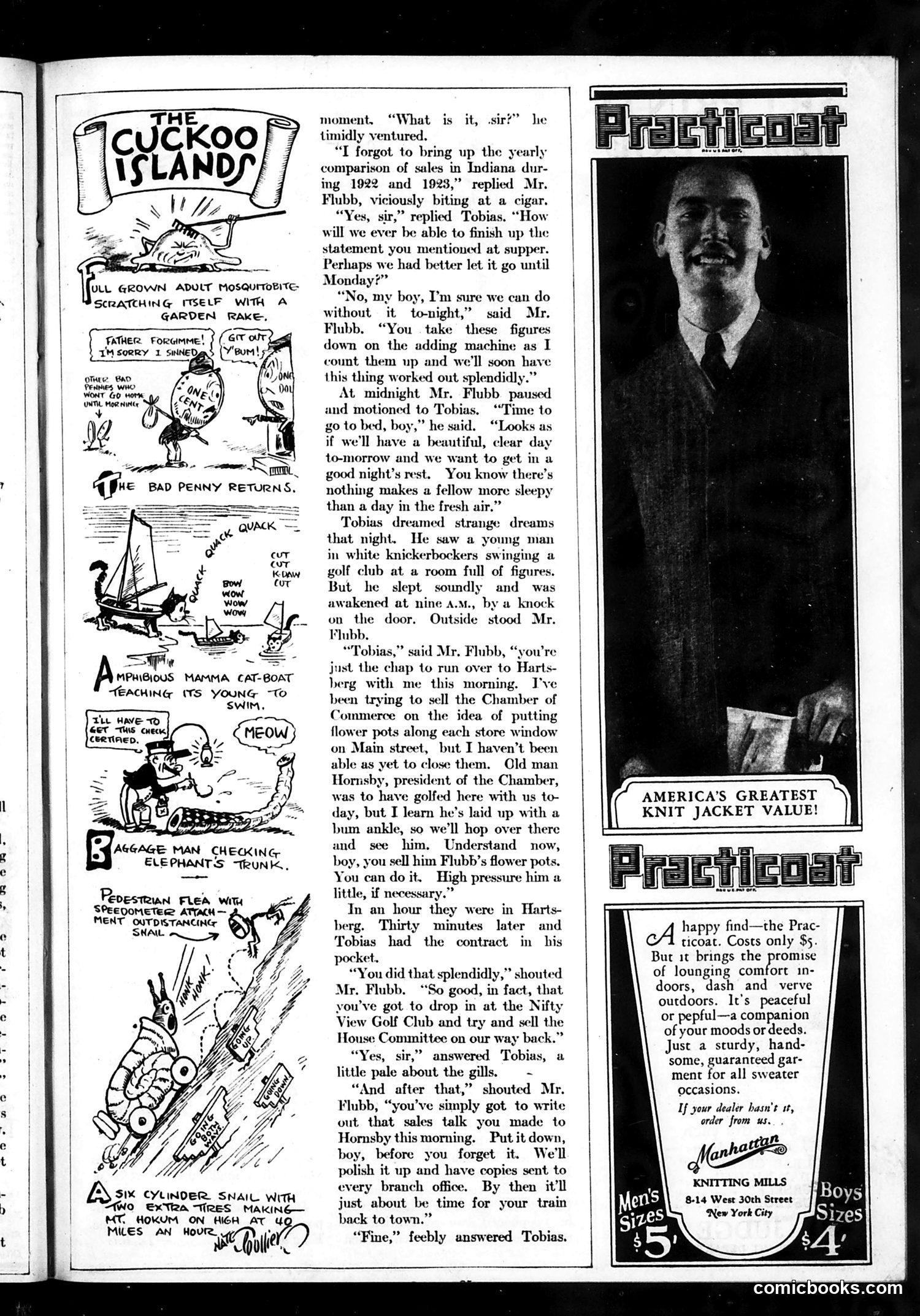
This page contains a whimsical comic strip titled "The Cuckoo Islands" featuring absurdist humor typical of early-20th-century satirical magazines. The strip depicts increasingly ridiculous scenarios: a mosquito scratching itself with a rake, a cat-boat teaching its young to swim, a baggage man checking an elephant's trunk, and a snail with oversized tires traveling at high speed. Below this is a longer narrative story about Mr. Flubb and his employee Tobias. The story satirizes **aggressive workplace sales culture and relentless capitalism**: Mr. Flubb forces Tobias to work late on sales figures, then immediately assigns him to sell flower pots to a sick chamber president, then to sell at a golf club, then to document the sales pitch—all before Tobias must catch his train home. The joke is the exhausting, exploitative nature of turn-of-the-century business practices masquerading as ambition. The advertisements on the right are period product placements unrelated to the editorial content.
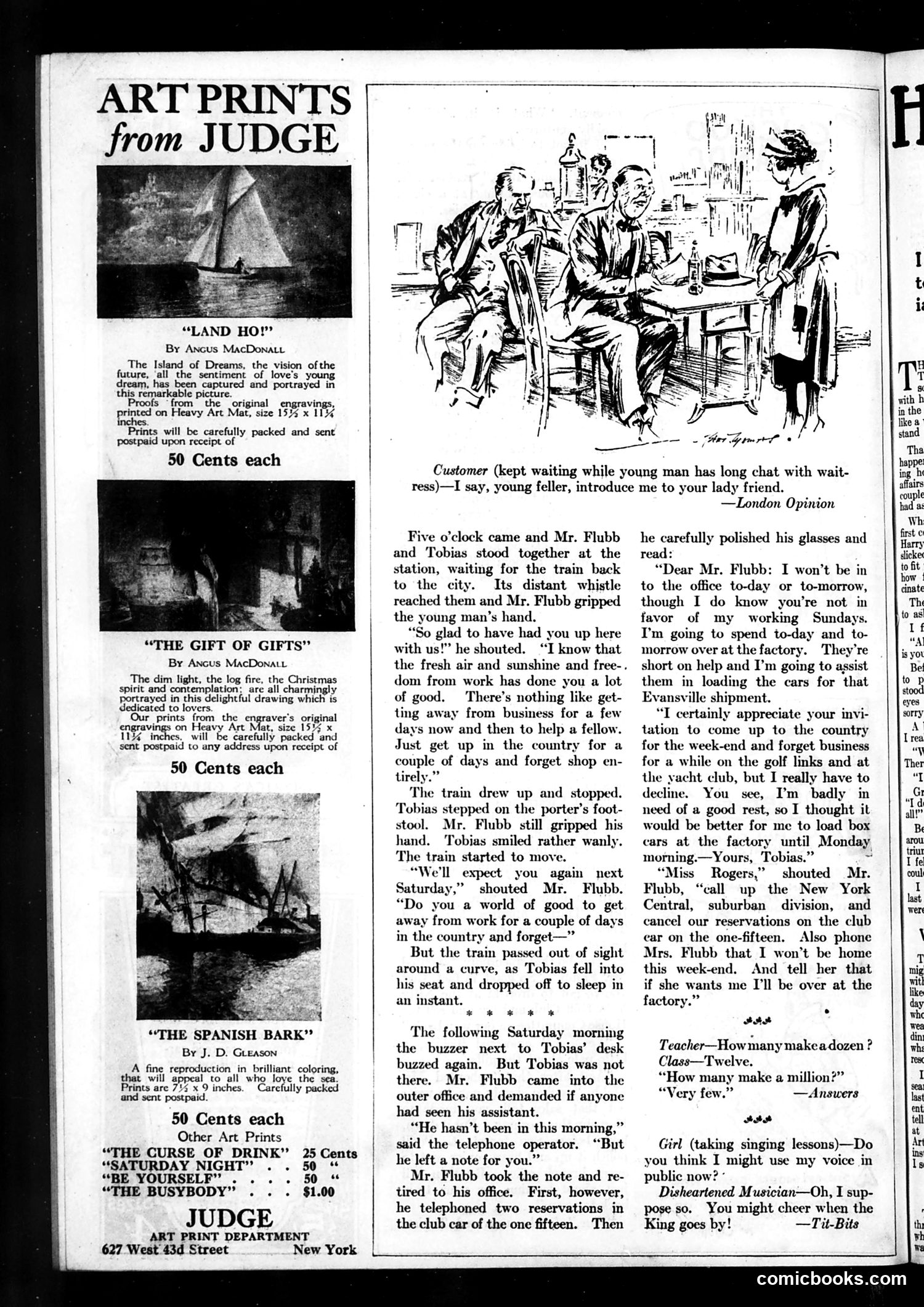
This page features editorial cartoons and a satirical story mocking wealthy paternalism. **The Cartoon (top right):** A customer, tired of waiting, confronts a young man chatting with a waitress, asking for an introduction. The joke reflects early-20th-century class dynamics and impatience with working-class flirtation. **"Mr. Flubb" Story:** The narrative satirizes a condescending businessman who urges his exhausted assistant Tobias to take a weekend country retreat, lecturing him about "getting away from work." When Tobias writes back declining the invitation to work instead—loading factory cars—Flubb is outraged. The satire exposes how wealthy employers romanticize leisure while exploiting workers who cannot afford to refuse overtime, and how they resent workers choosing work over their prescribed "generosity." The irony is sharp: Flubb cancels his club reservations, furious that his subordinate won't play the leisure game he directed.
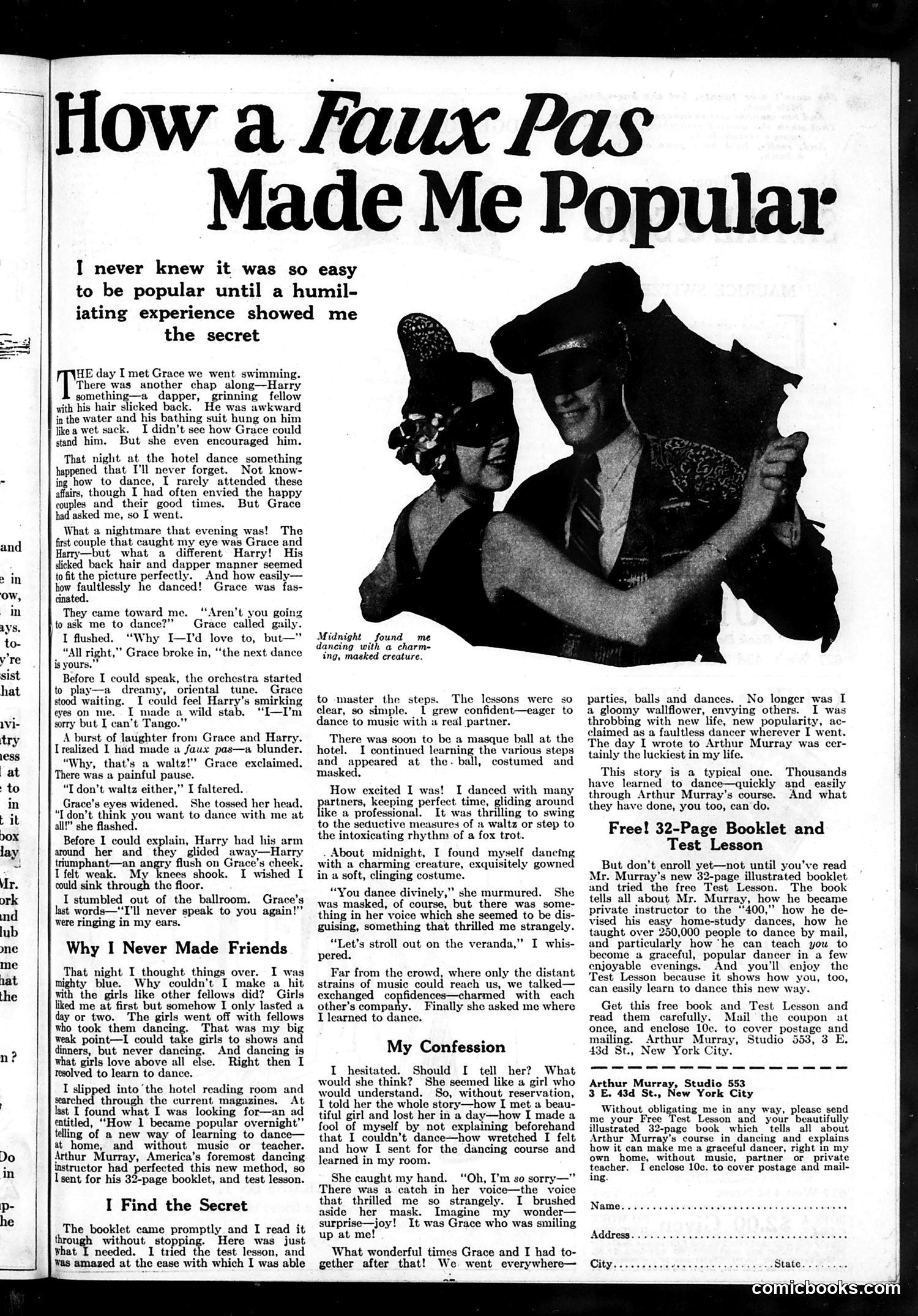
This is a **fictional testimonial advertisement** disguised as entertainment content—a common Judge magazine format of the era. **The narrative:** An awkward young man embarrasses himself by claiming he can't dance a waltz (confusing it with tango), loses the affection of Grace to the smooth-dancing Harry, then secretly learns to dance via Arthur Murray's mail-order course. He regains social standing and popularity. **The satire/point:** The piece gently mocks both male insecurity about social dancing and the explosive growth of **mail-order self-improvement schemes** that promised rapid transformation. The irony is that the narrator's humiliation over one social misstep—which seems trivial today—drove him to pay for lessons. This reflects 1920s-30s anxieties about appearing sophisticated. **The ad pitch:** The masked ball ending (where his dancing finally impresses) is calculated to make readers desire similar transformation. The coupon below invites purchasing Arthur Murray's actual dancing course. The "charming masked creature" he dances with appears designed to suggest romantic possibility through newly acquired skills.
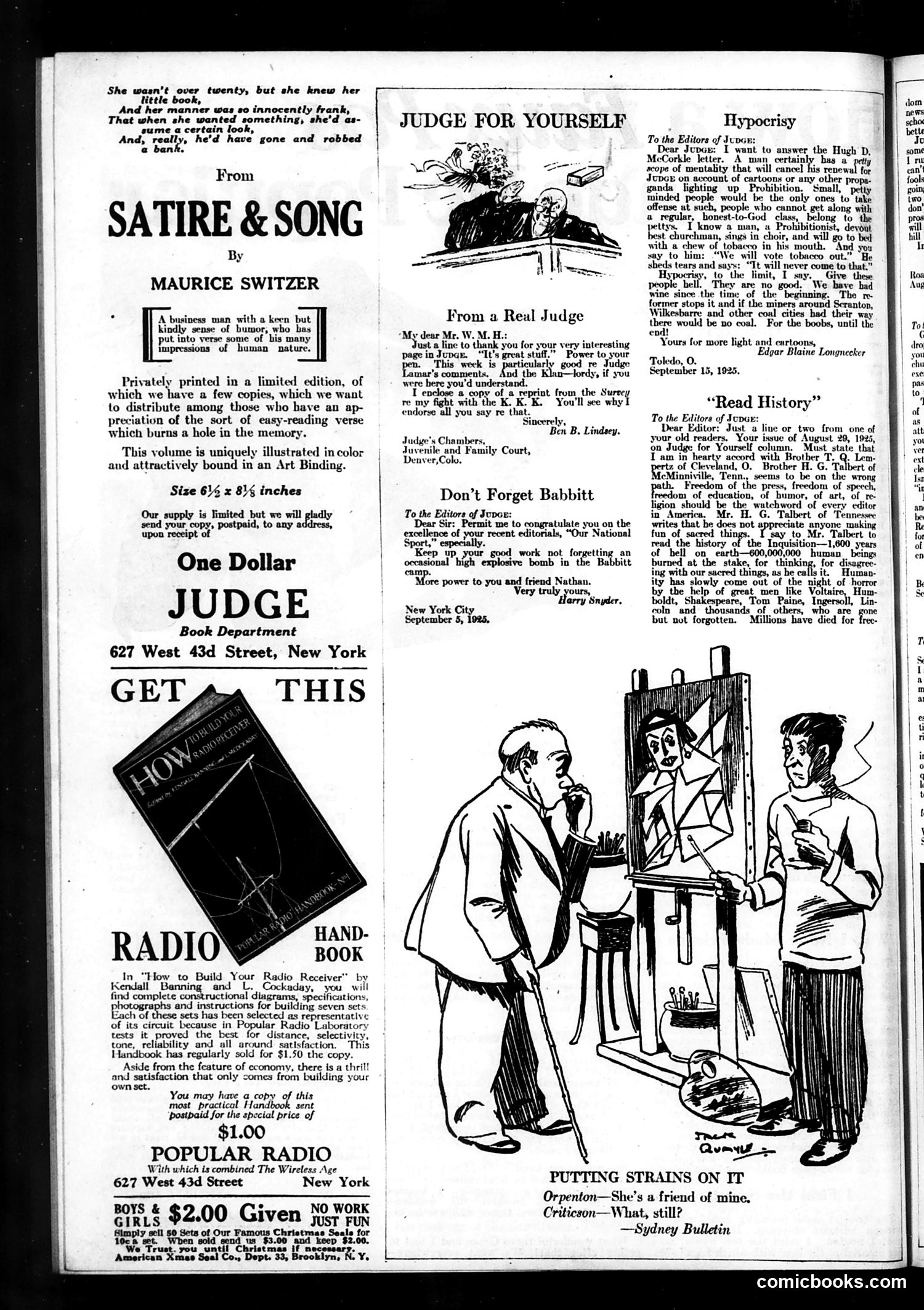
This page from *Judge* magazine (dated September 1925) contains editorial letters and advertisements, with one significant historical element. **The Main Historical Content:** The letter from **Ben B. Lindsey**, a real Denver judge, references the **KKK ("Klun")** positively regarding an article in *Judge*. Lindsey was a famous progressive juvenile court judge who publicly fought the Ku Klux Klan in Colorado—making this reader's endorsement significant. The reference to "your fight with the K.K.K." confirms *Judge* published anti-Klan content during this period when the organization was experiencing a resurgence. The other letters discuss editorial content about Prohibition ("Babbitt" references Sinclair Lewis's conformist character) and general magazine criticism. **The Cartoons:** Include generic humorous illustrations unrelated to specific political figures—typical filler for the magazine. This page demonstrates *Judge's* role as a vehicle for progressive social commentary during the 1920s.
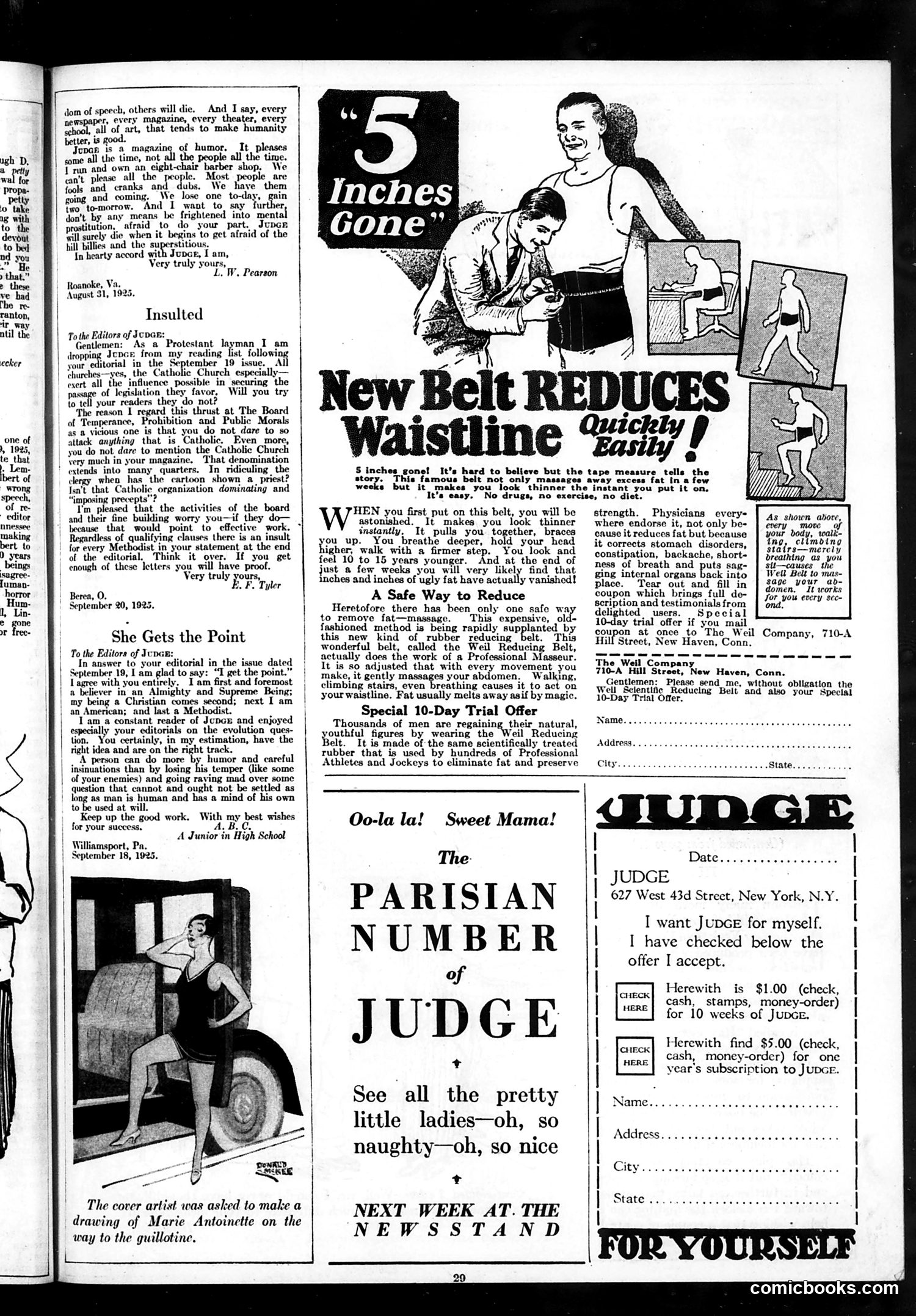
This page primarily contains **reader letters and advertisements** rather than political cartoons. The letters critique *Judge* magazine's editorial stance. One Protestant reader protests the magazine's attack on a temperance board, arguing *Judge* wouldn't dare similarly mock the Catholic Church—implying editorial cowardice or bias. Another writer defends *Judge's* commitment to humor and free speech against moral censorship. The dominant visual content is a **commercial advertisement** for the "Weil Reducing Belt"—a rubber corset-like device claiming to massage away abdominal fat without diet or exercise. The ad features before/after illustrations of a woman and includes a 10-day trial offer. **Context for moderns**: This reflects 1920s concerns with weight reduction and the marketing of dubious health devices. The letters reveal debates about magazine editorial independence and religious influence in American public discourse—tensions that remain relevant today.
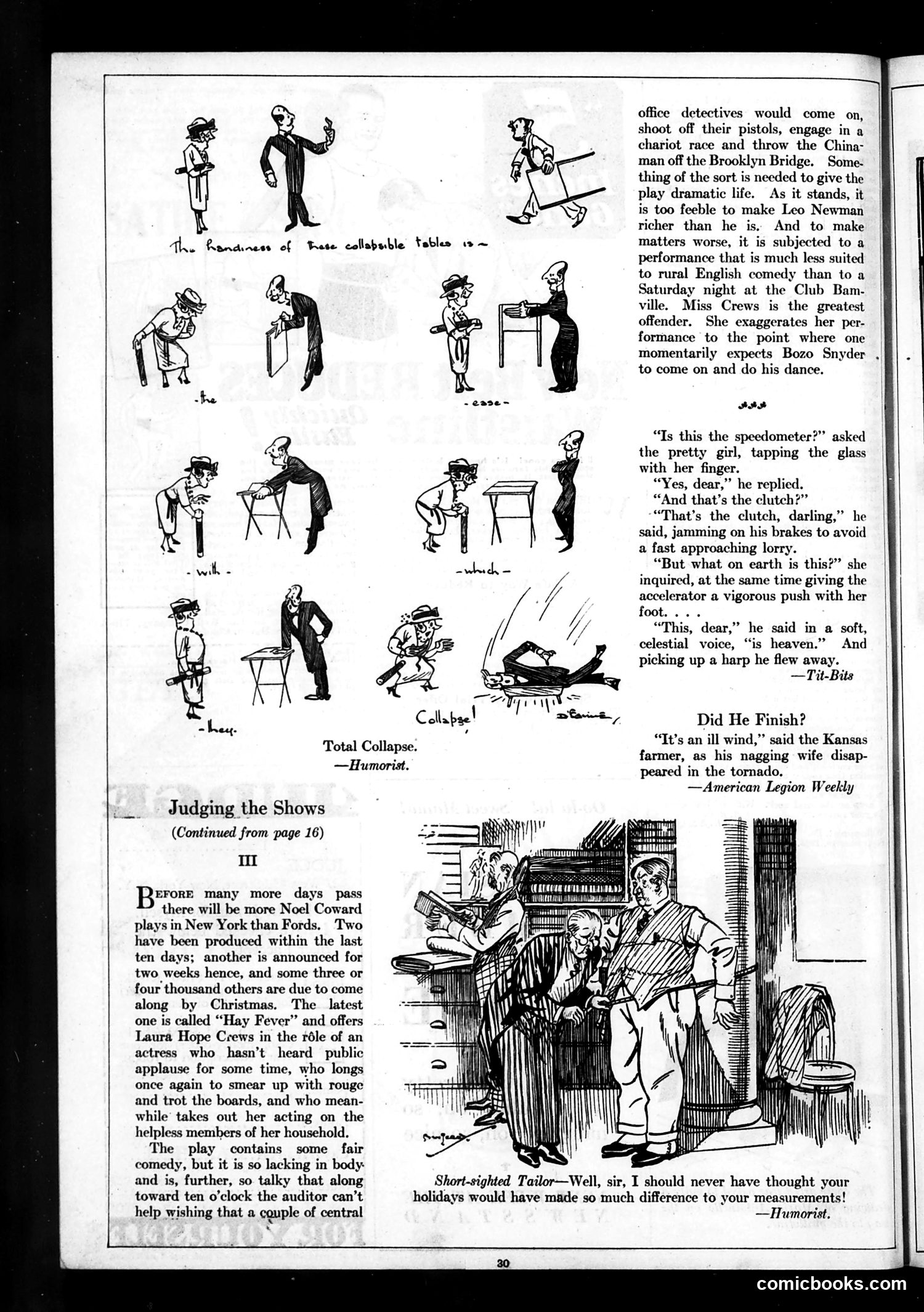
This page from *Judge* contains several distinct pieces of satirical content: **Top Section ("Total Collapse"):** A wordless comic strip satirizing collapsible furniture—showing a couple repeatedly failing to properly use/assemble collapsible chairs and tables, ending in complete physical collapse. The humor relies on physical comedy and the frustration of poor product design. **"Judging the Shows":** A theater review mocking Noel Coward's prolific output ("more Noel Coward plays in New York than Fords"). The critic dismisses "Hay Fever" as lacking substance despite fair comedy, faulting actress Laura Hope Crews for over-the-top performance unsuited to the rural English setting. **Three Short Joke Items:** Brief humorous anecdotes—one about a speedometer/car encounter, another about a Kansas farmer's wife caught in a tornado. These rely on double entendre and dark humor typical of 1920s magazine humor. The page reflects early-20th-century theatrical criticism and domestic comedy sensibilities, with drawing styles consistent with *Judge's* satirical tradition.
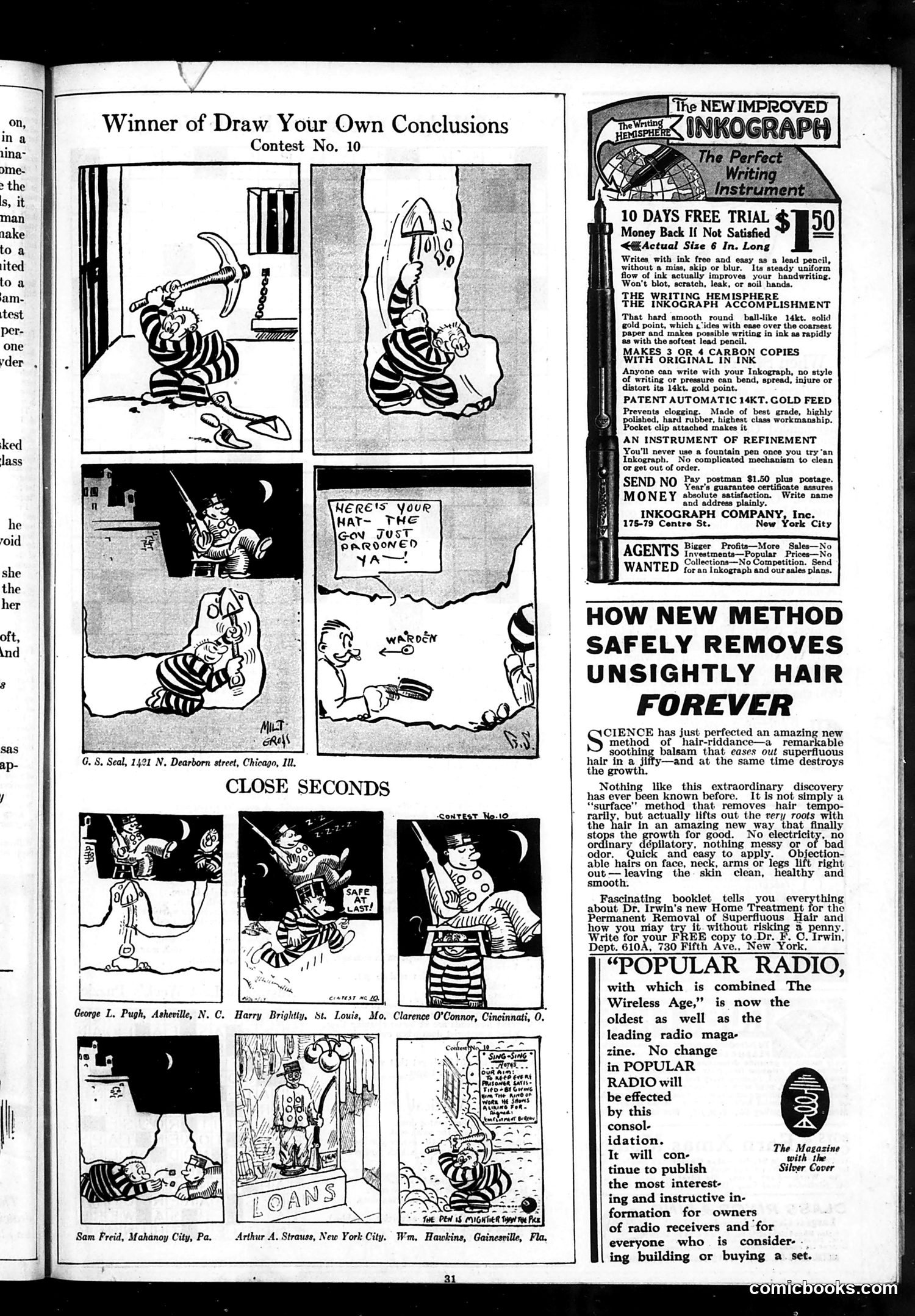
This page features the winning entry from "Draw Your Own Conclusions Contest No. 10"—a cartoon contest where readers submitted their own comic panels. **The Main Cartoon (top):** Depicts a striped bee or wasp character in various scenes of apparent mischief or trouble. The final panel reads "Here's your tie, gov. I just borrowed it, ya?"—suggesting the insect borrowed the man's necktie without permission. The humor appears to rely on the absurdity of a bee casually returning borrowed clothing to a human, playing on the concept of anthropomorphized animals behaving like irresponsible people. **"Close Seconds" (below):** Shows runner-up entries from other contest participants, each depicting surreal or comedic scenarios with similarly simple cartoon characters and punchlines. The page is primarily filled with period advertisements (Inkograph fountain pens, hair removal treatments, Popular Radio magazine), which was typical magazine filler of this era. The contests and cartoons themselves represent Judge's reader-participation approach to humor.
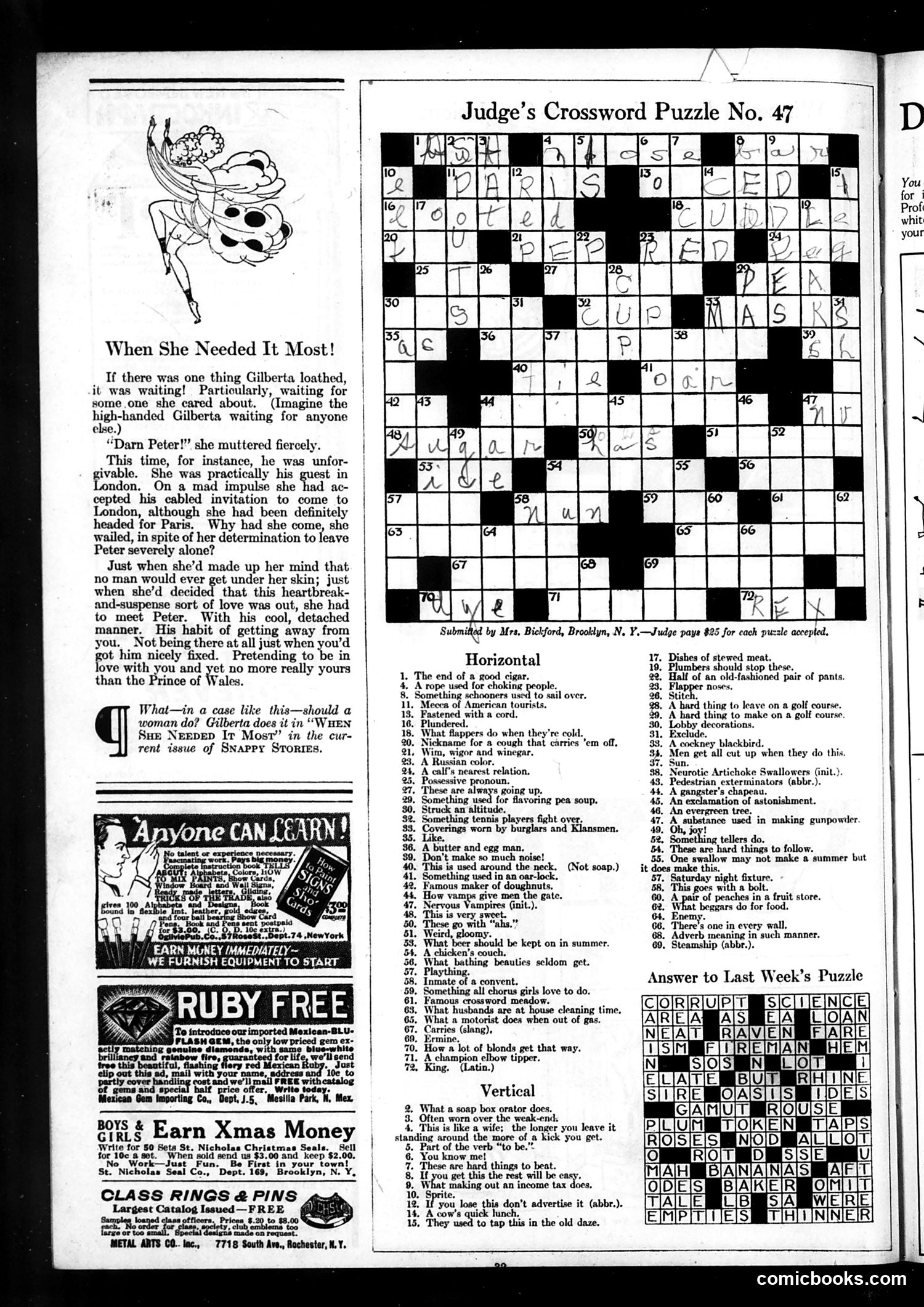
This page is primarily a **crossword puzzle** with accompanying advertisements and a short story teaser, not political satire. The cartoon illustration shows a woman in 1920s style clothing (flapper era) with the caption "When She Needed It Most!" It accompanies a brief narrative about a character named Gilberta who impulsively travels to London to see a man named Peter, only to find herself frustrated by his emotional unavailability and detached manner. The story appears in *Snappy Stories* magazine and uses romantic frustration as its hook—depicting the common complaint that men disappoint women by being present physically but emotionally distant. The page also contains period advertisements for mail-order items (Mexican opals, Christmas seals, class rings), common in early 20th-century publications. There is **no political content** visible on this page—it reflects typical 1920s consumer culture and popular romance fiction marketed to women readers.
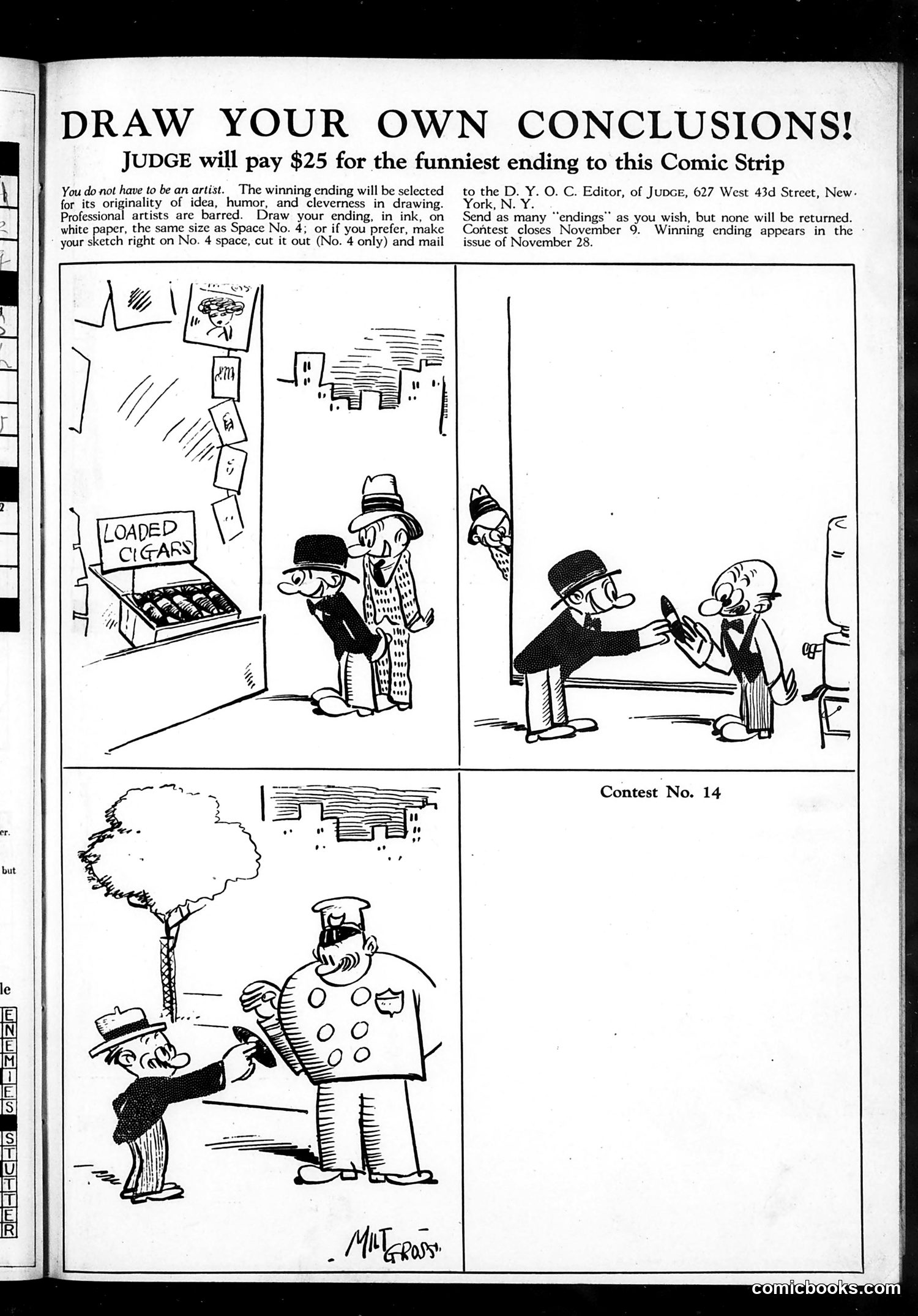
This page from *Judge* magazine presents an interactive comic contest. The unfinished strip shows three scenarios: (1) a man discovering loaded cigars, apparently a gift-giving scheme; (2) two men in hats exchanging something, with a third figure watching from above; (3) a small man pointing at a large uniformed official beneath a tree. The joke setup remains unclear without the original context, but the scenarios suggest con games or deceptive dealings—common satirical subjects. Readers were invited to submit funny endings to complete the strip. The $25 prize (substantial for the era) and restriction barring professional artists indicate *Judge* sought amateur creativity. The cartoons appear to satirize trickery or corruption, likely referencing contemporary social concerns, though specific figures or events aren't identifiable from the image alone. The "draw your own conclusions" title ironically invites readers to finish narratives whose meanings remain deliberately ambiguous.
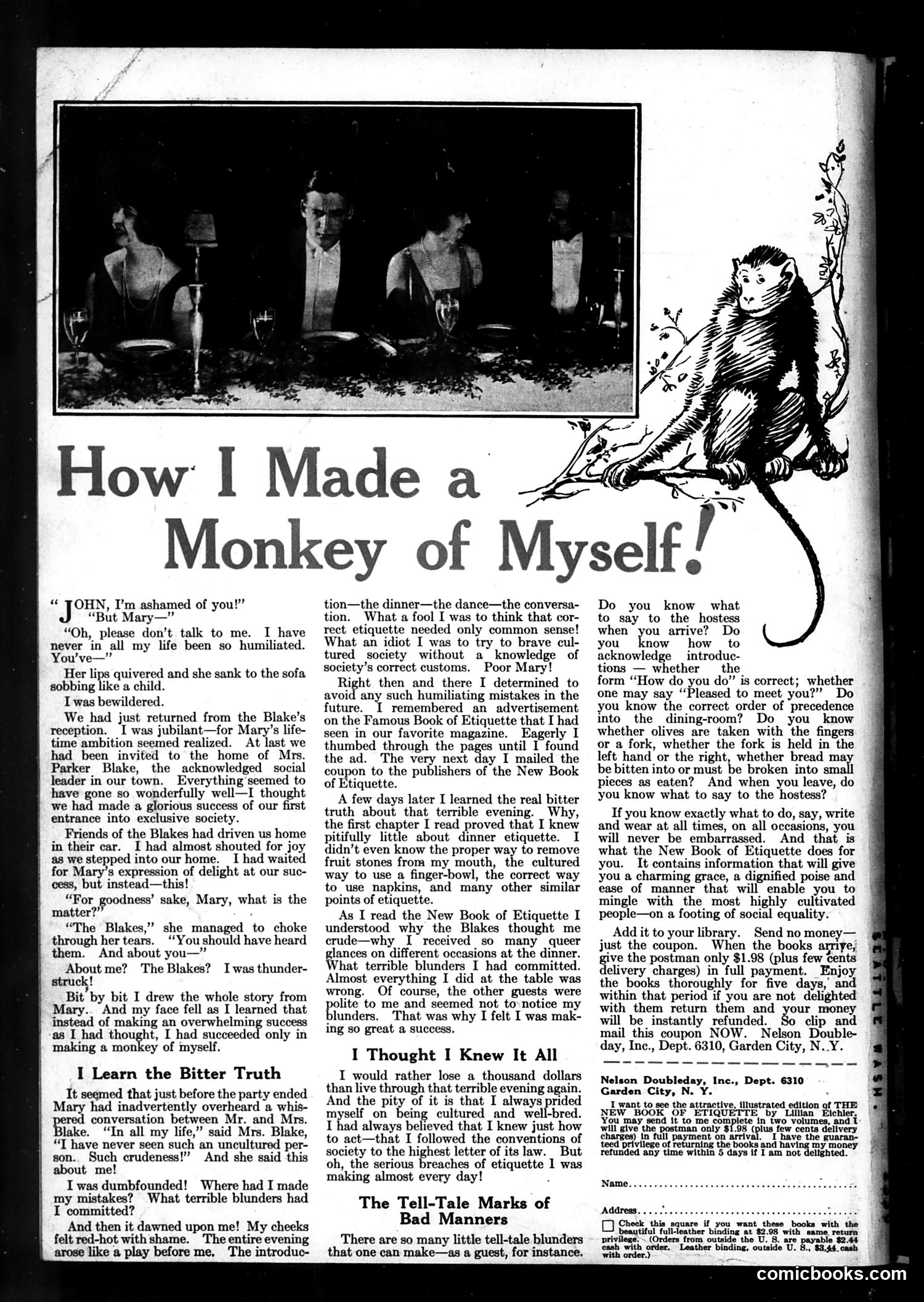
This is an etiquette advertisement disguised as a confessional story, reflecting early 20th-century anxieties about social mobility and "correct" behavior. The narrative depicts a middle-class man invited to an exclusive party by Mrs. Parker Blake, the town's social leader. Believing his common sense sufficient, he commits numerous dining etiquette violations—improper fruit-stone removal, incorrect napkin use, finger-bowl mistakes. Though guests politely conceal their judgments, the Blakes mock him privately, calling him "uncultured" and "crude." The satire targets aspirational social climbers: the protagonist's humiliation symbolizes the vulnerability of those attempting to enter "exclusive society" without proper training. The monkey illustration reinforces the mockery—he's made himself ridiculous through ignorance. The ad's solution: purchase the "New Book of Etiquette," which promises to prevent such social catastrophes. This reflects the period's commercialization of social anxiety and the profitable publishing industry around etiquette guides.

I can see this is a page from *Judge* magazine with a decorative patterned background and the comicbooks.com watermark, but the image is too dark and low-contrast for me to discern any specific cartoon content, text, or figures with confidence. The OCR text only shows the website watermark, providing no additional context about the page's subject matter, dates, or any political or social references that might be present. To properly analyze this as a political cartoon or satirical content, I would need a clearer, higher-contrast image where the actual artwork and any accompanying text are legible. I cannot responsibly identify figures or explain satire from an image I cannot clearly see.