
Judge, 1925-10-31 · page 18 of 37
Judge — October 31, 1925 — page 18: what you’re looking at
What you’re looking at
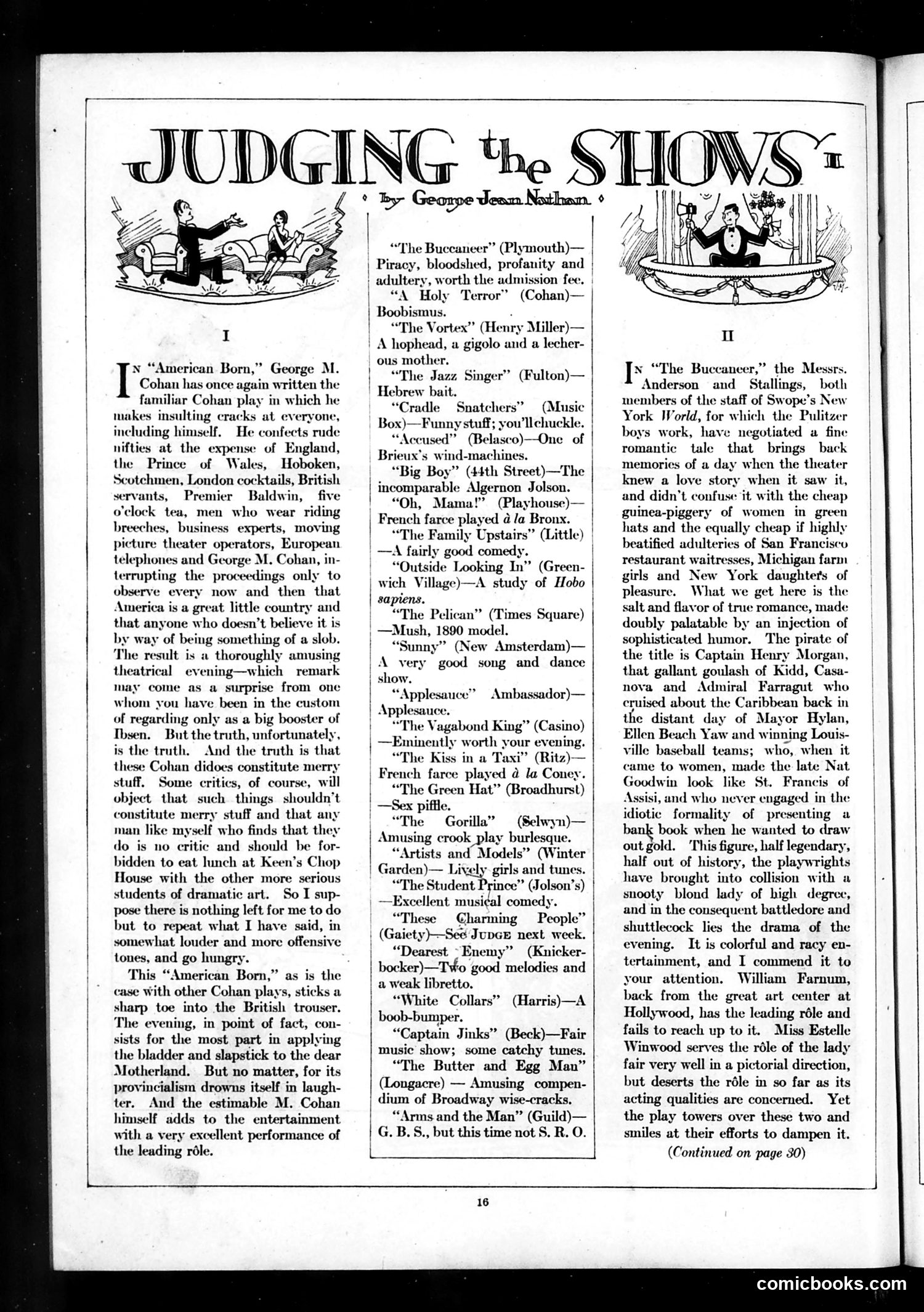
This is a theater review column by George Jean Nathan critiquing Broadway productions. The page contains two sections: **Section I** reviews George M. Cohan's "American Born," praising it as genuinely entertaining despite Cohan's reputation as a serious dramatist. Nathan defends enjoying comedic "merry stuff" while poking fun at critics who would disapprove. **Section II** is a rapid-fire listing of current Broadway shows with Nathan's pithy judgments—some complimentary ("A very good song and dance show"), others derisive ("Boobismus," "Mush, 1890 model"). He uses brief, often crude descriptors and ethnic stereotyping typical of 1920s criticism. The reviews praise "The Buccaneer" as a refreshing romantic play amid theater's current triviality, and highlight Al Jolson's performance in "Big Boy." The column exemplifies early 20th-century theater criticism's caustic wit and casual prejudice.
📄 Transcribed text from this page (OCR, searchable)
Machine-transcribed from the original scan — historical spelling and the odd misread are preserved.
Nn “American Born,” Cohan has once again written the familiar Cohan play in which he makes insulting cracks at everyone, George M. including himself. He confects rude nifties at the expense of England, the Prince of Wales, Hoboken, Scotchmen, London cocktails, British servants, Premier Baldwin, _ five o'clock tea, men who wear riding breeches, business experts, moving picture theater operators, European telephones and George M. Cohan, in- terrupting the proceedings only to observe every now and then that America is a great little country and that anyone who doesn’t belie i by way of being something of a slob. The result is a thoroughly amusing theatrical evening—which remark may come as a surprise from one whom you have been in the custom of regarding only as a big booster of Ibsen. But the truth, unfortunately, is the truth. And the truth is that these Cohan didoes constitute merry stuff. Some critics, of course, will object that such things shouldn’t constitute merry stuff and that any man like myself who finds that they do is no critic and should be for- bidden to eat lunch at Keen’s Chop House with the other more serious students of dramatic art. So I sup- pose there is nothing left for me to do but to repeat what I have said, in somewhat louder and more offensive tones, and go hungry. This “American Born,” as is the case With other Cohan plays, sticks a sharp toe into the British trouser. The evening, in point of fact, con- sists for the most part in applying the bladder and slapstick to the dear Motherland. But no matter, for its provincialism drowns itself in laugh- ter. And the estimable M. Cohan himself adds to the entertainment with a very excellent performance of the leading rdle. JUDGING the SHOWS = “The Buccaneer” (Plymouth)— adultery, worth the admission fee. “N° Holy Terror” (Cohan)— Boobismus. “The Vortex” (Hem ry Miller)— | A hophead, a gigolo and a lecher- ous mother, | “The Jazz Singer” (Fulton)— Hebrew bait. “Cradle Snatchers” (Music Box)—Funny stuff; you’llchuckle. “Accused” (Belasco)—One_ of Brieux’s wind-machines. “Big Boy” (44th Street)—The incomparable Algernon Jolson. “Oh, Mama!” (Playhouse)— French farce played @ /a Bronx. “The Family Upstairs” (Little) —A fairly good comedy. “Outside Looking In” (Green- wich Village)—A study of Hobo sapiens. “The Pelican” (Times Square) | —Mush, 1890 model. “Sunny” (New Amsterdam)— | A very good song and dance | show. | “Applesauce” Ambassador)— | Applesauce. ' “The Vagabond King” (Casino) —Enminently worth your evening. “The Kiss in a Taxi” (Ritz)— French farce played @ la Coney. “The Green Hat” (Broadhurst) “The Gorilla” (Selwyn)— Amusing crook play burlesque. “Artists and Models” (Winter Garden)— Lively girls and tunes. “The Student since” ” (Jolson’s) —Excellent mmusieal comedy. “These Charming People” (Gaiety)—See JupcE next week. “Dearest “Enemy” (Knicker- | bocker)—Tv'o good melodies and | a weak libretto. “White Collars” (Harris)—A boob-bumper. “Captain Jinks” (Beck)—Fair music show; some catchy tunes. “The Butter and Egg Man” (Longacre) — Amusing compen- | dium of Broadway wise-cracks. “Arms and the Man” (Guild)— G. B.S., but this time not S. R. O. Piracy, bloodshed, profanity and | L | Is “The Buccaneer,” the Messrs. Anderson and Stallings, both members of the staff of Swope’s New York World, for which the Pulitzer boys work, have negotiated a fine romantic tale that brings back memories of a day when the theater knew a love story when it saw it, and didn’t confuse it with the cheap guinea-piggery of women in green hats and the equally cheap if highly beatified adulteries of San Francisco restaurant waitresses, Michigan farm girls and New York daughters of pleasure. What we get here is the salt and flavor of true romance, made doubly palatable by an injection of sophisticated humor. The pirate of the title is Captain Henry Morgan, that gallant goulash of Kidd, Casa- nova and Admiral Farragut who cruised about the Caribbean back in the distant day of Mayor Hylan, Ellen Beach Yaw and winning Louis- ville baseball teams; who, when it came to women, made the late Nat Goodwit in look like St. Francis of Assisi, and who never engaged in the idiotic formality of presenting a bank book when he wanted to draw out gold. ‘This figure, half legendary, half out of history, the playwrights have brought into collision with a snooty blond lady of high degree and in the consequent battledore and shuttlecock lies the drama of the evening. It is colorful and racy en- tertainment, and I commend it to your attention. William Farnum, back from the great art center at Hollywood, has the leading réle and fails to reach up to it. Miss Estelle Winwood serves the réle of the lady fair very well in a pictorial direction, but deserts the réle in so far as its acting qualities are concerned. Yet the play towers over these two and smiles at their efforts to dampen it. (Continued on page 30) comicbooks.com