
Judge, 1925-10-31 · page 15 of 37
Judge — October 31, 1925 — page 15: what you’re looking at
What you’re looking at
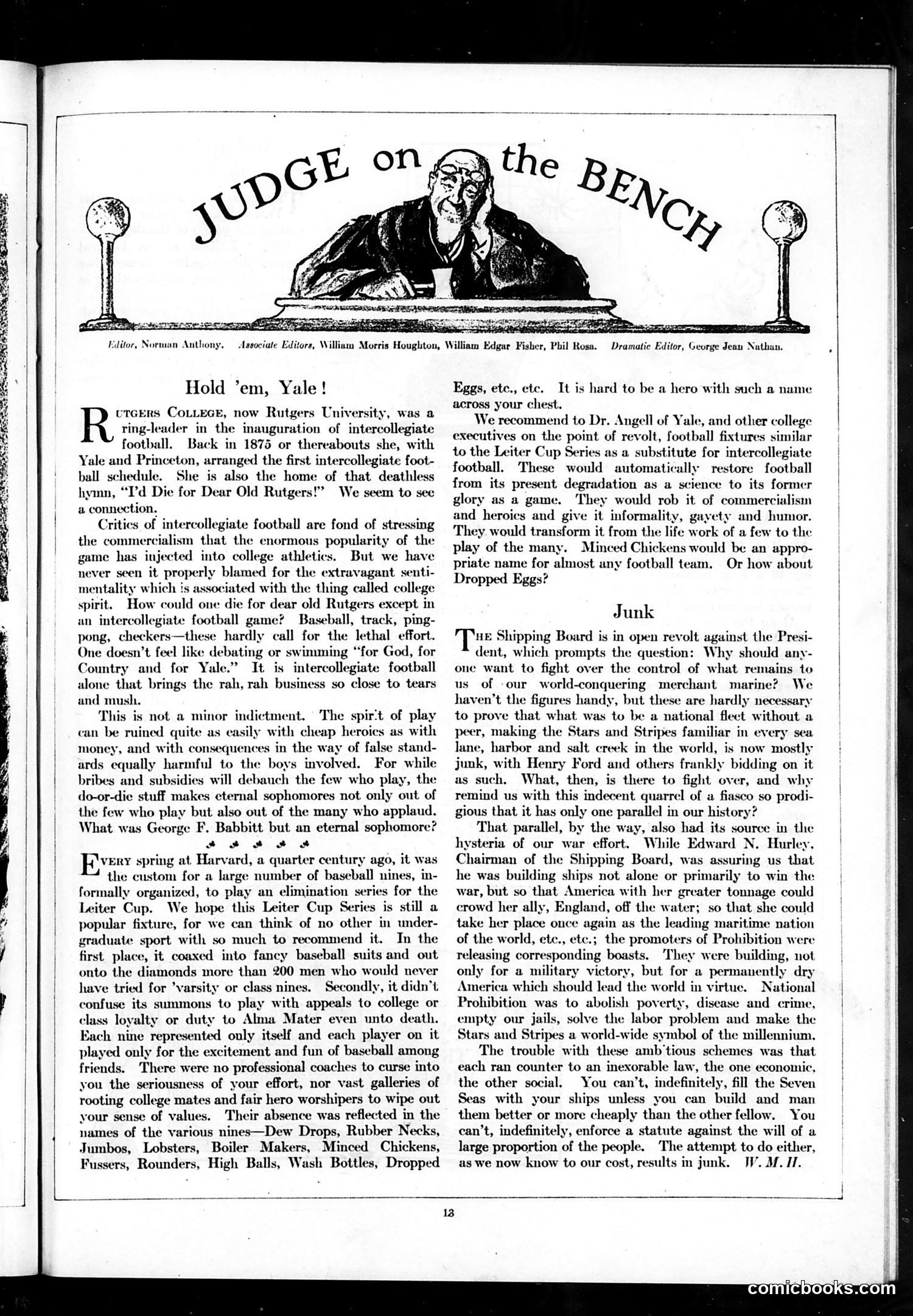
This page critiques **excessive sentimentality in American college football**. The editorial attacks how intercollegiate football has created dangerous "college spirit"—the willingness to die for one's school—rather than fostering genuine play. It argues this artificial heroics harms young men by turning them into permanent adolescents, citing George Babbitt (Sinclair Lewis's conformist protagonist) as the result. The piece proposes **Harvard's historical Leiter Cup Series as an alternative**: informal baseball tournaments with playfully irreverent team names (Dew Drops, Minced Chickens, Dropped Eggs) that prioritized fun over institutional loyalty and commercial spectacle. The satire suggests restoring football's joy by stripping away the mythology—renaming teams after breakfast foods would make heroic posturing impossible. A brief note about **Shipping Board revolt** against the President appears separately, likely referring to contemporary maritime policy disputes.
📄 Transcribed text from this page (OCR, searchable)
Machine-transcribed from the original scan — historical spelling and the odd misread are preserved.
DERE ES QA It, es. a Editor, Norman Anthony, — Associate Editors, William Morris Houghton, William Edgar Fisher, Phil Rosa. Dramatic Editor, George Jean Nathan. Hold ’em, Yale! utcers CoLLEeGE, now Rutgers University, was a R ring-leader in the inauguration of intercollegiate football. Back in 1875 or thereabouts she, with Yale and Princeton, arranged the first intercollegiate foot- ball schedule. She is also the home of that deathless hymn, “I’d Die for Dear Old Rutgers!” We seem to see a connection, Critics of intercollegiate football are fond of stressing the commercialism that the enormous popularity of the game has injected into college athletics. But we have never seen it properly blamed for the extravagant senti- mentality which is associated with the thing called college spirit. How could one die for dear old Rutgers except in an intercollegiate football game? Baseball, track, ping- pong, checkers—these hardly call for the lethal effort. One doesn’t feel like debating or swimming “for God, for Country and for Yale.” It is intercollegiate football alone that brings the rah, rah business so close to tears and mush, This is not a minor indictment. The spir:t of play can be ruined quite as easily with cheap heroics as with money, and with consequences in the way of false stand- ards equally harmful to the boys involved. For while bribes and subsidies will debauch the few who play, the do-or-die stuff makes eternal sophomores not only out of the few who play but also out of the many who applaud. What was George F. Babbitt but an eternal sophomore? et et HH SH Breer spring at Harvard, a quarter century ago, it was the custom for a large number of baseball nines, in- formally organized, to play an elimination series for the Leiter Cup. We hope this Leiter Cup Series is still a popular fixture, for we can think of no other in under- graduate sport with so much to recommend it. In the first. place, it coaxed into fancy baseball suits and out onto the diamonds more than 200 men who would never have tried for ’varsity or class nines. Secondly, it didn’t. confuse its summons to play with appeals to college or class loyalty or duty to Alma Mater even unto death. Each nine represented only itself and each player on it played only for the excitement and fun of baseball among friends. There were no professional coaches to curse into you the seriousness of your effort, nor vast galleries of rooting college mates and fair hero worshipers to wipe out your sense of values. Their absence was reflected in the names of the various nines—Dew Drops, Rubber Necks, Jumbos, Lobsters, Boiler Makers, Minced Chickens, Fussers, Rounders, High Balls, Wash Bottles, Dropped Eggs, ete. It is hard to be a hero with such a name across your chest. We recommend to Dr. Angell of Yale, and other college executives on the point of revolt, football fixtures similar to the Leiter Cup Series as a substitute for intercollegiate football. These would automatically restore football from its present degradation as a science to its former glory as a game. They would rob it of commercialism and heroics and give it informality, gayety and humor. They would transform it from the life work of a few to the play of the many. Minced Chickens would be an appro- priate name for almost any football team, Or how about Dropped Eggs? Junk TT Shipping Board is in open revolt against the Presi- dent, which prompts the question: Why should any- one want to fight over the control of what remains to us of our world-conquering merchant marine? We haven’t the figures handy, but these are hardly necessary to prove that what was to be a national fleet without a peer, making the Stars and Stripes familiar in every sea lane, harbor and salt creek in the world, is now mostly junk, with Henry Ford and others frankly bidding on it as such, What, then, is there to fight over, and why remind us with this indecent quarrel of a fiasco so prodi- gious that it has only one parallel in our history? That parallel, by the way, also had its source in the hysteria of our war effort. While Edward N. Hurley, Chairman of the Shipping Board, was assuring us that he was building ships not alone or primarily to win the war, but so that America with her greater tonnage could crowd her ally, England, off the water; so that she could take her place once again as the leading maritime nation of the world, etc., etc.; the promoters of Prohibition were releasing corresponding boasts. They were building, not only for a military victory, but for a permanently dry America which should lead the world in virtue. National Prohibition was to abolish poverty, disease and crime, empty our jails, solve the labor problem and make the Stars and Stripes a world-wide symbol of the millennium. The trouble with these amb'tious schemes was that each ran counter to an inexorable law, the one economic, the other social. You can’t, indefinitely, fill the Seven Seas with your ships unless you can build and man them better or more cheaply than the other fellow. You can’t, indefinitely, enforce a statute against the will of a large proportion of the people. The attempt to do either, as we now know to our cost, results in junk. WW. M.//.