
Judge, 1925-10-31 · page 20 of 37
Judge — October 31, 1925 — page 20: what you’re looking at
What you’re looking at
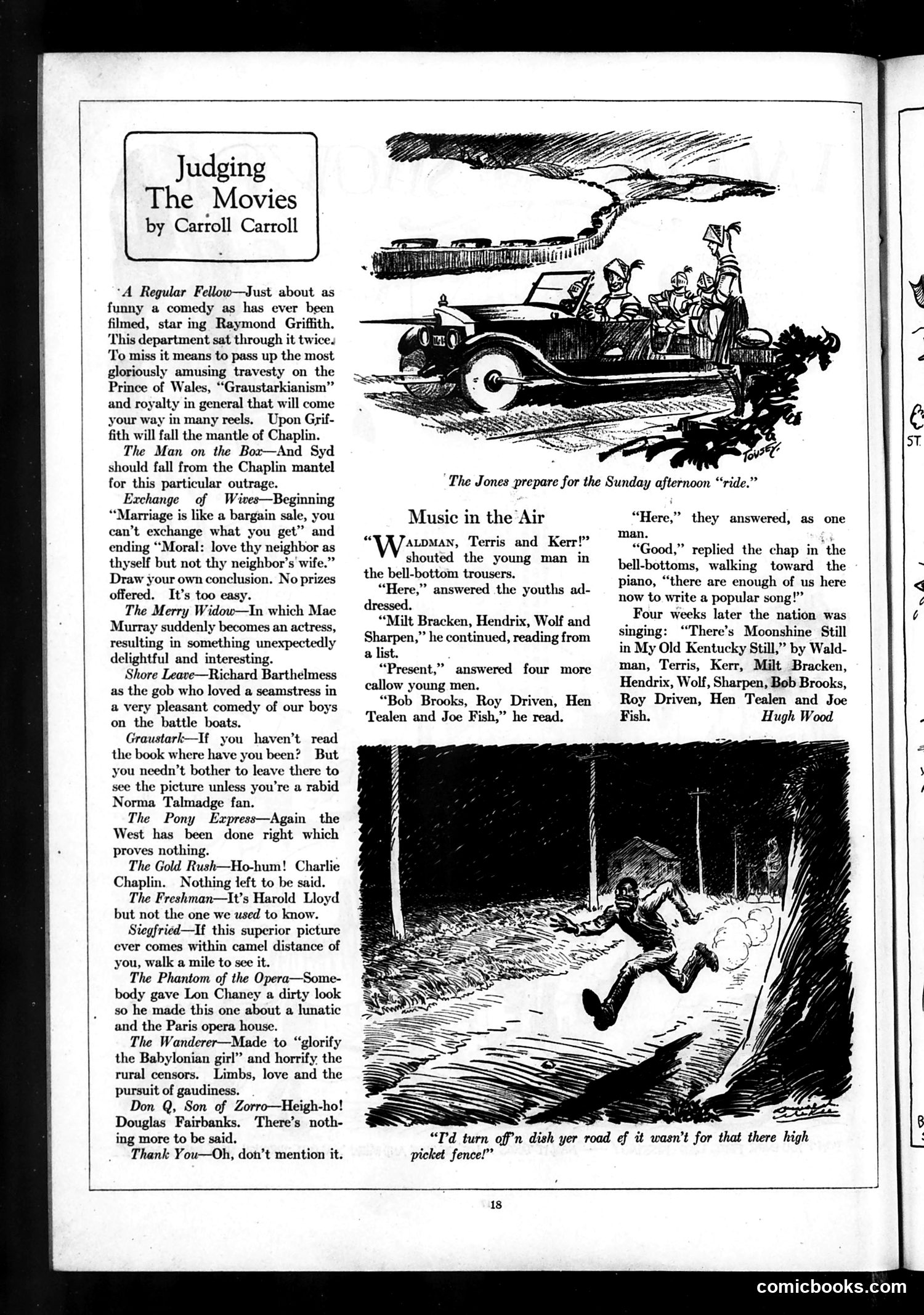
This page contains two distinct sections: **Left column:** Carroll Carroll's film review column critiquing silent movies from the mid-1920s. The reviews are brief, sarcastic assessments of popular films and stars (Chaplin, Harold Lloyd, Douglas Fairbanks, Lon Chaney). The satire targets both the films themselves and contemporary celebrity culture—he mocks Mae Murray's sudden "discovery" as an actress and dismisses several pictures as mediocre. **Right section:** Two unrelated items—an illustrated story titled "Music in the Air" about young men collaboratively writing a popular song (appears to reference actual songwriters of the era), and below it, a single-panel cartoon showing two figures on a rural road with a high picket fence, with the caption suggesting someone won't leave the road because of the fence. This appears to be rural/folksy humor typical of Judge's style. The page represents typical 1920s satirical magazine content mixing entertainment criticism with light humor.
📄 Transcribed text from this page (OCR, searchable)
Machine-transcribed from the original scan — historical spelling and the odd misread are preserved.
Judging The Movies by Carroll Carroll ‘A Regular Fellow—Just about as funny a comedy as has ever been filmed, star ing Raymond Griffith. ‘This department sat through it twice. To miss it means to pass up the most gloriously amusing travesty on the Prince of Wales, “Graustarkianism” and royalty in general that will come your way in many reels. Upon Grif- fith will fall the mantle of Chaplin. The Man on the Box—And Syd should fall from the Chaplin mantel for this particular outrage. Exchange of Wives—Beginning “Marriage is like a bargain sale, you can’t exchange what you get” and ending “Moral: love thy neighbor as thyself but not thy neighbor’s' wife.” Draw your own conclusion. No prizes offered. It’s too easy. The Merry Widow—In which Mae Murray suddenly becomes an actress, resulting in something unexpectedly delightful and interesting. Shore Leave—Richard Barthelmess as the gob who loved a seamstress in a very pleasant comedy of our boys on the battle boats. Graustark—If you haven’t read the book where have you been? But you needn’t bother to leave there to see the picture unless you're a rabid Norma Talmadge fan. The Pony Express—Again the West has been done right which proves nothing. The Gold Rush—Ho-hum! Charlie Chaplin. Nothing left to be said. The Freshman—It’s Harold Lloyd but not the one we used to know. Siegfried—If this superior picture ever comes within camel distance of you, walk a mile to see it. The Phantom of the Opera—Some- body gave Lon Chaney a dirty look so he made this one about a lunatic and the Paris opera house. The Wanderer—Made to “glorify the Babylonian girl” and horrify, the rural censors. Limbs, love and the pursuit of gaudiness. Don Q, Son of Zorro—Heigh-ho! Douglas Fairbanks. There’s noth- ing more to be said. Thank You—Oh, don’t mention it. The Jones prepare for the Sunday afternoon “ride.” Music in the Air “YVauoman, Terris and Kerr!” shouted the young man in the bell-bottom trousers. “Here,” answered the youths ad- dressed. “Milt Bracken, Hendrix, Wolf and Sharpen,” he continued, reading from a list. “Present,” answered four more callow young men. “Bob Brooks, Roy Driven, Hen Tealen and Joe Fish,” he read. SSSA» SSS “Here,” they answered, as one “Good,” replied the chap in the bell-bottoms, walking toward the piano, “there are enough of us here now to write a popular song!” Four weeks later the nation was singing: “‘There’s Moonshine Still in My Old Kentucky Still,” by Wald- man, Terris, Kerr, Milt Bracken, Hendrix, Wolf, Sharpen, Bob Brooks, Roy Driven, Hen Tealen and Joe Fish. Hugh Wood “Td turn off'n dish yer road ef it wasn’t for that there high picket fence!” comicbooks.com