
A complete issue · 36 pages · 1925
Judge — September 19, 1925
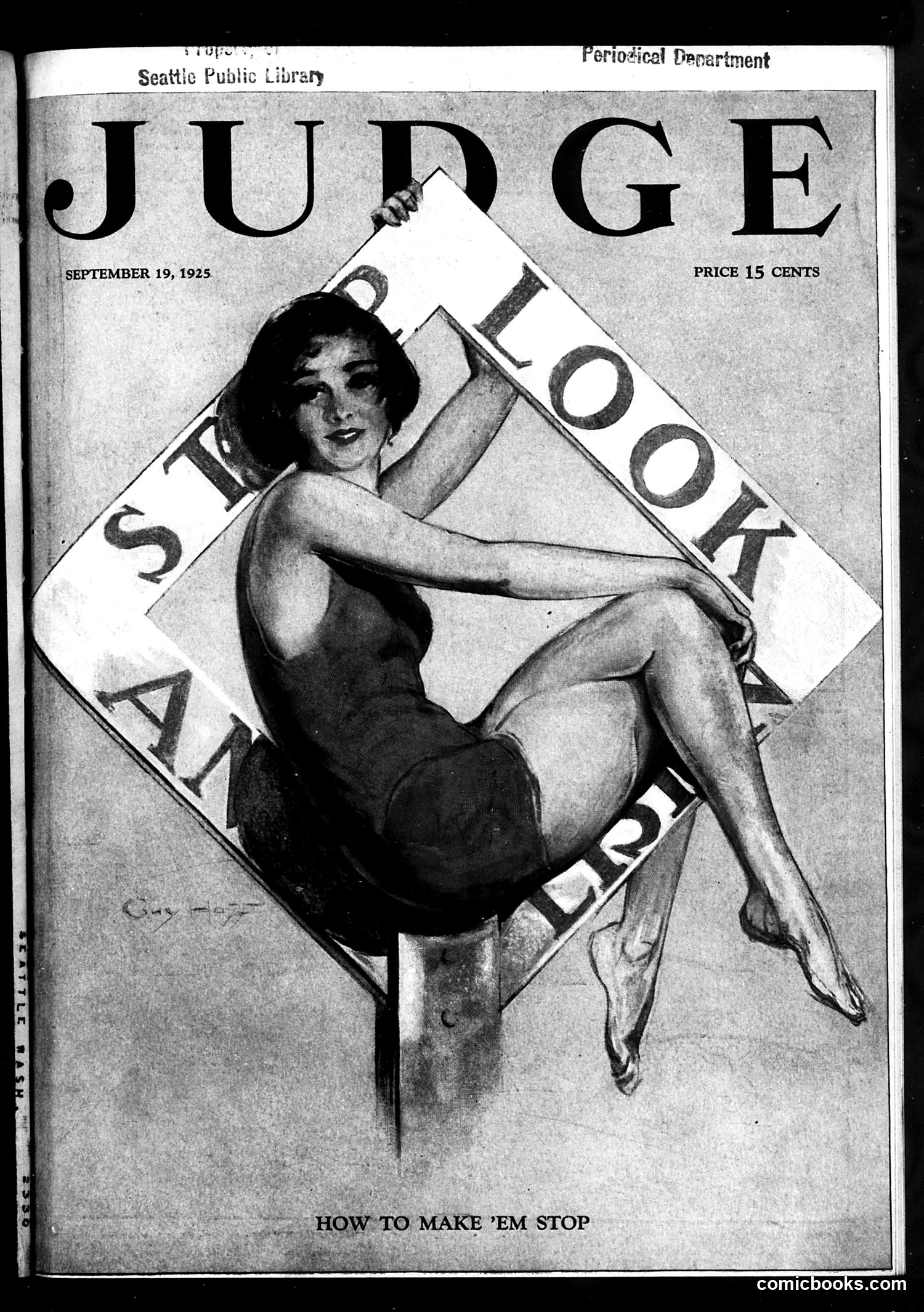
This is primarily a magazine cover featuring an illustration rather than political commentary. The image shows a woman in a bathing suit positioned inside a large mousetrap labeled "A SLICK LOOK" (text runs along the trap's edges). The caption reads "HOW TO MAKE 'EM STOP." The satire appears to target the "flapper" culture of the 1920s—specifically critiquing women's modern fashion and behavior as "traps" for men. The mousetrap metaphor suggests that fashionable women (depicted with short hair and revealing swimwear) are deliberately luring or ensnaring men. This reflects period anxieties about changing gender roles and women's increasing social freedom during the Jazz Age. The joke reinforces conservative criticism of 1920s women's liberation.
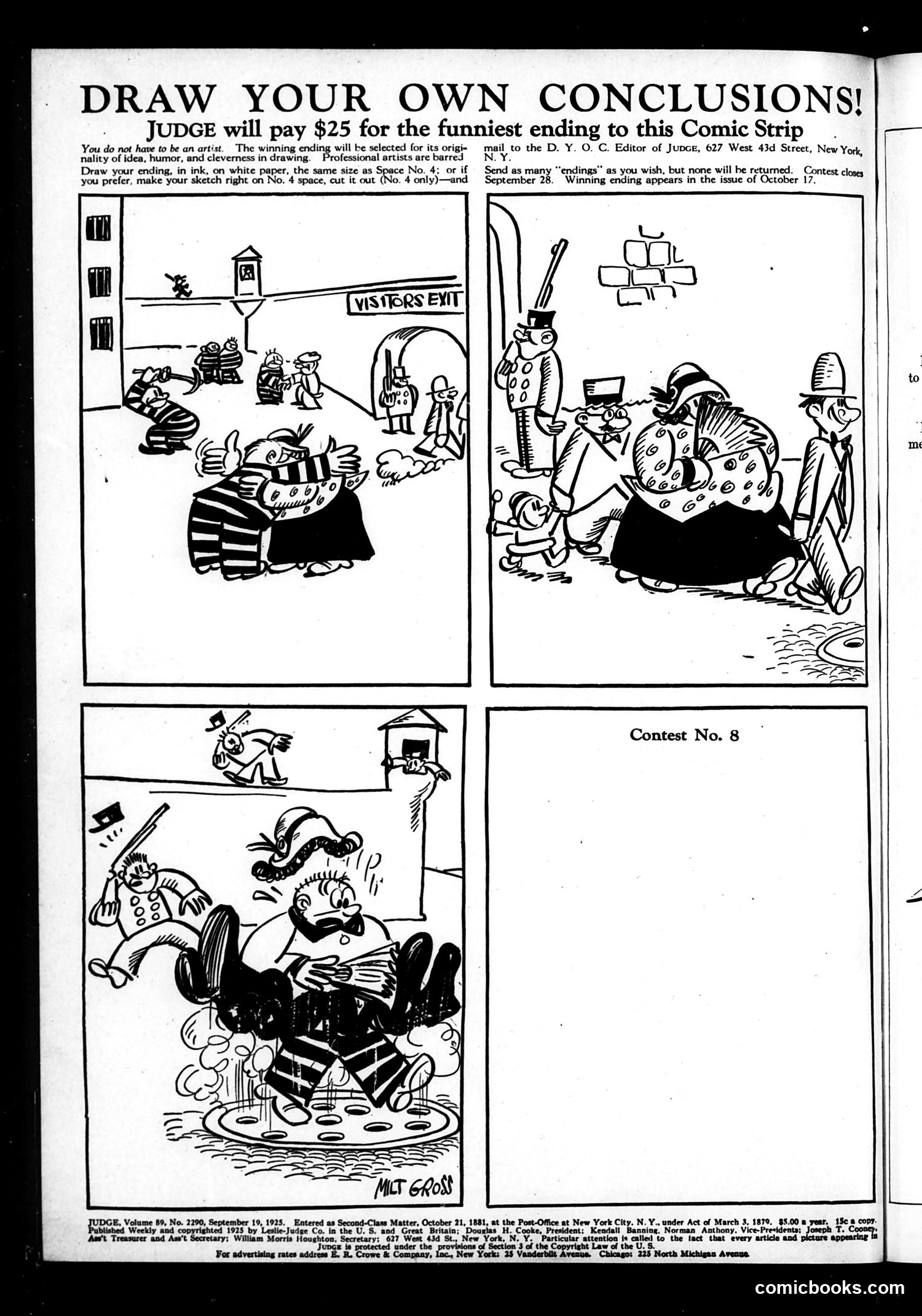
This page presents a reader-participation contest (Contest No. 8) inviting submissions of humorous comic strip endings. The Judge offered $25 for the funniest conclusion to an incomplete three-panel strip. The three example panels shown depict what appears to be a **museum or exhibition visit with anthropomorphic animal characters**—likely satirizing contemporary visitors' behavior at cultural institutions. The scenes show crowded, chaotic viewing situations with exaggerated character expressions suggesting either confusion or misbehavior. The humor targets how ordinary people conduct themselves in formal spaces. The final panel, signed by cartoonist Milt Gross, shows characters in water—suggesting a comedic escalation or absurd conclusion typical of 1920s slapstick humor. This represents Judge's interactive approach to generating content while engaging its readership during the Jazz Age era.
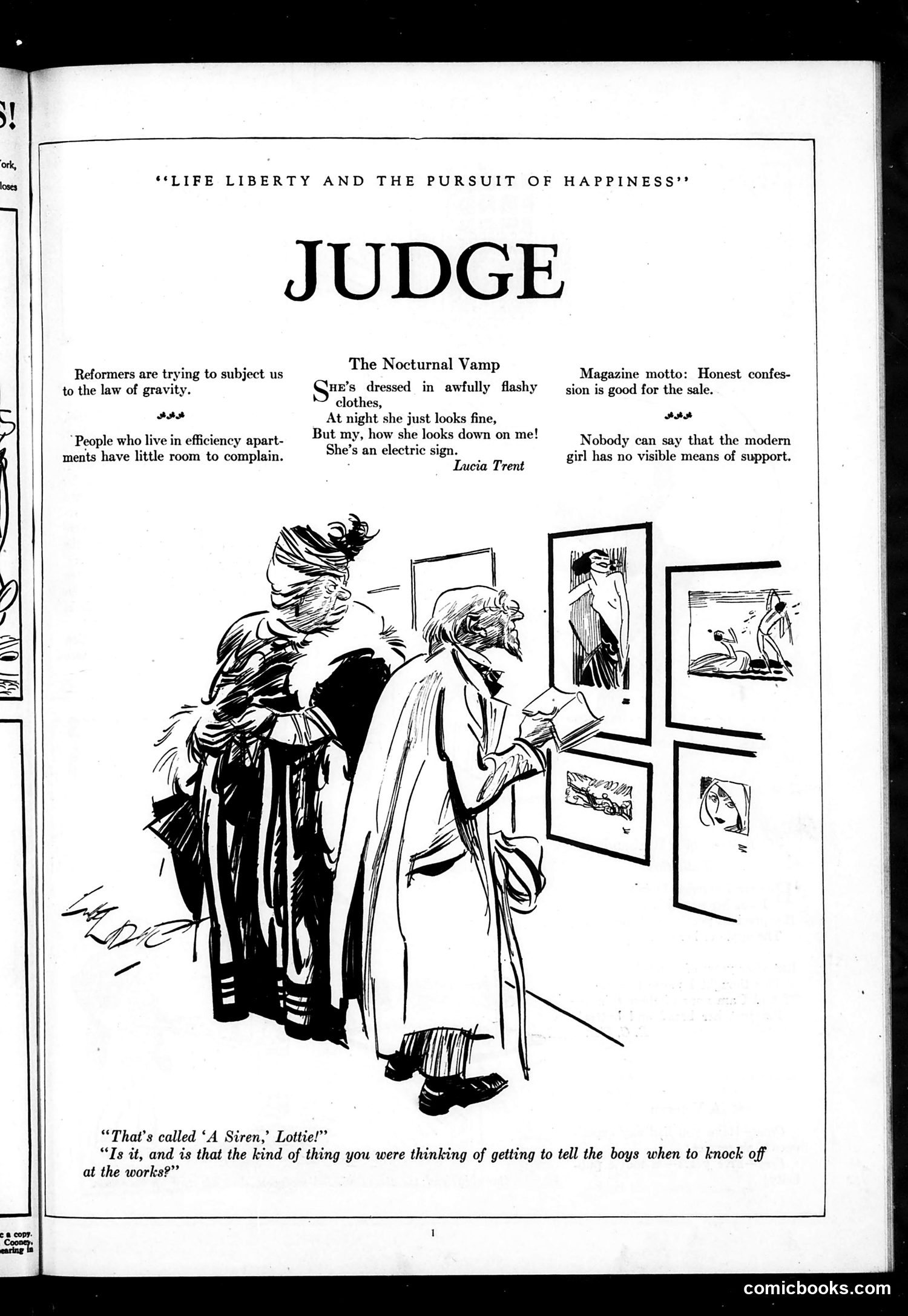
This page from *Judge* magazine satirizes 1920s social changes through multiple short commentaries and a cartoon titled "The Nocturnal Vamp." The main illustration depicts two figures—a man in formal attire examining artwork on a wall while a woman in a revealing, flowing outfit poses behind him. The caption's dialogue suggests the woman is demonstrating a "siren" technique to impress boys at work. The surrounding text mocks modern social trends: reformers trying to impose morality ("law of gravity"), cramped urban living, and women's newfound visibility and independence ("the modern girl has no visible means of support"). The satire targets post-WWI anxieties about changing gender roles, women's liberation, and modern courting practices—portraying women's newfound social freedom as scandalous or manipulative.
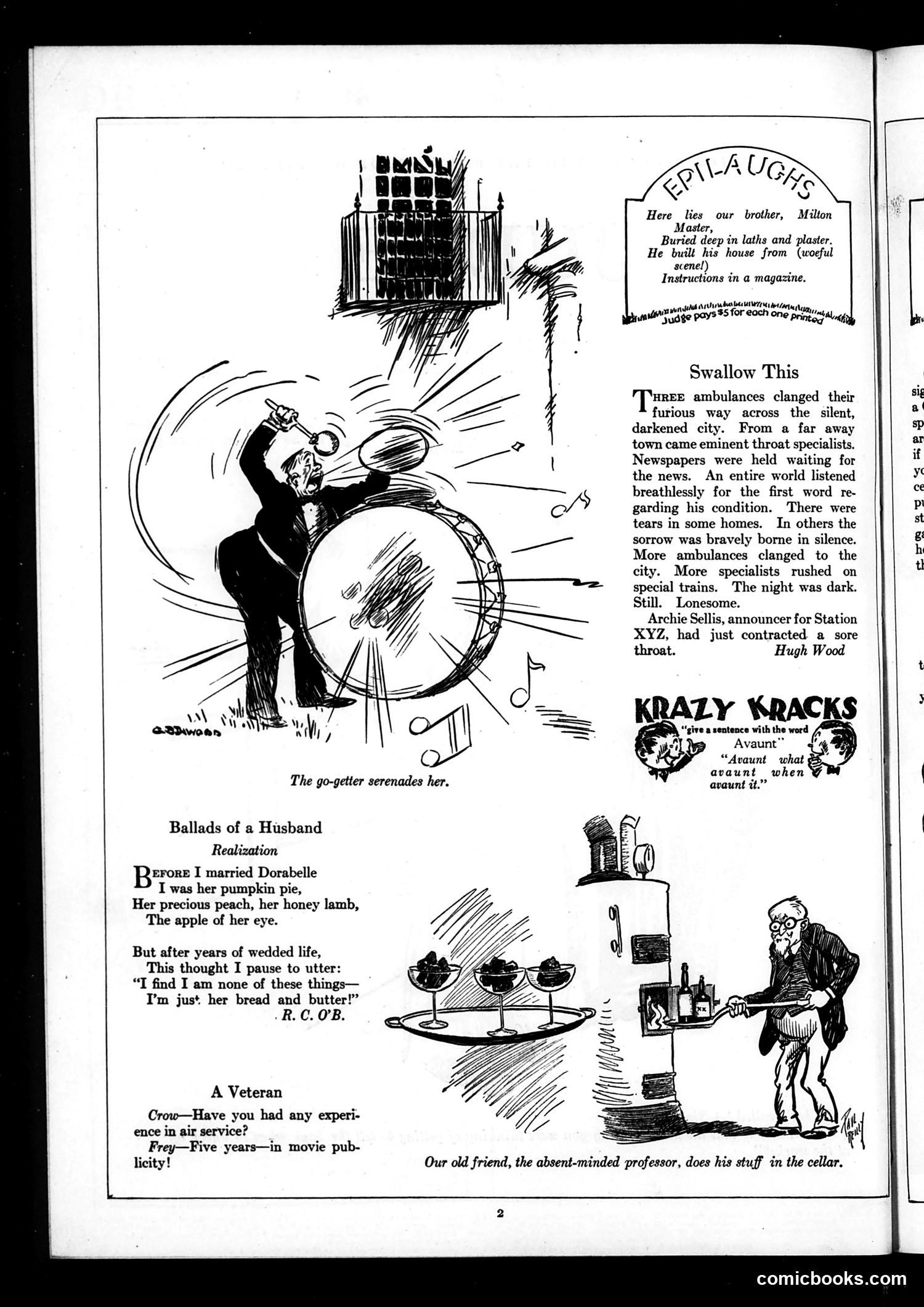
This page contains three distinct pieces of humor: **"Swallow This"** (top right): A story about three ambulances rushing through a city for an unnamed patient, with newspapers eager for updates and specialists arriving by train. The patient turns out to be radio announcer Archie Sellis with a sore throat—a deflating anticlimax mocking the media's breathless coverage of minor celebrity ailments. **"Ballads of a Husband"** (bottom left): A poem by R.C. O'B. contrasting romantic pre-marriage idealization of a woman with post-marriage reality, where the husband dismisses his wife as merely "bread and butter"—satirizing disillusionment in marriage. **"A Veteran"** and **"Krazy Kracks"** are brief joke segments with minimal context visible. The page satirizes media sensationalism, celebrity culture, and marital disappointment.
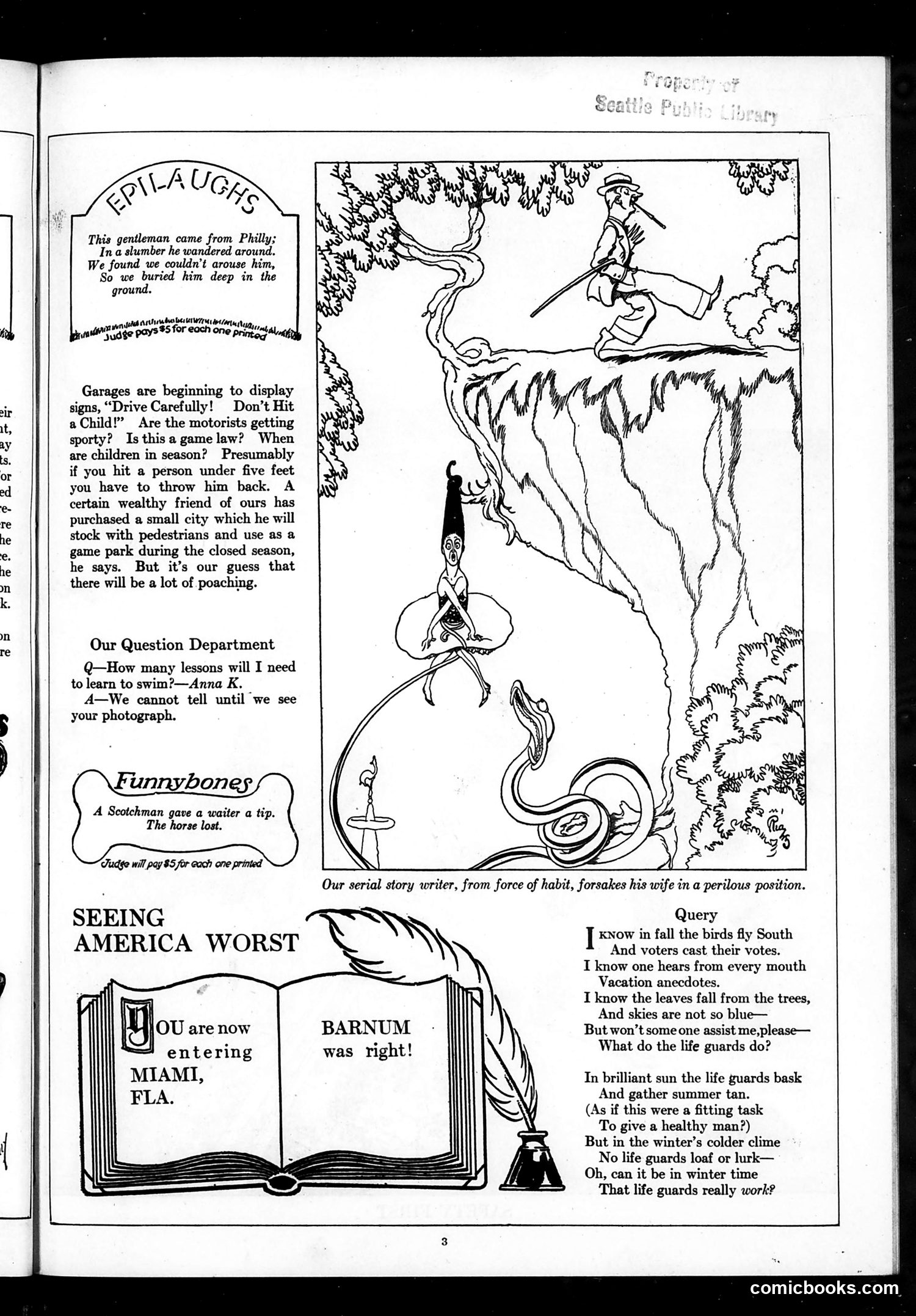
**Main Cartoon ("Epilaughs"):** This features a dark humor "obituary" section. The accompanying illustration depicts a man in a precarious position suspended over a dangerous cliff with a coiled snake, apparently illustrating the text's reference to a gentleman from Philadelphia who "wandered around" in a slumber and couldn't be aroused—so "we buried him deep in the ground." **"Seeing America Worst":** A satirical book labeled "BARNUM was right!" references entering Miami, Florida, suggesting P.T. Barnum's famous quote about "sucker" tourists—implying Miami attracts gullible visitors. **Remaining Content:** Includes humorous questions about swimming lessons, a Scottish joke about tipping, and a poem critiquing life guards' seasonal work habits and leisure activities. The overall tone reflects early 20th-century American satirical humor targeting middle-class follies and tourist behavior.
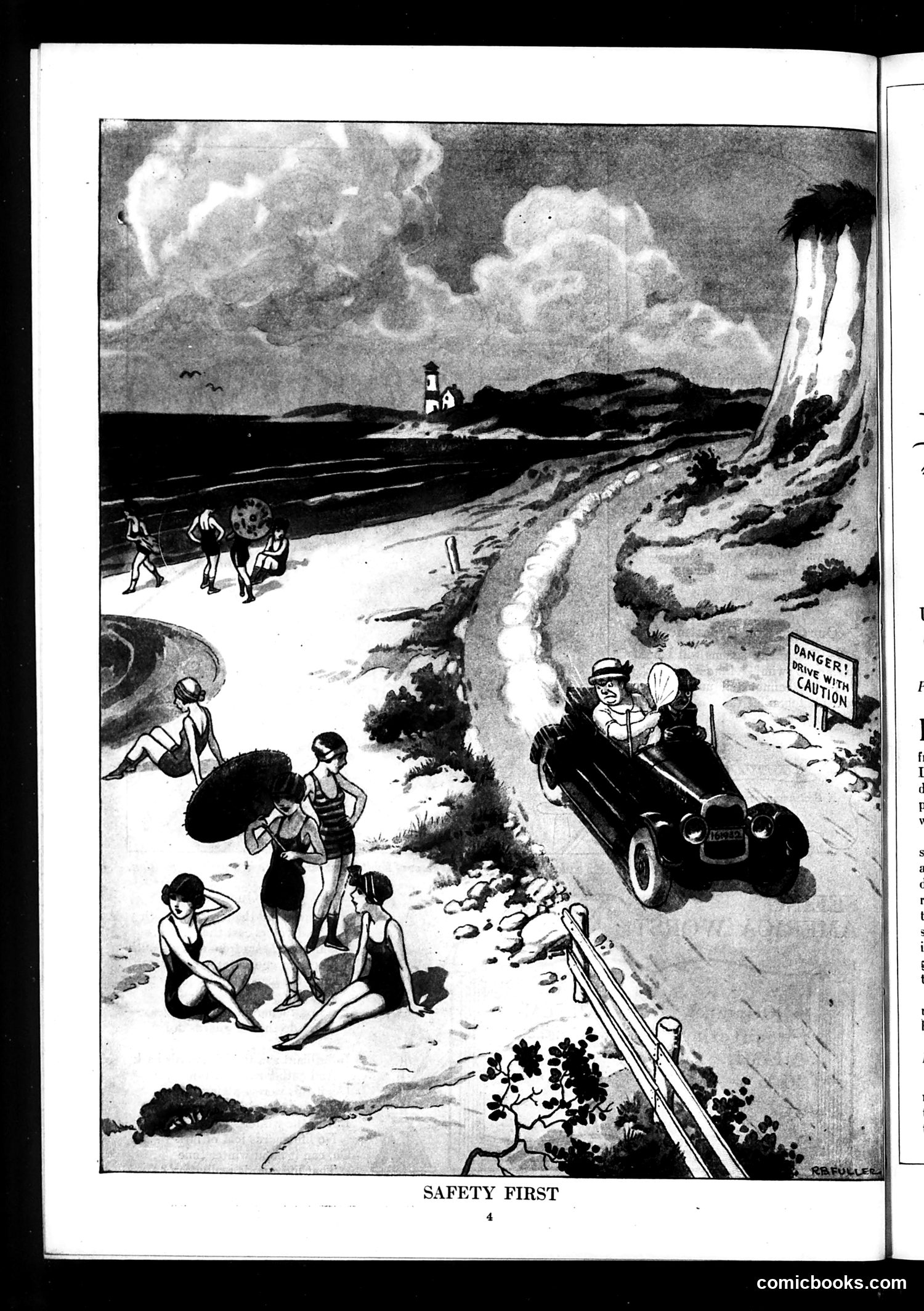
This cartoon satirizes the contrast between safety warnings and reckless behavior. The titled "SAFETY FIRST" appears ironic: a warning sign reads "DANGER! STEEP CLIFF CAUTION," yet beachgoers ignore it completely. The scene shows swimmers and sunbathers relaxing on the beach below a dangerous cliff, while a car drives recklessly down a precarious cliff-side road above them—appearing to pose immediate danger to the people below. A lighthouse visible in the distance suggests a seaside location. The satire targets how people disregard safety regulations and warnings. Despite posted cautions, the visitors proceed with dangerous activities: swimming near unstable cliffs, and motorists operating vehicles on unsafe terrain. The title ironically undercuts the supposed safety consciousness of the era, mocking how these warnings went unheeded.
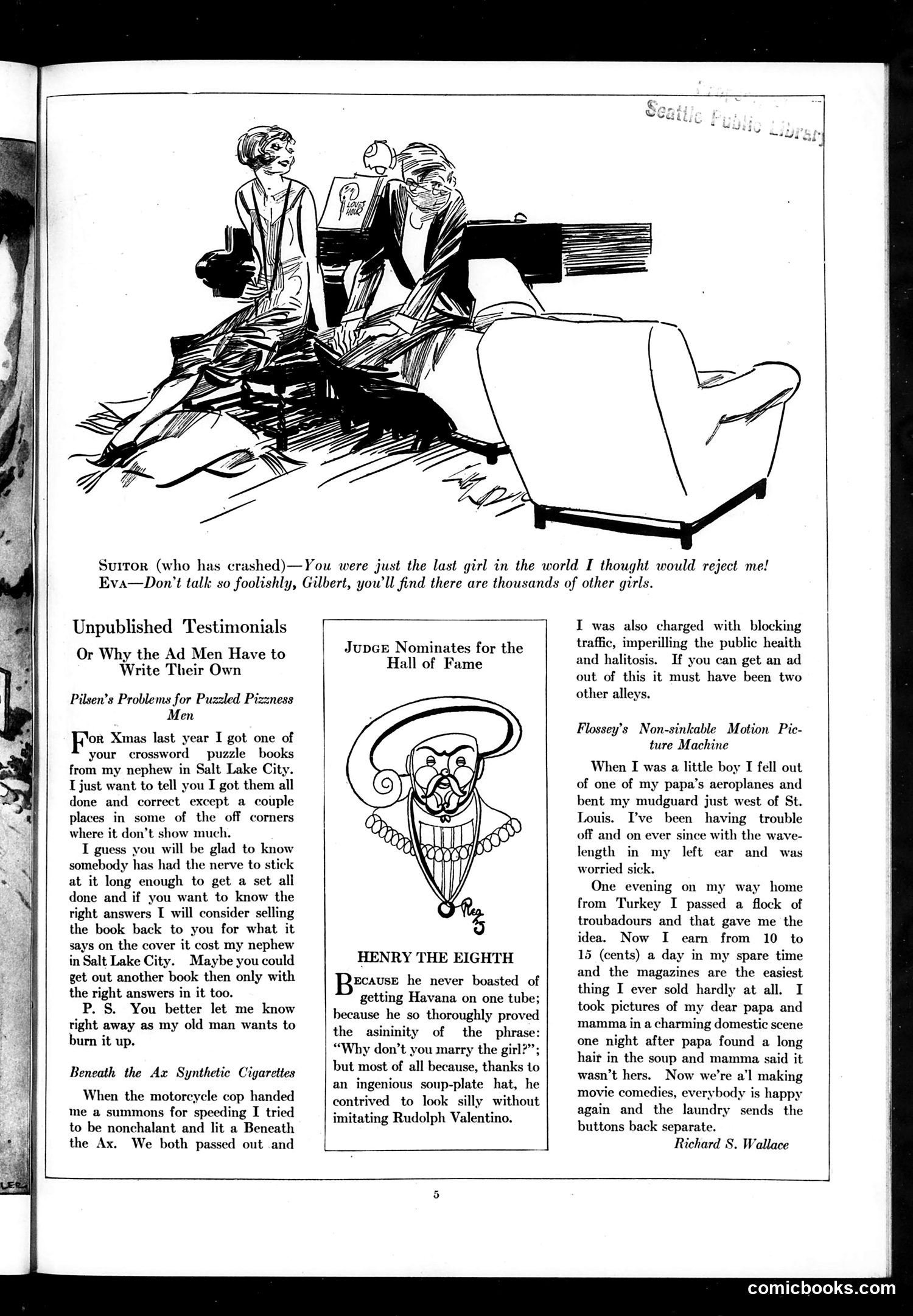
The main cartoon depicts a suitor who has crashed his automobile, attempting to console his female companion. His line—"You were just the last girl in the world I thought would reject me!"—satirizes male entitlement and the disconnect between romantic self-confidence and reality. The page is primarily comprised of "Unpublished Testimonials," humorous reader submissions mocking advertising claims. These include absurd anecdotes: a crossword puzzle book supposedly solving all answers, synthetic cigarettes enabling motorcycle speeding, and an airplane accident creating convenient medical treatment. The "Henry the Eighth" section appears to be a character feature, though its specific satirical target is unclear from visible text. Overall, this page exemplifies *Judge's* satirical approach: mocking both courtship conventions and the exaggerated claims of consumer advertising through fictional testimonials.
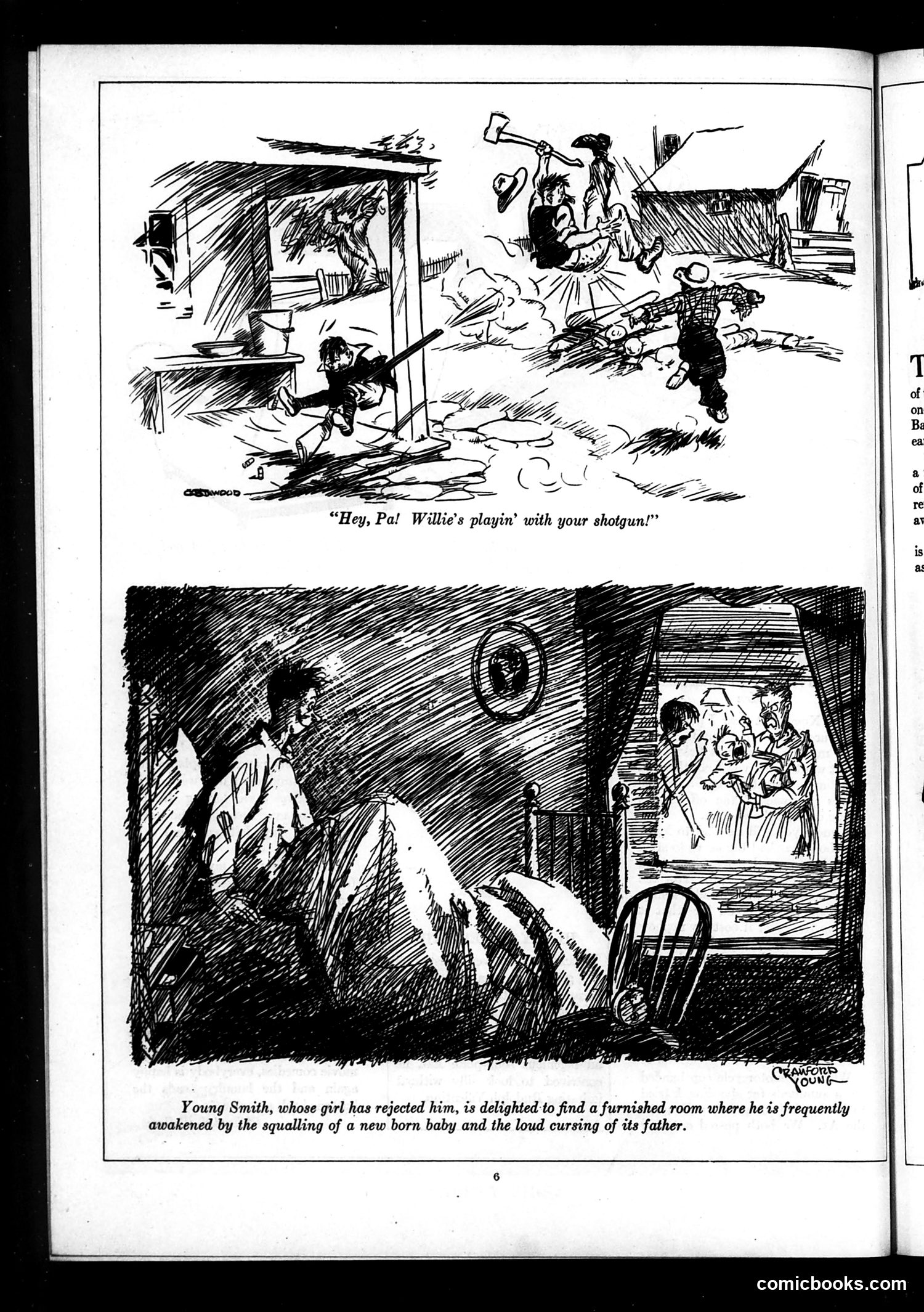
This page contains two cartoons satirizing domestic life and social class. The **top cartoon** shows children playing dangerously with an actual firearm, with one child alerting his father ("Pa") that "Willie's playin' with your shotgun!" The joke targets parental negligence—treating a loaded weapon as casually as any toy. The **bottom cartoon** depicts a young man named Smith finding refuge in a furnished room to escape his girlfriend's rejection. The caption sarcastically notes he's "delighted" by his new living situation, where he's constantly disturbed by "the squalling of a new born baby and the loud cursing of its father" from neighboring tenants. Both cartoons mock lower-class urban life: one depicting careless gun ownership among working families, the other portraying the misery of cheap boarding-house living. The humor derives from presenting obviously unpleasant situations with mock-cheerful framing.
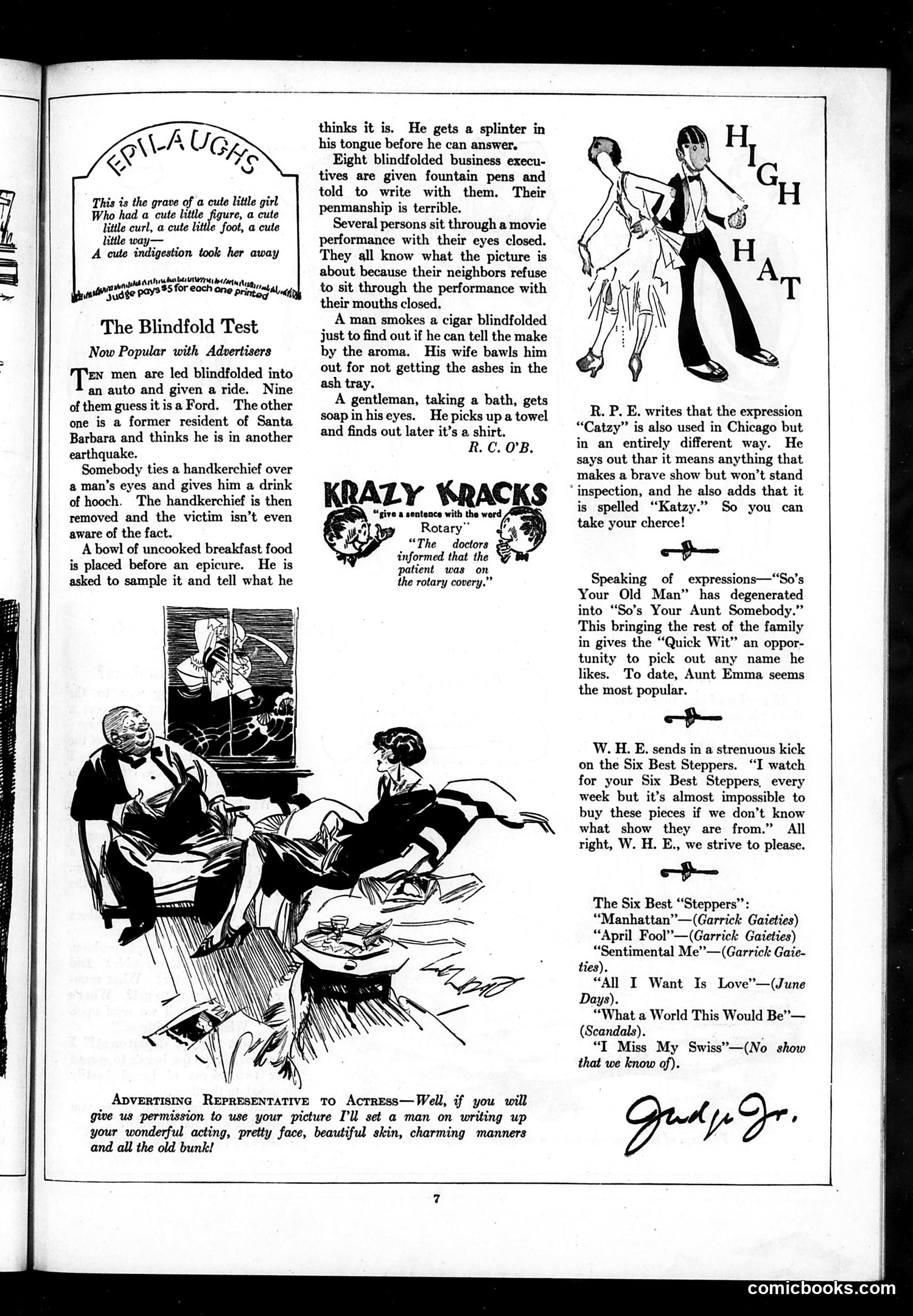
This page satirizes a popular 1920s advertising gimmick where blindfolded consumers supposedly identified products by sensory perception alone. Judge mocks the absurdity of these demonstrations through a series of humorous scenarios. The satire exposes how such "tests" were rigged or meaningless: a man guesses a Ford because of confirmation bias; executives given poor fountain pens produce terrible handwriting regardless; movie-goers know the plot from neighbors talking loudly; a man can't identify a cigar's make; someone confuses a shirt for a towel while bathing. The humor targets both advertisers' false claims about product superiority and consumers' gullibility in believing blindfold tests proved anything. It's social commentary on 1920s consumer culture and advertising deception—showing that subjective judgment and external factors (gossip, poor products, simple mistakes) matter far more than advertised claims about distinguishing quality blindly.
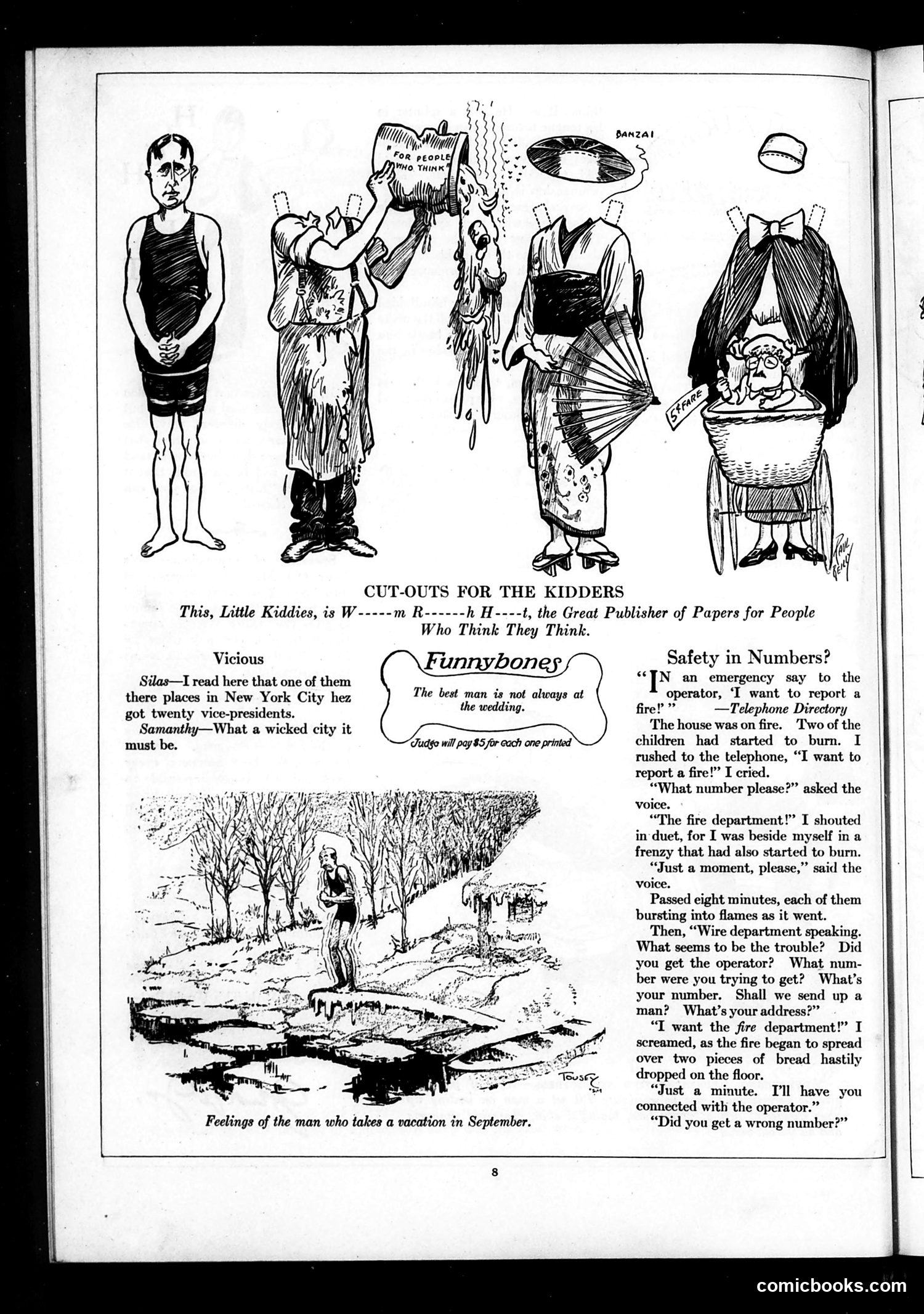
This page contains satirical content targeting early 20th-century American institutions and bureaucracy. **The top section** features paper cutouts mocking "W----t" (likely William Randolph Hearst), a powerful newspaper publisher criticized for sensationalism and papers for unsophisticated readers. **"Vicious Funnybones"** is a brief joke about New York City corruption: having twenty vice-presidents suggests widespread official misconduct. **"Safety in Numbers?"** is the main satire—a darkly comic critique of telephone system inefficiency. A caller reporting a house fire gets repeatedly transferred between departments (wire department, operator) over eight minutes while the fire spreads. The bureaucratic runaround and confused questioning ("Did you get a wrong number?") highlight how institutional red tape can be dangerous and absurd. **Bottom illustration** shows a man's exhausted vacation feelings in September—likely satirizing the brevity of working-class leisure time. The page mocks early 1900s institutional incompetence and bureaucratic frustration.
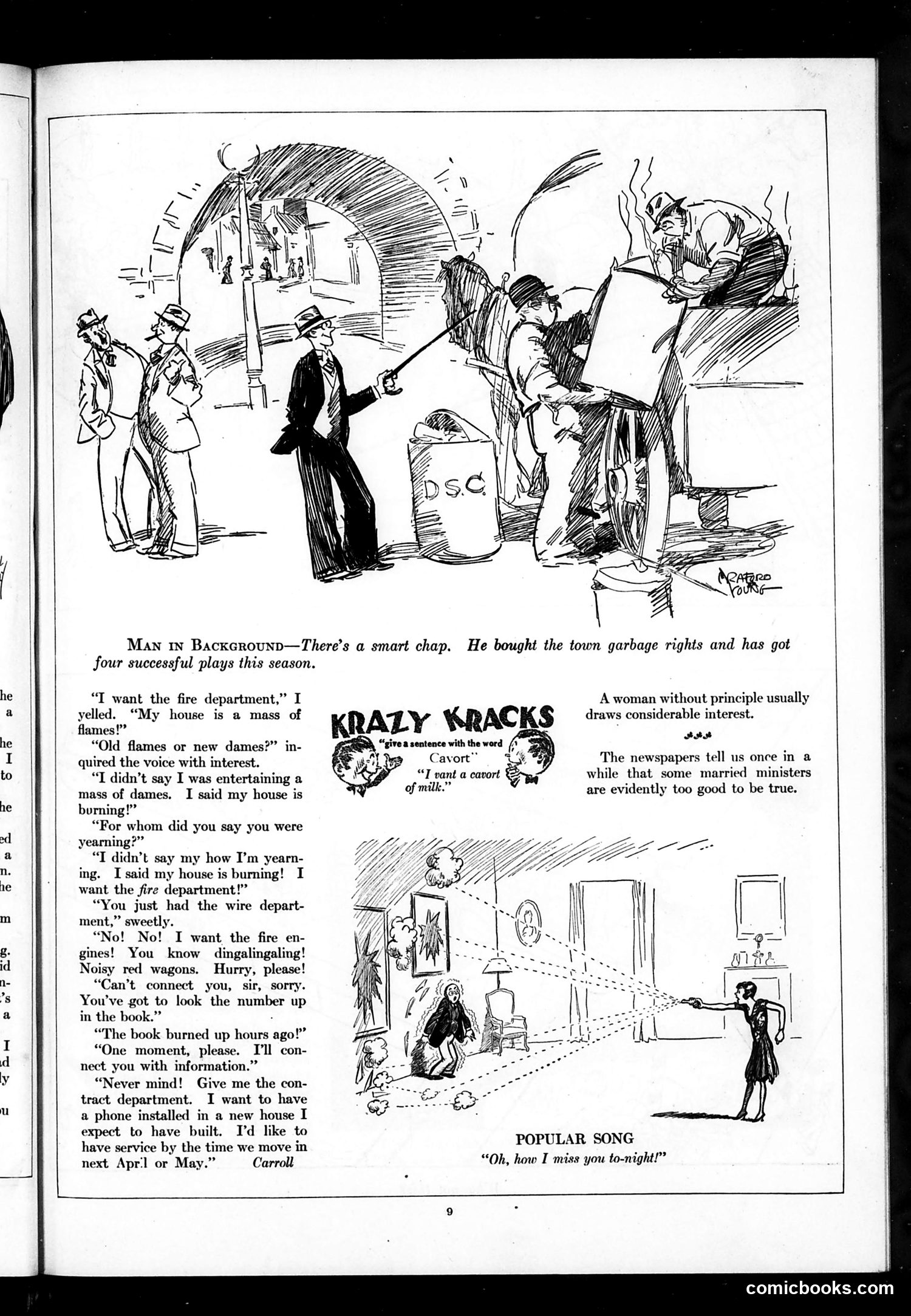
**Top Cartoon ("Man in Background"):** Satirizes a real estate speculator who purchased municipal garbage collection rights and simultaneously produced four successful theatrical plays. The joke celebrates his entrepreneurial opportunism—profiting from both waste disposal and entertainment. **Main Comic Strip:** A slapstick telephone comedy mocking inefficient phone service. A man's house is burning, but the operator repeatedly mishears "fire department" as romantic references ("old flames," "dames," "yearning"). When he finally reaches someone, they direct him to consult a directory—which burned in the fire. The satire targets poor telephone infrastructure and operator competence during the early telephone era. **"Krazy Kracks":** Brief humorous quips. One jokes about married ministers' moral hypocrisy; another uses the word "cavort" in a sentence about desire, playing on the word's association with romantic misbehavior. The page reflects early 20th-century urban anxieties: unreliable utilities, bureaucratic incompetence, and social hypocrisy among respectable institutions.
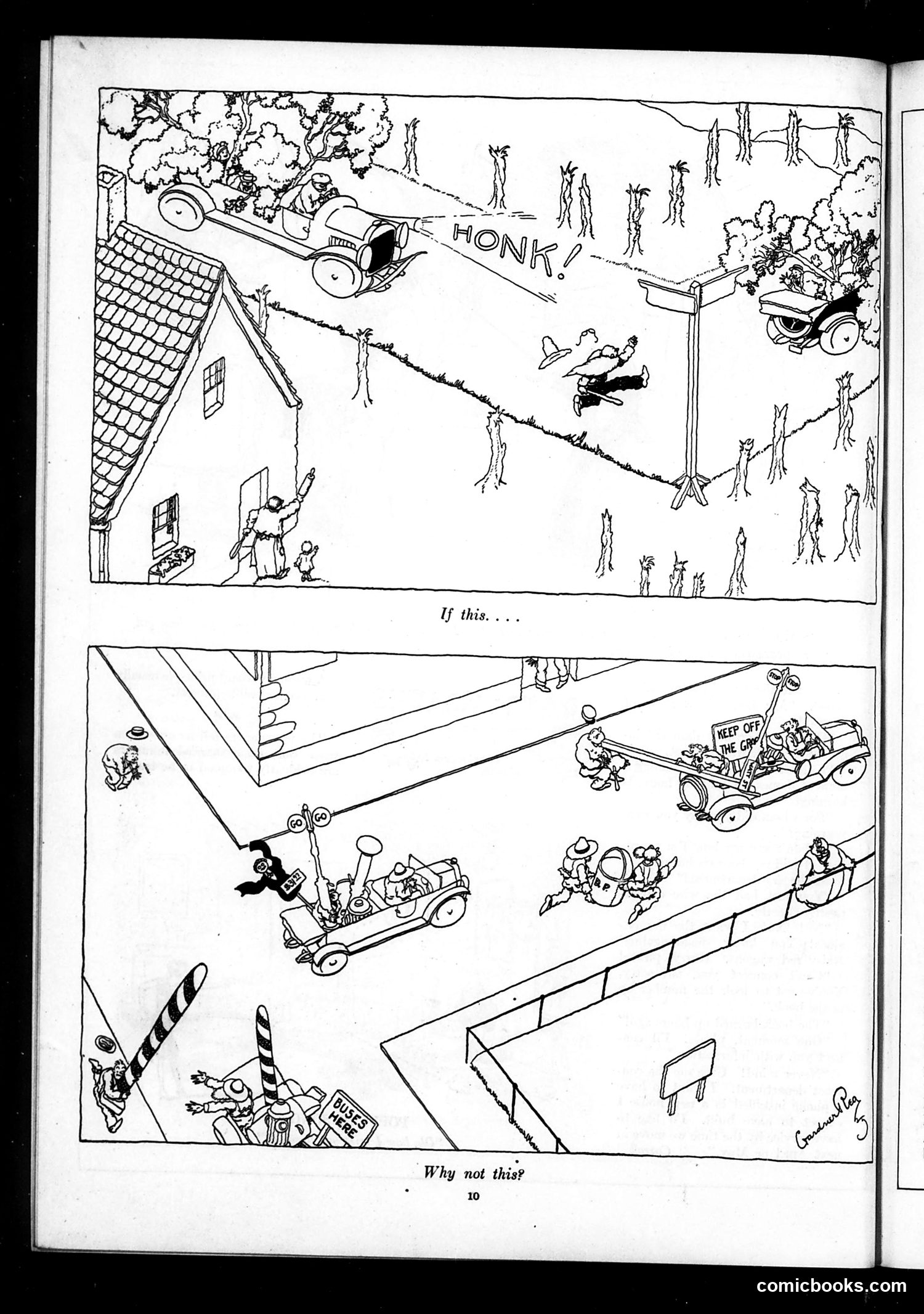
This two-panel cartoon appears to satirize urban traffic safety and street design, likely from the early-to-mid 20th century when automobiles were becoming common. The top panel shows chaos: cars honking while pedestrians scatter among clotheslines and a house. The caption reads "If this...." The bottom panel, captioned "Why not this?" proposes an alternative: a grade-separated roadway system where cars travel on an elevated or sunken level, completely separated from pedestrians and buildings at ground level. The satire critiques the dangerous mixing of automobiles and pedestrians in existing streets. The cartoonist argues for segregated traffic—a progressive urban planning concept at the time—as an obvious solution to the mounting street congestion and safety problems of growing cities. The humor lies in presenting this separation as obviously sensible while cities continued allowing dangerous street-level chaos.
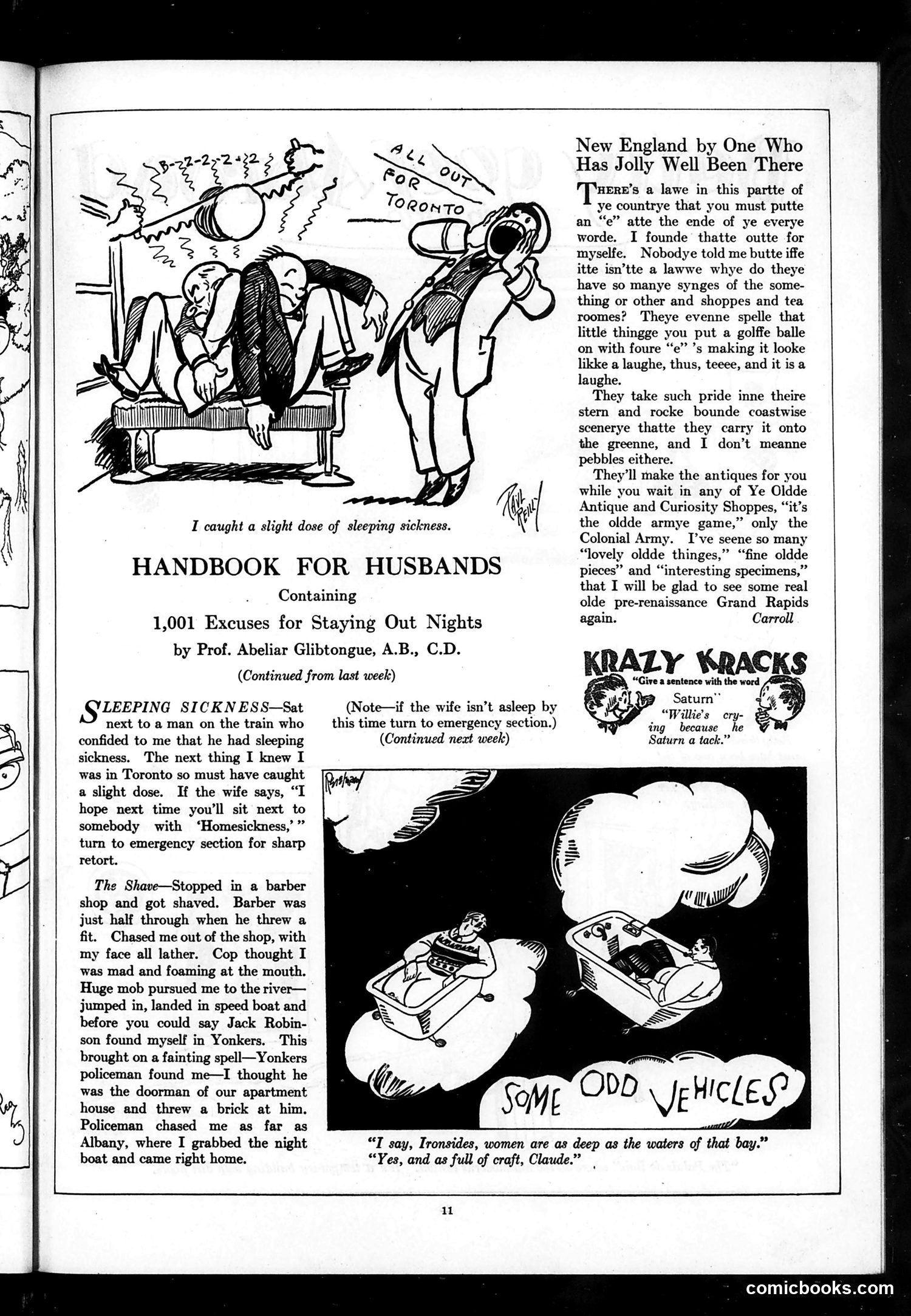
This page contains three satirical pieces mocking New England culture and marital dynamics: **"New England by One Who Has Jolly Well Been There"**: The author ridicules New England's supposed obsession with adding the letter "e" to every word (mimicked throughout the text: "thatte," "shoppe," "teeee"). This mocks both the region's actual historical spelling conventions and tourists' exaggerated perception of quaint Ye Olde New England authenticity. The dig at antique shops selling "oldde armye" items as "Colonial Army" relics—contrasted unfavorably with "Grand Rapids" furniture—suggests New Englanders cynically market fake colonial nostalgia to tourists. **"Handbook for Husbands"**: This recurring feature humorously catalogs excuses married men use to stay out late. "Sleeping Sickness" and "The Shave" are implausible scenarios (the barber incident escalates absurdly from haircut to police chase to Yonkers). **"Krazy Knacks"**: A wordplay puzzle asking readers to construct sentences using "Saturn." The overall tone reflects 1920s-era satire about regional stereotypes, tourist commercialism, and domestic marital tensions.
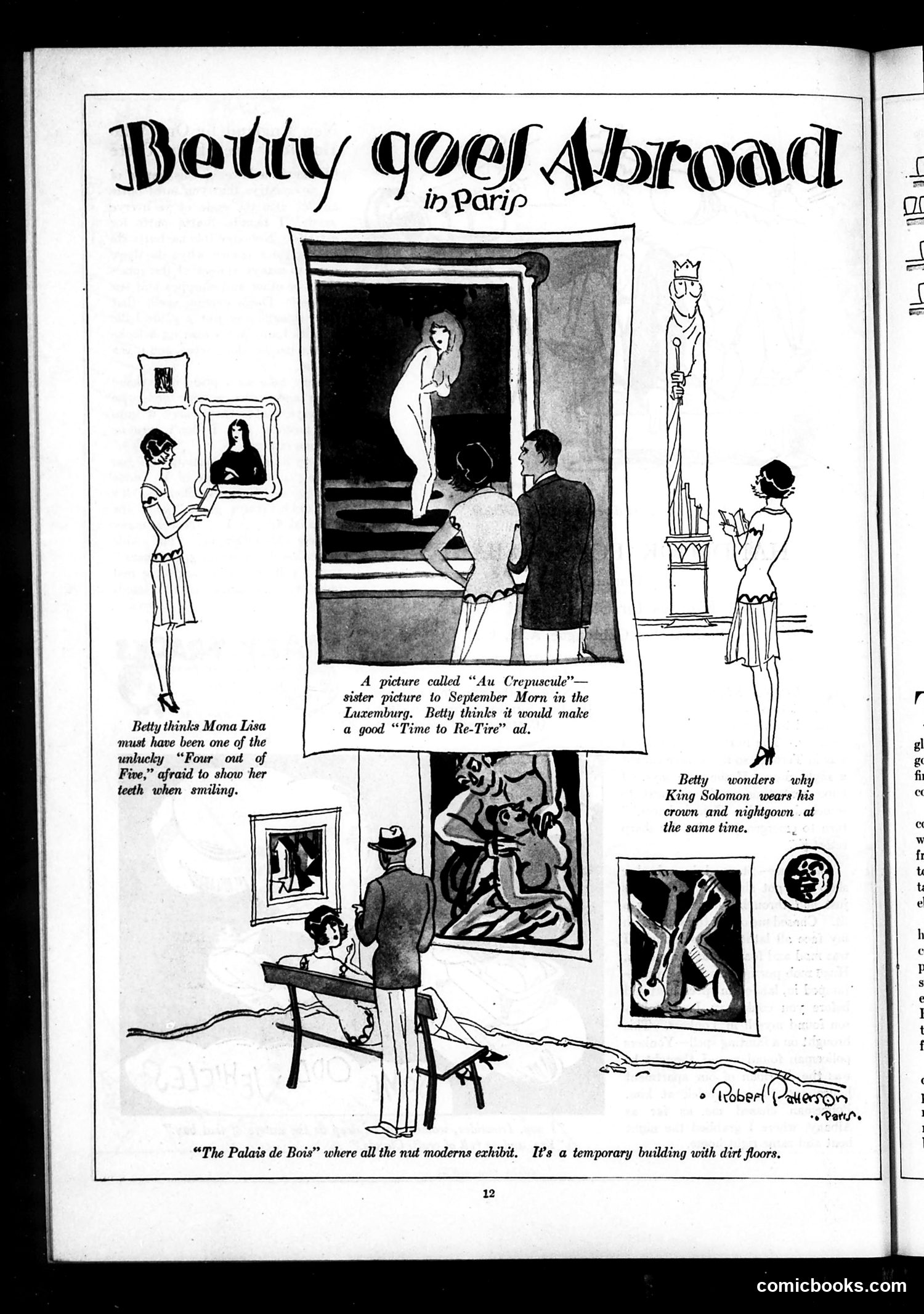
This satirical page mocks American tourist Betty's observations of modern art and European culture. The central joke references "September Morn," a famous 1912 painting by Paul Chabas that scandalized Americans for depicting female nudity—Betty compares a cubist artwork ("Au Crepuscule") to this notorious picture, suggesting modern art is equally shocking or absurd. The side gags ridicule famous artworks: Betty critiques the "Mona Lisa" for not smiling (playing on dental hygiene advertising), and questions King Solomon's simultaneous crown and nightgown in a painting. The caption mocks the "Palais de Bois" exhibition venue as a temporary structure with dirt floors, suggesting modernist/avant-garde art exhibitions were pretentious despite humble physical conditions. The humor targets both American prudishness about art and the perceived pretentiousness of modernist movements in 1920s Paris.
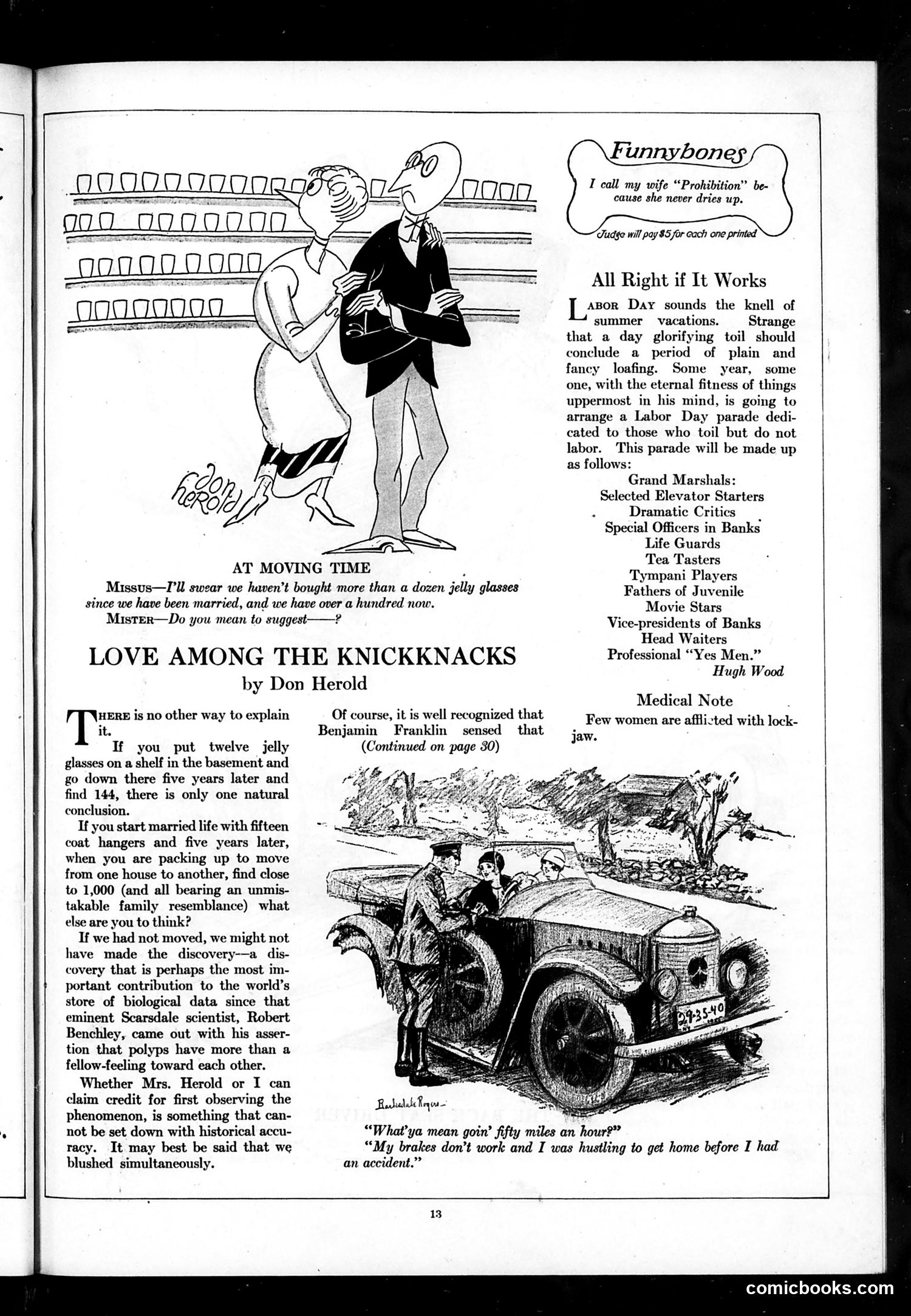
This page contains three satirical pieces typical of 1920s humor: **"Funnybones" joke**: A husband calls his wife "Prohibition" because "she never dries up"—a topical reference to Prohibition-era drinking bans. The joke equates nagging wives with alcohol restrictions. **"All Right if It Works"**: A Labor Day satire listing "workers" who don't actually labor: elevator starters, dramatic critics, bank officers, tea tasters, movie stars, and "Yes Men." It mocks white-collar professions and corporate hierarchy as parasitic rather than productive. **"Love Among the Knickknacks" by Don Herold**: The main piece humorously explains how household items mysteriously multiply during married life—twelve jelly glasses become 144; fifteen coat hangers become 1,000. It's an absurdist observation about domestic accumulation and moving day discoveries. **Car cartoon**: A couple in a disabled vehicle; the driver explains he was speeding because his brakes don't work—dark humor about automotive dangers. The page reflects Jazz Age cynicism about marriage, labor, and modern life.
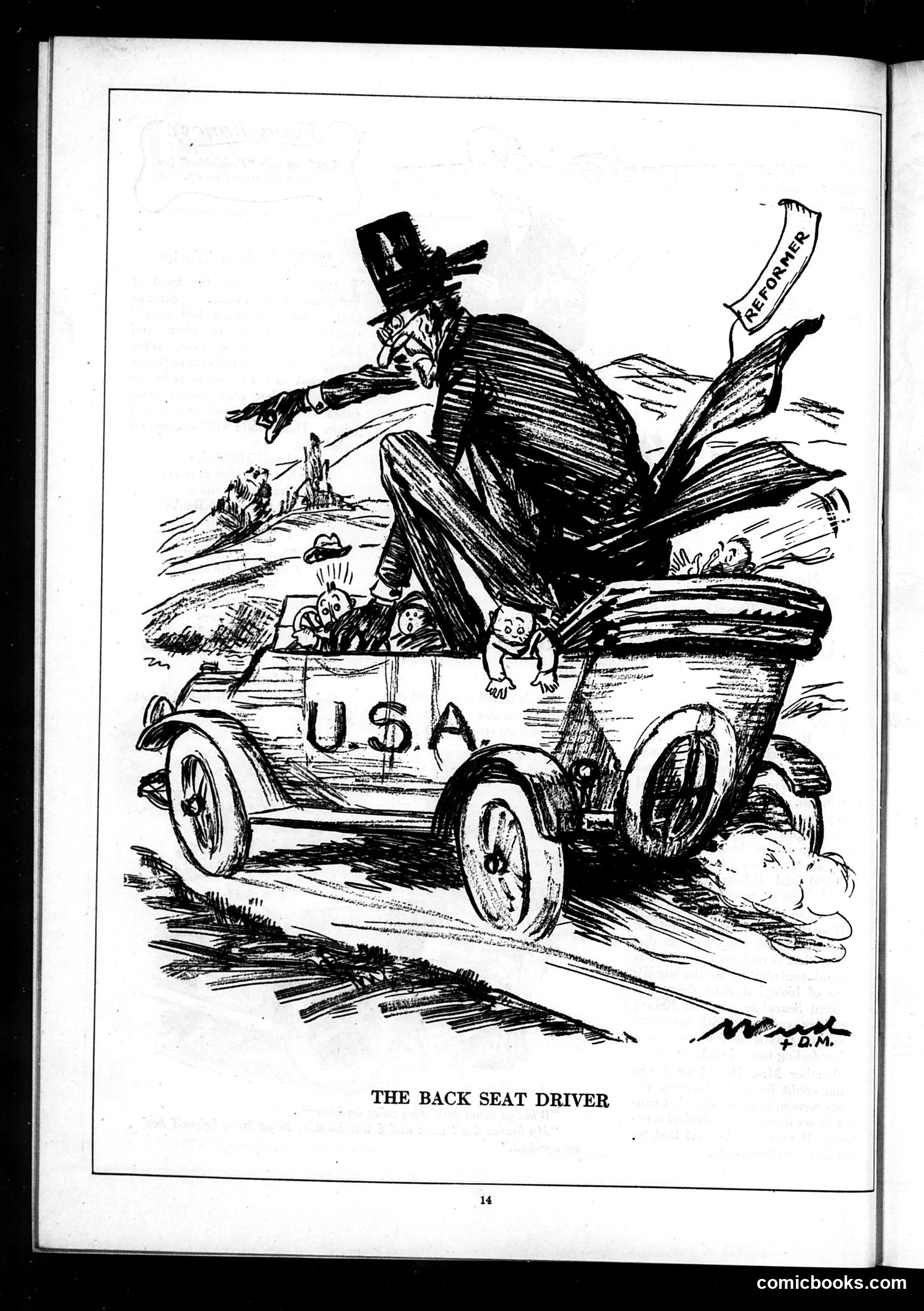
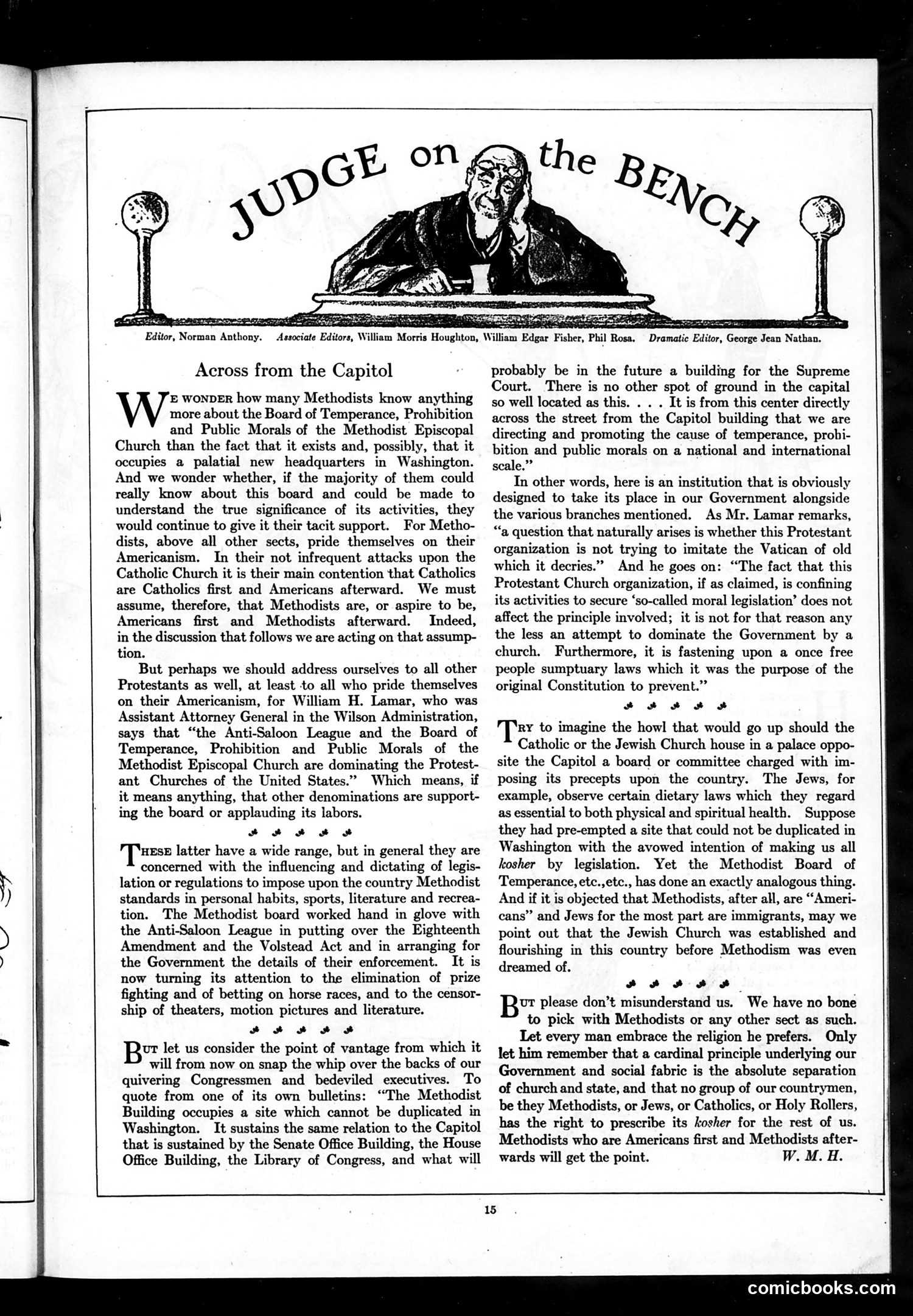
This editorial criticizes the Methodist Board of Temperance, Prohibition and Public Morals for operating like a quasi-governmental authority from their new Washington headquarters directly across from the Capitol building. **The satire targets:** - Methodist Methodists' hypocrisy: they claim to be "Americans first," yet their board dominates Protestant churches and imposes Methodist standards nationwide - The board's influence over Prohibition enforcement, the Volstead Act, and censorship legislation - The irony that Protestants attack Catholicism for Vatican influence, while the Methodist board itself functions as a religious power center dictating to government **The joke:** The author compares the Methodist Building's strategic proximity to the Capitol to the Vatican's relationship with secular power—exactly what the Methodists criticize Catholics for doing. The board claims to promote "moral legislation," but it's actually attempting to dominate American policy through religious institutional power, violating the Constitutional separation of church and state. The satire mocks this as fundamentally un-American.
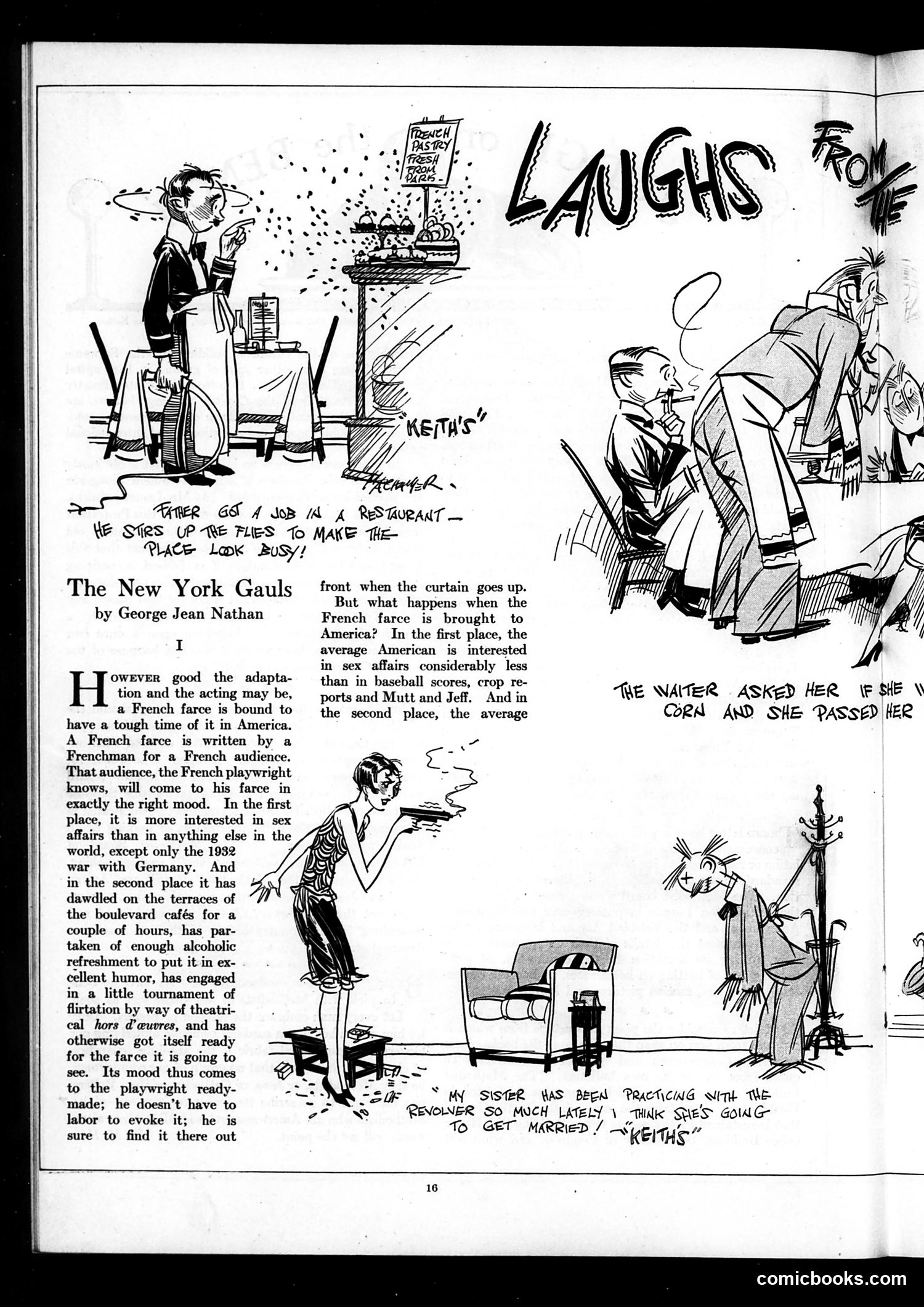
This page critiques the American reception of French farce theater. Nathan argues that French farces succeed in France because audiences arrive pre-conditioned: they've spent hours at cafés drinking wine, flirting, and are primed for bawdy comedy focused on sex affairs. In America, he contends, the strategy fails. American audiences care more about baseball scores and comic strips (Mutt and Jeff) than sexual intrigue. The accompanying cartoons illustrate this cultural gap through domestic and restaurant scenarios—depicting Americans' indifference to the sophisticated flirtation and romantic complications that form French farce's foundation. The piece uses "Gauls" (ancient French people) ironically, suggesting French dramatic traditions simply don't translate to American sensibilities. This reflects 1930s attitudes about European versus American cultural values and humor preferences.
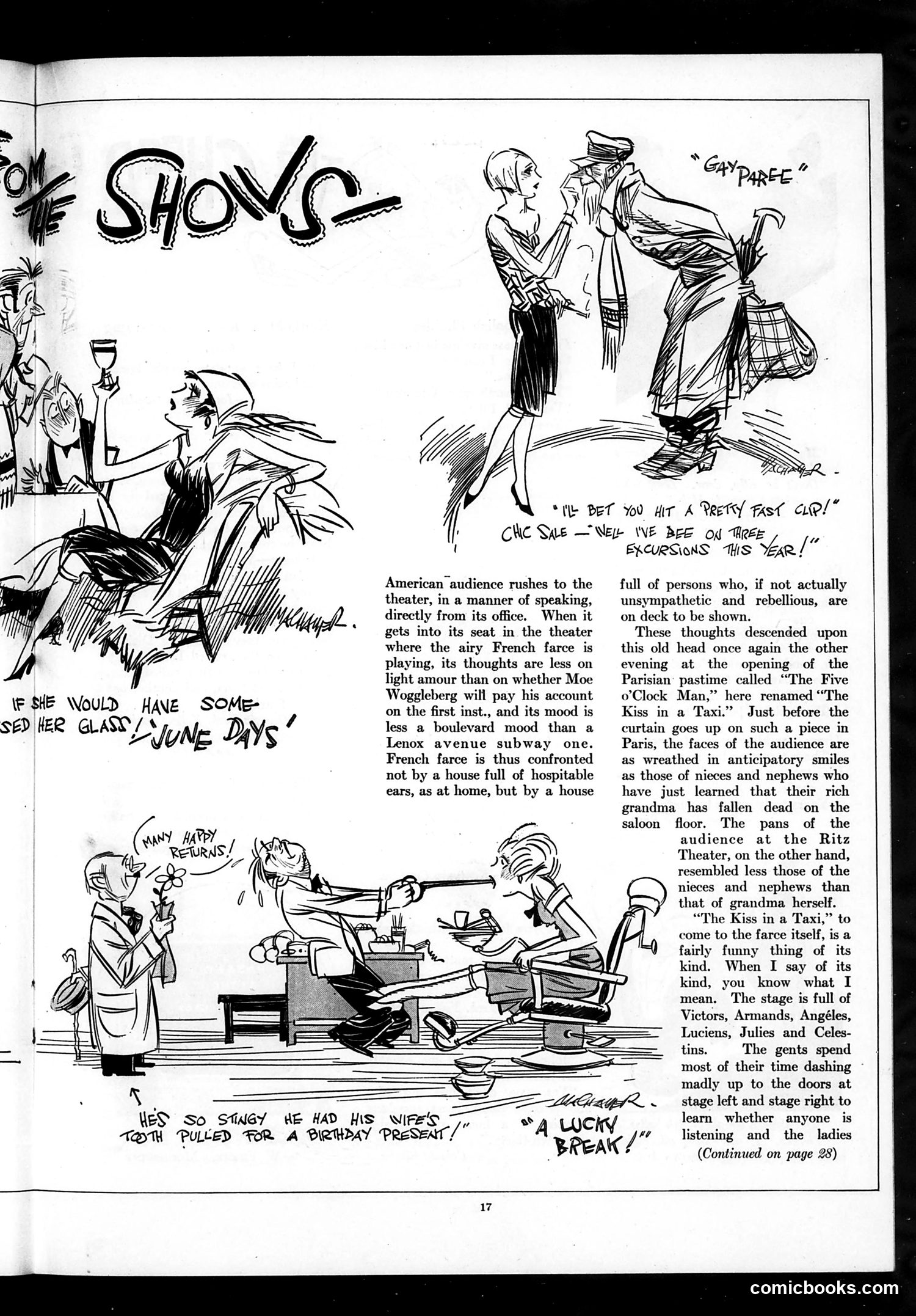
This page satirizes the contrast between French and American theater audiences attending a French farce called "The Kiss in a Taxi" (originally "The Five o'Clock Man"). **The Satire's Point:** American audiences attending this Parisian comedy at the Ritz Theater lack the carefree, romantic mood essential to appreciating French farce. Instead of arriving in a "boulevard mood," they're preoccupied with mundane concerns—paying bills, subway commutes, office work. Where Parisian audiences greet such plays with anticipatory smiles like heirs learning of a rich grandmother's death, American audiences resemble the disappointed grandma herself. **The Comics:** Crude sketches mock domestic scenes and theater-goers, illustrating the cultural disconnect. Captions like "If she would have some June days" and "A lucky break!" reference the play's romantic pretensions versus American pragmatism. **Historical Context:** This reflects early 20th-century anxiety about American materialism and commercialism allegedly undermining appreciation for European cultural refinement and leisure.
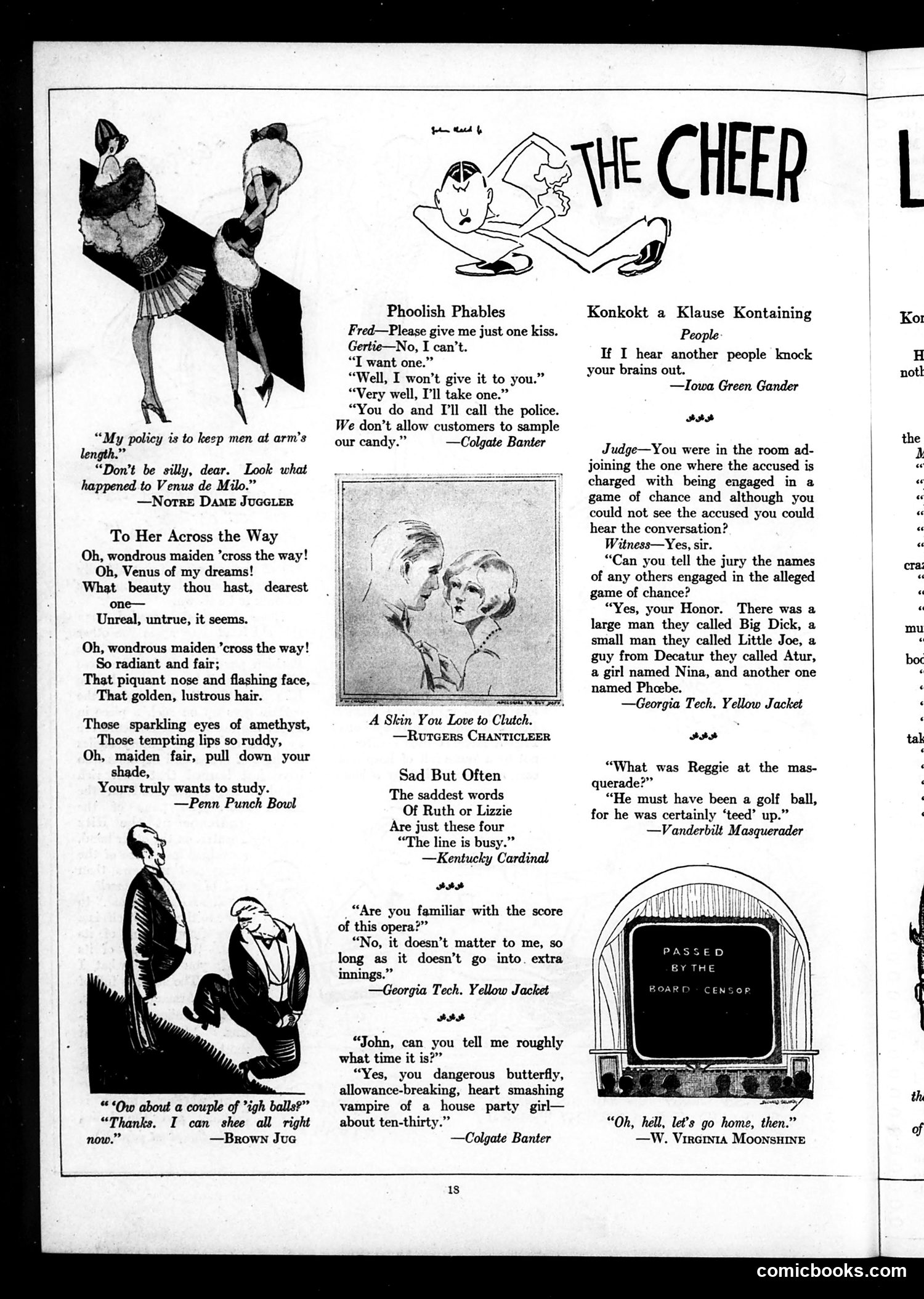
This is a humor compilation page from *Judge* magazine featuring college-oriented jokes and satirical observations. The content reflects early 20th-century collegiate and social life: **Main themes:** 1. **Dating/courtship humor**: Multiple jokes about pursuing women, kissing, and romantic advances—with women often refusing or threatening police involvement ("we don't allow customers to sample our candy"). 2. **College life**: References to Penn, Brown, Rutgers, Georgia Tech, Kentucky, and Vanderbilt suggest college publication origins. Jokes about studying, masquerades, and drinking ("high balls"). 3. **Social commentary**: The Venus de Milo reference jokes about women maintaining distance from men. A joke about telephone busy lines satirizes modern technology's frustrations. 4. **Alcohol**: Casual references to drinking, including a drunk man who can "shee all right now." 5. **Gender dynamics**: The humor consistently depicts men pursuing women who resist or mock them, reflecting period attitudes toward courtship. The page's satire is genteel rather than political—aimed at amused college audiences recognizing their own social experiences.
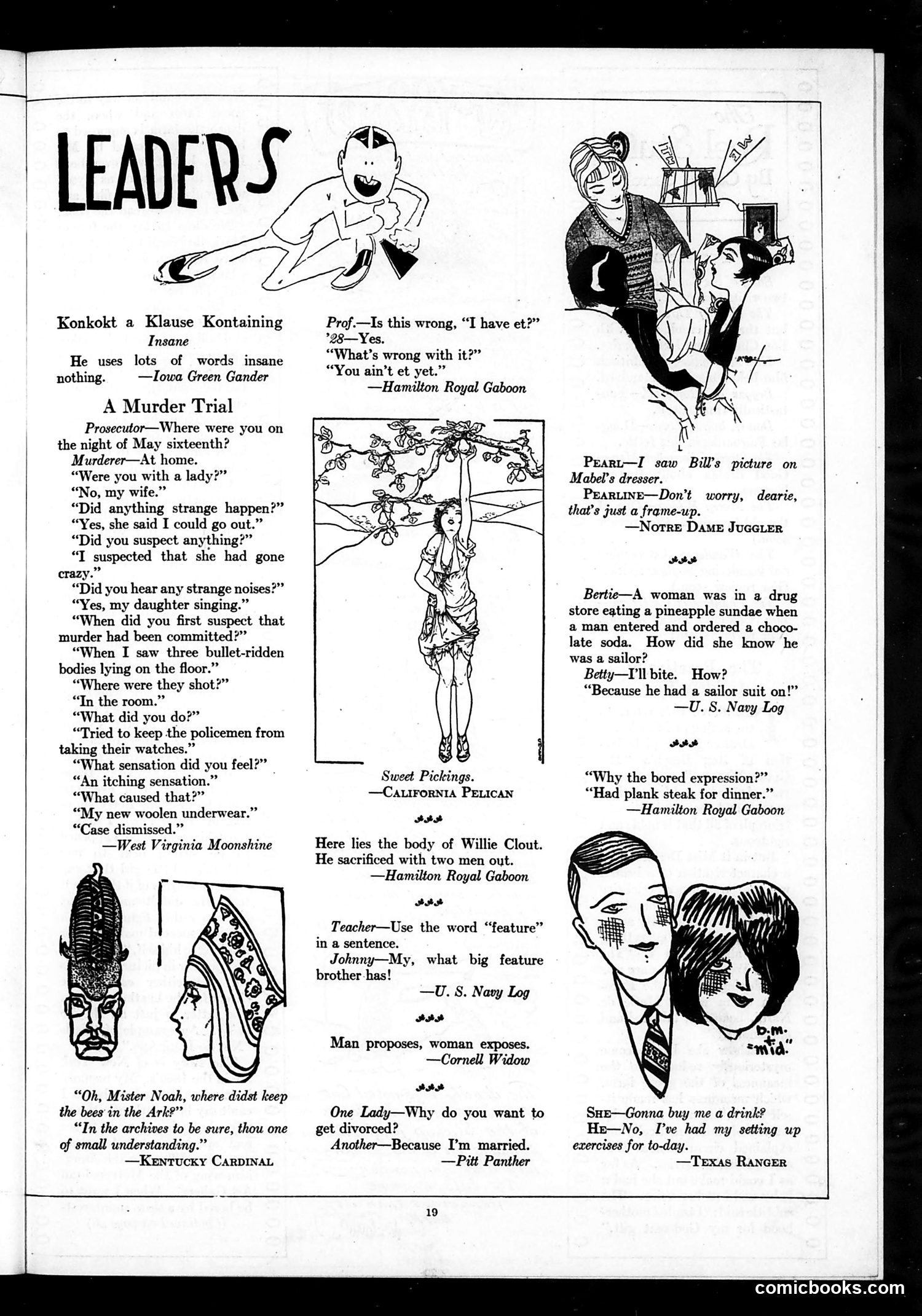
This page collects short humorous quips and jokes typical of early-20th-century college and military humor magazines. The content includes: **"A Murder Trial"** presents absurdist courtroom dialogue where a defendant's testimony becomes increasingly ridiculous—his wife saying he could go out is treated as suspicious, and he admits trying to prevent police from taking their watches at a crime scene. The humor derives from subverting legal logic. **Other jokes** traffic in period stereotypes and wordplay: a grammar lesson about incorrect verb usage, baseball references ("sacrificed with two men out"), and domestic humor about marriage being grounds for divorce. The **visual cartoons** include anatomical drawings (African masks, classical profiles) unrelated to the text, and illustrations of women in 1920s fashion alongside brief romance/gender jokes. The sourcing ("West Virginia Moonshine," "Cornell Widow," "U.S. Navy Log") indicates these are reprinted from college and military publications. The humor emphasizes marital discord, linguistic absurdity, and innuendo typical of the era's college humor tradition—mostly inaccessible without period context about what counted as "daring" comedy.
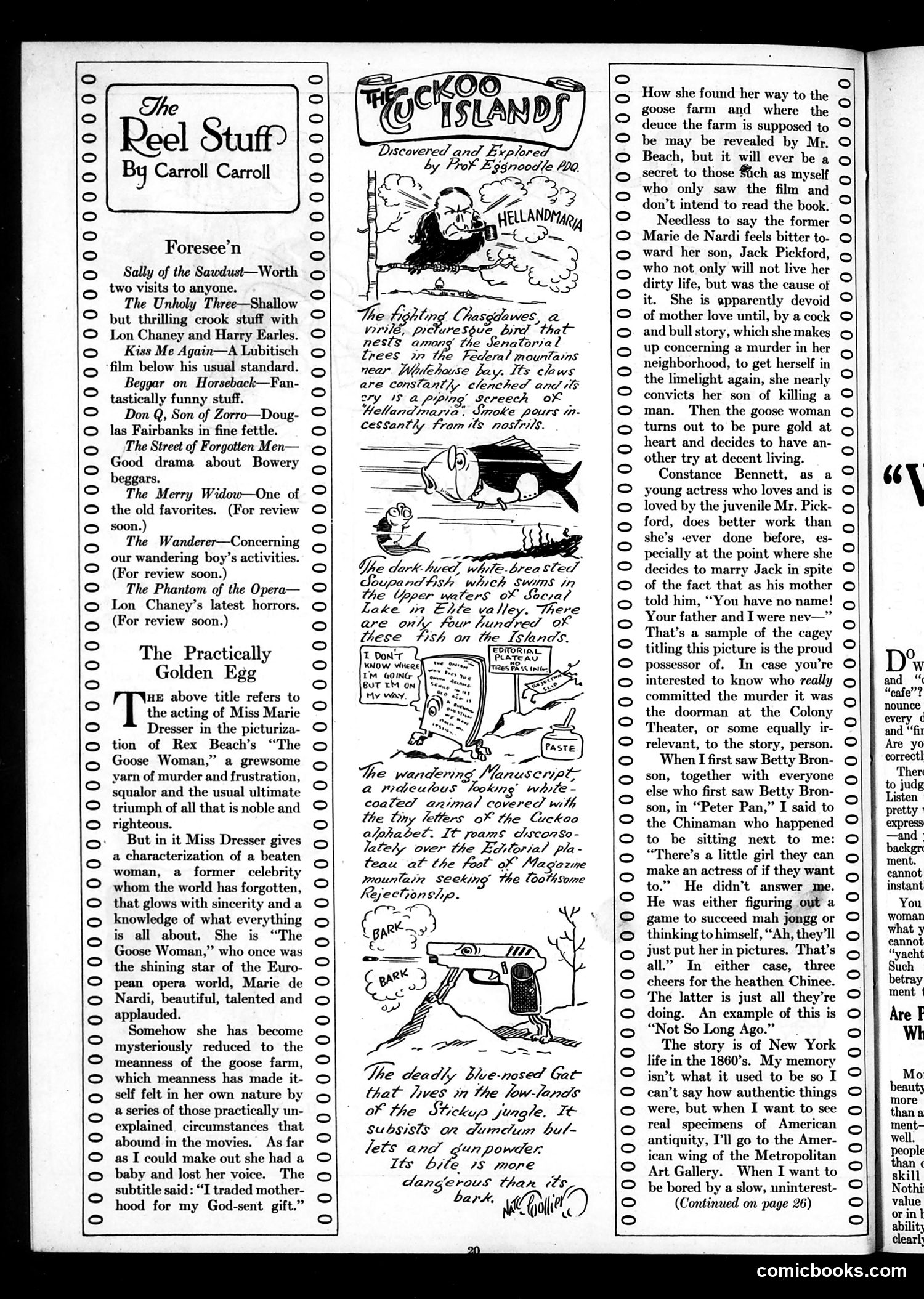
This page from *Judge* magazine contains film reviews and a satirical section called "The Cuckoo Islands." **The Main Content:** The left column reviews silent films from the 1920s, including works by Lon Chaney and Douglas Fairbanks. The review of "The Goose Woman" praises actress Marie Dressler's performance as a former opera star reduced to running a goose farm—a melodramatic plot typical of silent cinema. **The Satire (Center & Right):** "The Cuckoo Islands" mockingly catalogs fictional exotic creatures with absurd names and characteristics. This appears to parody travel narratives and pseudoscientific discovery accounts popular in the era. The hand-drawn creatures are deliberately ridiculous, with descriptions like birds making "piping screeches" and fish existing in tiny numbers—obvious nonsense presented as serious discovery documentation. The satire targets gullible readers who believed exaggerated travel stories and the magazine's own editorial pretensions.
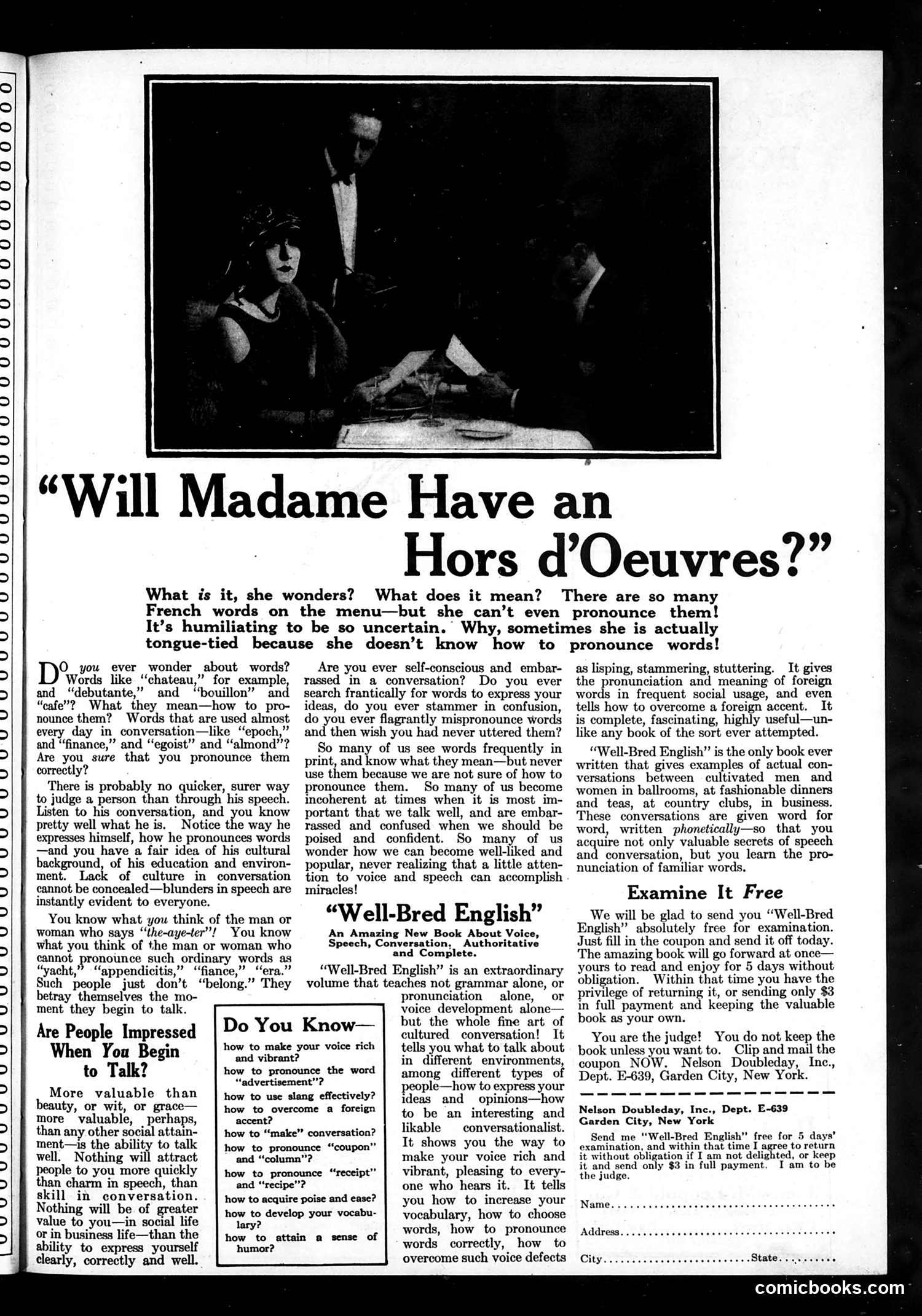
This is primarily **advertising disguised as advice content**—a common early 20th-century magazine tactic. The satirical cartoon at top depicts a woman embarrassed at a restaurant, unable to pronounce French menu items like "hors d'oeuvres." The accompanying article exploits **class anxiety**: it claims that poor speech reveals low education and social standing, making you unpopular and professionally unsuccessful. Words like "yacht," "chateau," and "bouillon" supposedly expose you as uncultured. The real point: sell the advertised book "Well-Bred English" by convincing readers they're socially deficient without it. **The satire works on two levels**: Judge mocks both the pretentious use of French in everyday American life AND the insecurity-based marketing that preys on social climbers. The implication is that Americans needlessly adopt foreign affectations while simultaneously feeling inadequate about pronouncing them—a distinctly American anxiety about class and sophistication that persists today.
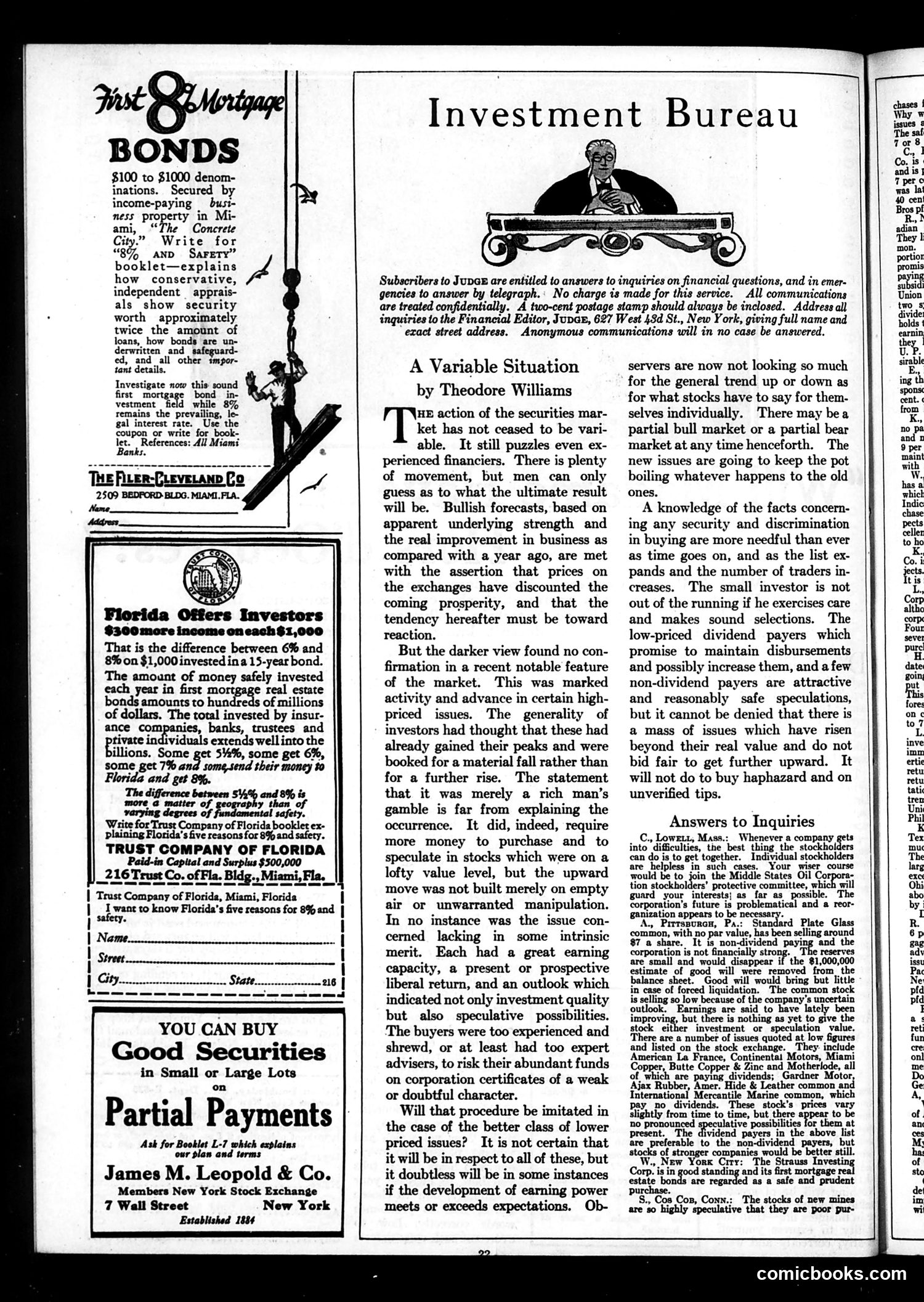
This page is primarily **financial advertising** from Judge magazine's "Investment Bureau" section, not political satire. The cartoons function as marketing hooks rather than social commentary. The left side features advertisements for bonds and securities from various Florida and New York financial firms, emphasizing safe, income-producing investments (6-8% returns). The imagery shows a prosperous businessman and depicts investment as accessible even to modest investors through partial payment plans. The main article, "A Variable Situation" by Theodore Williams, discusses stock market volatility and investor psychology during this period (appears to be 1920s). Williams argues that recent activity in high-priced stocks reflects genuine business strength rather than mere speculation or manipulation by wealthy elites. The tone is reassuring: solid companies with real earnings capacity are rising, not risky ventures. This reflects post-WWI optimism about American business, before the 1929 crash.
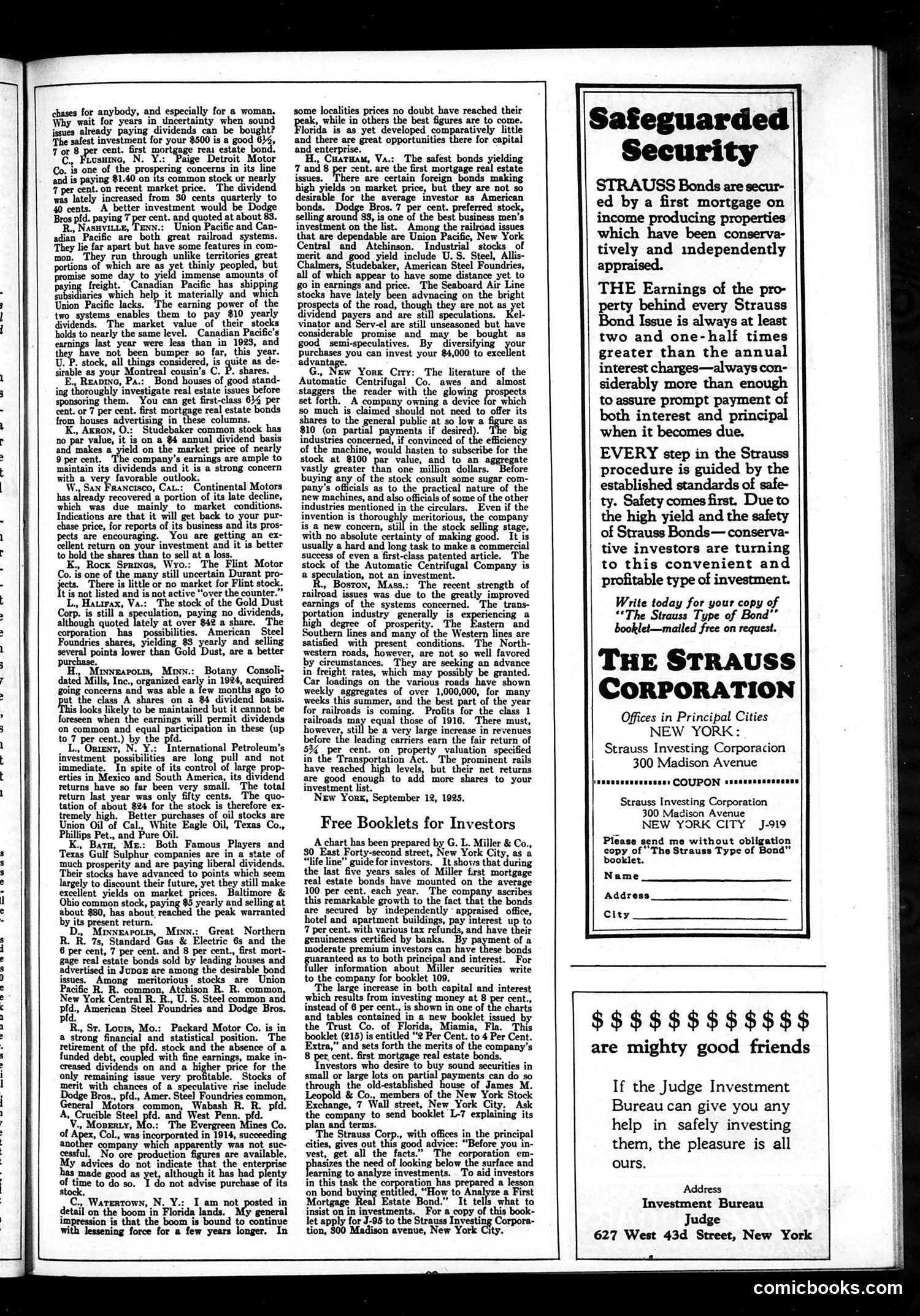
This page is primarily **financial advice columns**, not political satire. It contains reader letters asking about stock and bond investments, with expert responses recommending various securities. The content reflects the **1920s investment boom era**—readers inquire about auto stocks (Paige, Dodge, Studebaker, Flint Motor), railroads (Union Pacific, Canadian Pacific), oil companies (Union Oil, Texas Co.), and real estate bonds. The right-hand advertisements promote **Strauss Bonds** as "safeguarded" investments with high yields and safety, typical of the period's investment marketing. The page's satirical value (if any) lies implicitly in its earnest promotion of stocks later devastated by the **1929 crash**—ironic in retrospect. However, the page itself contains no visible cartoons or explicit satire; it's straightforward financial content reflecting pre-Depression investment confidence.
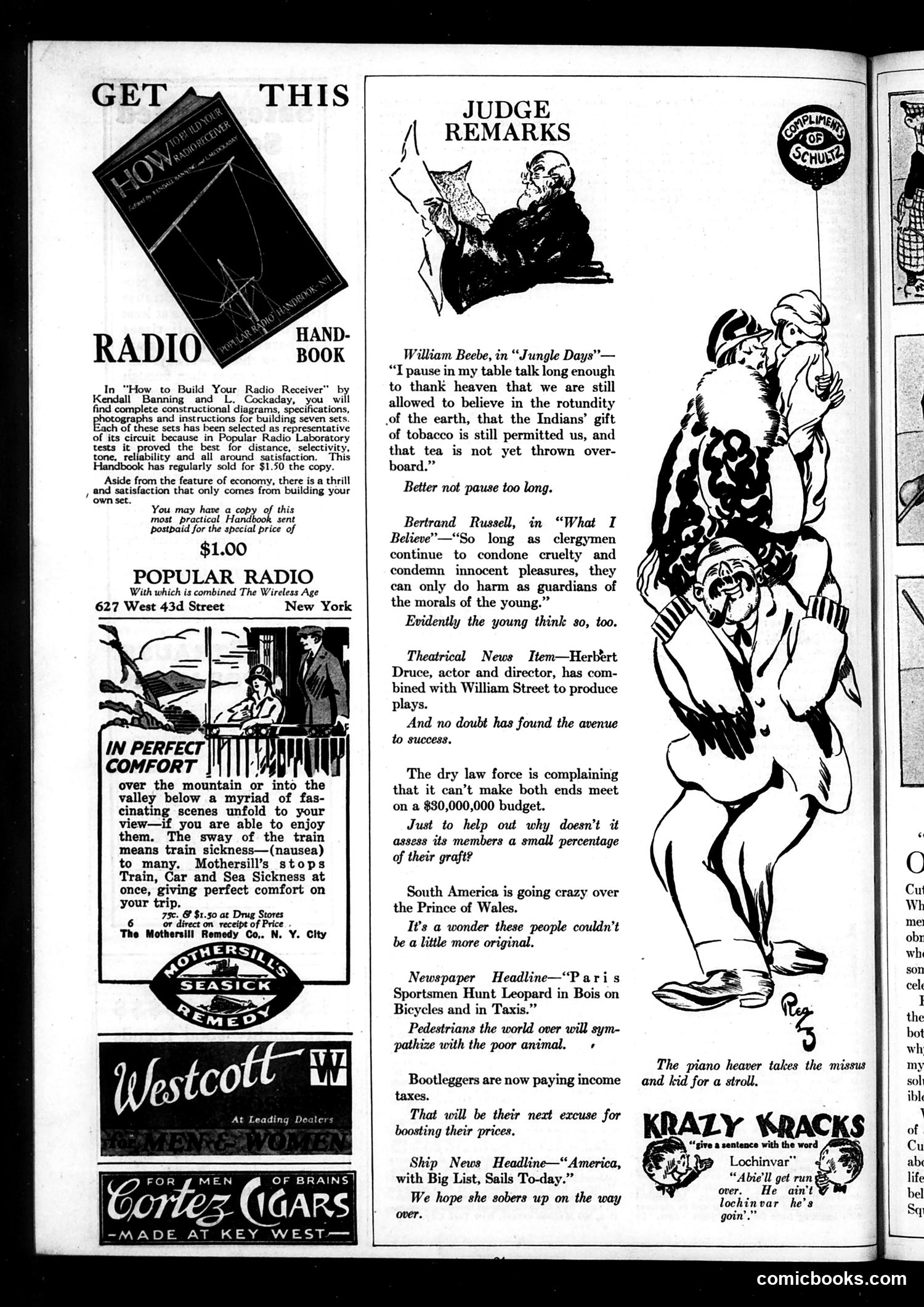
This page combines advertisements with satirical commentary typical of Judge magazine's format. The "Judge Remarks" section offers brief, cynical critiques of contemporary figures and news: **Key Satirical Points:** - **William Beebe and tobacco**: Mocks gratitude for being "allowed" to enjoy colonial products, with the editor suggesting Beebe shouldn't pause too long in his thankfulness. - **Bertrand Russell quote**: The editor sarcastically agrees that youth share Russell's view that clergy harm morality by condemning innocent pleasures—a jab at both religious hypocrisy and youth rebellion. - **Prohibition enforcement**: Criticizes the "dry law force" for claiming budget shortfalls while presumably taking bribes ("graft")—commentary on widespread corruption during Prohibition. - **Prince of Wales popularity**: Mocks South America's fascination as unoriginal. - **Bootleggers paying taxes**: Dark humor suggesting criminals now use tax payments as an excuse to raise prices. The cartoons (particularly the "piano heaver" illustration) depict working-class characters in humorous situations, a common Judge staple. The advertisements target educated, middle-class readers interested in radio construction and travel comfort.
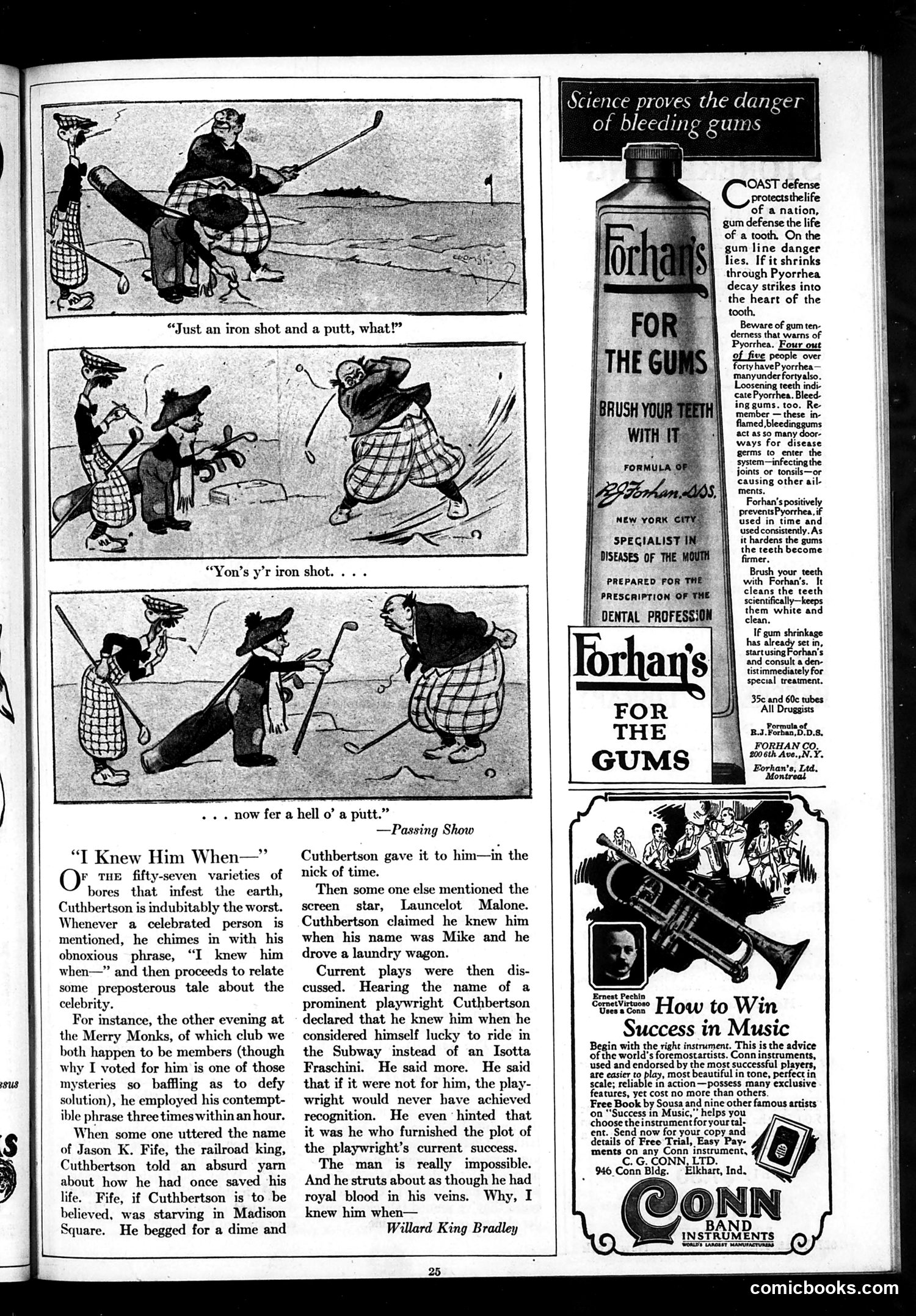
**The Main Cartoon (Left):** This is a satirical comic strip about "Cuthbertson," a social bore who constantly claims to have known famous people "when" they were nobodies. The accompanying article (by Willard King Bradley) explains the joke: whenever a celebrity is mentioned at a club, Cuthbertson interrupts with fabricated stories of their humble origins—claiming he once gave railroad magnate Jason K. Fife a dime when starving, or knew playwright Launcelot Malone when he drove a laundry wagon. The humor is in exposing social pretension and name-dropping. The narrator ironically admits he himself knew Cuthbertson "when"—turning the tedious phrase back on the bore himself. **Golf panels (top left):** Simple sight gags about golf ("iron shot," "putt"). **Right side:** Period advertisements for Forhan's toothpaste and Conn Band Instruments—not satirical content. The cartoon mocks a recognizable social type: the tiresome person who inflates their importance through dubious connections to the famous.
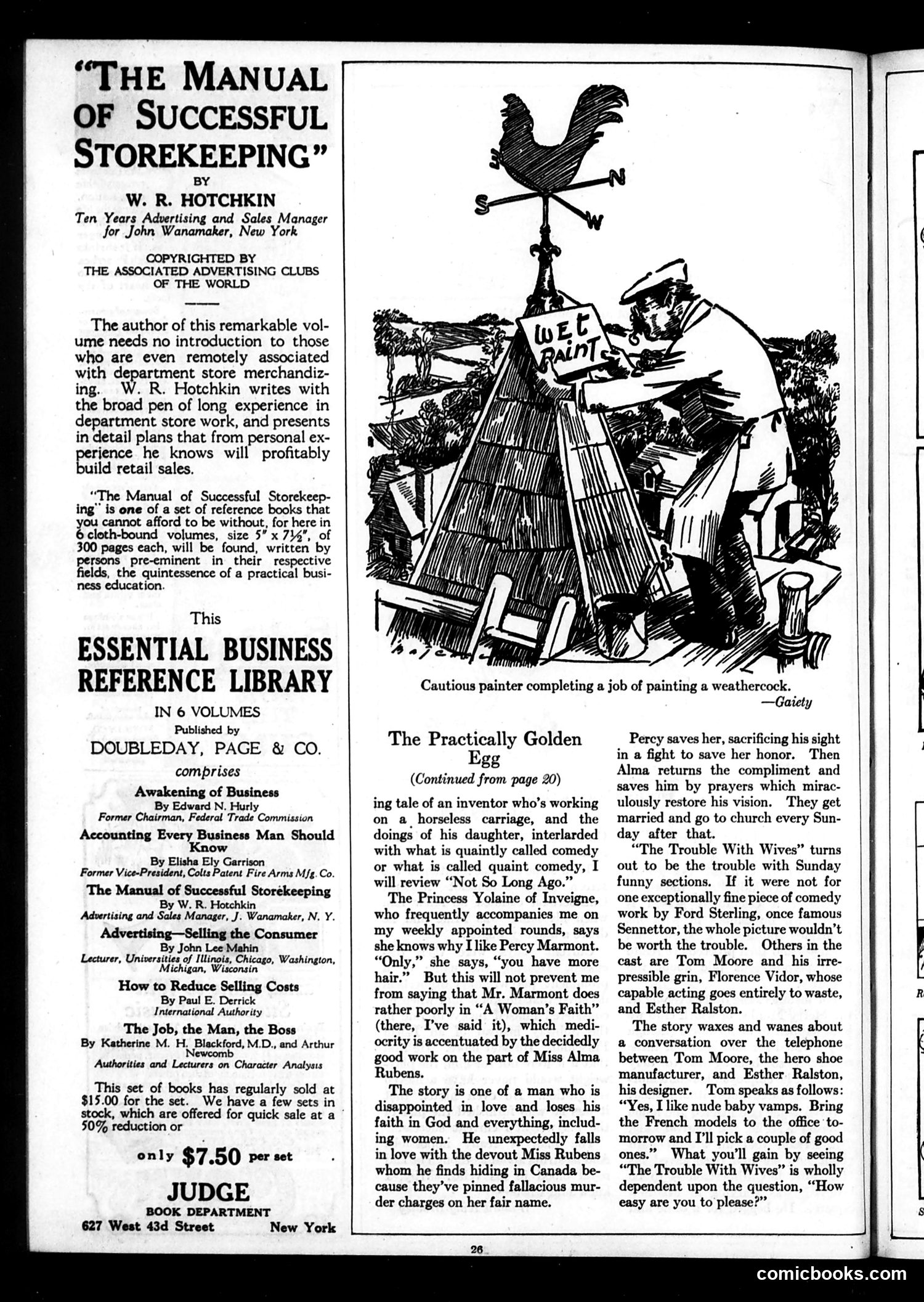
This page is primarily **advertising and book promotion**, not satirical content. The main cartoon shows a painter precariously perched on a weathercock while painting it—a visual pun about the instability of the job, captioned "Cautious painter completing a job of painting a weathercock." The bulk of the page advertises a six-volume business reference library published by Doubleday, Page & Co., featuring "The Manual of Successful Storekeeping" by W.R. Hotchkin (a department store executive). The accompanying text reviews three films ("Not So Long Ago," "A Woman's Faith," and "The Trouble With Wives"), with commentary on actors like Percy Marmont and Alma Rubens—typical movie criticism from this era. The weathercock cartoon's joke relies on the double meaning: both the literal precarious painting task and the figurative sense of "weathercock" (something changeable/unstable), making light of occupational hazards.
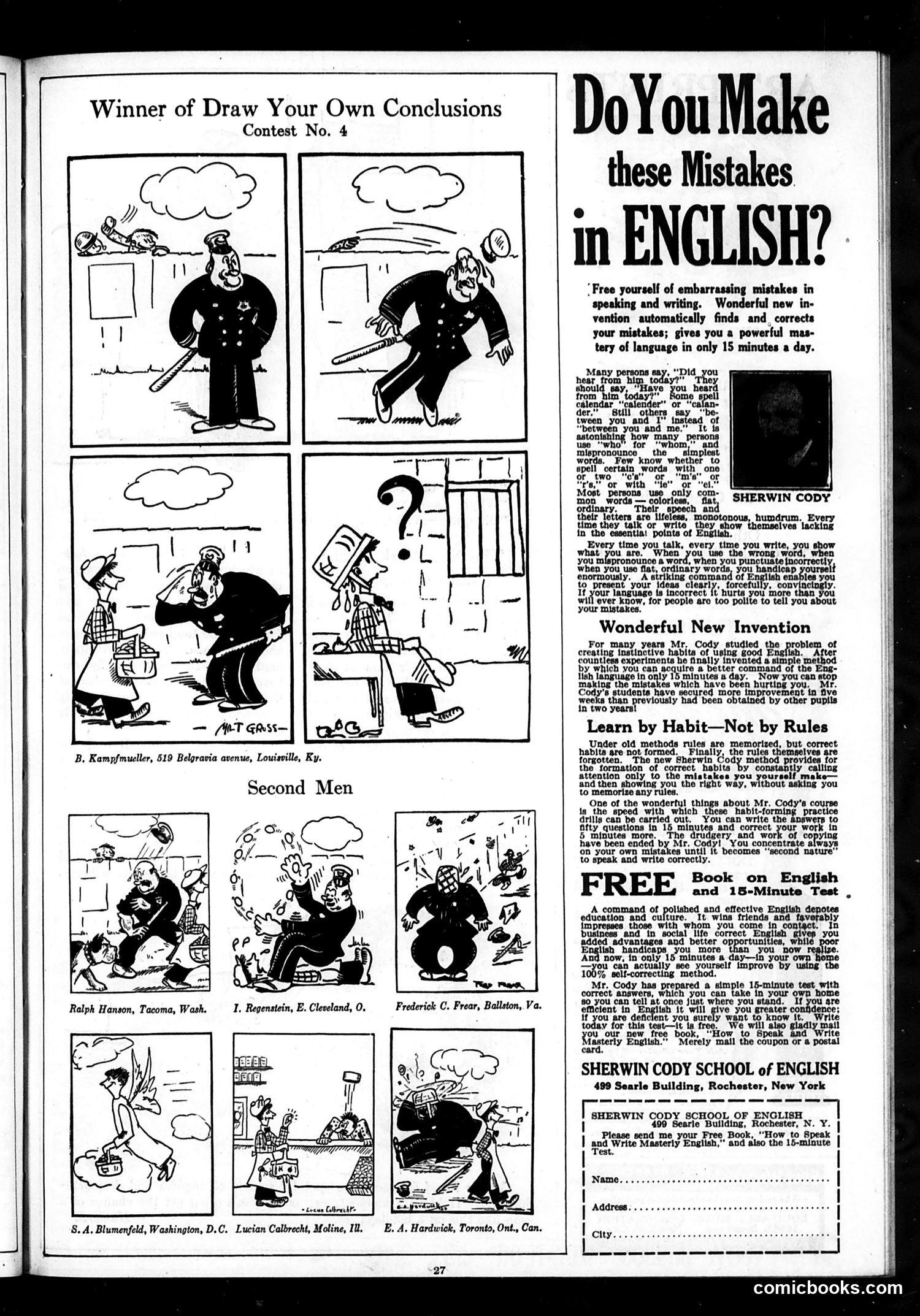
This page contains two distinct elements: **Top Section - Comic Strip ("Winner of Draw Your Own Conclusions Contest No. 4"):** A four-panel cartoon showing a man in various states of distress—appearing confused, running, questioning, and searching—likely depicting someone struggling with a problem or predicament. The cartoonist is B. Kampfmueller. Below it, another set titled "Second Men" shows similar comedic scenarios with different contributors. These appear to be humorous single-gag comics typical of *Judge* magazine's satirical style, though the specific jokes aren't immediately clear from visual context alone. **Right Section - Advertisement:** This is primarily a full-page advertisement for the "Sherwin Cody School of English," promoting a method to correct English pronunciation, spelling, and grammar "in only 15 minutes a day." The ad targets insecurity about proper language use—a concern in early 20th-century America regarding social class and respectability. It's marketing a "habit-forming" system rather than rule memorization, and offers a free book and test. The page reflects period anxieties about education and social status through language mastery.
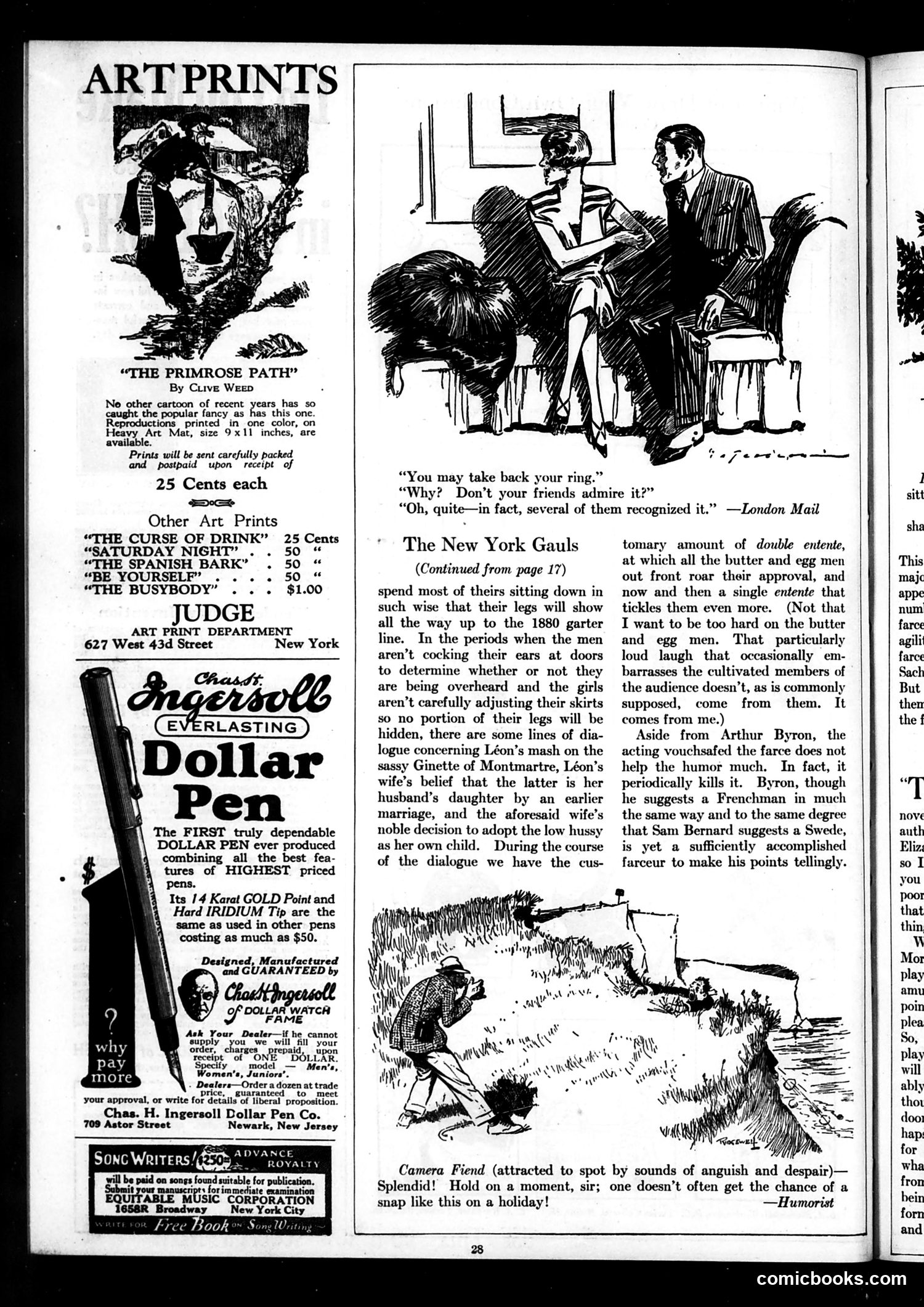
This page contains advertisements and satirical content typical of early 20th-century Judge magazine. **The Cartoons:** 1. **"The Primrose Path"** (top left): A cautionary illustration about temptation and moral decline—a popular moralizing theme of the era. Judge sold reproductions. 2. **The Ring Joke** (top right): A New York society satire about a woman returning an engagement ring because multiple female friends "recognized it"—implying the giver recycled the same ring through multiple engagements, a humorous jab at wealthy men's romantic inconsistency. 3. **"The New York Gauls"** (main text): A theater review criticizing a French farce, mocking its reliance on double entendre humor and leg-display for "butter and egg men" (wealthy theater patrons/investors). The author credits only actor Arthur Byron with genuine skill. 4. **Camera Fiend** (bottom): Dark humor about a photographer exploiting someone's distress for a "good shot." **Mostly this is advertising** (pens, song royalties) mixed with satirical theater and social commentary targeting contemporary audiences.
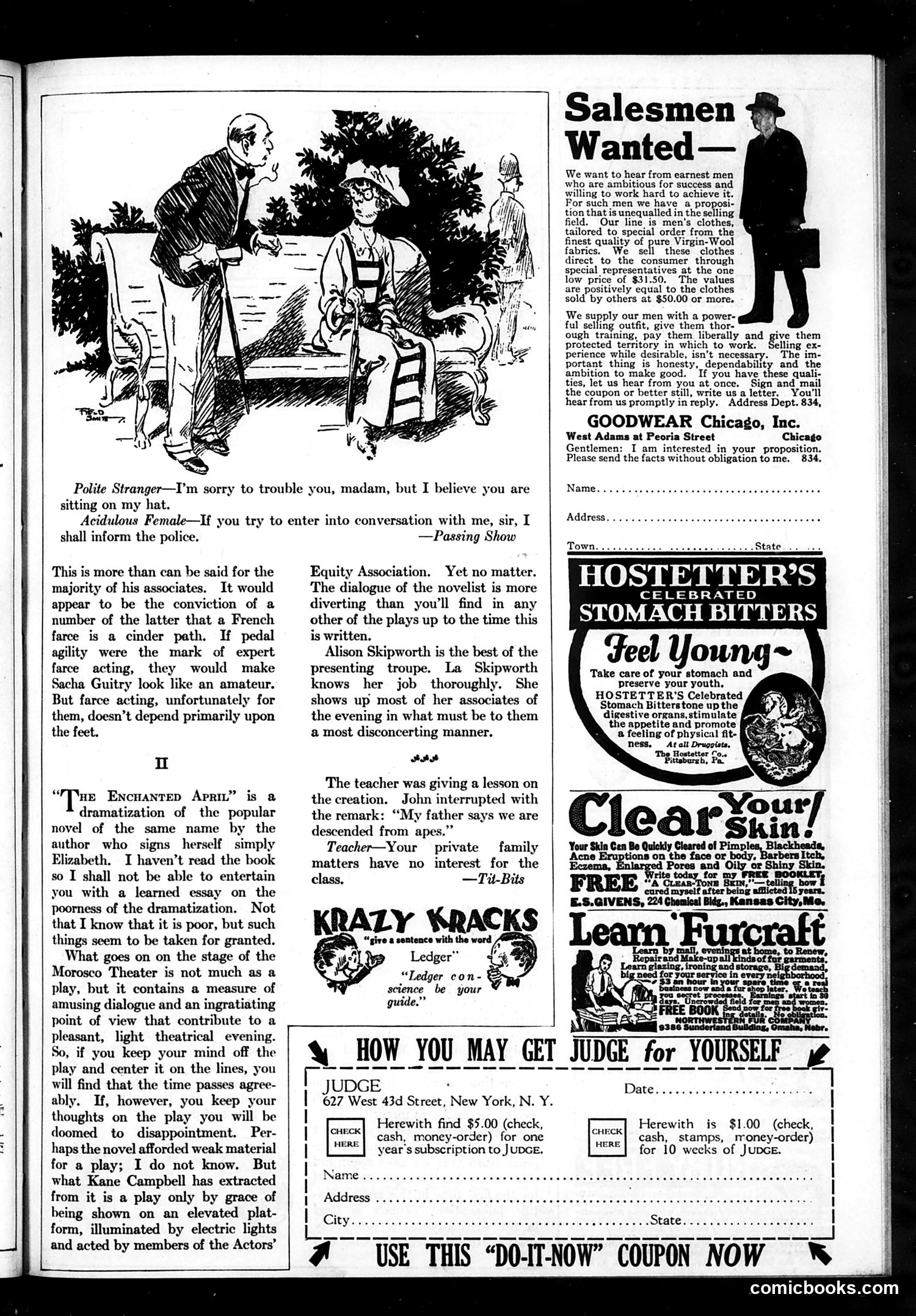
This page from **Judge** magazine (a satirical publication) mixes entertainment commentary with period advertisements. The main cartoon depicts a **class-based social encounter**: A working-class woman in a hat sits on a bench while an overdressed gentleman asks about his hat. When he attempts polite conversation, she threatens to call police—satirizing rigid class divisions and the expectation that working-class women would be deferential to upper-class men. The satire mocks both his entitlement and her exaggerated defensiveness. The text reviews theatrical productions, including favorable commentary on actress **Alison Skipworth** and criticism of "The Enchanted April" adaptation. A joke ("Krazy Kracks") uses a teacher-student exchange about human evolution for humor—the father's claim they descend from apes used as comic insult. The remainder comprises period advertisements: a **clothing salesman recruitment**, stomach bitters tonic, skin cream, and furcraft clothing instruction—typical early-20th-century magazine content targeting both upward mobility and patent-medicine consumption.
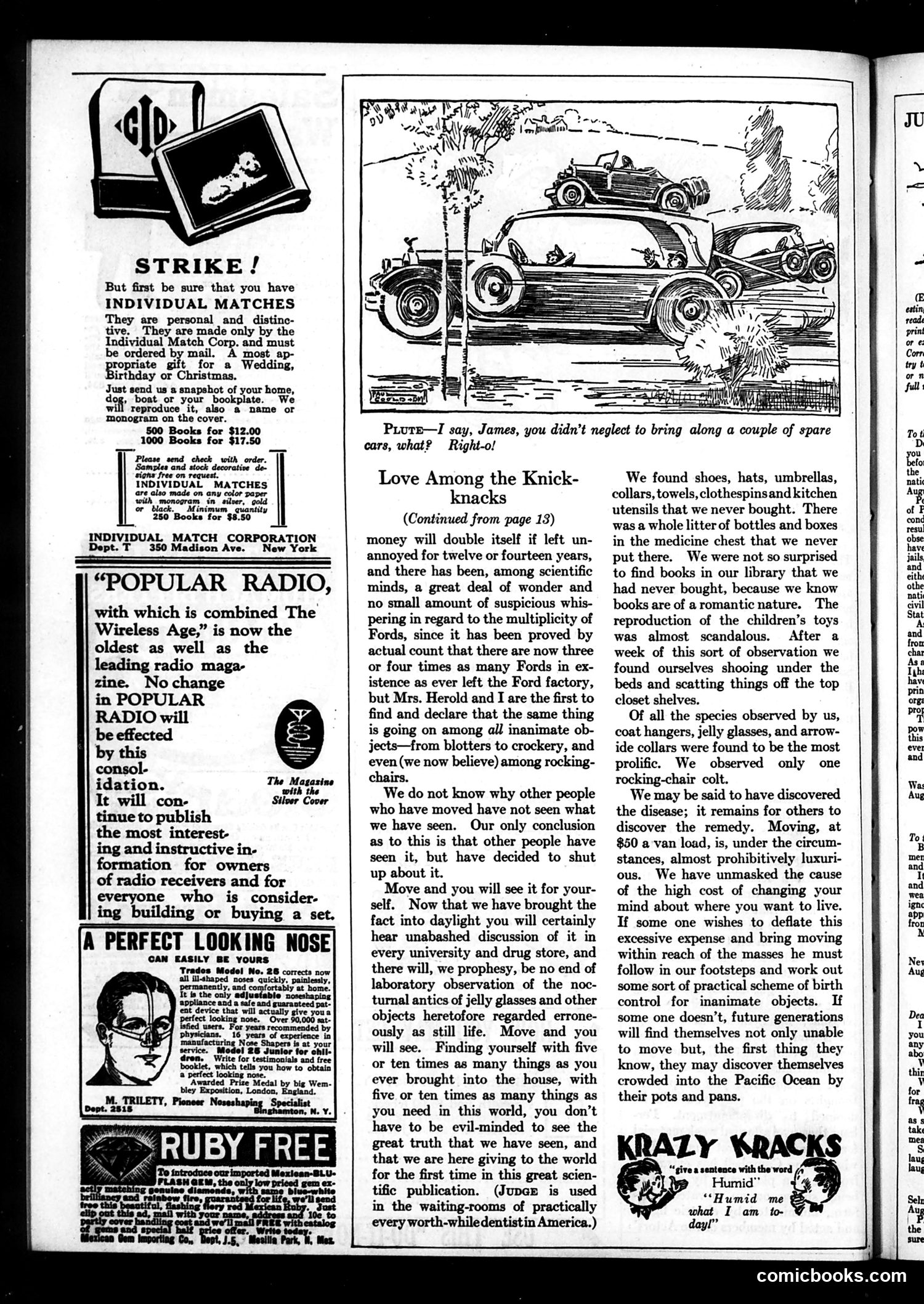
This page is primarily **advertising with one illustrated story excerpt**. The cartoon at top shows cars and a humorous caption about bringing "spare cars" on a trip—a joke about automobile abundance in the 1920s. The main text, "Love Among the Knick-knacks," is a comedic essay (continued from page 13) satirizing post-moving experiences. The author humorously claims that inanimate objects mysteriously multiply after relocating—shoes, hangers, jelly glasses, and toys appear that were never purchased. The piece absurdly treats this common domestic phenomenon as a scientific discovery worthy of university study. The satire targets **consumer culture and the proliferation of mass-produced goods** in the 1920s. By treating mundane clutter as a mystifying phenomenon requiring laboratory analysis, the author mocks both the abundance of cheap manufactured items and the era's earnest pseudo-scientific explanations for everyday occurrences. The surrounding ads (Individual Matches, Popular Radio, nose correction device) are period-typical consumer marketing—unremarkable for historical context beyond showing products advertised to Judge's middle-class readers.
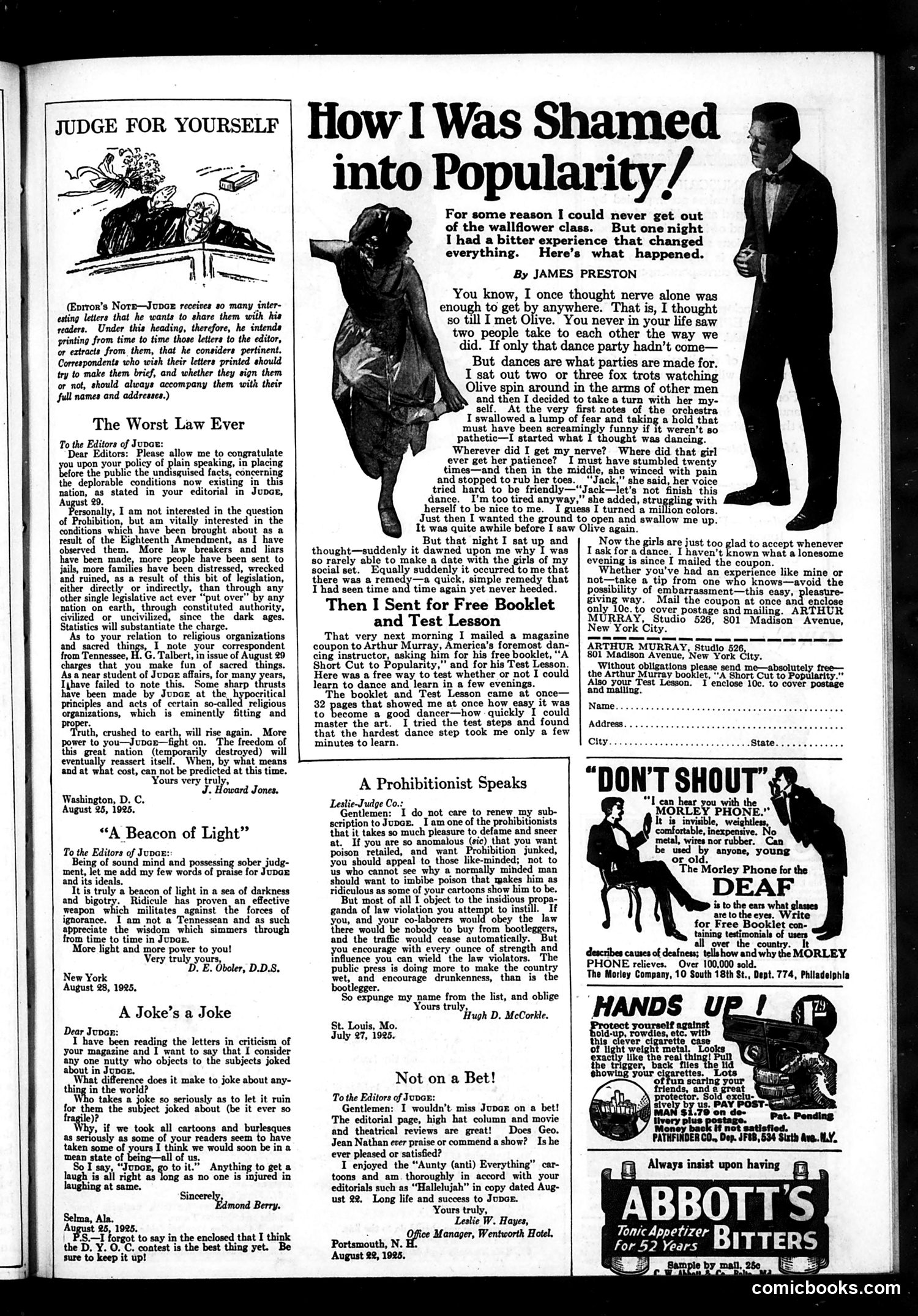
This page from Judge magazine (August 1925) primarily features a reader letters section titled "Judge for Yourself," where editors publish correspondence about the magazine's editorial stance. The letters praise Judge's satirical approach to social issues, particularly **Prohibition** (the Eighteenth Amendment, enacted 1920-1933). One correspondent criticizes Prohibition as having created "more law breakers and liars" and damaged families. Another defends Judge's use of ridicule against "ignorance" and "bigotry"—likely referencing the magazine's criticism of religious fundamentalism and the recent **Scopes Trial** (Tennessee's teaching of evolution, mentioned in the text). A third letter defends satire itself against complaints that joking about serious subjects is disrespectful. The main article, "How I Was Shamed into Popularity" by James Preston, appears to be a first-person narrative about overcoming social anxiety at a dance, though the text is cut off. The page also contains period advertisements, including one for Abbott's Bitters and the Morley telephone. The overall tone reflects Judge's 1920s role as a progressive publication defending satire, Prohibition criticism, and modernism against conservative opposition.
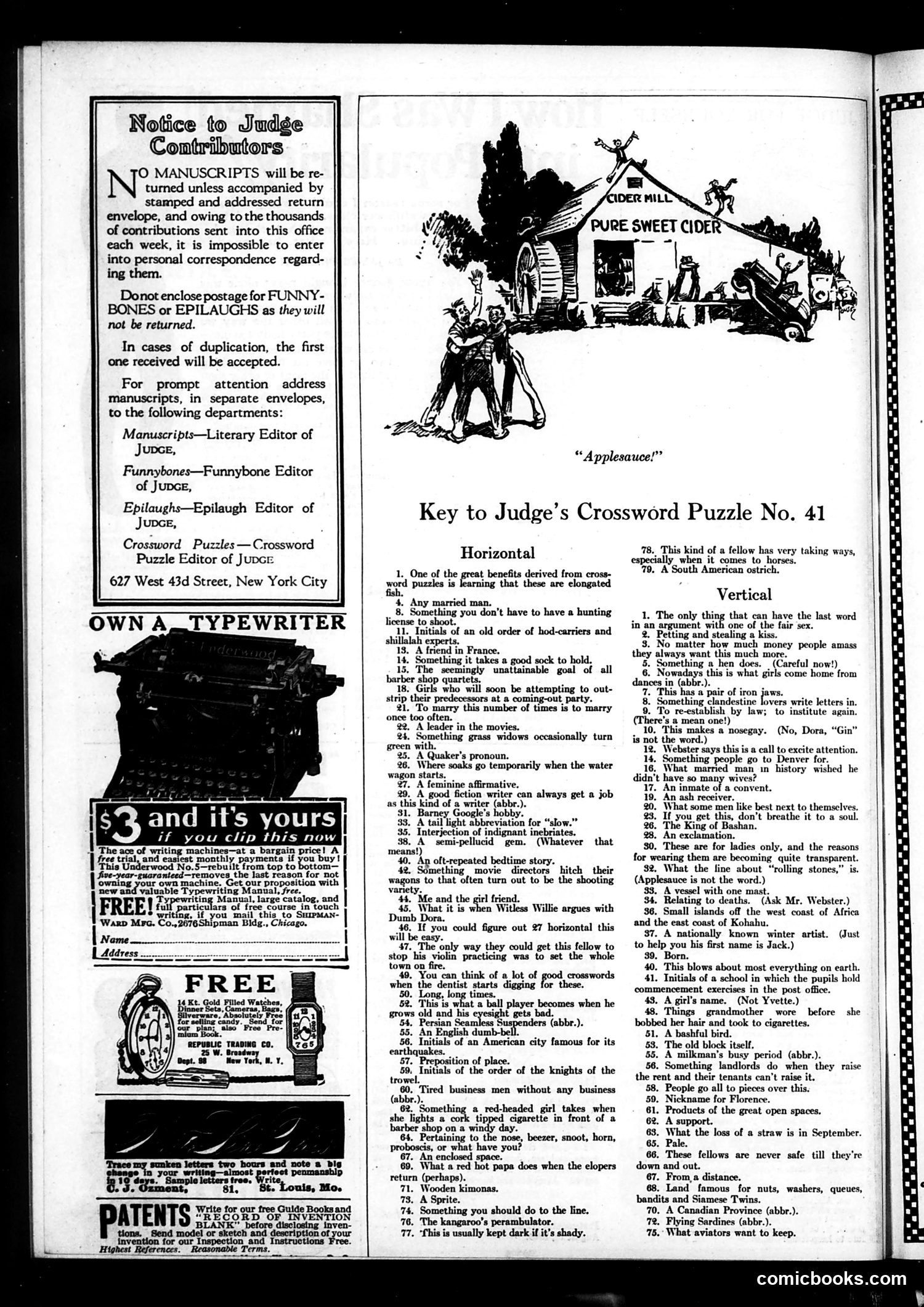
This page is primarily **administrative and advertising content** rather than political satire. The main elements are: 1. **"Notice to Judge Contributors"** — Editorial guidelines for submitting manuscripts, cartoons, and puzzles to the magazine 2. **"Own a Typewriter"** advertisement — promoting affordable typewriter purchases with monthly payment plans 3. **Crossword Puzzle No. 41 with Answer Key** — a full crossword puzzle and its solutions, featuring contemporary 1920s-30s references (mentions of characters like "Barney Google" and "Dumb Dora," slang terms like "applesauce") 4. **Additional advertisements** for patents and other products The only visual humor appears to be the small illustration of a cider mill labeled "Applesauce!" — likely chosen as a pun heading for the puzzle answers. The page demonstrates Judge's dual function as both a satirical publication and a general-interest magazine with puzzles and advertisements aimed at middle-class readers.
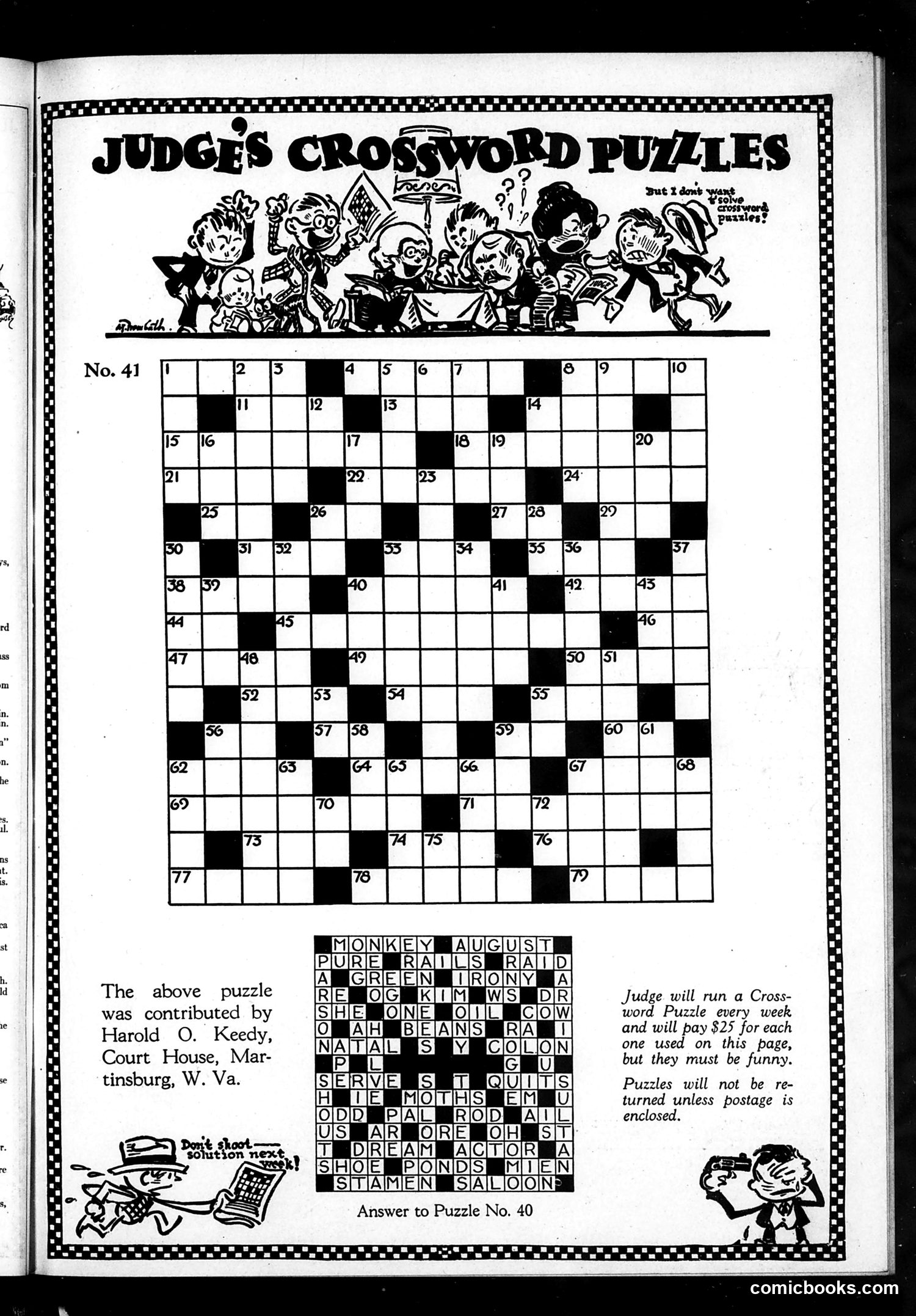
This page is primarily a crossword puzzle (No. 41) with decorative cartoon characters at the top. The puzzle itself is not satirical—it's a standard crossword grid numbered for solving. The page's content is administrative: it credits puzzle contributor Harold O. Keedy from Martinsburg, West Virginia, and announces Judge's policy of paying $25 weekly for crossword puzzles, with the stipulation that submissions must be "funny" (likely meaning clever or witty in construction rather than satirical). The small cartoon at bottom left appears to be a generic illustration unrelated to political satire. The answer key to the previous week's puzzle (No. 40) is shown in the center, displaying words like "MONKEY," "AUGUST," and "SALOON." This is essentially a puzzle page with publication logistics—not political commentary.
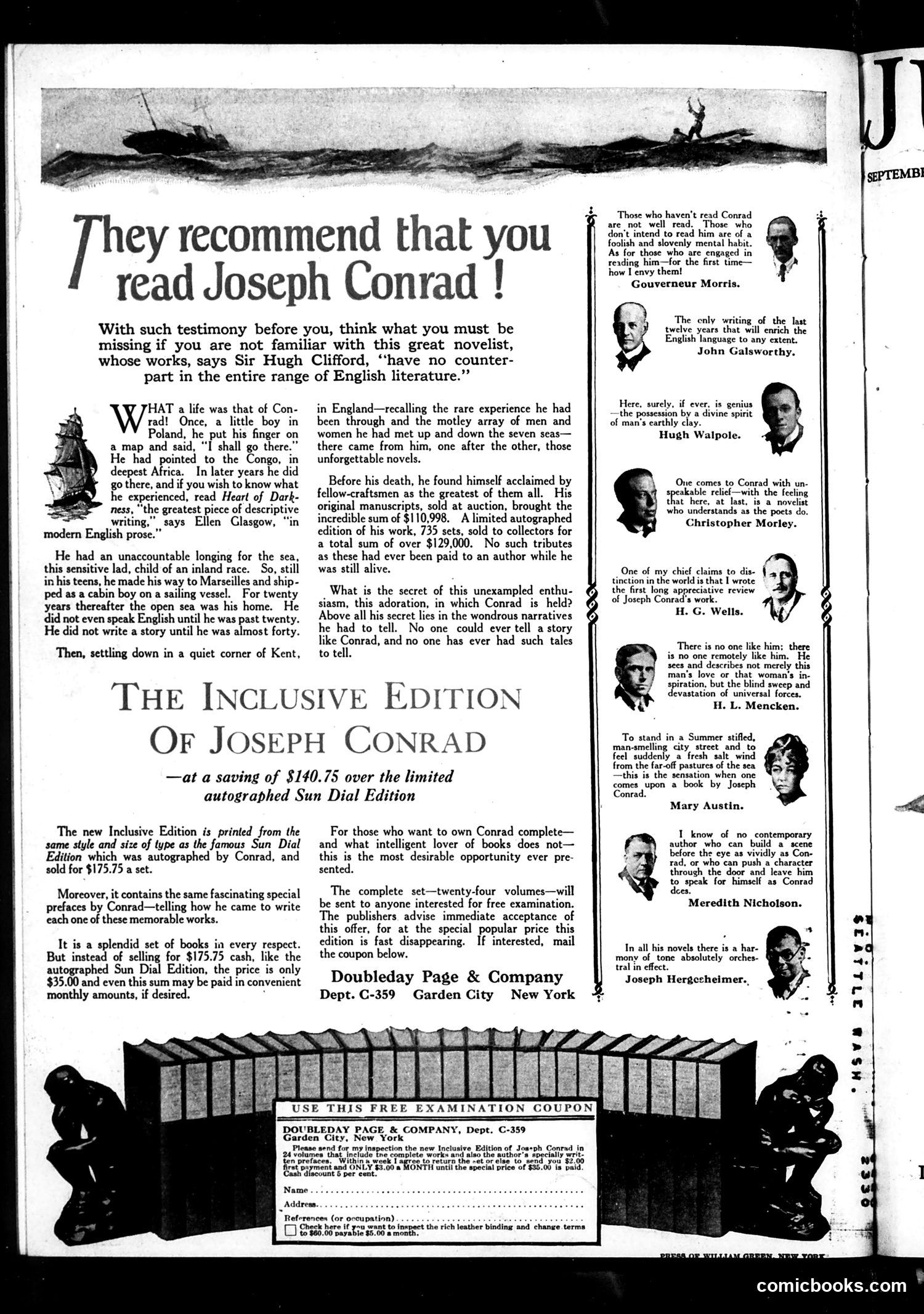
This page is primarily **advertising**, not political satire. It promotes the "Inclusive Edition" of Joseph Conrad's complete works through Doubleday Page & Company. The right side features **endorsements from prominent literary figures** (Gouverneur Morris, John Galsworthy, Hugh Walpole, Christopher Morley, H. L. Mencken, Mary Austin, Meredith Nicolson, and Joseph Hergesheimer) praising Conrad as essential reading for the educated public. The ad's sales pitch emphasizes Conrad's remarkable life—a Polish boy who became a merchant sailor, taught himself English, and only began writing in his forties—positioning his works as culturally valuable and collectible. By noting that limited autographed editions sold for $175.75, the advertisement justifies the cheaper "Inclusive Edition" at $35 as an exceptional opportunity for middle-class readers. There is **no visible political cartoon** on this page. The small illustration at top appears decorative rather than satirical.