
Judge, 1925-09-19 · page 18 of 36
Judge — September 19, 1925 — page 18: what you’re looking at
What you’re looking at
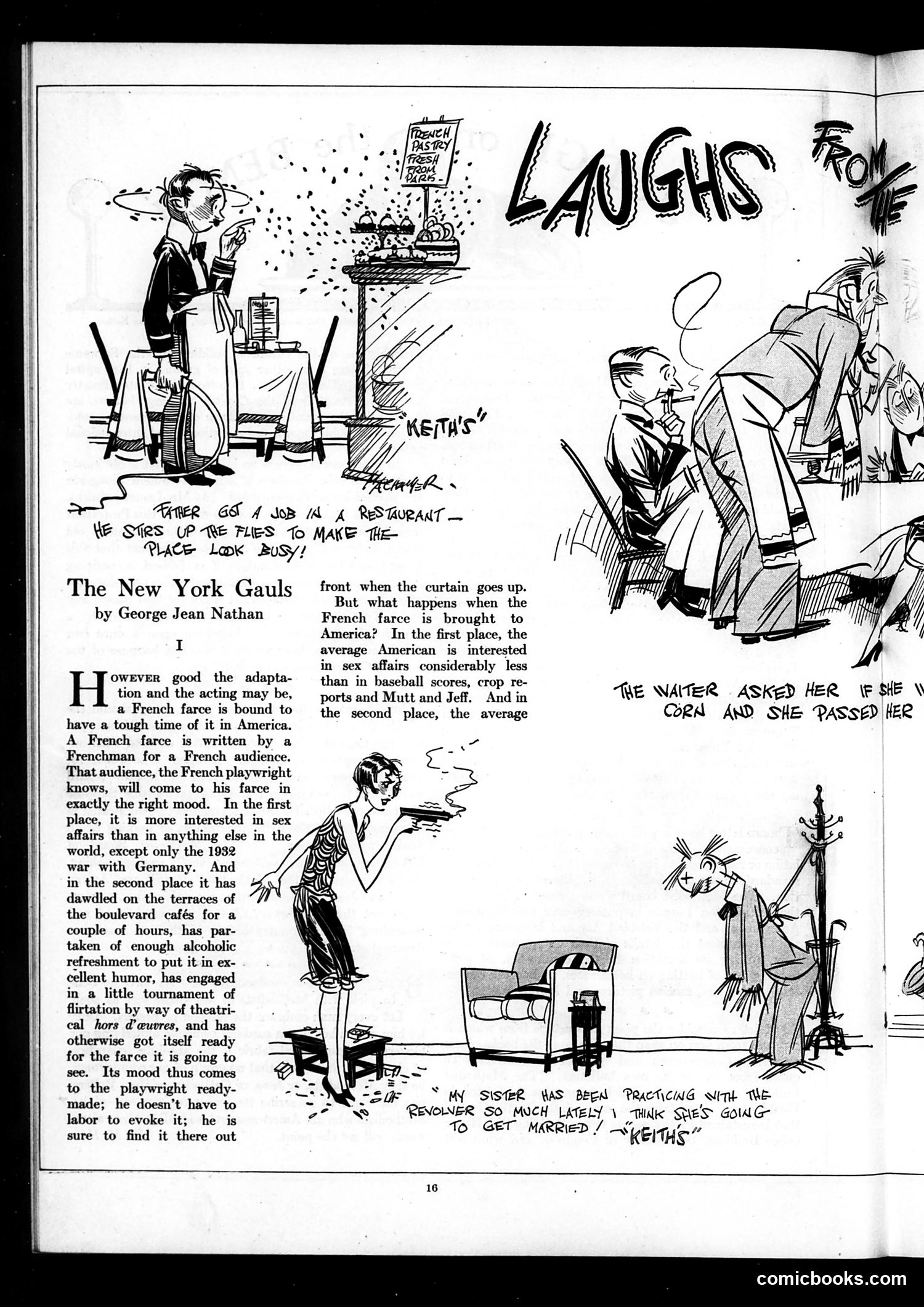
This page critiques the American reception of French farce theater. Nathan argues that French farces succeed in France because audiences arrive pre-conditioned: they've spent hours at cafés drinking wine, flirting, and are primed for bawdy comedy focused on sex affairs. In America, he contends, the strategy fails. American audiences care more about baseball scores and comic strips (Mutt and Jeff) than sexual intrigue. The accompanying cartoons illustrate this cultural gap through domestic and restaurant scenarios—depicting Americans' indifference to the sophisticated flirtation and romantic complications that form French farce's foundation. The piece uses "Gauls" (ancient French people) ironically, suggesting French dramatic traditions simply don't translate to American sensibilities. This reflects 1930s attitudes about European versus American cultural values and humor preferences.
📄 Transcribed text from this page (OCR, searchable)
Machine-transcribed from the original scan — historical spelling and the odd misread are preserved.
Pte Lak BuSy/ The New York Gauls by George Jean Nathan I OWEVER good the adapta- H tion and the acting may be, a French farce is bound to have a tough time of it in America. A French farce is written by a Frenchman for a French audience. That audience, the French playwright knows, will come to his farce in exactly the right mood. In the first place, it is more interested in sex affairs than in anything else in the world, except only the 1932 ) war with Germany. And in the second place it has dawdled on the terraces of the boulevard cafés for a couple of hours, has par- taken of enough alcoholic refreshment to put it in ex- cellent humor, has engaged in a little tournament of flirtation by way of theatri- cal hors d’euvres, and has otherwise got itself ready for the farce it is going to see. Its mood thus comes to the playwright ready- made; he doesn’t have to labor to evoke it; he is sure to find it there out FRNER GS 4 SBM 4 RSHURANT — WE SHS UP -RE FLIES To MAKE He front when the curtain goes up. But what happens when the French farce is brought to America? In the first place, the average American is interested in sex affairs considerably less than in baseball scores, crop re- ports and Mutt and Jeff. And in the second place, the average WE NAITER ASKED HER iF SHE \ CORN AND SHE Passed HER “MY SISTER WAS BEEN PRACTICNG wie WE ~ RENOINER SO MUCH LATELY \ cli SHES Goll G- To GET MARRIED | KEITHS” comicbooks.com