
Judge, 1925-09-19 · page 19 of 36
Judge — September 19, 1925 — page 19: what you’re looking at
What you’re looking at
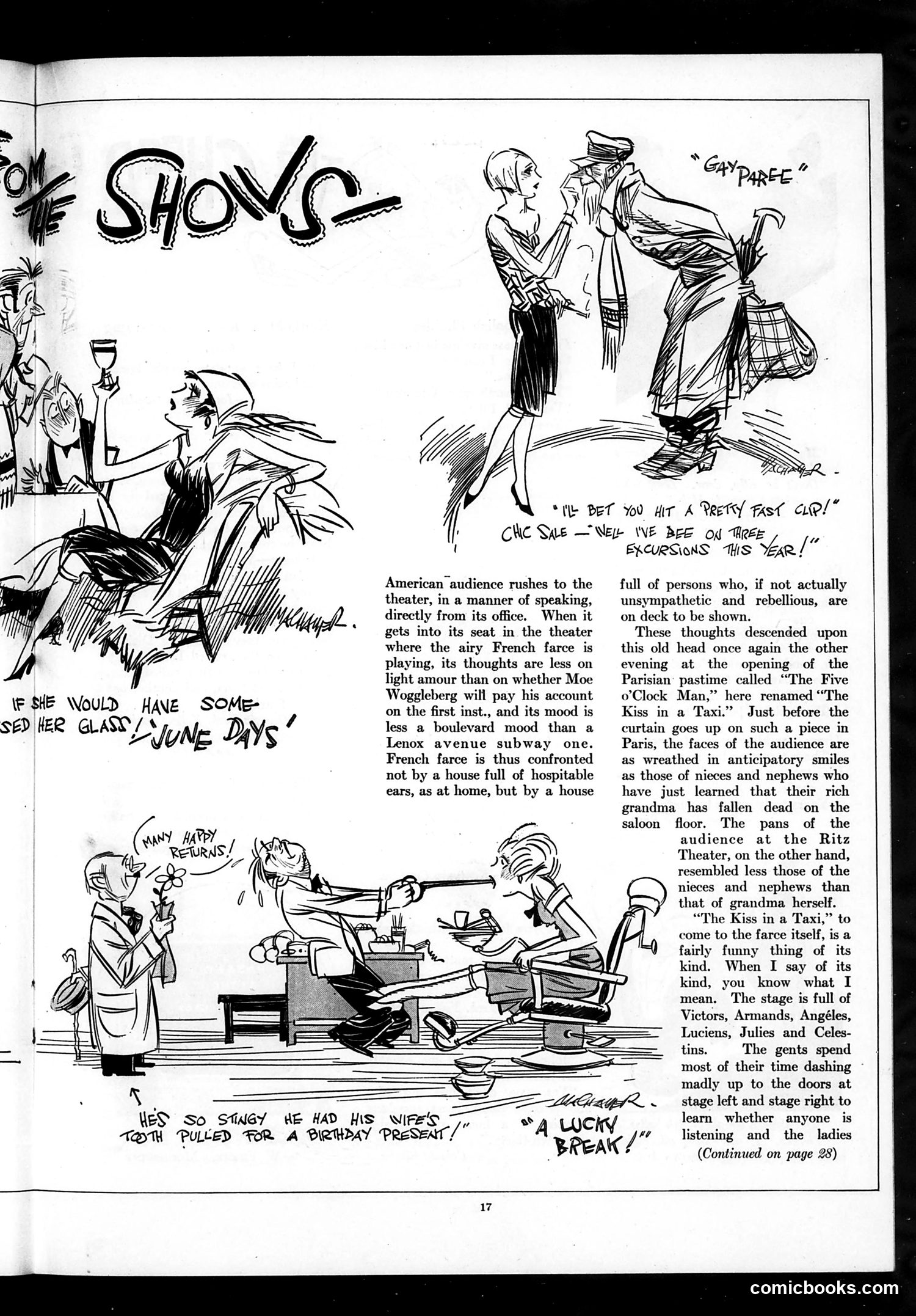
This page satirizes the contrast between French and American theater audiences attending a French farce called "The Kiss in a Taxi" (originally "The Five o'Clock Man"). **The Satire's Point:** American audiences attending this Parisian comedy at the Ritz Theater lack the carefree, romantic mood essential to appreciating French farce. Instead of arriving in a "boulevard mood," they're preoccupied with mundane concerns—paying bills, subway commutes, office work. Where Parisian audiences greet such plays with anticipatory smiles like heirs learning of a rich grandmother's death, American audiences resemble the disappointed grandma herself. **The Comics:** Crude sketches mock domestic scenes and theater-goers, illustrating the cultural disconnect. Captions like "If she would have some June days" and "A lucky break!" reference the play's romantic pretensions versus American pragmatism. **Historical Context:** This reflects early 20th-century anxiety about American materialism and commercialism allegedly undermining appreciation for European cultural refinement and leisure.
📄 Transcribed text from this page (OCR, searchable)
Machine-transcribed from the original scan — historical spelling and the odd misread are preserved.
\E SHE WOULD HAE SOME- SED HER GLASS / ‘ UNE Dis 4 American audience rushes to the theater, in a manner of speaking, directly from its office. When it gets into its seat in the theater where the airy French farce is playing, its thoughts are less on light amour than on whether Moe Woggleberg will pay his account on the first inst., and its mood is less a boulevard mood than a Lenox avenue subway one. French farce is thus confronted not by a house full of hospitable ears, as at home, but by a house “te BET YOO Air A Peete Fast cLe/” CNC Spee SWE WE BEE on Aree EXCURSIONS WHiS Er i if full of persons who, if not actually unsympathetic and rebellious, are on deck to be shown. These thoughts descended upon this old head once again the other evening at the opening of the Parisian pastime called “The Five o’Clock Man,” here renamed “The Kiss in a Taxi.” Just before the curtain goes up on such a piece in Paris, the faces of the audience are as wreathed in anticipatory smiles as those of nieces and nephews who have just learned that their rich grandma has fallen dead on the saloon floor. The pans of the audience at the Ritz Theater, on the other hand, resembled less those of the Ce) nieces and nephews than Ey that of grandma herself. i | “The Kiss in a Taxi,” to come to the farce itself, is a a fairly funny thing of its kind. When I say of its kind, you know what I mean. The stage is full of Victors, Armands, Angéles, Luciens, Julies and Celes- tins. The gents spend 7 7 leg = most of their time dashing 7 madly up to the doors at . x : ea ee i ee” LE stage left and stage right to WES So STNGY HE HAD HIS Wife 7, s learn whether anyone is TOM PULLED FOR A BIRTHDAY PRESENT, / . A ae pit listening and the ladies (Continued on page 28) comicbooks.com