
A complete issue · 37 pages · 1925
Judge — August 15, 1925
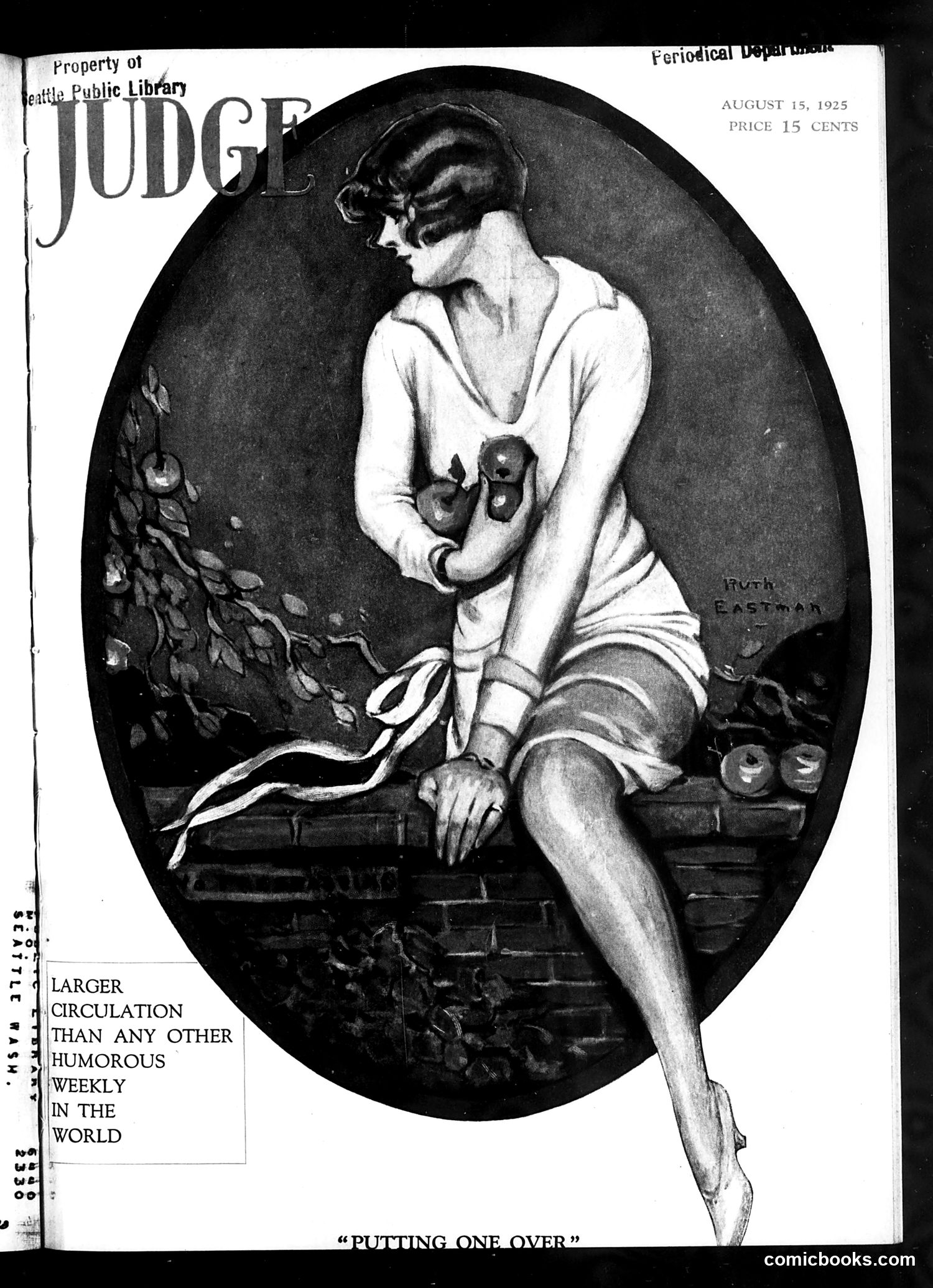
This August 15, 1925 Judge cover features an illustration titled "Putting One Over" by Ruth Eastman. The image shows a woman in 1920s athletic/bathing attire juggling boxing gloves while sitting on a brick ledge, with a snake nearby. The satire likely references the "modern woman" of the Jazz Age—the flapper era when women were increasingly participating in sports, boxing, and other activities previously reserved for men. The juggling of boxing gloves suggests women "juggling" or balancing traditionally masculine pursuits with femininity. The snake may symbolize danger or deception in this role-reversal. The phrase "putting one over" implies the woman is cleverly deceiving or outwitting traditional expectations, making this a commentary on changing gender roles during the 1920s.
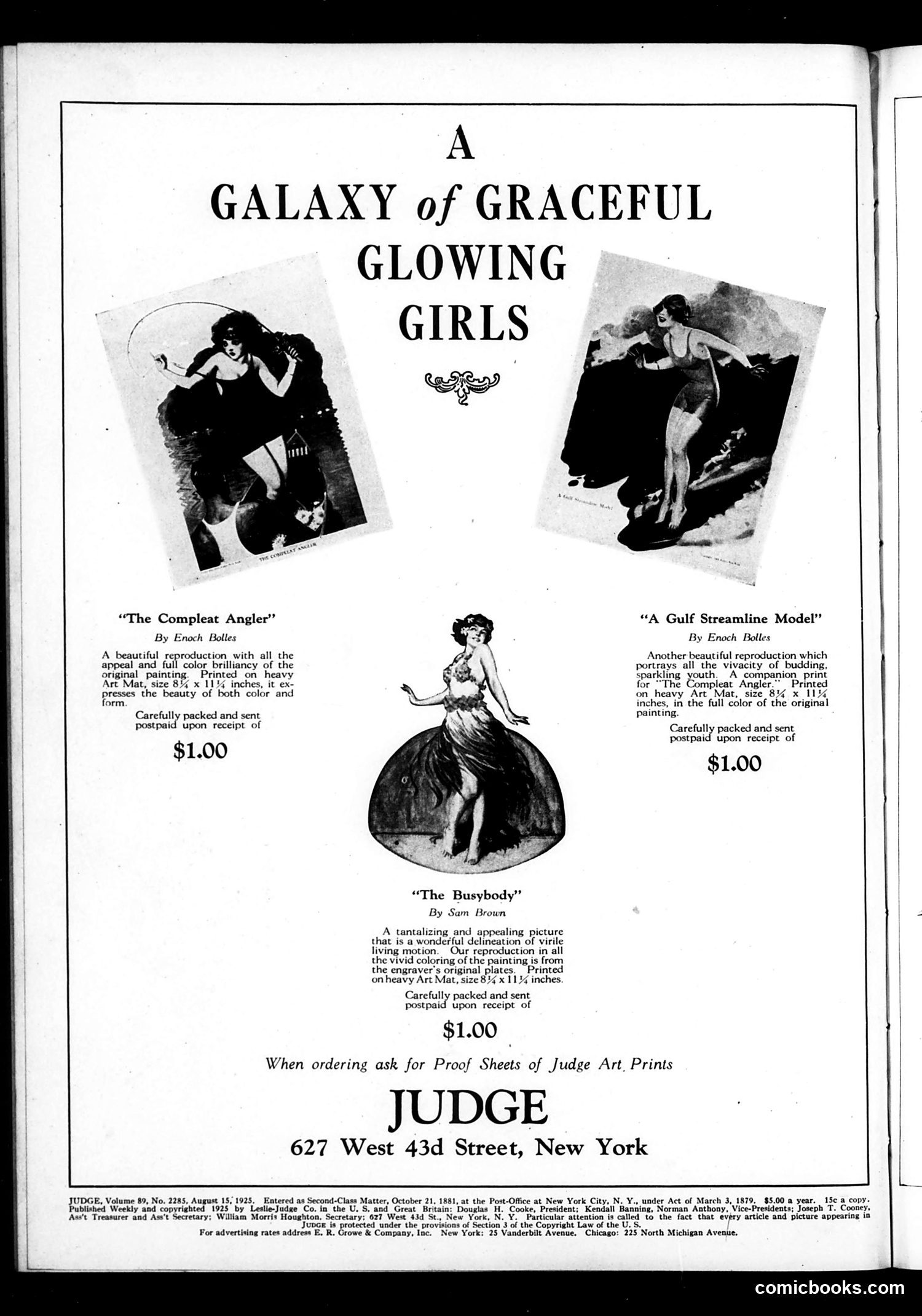
This page is primarily **advertising, not political satire**. It promotes three art prints available from Judge magazine for $1.00 each: 1. "The Compleat Angler" by Enoch Bolles — a reproduction of a painting featuring a woman in fishing attire 2. "A Gulf Streamline Model" by Enoch Bolles — another glamorous female figure 3. "The Busybody" by Sam Brown — a woman in an elaborate dress The prints are marketed as "A Galaxy of Graceful Glowing Girls," appealing to the aesthetic interests of 1920s readers. The emphasis on "vivacity," "sparkling youth," and artistic quality suggests these were decorative art prints for home display. This represents Judge's commercial side, offering readers attractive imagery rather than satirical commentary. The prints could be ordered from the publisher's New York address.
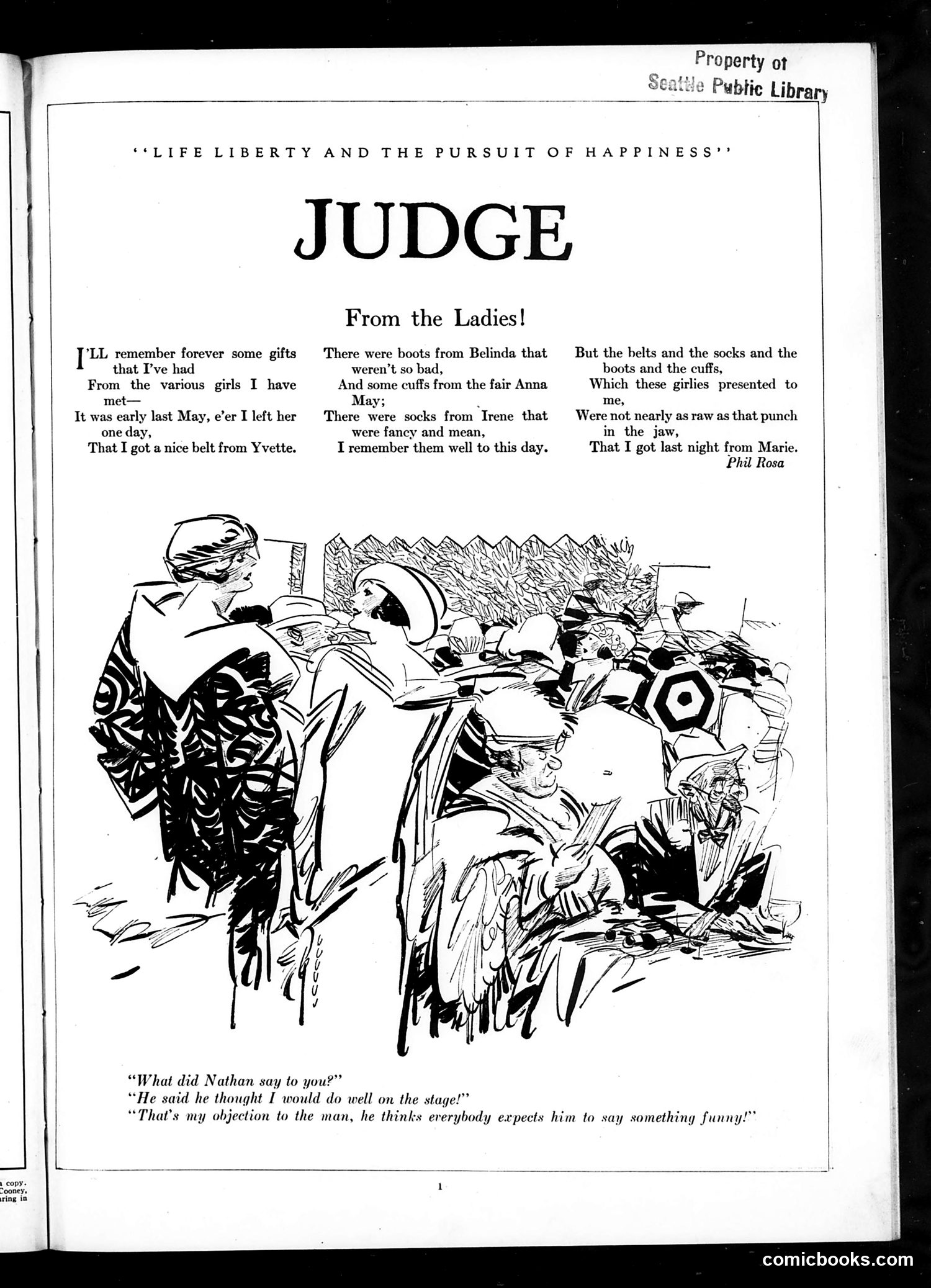
This page features humorous commentary about gifts received from women during a social season (early May). The poem celebrates various items—belts, socks, boots, and cuffs—given by named women (Yvette, Anna May, Irene, Marie). The accompanying illustration shows what appears to be a social gathering or picnic scene with multiple figures in early 20th-century dress. The caption references "Nathan," suggesting a comedic exchange about performance expectations. The satire targets genteel social conventions: the obligation to receive gifts graciously and the expectation that male recipients must respond with witty, entertaining remarks. The page gently mocks both the modest nature of such gifts and the social pressure men faced to perform humor and charm in return. The overall tone is light domestic satire typical of Judge's humor targeting middle-class social etiquette.
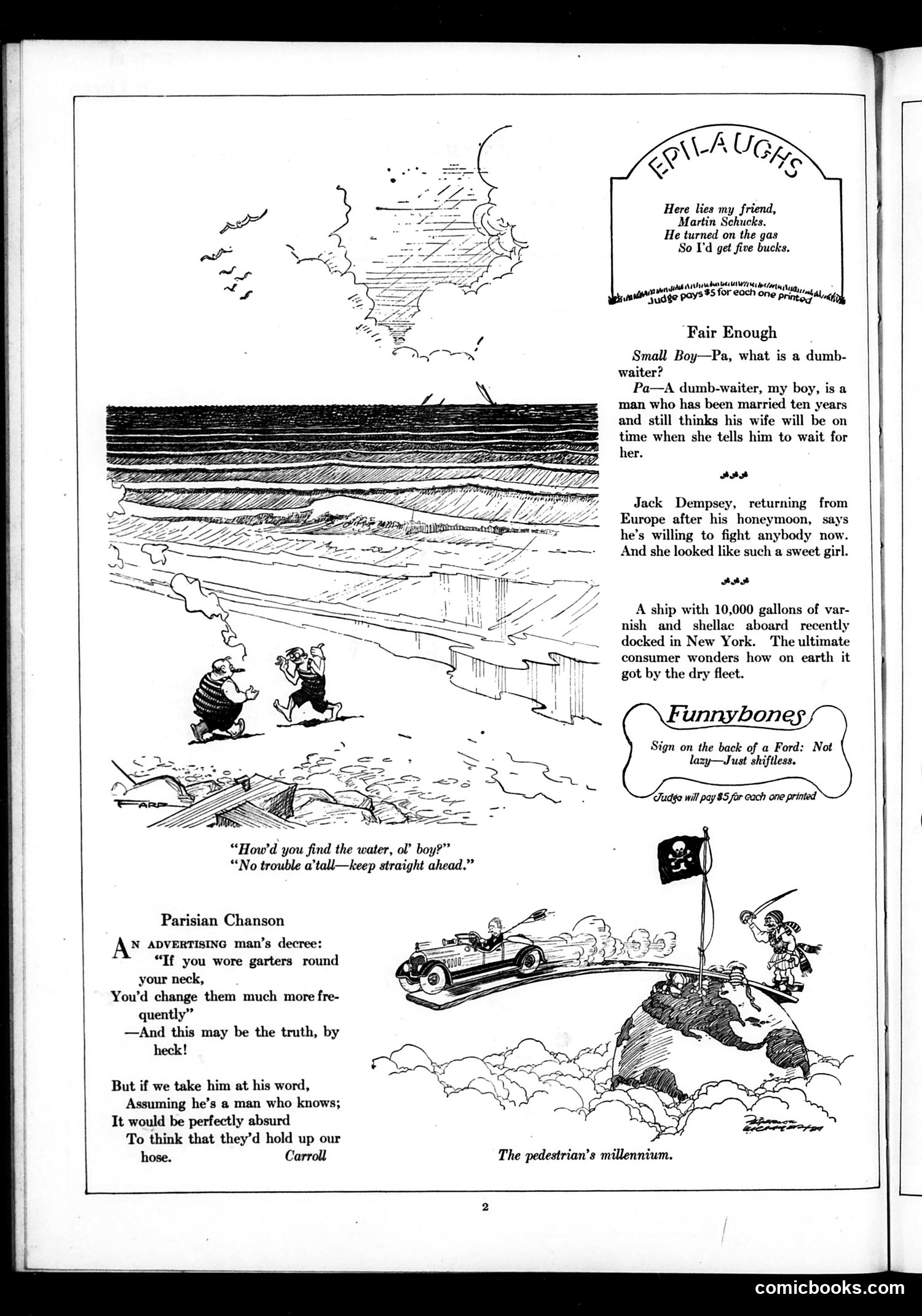
This page contains several brief humorous items rather than political cartoons: **"Fair Enough"**: A joke defining "dumb-waiter" as a man married ten years who still expects his wife to be punctual. **Jack Dempsey reference**: A quip about the boxer returning from his honeymoon, now willing to fight anyone. **"Funnybones"**: A joke about Ford automobiles lacking laziness—just "shiftless" operation. **"Parisian Chanson"**: A poem mocking advertising claims about garters, suggesting such promises are absurd. **"The pedestrian's millennium"**: A cartoon showing a car speeding past a pirate flag and a pedestrian, satirizing dangerous driving and reckless motorists as outlaws. The page primarily features light social satire about marriage, automobiles, and urban hazards rather than serious political commentary.
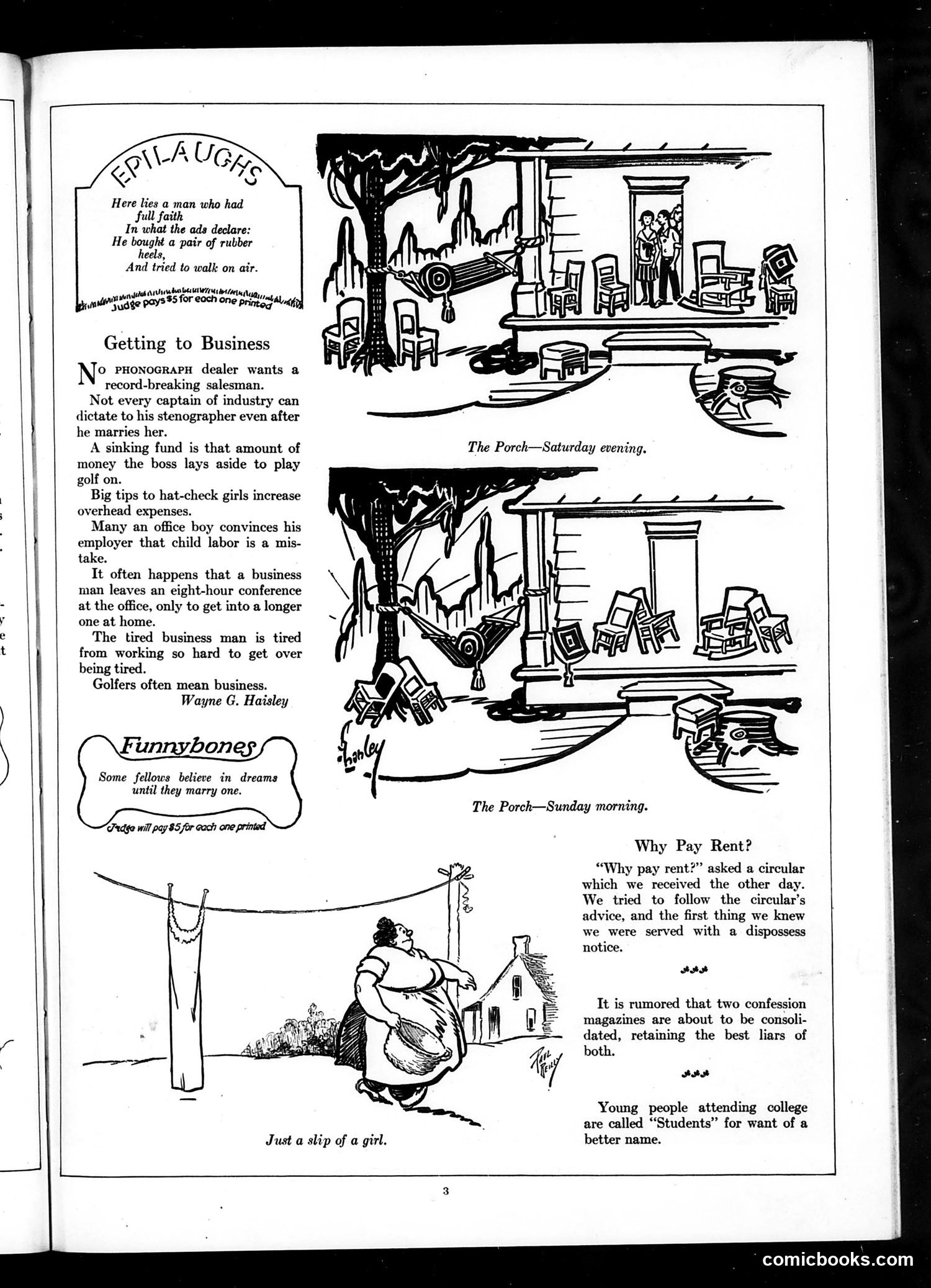
This page contains three separate humorous pieces targeting early 20th-century business and social conventions: **"Getting to Business"** critiques workplace inefficiency—phonograph salesmen lacking ambition, bosses neglecting actual work for golf, and office boys convincing employers that hiring hat-check girls increases productivity. The satire mocks both lazy management and the absurd overhead expenses of expanding female service staff. **"The Porch" illustrations** (Saturday evening vs. Sunday morning) humorously show how a domestic porch deteriorates after weekend entertaining—furniture scattered, debris accumulated—suggesting the chaos of middle-class social gatherings. **"Why Pay Rent?"** jokes about following a "no rent" circular literally, resulting in eviction, and makes light observations about confession magazines and college nomenclature. The overall tone targets business inefficiency and middle-class pretension common to 1920s satirical humor.
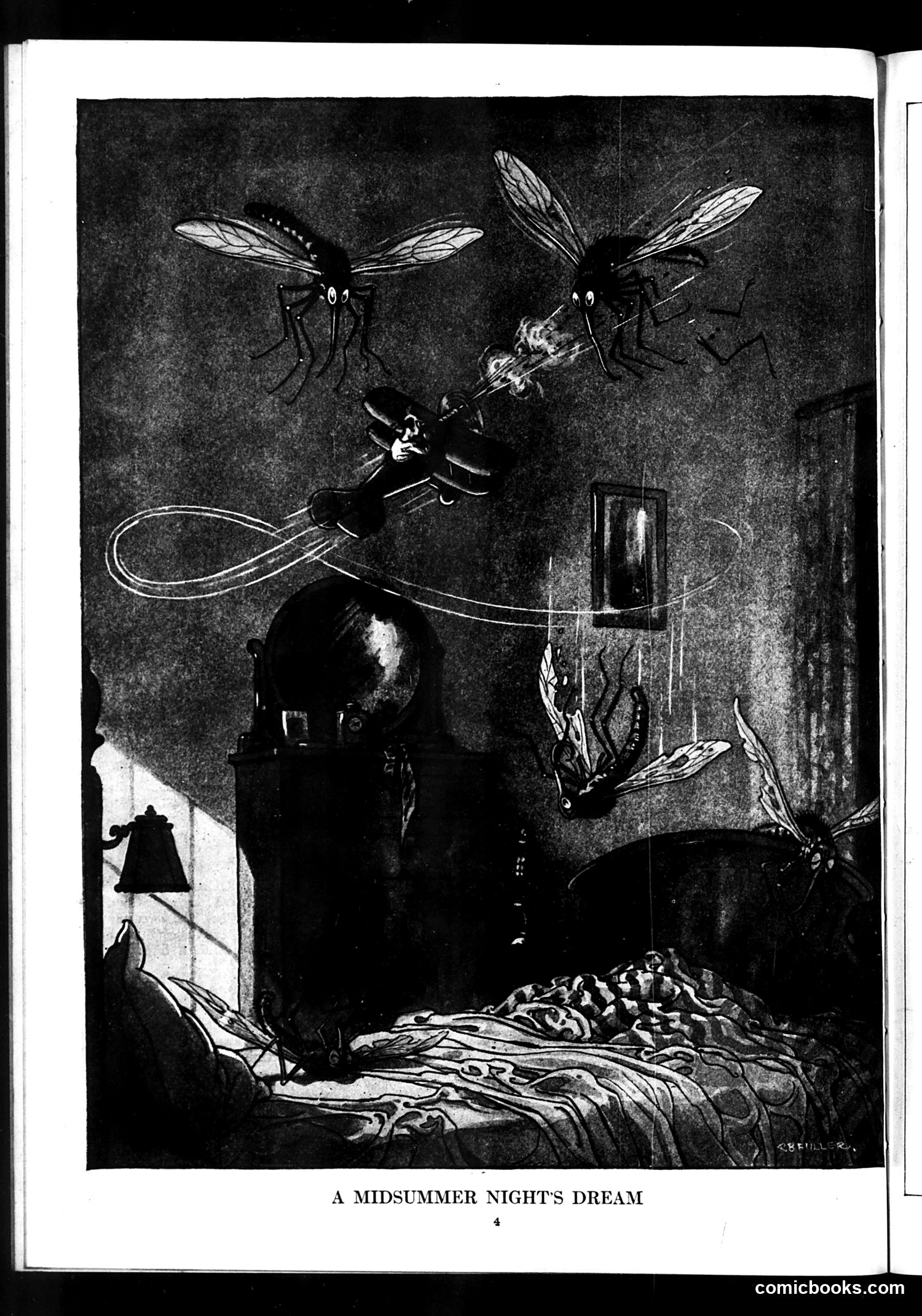
This illustration references Shakespeare's comedy *A Midsummer Night's Dream*, as indicated by the title. The image depicts a bedroom scene with a figure in bed and several winged creatures (likely fairies or insects) flying above, including what appear to be mosquitoes or gnats. The satire likely plays on the play's magical fantasy elements by contrasting them with a mundane modern reality—in this case, the comic torment of mosquitoes during summer nights. Rather than enchanted fairies creating mischief, the "dream" here involves the everyday annoyance of insects disturbing sleep, transforming Shakespeare's romantic comedy into a humorous commentary on summer's actual discomforts. The sleeping figure appears distressed by these unwelcome visitors.
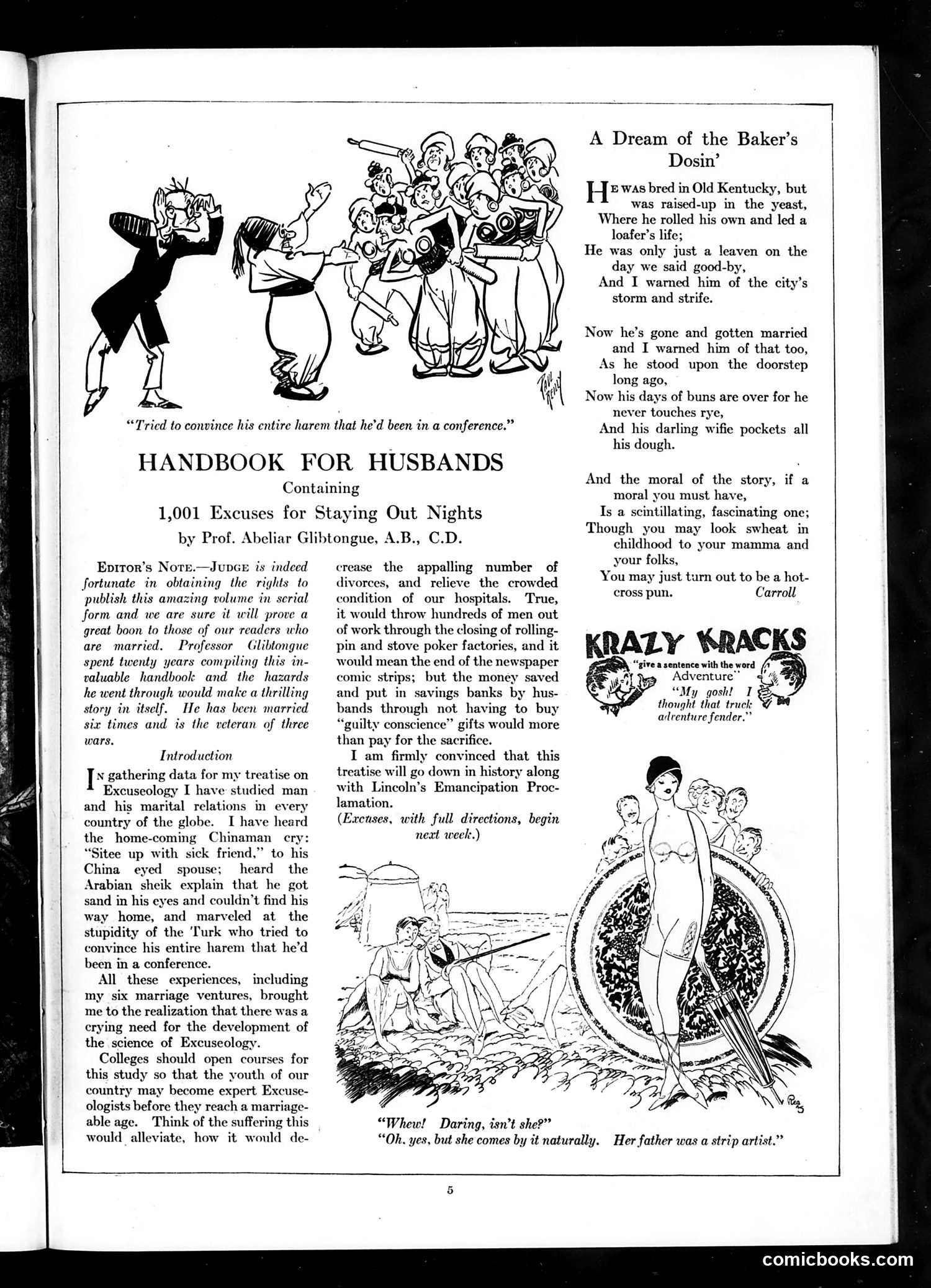
This page contains satirical content mocking marital dynamics of the era: **"Handbook for Husbands"** parodies a fake instructional book offering "1,001 Excuses for Staying Out Nights" by a fictional professor. The cartoon shows a man attempting to convince his wife he was at a conference while she remains skeptical—poking fun at husbands' transparent excuses for nighttime absences. **"A Dream of the Baker's Dosin'"** is a humorous poem about a young baker who left Kentucky for city life, got married, and now has his wages spent by his wife on household expenses ("his darling wife pockets all his dough"). The moral warns that city life traps naive young men in marriage. **"Krazy Kracks"** is a separate comic strip segment about unconventional domestic situations. The page satirizes early 20th-century marriage tensions and male anxieties about loss of freedom and financial control after marriage.
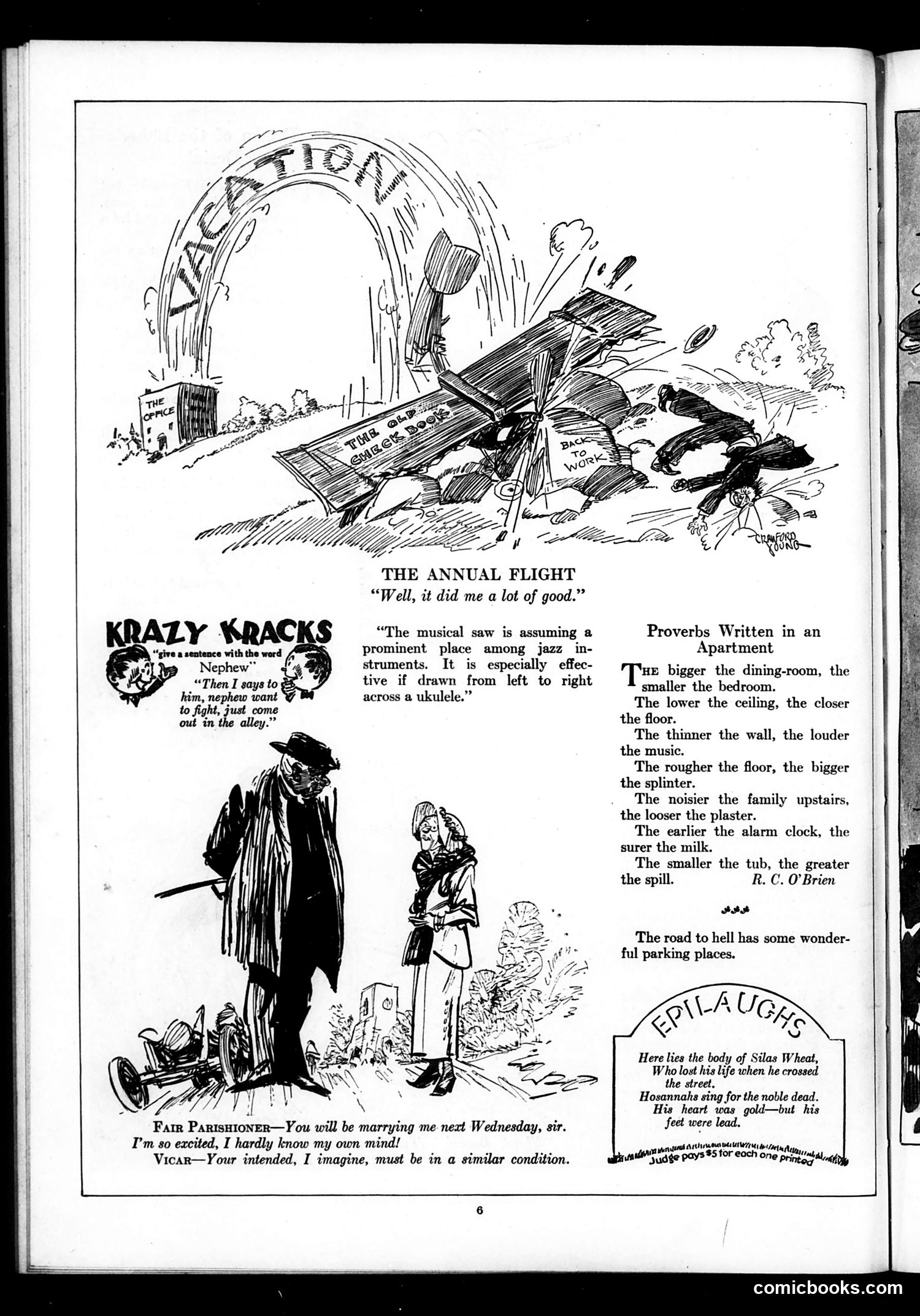
This page contains several distinct satirical pieces typical of 1920s-era humor: **"The Annual Flight"** (top): A cartoon showing a coffin labeled "VACATION HOPES" crashed near an arch labeled "VACATION," with a figure sprawled nearby. The caption "'Well, it did me a lot of good'" sarcastically suggests vacations disappoint—likely referencing post-WWI economic constraints or travel difficulties. **"Krazy Kracks"**: A brief joke about a nephew and uncle, with an accompanying cartoon showing a vicar and young woman discussing marriage, where the vicar implies the bride-to-be is equally confused/unprepared. **"Proverbs Written in an Apartment"**: Humorous observations about cramped urban apartment living—thin walls, small bathrooms, noisy neighbors—reflecting 1920s city life frustrations. **"Epil-aughs"**: A mock obituary with dark humor, playing on the irony that someone with a "gold heart" but "feet of lead" died crossing the street—a commentary on being too idealistic for practical survival. The page satirizes modern urban life, failed expectations, and contemporary anxieties rather than specific political figures.
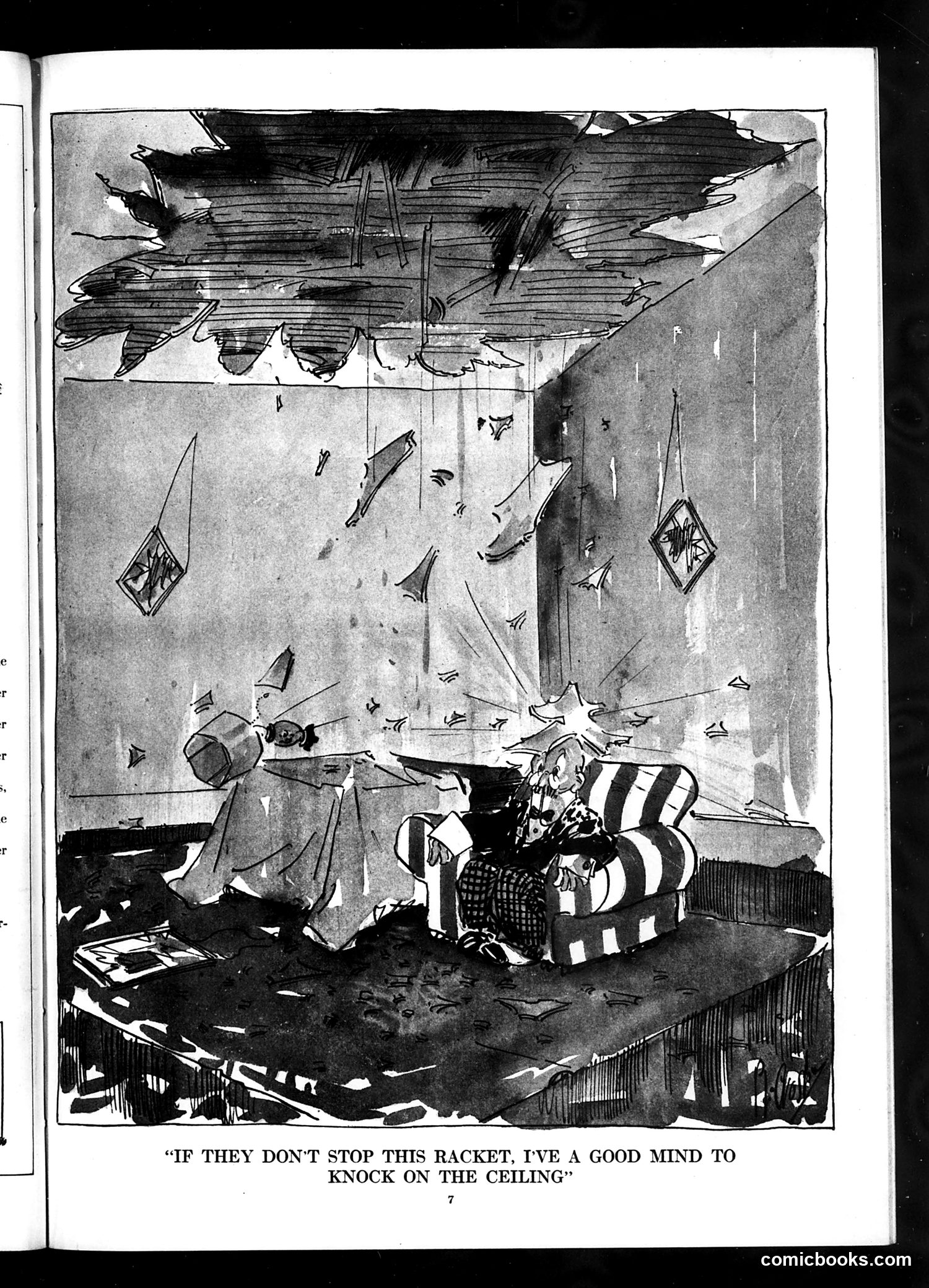
This cartoon depicts a domestic noise complaint scenario. Two figures in bed are disturbed by chaos above them—objects falling through the ceiling, papers and debris suspended in air. The caption expresses frustration about "this racket," with the speaker threatening to "knock on the ceiling" (a traditional way to signal upstairs neighbors to quiet down). The satire likely comments on social disruption or civil unrest of the era. The violent imagery overhead—the destruction and falling objects—suggests this refers to actual disturbances rather than literal neighbor noise. Without the publication date visible, the specific political event referenced is unclear, but the cartoon uses domestic inconvenience as metaphor for broader social upheaval. The weary resignation in the caption suggests public exhaustion with ongoing turmoil.
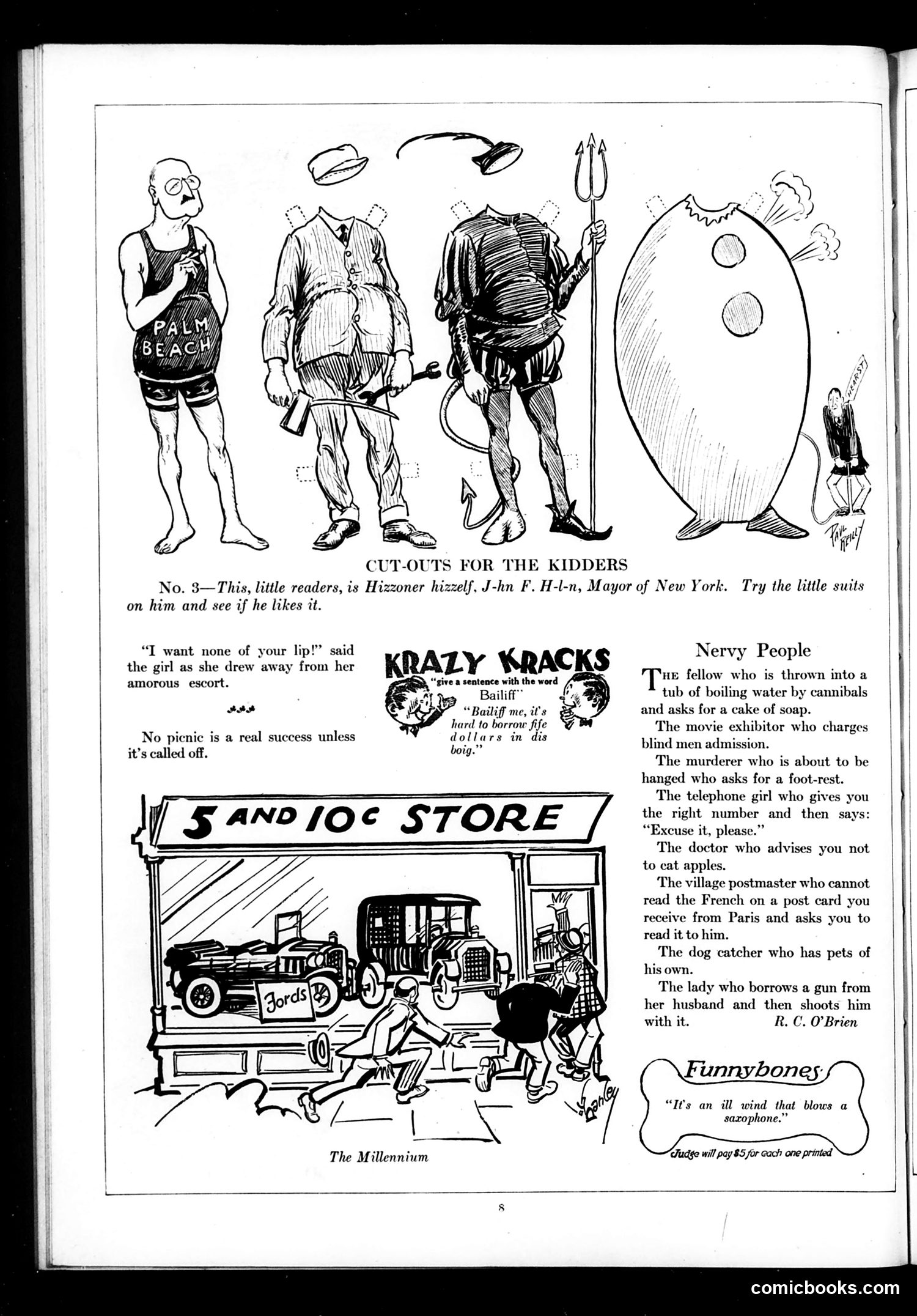
**Cut-Outs Section:** This shows paper dolls of Mayor John F. Hylan of New York (circa 1920s), with various costume options. The satire is that readers can dress him in different outfits to mock or ridicule him—a form of political caricature common in Judge magazine's irreverent humor. **"Krazy Kracks":** A pun section playing on words (e.g., "Bailiff me" sounds like "bail if" when the word "bail" is substituted). These are quick joke formats typical of period humor magazines. **"Nervy People":** A list of absurd character types and their contradictory behaviors—people who ask for inappropriate things in bad situations (asking for soap while boiling, asking for comfort before execution). This satirizes human irrationality and social awkwardness through exaggeration. **"The Millennium":** A 5-and-10-cent store window display showing Ford automobiles, likely satirizing commercialism and modern consumerism of the era. The overall tone is irreverent, mocking both politicians and social conventions.
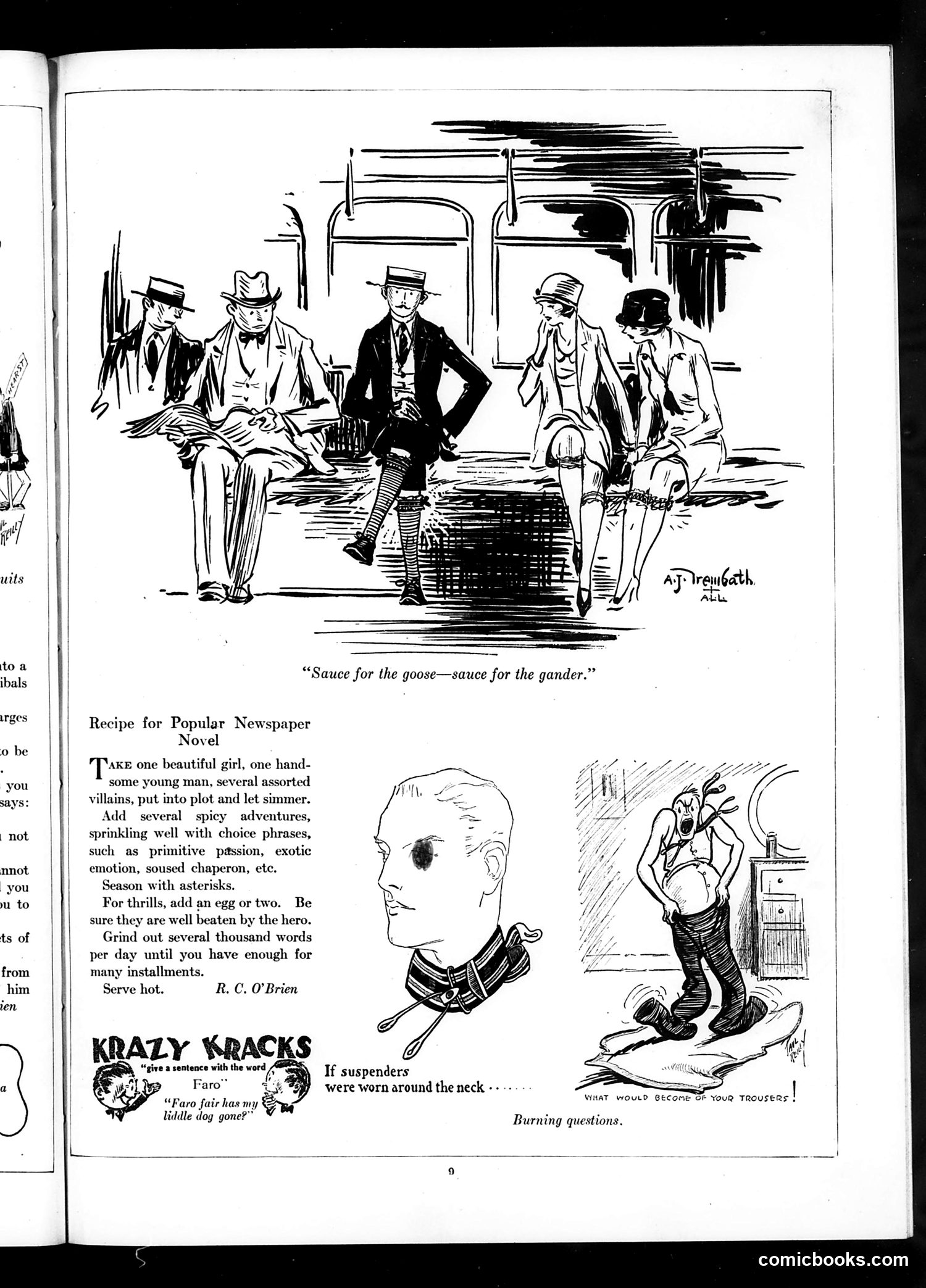
The top cartoon satirizes serialized newspaper romance novels—wildly popular in the early 20th century. Five men in a streetcar represent different stock characters (the handsome protagonist, villains, and supporting cast) that filled these melodramatic stories. The caption "Sauce for the goose—sauce for the gander" suggests these formulaic plots applied equally to male and female readers. The accompanying "Recipe" by R.C. O'Brien mocks the assembly-line production of these serials: take stock ingredients (beautiful girl, handsome man, villains), add clichéd phrases ("primitive passion," "exotic emotion"), grind out thousands of words daily. The joke is that publishers treated literature as mass-produced entertainment rather than genuine art. Below, "Krazy Kracks" presents word-play humor and absurdist "burning questions" about suspenders and a dog—typical filler comedy for magazines of this era. The satire targets mass-market literature and popular entertainment conventions.
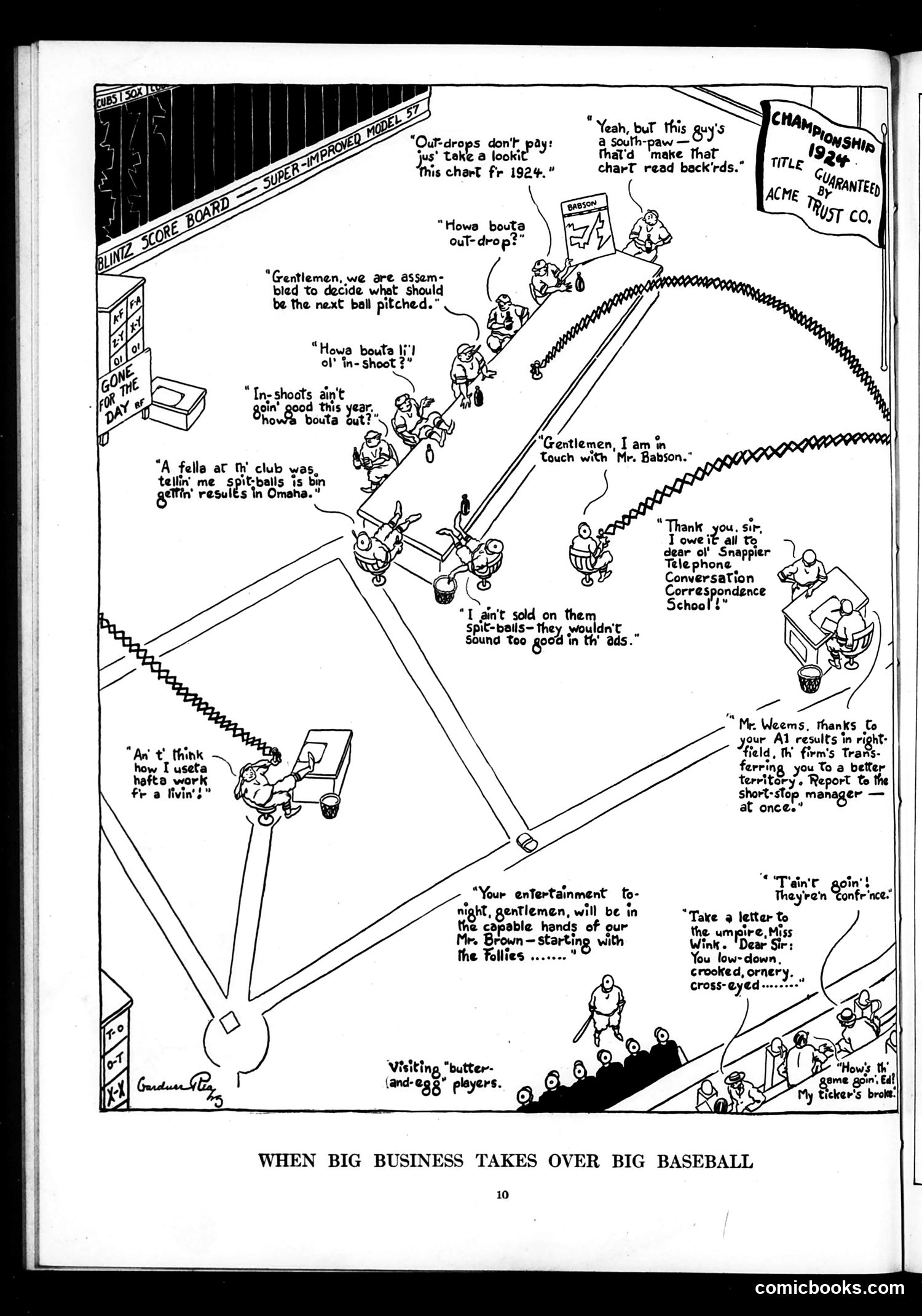
This 1920s satirical cartoon critiques the commercialization of baseball by corporate management. The baseball diamond is redrawn as a corporate flowchart, with businessmen discussing strategy using jargon like "out-drops," "spitballs," and pitch selection—but filtered through absurd business-speak and references to stock market analysts (Mr. Babson, who appears to be a real financial advisor of the era). The humor targets how big business has replaced traditional baseball intuition with charts, data, and corporate bureaucracy. References to entertainment ("Follies"), employee transfers, and corporate chains of command mock the sport's loss of spontaneity. The visiting players are reduced to "butter-and-egg" men—a period phrase for wealthy, unsophisticated businessmen. The satire suggests that commercialization has drained baseball of authenticity and replaced player skill with corporate management consulting.
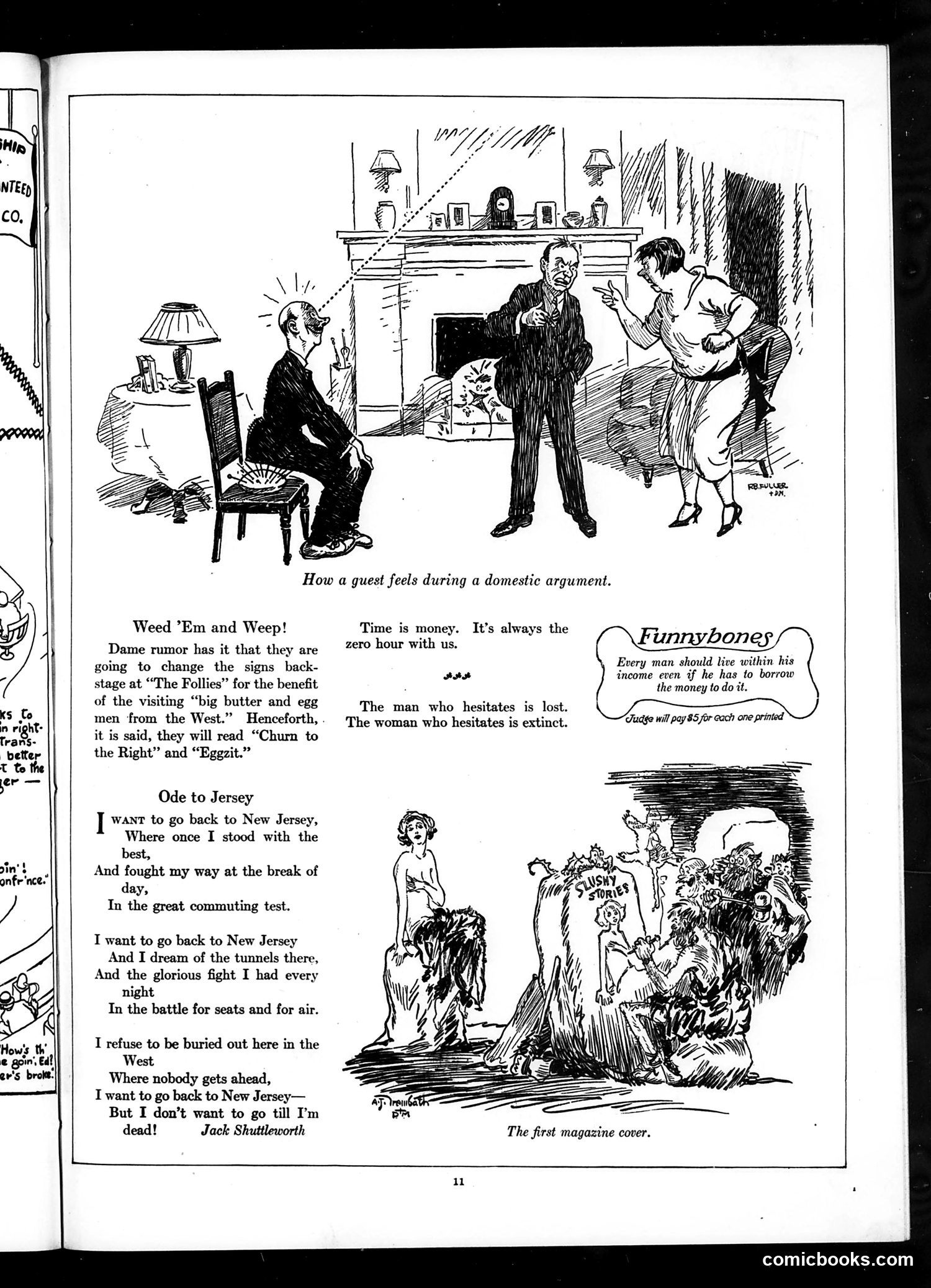
**Top Cartoon:** Depicts an awkward social situation where a dinner guest (left, seated) witnesses a marital argument between a couple. The husband gestures animatedly while the wife responds, illustrating the caption's point about guest discomfort during domestic conflicts. **"Weed 'Em and Weep":** A theatrical joke about Broadway's "Follies" show. Rural wealthy investors ("big butter and egg men from the West") visit the show, so backstage signs will be changed from theatrical directions ("Stage Right," "Exit") to agricultural puns ("Churn to the Right," "Eggzit")—mocking both rural visitors and theater industry snobbery. **"Ode to Jersey":** Satirizes New Jersey commuters' complaints about brutal daily transit battles—fighting for train seats and air during crowded rush hour. The poem humorously suggests the author prefers death over staying in the West, emphasizing the misery of commuting as a defining regional experience. **Funnyboney** and **The First Magazine Cover**: Brief humorous aphorisms and a separate illustration, likely unrelated editorial content.
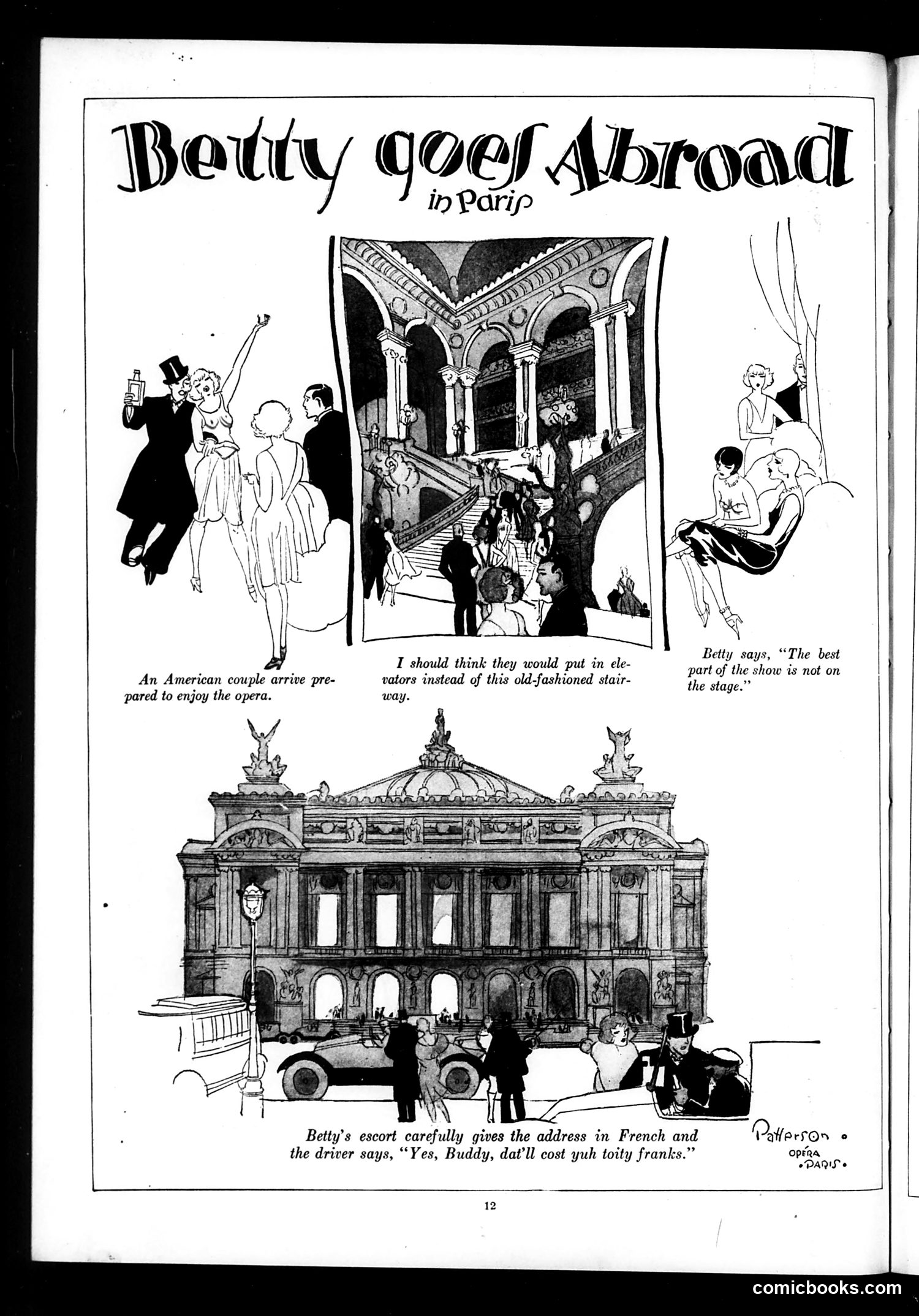
This is a humorous comic strip about an American tourist couple visiting the Paris Opera. The satire targets American tourists' pretensions and cultural ignorance: 1. **The setup**: An American couple arrives at the opera dressed formally, expecting high culture. 2. **The jokes**: - Betty complains the opera building needs modern elevators instead of "old-fashioned" grand staircases—missing that the architecture *is* the attraction - Betty notes "the best part of the show is not on the stage"—implying she's more interested in people-watching than the performance - Her escort attempts French sophistication when asking the taxi driver for directions, but the driver responds in exaggerated immigrant dialect ("toity franks" for "thirty francs") **The satire**: Americans abroad are portrayed as culturally oblivious, dismissive of European heritage, and prone to encountering working-class immigrants who speak broken English despite the tourists' attempts at continental sophistication.
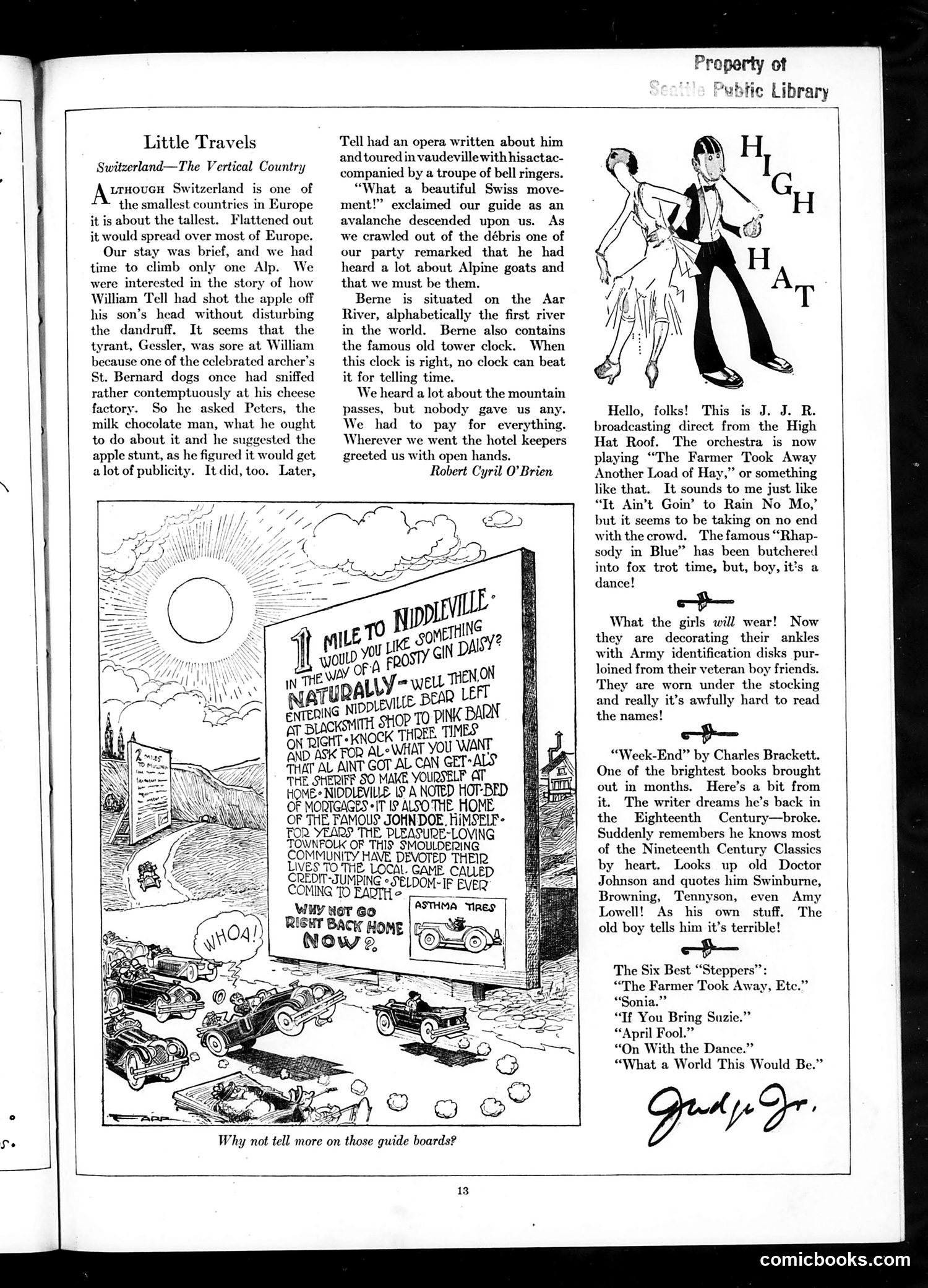
This page contains travel humor and entertainment commentary from the 1920s. **"Little Travels" Section:** A satirical travelogue mocking Swiss tourism and local legends. The author humorously deflates William Tell's heroic myth by claiming it was a publicity stunt suggested by "Peters, the milk chocolate man" to boost his cheese factory's reputation. The jokes play on Switzerland's geography (describing it as "vertical"), the famous Berne clock, and the stereotype of Swiss hospitality as mercenary ("greeted us with open hands" for payment). **"Niddleville" Advertisement Cartoon:** A humorous road sign advertising a fictional town, using exaggerated rural dialect and poor grammar to mock small-town America and automobile tourism. **"High Hat Roof" Section:** Jazz-age gossip about current dance crazes and popular songs. References contemporary hits like "Rhapsody in Blue" and fashion trends among young women wearing Army identification disks (likely souvenirs from WWI veteran boyfriends). The overall tone is lighthearted social satire targeting tourism, rural America, and modern youth culture.
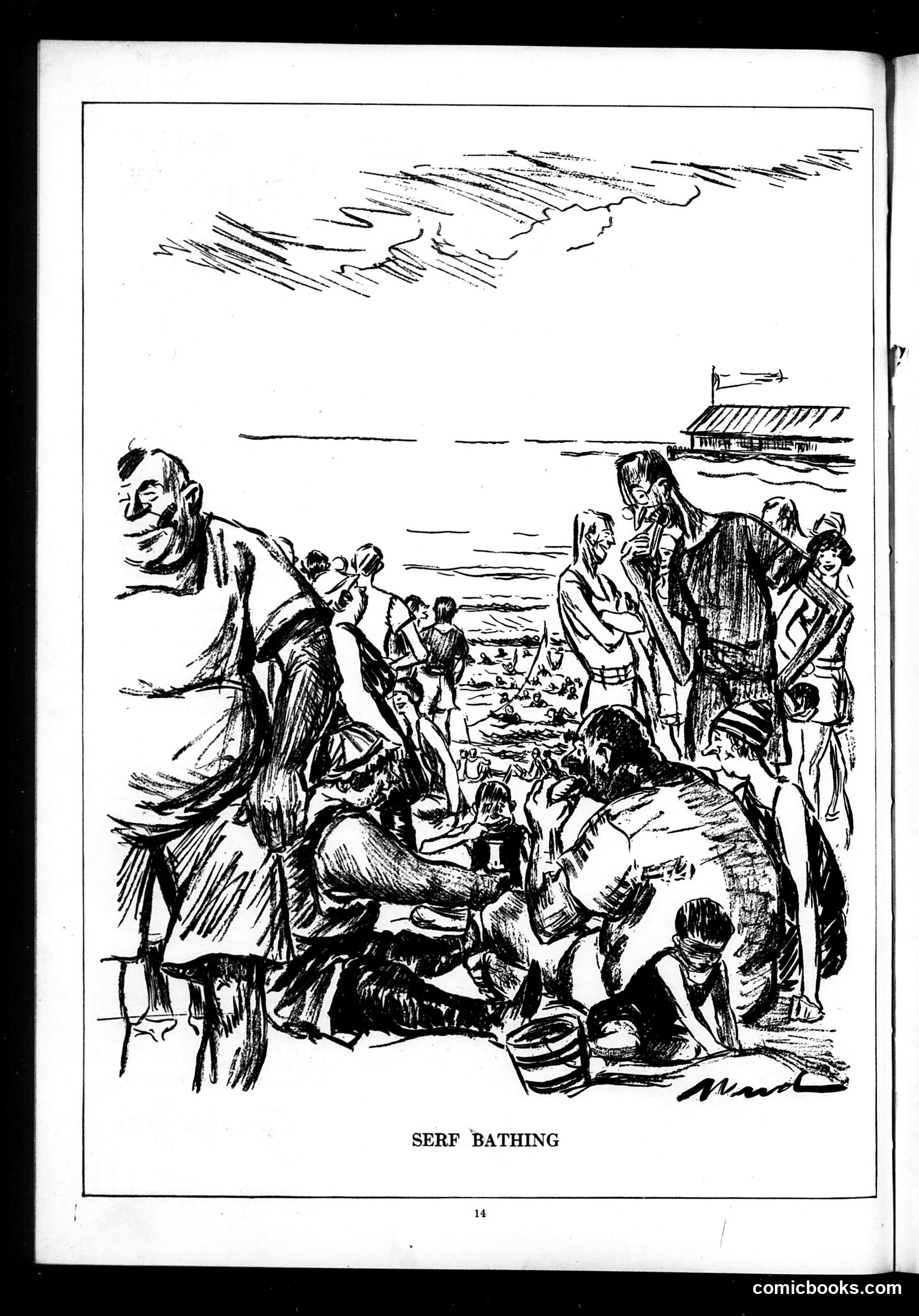
This cartoon depicts a crowded beach scene titled "Surf Bathing." The drawing shows exaggerated caricatures of beachgoers in Victorian/Edwardian-era swimming attire, with figures displaying grotesque or satirical features. The satire appears to target the social dynamics and pretensions of seaside resort culture—likely mocking the mixture of social classes, fashion absurdities, and human behavior on display at public beaches. The deliberately unflattering caricatures suggest Judge's typical approach of ridiculing social conventions and vanity. The scene includes what appears to be a bathhouse or pavilion in the background, establishing the seaside resort setting. Without additional context about the specific publication date, the precise targets of the satire remain somewhat unclear, though the general commentary on beach society and social pretension is evident.
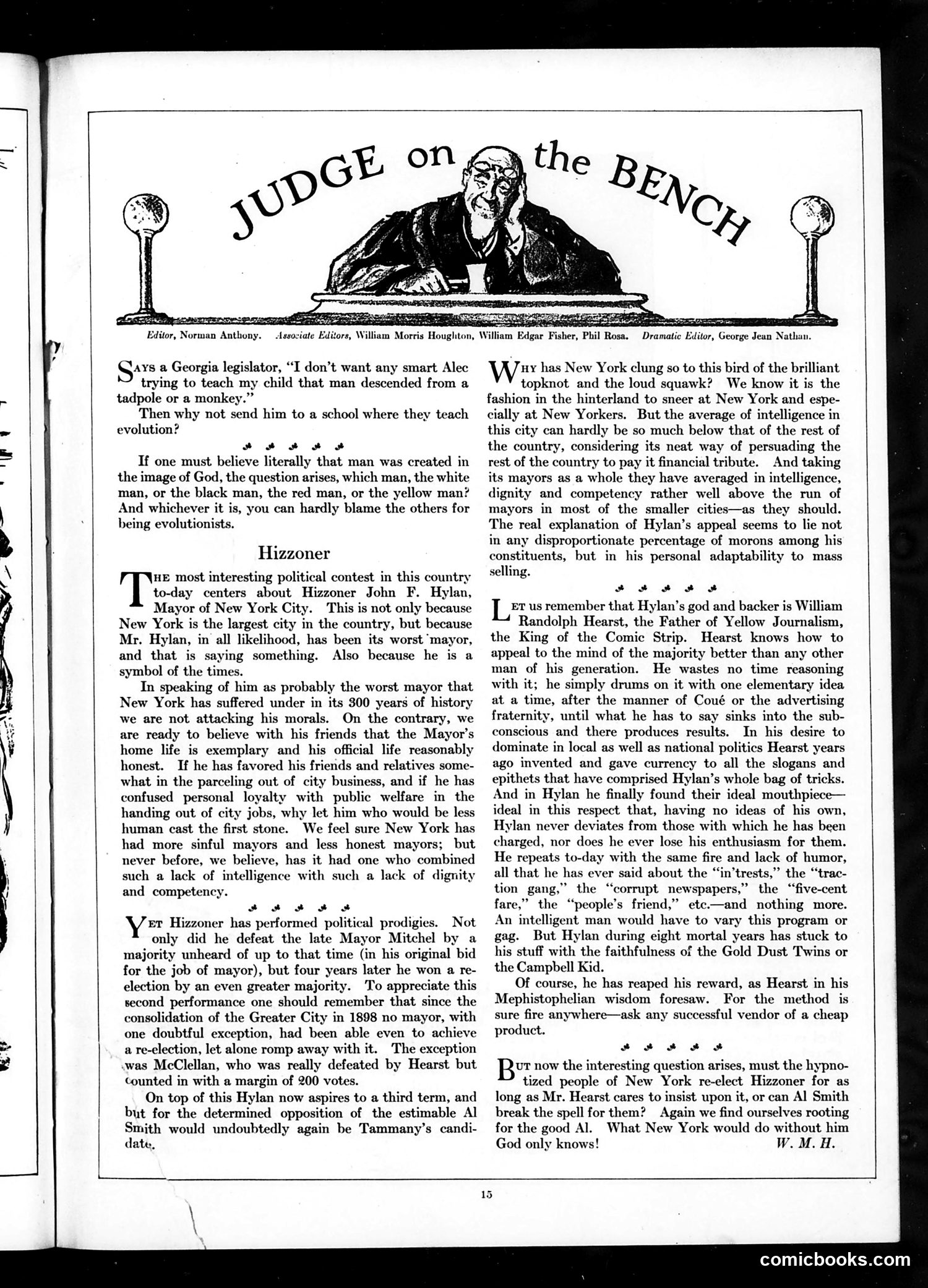
This *Judge* magazine page contains two satirical pieces: **The Evolution Joke** (top) mocks a Georgia legislator opposing evolution in schools. The satire's point: if you believe literally that man was created in God's image, which race are you referring to? The absurdity exposes the hypocrisy of creationist arguments used to defend racial hierarchy. **"Hizzoner" (main article)** critiques New York City Mayor John F. Hylan, calling him "probably the worst mayor" in the city's 300-year history—not morally corrupt, but profoundly unintelligent and lacking dignity. The author notes Hylan's political success despite incompetence, attributing it to his backer **William Randolph Hearst** (yellow journalism pioneer). The satire argues Hearst manipulates the masses through repetitive, elementary messaging rather than reasoning—Hylan succeeds because he's a perfect vehicle for mass propaganda, not despite his mediocrity.
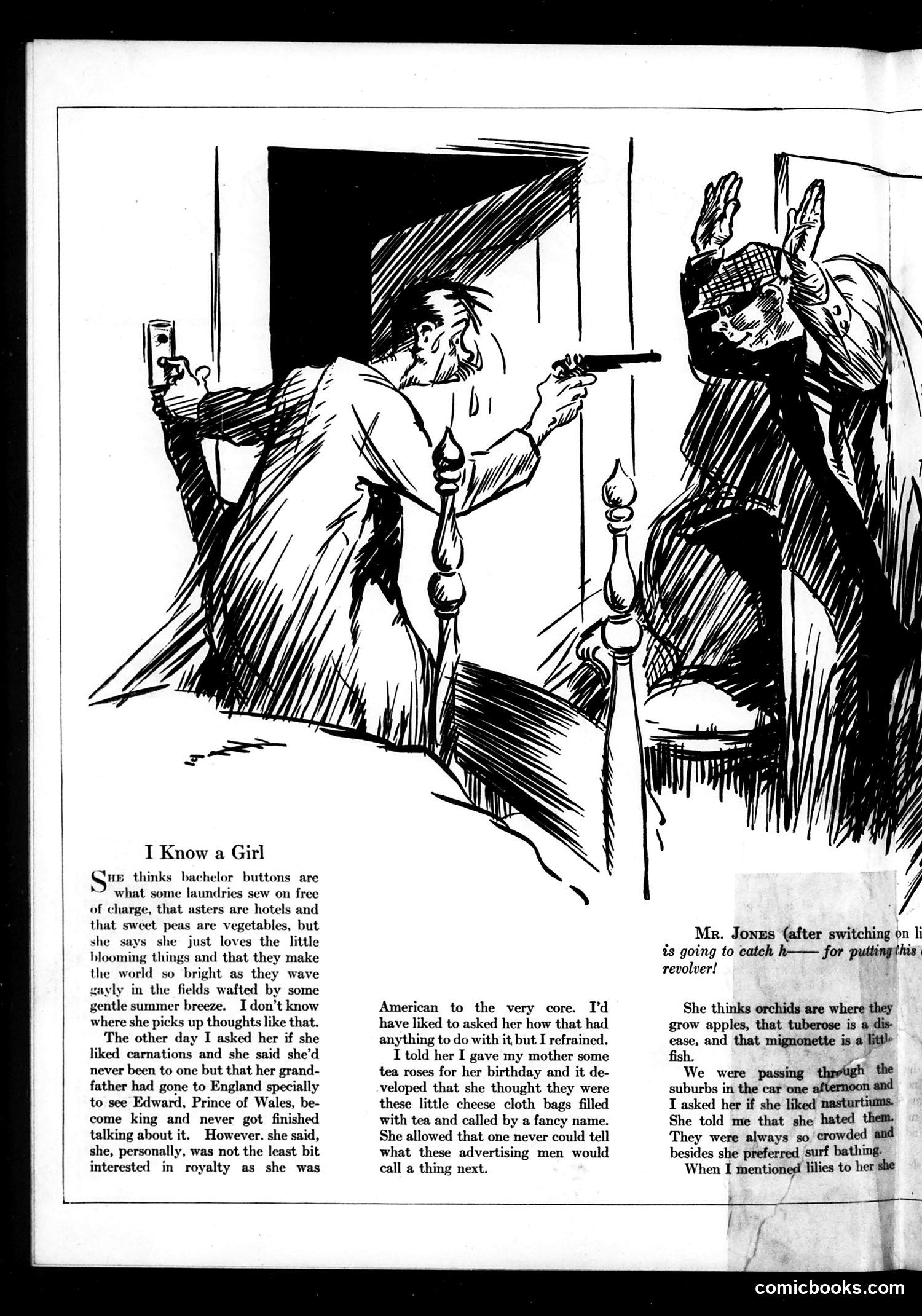
This is a humorous satirical piece about female ignorance, reflecting early 20th-century gender stereotypes. The unnamed narrator describes a girl who confuses flower names with completely unrelated concepts—"bachelor buttons" as laundry services, "asters" as hotels, "sweet peas" as vegetables, and "tuberose" as a disease. The joke mocks her lack of education while portraying her as charmingly oblivious. A secondary cartoon shows Mr. Jones threatening violence over a revolver being hidden, suggesting domestic discord. The satire targets both the girl's intellectual gaps and, implicitly, limited female education of the era. The piece uses her malapropisms for comedic effect, playing on period assumptions that women were less educated and more concerned with frivolous pursuits like bathing than intellectual matters—even rejecting interest in royalty as "American" despite her confusion about basic facts.
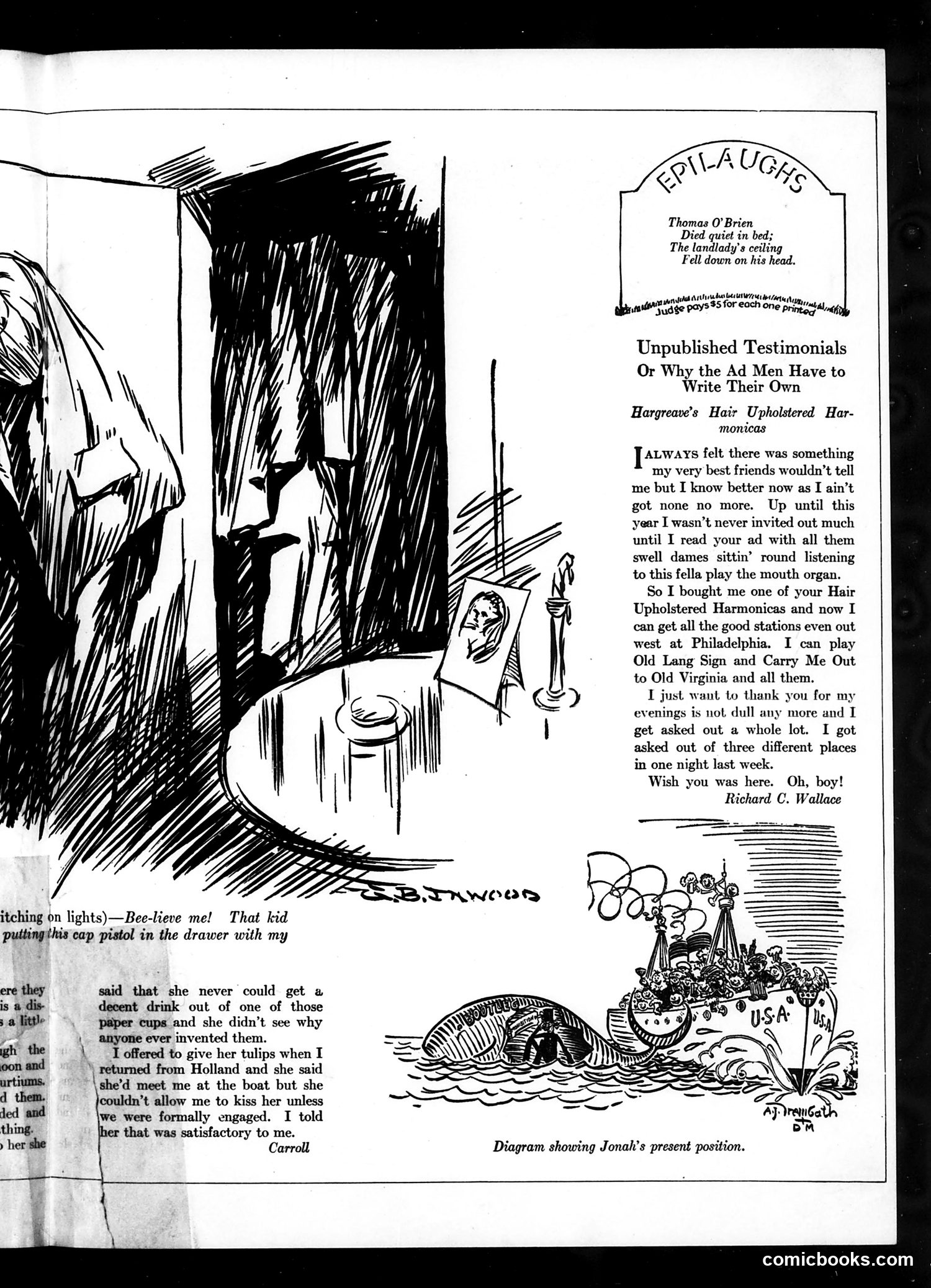
This page contains two distinct humor pieces satirizing early 20th-century advertising: **Top section** ("Unpublished Testimonials"): A mock testimonial for "Hargreave's Hair Upholstered Harmonicas." The joke is that the fictional product—a harmonica allegedly covered in hair—is absurdly useless, yet the testimonial writer claims it transformed his social life and musical abilities. The humor lies in the deliberately poor grammar and the testimonial's logic: buying a ridiculous product supposedly made him popular and allowed him to play better music. This satirizes deceptive advertising testimonials that made outlandish claims about products' life-changing powers. **Bottom section**: A cartoon captioned "Diagram showing Jonah's present position," depicting a whale in water with a small boat or structure emerging from it labeled "U.S.A." and "DEBT." This is a Depression-era political cartoon suggesting America is "inside" its debt problem, referencing the biblical Jonah swallowed by a whale—implying the nation is trapped in economic crisis.
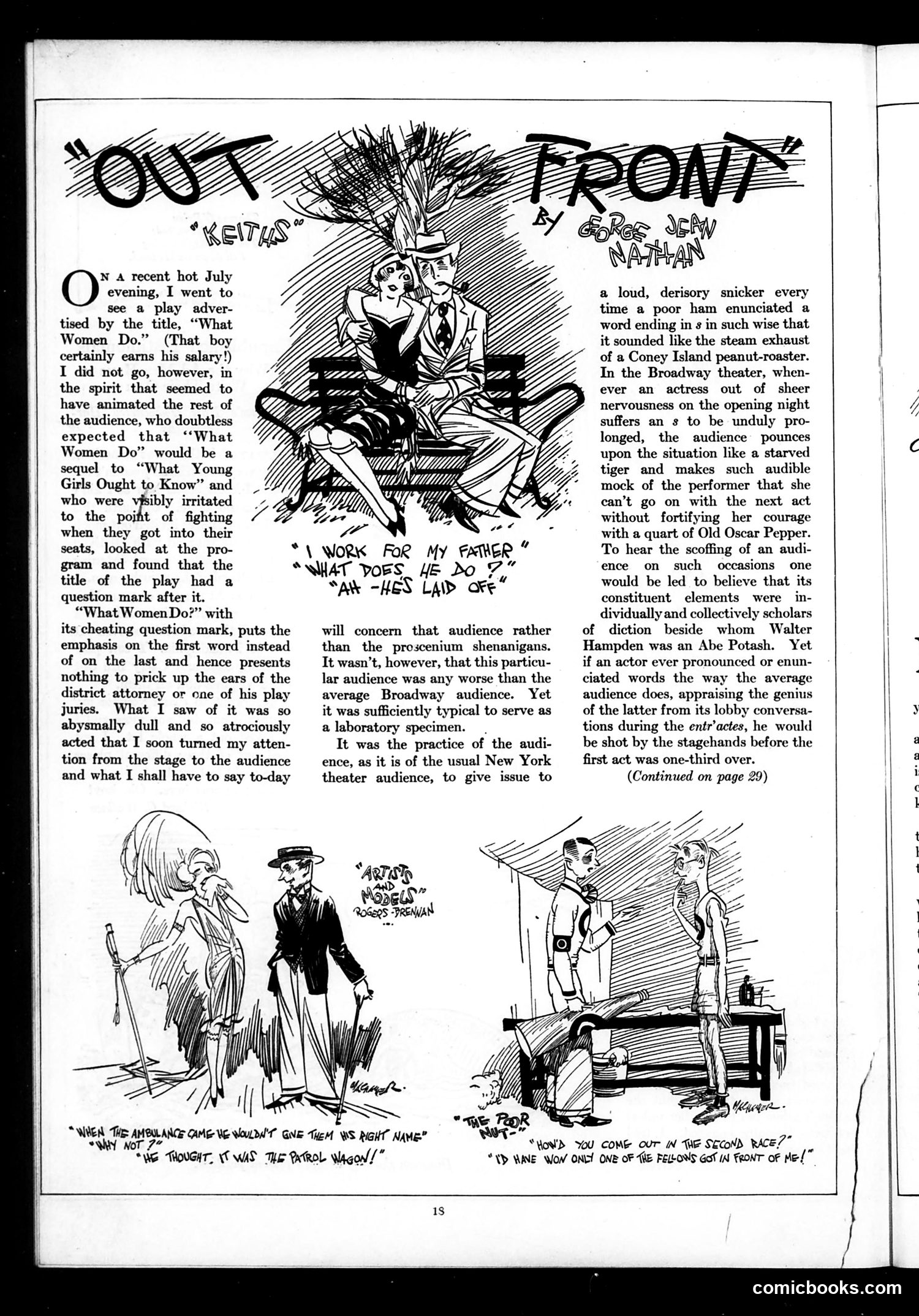
This article satirizes Broadway theater audiences' poor behavior during opening nights, using the play "What Women Do?" as a case study. The author criticizes theatergoers who mock actors for mispronouncing words ending in 's'—the audience would snicker derisively at any perceived affectation, as if the actor sounded like a Coney Island peanut-roaster's steam exhaust. This casual cruelty could rattle performers so badly they needed alcohol (Old Oscar Pepper whiskey) to continue. The piece argues such audiences are composed of "scholars of diction," implying they're not—ordinary theatergoers pretending to expertise. The author references Walter Hampden (a respected Shakespearean actor) to mock the gap between average audience knowledge and their presumed authority in judging performers. The accompanying cartoons illustrate typical theater audience absurdities: an old woman complaining about an ambulance's incorrect name, and someone boasting about racehorse betting—showing the frivolous, self-absorbed nature of opening-night crowds more interested in socializing than theater.
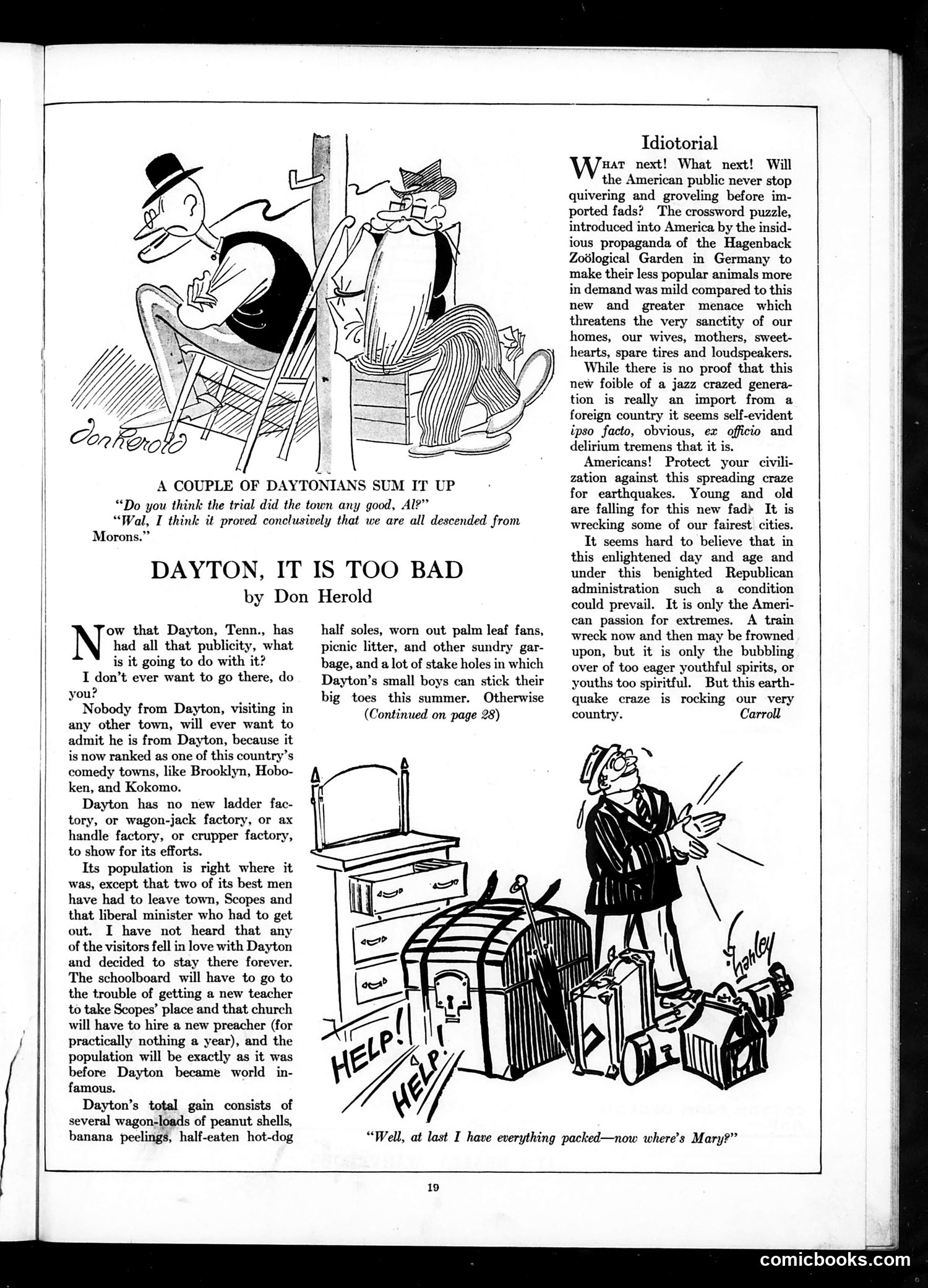
This page satirizes the **Scopes "Monkey Trial"** of 1925 in Dayton, Tennessee—a famous legal case where teacher John Scopes was prosecuted for teaching evolution, violating state law. The trial became a national spectacle attracting massive publicity. **Top cartoon**: Two Dayton residents joke that the trial "proved conclusively that we are all descended from Morons"—mocking both the anti-evolution position and Dayton's newfound notoriety as a backwards town. **Don Herold's article**: He sarcastically notes Dayton gained nothing from the publicity except litter and a damaged reputation. Key figures who left (Scopes and a liberal minister) represent the town's loss of its better elements. The town now ranks alongside Brooklyn and Hoboken as a national punchline. **"Idiotorial" section**: This mock editorial sarcastically blames imported "fads" (crossword puzzles, jazz, now earthquake crazes) for corrupting American civilization, satirizing the actual conservative hysteria about modern influences that motivated the Scopes trial itself.
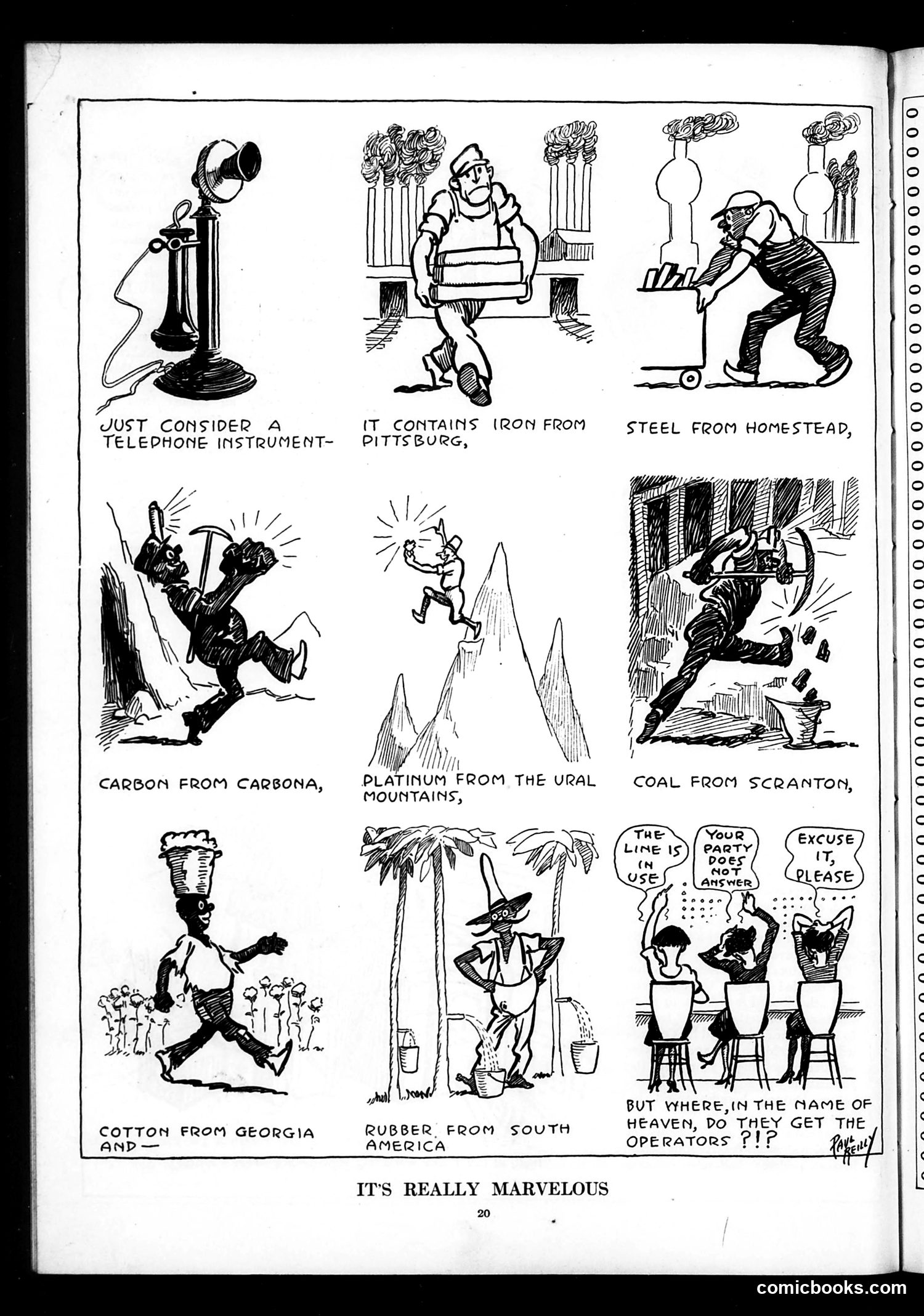
This satirical cartoon mocks the telephone industry's supply chain and labor practices. Each panel traces components' origins—iron from Pittsburgh, steel from Homestead, coal from Scranton, platinum from the Urals, rubber from South America, and cotton from Georgia—showing how a telephone instrument relies on materials from across America and the world. The final panel's punchline exposes the hypocrisy: while the industry proudly sources materials globally and nationally, it apparently cannot find qualified telephone *operators* from these same regions. Three women sit at desks, and one complains "the line is not in use" while another says "your party does not answer." The exasperated man demands, "where, in the name of heaven, do they get the operators?!" The cartoon satirizes both the telephone company's operational incompetence and likely contemporary labor disputes or complaints about operator service quality and availability—suggesting the industry can source materials anywhere but cannot staff competently.
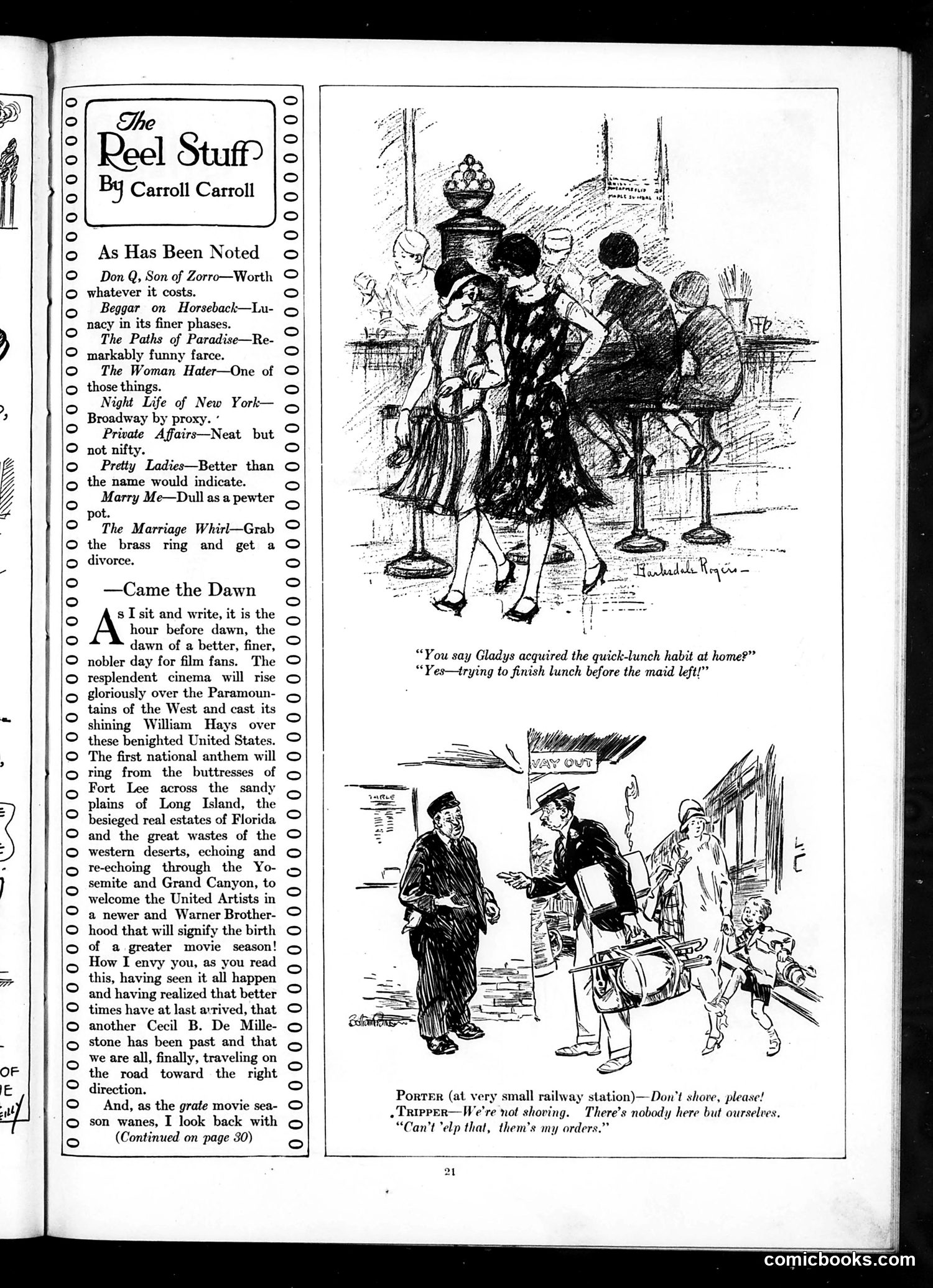
This page contains Carroll Carroll's film reviews—a satirical column critiquing recent movies. The humor derives from cynical one-liners about contemporary films: "Don Q, Son of Zorro" is worthless; "Beggar on Horseback" represents lunacy; "Marry Me" is dull as pewter. The main essay, "Came the Dawn," mocks Hollywood's self-importance through grandiose language. It ironically praises the coming "new era" under Will Hays (who headed film industry censorship), sarcastically imagining the film industry's anthem echoing across America—a parody of industry pomposity. The two illustrated cartoons show domestic and class humor unrelated to the film column. The top depicts wealthy women at leisure; the bottom shows a porter enforcing crowd-control rules despite no actual crowd—absurdist humor about blind obedience to protocol. The satire targets both Hollywood's pretension and contemporary social foibles.
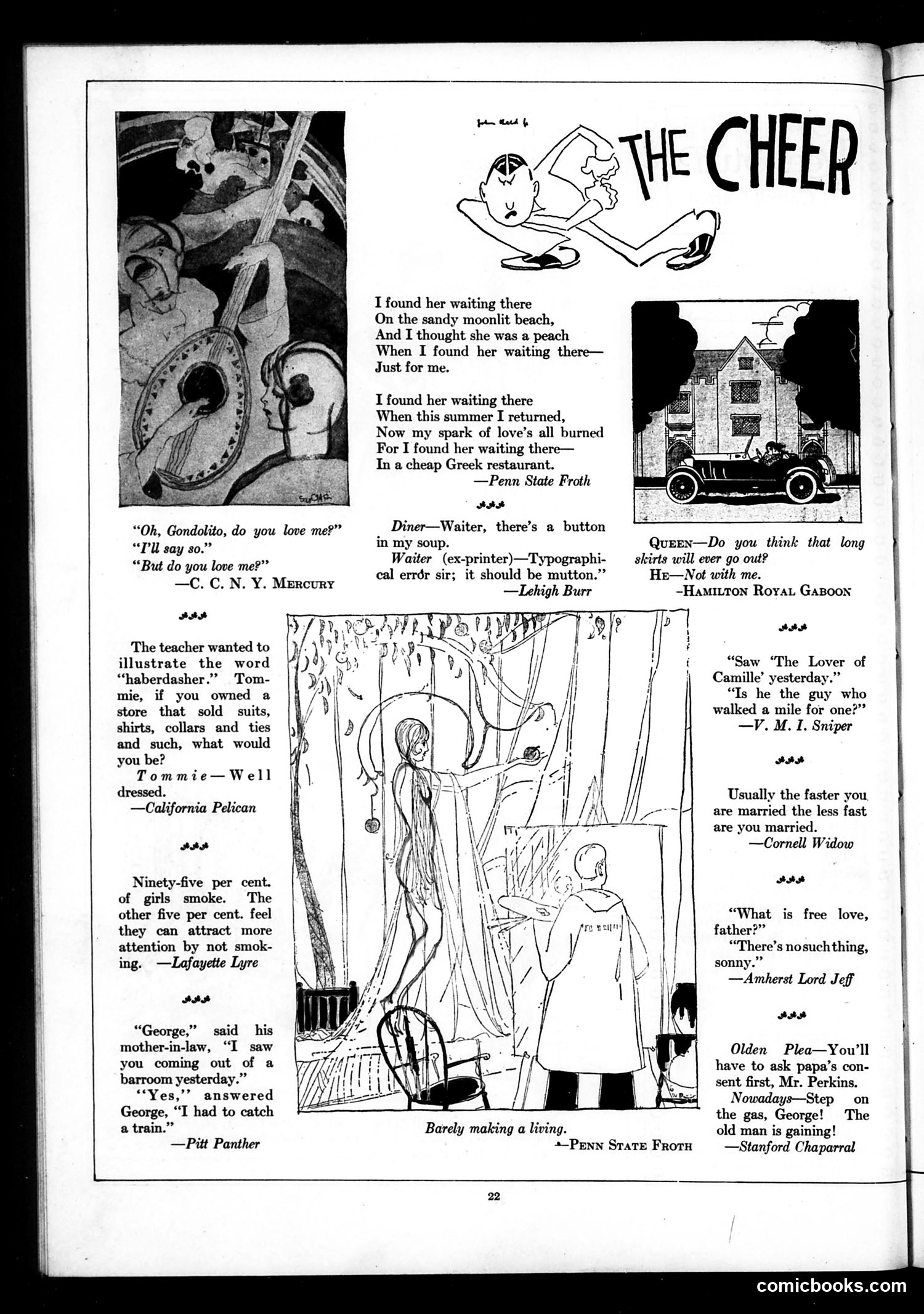
This page collects humor from college and university newspapers, featuring satirical jokes about courtship, marriage, and social behavior circa the 1920s. **Key themes:** **Romance/Dating:** Multiple jokes mock the transience of romantic interest—a man loses attraction when he finds his girlfriend "waiting" in a cheap restaurant instead of on a moonlit beach. Another joke plays on the Camels cigarette slogan ("I'd walk a mile for a Camel"). **Marriage satire:** Jokes contrast old courtship etiquette (asking father's permission) with modern elopement ("Step on the gas, George! The old man is gaining!"), reflecting changing social norms. Another suggests marriage kills passion: "the faster you are married the less fast are you married." **Gender commentary:** A joke about women smoking notes 95% do so; the remaining 5% think *not* smoking attracts more attention—satirizing performative femininity. **Miscellaneous wordplay:** A waiter's typo joke ("button" should be "mutton") and a haberdashery definition joke round out the collection. The overall tone reflects Jazz Age cynicism about love and modern life.
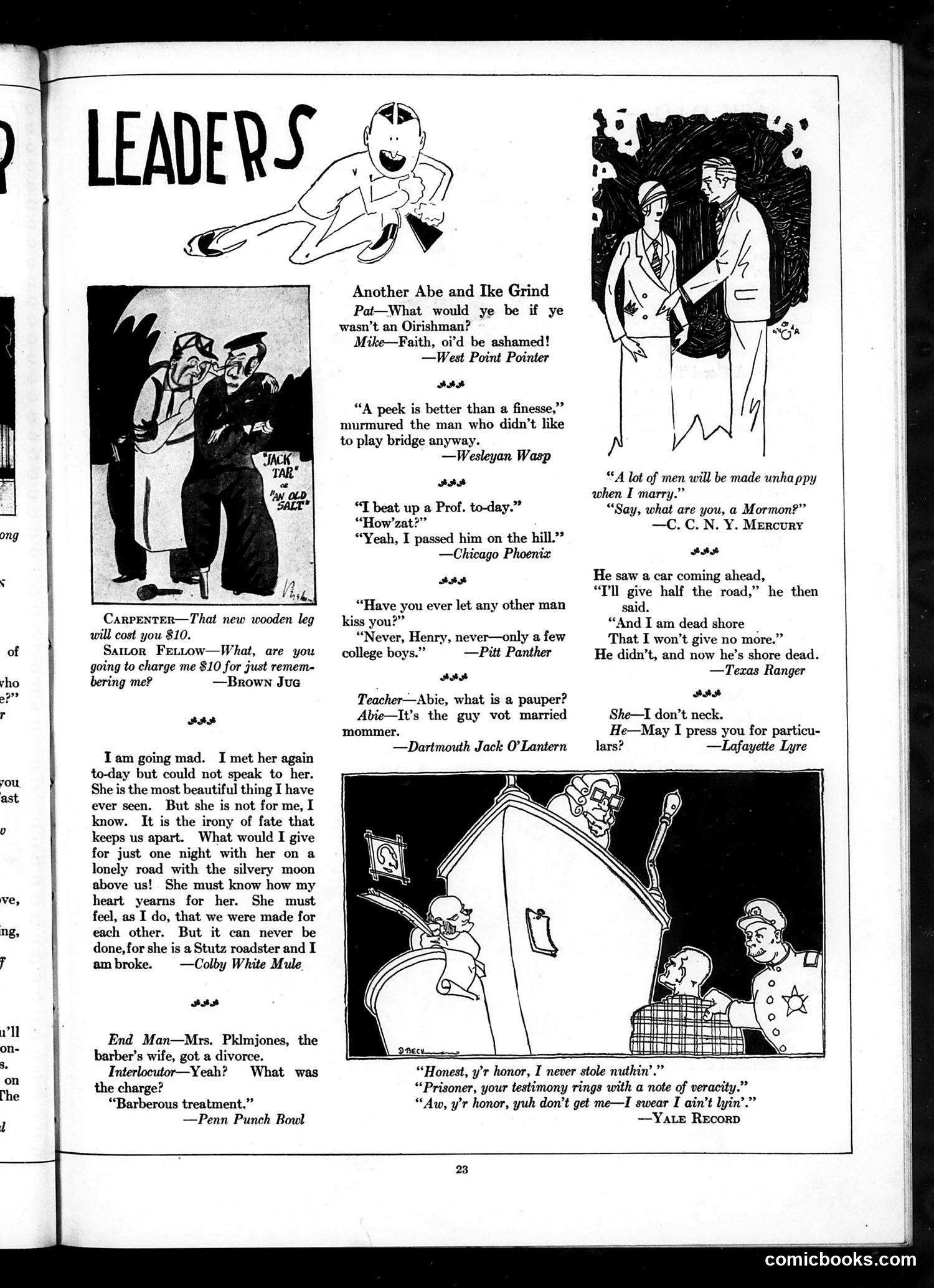
This page collects brief humorous anecdotes and jokes from college and university humor publications, a common Judge feature. The content reflects early 20th-century American college culture and social attitudes. **Key humor themes:** - **Dating/courtship**: Multiple jokes about romantic pursuit, necking (kissing), and marriage expectations, reflecting strict dating conventions of the era - **Ethnic stereotypes**: The "Abe and Ike Grind" features Irish dialect humor; another joke uses Jewish dialect ("Abie"), common in period publications - **College life**: References to professors, bridge-playing, and student pranks - **Class differences**: A joke about a working-class man who can't afford both a woman and a car (the "Stutz roadster") - **Legal/linguistic humor**: A courtroom scene where an Irish defendant's claim of honesty is treated as suspicious The cartoons accompanying these jokes are crude line drawings typical of the era. The overall tone reflects outdated social stereotypes and attitudes toward women, ethnicity, and class that would be considered offensive today. The page demonstrates how humor publications documented—and often reinforced—period prejudices.
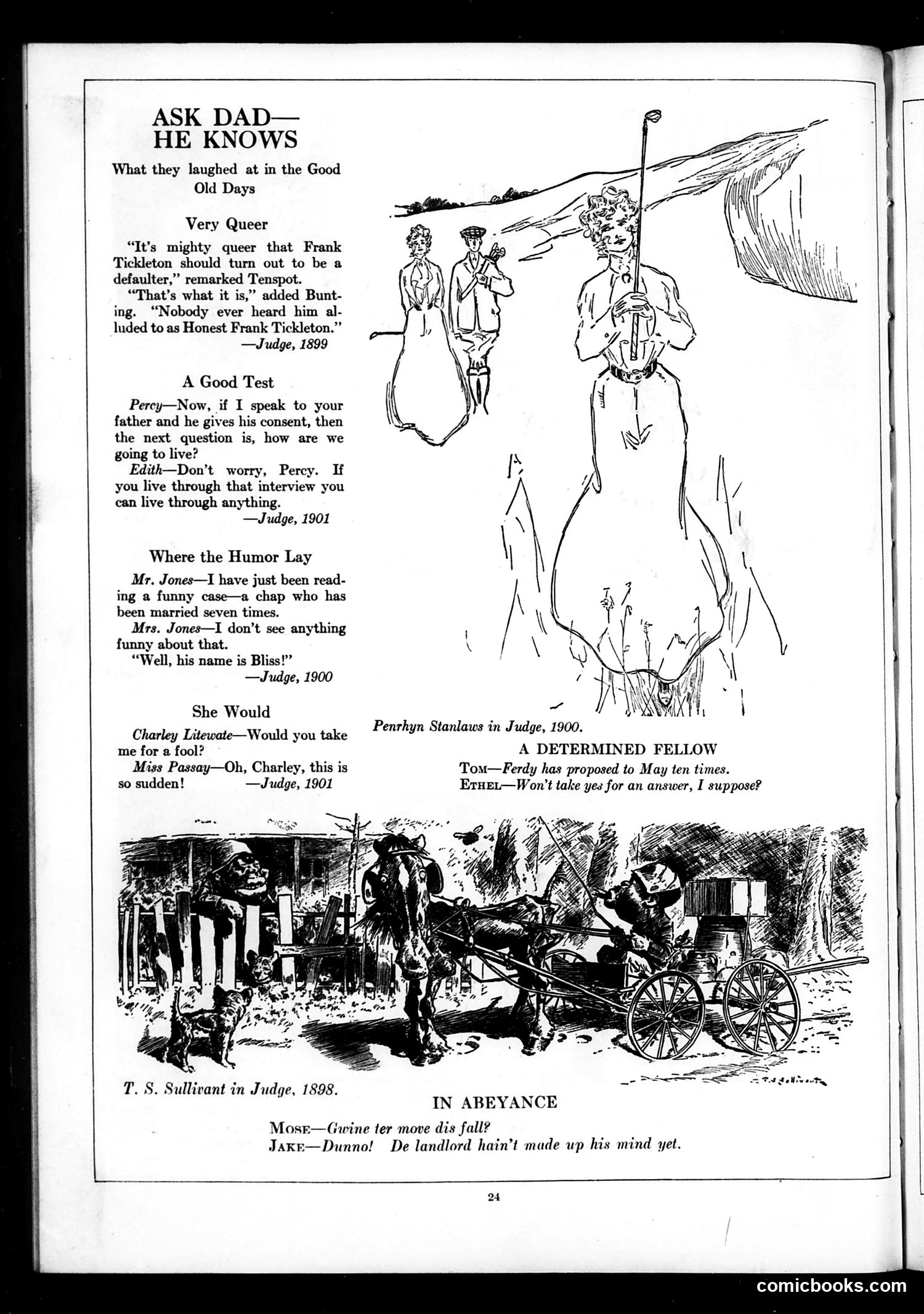
This page collects brief humorous anecdotes and cartoons from Judge magazine (1898-1901), showcasing period comedy styles. **The jokes rely on:** - **Wordplay**: "Bliss" married seven times is funny because his name suggests happiness, creating ironic contrast - **Social commentary**: A man proposed to ten times won't accept "yes"—satirizing persistent, unwanted suitors or perhaps commenting on male persistence and female hesitation about marriage - **Class humor**: References to "Honest Frank Tickleton" becoming a defaulter mock financial respectability; the landlord's indecision in "In Abeyance" portrays working-class housing instability - **Gender dynamics**: Multiple jokes center on marriage proposals and courtship as inherently awkward or risky encounters **The illustrations** depict period dress and rural/domestic scenes typical of the era's visual humor. The page's title "Ask Dad—He Knows" frames these as nostalgic "old days" humor, suggesting the magazine's audience found amusement in character types, wordplay, and social awkwardness rather than visual gags.
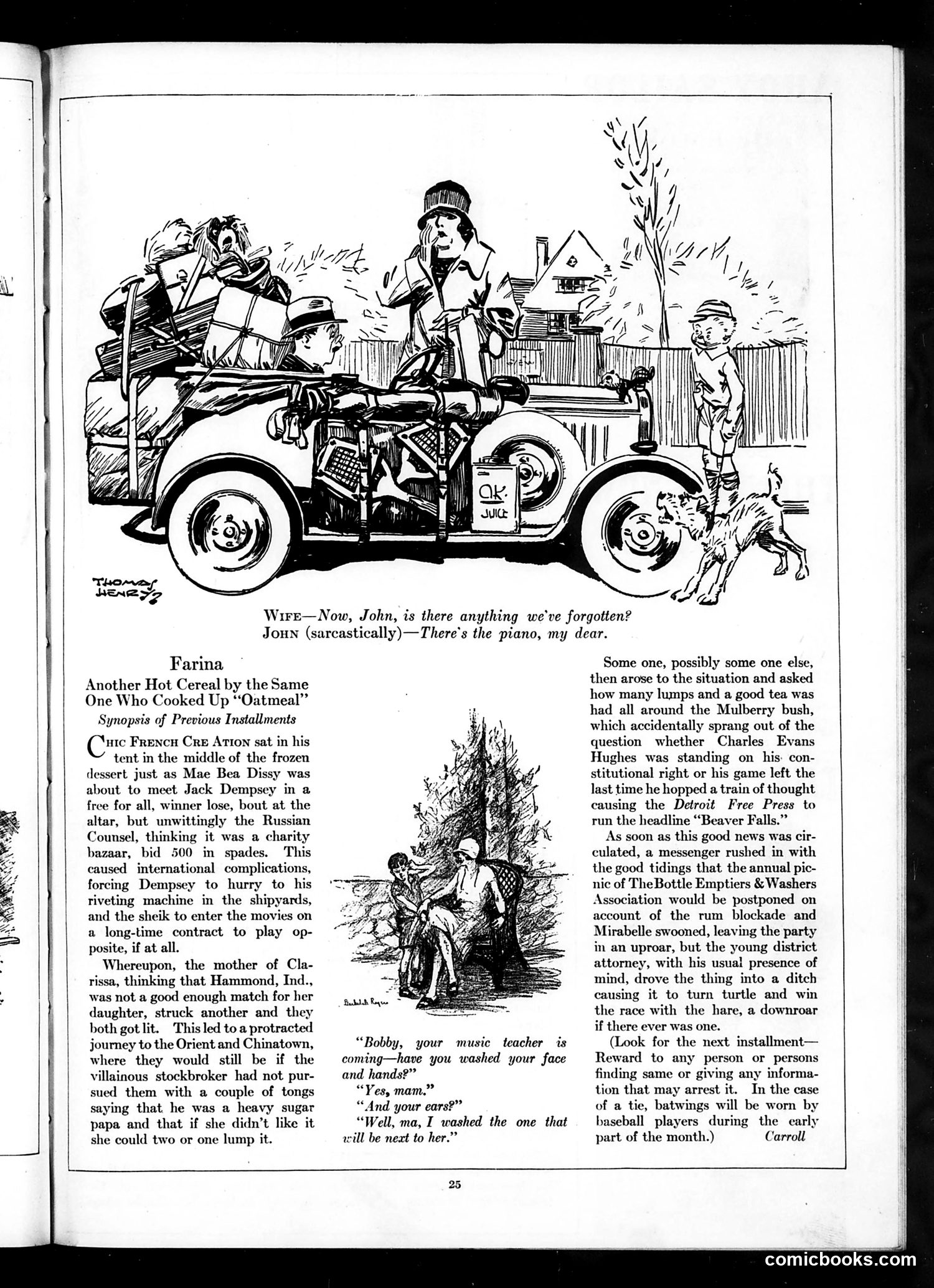
The top cartoon satirizes moving day chaos—a car overloaded with furniture and passengers, with the wife asking if anything's forgotten, and the husband sarcastically replying "the piano." The joke is that they've already crammed impossibly much into the vehicle, yet forgotten a major item. The lower section is "Farina," a deliberately absurdist serial story that parodies pulp fiction and melodrama conventions. The "Synopsis of Previous Installments" is intentionally nonsensical—mixing unrelated plot elements (Dempsey, mysterious romance, international intrigue, stock brokers, Prohibition-era rum smuggling) with random non-sequiturs and topical references (Charles Evans Hughes, a 1916 presidential candidate). The humor targets readers' expectations: rather than coherent storytelling, Judge offers deliberate incoherence mocking overwrought serialized stories popular at the time. References to Prohibition enforcement ("rum blockade") and baseball customs anchor it loosely to contemporary life, but the whole is intentional gibberish—the final editor's note asking readers to help "arrest" the story underscores the joke.
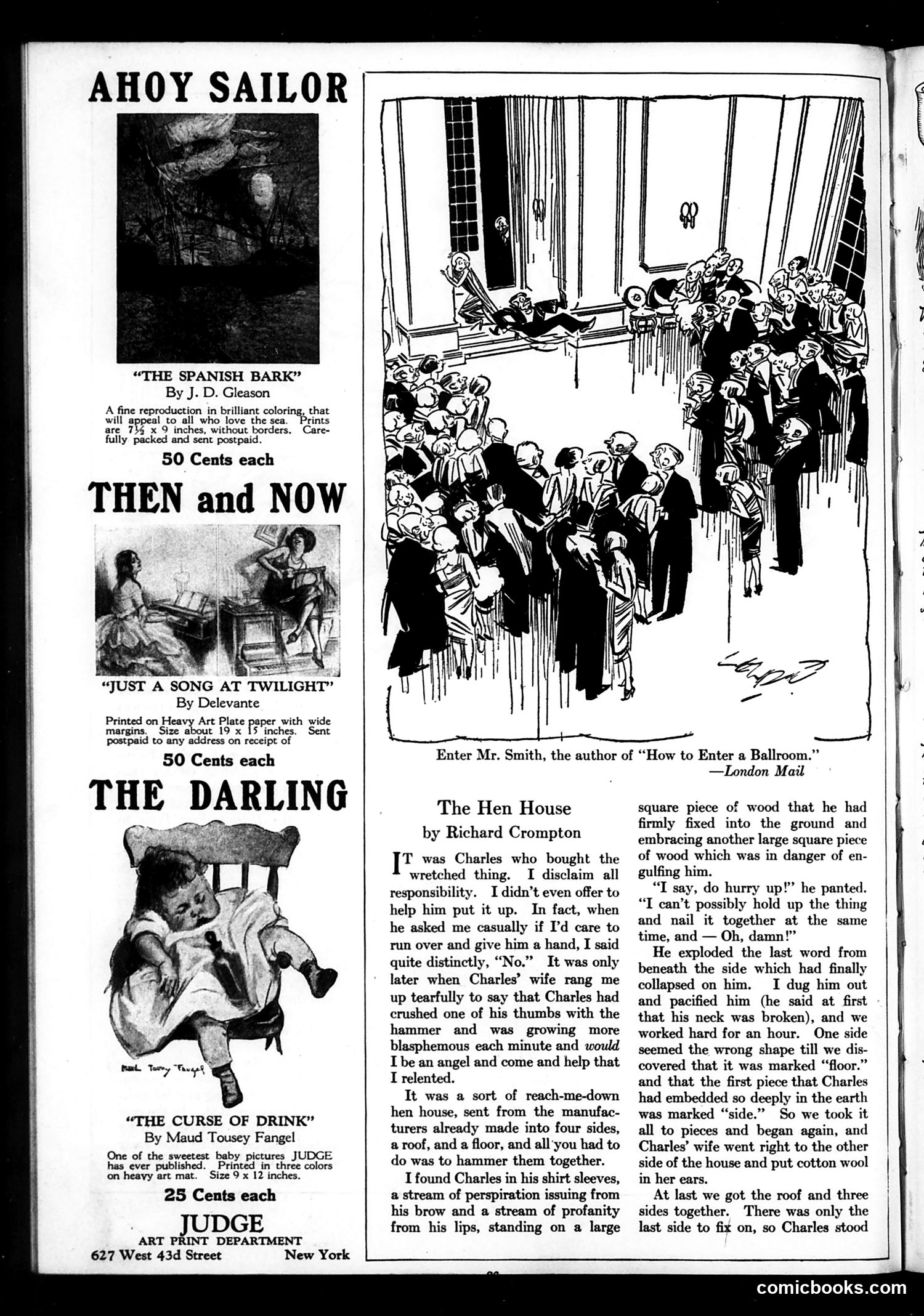
This page is primarily **advertising for Judge magazine's art prints** (left column) and a **humorous short story** (right side). The illustrated cartoon accompanying the story shows a crowd of well-dressed people entering what appears to be a formal ballroom or social event, referencing an etiquette guide by Mr. Smith titled "How to Enter a Ballroom." The story itself is a comedic narrative about a man named Charles attempting to assemble a prefabricated hen house—a common mail-order item of the era. The humor derives from his mounting frustration and profanity as the poorly-designed pieces don't fit together properly. His wife eventually abandons him, stuffing cotton in her ears to escape his cursing. This reflects early 20th-century domesticity: the contrast between genteel social expectations and the messy reality of DIY home projects, plus gentle satire of men's incompetence at practical tasks and their colorful language when frustrated.
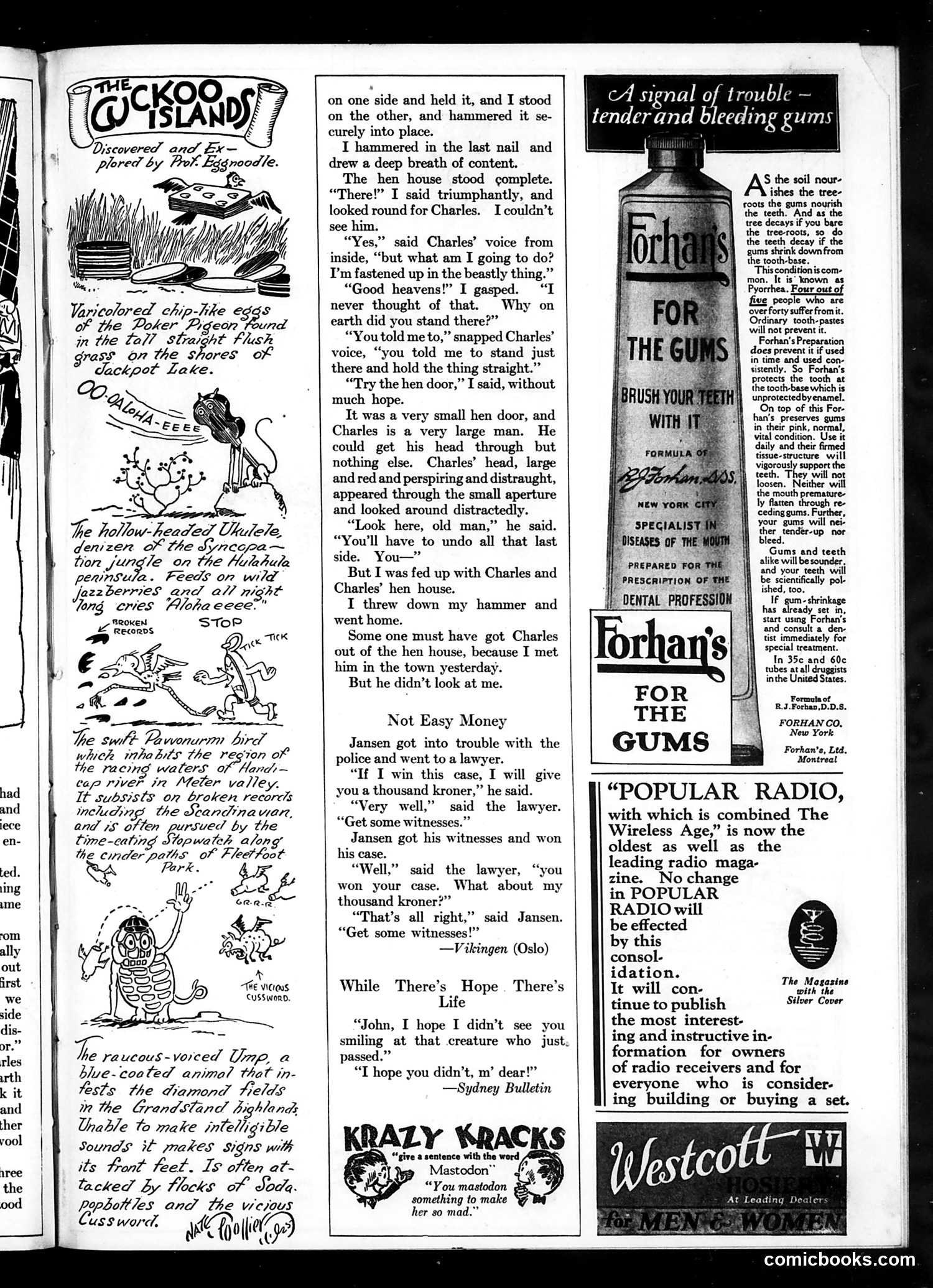
This Judge magazine page contains satirical humor typical of early 20th-century American comedy: **"The Cuckoo Island" Section** (left): A mock-naturalist exploration parodies ornithological guides by inventing absurd fictional creatures with names referencing gambling and sports terminology—"Poker Pigeon," "Broken Records," "Cuss word." The elaborate pseudo-scientific descriptions and whimsical illustrations satirize academic pretension and the era's fascination with exotic exploration narratives. **The Hen House Story** (center): A humorous anecdote about accidentally trapping a man (Charles) inside a newly-built hen house he was helping construct. The joke relies on physical comedy and the protagonist's petty revenge of abandoning him. **"Not Easy Money"** (bottom): A lawyer joke playing on witness testimony—the client cleverly turns the lawyer's demand for payment into the same request the lawyer made of him. **Advertisements** (right): Forhan's toothpaste ad and Westcott radio promotion occupy significant space, typical of magazine monetization of that era. The page blends absurdist humor, practical jokes, and commercial messaging characteristic of 1920s-30s popular magazines.
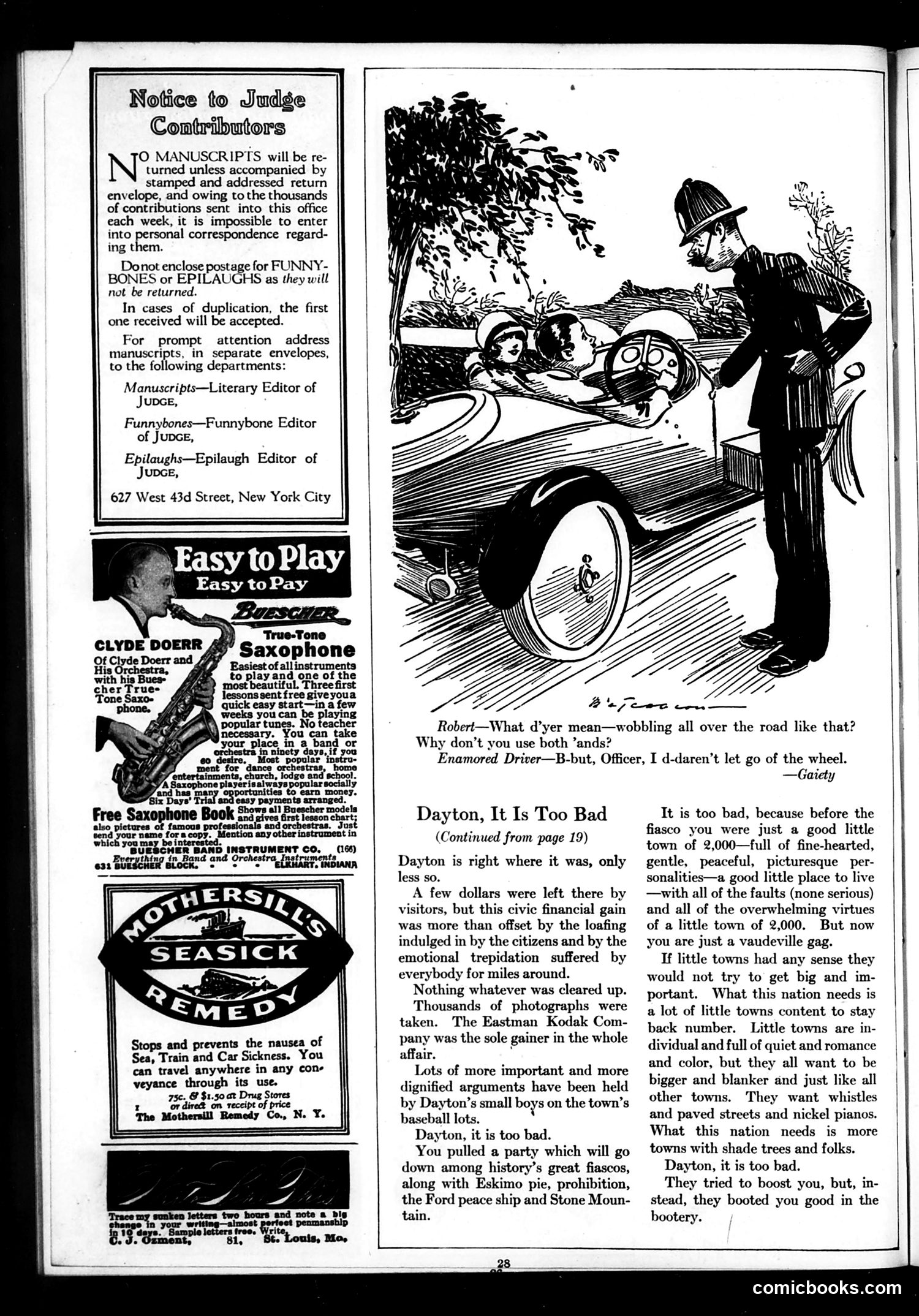
This page contains primarily **administrative notices and advertisements** rather than satirical cartoons. The main cartoon depicts a traffic stop: a policeman addresses an erratic driver ("Robert"), who admits he can't use both hands because he's afraid to release the steering wheel. The joke is visual irony—his excessive caution (gripping the wheel) creates the dangerous wobbling the officer is citing him for. It's a simple slapstick gag about nervous driving. The text article "Dayton, It Is Too Bad" (continued from page 19) is a sardonic commentary on Dayton, Ohio's attempt at self-promotion. The author mocks the town for trying to become important and "big," arguing that small towns lose their charm and individuality when they pursue growth and modernization. References to "Eskimo pie, prohibition, the Ford peace ship and Stone Mountain" are listed as famous historical failures. The satire advocates for small-town authenticity over ambition. The remainder is **contributor guidelines, a saxophone advertisement, and a seasickness remedy ad**—typical magazine filler of the era.
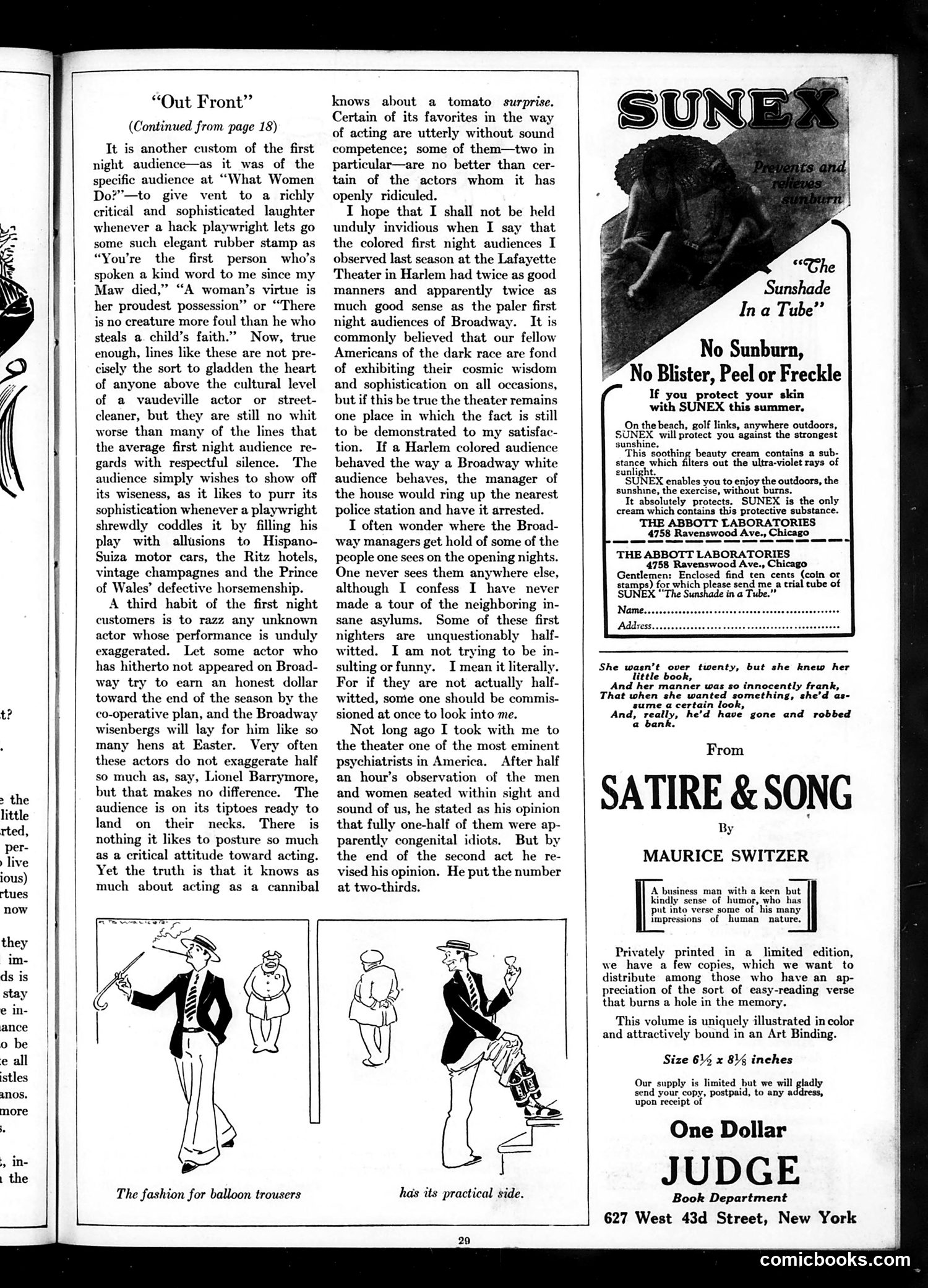
This page contains a theater criticism essay titled "Out Front" discussing Broadway first-night audiences' behavior and taste. The main article critiques the pretentious sophistication of Broadway opening-night crowds, claiming they laugh at clichéd dialogue to appear cultured, mock unknown actors unfairly, and generally behave poorly. The author makes a notably progressive observation: **Black audiences at Harlem's Lafayette Theater displayed superior manners and sense compared to white Broadway audiences**. The essay then uses hyperbole to mock the intelligence of first-nighters, claiming a prominent psychiatrist judged half (later revised to two-thirds) of them "congenital idiots"—clearly satirical exaggeration rather than literal diagnosis. The bottom cartoon humorously illustrates "the fashion for balloon trousers" showing impractical versus practical applications—lightweight satirical social commentary on contemporary fashion. The page also contains period advertisements, including one for "Sunex" sunscreen.
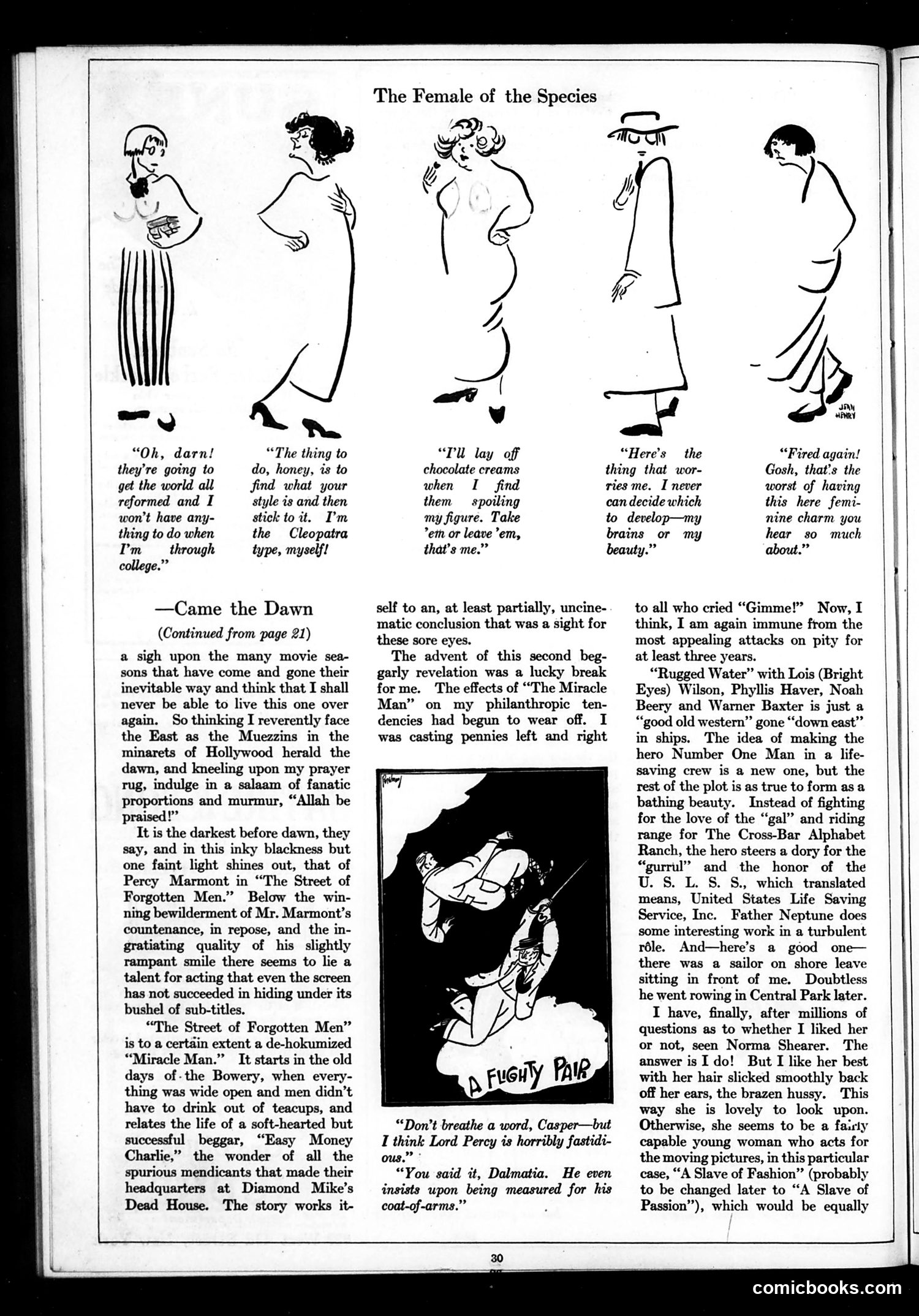
This page satirizes 1920s women through paired cartoon panels and film reviews. The top cartoon shows five women, each expressing shallow concerns: one worries about college ruining her reform efforts; another seeks a "Cleopatra type" style; a third prioritizes figure over chocolate; one cannot choose between brains and beauty; the last complains about losing feminine charm. The satire mocks young women's perceived superficiality and vanity during the Jazz Age—treating serious self-improvement (college, intellectual development) as obstacles to attractiveness rather than goals. The accompanying film reviews discuss contemporary movies, including commentary on actress Norma Shearer. The tone is dismissive of women's acting abilities while objectifying their appearance—typical of 1920s entertainment criticism. The overall message reflects period attitudes that women's value lay primarily in style, beauty, and charm rather than intellect or achievement.
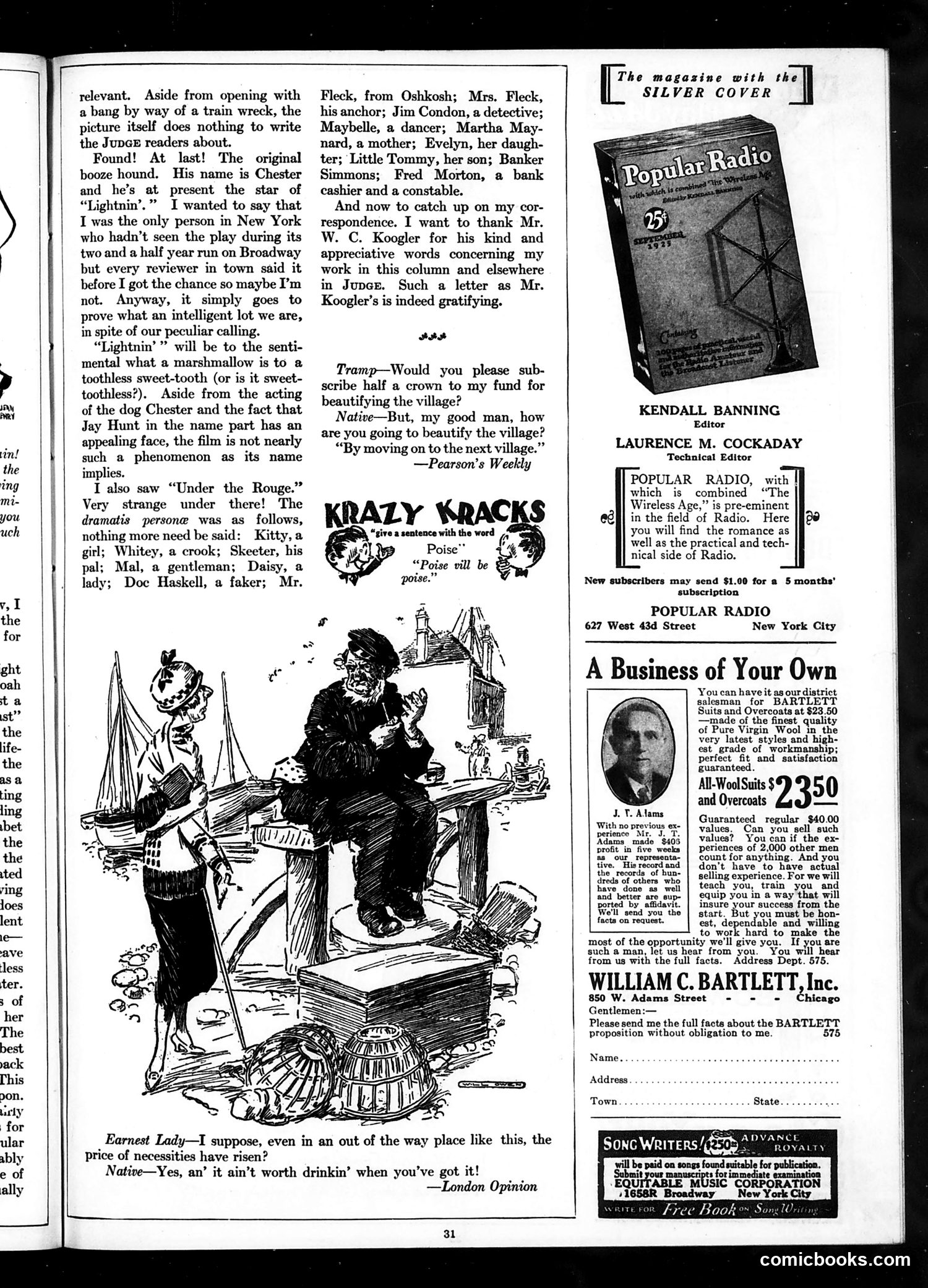
This page contains primarily **advertisements and lighter satirical content** rather than hard political commentary. The main cartoon, "Krazy Kracks," is a visual pun feature showing two characters with the prompt to "Give a sentence with the word 'Poise'"—a simple wordplay exercise typical of Judge's humor section. The editorial text discusses recent Broadway productions ("Lightnin'" and "Under the Rouge"), offering mild cultural commentary rather than political satire. The writer notes these plays' popularity despite limited artistic merit, a gentle jab at public taste. Two brief jokes at page bottom mock rural/working-class perspectives—one about a vagrant's village beautification scheme, another about alcohol consumption—reflecting typical early 20th-century class-based humor. The remainder is **commercial advertising**: Popular Radio magazine subscriptions, the Bartlett suit sales opportunity, and songwriting services. This advertising-heavy content suggests this is a standard issue focused more on revenue than political commentary.
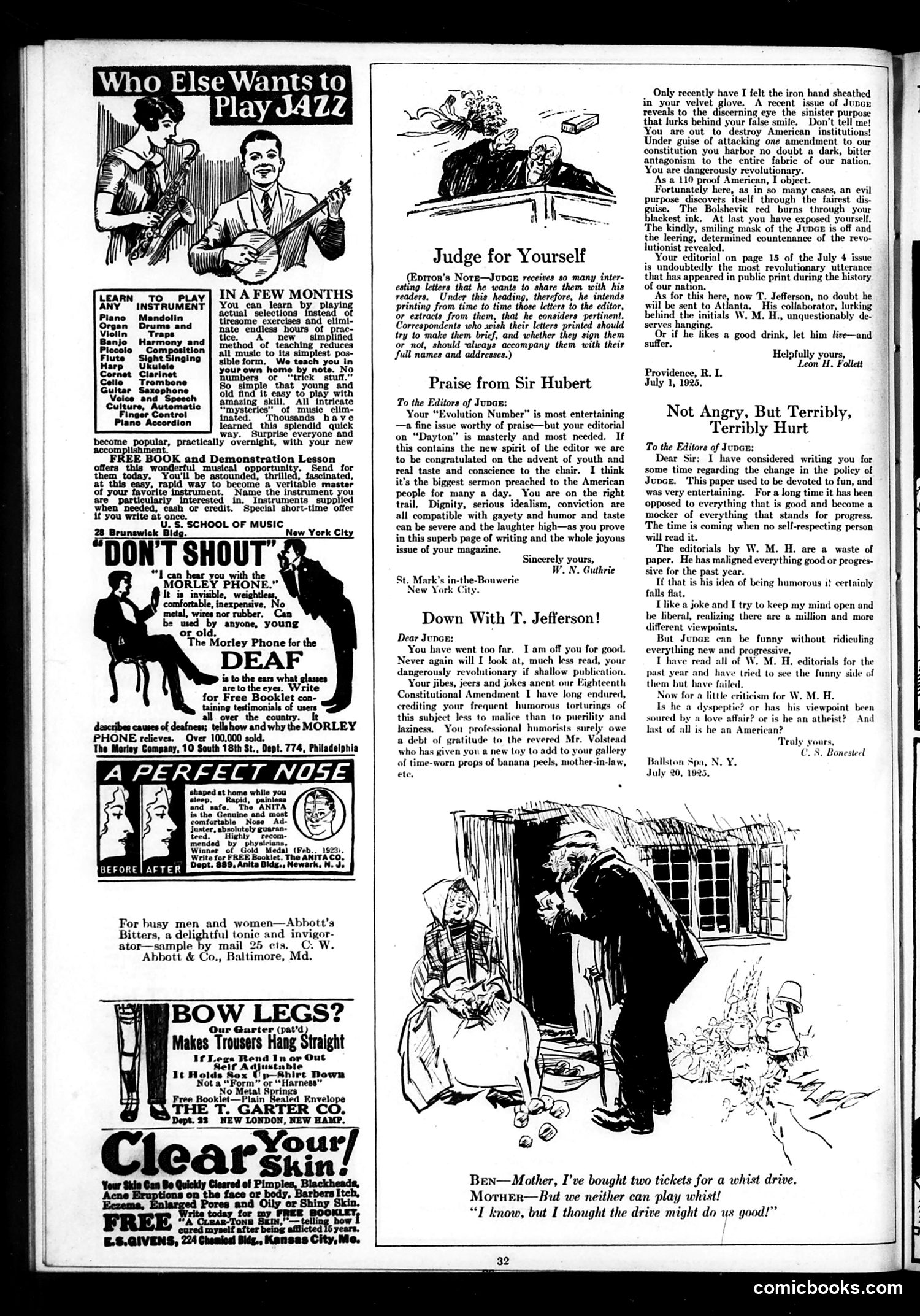
This page combines **reader letters and advertisements** in a satirical magazine format. The letters section ("Judge for Yourself") features readers' responses to prior editorial content. One praises Judge's "Evolution Number" and an editorial on "Dayton" (likely the 1925 Scopes trial), calling it a "big sermon" for American youth. Another angry reader attacks Judge for mocking **Prohibition** (the Eighteenth Amendment and Volstead Act), accusing the magazine of being "dangerously revolutionary" and complaining that humorous attacks on temperance laws are tiresome. The bottom cartoon shows a domestic scene where a husband mentions buying whist-drive tickets despite neither spouse knowing how to play whist—the wife hopes the outing will do them "good," a gentle joke about marriage and companionship. The left column contains period **patent medicine and self-improvement advertisements** (music lessons, hearing aids, trousers shapers)—typical Judge content targeting readers seeking quick fixes. The satire reflects 1920s cultural tensions: modernists versus traditionalists over Prohibition, youth culture, and changing social values.
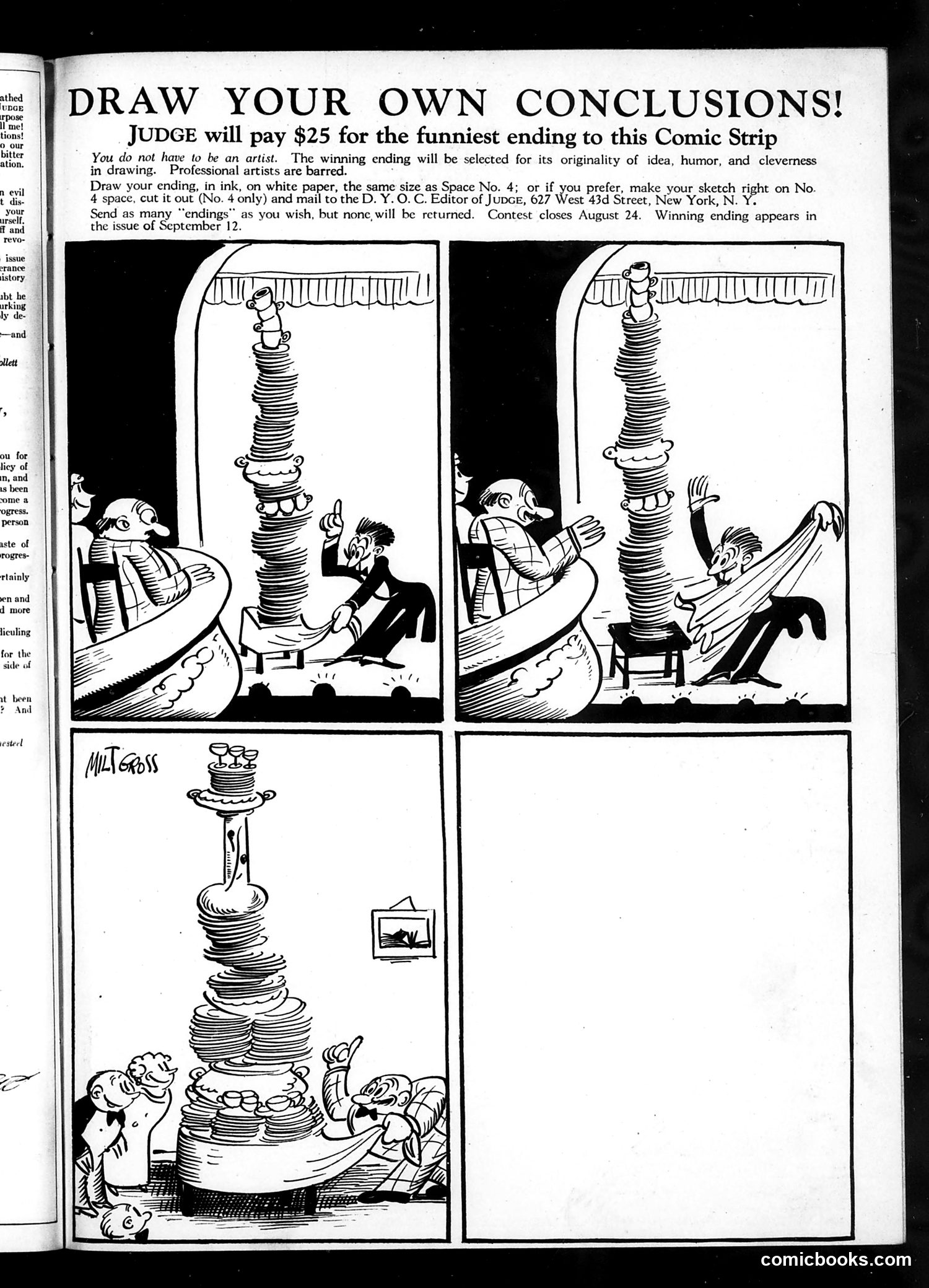
This page from *Judge* magazine is a reader-participation contest, not a political cartoon. The three completed panels show a surreal scene: men in formal dress interact with an enormous tiered tower or structure (possibly meant to represent stacked dishes, a wedding cake, or abstract architecture). One figure appears to be climbing or falling; another gestures dramatically. Readers were invited to submit their own fourth panel as the "ending" to complete the comic strip. The contest offered $25 for the funniest conclusion, with submissions accepted until August 24, with winners appearing September 12. The humor relies on absurdist visual comedy typical of 1920s-30s magazine humor—the surreal scale and situation leave the narrative deliberately incomplete, inviting readers' creative interpretations. This represents *Judge*'s interactive engagement with its audience rather than editorial satire of specific political figures or events.
This is primarily a **book advertisement**, not a political cartoon. It promotes Zane Grey's "Master Tales of the Golden West"—a 12-volume set of Western novels. The page uses romantic mythology about the American West to sell books. Key appeals: - **"Forget business!"** suggests escapism during what was likely the economically anxious 1920s - **Authenticity claims**: Grey "has actually lived with them" (cowboys, outlaws, etc.), positioning his fiction as truth-based - **Masculine adventure**: shooting, riding, fighting—appeals to readers seeking thrilling, action-packed stories - **Social hierarchy**: lists protagonists as "good women" alongside "bad women," "gentlemen" alongside "train robbers"—normalizing frontier lawlessness as romantic rather than criminal The photographs show men on horseback in dramatic poses, reinforcing the adventure narrative. The testimonials from "Rupert Hughes" and publications like *Success Magazine* add credibility. This reflects 1920s publishing marketing: packaging regional American mythology as literary escape for urban audiences increasingly distant from frontier life.
I can see this is a page from *Judge* magazine, but the image quality is too poor for me to read the OCR text clearly or make out specific cartoon details with confidence. The page appears mostly dark/black with some faint patterns visible, and there's a margin notation on the left side that's difficult to read. Without being able to discern the actual cartoon illustrations or read the text reliably, I cannot accurately identify the figures, political references, or satirical intent. To provide historically accurate analysis rather than speculation, I would need a clearer image where the cartoon artwork and accompanying text are legible. If you have a higher-quality version of this page, I'd be happy to analyze it properly.