
Judge, 1925-08-15 · page 20 of 37
Judge — August 15, 1925 — page 20: what you’re looking at
What you’re looking at
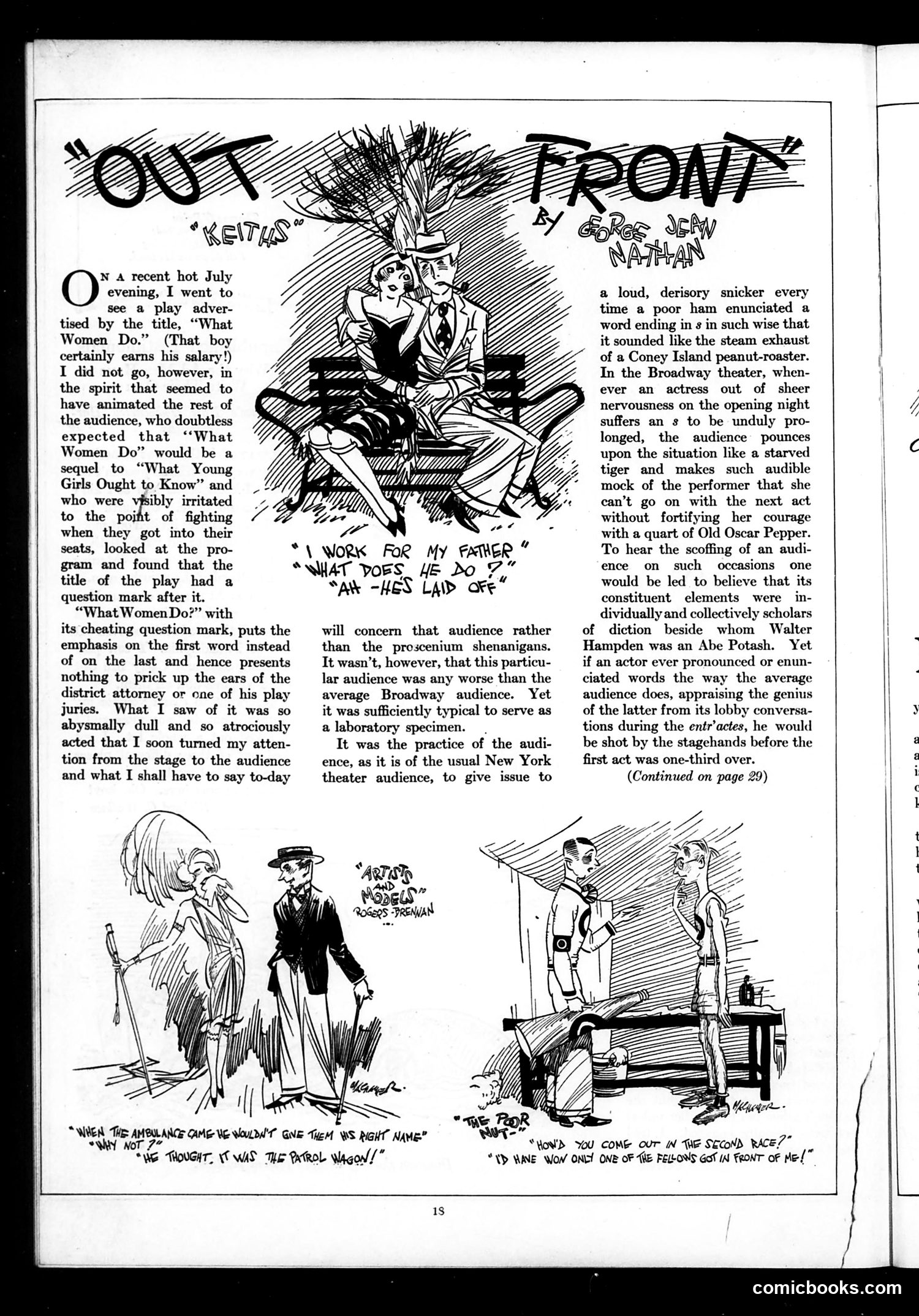
This article satirizes Broadway theater audiences' poor behavior during opening nights, using the play "What Women Do?" as a case study. The author criticizes theatergoers who mock actors for mispronouncing words ending in 's'—the audience would snicker derisively at any perceived affectation, as if the actor sounded like a Coney Island peanut-roaster's steam exhaust. This casual cruelty could rattle performers so badly they needed alcohol (Old Oscar Pepper whiskey) to continue. The piece argues such audiences are composed of "scholars of diction," implying they're not—ordinary theatergoers pretending to expertise. The author references Walter Hampden (a respected Shakespearean actor) to mock the gap between average audience knowledge and their presumed authority in judging performers. The accompanying cartoons illustrate typical theater audience absurdities: an old woman complaining about an ambulance's incorrect name, and someone boasting about racehorse betting—showing the frivolous, self-absorbed nature of opening-night crowds more interested in socializing than theater.
📄 Transcribed text from this page (OCR, searchable)
Machine-transcribed from the original scan — historical spelling and the odd misread are preserved.
N a recent hot July evening, I went to a loud, derisory snicker every see a play adver- time a poor ham enunciated a tised by the title, “What word ending in s in such wise that Women Do.” (That boy it sounded like the steam exhaust certainly earns his salary!) of a Coney Island peanut-roaster. I did not go, however, in In the Broadway theater, when- the spirit that seemed to ever an actress out of sheer have animated the rest of nervousness on the opening night y, the audience, who doubtless suffers an s to be unduly pro- ‘ expected that ‘‘What al longed, the audience pounces C Women Do” would be a pyyhat y upon the situation like a starved sequel to “What Young Ch ihe tiger and makes such audible Girls Ought to Know” and Cp mock of the performer that she who were vpibly irritated K can’t go on with the next act to the pojft of fighting Yer v’ : without fortifying her courage when they got into their a with a quart of Old Oscar Pepper. seats, looked at the pro- *\ WORK FoR My FAIKER “ To hear the scoffing of an audi- gram and found that the *QuWAT pors HE Do a” ence on such occasions one title of the play had a SA -Hes L AND Ore” would be led to believe that its question mark after it. constituent elements were in- “What Women Do?” with dividually and collectively scholars its cheating question mark, puts the will concern that audience rather of diction beside whom Walter emphasis on the first word instead than the proscenium shenanigans. Hampden was an Abe Potash. Yet : of on the last and hence presents It wasn’t, however, that this particu- if an actor ever pronounced or enun- nothing to prick up the ears of the lar audience was any worse than the ciated words the way the average district attorney or one of his play average Broadway audience. Yet audience does, appraising the genius juries. What I saw of it was so it was sufficiently typical to serve as of the latter from its lobby conversa- 3 abysmally dull and so atrociously a laboratory specimen. tions during the entr’actes, he would acted that I soon tuned my atten- It was the practice of the audi- be shot by the stagehands before the a tion from the stage to the audience ence, as it is of the usual New York first act was one-third over. ‘ and what I shall have to say to-day theater audience, to give issue to (Continued on page 29) ‘ I t 1 t ; : _ “me FegR ae E » = WHE Tt AMBRLANG Oe Vow GNE THEM WS RGHT NAME: wt SYoNtD YOU COME OU WHE SECOND RACE?” “WS Hougir, KC WAS Ther PatROL whaow!/” “Xp WINE WoW ONE! ONE OF “IE PELLONIS Gof IN FRONT OF He-/ as —_ = comicbooks.com