
A complete issue · 36 pages · 1925
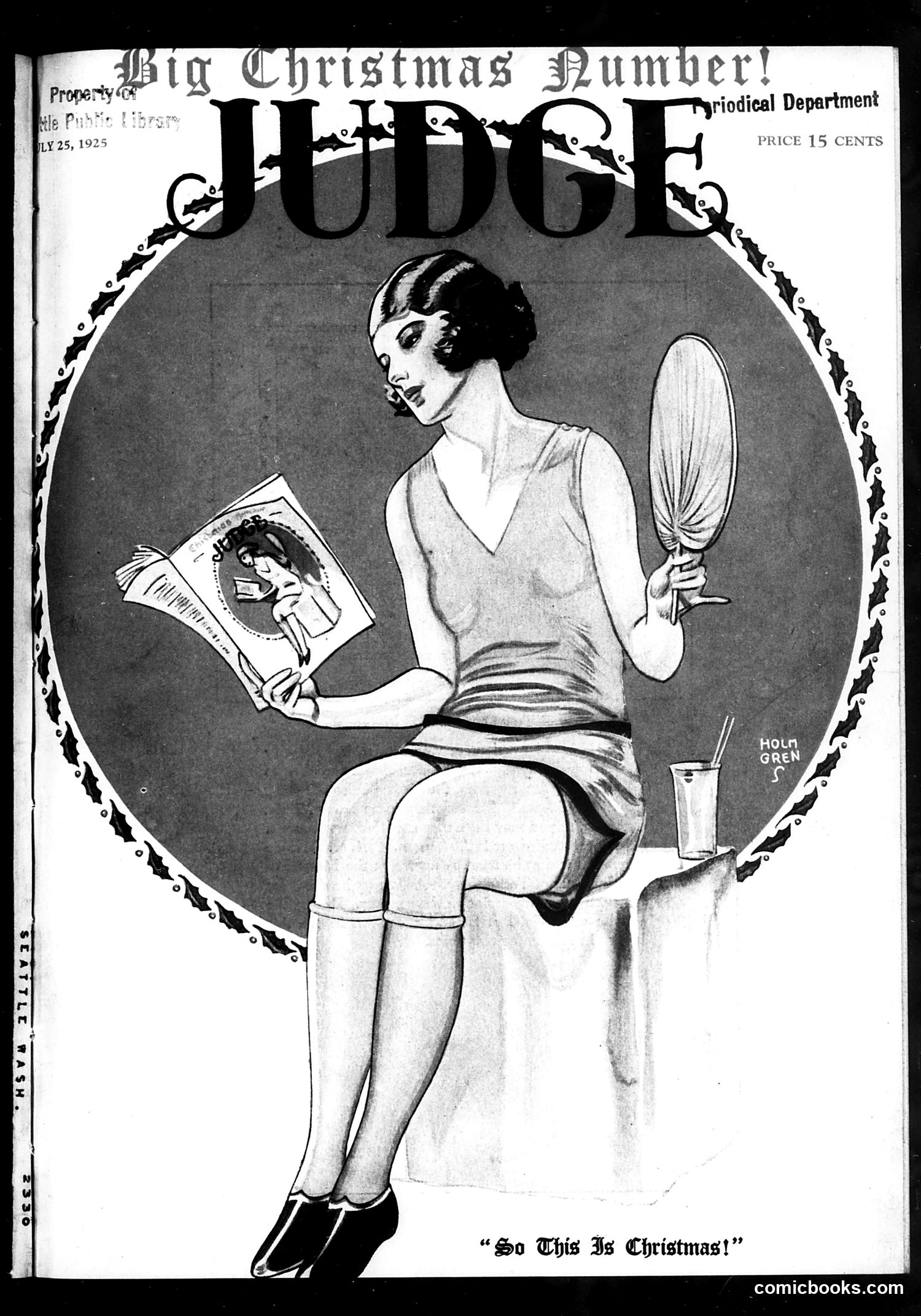
Judge — July 25, 1925
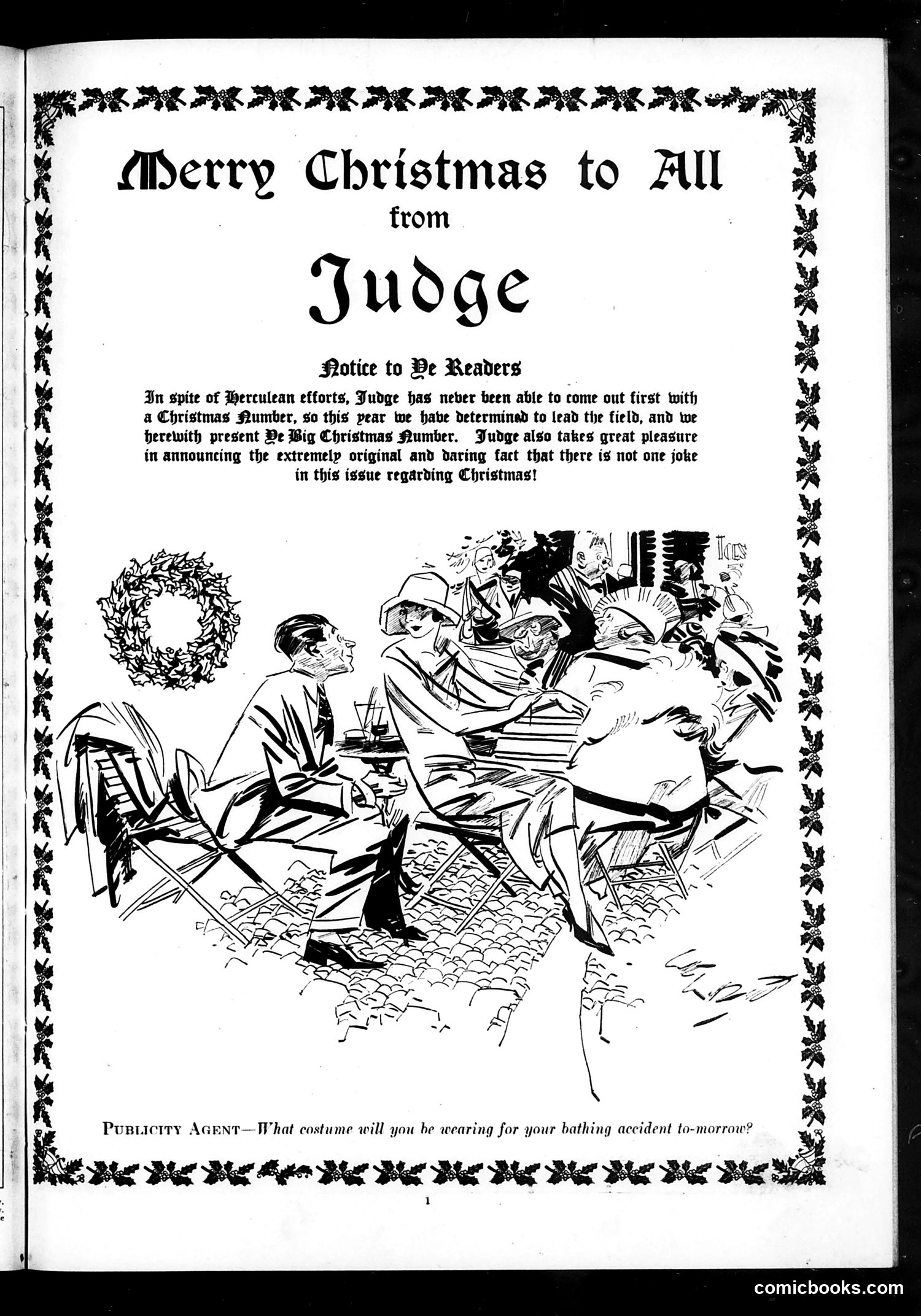
This is a **Christmas greeting page** from Judge magazine, not a political cartoon. The main illustration shows people in beach chairs enjoying a seaside scene, with one figure asking a "Publicity Agent" about costume choices for a bathing accident "to-morrow." The humor appears to rely on **absurdist satire**: the joke suggests that publicity agents orchestrate even personal disasters (bathing accidents) and that performers must plan what to wear for their own misfortunes—mocking the entertainment industry's obsession with image management and manufactured publicity. The notice claims this is Judge's "Big Christmas Number" with "extremely original and daring" content containing "not one joke...regarding Christmas"—a self-aware, humorous acknowledgment that the issue abandons traditional holiday themes entirely. The ornamental border and wreath are decorative seasonal elements.
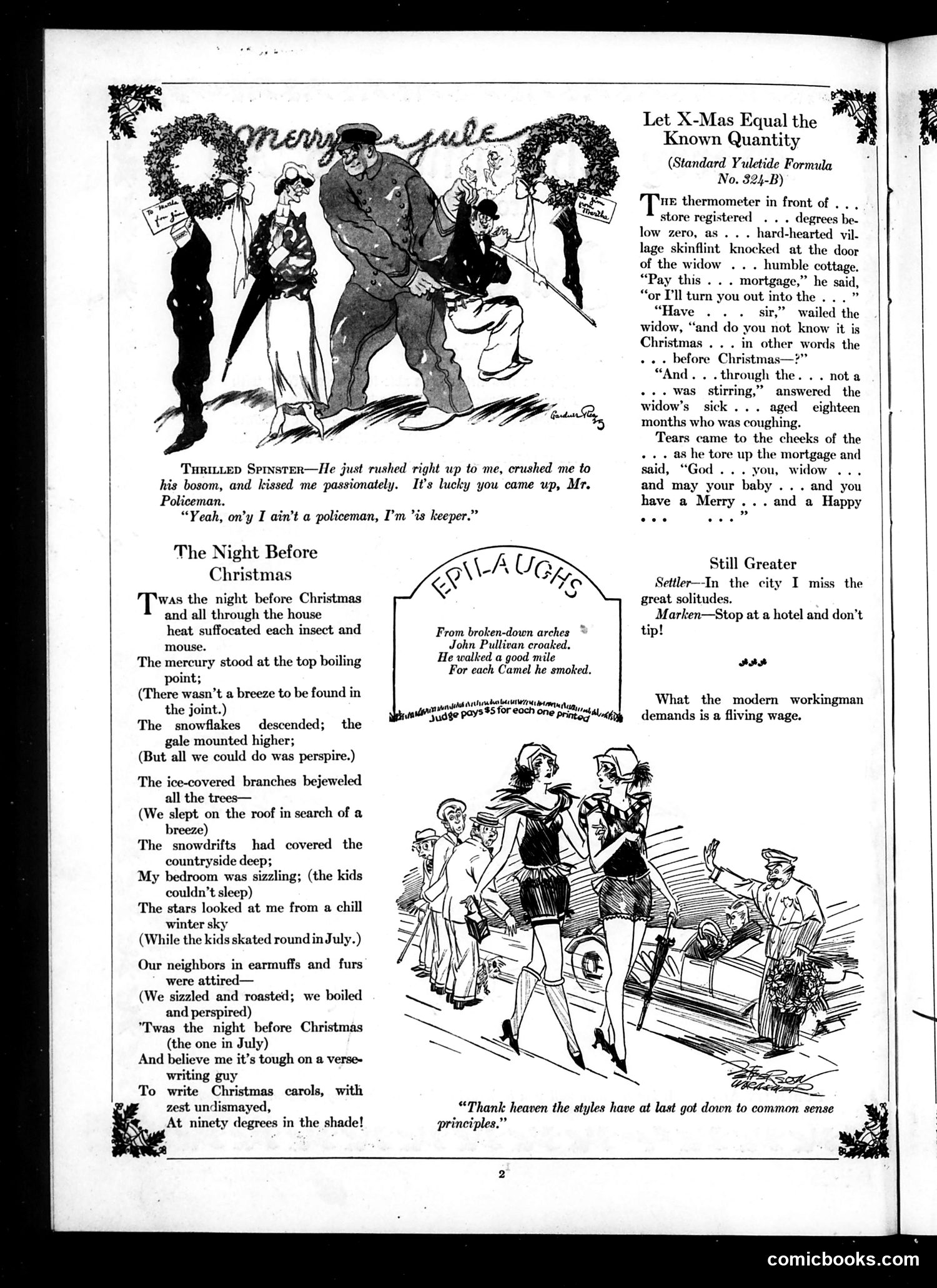
**Top Cartoon ("Thrilled Spinster"):** A comedic scene where a large man in a coat rushes toward a woman, crushing her to his chest while kissing her. A policeman observes. The caption plays on mistaken identity—she assumes he's a policeman but he's actually a "keeper" (suggesting an asylum worker or caretaker). The joke relies on slapstick humor and the woman's romantic misinterpretation. **"The Night Before Christmas" Poem:** A humorous parody of the classic Christmas poem, but set in summer (July), with winter imagery reversed. References to boiling heat, kids unable to sleep, and the absurdity of writing Christmas carols "At ninety degrees in the shade" satirize the heat of summer publication deadlines. **Bottom Illustration:** Shows fashionable women and a man, with a caption about styles finally achieving "common sense principles"—likely mocking women's fashion trends of the era.
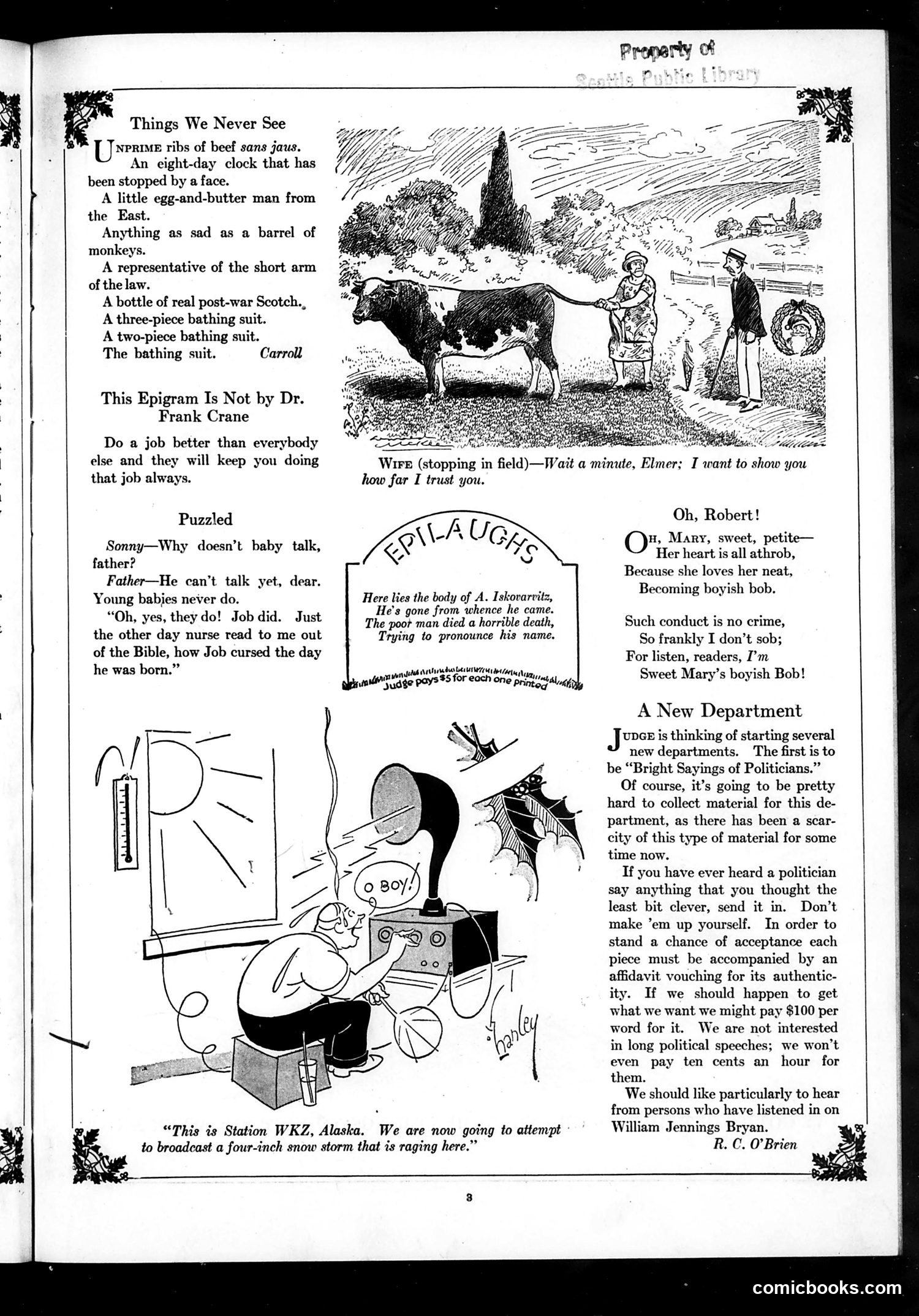
This page contains several satirical pieces typical of early 20th-century humor magazines: **"Things We Never See"** lists absurdities (upright beef ribs, a stopped clock, sad monkeys) — standard joke format. **The main cartoon** shows a man and woman with a cow in a rural setting. The wife tells "Elmer" she wants to show how far she trusts him—likely satirizing either marital dynamics or rural life stereotypes. **"Puzzled"** is a brief joke about babies not talking, where a father claims a nurse cursed the baby before birth—simple wordplay humor. **"A New Department"** proposes collecting "Bright Sayings of Politicians," humorously noting politicians rarely say anything clever. This satirizes political discourse and offers readers monetary incentives ($100 per accepted quote) to submit witticisms. The content reflects early 20th-century Judge magazine's mix of domestic humor, rural stereotypes, and political satire.
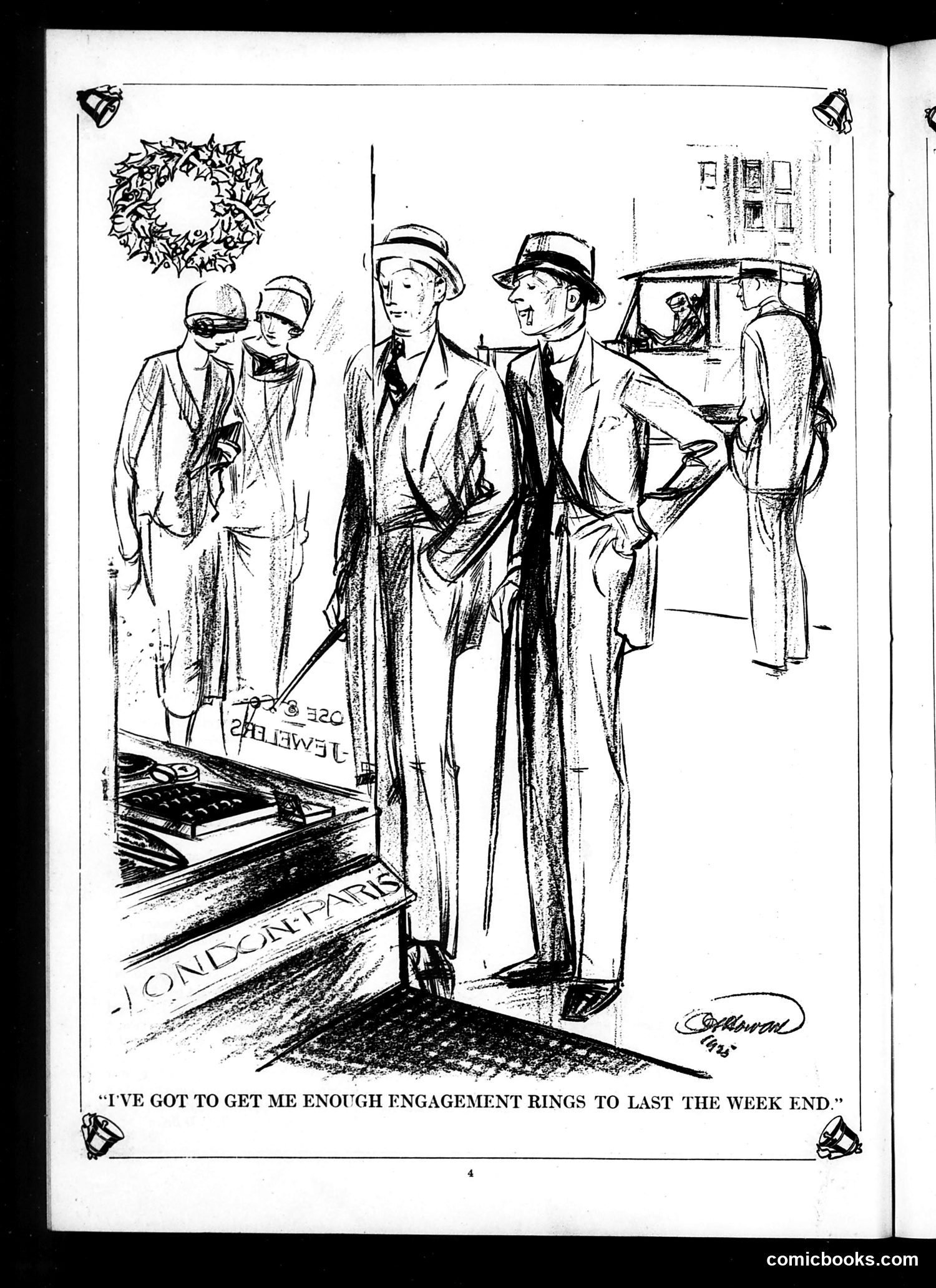
This cartoon satirizes men who rapidly cycle through engagement rings—a common practice among certain wealthy or frivolous men of the era. The speaker, apparently a jeweler or engagement ring vendor, explains to clients that he needs "enough engagement rings to last the weekend," implying he serially engages and disengages from women in rapid succession. The humor targets masculine irresponsibility and fickleness in romantic commitments. The well-dressed men and the formal setting suggest this was a critique of upper-class behavior. The joke relies on the assumption that engagement rings represent serious, lasting commitments—making the idea of needing multiple rings for a single week absurdly scandalous by period standards, mocking both the men's behavior and perhaps broader concerns about declining marriage commitment.
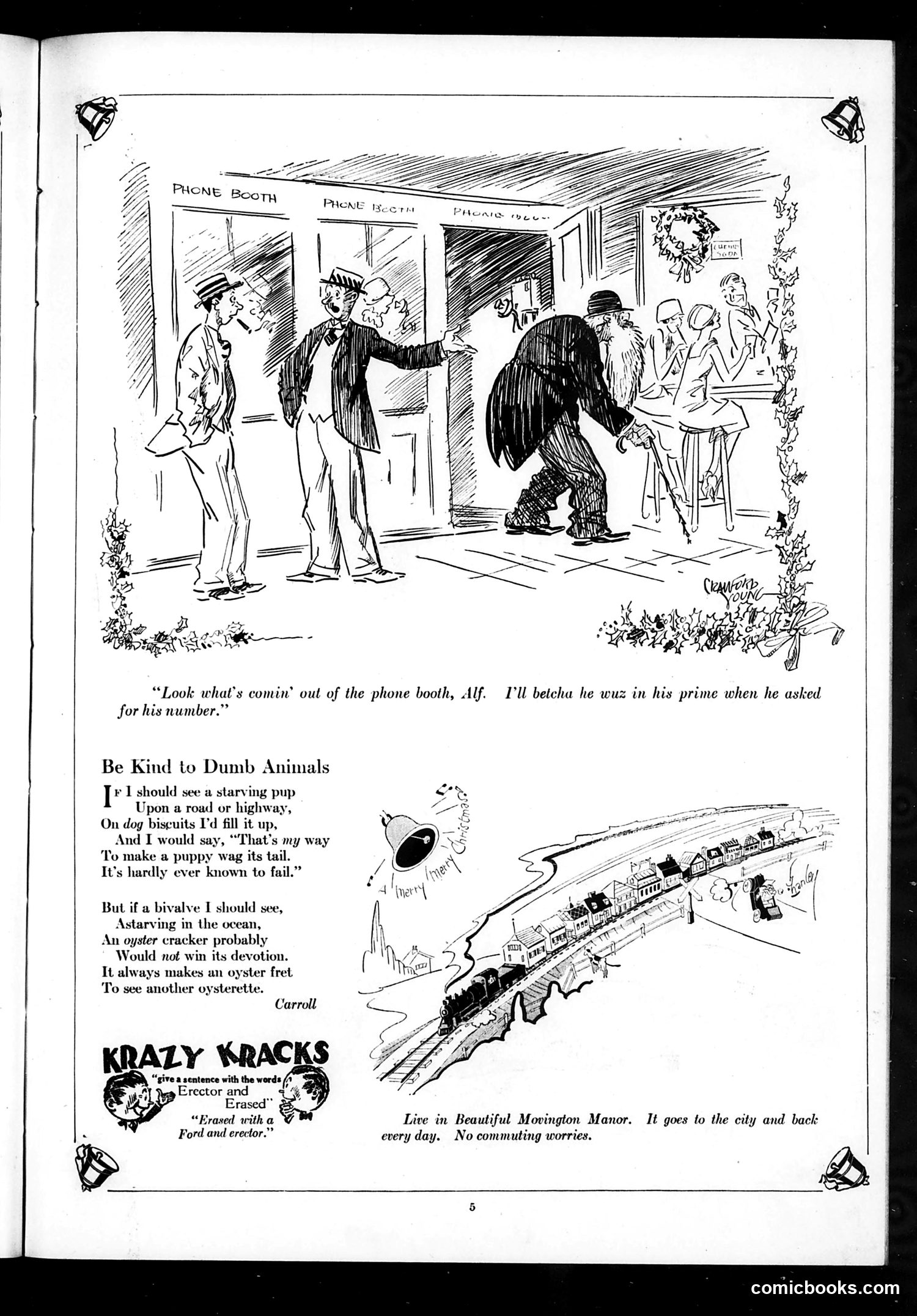
The top cartoon satirizes someone emerging from a phone booth in an awkward or embarrassing state. The caption suggests the person ("Alf") was caught doing something inappropriate while making a phone call—the joke being he'll "be in his prime when he asked for his number," implying embarrassment about his behavior. Below is a poem titled "Be Kind to Dumb Animals" by Carroll, using animals as metaphors for human behavior—a dog would loyally follow any master, while oysters only care about other oysters. This appears social commentary on class or loyalty. The "Krazy Kracks" section is a word puzzle feature using "Erector" and "Erased." A train advertisement for "Beautiful Movington Manor" completes the page—largely commercial content typical of Judge magazine's format blending humor with advertising.
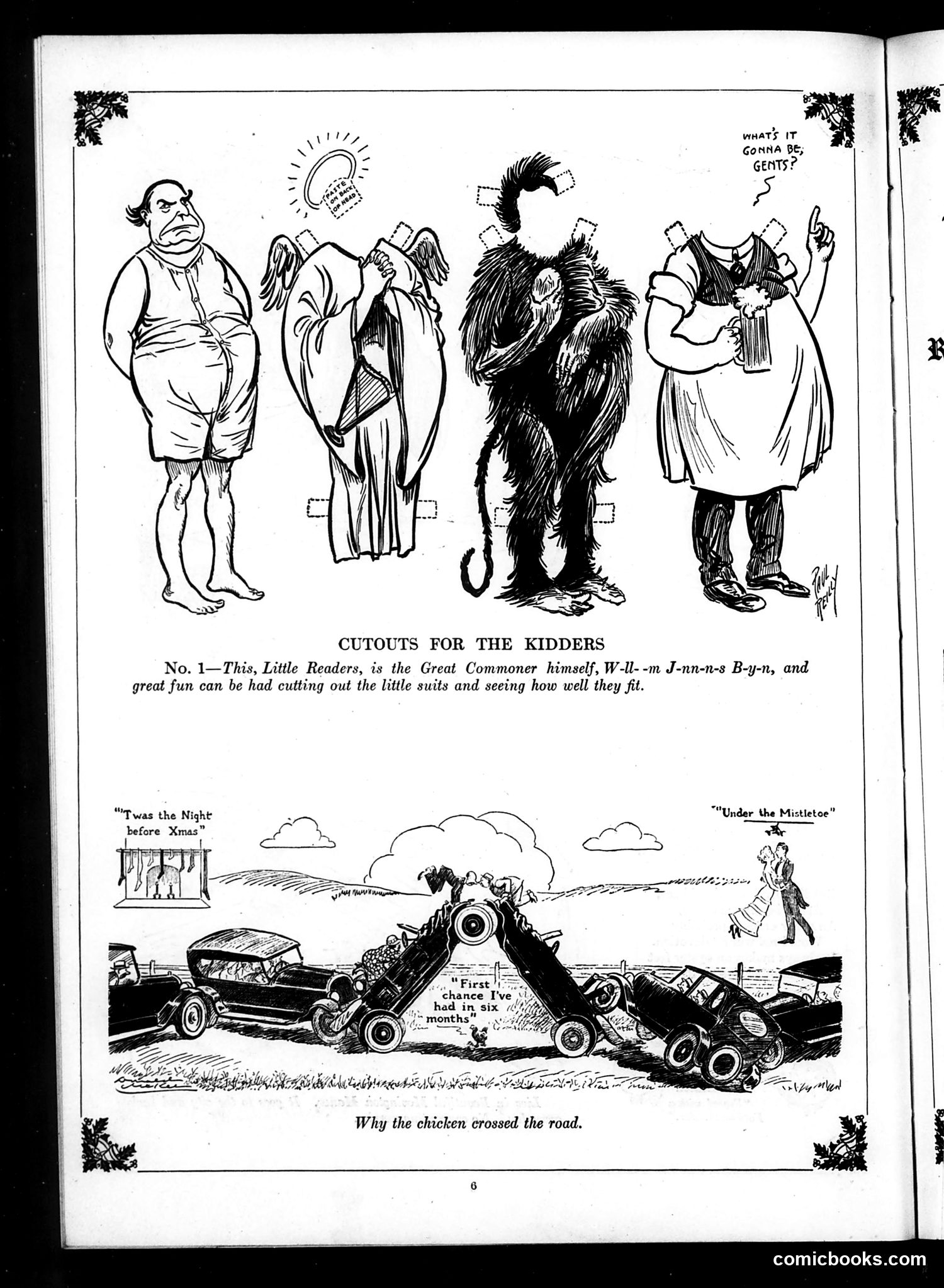
This Judge magazine page contains two distinct pieces of satire: **Top Section - "Cutouts for the Kidders":** This is a paper doll cutout featuring William Jennings Bryan (spelled phonetically as "W-ll--m J-nn-n-s B-y-n" to obscure the name). The satire mocks Bryan by presenting him as a toy to be dressed in different outfits—reducing the prominent political figure to children's entertainment. This was a common way to ridicule politicians. **Bottom Section - "Why the chicken crossed the road":** An early variation of this classic joke setup, depicted here through a surreal car accident scene with multiple vehicles colliding, clearly subverting audience expectations of the traditional punchline. The page overall demonstrates Judge's use of visual caricature and wordplay to mock political figures and cultural trends of the era (likely early 1900s, based on the automobile imagery and Bryan's prominence).
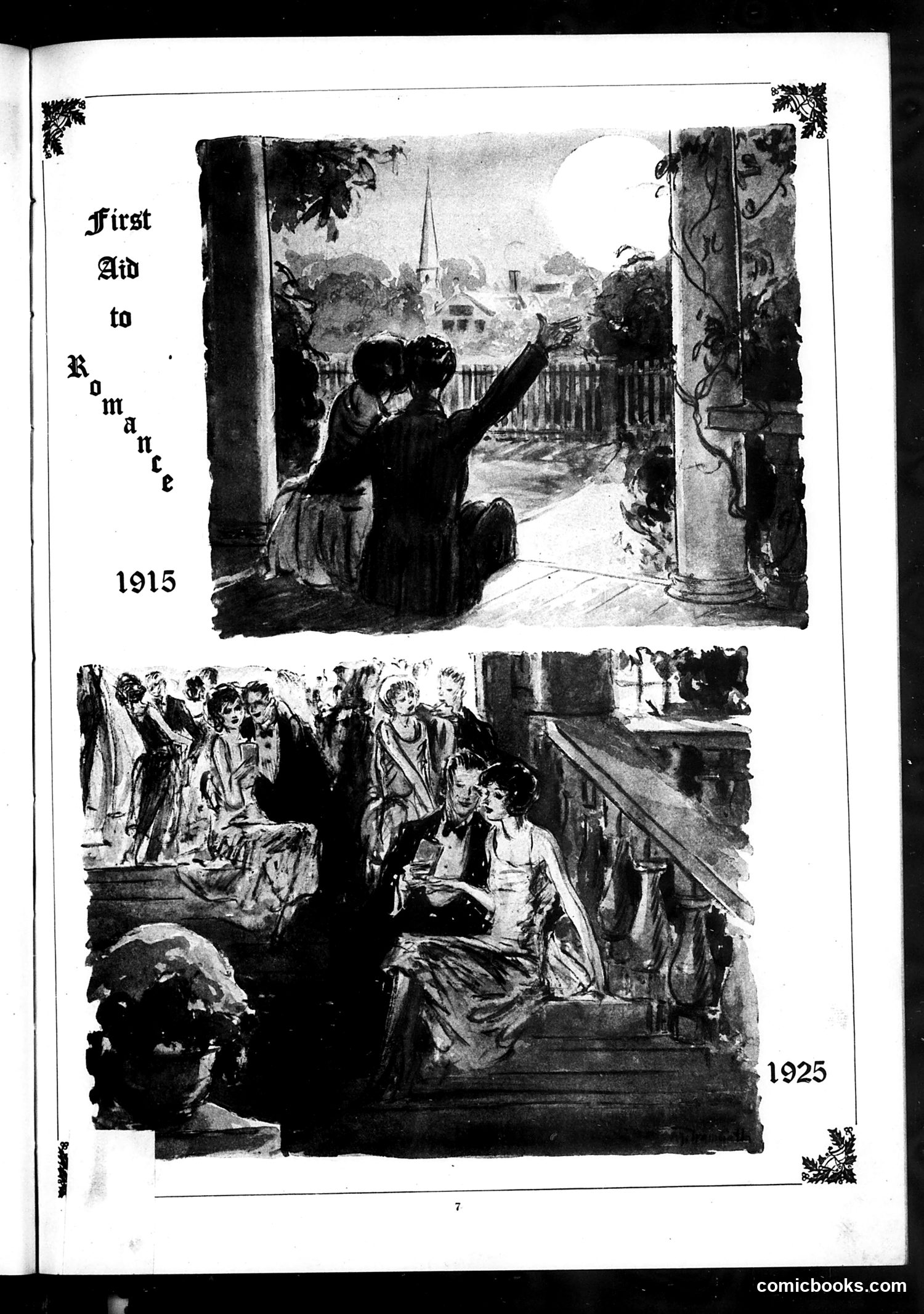
This page contrasts two scenes a decade apart, illustrating changing attitudes toward romance and courtship. The **1915 image** (top) depicts a traditional, genteel scene: a young woman points toward a distant church steeple while a man kneels beside her. This represents formal, church-sanctioned romance—proper Victorian courtship with marriage as the ultimate goal. The **1925 image** (bottom) shows the same scenario transformed: a crowded, secular gathering where romance appears more casual and social. The church has receded in importance; romance now occurs in public social spaces rather than private, formal settings. The satirical point critiques the rapid modernization of courtship customs in the 1920s—the "Jazz Age" shift away from religious tradition toward more liberated, public socializing among young people.
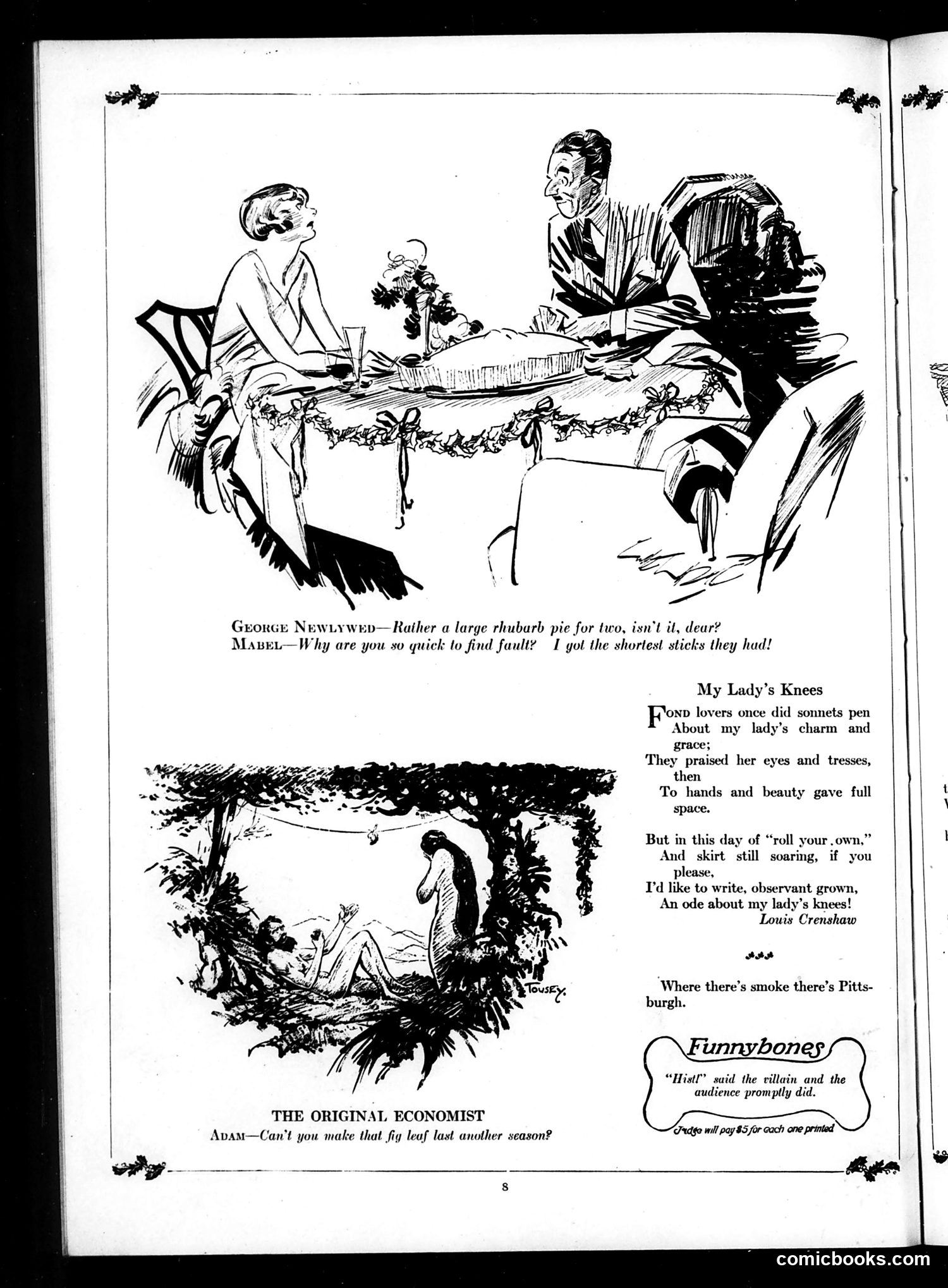
This page contains three distinct satirical pieces targeting early 20th-century social changes: **Top cartoon** ("George Newlywed"): Mocks newlywed domesticity, with a husband complaining about a rhubarb pie's size while his wife defensively explains her thrifty shopping. The satire targets post-marriage disillusionment and marital bickering. **"My Lady's Knees" poem**: A tongue-in-cheek response to women's fashion changes (rising hemlines of the era). The poet humorously suggests that modern women's exposed knees—scandalous by Victorian standards—deserve poetic attention alongside traditional feminine attributes. It mocks both the "roll your own" (independent woman) movement and evolving beauty standards. **Bottom cartoon** ("The Original Economist"): Adam asks Eve to reuse her fig leaf—satirizing post-war economic austerity and rationing while also playing on the famous biblical reference. The caption suggests readers will pay for each printed edition. All three pieces reflect 1920s anxieties about changing gender roles, consumerism, and post-WWI economic conditions.
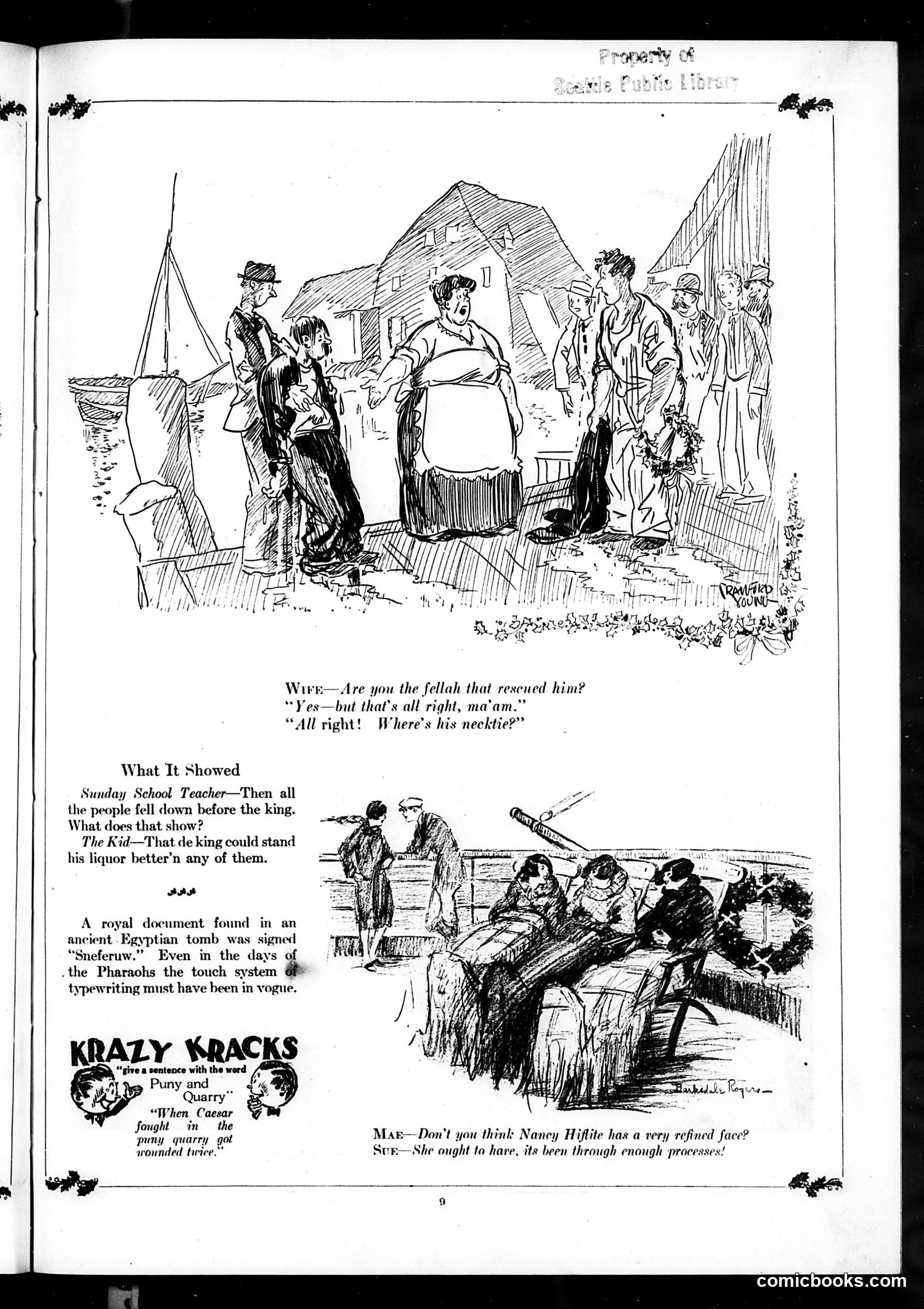
This page contains three separate humor pieces typical of early 20th-century satirical magazines: **Top cartoon**: A domestic scene where a man has been rescued from drowning. His wife thanks the rescuer but then immediately complains about her husband's missing necktie—satirizing wives' concern with propriety and appearance over genuine concern for their husbands' welfare. **"What It Showed"**: A Sunday School joke playing on children's innocent misinterpretation. When a teacher describes people bowing before a king, a child concludes the king "could stand his liquor better" than others—humor derived from the child hilariously connecting bowing/kneeling with drunkenness rather than reverence. **Egyptian tomb reference**: A brief joke about an ancient document signed "Sneferuw," suggesting even Pharaohs used the "touch system" of typewriting—anachronistic absurdist humor. **Bottom cartoon**: A joke about a woman named Nancy Hiflite's refined appearance, with the punchline that her face has been refined through "processes" (likely cosmetic procedures)—mocking women's use of beauty treatments.
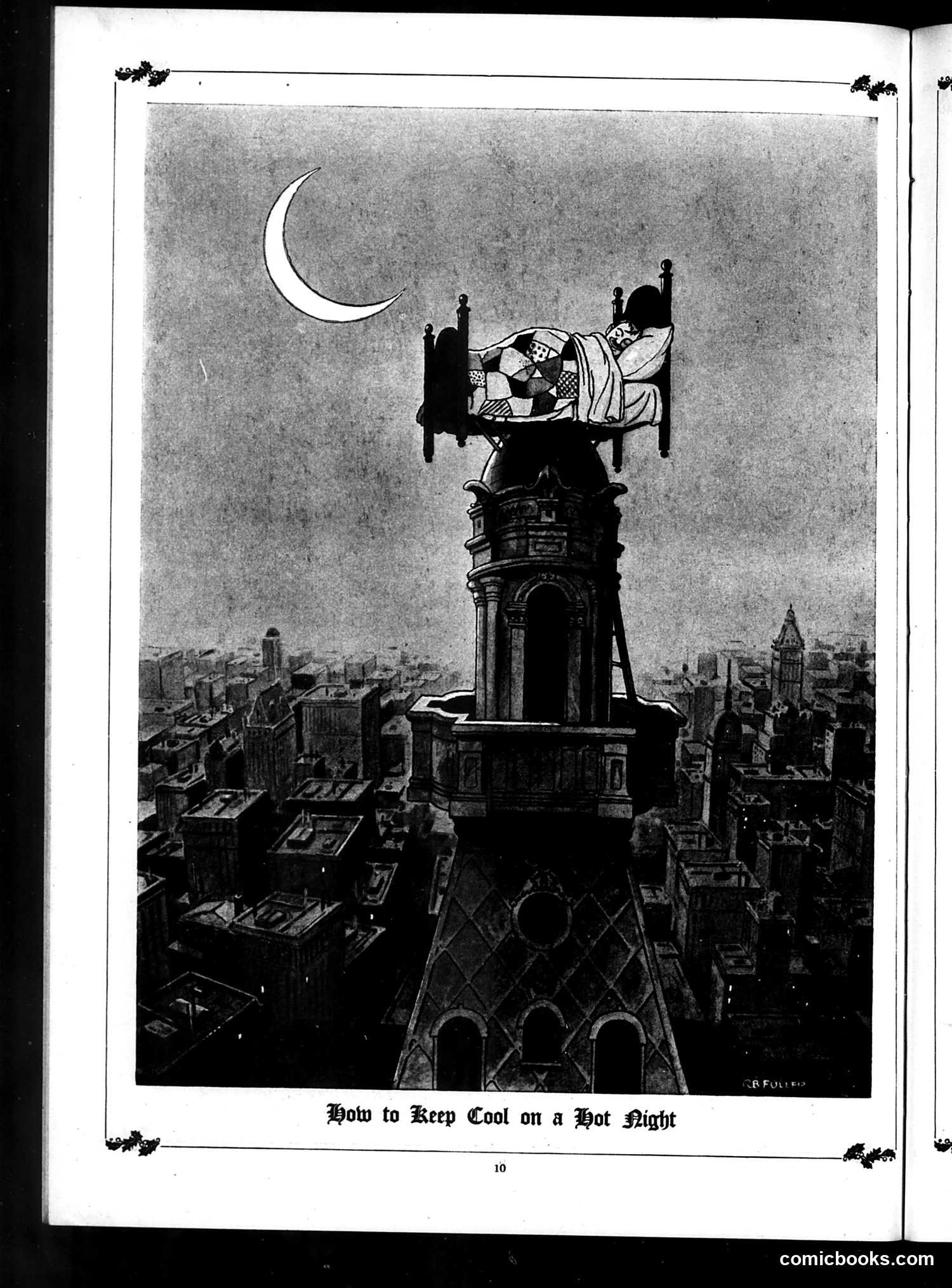
This satirical illustration shows a couple sleeping in a bed positioned atop a tall church or civic tower overlooking a sprawling city under a crescent moon. The caption "How to Keep Cool on a Hot Night" uses absurdist humor to suggest an impractical solution to urban summer heat. The joke likely references the discomfort of city living during hot nights before widespread air conditioning. By placing the bed impossibly high above the cityscape, the cartoon implies that escaping to elevation might catch cooling breezes—a humorous exaggeration of desperate measures people took to find relief. The surreal composition emphasizes the futility and desperation of seeking comfort during oppressive heat in densely packed urban environments.
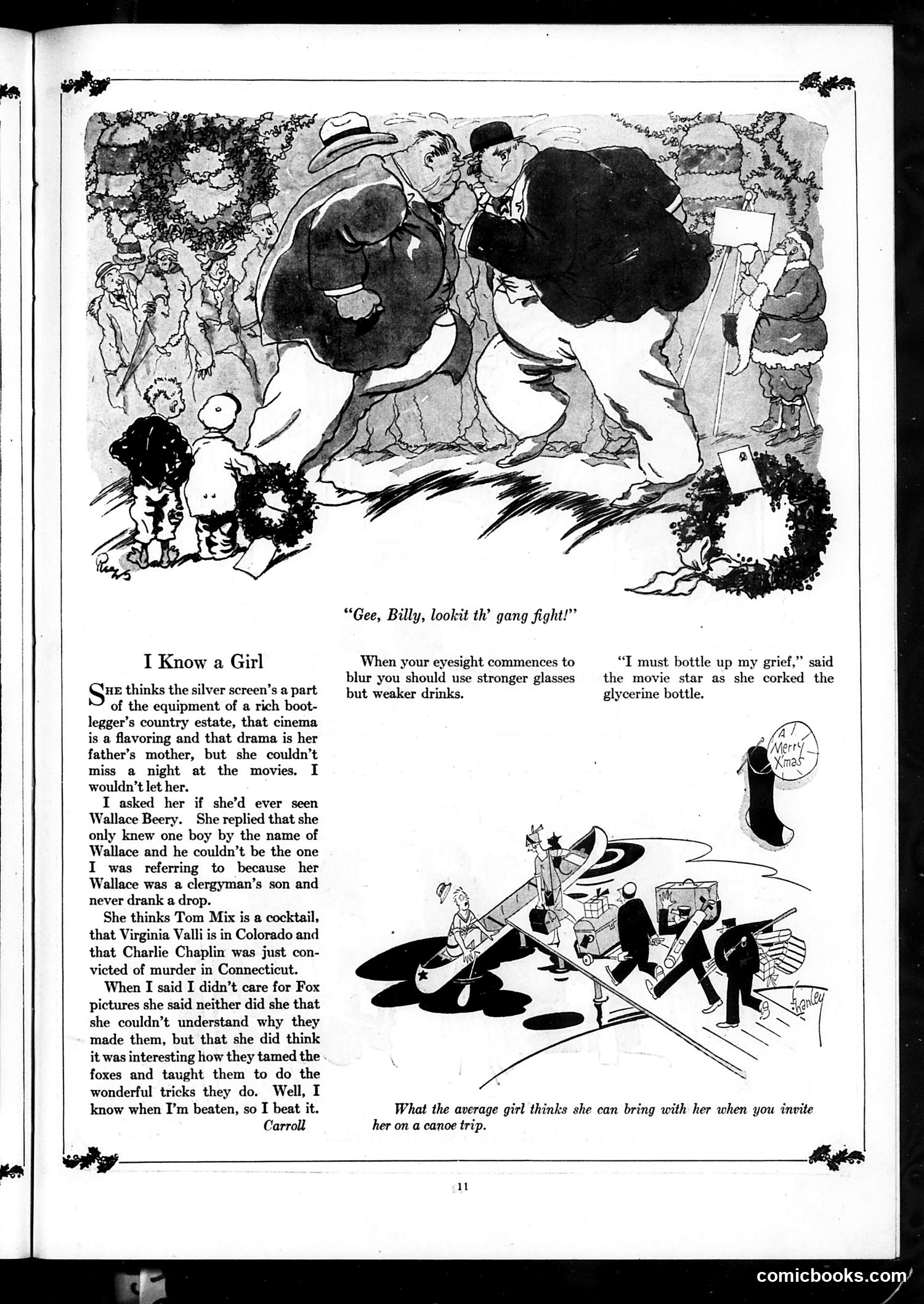
This page from *Judge* magazine contains three separate humor pieces mocking popular culture ignorance and female stereotypes: **"I Know a Girl"** (main text): A satirical column describing a woman who frequents movies but doesn't understand cinema. She confuses actors' names (Wallace Beery, Tom Mix, Virginia Valli, Charlie Chaplin) with unrelated concepts—Tom Mix as a cocktail, Virginia Valli as a Colorado location. The humor relies on the premise that she's culturally ignorant yet stubbornly devoted to moviegoing. References to 1920s Hollywood stars and Prohibition-era drinking are implicit. **Top cartoon**: Shows a street fight scene with onlookers, captioned "Gee, Billy, lookit th' gang fight!"—slapstick humor about urban violence as entertainment. **Right cartoons**: Two brief jokes about eyesight/drinking and a movie star using glycerine for tears, plus an illustration showing what "the average girl thinks she can bring" on a canoe trip—depicted as excessive luggage, mocking female impracticality. The overall tone reflects 1920s condescension toward women's engagement with popular entertainment.
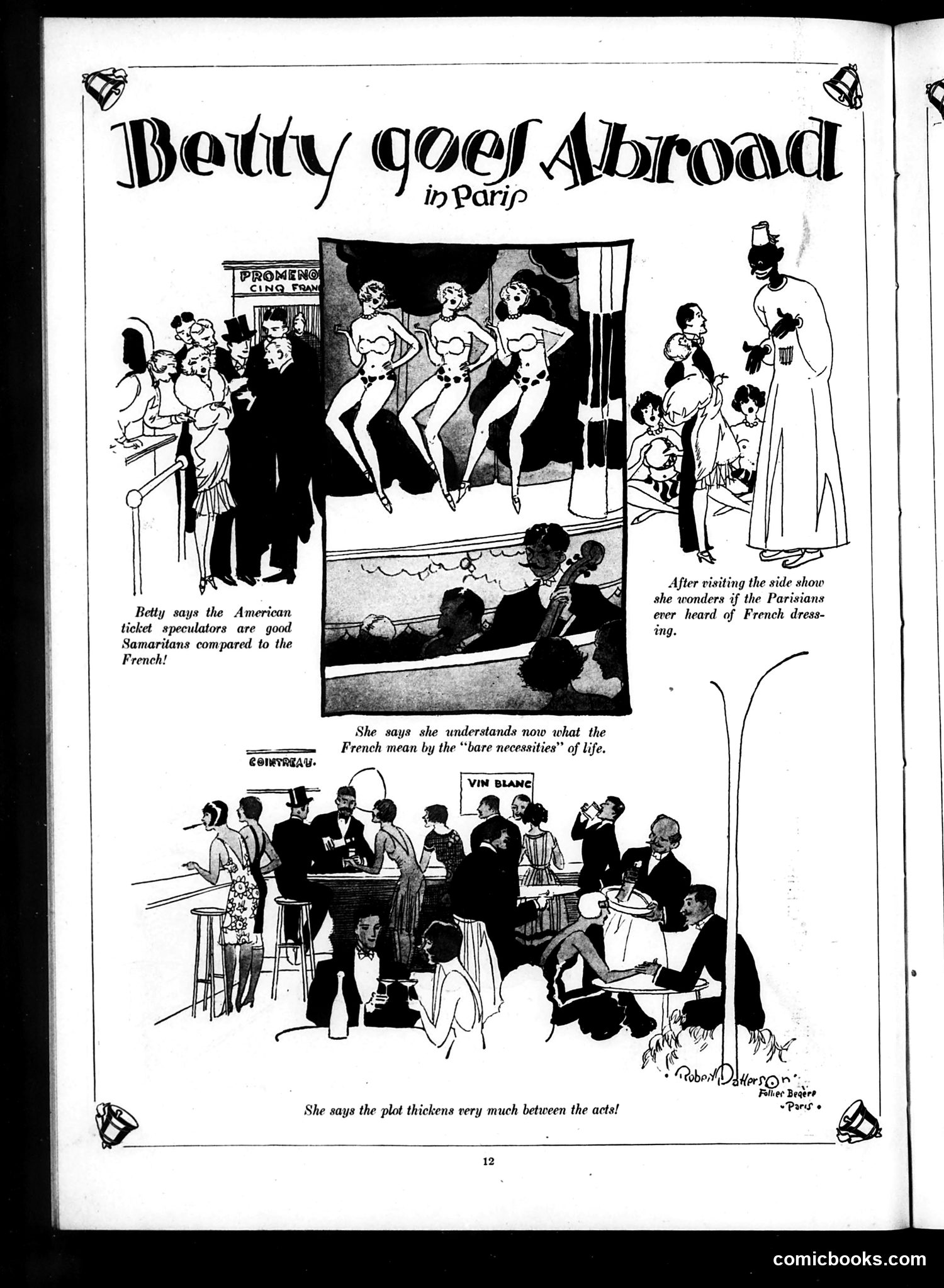
This satirical cartoon mocks an American tourist named Betty visiting Paris, comparing American and French culture. The humor relies on several contrasts: **The Setup:** Betty attends a Parisian cabaret featuring scantily-clad dancers (the "side show"), shocking her American sensibilities. **The Jokes:** - American ticket scalpers are portrayed as more honest than French ones - "Bare necessities" is a double entendre—the dancers wear minimal clothing, yet the French consider this normal fashion - Betty finds the plot "thickens between the acts," suggesting the entertainment is less about coherent narrative and more about spectacle **The Satire:** This reflects 1920s American attitudes toward Paris as a morally permissive European city where scandalous entertainment and relaxed social standards shocked American tourists. The cartoon plays on contrasts between American prudishness and French liberalism, with Betty serving as the innocent American encountering "continental" sophistication—presented here as merely underdressed dancers and casual immorality.
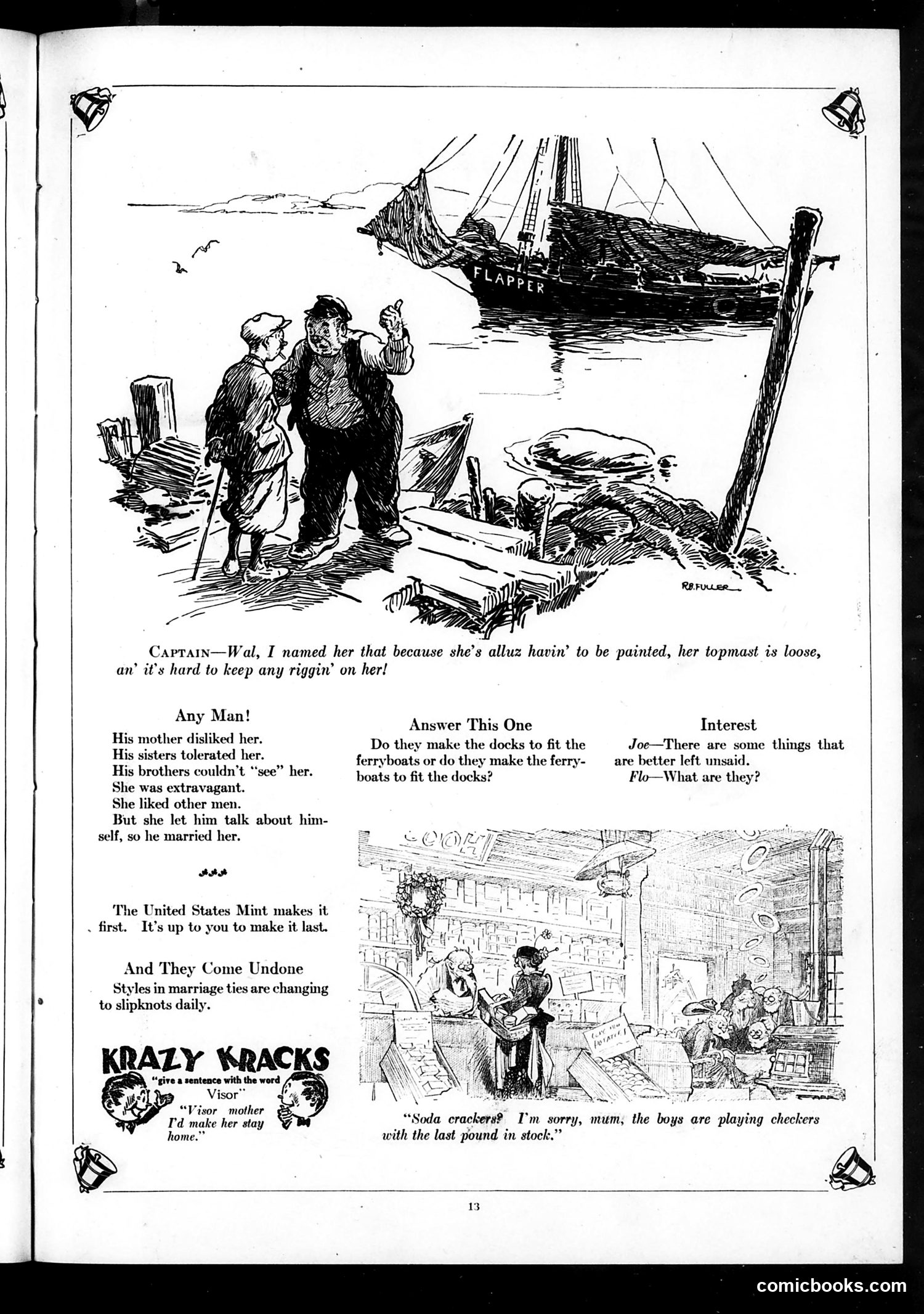
This page contains multiple satirical pieces mocking early 20th-century marriage and domestic life: **Top cartoon**: A ship captain explains naming his vessel after a woman—she requires constant maintenance (painting), has loose rigging, and is hard to control. This is a misogynistic joke equating women to poorly-maintained ships. **"Any Man!" section**: Satirizes why men marry difficult women—she's extravagant, unfaithful, disliked by family, but tolerates his self-centeredness. The point: men marry for vanity, not sense. **"And They Come Undone"**: A joke about marriage instability, using "slipknots" as metaphor for easily-dissolved bonds. **"Krazy Kracks"**: Advertising a visor product using a pun about sentence construction. **Bottom cartoon**: Wartime rationing humor—soda crackers are so scarce that boys use them as checkers pieces. References apparent food shortages during WWI era. The page mixes matrimonial cynicism with consumer/wartime messaging typical of Judge's satirical approach.
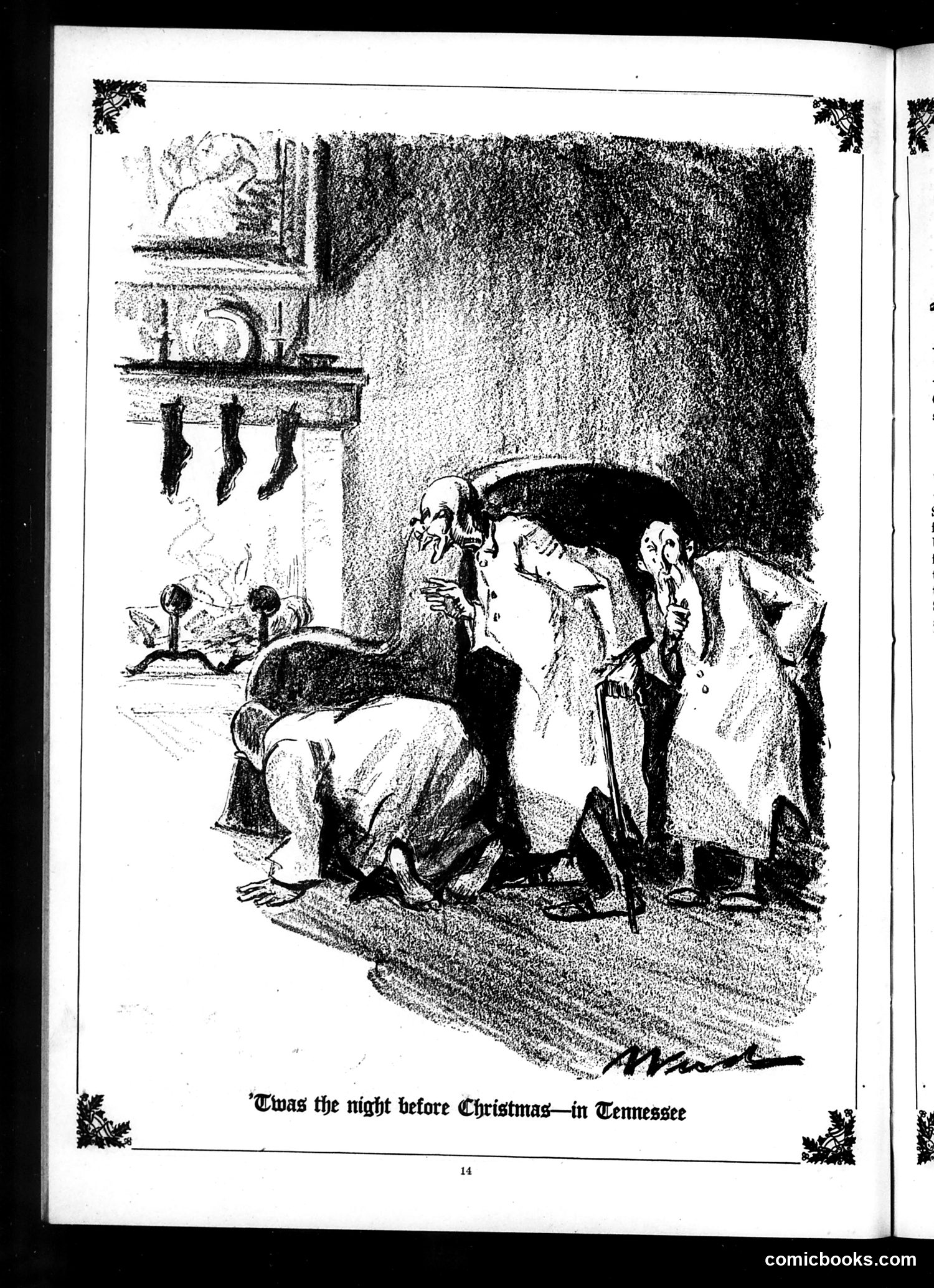
This cartoon parodies Clement Clarke Moore's famous poem "A Visit from St. Nicholas" ("'Twas the Night Before Christmas"), relocating it to Tennessee. The sketch shows what appears to be impoverished or rural figures huddled together in a sparse room with minimal furnishings—a stark contrast to the warm, prosperous household of the original poem. The satire likely critiques economic hardship or poverty in Tennessee during the magazine's era. The figures' thin, gaunt appearances and bare surroundings suggest deprivation. By invoking the beloved Christmas poem—typically associated with abundance and family comfort—the cartoonist highlights the gap between idealized American prosperity and harsh realities faced by some regions or populations. The exact historical context requires knowing Judge magazine's publication date, which isn't provided here.
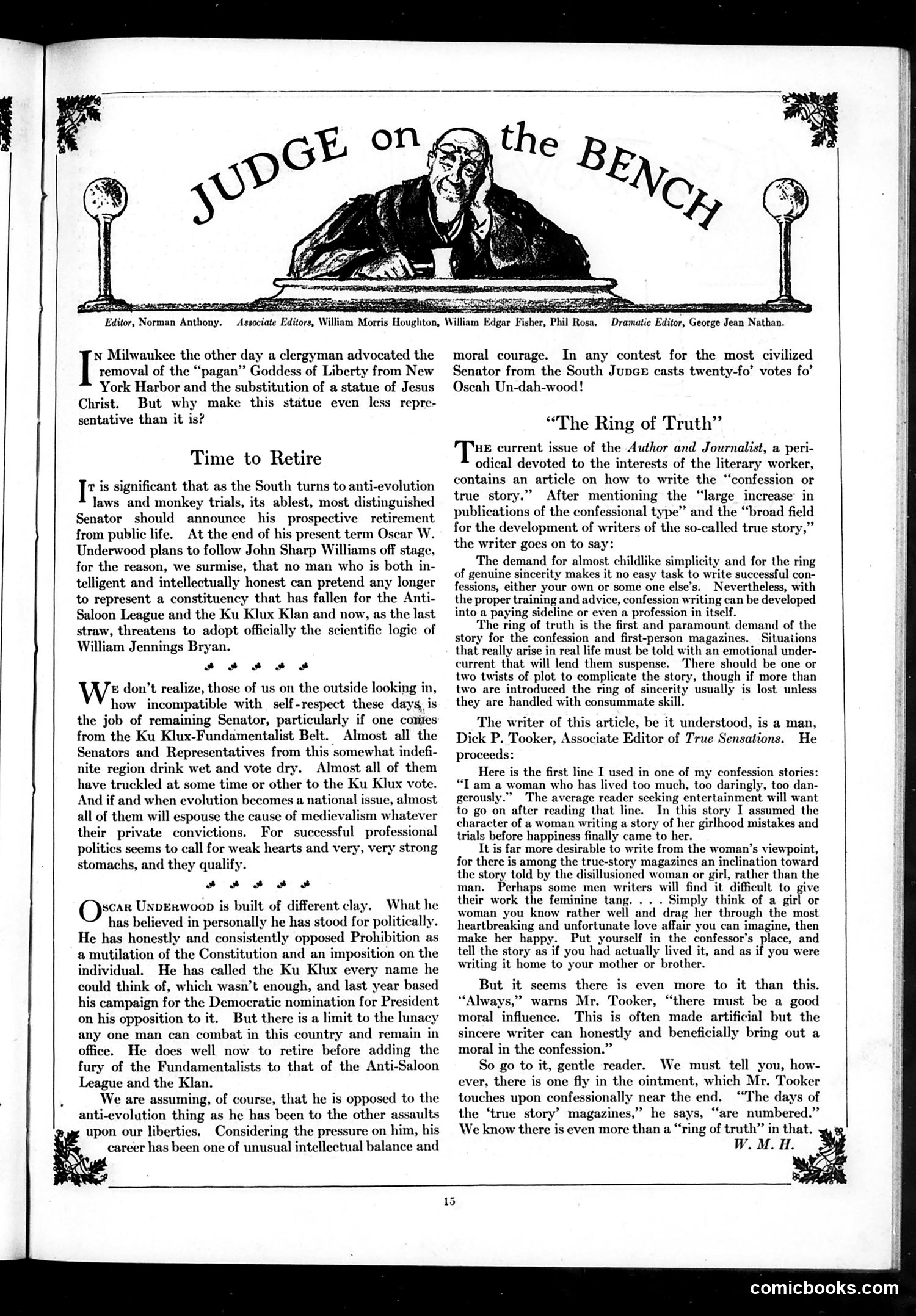
This page from *Judge* magazine contains editorial commentary on American politics circa the 1920s, not traditional cartoons. **Main Targets:** 1. **Senator Oscar W. Underwood** (Alabama) - The centerpiece criticizes his announced retirement, arguing that an intelligent man cannot ethically represent a Southern constituency that supports anti-evolution laws, the Ku Klux Klan, and Prohibition while maintaining intellectual honesty. 2. **Southern Fundamentalism** - The editors mock the South's embrace of anti-evolution "monkey trials" and characterize William Jennings Bryan's scientific logic as medieval. 3. **Political Hypocrisy** - The piece notes that Southern politicians drink alcohol privately while voting dry, and must compromise their convictions to appease special interests (the Klan, Anti-Saloon League). **The Satire's Point:** Underwood, praised for his personal integrity and principled opposition to Prohibition and the Klan, wisely recognizes he cannot survive politically while remaining honest—so retirement is actually the moral choice.
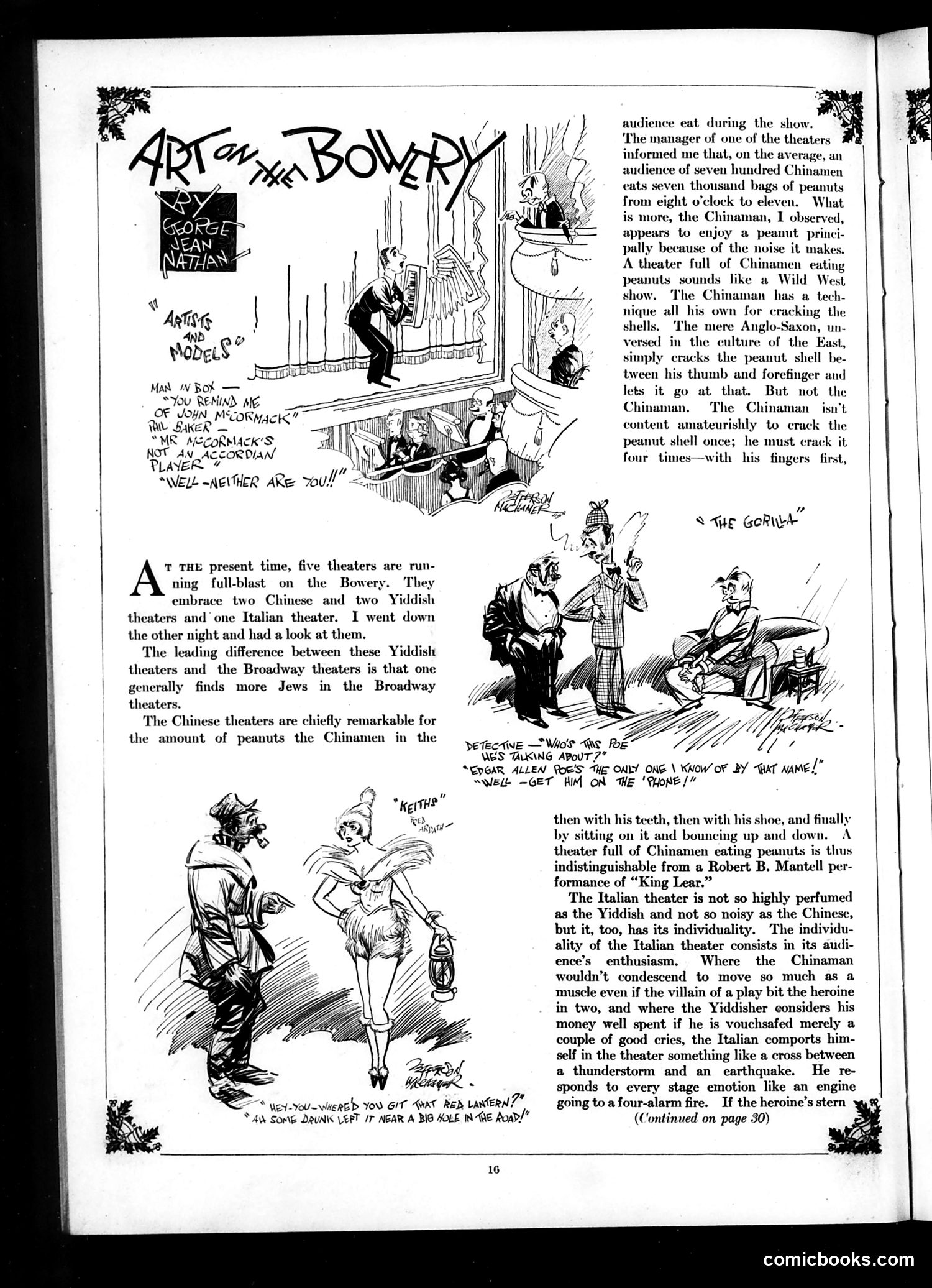
This article satirizes immigrant theater audiences on New York's Bowery, which had Chinese, Yiddish, and Italian venues. The humor relies on ethnic stereotyping common to early 20th-century American satire. The main joke concerns Chinese theatergoers eating peanuts—the author observes that seven hundred Chinamen consume seven thousand bags nightly, cracking shells with elaborate technique (fingers, teeth, shoes, sitting) to produce noise "like a Wild West show." This compares the cacophony unfavorably to actor Robert B. Mantell's dramatic "King Lear" performance. Side cartoons mock other ethnic groups: one depicts a police detective seeking "Edgar Allen Poe" by that name alone, suggesting Irish-American unfamiliarity with literature. Another shows characters with exaggerated features in stereotypical scenarios. The article concludes that Italian audiences are enthusiastic but unrefined, responding theatrically to stage emotions "like an engine going to a four-alarm fire"—treating entertainment as melodrama rather than serious drama. The satire's underlying assumption: immigrant audiences lack Broadway sophistication.
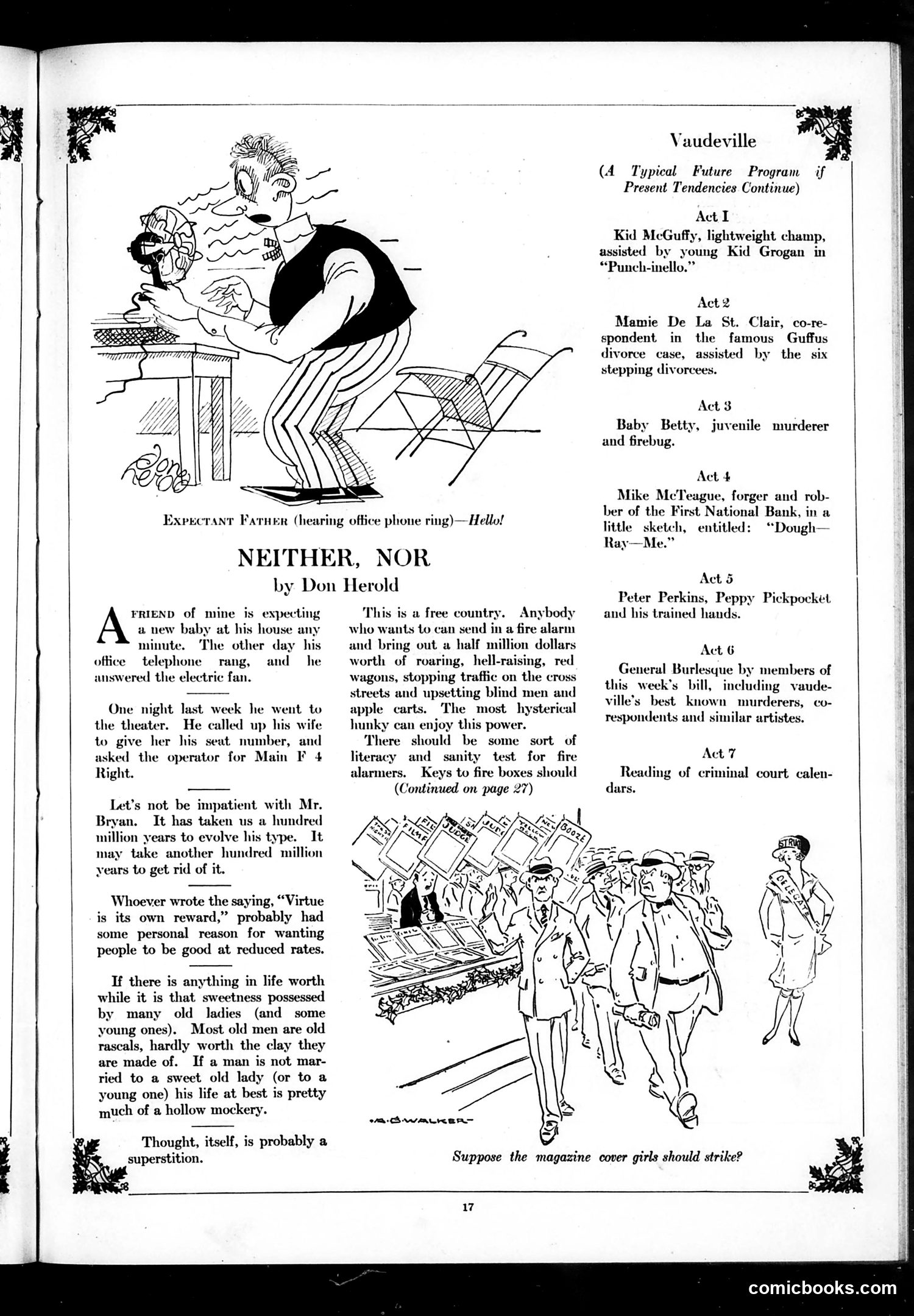
This page contains two satirical pieces by Don Herold attacking what he saw as declining American standards and competence. **"Neither, Nor"** mocks incompetence through anecdotes—a man answering his office fan instead of the phone, confusing theater seat numbers. The reference to "Mr. Bryan" (likely William Jennings Bryan, a prominent political figure) suggests frustration with slow societal progress, implying Bryan represents an obsolete type America is stuck with. **"Vaudeville"** presents a darker satire: a mock theater program imagining a future where criminal defendants and tabloid scandal figures become entertainment acts. Acts feature a forger, pickpocket, "juvenile murderer and firebug," and divorce co-respondents. The final act lists "criminal court calendars" as entertainment. The satire's point: Herold fears modern sensationalism and loose morals are turning criminals and scandals into celebrities. The "suppose magazine cover girls should strike?" caption below suggests anxieties about women's independence challenging social norms. Both pieces express conservative alarm at contemporary social disorder and deteriorating standards.
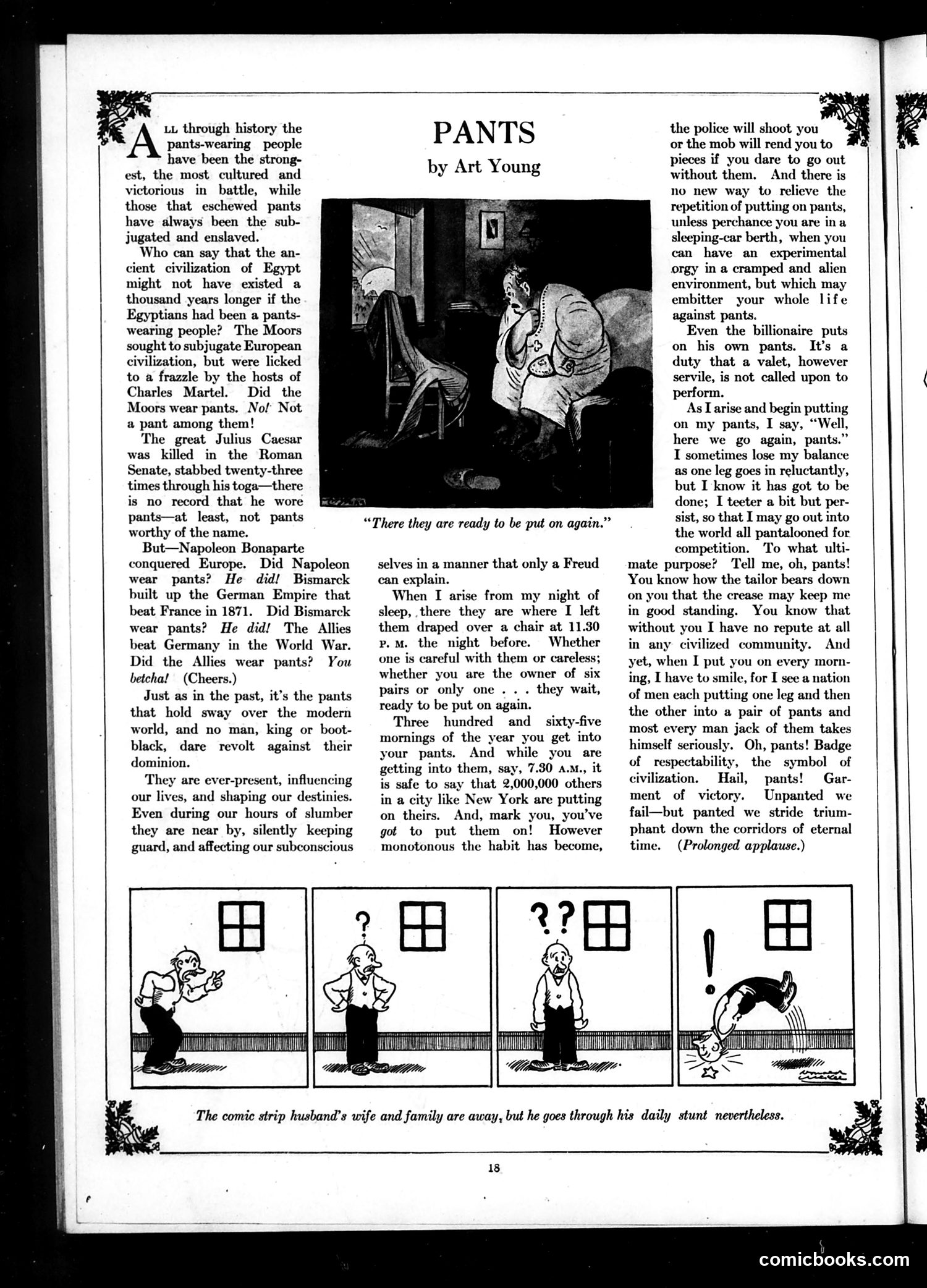
This satirical piece uses pants as a metaphor for social conformity and civilization itself. Young presents a pseudo-historical argument that pants-wearing peoples (Egyptians, Napoleon, Bismarck, Allied forces) conquered history while non-pants-wearers (Moors, Caesar in a toga) failed—a absurdist claim meant to mock deterministic historical narratives. The essay's real target is the *compulsory* nature of social convention. Young describes the daily ritual of putting on pants as inescapable drudgery enforced by threat ("the police will shoot you"). Even billionaires must do it themselves; even sleeping-car passengers cannot escape this tyranny of respectability. The satiric point: modern society treats arbitrary dress codes as natural law and markers of civilization, when they're actually oppressive habits. The accompanying comic strip shows a man performing his "daily stunt" alone—suggesting pants-wearing continues even without social observation, highlighting how internalized these pressures become. This reflects early-20th-century anarchist and socialist critique of capitalist conformity.
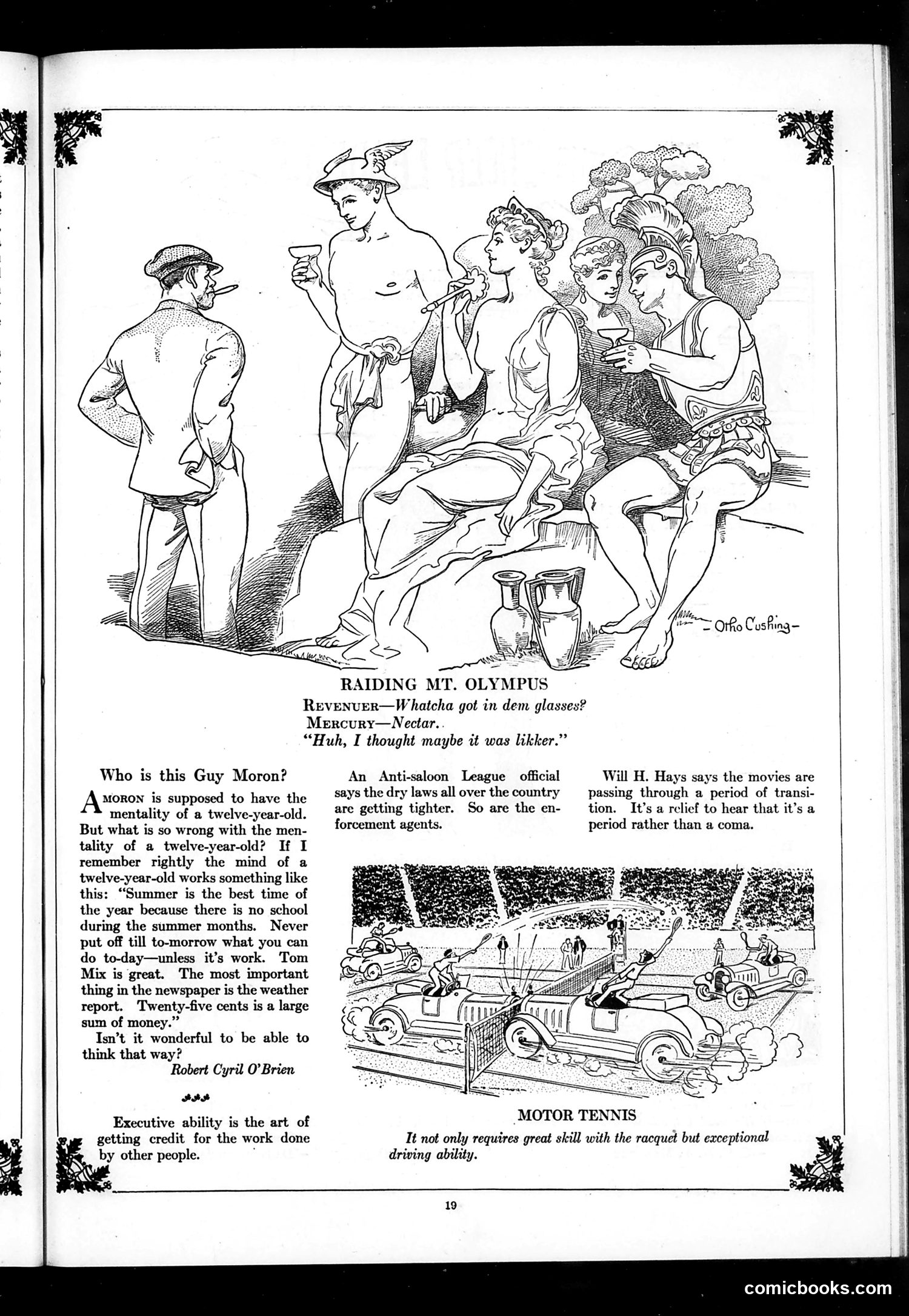
This Judge magazine page contains multiple satirical pieces: **"Raiding Mt. Olympus"** depicts Greek gods being confronted by a Prohibition agent. Mercury claims the nectar in their glasses is just that—not liquor—a joke about Prohibition enforcement during the dry laws era (likely 1920s-1930s). The satire mocks both overzealous federal agents and those trying to circumvent alcohol bans. **"Who is this Guy Moron?"** defends simple-minded thinking, arguing a twelve-year-old's practical priorities (no school in summer, getting things done today, enjoying entertainment) aren't actually foolish. **"Motor Tennis"** is a cartoon showing cars instead of players on a tennis court—a visual pun about automobiles becoming prevalent enough to play sports with. The page reflects early-20th-century American anxieties: Prohibition enforcement, changing attitudes toward intelligence and pragmatism, and the automobile's increasing role in modern life.
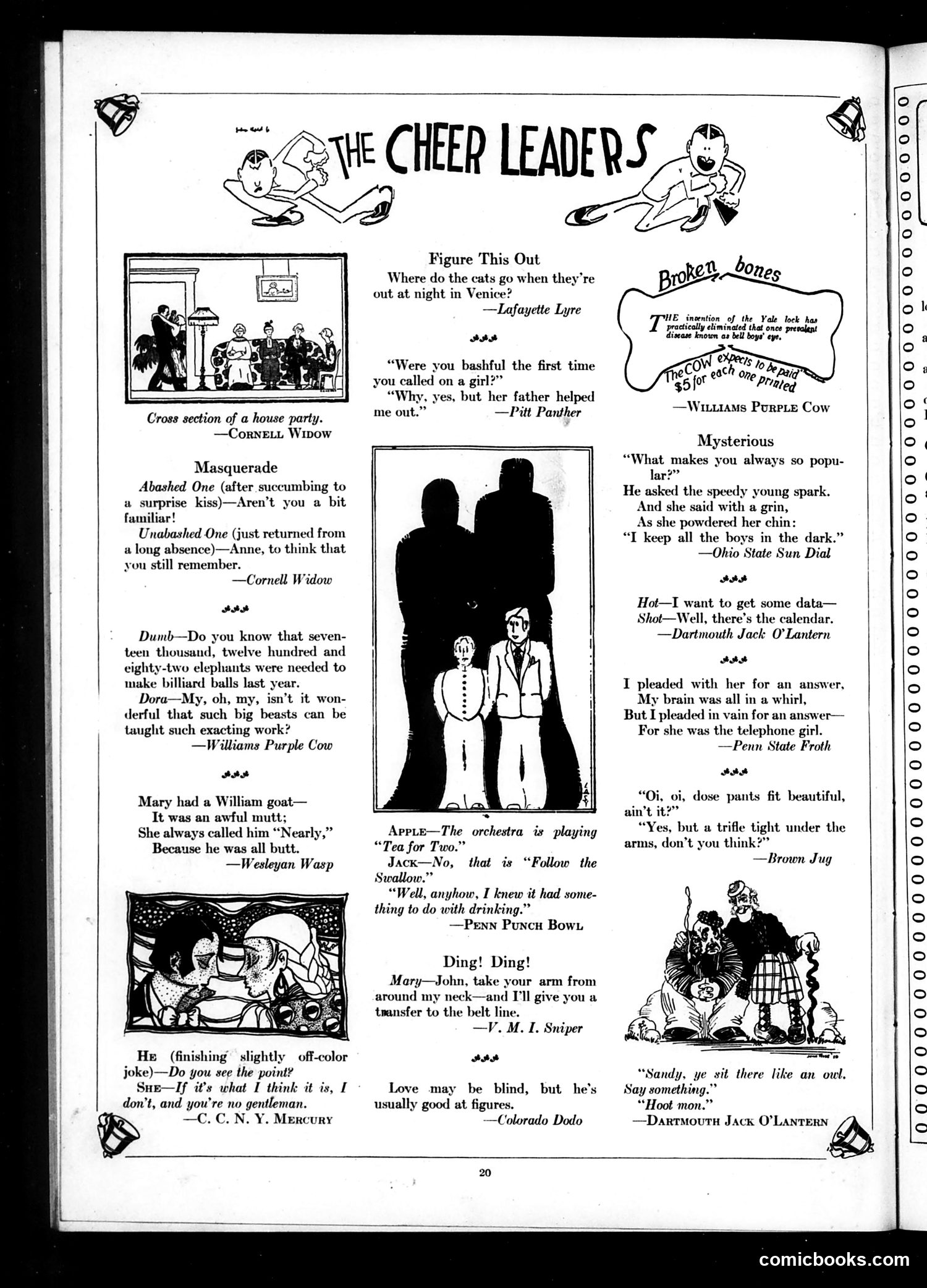
This is a humor page from *Judge* magazine featuring jokes and brief comic sketches contributed by college publications (Yale, Cornell, Penn, Brown, etc.). The content reflects early-20th-century collegiate humor and social satire. **Key themes:** - **Dating/courtship humor**: Multiple jokes about bashfulness, romantic advances, and telephone operators (then common intermediaries for connections) - **Gender dynamics**: Women portrayed as coy, mysterious, or manipulative; jokes about tight clothing and powdering makeup - **College stereotypes**: References to specific colleges' publications suggest inter-collegiate rivalry - **Mild risqué content**: References to "off-color jokes" and suggestive humor about physical closeness **Notable elements:** The silhouette illustration depicts a dance or party scene—the "masquerade" theme. One joke plays on "William goat" (sounds like "billy goat"). Another puns on Venice's canals. The page essentially showcases collegiate wit typical of the era: lighthearted, often about romance, rarely sophisticated, with gendered humor that now reads as dated.
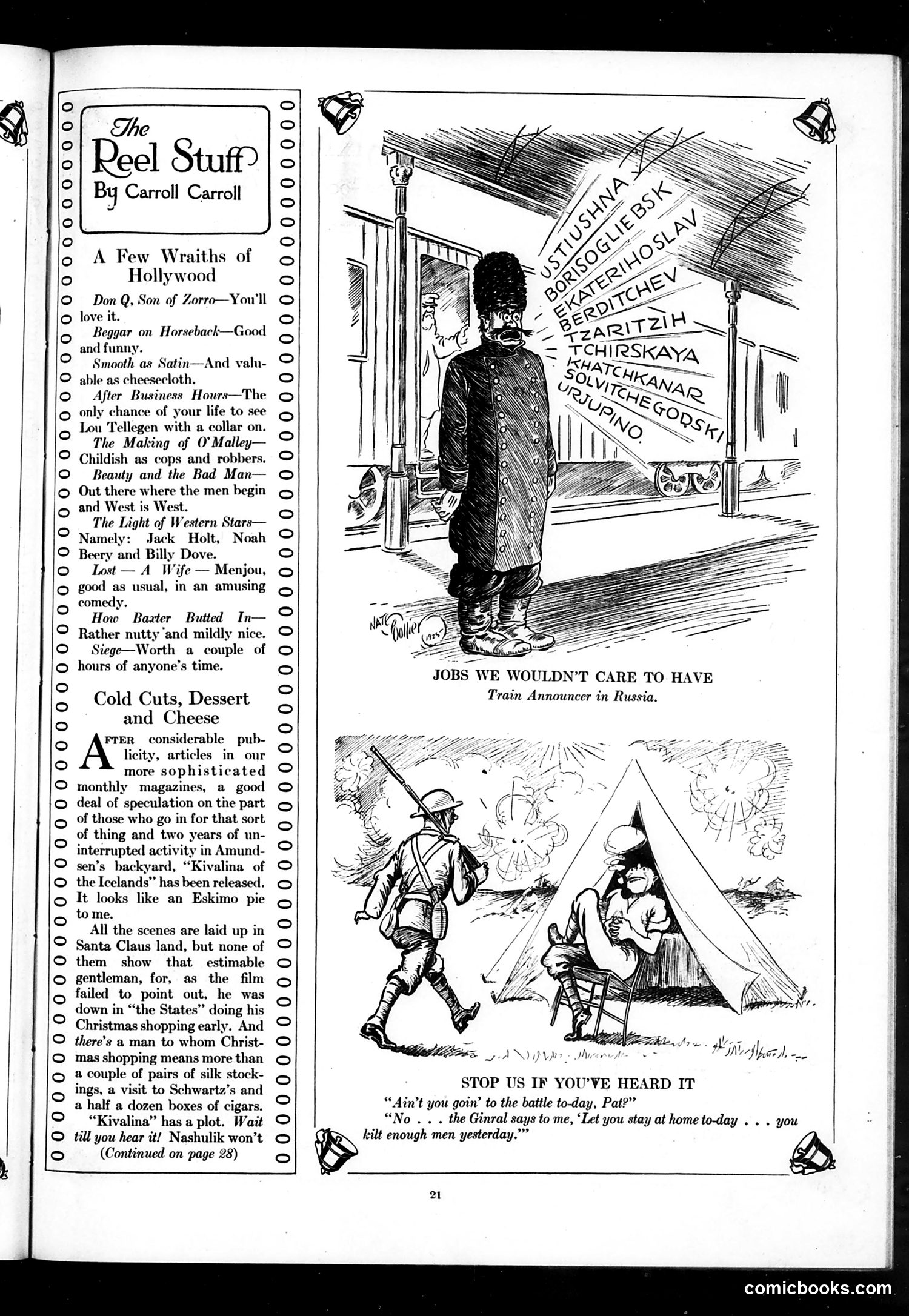
This page contains film reviews and satirical cartoons from an American humor magazine. **Top Cartoon**: Shows a Russian train station worker reading a massive list of unpronounceable Russian names and places. The satire targets post-Revolutionary Russia—the joke is that a train announcer in Russia would face an impossible job due to the difficulty of Russian nomenclature, playing on American stereotypes about Russian language complexity and the chaos of Soviet administration. **Bottom Cartoon**: An Irish dialect joke about a soldier avoiding battle. The humor relies on ethnic stereotyping—the "General" tells "Pat" to stay home because he's already killed enough men yesterday. This reflects WWI-era humor that often mocked Irish soldiers through dialect comedy. **Film Reviews Section**: Carroll Carroll critiques contemporary Hollywood films (Don Q, Beggar on Horseback, etc.), offering brief, flippant assessments. The "Cold Cuts, Dessert and Cheese" section reviews an Eskimo-themed film called "Kivalina of the Icelands," dismissing it sardonically as an "Eskimo pie." The page exemplifies early 1920s American satirical humor, mixing entertainment industry commentary with period-typical ethnic and national stereotypes.
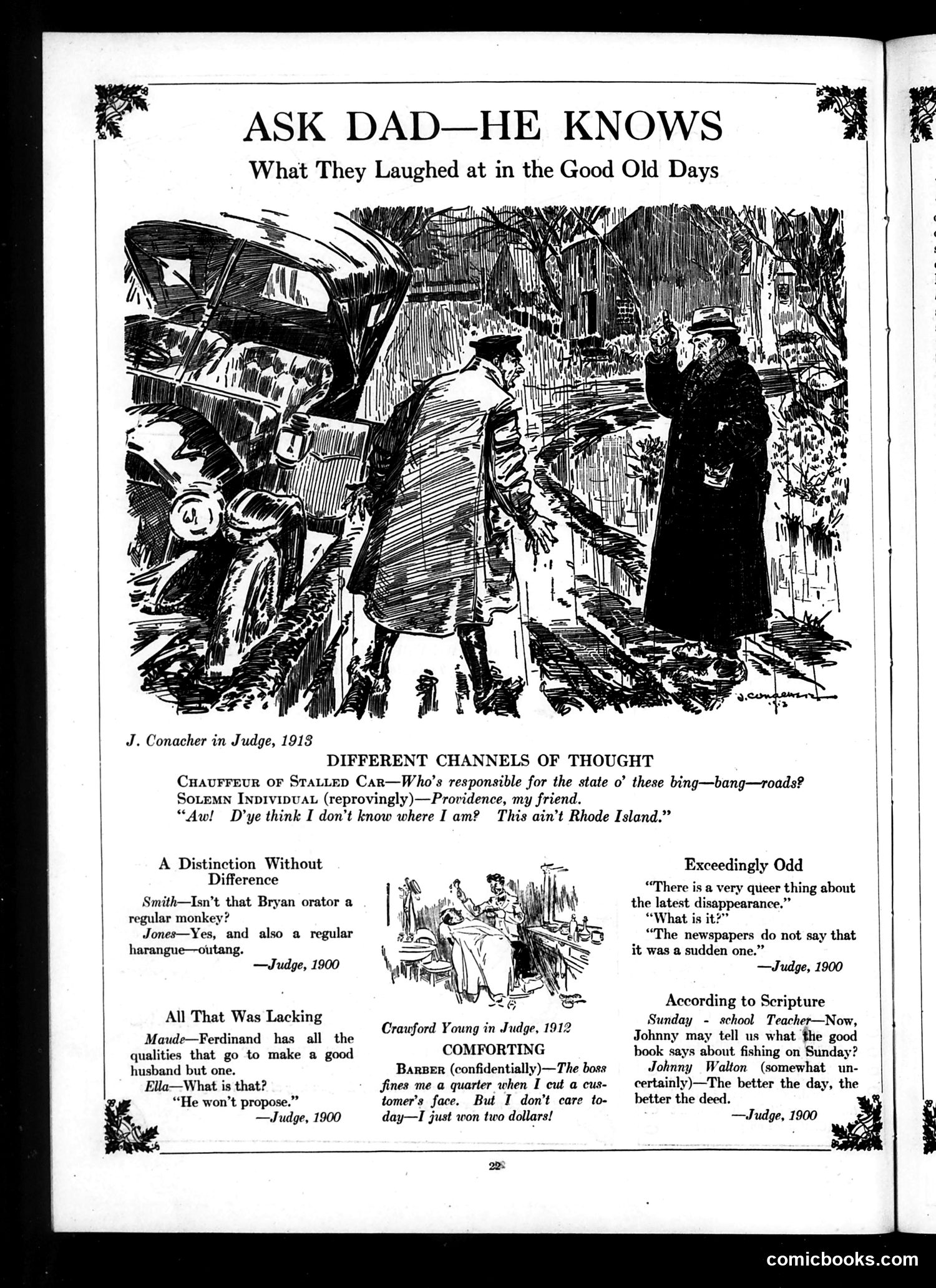
This page from Judge (c. 1912-1913) collects humorous anecdotes labeled "Ask Dad—He Knows," presenting jokes from the magazine's archives. The main cartoon depicts a car broken down on poor roads. A chauffeur blames "Providence" for road conditions, while a passenger sarcastically responds he knows perfectly well where he is—suggesting the roads are so bad they're literally impassable (a common complaint about American infrastructure in the early 1900s). Below are shorter jokes exploiting wordplay and social conventions: - A pun on "Bryan orator" as a "monkey" and "harangue-outang" - A woman noting her suitor has every quality except willingness to propose - A barber comforted despite being fined for cutting customers because he won money gambling - Observations about newspaper phrasing and a child misquoting scripture about Sunday fishing The humor relies on puns, domestic situations, class-based scenarios (servants, barbers), and innocent misunderstandings—typical of early-1900s American comic magazines.
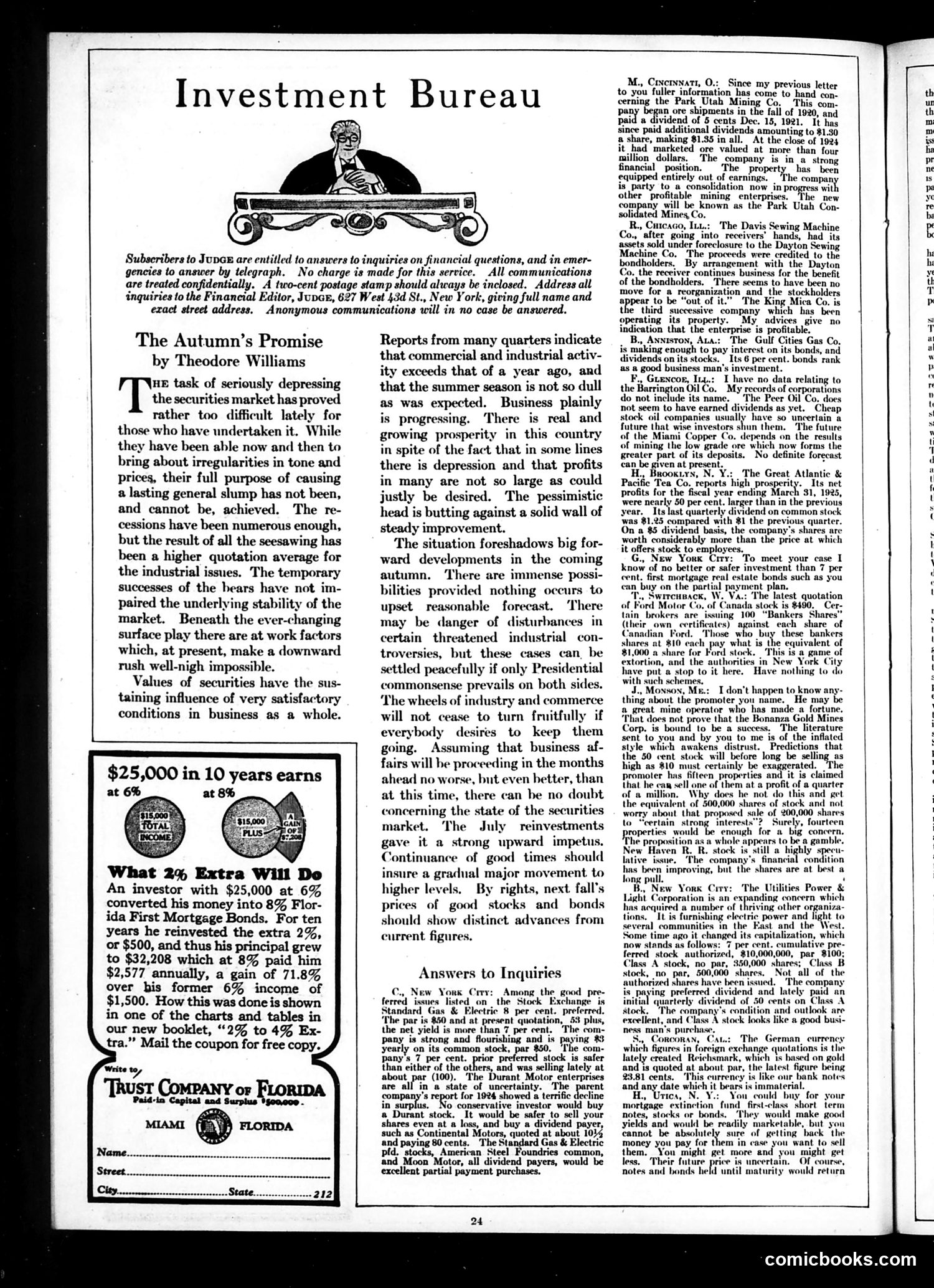
This page from *Judge* magazine presents financial advice and investment commentary rather than political satire. The main content includes: **"The Autumn's Promise"** by Theodore Williams argues that despite bear-market efforts to depress securities, the market remains fundamentally stable due to strong business conditions. He predicts continued industrial prosperity and stock market gains into fall, assuming labor disputes remain peaceful. **The Investment Bureau** offers readers financial consultation services—a legitimate feature where subscribers could submit questions about stocks and bonds, receiving confidential responses. **The advertisement** for Trust Company of Florida promotes their mortgage bonds, using a chart to demonstrate compound returns: $25,000 at 6% versus 8% yields significantly different income over ten years. **"Answers to Inquiries"** provides specific stock recommendations (Standard Gas & Electric preferred shares, etc.) with yield percentages. The page reflects early-20th-century investment culture and optimism about industrial growth, with no apparent satirical intent.
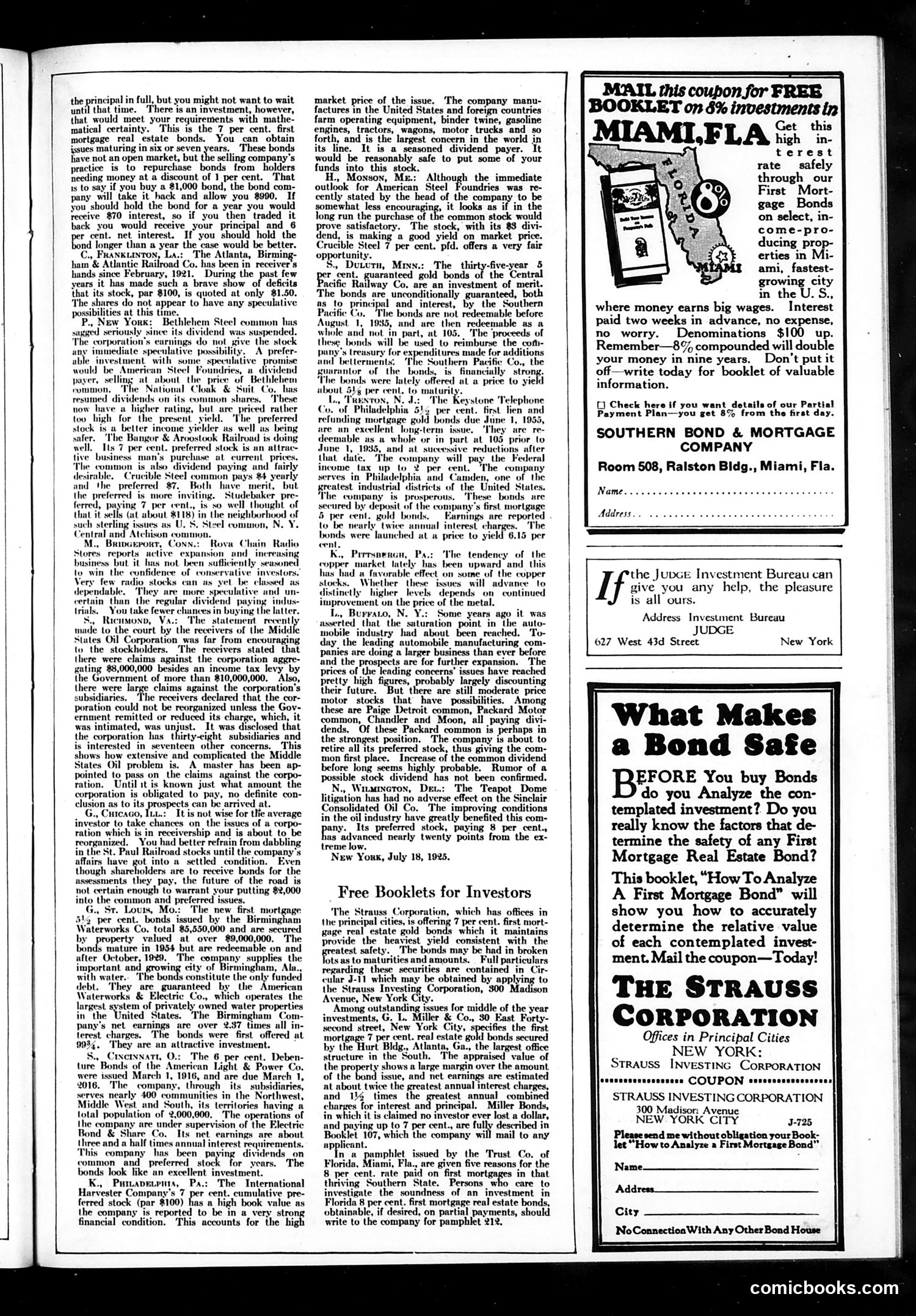
This page is **primarily financial advertising and investment advice**, not satire or political cartooning. It contains multiple bond and investment service advertisements targeting wealthy readers with disposable income during what appears to be the 1920s era. The main advertiser is the **Southern Bond & Mortgage Company** (Miami, Florida), promoting first mortgage bonds as safe investments. Other ads promote **The Strauss Corporation's investment services** and various railroad and industrial bonds. The accompanying text provides investment analysis of different corporate bonds and stocks—evaluating companies like Bethlehem Steel, American Steel Foundries, and various railroads. The advice emphasizes safety and guaranteed returns, typical of conservative investment guidance from this period. There is **no visible political cartoon or satire** on this page. It represents Judge magazine's business/financial content sections, which served an affluent readership interested in bond investments and corporate information.
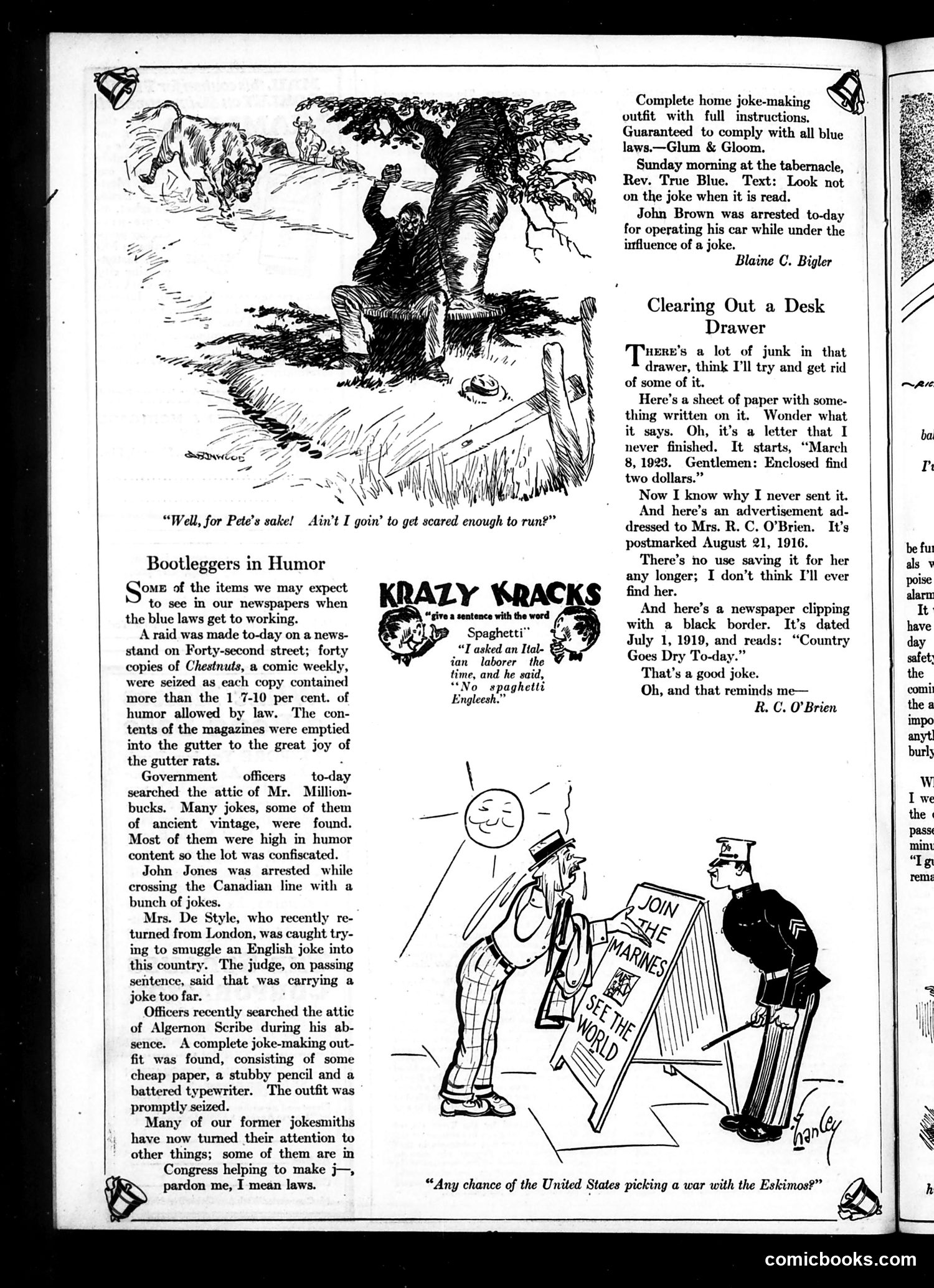
This page satirizes the enforcement of Prohibition-era "blue laws"—strict moral legislation banning alcohol and other "vices." The main article mockingly imagines absurd enforcement scenarios: police raiding newsstands to confiscate humor magazines that exceed allowed "humor content," arresting people for telling jokes, and confiscating joke-making equipment as contraband. The satire targets government overreach and the ridiculous extremes of moral policing. By treating jokes like bootlegged alcohol, the author ridicules how authorities treat humor as something dangerous requiring suppression. The cartoon below depicts recruitment propaganda ("Join the Marines—See the World"), likely mocking militarism during the WWI era. The caption "Any chance of the United States picking a war with the Eskimos?" suggests cynical commentary on American military ambitions and foreign policy adventurism. Together, these pieces critique government censorship, Prohibition enforcement, and militarism through absurdist humor.
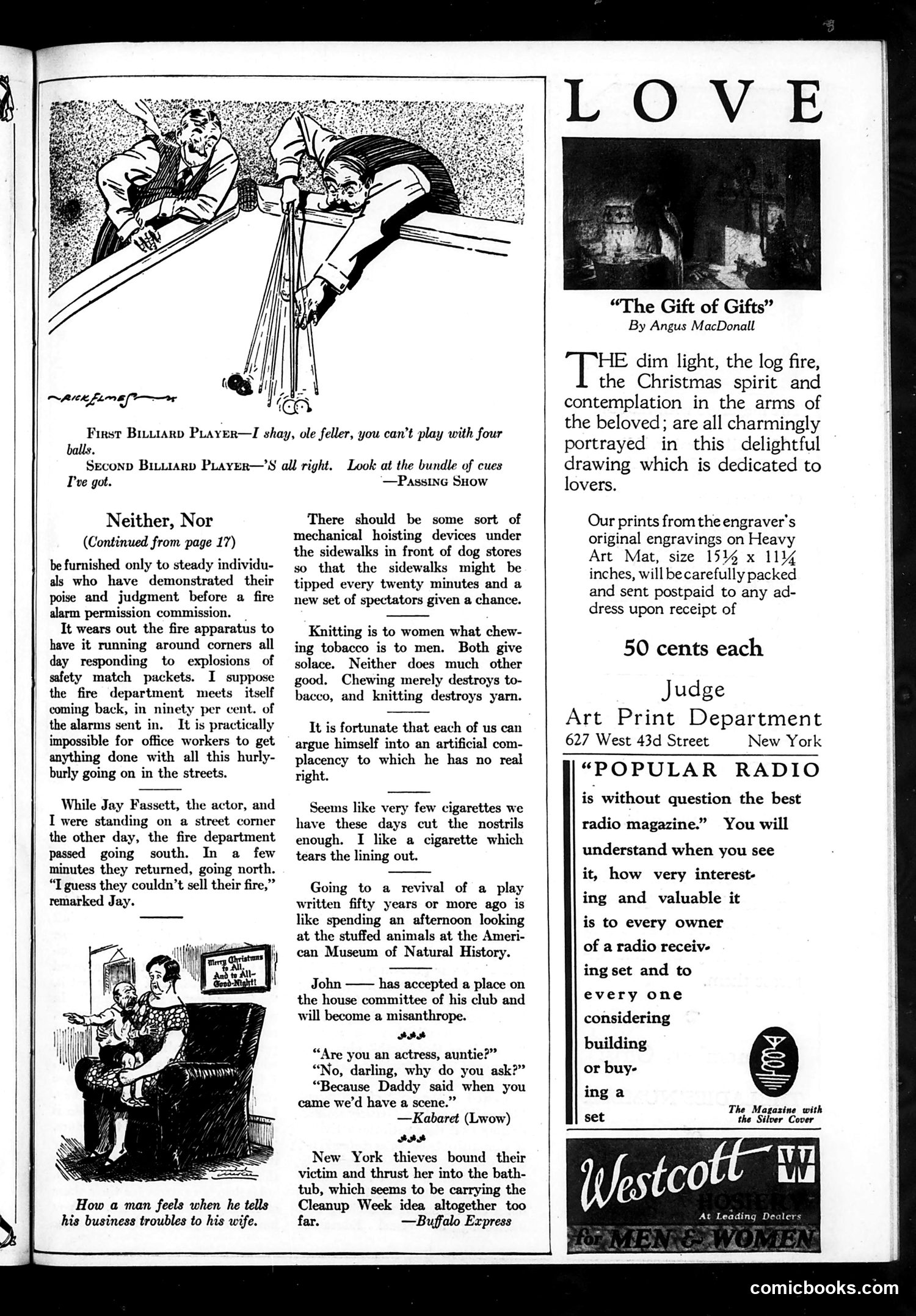
**The Billiards Cartoon:** Two players argue about pool rules—one claims you can't play with four balls; the other counters that he has "a bundle of cues." The joke plays on the double meaning: cues as pool sticks versus "cues" as hints/excuses, suggesting the second player has plenty of justifications regardless. **"Neither, Nor" Column:** A humorous social commentary piece touching on absurd modern grievances: fire departments responding to false alarms from safety matches, mechanical sidewalk-tipping devices for dog store spectators, and comparisons between women's knitting and men's chewing tobacco as equally pointless habits. Includes brief anecdotes and jokes about cigarette quality and social situations. **The Page's Purpose:** Primarily mixed editorial humor and advertising. The "Gift of Gifts" art print advertisement occupies substantial space, alongside promotions for Judge's art department and Popular Radio magazine. The content reflects Judge's satirical approach to everyday American life and consumer culture, circa the 1920s era.
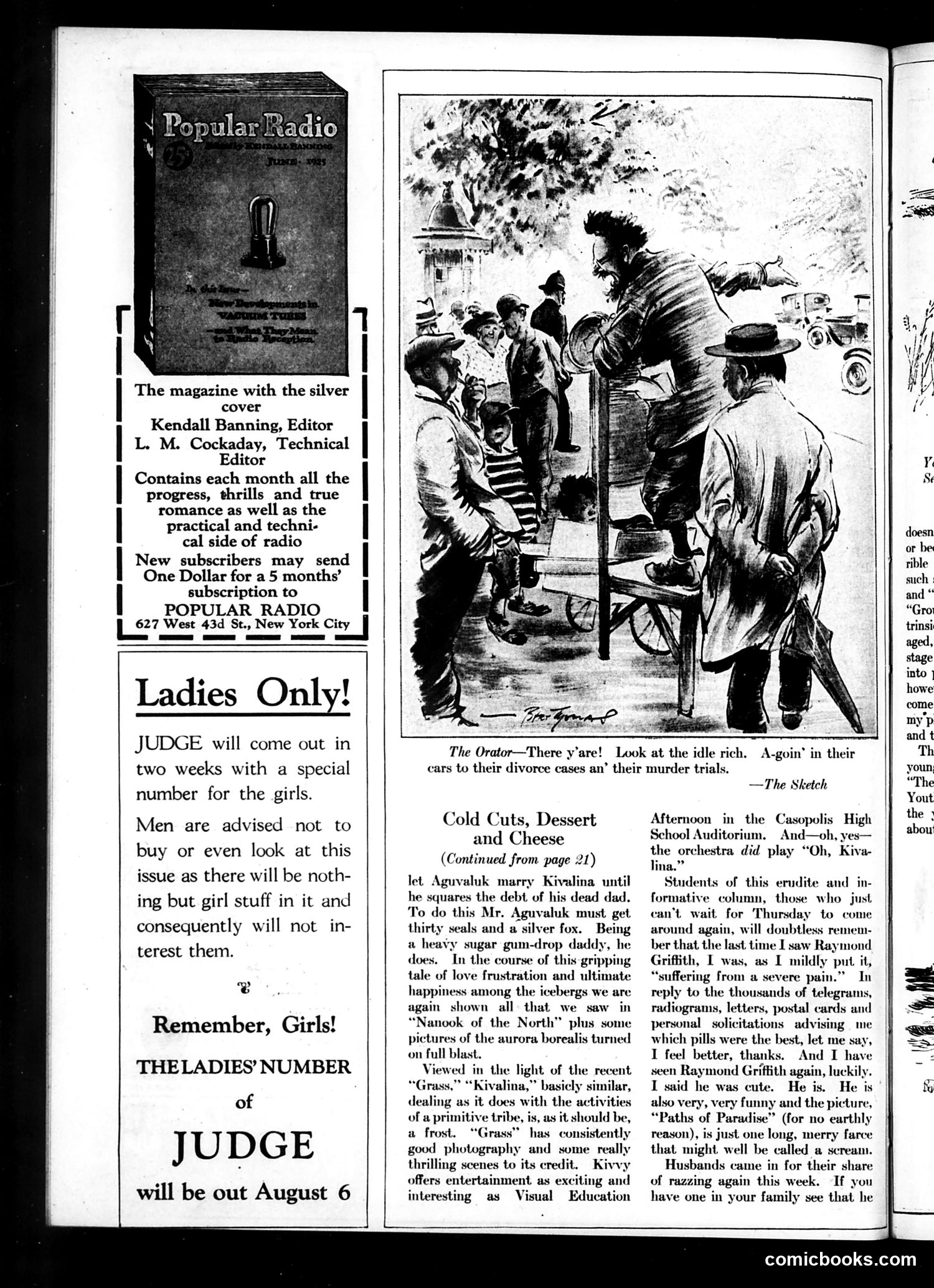
This page contains **advertisements and editorial content** from Judge magazine rather than political cartoons. The main cartoon depicts "The Orator" addressing a crowd about wealthy people attending divorce and murder trials—social satire about the idle rich and scandal-obsessed entertainment culture of the era. The page also advertises: - **Popular Radio** magazine (a technical publication about emerging radio technology) - A forthcoming **"Ladies' Number"** of Judge (August 6), humorously warning men not to read it as it contains only "girl stuff" The remaining text reviews films including "Kivalina" (an Inuit-focused drama similar to the famous "Nanook of the North") and praises actor Raymond Griffith's comedy "Paths of Paradise." A humorous column jokes about marital problems and relationship advice. The content reflects 1920s entertainment interests: emerging radio technology, cinema, and gender-targeted magazine marketing.
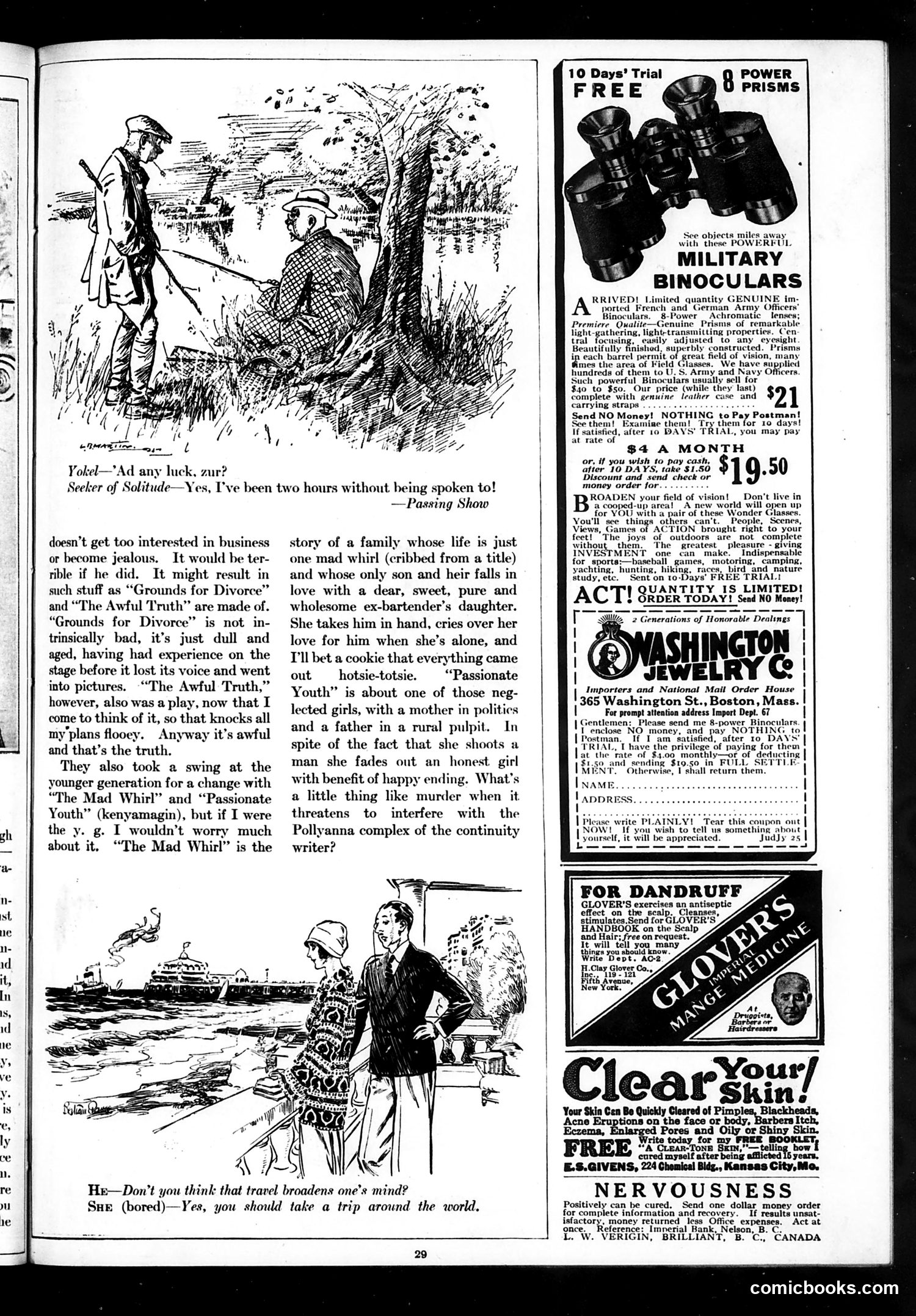
This page from *Judge* magazine contains two cartoon vignettes satirizing contrasting social types through brief comedic exchanges. **Top cartoon**: A well-dressed "Seeker of Solitude" encounters a yokel (rural countryman) and explains his happiness: he's gone two hours without human conversation. The joke mocks urban intellectuals who romanticize isolation and rural simplicity, presenting the "seeker" as pretentious—someone so desperate to escape social interaction that he considers it a vacation. **Bottom cartoon**: A bored woman tells her male companion that travel "broadens one's mind," while a ship passes in the background. The implication is sarcastic: she wants to travel as an escape from their relationship, while he remains indifferent. Both cartoons satirize contemporary attitudes about marriage, social climbing, and generational restlessness. The page is otherwise dominated by period advertisements (military binoculars, dandruff treatment, skin remedies, nervousness cures)—typical of early 20th-century magazines blending editorial content with commercial pitches.
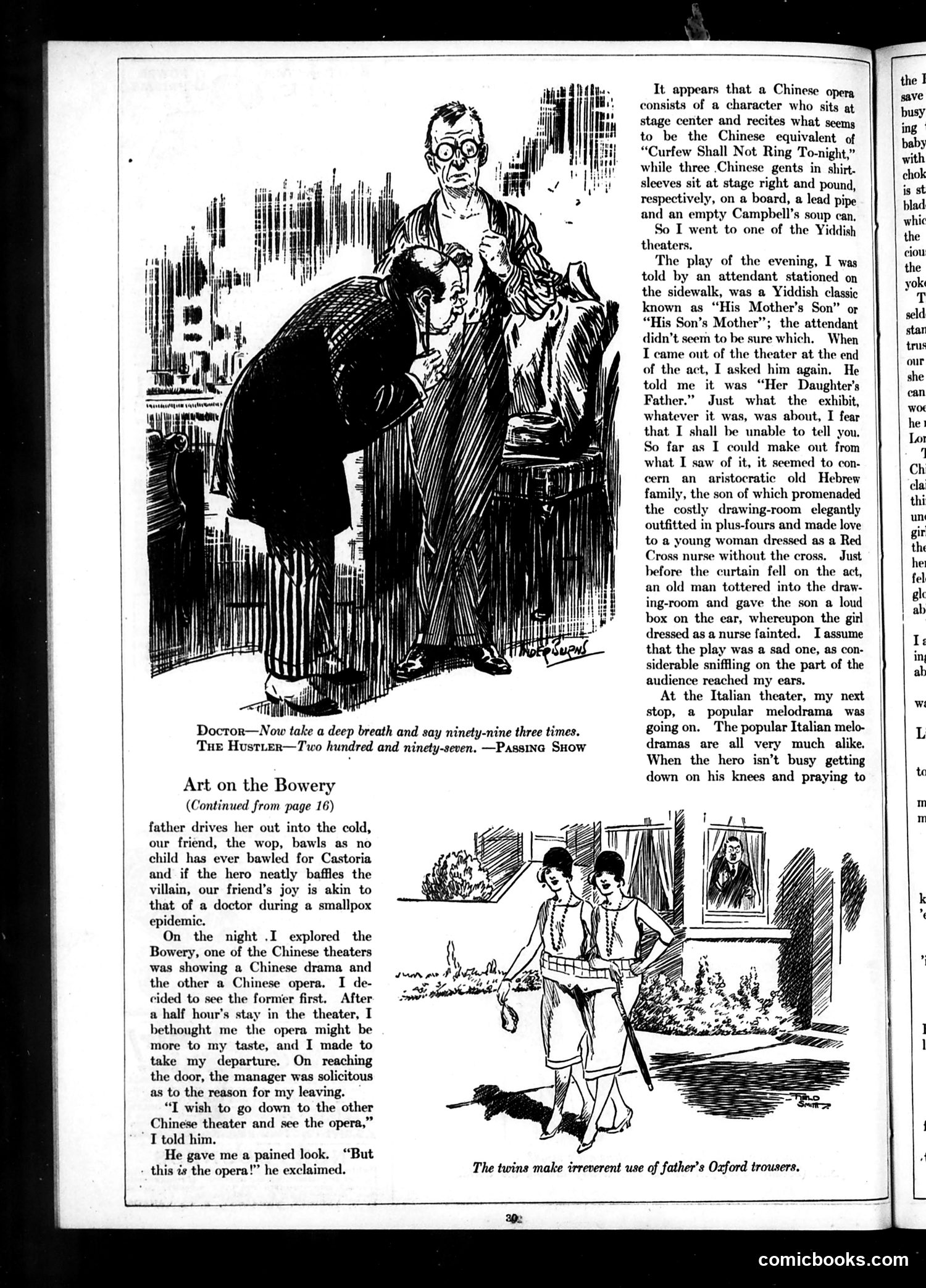
This 1910s-era Judge magazine page satirizes immigrant theater on New York's Bowery through ethnic stereotyping. The author visits Chinese, Yiddish, and Italian theaters, mocking each. **The top cartoon** shows a doctor instructing a patient to say "ninety-nine" repeatedly; the "hustler" (a con artist) deliberately says "two hundred and ninety-seven" instead—satirizing someone trying to outsmart medical authority. **"Art on the Bowery"** is a condescending travelogue where the author ridicules Chinese opera as monotonous (one actor reciting while others bang objects), then dismisses a Yiddish play as incomprehensible melodrama with unclear plots and excessive emotion. He mocks Italian melodramas as formulaic. The piece uses period slurs ("wop") and relies on ethnic caricature—portraying immigrant communities as culturally unsophisticated. The humor targets both the theaters themselves and their audiences, reflecting upper-class American prejudices of the era against working-class immigrant culture.
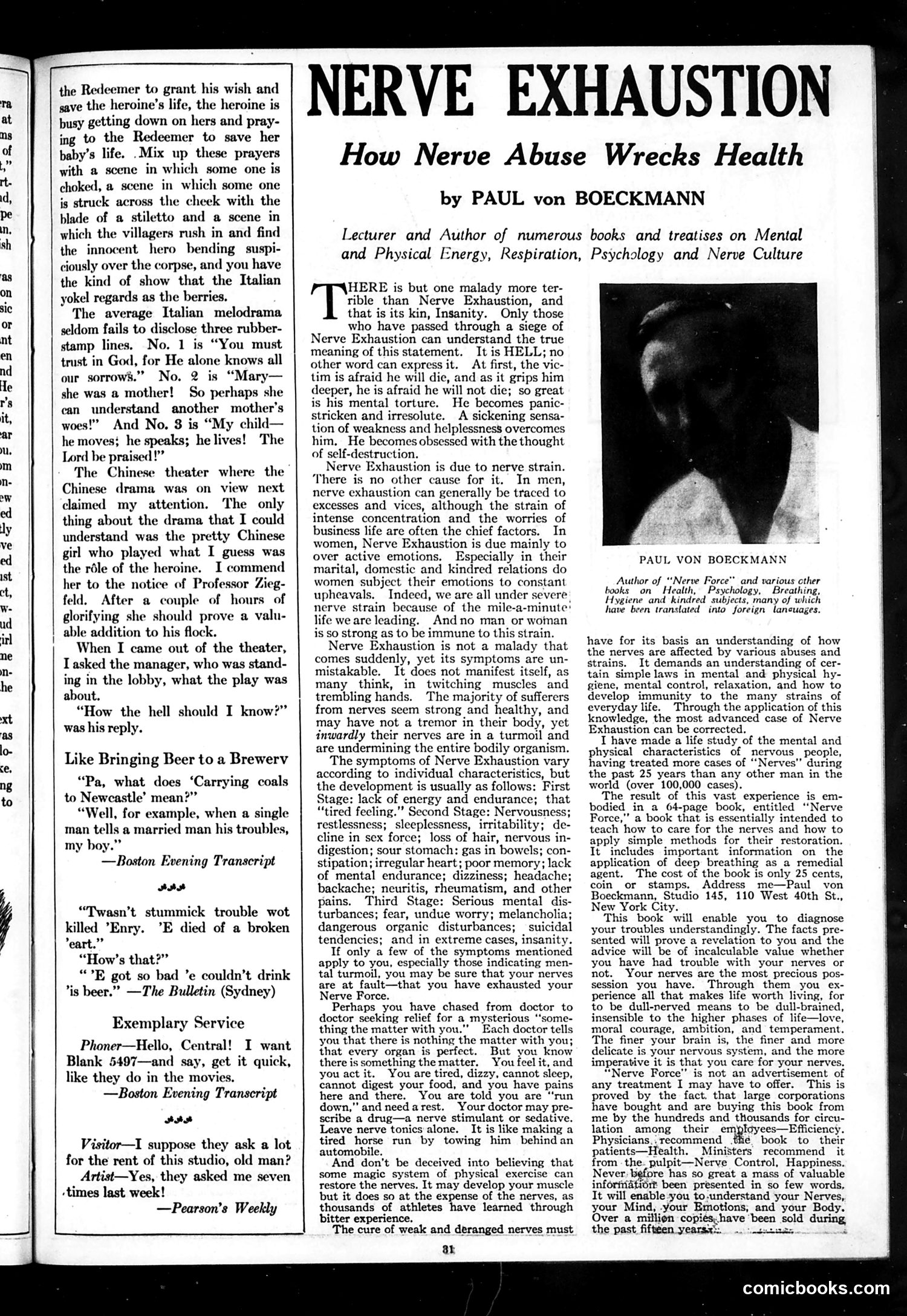
This page combines short humor pieces with a serious health article. The jokes—about Italian opera melodrama clichés, a Chinese theater manager who doesn't understand his own play, and various witty one-liners about relationships and work—represent typical early-20th-century Judge magazine fare: light satirical commentary on contemporary culture and social situations. The substantive content is Paul von Boeckmann's article on "Nerve Exhaustion," a diagnosis now understood as anxiety or nervous breakdown. This reflects genuine period medical concern about modern life's stresses—business pressure, emotional strain, and "mile-a-minute" living. The article presents nerve exhaustion as a serious condition distinct from insanity, with symptoms including fatigue, insomnia, digestive problems, and suicidal thoughts. Von Boeckmann promotes his book as treatment, exemplifying the era's wellness publishing. The page illustrates how humor and health advice coexisted in popular magazines.
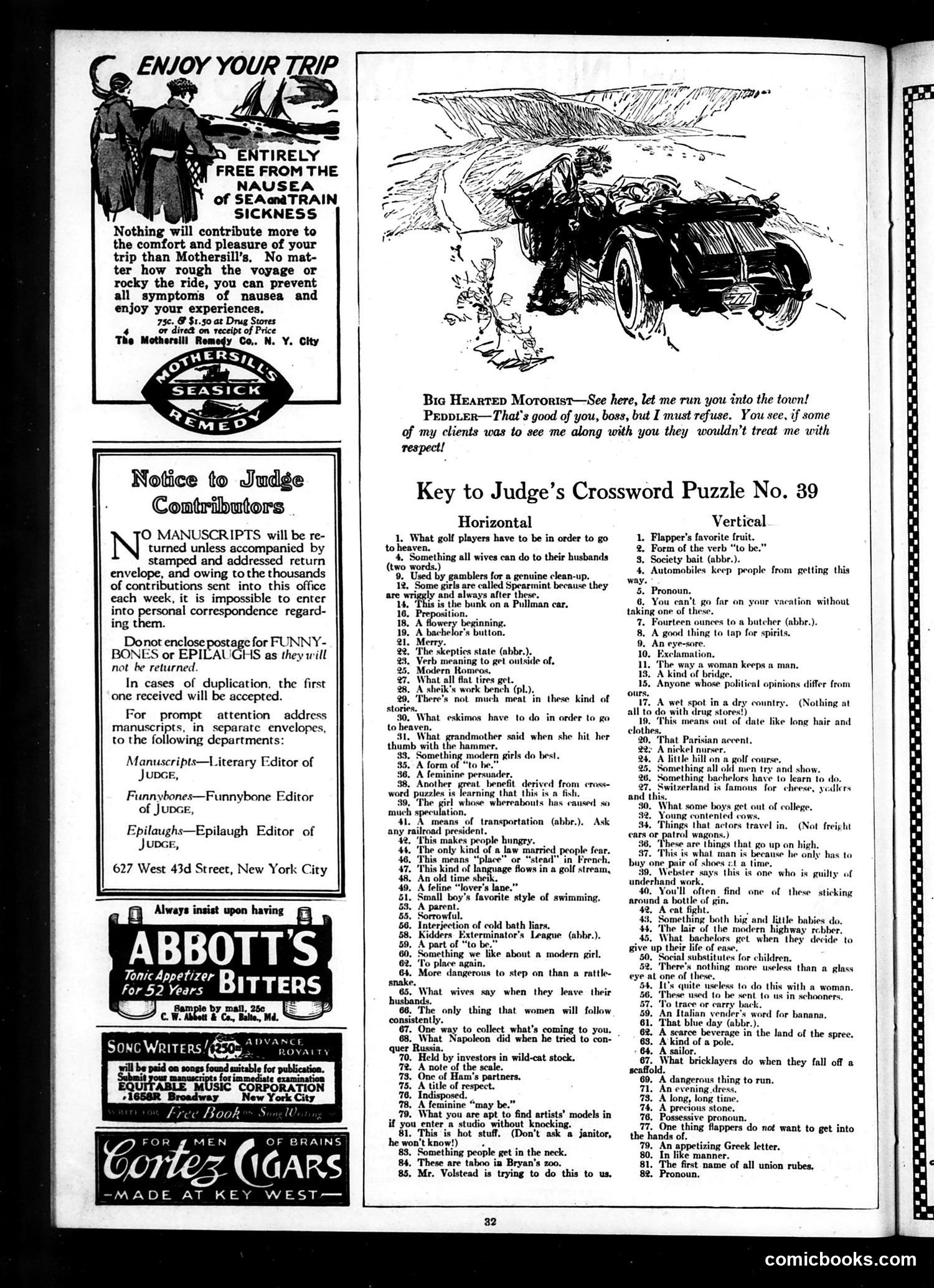
This page contains primarily **advertisements and editorial notices** rather than political satire. The main cartoon depicts a "Big Hearted Motorist" offering a ride to a porter or service worker, who refuses despite the kind offer. The porter explains he cannot be seen with the motorist socially because his clients would lose respect for him—a comment on **racial or class segregation** of the era. The motorist represents someone of higher social standing; accepting his charity would damage the porter's standing with his employers or clientele. The page otherwise features **product advertisements** (Motherill's seasickness remedy, Abbott's Bitters, Cortez Cigars, a songwriting competition) and **editorial notices** to Judge contributors regarding manuscript submission. A crossword puzzle with answers concludes the page.
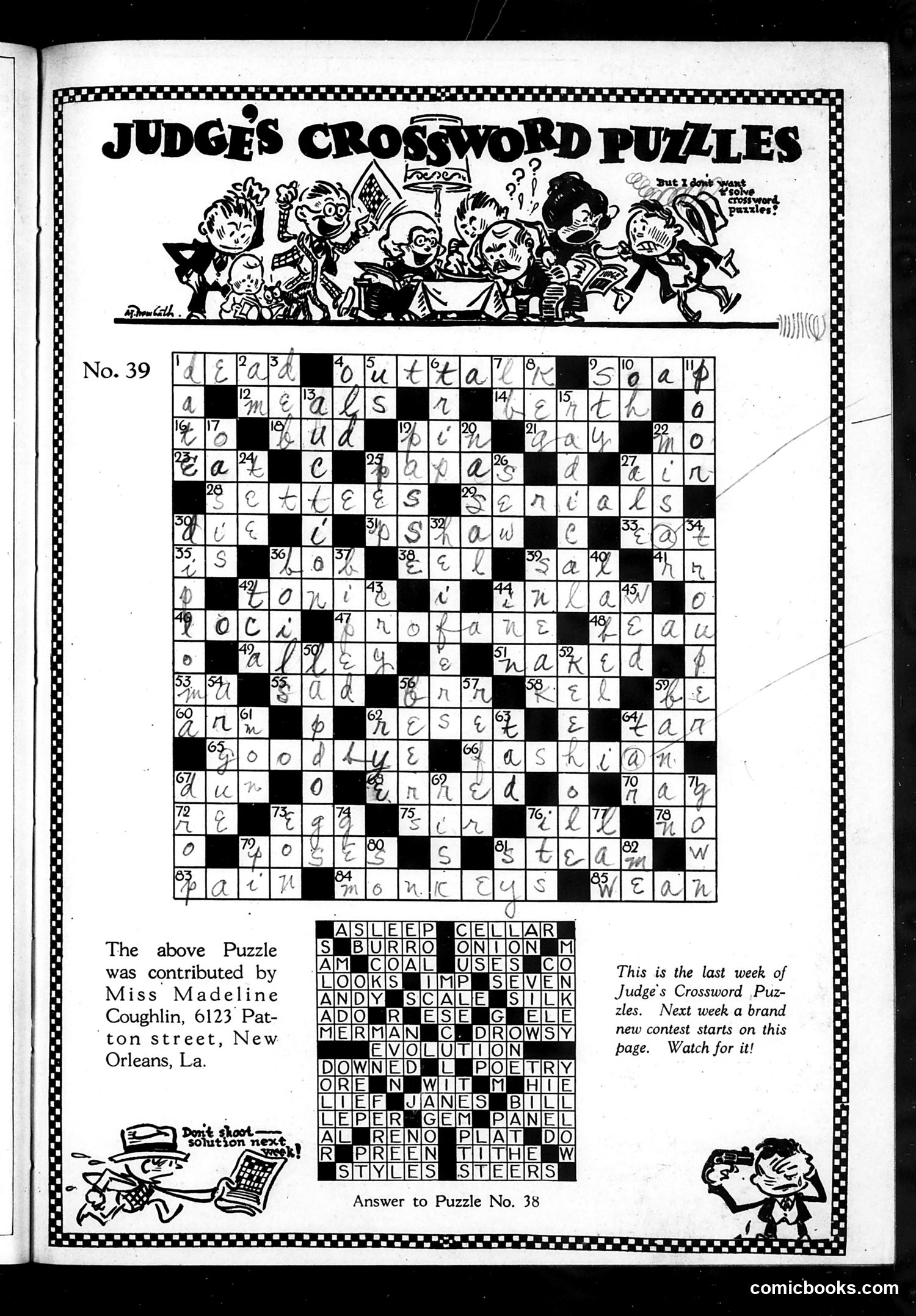
This page primarily features **Judge's Crossword Puzzles No. 39**—a standard puzzle grid with numbered clues and an answer key for the previous week's puzzle (No. 38). The content is not satirical or political. It's a recreational puzzle page contributed by reader Madeline Coughlin of New Orleans. The decorative header shows cartoon characters celebrating puzzles, establishing a lighthearted tone. The text indicates this is the final week of Judge's crossword puzzle series, with a new contest starting the following week. The page serves as entertainment content rather than commentary on current events or social issues—typical of Judge magazine's mixed editorial and recreational offerings during this era.
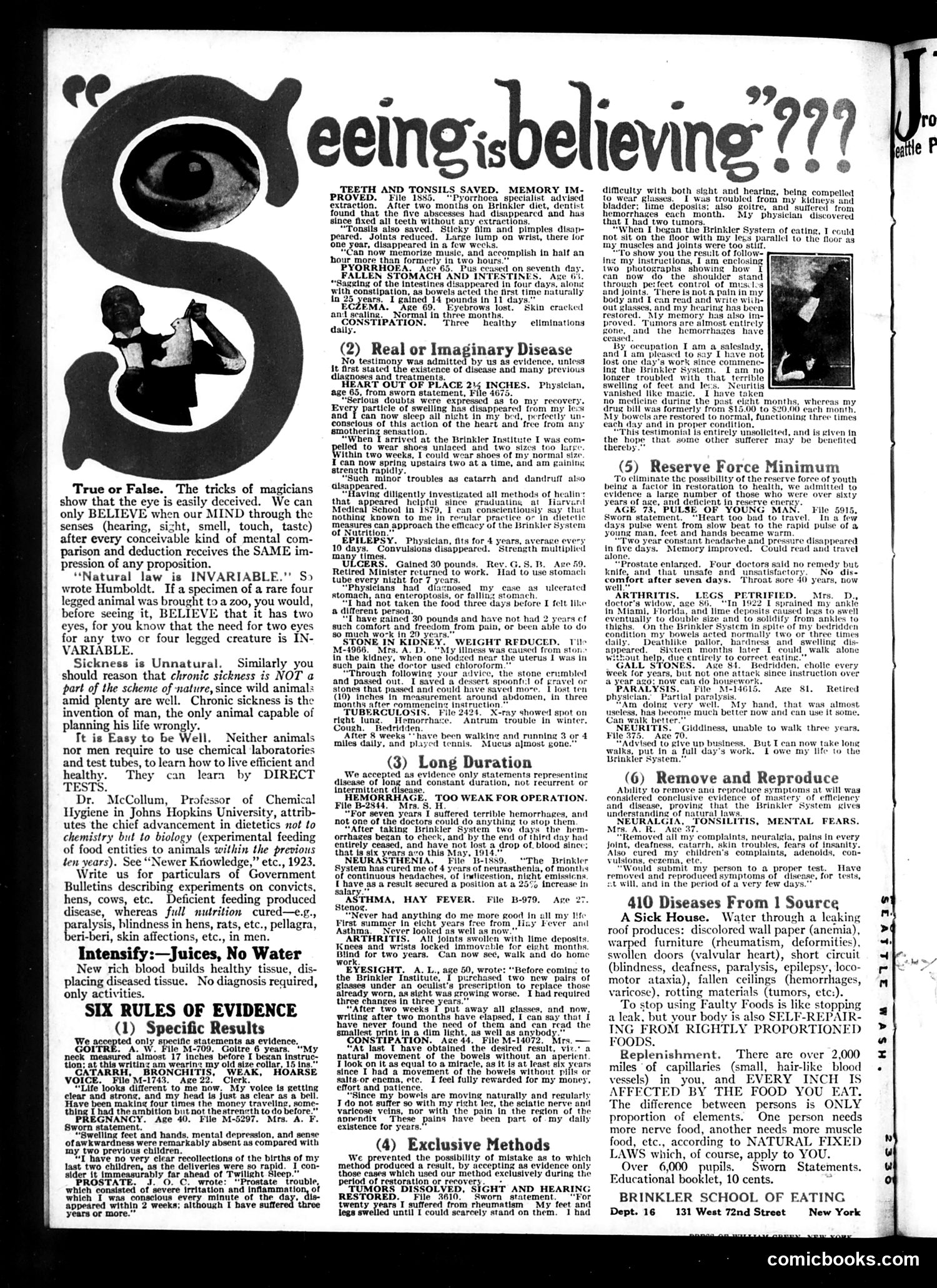
This page from *Judge* magazine presents pseudoscientific health claims disguised as evidence-based medicine. The large eye illustration and headline "Seeing is believing???" frame the argument that personal testimonials prove the efficacy of the "Brinkler diet" or system. The content lists supposed case studies—goiter reduction, pregnancy ease, prostate trouble relief—presented as "sworn statements" to lend credibility. However, these lack any medical verification, dosages, or scientific controls. This represents early 20th-century medical quackery: using anecdotal "evidence," appeals to natural law, and pseudo-philosophical reasoning about observation to market unproven treatments. The satire (if present) isn't explicit; this appears to be genuine advertising for dubious health practices that *Judge* apparently published, reflecting the era's lack of FDA regulation and widespread acceptance of patent medicine claims.