
Judge, 1925-07-25 · page 17 of 36
Judge — July 25, 1925 — page 17: what you’re looking at
What you’re looking at
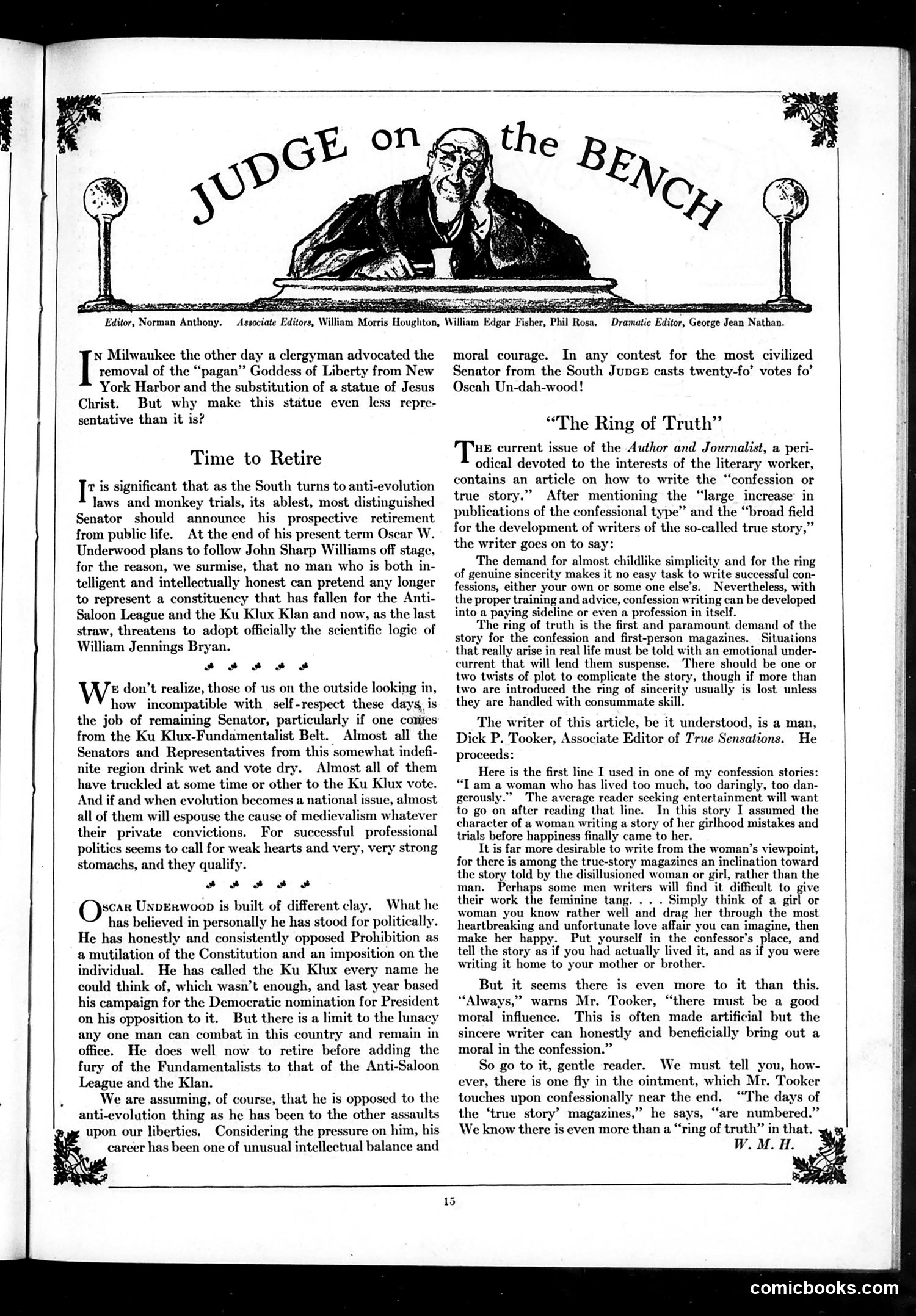
This page from *Judge* magazine contains editorial commentary on American politics circa the 1920s, not traditional cartoons. **Main Targets:** 1. **Senator Oscar W. Underwood** (Alabama) - The centerpiece criticizes his announced retirement, arguing that an intelligent man cannot ethically represent a Southern constituency that supports anti-evolution laws, the Ku Klux Klan, and Prohibition while maintaining intellectual honesty. 2. **Southern Fundamentalism** - The editors mock the South's embrace of anti-evolution "monkey trials" and characterize William Jennings Bryan's scientific logic as medieval. 3. **Political Hypocrisy** - The piece notes that Southern politicians drink alcohol privately while voting dry, and must compromise their convictions to appease special interests (the Klan, Anti-Saloon League). **The Satire's Point:** Underwood, praised for his personal integrity and principled opposition to Prohibition and the Klan, wisely recognizes he cannot survive politically while remaining honest—so retirement is actually the moral choice.
📄 Transcribed text from this page (OCR, searchable)
Machine-transcribed from the original scan — historical spelling and the odd misread are preserved.
te nurs Editor, Norman Anthony. Associate removal of the “pagan” Goddess of Liberty from New York Harbor and the substitution of a statue of Jesus Christ. But why make this statue even less repre- sentative than it is? I: Milwaukee the other day a clergyman advocated the Time to Retire I" is significant that as the South turns to anti-evolution laws and monkey trials, its ablest, most distinguished Senator should announce his prospective retirement from public life. At the end of his present term Oscar W. Underwood plans to follow John Sharp Williams off stage, for the reason, we surmise, that no man who is both in- telligent and intellectually honest can pretend any longer to represent a constituency that has fallen for the Anti- Saloon League and the Ku Klux Klan and now, as the last straw, threatens to adopt officially the scientific logic of William Jennings Bryan. se Ft AH SH © don’t realize, those of us on the outside looking in, how incompatible with self-respect these days, is the job of remaining Senator, particularly if one cories from the Ku Klux-Fundamentalist Belt. Almost all the Senators and Representatives from this somewhat indefi- nite region drink wet and vote dry. Almost all of them have truckled at some time or other to the Ku Klux vote. And if and when evolution becomes a national issue, almost all of them will espouse the cause of medievalism whatever their private convictions. For successful professional politics seems to call for weak hearts and very, very strong stomachs, and they qualify. ye te HH SH Ove Unprrwoon is built of different clay. What he has believed in personally he has stood for politically. He has honestly and consistently opposed Prohibition as a mutilation of the Constitution and an imposition on the individual. He has called the Ku Klux every name he could think of, which wasn’t enough, and last year based his campaign for the Democratic nomination for President on his opposition to it. But there is a limit to the lunacy any one man can combat in this country and remain in office. He does well now to retire before adding the fury of the Fundamentalists to that of the Anti-Saloon League and the Klan. We are assuming, of course, that he is opposed to the anti-evolution thing as he has been to the other assaults upon our liberties. Considering the pressure on him, his career has been one of unusual intellectual balance and Dramatic Editor, George Jean Nathan. moral courage. In any contest for the most civilized Senator from the South JupGE casts twenty-fo’ votes fo’ Oscah Un-dah-wood! “The Ring of Truth” HE current issue of the Author and Journalist, a peri- odical devoted to the interests of the literary worker, contains an article on how to write the “confession or true story.” After mentioning the “large increase’ in publications of the confessional type” and the “broad field for the development of writers of the so-called true story,” the writer goes on to say: The demand for almost childlike simplicity and for the ring of genuine sincerity makes it no easy task to write successful con- fessions, either your own or some one else’s. Nevertheless, with the proper training and advice, confession writing can be developed into a paying sideline or even a profession in itself. The ring of truth is the first and paramount demand of the story for the confession and first-person magazines. Situations that really arise in real life must be told with an emotional under- current that will lend them suspense. There should be one or two twists of plot to complicate the story, though if more than two are introduced the ring of sincerity usually is lost unless they are handled with consummate skill. The writer of this article, be it understood, is a man, Dick P. Tooker, Associate Editor of True Sensations. He proceeds: Here is the first line I used in one of my confession stories: “T am a woman who has lived too much, too daringly, too dan- gerously.” The average reader seeking entertainment will want to go on after reading that line. In this story I assumed the character of a woman writing a story of her girlhood mistakes and trials before happiness finally came to her. It is far more desirable to write from the woman’s viewpoint, for there is among the true-story magazines an inclination toward the story told by the disillusioned woman or girl, rather than the man. Perhaps some men writers will find it difficult to give their work the feminine tang. . . . Simply think of a girl or woman you know rather well and drag her through the most heartbreaking and unfortunate love affair you can imagine, then make her happy. Put yourself in the confessor’s place, and tell the story as if you had actually lived it, and as if you were writing it home to your mother or brother. But it seems there is even more to it than this. “Always,” warns Mr. Tooker, “there must be a good moral influence. This is often made artificial but the sincere writer can honestly and beneficially bring out a moral in the confession.” So go to it, gentle reader. We must tell you, how- ever, there is one fly in the ointment, which Mr. Tooker touches upon confessionally near the end. “The days of the ‘true story’ magazines,” he says, “are numbered.” We know there is even more than a “ring of truth” in that. W. M. H. comicbooks.com