
A complete issue · 36 pages · 1925
Judge — February 14, 1925
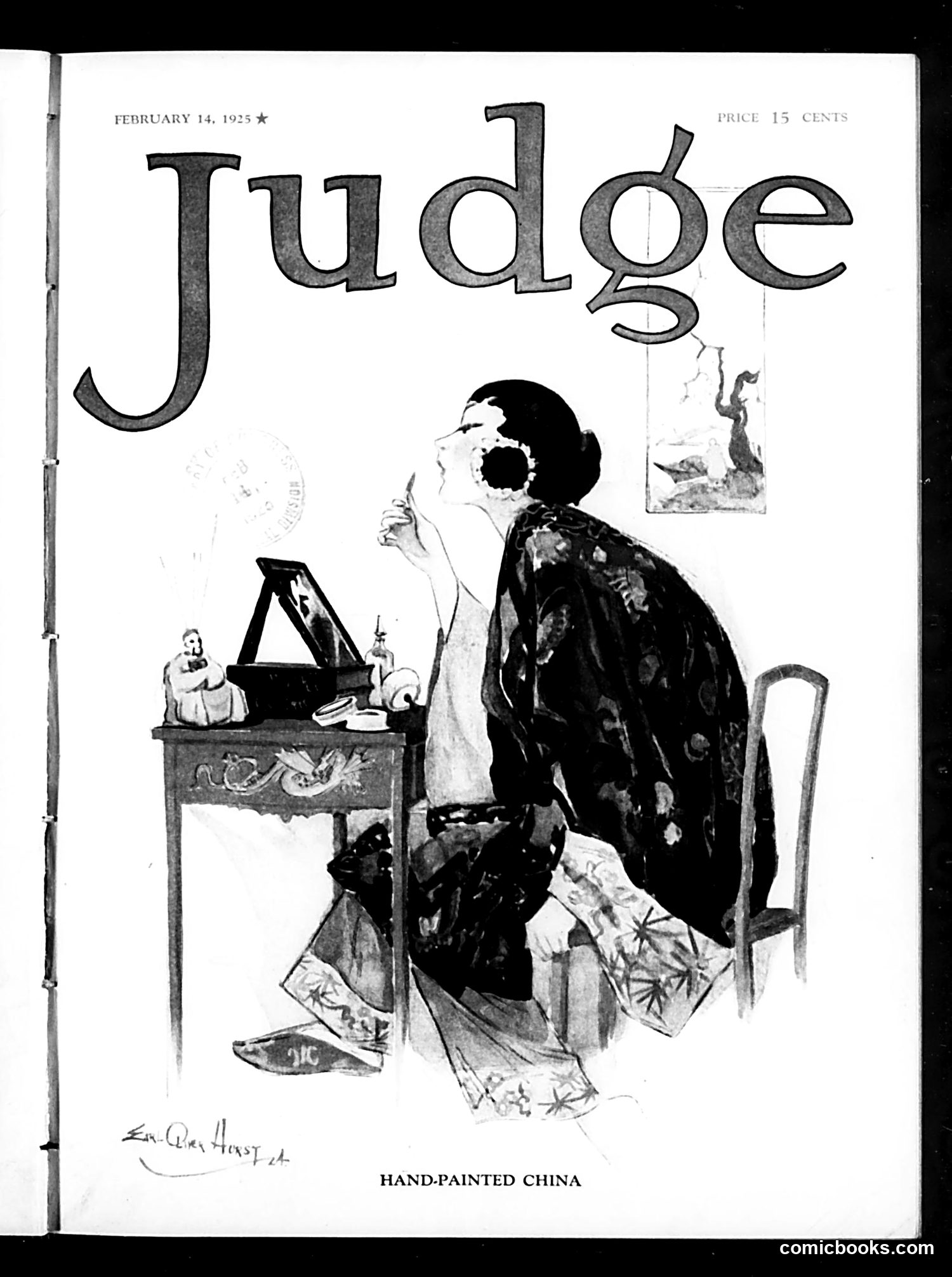
This cover depicts a woman at a vanity mirror, admiring herself while applying makeup. The caption reads "Hand-Painted China," a satirical reference to the 1920s beauty trend of heavily applied cosmetics and theatrical makeup styles. The joke targets the artificiality of modern women's appearance—comparing a woman's face to hand-painted porcelain: attractive but fundamentally artificial and fake. This reflects 1920s anxieties about changing female beauty standards and the new cosmetics industry's expansion. The ornate robe and vanity setup suggest wealth and vanity, while the exaggerated facial expression conveys both self-satisfaction and ridiculousness. The artwork is signed by what appears to be a period illustrator. This represents typical Judge satire mocking contemporary social trends and gender roles.
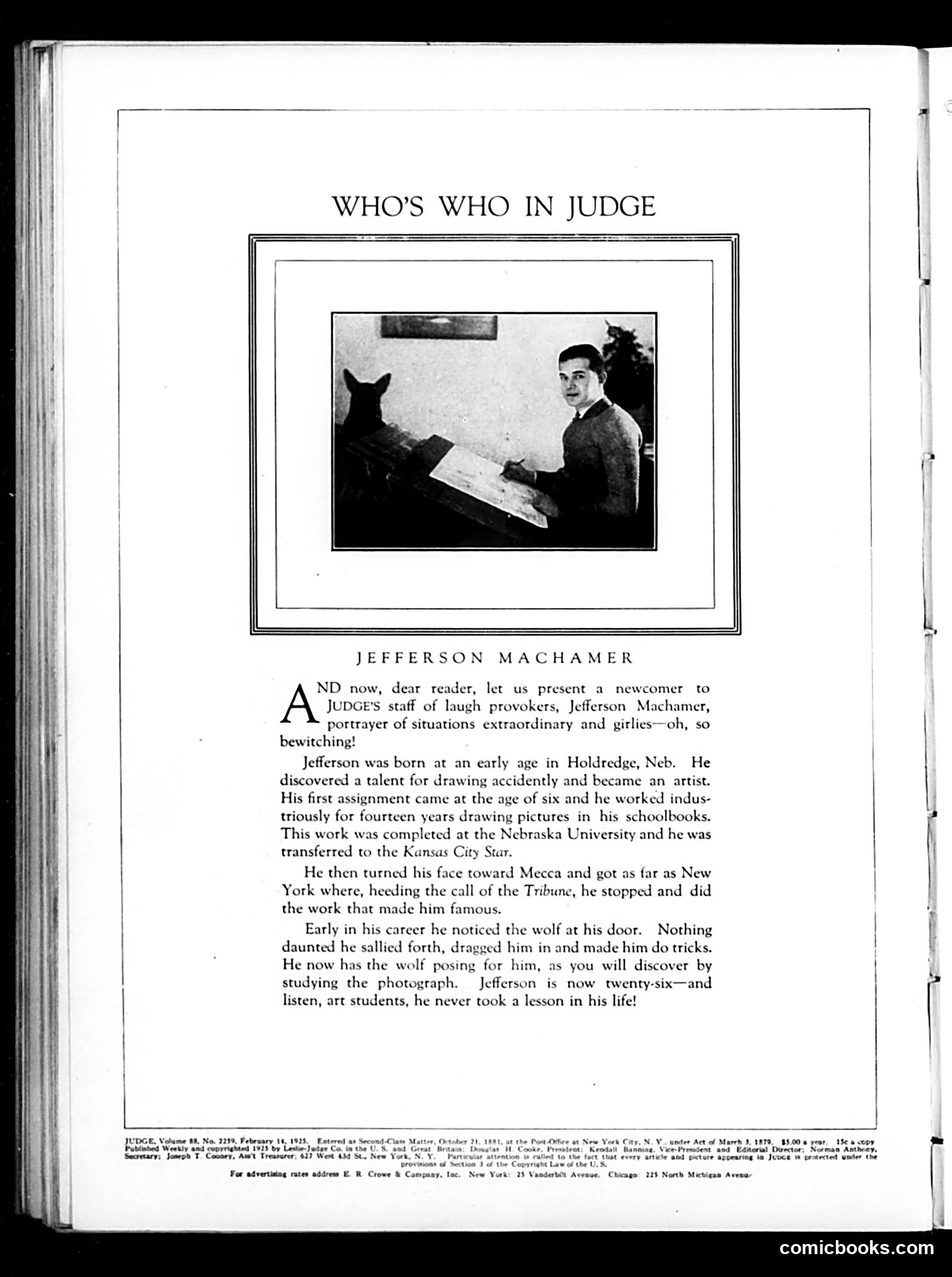
This is a biographical profile of Jefferson Machamer, a cartoonist and illustrator for *Judge* magazine. The text humorously introduces him as a "newcomer to Judge's staff of laugh provokers," noting his talent for drawing "situations extraordinary and girties—oh, so bewitching!" The biography details his career trajectory: born in Holdrege, Nebraska, he studied art at Nebraska University and the Kansas City Star before moving to New York, where he worked for the *Tribune* and became famous. The accompanying photograph shows Machamer with a wolf, illustrating the text's humorous claim that "early in his career he noticed the wolf at his door" and "now has the wolf posing for him"—a witty play on the expression about financial hardship, suggesting he's achieved enough success to control his circumstances.
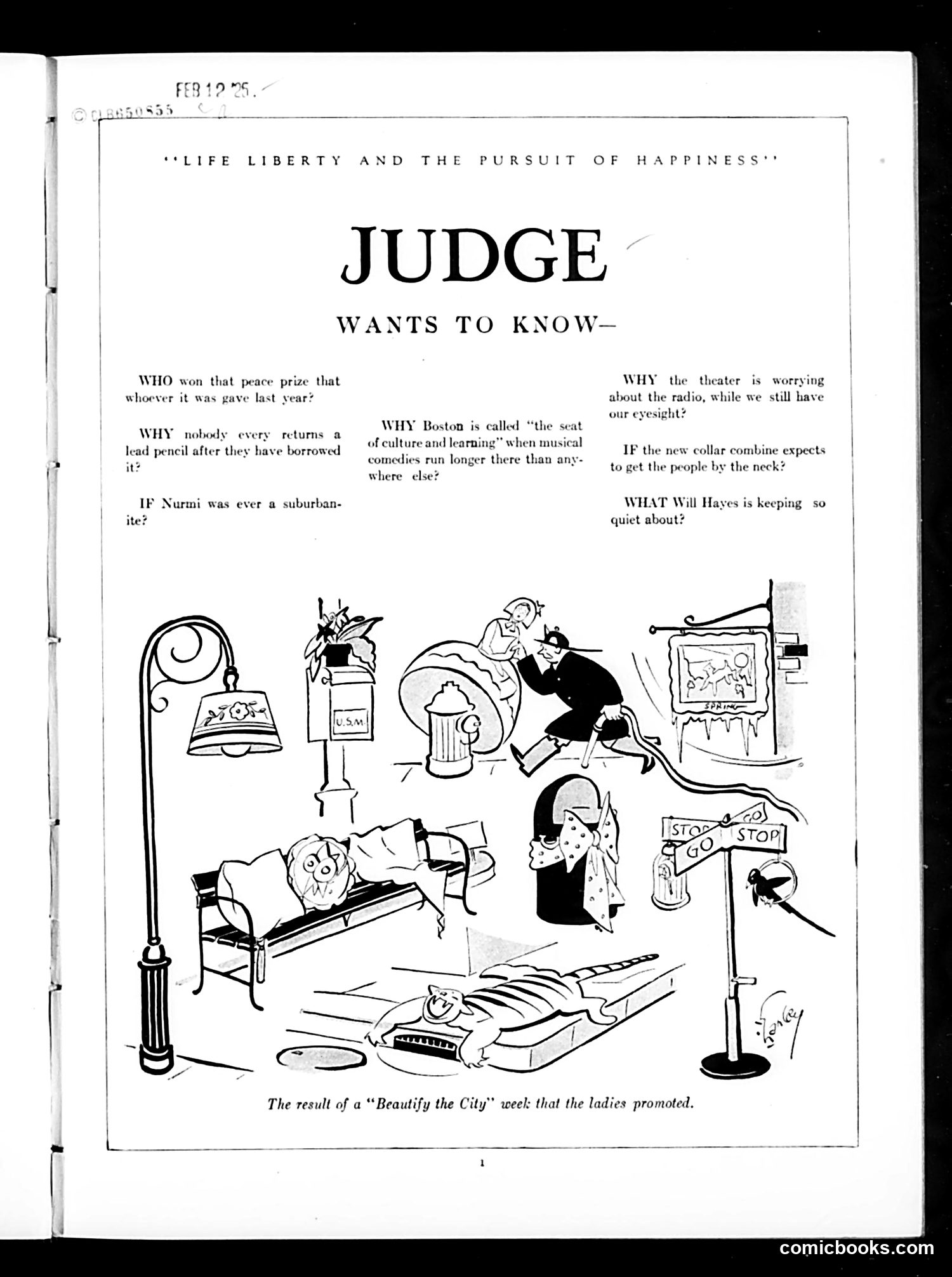
This satirical page from **Judge** magazine presents "questions a Judge wants to know" paired with illustrations mocking contemporary social concerns. The cartoon depicts chaos from a "Beautify the City" campaign promoted by women's groups. The satire targets: - **Lost lead pencils** (borrowed items never returned) - **Boston's cultural pretensions** - **Radio technology** threatening eyesight - **Fashion anxieties** (a new collar style) - **Will Hayes** (likely the film industry censor, keeping something "quiet") - **Nirmi** (unclear reference, possibly a local or entertainment figure) The central illustration shows urban disorder—people lounging messily, traffic signs ignored, disorder everywhere—suggesting that women's well-intentioned beautification efforts backfired into general chaos. It's satire on progressive reform movements producing unintended consequences.
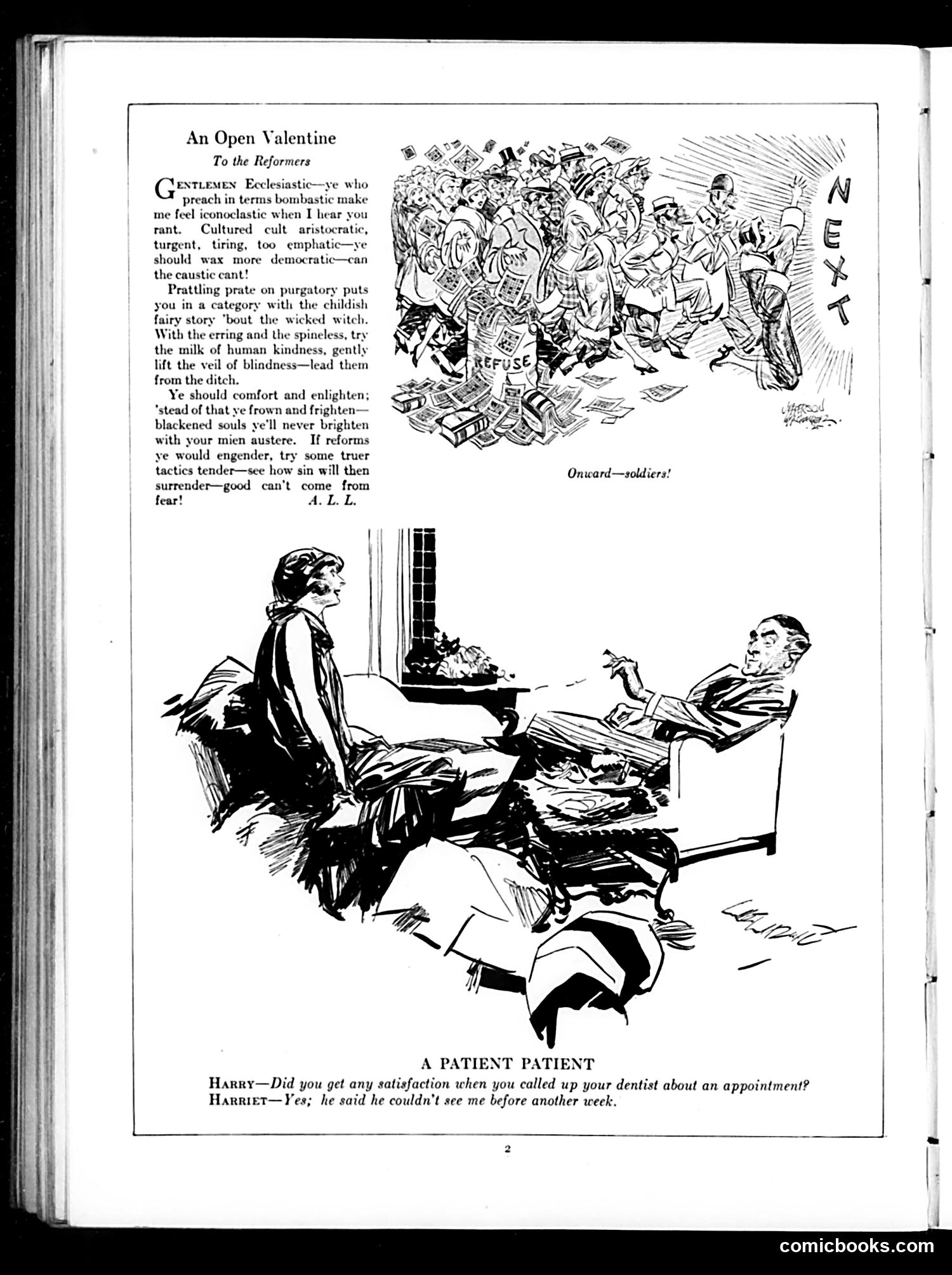
**Top Section - "An Open Valentine to the Reformers":** This is political satire criticizing ecclesiastical reformers. The author (A.L.L.) mocks clergy who use "bombastic" preaching and aristocratic condescension toward the working poor. The accompanying chaotic illustration shows a crowd labeled "REFUSE," suggesting reformers view poor people as social waste to be discarded rather than helped. The satirist argues reformers should use "human kindness" instead of fear-based tactics, and that genuine moral change won't come through coercive methods. **Bottom Section - "A Patient Patient":** A domestic humor cartoon showing a woman (Harriet) frustrated that her dentist wouldn't schedule an appointment for a week. The joke is wordplay: "patient" means both someone awaiting medical care and someone with patience/tolerance. The satire mocks American service standards and inconvenient professional delays.
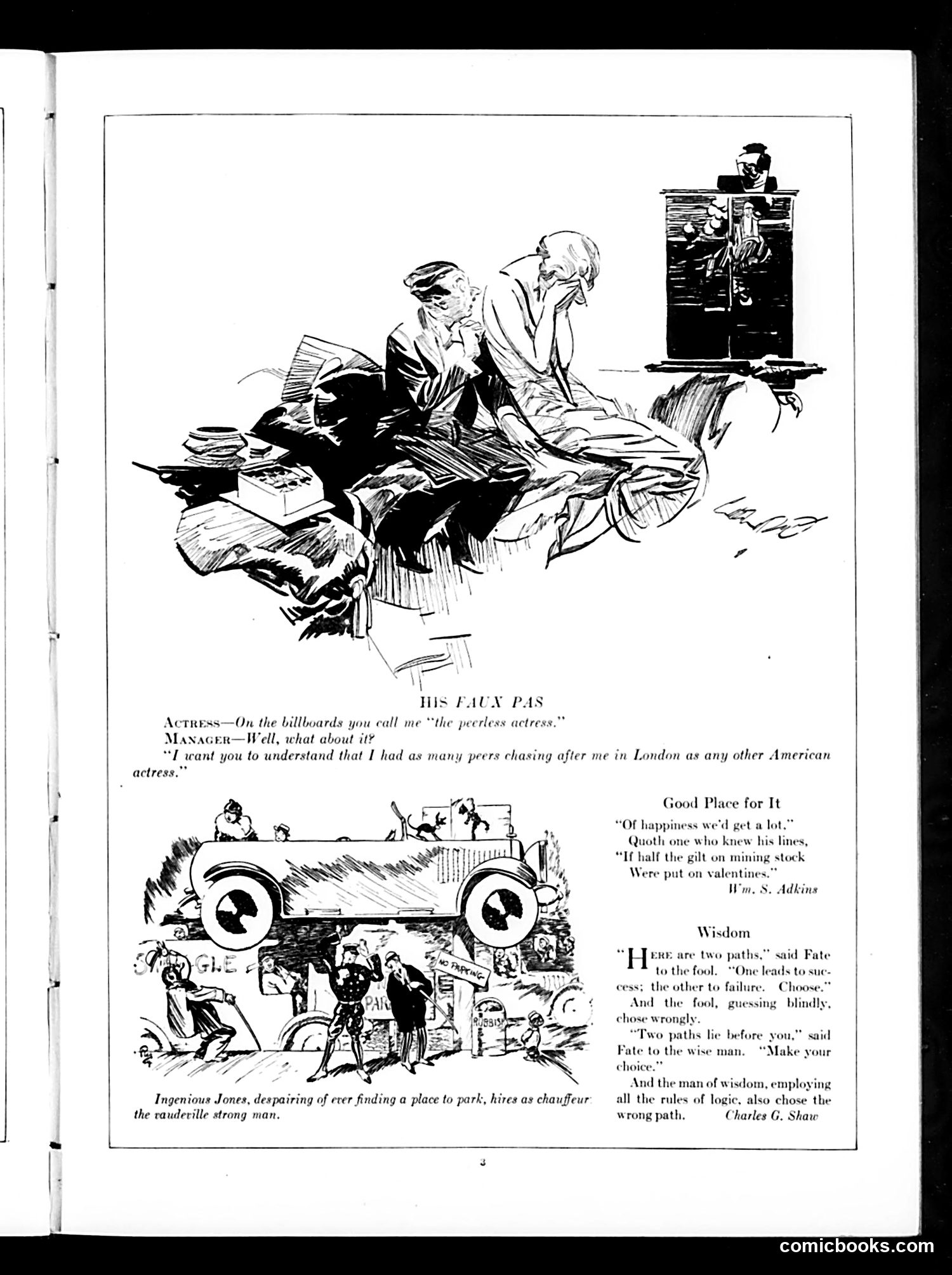
**Top Cartoon ("His Faux Pas"):** An actress confronts her theater manager about being called "the peerless actress" on billboards. She boasts of having "as many peers chasing after me in London as any other American actress"—a joke about her popularity with admirers rather than critical acclaim. The satire mocks actresses' vanity and the gap between promotional hype and actual talent. **Bottom Cartoon:** "Ingenious Jones" hires a chauffeur to solve his parking problem, satirizing early automobile-era urban congestion. The crowded scene around the car suggests that hiring a driver doesn't actually solve the fundamental parking shortage—a commentary on ineffective solutions to modern city problems. Both pieces use humor about performance and automobiles, typical Judge magazine fare.
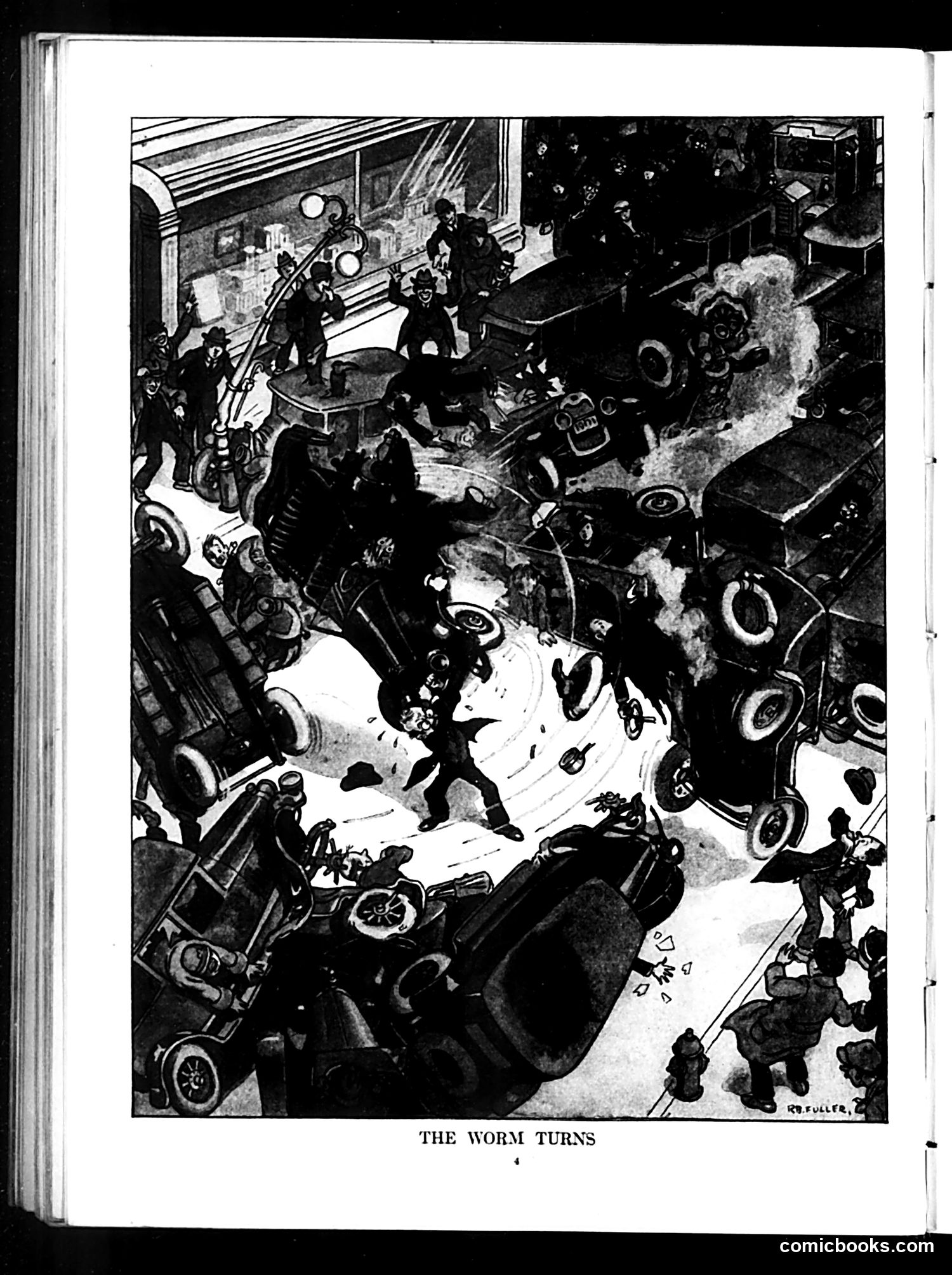
This cartoon depicts a chaotic industrial or factory scene with numerous workers in conflict. The title "The Worm Turns" is a reference to the proverb "even a worm will turn" — meaning that even the meekest will eventually fight back when pushed too far. The image shows workers (depicted in dark clothing) apparently rebelling or rioting against management or authority figures visible at the upper levels of the facility. The scene includes machinery, smoke, and general disorder suggesting labor unrest or a strike. Without additional context from Judge magazine's publication date, the specific historical labor conflict referenced remains unclear, but this appears to satirize worker rebellion against industrial or factory conditions and management during America's labor movement era.
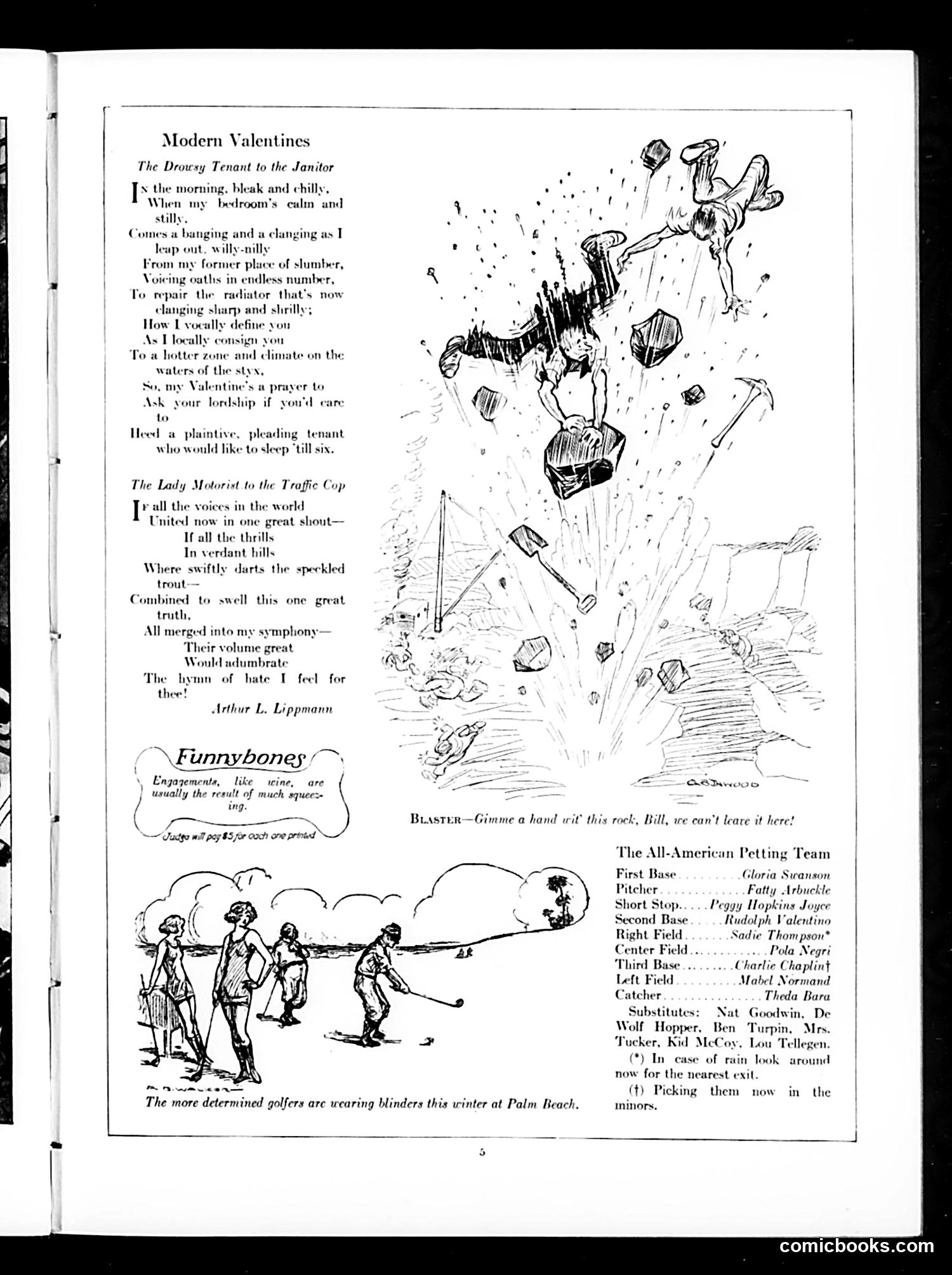
This page contains two unrelated sections: **Top: "Modern Valentines"** — Two humorous poems mocking contemporary annoyances. "The Drowsy Tenant to the Janitor" complains about early morning noise from building repairs; "The Lady Motorist to the Traffic Cop" sarcastically praises a traffic officer, expressing frustration with speeding fines. Both use exaggerated, ironic praise to critique everyday modern irritations. **Bottom: "The All-American Petting Team"** — A satirical roster of women baseball players with a cartoon showing women golfers. This appears to mock women's participation in sports during the era when such activities were considered unconventional for women. The "Funnybones" section includes light jokes about engagements and dating. The page primarily offers social satire about modern urban life and changing gender roles through humor rather than political commentary.
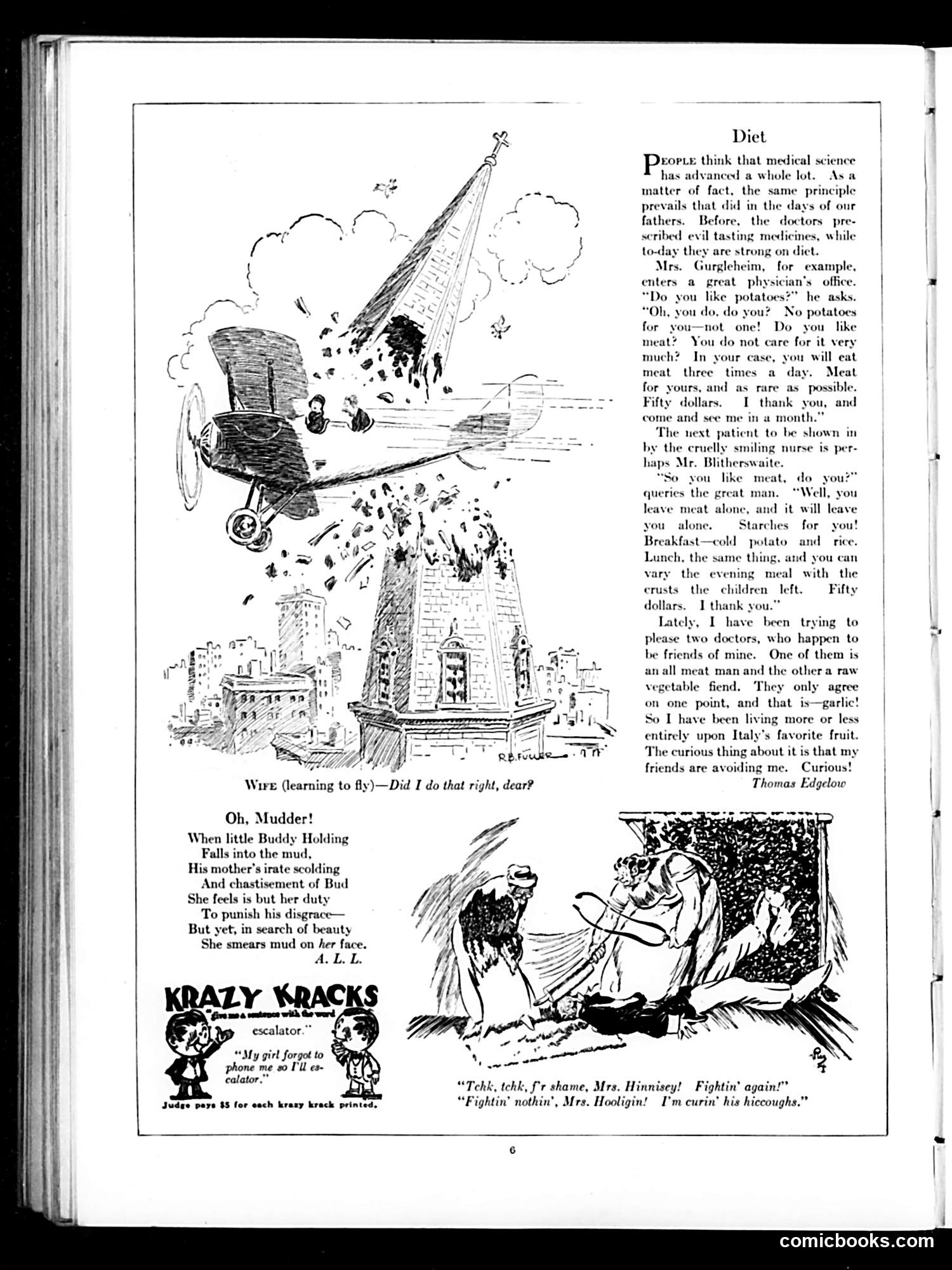
This page satirizes early-20th-century medical fads and social absurdities. **"Diet" article**: Mocks physicians who prescribe opposite diets to different patients for identical complaints. A doctor tells one patient (Mrs. Gurgleheim) to eat rare meat three times daily; the next patient (Mr. Blitherswaite) gets starches and cold potatoes—both charged fifty dollars. The author notes he's caught between two doctor-friends (one all-meat advocate, one raw-vegetable devotee) who agree only on garlic, forcing him to eat garlic exclusively until both friends avoid him. The satire critiques medicine's contradictory dietary theories presented as science. **"Wire" cartoon**: A woman learning to fly in an early airplane crashes into a building, asking "Did I do that right, dear?"—absurdist humor about aviation's dangers. **"Oh, Mudder!" verse**: Ironic commentary on a mother who scolds her son for getting dirty while simultaneously applying mud to her own face (likely a beauty treatment)—hypocrisy about cleanliness standards. **"Krazy Kracks"**: Wordplay jokes about an escalator and fighting used as hiccough cure.
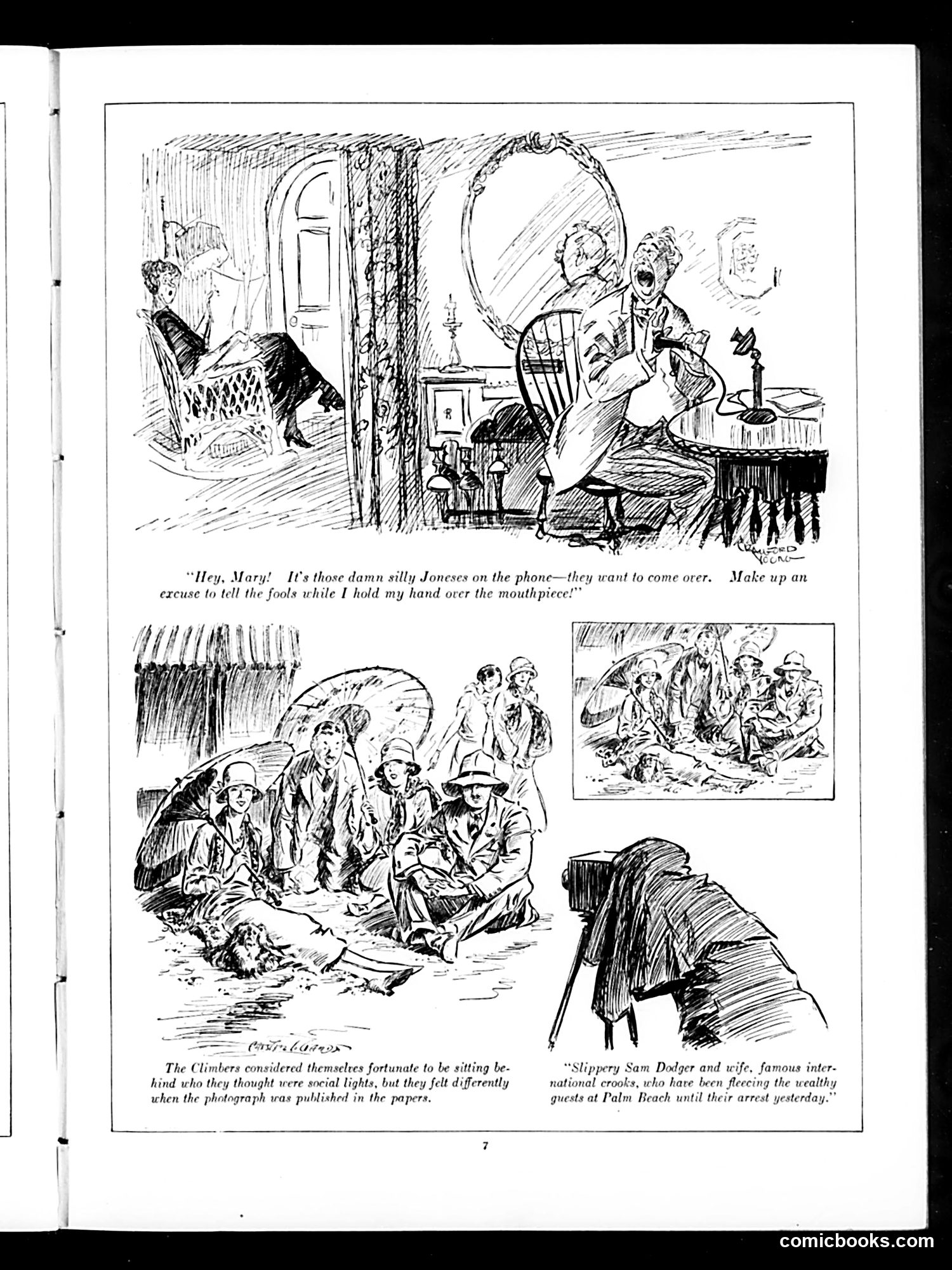
This page contains three interconnected satirical cartoons about social pretense and embarrassment. The top cartoon mocks social climbing and phoniness: a man rudely refuses the "Joneses" while covering the mouthpiece, revealing his contempt for people he pretends to befriend. The middle cartoon shows "The Climbers"—social aspirants who felt honored sitting near what they thought were society elites at an event, only to be mortified when a photograph published in newspapers revealed those "social lights" were actually criminals. The bottom cartoon depicts "Slippery Sam Dodger and wife," infamous con artists who had been swindling wealthy Palm Beach guests before their arrest. The irony is sharp: the climbers' social betters were sophisticated thieves. The satire targets 1920s social anxiety, class aspiration, and the gap between appearances and reality—with the added sting that "respectable" society people were literally criminals, making the climbers' embarrassment darkly comic.
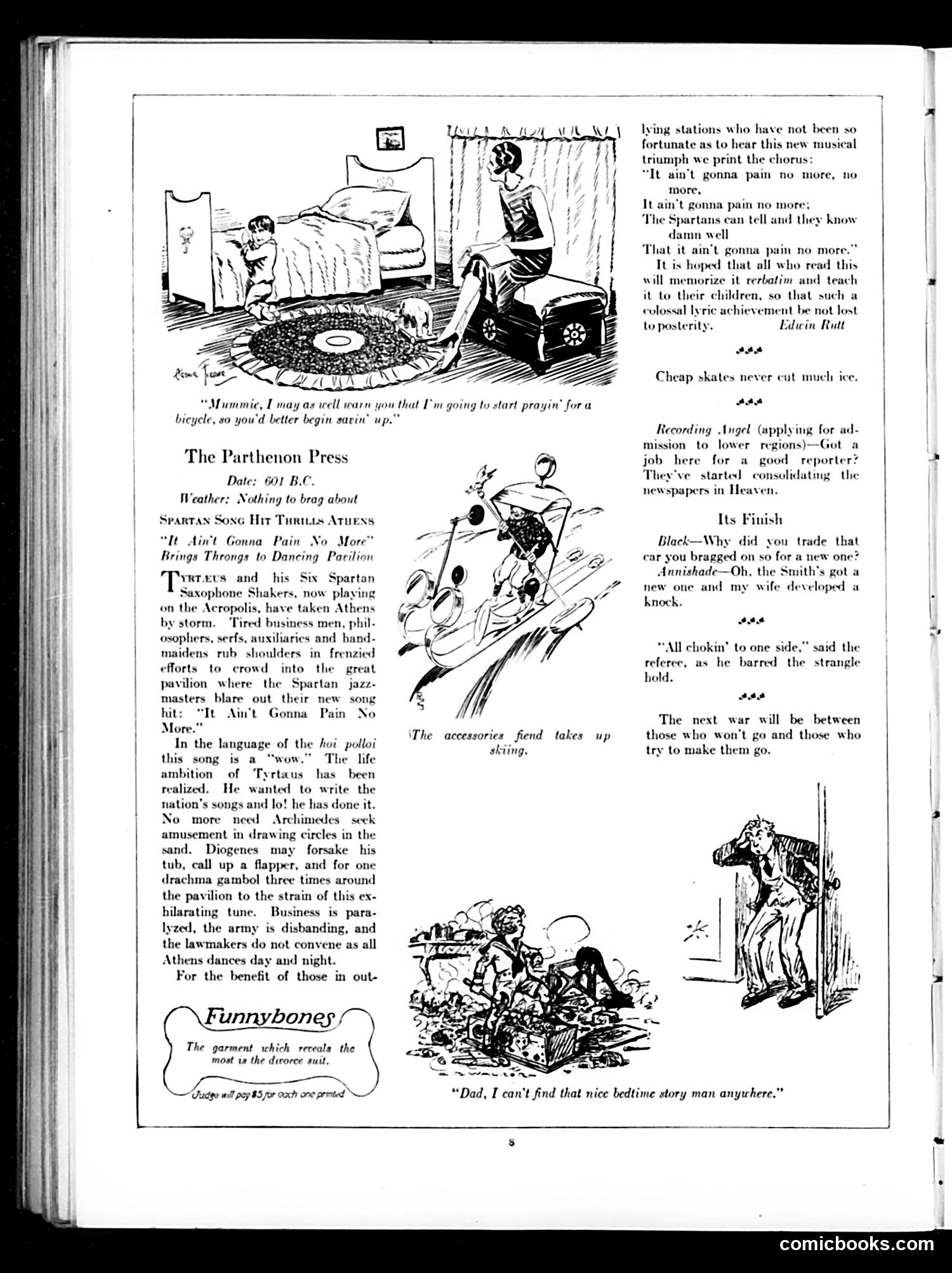
This page satirizes modern jazz-age frenzy by setting it in ancient Athens (601 B.C.). The main piece mocks how a popular song—"It Ain't Gonna Pain No More"—by a fictional Spartan band creates such cultural hysteria that business stops, the army disbands, and lawmakers abandon their duties. The satire targets 1920s American obsession with jazz and popular entertainment, suggesting it's frivolous distraction from serious civic responsibilities. By transplanting this to classical antiquity, the piece ridicules how contemporary society abandons civilization for entertainment trends. The smaller jokes scattered throughout—about divorce suits, skiing accessories, and reluctant war participation—are typical Judge magazine filler commentary on contemporary social issues: marital dissolution, consumer culture, and growing anti-war sentiment (likely post-WWI).
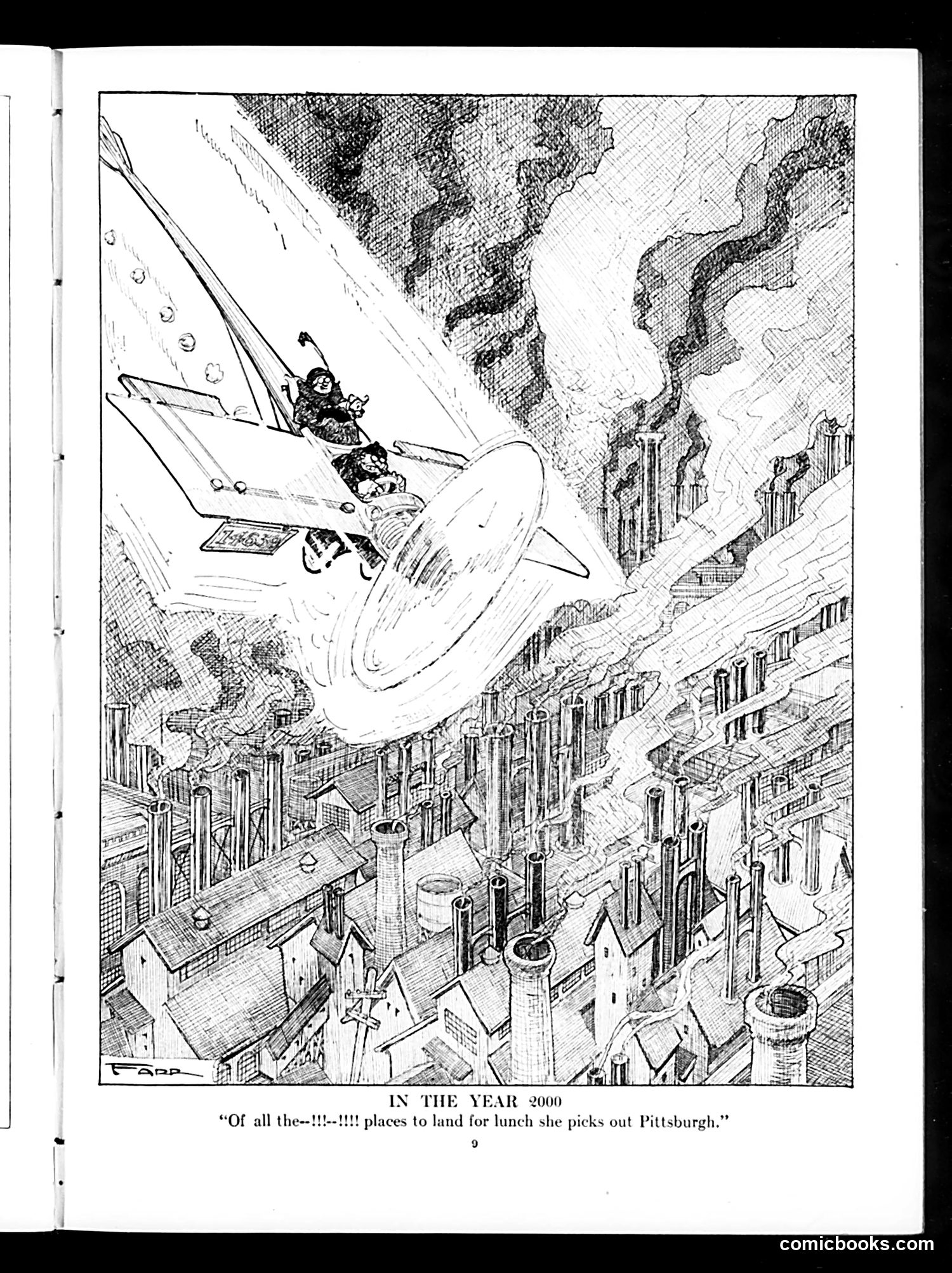
This futuristic satirical cartoon depicts an aircraft or spacecraft landing in Pittsburgh for lunch, with the pilot apparently exasperated at the destination choice. The joke targets Pittsburgh's industrial reputation—likely referring to its massive steel mills and heavy manufacturing sector, which produced significant air and water pollution throughout the 20th century. The humor operates on two levels: first, the absurdity of future air travel making casual lunch stops; second, the implication that Pittsburgh in the year 2000 remains such an undesirable, polluted industrial center that choosing it for a meal is ridiculous. The cartoon is satirizing both Pittsburgh's industrial character and perhaps making a broader commentary on whether industrial cities could improve their environmental conditions.
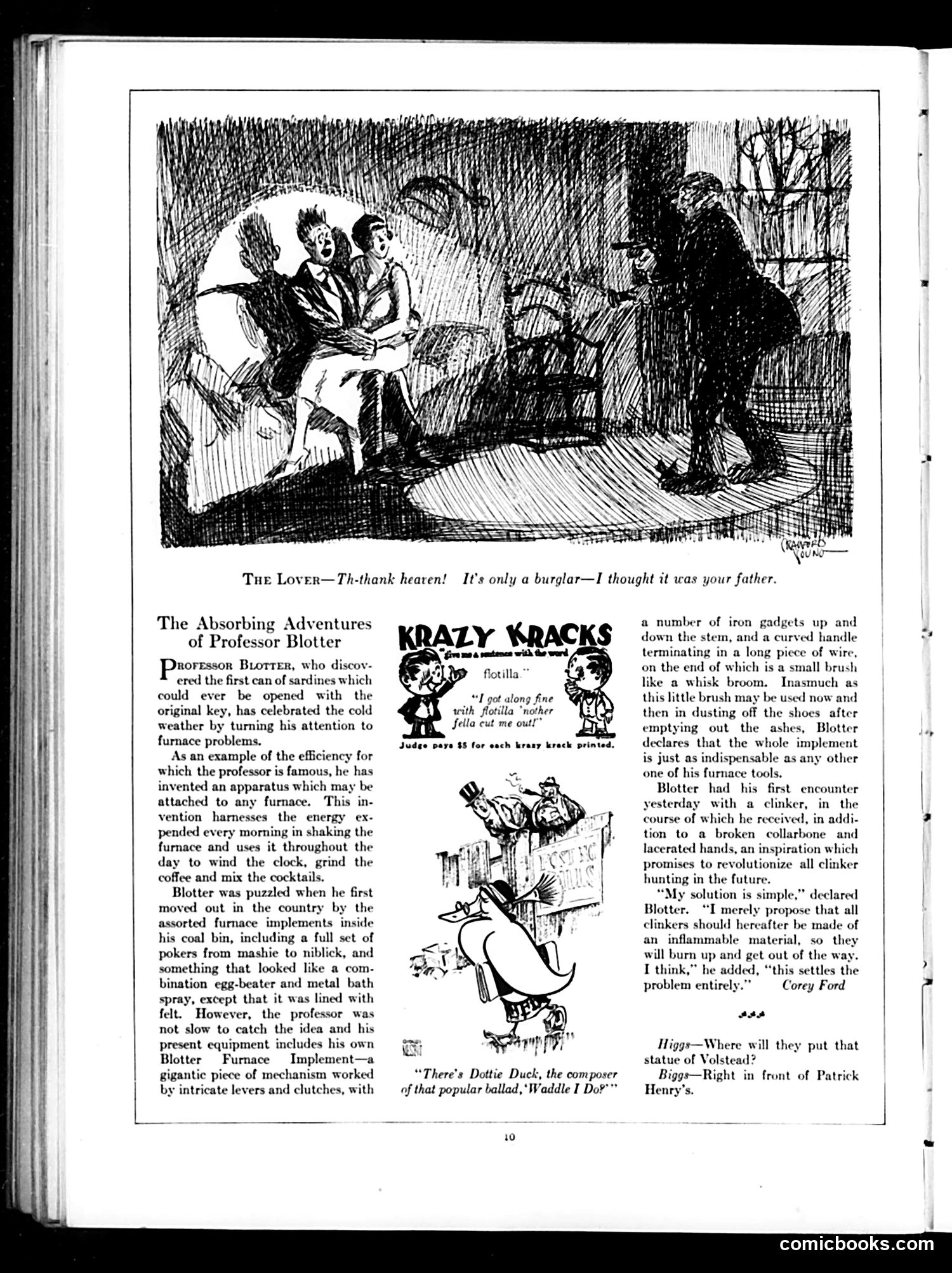
This page contains two separate humor pieces from *Judge* magazine: **"The Absorbing Adventures of Professor Blotter"** is a comedic serial about an eccentric inventor. Professor Blotter creates an absurdly overcomplicated furnace apparatus that supposedly harnesses shaking energy to wind clocks, grind coffee, and mix cocktails—satirizing unnecessary mechanical complexity. The joke culminates when he injures himself on a clinker (coal residue) and proposes the solution of making clinkers from inflammable material so they burn away—defeating the entire point of removing them. **The cartoon at top** shows a couple being startled by an intruder; the wife mistakes a burglar for her father—a joke about in-laws being unwelcome or unpleasant. **The "Krazy Kracks"** section features brief, groan-worthy puns about the word "flotilla." **The final jokes** reference Volstead (the Prohibition-era politician) and a statue placement pun involving Patrick Henry's famous "Give me liberty or give me death" quote—likely suggesting ironic placement near alcohol-related humor during Prohibition.
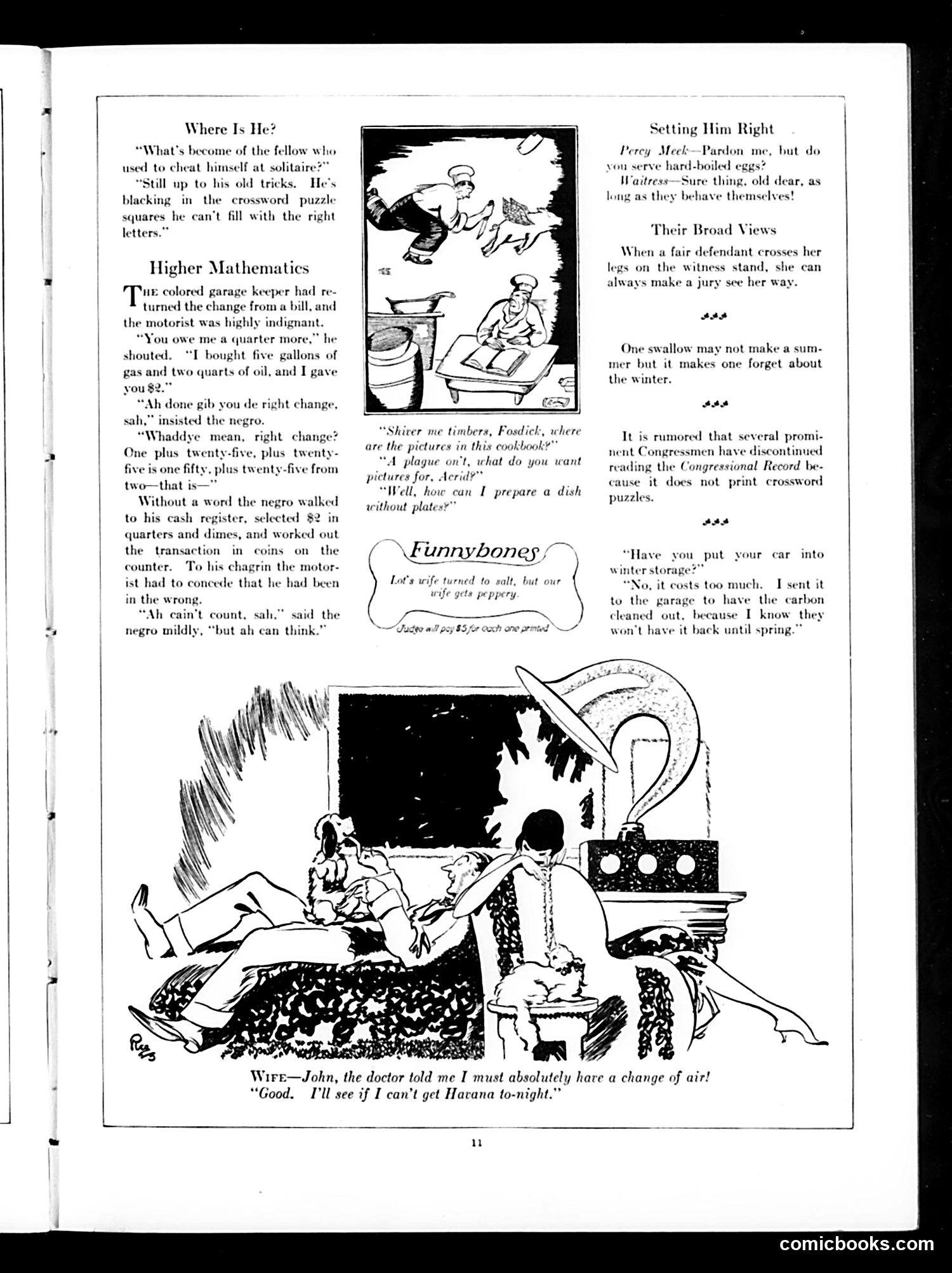
This page contains several short humor pieces typical of 1920s-era Judge magazine: **"Higher Mathematics"** mocks racial stereotypes while making a point about practical intelligence versus formal education. A Black garage attendant proves superior at mental arithmetic despite claiming he "cain't count," outwitting a white motorist's faulty math. **"Where Is He?"** and other brief jokes reference contemporary concerns: crossword puzzle crazes (newly popular), wartime rationing or gas/oil shortages, and marital dynamics. **The large cartoon** depicts a couple's domestic scene where the wife seeks "a change of air" for health reasons, while the husband misinterprets this as obtaining Havana cigars—a pun on literal versus figurative meaning, likely satirizing either male obtuseness or Cuban trade/luxury goods. The content reflects 1920s preoccupations: puzzles, automobiles, gender relations, and casual racial humor typical of the era's mainstream magazines. The satire generally targets everyday human foolishness rather than specific political figures.
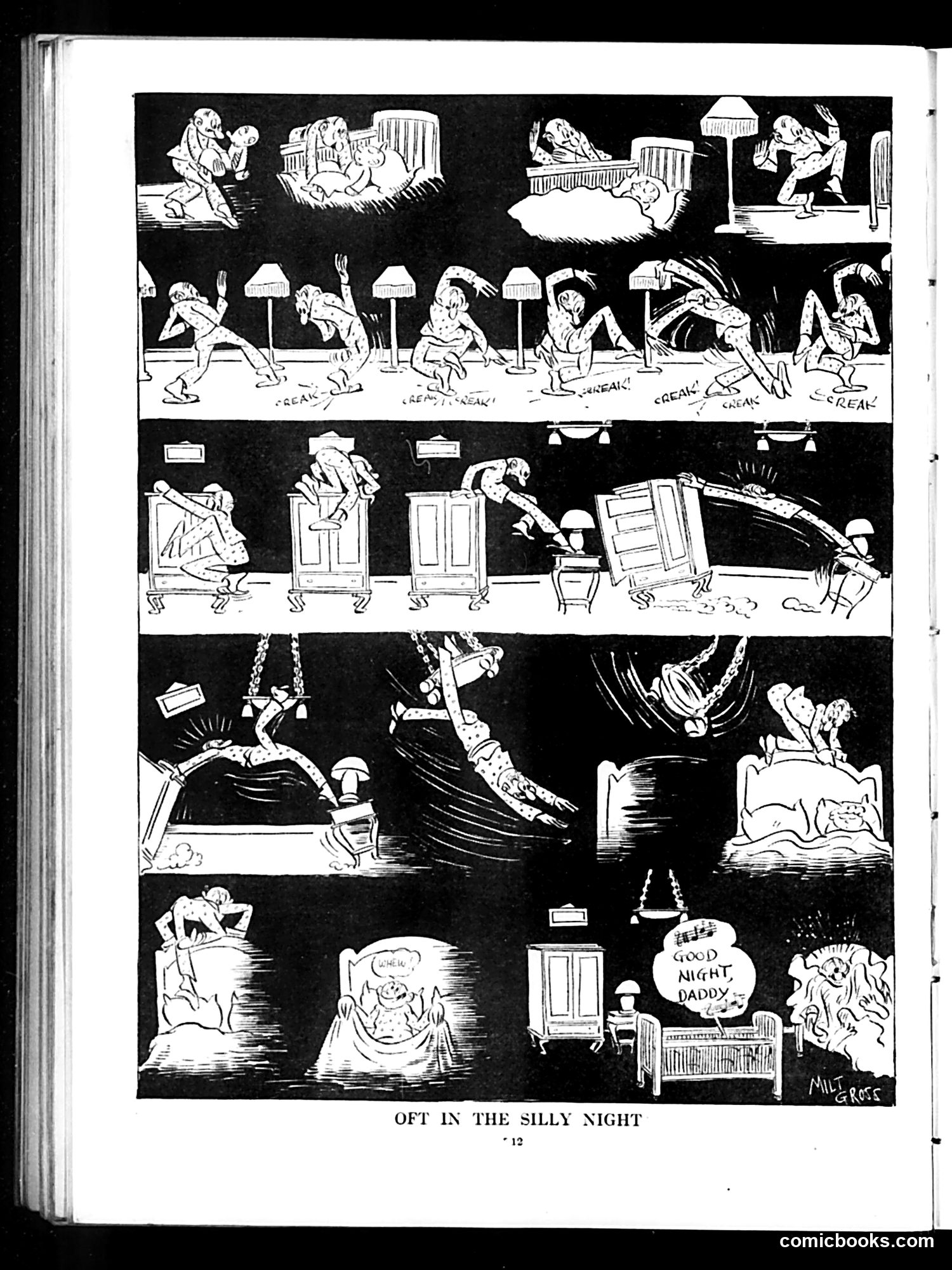
This comic strip depicts children engaged in nighttime mischief and chaos in a bedroom. The title—a play on the Thomas Moore poem "Oft in the Stilly Night"—humorously substitutes "silly" for "stilly," setting expectations for comedic rather than sentimental content. The sequential panels show children creating bedlam: jumping on beds, throwing pillows, overturning furniture, swinging from fixtures, and generally running wild while parents sleep. The final panels show the aftermath—exhausted children finally settling down, with one saying "Good night, Daddy." The satire targets both children's chaotic energy and parental exhaustion. It's gentle domestic humor reflecting early 20th-century middle-class family life, poking fun at the difficulty of managing children's bedtime routines. The signed work appears to be by "Miles Cross" (visible in lower right).
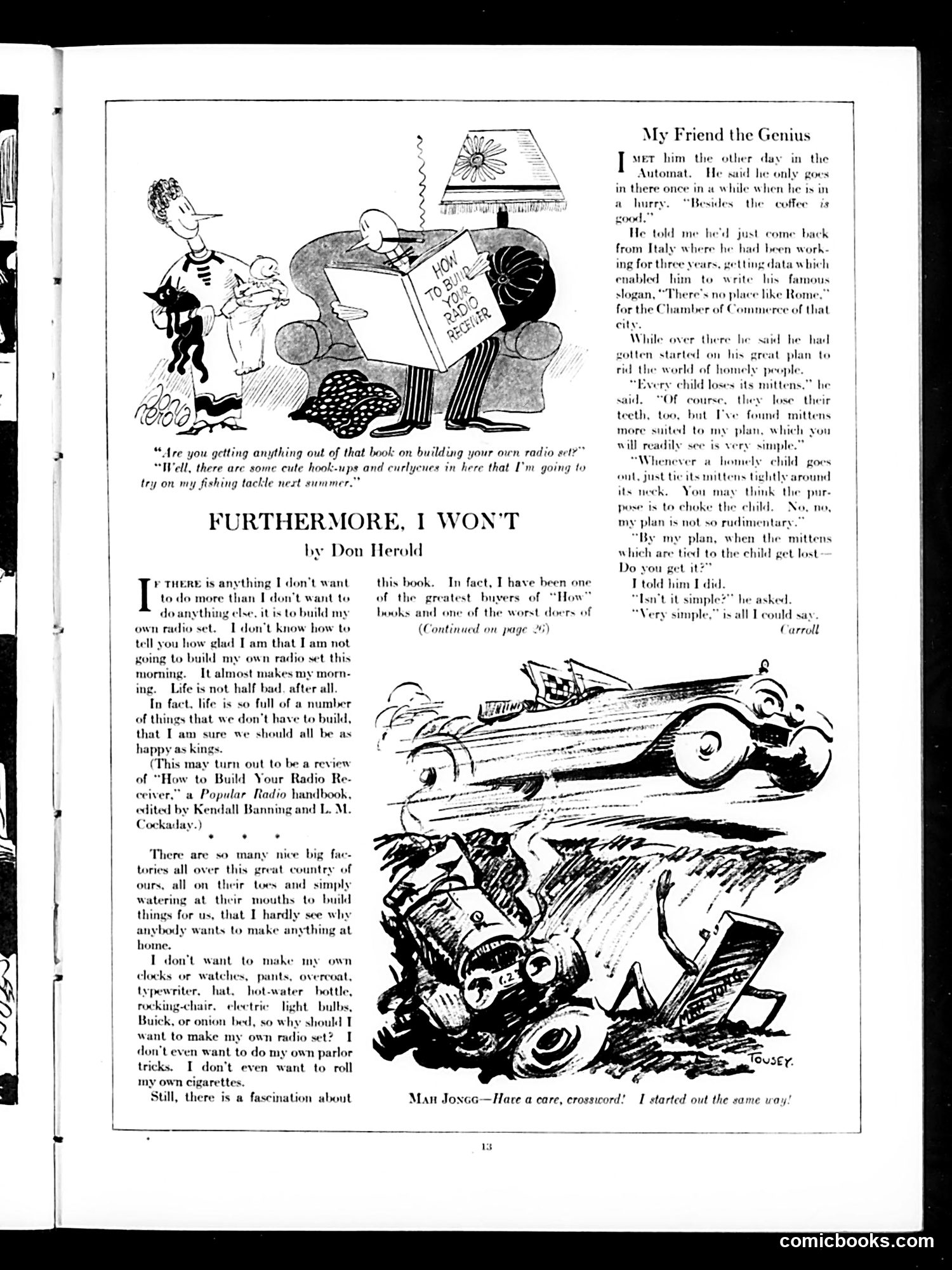
This page contains two distinct pieces of satire: ## "Furthermore, I Won't" by Don Herold A humorous essay rejecting the DIY radio-building craze. Herold mocks the popular trend of home radio construction—reflected in the referenced handbook "How to Build Your Radio Receiver"—by arguing he has no desire to build anything at home when factories already exist for that purpose. The satire targets the early 1920s-1930s enthusiasm for amateur radio construction as a hobby. ## "My Friend the Genius" A sidebar story about an absurdly impractical inventor planning to solve child homelessness by tying mittens around children's necks so they'll strangle when the mittens are lost. The cartoon illustrates this ridiculous "solution," satirizing pseudo-intellectual schemes and impractical social planning dressed up as innovation. Both pieces mock pretentious attempts at self-improvement and dubious "genius" schemes common in the era.
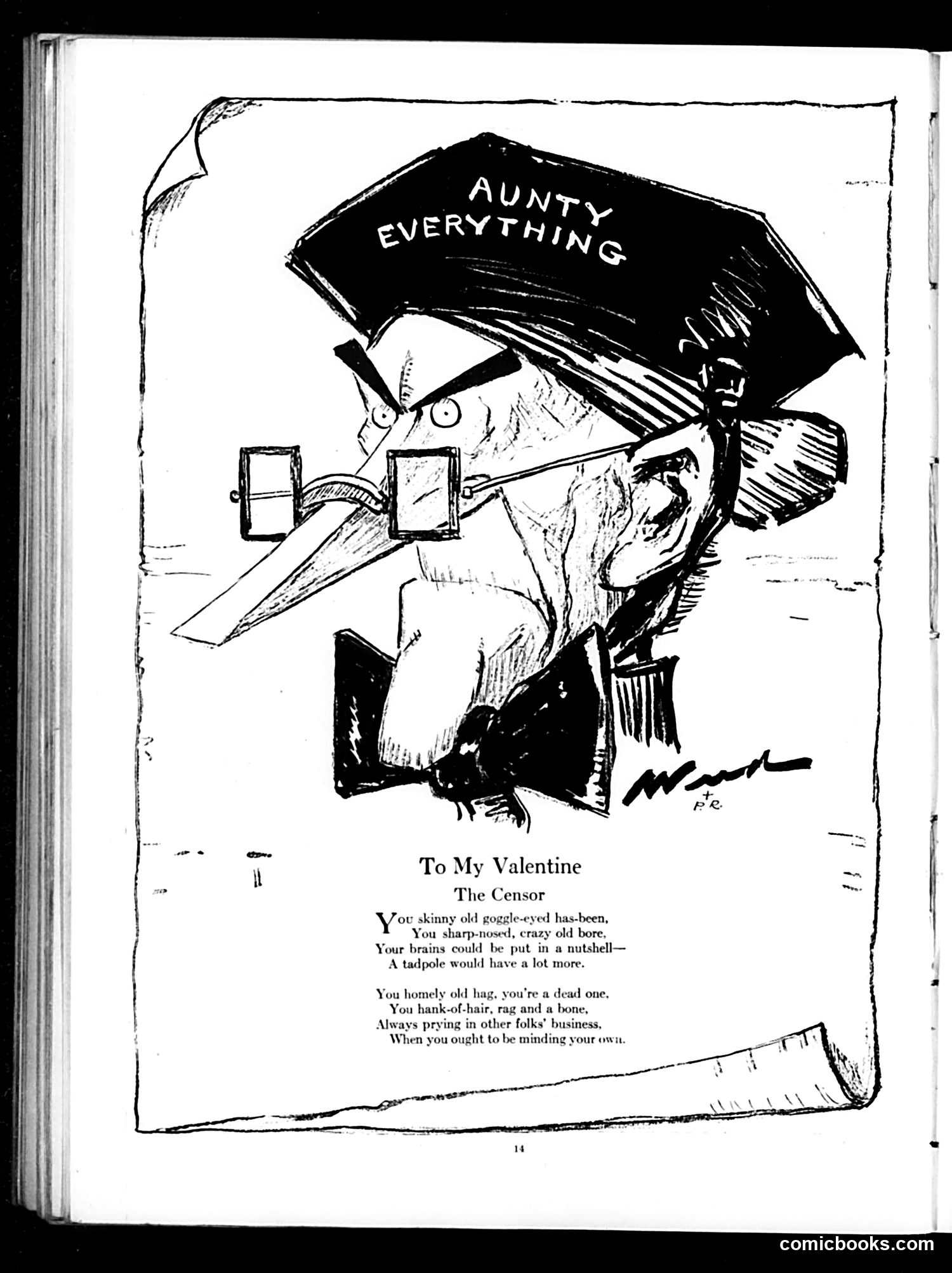
This is a scathing satirical "Valentine" attacking a censor—likely referencing wartime or governmental censorship. The caricature depicts a skeletal, sharp-featured figure wearing goggles labeled "AUNTY EVERYTHING," suggesting an officious authority figure who oversees all content. The poem mocks the censor as incompetent ("brains could be put in a nutshell"), physically repulsive ("homely old hag"), and a busybody who meddles in others' affairs while neglecting their own business. The exaggerated, grotesque illustration emphasizes the satirist's contempt. Judge magazine used such cartoons to critique censorship restrictions on press freedom and expression, presenting the censor as both ridiculous and tyrannical—a common anti-censorship argument in American satirical publications.
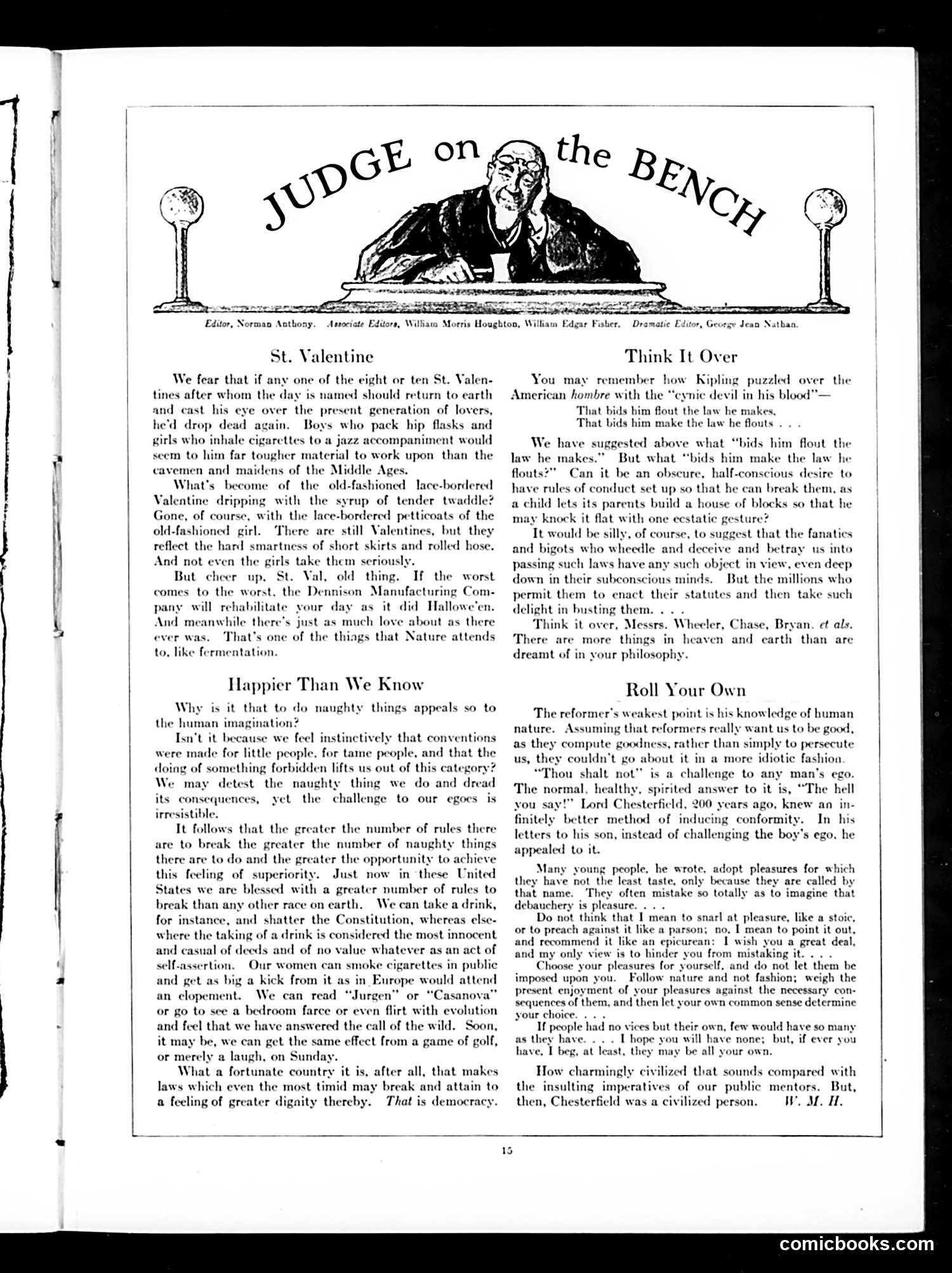
This page from Judge satirizes American attitudes toward laws and rule-breaking during Prohibition-era America (likely 1920s, given references to hip flasks, cigarette-smoking women, and "the Constitution"). **Main Satirical Points:** The articles argue that Americans uniquely enjoy breaking laws—not because the laws are unjust, but for the ego satisfaction of defying authority. The writer notes that American women can smoke publicly and people can drink despite Prohibition, which Europeans cannot, making rule-breaking feel like self-assertion and personal freedom. **Key Targets:** The final article directly addresses anti-vice crusaders—"Wheeler, Chase, Bryan" (likely William H. Wheeler and William Jennings Bryan, prominent Prohibition advocates)—suggesting their laws paradoxically *create* the rebellious behavior they condemn by providing rules to break. **The Joke:** The satire isn't that laws are bad, but that America's abundance of restrictive legislation has made lawbreaking feel like democracy itself—a dark irony for those who enacted such laws believing they'd improve morality.
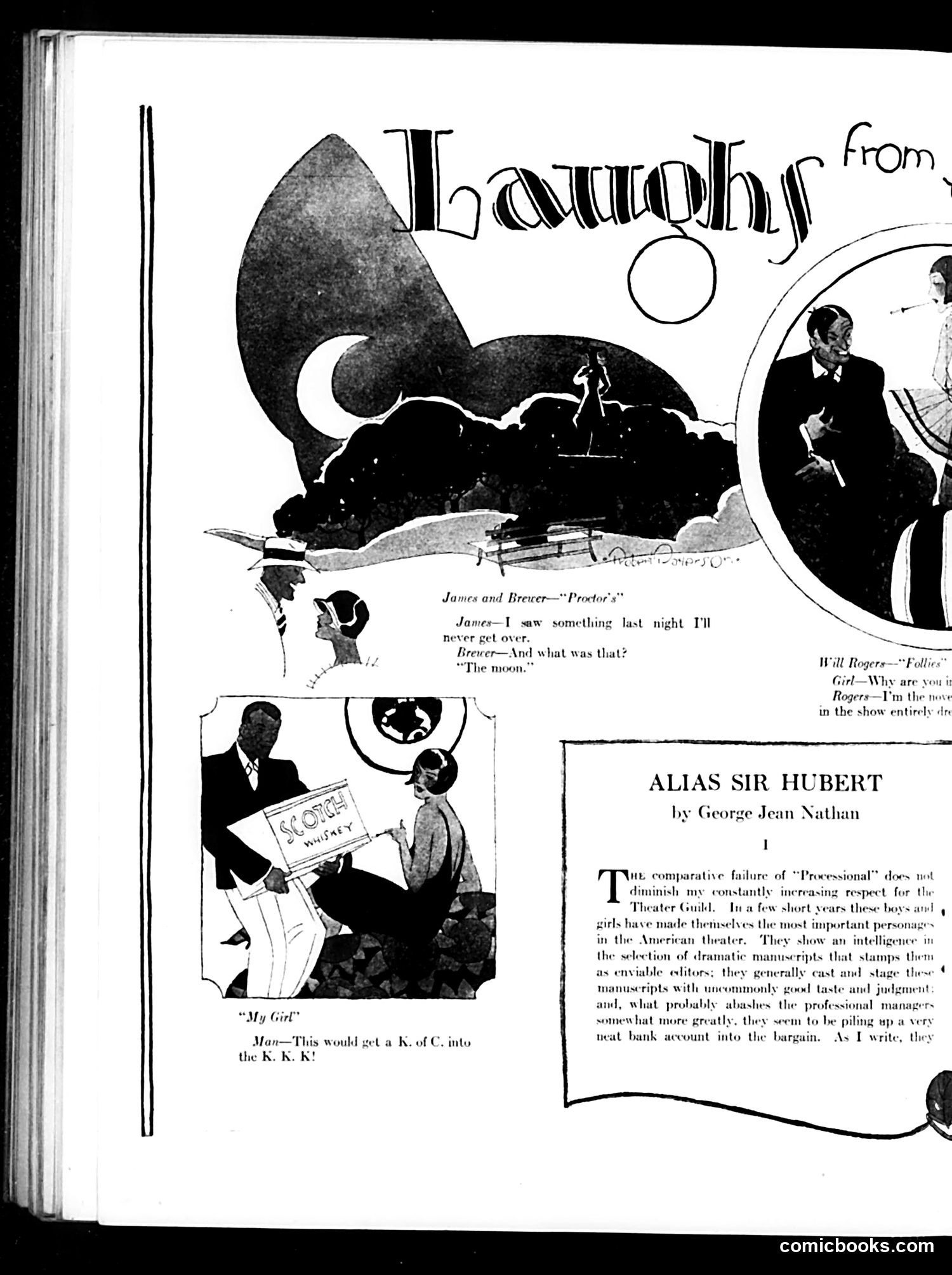
This page from *Judge* magazine features theatrical humor and criticism: **The Cartoons (top left):** Three brief comedic sketches with punchy dialogue. The "James and Brewer" exchange mocks sentimentality about seeing the moon. The "My Girl" panel jokes that a scenario involving a K. of C. (Knights of Columbus) member would provoke the K.K.K.—likely playing on anti-Catholic tensions of the 1920s era when the KKK was resurgent and virulently anti-Catholic. **The Article:** George Jean Nathan reviews the Theatre Guild's production "Processional" (which apparently underperformed). Despite this failure, Nathan praises the young Guild members for their intelligent manuscript selection and casting taste, suggesting they're outperforming professional managers and building financial success. The page reflects 1920s theatrical culture and broader social anxieties about religious prejudice prevalent during that period.
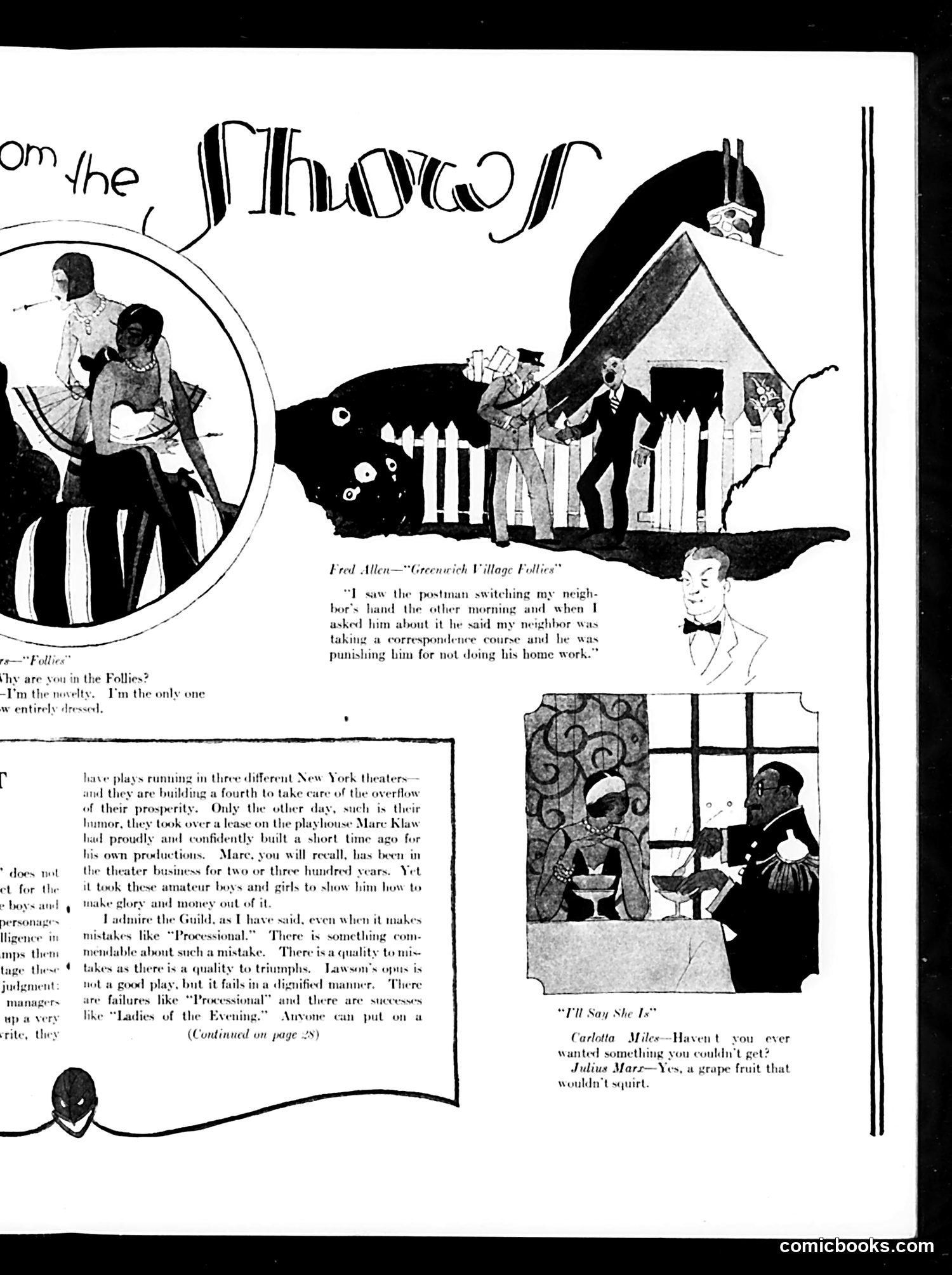
This page discusses Broadway's "Follies" productions and theatrical amateur productions. The main satire concerns **Marc Klaw**, a veteran theater producer, being outperformed by inexperienced amateur theater groups. The joke is that these "boys and girls" succeeded where Klaw's decades of professional experience failed—they made "glory and money" from their productions, while his own efforts struggled. The page also mocks a play called **"Processional"** for its failures and compares it unfavorably to successful shows like "Ladies of the Evening." At bottom, there's a comedic dialogue between characters **Carlotta Miles** and **Julius Marrs** about desire and fruit—a mild, era-typical vaudeville-style gag where a grapefruit that "squirts" becomes the punchline. The overall tone suggests contemporary criticism of professional theater establishment versus popular amateur theater innovation.
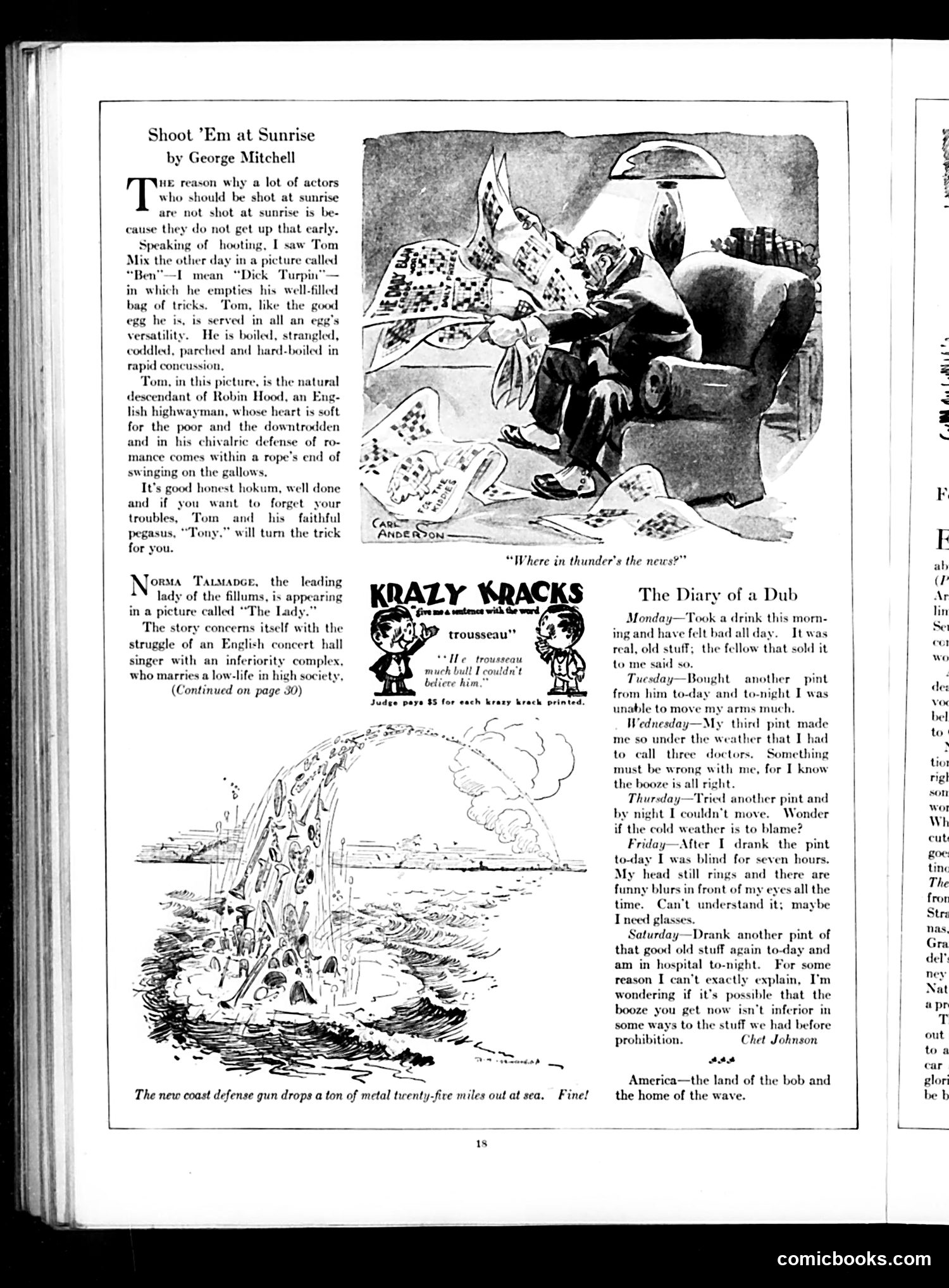
This Judge magazine page contains three distinct pieces of satire: **"Shoot 'Em at Sunrise"** (top left) is a film review by George Mitchell praising actor Tom Mix in a Western picture. The joke plays on the phrase "shot at sunrise" (execution) versus "shot" (filmed). Mitchell humorously critiques lazy actors while praising Mix's versatility and his horse "Tony." **"Krazy Kracks"** (center) is a brief joke about a trousseau, with minimal visual context. **"The Diary of a Dub"** (right column) is a Prohibition-era satire. "Dub" means a gullible fool. The narrator drinks "old stuff" (bootleg liquor) daily and suffers increasingly severe symptoms—hangovers, paralysis, blindness—yet attributes them to weather or illness rather than recognizing the illegal alcohol's dangerous quality. The punchline satirizes how Prohibition created inferior, potentially poisonous black-market alcohol, while the narrator remains oblivious to the obvious cause of his deterioration. The illustration at bottom left appears to show a military coastal defense gun demonstration.
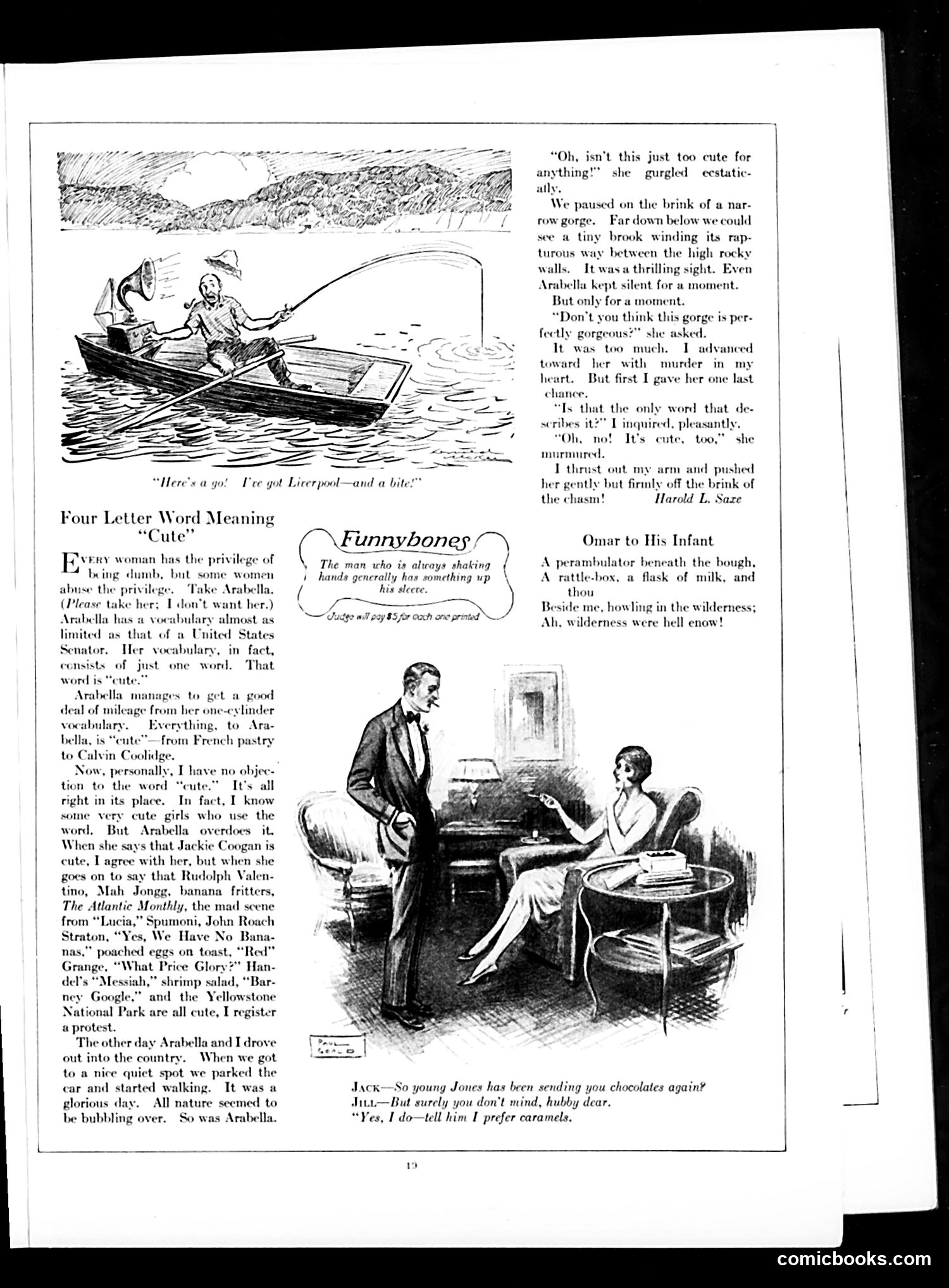
This page from the satirical magazine *Judge* contains several pieces satirizing 1920s American culture. The main article, "Four Letter Word Meaning 'Cute,'" mocks a character named Arabella who overuses the word "cute" to describe everything—from Jackie Coogan and Rudolph Valentino to shrimp salad and Yellowstone National Park. The satire targets the affectation of young women who adopted trendy vocabulary without discrimination. The narrator's exaggerated threat to push her off a gorge is hyperbolic humor about her linguistic excess. The "Funnybones" section offers brief witticisms, while "Omar to His Infant" parodies the Rubaiyat of Omar Khayyam, replacing romantic imagery with mundane domestic life—a common literary-mockery technique. The bottom cartoon dialogue about chocolates versus caramels presents mild domestic humor about spousal preferences, typical of era's relationship comedy. The page targets 1920s consumerism, linguistic trends, and romantic idealization.
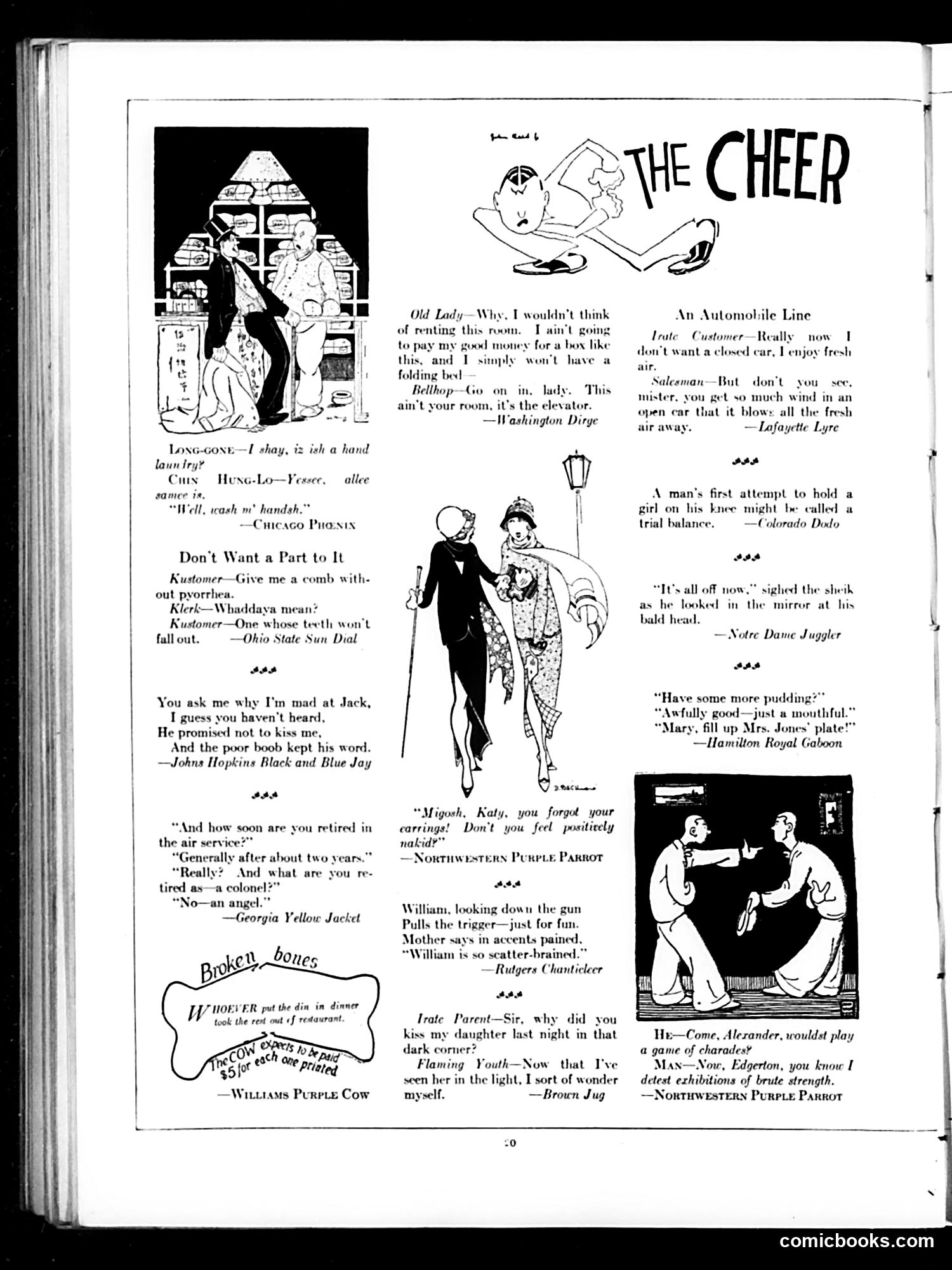
This is a collection of brief jokes and humorous anecdotes typical of early 20th-century collegiate and satirical humor. The page includes: **Social/Dating Humor**: Jokes about courtship etiquette, such as a man who kept his promise *not* to kiss a girl (considered foolish), and a "sheik" (fashionable young man) embarrassed by his baldness. **Period-Specific References**: "Flaming Youth" mocking modern young people's behavior; automobiles as still-novel technology; mentions of pyorrhea (gum disease), suggesting contemporary advertising concerns. **Generational Commentary**: Humor about scatter-brained children, absent-minded youth, and generational differences in propriety. **Wordplay & Puns**: "Trial balance," jokes about restaurant/dinner terminology, dental/grooming humor. The cartoons are crude, featuring stylized figures in formal dress and period clothing. The overall tone reflects Jazz Age social anxieties about changing morality, gender relations, and modernity—all delivered through light, collegiate humor attributed to university publications.
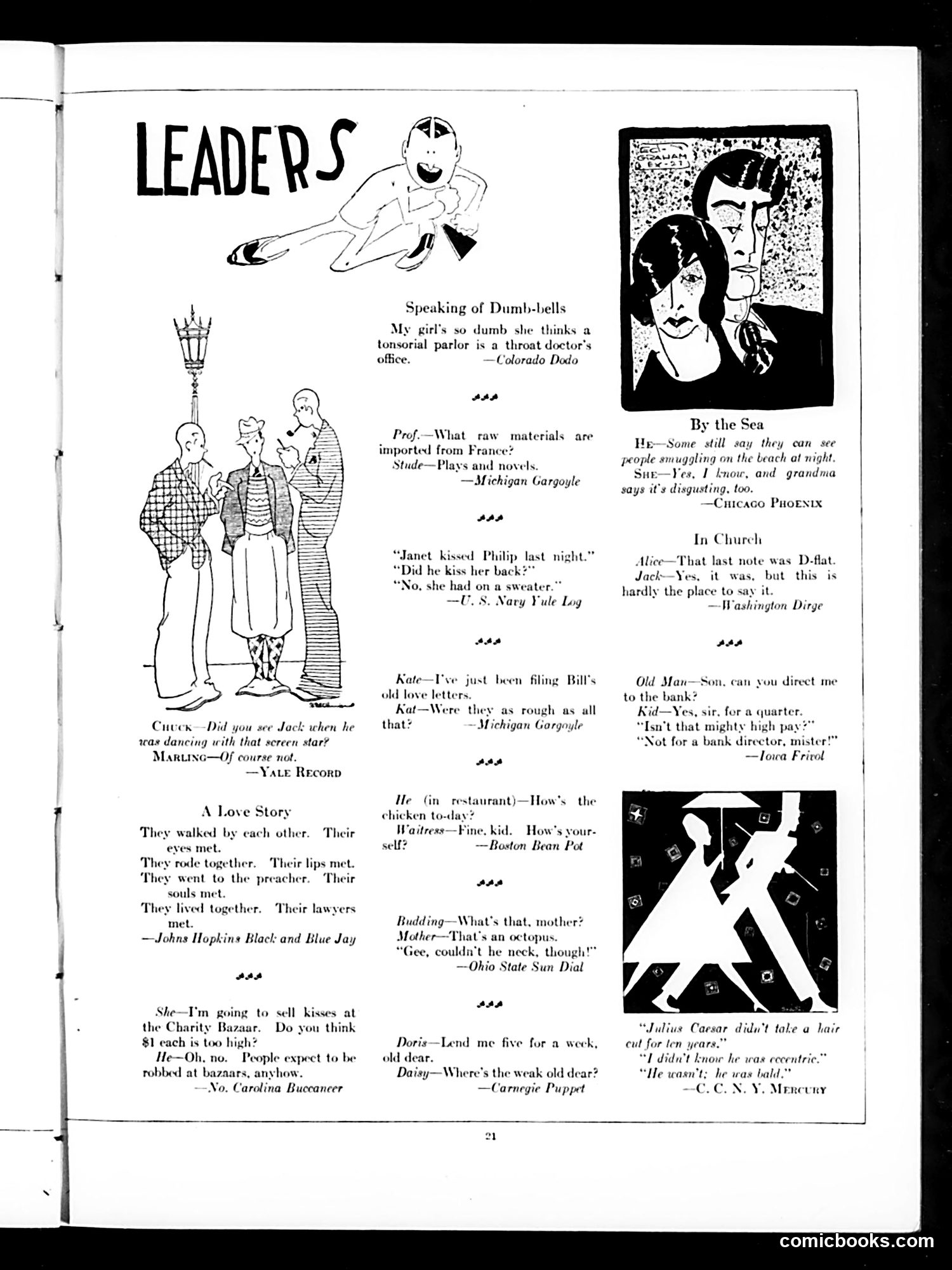
This page collects brief jokes and humorous anecdotes typical of early 20th-century American college humor magazines. The content satirizes contemporary social attitudes and behaviors: **Key Themes:** - **Marriage and divorce**: "A Love Story" sarcastically traces romance's trajectory from meeting through "their lawyers met"—mocking the prevalence of divorce among the wealthy. - **Gender and intellect**: Jokes mock women's intelligence ("dumb" girlfriend thinking a barber shop is a doctor's office). - **Class and morality**: References to Prohibition-era smuggling and corruption ("bank director" charging a quarter for directions). - **Dating/courtship**: Multiple jokes about kissing, necking, and physical affection reflect Jazz Age anxieties about changing sexual mores. The cartoon of the football player ("LEADERS") at top left appears decorative rather than satirical. The humor reflects casual sexism, class consciousness, and social commentary typical of 1920s collegiate publications—attitudes a modern reader would find dated or offensive.
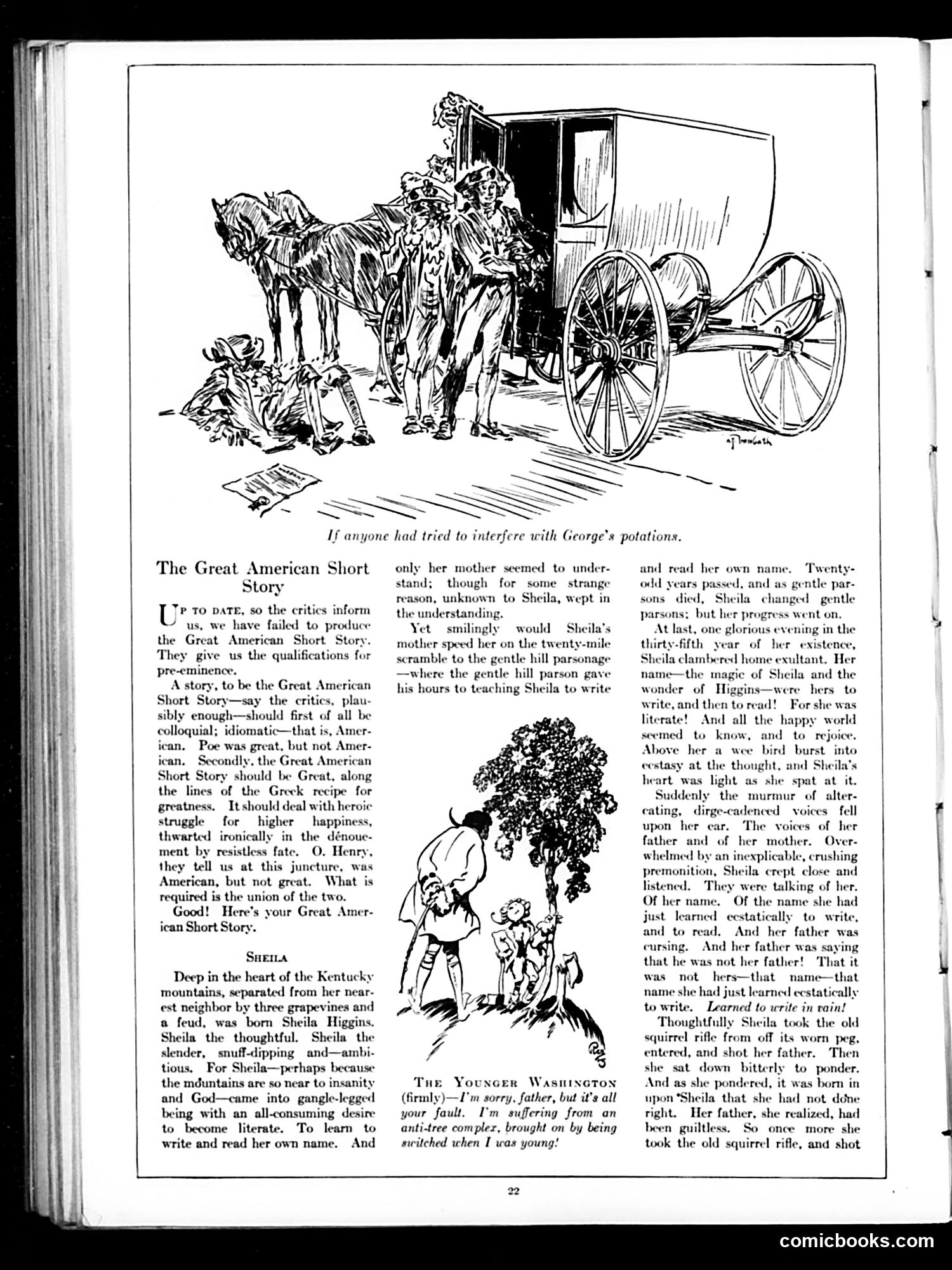
This page satirizes literary critics' prescribed formula for the "Great American Short Story." The critics demand three elements: colloquial American language, tragic grandeur on Greek lines, and heroic struggle ending in ironic defeat by fate. The accompanying story "Sheila" mockingly delivers exactly what they asked for. A Kentucky mountain girl spends 35 years learning to write her own name—a humble, colloquial struggle. Upon achieving literacy, she discovers her father isn't her biological parent, making her hard-won education meaningless. She shoots him, then realizes he was innocent and shoots herself instead. The satire works by literalizing the critics' demands: the story *is* colloquial, *is* tragic, *is* thwarted by fate—yet the result is absurd melodrama, not great literature. The secondary cartoon about "The Younger Washington" appears unrelated, likely advertising or filler.
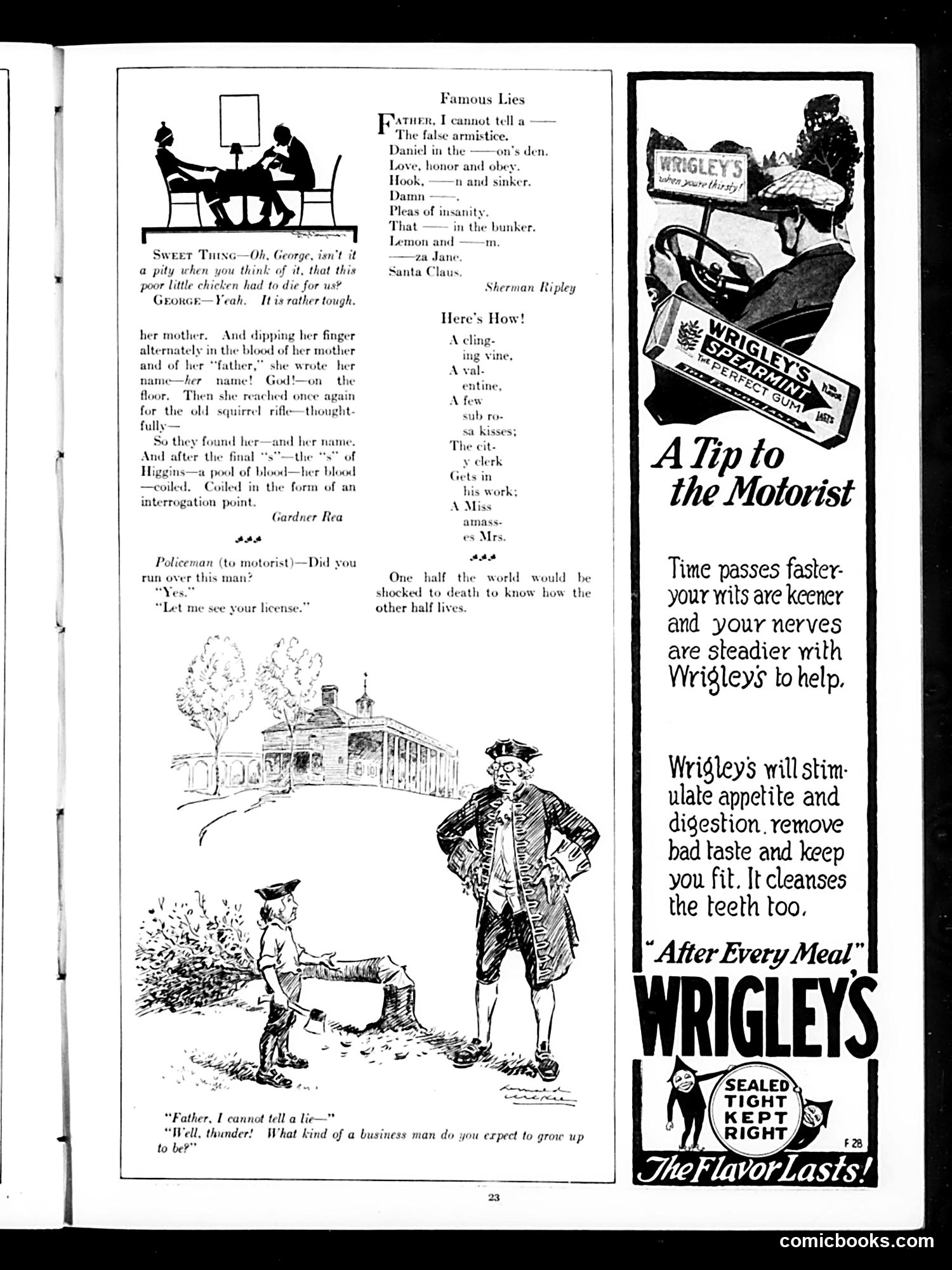
This page contains satirical humor pieces and advertising typical of early 20th-century Judge magazine. **Main cartoons:** - A sentimental dialogue mocking hypocrisy: a couple expressing sadness that a chicken died for dinner, though they eat it anyway - A dark story about a girl who discovers her parents' infidelity, writes her name in their blood, and dies—satirizing Victorian melodrama - A joke about a policeman stopping a motorist who hit a man; when asked for his license, the motorist invokes "Father, I cannot tell a lie" (George Washington's cherry tree myth), and the officer scolds him for not teaching honesty in business—mocking how Americans selectively apply moral lessons **"Famous Lies" section:** Lists common deceptions (false armistice, broken marriage vows, Santa Claus, etc.)—social commentary on everyday dishonesty. **Wrigley's gum advertisement:** Takes up the right side, promoting chewing gum's benefits for motorists' alertness and digestion—typical period advertising linking products to modern concerns like automobile driving.
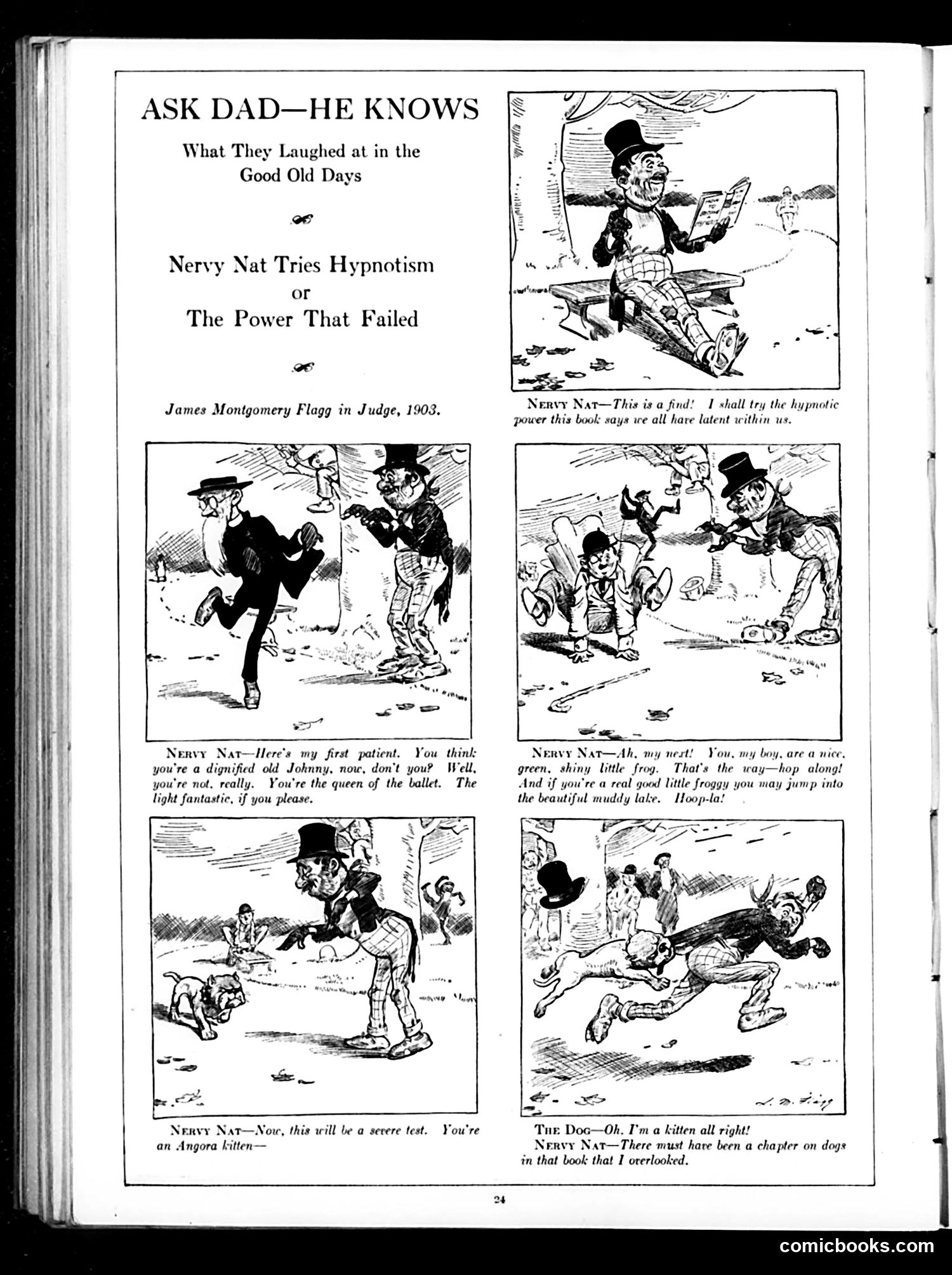
This comic strip by James Montgomery Flagg satirizes the early 1900s craze for hypnotism as a fashionable parlor trick. "Nervy Nat," an opportunistic character, reads a book claiming everyone possesses latent hypnotic powers and decides to test it on unsuspecting victims. The humor derives from failed hypnotic suggestions: Nat tells a dignified man he's a ballet dancer, convinces a boy he's a frog (who actually hops), and attempts to hypnotize a dog into believing it's a kitten—which comically fails. The final panel's joke—that Nat "overlooked" the chapter on dogs—suggests the book's dubious legitimacy. The satire targets both the pseudo-scientific enthusiasm for hypnotism and the gullibility of people willing to believe such nonsense. The exaggerated physical comedy and absurd outcomes mock the era's fascination with this supposedly mysterious mental power.
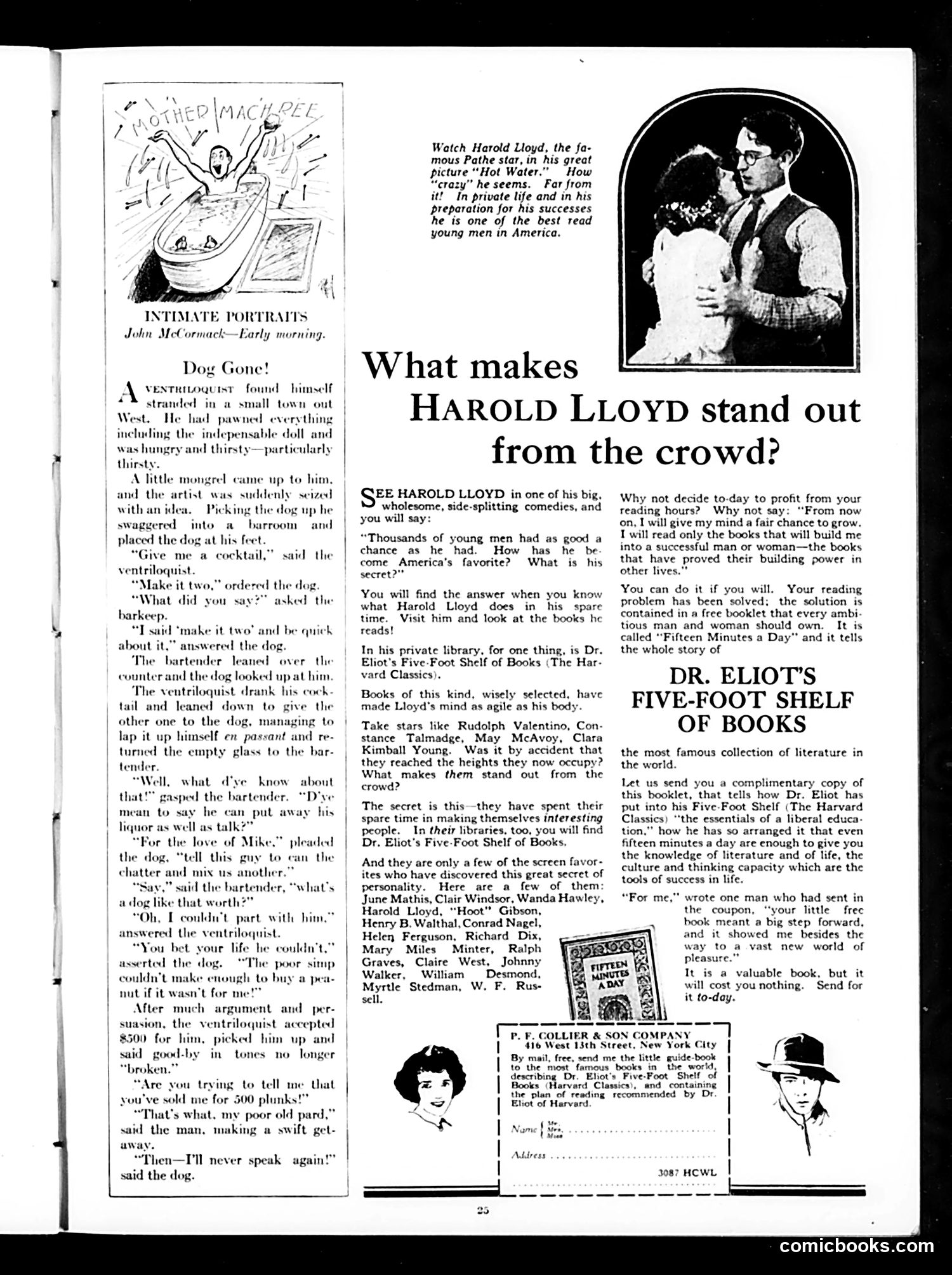
This page combines entertainment promotion with educational advertising, typical of 1920s magazines. **The Cartoon**: "Dog Gone!" is a simple joke about a ventriloquist and his dog in a bar. The humor is straightforward slapstick—the bartender can't tell who's speaking when both the man and dog order drinks, creating confusion. It's not political satire. **The Harold Lloyd Content**: The main feature promotes actor Harold Lloyd's film "Hot Water" while arguing that Lloyd's success stems from being well-read, specifically from using Dr. Eliot's Five-Foot Shelf of Books (a famous curated collection). The article lists other silent-film stars (Rudolph Valentino, Constance Talmadge) and claims their success similarly derives from self-improvement through reading. **The Satire**: This appears to be gentle satire on the "self-help" craze of the era—the implicit joke is that Hollywood stars' success is attributed to classic literature rather than talent, looks, or luck. The advertisement frames reading as the secret to American success. The "Intimate Portraits" sketch of John McCormack (likely the Irish tenor) appears unrelated filler.
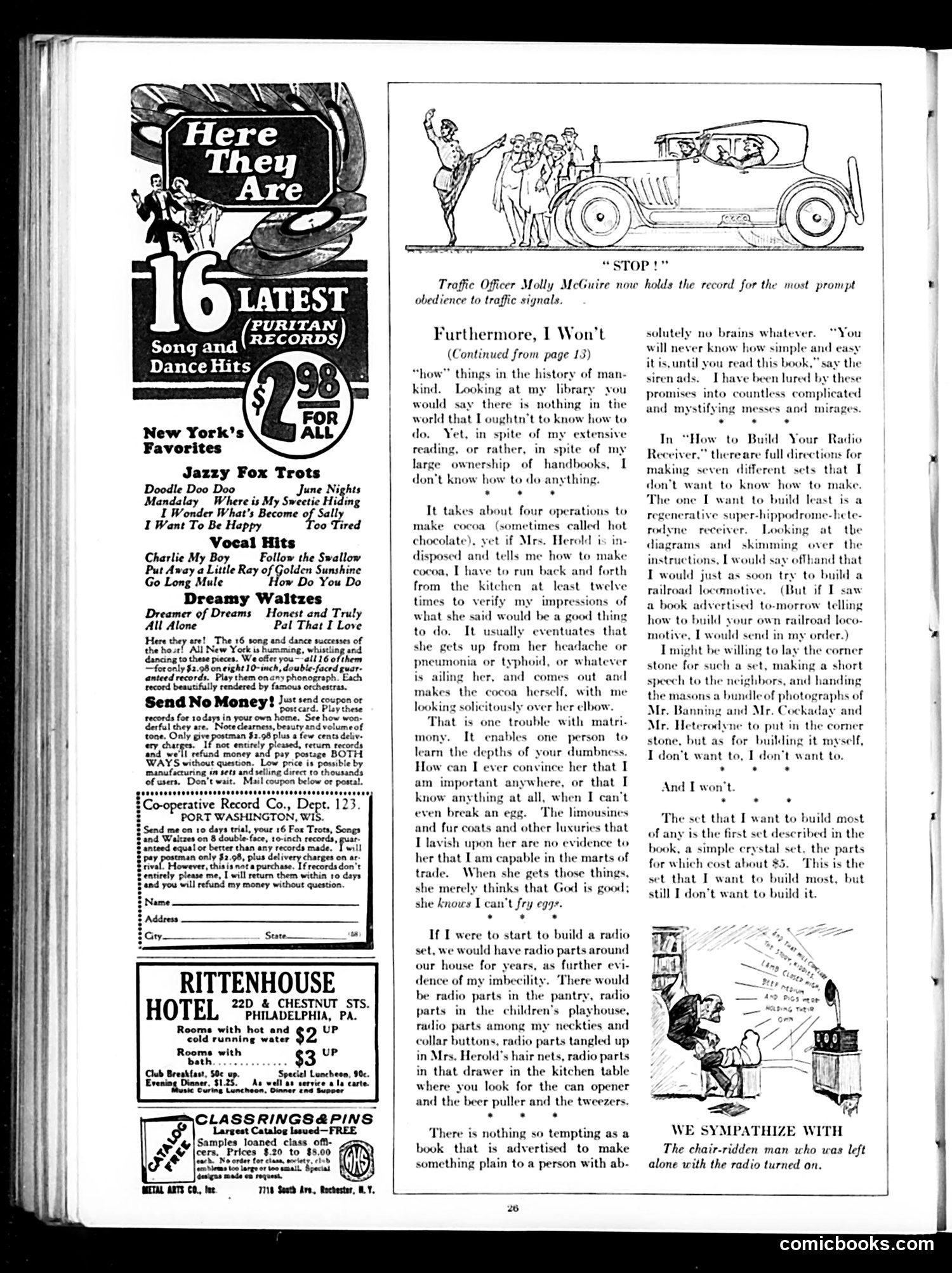
This page is primarily **advertisements and record listings** for Puritan Records, with one small cartoon at the top right. The cartoon depicts "Traffic Officer Molly McGuire" stopping a car full of pedestrians. The caption jokes that she "holds the record for the most prompt obedience to traffic signals"—a pun playing on "record" (the traffic/driving record and the phonograph records being sold). The cartoon likely mocks overly obedient compliance with traffic laws, presenting it as absurdly strict. The humor seems gentle satire about early automobile-era traffic enforcement. The rest of the page features song listings, a humorous article "Furthermore, I Won't" about masculine incompetence in domestic tasks, and various period advertisements for hotels, records, and class rings—typical Judge magazine mixed content from the 1920s era.
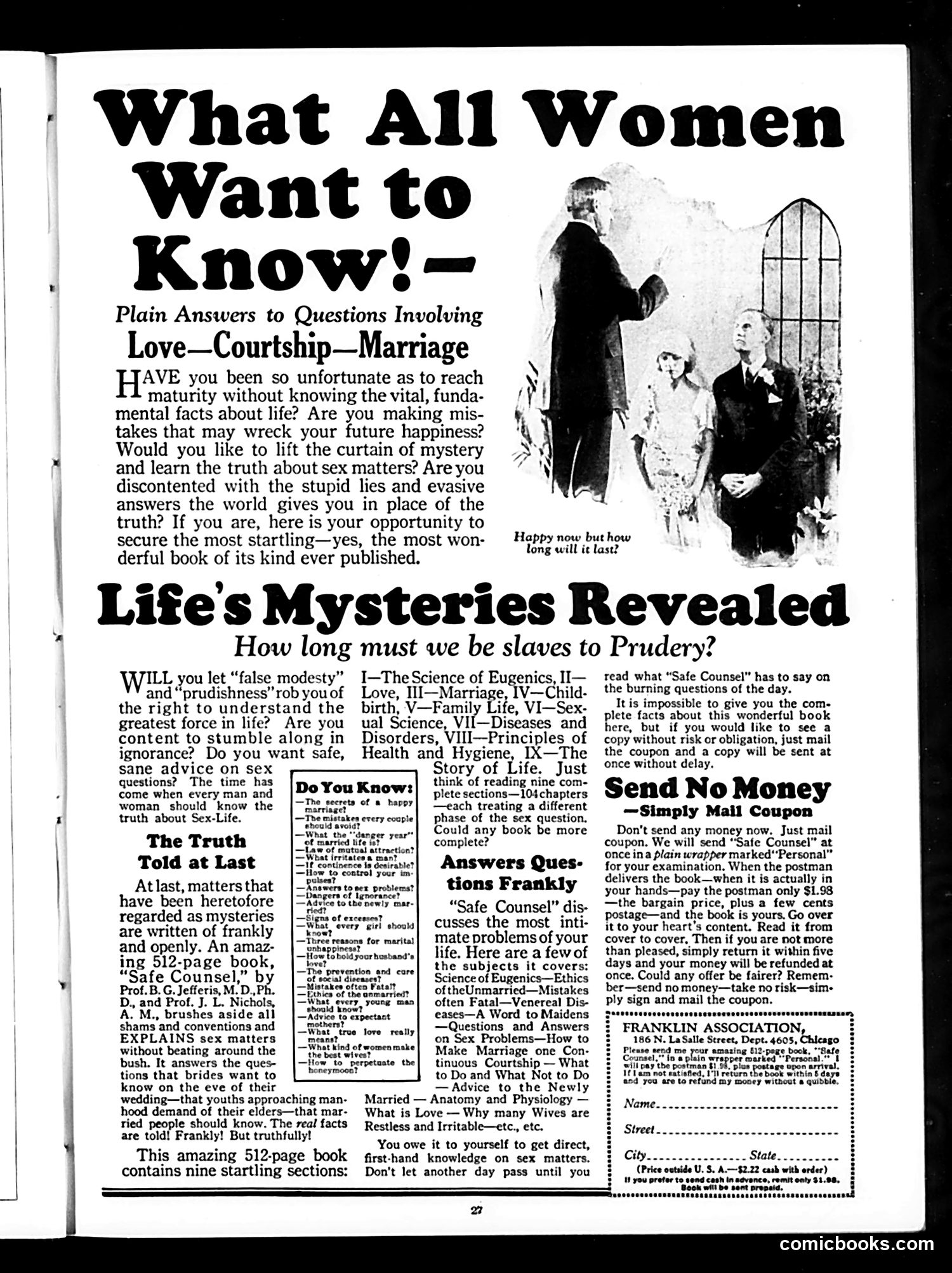
This is a **mail-order advertisement** for "Safe Counsel," a sex education book marketed to young women and couples. The page satirizes early 20th-century sexual repression by mocking society's "false modesty" and "prudishness" around sex education. The illustration shows a **wedding scene** with the caption "Happy now but how long will it last?"—implying marital unhappiness stems from sexual ignorance. The advertisement promises frank answers to questions brides, youths, and married couples have about reproduction, disease prevention, and maintaining marital attraction. It covers nine topics including eugenics, venereal disease, and sexual anatomy. The satire targets the era's **contradiction**: society demanded sexual ignorance while expecting people to navigate intimate life successfully. The book offered what polite society refused to discuss directly. The coupon-based "send no money" format was typical of contemporary direct-mail marketing, designed to overcome buyer hesitation about ordering such controversial material.
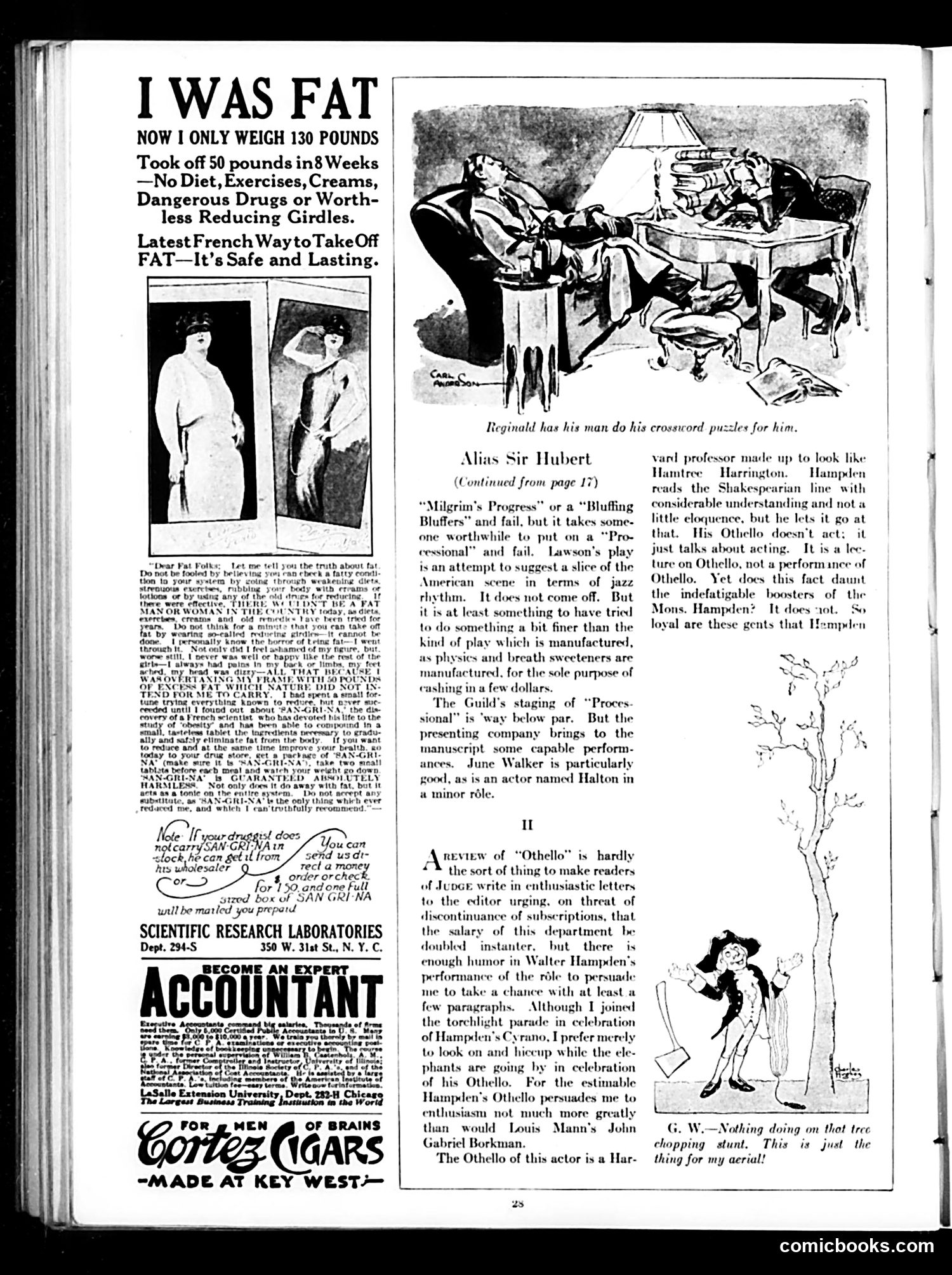
This page combines a weight-loss advertisement with theater reviews. The top section is a testimonial ad for "San-Gri-Na," a French weight-loss product promising 50 pounds lost in 8 weeks without diet or exercise—typical snake-oil marketing of the era. The cartoons satirize upper-class leisure and theatrical pretension. One shows a wealthy man having his servant solve crossword puzzles for him—mocking lazy affluence. Another depicts a woman hanging from a tree, captioned as "aerial" entertainment. The reviews critique theatrical productions. Walter Hampden's Othello is mocked as intellectually competent but emotionally hollow—a "lecture on Othello, not a performance," delivered by someone who "reads the Shakespearian line with considerable understanding" but fails to truly *act* the role. The critic suggests Hampden's admirers are uncritically loyal ("indefatigable boosters") despite his inadequate performance. The page captures 1920s Judge sensibilities: skepticism toward dubious commercialism and theatrical pretension among the wealthy.
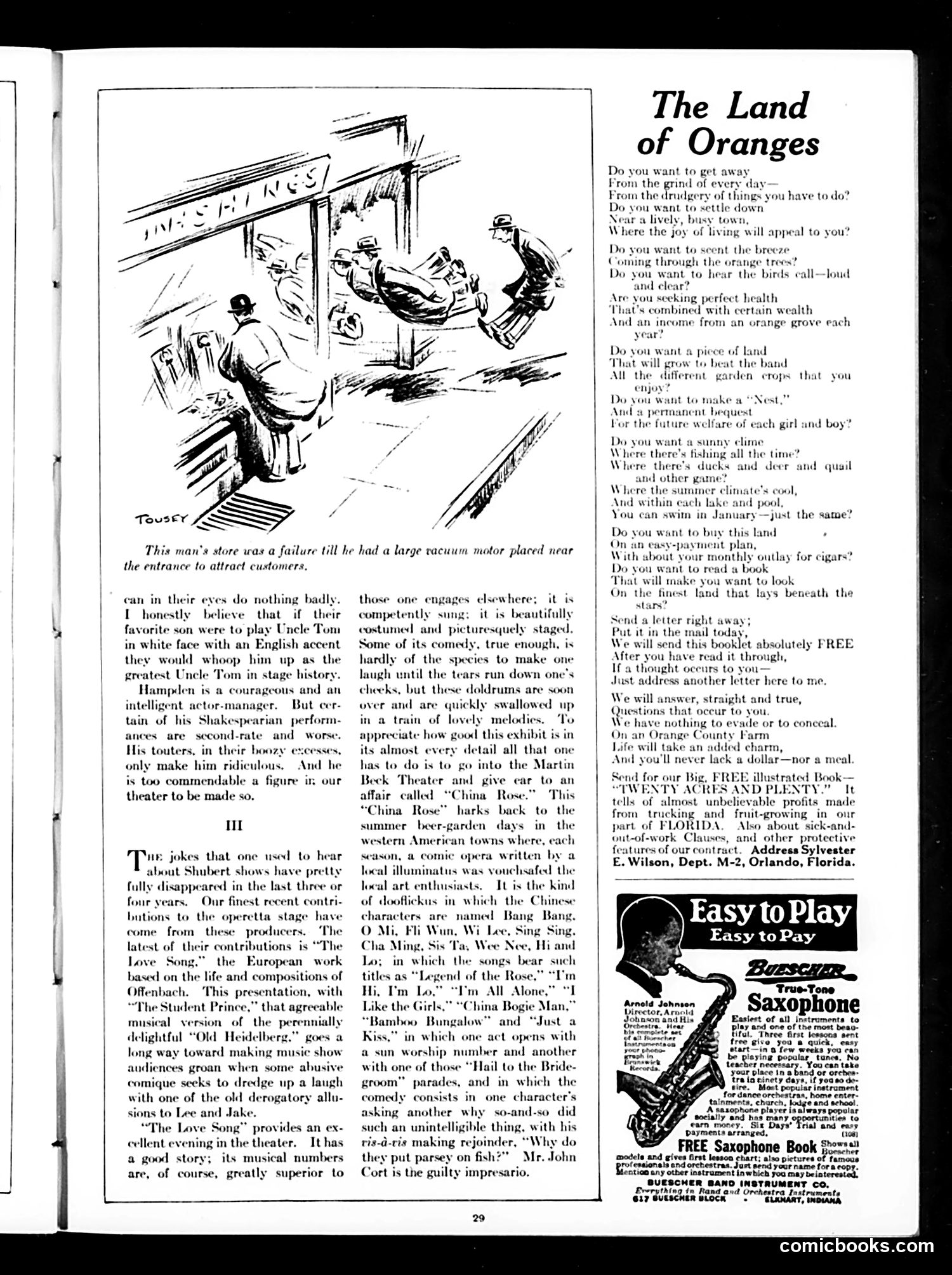
The page contains two distinct elements: **The Cartoon (top left):** A sketch by "Tousey" shows a shopkeeper who installed a large vacuum motor near his store entrance to attract customers—a joke about absurd marketing gimmicks. The satire mocks businessmen who employ ridiculous tactics hoping to draw crowds. **The Advertisement (right side):** A promotional text for Florida orange grove land, using rhetorical questions to sell the romantic ideal of escaping urban drudgery for a leisure life of perfect weather, hunting, fishing, and passive income from fruit crops. It's a classic early-20th-century land-promotion scheme targeting people exhausted by industrial city life, promising health, wealth, and paradise. The juxtaposition is ironically apt: both represent period marketing—one mocking vacuous advertising claims, the other *exemplifying* exactly the kind of exaggerated pitch Judge's readers would have found satirical.
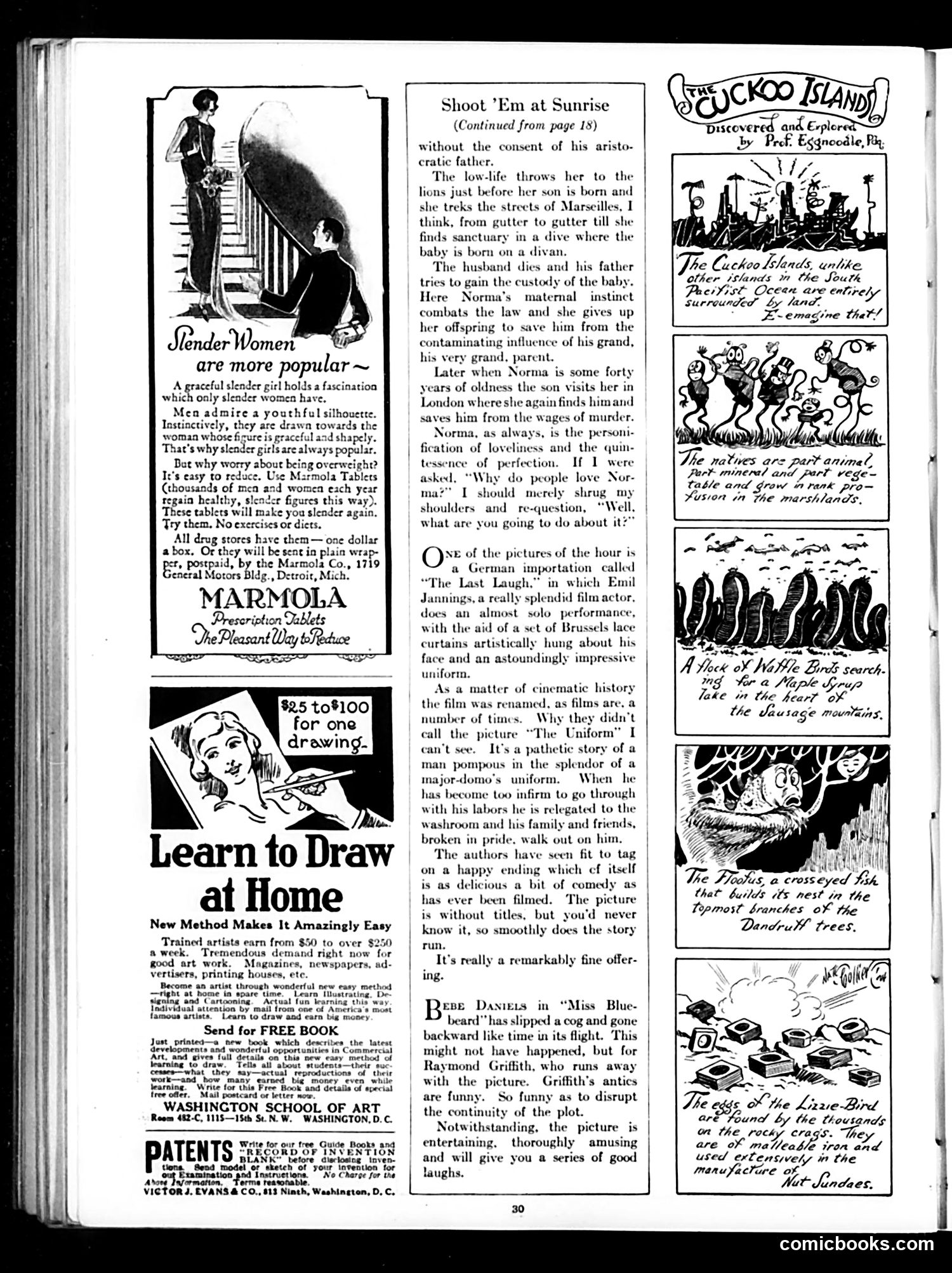
This page contains **advertisements and film reviews** rather than political cartoons. The ads promote weight-loss tablets (Marmola), art instruction, and patent services—typical 1920s commercial pitches targeting aspirational readers. The notable content is a **film review column** discussing two movies: a picture called "Shoot 'Em at Sunrise" (plot details about a woman named Norma) and "The Last Laugh," a German film starring Emil Jannings as a pompous hotel doorman reduced to washroom duty. The reviewer praises both films' emotional depth and acting. The review reflects **1920s cinema criticism**, emphasizing pathos, character arc, and visual storytelling—hallmarks of silent film appreciation. The German import reference shows Judge's awareness of European film influence on American cinema during this era. The **Cuckoo Islands** feature in the right margin appears to be illustrated fantasy content, unrelated to the page's main themes.
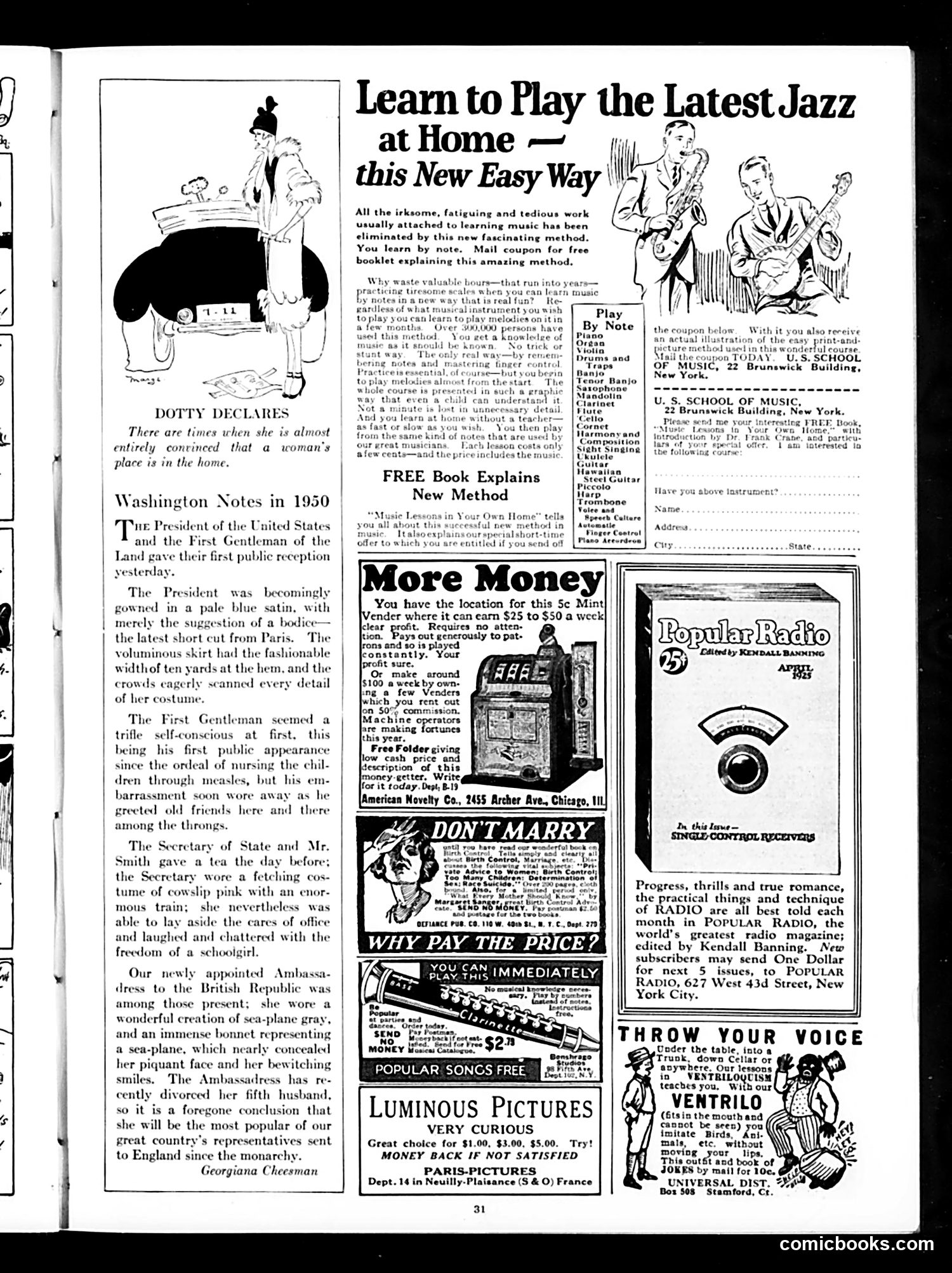
This piece satirizes a hypothetical future where traditional gender roles are reversed. The "President of the United States" is female, wearing a fashionable pale blue satin gown with a ten-yard hem, while the "First Gentleman" is her husband, notably anxious about his first public appearance after "nursing the children through measles." The satire continues with female ambassadors and officials attending formal events in elaborate costumes. The humor relies on the 1950 reader finding this scenario absurd—the idea of women holding high political office while men manage domestic duties was presented as ridiculous social inversion. The byline credit to "Georgiana Cheesman" may itself be part of the joke, though this cannot be confirmed from the image alone. This reflects Judge magazine's satirical approach to contemporary social anxieties about changing gender roles in mid-century America.
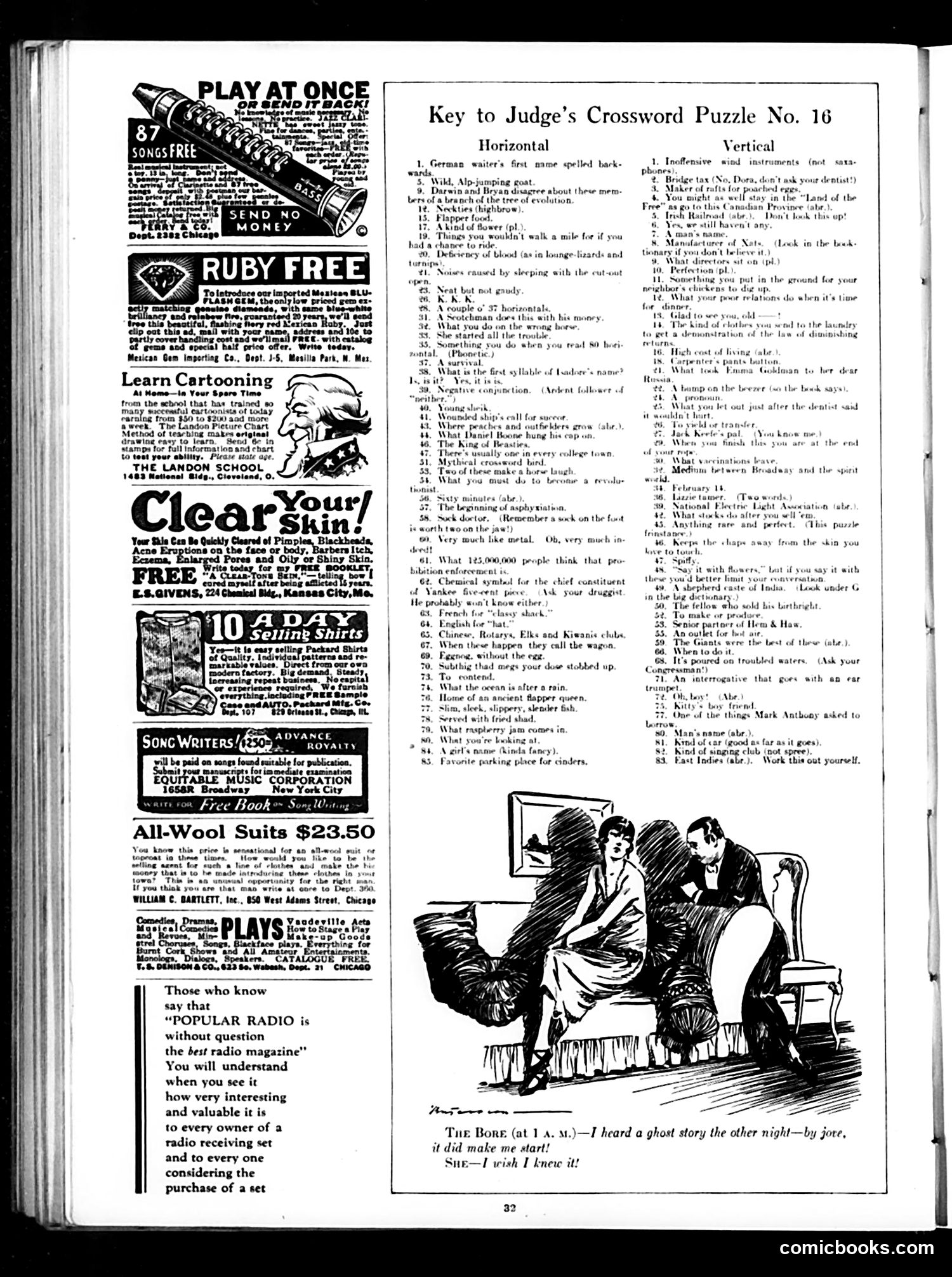
This page is primarily **advertising and puzzle content** rather than political satire. The dominant feature is the "Key to Judge's Crossword Puzzle No. 16"—a solution guide to a crossword puzzle published elsewhere in the magazine. The only cartoon on the page appears at bottom: titled "The Bore (at 1 a.m.)," it depicts a social scene where one man tells another a ghost story late at night. The humor is domestic/social rather than political—it jokes about boring dinner-party conversation and the listener's frustration ("I wish I knew it!" implying he wishes he knew how to escape). The surrounding advertisements promote mail-order services typical of 1920s-30s magazines: cartooning lessons, skin-care products, radio magazines, and clothing. These reflect ordinary consumer marketing rather than social commentary. **No major political figures or satire are present on this page.** It represents Judge functioning as a general humor and lifestyle magazine, not primarily as a vehicle for political cartooning.
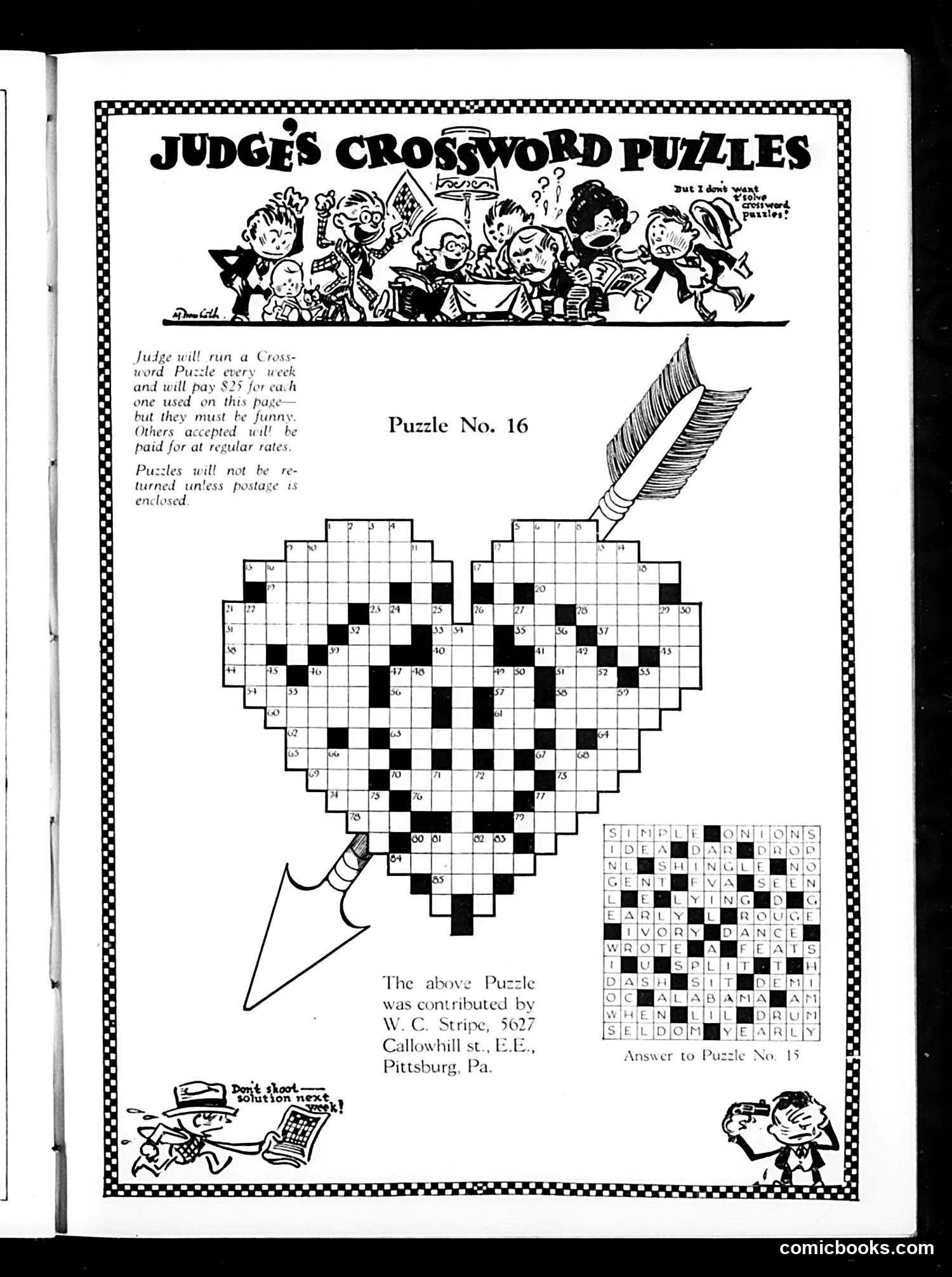
This page presents **Puzzle No. 16**, a crossword puzzle contributed by W.C. Stripe of Pittsburgh. The content is primarily functional rather than satirical—it's an announcement that *Judge* magazine will run weekly crossword puzzles, paying $25 for accepted submissions (with payment at regular rates for others). The page includes decorative cartoon illustrations typical of the era: characters at the top appearing excited or chaotic, and figures at the bottom. These are generic humorous vignettes rather than political commentary. The puzzle itself appears heart-shaped, a common decorative choice for the period. An answer key for "Puzzle No. 15" is printed in the lower right corner. This represents *Judge's* expansion into popular puzzle entertainment during the crossword craze of the 1920s-30s, appealing to readers beyond traditional satirical content.
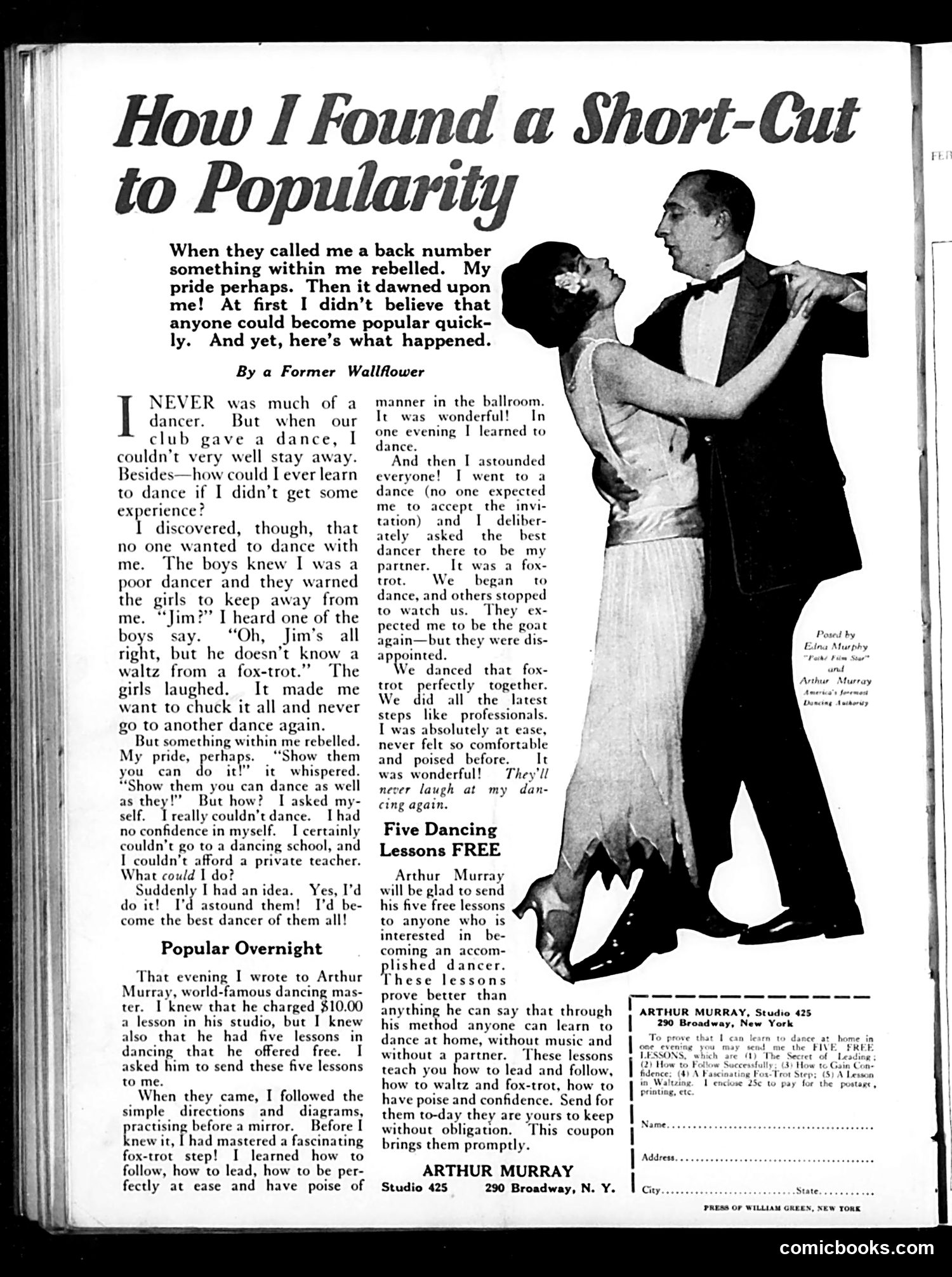
This is primarily an **advertisement disguised as editorial content** for Arthur Murray's dance lessons, a common marketing technique in early 20th-century magazines. The "story" follows a socially awkward man ("a back number," slang for someone out of fashion) rejected by dancing partners at social clubs. Through Arthur Murray's free five-lesson course (practiced at home with a mirror), he transforms into a confident dancer, impressing his peers at the next dance. **The satire/pitch:** The piece mocks social anxiety and class consciousness around dance ability while selling the fantasy of instant self-improvement. The accompanying photograph shows a posed dancing couple, presumably demonstrating Murray's methods. **Context for modern readers:** Dancing skill directly determined social status and romantic prospects in this era. The appeal was democratizing—expensive private lessons ($10 per session) were replaced with free mail-order instruction, suggesting anyone could become socially acceptable through modest effort. This is advertisement-as-narrative, exploiting insecurity to drive business.