
Judge, 1925-02-14 · page 17 of 36
Judge — February 14, 1925 — page 17: what you’re looking at
What you’re looking at
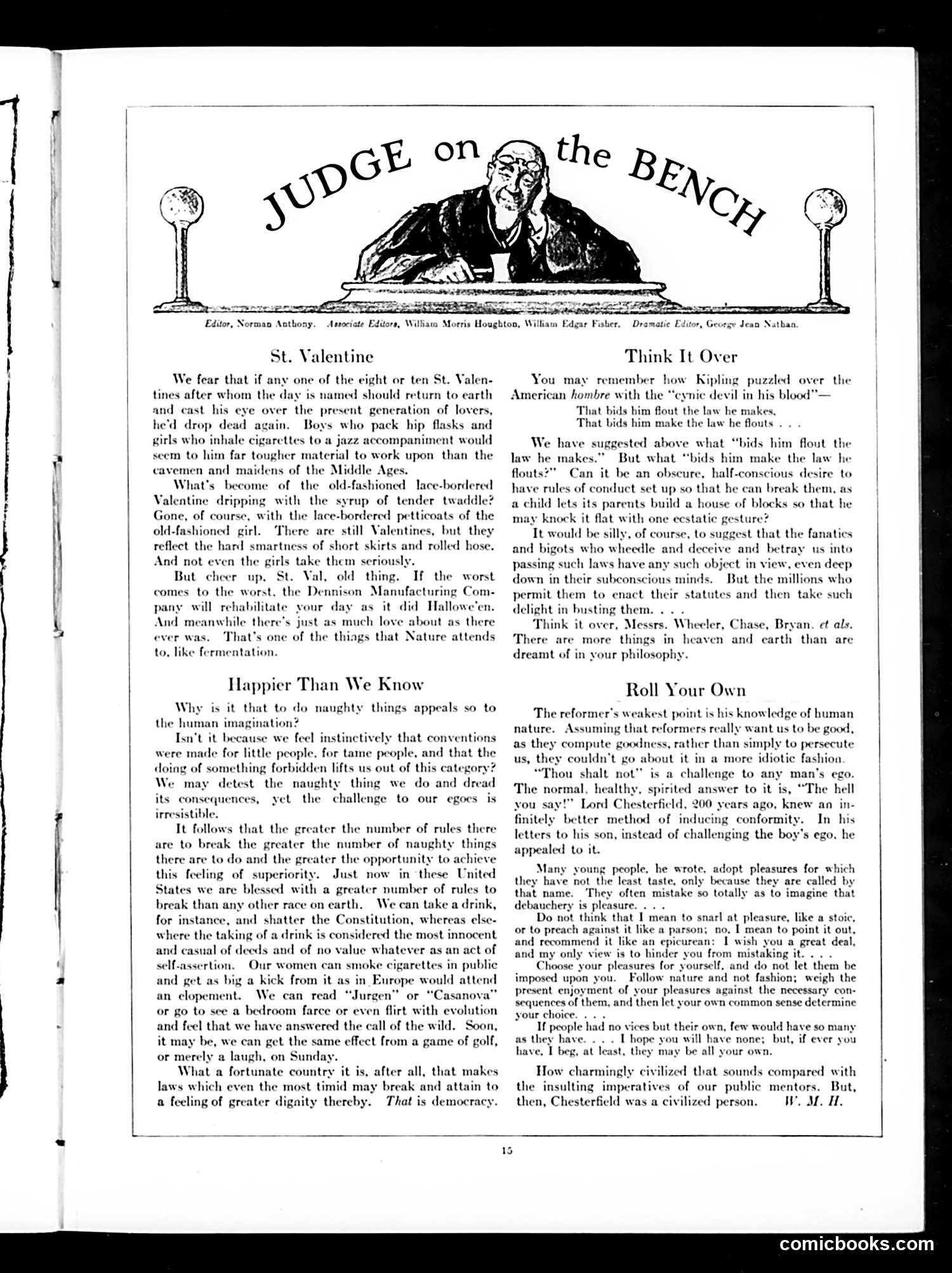
This page from Judge satirizes American attitudes toward laws and rule-breaking during Prohibition-era America (likely 1920s, given references to hip flasks, cigarette-smoking women, and "the Constitution"). **Main Satirical Points:** The articles argue that Americans uniquely enjoy breaking laws—not because the laws are unjust, but for the ego satisfaction of defying authority. The writer notes that American women can smoke publicly and people can drink despite Prohibition, which Europeans cannot, making rule-breaking feel like self-assertion and personal freedom. **Key Targets:** The final article directly addresses anti-vice crusaders—"Wheeler, Chase, Bryan" (likely William H. Wheeler and William Jennings Bryan, prominent Prohibition advocates)—suggesting their laws paradoxically *create* the rebellious behavior they condemn by providing rules to break. **The Joke:** The satire isn't that laws are bad, but that America's abundance of restrictive legislation has made lawbreaking feel like democracy itself—a dark irony for those who enacted such laws believing they'd improve morality.
📄 Transcribed text from this page (OCR, searchable)
Machine-transcribed from the original scan — historical spelling and the odd misread are preserved.
—X—=——_eessh re a eee le a a Editor, Norman Anthony. St. Valentine We fear that if any one of the eight or ten St. Valen- tines after whom the day is named should return to earth and cast his over the present generation of lovers, he'd drop de in. Boys who pack hip flasks and girls who inhale cigarettes to a jazz accompaniment would seem to him far tougher material to work upon than the cavemen and maidens of the Middle Ages. What's become of the old-fashioned lace-bordered Valentine dripping with the syrup of tender twaddle? Gone, of course, with the lace-bordered petticoats of the old-fashioned girl. There are still Valentines, but they reflect the hard smartness of short skirts and rolled hose. And not even the girls take them seriously. But cheer up, St. Val, old thing. If the worst comes to the worst, the Dennison Manufacturing Com- pany will rehabilitate your day as it did Hallowe'en. And meanwhile there's just as much love about as there ever was. That's one of the thiags that Nature attends to, like fermentation. Happier Than We Know Why is it that to do naughty things appeals so to the human imagination? Isn't it because we feel instinctively that conventions were made for little people, for tame people, and that the doing of something forbidden lifts us out of this category? We may detest the naughty thing we do and dread its consequences, yet the challenge to our egocs is irresistible. It follows that the greater the number of rules there are to break the greater the number of naughty things there are to do and the greater the opportunity to achieve this feeling of superiority. Just now in these United States we are blessed with a greater number of rules to break than any other race on earth. We can take a drink, for instance, and shatter the Constitution, whereas else- where the taking of a drink is considered the most innocent and casual of deeds and of no value whatever as an act of self-assertion. Our women can smoke cigarettes in public and get as big a kick from it as in Europe would attend an clopement. We can read “Jurgen” or “Casanova” or go to see a bedroom farce or even flirt with evolution and feel that we have answered the call of the wild. Soon, it may be, we can get the same effect from a game of golf, or merely a laugh, on Sunday. What a fortunate country it is, after all, that makes laws which even the most timid y break and attain to a feeling of greater dignity thereby. That is democ Associate Editors, Williara Morris Houghton, William Edgar Fisher. Dramatic Edit Think It Over You may remember how Kipling puzzled ov American hombre with the “cynic devil in his blood” — That bids bim flout the law he makes, That bids him make the law he flouts . . . the We have suggested above what law he makes.” But what “bids him make the law he flouts?” Can it be an obscure, half-conscious desire to have rules of conduct set up so that he can break them, as a child lets its parents build a house of blocks so that he may knock it flat with one ecstatic gestui It would be sill and bigots who w “bids him flout the to suggest that the fanatics eedle and deceive and betray us into passing such laws have any such object in view, even deep down in their subconscious minds. But the millions who permit them to enact their statutes and then take such delight in busting them. . . . Think it over, Messrs. Wheeler, Chase, Bryan. et als. There are more things in heaven and earth than are dreamt of in your philosophy. of course, Roll Your Own The reformer’s weakest point is his knowledge of human nature. Assuming that reformers really want us to be good, as they compute goodness, rather than simply to persecute us, they couldn't go about it in a more idiotic fashion “Thou shalt not” is a challenge to any man’s ego. The normal, healthy, spirited answer to it is, “The hell you say!” Lord Chesterfield, 200 years ago, knew an in- finitely better method of inducing conformity. In his letters to his son, instead of challenging the boy's ego, he appealed to it. Many young people, he wrote, adopt pleasures for which they have not the least taste, only because they are called by that name. They often mistake so totally as to imagine that debauchery is pleasure. . Do not think that I mean to snarl at pleasure, like a stoic, or to preach against it like a parson; no, I mean to point it out, and recommend it like an epicurean: I wish you a great deal, and my only view is to hinder you from mistaking it. Choose your pleasures for yourself, and do not let ‘them be imposed upon you. Follow nature and not fashion; weigh the present enjoyment of your pleasures against the necessary con- sequences of them, and then let your own common sense determine your choice. If people had no vices but their own, few would have so many as they have. . . . I hope you will have none; but, if ever you have, I beg, at least, they may be all your own. How charmingly civilized that sounds compared with the insulting imperati of our public mentors. But, then, Chesterfield was a civilized person. We MH. comicbooks.com