
Judge, 1925-02-14 · page 24 of 36
Judge — February 14, 1925 — page 24: what you’re looking at
What you’re looking at
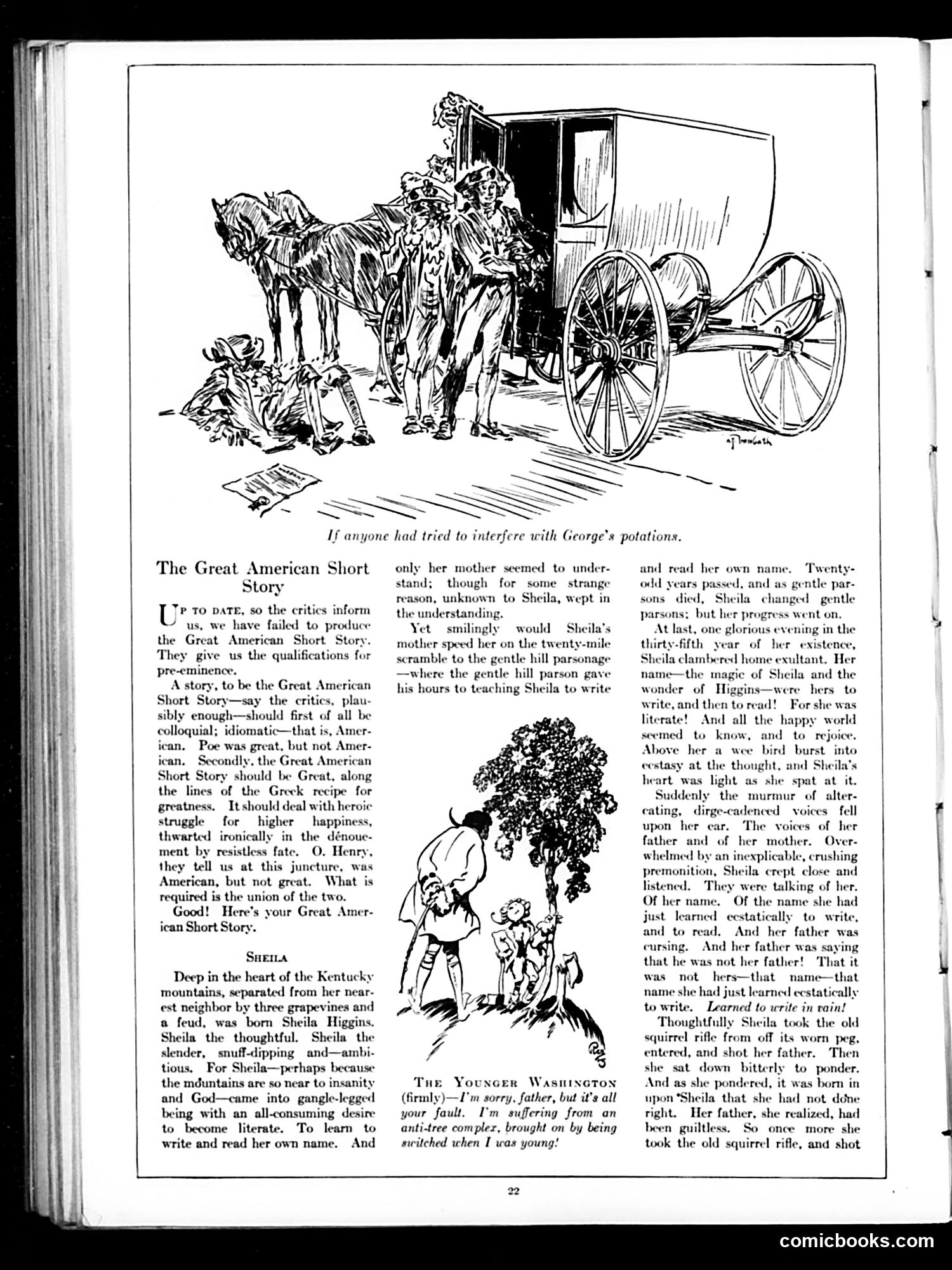
This page satirizes literary critics' prescribed formula for the "Great American Short Story." The critics demand three elements: colloquial American language, tragic grandeur on Greek lines, and heroic struggle ending in ironic defeat by fate. The accompanying story "Sheila" mockingly delivers exactly what they asked for. A Kentucky mountain girl spends 35 years learning to write her own name—a humble, colloquial struggle. Upon achieving literacy, she discovers her father isn't her biological parent, making her hard-won education meaningless. She shoots him, then realizes he was innocent and shoots herself instead. The satire works by literalizing the critics' demands: the story *is* colloquial, *is* tragic, *is* thwarted by fate—yet the result is absurd melodrama, not great literature. The secondary cartoon about "The Younger Washington" appears unrelated, likely advertising or filler.
📄 Transcribed text from this page (OCR, searchable)
Machine-transcribed from the original scan — historical spelling and the odd misread are preserved.
If anyone had tried to interfere with George's potations. The Great American Short Story TP To DATE, so the critics inform + us, we have failed to produce the Great American Short Story. They give us the qualifications for pre-eminence, A story, to be the Great American Short Story—say the critics, plau- sibly enough—should first of all be colloquial; idiomatic—that is, Amer- ican, Poe was great, but not Amer- ican. Secondly, the Great American Short Story should be Great, along the lines of the Greek recipe for greatness. It should deal with heroic struggle for higher happiness, thwarted ironically in the dénoue- ment by resistless fate. O. Henry, they tell us at this juncture, was American, but not great. What is required is the union of the two. Good! Here’s your Great Amer- ican Short Story. SnHei.a Deep in the heart of the Kentucky mountains, separated from her near- est neighbor by three grapevines and a feud, was born Sheila Higgins. Sheila the thoughtful. Sheila the slender, snuff-dipping and—ambi- tious. For Sheila—perhaps because the mduntains are so near to insanity and God—came into gangle-legged being with an all-consuming desire to become literate. To learn to write and read her own name, And only her mother seemed to under- stand; though for some strange reason, unknown to Sheila, wept in the understanding. Yet smilingly would Sheila's mother speed her on the twenty-mile scramble to the gentle hill parse —where the gentle hill parson gave his hours to teaching Sheila to write Tue Youncer Wasntncton (firmly)—I'm sorry, father, but it’s all your fault, I'm suffering from an anti-tree compler, brought on by being awitched when I was young! and read her own name. Twenty- odd years passes and as gentle par- sons died, Sheila changed gentle parsons; but her progress went on. At last, one glorious evening in the thirty-fifth year of her existence, Sheila clambered home exultant. Her name—the magic of Sheila and the wonder of Higgins—were hers to write, and then to read! For she was literate! And all the happy world seemed to know, and to rejoice. Above her a wee bird burst into cestasy at the thought, and Sheila's heart was light as she spat at it. uddenly the murmur of alter- cating, dirge-cadenced voices fell upon her ear. The voices of her father and of her mother. Over- whelmed by an inexplicable, crushing premonition, Sheila crept close and listened. They were talking of her. Of her name. Of the name she had just learned eestatically to write, and to read, And her father was cursing. And her father was saying that he was not her father! That it was not hers—that name—that name she had just learned ecstatically to write. Learned to write in vain! Thoughtfully Sheila took the old squirrel rifle from off its worn peg, entered, and shot her father. Then she sat down bitterly to ponder. And as she pondered, it was born in upon ‘Sheila that she had not done right. Her father, she realized, had been guiltless. So once more she took the old squirrel rifle, and shot comicbooks.com uF