
A complete issue · 36 pages · 1924
Judge — December 6, 1924
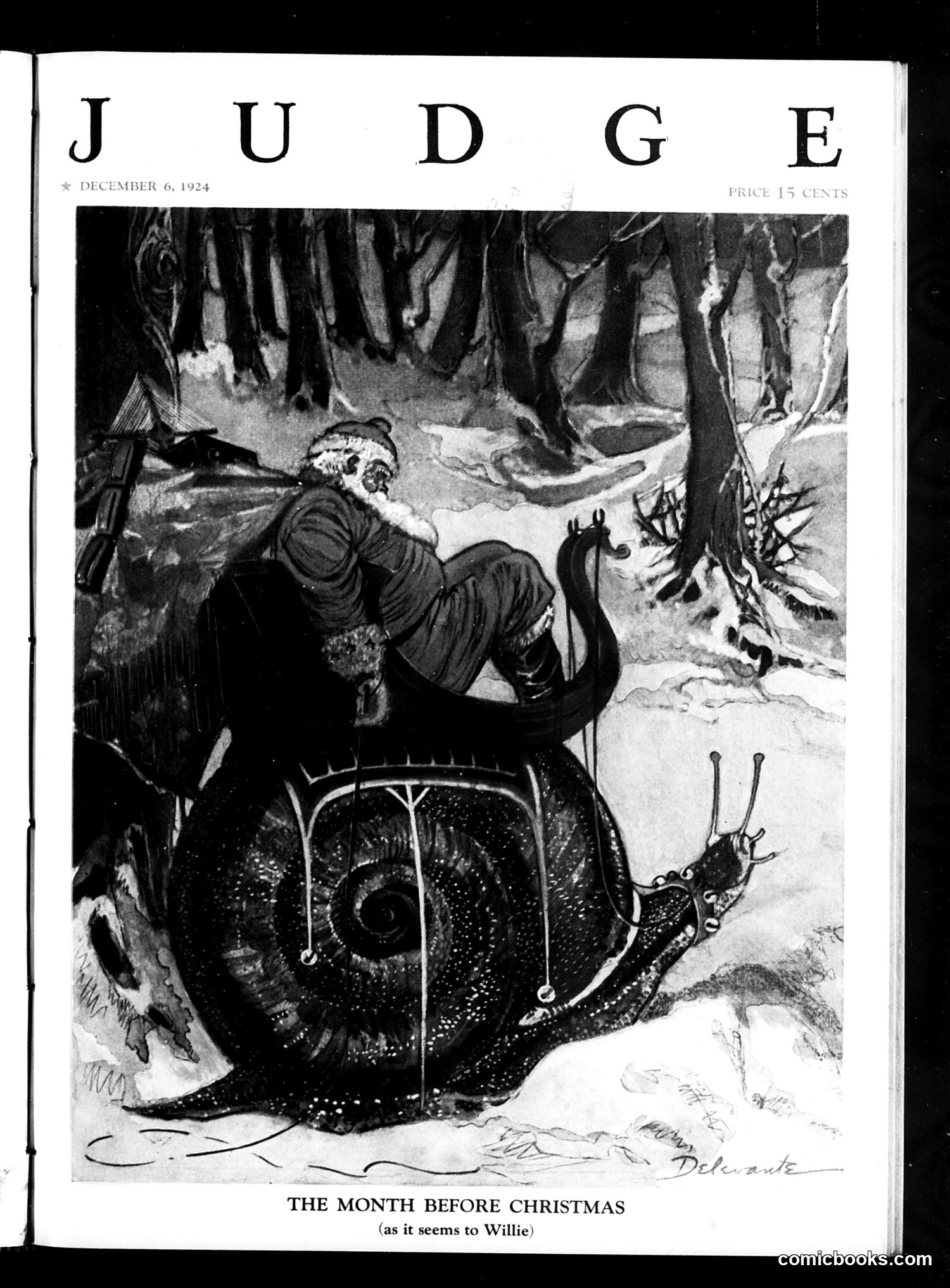
This satirical illustration depicts a figure labeled "Willie" experiencing a chaotic December scene before Christmas. The man sits surrounded by what appears to be a large beetle or insect, tangled holiday decorations, and forest scenery. The satire likely references the commercial chaos and stress of pre-Christmas shopping and preparation—the "month before Christmas" becomes overwhelming and grotesque rather than festive. The oversized insect and disheveled figure suggest that holiday preparations transform into something monstrous and out-of-control. "Willie" appears to be a generic everyman character used to represent the average person struggling with Christmas season demands. The artistic style is typical of Judge's satirical approach to American social customs and consumer culture of the 1920s.
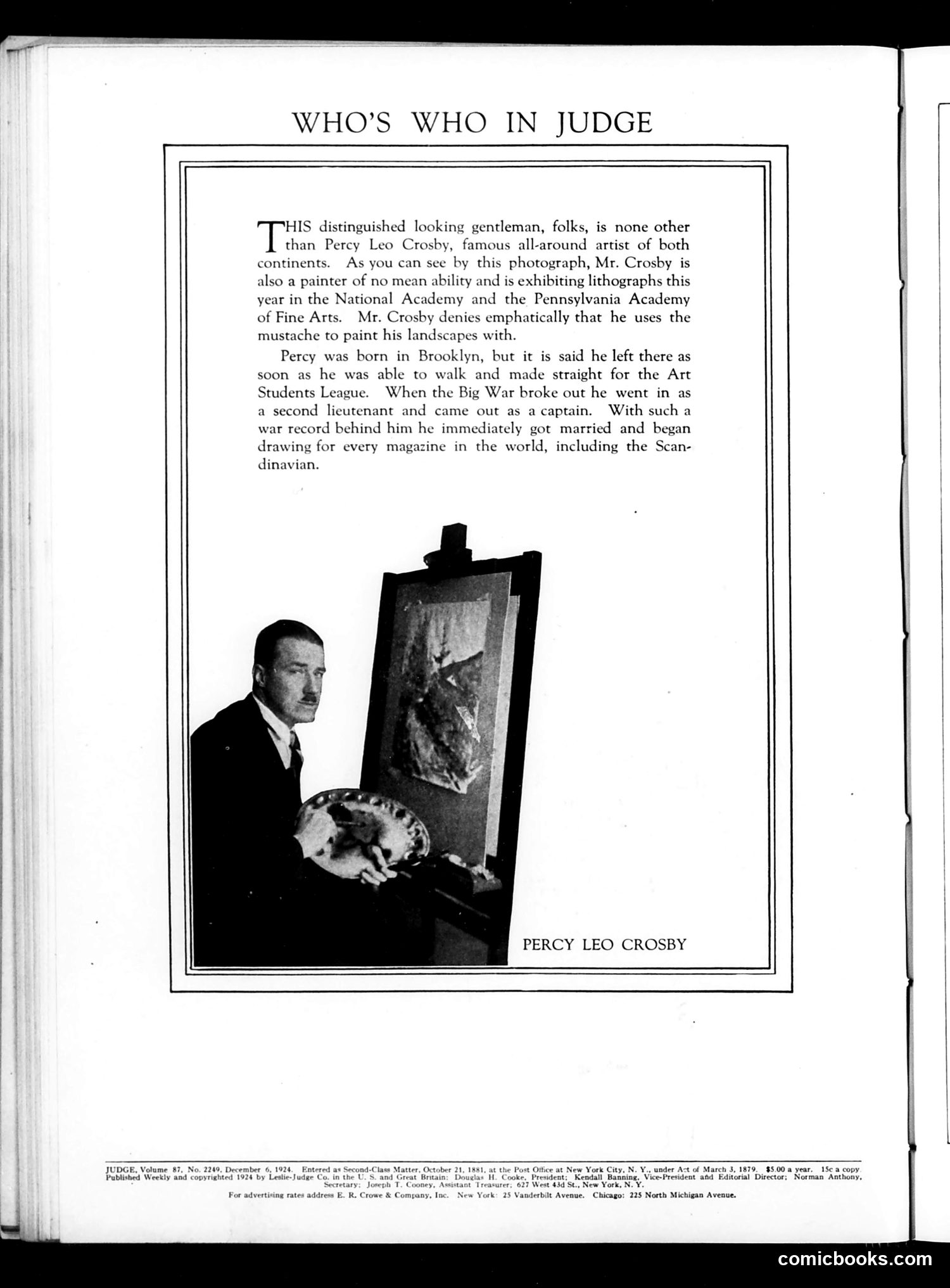
This page profiles Percy Leo Crosby, a prominent artist and illustrator of the early 1920s. The photograph shows him posing with his artist's palette beside an easel displaying one of his landscape paintings. The accompanying text humorously describes Crosby as a versatile "all-around artist of both continents" who paints and creates lithographs. It includes a joke about his mustache—explicitly stating he *doesn't* use it to paint landscapes, a humorous denial suggesting readers might have made that assumption. The biographical details note his Brooklyn birth, early commitment to art, World War I service as a captain, and subsequent prolific career illustrating for major magazines including Scandinavian publications. This appears to be a lighthearted celebrity profile typical of Judge's "Who's Who" feature.
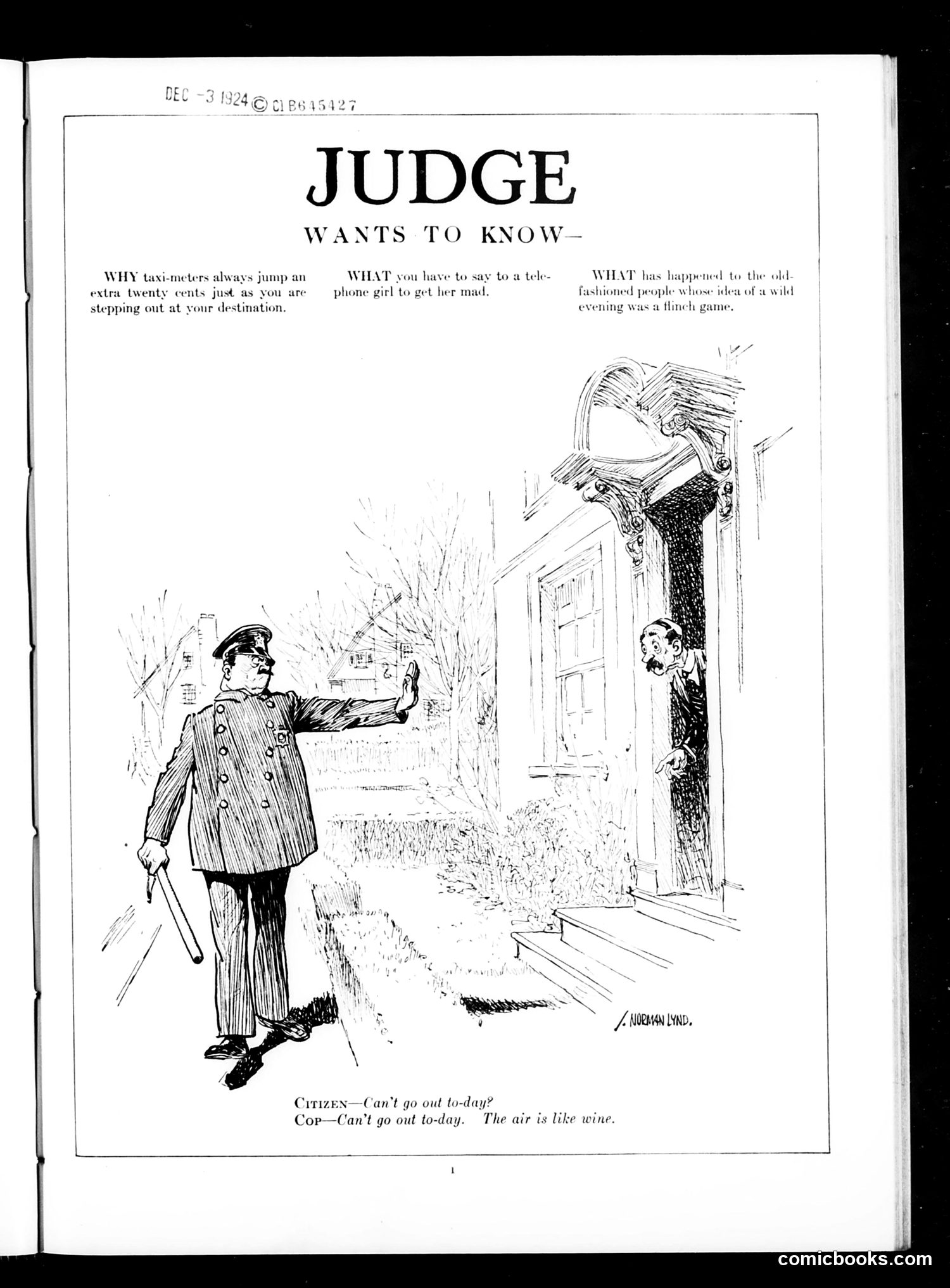
This 1924 Judge magazine cartoon satirizes Prohibition enforcement. A police officer blocks a citizen from leaving his home, claiming "The air is like wine"—a sarcastic reference to the environmental effects of Prohibition-era bootlegging and home alcohol production. The three "wants to know" questions above mock the absurdities of Prohibition: - Why taxi-meters jump twenty cents as you arrive - What to tell a telephone girl to get her mail - What happened to old-fashioned people whose idea of a wild evening was a lunch game The cartoon ridicules both police overreach and the widespread illegal alcohol production that characterized Prohibition, suggesting that even the air itself smells of illicit fermentation. It's social commentary on the law's unpopularity and ineffectiveness.
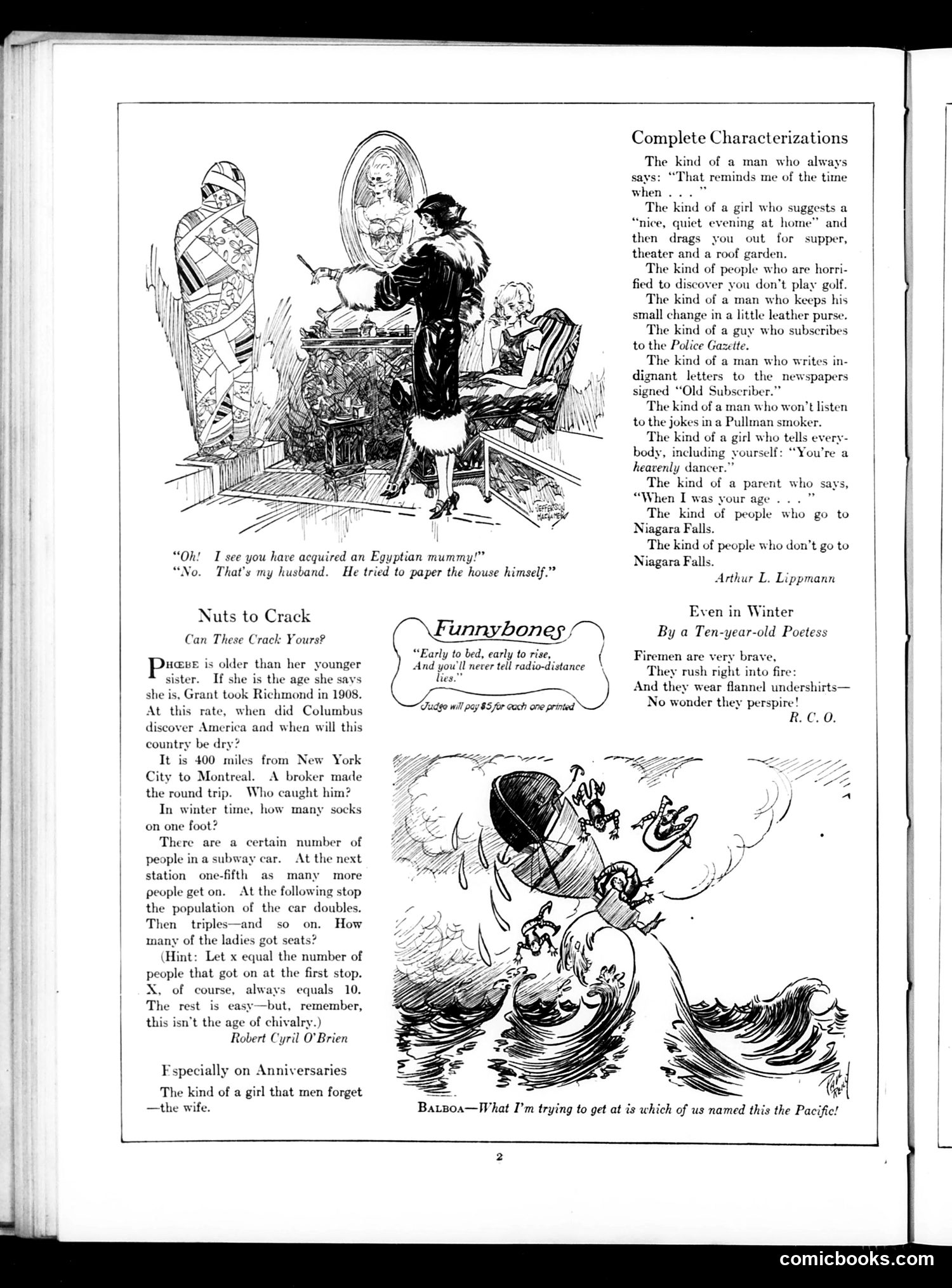
The main cartoon shows a woman examining an Egyptian mummy while a man and child look on. The caption reads: "Oh! I see you have acquired an Egyptian mummy!" / "No. That's my husband. He tried to paper the house himself." **The joke**: This is domestic humor mocking incompetent DIY home improvement. The husband's botched wallpapering job has left him looking mummified—wrapped in strips of paper. The satire targets male pride in attempting household tasks without proper skill or help, a common theme in early-20th-century American humor. The page also contains unrelated humorous pieces ("Nuts to Crack," "Funnybones," and "Even in Winter") that are various short jokes and verses typical of *Judge* magazine's satirical content.
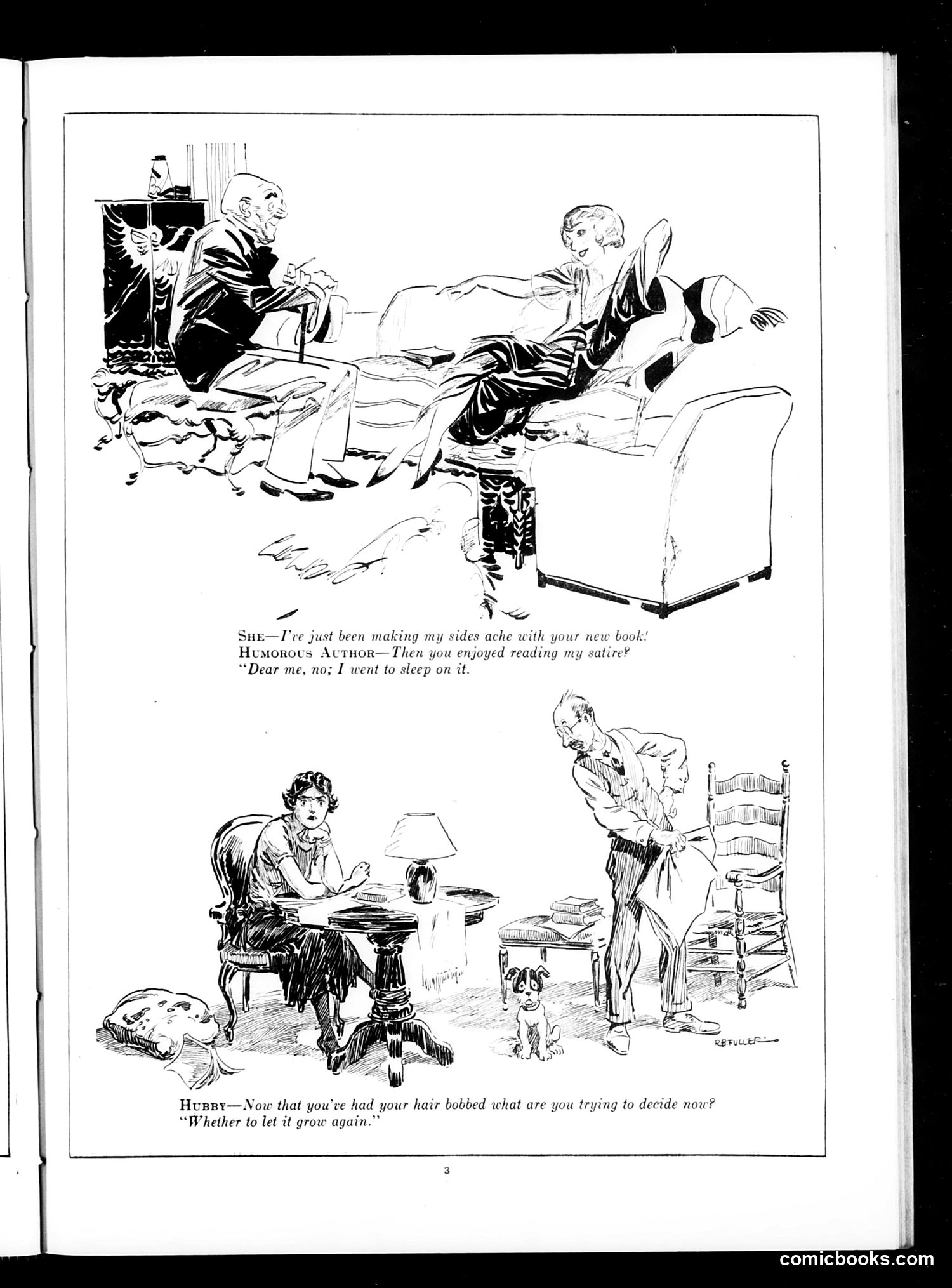
This page contains two separate humorous cartoons satirizing domestic life and social conventions of the era (likely early 20th century based on style). **Top cartoon**: A woman complains to a male author that his satirical book made her "sides ache" from laughing. He responds he's glad she enjoyed his satire, as he wanted readers to "sleep on it"—suggesting his work was intended as serious social criticism, not mere entertainment. **Bottom cartoon**: A husband questions his wife about her newly bobbed hair, asking whether she'll let it grow back. This satirizes the 1920s fashion controversy surrounding bobbed hair—a symbol of women's liberation and changing social norms that conservatives found shocking. Both cartoons gently mock contemporary social anxieties: intellectual pretension and generational shifts in women's appearance and autonomy.
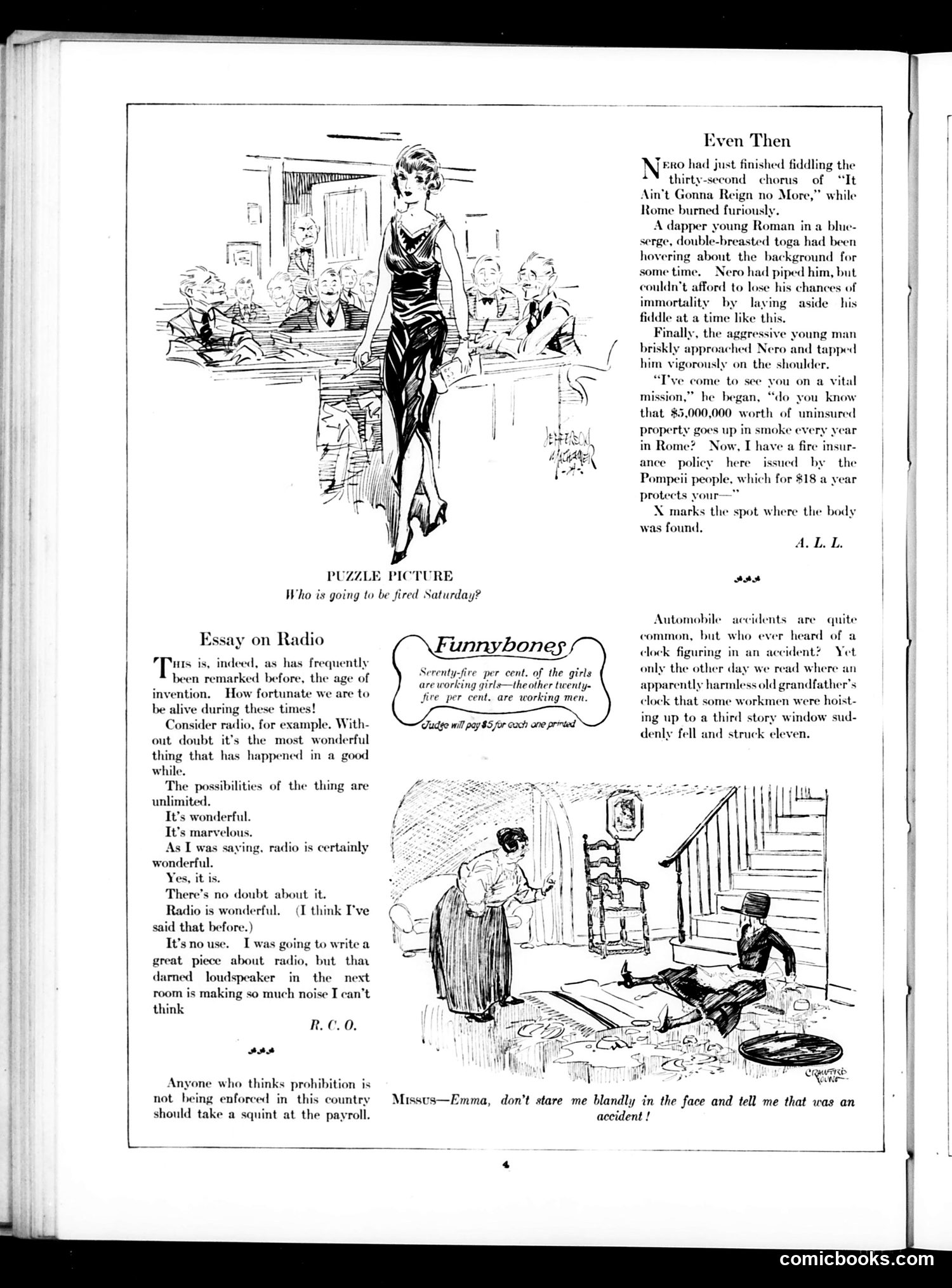
**Top Cartoon ("Puzzle Picture"):** Shows a glamorous woman in a nightclub setting. The caption asks "Who is going to be fired Saturday?" This appears to be a social satire about workplace romance or scandal in the Jazz Age—likely suggesting someone will face consequences for improper conduct. **"Even Then" Story:** References Nero and Rome burning, comparing it to a modern insurance sales pitch about fire damage in Rome. The humor lies in the absurdity of selling fire insurance during catastrophe—a satire on aggressive salesmanship and commercialism. **"Essay on Radio":** Praises radio as a wonderful invention while criticizing a loud speaker in the next room, satirizing how technology creates new annoyances. **"Funnybones" Cartoon:** Shows domestic chaos—a humorous domestic scene satirizing family life and accidents, with the caption suggesting a clock fell from a window.
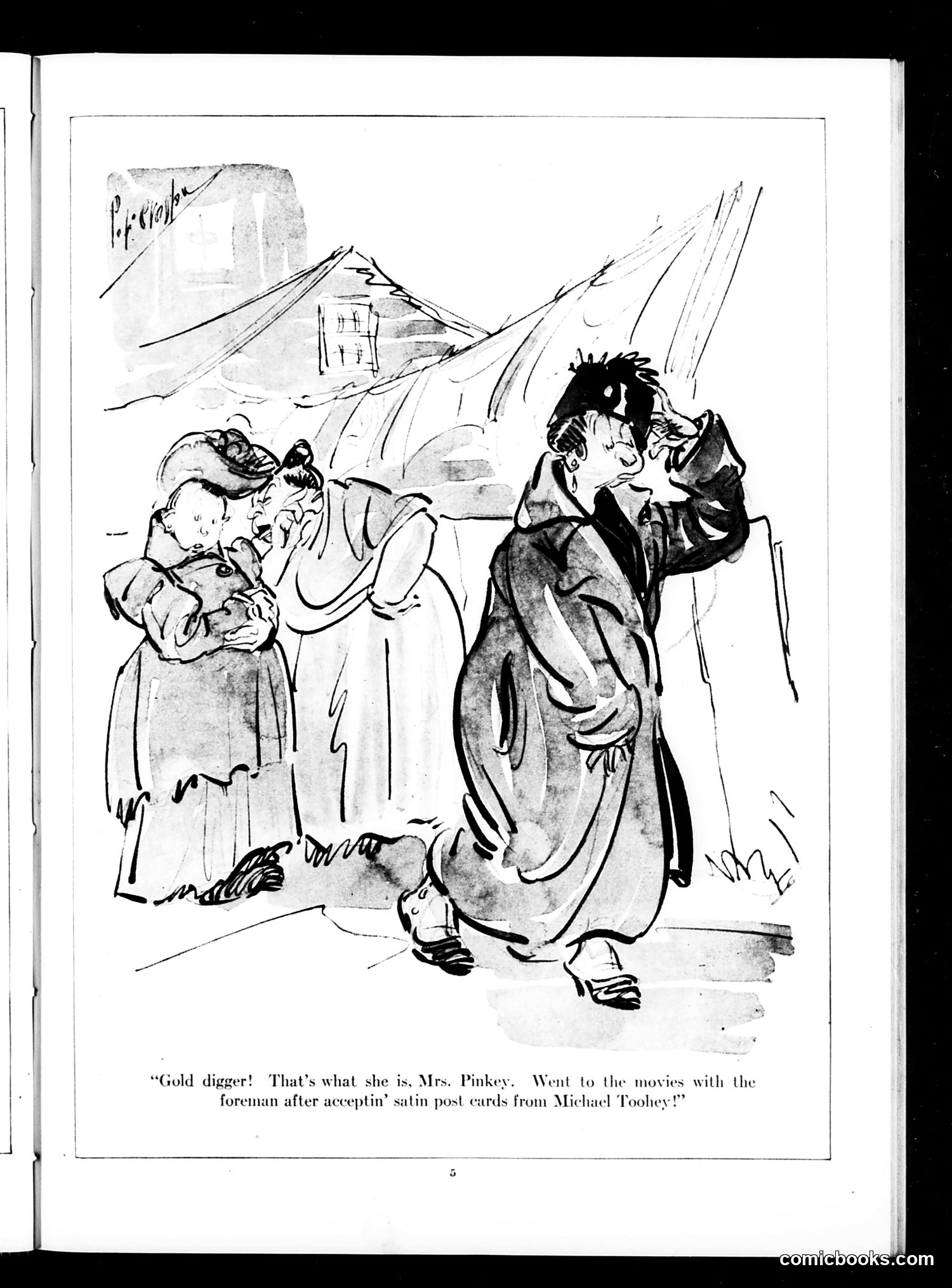
This satirical cartoon from *Judge* magazine mocks a woman named Mrs. Pinkey for her social climbing and moral flexibility. The caption reports she's a "gold digger" who accepted "satin post cards from Michael Toohey" and then went to the movies with a foreman—apparently trading romantic favors for gifts. The humor targets women perceived as mercenary in romantic relationships, a common trope in early-to-mid 20th century satire. "Gold digger" specifically refers to women who pursued men for money rather than genuine affection. The cartoon ridicules Mrs. Pinkey's apparent willingness to socialize with different men of varying social status in exchange for small luxuries, presenting her as unprincipled and opportunistic.
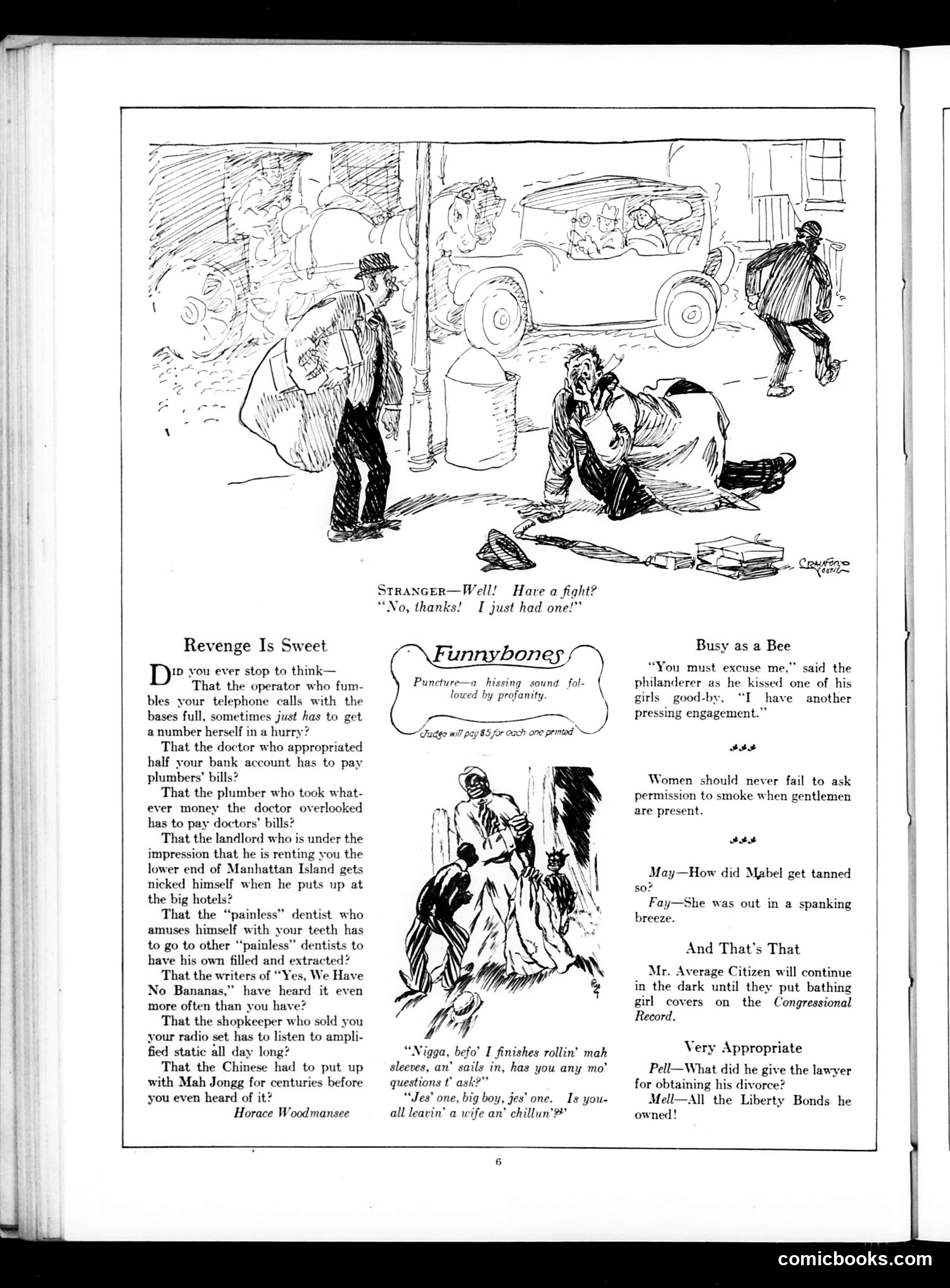
This page contains humor pieces satirizing everyday professional and social grievances from the early 20th century. **"Revenge Is Sweet"** by Horace Woodmansee presents a chain-of-comeuppance theme: the telephone operator who fumbles calls, the doctor who overcharges, the plumber who overcharges the doctor, the landlord who exploits tenants—all eventually face similar mistreatment from others. It's satirical social commentary suggesting cosmic justice through mutual exploitation. The final examples (the "Mah Jongg" reference, the radio seller) extend this to consumer frustrations of the era. **The cartoon at top** depicts a street fight between two men, with one saying he "just had one"—a joke about habitual fighting or quarrels. **"Funnybones"** offers a pun on "puncture" (a tire blowout producing profanity), with an illustration of a confrontation using period dialect. **The right column** contains brief jokes about infidelity, women's smoking etiquette, tanning, congressional transparency, and divorce settlements (specifically Liberty Bonds, likely WWI-era investments). The overall tone mocks professional services, gender relations, and consumer frustrations typical of the 1920s era.
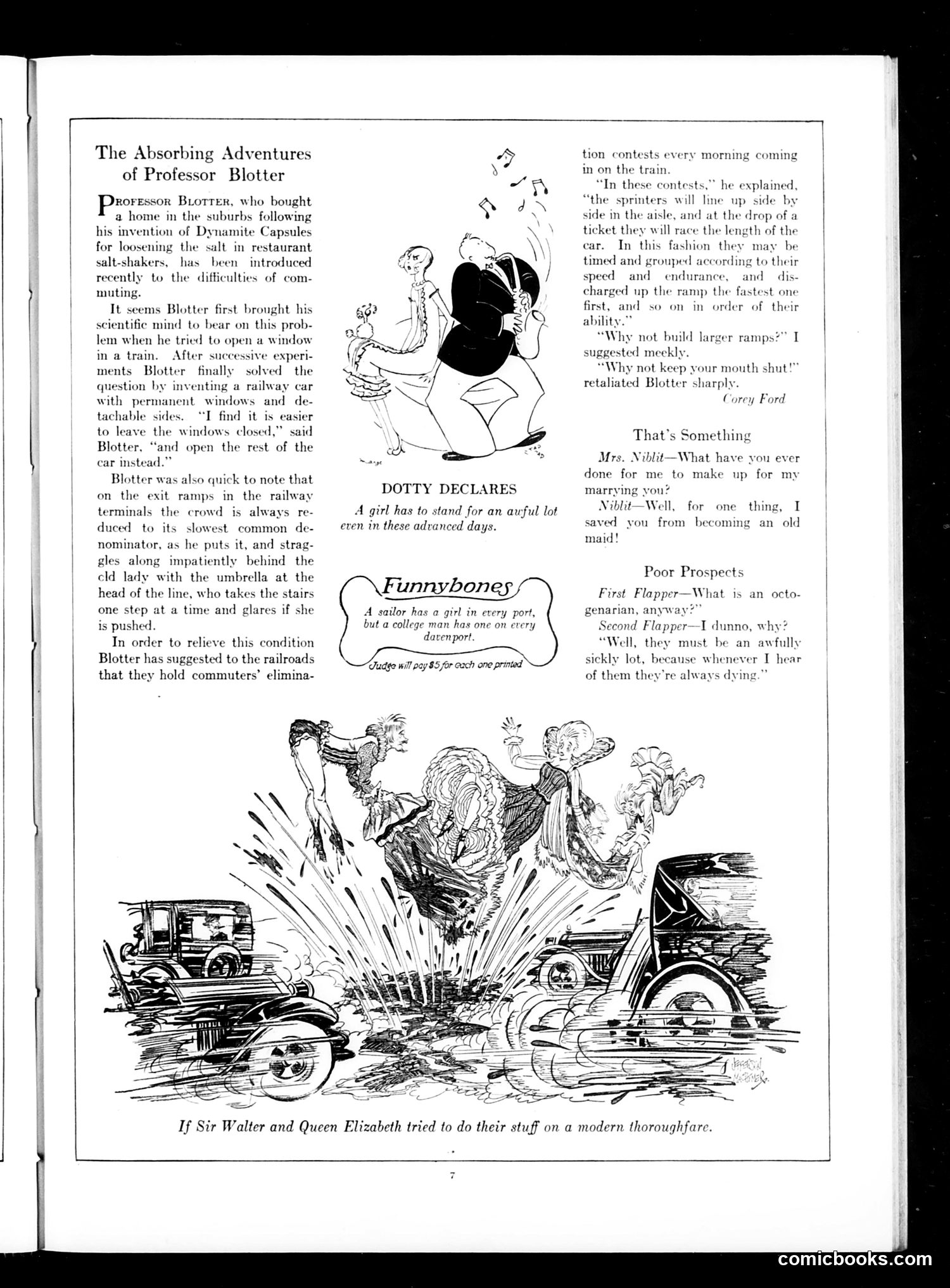
This page satirizes the absurdities of suburban commuting in early 20th-century America. "Professor Blotter," an inventor of trivial gadgets, attempts to solve train overcrowding with characteristically impractical solutions—designing railway cars with detachable sides or organizing "elimination contests" where commuters race down aisles. The satire targets both technological overconfidence and the very real frustration of commuter bottlenecks caused by slow elderly passengers blocking exits. The accompanying humor pieces mock courtship and generational ignorance. "Dotty Declares" comments on women's limited autonomy in dating. The "Funnybones" quips contrast sailors' romantic prospects with college men's. "Poor Prospects" ridicules young flappers' ignorance—they confuse "octogenarian" with a disease because older people "always dying." The bottom illustration depicts a catastrophic multi-car pileup, humorously visualizing what would happen if historical figures attempted modern transportation. Overall, the page combines gentle mockery of commuting frustrations, technological pretension, and youth culture.
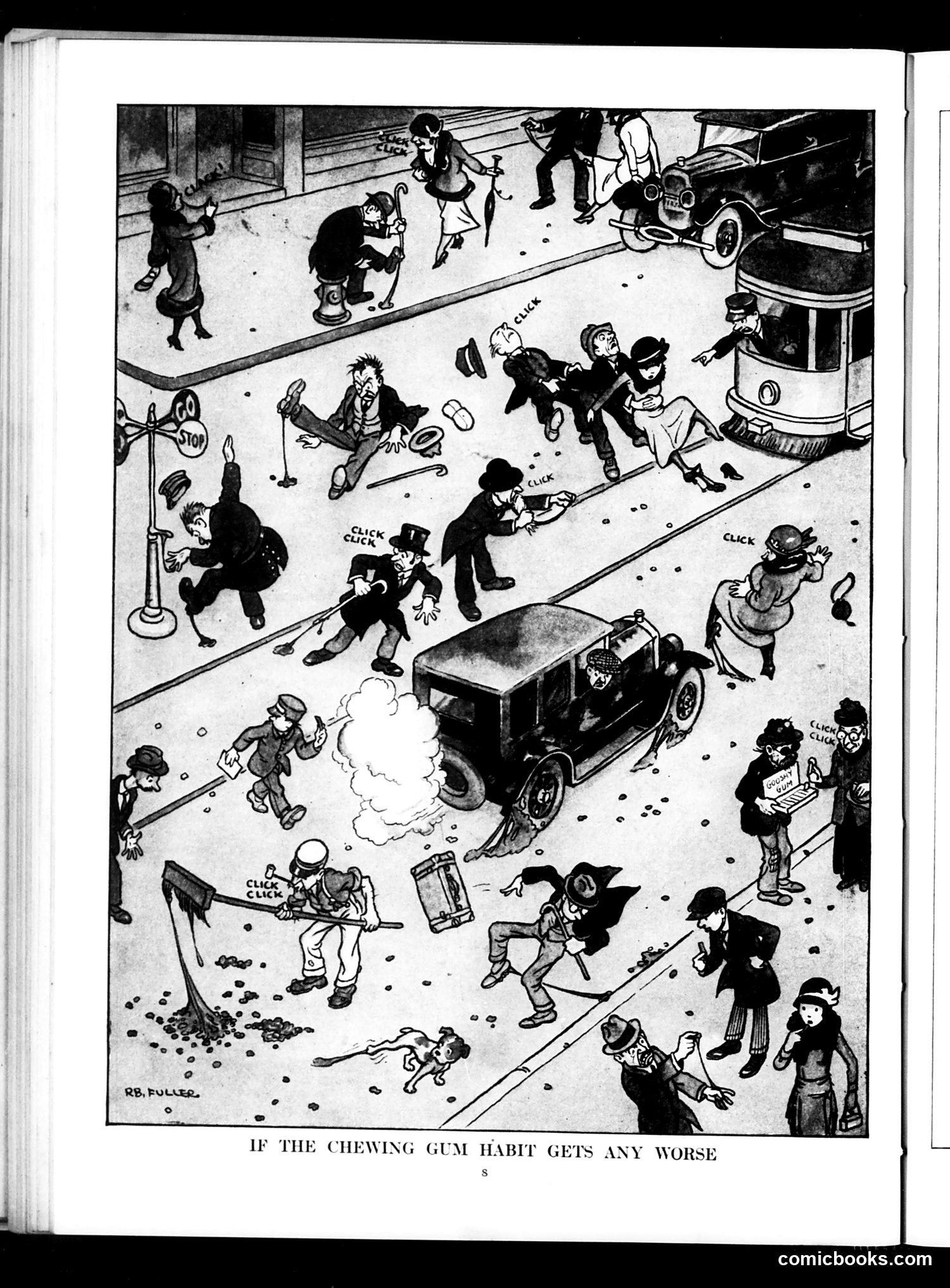
This is a satirical cartoon depicting a street scene where chewing gum litter has created chaos. The title "If the Chewing Gum Habit Gets Any Worse" suggests social commentary on a growing consumer trend. The cartoon shows numerous people scattered across a sidewalk, many appearing to slip or fall on discarded gum. Workers with tools attempt cleanup while others struggle to walk. The scene is deliberately exaggerated—gum appears everywhere as small dots on the pavement. The satire mocks both the chewing gum habit's popularity and public littering. This likely dates to the early-to-mid 20th century when mass-produced chewing gum became common and ubiquitous street litter was a genuine urban concern. The cartoon warns of societal decline through an absurdist lens, using gum as a symbol of consumer carelessness and its public consequences.
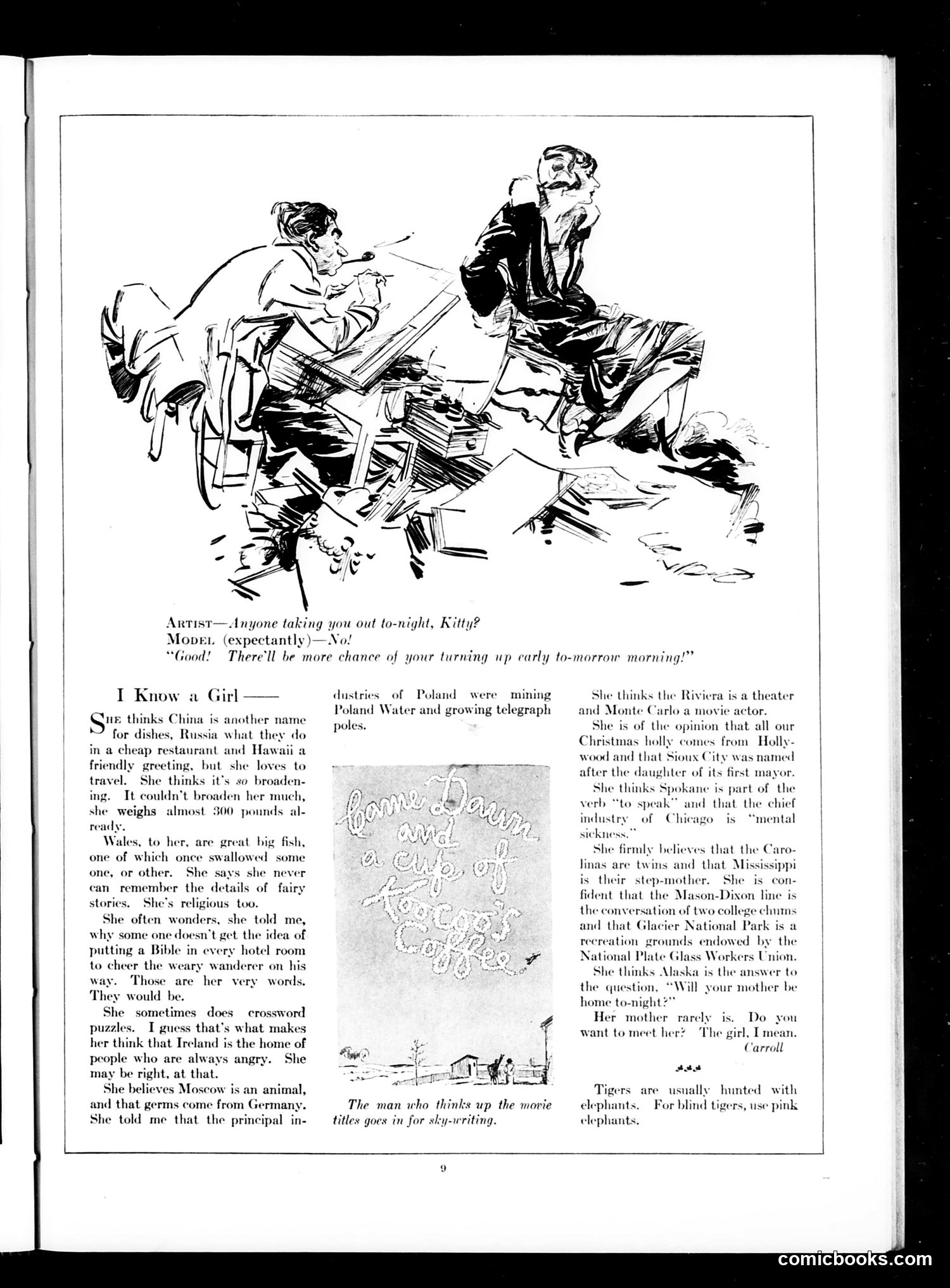
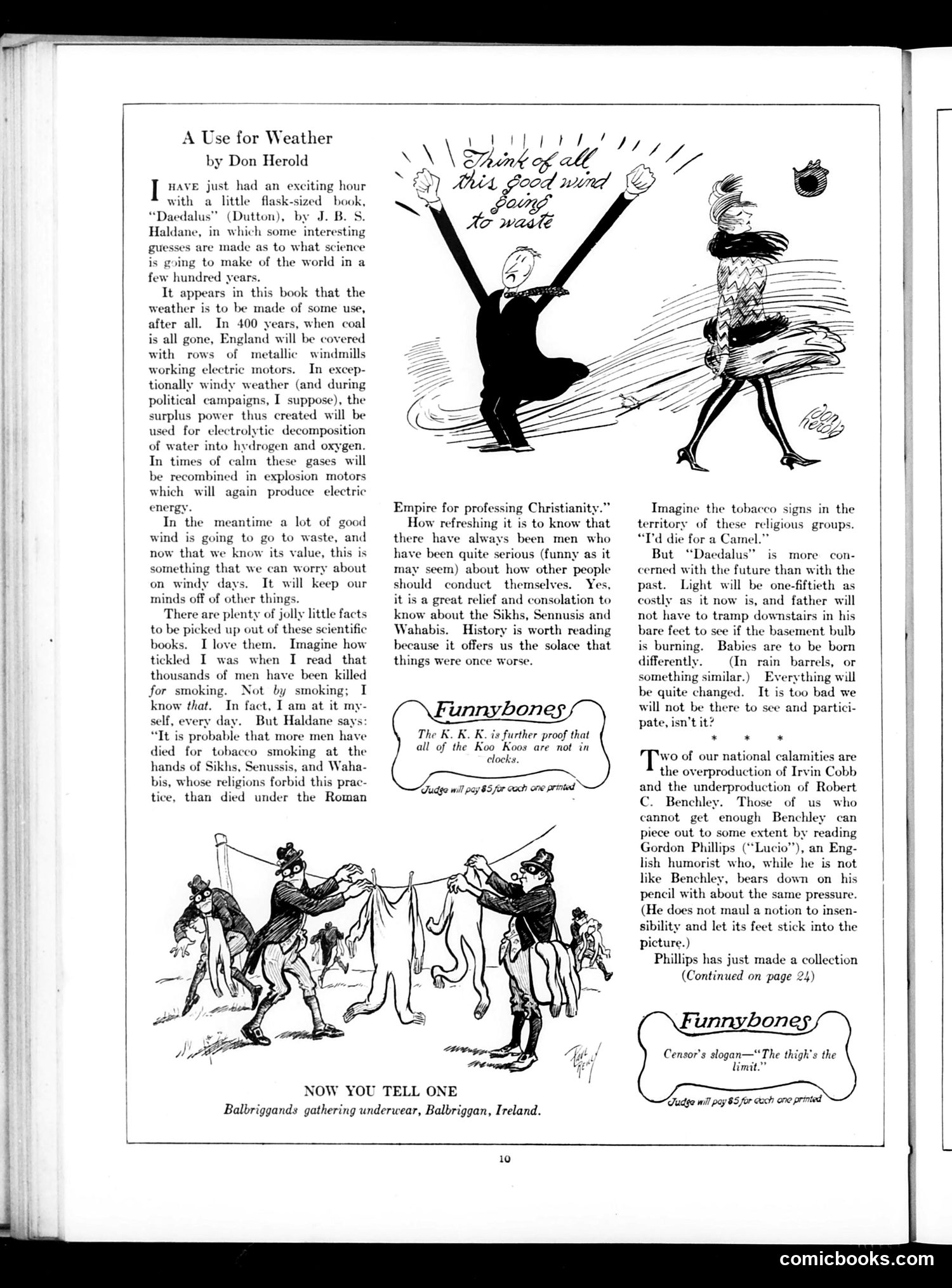
This is a humorous essay reviewing J.B.S. Haldane's futuristic book "Daedalus." Herold discusses Haldane's prediction that in 400 years, England will harness wind power via metallic windmills to generate electricity and decompose water into hydrogen and oxygen for fuel—making weather "useful" at last. The satire lies in Herold's digression about historical religious violence. He notes that more men have died for tobacco smoking at the hands of Sikhs, Senussis, and Wahhabis (whose religions forbid the practice) than died under Roman persecution of Christians. The joke: it's darkly comforting that humanity has *always* been absurdly serious about controlling others' behavior—religious intolerance isn't modern. The cartoon below shows men gathering laundry in Balbriggan, Ireland, with the caption "NOW YOU TELL ONE"—likely a joke about the town's textile industry (Balbriggan linen was famous). Two small "Funnybones" gag boxes appear, including one about the K.K.K. not being in clocks.
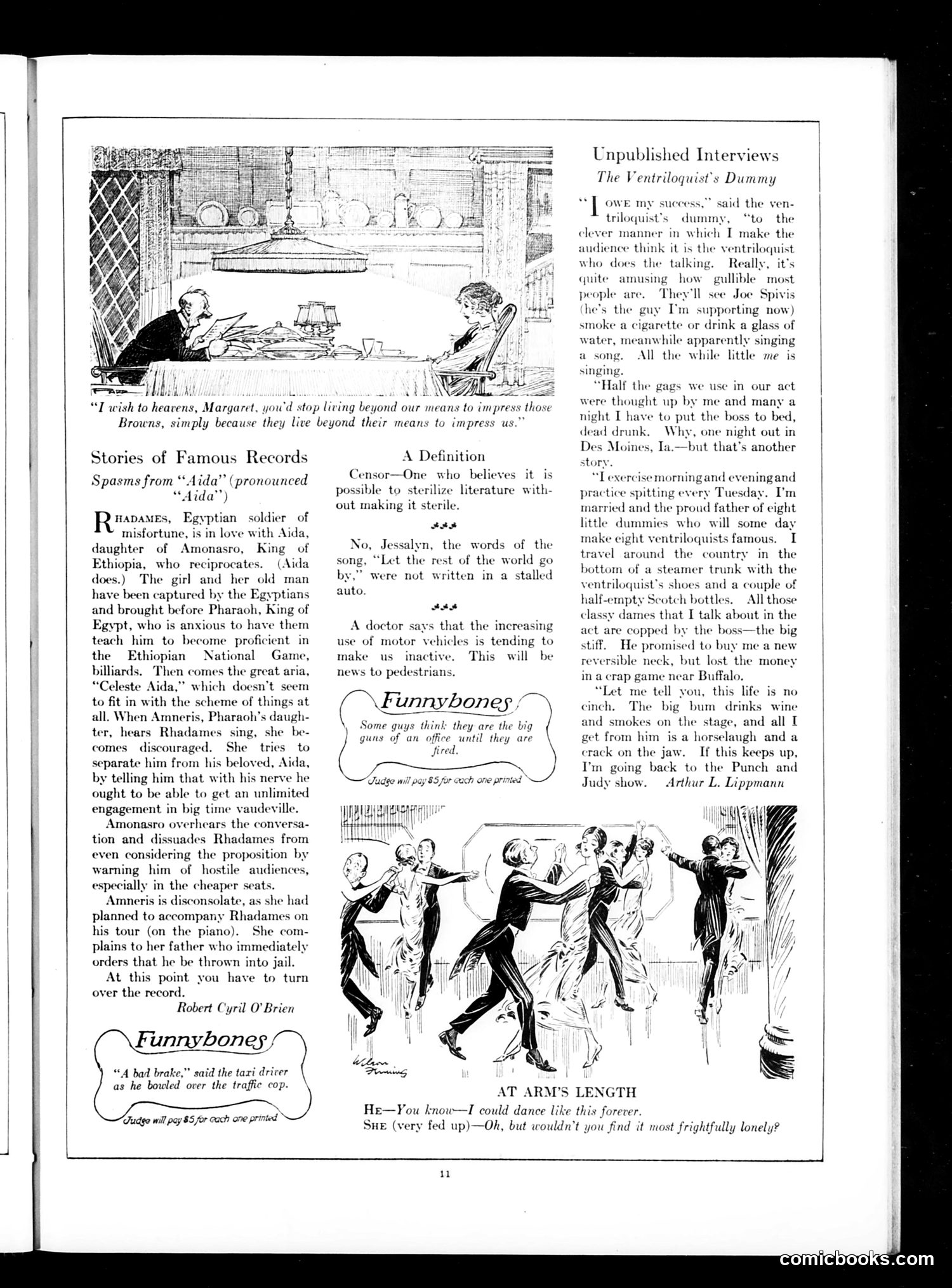
This page contains several satirical pieces typical of early-20th-century humor: **Main cartoon** (top): Depicts a couple at dinner, with the husband objecting to his wife's spending habits—a commentary on class anxiety and keeping up appearances. The satire targets Americans' tendency to overspend imitating wealthier neighbors. **"Stories of Famous Records"**: A humorous summary of Verdi's opera *Aida*, reducing its plot to absurdities (Pharaoh wanting to learn "the Ethiopian National Game, billiards"). This mocks both operatic conventions and American unfamiliarity with classical music. **"Funnybones" jokes**: Brief quips about censorship, automobiles, and office dynamics—reflecting contemporary concerns about new technology and workplace life. **"Unpublished Interviews"**: A ventriloquist's dummy claims credit for the act's success, satirizing ego and the exploitative relationship between performer and prop. The dummy describes a shabby touring life, critiquing vaudeville conditions. **Bottom cartoon** ("At Arm's Length"): A flirtation joke where the woman fears emotional attachment, using dancing as metaphor. The overall tone reflects Jazz Age humor: cynical about relationships, technology, and institutions.
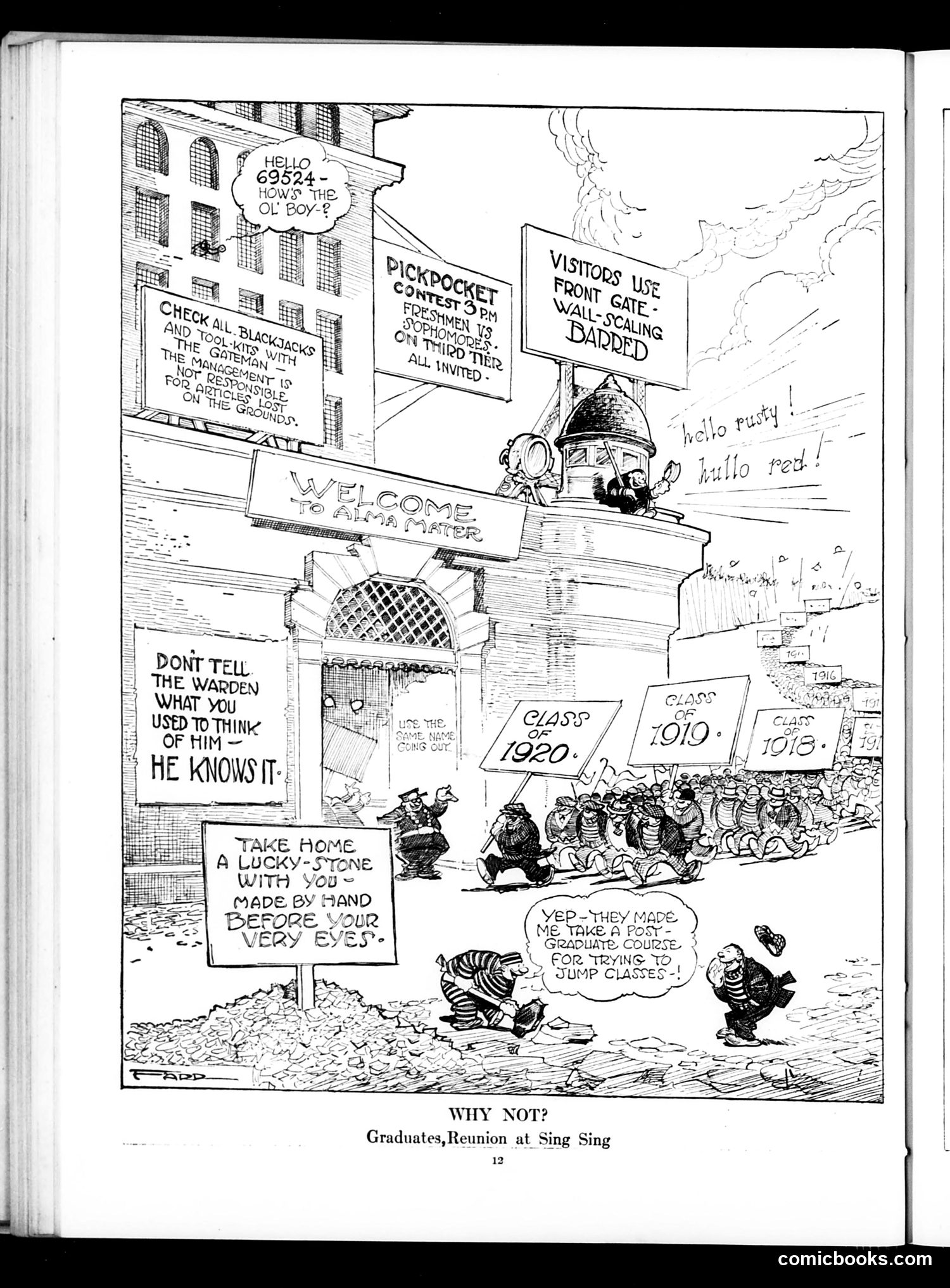
This satirical cartoon depicts a prison reunion at Sing Sing Correctional Facility. The image shows graduates from different class years (1920, 1913, etc.) returning to the prison where they were previously incarcerated, treating it as if it were an alma mater. The humor targets the revolving-door nature of the criminal justice system—suggesting that inmates frequently return to prison after release. The various signs and dialogue mock both the prison's attempts at rehabilitation and the inmates' apparent inevitability of recidivism. References include the "pickpocket contest," warnings about security procedures, and the ironic notion that prisoners are taking "lucky stones made by hand" as souvenirs. The phrase "Why Not?" sardonically suggests that returning to prison is expected and unremarkable. This reflects early 20th-century cynicism about whether prisons could genuinely reform inmates or merely served as institutions that cycled the same criminals repeatedly.
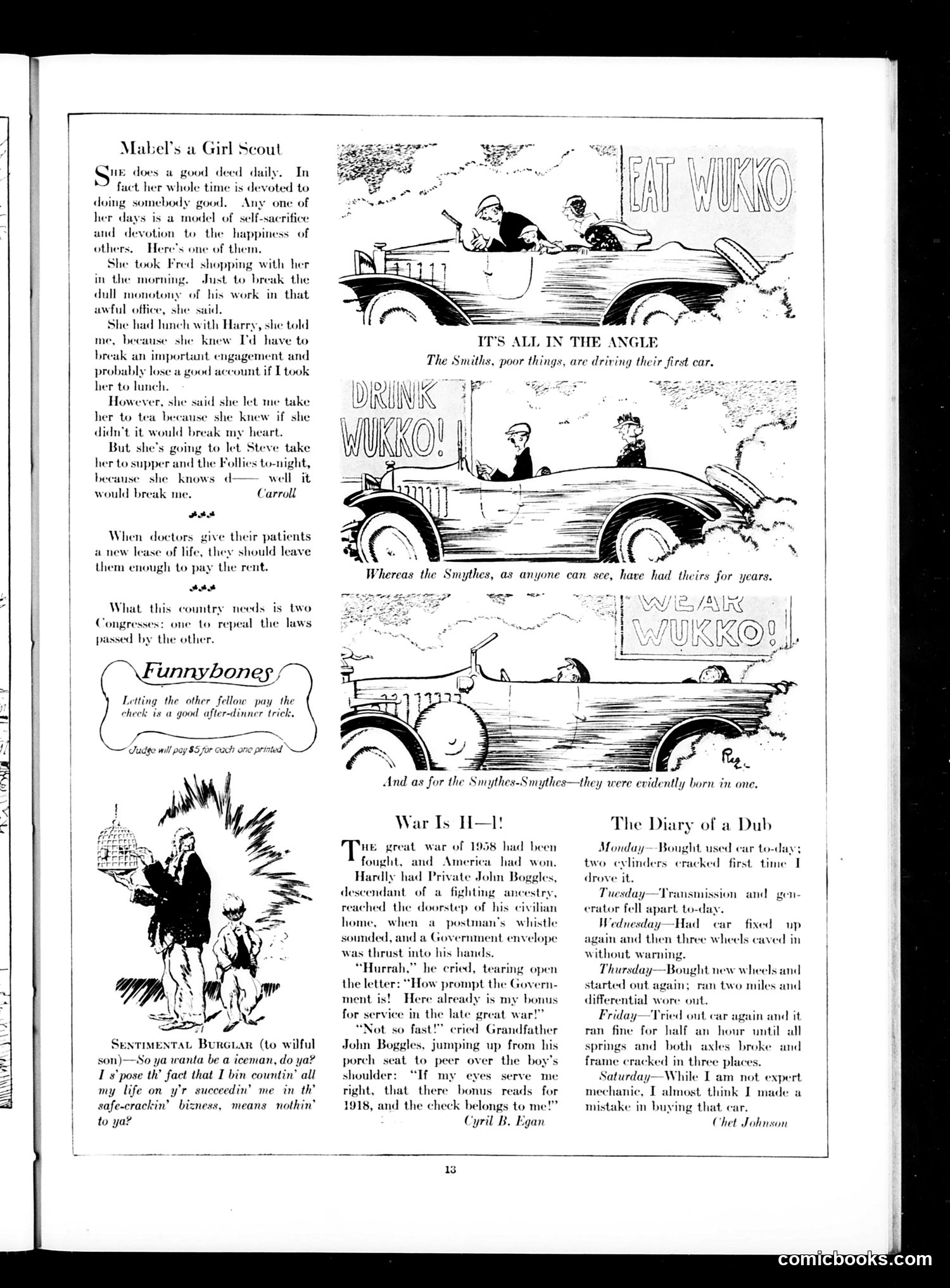
This page lampoons early 20th-century social conventions through several satirical pieces: **"Mabel's a Girl Scout"** mocks a young woman's performative virtue. Despite claiming daily good deeds, Mabel cynically manipulates male suitors—taking Fred shopping, lunching with Harry, tea with another man, and supper with Steve—each time claiming she's doing *them* a favor to avoid "breaking their hearts." The satire targets both her transparent manipulation and the sentimental gullibility of the men. **"It's All in the Angle"** uses a car-driving sequence to joke about perspective: the Smiths' first car appears impressive from one angle but clearly ramshackle from another—commentary on superficial appearances. **"War Is H—l!"** satirizes bureaucratic incompetence: a WWI veteran receives a bonus check, only for his grandfather to claim it belongs to him from the 1918 war, mocking governmental record-keeping failures. **"The Diary of a Dub"** humorously catalogs a used car's catastrophic mechanical failures across one week, lampooning both poor-quality automobiles and the buyer's foolish optimism.
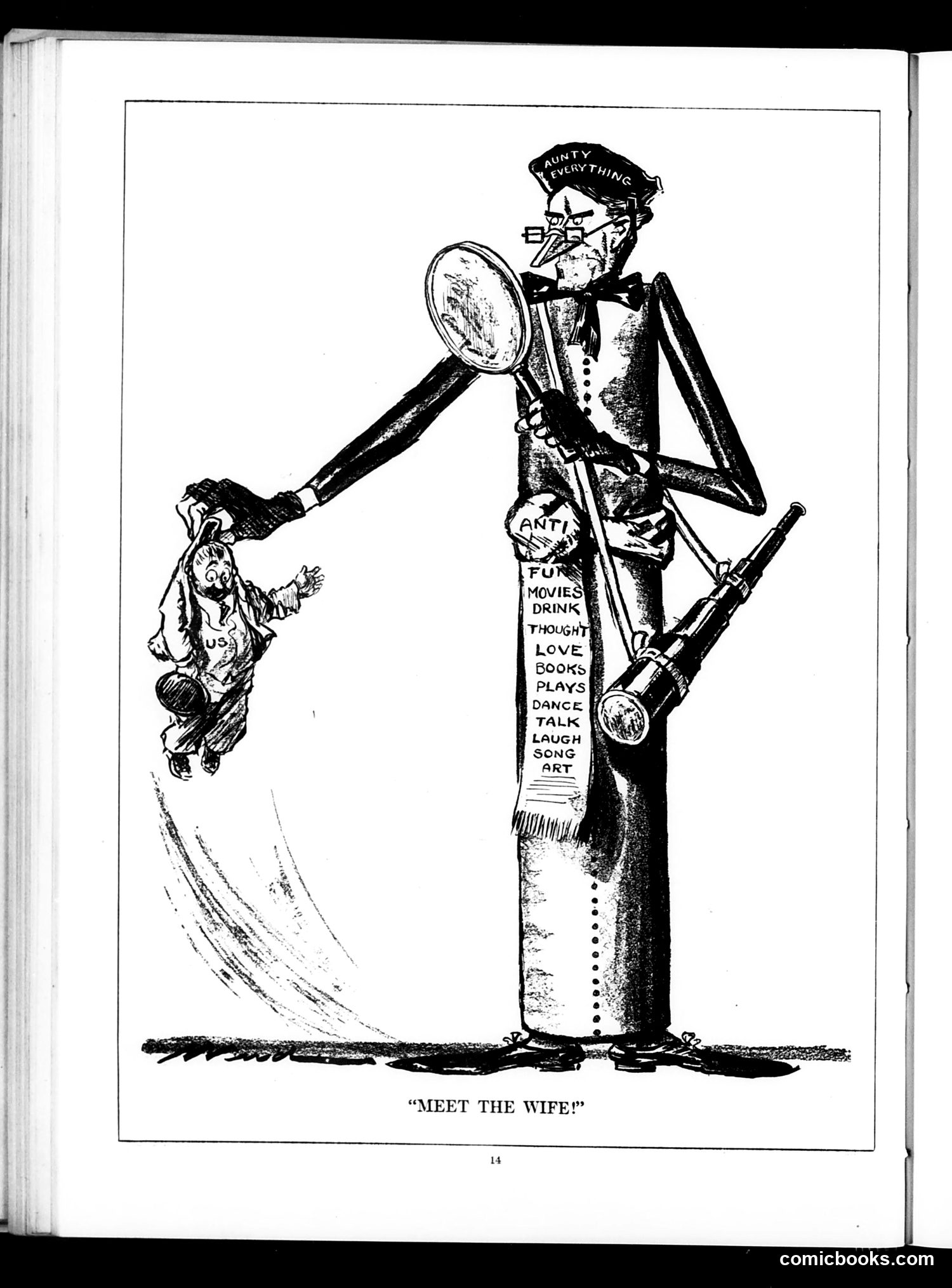
This satirical cartoon depicts a tall, skeletal figure labeled "Bounty on Everything" holding a magnifying glass, examining a tiny woman labeled "U.S." The woman appears distressed or defensive. The figure represents an authority or regulatory system imposing taxes/fees ("bounty") on all goods and services. The list on the woman's dress—"Fun, Movies, Drink, Thought, Love, Books, Plays, Dance, Talk, Laugh, Song, Art"—catalogs everyday pleasures being taxed or restricted. The cartoon satirizes excessive government taxation and regulation of civilian life, portraying the U.S. public as powerless and examined under scrutiny. The title "Meet the Wife!" uses dark humor, suggesting the government has married itself to the American people through invasive fiscal policy. The work likely dates to the early 20th century, reflecting anxieties about expanding government oversight.
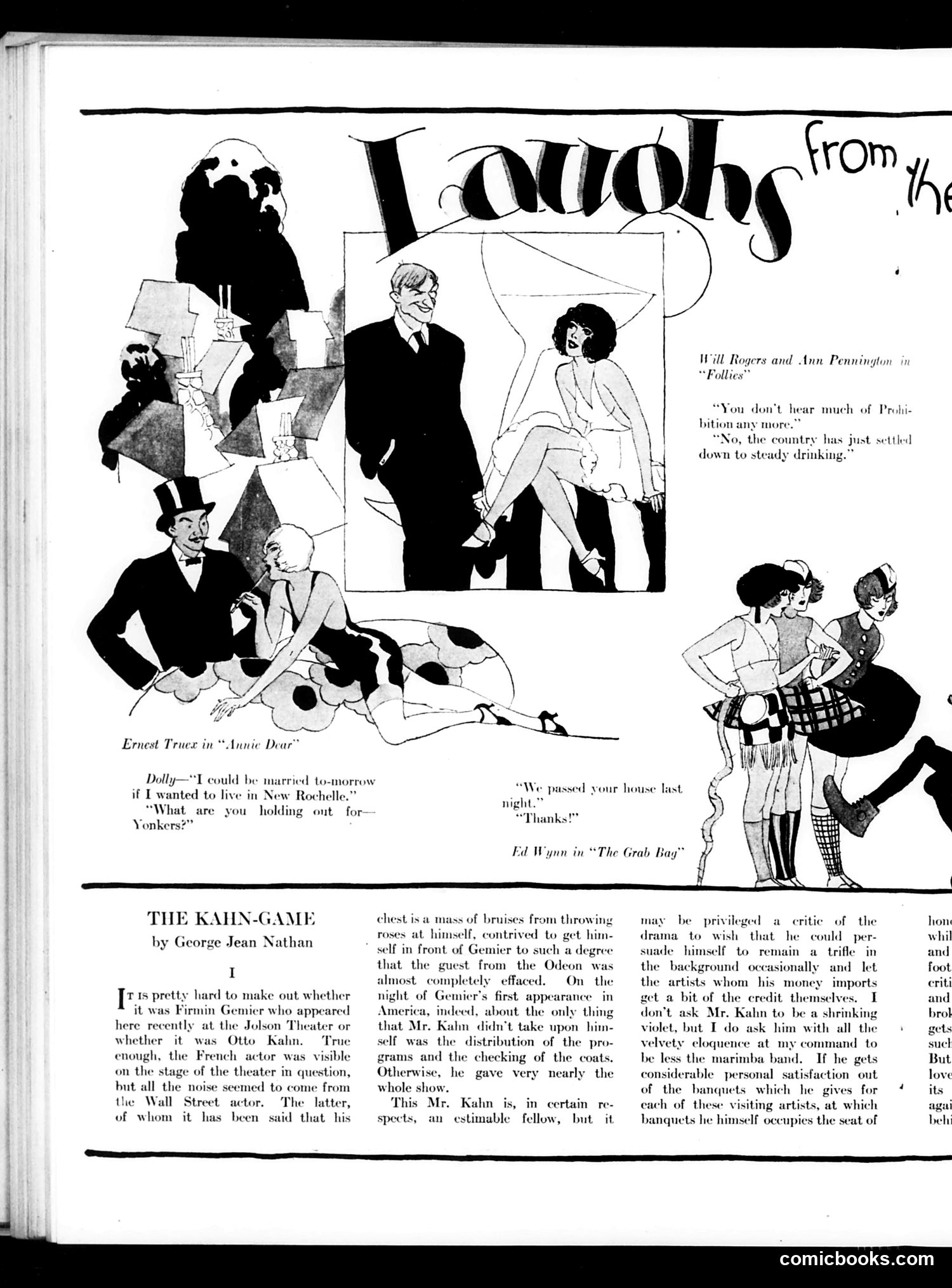
This page from Judge magazine features theatrical vignettes and drama criticism. The top section shows brief comic scenes from popular Broadway shows ("Annie Dear," "Follies," "The Grab Bag") with witty dialogue—typical Judge humor mocking social pretensions and romantic entanglements. The main article, "The Kahn-Game" by George Jean Nathan, satirizes **Otto Kahn**, a wealthy Wall Street financier and arts patron. Nathan criticizes Kahn for dominating theatrical events he sponsors, overshadowing the actual performers and artists. The critique suggests Kahn uses his financial power to self-aggrandize rather than genuinely support art—he throws lavish banquets where he occupies the seat of honor rather than letting visiting artists receive proper credit. Nathan's tone is mordantly ironic: Kahn is "estimable" but needs to stop being a "marimba band" (noise-maker) and let the actual talent shine. It's satire about wealthy patrons' ego versus genuine artistic patronage.
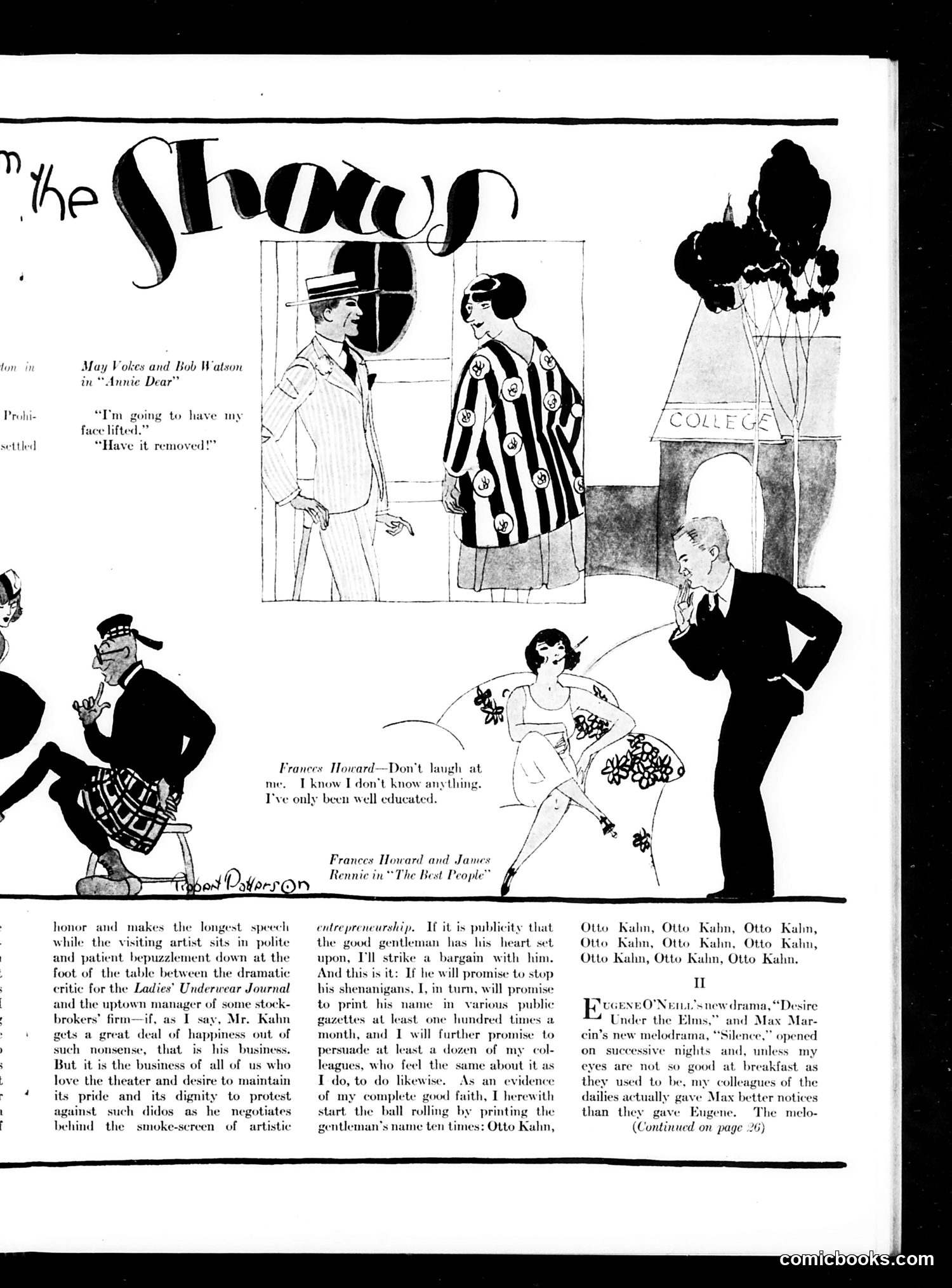
This page satirizes theater impresario **Otto Kahn**, a wealthy patron known for self-promoting involvement in Broadway affairs. The main text mocks Kahn's tendency to insert himself into theatrical productions for publicity, making lengthy speeches while actual artists remain marginalized. The cartoon vignettes show social comedy from contemporary plays: one depicts a woman joking about having her "face lifted" (a cosmetic procedure reference), while another features actress Frances Howard making a self-deprecating quip about being "well educated" but knowing nothing. The satire's core complaint: Kahn uses his wealth and influence to gain public attention through theater patronage, overshadowing genuine artists. The author sarcastically offers to print Kahn's name repeatedly in exchange for ceasing his theatrical meddling—then immediately does so, demonstrating how easily Kahn can command press coverage regardless of actual artistic merit.
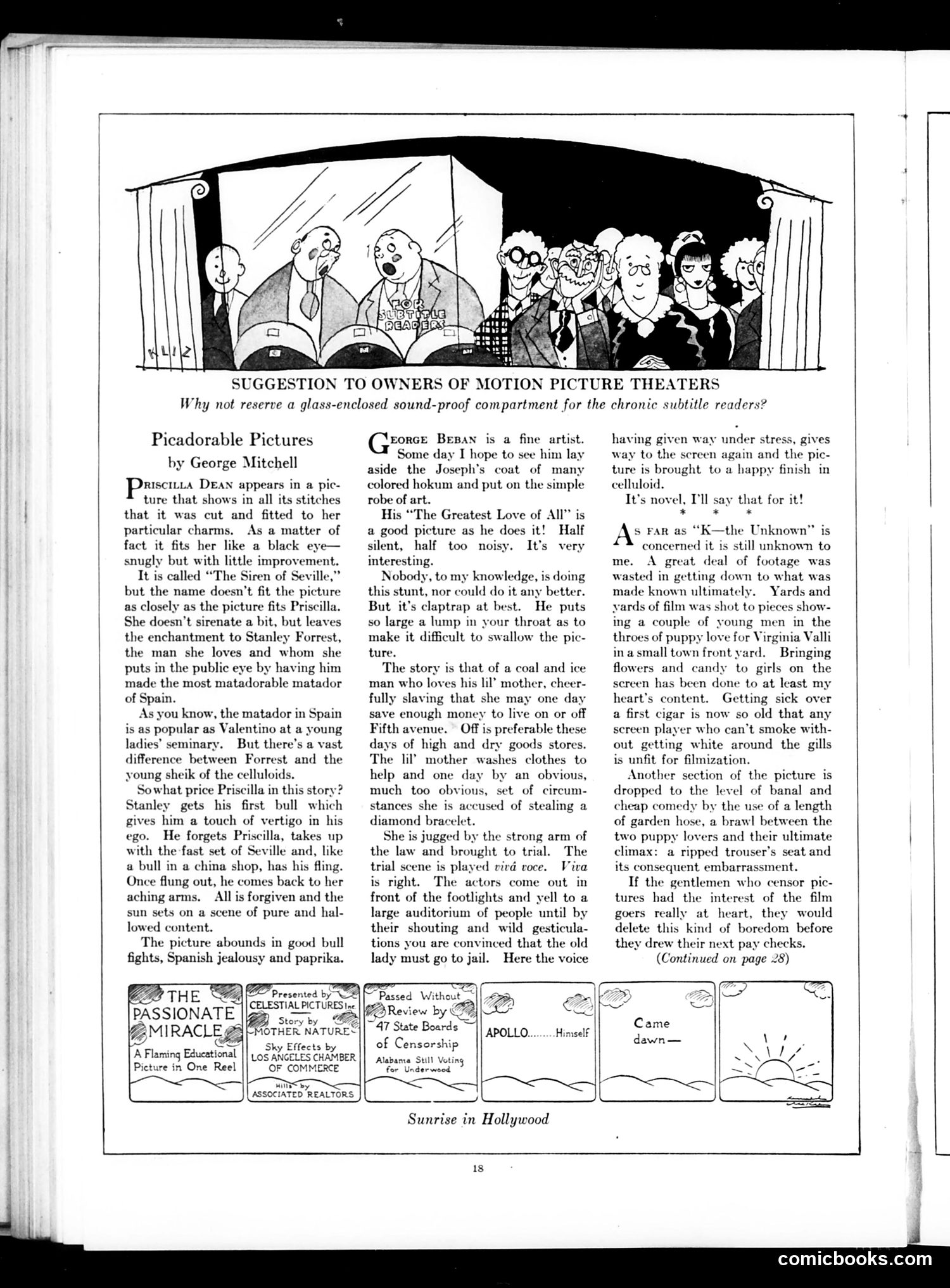
This page from *Judge* magazine satirizes early sound cinema's technical challenges. The header cartoon mocks moviegoers who read subtitles during "talkies" (early talking pictures), suggesting theaters install soundproof booths for chronic subtitle readers—implying such viewers were annoying distractions during the transition from silent to sound films. The film reviews below critique specific movies and acting performances of the era. Critics complain about excessive melodrama, poorly integrated physical comedy (like garden hose gags), and clumsy editing. One review notes an actress's name doesn't match her performance; another criticizes actors breaking the fourth wall by stepping "in front of the footlights." The satirical point: early sound films suffered from amateurish technique and overwrought storytelling as the industry adapted to new technology. The censor complaint suggests frustration that film boards would cut minor embarrassments while allowing tedious, poorly-made content to remain.
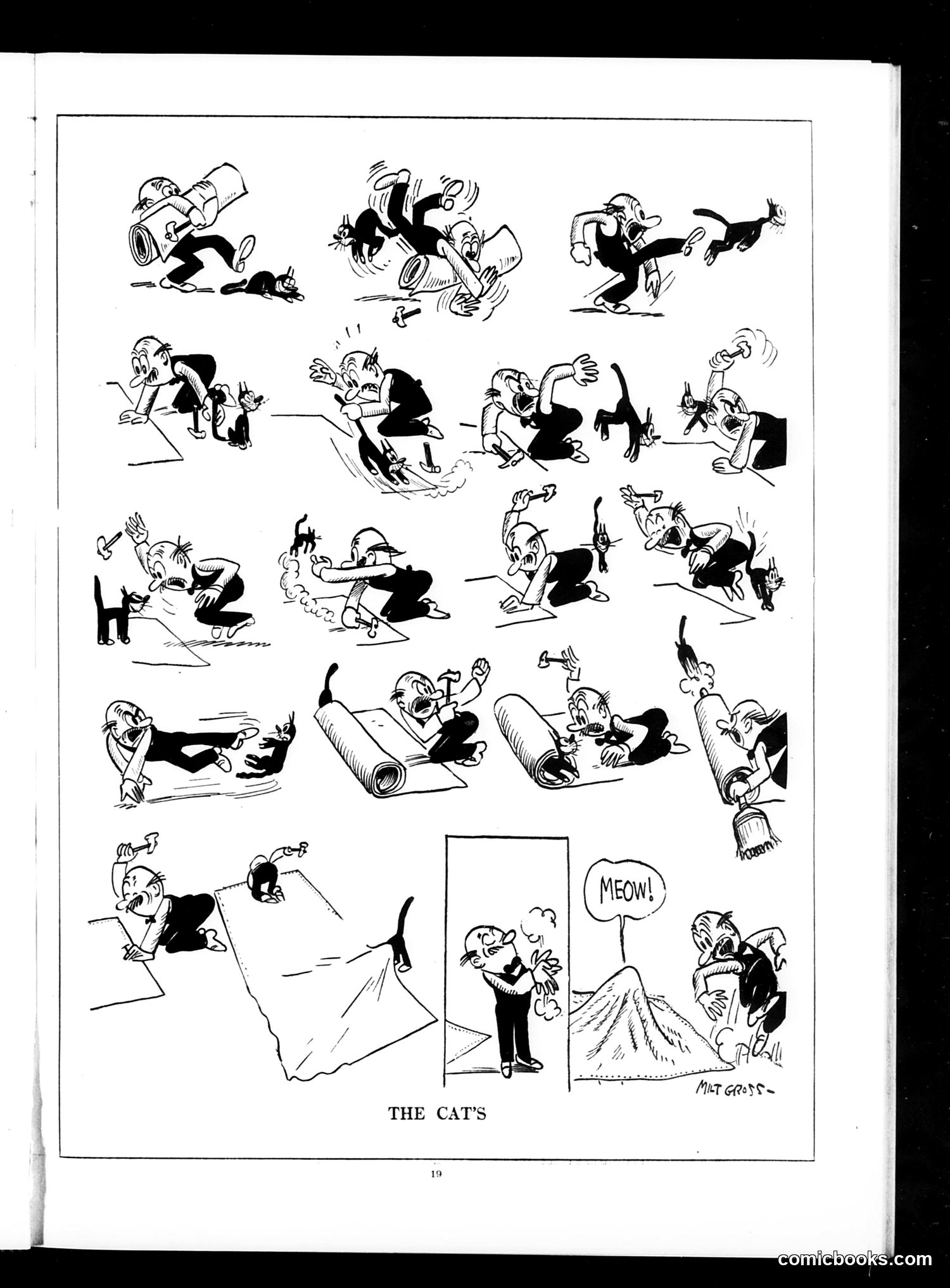
This is a multi-panel comic titled "The Cat's" showing a man repeatedly harassed and chased by a black cat. The sequence depicts escalating chaos: the cat trips him, tangles him in rope, knocks over objects, creates general mayhem indoors and outdoors, and ultimately causes him to flee up a mountain shouting "MEOW!" This appears to be a visual gag playing on superstitions about black cats bringing bad luck. The satire likely mocks either someone's paranoia about bad omens or, possibly, critiques a particular public figure's tendency to blame external forces (represented by the relentless cat) for their misfortunes. Without additional context, the specific political target remains unclear, though Judge's cartoons typically lampooned contemporary politicians and social figures.
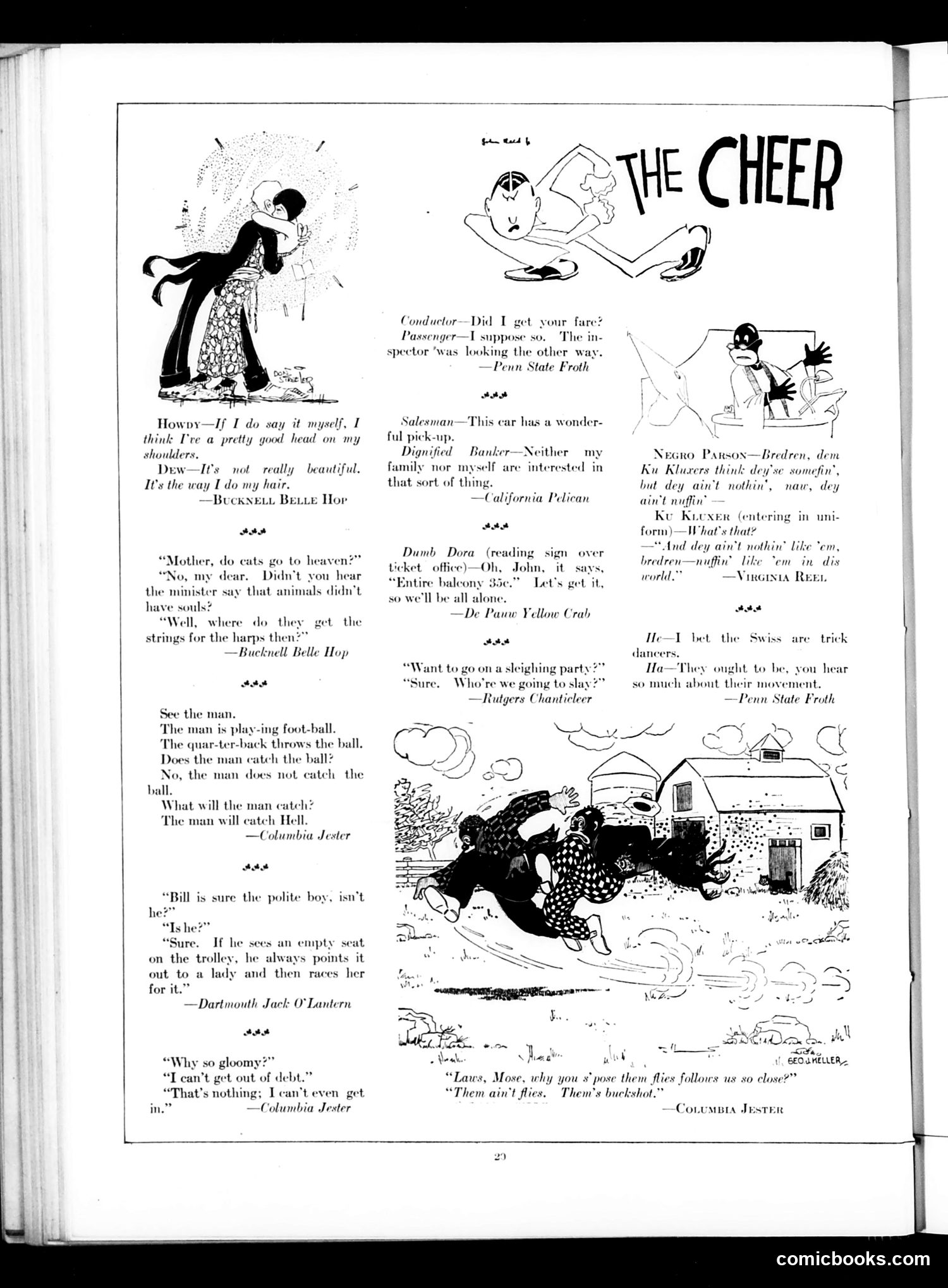
This is a collection of brief jokes and comic sketches from college humor magazines (Penn State Froth, Columbia Jester, Rutgers Chanticleer, etc.), typical of early 20th-century American college publications. The humor targets include: - **Vanity and appearance** (opening joke about hair) - **Logic puzzles** ("See the man" football joke playing on double meanings of "catch") - **Courtship and gender dynamics** (the "polite boy" racing a lady for a trolley seat) - **Financial anxiety** (debt jokes) - **Dating etiquette** ("sleighing party," "alone in balcony") - **Racial humor** (the final large illustration and dialogue featuring African American dialect, referencing the Ku Klux Klan—presenting the KKK member as foolish) The style reflects college-humor conventions: absurdist wordplay, mild social satire, and casual inclusion of period racial stereotypes that would be considered offensive today. The overall tone is lighthearted pranking rather than serious commentary.
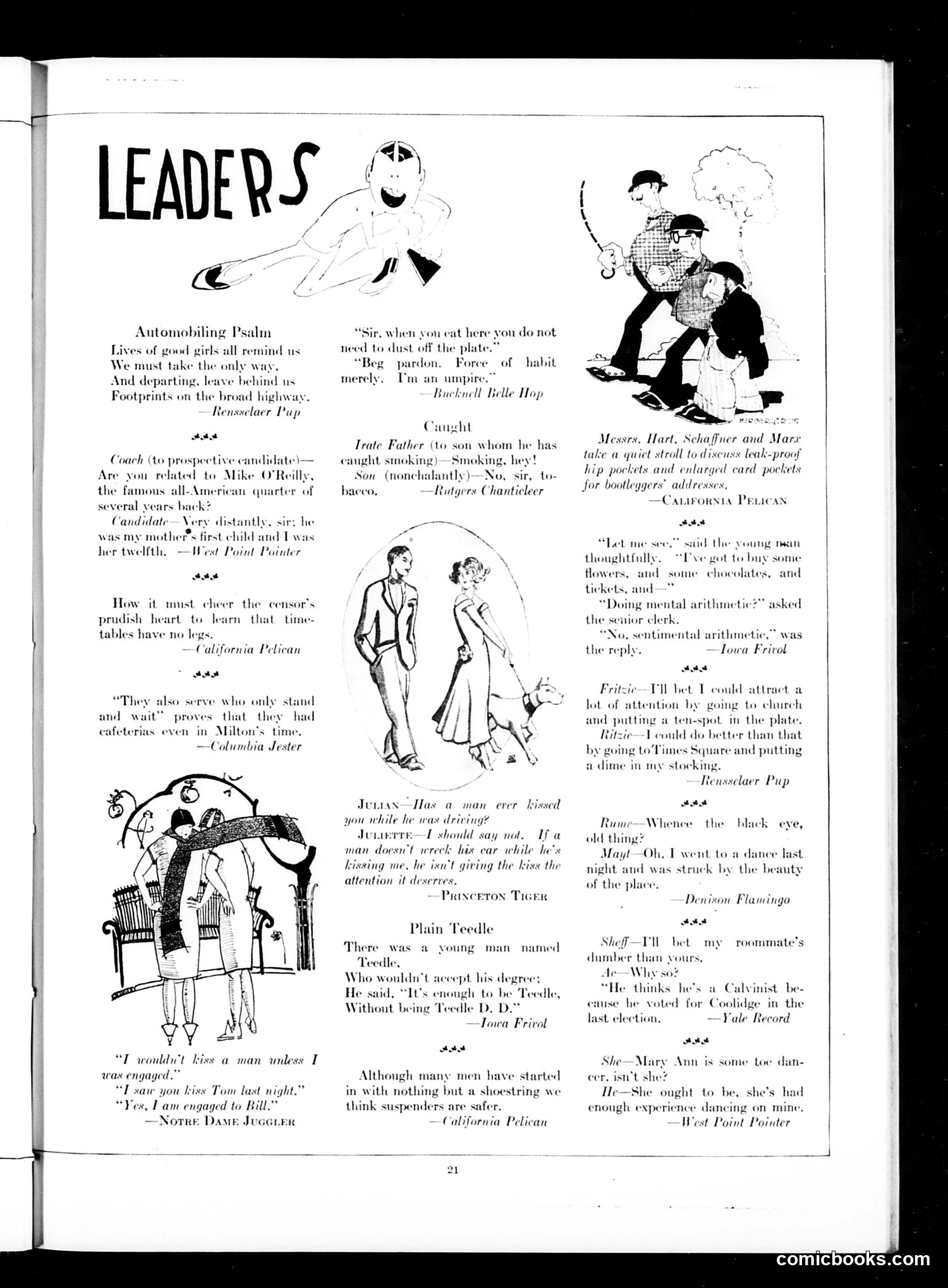
This page collects brief humorous quips and cartoons from various college publications, organized around the theme of "Leaders" (authority figures and romantic pursuits). The content satirizes: **College life absurdities**: A coach questions a candidate's relations to a famous athlete; a censor's prudishness about "time-tables" lacking legs; debates over whether accepting degrees requires additional credentials. **Dating and romance**: Multiple jokes about kissing, engagement expectations, and courtship rituals—mocking both male and female dating conventions of the era. **Social commentary**: References to Prohibition-era bootlegging; commentary on suspenders vs. shoestrings (unclear reference); a dig at Calvin Coolidge voters as intellectually inferior. **The cartoons** show figures in typical college/romantic scenarios—couples courting, authority figures with young people. The humor relies on wordplay, double meanings, and generational observations typical of 1920s college humor magazines. Without specific dates visible, the Coolidge reference suggests this is from the mid-to-late 1920s.
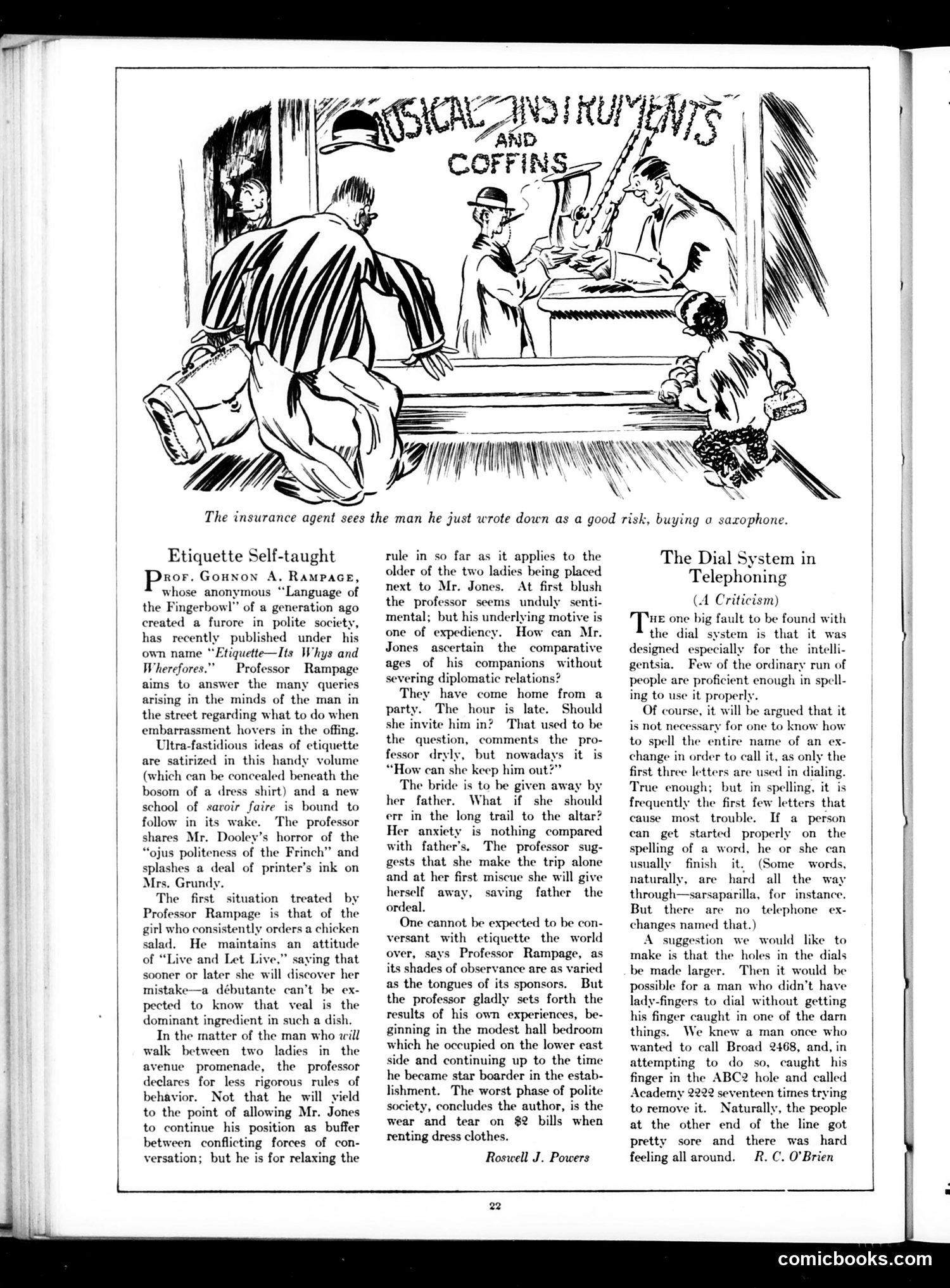
## The Cartoon The top illustration shows an insurance agent who just insured a man as a "good risk," only to spot him buying a saxophone at a shop. The joke is ironic: the agent's assessment of the man's reliability has been immediately contradicted by an impulsive, frivolous purchase—suggesting the man is actually a poor insurance bet. ## The Articles The page contains three separate satirical pieces: 1. **"Etiquette Self-taught"** reviews a new etiquette book by "Professor Rampage," mocking overly rigid social rules (like where ladies should walk during promenades) as impractical. The satire suggests such rules are absurdly obsessive. 2. **"The Dial System in Telephoning"** humorously critiques the newly-introduced rotary dial telephone system, arguing it's "designed especially for the intelligentsia" because ordinary people can't spell well enough to dial exchanges by their names (like "Madison" or "Plaza"). All three pieces mock pretentious modern systems—insurance assessments, social etiquette, and technology—as disconnected from everyday reality.
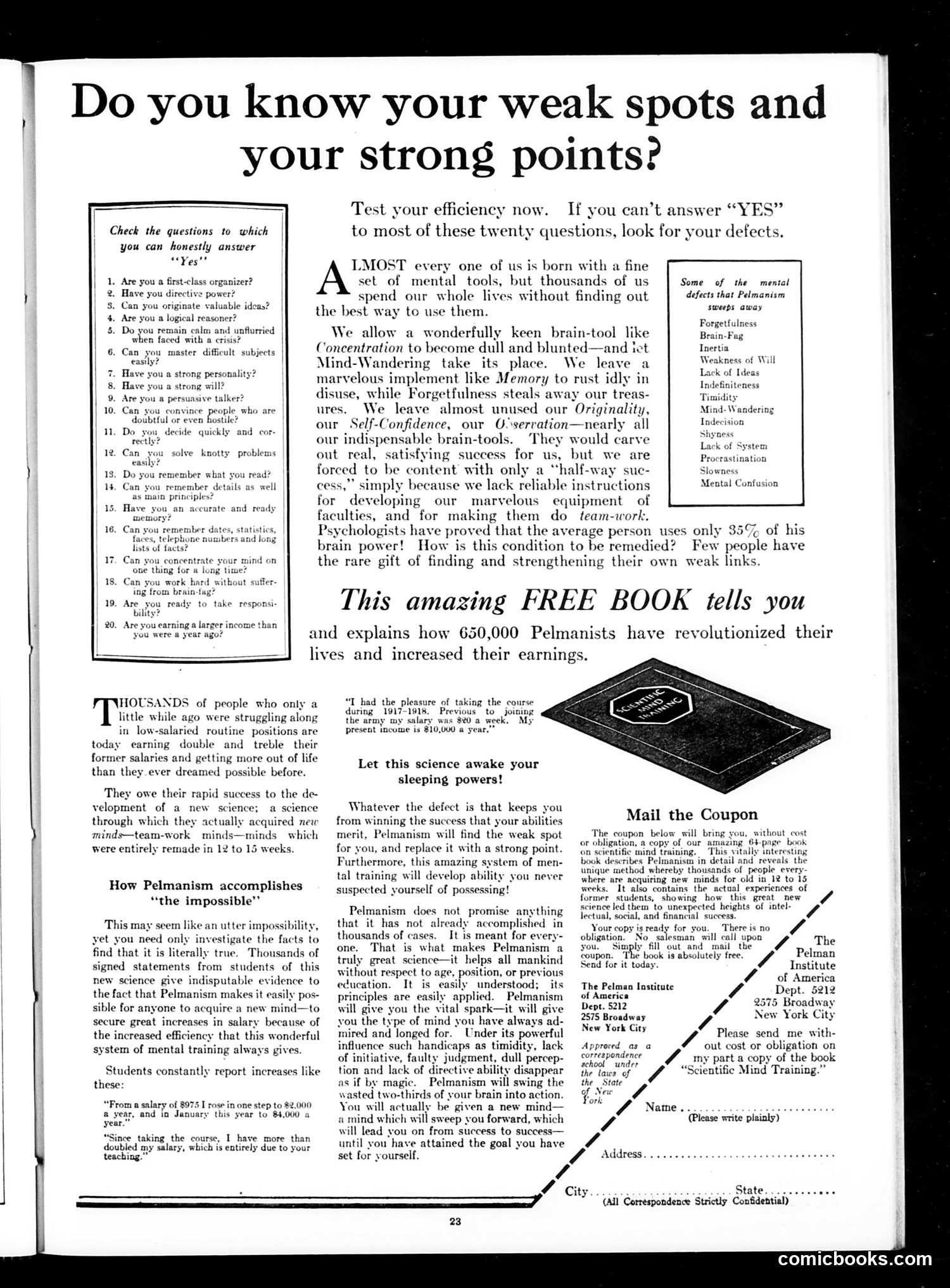
This page is primarily an **advertisement for Pelmanism**, a self-improvement/mind-training system popular in the early 20th century. Rather than a political cartoon, it's a direct-response ad using a self-assessment questionnaire. The ad promises to identify mental "weak spots" (listed in a sidebar: forgetfulness, brain-fog, lack of willpower, procrastination, etc.) and claims Pelmanism can rewire your brain in 12-15 weeks. It presents testimonials of people who increased earnings dramatically—one claims jumping from $20/week to $10,000/year. **For modern readers**: This represents the era's fascination with **pseudo-scientific self-improvement**. The appeal to "brain power" and "team-work minds" reflects early-1900s pop psychology before modern neuroscience. The claim that people use only 35% of brain capacity is the origin of the persistent (and false) "10% of brain" myth. The ad exploits anxiety about personal inadequacy to sell mail-order courses—a precursor to modern motivational self-help marketing.
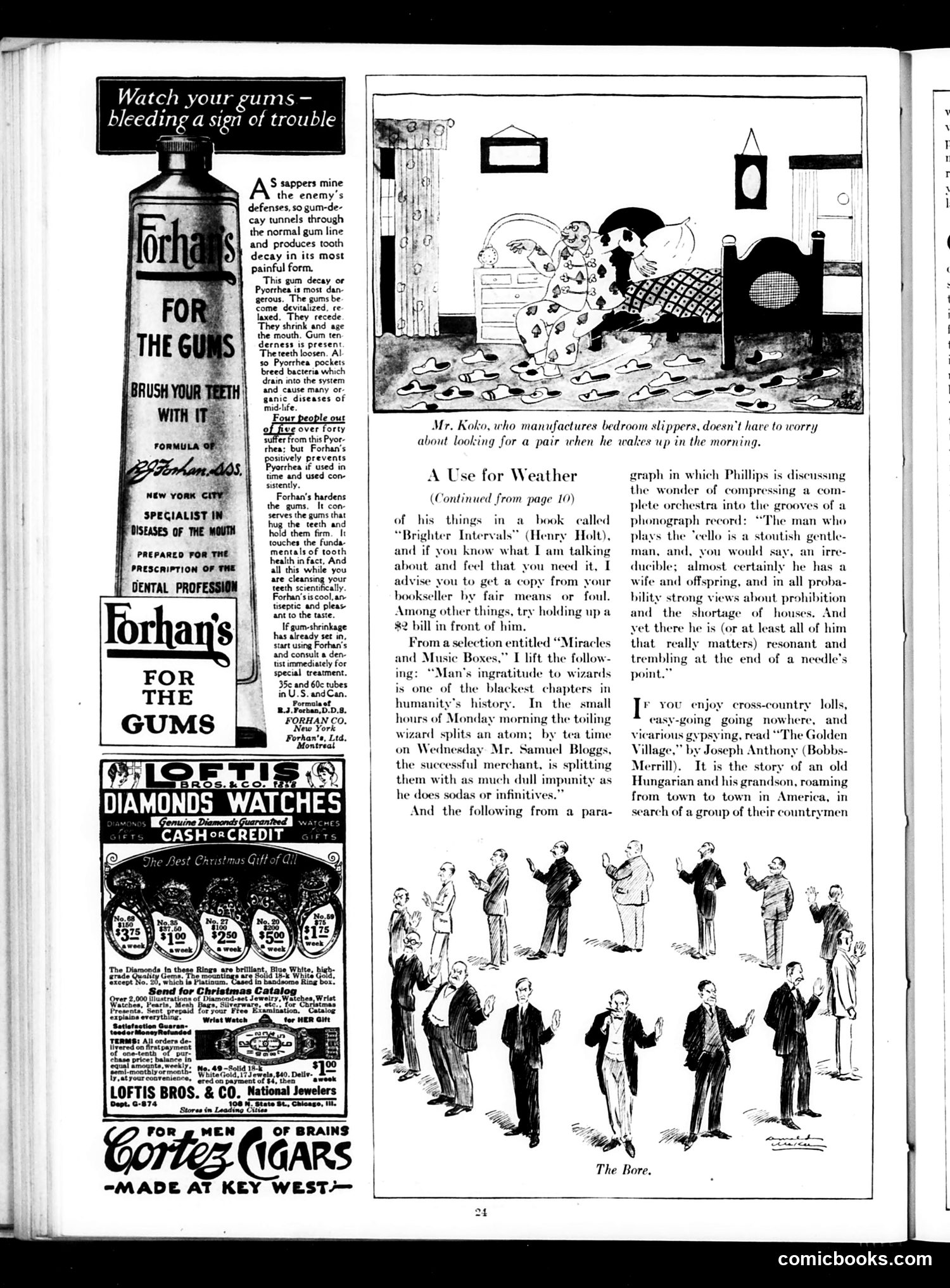
This page contains primarily **advertisements** and a brief article excerpt, with minimal satirical cartooning. The main visual content is a cartoon titled "The Bore" depicting various social types—men in formal dress engaged in conversation. The caption references a "bore," suggesting social satire about tedious conversationalists. The article "A Use for Weather" (continued from previous page) discusses a book called "Brighter Intervals" by Henry Holt. It includes humorous anecdotes about wizards and atoms, and mentions a novel "The Golden Village" about Hungarian gypsies traveling America. The left side features **period advertisements**: Forhan's gum treatment (marketed as preventing pyorrhea/gum disease), Loftis Bros. diamond watches, and Cortez cigars from Key West. Without more context about the date or surrounding editorial content, the satire's specific targets remain unclear. The "bore" cartoon appears to be gentle social humor about personality types rather than political commentary.
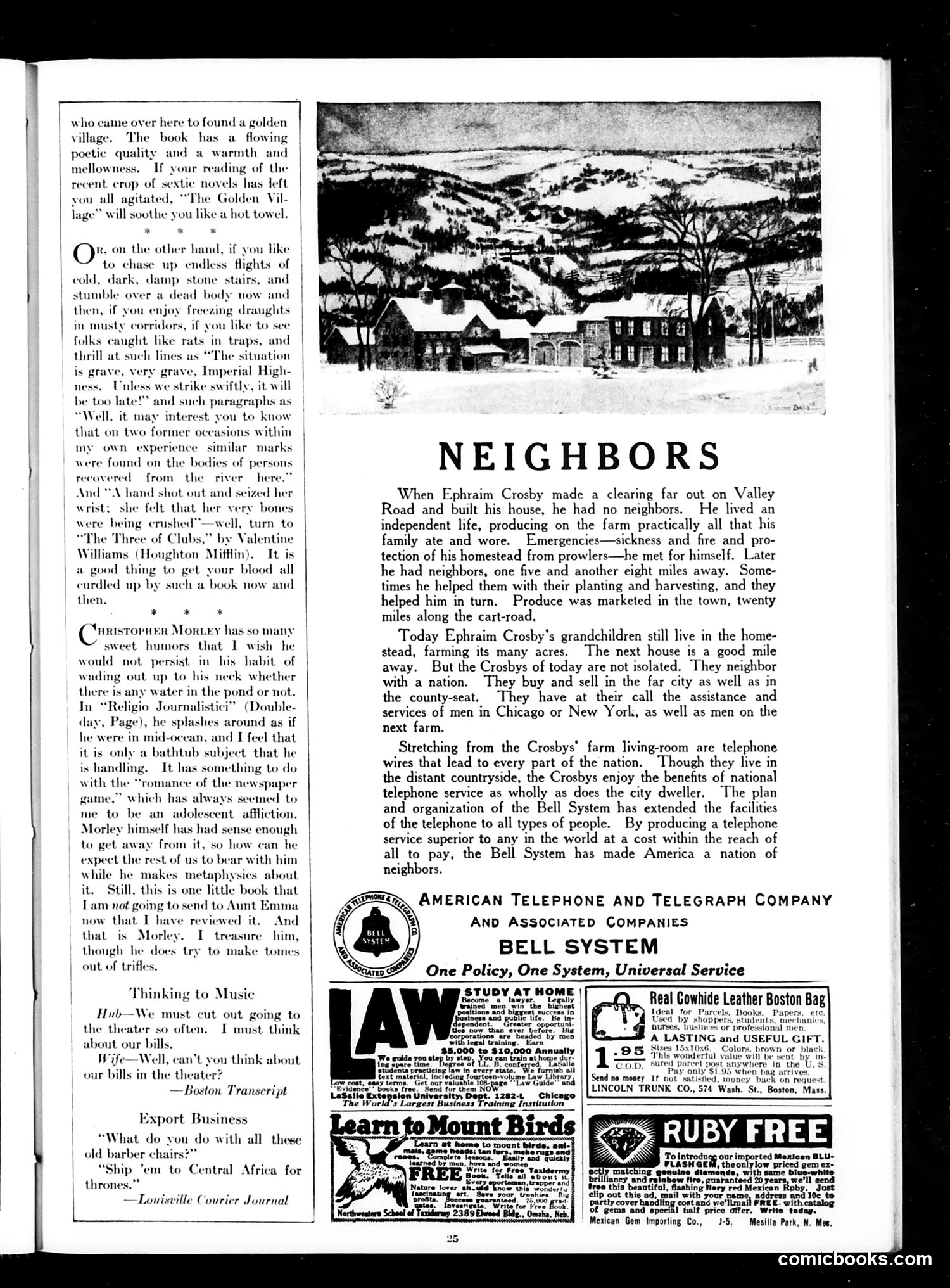
This page contains **book reviews and advertisements** rather than political cartoons. The reviews discuss three books: *The Golden Village* (praised as soothing), *The Three of Clubs* by Valentine Williams (a thriller with gothic elements), and *Religio Journalistici* by Christopher Morley (criticized for overwrought prose about mundane topics). A humorous dialogue contrasts marital priorities: a husband suggests skipping theater to economize, but his wife quips they could think about bills *during* theater anyway—a gentle jab at male financial anxiety during this period. The main content is a **Bell System telephone advertisement** disguised as editorial copy about rural America. It traces how farmer Ephraim Crosby's isolated homestead evolved from self-sufficient isolation to national connectivity via telephone service. This is corporate propaganda presenting telephony as modernizing rural life and connecting farmers to urban markets and services—essentially promoting telephone adoption as progress and convenience. The advertisement reflects early-20th-century attitudes about technology's role in "civilizing" rural areas.
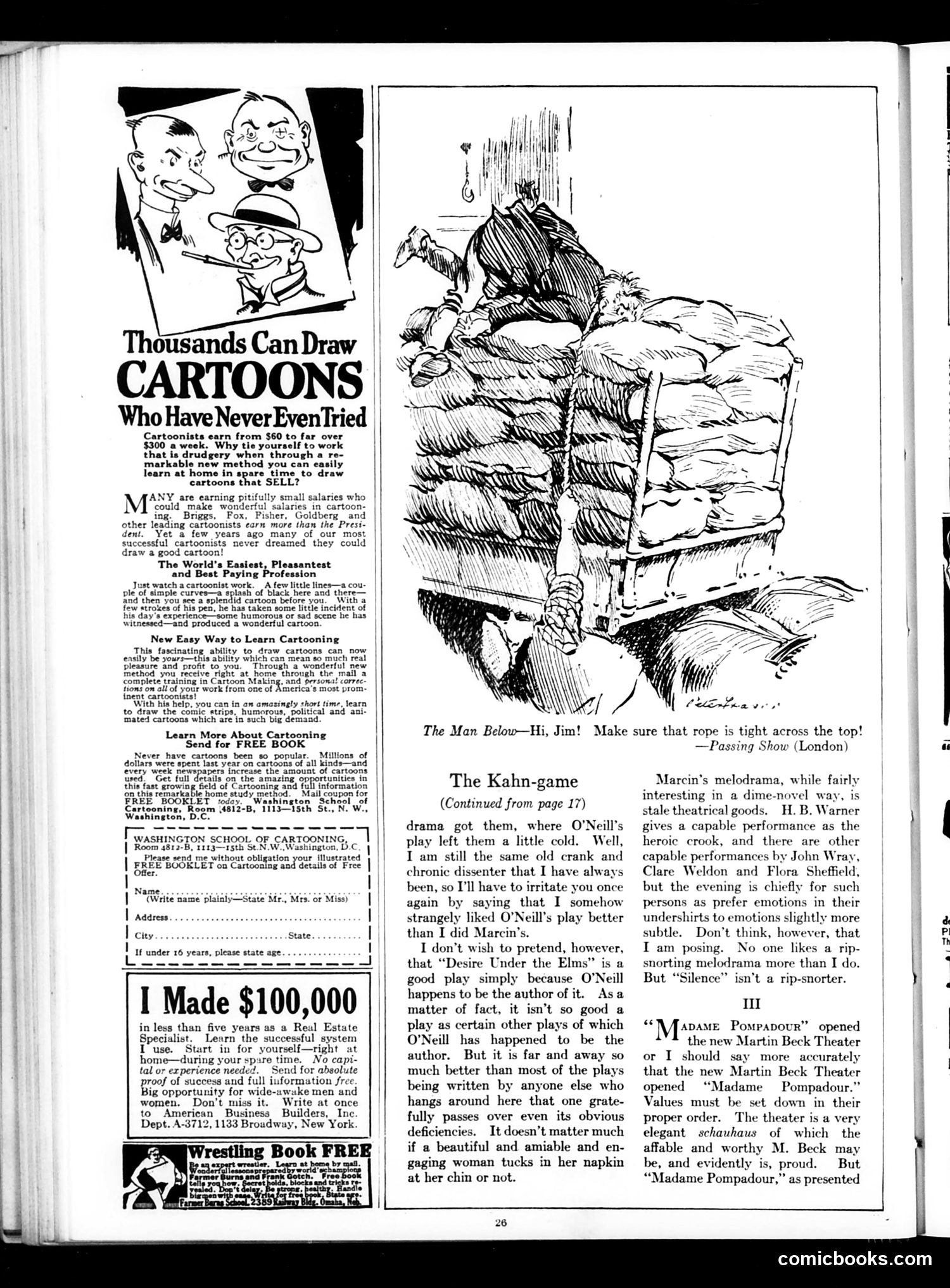
This page contains primarily **advertising content**, not political satire. The dominant feature is a vocational advertisement for the Washington School of Cartooning, promising that ordinary people can learn to draw and sell cartoons profitably. It names famous cartoonists (Briggs, Fisher, Goldberg) earning high salaries and emphasizes the profession's growing demand. The small cartoon illustration labeled "The Man Below" shows a figure with a rope across boxes—its meaning is unclear without additional context. The right column contains theater criticism of "The Kahn-game," discussing O'Neill's play "Desire Under the Elms" compared to a play by Marcin. The page reflects early-20th-century attitudes about cartooning as an accessible, lucrative profession, but contains no discernible political satire or recognizable satirical figures.
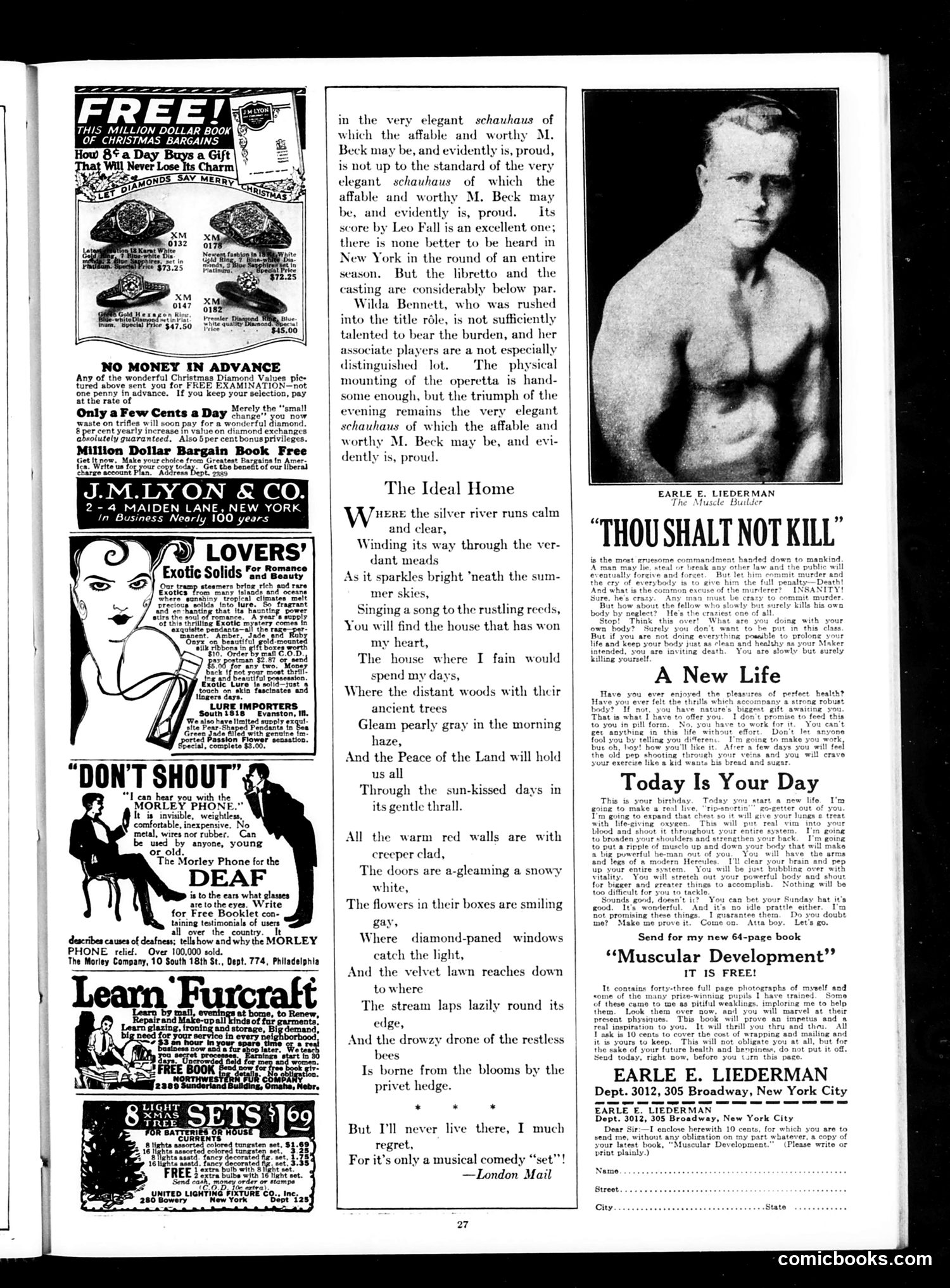
This page is primarily **advertisements and light content** rather than political satire. The main elements are: **The "Ideal Home" poem** (center) is sentimental verse about a picturesque country house—typical of early 20th-century romantic literature. The punchline reveals it's merely a stage set from a musical comedy, mocking the gap between idealized fantasy and theatrical reality. **The opera review** (top right) critiques a production at M. Beck's theater, repeatedly using "schauhaus" (German for "show house") to mock the venue's pretensions while admitting its libretto and casting are subpar. **The advertisements** dominate: J.M. Lyon & Co. offers diamond "bargains," while Earle E. Liederman promotes "Muscular Development" courses—typical early 1900s mail-order schemes. The Morley Phone for the Deaf and "Don't Shout" products target specific consumer needs. **No clear political cartoon** appears on this page. It reflects the magazine's mixed format of light humor, theatrical criticism, and commercial advertising typical of Judge's era.
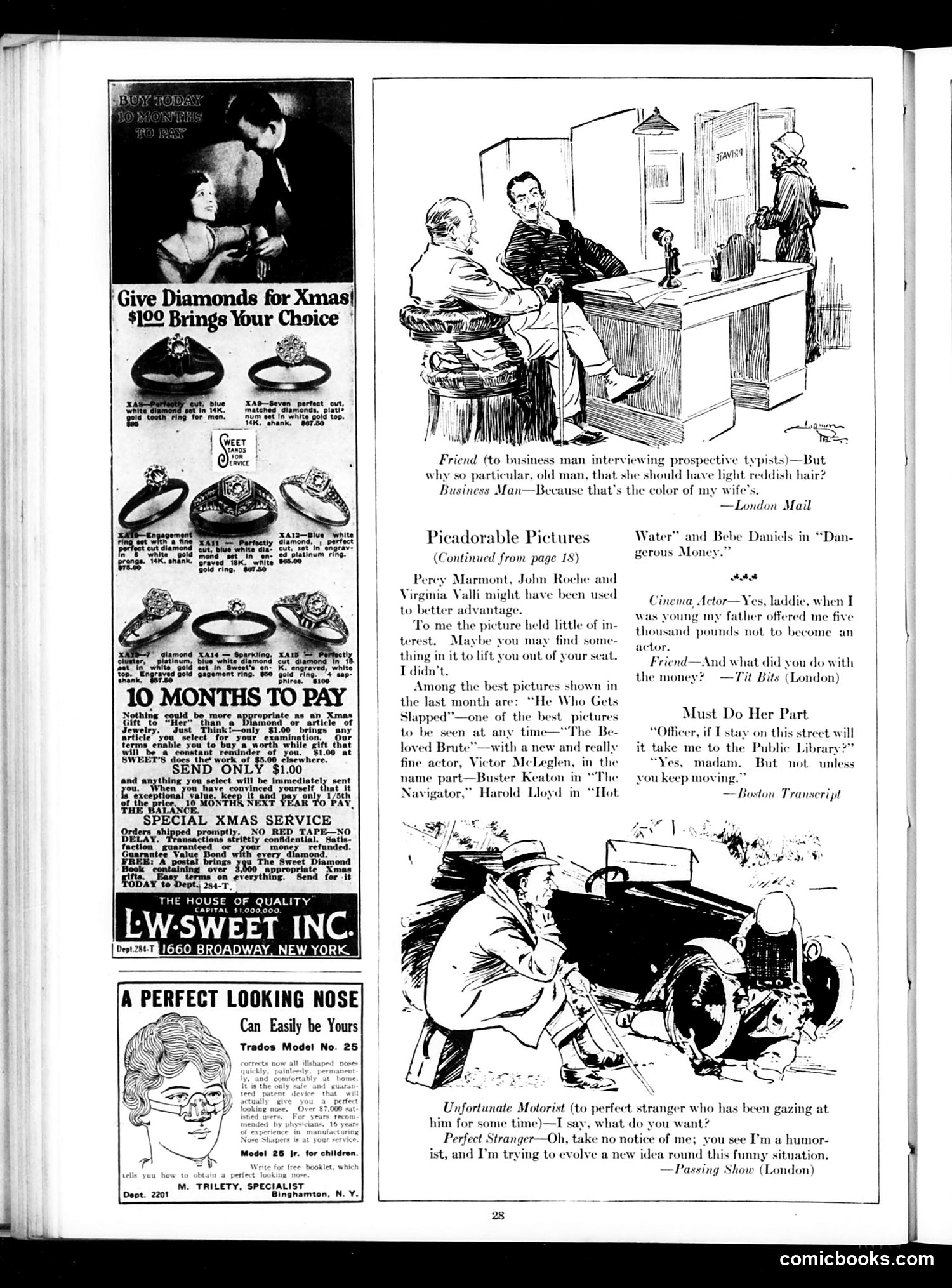
This page combines advertisements with humorous captioned illustrations typical of 1920s Judge magazine. **The Advertisements** occupy the left side: L.W. Sweet Inc. promotes diamond rings for Christmas ($1 down, 10 months to pay), and M. Trilety advertises the "Trados Model No. 25"—a cosmetic nose-shaping device, reflecting period anxieties about appearance. **The Cartoons** on the right are brief comic vignettes with social commentary: 1. **"Friend" and "Business Man"**: A husband prefers hiring a typist with reddish hair because it matches his wife's—satirizing either marital jealousy or shallow hiring practices based on appearance rather than competence. 2. **"Unfortunate Motorist"**: A stranger stares intensely at a driver, claiming he's a humorist "evolving a new idea" from the situation—mocking both pretentious creative types and the absurdity of their methods. These genteel jokes reflect 1920s concerns: commercialized beauty standards, workplace propriety, and artistic pretension.
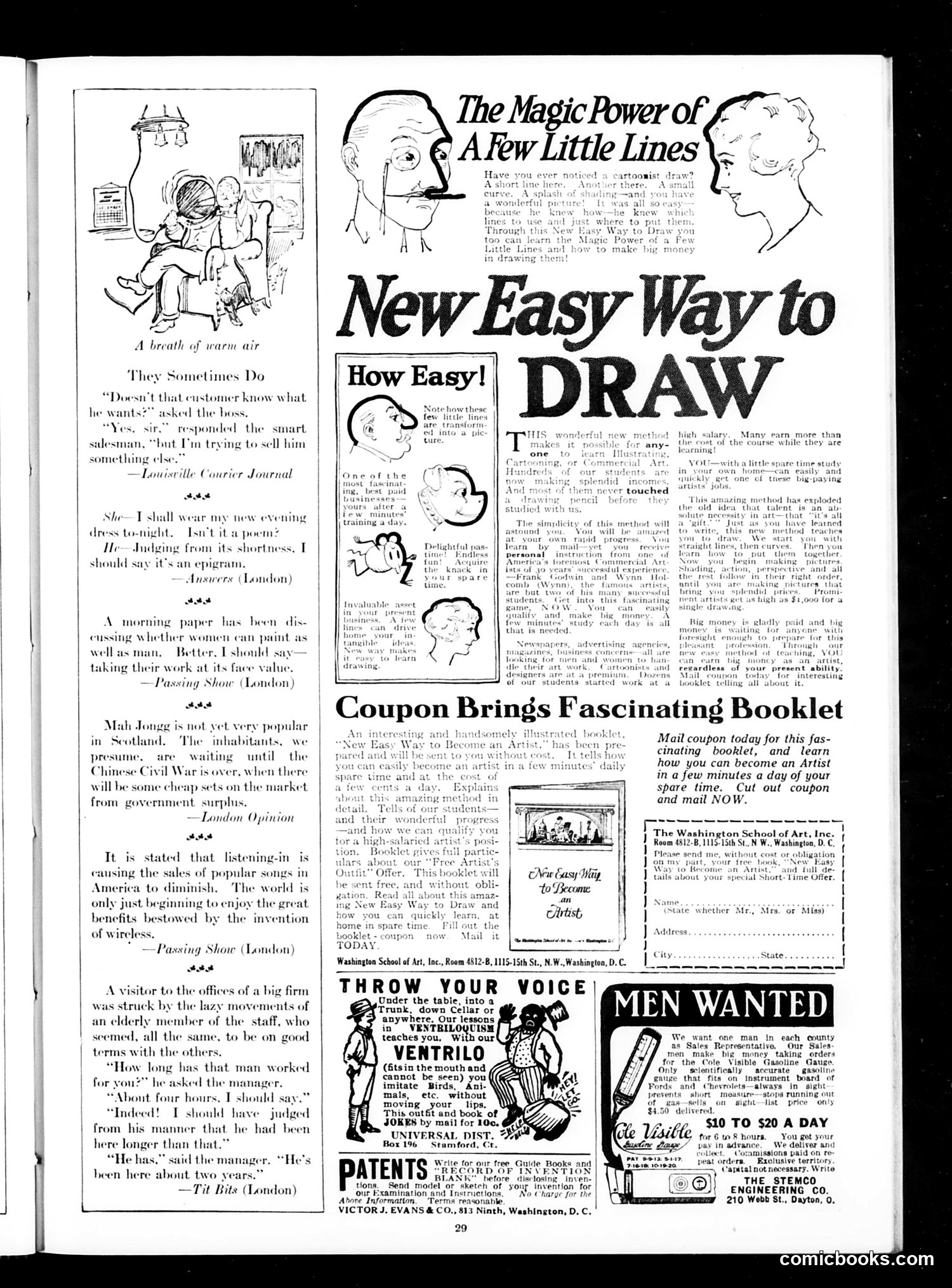
This page is primarily **advertising**, not satire or political cartoons. It contains brief humor quotes and multiple mail-order advertisements typical of 1920s magazines. The small quoted jokes at top mock everyday situations: a salesman's dishonest pitch, a woman's witty remark about her dress being more "epigram" than "poem," and workplace laziness. These are generic humor pieces, not political satire. The page's main content consists of **mail-order ads**: a drawing instruction course from Washington School of Art ("become an Artist in a few minutes"), ventriloquism lessons with a hidden mouth device, a patent record service, and automotive gauges promising "$10 to $20 a day" commissions. These ads reflect 1920s consumer culture—the era's fascination with self-improvement schemes, correspondence courses, and side hustles. The promises are characteristically optimistic and vague about actual earnings potential, typical of period advertising before modern consumer protection laws. No political figures or events are referenced.
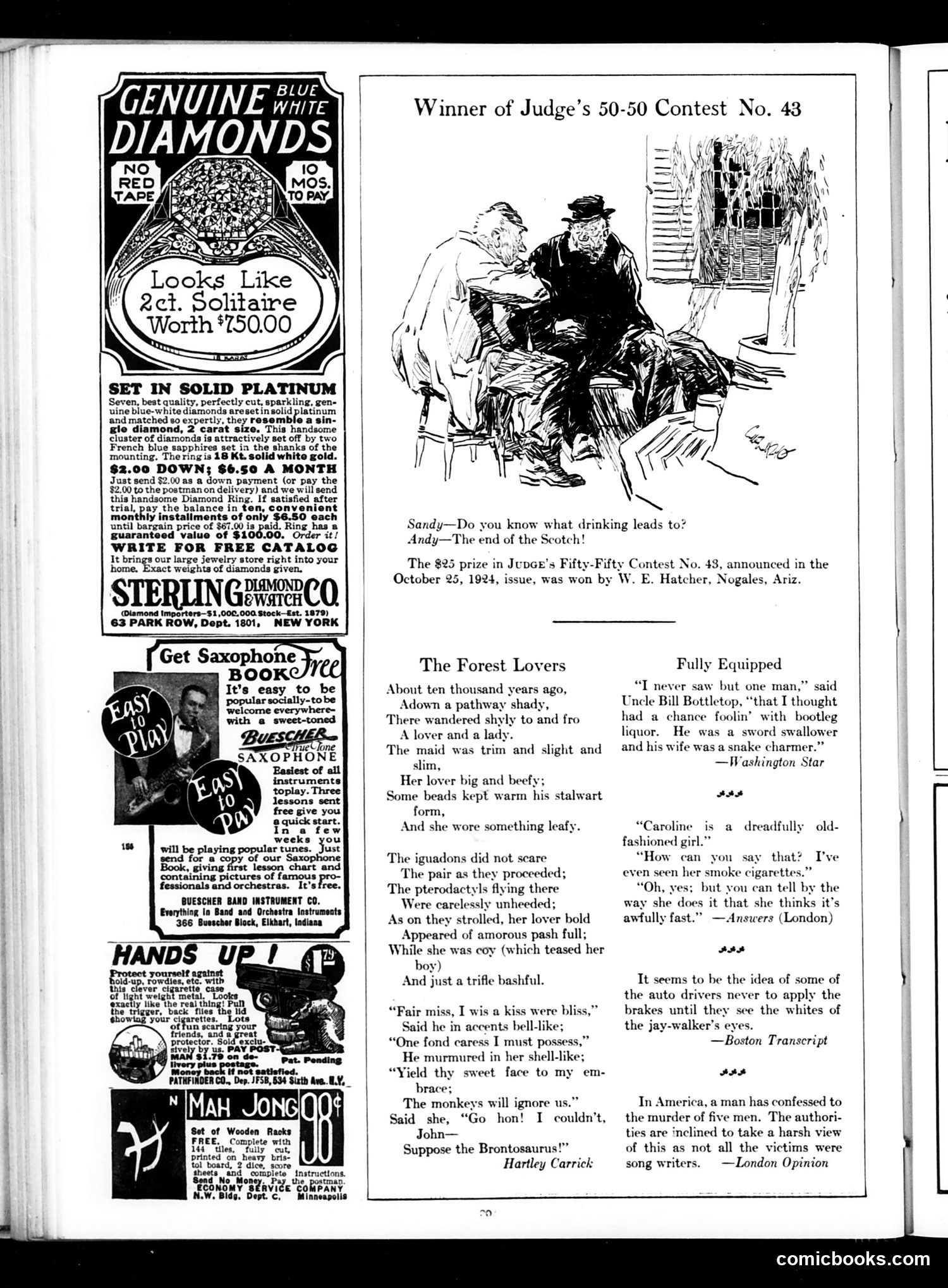
This page from Judge (a 1924 satirical magazine) contains mostly **advertisements** alongside brief humor pieces and a contest winner announcement. The main cartoon is "The Forest Lovers"—a humorous poem about prehistoric humans encountering dinosaurs while courting. The joke plays on anachronism: the couple worries about a "Brontosaurus" interrupting their romance, treating extinct creatures as casual obstacles. It's gentle satire mocking both romantic clichés ("amorous pash") and the era's popular fascination with prehistoric life. The shorter jokes reference Prohibition-era drinking (the "Scotch" reference), and contemporary social observations about women smoking cigarettes and auto safety. The advertisements—for diamonds, saxophones, and novelty items—are typical of 1920s magazines targeting middle-class readers with aspirational products. The contest winner (W.E. Hatcher) is noted for submitting a brief joke to Judge's humor contest. Overall, this is a fairly standard magazine page mixing light satire with commercial content.
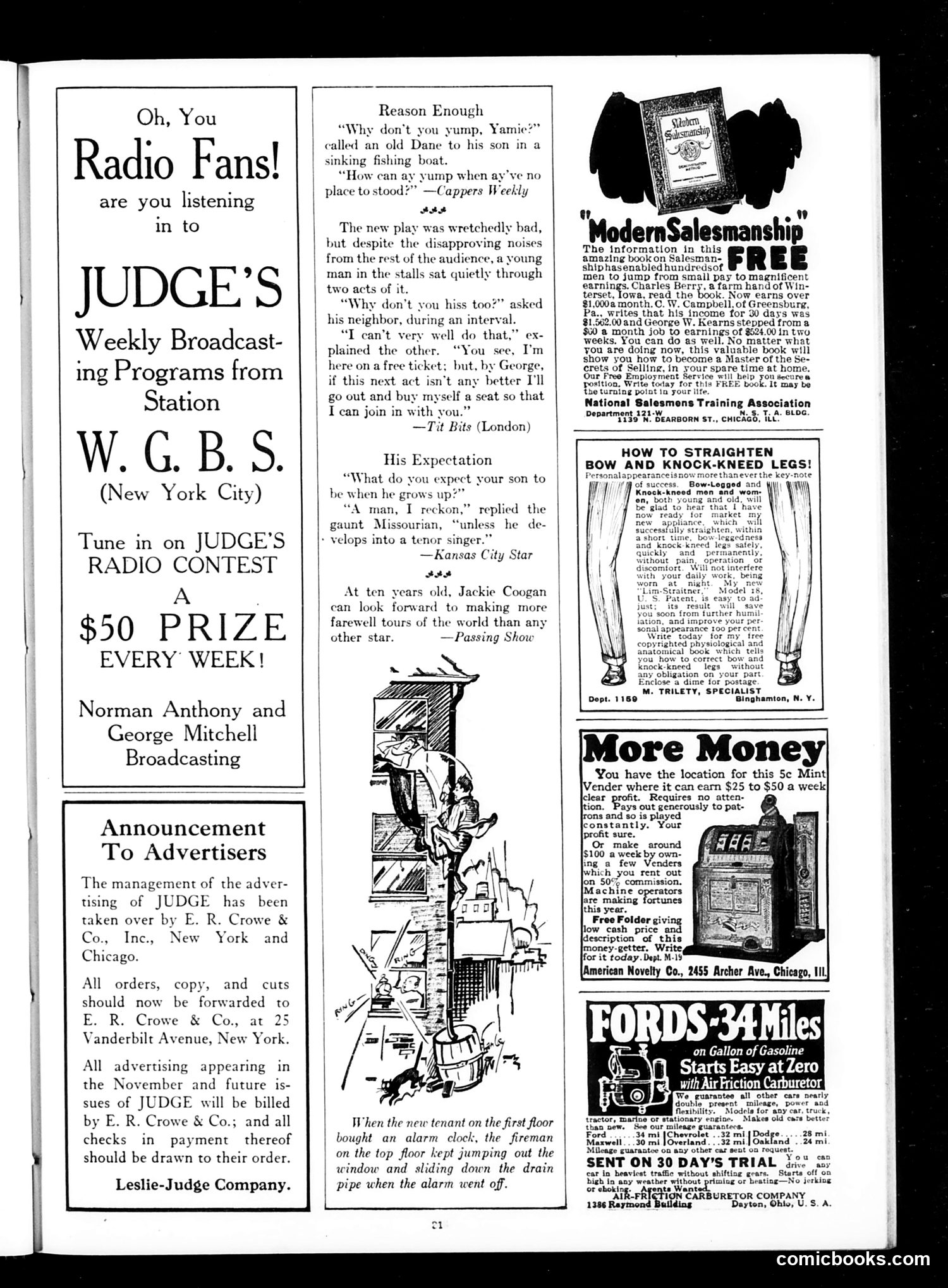
This page from Judge (appears to be early 1920s based on references) is primarily **advertising and announcements** rather than satirical content. The main items are: 1. **Radio contest promotion** for Judge's broadcasting program on station W.G.B.S. (New York City), offering $50 weekly prizes—reflecting the novelty of radio as new entertainment medium. 2. **Administrative notice** that Judge's advertising management transferred to E.R. Crowe & Co. 3. **Humorous anecdotes** in the center column—brief jokes about a sinking boat, theater attendance, child star Jackie Coogan, and a fireman startled by an alarm clock. These are lighthearted observations rather than political satire. 4. **Mail-order advertisements** for self-improvement books (salesmanship, physical correction of leg deformities) and consumer products (gasoline carburetors, slot machines). The cartoon illustration shows a dramatic multi-story scene, likely accompanying one of the anecdotes, but the specific reference is unclear from the image alone.
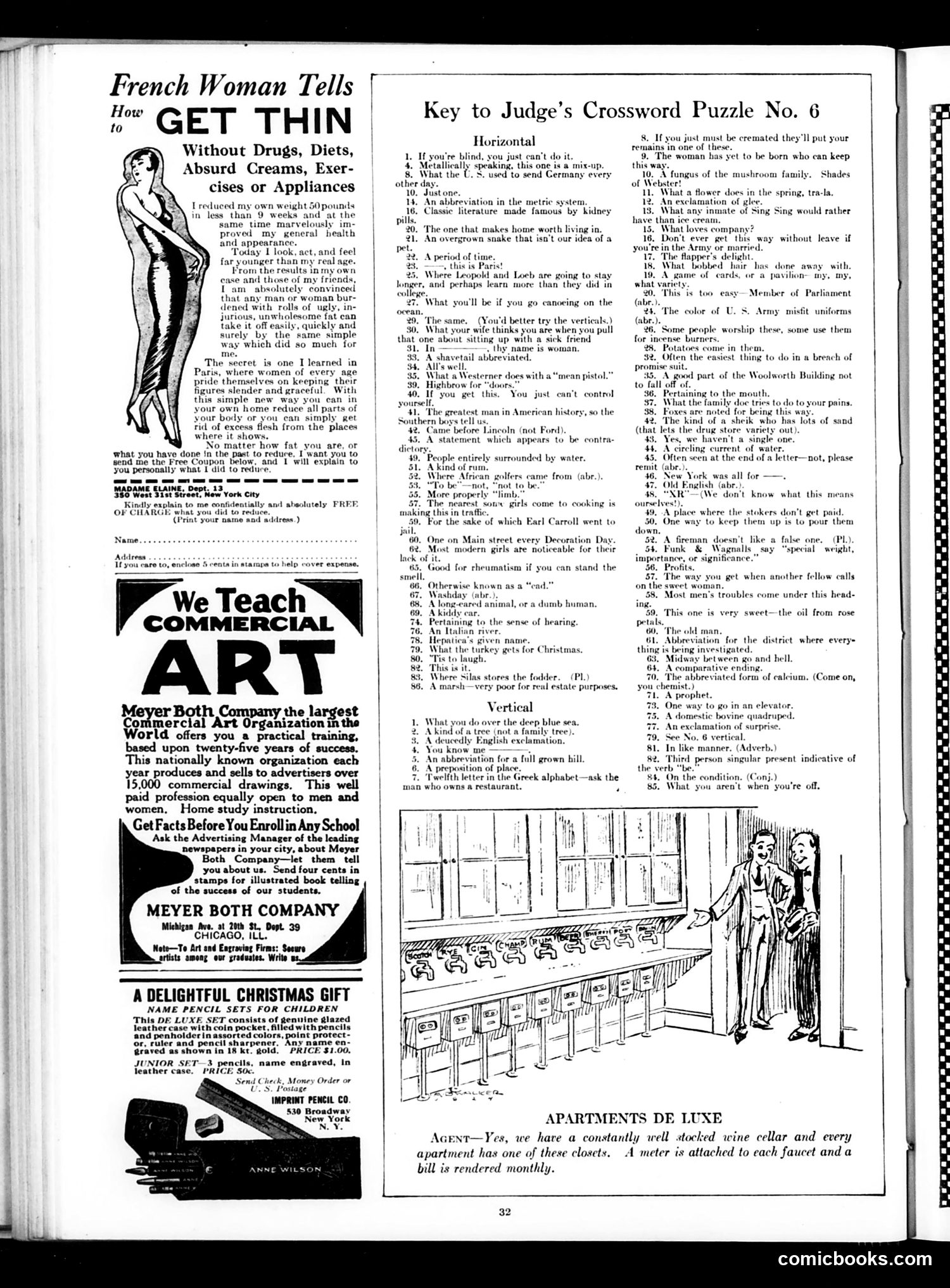
This page contains **mostly advertisements and a crossword puzzle**, with minimal satirical cartooning. The primary editorial content is a **crossword puzzle** ("Key to Judge's Crossword Puzzle No. 6"). Below it is an illustration of a luxury apartment building with two figures, advertising "Apartments de Luxe" with wine cellars and individual meters. The page is dominated by **commercial advertisements**: a prominent ad for a "French Woman" offering weight-loss methods without drugs or diets (typical of early 20th-century dubious health claims); Meyer Both Company advertising commercial art training; and pencil set promotions. The illustration accompanying the apartment ad appears to be straightforward advertising rather than satire—depicting modern urban luxury amenities. This appears to be a typical Judge issue page mixing editorial content (the puzzle) with paid advertising. The satirical commentary that Judge was known for is absent here; the page functions primarily as a revenue-generating advertising vehicle. The "French Woman" weight-loss ad particularly reflects period attitudes toward women's appearance and consumer marketing practices of the era.
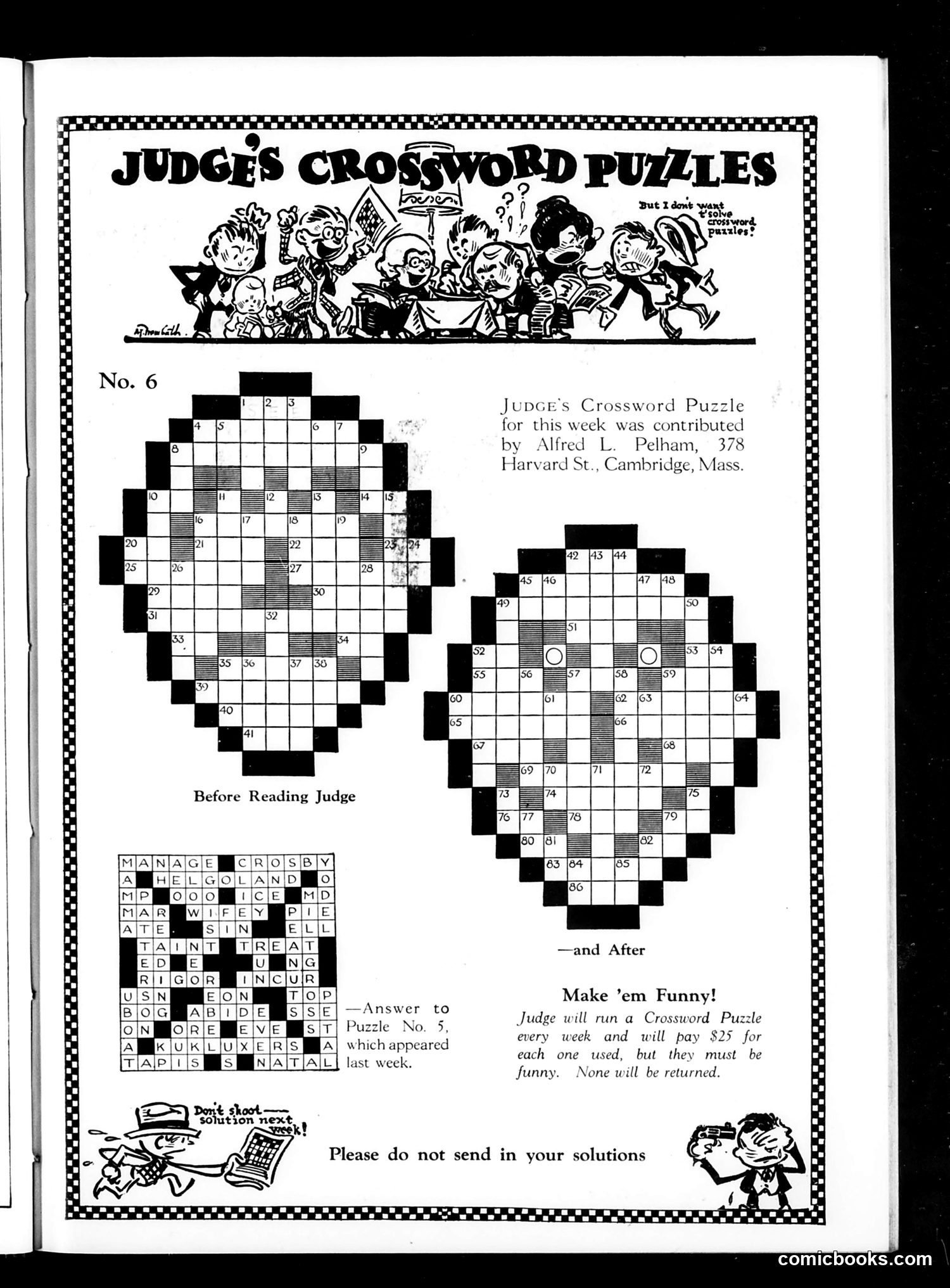
This page features **Judge's crossword puzzle contest**, not political satire. The content shows: **Main Elements:** - Two crossword puzzles (labeled "No. 6" and numbered grids) - An answer key to the previous week's puzzle - A cartoon titled "Before Reading Judge—and After" depicting a man's transformation, suggesting Judge magazine improves readers' appearance or wit **The Contest:** Judge offered $25 per puzzle (a modest but notable sum in this era) for reader-submitted crosswords, with the stipulation that puzzles "must be funny." This reflects the magazine's comedic purpose—even utility features needed humor. **Visual Joke:** The "Before and After" cartoon uses physical transformation to advertise Judge itself, implying the magazine enhances readers. **Historical Context:** This appears to be mid-20th century, when crosswords were popular entertainments and Judge still published its traditional satirical magazine format alongside puzzles and reader contests.
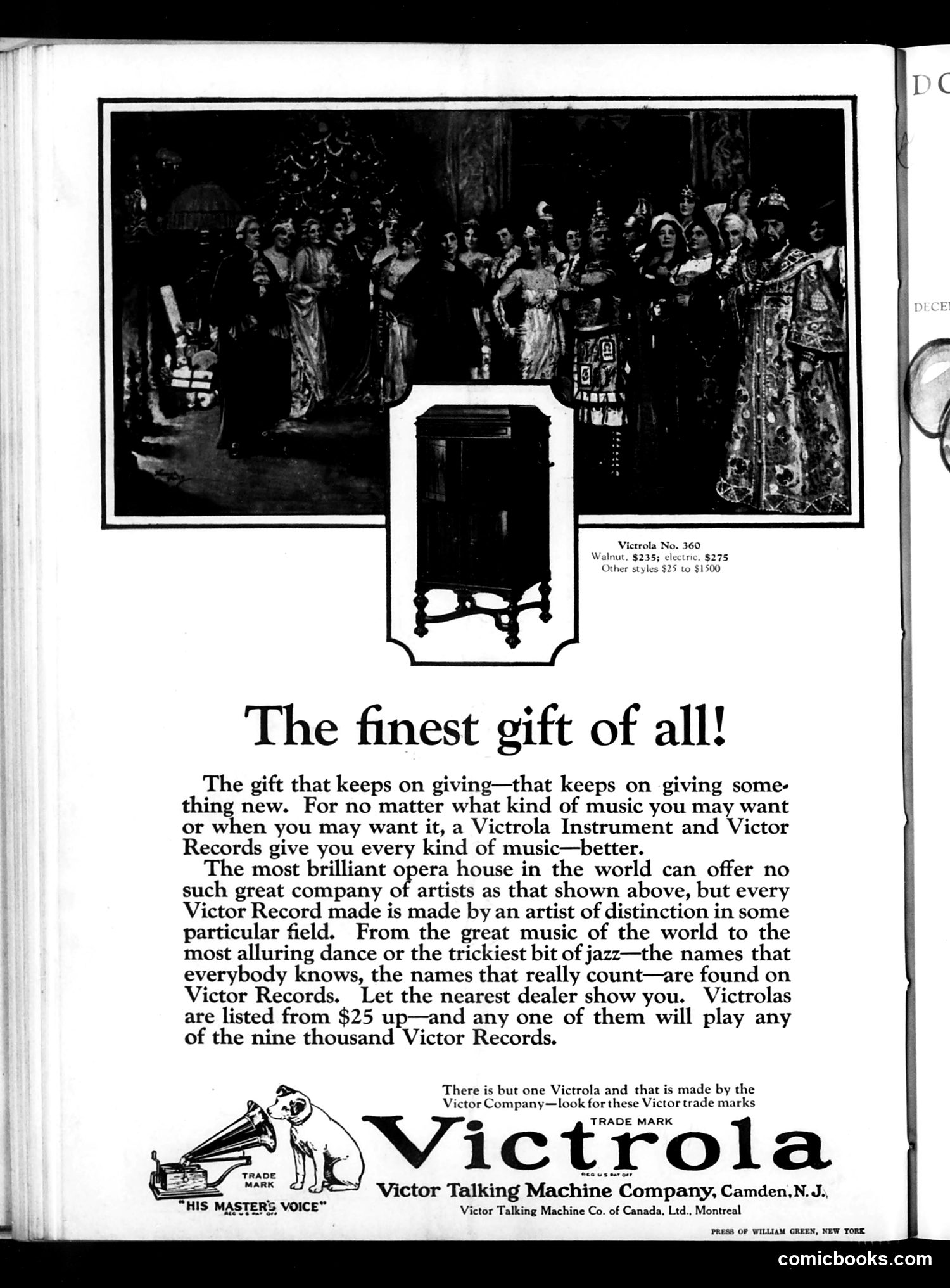
This is not a cartoon or satire—it's a **full-page advertisement** for the Victrola phonograph, placed in *Judge* magazine. The image shows an ornate phonograph cabinet (Model 360) positioned below a theatrical scene depicting an opera or formal musical performance with elaborately costumed performers and audience members in evening dress. The advertisement's central pitch is that a Victrola provides access to world-class musical entertainment at home: "The most brilliant opera house in the world can offer no such great company of artists as that shown above, but every Victor Record made is made by an artist of distinction." It emphasizes the breadth of available recordings—"nine thousand Victor Records"—spanning classical music to jazz and dance music, with famous artists' names as selling points. Prices range from $25 upward. The famous "His Master's Voice" trademark (showing a dog listening to a phonograph) appears at bottom. This represents early 20th-century mass marketing of consumer technology, targeting affluent readers by associating home music-playing with high culture and live performance.