
Judge, 1924-12-06 · page 17 of 36
Judge — December 6, 1924 — page 17: what you’re looking at
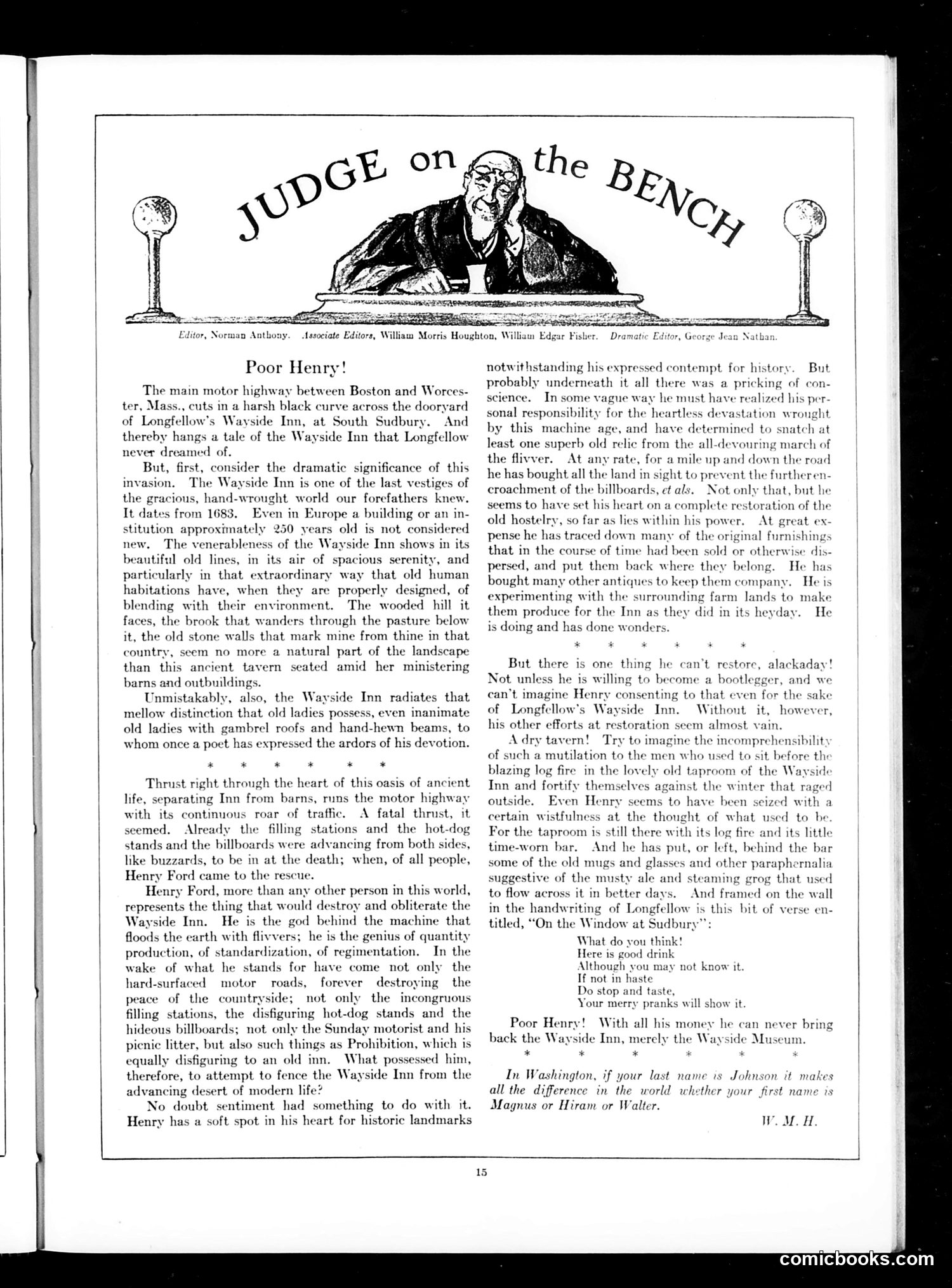
A restored page from Judge, 1924-12-06. Page through the whole issue in the reader above.
📄 Transcribed text from this page (OCR, searchable)
Machine-transcribed from the original scan — historical spelling and the odd misread are preserved.
Editor, Norman Anthony. Poor Henry! The main motor highway between Boston and Worces- ter, Mass., cuts in a harsh black curve across the dooryard of Longfellow’s Wayside Inn, at South Sudbury. And thereby hangs a tale of the Wayside Inn that Longfellow never dreamed of. But, first, cade the dramatic significance of this invasion. The Wayside Inn is one of the last vestiges of the gracious, hand- wrought world our forefathers knew. It dates from 1683. Even in Europe a building or an in- stitution approximately 250 years old is not considered new. The venerableness of the Wayside Inn shows in its beautiful old lines, in its air of spacious serenity, and particularly in that extraordinary way that old human habitations have, when they are properly designed, of blending with their environment. The wooded hill it faces, the brook that wanders through the pasture below it, the old stone walls that mark mine from thine in that seem no more a natural part of the landscape than this ancient tavern seated amid her ministering barns and outbuildings. Unmistakably, also, the Wayside Inn radiates that mellow distinction that old ladies possess, even inanimate old ladies with gambrel roofs and hand-hewn beams, to whom once a poet has expressed the ardors of his devotion. country, * * * * * * Thrust right through the heart of this oasis of ancient life, separating Inn from barns, runs the motor highway with its continuous roar of traffic. A fatal thrust, it seemed, Already the filling stations and the hot-dog stands and the billboards were advancing from both sides, like buzzards, to be in at the death; when, of all people, Henry Ford came to the rescue. Henry Ford, more than any other person in this world, represents the thing that would destroy and obliterate the Wayside Inn. He is the god behind the machine that floods the earth with flivvers; he is the genius of quantity production, of standardization, of regimentation. In the wake of what he stands for have come not only the hard-surfaced motor roads, forever destroying the peace of the ide; not only the incongruous filling stations, the disfiguring hot-dog stands and the hideous billboards; not only the Sunday motorist and his picnic litter, but also such things as Prohibition, which is equally disfiguring to an old inn. What possessed him, therefore, to attempt to fence the Wayside Inn from the advancing desert of modern life? No doubt sentiment had something to do with it. Henry has a soft spot in his heart for historic landmarks country’ Associate Editors, William Morris HSGguLGL. William Edgar Fisher. notwithstanding his expressed contempt for history. But probably underneath it all there was a pricking of con- science. In some vague way he must have realized his per- sonal responsibility for the heartless devastation wrought by this machine age, and have determined to snatch at least one superb old relic from the all-devouring march of the flivver. At any rate, for a mile up and down the road he has bought all the land in sight to prevent the furtheren- croachment of the billboards, et als. Not only that, but he seems to have set his heart on a complete restoration of the old hostelry, so far as lies within his power. At great ex- pense he has traced down many of the original furnishing that in the course of time had been sold or otherwise dis- persed, and put them back where they belong. He has bought many other antiques to keep them company. He is experimenting with the surrounding farm lands to make them produce for the Inn as they did in its heyday. He is doing and has done wonders. But there is one alackaday! Not unless he is willing to become a bootlegger, and we can’t imagine Henry consenting to that even for the sake of Longfellow’s Wayside Inn. Without it, however, his other efforts at restoration seem almost vain. A dry tavern! Try to imagine the incomprehensibilit of such a mutilation to the men who used to sit before the blazing log fire in the lovely old taproom of the Waysid: Inn and fortify themselves against the winter that raged outside. Even Henry seems to have been seized with a certain wistfulness at the thought of what used to be. For the taproom is still there with its log fire and its little time-worn bar. And he has put, or left, behind the bar some of the old mugs and glasses and other suggestive of the musty ale and steaming grog that used to flow across it in better days. And framed on the wall in the handwriting of Longfellow is this bit of vers titled, “On the Window at Sudbur. What do you think! Here is good drink Although you may not know it. If not in haste Do stop and taste, Your merry pranks will show it. Poor Henry! With all his money he can never bring back the Wayside Inn, merely the Wayside Museum. thing he can’t restore, araphernalia en- In Washington, if your last name is Johnson it mak all the difference in the world whether your first name is Magnus or Hiram or Walter. VoMH, comicbooks.com