
Judge, 1924-12-06 · page 12 of 36
Judge — December 6, 1924 — page 12: what you’re looking at
What you’re looking at
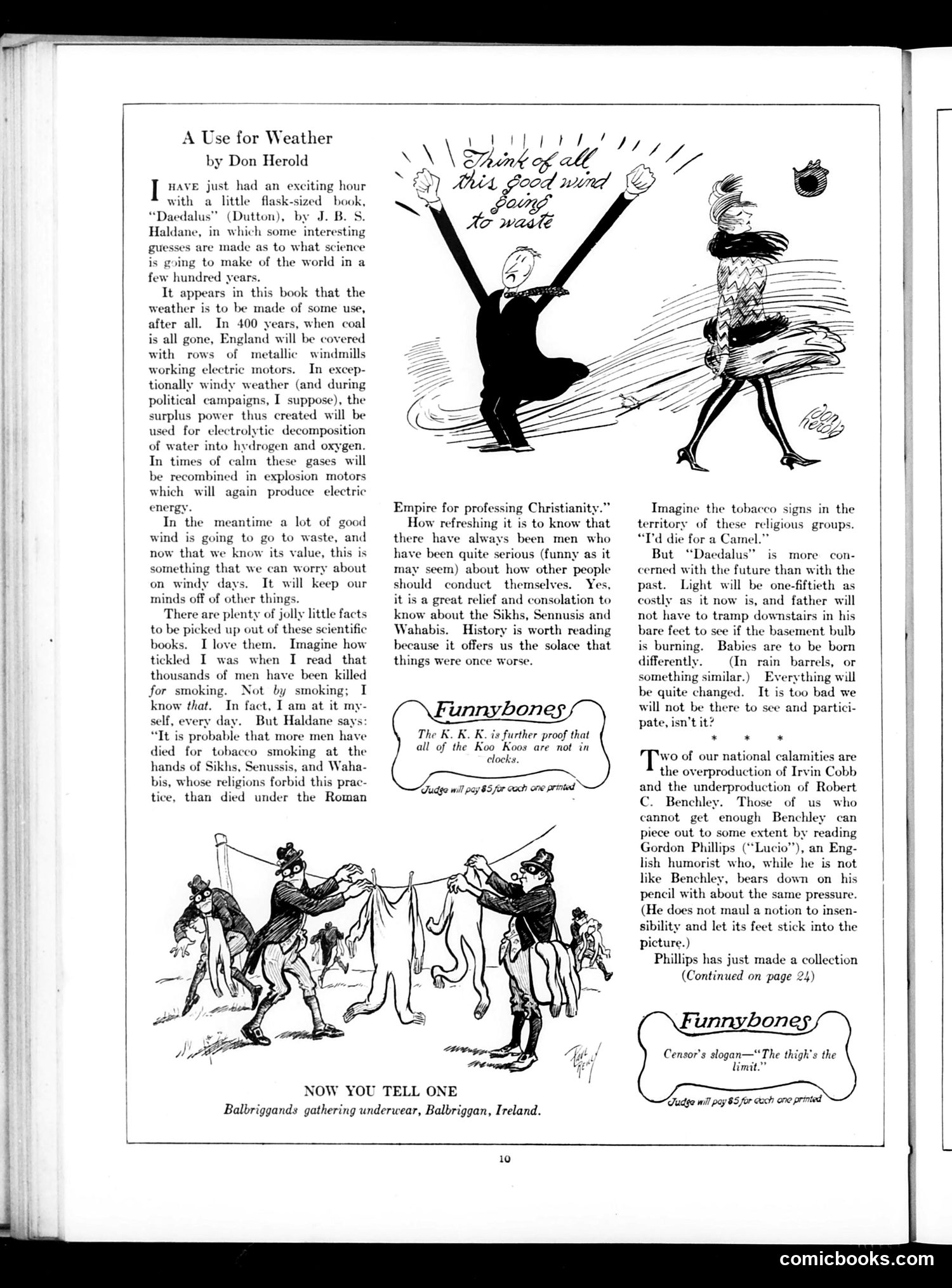
This is a humorous essay reviewing J.B.S. Haldane's futuristic book "Daedalus." Herold discusses Haldane's prediction that in 400 years, England will harness wind power via metallic windmills to generate electricity and decompose water into hydrogen and oxygen for fuel—making weather "useful" at last. The satire lies in Herold's digression about historical religious violence. He notes that more men have died for tobacco smoking at the hands of Sikhs, Senussis, and Wahhabis (whose religions forbid the practice) than died under Roman persecution of Christians. The joke: it's darkly comforting that humanity has *always* been absurdly serious about controlling others' behavior—religious intolerance isn't modern. The cartoon below shows men gathering laundry in Balbriggan, Ireland, with the caption "NOW YOU TELL ONE"—likely a joke about the town's textile industry (Balbriggan linen was famous). Two small "Funnybones" gag boxes appear, including one about the K.K.K. not being in clocks.
📄 Transcribed text from this page (OCR, searchable)
Machine-transcribed from the original scan — historical spelling and the odd misread are preserved.
for smoking. A Use for Weather by Don Herold I HAVE just had an exciting hour with a little flask-sized book, “Daedalus” (Dutton), by J. B. Haldane, in which some interesting guesses are made as to what science is going to make of the world in a few hundred years. It appears in this book that the weather is to be made of some use, after all. In 400 years, when coal is all gone, England will be covered with rows of metallic windmills working electric motors. x tionally windy weather (and during political campaigns, I suppose), the surplus power thus created will be used for electrolytic decomposition of water into hydrogen and oxygen. In times of calm these gases will be recombined in explosion motors which will again produce electric energy. In the meantime a lot of good wind is going to go to waste, and now that we know its value, this is something that we can worry about on windy days. It will keep our minds off of other things. There are plenty of jolly little facts to be picked up out of these scientific books. I love them. Imagine how tickled I was when I read that thousands of men have been killed Not by smoking; I In fact, I am at it my. day. But Haldane s: “Tt is probable that more men have died for tobacco smoking at the hands of Sikhs, Senussis, and Waha- bis, whose religions forbid this prac- tice, than died under the Roman know that. self, eve I \\\ Shakey eA Empire for professing Christianity How refreshing it is to know that there have always been men who have been quite serious (funny as it may seem) about how other people should conduct themselves. Yes, it is a great relief and consolation to know about the Sikhs, Sennusis and Wahabis. History is worth reading because it offers us the solace that things were once worse. The K. RK. 3 further proof that Koos are not in clocks. all of the Tudge wil pay 85 for cach one printed NOW YOU TELL ONE Balbriggands gathering underwear, Balbriggan, Ireland. QQ) Mia Sood nund f eo Imagine the tobacco signs in the territory of these religious groups. “T'd die for a Camel.” But “Daedalus” is more con- cerned with the future than with the past. Light will be one-fiftieth as costly as it now is, and father will not have to tramp downstairs in his bare feet to see if the basement bulb is burning. Babies are to be born differently. (In rain barrels, or something similar.) Everything will be quite changed. It is too bad we will not be there to see and partici- pate, isn’t it? + * * Tre of our national calamities are the overproduction of Irvin Cobb and the underproduction of Robert C. Benchley. Those of us who cannot get enough Benchley can piece out to some extent by reading Gordon Phillips (“Lucio”), an Eng- lish humorist who, while he is not like Benchley, bears down on his pencil with about the same pressure. (He does not maul a notion to insen- sibility and let its feet stick into the picture. Phillips has just made a collection (Continued on page 24) Funnybones Censor's slogan—“The thigh's the Limit.” Tradge mil pay 85 for cach one printed comicbooks.com